59 http://dx.doi.org/10.5935/1981-2965.20100007 Artigo Cientifico www.higieneanimal.ufc.br/
Fatty acid concentration and proximate composition of acid silage
from Nile tilapia (Oreochromis niloticus) waste, farmed in Indaiatuba –
SP
Concentración de ácidos grasos y la composición proximal del ensilado ácido de los desechos de la tilapia del Nilo (Oreochromis niloticus) de cría en Indaiatuba - SP
Ronaldo de Oliveira Sales *1, Kil Jin Park 2,Selene Maia de Morais 3
1
Universidade Federal do Ceará
2
Universidade Estadual de Campinas
3
Universidade Estadual de Ceará
______________________________________________________________ Summary: This study was conducted to determine the composition and fatty acid
profile of the Nile tilapia waste silage with the aim of investigating its nutritional potential. Four lots (5 kg each) of Nile tilapia waste was ground with 3% (w/w) formic acid, stored at 27°C room temperature for 90 days in polyethylene boxes with holes, through which gases went out and then the levels of moisture, protein, ash and total lipids were analyzed obtaining: 77.25, 16.31, 3.17 and 3.26% respectively. 22 types of fatty acids were identified in the range of 10 to 22 carbon atoms and the most abundant was oleic acid-18:1 (22:14%), followed by palmitic acid-16:0 (18.2%). Approximately 97% of fatty acids (FA) were identified in the silage, being 30.81% of saturated fatty acids (SFA), 38.42% of monounsaturated fatty acids (MUFA) and 27.32% of polyunsaturated fatty acids (PUFA) which characterize this product as an important source of essential fatty acids. All parameters indicate a good nutritional potential for acid silage of Nile tilapia, mainly in relation to fatty acids and protein content.
Key words: Fish silage, frequencies percentage, fatty acid profile, fish despesca. Resumen: Este estudio se realizo para determinar la composición y el perfil de
ácidos grasos del ensilado de despesca de la tilapia del Nilo
(Oreochromis niloticus (Linnaeus) con el fin de analizar su potencial nutricional. Cuatro lotes (5 kg cada uno) de despesca de la tilapia del Nilo se molieron con 3% (p/p) ácido fórmico, almacenados a 27ºC de temperatura ambiente durante 90 días en cubos de polietileno con un agujero, a través del cual los gases puedem salir y después se analizaron los niveles de humedad, proteína, cenizas y lipidos totales (77,25, 16,31, 3,17 y 3,26 %, respectivamente). En el ensilado se detectaron 22 tipos de ácidos grasos en el rango de 10 a 22 átomos de carbono, el más abundante fue ácido oleico-18:1 (22:14%), seguido por el ácido palmítico-16:0 (18,2%). Aproximadamente 97% de ácidos grasos (AG) fueron identificados en el ensilagem, 30,81% de ácidos grassos saturados (AGS), 38,42% de ácidos grasos monoinsaturados (AGMI) y 27,32% de ácidos grasos poliinsaturados (AGPI), ló que caracteriza este produto una fuente importante de ácidos grasos esenciales. Todos lós parâmetros indican un bueno potencial nutricional para el ensilado ácido despesca de la tilapia del Nilo, principalmente en relacione a lós ácidos grasos e contendo de proteína.
60
Palabras clave: ensilado de pescado, las frecuencias porcentuales, perfil de
ácidos grasos, despesca de peces. __________________________
Autor para correspondência. E.Mail:* [email protected] Recebido em 10.03.2010. Aceio em 20.06.2010
Introduction
The use of animal waste for the production of silage is one way to eliminate an environmental problem that is the disposal of these wastes, besides being an alternative use in animal feed. The acid silage of Nile tilapia waste from Industry filleting can be stored for some time without showing microorganisms proliferation being useful as a source of protein and essential fatty acids (6).
The Nile tilapia has been one of the first fish to be reared in
aquaculture by the ancient
Egyptians (4000 years) and in Brazil, the tilapia culture has developed from the 70’s, especially with native species, usually found in freshwater
environments from
Venezuela to Argentina (1).
The flesh of aquatic animals, especially fish, has approximately the
same protein content of
mammals and birds, but its protein content has a higher digestibility (9). The lipid content of aquatic animals commonly presents fatty acids of
important nutritional value,
especially polyunsaturated fatty acids omega-3 (PUFA n-3),
alpha-linolenic (LNA, 18:3 n-3),
eicosapentaenoic (EPA, 20:5 n-3) e docosahexaenoic (DHA, 22:6 n-3) (13).
The LNA is a
precursor of other fatty acids of omega-3 series, such as EPA and DHA, which, if ingested by fish, can be stored in their tissues with the remaining LNA. The concentrations of fatty acids
PUFAn-3 in fish
61 depend especially of the diet consumed
by fish (22).
Surveys conducted in Brazil showed that meat from captive fish fed on commercial diets with low levels
of omega-3 fatty acids had
meat with low levels of this compound in comparison to species obtained from natural sources (17). According to (22), fish fed diets containing high levels of omega-3 provide meat with higher levels of PUFA, n-3.
Considering the potential use of Nile tilapia wastes in the preparation of
feed for animal nutrition of
monogastric and poligastricos, we carried out this study with the aim of analyzing the composition and fatty acid profile of the silage of Nile tilapia
Oreochromis niloticus (Linnaeus), in order to evaluate the nutritional potential of this species.
Materials and Methods
The raw material for the production of chemical fish silage,
comprised the discard of Nile
tilapia (Oreochromis niloticus
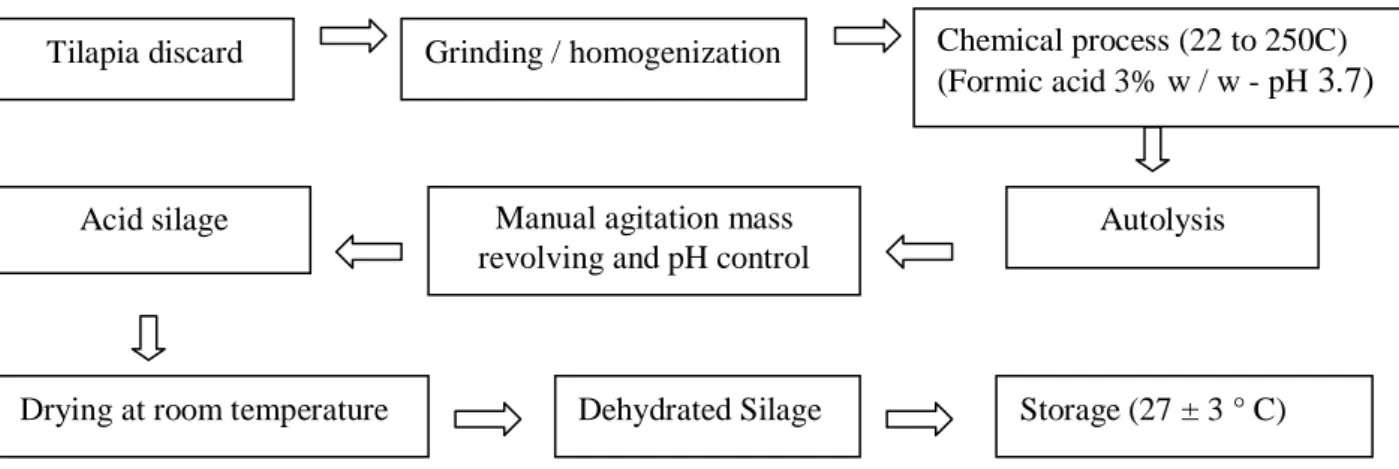
(Linnaeus) from the commercial cultivation in the region of Indaiatuba, SP fragmented into a crusher, an electrical equipment model ML-4,0 / Weg-Uline, totalizing 5 kg in each run. Then it was homogenized, weighed and evenly distributed in hard plastic containers, adding formic acid at a ratio of 3% (w/w) of volume of the acid solution for the residue mass (20). The material was often shaken to spread the enzymes, thus accelerating the rate of liquefaction (15) obtaining,
this way, the chemical silage of tilapia, in which the pH daily control was made to remain close to 4.0. Then the material was subjected to a process of decantation for (15-20 days) for separation of the parts fully and partially defatted as the silage remained at ambient (27 ± 3°C) for 72 hours, when submitted to analysis of
62 chemical composition, as shown in Figure 1.
Figure 1. Flowchart processing for preparation of Nile tilapia acid silage
Analyses were conducted to determine the composition of the chemical silage of Nile tilapia. All the tests were performed in triplicate and according to (2). Moisture was determined by gravimetric method, in a greenhouse maintained at 105°C to constant weight. The protein was determined by the micro-Kjeldahl method with digestion in a digester block and then distillation in the attached still and titration with 0.02N sulfuric acid. The lipid fraction was obtained by Soxhlet extraction. It was used petroleum ether as solvent,
followed by heating in an oven until total evaporation of the solvent. The ash content was measured gravimetrically in the oven at 550° C and incineration of organic matter in a Bunsen burner. Fatty acids underwent saponification and esterification to obtain the methyl esters (12). In animals of the same batch with the same specifications described
above, the waste was
crushed and stored on refrigeration for later determination of total lipids. All tests were performed in triplicate and results presented as means with their standard deviations.
Chemical process (22 to 250C) (Formic acid 3% w / w - pH 3.7)
Grinding / homogenization Tilapia discard
Autolysis Manual agitation mass
revolving and pH control Acid silage
Dehydrated Silage Storage (27 ± 3 ° C) Drying at room temperature
63 The total lipid (TL) were
subjected to the processes of methylation, as ISO method (1978). The methyl esters of fatty acids were
separated by Shimadzu gas
chromatograph equipped with fused silica capillary column (100 m, 0.25 mm id and 0.20 mm CP-Sil 88) and flame ionization detector. The flow was 1.2 mL min-1 for the carrier gas H2, 30 mL min-1 for the auxiliary gas (make-up) N2, and 30 and 300 mL min-1 for the flame gas H2 and synthetic air, respectively.
The ratio of division (split) of the sample was 1/100. The column operated under the following conditions: injector and detector, respectively, at 220 and 245°C and temperature program of 180 ° C for 5 minutes, raising the temperature to 240 º C at a rate of 5 °C min-1. The injected volume was 1mL for
each sample with three
replicates. The peak areas were
determined by the method of
standardization, using an integrator-processor CG-300 (GC Scientific Instruments). The identification
was made by comparing the retention times of fatty acid methyl esters standards from Sigma (USA).
The data were analyzed according to completely randomized design (3). For the analysis of variance and means comparison, we used the Tukey test at 5% probability.
Results
There was no significant difference (P> 0.05) in proximate composition between the analyzed batches of Nile tilapia used for preparation of acid silage of fish, with average value 76.62%, 17.7%, 3.57% and 2 33% for moisture, protein, fat and ash, respectively (Table 1). These data are consistent with those reported by (21) which analyzed the composition of hybrid tilapia Tilapia nilotica with hornorum, and found out that the moisture was presented into the range of
64 74.32% to 75.63%, protein from 17.52
to 17.62% ash, 1.73 to 2.32% and lipids 3.75 to 7.48%. The largest coefficient of variation (CV%) occurred
in the levels of ash with 26.29%, and then to a lesser extent by lipids, with 9.20% protein, with 2.24% and finally
moisture, with 1, 30%.
Table 1. Proximal composition of acid silage of Nile tilapia (Oreochromis niloticus) (Linnaeus), (complete fish with visceras, skin, and scales) from Indaiatuba,
São Paulo,
Amostra Umidade % Proteína % Lipídios % Cinzas %
Lote l 77.24a 0.11 16.30 a 0.07 3.28a 0.50 3.19 a 0.01 Lote 2 77.25a 0.24 16.3l a 0.21 3.27a 0.36 3.18 a 0.01 Lote 3 77.26a 0.29 16.32 a 0.05 3.26a 0.05 3.17 a 0.08 Lote 4 77.27a 0.52 16.31 a 0.12 3.25a 0.69 3.16 a 0.09 F 0.00NS 0.01NS 0.00NS 0.14NS CV (%) 0.42 0.79 14.19 1.91 DMS 0.8515 0.3356 1.2111 0.1585 Média 77.25 16.31 3.26 3.17
Medium values and standard deviation of data from three determinations. Mean values in the same column showing same letters do not present significant differences, by Tukey test at P <0.05
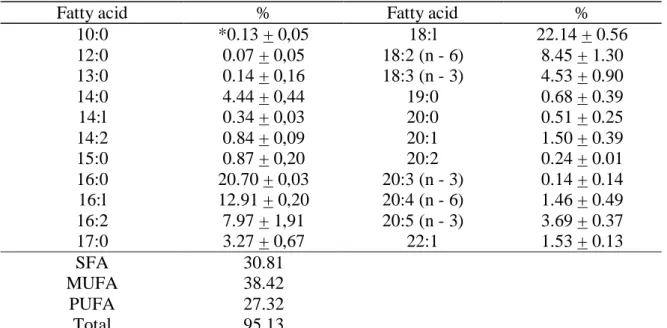
Table 2 shows the fatty acid composition of oil extracted from the
acid silage of Nile tilapia, stored at room temperature.
Tabela 2. Fatty acid percent composition of Nile tilapia acid silage
Fatty acid % Fatty acid %
10:0 *0.13 + 0,05 18:l 22.14 + 0.56 12:0 0.07 + 0,05 18:2 (n - 6) 8.45 + 1.30 13:0 0.14 + 0,16 18:3 (n - 3) 4.53 + 0.90 14:0 4.44 + 0,44 19:0 0.68 + 0.39 14:l 0.34 + 0,03 20:0 0.51 + 0.25 14:2 0.84 + 0,09 20:1 1.50 + 0.39 15:0 0.87 + 0,20 20:2 0.24 + 0.01 16:0 20.70 + 0,03 20:3 (n - 3) 0.14 + 0.14 16:l 12.91 + 0,20 20:4 (n - 6) 1.46 + 0.49 16:2 7.97 + 1,91 20:5 (n - 3) 3.69 + 0.37 17:0 3.27 + 0,67 22:1 1.53 + 0.13 SFA 30.81 MUFA 38.42 PUFA 27.32 Total 95.13
65 Approximately 97% of the fatty acids
(FAs) in silage was identified, corresponding to 22 different FAs, range from 10 to 22 carbons, being 12 of these fatty acids found at concentrations below 1%. Oleic acid (18:1) (22.14%) was the FA found in greater quantity, followed by palmitic acid (16:0) (20.70%), and palmitoleic acid (16:1) (12.91%). The relative percent concentration of essential fatty acids was 18.27%, being 9.91% of n-6 and 8.36% of n-3.
Discussion
Analyzing the proximate
composition of different species of Nile tilapia waste silage, similar results were obtained by (20), which observed no difference (P> 0.05) among the samples analyzed. The more pronounced variation was in ash content (0.7 to 4.2 %), being the lowest in moisture and protein, in which almost all species have similar values and the tilapia can
be classified as a lean fish (3.25 to 6.26 %) of high protein content. According to (9), the composition of Nile tilapia varies from one species to another and even within the same species, depending upon the season, type of food, degree of maturation and sex. It may also vary in the same fish, depending on the analyzed part.
Thus, the amount of 3% formic acid at 98% compared to the weight of ground fish, usually recommended in the literature (21), was judged satisfactory, not changing the proximate composition data, being kept constant throughout the storage period of 90 days at a temperature of 27 ± 3 °C. (11) working with fish waste, recommends a mixture of formic acid and propionic acid in a 1:1 ratio and addition of 5 to 3.0% (v/w) on the mass in order to obtain silage which is stable and free of pathogenic microorganisms.
66 The proportion of total lipid
(TL) in acid silage of Nile tilapia in this study (3.26%) was lower than those obtained in several species of silage
from head and viscera,
skeleton (including heads) and only heads of herring reported by (11), (10), (19) and (5) on the proportions of 9,1%, 3,7% 4,0% e 4,8%, respectively. Explain that differences occur because the lipid content varies from one species to another and within the same species depending upon the time of the year, feeding, sexual maturation and animal sex, and lower levels in younger animals (20). In this study the LT yield was analyzed separately, in viscera and the result was in accordance with the results of (4) working with viscera of different fishes, with addition of a mixture of HCl and HCOOH, obtained 4.8% total lipids.
About the fatty acid profile, oleic acid (18:1) was the FA found in greater quantity in the acid silage of Nile
tilapia, corroborating with the results reported in the literature (15). Another studies of (11), evaluating the fatty acid profile of Nile tilapia silage, found a predominance of unsaturated fatty acids, so that the oleic (C18:1) appeared in greater quantity (28.60 g/100 oil), also noting, traces of eicosapentaenoic
acid (EPA – C20:5) and
docosahexaenoic acid (DHA - C22:6). Studing the acid silage, stored for 60 days, produced from different raw materials, obtained values of 1.1 g/100g of oil to EPA and 1.1 g/100 g of oil for DHA, approaching another use of fish silage in diets for aquaculture (10). Characterized the lipid fraction of waste tilapia silage, saying that the oil obtained from process of silage is a source of, high-quality, low-cost unsaturated fat but the fatty acid profile tends to vary according to the raw material used in the preparation of silage (17).
67
Made the characterization of the oils present in acid and fermented silages produced from Tilapia filleting residue (22). With respect to saturation degree of fatty acids, the following
proportion was observed for
polyunsaturated, monounsaturated and
saturated fatty acids
(PUFA:MUFA:SFA): 0.35:1.0:0.86 and 0.42:1.0:1.0, for acid and fermented silage respectively. The acid condition was obtained with a mixture of formic acid (1%) and sulfuric acid (1%). In the present study, Nile tilapia waste silage showed the ratio PUFA:MUFA:SFA of 1:1.41:1.23, and the ratio n-6/n-3 fatty acids was 1.2. The amount of polyunsaturated fatty acids was greater then cited results, probably because the silage obtained in milder acid condition (3% formic acid) conducted the oxidation to a lesser extent, preserving more the essential fatty acids.
Diets where the ratio PUFA/SFA is higher to 0.45 (7) and the ratio
n-6/n-3 is lower than 4 (8) are considered healthy for human being in a nutritional point of view. The ratios PUFA/SFA and n-6/n-3 observed for Nile tilapia waste silage prepared with 3% formic acid are satisfactory and indicate desirable lipid content.
Conclusions
The results of this work corroborate previous reports showing the nutitional usefulness of fish waste
silages, and demonstrate the
possibility of the use of 3% formic acid silage from the discard of Nile tilapia (Oreochromis niloticus, L.) as a rich source of protein and essential fatty acids, as a partial substitute of fishmeal or as a ingredient in balanced rations for animal feed.
References
ACCARIN, A. E.; CAMARGO, A. F. M. Characterization and evaluation of the impact of feed management on the effluents of Nile tilapia (Oreochromis
68
of Biology and Technology, v.48,
n. 4, p.81-90, 2005.
AOAC. Association of Official
Analytical Chemists. HORWITZ,
W. (Ed). Official Methods of
Analysis. 17.ed. Arlington, Virginia,
USA, 2000. v. 1 and v. 2.
BARBOSA, J. C.; MALDONADO JR. W.; AgroEstat - System for Statistical Analysis of Agronomic Trials, Version 1.0, 2010.
BEERLI, E. L. et al. Acid Silage of trout (Oncorhynchus mykiss), using
muriatic acid. Agrotechnology
and Science, v.28, n.1, p. 195-198,
2004.
BORGHESI, R. et al. The fish silage in feed for aquatic organisms. CEPPA
Bulletin, Curitiba, v. 25, n.2, p.
329-339 July / December 2007.
BOSCOLO, W. R.; DOS SANTOS, A. M.; MARTINS, C. V. B.; FEIDEN, A.; BITTENCOURT, F.; SIGNO, A. A.
Avaliação microbiológica e
bromatológica da silagem ácida obtida
de resíduos da indústria de filetagem de tilápia do Nilo (Oreochromis niloticus).
Ciências Agrárias, v. 31, n. 2, p.
515-522, 2010.
DEPARTMENT OF HEALTH AND SOCIAL SECURITY - DHSS. Diet and cardiovascular disease.London: HMSO, 1984 (Report on Health and Social Subjects, 28).
DEPARTMENT OF HEALTH - DH. Nutritional aspects of cardiovascular disease. London: HMSO,1994. 178p (Report on Health and Social Subjects, 46).
ESPE, M.; LIED, E. Fish silage prepared from different cooked and uncooked raw materials: Chemical changes During storage at different temperatures. Journal of Science Food and Agriculture, v. 79, No 2,
p. 327-332, 1999.
ESPIDOLA FILHO, A. Utilization of
solid residue of fish, shrimp and bivalves as a feed ingredient for
69
1999. 224f. Thesis (Ph.D. in
Environmental
Sanitation). (Mackenzie University).
FERRAZ DE ARRUDA,
L. Utilization of waste improvement
of Nile tilapia (Oreochromis niloticus) to obtain silage and oil byproducts. Piracicaba, 2004. 78 f. Thesis (Master of Science and Food
Technology), Department of
Agribusiness, Food and Nutrition, University of São Paulo.
HARTMAN, L.; LAGO, R. C. A. Rapid Preparation of fatty acid methyl esters from lipids. Laboratory
Practice, v. 22, n. 4, p. 475-476, 1973.
INTERNATIONAL
ORGANIZATION FOR
STANDARDIZATION - ISO.
Method ISO 5509. Geneve: ISO,
1978. 6p.
KIMURA, Y.; TAKAKU, T.;
NAKAJIMA, S. et al. Effects of carp and tuna oils on
5-fluorouracil-induced antitumor activity and side effects in sarcoma 180-bearing mice.
Lipids, v.36, n.4, p.353-359, 2001.
LEGENDRE, M.; KERDCHUEN, N. Larval rearing of an African Catfish (Heterobranchus longifilis Teleostei,
Claridae): effect of dietary lipids on
growth survival and fatty acid composition of fry. Aquatic Living
Resources, v.8, n.3, p.355-363, 1995.
MACH DIEP, T. N.; NORTVEDT, R. Chemical and nutritional quality of silage made from raw or cooked lizard fish (Saurida undosquamis) and blue crab (Portunus pelagicus). Journal of
the Science of Food and Agriculture,
v. 89, n. 15, p. 2519-2526, 2009.
MAIA, W. et al. Characterization of lipid fraction of silage waste of tilapia for use in feed for aquaculture. In:
BRAZILIAN SYMPOSIUM ON
AQUACULTURE, 10., Recife,
1998. Anais ... Recife: Persona, 1998, v. 2, p.55-64.
70 MOREIRA, A. B.; VISENTAINER, J.
V.; SOUZA, N. E. et al. Fatty acids profile and cholesterol contents of three Brazilian brycon freshwater fishes. Journal of Food Composition
and Analysis, v.14, p.565-74, 2001.
OLIVEIRA RODRIGUES, A. C. et al. Effect of inclusion of acid silage of fish waste on the digestibility of sheep
diets. Journal of Animal
Nutrition, v.1, n. 2, p. 28-33, 2007.
SALES, R. O. Chemical processing,
and nutritional evaluation of harvest silage of Nile tilapia (Oreochromis niloticus) in rats with experimental diets, Campinas, 1995. 174p. (Doctorate in
Food Engineering) (University of Campinas).
SEIBEL, N. F.; SOUZA-SOARES, L. A. Production of chemical silage with marine fish waste. Brazilian Journal
of Food Technology, v.6, n.2, p.
333-337, 2003.
VIDOTTI, R. M.; PACHECO, M. T.
B.; GONÇALVES, G. S.
Characterization of the oils present in acid and fermented silages produced from Tilapia filleting residue. Revista Brasileira de Zootecnia, v.40, n.2, p.240-244, 2011
VISENTAINER, J. V. Composição de
ácidos graxos e quantificação dos ácidos LNA, EPA e DHA no tecido muscular de tilápias (Oreochromis niloticus), submetidas a diferentes tratametos com óleo de linhaça.
Campinas: Universidade Estadual de Campinas, 2003. 184p. Tese (Doutorado
em Ciência de Alimentos) -
Universidade Estadual de Campinas, 2003.