https://doi.org/10.6018/analesps.368621 Online edition License Creative Commons 4.0: BY-SA
Perception of organizational politics, psychological safety climate, and work engagement:
A cross-level analysis using hierarchical linear modeling
Renata Silva de Carvalho Chinelato1*, Susana Maria de Oliveira e Mota Tavares2, Maria Cristina Ferreira3, and Felipe Valentini4
1 Universidade Federal de Santa Catarina (Brasil). 2 Instituto Universitário de Lisboa (ISCTE-IUL) (Portugal).
3 Universidade Salgado de Oliveira (Brasisl). 4 Universidade São Francisco (Brasil).
Título: Percepción de las políticas organizacionales, clima de seguridad psicológica y compromiso con el trabajo: Un análisis cruzado usando mo-delos jerárquicos lineales.
Resumen: El propósito de esta investigación fue probar empíricamente la hipótesis de que el clima de seguridad psicológica de la organización y la percepción de las políticas de la organización predicen hasta qué punto los empleados se sienten comprometidos con su trabajo. El uso de modelos je-rárquicos lineales y los datos recopilados de 1,244 empleados en 64 organi-zaciones mostraron que el clima de seguridad psicológica a nivel organizati-vo y la percepción de la política organizacional a nivel de los empleados predijo el compromiso con el trabajo de los empleados. También hubo una inesperada interacción significativa entre los niveles, de modo que el efecto negativo de la percepción de las políticas organizacionales se amplificó en organizaciones con un clima de seguridad psicológica positivo. En otras palabras, la seguridad psicológica organizacional beneficia más el compro-miso de los individuos cuando ellos perciben la existencia de políticas or-ganizacionales bajas. Los resultados ofrecen información sobre los meca-nismos por los cuales el contexto organizativo percibido puede influir en el compromiso laboral de los empleados y resaltar la importancia de la cohe-rencia organizativa percibida en la promoción del compromiso laboral dentro de su organización.
Palabras clave: Políticas organizacionales; Compromiso de los emplea-dos; Clima organizacional; Análisis multinivel.
Abstract: The purpose of this research was to empirically test the hypot-hesis that the organizational psychological safety climate and the percep-tion of organizapercep-tional politics predict the extent to which employees feel engaged in their work. Using hierarchical linear modeling and data collec-ted from 1,244 employees in 64 organizations, organizational level psycho-logical safety climate and employee-level perception of organizational poli-tics predicted employee work engagement. There was also an unexpected significant cross-level interaction, so that the negative effect of the percep-tion of organizapercep-tional politics was amplified in organizapercep-tions with a positi-ve psychological safety climate. In other words, organizational psychologi-cal safety benefits the work engagement of individuals more when they perceive the existence of low organizational politics. The results offer in-sight into the mechanisms by which the perceived organizational context may influence employees‟ work engagement and highlight the importance for the perceived organizational consistency in the promotion of work en-gagement within their organization.
Keywords: Organizational politics; Employee engagement; Organizational climate; Multilevel analysis.
Introducción
Work engagement is a construct in the field of positive orga-nizational psychology and has increasingly attracted the at-tention of researchers in the area (Bakker & Albrecht, 2018; Knight, Petterson, & Dawson, 2019). Studies have demons-trated that more engaged individuals have higher levels of wellbeing (Bakker & Oerlemans, 2011), revealing better health (Seppälä et al., 2012), greater positive emotions expe-rience (Bakker, Demerouti, & Sanz-Vergel, 2014) and greater opening to new experiences (Fredrickson, 2001).
Work engagement also entails consequences for the or-ganization. Research evidences that engaged individuals are more productive and perform better (Bakker & Bal, 2010; Halbesleben & Wheeler, 2008; Salanova, Agut, & Peiró, 2005), as well have more creative ideas and are more likely to innovate (Gawke, Gorgievski, & Bakker, 2017; Orth & Vol-mer, 2017). This enhances the organizational performance * Correspondence address [Dirección para correspondencia]: Renata Silva de Carvalho Chinelato. Rua Salvatina Feliciana dos Santos 391/704 b, Itacorubi. Florianópolis / Santa Catarina. zip code 88034600 (Brasil). E-mail: [email protected]
(Article received: 14-3-2019; revised: 8-9-2019; accepted: 6-11-2019)
thus producing higher financial returns (Albrecht, Bakker, Gruman, Macey, & Saks, 2015; Schneider, Yost, Kropp, Kind, & Lam, 2017; Xanthopoulou, Bakker, Demerouti, & Schaufeli, 2009), greater client satisfaction/loyalty (Harter, Schmidt, & Hayes, 2002; Salanova et al., 2005), besides low rates of absenteeism and turnover (Harter et al., 2002; Schaufeli, & Bakker, 2004). On accounting of these conse-quences, managers and researchers have worked to deepen the study of the factors that can condition the development of individuals‟ greater engagement in their work (Bakker et al., 2014).
The predictors of work engagement have been frequently classified as situational (job demands and resources) and in-dividual (personal resources) (Bakker et al., 2014). Concer-ning job resources, different studies indicate that resources like career and development opportunities (Crawford, LePi-ne, & Rich, 2010) and leadership and autonomy (Christian, Garza, & Slaughter, 2011), for example, are positive predic-tors of work engagement.
Researchers have also taken interest in the nature of the organizational resources that affect the engagement (Kahn, 1990; Albrecht et al., 2015; Albrecht, Breidhal, & Marty, 2018; Idris, Dollard, & Tuckey, 2015). One of these
resour-ces is the psychological safety climate, which has been asso-ciated to positive outcomes at work, such as voice behaviors, learning and creativity at work and team performance (De-tert & Burris, 2007; Edmonson, 1999; Kark & Carmeli, 2009). However, this phenomenon received relatively little attention in the literature despite its consequences (May, Gilson, & Harter, 2004), specially in its relationship with work engagement (e.g., Kark & Carmeli, 2009; Kirk-Brown & Van Dijk, 2011).
Turning to job demands, studies have shown that they have positive and negative relations with engagement. Work overload (Xanthopoulou, Bakker, Demerouti, & Schaufeli, 2007a), time pressure (Schaufeli, Taris, & van Rhenen, 2008) and the levels of responsibility at work (Crawford et al., 2010) have shown positive relations with this phenomenon. On the other hand, perception of organizational politics (Crawford et al., 2010), role conflict and bias, as well as the clients‟ emotional demands (Hakanen & Roodt, 2010) cons-titute negative predictors of work engagement.
Perceptions of organizational politics represent a strong reality in the work environment (Cropanzano, Howes, Grandey, & Toth, 1997) and pose a potential threat to the organization’s efficiency and general efficacy (Kacmar, Boze-man, Carlson, & Anthony, 1999). Individuals who perceive the existence of organizational politics experience negative outcomes, such as low satisfaction levels and work commit-ment and higher stress levels (Atinc, Darrat, Fuller, & Par-ker, 2010; Bedi & Schat, 2013; Vigoda-Gadot & Talmud, 2010). Despite its importance in the organizational context, perception of organizational politics has not so far been suf-ficiently explored in terms of its consequences (Kacmar et al., 1999), specially concerning its association with engage-ment (e.g., Kane-Frieder, Hochwarter, & Ferris, 2014a; Lan-dells & Albrecht, 2019).
Thus, it is observed that both the perception of organiza-tional politics and the psychological safety climate reflect important aspects of the work environment. Research on their effects on work outcomes, specially on workers’ en-gagement, is still scarce and has predominantly been execu-ted independently. In addition, research aimed at jointly in-vestigating the effects of individual and organizational varia-bles for work engagement remains scarce (Schaufeli & Taris, 2014). Therefore, one of the objectives of this study was to investigate the conjoint effects of the psychological safety climate and the perception of organizational politics on wor-kers' engagement.
If the stress caused by organizational politics perceptions is strong enough, it may diminish the motivational state that characterizes work engagement. Thus, we need to obtain a deeper understanding not only of employees’ negative respon-se to organizational politics perceptions, materializing in re-duced engagement, but also of how this harmful effect could be buffered.
According to the Job Demands–Resources (JD-R) theory, adverse work conditions have a negative impact on work behaviors, but relevant resources can attenuate this
process (Bakker & Demerouti, 2018). When employees be-lieve that decision making in their organization is mainly po-litical, they usually become anxious (Ferris & Kacmar, 1992), a condition that can drain their energy and cause a diminish-ment of their engagediminish-ment at work. However, this negative re-lationship between organizational politics perceptions and work engagement might be less pronounced when emplo-yees feel that their organization is a safe place where to ex-press their feelings without fear of negative consequences (Edmondson, 2003), and, therefore, they feel more energized to accomplish their tasks. Consequently, another objective of the study was to investigate the moderating role of the psychological safety climate in the relationship between per-ceptions of organizational politics and workers' engagement. This responds to the demand for applying contingency ap-proaches to study organizational politics perceptions outco-mes (Chang, Rosen, Siemieniec, & Johnson, 2012; Lee & Peccei, 2011).
The study contributes to the literature on work engage-ment in different ways. First, in order to understand the ante-cedents of the construct, we sought to integrate an individual predictor (perception of organizational politics) and an orga-nizational predictor (psychological safety climate). Second, when investigating the effects of the interaction between or-ganizational politics perceptions and the psychological safety climate at the secondary level, an additional perspective was offered on the prediction of work engagement at the indivi-dual level. Thus, the impact of the psychological safety cli-mate on engagement was tested through a cross-level focus, and showed that the organizational context can interfere in the expression of individual differences, thus offering an im-portant evidence on the value of a cross-level approach to understand work engagement. The theory underlying work engagement (JD-R) deals essentially with an individual ap-proach but has also been applied at higher aggregation levels (Bakker & Demerouti, 2017; Schaufeli & Taris, 2014). Thus, the study adds to the emerging interest in cross-level in-fluences on organizational behavior, providing further evi-dence on the need to consolidate this approach. Third, the study also intended to extend the empirical findings on en-gagement in Brazilian samples; these findings are still inci-pient (see, for example, Siqueira, Martins, Orengo, & Souza, 2014), and should certainly allow the acquisition of further knowledge on positive attitudes and outcomes in the job framework and the future development of organizational practices, which can be useful for Brazilian organizational managers.
Work engagement and psychological safety climate
Work engagement is a work-related positive and fulfilling mental state, characterized by vigor, dedication and ab-sorption (Bakker, Schaufeli, Leiter, & Taris, 2008; Schaufeli, Salanova, González-Roma, & Bakker, 2002). Vigor refers to high levels of energy and mental resiliency while at work, the desire to make efforts on the job and to persist, even when
facing difficulties. Dedication is a sense of meaning, enthusi-asm, inspiration, pride and challenge. Therefore, it goes be-yond the concept of work involvement, comprising cognitive and affective dimensions. Absorption is related to the indivi-dual’s complete concentration on work, which makes time go by quickly without the individual noticing it, and which makes him/her avoid disconnecting from what he/she is do-ing (Schaufeli et al., 2002).
The JD-R theory has served as the main reference model for research on work engagement. Initially developed by Demerouti, Bakker, Nachreiner and Schaufeli (2001), it has gone through a lot of refinements (Bakker & Demerouti, 2007; 2014; 2017; 2018; Schaufeli & Taris, 2014). The theory focuses on the processes through which the job demands and resources influence the development of work engage-ment.
According to this theory, all job characteristics can be classified into two broad categories: job demands and job re-sources (Bakker & Demerouti, 2017; Demerouti et al., 2001; Schaufeli & Bakker, 2004). Job demands are the physical, psychological, and social/organizational aspects of the job that require physical or mental effort. They are thus associa-ted with an energy resources depletion process which, in the longer run, may give rise to job strain and health complaints. Job resources, on the other hand, are the physical, psycholo-gical, and social/organizational aspects of the job that fulfill basic human needs, stimulating personal growth and accom-plishment. They are thus associated to a motivational process that gives rise to work engagement.
Job demands and job resources are therefore responsible for two substantially independent processes. While job de-mands engender a health impairment process leading to ne-gative outcomes such as burnout, job resources promote a motivational process leading to positive outcomes such as work engagement (Bakker & Demerouti, 2014). In other words, job demands have detrimental effects on employee’s health and well-being, whereas job resources have beneficial effects. In this sense, job resources are the most important predictors of engagement at work (Bakker & Demerouti, 2017).
The psychological safety climate is considered to be an organizational resource because it refers to the individual’s belief that he is capable of showing and expressing himself without fear of negative consequences in the company (Kahn, 1990). Individuals feel safe when they perceive that expressing themselves sincerely in the work environment will not cause retaliations.
According to McCaughey (2010), the construction of the safety climate is a psychological interpretation of an emplo-yee’s perception of his workplace in terms of work safety. Thus, the safety climate reflects the relationship between the employees’ perception and the work environment and serves as an antecedent for the worker’s subsequent affective states, behavior in the workplace and organizational and individual outcomes.
Some studies suggest that the psychological safety
clima-te can exist at the individual level (Ashford, Rothbard, Pide-rit, & Dutton, 1998; Detert & Burris, 2007) and at the group level (Edmondson, 1999). Hence, organizational climates ha-ve also been proposed as collectiha-ve phenomena, although they are based on individual perceptions (Kuenzi & Schmin-ke, 2009). In this way, psychological safety can be approached as an individual, as a team and as an organizational pheno-menon (Edmondson & Lei, 2014).
Research results have shown that psychological safety contributes to performance in terms of creativity and lear-ning (Edmondson, 1999; Kark & Carmeli, 2009; Kessel, Kratzer, & Schultz, 2012) and to voice behaviors (Detert & Burris, 2007). A positive safety climate, in which the emplo-yees perceive that safety is a priority and that the managers make efforts in this field, can also increase the organizational workers’ feelings of commitment and satisfaction, thus in-fluencing the individual’s behavior (Morrow & Crum, 1998). Recently, the psychological safety climate was also positively associated with job crafting behaviors (Plomp, Tims, Kha-pova, Jansen, & Bakker, 2019).
Kahn (1990) argues that certain psychological conditions, such as safety, lead to the employees' engagement. Thus, in-dividuals demonstrate greater engagement when they feel psychologically safe and can act without fear of negative consequences for their self- image, career or status (Kahn, 1990). In line with these arguments, Kark and Carmeli (2009), in one of the only studies to date about those rela-tionships, observed that the psychological safety climate was positively associated to vitality, which is conceptually similar to work engagement, while Kirk-Brown and Van Dijk (2011) found that the psychological safety climate was positively as-sociated to work engagement. More recently, Lee and Ok (2015) observed that when employees believe that their or-ganization provides a reliable and predictable working envi-ronment where their performance and conduct do not create risk to the intergroup dynamics, they are more likely to be-come engaged. Therefore, the following research hypothesis was raised:
H1: Organizations with a higher psychological safety cli-mate will have employees who report higher levels of work engagement than organizations with a lower psychological safety climate.
Work engagement and perception of organizational politics
Since its initial proposition, the JD-R theory has gone through expansions, leading to many studies. One of these refinements is the classification of the demands into obsta-cles and challenges. The latter refer to aspects of the job con-text that, although stressful, contribute to the individual’s personal growth and obtainment of future gains. The obsta-cle or hindering demands, in turn, refer to stressful aspects of the work environment that tend to impede personal growth, learning and the accomplishment of objectives (Crawford et al., 2010). Challenge demands are the most
im-portant predictors of work engagement, while obstacle de-mands are the most important predictors of burnout (Craw-ford et al., 2010).
The perception of organizational politics in the organiza-tion can be considered a hindering demand because it de-mands physical and/or psychological efforts by the emplo-yees, resulting in negative attitudes and behaviors and beha-vioral consequences for psychological health (Bedi & Schat, 2013). This phenomenon refers to behaviors the organizati-on does not endorse, and which entail negative corganizati-onsequen- consequen-ces for the organizations and their members. It is characteri-zed by subjective perceptions of the extent to which the work environment features self-servicing to various indivi-duals and groups, to the detriment or at the cost of other in-dividuals or groups (Ferris, Russ, & Fandt, 1989), without taking into account the well-being of the stakeholders (Ka-cmar & Baron, 1999). Work environments perceived as being dominated by organizational politics are characterized by a high degree of bias and uncertainty, competition over limited resources, allocation of rewards based on non-objective criteria and self-promotion behaviors (Ferris et al., 1989; Kacmar et al., 1999).
Hence, the perceived political games in organizations re-fer to the individual’s personal assessment based on what he/she experiences in the work environment. Although these perceptions may not reflect the objective reality, they can in-fluence the individuals‟ cognitive, emotional and behavioral reactions in his/her work organizations (Ferris et al., 1989).
The perceived political games have been associated with negative outcomes in the job context, revealing their dysfun-ctional role (Ferris & Judge, 1991; Kacmar & Baron, 1999). Meta-analytic evidences (Chang, Rosen, & Levy, 2009; LePi-ne, Podsakoff, & LePiLePi-ne, 2005) indicate that the perceived existence of frequent political behaviors in the organization is a factor that induces stress. Individuals who perceive higher levels of organizational politics can feel less sure about their position at work and their well-being may be compromised, causing them to experience high levels of psychological tension (Chang et al., 2009; Cropanzano et al., 1997).
Research findings have shown positive associations bet-ween organizational politics and burnout, stress at work (Kacmar et al., 1999) and intended turnover (Chang et al., 2009; Miller, Rutherford, & Kolodinsky, 2008). On the other hand, negative associations have been found between the perception of organizational politics and organizational ci-tizenship behaviors (Chang et al., 2009; Chang et al., 2012), organizational commitment (Maslyn & Fedor, 1998; Nye & Witt, 1993; Witt, 1998; Vigoda, 2000; Vigoda-Gadot, Vinars-ki-Peretz & Ben-Zion, 2003), job satisfaction (Abbas, Raja, Darr, & Bouckenooghe, 2014; Chang et al., 2009; Ferris, Frink, Galang, Zhou, Kacmar, & Howard, 1996; Zhou & Fe-rris, 1995) and job performance (Vigoda-Gadot & Talmud, 2010). Thus, environment with higher organizational politics usually produces negative images of the organizations, which can entail harmful consequences for work.
More recently, some investigators have empirically exa-mined the relationship between organizational politics per-ceptions and work engagement (Kane-Frieder, Hochwarter, Hampton, & Ferris, 2014b; Karatepe, 2013; Landells & Al-brecht, 2019) and found a negative relationship between these two constructs. Work environments in which indivi-duals experience self-servicing, high degrees of bias, and competition over limited resources (Ferris et al., 1989) are therefore associated negatively with work engagement. Thus, perceptions of organizational politics consist in a hindrance demand and are typically viewed as obstacles that thwart gains and accomplishment, because they encompass the as-sumption that they are dependent on external and uncontro-llable factors, which can result in a sense of being overwhel-med (Vujčić, Oerlemans, & Bakker, 2017). So, when emplo-yees feel that organizational decision making is dominated by self-serving attitudes and behaviors, they usually feel high le-vels of anxiety, frustration and anger (Ferris & Kacmar, 1992). These negative perceptions of organizational politics and the relevant feelings usually drain employees’ energy and diminish the likelihood of feeling engaged at work. Therefo-re, a negative association is expected between perception of organizational politics and work engagement. Hence, the fo-llowing hypothesis was formulated:
H2: Employees who perceive the existence of higher le-vels of organizational politics will report lower lele-vels of work engagement compared to employees who perceive the exis-tence of lower levels of organizational politics.
The moderating role of the psychological safety cli-mate
In addition to the main effects of resources and demands on employees’ well-being, the JD- R theory proposes an in-teraction effect between demands and resources, known as the buffering effect (Bakker & Demerouti, 2017). Accordin-gly, job resources may buffer the negative effect of hindrance job demands on well-being. Thus, job resources give emplo-yees tools to cope with the stressors at work and to recover the energies they lost through the job demands. Thus, when employees have more resources to cope with their job de-mands, the latter detrimental effect on work engagement is mitigated. The combination of high demands with high re-sources characterizes the so-called active jobs that challenge employees to learn new things on the job and motivate them to use new behaviors (Bakker & Demerouti, 2014). Different studies have found evidence for this buffering hypothesis, showing that resources play an important motivational role and become particularly useful when needed (Bakker, Haka-nen, Demerouti, & Xanthopoulou, 2007; Bakker, Van Veldhoven, & Xanthopoulou, 2010; Hakanen, Bakker, & Demerouti, 2005; Tadic, Bakker, & Oerlemans, 2015; van Woerkom, Bakker, & Nishii, 2016; Xanthopoulou et al., 2007b).
Based on the JD-R theory (Bakker & Demerouti, 2018), we then propose that the psychological safety climate is a job
resource that mitigates the relationship between perceptions of organizational politics and work engagement. Perceptions of organizational politics consist in shared perceptions that the organizational environment is safe for taking risks in the work setting (Edmondson, 1999), allowing self-expression without fear of negative consequences to self-image, status or career (Kahn, 1990) and allowing speaking up (Kessel et al., 2012). Individuals use to evaluate their decisions to take or not actions depending on the particular risks of being hurt in their organizational interpersonal environment (Edmon-son, 2003). Thus, an action seen as very unlikely in a certain environment could be seen as very likely in another one. This happens because the psychological safety climate helps employees to overcome their anxiety and to show themsel-ves without fear (Kark & Carmeli, 2009).
In other words, psychological safety climate facilitates the exposure of employees' errors and failures more openly and without fear because they feel they are in a trustful and safe environment (Edmonson, 1999), where they will not be considered ridiculous (Kark & Carmeli, 2009). Besides, their investment in work is considered less risky (Randall, Cropan-zano, Bormann, & Bir julin, 1999). Thus, Kiewvitz, Hoch-wart, Ferris and Castro (2002) argue that in such environ-ment employees engage in tasks that maximize their return, even if their organizations are permeated by a lot of politics. Giving support to these arguments, Kiewitz et al. (2002), in one of the few studies about the effects of the interaction between psychological safety climate and perceptions of or-ganizational politics on job outcomes, showed that the nega-tive impact of perceptions of organizational politics on commitment, as well as the positive impact of the perception of organizational politics on turnover intent, was attenuated by a positive psychological climate.
We can then suppose that individuals who perceive their organizational environment as safe, that is, who feel that the level of their organization's psychological safety climate is high, would be more energized and engaged in investing ef-forts to accomplish their tasks, even when they are in an en-vironment dominated by organizational politics, where they usually feel anxious and frustrated and with their energies drained (Ferris & Kacmar, 1992). On the other hand, when they feel that the level of their organization's psychological safety climate is low and dominated by organizational poli-tics, they would be less prone to be engaged at work. Thus, we propose, on the basis of the JD-R theory that the psychological safety climate acts as a resource that can buffer the negative effect of perceptions of organizational politics on work engagement, that is, psychological safety climate moderates the negative association between the perception of organizational politics and work engagement. Thus, the following hypothesis was raised:
H3: The relationship between the perception of organiza-tional politics and work engagement will be buffered (i.e., smaller) when the organizational psychological safety climate is higher, when compared to lower psychological safety cli-mate.
Materials and methods
Participants and Procedures
The investigators contacted about 350 organizations by e-mail. Eighty of them accepted to participate in the study, but only 64 had a sufficient number of respondents to be in-cluded in the sample for the purpose of a multilevel research (Mathieu, Aguinis, Culpepper, & Chen, 2012). To be inclu-ded in the sample, the individual should have been working for at least one year. The respondents were informed that their answers would be kept anonymous.
The participants were contacted by e-mail and through face-to-face interviews. In the on-line application (e-mail), first, the research objectives were briefly described, followed by a link leading directly to the investigation homepage. Par-ticipants who indicated that they wanted to answer the ques-tionnaire electronically and return it to the investigators, also received the questionnaire in a Word file. Hence, 936 parti-cipants answered the questionnaire electronically, 912 of whom through the link that was provided to them and 17 in a Word file. In the face-to-face interviews, 380 individuals answered the questionnaire. The participants read the ins-tructions and then completed the questionnaire and returned it to the investigators.
The convenience sample included 1,244 Brazilian wor-kers, male and female (58.5% female). The participants‟ age ranged between 17 and 72 years, with an average age of 36.23 years (SD = 9.93). Out of 26 Brazilian States and the Federal District, 21 States participated in the research. Res-pondents from the State of Minas Gerais (29.9%) stood out. The respondents belonged to 64 different organizations. The average number of individuals per organization was 19.44. Most of the sample reported having a post-graduation de-gree (65.7%), and teachers represented the most significant part of the sample (28.9%), with 31.9% of the respondents working in the teaching department and 72.1% being affilia-ted with public organizations. The employees‟ total expe-rience in the organization ranged between one and 36 years, averaging 6.23 years (SD = 6.35), with 17.5% having worked in the organization for at least one year and 47.8% between two and five years having worked for the same organization.
Instruments
In order to measure the perception of organizational po-litics, we adapted items from the Perceptions of Organizati-onal Politics scale, developed by Hochwarter, Kacmar, Pe-rrewé and Johnson (2003), answered on a seven-point Likert scale, ranging from one (“never”) to seven (“always”) (α = .85). One item, for example, is: “People do what is best for them and not what is best for the organization”.
Work engagement was measured using the short Brazi-lian version of the Work Engagement Scale (Ferreira et al., 2016), adapted from the Utrecht Work Engagement Scale (UWES) by Schaufeli, Bakker and Salanova (2006). The scale
consists of nine items (α = .92), to be answered on a seven-point Likert scale ranging from one (“never”) to seven (“always”). One item, for example, is “My work inspires me”. The psychological safety climate was measured through three items (Burris, Detert, & Chiaburu, 2008), adapted from Edmondson (1999) and answered on a seven-point Likert scale, ranging from one (“I totally disagree”) to seven (“I to-tally agree”) (α = .93). One item, for example, is “Employees feel safe to voice what they think”.
We controlled for age and education. The educational le-vel was measured on a six- point scale, ranging from 1 (pri-mary education) to 6 (post-graduation).
Data treatment
The software Mplus, version 7.11 was used to perform the confirmatory factorial analysis and the hierarchical linear modeling (HLM) analyses. The simple slopes were estimated through the site http://www.quantpsy.org/interact/, cons-tructing two variables corresponding to a high level and to a low level of the moderating variable which consists in the psychological safety climate.
Results
To assess the model structure and discriminant validity of the variables, three models were tested: One model with only one general factor covering all items; one two-factor model, being one specific engagement factor and one factor cove-ring all organizational politics and psychological safety clima-te iclima-tems (explanatory variables of the model); and one three-factor model. The single-three-factor model did not adjust to the data (2(gl) = 3810.4 (87); TLI = .52; CFI = .60; RMSEA = .19; SRMR = .17) and the fitness of the two-dimensional model was not appropriate either (2(gl) = 1526.7 (86); TLI = .81; CFI = .85; RMSEA = .12; SRMR = .09). The three-factor model indicated a good data general fit (2(gl) = 264.4 (84); TLI = .98; CFI = .98; RMSEA = .04; SRMR = .03). These results indicate that the research variables have pre-sented discriminant validity. In addition, expanding this dis-cussion, the average variances extracted (AVE) were calcula-ted; they equaled .64, .60 and .81 for the factors work
en-gagement, perception of organizational politics and psycho-logical safety climate, respectively. These AVEs were higher than all determination coefficients (i.e. squared correlations) and represent additional discriminant validity evidence. Ta-ble 1 shows the loadings for the final model.
Table 1. Standardized loadings for Engagement, Organizations Politics, and Safety Climate Latent Variables (final model).
Dimension / Item Loading SE
1. Engagement item1 0.79 0.01 item2 0.86 0.01 item3 0.84 0.01 item4 0.74 0.02 item5 0.85 0.01 item6 0.86 0.01 item7 0.66 0.02 item8 0.80 0.02 2. Organizational Politics item1 0.71 0.02 item2 0.86 0.02 item3 0.82 0.02 item4 0.71 0.02 3. Safety climate item1 0.81 0.01 item2 0.92 0.01 item3 0.96 0.01
After ensuring the discriminant validity of the scores, we aimed to assess the possibility of adding the psychological sa-fety climate variable to the organizational analysis level. The mean rwb equaled .25, ranging between 0 and .84, with 9.37% surpassing .6. This indicates that 9.37% of the wor-kers presented similar perceptions regarding the psychologi-cal safety in the organization. In addition, the estimated in-traclass correlation coefficient ICC1 was equal to .11, and the estimated ICC2 was equal to .70. The ICC2 coefficients can be interpreted as the precision of the aggregated scores. An ICC2 of .10 indicates a medium effect, while a coefficient greater than .70 is recommended (Nunnally & Bernstein, 1994). Table 2 presents the means, standard deviations, re-liability and correlations of the measures and variables used in the study.
Table 2. Means, standard deviations, reliability and correlations.
Individual variables (Level 1) M SD 1 2 3 4
1. Work engagement 4.60 1.32 (.92)
2. Age 36.32 9.93 .18***
3. Education .10*** .23***
4. Perception of organizational politics 3.85 1.41 -.19*** -.06* -.01 (.85)
Organizational Variables (Level 2) M SD 1 2
1. Work engagement (Random intercepts) .65***
2. Psychological safety 4.12 .75 (.92)
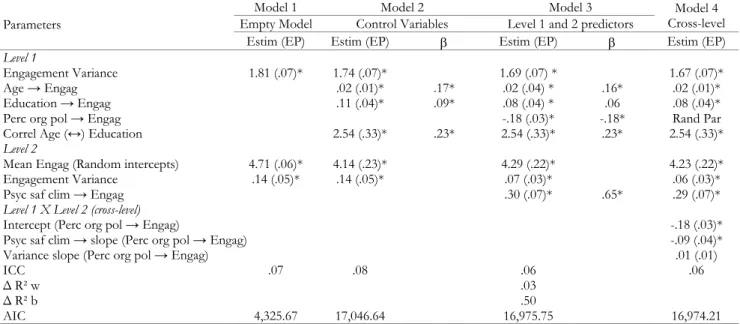
Table 3 summarizes the results of the HLM analyses, ba-sed on the random regression coefficient (or slope as out-come) model and implemented in MPlus. The research hy-potheses indicate that part of the variance in work engage-ment can be explained at the individual and organizational levels. Thus, first, a null model was tested in which variance
in work engagement was separated per analysis level. In Ta-ble 3, in the empty model, significant variance in engagement is found at both analysis levels. Also in the empty model, the ICC coefficient indicated that 7% of the variance in the work engagement can be attributed to the organizational level. Table 3. Hierarchical Linear Modeling Results.
Parameters
Model 1 Model 2 Model 3 Model 4
Cross-level
Empty Model Control Variables Level 1 and 2 predictors
Estim (EP) Estim (EP) Estim (EP) Estim (EP)
Level 1
Engagement Variance 1.81 (.07)* 1.74 (.07)* 1.69 (.07) * 1.67 (.07)*
Age → Engag .02 (.01)* .17* .02 (.04) * .16* .02 (.01)*
Education → Engag .11 (.04)* .09* .08 (.04) * .06 .08 (.04)*
Perc org pol → Engag -.18 (.03)* -.18* Rand Par
Correl Age (↔) Education 2.54 (.33)* .23* 2.54 (.33)* .23* 2.54 (.33)*
Level 2
Mean Engag (Random intercepts) 4.71 (.06)* 4.14 (.23)* 4.29 (.22)* 4.23 (.22)*
Engagement Variance .14 (.05)* .14 (.05)* .07 (.03)* .06 (.03)*
Psyc saf clim → Engag .30 (.07)* .65* .29 (.07)*
Level 1 X Level 2 (cross-level)
Intercept (Perc org pol → Engag) -.18 (.03)*
Psyc saf clim → slope (Perc org pol → Engag) -.09 (.04)*
Variance slope (Perc org pol → Engag) .01 (.01)
ICC .07 .08 .06 .06
Δ R² w .03
Δ R² b .50
AIC 4,325.67 17,046.64 16,975.75 16,974.21
Note. Number of workers = 1.244; Number of organizations = 64; * p ≤ .01; Coefficients between parentheses correspond to the standard error of the
esti-mation. Rand par = randomized slope for the second analysis level. R² refers to the percentage explained by the model, through the control of the variables age and education. Although the secondary-level variance of the randomized parameter between perceived organizational political and engagement was low (.009 – coefficient not presented in the table), the psychological safety climate can explain 44.4% of this variable.
In model 2 (Table 3), the control variables age and edu-cation were included. These variables presented a significant effect on engagement at the individual level. In model 3, the effect of the predicting variables perception of organizational politics and psychological safety climate was tested. This model was used to test Hypotheses 1 and 2 and suggests that the psychological safety climate presented significant effects (.30, p ≤ .01) on organizational engagement, which allowed confirmation of Hypothesis 1, while the perception of orga-nizational politics was negatively associated with work en-gagement (-.18, p ≤ .01), which confirms hypothesis 2.
In model 4, the regression parameter between perception of organizational politics and work engagement at the indivi-dual level was randomized for the organizational analysis model. Thus, in Table 3, the intercept of this parameter, equal to -.18, (‘intercept Perc Org Pol → Engag’) refers to the mean effect of the perception of organizational politics on engagement. In addition, we aimed to explain the variabi-lity in this regression parameter through the psychological safety climate variable. In other words, we aimed to test Hy-pothesis 3 about the moderating effect of the psychological safety climate on the relationship between perception of or-ganizational politics and work engagement. This effect was
significant (-.09, p ≤ .01), but negative, showing that the psychological safety climate variable has contributed to en-hance the negative relationship between the perceptions of organizational politics and work engagement. Therefore, Hypothesis 3 was not supported.
It is highlighted that the parameters of model 4, presen-ted in Table 3, are not standardized and therefore cannot be mutually compared in terms of the effect size. To support the interpretation of the effect sizes, Figure 1 presents the model relation between the variables and the standardized regression parameters. The results indicate that, at the indi-vidual analysis level, the effect of the perception of organiza-tional politics on engagement is small ( = -.18). Neverthe-less, the psychological safety climate can largely explain the random part of this parameter at the organizational level ( = -.68). It is highlighted that the beta of the moderation was standardized, considering the random slope variance and, therefore, it is not included in the same beta measure of the mean effect between perception of organizational politics and engagement. In other words, the betas -.18 and -.68 cannot be directly compared in this case.
Figure 1. Moderating effect. In order to enhance the understanding about the
inter-pretability of the moderating effects, we aimed to test the ef-fects of simple slopes using the procedures indicated by Preacher, Curran and Bauer (2006). These effects indicated that, in organizations with high levels of psychological safety climate, the negative magnitude of the association between the perceived organizational politics and work engagement is higher (b = -.24, EP = .04, p ≤ .01) than in organizations with low levels of psychological safety (b = -.12, EP = .03, p ≤ .01). To classify the institutions regarding low and high le-vels of psychological safety, the cut-off points – 1 SD and+ 1SD were used.
Figure 2. Moderating effect of psychological safety climate in the relation between organizational politics and work engagement.
In Figure 2, the relationship between work engagement and perception of organizational politics as moderated by the psychological safety climate is displayed. Considering that the psychological safety climate is an interval variable, to facilitate the chart interpretation, this variable was categori-zed in low and high levels. Therefore, the cut-off points of one standard deviation were considered. In the figure, we
perceive a more enhanced drop in engagement in relation to the increase in organizational politics for organizations with a high psychological safety climate. Considering that the per-ception of organizational politics is negative for engagement (as a function of the measure of the variable used in this study), the moderating effect of the psychological safety cli-mate can also be interpreted as a booster of this relationship.
Discussion
Based on the JD-R theory (Bakker & Demerouti, 2017), we tested three of its main assumptions: the main effect of a job resource, the main effect of a job demand and the buffer effect of a job resource. The direct relationship between the aggregated psychological safety climate and the engagement was an important finding, which justifies the use of a multi-level study. As predicted, a positive relationship between psychological safety climate and work engagement was found. This mimics findings in previous research about the positive effects of psychological safety climate on positive work attitudes and behaviors, specifically work engagement (Kessel et al., 2012; Kirk-Borwn & Van Dijk, 2011; Lee & Ok, 2015; Plomp et al., 2019). As employees estimate the perceived costs and risks to expose themselves in an uncer-tainty environment (Kark & Carmeli, 2009), psychological safety climate facilitates their engagement because it conveys them messages that they are in a trustful and safe setting (Edmonson, 1999; Kahn, 1990), where they can be energetic and invest efforts in their tasks without risks (Randall et al, 1999).
Our second prediction was also supported, since a direct negative relationship between organizational political percep-tions and work engagement was found. These findings are similar to those of previous research about the harmful ef-fects of perceptions of organizational politics on positive work attitudes and behaviors, including work engagement (Abbas et al., 2014; Chang et al., 2012, Kane-Frieder et al., 2014b; Karatepe, 2013; Landells & Albrecht, 2019). Thus, the perceptions of self-serving behaviors and politically ba-sed decision making in the organization cause feelings of frustration and anger (Ferris & Kacmar, 1992) which deplete
employees’ energy levels and diminish their engagement. In other words, engaged individuals perceive organizational po-litics as hindrance demands (Crawford et al., 2010) that re-present barriers to their personal goal attainment and impede the likelihood that their investments will be rewarded (Kane-Frieder et al., 2014a). Our results support earlier research findings about the relationship between work resources, work demands and engagement (Bakker et al., 2014), at the individual and organizational levels (Schaufeli & Taris, 2014). We also investigated the cross-level interaction between the perception of organizational politics and organizational characteristics, which was neglected in earlier studies (Kie-witz et al., 2002). Contrary to our prediction, however, no support was found for the buffer effect of psychological sa-fety climate on the relationship between organizational poli-tical perceptions and work engagement. Our results were therefore different from the previous ones observed in the context of the JD-R theory (Bakker et al., 2007; Hakanen et al., 2005; Xanthopoulou et al., 2007b, where this buffer ef-fect has been observed.
In fact, we found a significant booster effect of psycho-logical safety climate on those relationships. In other words, we showed that psychological safety climate moderated the association between the perception of organizational politics and work engagement, enhancing the negative effect of or-ganizational political perceptions on work engagement. So, when the environment of the organization was perceived as being safer, the organizational life was perceived as more political, which in turn caused less employees’ engagement. In other words, organizations that allow individuals to talk openly about what they think increase the individual and ne-gative effect of the perception of organizational politics on the work engagement.
Although the JD-R theory postulates a buffer effect of the job resources on the relationships between job demands and well-being (Bakker & Demerouti, 2017); such effect was not always evident. Thus, in a longitudinal investigation with samples composed of Australian and Chinese employees, Brough et al. (2014) found that only one out of 16 interacti-on tests were significant.
In addition, the JD-R theory does not postulate a boosting effect of the job resources on the relationships between job demands and work engagement, since it consi-ders that job resources are always beneficial (Bakker & De-merouti, 2017). However, the possibility that job resources are not always beneficial, since their effects depend on the context, has recently begun to be discussed in the literature (Van Veldhoven, van den Broeck, Daniels, Bakker, Tavares & Ogbonnaya, 2019). In this connection, Schaufeli and Taris (2014) contend that a resource can either be perceived as threatening, turning to be a demand, or as an opportunity for learning and development.
It is, therefore, possible that in the present study, the perceptions that organization is safe have facilitated the prac-tice of organizational politics, in so far as people felt safe and confident in adopting more self-serving attitudes and
beha-viors. This may have changed employees' perceptions that the organization was a safe place to the perceptions that their organization was a place dependent on external and un-controllable factors (Vujčić et al., 2017), a fact that probably caused anxiety, frustration and anger (Ferris & Kacmar, 1992) and contributed to the depletion of energy and to the reduction of work engagement. In other words, it is possible that the psychological safety climate, in the presence of or-ganizational politics, was perceived as an additional hindran-ce demand and not as a resourhindran-ce, which enhanhindran-ced the nega-tive effect of organizational politics perceptions on work en-gagement. Therefore, these results can be viewed as an indi-cation that "we need to have the right resources and the right time to do the right thing" (Van Veldhoven et al., 2019, pg. 12).
Theoretical implications
The outcome of our study makes several important con-tributions to the existing literature and broadens our un-derstandings on the conditions that may foster or undermine employees’ work-related well-being. First, our results brought additional evidence on the direct association bet-ween job demands and resources on employees’ health and well-being. Although the perception of organizational poli-tics significantly influences the work engagement, little re-search has been conducted on how these behaviors affect engagement (Landells & Albrecht, 2019). Hence, the study provides empirical evidence on the negative association bet-ween the perception of organizational politics and work en-gagement, demonstrating that, when the individuals perceive self-servicing behaviors within the organizations, their en-gagement level will drop. It was possible to understand this construct as a hindering demand since it requires efforts by the individuals and hinder their development. On the other hand, the psychological safety climate was understood as an organizational resource that stimulates personal growth, learning, and development (Bakker et al., 2007).
Second, our investigation is in line with the recent clima-te studies that have used a multilevel approach (Dollar & Bakker, 2010; Idris et al., 2015). Essentially, the JD-R model presents an individual-level approach and the majority of the investigations conducted under its scope were performed at the individual level (Bakker & Demerouti, 2017. However, it has also been applied to higher aggregation levels (Schaufeli & Taris, 2014). In addition, the integration of multilevel constructs in the engagement investigations can contribute to the development of more complex models (Bakker & Demerouti, 2017). Although the ICC indicated a medium ef-fect, the results indicate an association between the modera-ting variable of the organizational level (psychological safety climate) and the dependent variable at the individual level (work engagement). In other words, even if the variable may not refer exactly to an organization phenomenon, the indivi-duals’ average perception of an organization’s psychological safety climate influences work engagement. Thus, we
advan-ced the literature on the JD-R theory by investigating an or-ganizational resource as predictor of individual processes, using a more complex model.
Finally, and perhaps the most important implication of the findings is that the organizational conditions play an im-portant role on how people interpret the environment and its relationships in the job context, thus developing beha-viors at work. In that sense, this study theoretically develo-ped the cross-level interaction effect on work engagement by integrating the constructs of perception of organizational po-litics and psychological safety climate. In addition, the inves-tigation empirically demonstrated the moderating role of the psychological safety climate on the relationship between the perception of organizational politics and engagement at the organizational level in different organizations. In fact, this study is one of the first ones to examine how the psychologi-cal safety climate influences the relationship between the perception of organizational politics and work engagement.
Overall, we established a more complete picture of the contingency approaches to the study of perceptions of or-ganizational politics. In particular, we extended extant litera-ture by specifying the concurrent and cross-level influence of organizational politics perceptions and psychological safety climate on engagement. However, we found no evidence about the proposed buffering effect of job resources (Bak-ker & Demerouti, 2017). We reveal, on the contrary, the boosting influence of an organization level resource (psycho-logical safety climate) on the likelihood that perceptions of self-serving behavior diminish work engagement. In other words, the findings demonstrate that the detrimental effects of organizational politics on work engagement are stronger in companies with a high psychological safety climate. It seems then that not all job resources are appropriate to deal with job demands (Plomp et al., 2019), considering that they do not always generate positive effects. This indicates the need for additional research that can elucidate the circum-stances in which job resources interact with job demands in a positive or negative direction (Van Veldhoven et al., 2019).
Limitations and future studies
The use of a cross-sectional study in this investigation does not allow determination of the causal link. As the hy-potheses were based on theories, however, we believe that the above aspect did not significantly affect the interpreta-tion of the results. Nevertheless, future longitudinal studies are needed to demonstrate the causal link.
Despite the use of self-reported research data collected at a single moment, the moderating effects contributed to mi-nimize the common method variance effects. In an earlier investigation, it was verified that psychological safety can vary significantly among groups within an organization (Ed-mondson, 1999) but, in this study, the psychological safety as a group variable was not controlled for.
This study used only one obstacle demand. Further stu-dies should include other demands in the investigation
mo-del, such as challenging demands. With regard to the JD-R theory, these studies should include the analyses of the de-mands and resources‟ valences, and consider them as threats or opportunities for growth, based on the study context. This investigation did not intend to use personal resources in the model, and this should be reconsidered in future studies, which should focus on the individuals’ characteristics and their relationship with work engagement.
Another limitation was the use of a single organizational variable, which contributed to the low ICC. Further investi-gations should expand studies using variables from the orga-nizational context. The application of the method in the mul-tilevel study sample illustrated that the power to detect signi-ficant cross-level interactions was extremely low. The power to detect cross-level interactions largely depends on the magnitude of the cross-level interactions and the standard deviation of the slopes, both alone and in combination. The Level 2 and the mean of the Level 1 sample also play promi-nent roles in determining the capacity to detect cross-level interactions, both directly and in combination with other factors (Mathieu et al., 2012). Future studies should also measure the perception of political activities with regard to different targets, organizations, supervisors, departments and work groups (in line with Maslyn & Fedor, 1998).
Practical implications
This study offers practical implications. As the organiza-tions increasingly seek to find strategies to reduce the impact of the perception of organizational politics (Witt, 1998), the chances that workers will develop positive attitudes towards their work activities will increase. Human Resource profes-sionals and managers should promote frequent meeting with their workers and apply other practices that can diminish the detrimental effects of organizational politics perceptions.
The relationship between the perception of organizatio-nal politics and work engagement was moderated by the psychological safety climate. Thus, the organizations strongly influence the individual’s relationship with his/her work ac-tivities, especially in the negative sense. Therefore, ensuring the employees that no self-servicing behaviors take place in the organization, mainly in a safe place, can favor work en-gagement.
Conclusion
The current study showed that both organizational level psychological safety climate and employee-level perceptions of organizational politics predicted employee's work en-gagement. Specifically, employees who perceived the exis-tence of less frequent organizational politics behaviors in their organizations and who were employed in organizations with more positive psychological safety climates were more likely to be engaged in their work. There was also a significant cross-level interaction, so that the negative effect of the perceptions of organizational politics was
ampli-fied in organizations with a positive psychological safety climate. These findings offer insights into the mechanisms by which the perceived organizational context may
influen-ce employees’ work engagement and entails practical and theoretical implications for the organizational promotion of work engagement .
References
Abbas, M., Raja, U., Darr, W., & Bouckenooghe, D. (2014). Combined ef-fects of perceived politics and psychological capital on job satisfaction, turnover intentions, and performance. Journal of Management, 40, 1813– 1830. doi: 10.1177/0149206312455243
Albrecht, S. L., Bakker, A. B., Gruman, J. A., Macey, W. H., & Saks, A. M. (2015). Employee engagement, human resource management practices and competitive advantage. Journal of Organizational Effectiveness: People and
Performance, 2, 7-35. doi: 10.1108/JOEPP-08-2014-0042
Albrecht, S. L., Breidhal, E., & Marty, A. (2018). Organizational resources, organizational engagement climate, and employee engagement. Career
Development International, 23, 67-85. doi: 10.1108/CDI-04-2017-0064
Ashford, S. J., Rothbard, N. P., Piderit, S. K., & Dutton, J. E. (1998). Out on a limb: The role of context and impression management in selling gender-equity issues. Administrative Science Quarterly, 43, 23-57. doi: 10.2307/2393590
Atinc, G., Darrat, M., Fuller, B., & Parker, B. W. (2010). Perceptions of or-ganizational politics: A meta-analysis of theoretical antecedents. Journal
of Managerial Issues, 22, 494-513. doi: 10.1007/s10869-008-9061-5
Bakker, A. B., & Albrecht, S. (2018). Work engagement: Current trends.
Ca-reer Development International, 23, 4-11. doi: 10.1108/CDI-11-2017-0207
Bakker, A. B., & Bal, P. M. (2010). Weekly work engagement and perfor-mance: A study among starting teachers. Journal of Occupational and
Orga-nizational Psychology, 83,189-206. doi: 10.1348/096317909X402596
Bakker, A. B., & Demerouti, E. (2007). The Job Demands-Resources mo-del: State of the art. Journal of Managerial Psychology, 22, 309-328. doi: 10.1108/02683940710733115
Bakker, A. B., & Demerouti, E. (2014). Job demands-resources theory. In P. Y. Chen, & C. L. Cooper (Eds.), Work and wellbeing: Wellbeing: A complete
reference guide (Vol. 3, pp. 37-64). Chichester, UK: Wiley-Blackwell.
Bakker, A. B., & Demerouti, E. (2017). Job Demands–Resources Theory: Taking stock and looking forward. Journal of Occupational Health
Psycho-logy, 22, 273-285. doi: 10.1037/ocp0000056
Bakker, A. B., & Demerouti, E. (2018). Multiple levels in job demands-resources theory: Implications for employee well-being and performan-ce. In E. Diener, S. Oishi, & L. Tay (Eds.), Handbook of wellbeing. Salt Lake City, UT: DEF Publishers. doi: nobascholar.com
Bakker, A. B., Demerouti, E., & Sanz-Vergel, A. I. (2014). Burnout and work engagement: The JD-R approach. Annual Review of Organizational
Psychology and Organizational Behavior, 1, 389-411. doi:
10.1146/annurev-orgpsych-031413-091235
Bakker, A. B., Hakanen, J. J., Demerouti, E., & Xanthopoulou, D. (2007). Job resources boost work engagement, particularly when job demands are high. Journal of Educational Psychology, 99, 274–284. http://dx.doi .org/10.1037/0022-0663.99.2.274
Bakker, A. B., & Oerlemans, W. (2011), Subjective well-being in organizati-ons. In K. S. Cameron & G. M. Spreitzer (Eds.), The Oxford handbook of
positive organizational scholarship (pp. 178-189). New York: Oxford
Uni-versity Press.
Bakker, A. B., Schaufeli, W. B, Leiter, M. P, & Taris, T. W. (2008). Work engagement: An emerging concept in occupational health psychology.
Work & Stress, 22, 187-200. doi: 10.1080/02678370802393649
Bakker, A. B., Van Veldhoven, M. J. P. M., & Xanthopoulou, D. (2010). Be-yond the Demand-Control model: Thriving on high job demands and resources. Journal of Personnel Psychology, 9, 3–16. doi: 10.1027/1866-5888/a000006
Bedi, A., & Schat, A. C. H. (2013). Perceptions of organizational politics: A meta-analysis of its attitudinal, health, and behavioral consequences.
Canadian Psychology, 54, 246-259. doi: 10.1037/a0034549
Brough, P., Timms, C., Siu, O., Kalliath, T., O‟Driscoll, M. P, Sit, C. HP., Lo, D., & Lu, C. (2014). Validation of the Job Demands-Resources model in cross-national samples: Cross-sectional and longitudinal
pre-dictions of psychological strain and work engagement. Human Relations,
66, 1311-1335. doi: 10.1177/0018726712472915
Burris, E. R., Detert, J. R., & Chiaburu, D. S. (2008). Quitting before lea-ving: The mediating effects of psychological attachment and detach-ment on voice. Journal of Applied Psychology, 93, 912–922. doi: 10.1037/0021-9010.93.4.912
Chang, C. H., Rosen, C. C., & Levy, P. E. (2009). The relationship between perceptions of organizational politics and employee attitudes, strain, and behavior: A meta-analytic examination. Academy of Management
Jour-nal, 52, 779–801. doi: 10.5465/amj.2009.43670894.
Chang, C. H., Rosen, C. C., Siemieniec, G. M., & Johnson, R. E. (2012). Perceptions of organizational politics and employee citizenship beha-viors: Conscientiousness and self-monitoring as moderators. Journal of
Business and Psychology, 27, 95–406. doi: 10.1007/s10869-012-9257-6
Christian, M. S., Garza, A. S., & Slaughter, J. E. (2011). Work engagement: A quantitative review and test of its relations with task and contextual performance. Personnel Psychology, 64, 89-136. doi: 10.1111/j.1744-6570.2010.01203.x
Crawford, E. R., LePine, J. A., & Rich, B. L. (2010). Linking job demands and resources to employee engagement and burnout: A theoretical ex-tension and meta-analytic test. Journal of Applied Psychology, 95, 834-847. doi: 10.1037/a0019364
Cropanzano, R., Howes, J. C., Grandey, A. A., & Toth, P. (1997). The rela-tionship of organizational politics and support to work behaviors, atti-tudes, and stress. Journal of Organizational Behavior, 18, 159-180. doi: 10.1002/(SICI)1099-1379(199703)18:2<159::AID-JOB795>3.0.CO;2-D
Demerouti, E., Bakker, A. B., Nachreiner, F., & Schaufeli, W. B. (2001). The job demands–resources model of burnout. Journal of Applied Psychology,
86, 499-512. doi: 10.1037//0021-9010.86.3.499
Detert, J. R., & Burris, E. R. (2007). Leadership behavior and employee voi-ce: Is the door really open? Academy of Management Journal, 50, 869-884. doi: 10.5465/AMJ.2007.26279183
Dollar, M. F., & Bakker, A. B. (2010). Psychosocial safety climate as a pre-cursor to conducive work environments, psychological health pro-blems, and employee engagement. Journal of Occupational and
Organizatio-nal Psychology, 83, 579–599. doi: 10.1348/096317909X470690
Edmondson, A. C. (1999). Psychological safety and learning behavior in work teams. Administrative Science Quarterly, 44, 350-383. doi: 10.2307/2666999
Edmondson, A. C. (2003). Speaking up in the operating room: How team leaders promote learning in interdisciplinary action teams. Journal of
Management Studies, 40, 1419–1452. doi:10.1111/1467-6486.00386.
Edmondson, A. C., & Lei, Z. (2014). Psychological safety: The history, re-naissance, and future of an interpersonal construct. Annual Review of
Or-ganizational Psychology and OrOr-ganizational Behavior, 1, 23–43. doi:
10.1146/annurev-orgpsych-031413-091305
Ferreira, M. C., Valentini, F., Damásio, B. F., Mourão, L., Porto, J. B., Chi-nelato, R. S. C., Novaes, V. P., & Pereira, M. M. (2016). Evidências adi-cionais de validade da UWES-9 em amostras brasileiras [Additional va-lidity evidences of UWES-9 in Brazilian samples]. Estudos de Psicologia,
21, 435-445. doi: 10.5935/1678-4669.20160042
Ferris, G. R., & Judge, T. (1991). Personnel/human resource management: A political influence perspective. Journal of Management, 17, 447-488. doi: 10.1177/014920639101700208
Ferris, G. R., & Kacmar, K. M. (1992). Perceptions of organizational poli-tics. Journal of Management, 18, 93–116. 18, 93-116. doi: 10.1177/014920639201800107
Ferris, G. R., Frink, D. D., Galang, M. C., Zhou, J., Kacmar, M., & Howard, J. L. (1996). Perceptions of organisational politics: Prediction, stress-related implications, and outcomes. Human Relations, 49, 233-265. doi: 10.1177/001872679604900206