p a t i e n t s
’
s a t i s f a c t i o n w i t h t h er h e u m a t o l o g y d a y c a r e u n i t
Lurdes Barbosa
*, Sofia Ramiro
*, Raquel Roque
*, Pedro Gonçalves
*, J. Canas da Silva
*, Maria José Santos
**Department of Rheumatology, Hospital Garcia de Orta, Almada, Portugal.
(β 2.28, 95%CI 1.20-3.35) and increasing levels of satisfaction with the room temperature (β 5.64, 95%CI 3.06-8.21) and waiting time (β 25.53, 95%CI 8.1742.89, for a very good vs nonacceptable wai -ting time) were positively associated with the level of satisfaction, while the nursing score was inver -sely associated.
Conclusions: Patients were overall very satisfied with the functioning of the RDCU. Waiting time, satisfaction with the physician role, room tempera -ture and intravenous therapy were the main factors positively associated with the level of satisfaction. Keywords: Patient Satisfaction; Day care; Biologi-cal Therapy; Portugal.
Introduction
Patients’ satisfaction has been widely investigated in health care research. Many authors consider pa-tients’ satisfaction as an indicator of quality of care from the patients’ perspective1-4and it is increas-ingly considered an important component of com-prehensive chronic disease management5. The im-portance of patients’ satisfaction as a measure of quality is based in two main principles: 1) patients are an essential source of information on how a health care service works; 2) patients’ perspective is increasingly being valued when planning and evaluating services1,6,7.
The assessment of patients’ satisfaction through satisfaction surveys is nowadays the preferred method for valuing the perspective of patients about the health care provided8. Findings from se -ve ral studies established the importance of the relationship between satisfaction and both the physi -cal environment and the interpersonal compo-nents of a health unit9,8. Empathy and assurance with the health care team, which mainly represent interpersonal communication, were identified as having a strong influence on the patients’ willing-ness to come back to the hospital9. This, in turn,
Abstract
Background: Patients receiving biological therapies are regularly evaluated and monitored at rheumatology day care units (RDCU). Despite patients’ sa -tisfaction with the delivered care and the relation-ship between the patient and the multidisciplinary team being acknowledged as important aspects to ensure adherence to therapy, factors associated with them have not been investigated so far.
Objectives: To evaluate patients’ satisfaction with the functioning of the RDCU and to identify the factors associated with the level of satisfaction. Methods: An anonymous questionnaire was admi -nistered to all patients with rheumatoid arthritis (RA) or spondyloarthritis treated with biological drugs and followed at the RDCU at Hospital Garcia de Orta, Almada, Portugal. Satisfaction was measured using a visual analogue scale (0100, 0 mea -ning completely unsatisfied, 100 mea-ning com-pletely satisfied). Further information was col lected on socio-demographic variables, physical condi-tions of the RDCU, waiting time, satisfaction with the role of medical, nursing and administrative staff (satisfaction level with their friendliness, question answering, care delivery, privacy during consulta-tion, clarity in the information given, which was then transformed into a composite score, 0-20). Factors associated with satisfaction were studied by univariable followed by multiple linear regression to adjust for potential confounders.
Results: In total, 150 patients were included in the study (mean age 50.6 ± 13.7 years, 64% female, 62% RA, mean disease duration 10.6 ± 6.1 years). The majority of patients attended the RDCU for more than three years and 57% received subcutaneous the rapy. The mean level of satisfaction with the RDCU was 81.9 ± 17.9. Multivariable analysis sho -wed that intravenous therapy (β 6.13, 95% confi-dence interval – CI 0.71-11.55), physician score
ted with this level of satisfaction.
Methods
Study Population
We conducted a crosssectional study that inclu -ded patients with RA and SpA, treated with bio-logical drugs and regularly followed at the RDCU at HGO. All patients with the abovementioned di -seases and assessed at the RDCU during the first semester of 2010 were invited to participate and no further eligibility criteria were applied. The 150 pa-tients who participated in the study were assessed using an anonymous questionnaire.
Patients’ satisfaction with the rheumatology day care unit
The overall patients’ satisfaction regarding the RDCU was assessed using a visual analogue scale from 0 (completely unsatisfied) to 100 (completely satis-fied). We evaluated various dimensions of patients’ satisfaction with regard to the physical conditions of the RDCU (room’s size, decoration and temperature) and to the role of the physician, nursing and ad-ministrative staff, using Likert scales (ranging from 0 to 4, from unsatisfied to very satisfied). The deli very of care by physicians and nurses was evaluated with respect to their friendli ness and attention, response to questions, way how provided care was delivered, privacy during care and clarity of the information provided. The administrative service was classified for the kindness, availability/attention, speed/effi-ciency and clarity of the information provided. For each professional, we calculated an overall score re-flecting the level of patients’ satisfaction with the performance of the health professional. In the case of the level of patients’ satisfaction with the rheuma-tologist’s performance, this score was designated as physician score (ranging from 0, patient unsatisfied with the performance of the physician in all five eva -luated dimensions to 20, patient very satisfied with the performance of the physician in the five dimen-sions evaluated). The nursing score was cons tructed similarly, ranging between the same values. The admi nistrative score, also built in a similar way, ranged from 0-16, reflecting the four dimensions evaluated.
Factors possibly associated with patients’ satisfaction with the rheumatology day care unit
We also evaluated demographic and clinical factors may also represent a better adherence to the
treat-ment plan and disease monitoring, particularly im-portant in chronic conditions.
In the last decade there has been a paradigm shift in the approach to chronic inflammatory rheu matic diseases, in part thanks to a better un-derstanding on the etiopathogenic mechanisms of the diseases, but also the emergence of new and more efficacious drugs. With the widespread use of biological drugs in various inflammatory rheuma -tic diseases, including rheumatoid arthritis (RA) and spondylarthritis (SpA), rheumatology depar t -ments have adapted to this reality, being it essen-tial to ensure high levels of quality in the care de-livered. Patients treated with biological drugs are evaluated in a standardized way in dedicated cli -nics, usually in the environment of a RDCU. At Hospital Garcia de Orta, in Almada, the RDCU is an integrated outpatient unit at the Department of Rheumatology, where every day patients with chronic systemic diseases are followed, in particu -lar RA, SpA (including ankylosing spondylitis, pso-riatic arthritis and undifferentiated spondylarthri-tis), juvenile idiopathic arthritis, Behçet’s disease, systemic lupus erythematosus, progressive systemic sclerosis, Sjögren syndrome, syssystemic vascu -litis or idiopathic inflammatory myopathy treated with biotechnological drugs. The biological thera-pies, administered subcutaneous (SC) or intra-venously (IV), are expensive drugs with some wellknown risks that justify close monitoring and rigo -rous evaluation of the risks and benefits. All pa-tients taking these drugs, either administered IV (Infliximab, Rituximab, Abatacept, Tocilizumab), or SC (Etanercept, Adalimumab, Anakinra), are regularly monitored at the RDCU. When patients are stable, the clinical and laboratory evaluations are carried out every 12-16 weeks.
The quality of health services provided by mul-tidisciplinary teams and the patient’s relationship and empathy with those, are essential issues to in-crease the security and the patient’s compliance to therapy, which are a key to therapeutic success10-12. For these reasons, it is important to know the le vel of the patients’ satisfaction, both with to the phy -sical aspects of our RDCU, but also with the provi-sion of health care by the various elements of the health team, in particular physicians, nurses and administrative staff.
The purpose of this study was to evaluate the level of patients’ satisfaction with the functioning of the RDCU and to investigate the factors associa
-tistical analysis was performed using Stata SE ver-sion 11 and a significance level of 5% was assumed.
Results
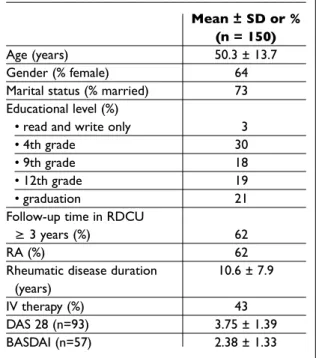
The study included 150 patients, with a mean age of 50.3 ± 13.7 years, being 64% female (Table I). Sixty-two percent of the patients had a diagnosis of RA, the remaining had SpA (ankylosing spon dylitis/undifferentiated spondylarthritis). The ave -rage rheumatic disease duration was 10.6 ± 7.9 years. Considering only the patients with RA, the mean disease duration was 10.3 ± 7.0 years and 11.2 ± 9.1 years for the patients with SpA.
Most patients were followed at the RDCU for more than five years, and 43% of the patients were on intravenous therapy (Infliximab, Rituximab, Abatacept or Tocilizumab), while the remaining were treated with subcutaneous therapy (Adali-mumab, Etanercept or Anakinra).
Most patients (46%) lived at a distance from the hospital lower than 15 Kms, 31% at a distance of over 25 Kms, the vast majority of the patients (75%) travelled to the hospital by car and 65% on their own (Table II).
possibly associated with the level of patients’ sa -tisfaction with the RDCU. Demographic factors as-sessed were age, gender, marital status, number and relationship to the people with whom the pa-tient lived and educational level. With regard to clinical factors, we collected information on the rheumatic disease diagnosed, disease duration, type of biological drug used, follow-up time at RDCU and disease activity. The disease activity was assessed by the Disease Activity Score with 28-joint assessment (DAS28)13, in the case of RA, and the Bath Ankylosing Spondylitis Disease Activity Index (BASDAI)14, in the case of SpA.
Patients were also asked about some aspects re-lated to the RDCU that could be associated with their level of satisfaction, including the distance from home to the RDCU, travel method, accom-panying in the visit to the RDCU, ease of access to the RDCU from the main entrance of the hospital, waiting time and adequacy of the physical envi-ronment for the purpose of the RDCU. The wai ting time was rated from 0 to 3, where 0 corresponded to “not acceptable”, 1 “reasonable”, 2 “good” and 3 “very good”. The RDCU team recommends to pa-tients to contact the RDCU by telephone, in case of doubt or appearance of any new event, so that an urgent evaluation can be considered. In this context, patients were asked whether they were aware of this possible telephone contact, as well as their previous experience with contact to the RDCU in an urgent situation, in case they had any.
Statistical Analysis
First, a descriptive statistical analysis was under-taken, in which the categorical variables are expressed as frequencies and the continuous varia -bles in the form of mean ± standard deviation.
The administrative score was converted to vary from 0 to 20, to be more easily comparable to the results obtained for the physicians’ and nurses’ scores.
In order to identify factors associated with the level of the overall patients’ satisfaction with the RDCU, univariable linear regression analyses were undertaken between the level of the overall pa-tients’ satisfaction (0-100) and the demographic, clinical and physical factors related to the RDCU previously described.
Factors with a p-value < 0.1 were subsequently included in a model of multiple linear regression analysis (backwards method) until the best final model was obtained and which is presented.
Sta-SD – standard deviation; RA – rheumatoid arthritis; IV – intravenous; DAS28 – disease activity score with 28-joint assessment; BASDAI – Bath Ankylosing Spondylitis Disease Activity Score
Table I. General characteristics of the population Mean ± SD or %
(n = 150)
Age (years) 50.3 ± 13.7
Gender (% female) 64
Marital status (% married) 73
Educational level (%)
• read and write only 3
• 4th grade 30
• 9th grade 18
• 12th grade 19
• graduation 21
Follow-up time in RDCU
≥ 3 years (%) 62
RA (%) 62
Rheumatic disease duration 10.6 ± 7.9
(years)
IV therapy (%) 43
DAS 28 (n=93) 3.75 ± 1.39
tance between the RDCU and main entrance. The waiting time was considered good by 42% of the patients; 29% found it very good and 27% reasonable; 2% found it not acceptable.
When asked about the adequacy of the RDCU room for its purpose, 84% of the patients agreed it was adequate. The level of satisfaction with the room size was fairly satisfactory for 24% of the patients and very satisfactory for 22%. As for the de coration of the room, 43% of the patients were sa -tisfied, 26% fairly satisfied and 24% very satisfied. Regarding the room temperature, 41% showed satis faction, 20% were fairly satisfied and 35% very satisfied.
One hundred and thirty-eight patients (92%) ad-mitted having knowledge of the possible telephone contact to the RDCU in case of urgency, and 99% of the patients confirmed that when they needed help, the telephone contact with the RDCU did solve their problems. We also wanted to know if patients had used the RDCU in case of an urgent situation and 52 patients (35%) said yes. Of those patients, 98% reported to be easily attended at the RDCU in these situations.
The average overall patients’ satisfaction level with the RDCU, considering all its functioning, was 81.91 ± 17.91, on a scale from 0 to 100, where 0 meant completely unsatisfied and 100 completely satisfied.
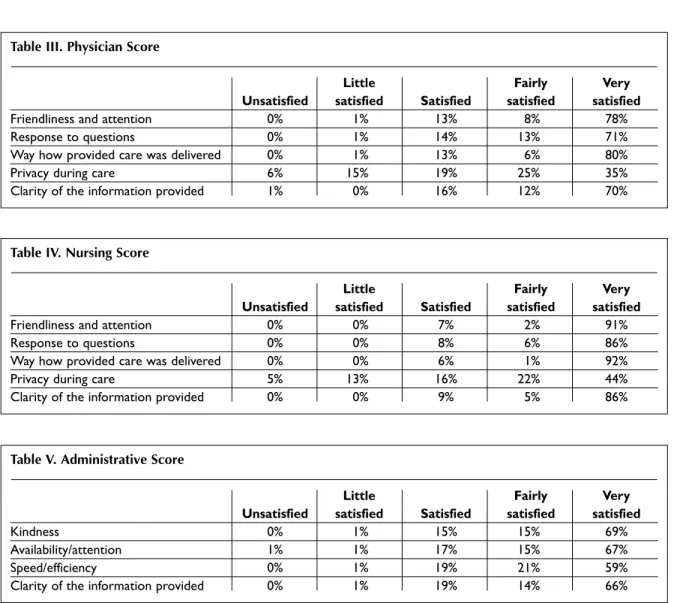
The levels of patients’ satisfaction with the dif-ferent dimensions in delivery of care by the physi-cian, nursing and administrative staff are in Tables III, IV and V. The mean physician score was 16.53 ± 4.27 and the nursing score was 17.70 ± 3.54. The administrative score obtained the mean value of 16.71 ± 4.86. The privacy of patients during their consultation, either with the physician or nurse, was the aspect evaluated as the least satisfactory for patients: only about 40% of the patients were very satisfied with this aspect, comparing with a frequency of above 70% for the other aspects eva -luated. The various aspects of delivery of care with respect to the nursing team were identified as very satisfactory, with more than 85% of the patients being very satisfied. With respect to the perfor-mance of the administrative staff, the speed and ef-ficiency in the service was the least satisfactory as-pect.
The disease activity of patients with RA, assessed using the DAS28, had an average score of 3.75 ± 1.39. Sixty-two of the 93 patients (67%) had a DAS28 equal or superior to 3.2, so they had active When asked about ease of access to RDCU from
the entrance of the hospital, 85% confirmed it was easily accessible. Of the 23 patients (15%) who re-ported a not easy to access to the RDCU from the entrance of the hospital, the reasons given were in 39% the difficulty in parking the car, in 30% a long waiting time for the lifts and in 30% the long
dis-Table II. Characterization of aspects of the RDCU Mean ± SD or % (n = 150)
Distance home – hospital (%)
• 1-15 km 46
• 15-25 km 19
• >25 km 31
Easy access to the RDCU (%) (yes/no) 85
Patients’ satisfaction with the waiting time (%)
• not acceptable 2
• reasonable 27
• good 42
• very good 29
Room appropriate for the RDCU 84
(%) (yes/no)
Patients’ satisfaction with the room size (%)
• satisfied 26
• reasonably satisfied 24
• very satisfied 22
Patients’ satisfaction with the room decoration (%)
• satisfied 43
• reasonably satisfied 26
• very satisfied 24
Patients’ satisfaction with the room temperature (%)
• satisfied 41
• reasonably satisfied 20
• very satisfied 35
Knowledge of possible telephone 92
contact in case of urgency (%) (yes/no)
Efficiency of telephone contact in case 99
of urgency (%) (yes/no)
Previous access to the RDCU in 35
an urgent situation (%) (yes/no)
Easy access to the RDCU 98
in urgent situation (%) (yes/no)
disease. Thirty-one of the 93 patients evaluated with the DAS28 (33%) had low disease activity (DAS28 < 3.2), and of these, 17 (17 of 93 patients = 18.3%) met criteria for remission (DAS28 < 2.6).
Disease activity of patients with SpA was as-sessed by the BASDAI and had an average score of 2.38 ± 1.33. Six of the 57 evaluated patients (11%) with BASDAI had active disease (BASDAI>4).
Factors associated with the level of patient satisfaction with the RDCU
The factors that were associated with patients’ le -vel of satisfaction were identified by a univariable linear regression analysis, followed by multivaria -ble regression (Ta-ble VI). The best final model, adjus ted for gender, age and main diagnosis, iden-tified the use of intravenous treatment (β 6.13, 95% CI 0.71 – 11.55), the satisfaction with the room
tem-perature (β 5.64, 95% CI 3.06 – 8.21), the satisfac-tion with the physician performance (β 2.28, 95% CI 1.20 – 3.35) and the evaluation of the waiting time as factors with a positive association with the level of satisfaction.
Taking the patients that evaluated the waiting time as not acceptable as a reference, the patients who considered the waiting time very good had a global level of satisfaction 25 times higher (β 25.53, 95% CI 8.17 – 42.89), while the patients who con-sidered the waiting time as good had a satisfaction level 24 times higher (β 24.04, 95% CI 7.50 – 40.59).
There was an inverse relationship between the overall patients’ satisfaction and the nursing score (β -1.71, 95% CI -2.91 – -0.50). There was no statis-tically significant association (either in the uni-variable regression) between the overall level of satisfaction and the following variables: disease
Table III. Physician Score
Little Fairly Very
Unsatisfied satisfied Satisfied satisfied satisfied
Friendliness and attention 0% 1% 13% 8% 78%
Response to questions 0% 1% 14% 13% 71%
Way how provided care was delivered 0% 1% 13% 6% 80%
Privacy during care 6% 15% 19% 25% 35%
Clarity of the information provided 1% 0% 16% 12% 70%
Table IV. Nursing Score
Little Fairly Very
Unsatisfied satisfied Satisfied satisfied satisfied
Friendliness and attention 0% 0% 7% 2% 91%
Response to questions 0% 0% 8% 6% 86%
Way how provided care was delivered 0% 0% 6% 1% 92%
Privacy during care 5% 13% 16% 22% 44%
Clarity of the information provided 0% 0% 9% 5% 86%
Table V. Administrative Score
Little Fairly Very
Unsatisfied satisfied Satisfied satisfied satisfied
Kindness 0% 1% 15% 15% 69%
Availability/attention 1% 1% 17% 15% 67%
Speed/efficiency 0% 1% 19% 21% 59%
duration, marital status, educational level, number of people with whom the patient lived, ease of ac-cess to the RDCU, satisfaction with the adequacy of the room, knowledge about the possibility of telephone contact with RDCU in an urgent situa-tion, the follow-up time at the RDCU, the distance from home to RDCU, the travel to the RDCU with a companion and the disease activity (DAS28 and BASDAI).
The multivariable linear regression analysis was repeated, including in the model the individual variables that were part of the physician and the nursing scores, and the results were similar, with the same variables in the final model (except for in-travenous therapy) and the regression coefficients being in the same order of magnitude (results not shown). From the individual variables from the physician and nursing scores, the only one that re-mained in the final model was the satisfaction with the friendliness of the doctor (β 12.95, 95% CI 9.54 – 16.37, in the univariable analysis and β 2.28, 95% CI 1.20 - 3.35, in the multivariable analysis).
Discussion
Overall, patients are very satisfied with the
func-tioning of the RDCU. The average level of satisfac-tion was 81.91 ± 17.91, on a scale from 0 to 100, where 0 meant completely unsatisfied and 100 completely satisfied.
The main factors which have been shown to be associated with the overall level of patients’ satis-faction were: the waiting time, global satissatis-faction with the medical delivery of care, intravenous thera py and the temperature of the room, all with a positive association with the level of patients’ satis faction. Satisfaction with the nursing care showed an inverse relationship with the level of ove rall satisfaction.
The results of this study are consistent with the literature, though sparse in this area. Cleary and McNeil15identified the characteristics of health care providers or organizations that result in per-sonal care as factors associated with higher levels of satisfaction. No other similar studies analyzing factors associated with patients’ satisfaction with respect to their treatment were found.
The results of several studies have shown the importance of the interpersonal component of the delivery of care on patients’ satisfaction16,17. A simi -lar result was obtained in our study, with regard to overall medical assistance and more specifically to the most valued by patients: the physician’s
friend-Table VI. Univariable and multivariable linear analysis
Univariable Analysis Multivariable Analysis
Variables β (95% CI) β (95% CI)
Gender (female vs male) -6.76 (-12.74; -0.79) 0.42 (-5.56; 6.39)
RA (yes/no) -6.80 (-12.68; -0.92) -2.50 (-8.70; 3.71)
Age (years) -0.04 (-0.25; 0.18) -0.05 (-0.23; 0.14)
IV therapy (yes/no) 9.81 (4.15; 15.46) 6.13 (0.71; 11.55)
Satisfaction with the room temperature (0-4) 8.56 (5.90; 11.22) 5.64 (3.06; 8.21)
Physician score (0-20) 1.85 (1.20; 2.51) 2.28 (1.20; 3.35)
Nurse score (0-20) 1.11 (0.22; 1.99) -1.71 (-2.91; -0.50)
Reasonable vs not acceptable waiting time 28.09 (9.11; 47.07) 19.21 (2.65; 35.78)
Good vs not acceptable waiting time 35.35 (16.61; 54.09) 24.04 (7.50; 40.59)
Very good vs not acceptable waiting time 45.34 (26.41; 64.27) 25.53 (8.17; 42.89)
Satisfaction with the room size (0-4) 5.10 (2.92; 7.25) *
Satisfaction with the room decoration (0-4) 7.24 (4.40; 10.09) *
Administrative score (0-20) 0.85 (0.24; 1.46) *
Travel to the RDCU by car vs walking 27.89 (7.27; 48.51) *
Travel to the RDCU by bus vs walking 23.04 (1.47; 44.61) *
Travel to the RDCU by train vs walking 26.22 (2.74; 49.70) *
* The variable was not selected during the multivariable analysis (p ≥0.05)
liness and this was the only item, among the dif-ferent ones evaluated on the delivery of care by health professionals, with a statistically significant association with the overall patients’ level of satis-faction.
With respect to patients’ satisfaction with the performance of the nursing staff, we obtained an inverse association with the level of overall pa-tients’ satisfaction. As a possible explanation, we consider the fact that this health professional does not yet have a recognized significant impact on the assessment and treatment of rheumatic patients, such as the physician’s expertise actually has. This result enhances the fact that, in Portugal, there is still a long way to go. There is much room for im-provement in the nursing training and skills de-velopment for the treatment of rheumatic patients and for the assertion of the specialized nurse role so that this health professional is truly recognized in their working environment and their contribu-tion has a positive impact on the approach to the patient.
Eijk-Hustings et al.18, on behalf of the European League Against Rheumatism (EULAR) nursing task force, developed ten recommendations for the role of the rheumatology nurse in the management of patients with chronic inflammatory arthritis. These recommendations may provide a basis for em-phasising and optimising nursing care in order to contribute to a more standardised level of profes-sional nursing across Europe. These recommen-dations underline the nurses’ role to be an inter-face between the patient and other members of the multidisciplinary team. As a result of the avai-lability of new treatment options and organisatio-nal developments, the role of the nurse has un-dergone significant changes over the last decades. However, there are still striking difference between and within countries, mainly due to differences in legal regulations, educational background of the nurses, and funding issues related to overall health care provision18.
One of the items most valued by patients was the waiting time. It is understood that the time spent by patients in their hospital visits is necessary to be spent on other activities and it is not pleasant for the patient to have to wait. In this regard, one of the concrete proposals resulting from this project con-sists precisely in the attempt to optimize the organization of the RDCU, in order to reduce the wai -ting time of patients.
In order to plan specific measures in an attempt
to maximize the patients’ level of satisfaction with the RDCU, it would be important to identify not only factors which were associated with the over-all level of satisfaction, but essentiover-ally factors with a causal relationship. In this sense, studies with a longitudinal design could assess this particular point. The identification of factors with a possible causal relationship with the overall level of satis-faction would enable the planning of specific mea-sures to improve this aspect, so important for the patient and the success of the therapy, a key objec -tive for all professionals involved in treating these patients. Later, it would also be interesting to fol-low prospectively patients and investigate the dif-ferent outcomes of patients with difdif-ferent levels of satisfaction with the care delivered.
Conclusion
Overall, patients are very satisfied with the func-tioning of the RDCU. Patients more satisfied with the waiting time for evaluation at the RDCU, un-der intravenous therapy and more satisfied with the room temperature and with the delivery of care by the rheumatologist revealed a higher level of overall satisfaction. Satisfaction with the perfor-mance by nurses was inversely associated with the overall level of satisfaction, which probably reflects a failure to recognize the important role of nurses in the management of chronic rheumatic diseases.
Correspondence to
Lurdes Barbosa
Hospital Garcia de Orta, EPE Av. Prof. Torrado da Silva 2801-951 Almada, Portugal E-mail: [email protected]
References
1. Van Campen C, Sixma H, Friele RD, Kerssens JJ, Peters L. Quality of care and patient satisfaction: a review of measuring instruments. Med Care Res Rev 1995;52: 109–133.
2. Sitzia J, Wood N. Patient satisfaction: A review of issues and concepts. Soc Sci Med 1997; 45: 1829–1843. 3. Zuidgeest M, Sixma H and Rademakers J. Measuring
patients’ experiences with rheumatic care: the con-sumer quality index rheumatoid arthritis. Rheumatol Int 2009; 30:159–167.
4. Kírsner RS, Federman DG. Patient Satisfaction: Quali-ty of care from the patients’ perspective. Arch derma-tol 1997; 133: 1427-1431.
5. Jacobi CE, Boshuizen HC, Rupp I, Dinant HJ and Van Den Bos GAM. Quality of rheumathoid arthritis care:
the patient’s perspective. International Journal for Quality in Health Care 2004; 16: 73-81.
6. Salisbury C, Wallace M, Montgomery AA. Patients’ ex-perience and satisfaction in primary care: Secondary analysis using multilevel modelling. BMJ 2010;341: c5004.
7. Avis M, Bond M, Arthur A. Satisfying solutions? A review of some unresolved issues in the measurement of pa-tient satisfaction. Journal of Advanced Nursing 1995; 22: 316-322.
8. Ruiz MA, Pardo A, Rejas J, Soto J, Villasante F, Aranguren JL. Development and validation of the “Treatment Satis faction with Medicines Questionnaire”. Value in Health 2008;Vol.11, 5: 913-926.
9. Anbori A, Ghani SN, Yadav H, Daher AM, Su TT. Patient satisfaction and loyalty to the private hospitals in Sana’a, Yemen. International Journal for Quality in Health Care 2010; Vol.22, 4: 310–315.
10. Van Campen C, Sixma HJ, Kerssens JJ, Peters L, Rasker JJ. Assessing patients’ priorities and perceptions of the quality of health care: the development of the quote-rheumatic-patients instrument. British Journal of Rheumatology 1998;37:362–368.
11. Jenkinson C, Coulter A, Bruster S, Richards N, Chan-dola T. Patients’ experiences and satisfaction with health care: results of a questionnaire study of speci fic aspects of care. Qual Saf Health Care 2002; 11: 335-339.
12. Sixma HJ, Spreeuwenberg PMM, Van der Pasch MAA. Patient Satisfaction with the General Practitioner: A Two-Level Analysis. Medical Care 1998; 2: 212-229. 13. Prevoo ML, Van ‘t Hof MA, Kuper HH, Van Leeuwen MA,
Van de Putte LB, Van Riel PL. Modified disease activity scores that include twentyeightjoint counts. Develop -ment and validation in a prospective longitudinal study of patients with rheumatoid arthritis. Arthritis Rheum 1995; 38: 44-48.
14. Garrett S, Jenkinson T, Kennedy LG, Whitelock H, Gais -ford P, Calin A. A new approach to defining disease sta-tus in ankylosing spondylitis: the Bath Ankylosing Spondylitis Disease Activity Index. J Rheumatol 1994; 21: 2286-91.
15. Cleary PD, McNeil BJ. Patient satisfaction as an indica -tor of quality care. Inquiry 1988; 25: 25-36.
16. Mittal B, Lassar WM. The role of personalization in ser-vice encounters. J Retail 1996; 72: 95–109.
17. Brady MK, Cronin JJ. Some new thoughts on concep-tualizing perceived service quality: a hierarchical ap-proach. J Market 2001; 65: 34–49.
18. Eijk-Hustings Y et al. EULAR recommendations for the role of the nurse in the management of chronic in-flammatory arthritis. Ann Rheum Dis. 2012; 71:13-19.