Entry strategies in the face of incumbents dominant position:
the case of advanced renewable energy technologies
Margarida Fontes (corresponding author)LNEG – Laboratório Nacional de Energia e Geologia
Campus do Lumiar, Estrada do Paço do Lumiar, Edifício C, 1649-038 Lisboa, Portugal [email protected]
Cristina Sousa
DINAMIA’CET / ISCTE-IUL
Avenida das Forças Armadas, Edifício ISCTE, 1649-026 Lisboa, Portugal [email protected]
Silvana Pimenta
ISCTE-IUL
Abstract
The paper discusses the entry strategies adopted by research-based firms introducing advanced renewable energy technologies in the electricity production sector, which combines strong incumbent power with fast technological change. Drawing on contributions from the literatures on sustainability transitions and on strategic management of technology we build an analytical framework to address the conditions faced by the new entrants and the attitude of established incumbents towards their technologies. This framework is applied through in-depth case studies of new firms in two energy fields that display different levels of technological maturity: wind and wave energy. The paper presents preliminary results from a first set of case studies, which provide some insights into the “commercialisation environment” prevailing in those fields. They suggest that research-based firms tend to depend on the complementary assets possessed by incumbents, but have conditions to protect their technologies; and that the technology is relevant for (at least some) incumbents, which show interest on them, or are directly involved in their development/use. This is, in most cases, conducive to “cooperation” strategies, which assume different forms according to the stage of development of the technology and its proximity to incumbent competences and business models.
Keywords: renewable energy technologies; technology commercialisation;
research-based firms; entry strategies; incumbents attitude
JEL: L21, L22, O32, Q42
ICEE Conference Topic: Markets and Drivers of Renewable Energy
Acknowledgment: This paper draws on the research conducted in the Project TESS
2
Entry strategies in the face of incumbents dominant position: the case of advanced renewable energy technologies
1. Introduction
The paper investigates the entry strategies adopted by new firms exploiting advanced renewable energy technologies (RET). Firms that introduce new technologies targeting the energy/electricity production are confronted with a very particular environment. They are entering a sector where, despite the profound transformations occurred in the last decade, powerful incumbents still occupy dominant positions. But where the acceleration of the pace of technological change creates opportunities for technology-intensive new entrants (Brown et al, 2007) and influences the incumbents’ attitude towards those entrants and their technologies (Hockerts and Wustenhagen, 2010). Since research-based start-ups are typically small firms with strong knowledge competences but limited financial and market-related resources and competences (Mustar et al, 2006), they inevitably need to establish relationships to transform their technologies in marketable products/services and sell them (Colombo et al, 2006). In sectors dominated by large established firms at least some of those “complementary assets” may be possessed by them (Rothaermel, 2001), and therefore firms’ commercialisation strategies need to take into account the incumbents’ behaviour.
Thus, the capacity of new energy firms to exploit their technologies depends on their ability to devise the appropriate strategies to deal with this particular commercialisation environment (Gans and Stern, 2003). However, research on the strategic behaviour of entrepreneurial energy firms is still scarce (Wustenhagen and Wuebker, 2011; Krishna et al, 2011). This paper contributes to fill this gap, by investigating the commercialisation of RET in different stages of development, in order to uncover the strategies adopted by the new firms and their positioning relatively to large incumbents. For this purpose the research combines contributions from the sustainability transitions literature on the dynamics of the energy sector (Verbong and Geels, 2010; Hekkert and Negro, 2009; Sine and David, 2003) and from the strategic management of technology on the exploitation of advanced technologies by new entrants, in industries dominated by powerful incumbents (Teece, 1986; Rothaermel, 2001; Gans and Stern, 2003). Drawing on this framework, empirical research is conducted on the creation and early development of Portuguese research-based energy firms, investigating the process of commercialisation of their technologies and the nature of the relationships established for this purpose. This paper presents the results of an exploratory analysis, based on case studies in two renewable energy fields in different stages of development - wind and wave energy. The analysis provides a first approach to the entry strategies open to the new firms and to the impact of differences between energy technologies on the conduction of these processes.
2. The technological and business environment in the energy sector(s)
New firms developing RET that have an application in the process of electricity generation and/or distribution are entering a large and highly complex sector that is undergoing a profound transformation (Jacobsson and Bergek, 2004; Jager-Waldau et al, 2011). The structural processes taking place in the sector and their impacts on the prevailing sectoral regime have been addressed by the various streams of the
3
“sustainability transitions” literature (Markard and Truffer, 2008). According to this literature, these processes introduced some destabilisation in the prevailing regime (Geels, 2002), leading to changes in the industrial structure and knowledge base.
The liberalisation of the energy sector brought about the extinction of public monopolies and forced the separation between energy production, transmission, distribution and commercialisation, making market entry comparatively easier, at least in some segments (Verbong and Geels, 2010). In parallel, the creation of a growing space for renewable energies, drove a renewal of the industry knowledge base, creating opportunities for firms that develop and/or exploit new technologies targeting the energy production, or system-level problems associated with the introduction of renewable sources (Brown et al, 2007). A fast increase in the level of R&D and innovative activity in RET was observed (Ayari, 2012). The new technologies often started being developed in niches, given the high technological and market uncertainty associated with their exploitation (Raven, 2007). But some of them have reached a stage where wider commercial exploitation became viable (if not fully competitive with conventional sources). The distributed nature of some of the new sources also favoured new entry (Schoettl and Lehmann-Ortega, 2010), which was further encouraged by a variety of policy incentives for renewables. This challenged the dominant position of the old utilities (Duncan, 2010) and led to some readjustments in the actor composition and balance of power (Verbong and Geels, 2010). However, despite these changes, the sector still retains its infrastructural and centralised nature and is still largely dominated by large companies (Hockerts and Wüstenhagen, 2010).
3. The position of incumbents and conditions for new entry 3.1 Incumbents behaviour in the electricity production sector
As a result of the processes described above, the renewable electricity production and distribution sub-sector is currently characterised by fast technological change and, simultaneously, by an industrial structure where large established firms occupy dominant positions, at least in the renewable segments that are closer to maturity. However, there are great differences between RETs in terms of stage of development and level of market diffusion and therefore in terms of the actual structure of the respective “industrial segments” (Jäger-Waldau et al, 2011; IPCC, 2011). This have implications for research-based firms entering the energy business, since it influences the opportunities that are created and the conditions in which these can be exploited. Established companies are often reluctant to get involved in the early exploitation of more immature technologies, given the high uncertainty and their lack of competences (Levinthal, 1997). Thus, ex-utility operators repositioning themselves in the renewable field, or companies diversifying from other sectors are more likely to invest in mature technologies, preferably those that enable large scale projects and are closer to their competences and competitive advantages (Hockerts and Wustenhagen, 2010; Duncan, 2010). But even in these fields there remains a variety of complex problems, both at technology and at system level, that require extensive technological developments, creating opportunities for technology-intensive specialised suppliers.
The still unsatisfactory performance of several RET already in the market (in terms of energy yield, costs and security of supply) also opens some space for the emergence of
4
alternative designs, often in an experimental stage, that are explored in niches. The same happens in the case of emerging RET that have not yet reached a commercial stage, such as those related with ocean energy conversion. These emerging fields offer good opportunities for new firms originating from academic research that base their competitiveness on the production and exploitation of advanced knowledge (Conceição et al, 2012).
Incumbents attitude to emerging technologies vary (Hockerts and Wustenhagen, 2010; Ansari and Krop, 2012). But the growing international competition has quickened the technological pace and increased the pressure to invest in innovation, and thus the need to look for new technologies, or get involved in alternative technological paths (Hekkert and Negro, 2009). Thus incumbents may wish to keep an eye on the new developments, in order to follow-up (or even influence) their evolution and/or to guarantee an early position, once a dominant design emerges (Sine and David, 2003). But they usually prefer to achieve this through collaborations that reduce the risks and costs involved.
3.2 Start-up strategies in conditions of incumbent dominant position
The combination of strong incumbent power and fast technological change creates a particular environment for new firms introducing new technologies. The conditions faced by entrants in this type of environment and the strategic opportunities open to them have been addressed by the literature on the strategic management of technology (Teece, 1986; Arora et al, 2001). According to this literature, the capacity to protect the technology and the conditions of access to a number of downstream resources or competences that are necessary to sell a complete product/service – the “complementary assets” - are basic elements in the start-up strategic decisions. In particular, it has been shown that when large incumbents control a number of key complementary assets, small technology-intensive start-ups may benefit from adopting “cooperation strategies” (Gans and Stern, 2003), entering in relationships with them (Colombo et al, 2006). These alliances can be mutually favourable, even if often characterised by power asymmetry (Rothaermel, 2001). Since this asymmetry increases the appropriability hazards, making firms vulnerable to the expropriation of their main (or even unique) asset (Teece, 1986), the capacity to protect the technology is critical. Formal appropriation mechanisms like patents are often the only effective means of protection for small technology-intensive firms (Arora and Merges, 2004).
The strategies open to new technology-based entrants were addressed in detail by Gans and Stern (2003), who argue that the characteristics of the commercialisation environment constrain the choices to be made by the entrepreneurs. They define “commercialisation environment” along two dimensions - the extent to which innovation by the start-up precludes the incumbent’s development and the relevance of incumbent complementary assets to the start-up – and devise a typology of environments and associated strategies. This framework is relevant for our analysis, since it addresses the type of conditions that may influence the attitude of incumbents towards the advanced technologies being developed by the new energy firms and the nature of the relationships that are likely to be established between both.
The environment labelled by the authors as “ideas factories” configures a set of conditions that is likely to emerge in the renewable energy sector. In this case, invention by the up precludes effective development by established firms, because the
start-5
up ability to protect the technology makes its appropriation difficult; but established firms control the complementary assets required for its commercialisation. This environment is conducive to a “cooperation strategy”, which may range from the licensing of the intellectual property, to the establishment of a variety of strategic alliances to, in the limit, the acquisition of the start-up. For incumbents the relationship with several innovative start-ups offers a fertile source of new ideas in fields where they have limited competences and/or where uncertainty is still too high and thus experimentation with a variety of competitive paths is still required (Raven, 2007). Alliances with incumbents have benefits for the start-up, enabling it to access markets and supply chains; and providing capital for technology development and sometimes conditions for the testing or demonstration of its technologies/products. Thus, they reduce the start-up investment on downstream assets (Arora et al, 2001) and offer advantages in terms of legitimacy building. However, very often they strengthen the basis for incumbents’ advantage and thus their market power (Gans and Stern, 2003). Gans and Stern (2003) also argue that when incumbent complementary assets are less important and the technology can be protected from appropriation - the “greenfield competition” environment - the start-up may consider the choice between collaborating and competing. The ability to control the development of platforms and standards is critical if the start-up decides to engage in product market competition. Cooperation is equally an alternative and in this case the start-up has stronger bargaining power and can define where and which conditions to cooperate.
3.3. Research-based firms and the process of commercialisation of the new RET
Although there is a body of empirical research on the conditions faced by technology-intensive start-ups that are entering industries dominated by large incumbents and on the relationships they establish, there is still limited knowledge about the behaviour of start-up firms that are willing to introduce new technologies in the energy sector.
This gap reflects a more general problem in the research on the transformation of the energy sector: a focus on the processes occurring at the system level and a still limited understanding of micro-level aspects, such as the strategies of individual firms and their relationship with the system (Markard and Truffer, 2008; Wustenhagen and Wuebker, 2010). The sustainable transitions literature presents entrepreneurs as playing an important role in the transition process, bringing in new technologies and attitudes and contributing to set-off change (Hekkert et al, 2007); and as interacting with other actors to build support to the development and diffusion of new ideas/technologies (Raven, 2007). However, there is limited knowledge on how firms effectively act/interact to introduce these technologies (Kishna et al, 2011; Hockerts and Wustenhagen, 2010). To address this gap, this paper proposes an exploratory research at the micro-level, based on an in-depth analysis of the relational behaviour of research-based firms, in the process of development and early commercialisation of their technologies. Building on Gans and Stern (2003) concept of commercialisation environment we define an analytical framework to address the firms’ positioning, that draws on and extends its two main dimensions:
6
1) The relevance of incumbents’ complementary assets, for the new firm to capture the value of its technology, i.e. the start-up need for and mode of access to those assets. At this level we distinguish, first of all, between firms that decide to avoid engaging in the development of products/services based on the technology and thus skip the need for those assets; and the companies that at least partly engage in the activities necessary for such development and thus require downstream assets (Arora et al, 2001). Regarding the latter, we consider the established distinction between assets mostly supplied competitively in the market and assets co-specialised to the innovation and mostly controlled by incumbents (Teece, 1986).
2) The positioning of incumbents relatively to the technology exploited by the new firm, i.e. whether the technology is relevant for them and whether the new firm can preclude appropriation. Three generic levels of incumbent involvement are considered: keep a watch on the activities conducted by the developers of the technology; show interest in their development, expressed through direct participation (investment), or through the use of the resulting IP, products or services; be involved in the development and/or commercialisation of competitor technologies. The two first levels are conducive to cooperation between incumbents and new entrants, while in the third one there is competition. As pointed out above, whether “interest” induces cooperation or brings the threat of appropriation depends on the firms’ capacity to protect the technology, which will also be considered. The precise characterisation of the environment(s) prevailing in the energy sector – which supports our assessment of incumbents’ behaviour – will be based on the analyses conducted by the transitions literature on the nature and dynamics of the energy regime and the implications of the changes underway. It will be complemented by the empirical literature addressing the emergence and development of the renewable energy sector, which points to substantial differences between RET in terms of maturity and market penetration. This supports the notion that different energy fields - and within them different energy segments – may generate variation in the competitive environments and thus dissimilar conditions for new entrants. The strategic implications of this variety will be investigated in the empirical analysis.
4. Empirical analysis
4.1 Methodology and sample
The empirical analysis uses a case study approach to gain an in-depth understanding of the technology commercialisation process, addressing firm creation and early development and focusing on the role played by relationships with different types of actors in that process.
The paper is focused on Portuguese research-based firms operating in two energy fields in different stages of technology development and market penetration: i) wind energy, already in full commercial exploitation and deploying the most stabilised technologies, despite some less developed segments, which are also considered; ii) wave energy, that only recently started to move from R&D to the early stages of industrial development, but where a dominant design has not yet emerged. This choice was based on our expectation that such differences lead to variation in the behaviour of the new firms, as well as on the attitude of established companies relatively to the technologies.
7
Portugal was regarded as providing a good empirical setting for this research. In the last decade the country invested strongly in the development of RET, both at the research and at the industrial level. It also introduced a very favourable incentive regime for the production and use of energy from renewable sources. As a result Portugal is currently positioned among the European countries with a greater penetration of renewable energy in electricity production and also with more ambitious targets regarding for its future development (MEID, 2010).
The favourable environment thus generated led to a recent upsurge in the creation of research-based firms exploiting advanced technologies targeting the renewable electricity production sector, which are the object of this empirical research. An extensive search conducted by the authors identified around 35 firms active in 2012, with particular focus on the bioenergy, wind and solar fields (Fontes et al, 2012). From this group, we selected, in a first stage, four firms for detailed case studies. In this selection there was an attempt to include some variety of situations in terms of maturity of the technology, firm age and also type of business (which is expected to influence the resources needed and thus produce variation in the nature of relationships established). The firms operate in the following areas:
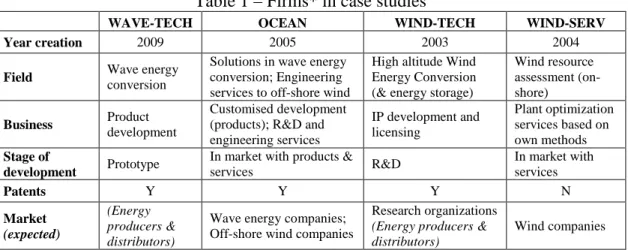
- Wind: Plant optimisation; High-altitude wind; Off-shore engineering services - Wave: Engineering solutions (services and products); Conversion systems Data were collected through detailed interviews with the founders, supported by a semi-structured questionnaire, complemented with an extensive search for documentary information on the firms. The interviewees were asked to provide a brief history of the firm creation and then to give detailed information on the relationships established along the process of development and market introduction of the technologies being exploited. The main characteristics of the firms studied are presented in Table 1. Their individual case stories can be found in Fontes et al (2012).
Table 1 – Firms* in case studies
WAVE-TECH OCEAN WIND-TECH WIND-SERV
Year creation 2009 2005 2003 2004
Field Wave energy
conversion
Solutions in wave energy conversion; Engineering services to off-shore wind
High altitude Wind Energy Conversion (& energy storage)
Wind resource assessment (on-shore) Business Product development Customised development (products); R&D and engineering services IP development and licensing Plant optimization services based on own methods Stage of development Prototype
In market with products & services R&D In market with services Patents Y Y Y N Market (expected) (Energy producers & distributors)
Wave energy companies; Off-shore wind companies
Research organizations
(Energy producers & distributors)
Wind companies
* Firms’ names are fictitious to guarantee confidentiality 4.2 Commercialising strategies
Drawing on the analytical framework presented in section 3.3 we started by assessing the nature of the technology being introduced and the industrial structure of the segment where the firm operates. We subsequently draw on the information obtained from the case studies to understand the firms’ positioning concerning the framework dimensions: whether some of the key complementary assets are possessed by incumbents and in
8
which conditions the new firm can gain access to them; whether the technology being introduced by the new firm is relevant for the incumbents and thus which is their attitude towards the technology and its supplier(s); whether the new entrants have the capacity to protect their technology from expropriation.
Regarding the capacity to protect the technology, all firms studied are, at least in principle, in a similar position. In fact, all but one have the core technology protected by patents. The one that did not patent the technology benefits from the protection afforded by the tacit and experiential nature of the knowledge base. It is therefore possible to assume that these firms had conditions to exclude others from imitating their technology, thus retaining the capacity to establish market relationships with incumbents or even to compete with them. We will now discuss the various firms’ situations regarding of the remaining dimensions.
OCEAN and WAVE-TECH, that operate in the wave field, are introducing technologies still in a very immature stage, which require extensive testing, first at prototype and later at pilot stage in real life conditions. These experiments involve complex infrastructures and extensive financial resources that are beyond the reach of a small firm, being often possessed by large firms or consortia that lead large scale demonstration projects. For OCEAN, access to these settings is critical, since it provides a market for its products and services and simultaneously a test bed to improve its technologies. The incumbents show interest in its technologies and are prepared to get involved in its testing and validation. Thus OCEAN has to establish alliances with the owners of the co-specialised assets. However, because no dominant design has emerged, there are several experimental projects underway. This provides OCEAN with opportunities for establishing relationships with different partners, the main challenge being to capture their interest in a context where there are several small suppliers with competing technologies. The fact that OCEAN emerged within the Portuguese “wave energy community” and that its entrepreneurs were actively involved in the early development of the sector was instrumental in this process. In fact, the firm benefited from their scientific reputation, industry visibility and extensive contacts to gain access to experimental settings at national and international level. It was thus able to establish a close relationship with local energy incumbents (both the ex-utility and an equipment manufacturer) that have a strategic interest in ocean technologies and thus provide it with a market for technologies and skills that can be applied both to wave energy and offshore wind. But OCEAN was equally able to establish relationships with foreign companies that lead the wave sector and to participate in consortia involving several public and private actors conducting experimental projects in Portugal and abroad. Thus OCEAN capitalized on the still turbulent nature of the sector to propose its technology and extensive skills to different partners, deflecting the risks of exclusive relations.
A similar reasoning may apply to WAVE-TECH, which is still developing a prototype, in its future efforts to introduce its innovative wave technology. The main issue in this case concerns the extent to which the new technology being introduce will require the same degree of integration with incumbent assets to obtain a final product, since its system is presented as having a greater autonomy. In any case, the incumbents’ attitude relatively to the technology is likely to be different. Contrary to OCEAN, this firm emerged outside the “wave energy community” with a technology design that departs from the one in which the local incumbents are involved. Nevertheless, we observe an interest of the ex-utility in watching the development of a technology that deviates from
9
its core competence, but appears to have some potential. This is materialised in some contribution to its development (seed capital, access to facilities and human resources), as well as advice and credibilisation. That is, the incumbent is offering access to some key assets that will enable the new company to complete the development of the technology. We observe a strong reliance of the new firm on the “benevolent” interest of the influential company, but its strategy is not confined to the local market. In fact, it profited from the visibility afforded by winning a series of entrepreneurship contests to gain access to an international incubator that can provide it with a wider range of connections. The firm plans to manufacture its core product and eventually license the technology for other applications. Once it engages in these activities it will have to make some new decisions regarding the type of relationships to establish.
The case of WIND-TECH that is also introducing an emerging technology, presents an interesting contrast. First of all, because WIND-TECH opted for focusing on the development of the technology and licensing the intellectual property, thus avoiding the need to build production and commercialisation assets altogether. Second, because high-altitude wind is at an even earlier stage than wave conversion, and thus the essential of the relationships WIND-TECH established so far concern R&D activities and are taking place in the context of European RTD consortia (involving public and private organisations). However, subsequent developments may require other types of alliances and, in the limit, licensing contracts. Finally, the technology that is being developed is much outside the competences of local incumbents. Indeed, the genesis of the company was an international organization in a different field (space) that remains a key partner, being a source of knowledge and contacts. However, the ex-utility integrates the European RTD consortium, denoting some interest in keeping a watch on a technology that is a potential extension - or even a competitor – to its core wind area. Finally, the structure of relationships is clearly different in the case of WIND-SERV that operates in the onshore wind segment, dominated by large incumbents. In this case the new firm is a typical small specialised supplier of services that improve the performance of the incumbents’ core business. Thus, its activities provide value to the incumbents, but competition with them is unlikely given the different set of competences involved, and the risk of expropriation is low because imitation is difficult. Although the firm business depends on the incumbents’ activity, it sells its competences in a market populated by a variety of potential clients and thus arms’ length commercial relationships prevail. But long standing relationships exist with important clients, some of whom had a lead-user role at early stages and have consistently included the firm in their wind plant installation projects. WIND-SERV early expansion to foreign markets also benefitted from the interest of the incumbents in the technology, since it often took place in the context of their international projects. This was instrumental for the firms’ penetration in some markets. WIND-SERV also draws some visibility from the participation of its entrepreneurs in activities for the promotion of the industry.
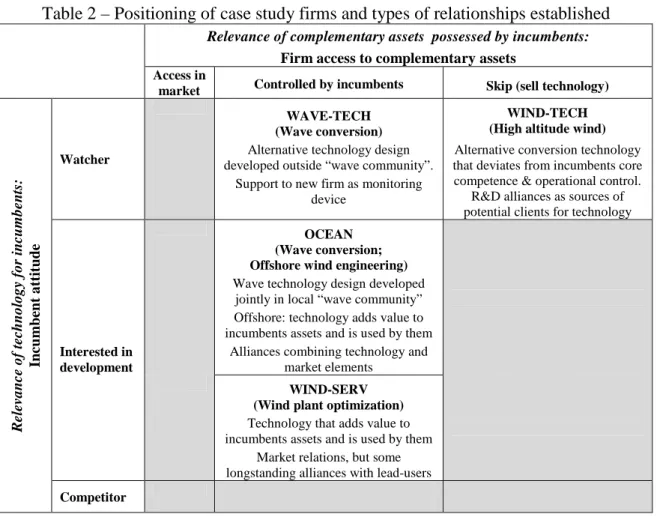
The above analysis enables us to uncover some sources of variation in the conditions experienced by firms, that can at least partly explain their positioning relatively to incumbents and thus the nature of the relationships established with them in the commercialisation process. Drawing on it, we can position the firms along the main dimensions of the “competitive environment”, as defined by our framework (Table 2).
10
Table 2 – Positioning of case study firms and types of relationships established
Relevance of complementary assets possessed by incumbents: Firm access to complementary assets
Access in
market Controlled by incumbents Skip (sell technology)
R el ev a n ce o f te ch n o lo g y fo r in cu m b en ts : In cu m b en t a tt it u d e Watcher WAVE-TECH (Wave conversion)
Alternative technology design developed outside “wave community”.
Support to new firm as monitoring device
WIND-TECH (High altitude wind)
Alternative conversion technology that deviates from incumbents core competence & operational control.
R&D alliances as sources of potential clients for technology
Interested in development
OCEAN (Wave conversion; Offshore wind engineering)
Wave technology design developed jointly in local “wave community” Offshore: technology adds value to incumbents assets and is used by them
Alliances combining technology and market elements
WIND-SERV (Wind plant optimization)
Technology that adds value to incumbents assets and is used by them
Market relations, but some longstanding alliances with lead-users
Competitor
Considering the generic commercialisation environments proposed by Gans and Stern (2003), it is possible to conclude that the “ideas factory” environment appear to prevail in the energy fields analysed, although we observe at least one emerging technology that has potential to operate outside the centralised regime favoured by incumbents (high-altitude wind) and thus offer different conditions. But the case studies permitted to go in greater depth into the nature of the relationships that are associated with different positioning of the new firms relative to incumbents and different attitudes of the later. In both fields, most new firms depend more or less clearly on the complementary assets possessed by large energy incumbents, although the analysis enable us to understand that this happens for different reasons and assumes different forms, depending on the energy field and also the on technology. In wind, this results from a combination of incumbents’ dominant position in the industry and interest in the complementary technologies that add value to their assets. This is valid for both onshore and offshore, because despite the less mature stage of the technology in the latter, the relative position and function of the two actors is similar. Thus, new firms act as specialised technology suppliers to incumbents, establishing market relationships with them, which are more arms-length in onshore given the maturity of the technology and the wider number of customers. But we observe, in both cases, the presence of closer, longstanding relations with an important role in the early market introduction of the technology (in onshore) or in the access to service opportunities (in offshore).
In wave, where technology still has a “niche” nature, it results from the strong interest and resulting positioning of a number of incumbents (national and foreign) in the emerging field. Thus, the new firms develop the conversion technologies, but
11
incumbents have a dominant position in what concerns the resources and infrastructures required for test and demonstration. They are also well positioned to come to control the final installations, which are likely to match their operational competences and knowledge base and to require important investments. The nature of relationships established depends on the degree of incumbents’ familiarity with the technology: close, longstanding relationships when they were involved in the development of a given design vs. monitoring of alternative designs, through the identification and early support of new companies introducing them.
Despite the small number of cases, it is possible conclude that in the energy fields being analysed there appears to be some incumbents’ interest in the new technologies - and even some involvement in their development and use. On the other hand, the incumbents’ attitude appears to be beneficial for the early activity of the new firms, providing resources, markets and legitimacy. However, it also implies a great dependency on powerful companies, which is stronger when the number of incumbents involved in the field or interested in the technology is smaller, as becomes particularly evident in the case of wave energy. Indeed, new firms operating in this field search for partnerships with foreign companies, which can offer greater scope for exploitation and limit the threat of excessive dependence on one large partner.
5. Conclusions
This paper investigated the strategies open to new firms introducing advanced RET in the particular context of the electricity production sector. Given the nature of the sector – that combines a strong incumbent power with fast technological development - particular attention was put on the new firms’ position relative to the large established companies and on the attitudes of the latter towards the new technology.
An analytical framework was developed and tested on the basis of case studies in two fields with different levels of technology maturity: wind and wave energy. The research presented in this paper, although still preliminary, permitted an in-depth analysis of the strategies adopted by the new firms and provided some insights into the behaviour of incumbents in these fields. These first results suggest that both fields are characterised by a competitive environment where: new research-based firms tend to depend, to a greater or lesser extent, on the downstream complementary assets possessed by large energy incumbents (unless they opt for selling the technology), but have the conditions to protect their technology from appropriation (mostly with patents); and where the technology is relevant for (at least some of) the incumbents, which show interest in their development, although with different levels of involvement. This is conducive to “cooperation strategies”, which can assume diverse forms, depending on the stage of development of the field, the maturity of the technology and its proximity to the incumbents’ knowledge base and operational competences.
Subsequent research will expand these results by applying the framework to a larger number of cases along the different categories considered, in order to verify whether these preliminary results are confirmed and to achieve a more precise understanding of the modes of interaction between the different actors. It will also be relevant to extend the analysis to energy fields with a less centralised regime (such as solar energy), where the competitive environment may differ, leading to potentially different strategies.
12
References
Ansari, S. and Krop, P., 2012, Incumbent performance in the face of a radical innovation: Towards a framework for incumbent challenger dynamics, Research Policy, 41, 1357– 1374.
Arora, A. and Merges, R., 2004, Specialized Supply Firms, Property Rights and Firm Boundaries. Industrial and Corporate Change, 13, 451-475.
Arora, A., Fosfuri, A. and Gambardella, A., 2001, Markets for technology and their implications for corporate strategies. Industrial and Corporate Change, 10(2), 419–51.
Ayari, N,. Blazsek, S. and Mendi, P., 2012, Renewable energy innovations in Europe: a dynamic panel data approach. Applied Economics, 44 (24), 3135-3147.
Brown J.E., Hendry, C.N. and Harborne, P., 2007, Developing Radical Technology for Sustainable Energy Markets: The Role of New Small Firms. International Small Business Journal, 25(6), 603-630. Colombo, M., Grilli, L. and Piva, E., 2006, In search of complementary assets: the determinants of
alliance formation of high-tech start-ups. Research Policy, 35, 1166–99.
Conceição, O., Fontes, M. and Calapez, T., 2012, The commercialisation decisions of research-based spin-offs: targeting the market for technologies. Technovation, 32, 43-56.
Duncan, R., 2010, Renewable Energy and the Utility: The Next 20 Years. Renewable Energy World 2(3). Gans, J. and Stern, S., 2003, The product market and the market for “ideas”: commercialisation strategies
for technology entrepreneurs. Research Policy, 32, 333– 50.
Fontes, M, Sousa, C. and Pimenta, S., 2012, The commercialisation of emerging energy technologies: the strategic alliances of high technology entrepreneurial firms, DINAMIA’CET Working Paper 2012/05. Geels, F. W., 2002, Technological transitions as evolutionary reconfiguration processes: a multi-level
perspective and a case study. Research Policy, 31(8-9), 1257-1274.
Hekkert, M.P. and Negro, S.O., 2009, Functions of innovation systems as a framework to understand sustainable technological change: Empirical evidence for earlier claims. Technological Forecasting and Social Change, 76(4), 584-594.
Hockerts, K. and Wüstenhagen, R., 2010, Greening Goliaths versus emerging Davids — Theorizing about the role of incumbents and new entrants in sustainable entrepreneurship, Journal of Business Venturing, 25, 481–492.
IPCC, 2011, IPCC Special Report on Renewable Energy Sources and Climate Change Mitigation. Cambridge University Press, http://srren.ipcc-wg3.de/report/IPCC_SRREN_Full_Report.pdf.
Jacobsson, S. and Bergek, A., 2004, Transforming the energy sector: the evolution of technological systems in renewable energy technology. Industrial and Corporate Change, 13(5), 815-849.
Jäger-Waldau, A. Szabó, M., Scarlat, N. and Monforti-Ferrario, F., 2011, Renewable electricity in Europe. Renewable and Sustainable Energy Reviews, 15, 3703–3716.
Kishna. M.J., Negro, S. and Hekkert, M., 2011, Uncovering the strategies of environmental-technology entrepreneurs, DIME-DRUID Academy Winter Conference, 20-22 January 2011, Aalborg, Denmark. Levinthal, D., 1997, Adaptation on Rugged Landscapes. Management Science, 43, 934–950.
Markard J. and Truffer, B., 2008, Technological innovation systems and the multi-level perspective: towards an integrated framework. Research Policy, 37, 596–615.
MEID, 2010 – RE.NEW.ABLE. A Inspirar Portugal - Plano Novas Energias 2020 (ENE 2020). Ministério da Economia, Inovação e Desenvolvimento, Lisboa.
Mustar, P., Renault, M., Colombo, M., Piva, E., Fontes, M., Lockett, A., Wright, M., Clarysse, B. and Moray, N., 2006, Conceptualising the heterogeneity of research-based spin-offs: a multi-dimensional taxonomy, Research Policy, 35, 289–308.
Raven, R., 2007, Niche accumulation and Hybridisation strategies in transition processes towards a sustainable energy system. Energy Policy, 35(4), 2390-2400.
Rothaermel, F.T., 2001, Complementary assets, strategic alliances, and the incumbent’s advantage: an empirical study of industry and firm effects in the biopharma industry. Research Policy, 30, 1235–51. Schoettl, J. and Lehmann-Ortega, L., 2010, Photovoltaic Business Models: Threat or Opportunity for
Utilities? In R. Wüstenhagen & R. Wuebker (Eds.). Handbook of Research on Energy Entrepreneurship, Edward Elgar Publishing Ltd, London, pp. 145-171.
Sine, W. and David, R.J, 2003, Environmental jolts, institutional change, and the creation of entrepreneurial opportunity in the US electric power industry. Research Policy, 32, 185-207.
Teece, D.J., 1986, Profiting from technological innovation: implications for integration, collaboration, licensing and public policy. Research Policy, 15, 285–305.
Verbong, G. and Geels, F., 2010, Exploring sustainability transitions in the electricity sector with socio-technical pathways. Technological Forecasting & Social Change, 77, 1214-1221.
Wüstenhagen, R. and Wuebker, R. 2010, An introduction to energy entrepreneurship research. In R. Wüstenhagen & R. Wuebker (Eds.). Handbook of Research on Energy Entrepreneurship, Edward