IRINA: Iris Recognition (even) in Inaccurately Segmented Data
Hugo Proenc¸a and Jo˜ao C. Neves
IT - Instituto de Telecomunicac¸˜oes
University of Beira Interior, Portugal
{hugomcp,jcneves}@di.ubi.pt
Abstract
The effectiveness of current iris recognition systems de-pends on the accurate segmentation and parameterisation of the iris boundaries, as failures at this point misalign the coefficients of the biometric signatures. This paper de-scribes IRINA, an algorithm for Iris Recognition that is ro-bust against INAccurately segmented samples, which makes it a good candidate to work in poor-quality data. The pro-cess is based in the concept of ”corresponding” patch be-tween pairs of images, that is used to estimate the posterior probabilities that patches regard the same biological region, even in case of segmentation errors and non-linear texture deformations. Such information enables to infer a free-form deformation field (2D registration vectors) between images, whose first and second-order statistics provide effective bio-metric discriminating power. Extensive experiments were carried out in four datasets (IrisV3-Lamp, CASIA-IrisV4-Lamp, CASIA-IrisV4-Thousand and WVU) and show that IRINA not only achieves state-of-the-art performance in good quality data, but also handles effectively severe seg-mentation errors and large differences in pupillary dilation / constriction.
1. Introduction
Iris recognition is a mature technology, with systems successfully deployed in domains such as border controls, computers login and national ID cards. Since the pioneer al-gorithm [5] proposed in 1993, a long road has been travelled in iris biometrics research [2], with two major weaknesses subsisting:
• accurate segmentation and parameterization of the iris boundaries is required to image normalisation. As most of the iris encoding / matching strategies are phase-based, failures in segmentation lead to bit shift-ing in the biometric signatures, with a correspondshift-ing increase of false rejections;
• false rejections also increase in case of severely dilated
/ constricted pupils, which cause non-linear deforma-tions in the iris texture that are only partially compen-sated by the normalisation phase. Pupil movements laterally pressure the iris, with some of the fibers fold-ing underneath others and changfold-ing texture appear-ance.
Note that 1) varying lighting conditions change the lev-els of pupillary dilation; and 2) less constrained acquisi-tion protocols reduce data quality and make hard to accu-rately parameterise the iris boundaries. Hence, the robust-ness of recognition can be seen as the major concern be-hind the method proposed in this paper (IRINA), keeping as main goal to achieve state-of-the-art performance in good-quality data while also handling segmentation inaccuracies and non-linear texture deformations.
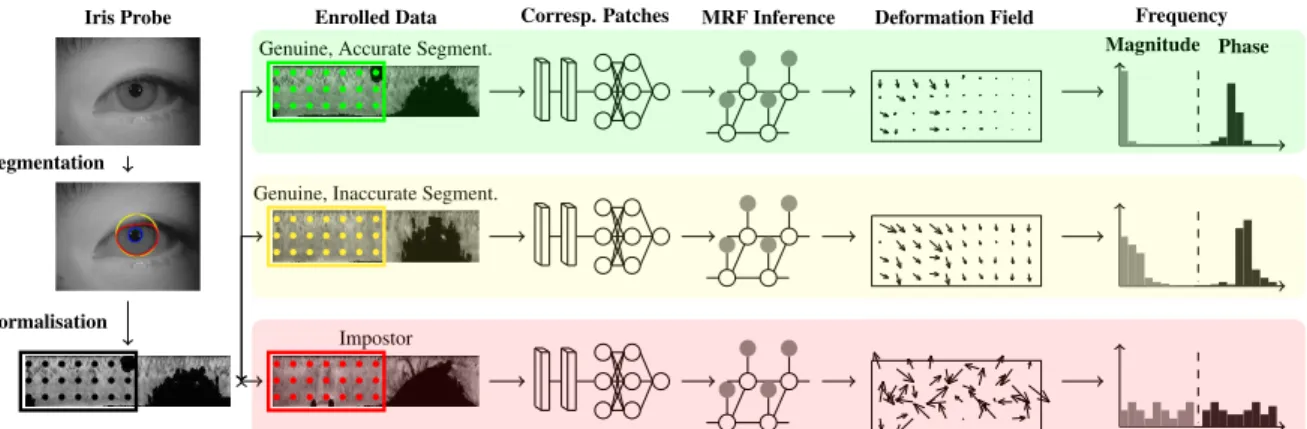
A cohesive perspective of IRINA is given in Fig.1, with a processing chain divided into three phases:
1. we estimate the posterior probabilities that patches from two iris samples correspond, even in case of non-linear texture deformations. Starting from a learning set of manually annotated point correspondences that define convex polygons, we densely sample these re-gions and obtain a large number of patches considered to regard the same biological region. This information feeds a convolution neural network (CNN), that: a) ex-plicitly discriminates between the corresponding and non-corresponding patches; and b) implicitly learns the typical iris texture deformations;
2. we infer a free-form deformation field (set of 2D vec-tors) that registrates pairs of samples represented in normalised coordinates. This step is formulated us-ing a discrete Markov random field (MRF), with unary costs provided by the responses of the CNN, and pair-wise costs imposing smooth solutions that penalize lo-cal gradients of the deformation field. The loopy belief propagation (LBP) algorithm [8] is used to solve the image registration problem;
Iris Probe
Segmentation
Normalisation
Enrolled Data Genuine, Accurate Segment.
Genuine, Inaccurate Segment.
Impostor
MRF Inference
Corresp. Patches Deformation Field Frequency Magnitude Phase
Figure 1. Overview of IRINA’s processing chain. The first and second order statistics of the free-form deformation vector fields are the basis for biometric recognition. Deformation fields are exaggerated for illustration purposes.
3. for biometric recognition, the key observation is that genuine deformation fields (between samples of the same subject) are composed of 2D vectors with phase and magnitude gradients substantially smaller than those of impostors. First and second-order statistics of these vectors provide the discriminating information for biometric recognition.
Belonging to the discriminative family of pattern recog-nition methods, IRINA’s rationale is evidently original with respect to the state-of-the-art, in which the generative paradigm rules: apart from assuming that data is accurately segmented, previous methods consider that no parts of the iris texture appear / vanish due to pupillary dilation. As an example, Thornton et al. [28] assume that the iris re-gions unaffected by pupil dilation still provide enough in-formation for matching (providing the insight for subse-quent works [14] and [24]) , while other authors provided (inevitably rough) parameterizations of iris deformations (e.g., [33], [4] and [29]). In a discriminative approach, Ross et al. [21] propose an information fusion framework where three distinct feature extraction and matching schemes are fused to handle the significant variability in the input ocular images. Finally, note that our idea of corresponding patch is different from the used in keypoint-matching iris recogni-tion algorithms, which analyzed the geometric distriburecogni-tion of perfectly matching pairs of keypoints between two im-ages (e.g., using SIFT descriptors [1]), but fail in case of varying levels of focus, lighting or non-linear iris deforma-tions.
1.1. Iris Recognition
Given the maturity of iris biometrics technology, strides have been concentrated in improving particular features of the recognition process: i) extending the data acquisition volume; ii) improving performance in less constrained
con-ditions; iii) augment the human interpretability of results; iv) develop cancellable signatures; and v) provide inter-sensor operability.
In terms of the data acquisition volume, a good exam-ple is the iris-on-the-move system [17], that acquires data from subjects walking through a portal. For similar pur-poses, Hsieh et al. [13] used wavefront coding and super-resolution techniques. In terms of the recognition robust-ness, Dong et al. [7] proposed an adaptive personalized matching scheme that highlights the most discriminating features. Pillai et al. [19] used the sparse representa-tion for classificarepresenta-tion algorithm in randomly projected iris patches, claiming to increase the robustness against acquisi-tion artefacts. Yang et al. [32] relied in high-order informa-tion to perform iris matching, while Alonzo-Fernandez et al. [9] focused in the image enhancement phase, propos-ing a super-resolution method based on PCA and eigen-transformations of local iris patches. Bit consistency is also a concern, with several approaches selecting only parts of the biometric signatures for matching (e.g. [12], [27] and [16]).
Under complementary perspectives, the lack of inter-pretability hinders the use of iris recognition in foren-sics [3]. Also, inter-sensor recognition provided the moti-vation for Pillai et al. [20], which learned transformations between data acquired by different sensors. Cancellable biometrics is a privacy-preserving solution that requires to find hardly invertible transfer functions of the biometric data into different domains: Zhao et al. [34] proposed the concept of negative recognition, using only complementary information (p-hidden algorithm) of the biometric data for matching. Finally, according to the growing popularity of CNNs, various approaches based on this paradigm appeared recently in the literature, either for specific phases of the recognition chain (e.g., segmentation [15] or spoofing
de-tection [18]) or for the whole process [10].
1.2. Image Registration
Image registration involves three components: i) a trans-formation model that maps regions of one image into re-gions of another; ii) a similarity criterion, that quantifies the nearness between image patches; and iii) an optimization strategy, that finds a global mapping between both images.
Transformation models can be global / local. The first family includes linear transformations such as rotation, scaling, translation and affine. Local transformations allow to warp regions of one image into another, using radial basis functions, physical continuum and large deformation models. The similarity criterion quantifies how much one image patch resembles another one in the reference data, using cross-correlation, mutual information or other distance functions. Similarity can be intensity or feature-based, with the latter family matching the most complex structures as lines and curves, based in spatial and frequency information. Finally, during optimization the set of parameters that optimally match both images are found. Exhaustive search techniques were firstly used here, but later abandoned due to their reduced computational feasibility. Modern approaches use optimization algorithms and gradient-free / gradient based techniques to derive reasonable solutions, which might be sub-optimal in case of non-convex cost functions. For additional information, Sotiras et al. [25] provide an overview of the state-of-the-art in image registration.
The remainder of this paper is organized as follows: Section2 provides a detailed description of the proposed method. In Section3we discuss the obtained results and the conclusions are given in Section4.
2. Proposed Method
2.1. Corresponding Iris Patches
The concept of corresponding patches between pairs of iris images is the key to learn the typical non-linear de-formations in normalized representations of the iris due to pupillary dilation / constriction and segmentation errors.
Iris recognition systems comprise a normalisation phase [6] that compensates for differences in scale, per-spective and pupillary dilation, assuming that iris deforma-tions are linear and limited to the radial direction. This does not compensate for the actual deformations, which are non-linear, radial and angular, with fibers vanishing / appearing for different levels of pupillary dilation [30]. Several au-thors proposed non-linear iris normalization schemes to at-tenuate the problem: Wyatt [31] developed a mathematical model to explain how the collagen fibers in the iris deform and Yuan and Shi [33] proposed a scheme based on that
model. Also, Clark et al. [4] described a theoretical model for the iris dynamics, used subsequently by Tomeo-Reyes et al. [29].
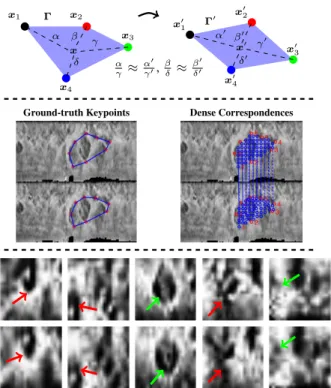
To infer the corresponding patches, we use pairs of nor-malized samples from the same subject and manually anno-tate sets of control points that (by visual inspection) seem to regard the same biological region. These control points de-fine two convex polygons Γ and Γ0and are represented by the coloured dots (xiand x0i) in the upper part of Fig.2. Let xi= (xi, yi) and x0i= (x0i, yi0), i = {1, . . . n} be the loca-tions of pointwise correspondences. We learn two funcloca-tions fr, fcthat establish a dense set of correspondences between positions (rows, columns) in Γ and Γ0, fr, fc : N2→ N , such that∀ x0
i∈ Γ0, x0i=!fc(x), fr(x)":
fc(x) = λTc[φ, p(x)], (1) fr(x) = λTr[φ, p(x)], (2) with φ = ⇥φ!|x − x1|2", . . . , φ!|x − xn|2"⇤, |.|2 repre-senting the `2 norm, φ(r) = e(−r/κ)
2
being a radial basis function and p(x) = [1, x, y] being a polynomial basis of first degree for a 2-dimensional vector space ( = 0.1 was used in all our experiments).
In order to obtain the λ coefficients, we define a n× n matrix A, Ai,j = φ!|xi− xj|2" and P as the n × 3 polyno-mial basis matrix, such that P = [p(x1); . . . ; p(xn)]. Then, λcand λrare given by:
λc= A P PT 0 &−1 x0 c 0 & (3) λr= A P PT 0 &−1 x0 r 0 & (4) with x0c=[x0
1, . . . , x0n]T and x0r=[y01, . . . , y0n]T concatenat-ing the horizontal (column) and vertical (row) positions of the control points in Γ0.
According to this procedure, we deem that positions x∈ Γ correspond biologically to x0 = !fc(x), fr(x)
" ∈ Γ0. As Γ and Γ0have different size and shape, this set of corre-spondences implicitly encodes the non-linear deformations that affect the iris texture. Finally, we consider patches P (from Γ) and P0(from Γ0) of21 × 21 pixels, cropped from the learning data and centered at each point correspondence. Using 320 images (from 75 subjects) of the CASIA-IrisV3-Lamp set, 510,000 corresponding Ci,j patches (Ci,j = [Pi, Pj0; Pj0, Pi]) were cropped. Also, using im-age pairs from different subjects, another 510,000 non-corresponding ¯Ci,j patches were created. Both were used to train a CNN that extracts high-level texture informa-tion and distinguishes between the corresponding / non-corresponding patches. Note that the iris boundaries in this
x α β γ δ x0 α0 β0 γ0 δ0 Γ Γ0 x1 x01 x2 x02 x3 x0 3 x4 x 0 4
Ground-truth Keypoints Dense Correspondences α γ ⇡ α0 γ0,βδ ⇡ β 0 δ0
Figure 2. Concept of corresponding iris patches. The top part of the figure gives a schema of the way correspondences are found: based on a set of manually marked corresponding control points between two iris samples (x.and x0.), two polygons (Γ and Γ0) are
defined. Next, for every point inside Γ, the corresponding position in Γ0is found (middle row). The bottom part of the figure shows
five pairs of corresponding iris patches, where non-linear defor-mations (red arrows), and vanishing / emerging regions (green ar-rows) inside each patch are evident.
learning set (obtained as described in Sec. 3.1) were not manually confirmed, i.e., there are accurately and inaccu-rately samples in this set, which is important to infer the deformations in the iris texture yielding from segmentation failures.
The CNN input is42×42 image patches and its architec-ture (Fig.3) is composed of six layers (three convolutional plus three fully connected layers): the first convolutional layer uses 32 kernels (3×3), and the next ones are composed of 64 kernels of size3 × 3 × 32. The responses from these layers feed max-pooling layers (stride equals to 1, given the relatively small size of the input data). Next, there are two fully connected layers, each one with 256 cells. The output is a soft max loss corresponding to the probability of two iris patches to correspond. Learning was done according to the stochastic gradient descend algorithm, with an initial learn-ing rate of 1e−2, momentum set to 0.9 and weight decay equals to1e−3.
The responses of the CNN enable to obtain the posterior probabilities that two iris patches regard the same
biologi-42 42 32 38⇥ 38 36⇥ 36 17⇥ 17 64 5⇥ 5 3⇥ 3 ⇥ 32 max(), 3⇥ 3 ⇥ 64 max() 256 256 64
Figure 3. Structure of the convolutional neural network (CNN) used to discriminate between the corresponding and non-correspondingiris pairwise patches.
cal region. Such information enters a Markov random field (MRF), which energy minimization provides the solution to the image registration problem, used as information source for biometric recognition.
2.2. Deformation Field Inference
We consider a free-form transformation model [22] to represent a deformation field, expressed as a set of 2D vec-tors d∈ Z2at control points ˚x∈ N2. We superimpose a r × c regular grid at positions G = {˚x1, . . . , ˚x|G|}, |G|=r.c, over the left half of the normalized images representation (corresponding to the lower part of the iris that is less prune to occlusions and shadows). Also, we assume that deforma-tions at any position d(x) can be obtained by interpolating the closest control points deformations [11]:
d(x) = |G| X
i=1
⌫(x) d(˚xi), (5)
with d(˚xi) representing the deformation at the ith control point and ⌫() being the interpolation function.
LetG = (V, E) be a graph representing a MRF, com-posed of a set of tv verticesV, linked by teedges E. In our model, every control point of G is a vertex ofG, i.e., tv= |G| and te= 2.r.c − r − c, using a typical grid con-figuration (4-neighborhood). The MRF is a representation of a discrete latent random variable L = {Li}, ∀i ∈ V, where each element Litakes one value lifrom a set of labels (each corresponding to a deformation vector d). In practi-cal terms, having the ithimage patch centered at position x, we find its corresponding patch in the second sample at po-sitions x+ m, m= (m1, m2), mi∈ {−mmax, . . . mmax}. We use mmax= 7 in our experiments (Fig.4).
Let l = {l1, . . . , ltv} be one configuration of the MRF.
The energy of l is the sum of the unary υi(li) and pairwise υ(li, lj) potentials: E(l) =X i2V υi(li) + X (i,j)2E υ(li, lj). (6)
According to this formulation, obtaining the deformation model between a pair of images is equivalent to infer the random variables in the MRF that minimize its energy:
ˆ
l= arg min
l E(l), (7)
whereˆl= {ˆl1, . . . , ˆltv} (ˆli≡ di) are the labels inferred. In
all cases, MRFs were optimized according to the Loopy Be-lief Propagation [8] algorithm. Even though it is not guar-anteed to converge to global minimums on loopy non-sub modular graphs (such as ours), we concluded that the algo-rithm provides acceptable solutions most of the times. 2.2.1 Unary Costs
Let ⌘(i, j) : N2→ [0, 1] be the CNN response for one pair of patches, expressing the likelihood p!⌘(i, j) | Ci,j" that the ithpatch of one sample corresponds to the jthpatch of its counterpart. According to the Bayes rule, and assuming equal priors, the posterior probability functions are given by: p!Ci,j| ⌘(i, j)" = p!⌘(i, j) | Ci,j " P|M| k=1p!⌘(i, k) | Ci,k ", (8)
with|M | expressing the number of positions in the second image where we search for the position corresponding to the ithpatch. This way, the unary costs of the labels in each vertex are defined as:
υi(li) = ↵ ⇣
1 − p!Ci,j | ⌘(i, j)" ⌘
, (9)
with ↵ ∈ [0, 1] determining the trade-off between the strength of the unary to the pairwise costs in MRF opti-mization.
2.2.2 Pairwise Costs
In our model, the pairwise costs serve to control the deriva-tives in the deformation field, i.e., penalise adjacent posi-tions with dramatically different deformation vectors that are not biologically plausible.
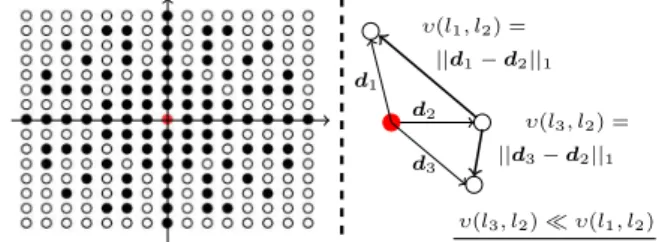
Let l represent a deformation vector d ∈ Z2 for one control point. For computational purposes, it is important to discretise the solution space, not only limiting the max-imum displacement mmaxallowed for d, but also defining an appropriate sampling strategy (dense sampling produces (2.mmax+ 1)2 labels). Based in [11], we use a circular sparse grid with p42.⇡. r nodes, r = {1, . . . , mmax} at positions x = ir.cos(✓), y = ir.sin(✓), ✓ ∈ [0, 2⇡], be-ing i the samplbe-ing rate at the r-radius circumference. This
sparse sampling strategy reduces over 50% the number of labels without significant decreases in the method perfor-mance (leftmost part of Fig.4).
d1 d2 ||d1− d2||1 υ(l1, l2) = d3 ||d3− d2||1 υ(l3, l2) = υ(l3, l2) ⌧ υ(l1, l2) Figure 4. At left: comparison between the number of labels (max-imum displacement mmax = ±7) when using a sparse sampling
strategy, with respect to the dense sampling variant (solid black points denote the displacements diusing the sparse sampling
strat-egy, while the white points would have been also considered by the dense sampling strategy). At right: schema of the pairwise cost υ(li, lj) for observing two displacement vectors (d1, d2) and
(d3, d2) in adjacent positions of the deformation field: d1being
farther than d3from d2implies that υ(l3, l2) ⌧ υ(l1, l2).
Finally, the pairwise cost for labelling two adjacent nodes is defined by:
υ(li, lj) = (1 − ↵) |di− dj|1, (10) being|.|1the `1norm.
2.3. Classification
The biometric recognition task is regarded as a binary classification problem. We use a machine-learned classifier to discriminate between the set of features extracted from positive (genuine) and negative (impostor) pairwise defor-mation fields. Let ˆl = {ˆl1, . . . , ˆltv} represent the set of
labels returned by the MRF. Each label li corresponds bi-jectively to a free form deformation vector di ∈ Z2 at a position x of the normalised coordinates space. We extract the histogram of magnitudes and phase angles of di and their second-order statistics (local energy and homogeneity) from the magnitude and phase maps (with 6× 12 vectors, taken in 3 × 3 and 5 × 5 regions, using stride 3 and 5), yielding 34 features that feed the binary discriminant (SVM in our case). A disjoint set from the CASIA-IrisV3-Lamp set (with 3,000 genuine / 3,000 impostor pairwise compar-isons) was used as learning data at this point.
3. Results and Discussion
3.1. Datasets and Experimental Setting
IRINA was empirically validated in four iris datasets: CASIA-IrisV3-Lamp, CASIA-IrisV4-Lamp,
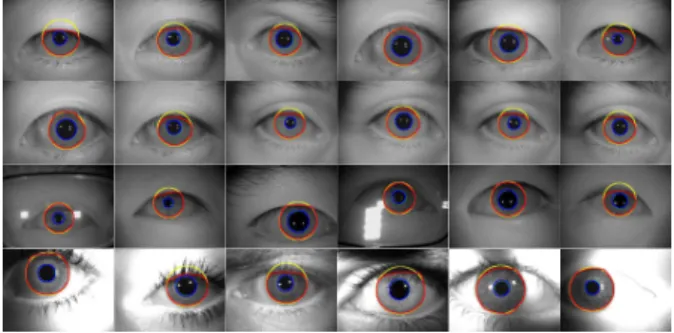
CASIA-IrisV4-Thousand 1 and WVU. 2. Examples are given in Fig. 5, showing the degradation factors of each set: off-angle and occluded irises, glasses, dilated / constricted pupils (all sets) and shadows (WVU). 500 classes (eyes) per data set were used: for all the CASIA-Iris sets, 10 images per class were considered, while for the WVU the number of images per class varied between 2 and 10. All images were successfully segmented according to a coarse-to-fine strategy [23], composed by a form fitting step and a geodesic active contours algorithm. This way, we accurately parameterize the iris boundaries, having the pupillary contour described by shapes of 20 degrees-of-freedom (dof) and the scleric boundary described by 3 dof. At this point, images were normalised into the pseudo polar domain [6] and their right halves were discarded (corresponding to the upper half of the irises in the original representation).
Figure 5. Datasets used in IRINA’s empirical validation. From top to bottom rows, images of the IrisV3-Lamp, CASIA-IrisV4-Lamp, CASIA-IrisV4-Thousand and WVU sets are shown.
As baselines, the methods due to Yang et al. [32] (using the O2PT iris-only variant, with block size w= 2, h = 14, translation vector[6, 3]Tand neighbourhood8 × 8) and Sun and Tan [26] (with dilobe and trilobe filters, Gaussians5×5, σ = 1.7, inter-lobe distances {5,9} and sequential feature selection) were firstly considered, as both concern about the robustness of recognition to pupillary dilation and to non-linear iris deformations. Also, the method due to Belcher and Du [1] (with 64 bins = 4 (horizontal)× 4 (vertical) × 4 (orientation), SIFT descriptors extracted using VLFeat package3) was chosen due to the fact of being
keypoints-based, even though its results cannot be considered state-of-the-art anymore. Three performance measures are reported: the decidability index (d0), the area under curve (AUC) and the receiver operating characteristic curve (ROC). In all ex-periments, the pairwise comparisons per dataset were di-1CASIA iris image database, http://biometrics.
idealtest.org
2West Virginia University iris dataset,http://www.clarkson.
edu/citer/research/collections/
3http://www.vlfeat.org/
vided into random samples (drew with repetition), each one with 90% of the available pairs. Then, independent per-formance tests were conducted in each subset, with the obtained results approximating the confidence intervals at each point, according to a bootstrapping-like strategy.
3.2. Learning and Parameter Tuning
It is important to note that the learning data used in the CNN was exclusively composed of CASIA-IrisV3-Lamp images. Using randomly sampled learning / validation and test sets (with 60% / 20% / 20% of the available pair-wise comparisons), performance was tuned and all pa-rameters strictly kept for the remaining datasets, meaning that the CASIA-Iris-V4-Lamp, CASIA-IrisV4-Thousand and WVU were used exclusively as test sets. The left plot in Fig. 6 shows the decision environment resulting from the responses ⌘(i, j) of the CNN, to distinguish be-tween the corresponding Ci,j and non-corresponding ¯Ci,j iris patches. The likelihood functions p!⌘(i, j) | Ci,j" and p!⌘(i, j) | ¯Ci,j" in the CASIA-IrisV3-Lamp test set are shown.
In terms of IRINA’s parameterisation, the value set to ↵ (9) is the most sensitive, as it expresses the relative weight in the MRF between the unary and the pairwise costs. Here, ↵ = 1 corresponds to deformation vectors that are inde-pendent of their neighbours (no MRF would be required). In opposition, small ↵ values reduce the local variations in the deformation field, with values below 0.9 imposing con-stant deformation fields with poor biometric discriminabil-ity. The AUC values obtained with respect to the value of ↵ are shown in the right plot of Fig.6. Note the significantly best performance (and smallest variance) for the CASIA-IrisV3-Lamp among all sets, due to the learning data that fed the CNN (same set, yet with disjoint instances). Based on these results, ↵ = 96.35 was used in all our subsequent experiments. 0 0.5 1 0 1 2 3 4 5 6 7 8 0.94 0.96 0.98 1 0.95 0.96 0.97 0.98 0.99 1 CASIA-IrisV3-Lamp CASIA-IrisV4-Lamp CASIA-IrisV4-Thousand WVU pdf η(i, j) p!η(i, j) | Ci,j " p!η(i, j) | ¯Ci,j" A UC α
Figure 6. Left plot: decision environment of the responses given by the CNN to distinguish between corresponding Ci,jand
non-corresponding ¯Ci,jiris patches (CASIA-IrisV3-Lamp set). Right
plot: variations in recognition performance with respect to the α parameter.
3.3. Accurately Segmented Data
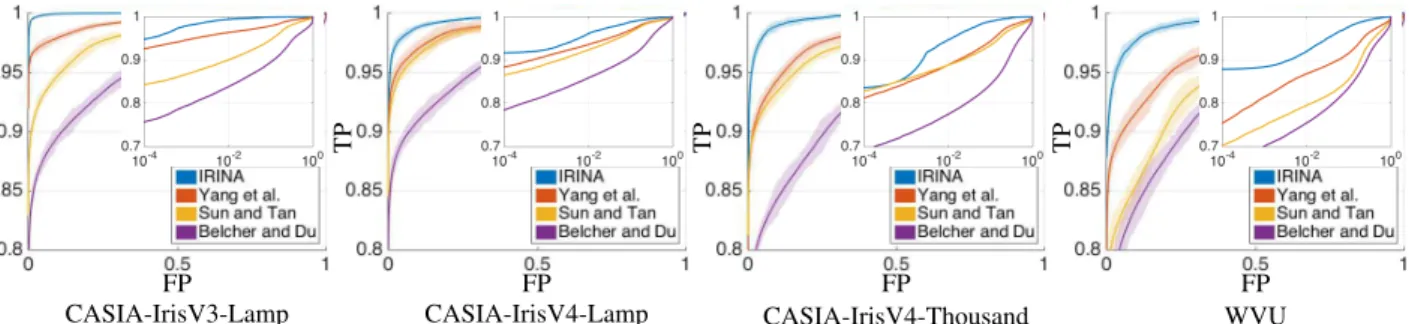
Performance was evaluated in two different settings: at first we used the accurate parameterisations of the iris boundaries, to perceive IRINA’s performance in relatively good quality data. Results are given in Fig.7, comparing the ROC curves (in linear and log scales) for the four meth-ods and four data sets considered. It can be seen that IRINA outperformed its competitors in all cases and regions of the performance space, with exception to a narrow band around FAR≈ 10−3in the CASIA-V4-Thousand. In the remain-ing cases, IRINA was considerably better than the other methods, at some operating points with reductions in FAR levels over 40% with respect to the second best approach (usually Yang et al.). At the other extreme, the method due to Belcher and Du got consistently the worst results in our experiments, due to the difficulties in finding exact key-point correspondences between images with different levels of focus or pupillary dilation. Overall, IRINA’s best per-formance among all methods is particularly evident in the CASIA-IrisV3-Lamp, where the decreases in the error rates (over the second-best strategy) almost reached one order of magnitude.
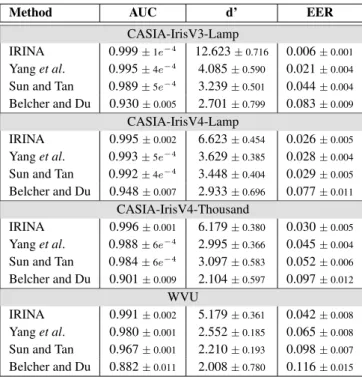
The most relevant performance indicators are sum-marised in Table 1. It should be noted that results re-ported here should not be directly compared to the last generation of iris recognition evaluation initiatives (Inter-national Biometric Group evaluation FRR 2-5%@ FAR≈ 1e−6 and Iris Challenge Evaluation FRR 1-3% @ FAR ≈ 1e−3), as the average quality of data here is substan-tially lower than in those contests. Even though, in or-der to provide easy baselines, IRINA obtained FRR lev-els at FAR≈ [1e−1,1e−2,1e−3,1e−4] of [0.001, 0.006, 0.021, 0.121] (CASIA-IrisV3-Lamp), [0.012, 0.039, 0.076, 0.084] (CASIA-IrisV4-Lamp), [0.011, 0.054, 0.140, 0.156] (CASIA-Iris-V4-Thousand) and [0.023, 0.080, 0.116, 0.121] (WVU).
3.4. Inaccurately Segmented Data
At a second stage, we added two type of errors (transla-tion and scale) to the iris boundaries parameterisa(transla-tions, to perceive the decreases in performance when the iris is in-accurately segmented. Segmentation errors of magnitude up to 21% were randomly generated, with ”magnitude” ex-pressing the difference between the maximum Euclidean distance between boundary points in the original and in the inaccurate segmentation parameterisation (e.g., for a circu-lar boundary with diameter of 100 pixels, a scale error of magnitude 10% will either change the diameter to 90 or 110 pixels, whereas a translation error will move the boundary 10 pixels in a random direction).
According to our observations, the inaccurate segmenta-tion setting is exactly when the advantages of IRINA with respect to the state-of-the-art are the most evident. The key
Method AUC d’ EER
CASIA-IrisV3-Lamp
IRINA 0.999± 1e−4 12.623± 0.716 0.006± 0.001
Yang et al. 0.995± 4e−4 4.085
± 0.590 0.021± 0.004
Sun and Tan 0.989± 5e−4 3.239
± 0.501 0.044± 0.004 Belcher and Du 0.930± 0.005 2.701± 0.799 0.083± 0.009 CASIA-IrisV4-Lamp IRINA 0.995± 0.002 6.623± 0.454 0.026± 0.005 Yang et al. 0.993± 5e−4 3.629 ± 0.385 0.028± 0.004
Sun and Tan 0.992± 4e−4 3.448
± 0.404 0.029± 0.005 Belcher and Du 0.948± 0.007 2.933± 0.696 0.077± 0.011 CASIA-IrisV4-Thousand IRINA 0.996± 0.001 6.179± 0.380 0.030± 0.005 Yang et al. 0.988± 6e−4 2.995 ± 0.366 0.045± 0.004
Sun and Tan 0.984± 6e−4 3.097
± 0.583 0.052± 0.006
Belcher and Du 0.901± 0.009 2.104± 0.597 0.097± 0.012
WVU
IRINA 0.991± 0.002 5.179± 0.361 0.042± 0.008
Yang et al. 0.980± 0.001 2.552± 0.185 0.065± 0.008
Sun and Tan 0.967± 0.001 2.210± 0.193 0.098± 0.007
Belcher and Du 0.882± 0.011 2.008± 0.780 0.116± 0.015
Table 1. Comparison between the performance obtained by IRINA with respect to three other strategies.
insight IRINA’ s robustness to segmentation failures is illus-trated in Fig.8, showing the deformation fields for genuine image pairwise comparisons, with accurate (green bound-aries) and inaccurate (red boundbound-aries) segmentations in the a)-c) rows, and one impostor comparison (bottom row) from the CASIA-IrisV4-Thousand set. Note that the impostor deformation field is almost chaotic, with much larger local derivatives than any genuine deformation field, where local correlation is evident.
The average decreases in performance with respect to segmentation inaccuracies up to 21% are given in Fig. 9
(mean AUC values, with 95% confidence intervals). It can be seen that IRINA almost kept its performance up to seg-mentation inaccuracies of 12%, and then slightly decreased its results, which could even be attenuated if larger mag-nitudes in the deformation field mmaxwere tolerated (yet, this would have increased the number of labels in the MRF and the computational cost). In opposition, both Yang et al. and Sun and Tan showed substantial decreases in per-formance even for relatively small segmentation errors, and almost loose any efficiency for errors larger than 15%. Fi-nally, as it is not phase-based, the method due to Belcher and Du proved to be relatively robust against segmentation inaccuracies, but at much lower performance levels than IRINA.
CASIA-IrisV3-Lamp FP CASIA-IrisV4-Lamp FP CASIA-IrisV4-Thousand FP WVU FP TP TP TP TP
Figure 7. Comparison between the ROC curves obtained for the three methods and four datasets considered. At each operating point, the confidence interval is denoted by the shade region.
Gallery (S5009L00 sample)
Probes (Segmentation) Free Form Deformation Fields
a) S5009L01
b) S5009L01
c) S5009L01
d) S5029R00
Figure 8. Examples of deformation fields with respect to failures in the segmentation of the iris. a) genuine comparison using an accu-rately segmented image; b) and c) genuine pairwise comparisons in inaccurately segmented data; d) impostor pairwise comparison. For illustration purposes, circular boundaries (3 dof) are used, as they provide the most evident patterns in the deformation fields.
OK (0%) Scale (-15%) Scale (+10%)Trans. (+10%) Tr+Sc (+15%) Segmentation Inaccuracies (Pupillary Boundary)
0% 3% 6% 9% 12% 15% 18% 21% 0.7 0.8 0.9 1 IRINA Yang et al. Sun and Tan Belcher and Du
A
UC
Inaccuracies Magnitude
Figure 9. Top row: examples of segmentation inaccuracies and their corresponding magnitudes. Bottom row: AUC values with respect to the magnitude of segmentation inaccuracies (CASIA-IrisV4-Thousand set).
4. Conclusions and Further Work
Iris recognition has limited robustness against failures in segmentation and dilated / constricted pupils. In this paper we proposed an algorithm (IRINA) to cope with such co-variates. The idea is to learn the ”corresponding” patches between pairs of iris samples non-linearly deformed due to segmentation failures and to pupillary dilation. A convo-lutional neural network is used for such purposes, which provides the information for an image registration step that matches patches of the query iris sample into the enrolled data. A Markov random field infers a free form deforma-tion field (set of 2D vectors), which first and second order statistics provide the discriminating information for biomet-ric recognition. Our experiments show that IRINA not only achieves state-of-the-art performance in good quality data, but also effectively handles severe segmentation errors and large differences in pupillary dilation / constriction.
As current work, we are concentrated in finding alternate strategies to obtain the 2D deformation fields and reduce the computational cost of matching.
Acknowledgements
This work was supported by UID/EEA/50008/2013 re-search program.
References
[1] C. Belcher and Y. Du. Region-based SIFT approach to iris recognition. Opt Lasers Engeneering, vol. 47, no. 1, pag. 139–147, 2009.2,6
[2] K. Bowyer, K. Hollingsworth and P. Flynn. A Survey of Iris Biometrics Research: 2008-2010. In M. J. Burge and K. W. Bowyer (eds), Handbook of Iris Recognition, Advances in Computer Vision and Pattern Recognition, pag. 15–54, Springer, 2013.1
[3] J. Chen, F. Shen, D. Chen and P. Flynn. Iris Recognition Based on Human-Interpretable Features. IEEE Transactions on Information Forensics and Security, vol. 11, no. 7, pag. 1476–1485, 2016.2
[4] A. Clark, S. Kulp, I. Herron and A. Ross. A theoretical model for describing iris dynamics. In M. J. Burge and K. W. Bowyer (eds), Handbook of Iris Recognition, Advances in Computer Vision and Pattern Recognition, pag. 129–150. Springer, 2013.2,3
[5] J. Daugman. High Confidence Visual Recognition of Persons by a Test of Statistical Independence. IEEE Transactions on Pattern Analysis and Machine Intelligence, vol. 15, no. 11, pag. 1148–1161, 1993.1
[6] J. Daugman. How iris recognition works. IEEE Transactions on Circuits and Systems for Video Technology, vol. 14, no. 1, pag. 21–30, 2004.3,6
[7] W. Dong, Z. Sun and T. Tan. Iris matching based on person-alized weight map IEEE Transactions on Pattern Analysis and Machine Intelligence, vol. 33, no. 9, pag. 1744–1757, 2011.2
[8] P. Felzenszwalb and D. Huttenlocher. Efficient Belief Prop-agation for Early Vision. International Journal of Computer Vision, vol. 70, no. 1, pag. 41–54, 2006.1,5
[9] F. Alonso-Fernandez, R. Farrugia and J. Bigun. Eigen-Patch Iris Super-Resolution for Iris Recognition Improvement. In proceedings of the 23rdEuropean Signal Processing Confer-ence, doi: 10.1109/EUSIPCO.2015.7362348, 2015. 2
[10] A. Gangwar and A. Joshi. DeepIrisNet: Deep Iris Repre-sentation With Applications in Iris Recognition and Cross-Sensor Iris Recognition. In proceedings of the International Conference on Image Processing, pag. 2301–2015, 2016.3 [11] B. Glocker, N. Komodakis, N. Navab, G. Tziritas and
N. Paragios. Dense Registration with Deformation Priors. Information Processing in Medical Imaging, vol. 21, pag. 540–551, 2009.4,5
[12] Y. Hu, K. Sirlantzis and G. Howells. Exploiting stable and discriminative iris weight map for iris recognition under less constrained environment. In proceedings of the IEEE Inter-national Conference on Biometrics Theory, Applications and Systems, pag. 1–8, 2015.2
[13] S-H. Hsieh, Y-H. Li, C-H. Tien and C-C. Chang. Extend-ing the Capture Volume of an Iris Recognition System UsExtend-ing Wavefront Coding and Super-Resolution. IEEE Transactions on Cybernetics, doi: 10.1109/TCYB.2015.2504388, 2016. 2
[14] B. Vijaya Kumar, J. Thornton, M. Savvides, V. Boddeti and J. Smereka. Application of Correlation Filters for Iris Recog-nition. Handbook of Iris Recognition , pag. 337–354, 2013. 2
[15] N. Liu, H. Li, M. Zhang, J. Liu, Z. Sun and T. Tan. Ac-curate Iris Segmentation in Non-cooperative Environments Using Fully Convolutional Networks. In proceedings of the International Conference on Biometrics, pag. 1–8, 2016.2 [16] N. Mahadeo, A. Paplinski and S. Ray. Optimization of Iris
Codes for Improved Recognition. In proceedings of the IEEE Conference on Computer Vision and Pattern Recog-nition Workshops, pag. 48–55, 2014.2
[17] J. Matey, O. Naroditsky, K. Hanna, R. Kolczynski, D. Lolanoco, S. Mangru, M. Tinker, T. Zappia and W. Zhao. Iris on the move: Acquisition of images for iris recognition in less constrained environments. Proceedings of the IEEE, vol. 94, no. 11, pag. 1936–1947, 2006.2
[18] D. Menotti, G. Chiachia, W. Schwartz, H. Pedrini, A. Falc˜ao and A. Rocha. Deep Representations for Iris, Face, and Fin-gerprint Spoofing Detection. IEEE Transactions on Infor-mation Forensics and Security, vol. 10, no. 4, pag. 864–879, 2015. 3
[19] J. Pillai, V. Patel, R. Chellappa and N. Ratha. Secure and robust iris recognition using random projections and sparse representations. IEEE Transactions on Pattern Analysis and Machine Intelligence, vol. 33, no. 9, pag. 1877–1893, 2011. 2
[20] J. Pillai, M. Puertas and R. Chellappa. Cross-sensor iris recognition through kernel learning. IEEE Transactions on Pattern Analysis and Machine Intelligence, vol. 36, no. 1, pag. 73–85, 2014.2
[21] A. Ross, R. Jillela, J. Smereka, V. N. Boddeti, B. V. K. Vi-jayaKumar, R. Barnard, X. Hu, P. Pauca and R. Plemmons. Matching Highly Non-ideal Ocular Images: An Information Fusion Approach. In proceedings of the 5th IAPR Inter-national Conference on Biometrics, doi: 10.1109/ICB.
2012.6199791, 2012.2
[22] T. Sederberg and S. Parry. A Free-form deformation of solid geometric models. In proceedings of the 13thannual
con-ference on Computer graphics and iterative techniques, pag. 151–160, 1986.4
[23] S. Shah and A. Ross. Iris Segmentation Using Geodesic Ac-tive Contours. IEEE Transactions on Information Forensics and Security, vol. 4, no. 4, pag. 824–836, 2009.6
[24] J. Smereka, V. Boddeti and B. V. K. Vijaya Kumar: Proba-bilistic Deformation Models for Challenging Periocular Im-age Verification. IEEE Transactions on Information Foren-sics and Security, vol. 10, no. 9, pag. 1875–1890, 2015.2
[25] A. Sotiras, C. Davatzikos and N. Paragios. Deformable Med-ical Image Registration: A Survey. IEEE Transactions on Medical Imaging, vol. 32, issue 7, pag. 1153–1190, 2013.3 [26] Z. Sun and T. Tan. Ordinal Measures for Iris Recognition.
IEEE Transactions on Pattern Analysis and Machine Intelli-gence, vol. 31, no. 12, pag. 221–2226, 2009.6
[27] C-W. Tan and A. Kumar. Accurate Iris Recognition at a Dis-tance Using Stabilized Iris Encoding and Zernike Moments Phase Features. IEEE Transactions on Image Processing, vol. 23, no. 9, pag. 3962–3974, 2014.2
[28] J. Thornton, M. Savvides and B. Vijaya Kumar. A Bayesian approach to deformed pattern matching of images. IEEE Transactions on Pattern Analysis and Machine Intelligence, vol. 29, no. 4, pag. 596–606, 2007.2
[29] I. Tomeo-Reyes, A. Ross, D. Antwan and C. Vinod. A biomechanical approach to iris normalization. In proceed-ings of the International Conference on Biometrics, pag. 1– 9, 2015.2,3
[30] Z. Wei, T. Tan and Z. Sun. Nonlinear iris deformation cor-rection based on Gaussian model. In proceedings of the Ad-vances in Biometric Person Authentication, Lecture Notes in Computer Science, vol. 4642, pag. 780–789, 2007.3 [31] H. Wyatt. A minimum wear-and-tear meshwork for the iris.
Vision Research, vol. 40, pag. 2167–2176, 2000.3
[32] G. Yang, H. Zeng, P. Li and L. Zhang. High-Order Infor-mation for Robust Iris Recognition Under Less Controlled Conditions. In proceedings of the International Conference on Image Processing, pag. 4535–4539, 2015.2,6
[33] X. Yuan and P. Shi. A non-linear normalization model for iris recognition. In Advances in Biometric Person Authenti-cation, Lecture Notes in Computer Science, vol. 3781, pag. 135–141, 2005.2,3
[34] D. Zhao, W. Luo, R. Liu and L. Yue. Negative Iris Recog-nition. IEEE Transactions on Dependable and Secure Com-puting, doi:10.1109/TDSC.2015.2507133, 2016.2