Repositório ISCTE-IUL
Deposited in Repositório ISCTE-IUL:
2019-03-26
Deposited version:
Post-print
Peer-review status of attached file:
Peer-reviewed
Citation for published item:
Duarte, M., Oliveira, S. M. & Christensen, A. L. (2015). Evolution of hybrid robotic controllers for complex tasks. Journal of Intelligent and Robotic Systems. 78 (3-4), 463-484
Further information on publisher's website:
10.1007/s10846-014-0086-x
Publisher's copyright statement:
This is the peer reviewed version of the following article: Duarte, M., Oliveira, S. M. & Christensen, A. L. (2015). Evolution of hybrid robotic controllers for complex tasks. Journal of Intelligent and Robotic Systems. 78 (3-4), 463-484, which has been published in final form at
https://dx.doi.org/10.1007/s10846-014-0086-x. This article may be used for non-commercial purposes in accordance with the Publisher's Terms and Conditions for self-archiving.
Use policy
Creative Commons CC BY 4.0
The full-text may be used and/or reproduced, and given to third parties in any format or medium, without prior permission or charge, for personal research or study, educational, or not-for-profit purposes provided that:
• a full bibliographic reference is made to the original source • a link is made to the metadata record in the Repository • the full-text is not changed in any way
The full-text must not be sold in any format or medium without the formal permission of the copyright holders.
Serviços de Informação e Documentação, Instituto Universitário de Lisboa (ISCTE-IUL) Av. das Forças Armadas, Edifício II, 1649-026 Lisboa Portugal
Phone: +(351) 217 903 024 | e-mail: [email protected] https://repositorio.iscte-iul.pt
(will be inserted by the editor)
Evolution of Hybrid Robotic Controllers for
Complex Tasks
Miguel Duarte · Sancho Moura Oliveira · Anders Lyhne Christensen
the date of receipt and acceptance should be inserted later
Abstract We propose an approach to the synthesis of hierarchical control systems comprising both evolved and manually programmed control for autonomous robots. We recursively divide the goal task into sub-tasks until a solution can be evolved or until a solution can easily be programmed by hand. Hierarchical com-position of behavior allows us to overcome the funda-mental challenges that typically prevent evolutionary robotics from being applied to complex tasks: boot-strapping the evolutionary process, avoiding deception, and successfully transferring control evolved in simu-lation to real robotic hardware. We demonstrate the proposed approach by synthesizing control systems for two tasks whose complexity is beyond state of the art in evolutionary robotics. The first task is a rescue task in which all behaviors are evolved. The second task is a cleaning task in which evolved behaviors are combined with a manually programmed behavior that enables the robot to open doors in the environment. We demon-strate incremental transfer of evolved control from sim-ulation to real robotic hardware, and we show how our approach allows for the reuse of behaviors in different tasks.
Keywords Evolutionary Robotics · Hierarchical Control · Artificial Evolution
This work was partly supported by FCT –
Foun-dation of Science and Technology under grants
SFRH/BD/76438/2011, PEst-OE/EEI/LA0008/2013 and EXPL/EEI-AUT/0329/2013.
Miguel Duarte ( )·Sancho Moura Oliveira·Anders Lyhne
Christensen
Instituto Universit´ario de Lisboa (ISCTE-IUL), Instituto de
Telecomunica¸c˜oes, Avenida das For¸cas Armadas, 1649-026
Lisboa E-mail:
{miguel duarte,sancho.oliveira,anders.christensen}@iscte.pt
1 Introduction
Evolutionary robotics (ER) is a field in which evolution-ary computation is applied to the design of autonomous robots. Artificial evolution is commonly employed to synthesize behavioral control [38], but can also be used to synthesize robot morphology (see [24, 6] for recent examples). ER techniques have the potential to auto-mate the design of control systems without the need for manual and detailed specification of the desired behav-ior [14] and to exploit the way in which the world is perceived through the robot’s (often limited) sensors. In ER, it is common to use artificial neural networks (ANNs) as robotic controllers because they: (i) provide evolution with a relatively smooth search space, (ii) are able to tolerate noisy input inherent to most real world sensors, and (iii) have been shown capable of repre-senting general and adaptive solutions [15]. Numerous studies have demonstrated evolved control systems that enable robots to solve simple tasks in surprisingly ele-gant ways [38, 16, 25, 7, 36]. It has, however, proven difficult to evolve controllers for complex tasks [37].1
The evolutionary process follows a fitness gradient in the search space. If a task is too difficult, an initial randomly generated population may be located in a region of the search space without a fitness gradient. The evolutionary process may therefore drift in such a region and fail to bootstrap. Even when a gradient is present, the gradient may lead the evolutionary process toward low-quality local optima, a problem known as
1
Task complexity cannot be quantified in general, and we therefore rely on the intuitive notion of complexity. We
con-sider a task to becomplex, if the task clearly is more
chal-lenging than the state of the art or if it incorporates several tasks that only individually have been solved by evolved con-trollers.
deception [48]. As the complexity of a task increases, the fitness landscape typically becomes rugged [37], and the evolutionary process becomes more vulnerable to deception.
A large number of candidate solutions typically have to be evaluated. As a consequence, evaluations are usu-ally conducted in computer simulation and not on real robotic hardware. Despite best efforts to accurately simulate the real world, differences are bound to exist between simulation and reality. The differences between simulation and reality are often referred to as the real-ity gap [27]. The presence of the realreal-ity gap means that controllers evolved in simulation may exploit aspects of the simulated world that are different or may not exist in the real world. Controllers evolved in simulation are therefore not guaranteed to maintain their performance when executed on real robotic hardware [28].
The reality gap, the bootstrapping problem, and de-ception remain major challenges in ER. While there has been considerable progress in the field of ER in recent years, there have been no significant breakthroughs in-dicating that ER scales to tasks with the level of com-plexity found outside strictly controlled laboratory con-ditions. Notwithstanding, evolutionary techniques still have significant potential in controller design that can be realized if we depart from the tradition unadulter-ated application of ER and embrace more practical and engineering-oriented approaches.
In this paper, we propose an approach that com-bines the benefits of ER, such as automatic synthesis of control, with human engineering to circumvent the bootstrapping problem, to avoid deception, and to suc-cessfully cross the reality gap. If a robotic controller cannot be evolved for a particular task, we manually divide the task into two or more sub-tasks and evolve sub-controllers for each sub-task. An additional con-troller that selects which sub-concon-troller is active at any given time is then evolved. Behavioral control for com-plex tasks can thus be synthesized in an incremental and hierarchical manner, and issues related to perfor-mance on real hardware can be addressed at each in-crement. Our approach allows for the reuse of evolved controllers and for the combination of evolved and pre-programmed control. Some tasks, such as those that require the robot to perform actions with a high degree of accuracy, might be difficult to simulate with sufficient fidelity to allow for successful transfer of evolved con-trol to a real robot. For such tasks, a preprogrammed behavior can be developed directly for the real robotic hardware and integrated in the hierarchical structure of the controller. We demonstrate our approach in two distinct tasks, which are beyond the complexity level of current state of the art in ER. In both tasks, controllers
evolved in simulation maintain their performance when transferred to a real robot.
The main contribution of this paper is the introduc-tion of a hierarchical approach to the semi-automatic synthesis of behavioral control for real robotic hard-ware. Our approach solves three fundamental issues re-lated to the use of ER techniques as an engineering tool: (i) incremental evolution: by taking an incremen-tal, divide-and-conquer approach to evolution, boot-strapping issues and deception are avoided, (ii) scal-ability: as partial solutions are combined, fitness func-tions can be derived based on the immediate task de-composition, and an increase in fitness function com-plexity is thereby averted as increasingly complex tasks are considered, and (iii) transfer: sub-controllers can be tested incrementally on real robotic hardware and is-sues related to real robot performance can be addressed locally in the controller hierarchy. Our approach fur-thermore allows for seamlessly integration of prepro-grammed control and evolved control.
The structure of this paper is as follows. In Sec-tion 2, we discuss the related work. In SecSec-tion 3, we discuss how behavioral control can be synthesized hi-erarchically. In Section 4, we present the software and hardware platforms used in the experiments. Sections 5, 6 and 7 detail three different experiments that were con-ducted in order to assess the validity of the proposed methodology. Finally, we present the conclusions in Sec-tion 8.
2 Background and Related Work
ER emerged as a field in the beginning of the 1990’s [40]. The use of artificial evolution frees the designer from manually specifying a robot’s controller in detail and allows for the self-organization of behavior [38]. Soon after the emergence of ER as a research field, two main challenges became clear, namely, (i) that it often is non-trivial to ensure successful transfer of behavior evolved in simulation to real robots, and (ii) that the number of evaluations required meant that simulation had to be used extensively.
Several authors have proposed approaches to enable controllers evolved in simulation to maintain their per-formance on real robotic hardware. Three complemen-tary approaches were proposed by Miglino et al. [33]: (i) the use of real robot sensor samples in simulation to narrow the reality gap, (ii) the introduction of a conservative form of noise in order for controllers to increase their tolerance to different sensory conditions, and (iii) the continued evolution of controllers for a few generations on a real robot. Continuing evolution on
real hardware allows controllers to adjust to minor dif-ferences between simulation and reality. The use of sam-ples from real robots and a conservative form of noise has since become widespread in ER studies, but cross-ing the reality gap still proves a challengcross-ing task. In 1997, Jakobi [27] advocated the use of minimal simula-tions in which the simulator only implements the spe-cific features of the real world that the experimenter deems necessary for a robot to complete its task. All other features are hidden in an envelope of noise to minimize the presence of simulation-only artifacts that can prevent successful transfer of evolved control to real robotic hardware. It is uncertain if Jakobi’s mini-mal simulations are feasible to apply to more complex tasks, since they require that the experimenter is able to determine the set of relevant features and to build a simple, task-specific simulator based on this set.
Koos et al. [28] proposed the transferability ap-proach that aims to ensure successful transfer of con-trol evolved in simulation to real robotic hardware. The transferability approach is a multi-objective formula-tion of ER, in which controllers are evaluated not only on their simulated performance, but also on their real-robot performance. A surrogate model is created to avoid having to test every solution in real hardware, and can be updated with results from a periodical real-robot experiment or by interpolation. In this way, a solution that relies on certain robot-environment dynamics that are inaccurately implemented in simulation might not be selected for reproduction by evolution. Koos et al. successfully validated the approach in two robotic tasks: a navigation task with an e-puck robot and a gait task with an 8-DOF quadrupedal robot. The authors pro-pose to evaluate the transferability of the best controller and update the surrogate model every five generations. Although frequent real robotic evaluations may be fea-sible for simple tasks for which a solution can be evolved in a few (100 or less) generations, it quickly becomes un-feasible if a solution for a more complex task is sought since several hundred or potentially thousands of gen-erations might be required. Furthermore, some tasks might take too long to perform or it may be difficult to automatically measure performance of the real robot.
Numerous studies have demonstrated evolved con-trollers solving basic tasks in surprisingly simple and elegant ways. Nelson et al. [37] surveyed different types of fitness functions used in the field of evolutionary robotics. In the discussion of their findings, they state that evolutionary robotics may possibly “generate au-tonomous systems with limited general abilities at some point in the future”. In their survey of more than one hundred different ER studies, there were only reports on the successful application of ER techniques to
rel-atively simple tasks, such as locomotion and obstacle avoidance [16], goal homing [22], foraging [36], and pho-totaxis [47]. In a different survey, Meyer et al. [32] ar-gued that “the challenge is to move from basic robot behaviours to ever more complex, non-reactive ones”. The lack of successful applications to complex tasks can be attributed to the bootstrapping problem and deception.
An approach to avoiding deception was proposed by Celis et al. [5], which allows for non-expert users to interact with the evolutionary process by allowing them to guide evolution away from local optima. The approach was demonstrated on a simple navigation task with a deceptive fitness function, where the robot has to reach a goal by moving around an obstacle. The non-expert user can aid evolution by defining an interme-diate way-point that the robot should pass through on its way to the target location.
Different incremental approaches have been studied as a means to overcome the bootstrapping problem and to enable the evolution of behaviors for complex tasks. In incremental evolution, the initial random population typically starts in a simple version of the environment. The complexity of the environment is then progres-sively increased as the quality of the evolved controllers improves [19, 7, 8]. An alternative approach is to de-compose the task into different sub-tasks that are then learned sequentially [22, 10], or even to incrementally change the structure of the artificial neural network in-stead of modifying the environment or the task [42].
While a single ANN controller is sometimes trained in each sub-task sequentially, different modules can also be trained to solve different sub-tasks. Moioli et al. [34] used a homeostatic-inspired GasNet to control a robot in two sub-tasks: obstacle avoidance and phototaxis. The authors used two different sub-controllers that were inhibited or activated by the production and secretion of virtual hormones, and they were able to evolve a controller that activated the appropriate sub-controller depending on external stimulus and internal stimulus. Nolfi and Parisi [39] experimented with dividing a neu-ral network into different modules in a garbage collec-tion task. The robot had to grasp objects and release them outside of the environmental bounds. For their experiments, they used a Khepera robot with a gripper module. They divided the network’s output layer into two modules that competed for activation. The con-troller evolved one of the modules to find and pick up the objects, and one to release them outside the bounds of the environment.
Stanley and Miikkulainen [42] introduced Neuroevo-lution of Augmenting Topologies (NEAT), an evolu-tionary algorithm that not only optimizes the weights
of the neural controller’s connections, but also incre-mentally augments the controller’s topology by adding new connections and neurons. NEAT has been shown to outperform traditional evolutionary techniques for some tasks and to produce solutions with minimal com-plexity. Recently, Lehman and Stanley introduced nov-elty search [31] as a means to avoid premature conver-gence and to overcome bootstrapping issues. In novelty search, behaviors are not scored based on a traditional fitness function, but based on behavioral novelty with respect to previously evaluated individuals. Since nov-elty search does not have a static objective, bootstrap-ping is typically not an issue, and the constant evo-lutionary pressure toward behavioral innovation means that novelty search is unaffected by deception. However, effective behavior characterizations are not always triv-ial do define [18].
In the past, several approaches have been proposed to the synthesis of controllers by hierarchical task de-composition. These studies have applied different tech-niques, such as genetic programming [30], neuroevolu-tion [29, 1], or fuzzy logic control [46]. The tasks in which the approaches have been demonstrated are rel-atively simple, and have been shown to be solvable by traditional evolutionary techniques. The approach pre-sented in this paper is distinct in a number of key as-pects: (i) our approach allows for hybrid controllers in which preprogrammed control and evolved control are mixed. Hybrid controllers can take advantage of the benefits of ER, namely the automatic synthesis of be-havior, and at the same time the use of manual pro-gramming for behaviors that would be infeasible to evolve; (ii) we test our approach in tasks that go be-yond the state-of-the-art in terms of complexity. We further demonstrate transfer of behavioral control from simulation to real robotic hardware without loss of per-formance; and (iii) derived fitness functions are intro-duced as a solution to circumvent the otherwise increase in fitness function complexity as the tasks considered become more complex.
Preliminary studies of the experiments presented in Section 5 and Section 6 have previously been published in [11] and [12], respectively. In this paper, we present a methodology that combines our previous work, and we demonstrate the application of the methodology to a non-sequential task that requires accurate sensorimotor coordination.
3 Hierarchical Evolution of Robotic Controllers
In this section, we provide an introduction of how our hierarchical approach can be applied in general. This
approach is demonstrated in specific tasks in Sections 5, 6 and 7.
3.1 Controller Structure
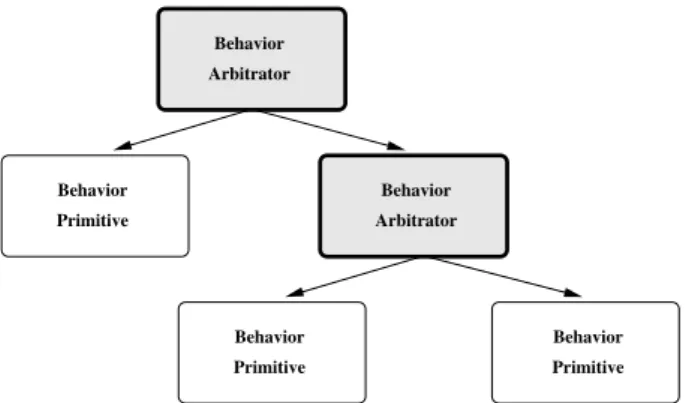
In our approach, we resort to manual division of the task into simpler sub-tasks when an evolutionary pro-cess is unable to find a solution to a task. Sub-controllers are then evolved to solve each sub-task, and the complete controller is composed of several sub-controllers arranged in a hierarchical structure (see Fig-ure 1). Each node in the hierarchy is either a behav-ior arbitrator or a behavbehav-ior primitive [30]. Behavbehav-ior primitives are at the bottom of the controller hierarchy and directly control the actuators of the robot, such as wheels. If it is possible to find an appropriate fitness function for a given task, a behavior primitive com-posed of a single ANN is evolved to solve the task. An appropriate fitness function is one that (i) allows evolu-tion to bootstrap, (ii) leads to controllers that are able to solve the task consistently and efficiently in simu-lation, and (iii) leads to controllers that maintain per-formance when transferred to real robotic hardware. In case an appropriate fitness function cannot be found, the task is manually and recursively divided into sub-tasks until an appropriate fitness functions has been found for each sub-task. We resort to manual program-ming of behavior primitives if an appropriate fitness function cannot be found for a sub-task that cannot be further divided. Previously evolved or preprogrammed behaviors can be reused if sub-tasks are sufficiently sim-ilar or if the behavior is general enough to be used in different tasks.
Sub-controllers are combined through the evolution or preprogramming of a behavior arbitrator. A behavior arbitrator receives either all or a subset of the robot’s
Behavior Primitive Primitive Behavior Primitive Behavior Arbitrator Behavior Behavior Arbitrator
Fig. 1 A representation of the hierarchical controller. A be-havior arbitrator delegates the control of the robot to one or more of its sub-controllers. A behavior primitive controls the actuators of the robots directly.
sensory inputs, and it is responsible for delegating con-trol to one or more of its sub-concon-trollers. The behav-ior arbitrators used in this study are all evolved and have one output neuron for each of their immediate sub-controllers. The output with the highest activation de-termines which sub-controller is activated at every con-trol cycle. The state of a sub-concon-troller is reset when-ever it is deactivated. Alternative methods for activat-ing sub-controllers could be used, such as allowactivat-ing for multiple sub-controllers to be active at the same time. The behavior primitives are synthesized first and are then combined through the synthesis of behavior arbi-trators. The resulting controller can then be combined with other controllers to create a hierarchy of increas-ingly more complex behavioral control. Each time a new sub-controller (either a behavior primitive or a com-posed controller) has been synthesized, its performance on real robotic hardware can be evaluated. The experi-menter can thus address issues related transferability incrementally during the development of the control system. A pseudocode representation of the proposed approach can be seen in Algorithm 1.
Algorithm 1 Pseudocode representation of the pro-posed approach.
procedure hierarchicalEvolution(task)
ifsuitable controller existsthen
returnexistingcontroller
else if infeasible to simulate accuratelythen return preprogramController(task) else
behaviorP rimitive=evolvePrimitive(task) if behaviorP rimitiveperforms adequatelythen
returnbehaviorP rimitive else
sub–tasks=decompose(task) controllers= ∅
foreachsub–task do
c=hierarchicalEvolution(sub–task) addctocontrollers
end for
return evolveArbitrator(task,controllers) end if
end if end procedure
The logic in each node of the controller hierarchy is completely independent of the logic in other nodes. For the experiments presented in Sections 5, 6 and 7, for in-stance, we evolve continuous-time recurrent neural net-works (CTRNN) [2] and use preprogrammed control, but nodes could be other types of ANNs or different types of control or decision systems altogether. Nodes can also be evolved under different simulation condi-tions and even using different algorithms. In this paper, we use a simple generational evolutionary algorithm
and focus on issues related to the hierarchical compo-sition of control. Our approach is, however, compatible with modern neuroevolution algorithms such as NEAT and novelty search, which can be used to evolve the individual components of our hierarchical controllers.
One of the potential costs of decomposing control hierarchically is that the solution space is restricted: the evolution of certain primitive behaviors is forced, and at the higher layers evolution is restricted by the set of behaviors available in lower layers. While decom-position might exclude optimal solutions, the narrower search space allows for the application of ER techniques to tasks that would otherwise be prohibitively complex.
3.2 Derived Fitness Functions
As we move up the controller hierarchy and attempt to synthesize behavioral control for increasingly complex tasks, fitness functions that lead to the evolution of ad-equate solutions may be challenging to define. If the fitness function for the evolution of a behavior arbitra-tor is difficult to define, it can be derived based on the task decomposition. The derived fitness function is con-structed to reward the arbitrator for activating a sub-controller that is valid for the current sub-task, rather than for solving the global task. The use of derived fitness functions in the composition step circumvents the otherwise increase in fitness function complexity as the tasks considered become more complex. The exper-imenter may not always know which sub-controller is the optimal one for a given situational context, and for such cases, a subset of valid sub-controllers can be spec-ified. In Section 5.2, we use a derived fitness function for the evolution of a behavior arbitrator.
4 Simulation, Evolution, and Robotic Hardware
We use the JBotEvolver simulation platform for evolu-tion of behavioral control [9]. JBotEvolver is an open source, multirobot simulation platform, and neuroevo-lution framework. The simulator is written in Java and implements 2D differential drive kinematics.
In simulation, we run a total of ten evolutionary runs with a population size of 100 genomes for each node in a controller hierarchy. The fitness score as-signed to each genome is the average score obtained in 50 simulations with different initial conditions. The five highest scoring genomes are copied directly to the next generation. Another 19 copies of each genome are made and mutation is applied to each gene with a prob-ability of 10%. A Gaussian offset with a mean of 0 and
a standard deviation of 1 is applied when a gene un-dergoes mutation. The evolutionary runs for each node are terminated after an empirically determined number of generations. Upon termination, we conduct a post-evaluation of the highest scoring controller of each evo-lutionary run in a total of 100 samples for each differ-ent configuration of the environmdiffer-ent. Genomes consist of floating-point alleles that encode the parameters of a CTRNN with one hidden layer of fully-connected neu-rons. The neurons in the hidden layer are governed by the following equation:
τi dHi dt = −Hi+ J X j=1 ωjiIj+ K X k=1 ωkiZ(Hk+ βk)
where τiis the decay constant, Hiis the neuron’s state,
J is the number of input neurons, ωji the strength of
the synaptic connection from neuron j to neuron i, I is the set of input neurons, K is the number of output neurons, β is the bias term, and Z(x) = (1 + e−x)−1is
the sigmoid function. The bias terms βi, the decay
con-stants τi, and the connection weights ωjiare genetically
controlled network parameters. The possible ranges of these parameters are: βi ∈ [−10, 10], τi ∈ [0.1, 32] and
ωji ∈ [−10, 10]. Circuits are integrated using the
for-ward Euler method with an integration step-size of 0.2 and cell potentials are set to 0 when the network is initialized.
For our real hardware experiments, we used an e-puck [35] (see Figure 2). The e-e-puck is a small circular (diameter of 75 mm) differential drive mobile robotics platform designed for educational use. The e-puck’s set of actuators is composed of two wheels that en-able the robot to move at speeds of up to 13 cm/s, a loudspeaker, and a ring of eight LEDs. The e-puck is equipped with several sensors: (i) eight infrared prox-imity sensors which are able to detect nearby obstacles and changes in light conditions, (ii) three microphones (one near each wheel of the robot, and one toward the front), (iii) a color camera, and (iv) a 3D accelerome-ter. Additionally, our e-puck robots are equipped with a range & bearing board [21] which allows them to com-municate with one another.
We use four of the e-puck’s eight infrared proximity sensors: the two front sensors and the two lateral sen-sors. We collected samples (as advocated in [33]) from the sensors on a real e-puck robot in order to model them in JBotEvolver. Each sensor was sampled for 10 seconds (at a rate of 10 samples/second) at distances from an obstacle ranging from 0 cm to 12 cm. We col-lected samples at increments of 0.5 cm for distances between 0 cm and 2 cm, and at increments of 1 cm for distances between 2 cm and 12 cm.
E−puck Range & Bearing
Board
Fig. 2 The e-puck with a range & bearing board [21].
We use ray-casting to model the infrared sensors in the simulation. Seven rays are cast from each sensor in different directions, from −α
2 to α
2, where α is the
sen-sor’s opening angle. Based on experimental data from the robot, we used an α value of 70◦. The distances
at which the rays intersect with an obstacle are aver-aged and the final sensor reading is the interpolation of the closest samples collected on the real robot. Finally, noise is added to the reading with an amount based on the variance measured on the real robot for the partic-ular distance.
The e-puck’s infrared sensors can measure the level of ambient light. In the experiments presented in Sec-tion 5 and SecSec-tion 6, we use ambient light readings from the two lateral proximity sensors to detect light flashes. When a light flash is detected on one of the sides, the activation of its corresponding sensor is set to 1. The sensor remains activated for 15 simulation cy-cles (equivalent to 1.5 seconds) to indicate that a flash has been detected. In simulation, we added Gaussian noise to the wheel speeds, with a standard deviation corresponding to 5% of the current wheel speed in each control cycle. The robot’s speed is limited to 10 cm/s in our experiments.
The e-puck only has 8 kb of onboard memory. If the control code does not fit within the e-puck’s lim-ited memory, we run the control code off-board. When the control code is executed off-board, the e-puck starts each control cycle by transmitting its sensory readings to a workstation via Bluetooth. The workstation then executes the controller, and sends back the output of the controller (wheel speeds) to the robot. We use off-board execution of control code in the real robot exper-iments conducted in Section 5 and Section 7, and on-board execution of control code in the real robot exper-iments conducted in Section 6. Videos of our real-robot experiments and source code for our preprogrammed behaviors can be found online [13].
Our simulator allows to automate some parts of the hierarchical composition process. The experimenter defines a configuration file with the various
sub-controllers, including information on how they are con-nected and the evolutionary setup for each node (envi-ronment, controller, evolutionary algorithm, and eval-uation function). The simulator then synthesizes and composes the hierarchical controller by picking the best controller for every hierarchical node, out of multiple runs. The experimenter can then test each node on the real robot. If a controller proves to be difficult to trans-fer to the real robot, the experimenter can change the configuration for that particular node and restart the evolutionary process from that node and up.
5 Evolving and Transferring Controllers for Complex Tasks
In this section, we apply the proposed methodology to a rescue task. The task is relatively complex and requires several behaviors typically associated with ER [37] such as exploration and obstacle avoidance [16], delayed re-sponse [45], and the capacity to navigate safely through corridors [41].
We purposefully designed the task to be more com-plex than any previously solved by real robots with evolved controllers: (i) a robot must first find its way out of a room with obstacles, (ii) the robot must then solve a double T-maze [3], and finally (iii) the robot must guide a teammate safely to the room. Variations of the T-maze task have been used extensively in stud-ies of learning and motivation in animals [43], neuro-science [44], and robotics. In robotics, T-mazes have been used to study different neural network models such as diffusing gas networks [26], the online learning capa-bility of continuous time recurrent neural networks [3], and the evolution of transferable controllers [27, 28]. While a T-maze task may appear simple from an an-thropomorphic perspective, robots’ sensors are often limited. In our experiment, each sensor only provides the controller with a single scalar or binary value. The information available to the controller about the envi-ronment and about the robot’s position in the environ-ment is thus very limited. Previous studies in which evolved control has been tested on real hardware, only single T-mazes were used.
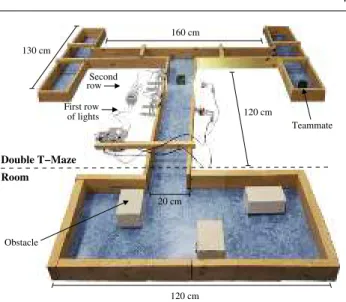
A number of obstacles are located in the initial room. The room has a single exit that leads to the start of a double T-maze (see Figure 3). In order to find its teammate, the robot should exit the room and navigate to the correct branch of the maze. Two rows of flashing lights in the main corridor of the double T-maze give the robot information about the location of the team-mate. Each row of lights indicates the branch leading to the teammate in a junction. For instance, if the left light of the first row and the right light of the second
Second row First row of lights 120 cm 20 cm 130 cm 120 cm 160 cm Teammate Obstacle Double T−Maze Room
Fig. 3 The environment is composed of a room with
ob-stacles and a double T-maze. The room is rectangular with varying side lengths. The double T-maze has a total size of
200 cm×200 cm. The two rows with the lights are located in
the central maze corridor. The activation of these two rows of lights indicates the location of a teammate.
row are activated, the robot should turn left at the first junction and right at the second junction. Upon nav-igating to the correct branch of the maze, the robot must guide the teammate back to the initial room. We included a boolean “near robot” sensor that indicates if the teammate is within 15 cm. For this sensor, we use readings from the range & bearing board.
For the real robot experiments, we built a double T-maze with a size of 200 cm × 200 cm (see Figure 3). In the real maze, a Lego Mindstorms NXT brick controlled the flashing lights. The brick was connected to four ul-trasonic sensors that detected when the robot passed by. Lights were turned on by the first and third ultra-sonic sensor and turned off by the second and fourth ultrasonic sensor. The NXT brick controlled the state of the lights using two motors.
We use simple, functional incremental fitness func-tions [37] for the evolution of behavioral primitives in the experiments presented below. Each fitness function typically has a number of cases that represent differ-ent outcomes of an experimdiffer-ent such as whether a robot reached its destination or not. Each case is kept sim-ple and typically has only one or two terms. The cases are weighted by adding a constant and by multiplying by a factor, initially with values of zero and one, re-spectively. The values of the constants and factors are adjusted through an empirical trial-and-error process when necessary: if a bootstrapping case is exploited over a goal case, guiding evolution toward local optima, the relative weight of the exploited case is either decreased or the weight of the other cases are increased. While
the exact weights are not crucial, the relative weight between cases need to be such that solving the task is significantly better than not solving the task. For instance, bootstrapping cases should have significantly lower weights than high-level goal cases. The constants and factors that appear in the fitness functions below are the result of such a process. Given the simplicity of the fitness functions used, this process usually only required a couple of iterations.
5.1 Attempting to Evolve a Monolithic Controller We attempted to evolve a monolithic controller, i.e. a controller with a single neural network for the complete rescue task. The chosen neural network was composed of seven input neurons (two light sensors, four infrared sensors, and one robot sensor), ten hidden neurons and two output neurons (two wheels). The robot was placed at a random position and with a random orientation in the room. The complexity of the task translates to a difficulty in finding an appropriate fitness function that allows evolution to bootstrap. In order to evaluate the controller, we chose a functional incremental, gradient-based fitness function with a bonus for reaching three intermediate points of the task: exiting the room, find-ing the teammate, and returnfind-ing to the room. The fit-ness function is defined as follows:
fmonolithic= 3 X i=1 β+Di− ds Di
where β is the bonus constant for reaching each in-termediate point, Di is total Euclidean distance from
the previous intermediate point of task to the current intermediate point of the task, di is the robot’s
Eu-clidean distance to the next intermediate point of the task. The bonus constant of each term in the fitness function was chosen based on the methodology pro-vided in Section 3.2, with values ranging from 1 to 5. The controllers were evolved for 1000 generations, and were post-evaluated in order to measure how many times they navigated to each of the intermediate points of the task. The controllers were able to solve the first part of the task and leave the room in 92% of the post-evaluation samples, and navigated to the correct exit of the double T-maze in 51% of the samples. The best controllers in some of the runs specialized in solving the task for a particular maze exit (i.e., 25% of the samples in which the robot managed to leave the room), and as a results, the average solve rate for the complete task was only 17%.
We also tried to evolve a monolithic controller for the rescue task using NEAT [42]. The NEAT imple-mentation available in the open-source Encog Machine Learning Framework [23] was integrated in our simula-tor platform JBotEvolver [9]. The controllers were eval-uated based on fmonolithic in a total of 10 evolutionary
runs. Each run was evolved for 1000 generations, and we used the parameter values proposed in [42]. We ob-served that evolution typically got stuck in a local op-timum around the 300th generations. On average, the best controllers of the 10 evolutionary runs were able to leave the room in 77% of the samples, navigated to the correct exit of the room in 19% of the samples, but none of the controllers was able to return to the ini-tial room. We experimented with several variations of the default parameter values, but obtained similar or inferior results (for details see [13]).
5.2 Decomposition of the Rescue Task
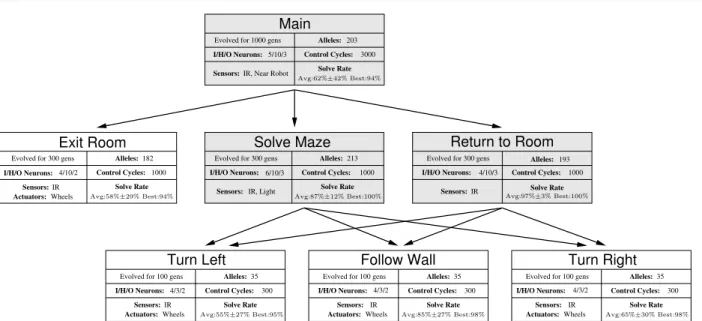
As shown in Section 5.1, the rescue task is relatively complex, which meant that we were unable to find an appropriate fitness function that allows evolution of a controller based on a single ANN. We therefore divided the rescue task into three sub-tasks: (i) exit the room, (ii) solve the double T-maze to find the teammate, and (iii) return to the room, guiding the teammate. We evolved sub-controllers to solve each of the sub-tasks. A hierarchical controller was then given access to each of the sub-controllers and evolved to solve the complete rescue task. Figure 4 shows the hierarchical structure of the complete controller, the description of each be-havior arbitrator and bebe-havior primitive, including the topology, inputs (sensors) and outputs (actuators) used by of each neural controller, and the performance re-sults in simulation.
5.2.1 Exit Room Sub-task
The first part of the rescue task is an exploration and obstacle avoidance task. The robot is located in a room and must find a narrow exit leading to the maze. The room is rectangular with side lengths that vary between 100 cm and 120 cm drawn from a uniform distribu-tion. We evolved the “Exit Room” behavior primitive to solve this sub-task. In each sample, we placed either two or three obstacles in the room depending on its size. Each obstacle was rectangular with random side lengths ranging from 5 cm to 20 cm drawn from a uniform dis-tribution. The location of the room exit was also ran-domized in each trial. The robot was randomly oriented and positioned inside the room at the beginning of each
Alleles: Solve Rate
Main
I/H/O Neurons: Sensors: IR, Near Robot
203 5/10/3 Control Cycles: 3000 Evolved for 1000 gens
Solve Maze
I/H/O Neurons:
Sensors: IR, Light Solve Rate Alleles:
6/10/3
213 Evolved for 300 gens
1000 Control Cycles: Return to Room I/H/O Neurons: Sensors: IR Alleles: Solve Rate 4/10/3 193 Evolved for 300 gens
1000 Control Cycles: Exit Room Alleles: Solve Rate 182 Control Cycles: I/H/O Neurons: 4/10/2
Evolved for 300 gens
Wheels 1000 Actuators: Sensors: IR Turn Left Sensors: Actuators: Wheels I/H/O Neurons: IR Alleles: Solve Rate 35 4/3/2
Evolved for 100 gens
300 Control Cycles: Sensors: Actuators: Wheels IR I/H/O Neurons: Turn Right 4/3/2 Alleles: Solve Rate 35 Evolved for 100 gens
300 Control Cycles: Follow Wall Sensors: Actuators: Wheels IR I/H/O Neurons: Alleles: Solve Rate 4/3/2 35 Evolved for 100 gens
300
Control Cycles:
Avg:62%±42% Best:94%
Avg:87%±12% Best:100% Avg:97%±3% Best:100%
Avg:58%±29% Best:94%
Avg:55%±27% Best:95% Avg:85%±27% Best:98% Avg:65%±30% Best:98%
Fig. 4 Hierarchical Rescue Task Controller. The controller used in our experiments is composed of three behavior arbitrators (with darker background) and four behavior primitives. In each node, we list its name, the number of generations for which the sub-controller was evolved, the number of alleles, the number of input, hidden and output neurons, the sensors and actuators, the number of control cycles each evaluation lasted, and the average and best solve rate of the post-evaluation.
sample. Controllers were evaluated differently depend-ing on whether they found the exit of the room within the allotted time or not, according to fexit room:
fexit room= 5 +C− c
C if exit was found
D− d
D time expired
where C is the maximum number of cycles (1 second = 10 control cycles), c is the number of cycles spent, D is the distance from the center of the room to its exit, and d is the closest point to the exit that the robot reached. fexit room rewards controllers that move from
the center of the room and toward the exit. Since the controller has no information about the location of the exit, we reward it based on how close it got to the exit in order to implicitly promote exploration.
In two of the ten evolutionary runs, the highest scor-ing controller was able to find the exit of the room in over 90% of the post-evaluation samples. The best per-forming controller starts by moving away from the cen-ter of the room until it senses a wall, which it then fol-lows counter-clockwise until the room exit is found. The remaining eight runs did not produce successful behav-iors: the robots would spin around in circles, sometimes finding the exit by chance but often colliding with one of the walls or with an obstacle.
5.2.2 Solve Maze Sub-task
In the second sub-task, the robot has to solve a dou-ble T-maze in order to find a teammate that needs to be rescued (see Figure 3). Controllers were evaluated according to fmaze: fmaze= 1 +C− c C if navigated to destination D− d
3D if collided or chose wrong path
0 if time expired
where C is the maximum number of cycles, c is the number of cycles spent, D is the distance from the start of the maze to the robot’s destination, and d is the fi-nal distance between the robot to its destination. fmaze
awards a score of 1 plus a speed bonus in case the robot reaches the destination. If the robot collides with a wall or chooses a wrong path, a lower fitness is awarded, cal-culated based on how close to the destination it man-aged to get. The experiment ends prematurely if the robot either collides with a wall or reaches one of the maze exits. In such cases, we do not count the time as having expired.
We divided the “Solve Maze” sub-task into three dif-ferent sub-tasks: “Follow Wall”, “Turn Left” and “Turn Right”, for which appropriate fitness functions could easily be specified. For each sub-task, we evolved a be-havior primitive. Although the intended bebe-haviors were
quite simple, we evolved the controllers in a wide vari-ety of simple mazes, some of which had a high degree of difficulty due to the starting position and orientation of the robot. The difficulty of some of the mazes had an impact on the solve rates of these controllers, bringing the average down to 55% in the “Turn Left” controller and 65% in the “Turn Right” controller (see Figure 4). We used ten different mazes for the “Turn Left” and “Turn Right” controllers, and four mazes composed of corridors with different widths for the “Follow Wall” controllers.
We then evolved a behavior arbitrator with the three highest scoring behavior primitives as sub-controllers. At the beginning of each trial, the robot was placed at the start of the double T-maze and had to navigate to the correct branch based on the activa-tions of the lights in the central corridor (see Figure 3). The robot was evaluated by fmaze, and the simulation
sample was terminated if the robot collided with a wall or if it navigated to a wrong branch of the maze. 5.2.3 Return to Room Sub-task
The final sub-task consists of the robot guiding its teammate back to the room. We initially tried to evolve a behavior primitive for this sub-task, but the evolved solutions proved difficult to transfer successfully to the real robot. We therefore reused the behavior primitives previously evolved for maze navigation (“Follow Wall”, “Turn Left” and “Turn Right”), and evolved a new behavior arbitrator. The new behavior arbitrator was evolved in the double T-maze with the robot starting in one of the four branches of the maze (chosen at ran-dom in the beginning of each trial). In the guidance sub-task, the robot had to navigate correctly through the maze, and we therefore used the same fitness func-tion, fmaze, as in the “Solve Maze” sub-task. The only
difference was the objective: the robot was evaluated based on how close it got to the initial room (see Fig-ure 3), and not the distance to the teammate.
For the complete task, we evolved a behavior arbi-trator with the highest scoring controllers for the “Exit Room”, the “Solve Maze”, and the “Return to Room” sub-tasks as sub-controllers. The teammate being res-cued continuously emitted a signal while waiting for the rescuing robot. We used a derived fitness function, fderived, to evolve the main behavior arbitrator for the
rescue task. The derived fitness function rewards the selection of a valid behavior for the current sub-task and penalizes the selection of an invalid behavior (for instance, selecting the “Exit Room” behavior primitive if the robot was in the T-maze). The controller was awarded a fitness score between 0 and 1 for each
sub-Generation 0
0.5
average of all runs 1 1.5 2 2.5 3 3.5 4 0 100 200 300 400 500 600 700 800 900 1000 Fitness best run
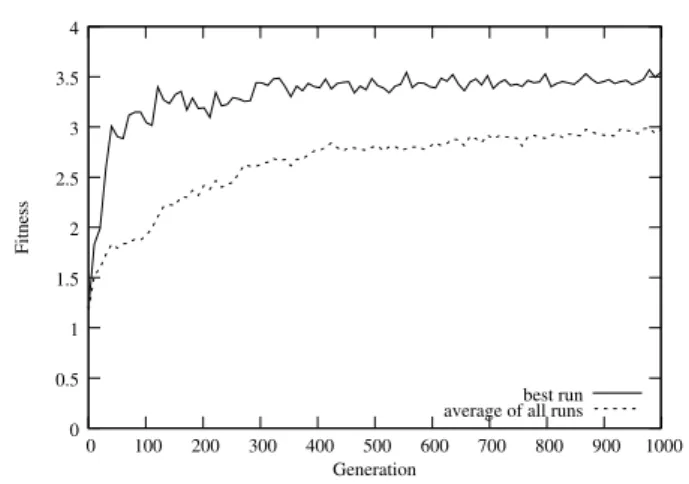
Fig. 5 The average fitness trajectory of each of the highest scoring controllers of all ten evolutionary runs, and the fitness trajectory of the highest scoring controller for the complete rescue task.
task (hence a maximum score of 3 for successful com-pletion of all sub-tasks), depending on the proportion of the time that it selected the valid behavior, plus a time bonus. fderived is defined as follows:
fderived= n X s=1 ts Ts −ws Ts ! + C− c
C if the task completed
0 otherwise
where the sum is over all the started sub-tasks, tsis the
number of cycles in which the controller chose a valid sub-controller for sub-task s, Ts is the number of
sim-ulation cycles that the controller has spent in sub-task s, ws is the number of cycles in which the controller
chose an invalid sub-controller for sub-task s, C is the maximum number of cycles, and c is the number of cy-cles spent. The fitness trajectory for the highest scor-ing controller evolved and the average fitness trajectory of all ten evolutionary runs for the rescue task can be seen in Figure 5. The best controller had a solve rate of 94%. Out of the ten controllers, seven were able to consistently solve the whole rescue task in over 89% of the samples, while the remaining three were not able to solve the three sub-tasks.
5.3 Transfer to the Real Robot
We tested each sub-controller incrementally on the real robot, which enabled us to ensure the transferability of the complete controller. After evaluating all the dif-ferent evolutionary runs of the complete controller, we tested the best performing controller from the simula-tion on a real e-puck. The robot had to solve the com-plete rescue task: find the exit of the initial room,
navi-gate to the correct branch of the double T-maze, and re-turn to the room. We used a room with a size of 120 cm ×60 cm for our real robot experiments. Three identical obstacles with side lengths of 17.5 cm and 11 cm were placed in the room as shown in Figure 3. We sampled the controllers six times for each light combination, re-sulting in a total of 24 samples.
To avoid interference between the two robots, we excluded the teammate in the real robot experiments, and manually triggered the near-robot sensor when the robot reached the correct maze branch. We ran ad-ditional proof-of-concept experiments in which we in-cluded a teammate that was preprogrammed to follow the main robot back to the initial room. Videos of these experiments can be found online [13].
The controller solved the composed task on the real robot in 22 out of 24 samples (a solve rate of 92%). The main behavior arbitrator consistently chose the correct sub-controller at each point of the task, and only failed once in the “Solve Maze” behavior (the robot turned the wrong way in the second intersection of the maze), and once in the “Return to Room” behavior (the robot did not turn at the intersection, ending up in a different maze branch).
The experiments and results presented above demonstrate how controllers can be composed in a hi-erarchical fashion to allow for the evolution of behav-ioral control for a complex task. For the main behavior arbitrator, we used a fitness function directly derived from the immediate decomposition of the task, that is, we used a fitness function that rewards a controller for activating a valid sub-controller given the current sit-uational context. During evolution, an arbitrator (an ANN) was rewarded for (i) activating the “Exit Room” sub-controller while the robot was in the room, (ii) the “Solve Maze” sub-controller while the robot was in the maze, and (iii) the “Return to Room” sub-controller after the teammate had been located. In this way, we avoid that the complexity of the fitness function in-creases with the task complexity as sub-controllers are combined. The highest scoring controller in simulation was able to cross the reality gap, achieving a mance on real robotic hardware similar to the perfor-mance obtained in simulation.
6 Hybrid Controllers
In this section, we experiment with the evolution of hybrid control systems that can take advantage of pre-programmed behavior primitives. There are examples in literature where researchers have combined evolved control and preprogrammed control, but it has been done in an ad-hoc manner (see for instance [20]). Our
approach, on the other hand, allows for a structured integration of learned and preprogrammed behavior in a hierarchical and incremental manner. We used the double T-maze task (see Section 5) with simple pre-programmed behavior primitives (“Follow Wall”, “Turn Left”, and “Turn Right”). The controller for the com-plete task is composed of an evolved behavior arbitrator that activates one of the three preprogrammed behavior primitives.
Two preprogrammed primitives take more than one control cycle to complete, namely turning 90◦
left or right. For such primitives, we introduce the concept of locking the controller. While a locking preprogrammed behavior is executing, no other behavior primitive can be executed. The locking mechanism helps to guarantee transfer of control from simulation to a real robot by ensuring that preprogrammed behaviors are allowed to complete before another behavior is executed.
6.1 Experiments and Results
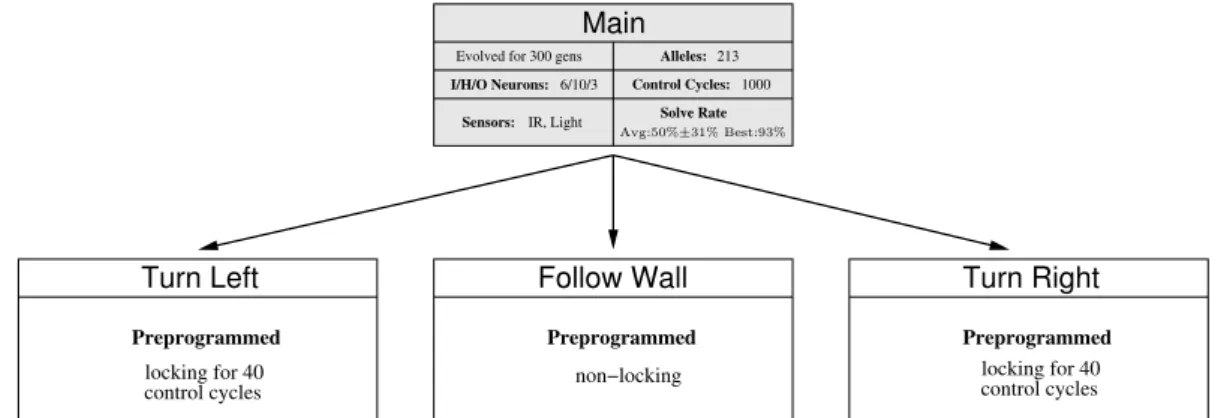
The input layer of the ANN-based behavior arbitrator was composed of six neurons: one for each of the four infrared proximity sensors, and one for each of the two light sensors. The highest value of the output neurons of the neural network determines which one of the three possible preprogrammed behaviors is activated: “Fol-low Wall”, “Turn Left” or “Turn Right”. The complete controller and the results are shown in Figure 6.
After the evolutionary process was concluded, we conducted a post-evaluation of the evolved controllers in which the fitness of every controller was sampled 100 times for each of the four possible light configurations. The evolved controllers had an average solve rate of 50%(±31%). A solve rate of 80% or more was achieved by three of the ten controllers, with a solve rate of 93% for the highest scoring controller. The solutions pro-duced in different evolutionary runs were similar. The controllers learned to navigate the T-maze correctly, but some were not able to take advantage of the infor-mation from the light flashes to consistently make the correct decisions at the junctions, which caused them to navigate to a wrong maze branch.
The highest scoring controller was tested on a real e-puck 24 times, six for each light configuration. The controller was successful in 22 of the 24 samples (a solve rate of 92%). In both failed samples, the robot turned to the wrong maze branch in the second intersection. These results are comparable to the results obtained in simulation and to the real robot experiments where the behavior arbitrator had access to evolved behavior primitives (see Section 5).
control cycles locking for 40 control cycles Alleles: Solve Rate Main I/H/O Neurons: Follow Wall
Sensors: IR, Light
6/10/3
213
Preprogrammed Preprogrammed
non−locking
Preprogrammed
Turn Left Turn Right
Control Cycles: 1000
locking for 40
Evolved for 300 gens
Avg:50%±31% Best:93%
Fig. 6 Hierarchical Solve T-Maze Controller. The controller used in our experiments is composed of one behavior arbitrator and three preprogrammed behavior primitives. Both the “Turn Left” and the “Turn Right” preprogrammed behavior primitives lock the network during execution, in order to ensure that the behavior completes before another primitive can be executed.
We used the same preprogrammed behaviors both in simulation and on the real robot for the experi-ments presented in this section. Preprogrammed behav-ior primitives can be an alternative to evolved behavbehav-ior primitives. It may not always be possible to evolve a controller for a sub-task, either because an appropriate fitness function cannot be found or because fine sensori-motor behaviors are required. Fine sensorisensori-motor behav-iors are those that require the robot to perform actions with a high degree of accuracy, and that depend on the precise information provided by the robot’s sensors. When such behaviors are necessary for solving the task, evolved control may be combined with preprogrammed behaviors, which can be fine-tuned manually for the real robotic hardware. The use of preprogrammed behaviors is particularly beneficial for sub-tasks and behaviors that are infeasible to simulate with sufficient accuracy to allow for the successful transfer to real robotic hard-ware. Behaviors that have only been implemented for the real robotic hardware can be integrated in simula-tion in two different ways: samples can be collected from the real robot performing the preprogrammed behavior and then played back in simulation (sensor playback ), or the normal control cycle can be stopped completely while the robot executes the preprogrammed behavior (offline behavior ). In either case, it is only necessary to change the state of the environment according to the robot’s ations, and not to simulate the detailed robot-environment interaction. We explore the offline behav-ior technique in the experiments described in the next section. Source code for the preprogrammed behaviors can be found online [13].
7 Hierarchical Evolution for Integrated Tasks
In the experiments presented in the previous sections, the behavior primitives were either all evolved, or all manually programmed. Furthermore, in the case of the experiments in Section 5, the task was sequential, which meant that the robot had to learn a strict sequence of behaviors: “Exit Room”, “Solve Maze” and “Return to Room”. In this section, we evaluate our approach in a task that is non-sequential and we combine evolved be-havior primitives and preprogrammed primitives. We use the offline behavior technique described in Sec-tion 6, in which a preprogrammed behavior is imple-mented for the real robot, but not in simulation. When the controller activates such a preprogrammed behav-ior in simulation, the normal control cycle is stopped, the end-result of the robot-environment interaction is applied, and controller is then resumed.
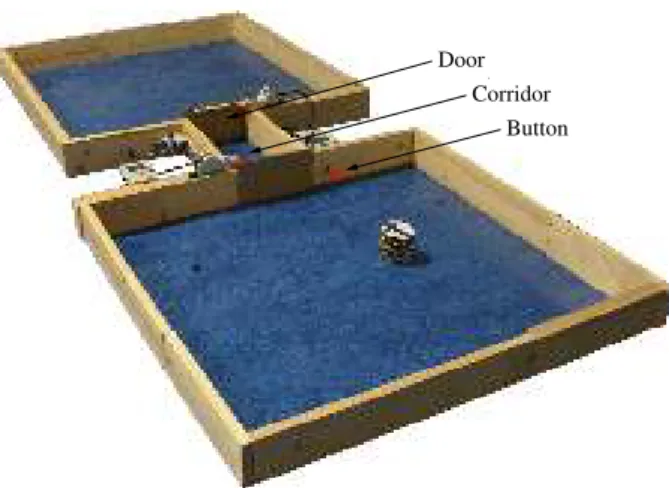
We use a task in which the robot must clean dust spots. The dust spots appear in two rooms that are connected by a corridor (see Figure 7). The rooms are square-shaped and side lengths vary between 80 cm and 120 cm drawn from a uniform distribution. A new dust spot is randomly placed in one of the two rooms every 10 s. The placement of a new spot is determined by a Bernoulli trial with a probability p that the spot is placed in one room and 1−p that it is placed in the other room. The probability p is randomly sampled from the uniform distribution at the beginning of each trial. A maximum of five dust spots can be in the environment at any given time. This means that if the robot keeps cleaning one room for a long time, all dust spots may eventually be in the other room.
In order to traverse the corridor connecting the two rooms, the robot must first push a button to open both
doors (see Figure 7). We preprogrammed a behavior primitive to enable an e-puck to push a button, which opens the doors to the corridor. Pushing a button to open the doors requires fine sensorimotor coordination, since the buttons are difficult to detect and hit. The buttons are only 2.5 cm in diameter, and they must be pushed at an angle under 45◦
. This is a difficult inter-action to model correctly in simulation, and it can also be a challenging behavior to evolve and transfer suc-cessfully. The preprogrammed “Push Button” behav-ior was therefore only implemented for the real robot, and activating the preprogrammed behavior automati-cally opens the door instantly in simulation. On the real robot, the preprogrammed behavior uses the e-puck’s on-board camera to find and move the robot toward the button. When the preprogrammed behavior primi-tive that opens the door is activated, the control cycle of the main behavior arbitrator is stopped. The prepro-grammed behavior primitive rotates the robot up to a maximum of 360◦
in order to try to locate the button, which can be identified by its red color. The central horizontal line of each image captured by the e-puck’s camera is scanned. If the button is identified, the robot aligns itself, moves forward, and pushes it. The main be-havior arbitrator is resumed after the preprogrammed behavior terminates. When the preprogrammed behav-ior is activated in simulation, the elapsed time of the current sample is increased by the average amount of time taken by the preprogrammed “Push Button” be-havior on the real robot. Source code for the prepro-grammed “Push Button” can be downloaded from [13].
Corridor Door
Button
Fig. 7 The environment is composed of two rooms, connected by a corridor. The corridor is blocked by two doors that the robot can open by pushing a red button.
7.1 Experiments and Results
In the real robot experiments, virtual dust spots are im-plemented using a visual tracking system. The position and orientation of the robot is tracked using an over-head camera. The robot has a cross-shaped marker on top (see Figure 7), which is extracted from the video feed using the OpenCV library [4]. This information allows virtual dust spots to be detected by the robot using virtual sensors. The controller is executed in a workstation, and the resulting movement commands are sent to the robot every 100 ms. The robot is able to sense the dust spots up to 30 cm away with eight vir-tual sensors, positioned on the perimeter of the robot’s body at equal angular intervals. The robot must acti-vate a virtual actuator when it is within 5 cm of a dust spot to remove the spot. The robot is also equipped with two button sensors that are placed at angles of −30◦ and 30◦, providing the controller with
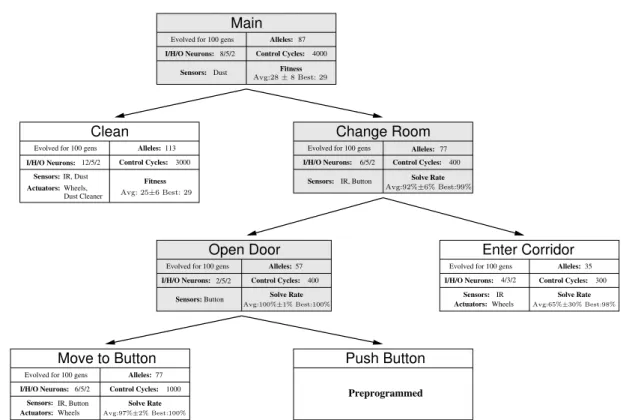
informa-tion on the direcinforma-tion and distance (up to 1 m) to the nearest button. The controller we used for these exper-iments can be seen in Figure 8. We decomposed the task into two main sub-controllers: “Change Room” and “Clean”. The “Change Room” sub-controller is a behavior arbitrator that can choose between the “Open Door” behavior arbitrator and the “Enter Corridor” be-havior primitive.
The robot must push a button to open the doors to the corridor before it can move from one room to the other. Once the doors have been opened, the robot has 40 seconds to traverse the corridor that leads to the other room before the doors close. We divided the “Change Room” sub-controller into a behavior primi-tive and a behavior arbitrator: the “Open Door” behav-ior arbitrator, which moves the robot toward the cur-rent room’s button (“Move to Button” behavior prim-itive) and pushes the button (“Push Button” prepro-grammed behavior primitive), and the “Enter Corri-dor” behavior primitive, which navigates to the corridor and crosses to the other room.
We first evolved the “Move to Button” behavior primitive. The controller was evaluated by by ftwo rooms
according to a distance gradient to the button, with a time-dependent bonus upon correctly activating the preprogrammed behavior primitive:
ftwo rooms= 1 + 10·C− c C if achieved objective D− d D otherwise
where C is the maximum number of cycles, c is the num-ber of cycles spent, D is the distance from the robot’s
I/H/O Neurons:
Alleles: Solve Rate
6/5/2
Sensors: IR, Button
77
Change Room
Evolved for 100 gens
Control Cycles: 400 Alleles: I/H/O Neurons: 57 Solve Rate Open Door Sensors: Button 2/5/2 Evolved for 100 gens
Control Cycles: 400 Sensors: Wheels IR I/H/O Neurons: Alleles: 35 4/3/2 Solve Rate Actuators: Enter Corridor
Evolved for 100 gens
Control Cycles: 300 Push Button Preprogrammed I/H/O Neurons: Alleles: Solve Rate 77 Actuators: IR, Button 6/5/2 Wheels Sensors: Move to Button
Evolved for 100 gens
Control Cycles: 1000 Alleles: Main I/H/O Neurons: 8/5/2 Sensors: 87 Fitness Dust Evolved for 100 gens
Control Cycles: 4000 Alleles: I/H/O Neurons: 12/5/2 113 Fitness Clean Actuators: Sensors:IR, Dust Evolved for 100 gens
Control Cycles: 3000 Wheels,
Dust Cleaner Avg: 25±6 Best: 29
Avg:92%±6% Best:99%
Avg:100%±1% Best:100% Avg:65%±30% Best:98%
Avg:97%±2% Best:100%
Avg:28 ± 8 Best: 29
Fig. 8 Hierarchical Dust Cleaning Controller. The controller synthesized for the dust cleaning experiment is composed of three behavior arbitrators and four behavior primitives.
starting point to the button, and d is the closest point to the button that the robot reached. In the case of the “Move to Button” behavior primitive, the objective was to get within 5 cm of the button.
The “Open Door” behavior arbitrator has access to the button sensor. In simulation, the preprogrammed “Push Button” behavior opens the doors if the robot is within 20 cm of the button, otherwise the robot stops moving while the behavior is activated. Since the “Push Button” behavior takes some time to execute on the real hardware, controllers that activate this behavior too of-ten or too far from the button are therefore indirectly penalized because they have less time to clean. On the real robot, such controllers would make the robot search for the button at a distance that would make it very difficult for the e-puck’s camera to detect a small tar-get. The controllers were evaluated by ftwo rooms, where
the objective was to open the corridor doors. Since the button was placed to the right-hand side of each door, we reused the “Turn Right” behavior primitive from Section 5 instead of evolving a new primitive for the “Enter Corridor” sub-controller. This behavior primi-tive allows the robot to move to the other room after pushing the button.
For the evolution of the “Change Room” behavior arbitrator, the robot was positioned and oriented ran-domly in one of the rooms at the beginning of each
trial, and had to push the button, enter the corridor and move to the other room. Each controller was also evaluated according to ftwo rooms, where the objective
was to reach the other room. For the “Change Room” arbitrator, D is the distance from the robot’s starting point to the end of the corridor, and d is the point clos-est to the end of the corridor that the robot reached.
The “Clean” behavior primitive was evolved in a single room without any door or exit. The output neu-rons controlled the speed of the robot’s wheels, and the “clean dust spot” actuator was triggered if its corre-sponding output had an activation value higher than 0.5. If no dust spot is nearby when the robot activates the “clean dust spot” actuator, the speed of the robot is set to 0. This penalizes the controller from always ac-tivating the actuator, instead of only acac-tivating it near a dust spot. The robot was randomly oriented and po-sitioned near the center of the room at the beginning of each sample. The fitness function rewarded the robot based on how many dust spots it cleaned (a score of 1 for each dust spot) in the allotted time or until it collided with a wall.
To obtain a controller for the complete task, the “Clean” behavior primitive and the “Cross Rooms” be-havior arbitrator were combined via the evolution of a new behavior arbitrator (see Figure 8). All evolu-tionary runs converged to a behavior where the robot
would move between rooms whenever necessary. If the robot did not sense any dust spot for a certain amount of time, the “Main” arbitrator would choose to acti-vate the “Change Room” behavior arbitrator. The con-trollers were evaluated according to the number of dust spots they cleaned, as in the evolution of the “Clean” behavior primitive. The controllers achieved an average fitness of 28 ± 8 in the ten evolutionary runs, and the best controller achieved an average of 29 ± 6. The con-trollers chose to cross to the other room an average of 2.86 times per sample.
7.2 Real Robot Experiments
For our real robot experiments, we built the walls of the two rooms and the corridor using wooden blocks. Each room had a size of 100 cm × 100 cm, and the corridor had a length of 40 cm and a width of 18 cm (see Figure 7). Both doors were opened and closed by motors connected to a Lego Mindstorms NXT brick. A physical button was placed on the wall to the right of the entrance to the corridor in each room.
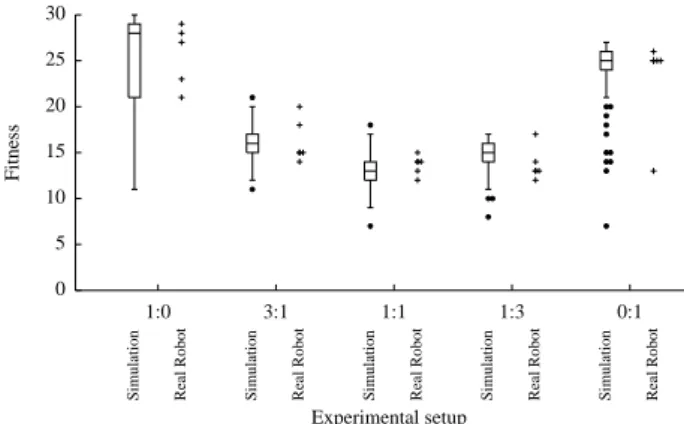
We transferred the highest scoring controller from simulation to the real e-puck. The performance of the controller on the real robot was sampled five times in five different configurations, for a total of 25 samples. We used fixed rates at which the dust spots were placed in each room. In each configuration, the rate of a dust spot being placed in each room was set to one of the fol-lowing: 1 : 0, 3 : 1, 1 : 1, 1 : 3, and 0 : 1. The robot started each sample in one of the rooms. In the 3 : 1 scenario, for instance, three dust spots are placed in the room where the robot starts, and then one dust spot is placed in the other room, and so on. The dust spots were placed deterministically at these fixed rates in order to allow for direct comparison of performance in simulation and performance in real hardware. We sampled the robot’s performance in simulation 100 times per configuration. Each sample lasted five minutes (3000 control cycles). The results can be seen in Figure 9. In the real robot experiments, the controller was able to complete the task with a performance comparable to that obtained in simulation.
Several outliers can be observed in the 0 : 1 configu-ration. In this configuration, the robot starts in a room where no dust spots are ever placed. After some time, the controller decides to cross to the other room. In most of the samples, the robot keeps cleaning the room in which all the dust spots appear, but sometimes the controller might choose to return to the initial room. This happens when several dust spots are placed in a cluster and the robot does not explore the part of the room containing the cluster for a certain amount
of time. In such cases, the number of dust spots that the robot can clean are significantly lower than if the robot remains in the room in which dust spots appear. The robot wrongly returned to the initial room in one of the real robot samples. As a result the robot only cleaned 13 dust spots in the 0 : 1 experimental setup, and received a low fitness (see outlier for the 0 : 1 setup in Figure 9).
7.3 Discussion
In this section, we introduced a non-sequential task that required fine sensorimotor coordination. A hybrid ap-proach in which evolved behaviors are combined with preprogrammed behaviors can be beneficial when some behaviors are too difficult to simulate accurately. In the case of pushing the button, we did not implement the preprogrammed behavior in simulation. When the con-trollers were being evolved, the doors in the environ-ment would open automatically if the robot activated the “Push Button” behavior primitive near the button. On the real robot, activating that same behavior prim-itive triggered a preprogrammed behavior, which used the robot’s camera to detect and push a physical button in the environment.
In the experiment, we reused a previously evolved behavior primitive from a different experiment. The “Turn Right” behavior primitive from Section 5 was used to navigate from one room to the other. In this case, the behavior could be reused because of the char-acteristics of both the task and the environment: the button was positioned to the right of the door, and the robot had to turn right to enter the corridor
0 5 10 15 20 25 30 1:0 3:1 1:1 1:3 0:1 Fitness
Simulation Real Robot Simulation Real Robot Simulation Real Robot Simulation Real Robot Simulation Real Robot
Experimental setup
Fig. 9 Results of the real robot experiments in the dust clean-ing experimental setup. The box plots represent 100 samples in simulation, while the scatter plots represent the fitness ob-tained in the real robot experiments. The whiskers extend
to the most extreme data point within 1.5×the interquartile
![Fig. 2 The e-puck with a range & bearing board [21].](https://thumb-eu.123doks.com/thumbv2/123dok_br/18651248.912493/7.892.484.766.127.295/fig-the-puck-with-range-amp-bearing-board.webp)