FACULDADE DE ECONOMIA
DIVIDEND POLICY AND INFORMATION UNCERTAINTY: A
SYSTEMATIC LITERATURE REVIEW
LILIANA GOMES SOBRAL SANTINHOS
FACULDADE DE ECONOMIA
DIVIDEND POLICY AND INFORMATION UNCERTAINTY: A
SYSTEMATIC LITERATURE REVIEW
LILIANA GOMES SOBRAL SANTINHOS
CORPORATE FINANCE
Supervisors:
Luís Miguel Serra Coelho, Ph.D.
Rúben Miguel Torcato Peixinho, Ph.D.
Page List of Figures……….………... iv List of Tables.………….……….. v Acknowledgments………... vi Resumo…...…….………. vii Abstract…..……….. ix 1 INTRODUCTION………... 1 2 KEY LITERATURE……….... 3 2.1 Dividend Policy………. 3 2.2 Information Uncertainty………... 6 2.3 Summary……… 7 3 METHODOLOGY………... 8
3.1 Traditional Literature Review vs. Systematic Literature Review………….... 8
3.2 Protocol Description………. 9
3.2.1 Process Overview………... 9
3.2.2 Research Protocol ………...………... 10
3.2.2.1 Consultation Group and Brief Description of the Consultation Process………... 10
3.2.2.2 Search Strategy……….. 11
3.2.2.3 Selection Criteria………... 13
3.2.2.4 Data Extraction………. 16
3.3 Literature Synthesis Process……… 18
4 FINDINGS……….. 19
4.1 Descriptive Analysis of Selected Papers……. ……… 19
4.1.1 Process Description……… 19
4.1.2 Descriptive Statistics……….. 20
4.2 Report of the Findings……….. 23
4.2.1 Dividend Policy……….. 23
4.2.2 Information Uncertainty……… 28
5 CONCLUSION……… 31
5.1 Implication for Further Research……….. 31
5.2 Methodology Appraisal……… 33
5.3 Learning Experience………. 33
5.4 Concluding Remarks………. 35
6 REFERENCES………... 36
Page 3.1 Systematic Review Procedure………. 9 4.2 Number of Publications Per Year………... 21
Page
3.1 Consultation Panel for the Systematic Review……….. 11
3.2 Keywords used in the Systematic Literature Review……… 12
3.3 Exclusion Criteria and Rationale (Title and Abstract)……….. 14
3.4 A Critical Appraisal Tool for the Systematic Review……… 16
3.5 Sample of the Data Extraction Form………. 17
4.1 All Papers and All Search Strings………. 19
4.2 Selection of Papers Process……… 19
4.3 List of Papers included in the Final Systematic Literature Review………… 20
4.4 Distribution of the Papers included in the Review by Journal and Area….... 22
I would like to gratefully acknowledge the enthusiastic supervision of Professor Luís Coelho, who encouraged and supported me during the process. I would also like to thank Professor Rúben Peixinho and Professor Clara Pires as panel members, for their general advice.
I will always be grateful to my family. To my parents, André and Soledade, an eternal thank you for everything they have done for me.
A presente dissertação explora a relação entre dois temas actualmente muito importantes para a literatura da área das finanças: a política de dividendos e a incerteza da informação. O nosso principal objectivo é perceber de que forma a literatura existente trata estes dois temas de forma conjunta. A investigação é conduzida através do método da revisão sistemática de literatura, sendo a nossa principal conclusão de que, exceptuando os trabalhos de Chay and Suh (2009) e Bradley, Capozza and Seguin (1996, 1998), nenhum outro estudo aborda a política de dividendos na óptica da incerteza da informação.
O estudo foi iniciado por uma revisão de literatura onde foram previamente seleccionadas palavras-chave, correntes de pesquisa e critérios de selecção por forma a abranger o máximo número de artigos possível. Estes são depois restringidos aos mais importantes para a presente pesquisa através dos critérios de selecção, tendo em conta que, na politica de dividendos o estudo se centra apenas na sinalização, assimetria de informação e conflitos de agência e relativamente à incerteza da informação centra-se mais em concreto no efeito que esta tem no valor de um empresa.
Após a pesquisa efectuada nas bases de dados EBSCO, Web of Science and SSRN foram seleccionados 23 artigos. Uma breve descrição destes é posteriormente apresentada no ponto dos resultados. A descrição dos artigos seleccionados apresenta-se separada por temas por forma a facilitar a compreensão.
exemplo, ao nível de um doutoramento.
Em suma, com esta revisão sistemática de literatura, pretende-se contribuir para uma maior percepção de como se podem relacionar a politica de dividendos e a incerteza da informação.
Palavras-chave: Política de Dividendos, Incerteza da Informação, Assimetria, Sinalização
ABSTRACT
This study is a systematic literature review of two areas of the finance literature: dividend policy and information uncertainty. My objective is identifying suitable research gaps to be explored at the PhD level. A brief overview of the thematic under analysis is presented in the first part of the study. Subsequently, a detailed analysis of the systematic literature review methodology is provided, including both the search strategy employed and the different selection criteria used. The last part presents the results. My main conclusion is that both themes have received considerable attention from many finance scholars but some interesting research questions still remain unsettled, providing the context for future research in the field.
1. INTRODUCTION
Dividend policy is at the very core of corporate finance and, despite the existing literature, a number of issues still remain unsettled. As such, clear guidelines for a suitable definition of an “optimal payout policy” have not emerged. As Black (1998) puts it: “the harder we look at dividend picture, the more it seems like a puzzle that just
don’t fit together”.
Some scholars argue that dividends may be used as a signalling mechanism (Ikenberry and Julio, 2004; Asquith and Mullins, 1983). Others claim that dividends minimize information asymmetry between insiders and outsiders (Miller and Rock; 1985); while many others suggest that dividends are useful for reducing agency conflicts (Kouki, 2009; Harada and Nguyen; 2006). These theories share a common idea: dividends are important tools for mitigating information uncertainty (IU). Interestingly, Jiang, Lee and Zhang (2005), define IU in terms of “value ambiguity”, i.e., the degree to which a firm’s value can be estimated by even the most knowledgeable investors at reasonable costs.
A few recent studies examine how known financial anomalies may be explained by investor’s reliance on incomplete information, which is generally affected by information uncertainty. In this context, some scholars argue that IU can lead investors to rationally price stocks in an apparently inefficient manner (Timmerman, 1993, Lewellen and Shanken, 2002, and Easley, Hvidkjaer and O´Hara, 2002); while others suggest that cognitive biases such as investor overconfidence explain why some market pricing anomalies can occur (Chan, Jegadeesh and Lakonishok, 1996). This dissertation adds to this literature by exploring to what extent the IU argument can be used to explain the dividend puzzle using a systematic review of the literature. In particular, as
suggested by Tranfield, Denyer and Smart (2003), such method is used to explore to what extent there is a gap in the literature in this context. The main advantage of a systematic literature review is that it requires the definition of an auditable process, which helps avoiding many issues that weaken the traditional narrative review of the literature. As result, potential links between the dividend policy literature and the IU literature are made explicit, which enables identifying, selecting and reviewing all the relevant studies.
In this study, I show that there is an important gap in the literature as no study has clearly explored how the dividend puzzle relates to IU. In particular, with the exception of Chay and Suh (2009) and Bradley and Capozza (1996, 1998), I could not find studies that specifically show how the known theories of the dividend policy (e.g., agency conflicts, signalling and information asymmetry) are impacted by IU. Furthermore, I also attempt to find suitable questions to be explored in subsequent research.
The study proceeds as follows. Chapter 2 summarizes the main theoretical issues of both the dividend policy and information uncertainty themes. Chapter 3 presents the methodology of the systematic literature review in detail while Chapter 4 presents the findings. Chapter 5 details the author’s learning experience and concludes.
2. Key Literature
This chapter is divided in three sections. The first, about dividend policy, briefly refers some dividend theories. The second deals with the issue of information uncertainty, by exploring its meaning and impact on firms’ valuation. The third section shows why it is interesting to look at the link between IU and firms’ dividend policy.
2.1 Dividend policy
Dividends are simply the distribution of a company’s profits to its shareholders. The finance literature has long debated to what extent the dividend policy can affect market value. In their seminal paper, Modigliani and Miller (1961) show that, in a world without taxes and no other market imperfections, firm value is only a function of its future cash-flows and the risk associated to such cash-flows. Hence, in this world, dividends are irrelevant in the sense they cannot affect firm value.
Modern financial markets are, however, very different from those proposed by Modigliani and Miller (1961). For example, taxation is a common feature of all developed countries and seems to play an important role in the context of the dividend payout policy. Brennan (1970) is one of the first studies that explicitly considers the impact of taxation when examining the relation between dividend yields and risk-adjusted returns. He shows that the pre-tax excess returns are positively and linearly related to the dividend returns and systematic risk. Such paper concludes that dividends’ tax disadvantage is, in general, compensated by higher pre-tax returns. Blume (1980), however, argues that the correlation of stock returns and dividend yields is very complex and cannot be explained solely by tax effects, claiming that higher dividend payout ratios lead to higher company’s future profits. This rationale reflects
misunderstandings about the nature of payout policy irrelevance in frictionless markets and the implications of adding personal taxes to the standard finance model.
Gordon (1963) takes a different approach and puts forward the “bird-in-hand theory”. Such theory states that shareholders might prefer cash dividends to capital gains simply because the former are less risky than the latter. Hence, according to Gordon (1963), firms with high dividend payout ratios should, ceteris paribus, have higher market value. In another classical contribution, Litzenberger and Ramaswamy (1979) suggest that dividend policy has a potential “clientele” effect, i.e., firms can influence the demand for their shares by following a particular dividend policy. For instance, growth firms that pay no dividends should be more interesting for younger investors, who are willing to trade current savings for future capital gains; in sharp contrast, retirees should be keen on investing on mature firms that pay steady and relative high dividends. In line with such prediction, Pettit (1977) presents some evidence that older investors are more likely to hold high dividend paying shares, a result he attributes to the fact that such investors are usually in the lower income tax brackets.
Firms can also use their dividend policy to communicate with the market (e.g., Pacheco, 1999). This is particularly relevant if one recognizes the importance of the information asymmetry that exists between managers and the other corporate stakeholders. For instance, in a survey addressing the issue of reappearing dividends, Ikenberry and Julio (2004), argue that firms needing to signal confidence may use dividends to express such message. Similarly, Miller and Rock (1985) claim that firms may use dividends to minimize information asymmetry. In particular, they argue that firms with interesting future prospects have an incentive to pay relatively higher dividends than similar firms
with poorer future perspectives. Such difference in the payout ratio should be recognized by the market and priced accordingly. Asquith and Mullins (1983) argue that dividends also motivate managers to take more efficient decisions that avoid the disclosure of pessimist signals in the future. However, Easterbrook (1994) claims that an increase in dividends is only an unambiguous good signal if the market can distinguish between firms that are in a growth stage from those who are already reducing their investments. Interestingly, Charest (1978), Healy and Krishna (1988), and Josef and Dotan (1994) show that a reduction in the dividend payout ratio (i.e., a pessimist signal) has more profound impact in firms’ stock price than a similar increase in dividends (i.e., a optimist signal). Moreover, Arnott and Asness (2001) find that low payout ratios historically precede low earnings growth, i.e., when managers are optimistic (pessimistic) due to its private information they tend to pay a large (small) share of earnings.
Agency conflicts, as Jensen and William (1976) and Jensen and Ruback (1983) suggest, can lead managers to allocate resources to activities that benefit them privately, but that are not in shareholders’ best interest. As such, shareholders need to implement monitoring measures, which generate agency costs. Jensen (1986) points out that managers have an incentive to let their firms grow beyond the optimal size because growth increases the amount of resources under their control. Clearly, such issue is more severe in firms with large free cash flows as they have more cash available than profitable investment opportunities. In this context, Easterbrook (1984) and DeAngelo, DeAngelo and Stulz (2004) among others, view dividends as a potential solution to agency conflicts. Dividend paying firms commit cash to such regular payments, which
lowers the ability of managers to use such cash to maximize their own utility at the shareholders’ expense.
2.2 Information Uncertainty
Future events are, by their very nature, uncertain. Jiang, Lee and Zhang (2005) define IU in terms of “value ambiguity”, i.e., the degree to which a firm’s value can be estimated by even the most knowledgeable investors at reasonable costs. Under this set up, a high-IU firm is a company with less “knowable” cash flows, perhaps due to the nature of its business or operating environment. In general, such firms should be associated with higher information costs and the estimation process of their fundamental value is inherently less reliable and more volatile. In this context, Avramov and Hore (2008) show that the concentration of momentum in high information uncertainty and high credit stocks is consistent with rational asset pricing, i.e., momentum is more pronounced in stocks with high return volatility, high cash flow volatility, small market capitalization, high analysts´ earnings forecast dispersion, as well as high credit risk. Kurz and Motolese (2001) present a study addressing the issue of endogenous uncertainty and market volatility. They define endogenous uncertainty as the component of economic risk and market volatility which is propagated within the economy by the beliefs and actions of agents and also consider this kind of uncertainty to be the most dominant form of uncertainty in our society.
A number of studies examine how various financial anomalies can be explained by investors’ reliance on incomplete information, which is generally affected by IU. In this context, Timmerman (1993), Lewellen and Shanken, (2002) and Easley, Hvidkjaer and O’Hara, (2002) argue that IU can lead investors to rational price equities in an
apparently inefficient manner. On the other hand, Chan, Jegadeesh and Lakonishok (1996), show that cognitive biases such as investor overconfidence explain why some market pricing anomalies may occur. In this context, Banks and Kinney (1982) reinforce the notion that uncertainty qualifications are associated with declines in stock price.
2.3 Summary
Uncertainty is associated with market volatility and risk, both of which affect how information flows from firms to current or potential investors. The same uncertainty also impacts managers’ behaviour and decisions. Thus, it is possible that firms may use the dividend policy to mitigate information uncertainty. If this is the case, high-IU (which are exposed to higher levels of information asymmetry and agency costs), should have more generous and less volatile dividend payout ratios. This very general preposition allow us to explore whether the IU argument can be used to explain the dividend puzzle.
Interestingly, and to the best of my knowledge, no study to date has linked firms’ dividend policy with the idea that firms face different levels of information uncertainty. In the next sections I employ a systematic literature review to ascertain to what extent this is (still) a relevant gap in this area. Using the systematic review method ensures that my effort to map the field is auditable and ensures that my conclusions are replicable by others. The next chapters summarize my methodological approach, findings and present my conclusions.
3. METHODOLOGY
This study employs a systematic approach in order to identify and analyse the relevant literature concerning dividend policy and information uncertainty. Section 1 introduces the basic concepts of the systematic literature review methodology and justifies its aptness. Section 2 show how such method is used in my particular case, describing the keywords, search strings, databases and selection criteria that are used. Section 3 concludes.
3.1. Traditional literature review vs. systematic literature review
Hart (1998) defines literature review as “the selection of available documents on the
topic, which contain information, ideas, data and evidence written from a particular standpoint to fulfil certain aims or express certain views on the nature of the topic and how it is to be investigated, and the effective evaluation of these documents in relation to the research being proposed”. A literature review can be undertaken using two key
approaches: the traditional and the systematic. Under the former, researchers do not have precise guidelines on how to collect and analyse the potentially relevant contributions for their research. In contrast, the latter adopts a replicable, scientific and transparent process to identify and assess both published and unpublished research, while mitigating potential biases that may arise due to the preferences of the researcher (Tranfield, Denyer and Smart, 2003). My study thus employs the systematic review method to analyse the existing literature concerning dividend policy and information uncertainty. To the best of my knowledge, both themes have been studied separately and therefore, I focus on the issues that can be directly linked in order to build a strong theoretical framework for my arguments.
3.2. Protocol description
This sub-section starts by discussing the major steps of the systematic literature review process. It continues by describing the specific research protocol developed to undertake this study’s systematic literature review.
3.2.1 Process overview
My systematic review process is schematically described in figure 3.1.
Figure 3.1: Systematic review procedure
The implementation of this protocol provides a scientific character to the review, which improves the quality of the findings. In general, researchers that follow a similar protocol to conduct their literature review are able to minimize errors that would naturally arise in the context of a traditional review. The next section provides an example of how this protocol may be used in practice.
Stage 1: Planing the review Step 1 – Forming a review panel Step 2 – Mapping your field of study Step 3 – Producing a review protocol Stage 2: Identify and evaluating studies
Step 4 – Conducting a systematic search Step 5 – Evaluating studies
Stage 3: Extracting and synthesizing data Step 6 – Conducting data extraction Step 7 – Conducting datasynthesis Stage 4: Reporting
Step 8 – Reporting the findings Stage 5: Utilising the findings
Step 9 – Informing research Step 10 – Informing practice
3.2.2 Research Protocol
This sub-section presents a description of the different steps used to develop the systematic review. The process is initiated with a scoping study, which consists of a loose literature review on the subject in which the researcher is interested in. In the particular case of this dissertation, the scoping study was the groundwork of chapters 1 and 2.
3.2.2.1 Consultation group and brief description of the consultation process
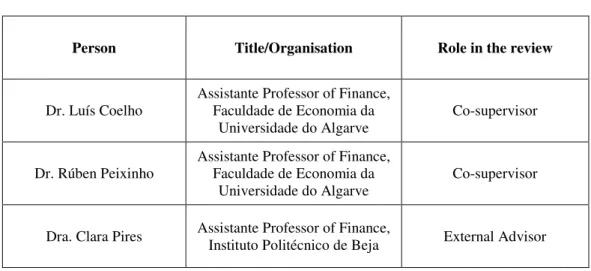
This systematic review of the literature is not a personal project entirely. Indeed, although it is mostly an individual effort, I benefited from the involvement of other people along the way. In particular, right from the beginning I set up a consultation panel to help me develop my research protocol. Such consultation panel plays two different and complementary roles within the development of a systematic literature review. The first is to provide guidance and expert advice on several aspects of the review. This ensures that all relevant literature is covered during the process. On the other hand, the review panel also acts as an auditor of the entire process. This means the panel members not only give advice but they also provide valuable input by constructively criticizing both the contents and process of the review. Table 3.1 shows the composition of my systematic review panel:
Table 3.1 – consultation panel for the systematic review
Person Title/Organisation Role in the review
Dr. Luís Coelho Assistante Professor of Finance, Faculdade de Economia da
Universidade do Algarve Co-supervisor
Dr. Rúben Peixinho Assistante Professor of Finance, Faculdade de Economia da
Universidade do Algarve Co-supervisor
Dra. Clara Pires Assistante Professor of Finance, Instituto Politécnico de Beja External Advisor
The members of the panel are selected according to their contribution in the finance area. My foremost inspiration was Professor Luís Coelho, who helped identify a topic that I am comfortable with and also provided guidance in the choice of keywords and research strings used in this systematic literature review. His supervision has been crucial to find the correct direction for my research and a source of motivation. I also benefited from the involvement of Professor Rúben, whose assistance was very helpful throughout my review. He offered many hours of his time to clarify and debate issues related to my project and the field in general. As an external academic, I involved Professor Clara Pires, given her expertise in the field and also has a vast amount of related research experience.
3.2.2.2. Search strategy
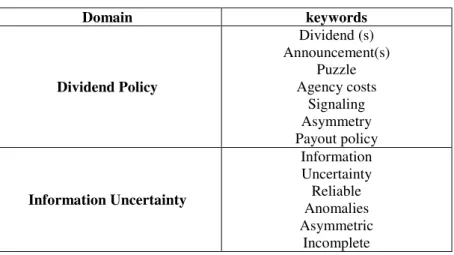
Developing a valid search strategy is a critical step in the systematic review process, as this delimits the subject topic. The first step of the process is identifying relevant academic studies in pre-determined electronic databases. In order to achieve such goal, a set of keywords are generated and different search strings are devised. I relied heavily on the help of the panel members to achieve such objective, with the following table presenting the keywords used in the study:
Table 3.2 – Keywords used in the systematic literature review
By combining such set of keywords, I define the following search strings:
Search string 1:
(Dividend AND policy) OR (Dividend AND announcements) OR (dividend AND puzzle) OR (payout policy).
The first search string is designed to capture studies that relate to firm’s dividend policy.
Search string 2:
[(Dividend policy) AND (agency costs)] OR [(dividend policy) AND signaling)] OR [(dividend policy) AND asymmetry)].
This second restricts the papers to those addressing dividend policy and that focus on the more relevant dividend theories for my survey.
Domain keywords Dividend Policy Dividend (s) Announcement(s) Puzzle Agency costs Signaling Asymmetry Payout policy Information Uncertainty Information Uncertainty Reliable Anomalies Asymmetric Incomplete
Search string 3
(Information uncertainty) AND (reliable information) OR [(Information uncertainty) AND anomalies] OR [(Information uncertainty) AND asymmetric information] OR [(Information uncertainty) AND (incomplete information)].
This last string captures papers that address the issue of information uncertainty.
3.2.2.3. Selection criteria
The use of the abovementioned search strings allows identifying a set of papers that are potentially interesting for my area of interest. However, only a fraction should be significant to my research. As a result, a set of predetermined selection criteria are designed to ensure that only high quality papers that make a relevant contribution to my study are reviewed in depth in the present dissertation. The next paragraphs detail such selection criteria.
Broad selection criteria
The first stage of the selection process consists of analyzing the titles and abstracts of the papers identified with the three search strings. I employ a set of exclusion criteria to ensure that only the relevant papers are considered past this initial stage, all of which are presented in table 3.3.
Table 3.3 – Exclusion criteria and rationale (Title and Abstract)
Criteria Rationale
1. I eliminate articles published in other sources than scholarly journals, with the exception of SSRN working papers and papers suggested by the panel.
Magazines, newspaper articles, and similar sources of information lack scientific rigor. 2. Studies that mention the keywords of interest as
residual issues or in other areas than accounting and finance.
In some cases, the search strings identify papers that are in other areas of research than accounting and finance; in addition, many papers that mention my keywords consider dividend policy and/or IU as residual issues. 3. Studies that focus on other dividend theories
besides signaling, agency costs and asymmetry. These are the three dividend theories that are more easily reconcilable with the notion of IU. All studies identified that do not fall into at least one of the abovementioned exclusion criteria are assessed by the selection criteria for full papers. Details of such criteria are presented in the next paragraphs.
Selection criteria for full papers
1. Empirical paper - in order to be included, empirical papers must provide/describe/state:
A clear definition of the sample (first and last year of the sample, sectors included, nationality of the sample firms, descriptive characteristics such as size distribution, etc.);
A clear definition of the variables and methodologies employed; The relation with existing theory and previous work;
Contribution to the existing knowledge;
The empirical results and their significance. Moreover, the paper must also provide a clear interpretation of the results in the context of the existing literature and relevant theory;
The methodological shortcomings that may reduce the possibility to generalize from the presented results.
2. Non-empirical papers – in order to be included, such papers must present/define: The aim of the model and relation with existing theory and previous
work;
Its contribution to existing knowledge; The assumptions of the model;
The variables, parameters and equations clearly;
Explicit proofs of the most important results and theorems.
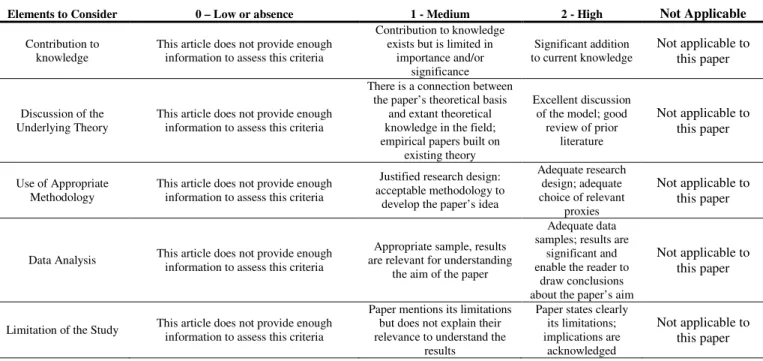
Beyond the abovementioned exclusion and selection criteria for abstracts, titles and full papers, a quality appraisal tool is also applied. I use a similar methodology to that of Marcos (2000) to address this issue. Such methodology analyses five different dimensions of each paper: contribution to knowledge, discussion of the underlying theory, use of appropriate methodology, data analysis and discussion of the limitations of the study. The details of the quality assessment tool are provided in the following table:
Table 3.4 – A Critical Appraisal Tool for the Systematic Review
Level
Elements to Consider 0 – Low or absence 1 - Medium 2 - High Not Applicable Contribution to
knowledge This article does not provide enough information to assess this criteria
Contribution to knowledge exists but is limited in
importance and/or significance
Significant addition
to current knowledge Not applicable to this paper
Discussion of the
Underlying Theory This article does not provide enough information to assess this criteria
There is a connection between the paper’s theoretical basis
and extant theoretical knowledge in the field; empirical papers built on
existing theory
Excellent discussion of the model; good
review of prior literature
Not applicable to this paper
Use of Appropriate
Methodology This article does not provide enough information to assess this criteria
Justified research design: acceptable methodology to
develop the paper’s idea
Adequate research design; adequate choice of relevant proxies Not applicable to this paper
Data Analysis This article does not provide enough information to assess this criteria are relevant for understanding Appropriate sample, results the aim of the paper
Adequate data samples; results are
significant and enable the reader to
draw conclusions about the paper’s aim
Not applicable to this paper
Limitation of the Study This article does not provide enough information to assess this criteria
Paper mentions its limitations but does not explain their relevance to understand the
results
Paper states clearly its limitations; implications are
acknowledged
Not applicable to this paper
Papers are considered for the systematic review if: 1) do not score two zeros in the five different categories above and 2) score a two at least once in any of the five categories above.
3.2.2.4. Data extraction
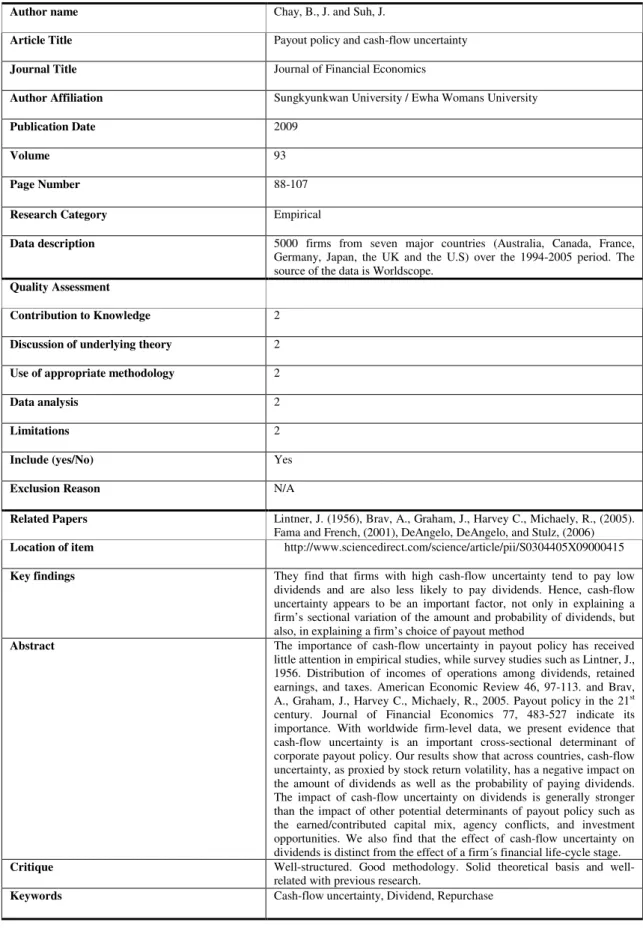
Data is extracted from the studies that are suitable for the aims of the systematic review and that meet all the selection criteria above. Table 3.5 provides an example of the data extraction form used in this study.
Table 3.5 – Sample of the Data Extraction Form Author name Chay, B., J. and Suh, J.
Article Title Payout policy and cash-flow uncertainty
Journal Title Journal of Financial Economics
Author Affiliation Sungkyunkwan University / Ewha Womans University
Publication Date 2009
Volume 93
Page Number 88-107
Research Category Empirical
Data description 5000 firms from seven major countries (Australia, Canada, France, Germany, Japan, the UK and the U.S) over the 1994-2005 period. The source of the data is Worldscope.
Quality Assessment
Contribution to Knowledge 2
Discussion of underlying theory 2
Use of appropriate methodology 2
Data analysis 2
Limitations 2
Include (yes/No) Yes
Exclusion Reason N/A
Related Papers Lintner, J. (1956), Brav, A., Graham, J., Harvey C., Michaely, R., (2005). Fama and French, (2001), DeAngelo, DeAngelo, and Stulz, (2006)
Location of item http://www.sciencedirect.com/science/article/pii/S0304405X09000415
Key findings They find that firms with high cash-flow uncertainty tend to pay low dividends and are also less likely to pay dividends. Hence, cash-flow uncertainty appears to be an important factor, not only in explaining a firm’s sectional variation of the amount and probability of dividends, but also, in explaining a firm’s choice of payout method
Abstract The importance of cash-flow uncertainty in payout policy has received little attention in empirical studies, while survey studies such as Lintner, J., 1956. Distribution of incomes of operations among dividends, retained earnings, and taxes. American Economic Review 46, 97-113. and Brav, A., Graham, J., Harvey C., Michaely, R., 2005. Payout policy in the 21st century. Journal of Financial Economics 77, 483-527 indicate its importance. With worldwide firm-level data, we present evidence that cash-flow uncertainty is an important cross-sectional determinant of corporate payout policy. Our results show that across countries, cash-flow uncertainty, as proxied by stock return volatility, has a negative impact on the amount of dividends as well as the probability of paying dividends. The impact of cash-flow uncertainty on dividends is generally stronger than the impact of other potential determinants of payout policy such as the earned/contributed capital mix, agency conflicts, and investment opportunities. We also find that the effect of cash-flow uncertainty on dividends is distinct from the effect of a firm´s financial life-cycle stage.
Critique Well-structured. Good methodology. Solid theoretical basis and well-related with previous research.
3.3 Literature synthesis process
The last step in the systematic review is to synthesize the selected papers into a connected whole. This is important in order to understand the research topic and to identify connections and patterns within the literature. Moreover, it helps identifying potential gaps in the literature. Accordingly, I considered a “literature tree” to help map out the structure of my research topic. Dividend policy and information uncertainty constitute the starting points of this structure. Given that my topic consists of the connection of two different areas, particular emphasis is given to the issues that can be linked.
I also raised the following questions that help me determine the structure of my literature synthesis:
1. What do we already know in the areas related to my research topic? 2. What are the characteristics of the key concepts?
3. What are the relationships between these key concepts? 4. What are the existing theories?
5. How can my research contribute to a better understanding of my research questions?
The next chapter summarizes the major findings of the papers identified with the search protocol now presented.
4. FINDINGS
This chapter presents my findings, which are divided in two parts. The first explains the selection of the key literature; the second summarizes the papers that comply with all the exclusion criteria cited above.
4.1. Descriptive analysis of the selected papers 4.1.1. Process description
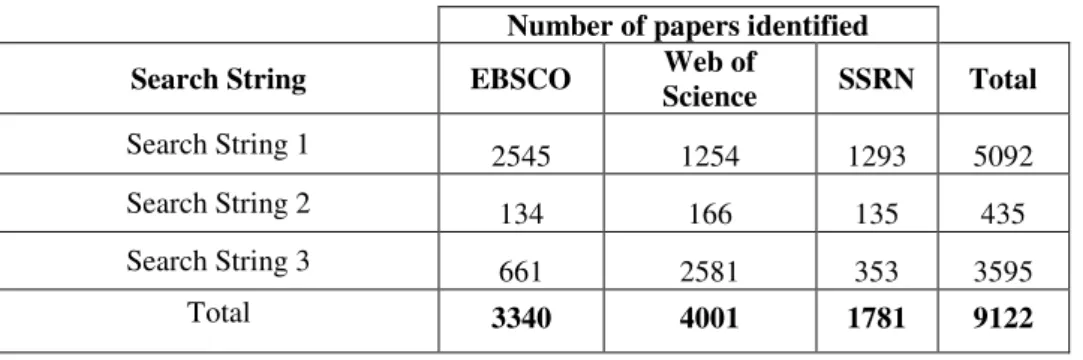
As mentioned in sub-section 3.3, the search strings are initially used with EBSCO, Web of Science and SSRN. Table 4.1 summarizes the number of papers by database identified in the first step of the process.
Table 4.1 – All papers and all search strings
Table 4.1 shows that a total of 9122 documents were identified using my search strings. Such voluminous literature was reduced using the exclusion criteria for titles and abstracts as well as for full texts. The results of such selection are presented in table 4.2.
Table 4.2 – Selection of papers process
Number of papers identified
Search String EBSCO Web of Science SSRN Total
Search String 1 2545 1254 1293 5092
Search String 2 134 166 135 435
Search String 3 661 2581 353 3595
Total 3340 4001 1781 9122
Documents from all sources 9122
Papers excluded based on criterion 1 -6472
Papers excluded based on criterion 2 -1563
Papers excluded based on criterion 3 -1068
Papers excluded based on the reading of full text -2 Papers included based on cross-references +3 Papers included based on panel suggestions +3 Final sample of papers for the systematic review 23
As shown in table 4.2, numerous papers were excluded due to their deficient classification in the original databases, or because they were from other areas than accounting and finance or because our main topics only simple marginal in the paper. Two empirical papers were also removed as they did not comply with all the requirements for such type of paper.
Table 4.2 also shows that I include three extra papers in my final list following the advice of the panel. Furthermore, three interesting papers were identified by cross referencing the original studies selected through my search protocol. In the end, the final numbers of papers included in my final review of the literature is 23.
4.1.2. Descriptive statistics
This sub-section provides some basic statistics about the final sample of 23 papers included in my review. Table 4.3 presents the list of the 23 papers included in my review.
Table 4.3 – List of papers included in the final systematic literature review
1. Angelini and Guazzarotti (2009)
2. Arnott and Asness (2001)
3. Bradley, Capozza and Seguin (1996)
4. Bradley, Capozza and Seguin (1998)
5. Bulan, Subramanian and Tanlu (2007)
6. Chay and Suh (2009)
7. Chen, Shevlin and Tong (2004)
8. De Angelo, DeAngelo and Stulz (2004)
9. Erickson, Wang and Zhang (2007)
10. Farinha (2002)
11. Ferreira, Massa and Matos (2010)
12. Francis, LaFond, Olsson and Schipper (2003)
13. Harada and Nguyen (2006)
14. Jiang, Lee and Zhang (2005)
15. Kandel and Pearson (1995)
16. Khang and King (2002)
17. Kouki (2009)
Table 4.3 – List of papers included in the final systematic literature review
19. Li and Zhao (2008)
20. Naceur, Goaied and Belanes (2006)
21. Yoon and Starks (1995)
22. Zhang (2006a)
23. Zhang (2006b)
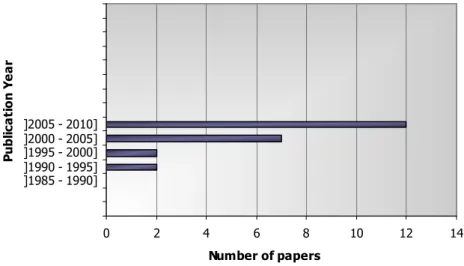
The next figure shows the number of publications per year.
Figure 4.2 - Number of Publications Per Year
As shown in figure 4.2, most of the studies included in the final list are published after 2000. In fact, I can only report four studies from 1995 (which is the year of publication of the first study included in the review) to 2000. Figure 2 also shows that the 2000-2010 period was the most productive in terms of literature directly related to my research interest.
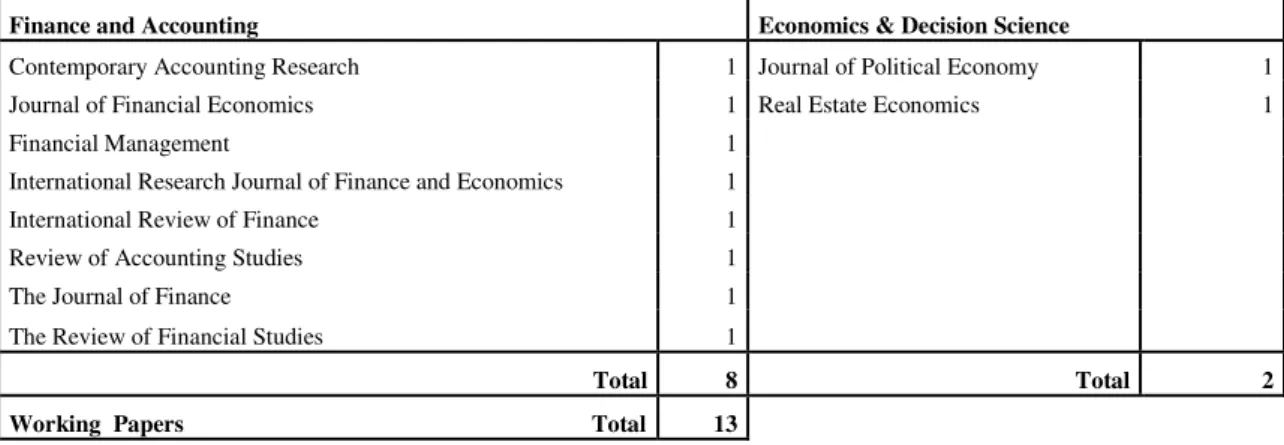
Table 4.4 shows the distribution of the selected papers by journal, which helps understand where the research relating to my topic is being published.
Table 4.4 – Distribution of the Papers Included in the Review by Journal and Area
As can be seen, most of the published research that I consider in my final list is published in finance and accounting journals (eight out of 23 papers). However, most studies are still working papers, available on SSRN. This shows that my research area is still not truly consolidated, which suggests that important gaps in the literature may exist.
The selected papers can also be divided into the empirical and non-empirical category. Table 4.5 lays out the number of papers under each category uncovered with my database search.
Table 4.5 – Empirical and Non-empirical Studies to Assess with Full Paper Criteria
As can be seen, most of the papers included in the final review are of empirical nature.
Finance and Accounting Economics & Decision Science
Contemporary Accounting Research 1 Journal of Political Economy 1
Journal of Financial Economics 1 Real Estate Economics 1
Financial Management 1
International Research Journal of Finance and Economics 1
International Review of Finance 1
Review of Accounting Studies 1
The Journal of Finance 1
The Review of Financial Studies 1
Total 8 Total 2
Working Papers Total 13
Nature of paper Number of papers
Empirical (Quantitative) 22
Non-Empirical 1
4.2 Report of the findings
This section provides a description of the findings. The first part addresses the issue of dividend policy and the second part addresses information uncertainty.
4.2.1 Dividend policy
Dividends convey unique valuable information for firms’ insiders and outsiders. The importance and relevance of the dividend policy has been empirically demonstrated by several studies. For instance, Arnott and Asness (2002) observe a sample drawn from Standard and Poors from 1926 to 2001 and from Cowles and associates from 1871-1925 to study to what extent the dividend policy matters. In particular, the authors investigate if managers should pay or hold back dividends according to their own internal growth projects. Arnott and Asness (2002) show that managers pay more dividends when they are optimistic. Moreover, they find that low payout ratios (high retention rates) precede low earnings growth, suggesting that a strong relation between these two events exists.
Bulan, Subramanian, and Tanlun (2007) investigate the signaling theory using a sample of 445 U.S. dividend omissions over the 1962-2001 period. Their results show that approximately 35% of dividend omissions are considered good news, signaling a turnaround in the fortunes of the omitting firms after a poor performance period. In contrast, supporting the lack of evidence concerning signaling theory, Li and Zhao (2008) use a CRSP/Compustat/IBES combined sample of 22,413 firm-year observations over the 1983-2003 period, and investigate the relation between a firm’s dividend policy and the quality of its information environment. The authors find that firms which suffer from information asymmetry tend to pay less in dividends, and are less likely to initiate and/or increase dividends. Similarly, Khang and King (2002) use a sample of all
publicly listed firms reporting to the SEC from January 1982 to December 1995 to explore the relation between dividends, insider trading gains and information asymmetry. In line with the free cash flow, and institutional monitoring theories, Khang and King (2002) show that firms which pay high dividends are not as exposed to asymmetry of information problems as similar firms exhibiting lower dividend payout ratios. In addition, the authors find that the more generous the dividend payout ratio the less insiders stand to gain by trading on their firms’ shares. Finally, in line with Li and Zhao (2008), Khang and King (2002) find little evidence to support that dividend changes act as a signaling mechanism.
In contrast with Khang and King’s (2002) results, Yoon and Starks (1995) observe 3,748 dividend increase and 431 dividend decrease announcements over the 1969 to 1988 period for a sample of U.S. firms. Their study focus on potential explanations for dividend change announcements and is based on two main hypotheses: 1) the cash flow signaling hypothesis, according to which a dividend change delivers information concerning current and/or future cash flows; and 2) the free cash flow hypothesis, under which a dividend change offers information about the incorrect use of cash flows by managers. Yoon and Starks (1995) findings are consistent with the cash flow signaling hypothesis as there is no evidence to suggest that managers reveal information concerning their investment policies when dividend announcement occur.
Chen, Shevlin and Tong (2004) use a sample of 2,981 firms listed on the NYSE, AMEX, or the NASDAQ from April 1974 to March 1999, to investigate the hypothesis that dividend changes are associated with changes in firms´ information risk. Chen et al (2004) show that information risk increases in the three year window following a
dividend decrease announcement. The authors also find that analysts’ forecast dispersion, and stock return volatility is more pronounced for such firms, suggesting they experience higher levels of uncertainty vis-à-vis their future prospects. As such, the evidence in Chen et al (2004) suggests that the information contained in dividends relates to changes in firms’ systematic risk (e.g., information risk), and changes in the uncertainty concerning firm’s future earnings and growth prospects.
Dividends are also important for shedding light on the impact of agency theory in corporate finance. For instance, Farinha (2002) collects a sample of around 600 UK firms over two periods (1987-91 and 1992-96) and explores how agency issues affect the cross-sectional distribution of dividend policies. He shows that shareholders dispersion has a positive and substantial impact on the dividend policy as his results show a strong U-shaped relation between insider ownership and dividend payout. Furthermore, DeAngelo, DeAngelo and Stulz (2004) use a sample of US firms listed in the NYSE, NASDAQ or AMEX over the 1973-2002 period, and find a highly significant relation between the ratio of retained earnings and the decision to pay dividends. In particular, they show that firms with high amounts of earned equity are more prone to pay dividends, which supports the hypothesis that firms pay dividends to moderate agency costs. In a parallel study, Harada and Nguyen (2006) collect a sample of Japanese firms listed on the Tokyo Stock Exchange from April 1995 to March 2002. They find that ownership concentration has great influence on how corporate decisions are made as it intensifies agency conflicts between majority and minority shareholders. In particular, a negative relation among dividend payout and ownership concentration is observed. This relation can be explained by the following reasons: 1) dominant shareholders have some sources under their control where private benefits can be
extracted; and 2) shareholders protect their best interests by omitting dividends when investments opportunities improve. In sharp contrast, Naceur, Goaied and Belanes (2006) use a dynamic panel data model with data from 48 Tunisian firms over the 1996-2002 period and find that ownership concentration does not impact dividend policy decisions. As the authors explain, looking at the Tunisian market is especially interesting as, contrary to other markets, the Tunisian government does not tax dividends or capital gains.
Also drawing on agency theory, Kouki (2009) investigates the relation between executive compensation and dividend policy using a sample of 89 companies listed on Toronto Stock Exchange over the 2000-2003 period. The author develops a model where shareholders cannot observe managerial quality and effort and highlight that adding stock options to managers´ compensation package provides an incentive for executives to reduce corporate dividends. Kouki (2009) also argues that, in such context, forcing a higher dividend payout ratio is likely to reduce the conflict of interests between managers and shareholders. In a very recent study, following Harada and Nguyen (2002), Ferreira, Massa and Matos (2010) examine a sample of 12,876 international firms over the 2000-2007 period to investigate the relation between institutional ownership and payout policy, supporting the existence of dividend clienteles around the world. In particular, Ferreira et al (2010) find that firms’ payout policy is influenced by the target payout ratio of the institutions holding the shares, which are defined according to tax, transaction costs, repatriation and reinvestment of dividends considerations.
Attempting to link the existence uncertainty in a firm to dividend policies, Bradley, Capozza and Seguin (1996) collect a sample of 75 firms listed in NAREIT (National Association of Real Estate Investment Firms) source book over the 1985-1992 period and find that the payout ratio has a negative (positive) correlation with expected uncertainty and firms’ leverage (firms diversification and size). In a subsequent paper, Bradley, Capozza and Seguin (1998) emphasize the importance of firm-specific volatility and its determinants. The authors find that dividends vary with the total volatility of future cash flows and not just with systematic risk. The evidence put forward by Bradley et al (1998) suggest that managers use dividends to signal not only the expected level of earnings but also their volatility, which contradicts authors who find little evidence supporting signaling hypothesis (e.g. Li and Zhao, 2008 and Khang and King, 2002).
Chay and Suh (2009) explore a sample of more than 5,000 firms from seven countries (Australia, Canada, France, Germany, Japan, the UK. and the U.S) over the 1994-2005 period. They contribute to the existing literature by showing that cash flow uncertainty is a crucial determinant of the payout policy at an international level. In particular, Chay and Suh (2009) focus on the level of the dividend payout rather than on the changes in dividends as most of the prior studies does (e.g. Chen, Shevlin and Tong, 2004; Yoon and Starks, 1995). They find that firms with high cash flow uncertainty avoid paying dividends and prefer using share repurchases as such alternative increases managers’ flexibility. Moreover, cash flow uncertainty is not only an important factor in explaining the cross-sectional variation of the amount and probability of dividends but also in explaining a firm’s choice of payout method. Chay and Suh (2009) also show that cash flow uncertainty has a stronger impact on dividends when compared to other expected
determinants (e.g. agency conflicts, earned/contributed capital mix and investment opportunities).
4.2.2 Information uncertainty
The impact and relevance of information uncertainty in financial markets has been the focus of some empirical studies, concerning the market´s reaction and its behavior. For example, Kandel and Pearson (1995) are among the first to explore how IU affects stock returns providing empirical evidence on the relation between the volume of trade and stock returns concerning public announcements. The authors compile a sample of announcements of stock splits and stock dividends between 1992 and 1993 and investigate how investors interpret such public signals. They find that agents have different interpretations of the public announcement which means that information is interpreted differently according to each individual. Overall it is subjective.
Jiang, Lee and Zhang (2005) work with all firms listed on the NYSE, AMEX and NASDAQ during the period from January 1965 through December 2001 to investigate the relation between IU and the cross-section of returns from a behavioral perspective. In particular, Jiang et al. (2005) examine whether the level of uncertainty is positively correlated with investor overconfidence. They find that: 1) high-IU firms earn lower future returns than low-IU firms (the “mean effect”); 2) the price and earnings momentum are much stronger among high-IU firms than low-IU firms (the “interaction effect”). In a parallel study, Zhang (2006a) considers a sample of U.S. firms collected over the 1983-2001 period and explores the association between IU (defined in terms of value ambiguity) and stock returns. In particular, he focuses on how prices change after the release of public information in the presence of IU. Under the hypothesis that
underreaction is stronger for high-IU firms, Zhang (2006a) concludes that expected returns are higher (lower) in cases of greater (lower) uncertainty following good (bad) news. In turn, this suggests the market has a slower response rate to news event when there is extra ambiguity regarding the implications of such events for firms’ value.
Francis, LaFond, Olsson and Schipper (2003) examine three types of accounting-based anomalies: PEAD (based on both analyst’s forecasts and seasonal random walk forecasts), value-glamour strategies (book-to-market, cash flow-to-price, and earnings-to-price) and accruals strategies (total accruals and abnormal accruals). They refer to IU as the precision or quality of an investment signal, in that poor quality signals have high IU while good quality signals have low IU. Francis et al. (2003) find that IU plays an important role in explaining accounting anomalies using a sample of U.S. firms over the 1982-2001 period. In particular, the authors show that the PEAD, the value-glamour effect and accruals trading strategies are all highly correlated with firm’s earnings quality, i.e., abnormal returns are associated with the abovementioned measures of a firm’s quality of accounting information (IU). Similarly, Angelini and Guazzarotti (2009) examine a sample of companies listed on NYSE, AMEX and NASDAQ over the 1985-2005 period and show a negative relation between stock price adjustment to news and the level of IU. The authors also provide new evidence concerning the post-earnings announcement drift by showing that such market pricing anomaly is not related to IU. This result is clearly at odds with that of Lee (2007), who uses both quarterly and annual earnings forecasts over the 1989 to 2005 period to investigate the relation between IU and PEAD.
Attempting to link firms acquisitions and IU, Erickson, Wang and Zhang (2007) explore a sample of 3,514 acquisitions taking place between 1985 and 2003. They show that, for acquirers, such corporate event leads, on average, to an increase in IU. Moreover, Erickson et al. (2007) find that the market tends to anticipate the negative effects (i.e., changes in information) of acquisitions, which results in negative abnormal returns around the announcement date. However, statistically, such effect is only significant when IU is proxied by the dispersion in analysts’ forecasts.
Finally, in an important contribution to the literature, Zhang (2006b) collects data for 49,923 firm-year observations over the 1983-2001 window, and shows that analysts, who are considered to be sophisticated market participants, tend to underreact to new information in the case of high-IU firms. In particular, their revisions are far from being complete in presence of great uncertainty and relatively complete in presence of low IU. Such evidence indicates that IU leads to slower revision of analysts’ forecasts, a phenomenon that seems especially important in the case of bad news.
5. CONCLUSION
This chapter concludes the present dissertation. Section 5.1 presents some research opportunities based on the findings of my systematic review. Section 5.2 examines the robustness of the methodology employed in this study. Section 5.3 describes my learning experience and Section 5.4 concludes.
5.1 Implications for further research
This systematic literature review on dividend policy and information uncertainty confirms that to date, with the exception of Bradley, Capozza and Seguin (1996 and 1998) and Chay and Suh (2009), no study has connected both subjects. As mentioned in Section 2.4, the aim of this review is to link dividend policy and information uncertainty in order to find a suitable gap in the literature for future research. The review of the selected papers confirms that some issues in these areas remain unclear and represent opportunities to explore them in a doctoral research.
For example, preview studies show that a firm’s dividend policy depends on the level of IU. Some papers argue that managers tend to pay more dividends to mitigate agency costs when firms are characterized by high-IU (e.g. DeAngelo, DeAngelo and Stulz, 2004, Farinha, 2002, Kouki, 2009). In contrast, Bradley, Capozza and Seguin (1996; 1998) and Harada and Nguyen, (2006) suggest that managers tend to reduce the payout ratio in high IU-firms and Naceur, Goaied and Belanes (2006) argue that ownership concentration does not impact dividend policy decisions. As such, conflicting evidence suggests that the relation between dividend policy and the level of IU may depend on specific environments (e.g. different legal, institutional, economic and cultural issues).
A comprehensive study in this area may be important to define the characteristics associated with a positive or negative relation.
Existing literature shows that firms with high levels of information asymmetry tend to have high levels of IU and lower dividend payouts. For example, Chen, Shevlin and Tong (2004) find that the information contained in dividends relates to changes in firm-uncertainty. Zhang, (2006a), Li and Zhao, (2008), Khang and King (2002), Chay and Suh, (2009) find that high asymmetry leads managers to pay lower dividends. How can this information asymmetry be controlled so it does not affect the level of IU? This is an interesting research avenue.
Existing literature suggests that managers signal a firm’s financial situation (expected level of earnings, volatility) by managing the dividend payout ratio. For instance, Bradley, Capozza and Seguin (1996 and 1998) and Chay and Suh (2009) manage the payout ratio according to the level of cash flow uncertainty. In contrast, Khang and King (2002) and Li and Zhao (2008) find little evidence that dividends act as signaling mechanism. Moreover, Kandel and Pearson (1995) support the idea that agents interpret public signals in a different way and Bulan, Subramanian and Tanlun (2007) present some new evidence concerning signaling theory showing that 35% of dividend omissions can be considered good news. Therefore, should dividends act or not as a signaling mechanism? And how can they be interpreted in a singular way by all agents?
5.2. Methodology appraisal
The present study uses the systematic literature review approach to review existing academic literature concerning dividend policy and information uncertainty. Although an improvement vis-à-vis the traditional approach, the systematic literature review is not free of criticism as one can always disagree with the keywords and exclusion criteria that are needed for implementing the search protocol. The panel has a fundamental role here. Moreover, selecting papers based on their titles and abstracts may lead to the exclusion of some studies that others may think are relevant for the study at hand. Therefore, one must recognize that the definition of the study´s refined scope ends up being somewhat tainted by the personal choices of the researcher. Likewise, the classification of papers based on the quality appraisal tool is also subjective, since different researchers may classify studies differently.
5.3. Learning Experience
The systematic review of the literature revealed itself to be a continuous learning process. The finance area has developed like not many other areas in the social domain earning the attention of the academic community around the world. Many studies in this area are a relevant contribution for the development of human knowledge. Hence, and due to the vast literature that exists in this area, it is very useful to develop a systematic literature review. Traditionally, researchers would wonder around the existing literature on a random basis, collecting whichever information they thought was important for their research topic but at the present time, this approach does not provide a comprehensive understanding of the research field in which the researcher is interested in. That is why it is necessary to do a systematic literature review which provides
solutions to the limitations of the traditional literature review. The following points summarize my most relevant thoughts on this issue:
1. Implementing a systematic review of the literature requires some knowledge about the research subject. A preliminary work of an explanatory nature must be first undertaken. Moreover, the panel plays a fundamental role by providing useful expert advice and comments when the researcher is not totally familiar with the subject;
2. This methodology also requires some database skills;
3. It is essential to define a set of reliable keywords and combine them in search strings. It is also key to have exclusion criteria that work.
4. The implementation of the quality assessment tool turned out to be more difficult than I thought. This is very subjective and the panel plays an important role drawing on their knowledge and expertise.
5. It is not possible to apply this methodology to other sources of information than academic papers (e.g., books). It provides a well-defined framework for doing a literature review but is not an ultimate search tool.
To sum up, the systematic literature review presents many advantages compared to the traditional approach. Despite all the advantages, the researcher must develop skills in specific areas like managing literature databases, must have a balanced consultation panel, be ready to take some important decisions and be aware that this methodology has some limitations. Importantly, complementing the research process with alternative methods of data collection is clearly a must. Nevertheless, when properly used, this method allows identifying suitable gaps in the literature and also refining the initial set of research questions.
5.4. Concluding Remarks
This dissertation employs the systematic literature review methodology to identify and assess the academic literature addressing dividend policy and information uncertainty, providing support for the connection between both subjects. This study finds a potential gap in the extant literature, which seems interesting for pursuing at the doctoral level.
The systematic review used in this dissertation represents an alternative method to avoid weakness of the traditional approach. The conduction of this process gave additional value to my findings and conclusions, but as quoted by Hart (1998) “There is no such thing as the perfect review”.
REFERENCES
Angelini, P. and G. Guazzarotti (2009) Information uncertainty and the reaction of
stock prices to news, SSRN, Document available at:
http://papers.ssrn.com/sol3/papers.cfm?abstract_id=1342672
Arnott, D. R. and C. S. Asness (2001) Does dividend policy foretell earnings growth?, SSRN, Document available at:
http://papers.ssrn.com/sol3/papers.cfm?abstract_id=295974
Asquith, P. and D. W. Mullins (1983) The impact of initiating dividend payments on
shareholder’s wealth, The Journal of Business, 56, 77-96.
Avramov, D. and S. Hore (2008) Momentum, information uncertainty, and leverage –
an explanation based on recursive preferences, SSRN, Document available at:
http://papers.ssrn.com/sol3/papers.cfm?abstract_id=1017419
Banks, D. and W. Kinney (1982) Loss contingency reports and stock prices: An
empirical study, Journal of Accounting research, 20, 240-254.
Black, F. (1976) The dividend puzzle, The best of the journal of portfolio management special issue 1996, 8-11.
Blume, M. E. (1980) Stock return and dividend yield: some more evidence, Review of Economics and Statistics, 62, 567-577.
Bradley, M., D. R. Capozza and J. P. Seguin (1996) Dividend policy revisited: the role
of cash flow uncertainty, SSRN, Document available at:
http://papers.ssrn.com/sol3/papers.cfm?abstract_id=7713
Bradley, M., D. R. Capozza and J. P. Seguin (1998) Dividend policy and cash-flow
uncertainty, Real Estate Economics, 26, 555-580.
Brennan, M. (1970) Taxes, market valuation and corporate financial policy, National Tax Journal, 23, 417-427.
Bruhin, A., T. Epper and H. Fehr-Duda (2009) Uncertainty breeds decreasing
impatience: the role of risk preferences in time discounting, SSRN, Document available
at: http://papers.ssrn.com/sol3/papers.cfm?abstract_id=1416007
Bulan, L., N. Subramanian and L. Tanlu (2007) When are dividend omissions good
news?, SSRN, Document available at:
http://papers.ssrn.com/sol3/papers.cfm?abstract_id=997427
Chan, L., N. Jegadeesh and J. Lakonishok (1996) Momentum strategies, Journal of Finance, 51, 1681-1713.
Charest, G. (1978) Dividend information, stock returns and market efficiency, Journal of Financial Economics, 6, 297-330.
Chay, B J. and J. Suh (2009) Payout policy and cash-flow uncertainty, Journal of Financial Economics, 93, 88-107.
Chen, S., T. Shevlin and H. Y. Tong (2004) What is the information content of dividend
changes? An investigation to an old puzzle, Document available at:
http://www4.gsb.columbia.edu/null?exclusive=filemgr.download&file_id=644977
DeAngelo,H., L. DeAngelo and M. R. Stulz (2004) Dividend policy, agency costs and
earned equity, SSRN, Document available at:
http://papers.ssrn.com/sol3/papers.cfm?abstract_id=563043
Easley, D., S. Hvidkjaer and M. O’Hara (2002) Is information risk a determinant of
asset returns? Journal of Finance, 57, 2185-2221.
Easterbrook, F. (1984) Two agency cost explanations of dividends, American Economic Review, 74, 650-659.
Erickson, M., S. W. Wang and F. X. Zhang (2007) Information uncertainty and
acquirer wealth losses, SSRN, Document available at:
http://papers.ssrn.com/sol3/papers.cfm?abstract_id=1031544
Farinha, J. (2002) Dividend policy, corporate governance and the managerial
entrenchment hypothesis: an empirical analysis, SSRN, Document available at:
http://papers.ssrn.com/sol3/papers.cfm?abstract_id=313976
Ferreira, A. M., M. Massa and P. Matos (2010) Dividend clienteles around the world:
Evidence from institutional holdings, SSRN, Document available at:
http://papers.ssrn.com/sol3/papers.cfm?abstract_id=1447573
Francis, J., R. LaFond, P. Olsson and K. Schipper (2003) Accounting anomalies and
information uncertainty, SSRN, Document available at:
http://papers.ssrn.com/sol3/papers.cfm?abstract_id=414141
Gordon, M. (1963) Optimal investment and financing policy, Journal of Finance, 18, 264-272.
Harada, K. and P. Nguyen (2006) Ownership concentration, agency conflicts and
dividend policy in Japan, SSRN, Document available at:
http://papers.ssrn.com/sol3/papers.cfm?abstract_id=953433
Hart, C. (1998) Doing a Literature Review, London, Sage Publications.
Healy, M. P. and G. P. Krishna (1988) Earnings information conveyed by dividend
initiations and omissions, Journal of Financial Economics, 21, 149-176.
Ikenberry, D. L. and B. Julio (2004) Reappearing dividends, Journal of Apllied Corporate Finance, 16, 89-100.