CUIDADO É FUNDAMENTAL
UNIVERSIDADE FEDERALDO ESTADODO RIODE JANEIRO. ESCOLADE ENFERMAGEM ALFREDO PINTO
R E V I S T A O N L I N E D E P E S Q U I S A
PESQUISA
CUIDADO É FUNDAMENTAL
UNIVERSIDADE FEDERAL DO ESTADO DO RIO DE JANEIRO . ESCOLA DE ENFERMAGEM ALFREDO PINTO
DOI: 10.9789/2175-5361.2017.v9i4.990-998
DOI: 10.9789/2175-5361.2017.v9i4.990-998 | Souza IP; Araújo LFS; Bellato R | Gift and care during the time lived with the family
Gift and care during the time lived with the family
1A dádiva e o cuidado no tempo do vivido em família
La dádiva y el cuidado en el tiempo del vivido en família
Ítala Paris de Souza2, Laura Filomena Santos de Araújo3, Roseney Bellato4
How to quote this article:
Souza IP, Araújo LFS, Bellato R. Gift and care during the time lived with the family. Rev Fun Care Online. 2017 out/dez; 9(4):990-998. DOI: http://dx.doi.org/10.9789/2175-5361.2017.v9i4.990-998
ABSTRACT
Objective: To understand the modeling of family care provided over time to an elderly who experiences Alzheimer’s, including it in the gifting circuit. Methods: This was a situational study with a comprehensive approach, employing life story with an in-depth interview and observation of the elderly and family. Results: We learned about the ties that bind family members, allowing modeling care “in and for” life, over family time, establishing the gifting circuit that we present through the lemniscate image. In this modeling, we evidenced the intense effort expended by the family to provide and manage the care to the elderly, increasingly improved and updating the give-receive-reciprocate in an affective and laborious texture. Conclusion: Such understanding is important for health professionals to reflect on ways to produce good practices that endure over time, mobilizing resources to support the family with the necessary substrate for their care.
Descriptors: Family relations, Care, Alzheimer’s Disease, Life Change Events, Nursing.
RESUMO
Objetivo: Compreender a modelagem do cuidado familiar ao longo do tempo à idosa que vivencia o Alzheimer, inscrevendo-o no circuito da dádiva. Métodos: Estudo de situação, de abordagem compreensiva, empregando história de vida com entrevista em profundidade e observação junto à idosa e família. Resultados: Apreendemos os laços que unem os entes familiares, possibilitando a modelagem do cuidado “na e para” a vida, ao longo do tempo em família, instaurando o circuito da dádiva, que apresentamos pela imagem da lemniscata. Nessa modelagem evidenciamos o intenso esforço despendido pela família na provisão e gerenciamento dos cuidados à idosa, cada vez mais aprimorados, atualizando, assim, o dar-receber-retribuir, em tecitura afetiva e laboriosa. Conclusão: Tal compreensão se mostra importante aos profissionais de saúde para que reflitam sobre modos de produzir boas práticas que perdurem no tempo, mobilizando recursos para apoiar a família com o substrato necessário ao seu cuidar.
Descritores: Relações familiares, Cuidado, Doença de Alzheimer, Acontecimentos que Mudam a Vida, Enfermagem.
1 Manuscript originated from the master’s thesis “Modeling of daily family care in the chronic situation by Alzheimer’s”, developed in 2016, with a grant from the Coordination of Improvement of Higher Level Personnel (CAPES) and linked to the matrix research “Allowances for modeling care of families in situations of vulnerability, “institutional registry 131 / CAP / 2014, under the responsibility of the Research Group” Nursing Health and Citizenship “(GPESC) of the Faculty of Nursing of the Federal University of Mato Grosso (FAEN/UFMT).
2 Nurse. Master's Degree in Nursing by the Graduate Program in Nursing, Faculty of Nursing, Federal University of Mato Grosso (FAEN / UFMT). Member of the Nursing, Health and Citizenship Research Group (GPESC). Fellow CAPES FAEN/UFMT. Cuiabá - Mato Grosso, Brazil.
3 Nurse. PhD in Nursing, lecturer at FAEN/UFMT, leader of GPESC. Cuiabá - Mato Grosso, Brasil. E-mail: [email protected]. 4 Nurse. PhD in Nursing, lecturer at FAEN/UFMT, member of GPESC. Cuiabá - Mato Grosso, Brasil. E-mail: [email protected].
RESUMEN
Objetivo: Comprender el modelaje del cuidado familiar a lo largo del tiempo a la anciana con Alzheimer, inscribiéndolo en el circuito de dádiva.
Métodos: Estudio de situación, de enfoque comprensivo, empleando historia de vida con entrevista en profundidad y observación de la anciana y familia. Resultados: Reflexionamos sobre los lazos que unen entes familiares, posibilitando el modelaje del cuidado “en y para” la vida, a lo largo del tiempo en familia, instaurando el circuito de dádiva que presentamos por la imagen de lemniscata. En ese modelaje evidenciamos el intenso esfuerzo despendido por la familia en la provisión y gerenciamiento de los cuidados, cada vez más mejorados, reactualizando el dar-recibir-retribuir en tesitura afectiva y laboriosa. Conclusión: Tal comprensión es importante para los profesionales de salud para reflexionar sobre modos de producir buenas prácticas que perduren en el tiempo, movilizando recursos para apoyar la familia con el substrato necesario a su cuidar.
Descriptores: Relaciones familiares, Cuidado, Enfermedad de Alzheimer, Acontecimientos que Cambian la Vida, Enfermería.
INTRODUCTION
Alzheimer’s disease has been considered the most frequent among the elderly, and by the year 2030 it will reach about 65.7 million of the world population, rising to 115.4 million in 2050.1 In Brazil, the prevalence of people with this
illness has been increasing gradually. In the elderly aged 65 and over, it went from 7.6% to 7.9% between 2010 and 2020, that is, 55,000 new cases each year.2
Among the symptoms, there are those of cognitive decline - attention deficit, visual-perceptive and orientation, memory loss, apraxia, agnosia, among others - and neuropsychiatric ones, such as depression, irritability, agitation, delusions and behavioral change motor.3-4
Considered a chronic illness, Alzheimer’s brings with it a marked characteristic of persistence over time, which leads to potentially progressive, limiting and / or incapacitating affections. Thus, people who experience this condition present varied, prolonged and singular needs to their own living.5 Such needs go beyond the purely
biological dimension, affecting people in different spheres of daily living, whether social, psychological, economic or cultural, which are interrelated. As far as family coexistence is concerned, it becomes greatly compromised, since it is in everyday life, the stage of human relationships, with their powers, limits and affections, that the elderly person and their family share their feelings and are affectively and affectedly involved in care.
We understand daily life as the “way of living of human beings that is shown in everyday life, by their interactions, beliefs, values, meanings, culture, symbols, which outlines the process of living”. 6:6
The family, in the midst of this daily life, is the fundamental pillar of human sustenance over time, since it takes care of every family entity ‘in’ and ‘for’ life. And, of course, the onset of illness causes various affections that intensify this model of care and, consequently, the rearrangements necessary to provide them. Such a family movement to take care of itself occurs to the same extent of the potentials that the family and
the sick person have,5 but it is also dependent on the way that
care, as a good in itself, circulates between its beings over time. In this understanding, we corroborate that care encompasses ways of being wrapped in values, attitudes, empathy and affections that, together, favor the potentialities of people to care for and take care of, communing a better life.7 In the family relationship,
therefore, we presuppose a personal care that is shaped throughout life, resembling “the work of the sculptor who performs his work in the clay, in a unique way”.8:1138
Modeling care as a work means “to be intimate with it, to feel it within, to accept it, to respect it, to give it peace and rest. Caring is getting in tune with things. To listen to the rhythm and to tune with it “. 9:109
Family care is also modeled on the way in which the person and family experience illness, the relationships of affection, and also through the conditions and possibilities they have to care for.10
We will also assert that the family cares in the present tense according to what it means from its past experiences and, as it were, this past reverberates in the present, providing it with nourishing elements. Caring through life, then, causes resonances that have a certain permanence in time and which, in the present, become essentially powerful. As we understand it, this study highlights the temporal dimension of care in the family and, with it, a certain permanence and continuity between the generations.
We take the perspective of the gift to guide us in understanding the family experience of care, and in it, the way it circulates between its beings over time, moving the circuit of giving, receiving, and reciprocating. In this circuit, we emphasize the dimension of relationships between people, starting with dialogue and love as fundamental in human existence.
The Theory of the Gift, discussed first in the work of sociologist,11 reflects how people relate and form bonds under
the aegis of giving as a gift something of value, establishing reciprocity as a uplifting practice of social life.
Approaching this theorization to understand care within families, authors understand that, taken as a gift, it is at the service of their own family ties and, in essence, encompasses the continuity and diversity of shared supports throughout a lifetime.12-13
In this study we show how the family of elderly people who experience a chronic situation due to Alzheimer’s, at an already advanced stage, provides, in the present time, a myriad of care14-15 which are very effective. Such
provision between the spouses and other family entities was and is mediated by bonds of affection built and perpetuated in time.
The study seeks to provoke reflections on family care in their “craftsmanship of a life project”16:47; and, positively, to
offer subsidies so that we, as nurses, can offer our “practice as a possibility of a desiring and desirable existence, for both subjects of care, far beyond material production”.17:2074 The
construction of good practices in health must, therefore, glimpse possibilities of action articulated with the daily life of families in their needs.18
Thus, we aimed to understand the modeling of family care for the elderly who experience Alzheimer’s, by enrolling them in the gift circuit.
METHOD
We are guided by the comprehensive approach that rules empathic, respectful, open and sensitive posture in order to approach “the relief and contours of the fluid and dynamic reality of everyday human experience”.10:1394 Here we take the
dimension of the lived and, in it, the senses and meanings of the family experience of care.
Consistent with this approach, we propose a “situational study” that allows us to enter/learn the singular daily life and care, allowing us to draw some more comprehensive inferences from microcontexts.19 Then:
We focus on the presentation of the “how” things happen and if happen, in a detailed description of the situations experienced by people, without the pretension of exhausting them in their multiple senses and dimensions. We understand that this is not a limitation of thinking, but rather a broadening of thought that seeks to understand in depth what constitutes the specificity of each situation, each experience, making them stand out the vital effervescence.10:1395
To do so, we use the History of Life20 as a strategy that
values the lived by the people, according to their perspectives and expectations. HL therefore understands how people (re) interpret their stories by revealing the meanings attributed to the lived, with their own and variable intensities that give relevance to the unique situations of their lives20 and “who
are integrated into the whole of the life of each member of the family”. 10:1394
In the collection of the History of Life we invite family members to tell us about their lives, to which they follow their own logics and temporalities in their memories, giving relief and nuances to what is important to them of being narrated.10
The life narratives were welcomed through the in-depth interview in which each interviewee was invited to freely discourse about their experiences in an effort to remember the lived. The researcher’s questions allowed her to deepen certain narrative threads drawn from the story, to the extent of her understanding effort and according to the interest in aspects of the family experience.20 The deepening of the
interview entails the holding of several meetings in order to understand, among other things, “the way in which individuals experience their daily lives, in particular certain events or changes during their lives”. 21:877
We also take note of the observation20, which highlights
our own ability to understand the elements seen, felt, heard and experienced with the family, explaining important characteristics of people, places, events and the researcher’s own work and insights. The annotations emanated are identified in the text by the acronym Notes of Observation (NO), contributing to get closer to the family experience.
The choice of the participating family was based on a network of informants, composed of teachers and students from the institution proposing this study. The initial contact was through a nurse from a Family Health Strategy unit in the city of Cuiabá-MT that reported stories of five families within the scope area of her unit. Among these, we made the intentional choice of the history of the elderly woman with Alzheimer’s disease because it: delimited family care in the context of the home; is a chronic condition of peculiar illness, manifest as dementia; encompass family experience of care mediated by bonds of affection fed by a long-term caring relationship.
The family participating in the study is composed of Sara, who, at the age of 70 years, experiences a chronic situation due to Alzheimer’s already in an advanced stage. Her husband and companion is Abraham, 74, who has been very present in his care, being supported by the relatives of Sara - seven sisters and nieces. All names used here are fictitious.
Family meetings, numbering four, took place from April to October 2015, all at his residence. In the first two encounters only Abraham and Sara were present, being the narrator of the family history, since the wife can no longer verbally articulate her thinking. In the following meetings, besides the couple, they were present in the residence, privileged scene of the care: the sisters Débora, Samara, Edna, Mara and the niece Lídia, in the third encounter; and the sisters Marta, Susana and nieces Lídia and Talita, in the fourth meeting.
For our part, Sara received special attention, being directed our attention and care, seeking to perceive it in her presence and in what she could express of will. She manifested herself within her possibilities, usually through gestures and guttural sounds, since verbalization, coherent and orderly, is already quite limited by Alzheimer’s. Thus, the attentive gaze on Sara can offer us untouchable elements of the moment she experiences, in her concreteness of being in the family, always surrounded by her relatives and being cared for by them in a close and continuous way.
In the Research Journal20 we compile the collection
material resulting from the complete transcription of all interview meetings, recordings of observations and also the description of the experience lived in the field and the comprehensive effort of the History of Life, through reflections, preliminary ideas , doubts and concerns that, in short, constitute the study’s own theoretical-methodological work. This diary resulted in a total of 217 pages typed in Microsoft Word Document (docx), Times New Roman font, size 12 and single line spacing, composing the corpus of our study.
In order to “clarify the meaning of the lived” (NO) in what we can understand what the family told us, “we read, re-read and translate” (NO) the corpus containing the life story of Sara and Abraham in a gradual, slow, intense dive, enlivening the senses that drew us attention from the narratives of family members. This ‘enlivening’ of the senses for us gained colorful ‘tones’ marked in the text that evidenced two important axes in this study: a) the innumerable ways of Sara being and staying in daily life, with emphasis on the
before the illness; B) the mobilizations, efforts and care for Sara, by Abraham and the family, throughout her illness.
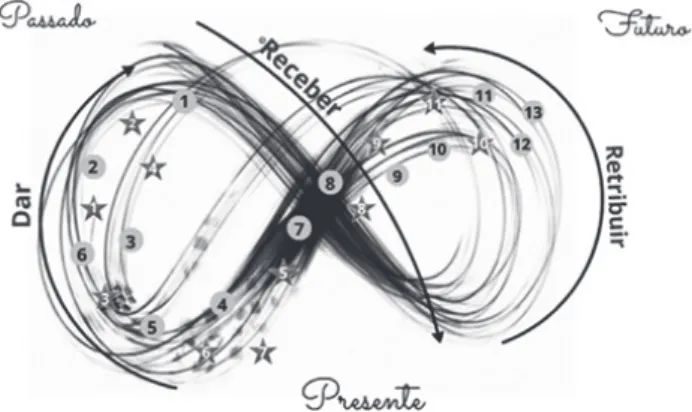
In an operative way, coloring narratives and arranging them according to their senses were arranged in a descriptive table in “Microsoft Word” format. This interpretive effort has generated the need to show family care in the dynamicity of life and over time, through family and conjugal bonds, in order to express the movement of the gift in its infinite happening. We have thus idealized an image design called “The gift circuit moving family care over time: the lemniscata” (Figure 1) showing the temporality of family care among the bonds that unite their bodies, building the gift in modeling care for life. Its explanation will be followed, since it is involved in the very presentation and discussion of the results.
The matrix research to which this study is linked had ethical approval under no. 951.101 / CEP-HUJM / 2015 and meets all the ethical principles required by Resolution no. 466/12 of the National Health Council. The participation of the family in the study occurred through the signing of the Free and Informed Consent Term, being guaranteed the anonymity of the interviewees, as well as of the institutions and health professionals referred by them. Still, it was essential to build a close relationship between researcher and participant, based on ethical-human values such as respecting, recognizing, sharing and taking responsibility, surrounded by empathy, freedom, autonomy, citizenship.
RESULTS AND DISCUSSION
In order to understand Sara’s life of care over time and how she became involved in family life, it was imperative that we approach her everyday context. It was from this perspective that we were able to apprehend the gift circuit embodied in the dynamicity of the lived, fed in time by strong bonds that unite Sara to its relatives. The circuit reverberates, in the present, intense care and maintainers of her life.
Sara is the first daughter of the eight female sisters; was born in a municipality located 340 km from Cuiabá-MT and, since her childhood, resided in rural property together with his brothers and parents, and later lived in Rondonópolis-MT. In this city, at the time of his 29 years, she met Abraham, 34 years and, six months later, they got together in marriage.
They had a life in common of accomplice and devoted one to the other, being that the pair did not have children. In the minutiae of everyday life, Sara devoted herself to caring for the home and the health of the people, as well as strengthening ties by sharing crochet knowledge with younger sisters and nieces, as well as religious teachings. Thus, wherever she passed, she radiated her presence, love, care, affection and companionship with the relatives.
She was diagnosed with Alzheimer’s in 2007. She lives with the limitations stemming from chronic illness, expressed by inability in dialogue, understanding, difficulty in motor coordination, which culminates with limitations even to perform small acts of care in daily life. Since then, countless people have participated in sustaining the best in health to their life, mainly family. It seems to us that the life
of care, based on affection and love, which Sara gave to her family, makes her recognized in the present, enabling her to reverberate an infinity of care to her, now sick.
The history of the family inserted in this context of life between being healthy and being sick has been rich in possibilities of understanding how care is being modeled on the thread of time by the various family entities. We seek to express, imageically, this temporal modeling of care in the life bulge of the lemniscate (Figure 1), created from the narrated by the family and, therefore, taken by us as “verbal drawing image”.10:1397
The lemniscata, symbol of infinity, comes from mathematics and designates an eight-shaped curve whose product of the distances between two or more fixed points of the plane is always constant. 22 We take it in analogy to the
idea of continuity and movement of life in its eternal return and that which is perpetuated in time, as its meaning. It thus represents time itself - past, future and present - inseparable from the gift circuit - to give, receive and reciprocate.
Figure 1 - The gift circuit making family care move over time:
the lemniscata, 2016.
Souza IP, Bellato R, Araújo LFS. O circuito da dádiva fazendo mover o cuidado em família ao longo do tempo: a lemniscata, 2016. Original Source link: http://cruzadaespiritualfeminina.blogspot.com. br/2013_03_01_archive.html
Being the leminiscata an allegory synthesizing the idea of time - present, past and future - we present care as a ‘good’ that circulates in this time, permeating the marital and family ties, as motive and nourisher of the movement of the circuit give, receive, reciprocate . We understand that this care is part of the gift circuit,11 since care for the Sara in the present time
is given in retribution to her past tense of care for her family. The experiences recalled by Abraham and the family are presented by color “densities” in the lemniscate (Figure 1), given the recurrent movement of the lines on a certain point that proved significant in the “intricate of striking simultaneous events”.23:78 Also the play of light and shadow
on this thickening of lines of the living seeks to express memories that are more vivid in their presentification or, on the contrary, those that fade by a certain forgetfulness. We agree with the author24 which, more important than
what has been lived, is the fabric of its recollection in its reminiscences, in this, including forgetting.
In the search to better express the recollections of the family of Sara on the lines of the lemniscata, we highlight luminous
points in the form of stars that, didactically, are allusive to her remarkable memories, because recurrent and / or accompanied by strong emotion. The stars, identified from 1 to 11, refer to the ways of being and caring for Sara and are memories of family members about her before her illness; the circles, identified from 1 to 13, signify the meticulous care of Sara’s sickness, provided daily by Abraham and his family. We attach special importance to this daily life, for it is in it that people weave relationships, build links and the “human living process and the sensible reason that constitutes it gain special relevance”. 25:505
Also the dispersive mode of distribution of the stars makes sense in the allegory in expressing life in motion and, in it, the reverberations of events that revert as care in the present. The gift of the lived, then, is rooted in the past; and, while this is re-signified by the present, both produce the becoming-the future.
The constellation of cares driven by Sara in the past has taught the family ways to be cared for in the present. Such events have become important and potent in producing, at the onset of illness, unveiled attitudes of caring for her many needs. It is evident, therefore, the movement of the gift in the triad, from what has been donated - noting that the donation can be done at any moment of the time lived in the family.
Of the eight sisters, Sara was the eldest; she took care of them, as well as the parents and nephews. Care was taken mainly in the small elements of being present (Figure 1 - star #1):
“She used to go to one’s house, go to the other’s house and so we became very attached to her ... because she was the older sister, always everything we needed from her she was always helping us.” (Marta - sister).
“She took care of her mother [...] made juice every day early for her mother...” (Edna - sister).
The life dedicated to Sara’s care teaches us the specificities that each family attributes to her, such as having an intra-generational character, in which the older sister cares for the younger ones. We agree with authors18 stressing that family
care “is learned, built, and developed along the path of their living process” in their unique way of being.
The donation of care is also marked in childhood, study says.26 This concern was manifested by Sara in the family life,
when the first socialization of the younger sister occurred as a child (Figure 1 - star 2):
“[...] my first shoe I placed on my foot was the one that she bought. The first time I took her in the park, she was [...]” (Edna - sister).
Sara was also careful with religious, humanistic, and formal education (Figure 1 - star # 3):
“The first time she preached to me (Marta - sister). Reinforced in the words of the other sister: vacations of my daughters she would get them, every vacation would stay, search, take to church, teach the hymn.” (Susana - sister).
“ She liked to correct Portuguese, a word, until those days she was sick, I said a wrong word, she corrected me , I said, I’m getting better ... [laughs]”. (Lídia - niece).
The values and beliefs handed down by Sara to her family members, therefore, covered a number of areas. In matrimonial life, affection, companionship and the exchange of affection fused a relationship of care also based on values cultivated throughout the time-space of the lived.
In 1986, Sara and Abraham joined in marriage and, in their daily life, she accompanied the husband in all situations, dedicating prayers together, going to church frequently (Figure 1 - star # 4), guarding the home while he worked, including helping him to build his own house, of which the husband spoke with pride:
“[…] She took care of herself right, and she at home, washing
clothes, ironing, making food, anything ... everything. She was going to church with me right. This woman of mine helped me a lot ... [...] If I was to land on the service that I was sometimes forced, to make a turn, I would tell advise her [...] she was my mate right.” (Abraham).
“[...] I moved to (name of the city’s neighborhood) and I stayed there for fourteen years [...] This little house that I own is ours, she helped to do [referring to Sara].” (Abraham).
In life, it is the exchange of symbolic goods - love, affection, attention, personal care, among others - that gives support to the care of the elderly. In this study, care is considered as an essential ‘good’, producer and mobilizer of affects between those who perform it and those who receive it over time. Marriage and family bonds that were built during the course of family life constituted a substantial element for the retribution of care, establishing and maintaining the gift circuit.
This can be seen in the situation in which the family, from the “recognition” of what Sara provisioned (Figure 1 - star # 5), is today the great promoter of care, providing the best “being-in-the-world “(Figure 1 - circle # 1):
“Come on, a bigger love, right? Because if she was not loving us, how would we be so careful with her, right? And it’s all of us, all the sisters ... helping each other and going ... I know that until now nothing has been missing for her yet ... [...] at least she receives a lot of affection.” (Susana - sister).
Caring for someone in old age is influenced primarily by values, beliefs, priorities and closely dependent on the past and current relationships between caregivers and the one who is cared for.26 Thus, it is not only the illness that is
the great sensitizer/motivator of the family to perform the care, but also, the affections, companionship (Figure 1 - star # 6), that is, the importance of maintaining the bonds and continuity of life:
“Well ... she was our mother, right, that’s why we’re like this ...” (Débora).
The close, affectionate and caring conviviality between the couple is now recognized by Abraham and generates the retribution movement, composing subtle modes of care essential to the life of Sara, now totally dependent (Figure 1 - circle # 2):
“I give her a snack ... if I have porridge, I give her porridge, if she’s sleeping I cannot give ... I give her water ... one always has to give water ...” (Abraham).
The past, permeated by the relationship of support and bonds of recognized affections, produced the rooting of Sara in the life of the relatives; this remembrance re-actualizes, in the present, the past lived and invigorates the family’s caregiving potentials, now turned to her. In this process, the Gift Theory allows us to understand that, in this family, the circulation of symbolic goods has been transmuted into care given, received and, in the present, reciprocated in a personal and uninterrupted manner, responding to Sara’s more urgent needs (Figure 1 - Circle # 3):
“I’m with her right here, fighting ... such ... all the time with her. So I buy the corn bread, I cut it ... today I put it with enough milk, but it was okay, I saw that it is a little dry, right ...” (Abraham).
When speaking in retribution, a studious13 stresses that
exchanges happen from the affective foundations between people and that these are built on trust. So the one who gives trust, that one day, she/he will repay him/her, making the gift rather a builder of relationships than something restrictive to retribution.
The family and the ties that unite their beings constitute the daily life as the base place of the gift, where the relationships are lived, realized and taught with more intensity, feeding and giving back the systems of the gift and the logics that govern their action.27 For the author,
the ties, within the family, “represent security, permanence, trust”27:156; therefore, provide effective responses to the needs
of affective and material support.
We understand that those involved are never just donors or recipients, they are beings of relationships who share, in time, peculiar ways of being and acting. In this way, care as ‘good’ then goes on to be modeled in its own rhythm, from the particularities that confer its form of existence - ‘diffuse and deferred in time’.13:564
Faced with this discussion, we wonder: how does the circulation of the gift impels a care so exquisite in the illness of Sara?
Approximately in 2007, Sara began to feel the early symptoms of Alzheimer’s disease - feelings that made her nervous and depressed; for this occasion, she began drug treatment (Figure 1 - circle # 4). In this initial period, the niece relates the intensification of the ‘depression’ to the death of Sara’s mother:
“after my grandmother died, then her depression only increased” (Lídia - niece).
Since then, other symptoms have arisen, such as excessive jealousy of the husband and mania of persecution:
“Then this one of the persecution worsened as soon as she panicked. She would cry, she would not be alone, hide, and say that people would kill her ... “(Lídia - niece).
The family, then, was more involved in the search for professional health care (Figure 1 - circle # 5), among them, by a psychiatrist who indicated treatment for schizophrenia (Figure 1 - circle # 6). Since the symptoms did not improve and were suspected of Alzheimer’s disease, the same physician requested imaging (Figure 1 - circle 7), which showed brain damage and reduction of the hippocampus, confirming this diagnosis. As the symptoms intensified, Sara and Abraham moved to the neighborhood where some of their sisters and nieces also lived, which made it possible to get closer and extend care for the family (Figure 1 - circle # 8):
The outside of the house is very spacious and the same grounds are home to three houses, where there are family members who help the couple to some extent. I observed many plants, fruit trees (guava, pineapple) and some spices [...] Sara seemed to be immersed in a nest full of people to protect and care for. (NO).
The conformation of the living spaces of the family exposed above also follows this same logic of proximity for care, since the three residences are placed in wheel, providing a more protective space for care. Study28 evidenced
that the family, when experiencing a chronic situation of illness, engender care centers to better support and give more effective answers to the needs of those who are sick. In this web of relationships, the family begets a constellation of people in the shelter of care.29
From the exacerbation of Sara’s symptoms, the family went on to offer her increasingly intense and continuous care, through daily rearrangements to provide them. In a shared way, each family entity is mobilized to the extent that it is affected by the elderly woman’s illness, as well as within the limits of their potentialities and possibilities. Abraham, however, shows himself to be closer and more constant in this diurnal care of his wife (Figure 1 - circle #9):
“I’m not working anymore as a bricklayer, I’ve got to be with her, right [...] Abraham stays with Sara for 24 hours, not only stays for two hours ... he sleeps with her and lives with her and stays with her. Day and dawn the day [...] I am with her right there, fighting there, all the time with her ...” (Abraham - husband).
We can see that the time / duration of the retributed care is recurrent in Abraham’s reports, being ‘close to Sara’ important for her to take all necessary care, even giving up his work (Figure 1 - circle 10). Such care seems to encompass
a universe of attention, zeal, and care towards the one with whom one is affectively involved, culminating in attitudes of concern and accountability to him.9
The illness experienced by Sara presupposes the need for a myriad of personalized care,15 because they need to
accept their ways of being and reacting; are also integral and uninterrupted care shrouded in a multitude of small actions for the maintenance of your life.
One of the dimensions of this care is the one that shows protection (Figure 1 - circle # 11) so that Sara does not get hurt by situations of aggression to herself during an episode of agitation. For example, the family molds a ‘safety belt’ device (Figure 1 - circle # 12), taking care of the moments of agitation, as the family dialogue shows:
“Aunt, lean like this, that’s right… [Lídia says to Sara, who wants to sit in the chair] (Lídia - niece); it is a safety belt [...] there, then, she stays still, right, it is not because of badness, it is for her sake, she stays safe there right”(Samara - sister).
Author affirms that care is born and molded in the genesis of human existence “and, as acts of humanity, it is through him that life is maintained” being, above all, a way of living and relating.30:215 It becomes, then, to be and to be
part of the human essence and is essentially “an attitude of concern, of responsibility and affective involvement with the other”. 9:38
Considering the history of illness, we think that what is experienced is built on the past, present and future, shaping the events of the here and now, the present being the movement of the past and the future.
Sara, who donated her time (Figure 1 - star # 6), her affection (Figure 1 - star # 7), her care (Figure 1 - star # 8) in the past, now has this gift updated, as retribution, also receiving care, affection, attention (Figure 1 - circle # 13). Remembering that the present of today is the future of the past happening; and that the gift circulates in the midst of this movement of time, making itself dependent and integral to it, constituting its infinity to happen throughout a life.
The care which, in the present time, reverberates from the lived past and is projected onto the future, the future, is emphasized again. In the case of Sara, this future tends to have this care increased and intensified, given the worsening of the disease. In this way, ‘time’ is highlighted as a relevant theme in the expression of family care, before which we ask ourselves: what is the vivid present made of?
For an author31 the present constitutes the moving
frontier between the past and the future, which inhabits human memory and expectation; That is, it is the interval of what has been and what will be in the (in) flow of our experience. The past and the future, as it were, are capable of being perceived from a point in time - “and this point is the present: the eternal here and now” 31:139 which, in their
movement, give color and concreteness to the lived moment. In the lemniscata we seek, imaginatively, to synthesize the life of care of Sara intertwined with that of Abraham and the family, contemplating the ‘temporality of the lived’ that, ‘far
from shoving it into fractions, numerically measurable’,32:70
integrates it into a continuum of moments of living, in its own rhythm. In remembering the lived by the family comes the moving and fluid substrate - the time, concrete and qualified time of memories.33 Thus we approach the memories and
family reminiscences, these being anchored in the affective reliefs of the events, from which we made the care stand out.
In such a way, care connects to the idea of time, being taken as reversible, cyclical and that it can be returned at will.34 The time, presented in the leminiscata (Figure 1),
takes the form of several rings, which sometimes intersect and expand, or taper and inverted, in multiple and non-coincident lines, reminding us of the understanding that the times of the lived are multiple. We express, therefore, as temporalities, variables for the person living and, within the family, for the different experiences shared.
From what we could apprehend from the experience of Sara and her family, the lemniscate (Figure 1) shows, imagetically, the human being as being in time and time in its movement. Living-today expresses, in this way, the temporality of the lived remembrance of the past which, in turn, is re-signified in the present. This all configures concrete, personal and time-consuming care.
In the presentation of the results of this text, therefore, let us choose only a few narratives of Abraham’s care for Sara, taking those that in their fragments denounce the minutiae involved in their provision, evidencing the peculiar dynamicity of this care.
Studious34 reminds us that the time of the lived is
engendered in its fundamental incoherence, and can always be revived, since it is reversible, mobile, dynamic and possible to turn in it whenever desired, either through narratives or images.
Taking this idea, we understand that it is also possible to stimulate the movement of this time of care by means of the memories and the own ways of accomplishing it, which become presentifications in the act. This means that “a lived event is finite, or at least contained in the sphere of the lived, whereas the event remembered is without limits, because it is only a key to everything that came before and after”. 24:37
The eternal return of time thus allows life to be revived forever, as embodied in the memories of the family of Sara. We are faced with this return to past time as a nurturer in very personal ways of how to welcome and care for it, as molded to its life and its own changing needs. Thus, even her tastes of old are remembered and respected, as when her sister offers her ice cream (Figure 1 - circle # 14), claiming to be her favorite dessert (Figure 1 - star # 9):
“I was giving an ice cream for her [...] do you know why? When she was well, she liked ice cream [...] before it got bad, she became like that without recognizing anyone. “(Susana - sister).
We agree with author27;167 when referring to the fact that
caring, especially of an elderly person, is an example of how, in the family gift, reciprocity extends throughout the time of their stories and goes beyond the restricted exchange. For
the author, caring for a loved one in old age is to recognize their value in the relationship, reciprocity being put into circulation in return for “gifts received in the course of life.”
Thus, mediated by trust and affectivity, reciprocity can be accomplished at the ‘scale of a life’, without there being a need to be told and / or made explicit what is exchanged and when it is exchanged, but rather by making the perennial bonds and affinities an eternal construction and reconstruction. As in the words of Sara’s sister, which means the nephew’s attachment / care to the elderly for the maternal affective value that she meant and still means, being mutual this feeling:
“[...] I think deep down she considers us, the nephews, as if we were her own children ... because she cared about each one ... it is like her children ... they [her nephews] are her children, which today, everyone is grown up , and is attached to her.” (Susana - sister).
This ‘timeless’ circuit of family care becomes interesting, since care, like that which is given, does not necessarily have a chronological sequence. Thus, what is given is not sequentially received and reciprocated immediately, but is allowed to remain ‘on hold’ to emerge at another time in life.
About the time of life, we corroborate with authors23
by mentioning that people follow a temporal logic of their own, signified and re-signified in an intricacy of striking and simultaneous events. It is also in the events that the ‘moment’ of the lived gains special importance, standing out for the ‘duration’ itself, since the constantly renewed moment ‘brings the being to freedom or the initial opportunity of becoming’ and events - in its discontinuity - conform the time itself.35:31
The reflections hitherto presented call attention to the myriad of care provided to Sara by the family in an inordinate effort that also reveals Sara’s way of being throughout her family life, “a builder of a perennial alliance of peace and amortization”.9:162
To this we allude to the idea of the synthesis of the crochet texture metaphor, since the line that interweaves it is the same one that creates relationships. Its genesis, based on the family’s own experience, made Sara patiently teach the sisters and nieces in the past, and at the present time also interweaves the affective-existential relations of the family.
Sara is remembered by sisters and nieces in her tender way of weaving ‘relationship-lines’ (Figure 1 - star # 10):
“She taught me how to crochet [...] I was little ... I think she was about six [...] seven years old, she taught me how to crochet [...] but my other older sister taught her knitting [...] Sara taught her ... [...] yes ... she did ... curtain, right Talita? [...] wow, but knitting is difficult, she weaved it thin ...” (Lídia - niece).
“I have a complete set that she made for me [referring to the carpets that Sara weaves] the last one I do not even use to not damage it” (Susana - sister).
Allusive to the crochet quilt, as a metaphorical notion of care, woven threads signify more than the simple construction
of a decorative object; while Sara weaved and taught (Figure 1 - star # 11), she also weaved love, companionship, affection, tenderness, values, radiating her presence through sensitive care attitudes shining in the concreteness of life.
The past and the future therefore have an eternal present that, in the process of time, allows for diverse configurations and modulations in their ways of being and acting.34 The
present is accentuated, therefore, by ‘wanting Sara to live’ and living well, enabling the family to offer her modeled and tensioned care for the values, deeds and affections experienced prior to illness.
CONCLUSION
This study sought to understand, at the heart of the relationships, the modeling of family care for the elderly woman who experiences Alzheimer’s, in order to give visibility to the affections of this experience in the life of each person, inscribing care in the gift circuit.
It made it possible to highlight the intense effort expended by Abraham, Sara’s husband, and some family members, in the provision and management of care for her, denoting an affective and laborious texture that, within the scope of her potentials, models daily life in rich possibilities of care, increasingly improved, “in and for” your life.
In this warp, a “second-hand” care has also been evidenced, in which the past, present and future shape proper forms of caring, in relation and in situation, circumscribing the gift circuit as a supporter of family care throughout its existence.
When considering the understanding of the time enrolled in this family experience, it was possible to highlight some elements that move their families to take care of Sara in the difficult situation of illness due to Alzheimer; and especially, how they perform care in consideration of the time of the past - the past and the future, being taken by us as nourishing elements of this care that is made to Sara “in and for” the present.
It also seems to us important the “recognition” as a mobilizer of care for the elderly today, in return for the one she has given to her family throughout her life, as well as for the companionship and mutual help fed by a lasting caring relationship between the couple.
Care in this relationship has proved to be very personal, for in this time of old age when Sara is ill, she is cared for by her own way of living, as well as by Abraham, being also guardian of the memories of “manners of being and caring “for Sara. Weaved by elements of different natures, it brings, therefore, particularities and minutiae of the conjugal care, engendered during a life in common and remodeled in the old age of the couple, to cover the needs of Sara in becoming ill by Alzheimer.
The importance of this understanding of family care in the concreteness of life is emphasized, considering the bonds that unite them over time, so that health professionals, especially nurses, reflect on ways to produce good practices that last throughout time, mobilizing resources to support the family with the substrate necessary for their care.
REFERENCES
1. Organização Mundial da Saúde (OMS). Dementia: a public health priority. Alzheimer’s Disease International. Reino Unido, 2012. 2. Burlá C, Camarano AA, Kanso S, Fernandes D, Nunes R. Panorama
prospectivo das demências no Brasil: um enfoque demográfico. Cien Saude Colet. 2013; 18(10):2949-956.
3. Schiffczyk C, Romero B, Jonas C, Lahmeyer C, Müller F, Riepe MW. Appraising the need for care in Alzheimer’s disease. BMC Psychiatry. 2013; 13:73.
4. Poletti M, Nuti A, Cipriani G, Bonuccelli U. Behavioral and psychological symptoms of dementia: factor analysis and relationship with cognitive impairment. Eur Neurol. 2012; 69:76–82.
5. Almeida KBB, Araújo LFS, Bellato R. Family caregiving in chronic illness: a young person’s experience. REME. 2014; 18(3):724-32. 6. Nitschke RG. Pensando o nosso quotidiano contemporâneo e a
promoção de famílias saudáveis. Ciên Cuidado Saúde. 2007; 6(supl 1): 24-6.
7. Waldow VR. Atualização do cuidar. Aquichan. 2008;8(1):85-96. 8. Schneider C L, Aráujo LFS, Bellato R, Nepomuceno MAS,
Petean E. Modeling of familiar care in a chronical condition by adrenoleukodystrofy. Ciência, Cuidado e Saúde (Online). 2015; 14(2):1130-1138.
9. Boff L. Saber cuidar: a ética do humano – compaixão pela terra. Petrópolis/RJ: Vozes, 2014.
10. Bellato R, Araújo LFS. Por uma abordagem compreensiva da experiência familiar de cuidado. Ciênc Cuidado Saúde. 2015; 14(3):1394-1400.
11. Mauss M. Sociologia e antropologia. São Paulo: Cosacnaify, 2003. 269p.
12. Portugal S, Nogueira C, Hespanha P. As teias que a doença tece: a análise das redes sociais no cuidado da doença Mental. DADOS -
Revista de Ciências Sociais. 2014; 57(4):935-968.
13. Portugal S. O que faz mover as redes sociais? Uma análise das normas e dos laços. Revista Crítica de Ciências Sociais. 2007; 79(1):35-53. 14. Bellato R, Araújo LFS, Dolina JV, Musquim CA, Corrêa GHLS. O Cuidado Familiar na situação crônica de adoecimento. In: Costa AP, Linhares RN, editores. Atas Congresso Ibero-Americano em investigação qualitativa; 2015 ago 5-7: Aracajú-Brasil, p. 393-38. 15. Souza IP, Araújo LFS, Bellato R. Care needs of youth living in chronic
situation resulting from concomitant disorders. Rev Anna Nery. No prelo 2016.
16. Ayres JRCM. Cuidado e reconstrução das práticas de saúde. In: Ayres JRCM, editor. Cuidado: trabalho e interação nas práticas de saúde. Centro de Estudos e Pesquisa em Saúde Coletiva, Instituto de Medicina Social, Universidade do Estado do Rio de Janeiro/ ABRASCO; 2011. p. 41-73.
17. Bellato R, Araújo LFS. Cuidado: trabalho e interação nas práticas de saúde. Cad. Saúde Pública. 2011; 27(10): 2071-2075.
18. Marcon SS, Radovanovic CAT, Waidman MAP, Oliveira MLF, Sales CA. Vivência e reflexões de um grupo de estudos juntos às famílias que enfrentam a situação crônica de saúde. Texto e contexto enfermagem. 2005; 14 (Esp):116-124.
19. Dolina JV, Bellato R, Araújo LFS. O adoecer e morrer de mulher jovem com câncer de mama. Ciênc Saúde Coletiva. 2013; 18(9):2671-80. 20. Araújo LFS, Dolina JV, Petean E, Musquin CA, Bellato R, Lucietto
GC. Diário de pesquisa e suas potencialidades em pesquisa qualitativa. Rev. Bras. Pesq. Saúde. 2013; 15(3): 53-61.
21. Lalanda P. Sobre a metodologia qualitativa na pesquisa sociológica. Análise social. 1998; 148(4):871-883.
22. Azevedo AIP. Gomes Teixeira e a lemniscata [Dissertação]. Porto – Portugal. Faculdade de Ciências, Universidade do Porto; 2000. 23. Dolina JV, Bellato R, Araújo LFS. Distinct temporalities in the breast
cancer disease process. Rev Esc Enferm USP. 2014; 48(2):73-80. 24. Benjamin W. Magia e técnica, arte e política: ensaios sobre a literatura
e história da cultura. 7ª edição. São Paulo: Brasiliensi; 2011. 25. Rodríguez-Borrego MA, Nitschke RG, Prado ML, Martini JG,
Guerra-Martín MD, González-Galán C. Pressupostos teóricos da sensibilidade de Maffesoli e Aprendizagem Baseada em Problemas na Educação de Enfermagem. Rev. Latino-Am. Enfermagem. 2014; 22(3):504-10.
Received on: 14/06/2016 Required for review: No Approved on: 10/10/2016 Published on: 25/10/2017
Contact of the corresponding author:
Ítala Paris de Souza Av. Fernando Corrêa da Costa, 2367 Boa Esperança, ZIP-code: 78068-600 Cuiabá-MT, Brasil. E-mail: <[email protected]>
26. Flores GC, Borges ZN, Budó MLD, Silva FM. A dádiva do cuidado: estudo qualitativo sobre o cuidado intergeracional com o idoso. Ciênc Cuid Saúde. 2011; 10(3):533-40.
27. Portugal S. A alquimia do parentesco. Para uma discussão da relação entre dádiva e família. Revista de Estudos Anti Utilitarista e Pos Coloniais. 2013; 3(1).
28. Nepomuceno MAS, Araújo LFS, Bellato R, Mufato LF. Modos de tecitura de redes para o cuidado pela família que vivencia a condição crônica por adrenoleucodistrofia. Cien Cuid Saúde. 2012; 11(1):156-165.
29. Bellato R, Araújo LFS, Mufato LF, Musquim CA. Mediação e mediadores nos itinerários terapêuticos de pessoas e famílias em Mato Grosso. In: Pinheiro R, Martins PH, editors. Usuários, redes sociais, mediações e integralidade em saúde. Rio de Janeiro: CEPESC-IMS, UERJ, Recife: UFPE; 2011. p. 177-183.
30. Coelho EAC, Fonseca RMGS. Pensando o cuidado na relação dialética entre sujeitos sociais. Rev Bras Enferm. 2005; 58(2):214-7. 31. Giannetti E. O valor do amanhã: ensaio sobre a natureza dos juros.
São Paulo: Companhia das letras, 2005.
32. Bellato R. A vivência da hospitalização pela pessoa doente [tese]. São Paulo (SP): Escola de Enfermagem de Ribeirão Preto; 2001.
33. BOSI, E. O tempo vivo da memória: Ensaios de Psicologia Social. São Paulo: Ateliê. Editorial, 2003.
34. Maffesoli M. A repetição e o trágico. In: Maffesoli M, editor. A conquista do presente. 2ª edição. Natal (RN): Argos Editora; 2001. 35. Bachelard G. A intuição do instante. Campinas: Verus Editora; 2007.