INNOVATIVE BUSINESS PLAN:
A CROWDSOURCING MEDICAL DATA ANNOTATION
PLATFORM COMPANY
Tan Wenwen
Project submitted as partial requirement for the conferral of Master of SCBA
Supervisor:
Prof. Alexandra Etelvina Fernandes, ISCTE Business School, Department of Marketing, Operation and Management
Co-supervisor:
Prof. Loizos Petrides, ISCTE Business School, Department of Marketing, Operation and Management
October 2019
Acknowledgements
First of all, I am very grateful to my supervisor, Professor Alexandra Etelvina Fernandes and Professor Loizos Petrides, for your selfless help, advice and guidance for my paper.
Secondly, I am very grateful to Mr Vitor Reis and the teachers of the Academic Service. Thank you for your patience in answering my questions and help.
Thirdly, I am very grateful to my mentor Weiwei and colleagues during the internship in Tencent. It is this exciting internship experience and the patents we developed together let me create this business plan.
Finally, I am very grateful to my family and friends who have always supported me. Thank you for your love and companionship.
Abstract
In this business plan, a new crowdsourcing medical data annotation platform company is proposed. It is to help companies and research institutions which are developing medical artificial intelligence outsource medical data annotation work to professional workers.
Crowdsourcing platform, as one of the intermediary platform, is a new Internet business model to provide service for large-scale enterprises. There is great demand for crowdsourcing service in medical AI field in China. However, there is no company in China could offer professional medical data annotation services. Since the development of medical artificial intelligence in China, most of the companies engaged in research and development of medical artificial intelligence can only rely on recruitment or give up research and development. The cost of the workforce and material resources is very high.
The proposed company's services can better address these issues. On the one hand, the proposed company can provide more cost-effective and accurate annotation data quickly through outsourcing. On the other hand, the proposed company can provide medical professionals with part-time opportunities to increase their income and reduce unemployment. Through the analysis in the paper, we can predict that the proposed company can stabilise the profit by collecting commissions and advertising. It will enable medical AI companies, the proposed companies and medical professionals to achieve a win-win situation. Therefore, it is attractive for Chinese start-ups to develop and fill this niche market.
Keywords: Medical data annotation, Medical artificial intelligence, Crowdsourcing, Niche market
Resumo
Neste plano de negócios, uma nova empresa de plataforma de anotação de dados médicos de crowdsourcing é proposta. É para ajudar empresas e instituições de pesquisa que estão desenvolvendo inteligência artificial médica a terceirizar facilmente o trabalho de anotação de dados médicos para trabalhadores profissionais. A plataforma de crowdsourcing, como uma das plataformas intermediárias, é um novo modelo de negócios na Internet para fornecer serviços para empresas de grande escala. Existe uma grande demanda por serviços de crowdsourcing no campo da IA médica na China. No entanto, nenhuma empresa na China poderia oferecer serviços profissionais de anotação de dados médicos. Desde o desenvolvimento da inteligência artificial médica na China, a maioria das empresas envolvidas em pesquisa e desenvolvimento de inteligência artificial médica só pode contar com seu próprio recrutamento ou desistir de pesquisa e desenvolvimento. O custo de mão de obra e recursos materiais é muito alto.
Os serviços da empresa proposta podem resolver melhor esses problemas. Por um lado, a empresa proposta pode fornecer dados de anotação mais econômicos e precisos rapidamente através da terceirização. Por outro lado, a empresa proposta pode oferecer aos profissionais médicos oportunidades de meio período para aumentar sua renda e reduzir o desemprego. Através da análise do artigo, podemos prever que a empresa proposta pode estabilizar o lucro coletando comissões e publicidade. Isso permitirá que as empresas de IA médica, as empresas propostas e os profissionais médicos alcancem uma situação em que todos saem ganhando. Portanto, é atraente para as empresas chinesas desenvolver e preencher esse nicho de mercado.
Palavras-chave: Anotação de dados médicos, Inteligência artificial médica, Crowdsourcing, Nicho de mercado
INDEX
1. Executive summary...1
2. Entrepreneur’s Profile... 3
3. Literature Review...6
3.1. Healthcare industry and Artificial Intelligence (AI) technology...6
3.2. The need of professional crowdsourcing medical data annotating platform... 12
3.3. Business Models... 15
4. The Foundation...18
4.1. Problem Statement...18
4.2. Value Proposition...21
4.3. The Business Model ...23
4.4. Identification and Enterprise Constitution...30
4.5. Brand...31 4.6. Corporate Culture...31 5. The Infrastructure...33 5.1. Organisational Chart... 33 5.2. Job Descriptions...34 6. The Context... 35 6.1. PESTEL Analysis...35 6.2. Industry Factors... 48
6.3. Porter´s Five Forces Analysis... 51
6.4. SWOT Analysis...60
7. Marketing Plan... 62
7.1. Objectives...62
7.2. Target Market Definition... 63
7.3. Marketing Mix Strategy...66
8. Financial Plan...73
8.1. Operating Plan... 73
8.3. Cash Flow Statement... 79
8.4. Working Capital and Cash Requirements...79
8.5. Valuation with Net Present Value ... 81
9. Conclusion...82
10. Bibliography...83
1. Executive summary
With the implementation of the 13th Five-Year Plan and the China Health 2030 Program, China is vigorously developing the AI industry, especially the medical AI industry. Medical data annotation is the basis for the development of the medical AI industry. The development of medical AI models requires a large amount of labelled medical data, and most of this work needs to be done by medical professionals. However, in China, no company now focuses on this area. Groups and individuals who develop medical AI need to use much workforce and material resources to complete data labelling tasks or abandon research and development.
This business plan is to create a crowdsourced medical data annotation company called "Health Crowdsourcing Co., Ltd.". It will provide more accurate, safer, and higher quality data annotation services. The business plan is designed to provide a win-win solution for R&D teams and personal and medical professionals.
In terms of data annotation services, the platform will provide three services: "data classification/cleaning, data verification/evaluation and data content extraction". The platform will use the founder's patent to increase the accuracy of the data annotation by 10%. In terms of data delivery, the platform will provide value-added services from Privatization Delivery to ensure data security. The company will adopt a variety of marketing methods such as search engine marketing and personal sales to attract more customers.
The company will adopt the method of Referrals to attract more than 10,000 medical professionals to register as crowdsourcing workers on the platform in the first six months. They will be conducted qualification examinations and online training to improve the quality of the annotated data. Besides, the platform will be launched on both the website and the WeChat applet, making it easier for crowdsourcing workers to use fragmented time to work and make money.
The company will be located in Shenzhen, China, where Internet companies and research institutes are concentrated. It is to provide timely services to target customers and enjoy the entrepreneurial preferential policies in this city. The company needs an initial investment of $227,779 of which $150,000 is the founder's investment and $127,779 is from the bank loan. The company will break even from the fourth year and continue to develop.
In summary, the proposed company has good market prospects, strong profitability and worth investing.
2. Entrepreneur’s Profile
Wenwen Tan
Founder, general manager of the proposed company, psychologist, Medical AI& Internet product manager
Educational experience
2017.9- NOW Master of Business Administration, ISCTE-IUL
2011.9- 2016.7 Bachelor of Clinical Medicine, Bachelor of Applied Psychology, Southern Medical University.
Project experience
She used to be an assistant product manager for critical projects in the medical artificial intelligence laboratory at Tencent Technology (Shenzhen) Co., Ltd. She has experience in Internet product design, data processing and maintenance, and medicinal knowledge support.
1. Medical artificial intelligence question and answer system: research and analysis of more than ten types of competing products, assist in the design of medical artificial intelligence products in the outpatient clinic of Guangdong Women and Children Medical Center, define the labelling system and specifications;
2. Construction and visualisation of medical knowledge maps: designing map prototypes and expanding content, searching for authoritative data, customising million-level data labelling schemes, and following up progress;
3. WeChat drug Search system: handling bugs in drug search systems and feedback, submitting to developers to assist product iteration.
Yunfei Long
Co-founder, developer of the proposed company, China Reserve Peacock Project Talent, Natural language
processing expert, Medical AI expert Educational experience
2015.9- 2019.4 PhD in Natural Language Processing, Department of Electronic Computing, Hong Kong Polytechnic University
2013.9- 2015.1 Master of Artificial Intelligence, School of Information Science, University of Edinburgh
Project experience
1. Participate in the research of the critical technology of Chinese full-text meaning labelling in the National Natural Science Foundation of China (61272221), the essential project of Jiangsu Provincial Philosophy and Social Science Fund (12YYA002), the study of multi-word expression in modern Chinese;
2. Hong Kong Government Science Research Fund Project A Multi-Dimensional Approach in Reader Emotion Modeling and Prediction, Acquisition of Chinese Commonsense Knowledge for Emotion Analysis (Chinese Knowledge Base Acquisition and Emotional Analysis) Application;
3. UK National Mathematics/Physical/Engineering Research Fund: Automatic monitoring of the Youth Mental Health Forum, mental illness status discrimination based on text mining technology, prediction of two-way affective disorder and potential intervention.
Academic Achievements:
artificial intelligence and natural language processing. Among them, he published five articles in the JCR Region and two in the CCF Class B, 1in SSCI, including IEEE trans of Affective computing (SCI IF: 4.585), Knowledge based system (SCI IF 5.03) and Bio-informatics. In part-time, he served as an academic reviewer for IEEE Access, Knowledge Based System, ACM Transactions on Asian Language Information Processing, and participated in the review of CMN list meetings EMNLP, COLING. He is a member of the discussion group on mental health and natural language processing in the UK Healthcare Text Analytics network.
3. Literature Review
3.1. 3.1.Healthcare industry and Artificial Intelligence (AI)
technology
The healthcare industry, which is also called as medical industry, is one of the fast-growing sectors all over the world. In 2016, the US spent 17.8% of its GDP (Gross Domestic Product) on health care, while Japan and Europe spent about 10% GDP on it (Papanicolas, Woskie, & Jha, 2018). According to the research by Health Affairs, the US will speed nearly 20% of GDP to health care by 20201. In China, like
most of developing countries of which this industry is not mature, healthcare consumption was only about 6% of its GDP in 2016, but with high increase rate as 12% per year. It is expected that by 2020, China will spend 6.5% to 7 % of its GDP on healthcare industry2. Besides, with the rapidly ageing population and the rapid
development of the economy, the healthcare market all over the world will be fast-growing continuously.
During this booming period, the combination between the healthcare industry and Artificial Intelligence (AI) technology is one of the essential chances and challenges. On the one hand, AI could do what humans do with more efficiency and lower cost by specific training. Technology applications and APPs could help individuals monitor their health situation easily and build up healthier lifestyles. Correspondingly, by providing those services, those systems could get more practical big data to analyse and improve algorithms to maximise the accuracy and correct use of technology. AI could be used in keeping healthy, disease early detection, diagnosis, decision making, research3, as well as medical skills training. On the other hand, the application of AI
1Healthy China is providing healthy services;
http://finance.eastmoney.com/a/20181103976885724.html; Accessed on: 10/2019.
2 China’s Healthcare Reforms Underscore Market Growth;
http://www.china-briefing.com/news/healthcare-reforms-underscore-market-growth-china/; Accessed on: 10/2019.
3 No longer science fiction, AI and robotics are transforming healthcare;
https://www.pwc.com/gx/en/industries/healthcare/publications/ai-robotics-new-health/transforming-hea lthcare.html; Accessed on: 10/2019.
in the pharmaceutical industry is still faced with some challenges such as the selection of medical-based technologically solvable problems and the requirement of large and high quality labelled database for AI algorithm training and test (Wu & Yang, 2018). Those problems need to be solved by the contribution of AI engineers, medical professionals and patients as well.
3.1.1. Chinese health care system
Nowadays, Chinese physicians are faced with unprecedented pressure because their workloads are much more massive than ever before. From 2006 to 2016, the number of China's licensed physician was increasing steadily and reached 3.2 million in 2016. The number of physicians per thousand persons is 2.31 in the same year. From 1998-2016, although the number of physicians increased from 2.0 million to 3.2 million, their workloads have increased three times as much as physicians in 1998 because of the dramatically increase of the number patients during this period (Fu, Schwebel, & Hu, 2018). Besides, although the distribution of health care professionals in the national demographic perspective is in an absolute equality level, there is intra-regional Inequality within the east, central, and western regions (Wu & Yang, 2018). Moreover, this kind of inequality is getting worse. According to the 2017 Future Health Index from Philips, the density of skilled healthcare professionals in China is lower than the other 19 countries surveyed (31.5 per 10,000 population). Chinese government is pushing new healthcare reform to solve the shortage of doctors. For example, the government provides free tuition for students who will be in village doctors after finishing education. However, the need for health care professionals cannot be satisfied in a few years. On the one hand, the conflicts between healthcare professionals and patients have intensified. Doctor and patient are lack of trust during the whole treatment process. The conflicts of interest and knowledge imbalances are the main reasons for the intensive patient-physician relationship. In China, some unfortunate influenced events even mob violence happens every year result from patient-physician mistrust (Tucker et al., 2015). Many Chinese patients complain that they are not satisfied during the process of seeing a doctor because doctors pay no
more than 10 minutes in inquiry generally. However, in the USA near 60% of physicians will spend 13 to 24 min on each patient (Zhang & Liu, 2018). One of the important reason is that doctors should deal with 40 patients per day on average (Zhang & Liu, 2018), it is like 5-10 times as the outpatient volume per doctor per day in the US. According to a research for younger doctors’ quality of life by Ying Liang, 42.4% of respondents work 12 h to14 h a day. 69% of investigated doctors work 60 hours a week, which is 1.5 times the standard working time. Even though Chinese doctors work so hard, they did not get a good salary as they expected. Although 90% of young Chinese clinical doctors have a bachelor’s degree, 36.9% of them has monthly incomes lower than the disposable incomes per month of local urban residents in the developed part of China in 2013 (Liang, Wang, & Tao, 2015). The average annual salary of physicians in China was US$13,764. They earned only 1.59 times the Chinese GDP per capita. But the doctors in developed counties such as Canada and the United States could earn more than 4 times their national GDP per capita, which are US$230,000 and US$130,000 per year in the United States and Canada, respectively, with less workload (Zhang & Liu, 2018).
Previously, general undergraduate medical education in China is five years long (leading to a bachelor degree). It is one year longer than other local undergraduate education such as IT and Finance which need four years of education and lead to high-paying jobs. To improve the skill of doctors, Chinese government launched a national strategy named the standardised residency training (SRT) in 2013. It asks doctors to practice in class A hospital as residency in one of 36 specialities for 36 months and take related examinations to get the license. SRT will become mandatory for practising doctors all over China by 2020. This kind of model is called “5+3”. Because of “5+3” model, younger doctors must do three years more residency with a heavy workload and lower incomes than formal doctors. The more significant education and training time costs to be a doctor is one of the reasons for medical students and younger doctors to change careers.
and time costs mainly lead to the shortage of doctors. Those problems are hard to be solved soundly in a few years. Apart from that, geographical distribution inequality in healthcare professionals’ resources and the shortage of doctors lead to patients complain about the difficulties to see a doctor. We need new thinking of healthcare models. Thus, why the Chinese government wants to use “Internet Plus healthcare” to reduce supply and demand contradiction, providing more convenience and better services for patients.
3.1.2. E-health and “Internet Plus healthcare”
The digital revolution has already transformed the first decade of the 21st century magically, especially in the healthcare industry. The application and revolution of information technology is changing healthcare industry positively. The transformation of the medical service model has promoted the development of medical and healthcare. Everybody knows e-health today, but few know certain concepts of it. It is an emerging field, referring to health services and information delivered or enhanced by the Internet-related technologies. It includes not only medical knowledge but also the business and emerging artificial intelligence technology (Eysenbach, 2001). e-Health has become a hot spot since 2014.
In China, e-health is called "Internet healthcare" or "Internet Plus healthcare." It is a booming industry, not only because of the rapid growth of 4G internet network construction, the increasing use of the internet and cheaper mobile devices in China, but also because of the related new policies published by the Chinese government. In March 2015, on the Third Session of the 12th National People's Congress, Chinese Premier Keqiang Li first proposed the concept of “Internet Plus” in the annual government work report. “Internet Plus” is to combine China's real economy industry and traditional financial industry with the Internet (including mobile Internet, Internet of Things, etc.), and make these as new formats. This is the birth of “Internet Plus healthcare.” In November 2015, The Fifth Session of the 18th CPC Central Committee proposed the 13th Five-year Plan (2016 to 2020). It includes the plan to advance comprehensive reform of public hospitals, optimise the distribution of health
resources, improve basic health service and implementing the Internet Plus plan. The Party Central Committee and the State Council issued the “Healthy China 2030” blueprint in October 2016. More efforts will be put into foster this new industry, while new forms and models of business in the big healthcare field will help the growth of Internet-based health services (Tan, Liu, & Shao, 2017a).
Different from the traditional medical industry, the broad concept of healthcare industry is called “big health” industry in China. On China Big Health Industry Summit Forum 2018, Yin Dakui, the former deputy director of the Ministry of Health, proposed that the big health industry consists of six major industrial groups. They are: The medical industry (Mainly includes medical services, drugs, equipment and production, sales, and application of other products.)
Non-(cross) medical industry (Mainly includes physiotherapy, rehabilitation, and conditioning, reproductive care, beauty, and makeup.)
Traditional healthcare products industry (Mainly based on the production and sales of healthcare products, functional drinks, and other health products)
Health management industry (mainly based on personalised health tests and evaluation, consulting, sports and entertainment, intermediary services, health insurance, and health culture institutions)
New health industry (mainly includes disinfection and sterilisation products, environmental protection and epidemic prevention, healthy home, organic agriculture) The new healthy circulation industry (Transit circulation, professional logistics, and distribution as the main body, under the condition of criminalisation of medical health products)4
Since 2015, big health industry and “Internet Plus healthcare” have become opportunities for the development of China’s medical services. More and more
companies put capitals into it, and pursue the new way to make money by providing medical and health service through the Internet. In November 2017, the Chinese Ministry of Science and Technology announced that the nation’s first wave of open AI platforms would rely on China’s big tech companies. They are Baidu, Tencent and Alibaba (collectively called BAT). Baidu will do the part of autonomous vehicles, Alibaba Cloud will do the part of Smart Cities, and Tencent will do the part of smart medical healthcare. Tencent partnered with some UK-based companies such as Babylon, Medopad to do medical AI-based services. Besides that, it also invests many most famous China’s internet healthcare companies such as WeDoctor, Dingxiangyuan in 2014, and is also doing AI healthcare platforms by itself (Wang, Chen, Guo, Yu, & Zhou, 2016). For example, Tencent’s Miying is launched in 2017 to provide AI assistance in the diagnosis of different types of tumours for hospitals. The market for Chinese “Internet Plus healthcare” is enormous, and it will be US$2.92 billion in 2016 while it is US$2.27 billion in 2015 and US$1.65 billion in 2014, with an annual increase of 40%. By 2020, China's big health industry will reach US$1.2 trillion. This figure is supposed to reach US$2.4 trillion by 20305. The
population of internet healthcare services users was 194.8 million in 2016, accounting for 26.6% of all Internet users in China. With the fast increase in the market, this area becomes an investment. According to research by Rock Health, there are 585 digital health companies invested in 2016, and the total investment is US$7.9 billion. Similarly, in China, the entire investment and financing in the first three quarters of 2016 was US$2.08 billion, and the number of investment and financing transactions was 1786.
5 Mapping China's healthcare industry;
http://usa.chinadaily.com.cn/business/2017-08/30/content_31309034.htm; Accessed on: 10/2019.
6 A Summary of the Development of China's “Internet + Medical” (I);
3.2. The need of professional crowdsourcing medical data annotating
platform
3.2.1. The AI-based model is the core of e-Health
With the development of “Internet Plus healthcare,” the AI-based model is the core of e-Health. Standardised medical data is the most crucial task of the e-Health platform. If physicians want to diagnose patients with specific illnesses, they need to know the information like signs, symptoms, results of medical examination, etc. Thus, physicians will ask patients to tell them the information about themselves, but some information is valid for diagnosis, others are not. Physicians need to use their knowledge and experience to decide what they should use as clues to make a final diagnosis. The information said by patients is "duty data," and the data processed and selected by physicians is "clean data." That is to say, throughout the diagnostic process, the most crucial part is cleaning and processing the data.
Similarly, the most crucial part of internet health platform is to turn "big data" into "smart data." In the internet healthcare industry, the amount of data has exploded. For example, Ping An Good physician APP's daily consultation volume has reached about 400,000 times in 2017, which is 100 times as many as usual Third Class A Level Hospital7. There is no doubt that Internet inquiry platform will receive a mess of data
every day. When faced with big data, manual statistics and analysis are time-consuming and challenging, but by using smarter computers, it is quicker and time-saving. A well-known discipline in computer science named Natural language processing (NLP) is good at dealing with complicated text mission. By studying enough quantities of annotated data, NLP could translate free text into standardised data, which is useful to increase the accuracy and completeness of health data (Bresnick, 2018).
Besides, some AI-based models are trained to be expert in clinical decision support (CDS) for precision medicine and illness care, as what IBM Watson has been doing.
The goal of CDS is to “help health professionals make clinical decisions, deal with medical data about patients or with the knowledge of medicine necessary to interpret such data.” (Demner-Fushman, Chapman, & McDonald, 2009) The pilot program is to identify the patients who are at the risk of developing congestive heart failure within the year. Watson's accuracy rate is 85% after studying about 21 million records within 42 days (Bresnick, 2018). It not only has the value of helping health professionals to make a decision, but also could help people preventing specific health incident.
Traditional physicians may lose some useful information from the social and behavioural aspects of patients, but IBM Watson does not. This kind of information could do help to predict disease risk too. With more accurate information and Evidence-based medicine knowledge provided by medical AI, physicians could do better in illness diagnose. They could adjust the treatment plans to get better treatment for patients.
3.2.2. Medical AI-based models and annotated data
Medical AI-based models rely on annotated data. However, the annotated data on health and medicine cannot meet the demand of current models. Generally speaking, one of the challenges in building and training AI-based model is gathering and structuring a massive quantity of data. The training of medical AI-based model needs structured patient records. An excellent AI-based model needs to use enough samples as training set and test set to gain high accuracy. The essential tools of NLP, such as part-of-speech taggers (POS-taggers), also need manually tagged sentences. For example, the training and text of MedPost tagger rely on 5700 manually tagged sentences (Demner-Fushman et al., 2009). Another challenge is the quality of the annotated data. The professionalism and scientific nature of the label will affect the accuracy of the model. The granularity of the name will affect the fineness of the model. As for medical AI, it is even more difficult. There are some reasons. Firstly, the process of medical data is time-consuming because the classification of medical data is very complicated. In the International Statistical Classification of Diseases and
Related Health Problems 10th Revision (ICD-10), which is a popular medical classification list used by 27 countries made by World Health Organization (WHO), there are more than 14,400 codes for diseases, signs and symptoms, complaints, etc.8
That is to say, the data annotation system needs to be accurate and relies on specific well-structured codes. As for annotating workers, they should know detailed medical knowledge and even have practical experience for years to label data correctly. General annotating tasks only need workers with a high school diploma to label some data like general texts, voices, and graphs. Compared with it, this kind of professional annotators is uneasy to find and need much more training.
Based on the problems above, crowdsourcing is one of the potential ways to obtain sufficient annotated data. It is a new sourcing model to get goods and services by dividing work to a less-specific and more public group. This concept is described by Howe and Robinson as “outsource work to the crowd” in Wired in 2005 and then popularised online (Howe, 2006). Crowd-sourcing platforms give companies chances to find targeted professionals more efficiently with lower costs. However, as for annotating medical data, there are a few specialised platforms. Existing crowd-sourcing platforms are not capable of getting high-quality data for medical AI-based systems. The reasons are four-fold:
The qualified mechanism of annotators in commonalty-used universal crowd-sourcing platforms like Amazon Mechanical Turk, Figure Eight are hard to meet the demand of annotating expertise medical data. This work requires the annotators to have professional clinical medical knowledge, preferably with certain clinical practices. The Amazon Mechanical Turk (MTurk) is a representative crowd-sourcing platform. It could provide the service such as image/video processing,data verification and clean-up, information gathering and data processing. But it does not provide service for China’s users and also does not own the annotators who could work for medical text data annotating. Figure Eight could only do image
and video processing too. So it is tough for companies which want to process China’s medical data to find help in those foreign crowd-sourcing platforms.
There are few crowd-sourcing platforms for Chinese medical text. In China, the biggest crowd-sourcing platform is Baidu crowd test. Although it owns more than 5000 annotators online per day, it does not have the service for medical text annotating. Besides, other smaller crowd-sourcing platforms concentrate more on the annotating of medical images.
The AI-based system for medical involves different processing tasks, such as medical text segmentation for adhesive languages, classification of medical sentences, etc. These tasks require different annotated data format and data procedures. However, most of existing CSPs do not allow the requesters to customise their tasks.
The need for data masking could not be satisfied by present non-medical CSPs. As we all know, the privacy of the patient will be kept between physician and patient, and privacy is the fundamental right of the patient. When releasing medical text data to CSPs, data privacy concerns is one of the most critical problems that requesters will concern. However, most CPSs do not pay much attention to this part, which may lead to the disclosure of patients’ personal information and hurt requesters’ reputation. In summary, there is an urgent need for a professional crowdsourcing medical data annotation company to build up a crowdsourcing platform which has a large number of medical professional members.
3.3. Business Models
“Business models” is the design of organisational structures to enact a commercial opportunity (George & Bock, 2011). It is noticed by the public in the early 1970s and shone in the middle 1990s (Ghaziani & Ventresca, 2005).
Kaplan and Warren defines business models as “the way a company applies knowledge to capture value”. They proposed five critical components of a business
model: illustrate the value proposition, identify a market segment, define the value chain and resources for the firm to operate, forecast the cost and return, make the competitive strategy to build the business barrier (Kaplan & Warren, 2009).
Sayan Chatterjee defines the business model as a configuration of what a business does and what it invests in based on the logic that drives profits. A business model is a configuration of what a business does(core objectives) and what it invests in based on the logic that drives profits(profit logic). The business model should help figure out not only the value chain but also the value proposition to the customer and the value capture mechanism. He proposed four types of generic business model as a guideline for firms to design their business models: the operational efficiency based model, the perceived value based model, the network value based model, the network efficiency (Hub) based model (Chatterjee, 2013). According to this theory, the network efficiency (Hub) based model’s core objectives are:
- Maximise volume of transactions (and profit from each one) - Attract loyal givers (sellers) and takers (buyers) to a common hub - Build up Win-Win relationships
The rules of this model are:
- Unlock ecosystem capacity: build value for stakeholders to come and stay; enable efficiency for givers and takers;
- Evangelise the collaborative logic that attracts customers: convince givers (sellers) of the value of "growing the pie."
As we discussed above, the initial idea of this proposal is to prepare a network platform. It aims to provide data labelling services for organisations and individuals (which is similar to buyers) in the form of crowdsourcing and attract medical professionals as part-time workers (which is similar to sellers) for doing annotation tasks. The platform is a common hub to build up Win-Win relationships between stakeholders. Thus, to realise this business plan, we could use the network efficiency
(Hub) based model. In the foundation part, there will be further discussion about the business model.
4. The Foundation
4.1. Problem Statement
This business plan is to build up an online crowdsourcing platform to provide medical data annotation services for the individuals and organisations which are training medical AI models. The most popular task in medical AI field is using Natural Language Processing (NLP) to make assistant tools for healthcare (Chen, 2017). The target of Natural Language Processing is to make the computer understand what is human saying. In the medical NLP field, the goal of intelligent tool is to let the computer read natural language text to extract biomedical facts, process given patient profile automatically, and provide potential diagnoses or treatments for doctors to refer. It will help doctors save time. Correspondingly, doctors will provide feedback to do help to improve AI algorithms and the system of the tool (Jiang et al., 2017).
The long-term goal of biomedical NLP is providing recommendations to experts. To achieve this goal, the foundation is an enormous amount of manual-labelled standardised data for model training. Current intelligent systems are usually based on statistical learning models. Statistical learning models build a mathematical model based on manually annotated data, known as "training data." It is to make predictions or decisions without being explicitly programmed to perform the task. These annotated training data is used for learning, that is to fit the parameters (e.g., weights) of, for example, an automatic triage classifier (Good, Nanis, Wu, & Su, 2014). For instance, common medical text data annotation tasks are like these:
- Highlight all diseases and disease abbreviations
“...are associated with Huntington disease (HD)... HD patients received...” “The Wiskott-Aldrich syndrome (WAS), an X-linked immunodeficiency…”
- Highlight the longest span of text specific to a disease
“... contains the insulin-dependent diabetes mellitus locus …” and not just ‘diabetes’.
“...was initially detected in four of 33 colorectal cancer families…” and not just ‘cancer’.
“...In inherited breast cancer cases…” and not just ‘breast cancer’.
- Highlight disease conjunctions as single, long spans.
“...the life expectancy of Duchenne and Becker muscular dystrophy patients..” “... a significant fraction of breast and ovarian cancer, but undergoes…”
- Highlight symptoms - physical results of having a disease
“XFE progeroid syndrome can cause dwarfism, cachexia, and microcephaly. Patients often display learning disabilities, hearing loss, and visual impairment.”
- Highlight all occurrences of disease terms
“Women who carry a mutation in the BRCA1 gene have an 80% risk of breast cancer by the age of 70. Individuals who have rare alleles of the VNTR also have an increased risk of breast cancer”.
- Highlight all diseases, disease groups and key disease symptoms
“The set of 32 families in which no BRCA1 alterations were detected included 1 breast-ovarian cancer kindred manifesting clear linkage to the BRCA1 region and loss of the wild-type chromosome in associated tumors. Other tumor types found in BRCA1 mutation/haplotype carriers included prostatic, pancreas, skin, and lung cancer, a malignant melanoma, an oligodendroglioma, and a carcinosarcoma.”
- Do not highlight gene names
“... the spastic paraplegia gene (SPG) was found to..” highlight only the disease mention, not the gene
“...Huntington disease (HD) is caused by variations in huntingtin (HTT)...” the disease is highlighted, but the related gene is not.
“...Niethold-Alfred syndrome (NAS) is caused by mutation in the gene NAS…” (Good et al., 2014).
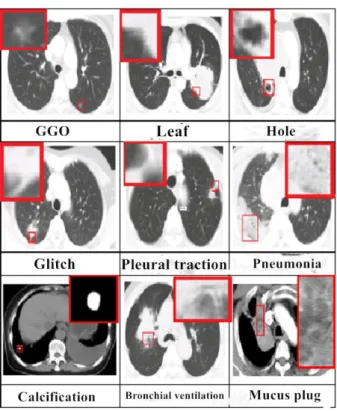
In addition to text annotation tasks, medical data annotations also have tasks such as image annotation, such as pathological section, x-ray film, CT film, MRI film image
annotation (Han, 2014).
Figure 1: Examples of common nine types of signs annotated on lung CT (Han, 2014)
The annotation of medical data requires professional medical knowledge or even clinical experience (Yetisgen-Yildiz, Solti, Xia, & Halgrim, 2010). Besides, there are significant differences between medical and non-medical corpora. Medical corpus has a specific format and is mastered by medical professionals (Campbell & Johnson, 2001). So the market chosen by this business plan is the companies and universities’ laboratory, which are doing medical AI, which continuously require a tremendous amount of annotation service (Chen, 2017).
As for the training of AI, it requires as much systematical labelled data as it can. The training of each medical AI model requires ten thousand to millions of biomedical texts. For example, IBM Watson’s pilot program makes use of 21 million medical records, which is annotated by medical professions (Butler, 2017). The more manageable tasks such as the training for the algorithm of a Chinese query & answer
system for hypertension-related knowledge require about 100 thousand annotated data. The cost to pay the workers of labelling one tag in the texts is between US$0.1438 to US$14.3765 or higher9. Each task will contain about 10 thousand to hundreds of thousands of texts to be annotated, while each text is required to be labelled one or more tag. So, each task will give the platform an order pricing ranging between thousands to hundreds of thousands of dollars. Nowadays, the existing crowdsourcing platforms such as Baidu Data Crowdsourcing Platform10 and AMT platform will
charge 20% to 50% fee on the reward (Good et al., 2014). Given the booming medical artificial intelligence market (Appendices- Figure 1), this market segment has great potential and prospects.
At present, there is no company concentrates on doing a crowdsourcing platform for Chinese medical data annotation service. Besides, these platforms only have websites and mobile apps. They do not use the WeChat mini program, although it is more convenient for users (Hao, Wan, Ma, & Wang, 2018). It is a significant and unique business opportunity.
4.2. Value Proposition
This business plan is to build up a crowdsourcing platform to provide medical data annotation services for the training of medical AI. The acquisition of well-annotated medical data is one of the pain points for medical AI industry. In the development industry chain of artificial intelligence, data is the core part of the foundation layer. However, the collected data cannot be directly used for algorithm training. These unstructured data must be converted into structured data through “data annotation.” An excellent medical AI model requires not only millions of annotation data for pre-training, but also numerical data for continually algorithm iteration. So the need for professional annotators is urgent. By using this crowdsourcing platform,
9 2016 China Online Medical Industry Data Monitoring Report;
https://www.iresearch.com.cn/Detail/report?id=2551&isfree=0; Accessed on: 10/2019.
10 2019 China Artificial Intelligence Basic Data Service White Paper;
requesters could save more money and more time. In the traditional way of doing medical data annotation project, requesters need to find a lot of suitable candidates who could do the annotating work. Generally speaking, tasks like this are accomplished by hiring a large temporary workforce, which is time-consuming, expensive, and difficult to scale, or have gone undone. Crowdsourcing is an excellent way to break down a manual, time-consuming project into smaller, more manageable tasks to be completed by distributed workers over the Internet. This platform could let requesters access to on-demand workforce cross the contrary, and get work done efficiently and quickly when they need it, which increases flexibility.
The proposed crowdsourcing platform will preprocess the data using a patent entitled
An Information Feedback Method, Device and Storage Media to make the data
annotations 10% more accurate than other similar services on the market. Apart from that, the crowdsourcing platform will distribute the tasks to micro-tasks to targeted temporary workforce. It could help finish tasks quickly as well as free up time and resources for the company, which makes internal staff can focus on higher-value activities (Berinsky, Huber, & Lenz, 2012).
On the social value aspect, on the one hand, crowdsourcing medical data annotation platform could make efforts to improve national health. Well-trained medical AI could help to solve some severe problems in the healthcare industry. With the improvement of life quality, the need for healthcare is increasing year by year (Appendices - Figure 2).
However, the number of medical professionals can not satisfy the present need. Besides, a society in which the population is ageing require more medical resources than ever before. However, the current training model is not enough to provide more medical professionals in the next 10 to 20 years (Chen, 2017). Medial AI is one possible way to solve the shortage of medical resources, improve the speed and quality of healthcare services. In the long run, it could also reduce the costs of
medical services. At present, AI technology is applied in the medical field. The medical AI products that have been or will be put into use all over the world in many areas, such as disease risk prediction, medical image assisted diagnosis, clinical adjuvant therapy, intelligent health management and smart hospital management (Wu & Yang, 2018). Thus, on the one hand, this platform will serve many medical AI organisations for developing products. It will do good to human’s well-being.
On the other hand, this platform could let healthcare professions to do part-time job as annotators. It is convenient for them to use their fragmented time and get reasonable payback. Besides, people with secondary education level could also do some simple and repetitive medical data annotation after training (Good, Nanis, Wu, & Su, 2014). It could give them new work opportunities and reduce the unemployment rate.
4.3. The Business Model
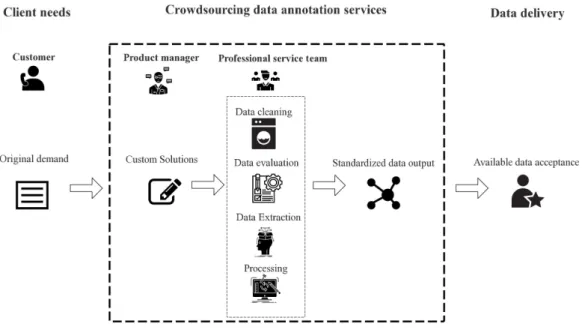
As shown in Figure 2, the proposed company is an online crowdsourcing medical data annotation platform company. The primary users of the platform will be two segments. On the one hand, requesters. They are organisations or individuals that are doing medical AI, with data annotation requirements. On the other hand, workers who are medical professionals want to make money through doing medical data annotation as a part-time job, such as medical school students, nurses, and doctors.
Figure 2: The architecture of the proposed crowdsourcing medical data annotation platform.
The process of platform work is like this:
Figure 3: Data annotation task flow chart
- The requester registers and places an order on the platform, providing the data needed annotation and requirements;
- The platform arranges the product manager to communicate with the requester to connect the project and clarify the relevant provisions of the task.
- The product manager divides the data annotation tasks into a large number of micro-tasks and assigns them to a certain
number of workers registered on the platform according to the task completion time, knowledge background and other requirements;
- Workers complete data labelling on the platform;
- The platform collects the data annotated by workers and validate it, and finally return it to the requester.
The proposed project will develop a website and a mini program. The mini program is an innovative format for the industry. The mini program is a concept given by Tencent Technology (Shenzhen) Co., DXYCo., which is an application that can be used on cell phone without downloading and installing. Users can use all the functions of the applet on the WeChat interface by scanning the QR code or searching for the WeChat mini program application name. The applet does not occupy the phone memory, and the user's personality information is recorded in the cloud. According to the annual financial report released by Tencent Holdings Co., Ltd. on December 31, 2018, the monthly active accounts of WeChat and mini program reached 1.98 billion, an increase of 11% year-on-year. The introduction of mini program has benefited the ecosystem as a whole. These data provide an ample space and platform for the proposed project (Hao et al., 2018).
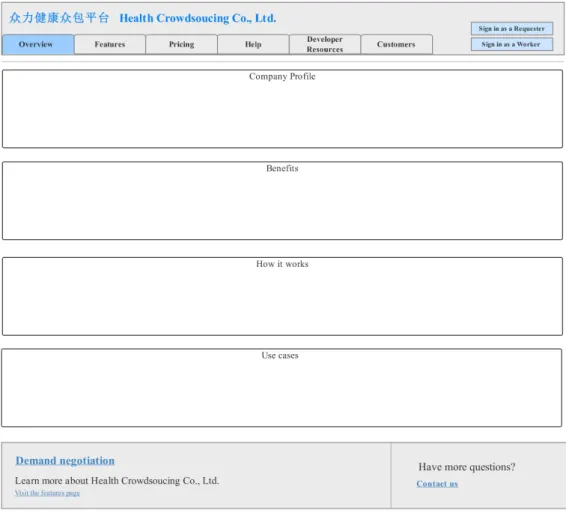
The proposed company's services are primarily implemented through the company's website and WeChat mini program. To attract customers and workers being users, the form of the homepage mainly refers to the Amazon Mechanical Turk (MTurk)11,
which mainly provides information about the company's qualifications, service model and advantages and online registration entry.
Figure 4: Home page
In order to facilitate the management of the platform, the crowdsourcing platform will develop two systems that can be switched to each other, serving requesters and crowdsourcing workers, respectively.
One is the crowdsourcing business system for the requester, as shown below. The interfaces are mainly used for customers to place orders. The user can perform simple registration through the mobile phone verification on the interface for customer, and then upload the raw data of the task as well as the overall requirements to the crowdsourcing platform. They are required to pay 50% of the fee. After receiving the task, the product manager will establish a WeChat group to communicate with the customer, refine the requirements of the labelling, and feedback the progress of the project on time. When the task is completed, the customer can get the processed data
on the platform and obtain the data result acceptance report of the platform. After the customer confirms the order is completed, the remaining fee will be paid within ten days.
Figure 5: Task publishing interface
Figure 7: Project acceptance interface
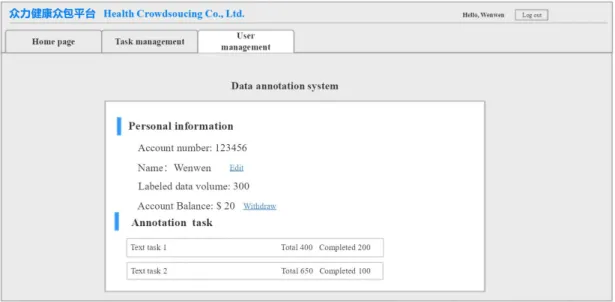
Besides, we will develop a data annotation system for managing crowdsourcing workers, assigning labelling tasks, collecting processed data and paying wages. The crowdsourcing workers will set up a user name and password for simple registration on the platform through mobile phone verification. Next, users need to upload their bank card information, the photo of student ID card or medical practitioner qualification certificate and other relevant documents to prove that they have medical background or clinical experience. After passing the qualification review, the user will become the crowdsourcing worker of the platform officially. The user can accept the annotation tasks allocated by the platform. After the task is completed, the platform will use manual & machine-two-way verification to assess the reliability and validity of the worker's work to satisfy the requester's requirements. Workers will be rewarded according to their workload. These rewards will be displayed in their account balance and can be withdrawn when it reaches the minimum amount of $10. The interface of the working system is as follows:
Figure 8: User management interface
Figure 10: Data annotation task interface
The proposed company can make a profit in two ways: 1. Receive the commission of the requester; 2. Publish the advertisements on the website and the WeChat applet. According to statistics, MTurk robot accounts for about 20% to 40% of the total order on each order. The commission for data labelling services in China accounts for approximately 20% to 50% of the total order value12. The services offered by our
company are more professional and accurate, so the commissions should be higher than the industry average.
4.4. Identification and Enterprise Constitution
The proposition is to create a limited liability partnership. China's company law stipulates that the limited liability company consists more than two persons and less than fifty persons. The shareholders shall be responsible for the company within the limits of their capital contribution. Assets are responsible for company debt. Thus, only the company’s equity is legally responsible for the debt of the company. This kind of partnership could reduce the risks for shareholders. The company will be a micro and small enterprise (MSE), which indicates the company with 10-100
employees, and operating income is between 1 million to 10 million yuan per year.
4.5. Brand
The most valuable assets of any business are intangible, such as its company name, brands,symbols, and slogan. The name of company and brand is crucial because it represents the basis of competitive advantage and future earnings streams (Aaker, 2009). In this case, the company will be named as “Health Crowdsourcing Co., Ltd.” in English and “众力健康”in Chinese. The meaning of the Chinese name is to achieve the health of the whole people with the help of everyone. It reflects the company's positive values and good wishes. The English name is translated literally from the Chinese name and expresses the same hope. The slogan is 众志成城,助力健康 in Chinese and Working together for healthier life in English. The main idea for the slogan is to show the proposed company's main business and unique crowdsourcing features to attract customers.
4.6. Corporate Culture
Corporate culture is the soul of the enterprise. The organisational culture refers to values that are shared by people in the group, which is long-lasting and stable during all activities of the organisation. As for company, corporate culture represents the patterns of employees’ behaviours which are tough to change (Kotter, 2008). Besides, it shows the culture of organization could exert a powerful influence on the behaviour of all employees, as well as affect the ability to shift strategic direction of company. Corporate Culture should follow and support the strategy (Hill & Jones, 2011).
Mission, vision and values are the soul of a corporate culture (Hunger & Wheelen, 2003). The mission is what the company does. It sets the guidance for strategies planning (Hill & Jones, 2011). In this case, the proposed company is customers-oriented. Thus the mission will be focused on satisfying customers’ needs (Hill & Jones, 2011). The vision is the declaration of the company’s objectives, which
could guide its decision-making (VISION & TODAY'S, 1996). “Vision provides guidance about what core to preserve and what future to stimulate progress toward.” The values are the value orientation of the company and its employees. It is the fundamental beliefs and business practices that the company advocates in the pursuit of business success, which plays a vital role in the development of the company (Collins & Porras, 1996).
Based on the above discussion and the specific circumstances of the proposed company, the mission, vision and values are:
Mission- Providing fast and professional data annotation service.
Vision- Be the leader in China's professional medical data annotation service industry. Values- Professional, fast, safe, accurate, customer orientation.
5. The Infrastructure
5.1. Organisational Chart
The structure of the proposed company is as the figure shows. Since it is a small scale Startup, the company will adopt a flat-management organisation in the early stage of the business. There will be four permanent employees: general manager, product manager, customer service representative and developer. The financial part and legal affairs will be down by the general manager. With such a compact organisational structure, the administration of the company can be more flexible and efficient. Similarly, due to the small number of employees, the cost will be reduced, which will enhance the company's market competitive advantage. It will also helps to strengthen the organisation's ability to respond to the dynamic changes in the market. Besides, it has a positive impact on firms' product innovation (Wei, Liu, & Herndon, 2011).
5.2. Job Descriptions
Jobs Qty Job Descriptions
General Manager 1 1. General Management;
2. Conducting administrative staff meetings; 3. Conducting cooperation talks;
4.Responsible for handling the company's financial and legal affairs.
Product Manager 1 1. Confirm the project requirements, formulate the project plan, control the project schedule, project budget, avoid risks, and make progress reports;
2. Expand projects and accumulate resources;
3. Settle wages, reimbursement and final accounts for crowdsourcing workers.
4. Control the quality of the data labelling. Customer Service
Representative 1 1. Responsible for answering customer service hotline,answering customer inquiries, handling and responding to customer complaints and opinions, and appeasing customer sentiment;
2. Responsible for online customer service, chat with customers and text communication, answer customer consultation, process and feedback customer complaints and opinions, and appease customer sentiment;
3. Timely discover the customer's needs and opinions during the telephone and online service process, and record feedback according to the process;
4. Complete the return visit, maintain the relationship with the customer, and improve customer satisfaction;
Developer 1 1. Responsible for developing Android and iOS apps;
2. Responsible for front-end design and development of Web-side products;
3. Continuously improve mobile APP/Web
performance, security, stability and scalability;
4. Development and maintenance of standard component libraries;
6. The Context
6.1. PESTELAnalysis
The PESTEL analysis model is a useful tool for analysing the macro environment. PESTEL analysis includes six factors: political, economic, social, technological, environmental, and legal. In the following chapters, we will combine those factors to analyse the feasibility of the project.
6.1.1. Political Factors 6.1.1.1. Overall Situation
Generally speaking, the political situation in China is very stable. Communist Party of China has headed the current government since 1949. However, apart from the political situation of European and American countries of which politics and economy are separated, there is a close relationship between China’s politics and economy. China makes the market mechanism play a decisive role in resource allocation under the conditions of adhering to the basic socialist economic system since the Chinese economic reform in 1978. In China, there are three existing capital model in the market. The top layer is state capital controlled by the government; the bottom layer is free private capital, which mainly includes small and medium-sized enterprises; the middle layer is joint state-private capital (Li, Yue, & Zhao, 2009). The structure of the coexistence of these three layers of capital also determines that in China, the market must obey related politics. In a word, politics is the leading guide to the market. Chinese government is implementing some favourable polices to develop Internet plus health. However, China faces a complicated and severe world economic situation because of the US politics to China, and China-United states trade war since 2018 (Liu & Woo, 2018).
Although there are both positive and negative influence on the government’s policies and strategies, China’s economic environment is facing more challenges than chances.
6.1.1.2. Policy Support
In August 2015, the State Council of China issued the “Outline for Promoting Big Data Development.” It points out the development of big data on medical health services and the construction of comprehensive health service applications. As shown in the Table 1 (Appendices - Table 1), the State Council and the Health Planning Commission issued many policies, making the development of health care big data become the strategy of each province.
6.1.2. Economic Factors
The economic factors in the PESTEL model refer to the external economic structure of the organisation, industrial layout, resource status, economic development level, and future economic trends.
To clarify the current situation and predict the future of China’s economy, it is essential to analyse some leading economic indicators.
6.1.2.1. Economic Overview
Since the implementation of the reform and opening-up policy, Chinese economy has been proliferating since experiencing rapid growth. In the past 70 years, China’s total economic volume has continued to increase; on the other hand, the industrial structure has been continuously optimised and adjusted.
Gross Domestic Product Gross Domestic Product (GDP) refers to the value of all final products and services produced in a country or region within a specified period. It is recognised as the best indicator to measure the economic situation. In 1952, China's GDP was 9.7 billion dollars; in 2018, GDP exceeded 12.9 trillion dollars, and the absolute value increased by about 1325 times than in 1952 (Appendices- Figure 3). In 2010, China's GDP surpassed Japan and became the second-largest economy.
Compared with the US, of which GDP is 21.3 trillion dollars, and the GDP growth rate is 3.1% (Q1 2019)13, China’s GDP growth rate is much higher.
Data released by China's National Bureau of Statistics on July 2019 showed that China's gross domestic product (GDP) in the first half of 2019 was 6.5 trillion dollars, increasing 6.3% year-on-year at comparable prices, slowing from a 6.5% expansion in 2018 and matching market expectations. What is more, it was the lowest growth rate since the first quarter of 1992, amid ongoing trade tensions with the US, weakening global demand and off-balance-sheet borrowings by local governments14.
The National Bureau of Statistics said that overall, China's economy operated in a reasonable range in the first half of the year, continuing a steady development trend. However, we must see that the current domestic and international economic situation is still complicated. The global economic growth has slowed down, while the external uncertainties in the economy have increased. The problem of uneven and insufficient domestic development is still prominent (Hang, Lin, Tao, & Baowen, 2019).
All in all, China’s economy is facing new downward pressure. Economic development is driven by industry. When the development of the economy slows down, it requires mechanical adjustment.
6.1.2.2. Industrial Overview
Chinese industries can be divided into two categories: traditional industries (represented by manufacturing) and emerging industries (represented by the Internet). In terms of traditional industries, most of the goals have been achieved. The bottleneck of its development is the lack of efficiency, mainly reflected in innovation capability, resource allocation, and cost control.
13 Gross Domestic Product, First Quarter 2019 (Third Estimate); Corporate Profits, First Quarter 2019
(Revised Estimate);
https://www.bea.gov/news/2019/gross-domestic-product-first-quarter-2019-third-estimate-corporate-pr ofits-first-quarter; Accessed on: 10/2019.
In terms of emerging industries, it mainly includes various high-tech tertiary industries. Some of the industries represented by the Internet are relatively mature. The ceiling of the market has already appeared. For more emerging industries such as AI, how to find the right application scenarios and achieve rapid scale commercialisation is the key to survival and development.
The data released by the Ministry of Industry and Information Technology of China indicates that the added value of the primary industry was 3.3 trillion dollars, up 3.0% year-on-year in 2018. The added value of the secondary industry was 2.5 trillion dollars, up 5.8%. The growth rate of the tertiary industry is much faster than that of other industries15. The tertiary industry is the focus of China's future development.
At present, China is in the information age, in which the cutting-edge digital technologies such as big data, cloud computing, and AI is booming. In 2018, China's digital economy reached 4.4 trillion dollars, accounting for 34.8% of GDP16.
The Industrial Internet is a concept derived from the consumer Internet. It refers to the traditional industry leveraging big data, cloud computing, intelligent terminals, and network advantages to enhance internal efficiency and external service capabilities. It is the transformation and upgrading of traditional industry. The industrial Internet based on cloud computing, intelligent terminals, and big data has ushered in an outbreak period after experiencing the development of “concept-policy-path.” Emerging enterprises and traditional enterprises have become active participants. "Internet +" is deeply integrated with all walks of life. In the Guiding Opinions on Actively Promoting “Internet Plus” issued by China’s State Council in 2015, it was pointed out that China will actively promote the "Internet Plus healthcare" service,
15 Economic performance of the Internet and related service industries in 2018;
http://www.miit.gov.cn/n1146312/n1146904/n1648355/c6633265/content.html; Accessed on: 10/2019.
developing the emerging online and offline consumption of which Internet is the carrier, and accelerating the development based on Internet services, health, pension, social security, and other emerging services. The “Healthy China 2030” blueprint proposes a healthcare industry centred on health, as well as promoting deep integration between industries. By 2030, it will restructure the healthcare industry with a complete system and optimised structure. This is the first medium- and long-term strategic plan for the healthcare industry at the national level since the founding of the People's Republic of China (Tan, Liu, & Shao, 2017b).
In "13th Five-Year Plan" proposal, "Healthy China 2030" is officially upgraded as national strategy. That is to say, "Internet Plus healthcare" has been an essential technical means to deepen health care system reform and promote the blueprint of “Healthy China 2030”. During this period, medical AI will be concentrated in the decision-making part of clinical diagnosis and treatment (Tan et al., 2017b). The medical big data industry caters to national policies, so it is the right time to enter the medical big data industry.
6.1.3. Social Factors
At present, China's population is ageing rapidly. The current population of China is more than 1.41 billion. The median age of the population has risen from 22 years in 1980 to 37 years in 2015. It is expected to rise to 43 years in 2030; in 2017, the proportion of people aged 65 and overreached 11.4% and is expected to reach Up to 30% in 2050. In 2010, the proportion of the working-age population aged 15-64 reached its peak, and the demographic dividend disappeared. The birth rate is 12.43% (the birth rate was 12.95% in 2016), and the population structure is ageing17
(Appendices - Figure 4). China is also ageing faster than other low- and middle-income counties. All in all, China is ageing before rich.
From 2008 to 2017, the number of outpatient visits and per capita diagnosis and treatment in China continued to rise. The number of per capita treatments has increased from 3.7 per person per year in 2008 to 5.8 per person per year. Based on 2013, the outpatient visit rate of hospitals over the age of 65 is 26.4% every two weeks18. Also, under the influence of modern living habits, the incidence of chronic
diseases such as diabetes and high blood pressure is increasing. Although the number of China's Health Care Institutions is increasing year by year, it is hard to satisfy the need of people. In the future, the number of medical treatments will continue to rise, and the medical system is under tremendous pressure (Li et al., 2017).
The ageing of the population and the rapid development of AI technology are the main reasons for the tremendous changes in the current Chinese economy. On the one hand, with the acceleration of population ageing, labour costs increase, which restricts economic development. On the other hand, AI is acting as the main force of a new round of technological revolution and industrial transformation. It will reconstruct the economic model of production, distribution, exchange, consumption, etc.
In the context of an ageing population, China should support the development of the AI industry and exert the alternative role of AI in the labour force. So China could make full use of the benefits brought by technological progress.
The ageing of China's population has led to a surge in demand for pensions, which provides an opportunity for the combination of “Internet Plus” and the pension industry. The new concept of "Internet + pension," a cross-border integration, came into being. "Internet + old-age care" is a new model of home-based care services. It integrates modern technologies such as the Internet, Internet of Things, big data services, and cloud computing with the traditional pension model. It includes many services such as big data analysis, health indicator monitoring, and remote monitoring and alarming for the elderly (Li, 2019).
After the concept of "Internet + pension" was put forward, the Chinese government has also taken active measures to encourage the development of this new type of pension industry. In July 2015, the State Council’s “Guiding Opinions on Actively Promoting “Internet +” Actions” clearly stated that “promoting the development of smart and healthy old-age industries, improving the level of old-age services, and raising “Internet + pension” to the national strategic level. The “Three-Five” Plan for the Development of the National Aging Industry and the Plan for the Construction of the Aged System also supports the construction of the “Internet + Pension” project and encourages the full use of new technologies such as the Internet to develop a smart retirement platform (Li, 2019).
An essential step in the implementation of “Internet + Pension” is to establish an electronic health record. The electronic health record is an electronic health record. It is a database of information covering the health status of residents throughout their life cycle and the records of residents receiving health services. It can be accessed, processed, stored, and transmitted via computers and the Internet. Establishing an electronic health record is a requirement of China's medical informationization and is also the primary content of "Internet + pension." Uploading necessary information, medical records, and health data of the elderly to the information platform through the Internet and intelligent monitoring terminals can dynamically grasp the living and health status of the elderly. Integrating older people's health big data can help doctors to comprehensively and correctly diagnose treatment. At the same time, it helps elderly service personnel to predict and select targeted types of aged care services. (Li, 2019)
Not only the processing of big health data in "Internet + pension," but also the model training in medical AI, needs a massive amount of labelled medical data. In other words, these emerging industries need to rely on the crowdsourcing data annotation platform for basic construction.
6.1.4. Technological Factors
The technical elements include not only the revolutionary inventions, but also the new technologies, new processes, new materials related to enterprise production.
With the rapid development of Web 2.0 technology, crowdsourcing technology has gradually emerged and received the attention of scholars. Over the past decade, researchers have used crowdsourcing to take advantage of human computing abilities and solve the well-known tasks that are difficult to solve on their own. For instance, determining whether an image contains trees, evaluating the relevance of a website, or verifying the phone number (Chen, 2017). The machine learning researchers used crowdsourcing as a quicker and cheaper tool for acquiring a large amount of well-labelled data, which is needed for training a machine learning system.
The application of crowdsourcing technology in AI is mainly three modules: labelling data, evaluating learning models, and human resources debugging of machine learning models. Because of the need for annotation, machine learning researchers first became interested in crowdsourcing. It usually works by crowdsourcing workers providing labels for unlabelled data instances, such as websites or images. Because the labels provided may be numerous, the same instance may be submitted to many crowdsourced workers to label. In the end, those results will be collected for training. This approach has been applied to many natural language processing to collect data, computer vision, and many other fields.
The advantage of crowdsourcing over automation is the ability to discover features that depend on human-beings’ knowledge and experience. At the same time, using crowdsourcing to evaluate machine learning model is also popular, which is very useful for unsupervised models without objective data. With the popularity of crowdsourcing evaluation topic models, researchers are trying to think add feedback