Departamento de Ciências Biomédicas e Medicina
Spray-dried polysaccharide microparticles aimed at
pulmonary delivery of antitubercular drugs
Filipa Raquel Horta Guerreiro
Dissertação de Mestrado para a obtenção do grau de Mestre
em Ciências Biomédicas
Trabalho efetuado sob a orientação de: Prof. Dra. Ana Grenha, PhD
Departamento de Ciências Biomédicas e Medicina
Spray-dried polysaccharide microparticles aimed at
pulmonary delivery of antitubercular drugs
Filipa Raquel Horta Guerreiro
Dissertação de Mestrado para a obtenção do grau de Mestre
em Ciências Biomédicas
Trabalho efetuado sob a orientação de: Prof. Dra. Ana Grenha, PhD
2
delivery of antitubercular drugs
Declaração de autoria de trabalho:
Declaro ser a autora deste trabalho, que é original e inédito. Autores e trabalhos consultados estão devidamente citados no texto e constam da listagem de referências incluída.
Filipa Raquel Horta Guerreiro
Copyright
A Universidade do Algarve tem o direito, perpétuo e sem limites geográficos, de arquivar e publicitar este trabalho através de exemplares impressos reproduzidos em papel ou de forma digital, ou por qualquer outro meio conhecido ou que venha a ser inventado, de o divulgar através de repositórios científicos e de admitir a sua cópia e distribuição com objetivos educacionais ou de investigação, não comerciais, desde que seja dado crédito ao autor e editor.
3
Em primeiro lugar gostaria de agradecer à Professora Doutora Ana Grenha pela disponibilidade que demonstrou em receber-me no seu laboratório. Durante todo o projeto de mestrado recebi todo o apoio, atenção e disponibilidade da sua parte. Agradecer também à Professora Doutora Ana Costa, ao Professor Doutor João Lourenço e à Professora Doutora Manuela Gaspar da Faculdade de Farmácia da Universidade de Lisboa que prestaram uma ajuda essencial para que algumas partes do trabalho pudessem ser realizadas.
Queria agradecer também aos meus colegas de laboratório Flávia Musacchio, Ludmylla Cunha, Joana Cavaco, Jorge Pontes e Tatiana Martins. Nestes meses de trabalho intensivo mostraram sempre disponibilidade em ajudar-me quando surgiam dúvidas, sobretudo nos primeiros meses e, tornaram o ambiente de trabalho num ambiente descontraído e com boa disposição. Um agradecimento especial à Ana Alves e à Susana Rodrigues por me facultarem alguns resultados que permitiram completar a minha tese. Aos meus amigos pelos momentos de diversão que me proporcionaram para que pudesse, por momentos, colocar as preocupações do trabalho no laboratório de parte. Mas também pelos momentos de paciência que tiveram comigo em determinadas alturas menos positivas.
Por fim, mas nem por isso menos importante aos meus pais. Talvez as pessoas que mais ouviram as minhas preocupações ao longo de todo o projeto. Pela motivação que me transmitiam quando as coisas não estavam a correr pelo melhor e, pelo orgulho que demonstram ter em mim pelo caminho que percorri até agora.
4
AE – Association Efficiency
ATCC - American Type Culture Collection Daer – Aerodynamic diameter
DMEM - Dulbecco's Modified Eagles's Medium DMSO - Dimethyl Sulfoxide
DNA - Deoxyribonucleic acid
DPPC - Dipalmitoylphosphatidylcholine FBS – Fetal Bovine Serum
HCl - Hydrochloric acid
HIV - Human Immunodeficiency Virus INH – Isoniazid
InhA - NADH-dependent enoyl-[Acyl-Carrier-Protein] reductase KGM – Konjac Glucomannan
LC – Loading Capacity LDH - Lactato Desidrogenase Leu - Leucine
Man - Mannitol
ManLAM – Mannose-Capped Lipoarabinomannan MDR-TB - Multidrug-Resistant Tuberculosis MIC - Minimum Inhibitory Concentration
5
Mtb – Mycobacterium tuberculosis
MTT - 3-(4 5-dimethylthiazol-2-yl)-2 5-diphenyltetrazolium bromide NADH - Nicotinamide Adenine Dinucleotide
NTLR - Non-Toll-Like Receptors PBS - Phosphate Buffer Saline
PIMs – Phosphatidyl-Myo-Inositol Mannosides PMA - Phorbol myristate acetate
(P)XRD – (Powder) X-Ray Diffraction RIF - Rifampicin
RFB - Rifabutin
RNA - Ribonucleic acid Rpm – Rotations per minute SD – Spray-dried
SDS - Sodium Dodecyl Sulphate TB – Tuberculosis
USA – United States of America
XDR-TB - Extensively Drug-Resistant Tuberculosis XRD - X-Ray Diffraction
6
Abstract
Microparticles (MPs) of konjac glucomannan (KGM) are proposed in this thesis as an alternative therapeutic approach for antitubercular drug delivery to the lung, in the ambit of tuberculosis (TB) therapy. KGM is composed of mannose groups that might comprise an entry mechanism in macrophages infected with Mycobacterium tuberculosis, mimicking one of the input paths of this infectious agent causer of TB. For this purpose, KGM MPs need to have certain properties, in particular an aerodynamic diameter between 1 and 3 µm that enables reaching the alveolar zone. These properties might be attained by a production using spray-drying technology. The objective of this work was to produce MPs of KGM through this process and associate two first-line antitubercular drugs, isoniazid (INH) and rifabutin (RFB). Furthermore, the effect of incorporating mannitol or leucine in the microparticle formulations was evaluated, regarding MPs aerodynamic characteristics, drug association and release, and biocompatibility profile.
After an initial optimization that required a hydrolysis of the original KGM polymer to enable spray-drying, several formulations of MPs were produced and characterised. The use of mannitol or leucine has demonstrated to improve the flow properties of some formulations, as did the association of RFB. However, the incorporation of excipients brought some disadvantages, especially regarding the in vitro release rate of the drug, which became faster. Additionally, the incorporation of mannitol was found to affect the association of INH, which became lower, suggesting a competing effect between INH and mannitol. Cytotoxicity assays in alveolar epithelial cells revealed that RFB-loaded KGM MPs may have a considerably toxic effect when used at a concentration of 1 mg/mL, in particular if MPs are also comprised of leucine.
The obtained results indicate that KGM MPs are suitable inhalable delivery systems for antitubercular drugs. Considering that a combination of drugs is advised by WHO in TB treatment, no benefit was found to occur from the incorporation of either leucine or mannitol in the formulation of KGM MPs.
Keywords: Isoniazid, Konjac glucomannan, Leucine, Mannitol, Microparticles,
7
Resumo
O tratamento convencional da tuberculose (TB) pulmonar baseia-se na administração de um conjunto de fármacos durante um longo período de tempo. A duração prolongada do tratamento potencia o aparecimento de efeitos secundários relativamente severos, bem como o desenvolvimento de resistência aos fármacos usados, o que contribui para o aparecimento da tuberculose multirresistente. Com o objetivo de contornar estes dois efeitos, uma das estratégias que tem suscitado um interesse crescente na área da investigação é a entrega pulmonar de fármacos através de sistemas transportadores. Estes permitem aumentar a concentração de fármacos nos pulmões, prolongar o seu tempo de residência na região respiratória e, por último, potenciam um direcionamento para os macrófagos alveolares, local onde a Mycobacterium tuberculosis, causadora da infeção, está alojada. Todos estes fatores contribuem para a possibilidade de diminuir a frequência de administração dos fármacos e usar doses menores, o que possivelmente diminui os efeitos sistémicos dos tuberculostáticos. Contudo, para que a estratégia funcione, é essencial que os fármacos cheguem ao seu local de ação em segurança, efeito que se potencia por utilização de transportadores (micropartículas (MPs)) para os fármacos. Os transportadores oferecem proteção contra agressões do meio e possibilitam uma libertação mais controlada dos fármacos, aumentando a sua biodisponibilidade. No entanto, para esta aplicação específica que envolve inalação de fármacos que têm de alcançar a região alveolar, as MPs devem apresentar caraterísticas específicas, nomeadamente um diâmetro aerodinâmico entre 1 e 3 µm, que permite por um lado alcançar dita região e por outro potenciar a captura pelos macrófagos.
As MPs poliméricas são dos sistemas mais estudados para a entrega de fármacos, dada a flexibilidade dos materiais utilizados. São formadas por uma matriz derivada de polímeros naturais ou sintéticos, onde uma pequena quantidade de fármaco é incorporada. Os polímeros naturais são dos mais utilizados e, entre eles, está o glucomanano de konjac (KGM). Este polímero apresenta na sua composição manoses, as quais podem ser um fator chave na utilização do KGM como material de matriz de um sistema de transporte de fármacos para o tratamento da TB, pois uma das portas de entrada da Micobactéria nos macrófagos alveolares são os recetores de manose. Mimetizando este processo, as MPs à base deste polímero, carregadas com fármacos
8
no tratamento da TB pulmonar.
Existem muitas técnicas para a produção de MPs, sendo a atomização (spray-drying) uma das mais utilizadas. Esta técnica é bastante usada na indústria farmacêutica para a produção de MPs poliméricas, pois permite produzir MPs com as caraterísticas pretendidas (tamanho, morfologia, densidade) de forma simples, rápida, uniforme e económica. Contudo, muitas vezes as partículas produzidas por atomização apresentam uma tendência de aglomeração, o que leva ao empobrecimento das propriedades de aerossolização do pó, o que afeta a deposição das MPs ao longo do trato respiratório. Para reduzir esta tendência recorre-se muitas vezes à incorporação de excipientes adjuvantes, como o manitol e alguns aminoácidos. A sua presença aumenta a rugosidade da superfície das MPs, o que diminui os espaços vazios e evita a coesão entre as mesmas, aumentando consequentemente a capacidade de dispersão do pó. O principal objetivo desta tese consistiu em avaliar a capacidade do KGM como principal material de matriz de MPs para uma aplicação na terapêutica inalatória da TB. Verificou-se a capacidade de produzir MPs de KGM pela técnica de atomização, bem como a possibilidade de associar dois tuberculostáticos de primeira linha, a isoniazida (INH) e a rifabutina (RFB), isoladamente ou em associação. Procedeu-se também à incorporação, de forma separada, de dois excipientes adjuvantes, o manitol e a leucina, tendo-se avaliado o seu efeito sobre as formulações.
As dispersões para atomização foram preparadas após a hidrólise do KGM, dado que o seu elevado peso molecular conduzia a soluções demasiado viscosas para processamento pela técnica mencionada. Embora a formulação de MPs de KGM sem adição de qualquer outro agente ou fármaco corresponda a partículas com propriedades de fluxo consideradas macroscopicamente insatisfatórias, a incorporação de RFB melhorou bastante as caraterísticas dos pós. O manitol e a leucina foram posteriormente incluídos nas formulações, tendo-se igualmente efetuado associação dos fármacos. Para todas as formulações, com e sem fármacos, com e sem excipientes adjuvantes, foi efetuada a caraterização das MPs (morfologia, densidade e tamanho), determinadas as eficácias de associação e perfis de libertação dos fármacos, e avaliado o perfil de citotoxicidade pelos métodos 3-(4,5-dimethylthiazol-2-yl)-2 5-diphenyltetrazolium bromide (MTT) e libertação de lactato desidrogenase (LDH).
9
contribui para a diminuição do tamanho das MPs e do seu diâmetro aerodinâmico. Este efeito foi ainda mais notório quando a RFB também estava presente, sobretudo quando foi utilizada isoladamente, sem a presença de INH. As densidades aparente e de compactação aumentaram com a introdução dos excipientes, ao contrário do que aconteceu com a densidade real. Em termos de morfologia, a incorporação do manitol ou de leucina alterou a aparência da superfície das MPs, que adquiriram maior rugosidade. A análise das formulações por difração de raios X permitiu verificar que as formulações exibem alguns picos de cristalinidade, ainda que atribuíveis apenas aos excipientes e não aos fármacos, os quais são menos intensos do que os correspondentes aos excipientes não atomizados.
Relativamente à inclusão dos excipientes adjuvantes, apenas a presença de manitol afetou a associação de fármaco às MPs, diminuindo-a, e apenas no caso da INH. Este efeito não foi visível para a RFB, tendo todas as outras formulações eficácias de associação entre os 90 e os 100%. Em relação aos perfis de libertação dos fármacos, as formulações com os excipientes registaram uma libertação mais rápida de ambos os fármacos.
A citotoxicidade foi avaliada em duas linhas celulares do pulmão, A549 e Calu-3. Algumas formulações revelaram comportamento citotóxico após 24h de exposição à concentração mais elevada (1 mg/mL). O fármaco RFB também mostrou ser tóxico após 24h de exposição, apesar de ter sido utilizado em menor concentração nas formulações em comparação com a INH.
Considerados todos os resultados, conclui-se que as MPs de KGM produzidas podem ser um sistema apropriado para a entrega pulmonar de fármacos e, a incorporação de excipientes, uma solução discutível para melhorar as propriedades aerodinâmicas das MPs, uma vez que o uso de manitol ou leucina nas MPs de KGM pode ter desvantagens, nomeadamente na libertação dos fármacos, uma vez que a libertação deixa de ser feita de maneira controlada. Embora não seja no âmbito desta tese, o passo seguinte deste trabalho consistirá em estudar a captura macrofágica destas MPs, o que será um dado essencial para o sucesso da formulação na terapêutica da TB.
Palavras-Chave: Entrega pulmonar, Isoniazida, Glucomanano de konjac, Leucina,
10
List of Contents
Acknowledgments ... 3 Abbreviations ... 4 Abstract ... 6 Resumo ... 7 1. Introduction ... 16 1.1. Tuberculosis ... 16 1.1.1. Epidemiology ... 161.1.2. The pathological agent and pathophysiology of tuberculosis ... 17
1.1.3. Conventional therapeutic approach ... 20
1.1.3.1. Isoniazid ... 21
1.1.3.2. Rifabutin ... 21
1.2. Pulmonary drug delivery ... 22
1.3. Microparticle matrix materials ... 25
1.3.1. Konjac Glucomannan ... 25
1.4. Spray-drying ... 26
2. Objectives ... 29
3. Materials and methods ... 30
3.1. Konjac Glucomannan hydrolysis ... 30
3.2. Preparation of KGM microparticles ... 30
3.3. Microparticle morphological and aerodynamic characterisation ... 32
3.3.1. Morphology ... 32
3.3.2. Feret’s diameter ... 33
3.3.3. Bulk and apparent tap density ... 33
3.3.4. Real density ... 33
3.3.5. Theoretical aerodynamic diameter ... 34
3.4. Powder X-Ray Diffraction analysis ... 34
3.5. Determination of drug association efficiency and loading capacity ... 35
3.5.1. Formulations with INH ... 35
3.5.2. Formulations with RFB (and INH/RFB) ... 36
3.6. In vitro drug release profile ... 36
3.7. Cell culture ... 37
3.8. Determination of cytotoxic profile of microparticles ... 38
11
3.9. Statistical analysis ... 41
4. Results and Discussion ... 42
4.1. Preparation of KGM microparticles by spray-drying ... 42
4.2. Characterisation of microparticles ... 43
4.2.1. Size and density ... 43
4.2.2. Morphology ... 46
4.3. PXRD pattern of KGM-based microparticles ... 49
4.4. Association efficiency and loading capacity... 57
4.5. Drugs release profile ... 59
4.6. Cytotoxicity evaluation ... 62
4.6.1. MTT assay ... 62
4.6.2. LDH release assay ... 69
5. Conclusions ... 72
6. Future Work of Interest ... 73
References ... 74
12
List of Figures
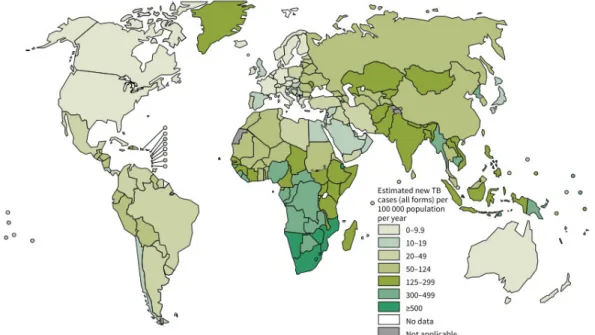
Figure 1.1. Estimated TB incidence rates, 2013.1... 16
Figure 1.2. (a) Evolution of notification and incidence rate of TB in Portugal,
2000-2013. (b) Incidence rate of TB per 100,000 people per district, in 2013 (adapted from3).
... 17
Figure 1.3. Granuloma in latent TB and active TB and dissemination of Mtb (adapted
from13). ... 19
Figure 1.4. Chemical structure of INH.8 ... 21
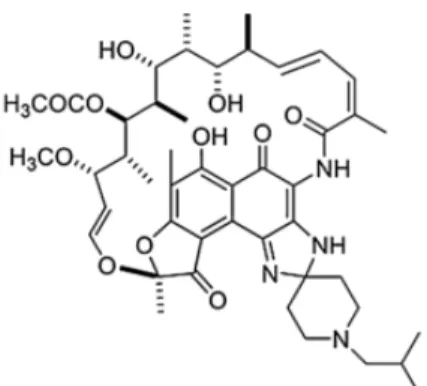
Figure 1.5. Chemical structure of RFB.28 ... 22
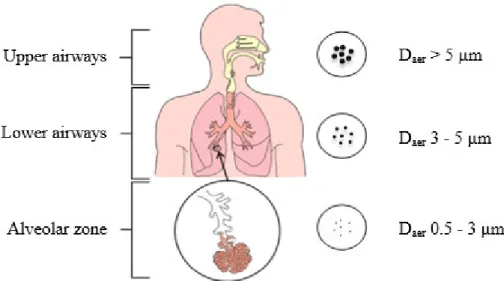
Figure 1.6. Deposition of MPs along the respiratory tract according to their daer
(adapted from 39). ... 24
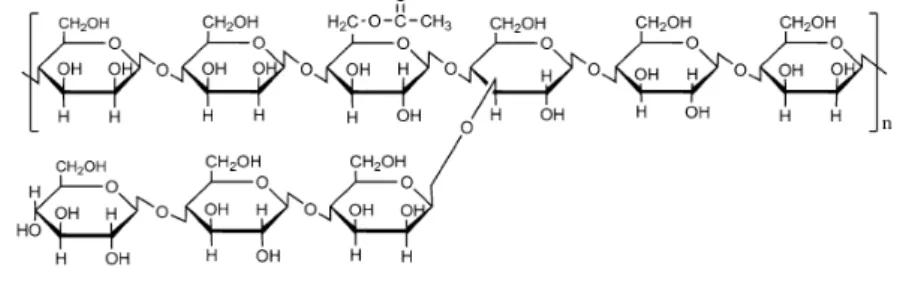
Figure 1.7. Chemical structure of KGM.52 ... 26
Figure 1.8. Diagram of spray-drying method (adapted from 60)... 27
Figure 4.1. SEM microphotographs of KGM-based MPs without adjuvant excipients
(mass ratios of KGM/drug indicated in parenthesis, KGM included at 2% (w/v) when used alone and 1.5% (w/v) when used with drugs). (a) Unloaded KGM MPs; (b) KGM/RFB (10/0.5); (c) KGM/INH/RFB (10/1/0.5). Scale bars = 5 µm. ... 47
Figure 4.2. SEM microphotographs of KGM-based MPs containing mannitol (mass
ratios of KGM/drug indicated in parenthesis, KGM included at 1.5% (w/v) and mannitol (Man) at 0.75% w/v). (a) Unloaded KGM-Man MPs; (b) KGM-Man/INH (10/1); (c) KGM-Man/RFB (10/0.5); (d) KGM-Man/INH/RFB (10/1/0.5). Scale bars = 5 µm. ... 47
Figure 4.3. SEM microphotographs of KGM-based MPs containing leucine (mass
ratios of KGM/drug indicated in parenthesis, KGM included at 1.5% (w/v) and leucine (Leu) at 0.75%, w/v). (a) Unloaded KGM-Man MPs; (b) KGM-Leu/INH (10/1); (c) KGM-Leu/RFB (10/0.5); (d) KGM-Leu/INH/RFB (10/1/0.5). Scale bars = 5 µm. ... 48
Figure 4.4. XRD patterns of KGM in three different forms: non-hydrolysed KGM,
hydrolysed KGM and spray-dried (SD) hydrolysed KGM. ... 50
Figure 4.5. XRD patterns of mannitol as commercially obtained and spray-dried (SD)
mannitol. ... 51
13
leucine. ... 53
Figure 4.8. XRD patterns of spray-dried (SD) leucine (Leu) and KGM-Leu MPs. ... 53 Figure 4.9. XRD patterns of RFB and spray-dried (SD) RFB... 54 Figure 4.10. XRD patterns of spray-dried (SD) RFB and formulations with RFB. Man,
mannitol; Leu, leucine. ... 55
Figure 4.11. XRD patterns of INH and spray-dried (SD) INH. ... 55 Figure 4.12. XRD patterns of spray-dried (SD) INH and formulations with INH. Man,
mannitol; Leu, leucine. ... 56
Figure 4.13. In vitro drug release profile of RFB from the formulations
KGM/INH/RFB, KGM-Mannitol (Man)/INH/RFB and KGM-Leucine (Leu)/INH/RFB. Data represented as mean ± SD (n > 3). ... 60
Figure 4.14. In vitro drug release profile of INH from the formulations
KGM/INH/RFB, KGM-Mannitol (Man)/INH/RFB and KGM-Leucine (Leu)/INH/RFB. Data represented as mean ± SD (n > 3). ... 61
Figure 4.15. A549 cell viability as determined by the MTT assay upon 3 h and 24 h
exposure to INH as free drug. Data are represented as mean ± SEM (n = 3). Dotted line represents 70% cell viability... 63
Figure 4.16. A549 cell viability as determined by the MTT assay upon 3 h and 24 h
exposure to RFB as free drug. Data are represented as mean ± SEM (n = 3). Dotted line represents 70% cell viability... 63
Figure 4.17. A549 cell viability as determined by the MTT assay upon a) 3 h and b) 24
h exposure to KGM polymer, KGM MPs, KGM/RFB MPs and KGM/INH/RFB MPs. Data are represented as mean ± SEM (n = 3). Dotted line represents 70% cell viability. ... 65
Figure 4.18. A549 cell viability as determined by the MTT assay upon 3 h and 24 h
exposure to 1 mg/mL of mannitol and leucine as commercially obtained and spray-dried (SD) mannitol and leucine. Data are represented as mean ± SEM (n = 3). Dotted line represents 70% cell viability... 66
Figure 4.19. A549 cell viability as determined by the MTT assay upon a) 3 h and b) 24
h exposure to KGM-Mannitol (Man) MPs, KGM-Man/INH MPs, KGM-Man/RFB MPs and KGM-Man/INH/RFB MPs. Data are represented as mean ± SEM (n = 3). Dotted line represents 70% cell viability... 67
14
h exposure to KGM-Leucine (Leu) MPs, KGM-Leu/INH MPs, KGM-Leu/RFB MPs and KGM-Leu/INH/RFB MPs. Data are represented as mean ± SEM (n = 3). Dotted line represents 70% cell viability... 68
Figure 4.21. LDH release from A549 cells after 24 h exposure to drugs, KGM polymer
and KGM MPs and excipients as commercially obtained and spray-dried (SD) at higher concentration tested in MTT assay. The data represented are mean ± SEM (n = 3). Dotted line (100% LDH) represents the result of incubation with cell culture medium, used as control. ... 70
Figure 4.22. LDH release from A549 cells after 24 h exposure to MPs produced by
spray-drying at higher concentration tested in MTT assay. The data represented are mean ± SEM (n = 3). Dotted line (100% LDH) represents the result of incubation with cell culture medium, used as control. ... 70
Figure A.1. Calu-3 cell viability as determined by the MTT assay upon 3 h and 24 h
exposure to INH and RFB as free drug. Data are represented as mean ± SEM (n = 3). Dotted line represents 70% cell viability. ... 81
Figure A.2. Calu-3 cell viability as determined by the MTT assay upon 3 h and 24 h
exposure to KGM MPs, KGM/RFB MPs and KGM/INH/RFB MPs. Data are represented as mean ± SEM (n = 3). Dotted line represents 70% cell viability. ... 82
Figure A.3. Calu-3 cell viability as determined by the MTT assay upon 3 h and 24 h
exposure to KGM-Leucine (Leu) MPs, KGM-Leu/INH MPs and KGM-Leu/RFB MPs. Data are represented as mean ± SEM (n = 3). Dotted line represents 70% cell viability. ... 83
Figure A.4. LDH release from Calu-3 cells after 24 h exposure to drugs, KGM
polymer and MPs produced by spray-drying at higher concentration tested in MTT assay. The data represented are mean ± SEM (n = 3). Dotted line (100% LDH) represents the result of incubation with cell culture medium, used as control. ... 84
15
List of Tables
Table 3.1. Optimised parameters of spray-drying for the different formulations (mean ±
SD, n = 3). ... 32
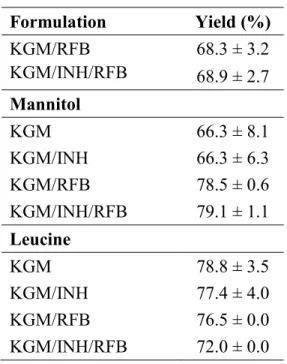
Table 4.1. MP formulations obtained by spray-drying and resulting yields (mean ± SD,
n = 3) ... 43
Table 4.2. Feret’s diameter, bulk, tap and real densities, and aerodynamic diameter
(daer) of KGM-based MPs in presence and absence of mannitol or leucine (mean ± SD, n
= 3). ... 45
Table 4.3. Association efficiency (AE) and loading capacity (LC) of RFB and INH in
16
1. Introduction
1.1. Tuberculosis
1.1.1. Epidemiology
Although the number of deaths caused by tuberculosis (TB) have decreased since the early 90’s, this remains the most lethal infectious disease globally, after the human immunodeficiency virus (HIV). According to the World Health Organization (WHO), in 2013 about 9 million people developed this infectious disease and 1.5 million people died of it.1,2 Of these 9 million people infected with TB, 13% were co-infected with
HIV and lived mostly in Africa. WHO estimated 480 000 new cases of MDR-TB worldwide, in 2013.1
The largest number of TB cases reported in 2013 occurred in Asia (56%), in countries like India, China, Pakistan and Indonesia. The African continent was also greatly affected by TB in 2013 (29%) with higher incidence in Nigeria and South Africa. Western Europe, Canada, United States of America (USA), Japan, Australia and New Zealand recorded the lowest incidence rates in relation to TB (Figure 1.1).1
17
Similarly to what happens in most countries, TB in Portugal has been declining over the years (Figure 1.2a). However, the fact that it is a persistent disease and is associated with vulnerable groups requires that responses to the disease remain ensured. Currently Lisbon, Oporto and Setubal are the districts with the highest incidence of cases (Figure 1.2b). In 2013, 2393 cases of TB were reported (of which 2195 were new cases), 212 cases less than those registered in 2012.3
Figure 1.2. (a) Evolution of notification and incidence rate of TB in Portugal,
2000-2013. (b) Incidence rate of TB per 100,000 people per district, in 2013 (adapted from3).
1.1.2. The pathological agent and pathophysiology of tuberculosis
TB is a chronic and progressive infection caused by Mycobacterium tuberculosis (Mtb). These bacilli were discovered in 1882 by Robert Koch4 and are aerobic acid-fast bacilli with a cell wall structure essential to survival. The bacteria cell wall is a real challenge in TB at both the physiological and therapeutic level, being in the basis of the resistance against the antibiotics and the proper host defence mechanisms. This is due to the high lipid content of components present in the cell wall (as the mycolic acid), which form a barrier.5,6 Other important components of Mtb include the peptidoglycan for cell wall rigidity and permeability barrier,5 and mannose-containing biomolecules (mannose-capped lipoarabinomannan (ManLAM), lipomannan, phosphatidyl-myo-inositol mannosides (PIMs), arabinomannan, mannan and mannoglycoproteins). Some of these
18
biomolecules play an important role in TB pathogenesis through modulation of the host immune response.6,7
Mtb is spread when an individual inhales Mtb-containing droplets (between 1 and 5 µm of diameter) produced by the coughing, sneezing, talking or singing of infected people with pulmonary or laryngeal TB.5,8,9 Once inhaled, the droplets containing bacilli install throughout the airways. If they manage to overcome the mucociliary clearance, a defence mechanism consisting in synchronised action between mucus and cilia in order to eliminate foreign substances, they will possibly reach the alveoli. Once there, they will be engulfed by alveolar macrophages. These cells are part of the innate response of the host and will act to destroy Mtb in order to avoid the infection.5 Alveolar
macrophages have a number of surface receptors, some responsible for the recognition of molecules expressed on the cell wall of Mtb (Toll-like receptors) and others responsible for phagocytosis of the microorganism (Non-toll-like receptors (NTLR) and opsonic receptors).10 Among NTLR is the C-type lectin family, to which belongs the
mannose receptor (MR). This is a transmembrane protein known as one of the main routes of entry of Mtb in the alveolar macrophage, after binding of ManLAM or PIMs to MR.7,10,11
The phagocytosis of Mtb, mediated by the receptors, triggers a series of events that usually result on the control of the infection. If it happens as so, the infected individual will have the so-called latent TB. However, it is also possible that the infection progresses to result in active TB, particularly when individuals do not have efficient immunity. Regardless of the evolution, the initial development of the infection involves the production of proteolytic enzymes and pro-inflammatory cytokines by macrophages, with the objective of degrading the microrganism.5,9 The release of cytokines attracts the cells responsible for cellular immunity, T-cells, to the place. In parallel, macrophages present the antigens on the surface of Mtb to T-cells, leading to their activation.5 In people with appropriate cell immunity, activated T-cells and macrophages join together to surround TB bacilli and form a structure called the granuloma, which encloses the bacteria.9 Activated T-cells and macrophages create a microenvironment inside the granuloma that limits the replication and dissemination of Mtb. This environment destroys the macrophages and produces necrosis in the center of the granuloma, which undergoes fibrosis and calcification. However, the bacilli are able
19
to adapt to survive. After 2 or 3 weeks, the necrotic environment is replaced by an environment with low oxygen, low pH and limited nutrient supply. All these conditions allow controlling the infection and the establishment of latency (latent TB) through Mtb growth restriction. The bacilli remain in a "dormant state" that can be prolonged for years.5 In this state, which happens in 90-95% of the cases, there are no signs or symptoms of TB and no transmission of the disease occurs (Figure 1.3).12
Persons with a less efficient immune system will eventually develop active TB (5 to 10% of cases).5,8 In spite of the formation of a granuloma, in these individuals this does not present the necessary features to contain the bacilli. The necrotic tissue undergoes liquefaction and the fibrous wall loses structural integrity (Figure 1.3). The semi-liquid necrotic material containing the TB bacilli may, ultimately, drain to the bronchi or near blood vessels.5 Although most of the cases of TB are pulmonary (80%), if the
dissemination of bacilli happens in the blood vessels, the occurrence of extra pulmonary TB is likely in regions such as bones, brain, kidneys, larynx, lungs, lymphatic nodes or spinal cord.5,8
The transmission of the microorganism to others occurs when the droplets containing Mtb are expelled from the bronchi of people with TB and infect other people, starting a new cycle of Mtb (Figure 1.3).5
Figure 1.3. Granuloma in latent TB and active TB and dissemination of Mtb (adapted
20 1.1.3. Conventional therapeutic approach
Before the discovery of the first antitubercular drug, streptomycin, individuals suffering of TB were just admitted in sanatoriums, and treatment was limited to a good nutrition and “get fresh air”.14 Streptomycin is no longer used due to its toxicity and the
development of resistance to the drug, but treatment continues to be based on antibiotherapy, usually administered through the oral route.
The WHO recommends that the treatment of active TB must be done through a combination of multiple drugs for long periods of time, in order to prevent the development of multidrug-resistant TB (MDR-TB).8,15 The therapy begins with the first-line antitubercular drugs isoniazid (INH), rifampicin (RIF), ethambutol and pyrazinamide, administered daily for a period of 2 months to reduce the number of bacilli rapidly dividing. The therapy remains daily or three times per week for 4 more months only with INH and RIF to sterilize lesions containing fewer and slow-growing bacilli.8,14,16 In cases where the treatment with first-line antitubercular drugs fails, mainly due to lack of patient adherence to the treatment and to MDR-TB, the solution encompasses a treatment with second-line antitubercular drugs. Ethionamide or prothionamide, kanamycin or amikacin, terizidone/cycloserin, capreomycin, viomycin and para-aminosalicylic acid are examples of second-line antitubercular drugs. These are known to be less effective and more toxic (multiple side-effects).8,16
Special circumstances may lead to a change in the medication usually recommended for the treatment of TB. An example of this situation is the use of Rifabutin (RFB) in people infected with HIV. In these cases, RIF is contraindicated due to its incompatibility with antiretroviral drugs.17–20 RFB is also a first-line antitubercular
drug,18 being recommended in the treatment of MDR-TB.17–19
The experimental work presented herein involves the use of both INH and RFB and, therefore, the characteristics of these drugs are detailed below.
21
1.1.3.1. Isoniazid
As mentioned above, INH is a first-line antitubercular drug,8,14 which use for this end
started in 1952.21 INH is easily soluble in water (140 mg/mL)22 and is very sensitive to
degradation by light. The chemical formula of this drug corresponds to C6H7N3O, as
depicted in Figure 1.4, exhibiting a molar mass of 137.14 g/mol.8,23
Figure 1.4. Chemical structure of INH.8
Its mechanism of action involves entering the Mycobacterium by passive diffusion.14 INH is a prodrug activated by Mycobacterium tuberculosis catalase-peroxidase, an enzyme that promotes the binding of the drug to nicotinamide adenine dinucleotide (NADH). The formed NADH-INH adducts will generate, subsequently, covalent complex with NADH-dependent enoyl-[Acyl-Carrier-Protein] reductase (InhA), which inhibits the synthesis of mycolic acid, an essential component of the cell wall of Mycobacterium. Apart from the inhibition of InhA, INH-NADH adducts appear to inhibit β-ketoacyl-ACP synthase also involved in the synthesis of mycolic acid.8,14,16,17,24,25 The absence of mycolic acids leads to death of the bacterium.17 An
important characteristic of INH is that it is only active on dividing bacilli, having a minimum inhibitory concentration (MIC) against Mtb of 0.125 µg/mL.26 Those bacteria
that are in latent state or under anaerobic growth, are not affected by this drug.14
1.1.3.2. Rifabutin
RFB was discovered in 1980 and is derived from rifamycin-S. The chemical formula of RFB corresponds to C46H62N4O11 and its structure is shown in Figure 1.5. It has a molar
22
mass of 847.02 g/mol and is only slightly soluble in water (0.19 mg/mL).19,20,26–28 According to pharmacopoeia, RFB should be protected from light and excessive heat.29
Figure 1.5. Chemical structure of RFB.28
RFB has a broad spectrum of microbial activity, including against Mtb. Studies with RFB have shown that this has a similar or even greater efficacy than other rifamycins.19,20,27,28 The activity of RFB is based on the inhibition of transcription by binding to the β-subunit of the bacterial DNA-dependent RNA polymerase and subsequent inhibition of protein production.16,19,20,28 The MIC of RFB against Mtb is
0.01 µg/mL.26
1.2. Pulmonary drug delivery
The conventional oral antibiotherapy applied in TB can cause toxicity in many organs, in particular the liver. The liver is responsible for first-pass metabolism of the antitubercular drugs and considering the long duration of the treatment, a failure in liver functions is admissible, as well as in other organs.8,30 Additionally, the emergence of MDR-TB due to resistance to at least two of the first-line antitubercular drugs (INH and RIF) and of extensively drug-resistant TB (XDR-TB), characterised by resistance to at least two first-line drugs and three or more second-line drugs, are increasing issues raising severe concern.14 Addressing these problems involves not only finding new drug molecules, but also applying therapeutic alternatives to existing drugs that allow, on one hand to shorten the treatment duration and, on the other, decrease drug resistance.31 One of the alternative therapeutic lines might comprise finding innovative delivery
23
approaches that replace the conventional administration of drugs occurring by the oral and parenteral routes of administration.16 In this regard, the use of inhalable systems could be a successful approach in the treatment of pulmonary TB. Considering the accumulation of the bacteria in the lung, the purpose of using such systems is to obtain high drug concentrations in the lungs, which could shorten the treatment and prevent MDR-TB.8 This would possibly allow less frequent administration of lower drug doses, reducing major side effects at systemic level and increasing therapeutic efficacy.8,16,32–35 Additionally, there is the possibility of providing alveolar macrophage targeting and control of the drug release, both contributing to therapeutic effectiveness.16,35
Nevertheless, successful administration of drugs to the lungs requires suitable carriers that must be rigorously designed to exhibit the adequate properties to reach a desired zone. This is highly dependent on the therapeutic objective and, in the case of TB, therapeutic carriers must reach the alveolar zone, where macrophages hosting Mtb reside.36 The above mentioned possibilities of cell targeting and controlled drug release
are also only achievable using tailor-made carriers, which will further provide drug protection.16
The fate of particles administered to the lungs is highly dependent on several parameters, including the deposition pattern and the mechanisms of lung clearance.34 The deposition of aerosol particles in a particular region of the respiratory tract depends on their aerodynamic properties, namely the aerodynamic diameter (daer), and on the
patient's breathing pattern. Daer of a particle is equivalent to the diameter of a sphere of
1 g/cm3 which has the same aerodynamic behaviour as the particle that is to be characterised.33,34 Carriers with a daer higher than 5 µm are mainly deposited in the
upper airways, while sizes below 5 µm can be distributed to the lower airways. This distribution pattern has, thus, a clear relation with the intended applications and the pharmacological responses to the treatment. Carriers with a daer between 1 and 3 µm are
those with higher probability of depositing in the alveolar region.37 This might be of interest for systemic delivery of drugs, as the alveoli are rich in capillaries and permit the passage to the systemic circulation, and also for local diseases with a focus on the alveolar zone, as is the case of TB. Importantly, particles with a very small size (daer <
0.5µm) face a high risk of exhalation, because their low mass prevents effective deposition in the mucosal surface (Figure 1.6). As regards to the patient breathing
24
pattern, a faster breathing promotes increase in the deposition of large particles in the upper airways, while a slow breathing increases the number of particles that penetrate the peripheral regions of the lungs.33,34,38,39
Figure 1.6. Deposition of MPs along the respiratory tract according to their daer
(adapted from 39).
The lung possesses several mechanisms to prevent the retention of aerosol particles inside the airways, in order to prevent potential harmful interactions between these particles and lung structures. The proper airway structure, with irregular and constant divisions, is an important defence barrier, as it imposes different deposition patterns, as explained above. Additionally, the removal or absorption of drugs from the lungs depends on the mucociliary clearance system, the site of deposition in the respiratory tract, biopharmaceutical factors, the drug release rate and the drug properties, such as the molecular weight.33 Lung delivery of drugs promoted by the use of carriers has
several advantages compared to the use of free drugs. Apart from increasing drug residence time and providing protection from local degradation, the carriers might promote stability against forces generated during aerosolization. Furthermore, they can be designed to enable vectorization to specific cells.34
In the particular case of lung TB and considering the hosting of Mtb by alveolar macrophages, a successful inhalable therapeutic strategy requires microparticles (MPs)
25
with a daer between 1 and 3 µm, which allows both reaching the alveolar space and a
favoured phagocytosis by macrophages.40
1.3. Microparticle matrix materials
MPs are spherical particles with a diameter of 1 µm to 1000 µm that are composed of a continuous matrix. There are many materials reported to enable the production of MPs, but polymers have been the most used materials in drug delivery. Apart from being biocompatible and biodegradable in many cases,38 polymeric carriers are reported
frequently to have better stability, higher drug loading capacity (LC), slower drug release, longer pharmaceutical activity and better storage properties when compared to other drug delivery systems such as liposomes.41,42 The application of polymeric MPs in pulmonary delivery has been frequent, because polymers are highly flexible and the particles might be tailored to deposit preferably in certain regions of the lung.38,42 The polymeric matrix may be derived from natural or synthetic polymers.43,44
Among natural polymers are proteins (albumin, gelatin and collagen) and a long list of polysaccharides (chitosan, carrageenan, starch, hyaluronic acid, dextran, glucomannan, etc.).44 Natural polymers are formed during the life cycle of organisms and are available in large quantities from renewable sources. They have a highly organised structure that contributes to their biocompatibility and biodegradability,43 properties of critical concern in biomedical applications, including drug delivery.45
1.3.1. Konjac Glucomannan
Konjac glucomannan (KGM), extracted from the Amorphophallus konjac tuber C (also known as devil's tongue or, simply, konjac),46–52 is native of Asia and grows mainly in tropical and subtropical regions of China and Japan.47–49 Known as a natural and biocompatible polymer, KGM is structurally composed by a linear chain of monomers of D-glucose and D-mannose, in a molar ratio of 1:1.6, linked by β-1,4 glycosidic linkages. It is further branched through units of β-1,6 glucosyl for each 50-60 monomers
26
in C-3 position, with an acetyl group for each 19 monomers in C-6 position (Figure 1.7).46–48,52–56
Figure 1.7. Chemical structure of KGM.52
Although soluble in water, a property mainly attributed to the presence of acetyl groups in the molecular chain54, KGM is highly viscous in aqueous solutions. This is due to the presence of internal friction forces between all molecules (molecules of the structure of KGM and/or molecules of the solvent). Furthermore, this polymer exhibits a large molecular weight between 200-2000 kDa, depending on the source, cultivation, processing and storage time.47,49,52,54,56
KGM has been used in the pharmaceutical industry, especially as matrix material of delivery systems intended to provide a controlled drug release.47,50,55 With a special
relevance in the ambit of TB therapy, the presence of mannose units on the polymer chain make it an interesting material for macrophage targeting. As referred in section 1.1.2, macrophages have on their surface mannose receptors6 that in fact mediate the recognition of Mtb. Mannose units in KGM might also mediate a recognition, favouring the access of drug-loaded particles to the intracellular compartment of macrophages, by phagocytosis.57 Therefore, the use of KGM as matrix material of a drug carrier aimed at the pulmonary delivery of antitubercular drugs, might be an effective approach.
1.4. Spray-drying
As mentioned above, reaching a determined zone of the lung tree requires that the used carriers display very specific characteristics, in particular as regards to their density, size and morphology.35 Spray-drying is one of the most used techniques in the
27
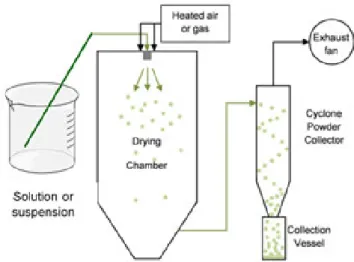
pharmaceutical industry to prepare polymeric MPs for drug delivery applications.32,41,58,59 It is described as highly reproducible, even on an industrial scale, it is simple, fast, inexpensive and usually provides a regular distribution of particle size, as well as ensures uniformity of drug distribution even when used at lower doses.41,58,60 Spray-drying is a method where a solution or suspension is converted into dry particles through some fundamental steps: atomization, drying and particle formation. During the process, a liquid passes through an atomizer which will create a spray, forming droplets that are exposed to a stream of hot air, or other gas capable of promoting the rapid evaporation of the solvent present in the formed droplets. After evaporation, the resultant dried particles are separated from the gaseous stream by a cyclonic separator and accumulate in the collection vessel (Figure 1.8).32,41,59–61
Figure 1.8. Diagram of spray-drying method (adapted from 60).
There are many parameters involved in the whole process, most of them affecting the final properties of the MPs. Therefore, by optimising these parameters and tuning them according to the final characteristics desired for the produced powders, it is possible to obtain very different products. It is this flexibility that makes the technique so valuable. The parameters possibly undergoing optimization might be divided in two categories: 1) characteristics of the solution/suspension to be sprayed; 2) adjustable parameters in the equipment. In the former, the viscosity of the dispersion and its content in solid materials are the relevant characteristics. Regarding the proper equipment, there is the need to consider inlet and outlet temperatures, air flow rate, feed speed of the liquid to
28
be atomized and the aspirator rate. By varying these parameters, the size, shape and density of the MPs and the flowing properties of the obtained powder (compressibility, dispersibility) might be tuned to the desired effect.32,58,59
Nevertheless, MPs produced by spray-drying present a natural tendency to agglomerate due to strong cohesive forces that decrease flow properties, which not only affects its storage but also reflects on the ability to deposit in the lungs.62 To circumvent this problem, the inclusion of other excipients in the formulations might be considered.35 The literature reports the use of many excipients as a means to increase the physical or chemical stability of drugs, their mechanical properties and/or their final pharmaceutical properties.32,63
Mannitol has emerged as an alternative to lactose as adjuvant excipient in therapeutic formulations, because mannitol is a non-hygroscopic sugar and it has low humidity.64
Furthermore, mannitol is not of animal origin, is not constituted of reducing groups, is highly crystalline even after being processed by spray-drying, and is approved for pulmonary delivery.65 There are many works reporting the use of mannitol in inhalable formulations. It is generally referred that particles with a significant content in mannitol have improved flow properties.66 According to Littringer et al.,67 depending of the outlet temperature during atomization, mannitol particles might become smoother or have a rougher surface. Those with a rougher surface increase the density and particle mechanical stability as a result of the reduction of empty space between the particles. Other excipients referred to be added to dry powder formulations in order to improve flowability are some amino acids. Among these is leucine and some studies have shown an increased deposition of bioactive particles in the lower airways of the respiratory tract when containing this agent, due to a decrease of interparticle interactions. Leucine acts as a surfactant during the drying stage of the spray-drying process, influencing the particle surface properties by making them more wrinkled. This also decreases the empty spaces avoiding the cohesion between particles and, thereby, increasing the flowing properties.62
29
2. Objectives
Considering the need to find alternatives to the conventional therapy of TB, this thesis is aimed at developing spray-dried KGM-based microcarriers for an application in the pulmonary delivery of antitubercular drugs (INH and/or RFB). In this manner, the work was devised to:
Produce KGM MPs by spray-drying, designing a formulation with concomitant association of INH and RFB, two first-line antitubercular drugs;
Optimize the spray-drying process so as to obtain MPs endowed with suitable aerodynamic characteristics to reach the alveolar zone and permit macrophage capture;
Test the effect of introducing mannitol and leucine individually as adjuvant materials in the MP formulations, regarding the flowing properties, ability to encapsulate the antibiotics and the release profile;
Evaluate the crystallinity pattern of KGM MPs containing antitubercular drugs; Determine the cytotoxic effect of the developed MP formulations in the
respiratory cell lines A549 (representative of alveolar epithelium) and Calu-3 (representative of bronchial epithelium).
30
3. Materials and methods
3.1. Konjac Glucomannan hydrolysis
KGM (Chemos, Germany) was submitted to a process of acid hydrolysis in order to decrease its molecular weight and, consequently, its viscosity (40 000 mPa·s) upon solubilization in water. The hydrolysis was performed based on the protocol proposed by Cheng et al.68 Briefly, 7 g of KGM as obtained commercially were added to 50 mL
of 96% ethanol (AGA, Portugal) in a two-necked round bottom flask, under stirring, to create a suspension. Then, a purge with nitrogen was performed for about 5 min to create an inert atmosphere, after which the suspension was stirred for 30 min. Afterwards, 8 mL of 37% HCl (VWR, USA) were added and the suspension was sonicated for 60 min at 45 kHz (ultrasonic bath; VWR, USA). The mixture was then filtered under vacuum through a No. 4 fritted funnel, and washed with 70% ethanol (AGA, Portugal), until neutral pH. For the evaporation of ethanol, the hydrolysed polymer was placed overnight in a fume hood and then in a vacuum oven (VD23 Vacuum Oven; Binder, Germany) for approximately 48 h at 50 °C. During this time the sample was weighed sometimes and was only removed from the vacuum oven after a constant weight was achieved. The yield (%) of the hydrolytic reaction was calculated by the following equation:
Yield = Final amount of hydrolysed KGM × 100Initial amount of KGM The hydrolysed KGM was stored in a desiccator until further use.
3.2. Preparation of KGM microparticles
KGM-based MPs were prepared from KGM solutions prepared at the concentration of 1.5% or 2% (w/v). The preparation of the solutions involved the mechanical stirring of the previously weighed polymer with ultrapure water (Mili-Q Plus; Milipore Iberica, Spain), at a temperature of approximately 70 °C.
31
INH (Sigma-Aldrich, Germany) and RFB (Chemos, Germany) were used as model antitubercular drugs. Two different formulations containing KGM and the drugs were prepared: KGM/RFB and KGM/INH/RFB. In all cases KGM was included at the concentration of 1.5% (w/v), the only exception occurring for MPs of KGM without any other material (drug or excipient). Concerning the drugs, INH was used at a polymer/drug ratio of 10/1 (w/w) and RFB at 10/0.5 (w/w). INH was dissolved separately in water in a test tube and subsequently added to the polymeric dispersion only 1 h before spray-drying, in order to prevent any degradation. In turn, in the two formulations including RFB, a minimum volume of HCl at the concentration of 0.01M was added to enable drug dissolution. In these cases, RFB was weighed in a test tube and dissolved with 0.01M HCl. After complete dissolution, it was added dropwise to the previously prepared KGM dispersion, and the mixture was stirred for about 20 h. All dissolutions were protected from light to prevent degradation.
Formulations containing the adjuvant excipients mannitol and leucine were also prepared. Mannitol (Sigma-Aldrich, Germany) was added to the polymeric dispersion in presence or absence of drugs at a concentration of 0.75% (w/v). It was weighed and solubilized simultaneously with KGM and left to stir for about 45 min before initiating spray-drying. Leucine (Panreac AppliChem, Germany) was used at the same concentration as mannitol (0.75%, w/v) in order to allow a comparison of effects. It was previously dissolved in water and then added to the KGM dispersion under stirring. The mixture undergone stirring for about 3 h until spray-drying took place. When drugs were added to the formulations containing the adjuvant excipients (INH and RFB individually, and in association), their inclusion occurred as described above for the formulations containing only KGM, regarding the process and the polymer/drug ratios: KGM/INH = 10/1, KGM/RFB = 10/0.5 and KGM/INH/RFB = 10/1/0.5 (w/w).
Ten formulations were thus prepared, as described in Table 3.1. For KGM alone two formulations were prepared, one with RFB and another one with INH and RFB. For KGM added of each of the adjuvant excipients, a formulation with each drug incorporated individually (INH or RFB) and another one containing an association of the drugs (INH and RFB) was prepared. Three replicates were prepared for each formulation.
32
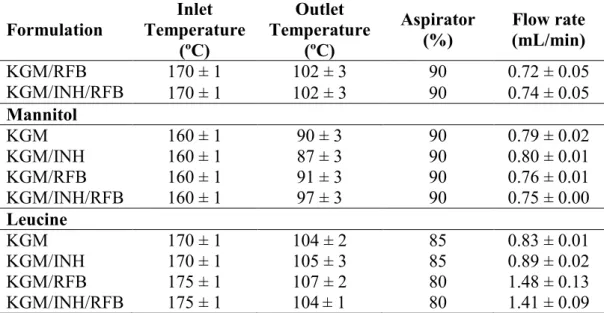
The dispersions were spray-dried in a Buchi B-290 laboratory mini spray-dryer (Buchi Labortechnik AG, Switzerland) equipped with a high performance cyclone. The spray flow rate was set at 473 L/h. As disclosed in Table 3.1 for each formulation, inlet and outlet temperatures ranged between 160-175 ºC and 87-107 ºC, respectively, the aspirator was set at 80-90% and the feed flow varied between 0.7 and 1.5 mL/min. The yield (%) of the spray-drying process for each MP formulation was calculated from the following equation:
Yield = Initial weight of solids in the dispersion × 100Weight of collected MPs
Table 3.1. Optimised parameters of spray-drying for the different formulations (mean ±
SD, n = 3). Formulation Inlet Temperature (ºC) Outlet Temperature (ºC) Aspirator (%) Flow rate (mL/min) KGM/RFB KGM/INH/RFB 170 ± 1 102 ± 3 90 0.72 ± 0.05 170 ± 1 102 ± 3 90 0.74 ± 0.05 Mannitol KGM 160 ± 1 90 ± 3 90 0.79 ± 0.02 KGM/INH 160 ± 1 87 ± 3 90 0.80 ± 0.01 KGM/RFB 160 ± 1 91 ± 3 90 0.76 ± 0.01 KGM/INH/RFB 160 ± 1 97 ± 3 90 0.75 ± 0.00 Leucine KGM 170 ± 1 104 ± 2 85 0.83 ± 0.01 KGM/INH 170 ± 1 105 ± 3 85 0.89 ± 0.02 KGM/RFB 175 ± 1 107 ± 2 80 1.48 ± 0.13 KGM/INH/RFB 175 ± 1 104 ± 1 80 1.41 ± 0.09
3.3. Microparticle morphological and aerodynamic characterisation
3.3.1. Morphology
The morphological characterisation of MPs was performed by field emission scanning electron microscopy (FESEM Ultra Plus, Zeiss, Germany). Dry powders were placed onto metal plates and 5 nm thick iridium film was sputter-coated (model Q150T S/E/ES, Quorum Technologies, UK) on the samples before viewing.
33 3.3.2. Feret’s diameter
The size of MPs was measured as the Feret’s diameter (distance between two parallel tangent lines on opposite sides of the particle) using an optical microscope (VWR, USA). For this purpose, the powder was spread between a slide and a coverslip and observed under the microscope. The average diameter was calculated as the mean of 300 measurements for each sample.
3.3.3. Bulk and apparent tap density
For solid materials, density is defined by the weight of a sample over its volume.69 However, calculation of the volume of a sample may not be an easy process.70 Powdered formulations usually have spaces between the MPs, the total volume of spaces depending on the size and morphology of MPs and their inter-individual interactions. Considering or not the powder porosity, different densities can be obtained and calculated.70
To determine the bulk and apparent (tap) densities, a known amount of each dry powder was gently placed in a 10 mL graduated cylinder and the initial volume registered. The cylinder was mechanically tapped (Densipro 250410; Deyman, Spain) until a constant volume was reached (n = 3). The bulk and tap densities (g/cm3) were determined
according to the following equations:
Bulk density =Initial volume of powderWeight of dry powder Tap density =Final volume of powderWeight of dry powder
3.3.4. Real density
Real density represents the weight of a unit volume of a sample, without considering its porosity.69,71 This can be determined by a gas pycnometer, in which the gas is
34
distributed through the solid material, filling the empty spaces. The accuracy of the pycnometer to determine the density of the sample depends on the sample material and the gas. In this regard, the sample must not contain volatile elements that might cause errors and instability, while the gas must be a pure gas or dry air.70 Helium is one of the most frequently used gases, as it is a very small atom able to diffuse rapidly through the pores of a sample.70,71
The real density of KGM-based MPs was determined by helium pycnometry (Accupyc 1330, Micromeritics Instrument Corporation, Norcross, GA) (n = 3).
3.3.5. Theoretical aerodynamic diameter
Daer is a very important parameter to characterise in aerosol particles, because it
provides indications on their flowing abilities. It is defined as the geometric diameter of a sphere with density of 1 g/cm3 which moves in the air with the same velocity as the particle in question. Particles that have the same daer assume the same behaviour in air,
regardless of physical size, shape, density or composition.72
Daer (µm) of the MPs was theoretically calculated based on the Feret’s diameter and the
real density:
Daer = Feret(s diameter × √real density
3.4. Powder X-Ray Diffraction analysis
To measure the nature and degree of crystallinity of the KGM, drugs (INH and RFB), excipients (mannitol and leucine) and the various formulations prepared using these materials, an analysis by powder x-ray diffraction (PXRD) was performed. To do so, the samples were placed in a sampleholder and analysed by a diffractometer (PANalitycal X'Pert Pro) using a CuKα radiation at a wavelength of 0.154 nm filtered by nickel. During the analysis the equipment operated at 45kV and 35 mA. PXRD patterns were obtained at 2θ angles from 5º to 70º with a step size of 0.05º and 1500 s per step, using an X'Celerator detector.
35 3.5. Determination of drug association efficiency and loading capacity
An initial screening of emission/absorption wavelengths was performed for each of the drugs, dissolved in 0.1M HCl (at different concentrations), in a spectrophotometer (UV-1700 Pharmaspec; Shimadazu, Japan). An absorbance peak was observed for RFB at 500 nm. It was not possible to detect a peak isolated for INH, where only this drug absorbed and there was no interference of RFB. Thus, it was found an absorption point at 268.5 nm in which occurred the intersection of INH spectrum with that of RFB and corresponding to full absorption of both drugs. Therefore, whenever needed RFB was quantified at 500 nm and INH was quantified at 268.5 nm after subtraction of the contribution of RFB at the same wavelength. A scan was also performed for KGM and the two adjuvant excipients, mannitol and leucine, to ensure an absence of interference at the same wavelengths. Association efficiency (AE), LC and drug release calculations were then determined.
3.5.1. Formulations with INH
A standard calibration curve of INH in adequate media (counting on any effect from the polymer) was prepared at 268.5 nm. To prepare the medium for INH dissolution, 1.5 mg of unloaded KGM MPs were dissolved in 10 mL of 0.1M HCl, being maintained under stirring for 1 h. The solution was then filtered (0.45 µm) and INH was dissolved in this solution. Then, dissolved INH was diluted at various concentrations. The resulting solutions were spectrophotometrically analysed at 268.5 nm.
To determine the amount of INH associated to KGM MPs, 1.5 mg of KGM MPs containing INH were solubilized in 10 mL of 0.1M HCl for 1 h, under constant stirring. After filtration (0.45 µm), the collected solutions were measured at 268.5 nm.
Based on the standard calibration curve, the AE (%) and the LC (%) of drug(s) were calculated by the following equations:
36
LC = Real content of drugWeight of MPs × 100
The quantification of INH present in the formulations with INH and RFB is explained in the following section.
3.5.2. Formulations with RFB (and INH/RFB)
A standard calibration curve of RFB was performed in adequate media (counting with any effect from the polymer). Thirty mg of unloaded KGM MPs (with or without excipients) were dissolved in 10 mL of 0.1M HCl. Upon 1 h stirring, the resultant solution was centrifuged at 8000 rpm for 30 min (Centrifuge 5810R; Eppendorf, Germany) and subsequently filtered (0.45 µm). This filtrate was used to solubilize RFB to prepare the calibration curve.
The determination of drug AE and LC was performed by dissolving 30 mg of unloaded KGM/RFB MPs in 10 mL of 0.1M HCl. After centrifugation and filtration in the same conditions described above, the recovered liquid (filtrate) was measured spectrophotometrically at 500 nm, when only RFB is present, and at both 500 nm and 268.5 nm for the formulation with drug association. The measurement at 500 nm was made directly and provided a direct calculation of the RFB amount present in the MPs. In turn, the measurement performed at 268.5 nm required a 1:10 dilution and represents the sum of amounts of INH and RFB. Regarding INH, its amount was calculated by subtracting the absorbance obtained at 500 nm (RFB) to that at 268.5 nm (RFB + INH). Then, AE and LC were calculated using the equations present in section 3.5.1.
3.6. In vitro drug release profile
The determination of the release profile was assessed for the formulations containing the association of both drugs, with or without the adjuvant excipients. In total, three
KGM-37
Leu/INH/RFB. A determined amount of each formulation was weighed (30 mg) and placed in a test tube containing 10 mL of release medium composed by Phosphate Buffer Saline (PBS; Sigma-Aldrich, Germany) pH 7.4 added of 1% (v/v) Tween
80 (Merk, Germany), based on the protocol proposed by Chandran et al.73 MPs were kept under horizontal shaking (Orbital Shaker OS-10; Biosan, Latvia) at 100 rpm and 37 °C (Dry line; VWR, USA). At pre-determined times, samples of 1 mL were collected, filtered (0.45 µm) and analysed spectrophotometrically at 500 nm to determine the amount RFB. Subsequently, a 1:10 dilution was performed and a further measurement was made at 268.5 nm in order to determine the amount representing the sum of INH and RFB. The amount of INH was obtained by subtracting the absorbance at 500 nm to that of 268.5 nm.
To know the concentration of drug released over time, three calibration curves were elaborated for the process: two for RFB, at 268.5 and 500 nm, and one for INH at 268.5 nm. These curves were prepared in a medium resulting from the incubation of unloaded KGM MPs (either containing or not adjuvant excipients) in the same medium used in the release assay (PBS pH 7.4 + 1% (v/v) Tween
80).
The percentage (%) of drug released over time was determined using the following equation:
Drug release = Concentration of drug releasedInitial drug concentration × 100
3.7. Cell culture
In vitro assays were performed using two cell lines from different regions of the lung. A549 cells (American Type Culture Collection (ATCC, USA) are derived from a human alveolar epithelial adenocarcinoma and represent the alveolar epithelium, while Calu-3 cells (ATCC, USA) derive from human bronchial epithelial adenocarcinoma and are representative of bronchial epithelium.
Both cell lines were maintained in culture in Dulbecco's Modified Eagles's Medium
38
penicillin/streptomycin (Sigma-Aldrich, Germany), 1% (v/v) L-Glutamine 200 mM (Sigma-Aldrich, Germany), 1% (v/v) Non-Essential Amino Acid (Sigma-Aldrich, Germany) and 10% (v/v) Fetal Bovine Serum (FBS, Gibco, USA). They were cultured in 75 cm2 flasks, in a 5% CO2/95% humidified atmospheric air incubator at 37 ºC.
Culture medium was exchanged every 2–3 days and cells were subcultured weekly in the case of A549 cells and every 10–15 days for Calu-3 cells.
3.8. Determination of cytotoxic profile of microparticles 3.8.1. MTT Assay
The 3-(4 5-dimethylthiazol-2-yl)-2 5-diphenyltetrazolium bromide (MTT) assay, developed by Mossman, is a colorimetric method to determine the number of living cells. It is based on the enzymatic reduction of yellow tetrazolium salt, MTT, by enzymes present only in metabolically active cells, to form purple formazan crystals. These can be solubilized using organic solvents, thus producing a coloured solution that might be analysed spectrophotometrically. The colour intensity is dependent on formazan concentration and is directly proportional to the number of metabolically active cells.74
The effect of the polymer, the adjuvant excipients and the various formulations of dry powders developed in this thesis (KGM, KGM MPs, KGM/RFB, KGM/INH/RFB, mannitol, mannitol MPs, Man, Man/INH, Man/RFB, KGM-Man/INH/RFB, leucine, leucine MPs, KGM-Leu, KGM-Leu/INH, KGM-Leu/RFB, KGM-Leu/INH/RFB) on cell viability was assessed in both A549 and Calu-3 cells, at the concentrations of 0.1, 0.5 and 1 mg/mL, for a period of 3 h and 24 h. To perform the assay, A549 cells were seeded in 96-well plates at a density of 1 × 10⁴ cells/well and Calu-3 cells at 2 × 10⁴ cells/well. After an incubation period of approximately 24 h (37 ºC, humidified 5% CO2/95% atmospheric air) to enable cell adherence, the medium was
removed and replaced with 100 µL of each sample suspended in pre-warmed DMEM without FBS.
The cytotoxicity of the free drugs was also tested in three concentrations corresponding to the approximate real amounts of each drug on the formulations. The theoretical
39
polymer/drug ratios were considered for this effect, being polymer/INH = 10/1 (w/w) and polymer/RFB = 10/0.5 (w/w). To do so, INH was solubilized in DMEM without FBS and tested at the concentrations of 0.01, 0.05 and 0.1 mg/mL. However, due to the hydrophobic character of RFB, its solubilization in culture medium is hampered. Therefore, the solubilization was performed with dimethyl sulfoxide (DMSO, Sigma-Aldrich, Germany) at a concentration of 10 mg/mL with subsequent dilution to three concentrations (0.005, 0.025 and 0.05 mg/mL) being performed with DMEM without FBS. To demonstrate the absence of toxicity of DMSO at the used concentrations, various dilutions of DMSO in DMEM were tested for 24 h. Two controls were transversely used in the assays: DMEM was considered a positive control of cell viability and sodium dodecyl sulphate (SDS, 2%, w/v) (Sigma-Aldrich, Germany) was the corresponding negative control.
After exposure to the formulations or controls (3 h or 24 h), the supernatant of cells was removed from all wells and replaced with 30 µL of MTT solution (0.5 mg/mL in PBS pH 7.4; Sigma-Aldrich, Germany). Plates were placed back in the incubator and 2 h later 50 µL of DMSO were added to dissolve the purple crystals formed during the reaction of the cells with MTT. After solubilization, the plate was read by spectrophotometry (Infinite M200; Tecan, Austria) at 540 nm and corrected for background absorbance at 640 nm, as indicated by Carmichael et al.75 Relative cell viability (%) was calculated as follows:
Cell viability = CM − S × 100A − S
Where A is the absorbance obtained for each of the concentrations of the test substance, CM is the absorbance obtained for untreated cells (incubated with cell culture medium only) and S is the absorbance obtained for the 2% SDS. The latter reading was assumed to correspond to 100% cell viability. The assay was performed on three occasions with six replicates at each concentration of test substance in each instance.