Integron mediated multidrug resistance in extended spectrum beta-lactamase
producing clinical isolates of
Klebsiella pneumoniae
Maryam Mobarak-Qamsari
1, Mitra Ashayeri-Panah
1, Freshteh Eftekhar
1,
Mohammad Mehdi Feizabadi
21
Department of Microbiology, Faculty of Biological Sciences, Shahid Beheshti University, G.C., Tehran, Iran. 2
Department of Microbiology, School of Medicine and Pediatric Infectious Diseases Research Center, Tehran University of Medical Sciences, Tehran, Iran.
Submitted: March 05, 2012; Approved: April 01, 2013.
Abstract
The present study describes integron mediated multiple antibiotic resistance in extended-spectrum b-lactamase producing clinical isolates ofKlebsiella pneumoniae. One hundred and four clinical iso-lates ofK. pneumoniaefrom two Iranian hospitals were screened for extended-spectrumb-lactamase production and susceptibility of the extended-spectrumb-lactamase producing isolates was deter-mined to 17 antibiotics by disc diffusion. Presence of integron classes 1, 2 and 3 was detected by PCR and integrase specific primers. Isolates harboring class 1 integron were then screened for variable re-gions using PCR. Fifty isolates (48%) produced extended-spectrumb-lactamases among which, 22 (44%) harbored class 1, 3 (6%) carried class 2 and none contained class 3 integons. Integron carriage was significantly associated with higher rates of multiple antibiotic resistance in extended-spectrum b-lactamase producing clinical isolates ofK. pneumoniae. Integron harboring isolates were more re-sistant to aztreonam (51.3%), ceftazidime (42.6%), cefotaxime (43.3%), cefepime (24.6%), kana-mycin (43.2%), tobrakana-mycin (30.7%), norfloxcacin (32%) and spectinokana-mycin (25.6%) compared to the organisms without integrons. On the other hand, resistance to nitrofurantoin and streptomycin was significantly higher among the integron negative isolates. PCR amplification of class1 integron variable regions revealed 9 different sized DNA fragments and isolates with similar profiles for class 1 integron variable regions showed the same antibiotic resistance phenotypes.
Key words:Klebsiella pneumoniae, extended-spectrumb-lactamase, multiple antibiotic resistance, integron.
Introduction
Klebsiella pneumoniaeis an opportunistic pathogen responsible for up to 10% of all nosocomial infections and one of the leading causes of urinary, respiratory and blood infections particularly in immuno-compromised patients (Brisseet al., 2006; Podschun and Ullmann, 1998). Emer-gence and spread of multidrug resistantK. pneumoniae, specifically the extended spectrum b-lactamase (ESBL) producing strains, is often responsible for the failure of an-tibiotic treatment in hospital settings (Paterson and Bono-mo, 2005). Mobile genetic elements such as plasmids and
transposons are reported to carry genetic units named inte-grons which contain genes for site-specific recombination, and are capable of capturing and mobilizing gene cassettes (Hall and Collis, 1995; Stokes and Hall, 1989). These can be subdivided into two main groups, the superintegrons and the antibiotic resistance integrons (ARIs) (Cambrayet al., 2010; Fluit and Schmitz, 2004). Dissemination of antibiotic resistance genes among bacteria can occur by mobile ge-netic elements containing the ARIs (Cambrayet al., 2010; Hall, 1997; Hall and Collis, 1995). Among different classes of ARIs, classes 1, 2, and 3 have been historically
impli-Send correspondence to F. Eftekhar. Department of Microbiology, Faculty of Biological Sciences, Shahid Beheshti University, G.C., Tehran, Iran. E-mail: f-eftekhar@ sbu.ac.ir; [email protected].
cated with multiple antibiotic resistance (MAR) pheno-types and are defined based on their respective integrase (intI) genes (Cambray et al., 2010; Hall, 1997). Class 1 integrons are the most widespread and have been fre-quently found in ESBL producing clinical isolates of EnterobacteriaceaeincludingK. pneumoniae(Joneset al., 2003; Machadoet al., 2007; Raoet al., 2006; Yaoet al., 2007). Class 2 integrons occur less frequently in ESBL pro-ducing E. coli and K. pneumoniae and finally, class 3 integrons are rarely found in ESBL producing K. pneumoniae (Bhattacharjee et al., 2010; Correia et al., 2003; Machado et al., 2005). We investigated the anti-microbial susceptibility and prevalence of class 1, 2 and 3 integrons in ESBL producing clinical isolates of K. pneumoniaefrom Iranian patients. The variable regions of class 1 integrons were also detected. Finally, the associa-tion between integron carriage and MAR phenotypes were determined.
Materials and Methods
Bacterial isolates
One hundred and four clinical isolates of K. pneumoniae were collected from hospitalized patients in two teaching hospitals in Tehran (Imam Hussein and Lab-bafinejad) from March 2008 to March 2009. The majority of the isolates were from urine (n = 90; 86.5%) followed by wound (n = 4; 3.84%), trachea (n = 4; 3.84%), sputum (n = 2; 1.92%), blood (n = 2; 1.92) and other unknown sources (n = 2; 1.92%). The ATCC standard strainsK. pneumoniae (ATCC 10031) andE. coli (ATCC 25922) were used as susceptibility controls. Klebsiella pneumoniae (ATCC 1029)was kindly provided by Dr. Rajabnia (Babol Univer-sity, Medical School) for use as positive control for class 1 integron in PCR tests.
ESBL production
The isolates were initially screened for ESBL produc-tion by the double disc synergy test (DDST) using cefo-taxime (30mg), ceftazidime (30mg) and cefepime (30mg) placed 20 mm center to center from an amoxicillin/cla-vulanic acid disk (20/10mg) (Himedia, India). ESBL pro-duction was detected when synergy was observed between the inhibition zones of cephalosporins and amoxicillin/cla-vulanic acid and was further confirmed by the phenotypic confirmatory test (PCT) using ceftazidime and cefotaxime alone or in combination with clavulanic acid (CLSI, 2011; Drieuxet al., 2008).
Antimicrobial susceptibility
In vitro antimicrobial susceptibility of ESBL produc-ing isolates was determined to 17 antibiotics accordproduc-ing to the CLSI criteria (CLSI, 2011). The antimicrobial discs (Himedia, India) were; cefepime (30 mg), ceftazidime (30mg), cefotaxime (30mg), imipenem (10mg), gentamicin
(10mg), tobramycin (10mg), aztreonam (30mg), amikacin (30 mg), nitrofurantoin (300 mg), streptomycin (10 mg), spectinomycin (100mg), norfloxacin (10mg), kanamycin (30mg), ampicilin/sulbactam (10/10mg), colistin (10mg), co-amoxiclav (20/10mg), piperacilin (100mg) and piper-cilin/tazobactam (100/10mg).
Detection of class 1, 2 and 3 integrons by PCR
Isolates were grown overnight (18 h) in Luria Bertani (LB) broth (Difco, Detroit, MI, USA) at 37 °C and genomic DNA was extracted using High Pure PCR template Prep kit for Genomic DNA extraction (Roche Diagnostics, Mannheim, Germany). PCR amplification of classes 1, 2 and 3 integrase genes was performed in 25mL reaction mix-tures containing 30 ng DNA template, 0.4 mM of each dNTP, 150mM MgCl2, 0.2 U Super Taq DNA polymerase (CinnaGen, Tehran, Iran) and 1 pM of each primer (FazaBiotech, Tehran, Iran) as follows: Int1F; CCTCCCGCACGATGATC, Int1R; TCCACGCATCGT CAGGC, Int2F; TTATTGCTGGGATTAGGC, Int2R; ACGGCTACCCTCTGTTATC, Int3F; AGTGGGTGGC GAATGAGTG, Int3R; TGTTCTTGTATCGGCAGGTG) (Goldsteinet al., 2001). Amplifications were performed in a Bioer TC25/HH Thermal Cycler (Bioer Technology Co. Ltd, Hangzhou, China) using the following program: initial denaturation at 95 °C for 5 min followed by 35 cycles of 1 min at 94 °C, 1 min at 60 °C and 1 min at 72 °C with a fi-nal extension at 72 °C for 10 min. For the class 1 integron carrying isolates, PCR amplification of variable regions was performed in 20mL reaction mixtures containing 30 ng DNA template, 20 mM of each dNTP, 150 mM MgCl2, 0.2 U Super Taq DNA polymerase and 1 pM of each primer (5’-CS; GGCATCCAAGCAGCAAG, 3’-CS AAGCAGA CTTGACCTGA) (Levesqueet al., 1995). Amplification of the integron variable regions was carried out with initial de-naturation of 4 min at 94 °C followed by 35 cycles of 1 min at 94 °C, 1 min at 55 °C and 1 min at 72 °C with a final ex-tension of 10 min at 72 °C. The amplified PCR products were resolved by electrophoresis in 1% agarose gels and vi-sualized after staining with ethidium bromide.
Statistical analysis
To compare the antibiotic resistance profiles between integron positive and integron negative isolates, non-para-metric analysis was performed using the two-tailed Mann-Whitney U test allowing for continuous variable and non-normal distribution.
Results
and cefotaxime (68%), tobramycin (66%), ceftazidime (64%), ampicillin/sulbactam (60%), spectinomycin (56%), cefepime (52%), norfloxacin (48%), gentamicin (36%), ni-trofurantoin (24%), amikacin (22%), piperacil-lin/tazobactam (20%), colistin (14%) and streptomycin (10%). All isolates were susceptible to imipenem (Table 1).
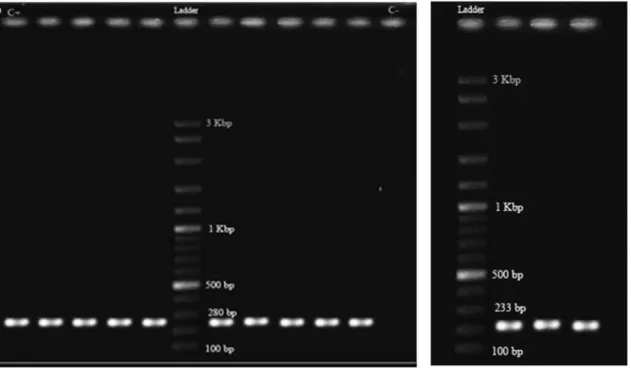
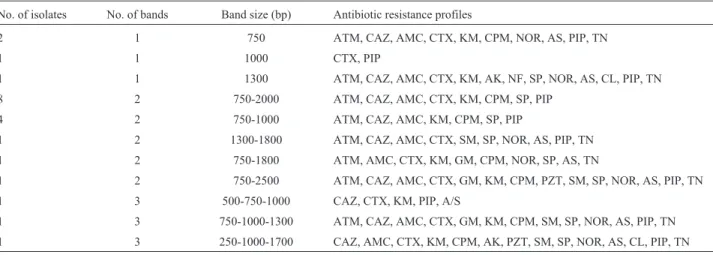
PCR amplifications for classes 1 and 2 integrase genes showed that 22 (44%) of the ESBL producing K. pneumoniae isolates harbored class 1 (Figure 1A) and 3 (6%) carried class 2 integrons (Figure 1B), two of which had both classes. None of the isolates carried class 3 integron. Class 1 integron harboring isolates possessed one to three DNA sequences manifested as nine different sized amplicons in the range of 0.5 to 3 kb (Figure 2). The integron harboring isolates were significantly more resis-tant to aminoglycosides including kanamycin (43.2%) and tobramycin (30.7%). The same trend was observed for other antibiotics where integron carrying isolates were more resistant to cefotaxime (43.3%), ceftazidime (42.6%), aztreonam (51.3%), norfloxcacin (32%), cefepime (24.6%) and spectinomycin (25.6%) (Table 1). On the other hand, resistance to streptomycin and nitrofurantoin was signifi-cantly higher in integron negative isolates (p£0.05) (Ta-ble 1). The association between integron carriage and antibiotic resistance was most significant for aztreonam (p = 0.000) followed by cefotaxime (p £ 0.001),
kana-mycin, ceftazidime and streptomycin (p£0.01) and finally tobramycin (p£0.05) (Table 1). Comparison of MAR phe-notype (resistance to 6 or more antibiotics) in the two groups of isolates showed that integron harboring strains had a much higher rate of MAR (95.65%) compared to integron negative isolates (48.15%) (p = 0.000). There was no significant association between the type of specimen with ESBL production, antibiotic susceptibility or integron carriage. However, isolates with similar profiles for class 1 integron variable regions had the same antibiotic resistance phenotypes (Table 2).
Discussion
ESBL producingK. pneumoniaehave been reported to harbor higher rates of class 1 integrons compared to non-ESBL strains (Bhattacharjeeet al., 2010; Goldsteinet al., 2001; Joneset al., 2003; Machadoet al., 2007; Marti-nez-Freijoet al., 1998; Raoet al., 2006; Whiteet al., 2001; Yaoet al., 2007). In the current study, 44% of the ESBL positive isolates carried class 1 integrons. We found a sig-nificant association between integron carriage and higher rates of resistance tob-lactams and aminoglycosides. Other reports have shown that resistance gene cassettes to all aminoglycosides are carried by class 1 integrons (Cambray et al., 2010; Fluit and Schmitz, 2004).
Table 1- Association between antimicrobial susceptibility and integron carriage in 50 extended-spectrumb-lactamase producing clinical isolates of
Klebsiella pneumoniae.
Antibiotic Integron positive isolates (n= 23) Integron negative isolates (n=27) Level of significance*
% R % I % S % R % I % S
Kanamycin 91.4 4.3 4.3 48.2 40.7 11.1 **
Tobramycin 82.6 0 17.4 51.9 0 48.1 *
Gentamicin 47.8 13 39.2 25.9 11.1 63 NS
Norfloxacin 65.3 4.3 30.4 33.3 22.3 44.4 NS
Aztreonam 95.7 4.3 0 44.4 11.2 44.4 ***
Cefotaxime 91.4 4.3 4.3 48.1 3.8 48.1 ***
Ceftazidime 87 8.7 4.3 44.4 22.3 33.3 **
Cefepime 65.3 4.3 30.4 40.7 0 59.3 NS
Spectinomycin 69.6 26.1 4.3 44.4 40.7 14.9 NS
Piperacillin 100 0 0 100 0 0 NS
Piperacillin/Tazobactam 26.1 34.8 39.1 14.8 29.6 55.6 NS
Streptomycin 0 30.4 69.6 18.5 48.2 33.3 **
Ampicilin/sulbactam 73.9 13.1 13 48.2 18.5 33.3 NS
Colistin 13 0 87 14.8 0 85.2 NS
Amikacin 17.4 34.8 47.8 25.9 3.7 70.4 NS
Nitrofurantoin 8.7 26.1 65.2 37 26 37 *
Imipenem 0 0 100 0 0 100 NS
Amoxyclav 100 0 0 92.6 0 7.4 NS
The size range of the amplified fragments for class 1 integron variable regions indicates presence of one or more gene cassettes, providing a possible explanation for various MAR phenotypes, or more than one integron in an isolate. It may also be concluded that these isolates either contain more than one class1 integron with a variety of integrated gene cassettes or integrons which have undergone possible rearrangements (Levesqueet al., 1995). Identical antibiotic resistance phenotypes in the isolates carrying similar sized fragments in variable regions could mean that amplicons of the same size carry the same resistance gene cassettes (El-Najjaret al., 2010).
According to our results, 6% of the ESBL positive isolates harbored class 2 integrons similar to the report by Bhattacharjee et al. (Bhattacharjee et al., 2010). Several studies have reported restricted distribution of class 2 inte-grons among the family Enterobacteriaceae including Escherichia coli, Salmonella, Enterobacter cloacae and also in Acinetobacter baumannii(Goldstein et al., 2001; Ramirezet al., 2010). To our knowledge, there is only one other report describing class 2 integron in ESBL producing K. pneumoniae(Bhattacharjeeet al., 2010).
We did not find any significant concordance between the presence of the ARIs and a specific MAR phenotype. However, in the integron positive isolates, the frequency of resistance to seven antibiotics from five classes was signifi-cantly higher than integron negative strains (p < 0.05). In addition, integron positive isolates were significantly more likely to show MAR phenotypes than integron negative iso-lates (p = 0.000). It could be concluded that ARI carriage may at least be partially responsible for not only higher rates of resistance to several antibiotics, but also higher prevalence of MAR phenotypes inK. pneumoniaeisolates (Martinez-Freijoet al., 1998; Yaoet al., 2007).
Interestingly, there was an inverse association be-tween resistance to streptomycin and nitrofurantoin with integron carriage, where integron negative isolates were more resistant to these antibiotics. No relationship was found between resistance to amikacin and colistin with integron carriage. Martinez-Freijo and colleagues also found no significant association between presence of inte-grons and amikacin resistance (Martinez-Freijo et al., 1998). Similar observations have been made by White and
Figure 2- PCR amplification of class 1 integron variable regions in ESBL producingKlebsiella pneumoniaeisolates (Lanes 1-5 and 7-12). Lane 6, DNA molecular weight marker (100 bp, Fermentas).
colleagues regarding amikacin and nitrofurantoin (Whiteet al., 2001). These results suggest that resistance to nitrofu-rantoin and amikacin are independent of resistance gene cassettes carried by ARIs.
Irrespective of whether or not resistance genes are contained within the integrons, the results presented here indicate wide dissemination of ARIs in ESBL producingK. pneumoniaeand correlation of integron carriage with in-creased drug resistance rates as well as multidrug resis-tance. Presence of integron associated resistance in the community has been shown to be widespread and can con-tribute to multidrug resistance in hospital settings (Levers-tein-van Hall et al., 2002). It has been suggested that screening for ARIs could complement existing antibiotic resistance surveillance programs by providing information on resistance profiles as well as dissemination of resistance between commensal and infectious strains (Jones et al., 2003).
Acknowledgments
The financial support of this research was provided by the Shahid Beheshti University Research Council.
Disclosure Statement
No competing financial interests exist.
References
Bhattacharjee A, Sen MR, Prakash P, Gaur A, Anupurba S, Nath G (2010) Observation on integron carriage among clinical isolates ofKlebsiella pneumoniaeproducing extended spec-trumb-lactamases. Ind J Med Microbiol 28:207-210.
Brisse S, Grimont F, Grimont PAD (2006) The genusKlebsiella.
In: Dworkin M, Falkow, S., Rosenberg, E., Schleifer, K.H., Stackebrandt, E. (eds). The Prokaryotes: a handbook on the biology of bacteria. Berlin, Springer-Verlag, 6:159-196.
Cambray G, Guerout AM, Mazel D (2010) Integrons. Annu Rev Genet 44:141-166.
Clinical and Laboratory Standards Institute (2011). Performance Standards for Antimicrobial Susceptibility Testing; Twenty-First Informational Supplement. M100-S21, 30(1). Clinical and Laboratory Standards Institute, Wayne, PA. Correia M, Boavida F, Grosso F, Salgado MJ, Lito LM (2003)
Molecular characterization of a new class 3 integron in
Klebsiella pneumoniae. Antimicrob Agents Chemother 47:2838-2843.
Drieux L, Brossier F, Sougakoff W, Jarlier V (2008) Phenotypic detection of extended-spectrumb-lactamase production in
Enterobacteriaceae: review and bench guide. Clin Microbiol Infect 14:90-103.
El-Najjar NG, Farah MJ, Hashwa FA, Tokajian ST (2010) Antibi-otic resistance patterns and sequencing of class I integron from uropathogenicEscherichia coliin Lebanon. Lett Appl Microbiol 51:456-461.
Fluit AC, Schmitz FJ (2004) Resistance integrons and super-integrons. Clin Microbiol Infect 10:272-288. Goldstein C, Lee MD, Sanchez S, Hudson C, Phillips B, Register
B, Grady M, Liebert C, Summers AO, White DG, Maurer JJ (2001) Incidence of class 1 and 2 integrases in clinical and commensal bacteria from livestock, companion animals, and exotics. Antimicrob Agents Chemother 45:723-726. Hall RM, Collis CM (1995) Mobile gene cassettes and integrons:
capture and spread of genes by site-specific recombination. Mol Microbiol 15:593-600.
Hall RM (1997) Mobile gene cassettes and integrons: moving an-tibiotic resistance genes in Gram-negative bacteria. CIBA Found Symp 207:192-205.
Jones LA, Mclver CJ, Rawlinson WD, White PA (2003) Polymer-ase chain reaction screening for integrons can be used to complement resistance surveillance programs. Commun Dis Intel 27:103-110.
Leverstein-van Hall MA, Paauw A, Box ATA, Blok HEM, Verhoef J, Fluit AC (2002) Presence of integron-associated resistance in the community is widespread and contributes to multidrug resistance in the hospital. J Clin Microbiol 40:3038-3040.
Table 2- Distribution of variable region fragments sizes among class1 integron carrying ESBL producingK. pneumoniaeclinical isolates.
No. of isolates No. of bands Band size (bp) Antibiotic resistance profiles
2 1 750 ATM, CAZ, AMC, CTX, KM, CPM, NOR, AS, PIP, TN
1 1 1000 CTX, PIP
1 1 1300 ATM, CAZ, AMC, CTX, KM, AK, NF, SP, NOR, AS, CL, PIP, TN
8 2 750-2000 ATM, CAZ, AMC, CTX, KM, CPM, SP, PIP
4 2 750-1000 ATM, CAZ, AMC, KM, CPM, SP, PIP
1 2 1300-1800 ATM, CAZ, AMC, CTX, SM, SP, NOR, AS, PIP, TN
1 2 750-1800 ATM, AMC, CTX, KM, GM, CPM, NOR, SP, AS, TN
1 2 750-2500 ATM, CAZ, AMC, CTX, GM, KM, CPM, PZT, SM, SP, NOR, AS, PIP, TN
1 3 500-750-1000 CAZ, CTX, KM, PIP, A/S
1 3 750-1000-1300 ATM, CAZ, AMC, CTX, GM, KM, CPM, SM, SP, NOR, AS, PIP, TN
1 3 250-1000-1700 CAZ, AMC, CTX, KM, CPM, AK, PZT, SM, SP, NOR, AS, CL, PIP, TN
Levesque C, Piche L, Larose C, Roy pH (1995) PCR mapping of integrons reveals several novel combinations of resistance genes. Antimicrob Agents Chemother 39:185-191.
Machado E, Ferreira J, Novais A, Peixe L, Cantón R, Baquero F, Coque TM (2007) Preservation of integron types among
Enterobacteriaceae producing extended-spectrumb -lacta-mases in a Spanish hospital over a 15-year period (1988 to 2003). Antimicrob Agents Chemother 51:2201-2204.
Machado E, Cantón R, Baquero F, Galán JC, Rollán A, Peixe L, Coque TM (2005) Integron content of extended spectrum
b-lactamase producing Escherichia coli strains over 12 years in a single hospital in Madrid, Spain. Antimicrob Agents Chemother 49:1823-1829.
Martinez-Freijo P, Fluit AC, Schmitz FJ, Grek VSC, Verhoef J, Jones ME (1998) Class I integrons in Gram-negative iso-lates from different European hospitals and association with decreased susceptibility to multiple antibiotic compounds. J Antimicrob Chemother 42:689-696.
Paterson DL, Bonomo RA (2005) Extended-spectrumb -lacta-mases: a clinical update. Clin Microbiol Rev 18:657-686.
Podschun R, Ullmann U (1998)Klebsiellaspp. as nosocomial pathogens: epidemiology, taxonomy, typing methods, and pathogenicity factors. Clin Microbiol Rev 11:589-603. Ramirez MS, Pineiro S, Centron D (2010) Novel insights about
class 2 integrons from experimental and genomic epidemiol-ogy. Antimicrob Agents Chemother 54:699-706.
Rao AN, Barlow M, Clark LA, Boring JR, Tenover FC, McGowan JE (2006) Class 1 integrons in resistant Esche-richia coliandKlebsiellaspp., US Hospitals. Emerg Infect Dis 12:1011-1014.
Stokes HW, Hall RM (1989) A novel family of potentially mobile DNA elements encoding site-specific gene-integration func-tions: Integrons. Mol Microbiol 3:1669-1683.
White PA, McIver CJ, Rawlinson WD (2001) Integrons and gene cassettes in the Enterobacteriaceae. Antimicrob Agents Chemother 45:2658-2661.
Yao F, Quian Y, Chen S, Wang P, Huang Y (2007) Incidence of extended spectrum b-lactamases and characterization of integrons in extended spectrum b-lactamase producing
Klebsiella pneumoniae isolated in Shantou, China. Acta Biochim Biophys Sin 39:527-532.