Characterization of a small cryptic plasmid from endophytic
Pantoea agglomerans
and its use in the construction of an expression vector
Rudi Emerson de Lima Procópio
1, Welington Luiz Araújo
2,3, Fernando Dini Andreote
2and João Lúcio Azevedo
2,31
Biotecnologia, Instituto de Ciências Biomédicas IV, Universidade de São Paulo, São Paulo, SP, Brazil.
2
Departamento de Genética, Escola Superior de Agricultura “Luiz de Queiroz”,
Universidade de São Paulo, Piracicaba, SP, Brazil.
3Núcleo Integrado em Biotecnologia, Universidade de Mogi das Cruzes, Mogi das Cruzes, SP, Brazil.
Abstract
A circular cryptic plasmid named pPAGA (2,734 bp) was isolated fromPantoea agglomerans strain EGE6 (an endophytic bacterial isolate from eucalyptus). Sequence analysis revealed that the plasmid has a G+C content of 51% and contains four potential ORFs, 238(A), 250(B), 131(C), and 129(D) amino acids in length without homology to known proteins. The shuttle vector pLGM1 was constructed by combining the pPAGA plasmid with pGFPmut3.0 (which harbors a gene encoding green fluorescent protein, GFP), and the resulting construct was used to over-express GFP inE. coli and P. agglomerans cells. GFP production was used to monitor the colonization of strain EGE6gfp in various plant tissues by fluorescence microscopy. Analysis of EGE6gfp colonization showed that 14 days after inoculation, the strain occupied the inner tissue ofEucalyptus grandis roots, preferentially colonizing the xylem vessels of the host plants.
Key words:green fluorescent protein, bacteria, host plant,Eucalyptus.
Received: June 6, 2010; Accepted: July 15, 2010.
Introduction
Endophytic bacteria are microorganisms that can re-side inre-side a host plant without triggering harmful reactions and/or induce the development of external structures like rhizobial nodules (Azevedo and Araújo, 2007). Due to the ability of endophytes to proliferate inside plant tissue, they are more likely to interact closely with the host than are rhizosphere bacteria (Reinhold-Hurek and Hurek, 1998). These characteristics make bacterial endophytes excellent candidates for the development of sustainable crop produc-tion strategies (Sturzet al.2000).
Eucalyptus is one of the most important crops in Brazil and is used for the production of cellulose and paper (Sociedade Brasileira de Silvicultura). Previous studies have described the genusPantoea(Gammaproteobacteria) as an important group of bacteria endophytically coloniz-ing plants (Araújoet al., 2001, 2002; Duanet al., 2007; Procópioet al., 2009). The roles of such endophytic bacte-ria inside the host plant include nitrogen fixation, produc-tion of phytohormones, solubilizaproduc-tion of phosphates, and
induction of systemic resistance (Sturzet al.2000; Fenget al., 2006; Ortmann and Moerschbacher, 2006: Sonet al., 2006).
The combination of its endophytic nature and the high occurrence of the genusPantoeain plants generate an opportunity to address the increasing interest in genetically modified endophytes (GMEs) (Andreoteet al., 2004). The use of GMEs is based on the introduction of heterologous genes into endophytic bacteria to confer new characteristics that may be useful in monitoring plant colonization and, features within the inner tissue of the host plant. Here we describe the characterization and cloning of a cryptic plasmid found in strains ofPantoea agglomeransisolated from eucalyptus. Moreover, we also describe the construc-tion of a shuttle vector carrying the genegfp, which was ef-ficiently used to monitor the bacterial colonization of eucalyptus plants.
Materials and Methods
Bacterial strains
The bacterial strain EGE6 (P. agglomerans)was pre-viously isolated fromEucalyptus grandis(Procópio REL, PhD Thesis, University of São Paulo, 2004), and its phylo-genetic affiliation was assessed by sequencing the 16S
Send correspondence to Rudi E.L. Procópio. Departamento de Genética, Escola Superior de Agricultura “Luiz de Queiroz”, Uni-versidade de São Paulo, Caixa Postal 83, 13400-970 Piracicaba, SP, Brazil. E-mail: [email protected].
rDNA gene. Genomic DNA from the strain was extracted from 1 mL of an overnight culture as described by Sam-brooket al.(1989). The 16S rRNA gene was amplified by PCR using primers (27f and 1378r) and protocols described by Weisburget al.(1991). The PCR product was purified using a GFX PCR DNA (Amersham Biosciences) and Gel Band Purification kit (Amersham Biosciences), and the re-sulting sample was sequenced using the 1378R primer on an automated sequencer (Applied Biosystems 3100). The resulting chromatogram was analyzed for sequence quality using Phred/Phrap, and only bases with quality values above 20 were used for phylogenetic analysis (490 bp in to-tal). The final sequence was compared to the database from the GenBank by a non-redundant BLASTn search (nr/nt). Additionally, the phylogenetic analysis of the obtained se-quence was performed using the ARB software package (Department of Microbiology, Technical University of Munich, Munich, Germany). The nucleotide sequence ob-tained in this study was deposited at GenBank under the ac-cession code (FN868159).
Nucleotide sequencing and analysis
Plasmid DNA inP. agglomeransstrains was isolated by alkaline lysis, as described by Sambrooket al.(1998). A total of approximately 2.7 kb of the pPAGA plasmid was analyzed by restriction mapping, and a unique site for re-striction with the endonuclease EcoRI was found. The pPAGA plasmid was then cloned into the vector pUC18 (in
Escherichia colistrain DH5a) using theEcoRI site and se-quenced by primer walking using the DNA sequencer ABI model 3100 with the Big Dye terminator kit (Applied Biosystems, Foster City, CA), according to the manufac-turer's instructions.
The quality of obtained sequences was assessed as previously described for the strain identification, and re-sulting sequences were assembled using Consed, com-pounding the final sequence of the pPAGA plasmid. The final sequence was also compared with the GenBank data-base (with an nr/nt search). Estimation of GC content was made at the EMBL-EBI website. Additionally, analysis of open reading frames (ORFs) and restriction maps was per-formed using the NEB cutter 2.0 program, and promoter se-quences were predicted using the “Neural Network Promoter Prediction” program of the University of Califor-nia, Berkeley. The nucleotide sequence of pPAGA has been assigned GenBank accession number (FN868248).
Expression vector construction and transformation of the EGE6 strain
A constitutive ribosomal RNA promoter was first cloned into the vector pGFPmut3.1, driving a strong and continuous expression of the genegfp. The 340-bp region containing the RNA promoter was amplified by PCR with specific primers for the ribosomal RNA promoter from the
E. coli genome (Shen et al., 1982). Second, the
pGFPmut3.1 vector harboring the promoter region was linearized with the endonucleaseEcoRI for ligation with
EcoRI-digested pPAGA. This ligation generated the endophyte vector pLGM1, which expresses thegfp gene constitutively. Such ligation did not interfere with any ORF present in the original pPAGA plasmid, maintaining the plasmid function as in the original strain.
The pLGM1 vector was then introduced into EGE6 cells by electroporation (2.5 kV, 200W, 25mF) as described by Andreote et al. (2004), and the recombinant P. agglomeransstrain was named EGE6gfp. Under ultraviolet light, EGE6gfpcells display an intense fluorescent green color, evidencing the vector induced production of GFP protein within the bacteria.
E. grandiscultivation and inoculation with EGE6gfp
Eucalyptus seedlings were inoculated with a suspen-sion of EGE6gfp cells. To generate the cell suspension, EGE6gfpwas cultured in 5 mL of liquid LB medium sup-plemented with ampicillin (100mg/mL) for 5 h at 150 rpm. Cells were harvested by centrifugation (5,000 g for 5 min), washed and inoculated into new liquid LB medium without antibiotics. Following culture for 10 h at 150 rpm, cells were harvested and rinsed twice with 10 mM potassium phosphate buffer (pH 7). The final suspension was prepared in sterilized distilled water at a final concentration of 106cells per ml (as determined turbidimetrically and con-firmed by plating counts).
Eucalyptus seedlings used in this study were 40 days old and had an average height of 25 cm. Seedlings were ob-tained by seed cultivation in vermiculite supplied with wa-ter. Seedlings were inoculated with 1 mL of bacterial sus-pension administered to the rhizospheres. To achieve a proper inoculation, the bacterial cell suspension was care-fully introduced 1 cm below the vermiculite surface using a pipette tip. This process prevented the contamination of sampled aliquots with aboveground E. grandis tissue. Plants were grown at 28 °C with a 14 h photoperiod in a controlled environmental chamber for 14 days. At day 14 after inoculation, the plants were examined with an epi-fluorescence microscope (Zeiss Axiophot-2) and photo-graphed with an automatic photograph system as described by Lacavaet al.(2007).
Results
Sequencing analysis of the pPAGA plasmid
Restriction analysis of pPAGA revealed a unique site for restriction with the endonucleaseEcoRI. This site was used for the insertion of the cryptic plasmid into the pUC18 cloning vector, allowing for its sequencing by primer walk-ing. This procedure resulted in the determination of the se-quence of 2,734 base pairs making up the pPAGA plasmid.
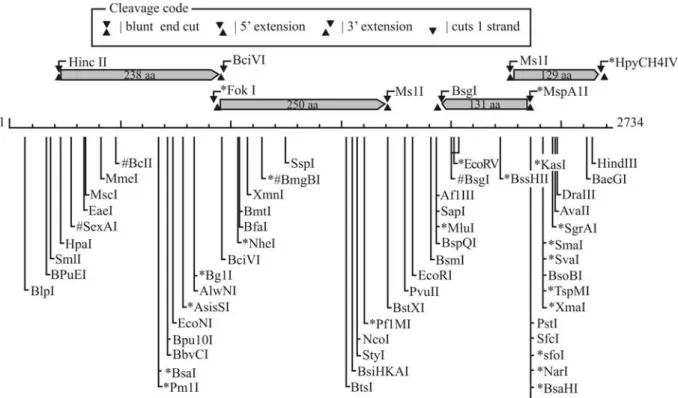
genomic analysis ofE. coli(50.8%, Blattneret al., 1997) and Erwinia carotovora (51.0%, Bell et al., 2004). Se-quence analysis showed the presence of four putative ORFs in pPAGA, each of which would encode a protein of more than 100 amino acids (aa) (Figure 1).
A putative operon was also found, comprising ORFs 1 and 2, which are separated by only three nucleotides.orf1
putatively encodes the largest polypeptide (238 aa), extend-ing from nucleotides 232 to 948. The sequence of this ORF displays high coverage (up to 98%) and similarity (> 50%) values with hypothetical proteins from distinct bacterial species such as Solibacter, Methylobacterium, Bacillus,
Beijerinckia, andBurkholderia.orf2 spans nucleotides 951 to 1703 and putatively encodes a protein of 250 aa. Within this ORF, it was possible to observe the presence of a highly conserved domain named DUF2382, which is found in many bacteria but is of unknown function. These results regarding ORFs 1 and 2 indicate that such proteins may have common roles in different bacterial groups. Their presence on a plasmid, which can be easily exchanged in the environment among bacterial cells not related phylo-genetically, may explain the diversity of species carrying similar proteins.
Both other ORFs were minor, encoding peptides of 131 and 129 aa, possibly related to the presence of truncated genes in the plasmid.orf3(131 aa) shows low similarity (30% to 50%) with proteins involved in type IV secretion system inCupriavidus taiwanensis (Betaproteo-bacteria), whileorf4(129 aa) presents also low levels of
similarity with enzymes involved in the promotion of oxi-dative processes in bacterial cells. In general, there was low resolution in the BLAST analysis of these ORFs, indicating that there is limited knowledge about plasmids found in endophytic bacteria.
Despite the presence of these ORFs, no similarity was found between the plasmid sequence and sequences re-ported as origins of plasmid replication (oriregions). How-ever, analysis of the DNA sequence revealed two AT-rich regions in the plasmid (Figure 2). These regions are de-scribed in the literature as being related to a replication ori-gin (ori) region, due to the intrinsic capacity of such a sequence to promote double helix dissociation (Ioannidiset al., 2007). The existence of islands within the plasmid se-quence was also indicated, reinforcing its origin from gene transfer and recombination with other DNA sequences.
The attempt to find putative promoter regions within the sequence of the pPAGA plasmid resulted in the identifi-cation of nine regions possibly involved in the promotion of gene expression with scores higher than 0.90 (scale from 0.0 to 1.0) (Table 1). Five of these regions were found in the forward orientation, along with three ORFs, and four puta-tive promoters were observed in the reverse orientation, where only one ORF is located. The location of two puta-tive promoter regions (PrFw1 and PrFw2) upstream of ORFs 1 and 2 corroborates the possibility of an operon be-ing formed by these two ORFs and also suggests that the regulation of such an operon would be modulated by more than one distinct factor. Considering the location of other
putative promoter regions, it is also possible to attribute the regulation oforf4 to PrFw4 and PrFw5 and the possible control oforf3to PrRv4. The other putative promoter re-gions were not adjacent to any ORF but may be involved in the regulation of plasmid replication regions.
Construction of an expression vector based on pPAGA
The relatively small size (2,734 bp) of the plasmid pPAGA makes it a candidate for the development of a shut-tle vector for endophyticP. agglomeransand related spe-cies. Such a strategy followed by introducing pPAGA se-quence into the pUC18 cloning vector along with a 212-bp fragment from theE. colirRNA promoter controlling the gene responsible for the synthesis of Gfp (Figure 3). A chi-meric plasmid was generated, containing the cryptic plas-mid, the pUC18 vector, and a reporter gene. Re-intro-duction of the new vector, designated pLGM1, into P. agglomeranscells resulted in an excellent means for visu-alizing the cells under ultraviolet light. Due to the use of the pPAGA backbone, the final vector was stable in EGE6 cells, where it showed high levels of GFP production.
Endophytic colonization byP. agglomerans
EGE6gfp
The colonization of P. agglomerans in eucalyptus seedlings was analyzed by the introduction of the expres-sion vector pLGM1 into cells of the strain EGE6, generat-ing the genetically modified endophytic strain EGE6gfp. Image analysis of cells from strain EGE6gfpshowed that these bacteria have the capacity to enter root tissue and es-tablish colonization in the inner tissue of the host plant (Figure 4). Based on such imaging, it is also possible to
sug-gest that these bacteria inhabit the vascular tissue of eucalyptus seedlings, preferentially xylem cells.
Discussion
In this study we describe the characterization of a cryptic plasmid named pPAGA isolated from Pantoea agglomeransstrain EGE6, an endophytic bacterial isolate from eucalyptus. Bacteria of the speciesP. agglomerans
have been considered one of the most important groups in terms of endophytic interaction with plants (Torreset al., 2008). Strains of this species have been found in studies us-ing several plant species, such as rice (Vermaet al., 2004), citrus (Araújoet al., 2001), and eucalyptus (Ferreiraet al., 2008). In some of these studies, the authors have demon-strated plant colonization by the addition of reporter genes into the bacterial cells (Sabaratnam and Beattie, 2003; Vermaet al., 2004; Duanet al., 2007). Previous work in eu-calyptus has shownP. agglomeransto be a seed endophyte, suggesting that endophyticP.agglomerans can be trans-mitted vertically from seeds to seedlings in Eucalyptus
(Ferreiraet al., 2008).It has also been suggested thatP. agglomeranscan be transported through xylem vessels or through the colonization of intercellular spaces in root and aerial tissues (Compantet al., 2005). Vermaet al.(2004) suggested that genusPantoeais an aggressive endophytic colonizer of deep-water rice. The authors made this conclu-sion based on a competition experiment, in which another endophytic strain of the genusOchrobactrumshowed very little colonization in the presence ofPantoeasp.
dreote et al. (2008), who also found a cryptic plasmid, pPA3.0, within cells of endophyticP. agglomeransisolated from citrus plants. In a comparison with the findings ob-tained by Andreoteet al.(2008), the identified plasmids did not present similarities. Plasmid sizes vary by approxi-mately 200 pb (pPA3.0 is 2.9 kb, while pPAGA is 2.7 kb in length), and are divergent regarding the genetic informa-tion they carry. While the plasmid described in citrus endo-phytes primarily presents small ORFs, with the biggest one encoding a peptide of 199 aa, the pPAGA plasmid harbors several ORFs coding for peptides of around 230 aa. Based on both analyses, it is possible to suggest that endophyticP. agglomeransspecies are important keepers of cryptic plas-mids, possibly providing for the efficient exchange of ge-netic material with other endophytic bacteria within plants.
Table
1
-List
of
putative
promoter
regions
found
within
the
sequence
of
the
cryptic
plasmid
pPAGA
obtained
from
cells
of
the
endophytic
Pantoea
agglomerans
strain
EGE6.
Strand
Putative
promoter
name
Sequence
location
Putative
promoter
sequence
Promoter
score
Possible
ORF
regulation
Forward
PrFw1
86-131
CTTTTACTTAAATTGCCTGCATTTTTCTGTATTTTTCTATCTTTTGTAGT
0.99
orf1
,
orf2
PrFw2
94-139
TAAATTGCCTGCATTTTTCTGTATTTTTCTATCTTTTGTAGTTCTTTGTG
0.90
orf1
,
orf2
PrFw3
1813-1858
TCATGGTTTTAAGAATTCACCAGACATGATACAACTCCCTGCATGTCGAA
0.99
ND
PrFw4
2066-2110
AGATGGCTGAAAGCCGACACTGATGAGAATAATATCCAATGGATCTGAAA
0.98
orf4
PrFw5
2246-2291
AGTGTGATGACAGCCACCGGATGCTGACATTTCATACCGATGTCCGCAGC
0.93
orf4
Reverse
PrRv1
2130-2085
CAGGCGGTTGCTTCAAACGTTTTCAGATCCATTGGATATTATTCTCATCA
0.98
ND
PrRv2
1742-1697
CTGTAATCGTATTTACTCAAAATGTTGCATCCACCATCATGGCATTACGG
0.91
ND
PrRv3
1421-1376
TCGCTGGCCTCTTTACGCAGCACCACTTCTTCAATAATTTCCGCAGTCTT
0.93
ND
PrRv4
246-201
TCAGGAGGTTGATTGTTCATGGTTAACCTGCCTGTAATACAGAGCGATCA
0.94
orf3
ND
-ORF
regulation
was
not
indicated
based
on
the
location
within
the
pPAGA
plasmid
sequence.
Figure 3- Schematic representation of the shuttle vector pLGM1. The cloning sites and promoter are indicated.
Further studies are necessary to determine the essentiality of these ORFs for endophytic behavior and development within plants.
There was variation in the GC content of the cryptic plasmid, suggesting the presence of an origin of replication without high similarity to any previously describedori re-gions and also the existence of rere-gions that were incorpo-rated into pPAGA by horizontal gene transfer and recombi-nation. Horizontal transfer likely occurs in soil (Syvanen and Kado, 1998; Gebhard and Smalla, 1999;), where these bacte-ria can live part of their life, but it still represents a phenome-non to be explored in endophytic communities. One could suggest that the putative genesorf1andorf2, found under the regulation of the same promoter regions, are essential for the endophytic characteristics ofP. agglomeransand, therefore, are refractory to transmission by horizontal gene transfer within the host plant. However, this hypothesis must be tested further to be properly affirmed.
Similar to results described by Andreoteet al.(2008), we used the cryptic plasmid backbone to develop a shuttle vector that is able to carry and express exogenous genes within the host plant. This approach was based on other studies, in which several shuttle vectors were constructed using replication regions from small cryptic plasmids (An and Miyamoto, 2006; Matsuiet al., 2007; Sangrador-Vegas
et al., 2007). The selected reporter gene, from pGFPmut3.1, was a variantgfpgene with higher fluores-cence and reduced half-life (Andersenet al., 1998, 2001). The efficient introduction of such a gene in endophytes and the further visualization of cells expressing the exogenous gene within plant tissue support the possibility of introduc-ing new characteristics into endophytes. The genetic modi-fication of bacteria is useful for the expression of genes that can benefit the host plant.
We also observed preferential occupation of the plant vessels by the genetically modified endophyte EGE6gfp, suggesting that this bacterium can invade internal root tis-sues of eucalyptus seedlings by passing epidermal and cor-tical cells and permeating the central cylinder. Such results corroborate the data described by Ferreiraet al. (2008), suggesting that if bacteria related toP. agglomerans are transferred by seeds, it will result in the preferential spread-ing of bacterial cells along the aerial portion of the plant through xylem vessels once the plant begins to develop.
In this study we caracterized a cryptic plasmid found in endophyticP. agglomeransisolated from eucalyptus. In ad-dition, we used this plasmid to create a shuttle vector, which can provide a means for introducing genes into plant cells. This study will support further research aiming to manipu-late endophytic bacteria for the benefit of healthy plants.
Acknowledgments
This work was supported by a grant from Suzano de Papel e Celulose S.A. We thank FAPESP for providing a fellowship to R.E.L.P. (Grant no. 00/07053-2).
References
An HY and Miyamoto T (2006) Cloning and sequencing of plasmid pLC494 isolated from human intestinal Lacto-bacillus casei: Construction of anE. coli-Lactobacillus shut-tle vector. Plasmid 55:128-134.
Andersen JB, Sternberg C, Poulsen LK, Bjørn SP, Givskov M and Molin S (1998) New unstable variants of green fluorescent protein for studies of transient gene expression in bacteria. Appl Environ Microbiol 64:2240-2246.
Andersen JB, Heydorn A, Hentzer M, Eberl L, Geisenberger O, Christensen BB, Molin SR and Givskov M (2001) Gfp-based N-acyl homoserine-lactone sensor systems for detec-tion of bacterial communicadetec-tion. Appl Environ Microbiol 67:575-585.
Andreote FD, Gullo MJM, Lima AOD, Maccheroni Jr W, Aze-vedo JL and Araujo WL (2004) Impact of genetically modi-fiedEnterobacter cloacaeon indigenous endophytic
com-munity of Citrus sinensis seedlings. J Microbiol
42:169-173.
Andreote FD, Rossetto PB, Souza LCA, Marcon J, Maccheroni Jr W, Azevedo JL and Araujo WL (2008) Endophytic popula-tion ofPantoea agglomeransin citrus plants and develop-ment of a cloning vector for endophytes. J Basic Microbiol 48:338-346.
Araújo WL, Maccheroni Jr W, Aguilar-Vildoso CI, Barroso PAV, Saridakis HO and Azevedo JL (2001) Variability and inter-actions between endophytic bacteria and fungi isolated from leaf tissues of citrus rootstocks. Can J Microbiol 47:229-236.
Araújo WL, Marcon J, Maccheroni Junior W, Elsas JD, van Vuurde JWL and Azevedo JL (2002) Diversity of endo-phytic bacterial populations and their interaction with
Xylella fastidiosain citrus plants. Appl Environ Microbiol 68:4906-4914.
Azevedo JL and Araújo WL (2007) Diversity and applications of endophytic fungi isolated from tropical plants. In: Ganguli BN and Desmukh SK (eds). Fungi: Multifaceted Microbes. Anamaya Publishers, New Delhi, pp 189-207.
Bell KS, Sebaihia M, Pritchard L, Holden MTG, Hyman LJ, Holeva MC, Thomson NR, Bentley SD, Churcher LJC, Mungall K,et al.(2004) Genome sequence of the enterobac-terial phytopathogenErwinia carotovorasubsp.atroseptica
and characterization of virulence factors. Proc Natl Acad Sci USA 101:11105-11110.
Blattner FR, Plunkett III G, Bloch CA, Perna NT, Burland V, Riley M, Collado-Vides J, Glasner JD, Rode CK, Mayhew GF,et al.(1997) The complete genome sequence of Esche-richia coliK-12. Science 277:1453-1474.
Compant S, Reiter B, Sessitsch A, Nowak J, Clement C and Barka EA (2005) Endophytic colonization ofVitis viniferaL. by plant growth-promoting bacterium Burkholderiasp. strain PsJN. Appl Environ Microbiol 71:1685-1693.
Duan J, Yi T, Lu Z, Shen D and Feng Y (2007) Rice endophyte Pantoea agglomerans YS19 forms multicellular symplas-mata via cell aggregation. FEMS Microbiol Lett 270:220-226.
Feng Y, Shen D and Song W (2006) Rice endophytePantoea
Ferreira A, Quecine MC, Laçava PT, Azevedo JL and Araújo WL (2008) Diversity of endophytic bacteria from Eucalyptus
species seeds and colonization of seedlings by Pantoea agglomerans. FEMS Microbiol Lett 287:8-14.
Gebhard F and Smalla K (1999) Monitoring field releases of ge-netically modified sugar beets for persistence of transgenics plant DNA and horizontal transfer. FEMS Microbiol Ecol 28:261-272.
Ioannidis P, Hotopp JCD, Sapountzis P, Siozios S, Tsiamis G, Bordenstein SR, Baldo L, Werren JH and Bourtzis K (2007) New criteria for selecting the origin of DNA replication in
Wolbachia and closely related bacteria. BMC Genomics 8:1-15.
Lacava PT, Araujo WL and Azevedo JL (2007) Evaluation of
endophytic colonization of Citrus sinensis and
Catharanthus roseus seedlings by endophytic bacteria. J Microbiol 45:11-14.
Matsui T, Saeki H, Shinzato N and Matsuda H (2007) Analysis of
the 7.6-kb cryptic plasmid pNC500 from Rhodococcus
rhodochrous B-276 and construction of Rhodococcus-E. colishuttle vector. Appl Microbiol Biotech 74:169-175. Ortmann I and Moerschbacher BM (2006) Spent growth medium
ofPantoea agglomeransprimes wheat suspension cells for augmented accumulation of hydrogen peroxide and
en-hanced peroxidase activity upon elicitation. Planta
224:963-970.
Procópio REL, Araújo WL, Maccheroni Jr W and Azevedo JL (2009) Characterization of an endophytic bacterial
commu-nity associated with Eucalyptus spp. Genet Mol Res
8:1408-1422.
Reinhold-Hurek B and Hurek T (1998) Interactions of grami-neous plants with Azoarcus spp. and other diazotrophs: Identification, localization, and perspectives to study their function. Crit Rev Plant Sci 17:29-54.
Sabaratnam S and Beattie GA (2003) Differences between Pseu-domonas syringae pv. syringae B728a and Pantoea agglomeransBRT98 in epiphytic and endophytic coloniza-tion of leaves. Appl Environ Microbiol 69:1220-1228. Sambrook J, Fritsch EFE and Maniatis T (1998) Molecular
Clon-ing: A Laboratory Manual. 2nd edition. Cold Spring Harbor Laboratory Press, New York.
Sangrador-Vegas A, Stanton C, van Sinderen D, Fitzgerald GF and Ross RP (2007) Characterization of plasmid pASV479
fromBifidobacterium pseudolongumsubsp.globosumand its use for expression vector construction. Plasmid 58:140-147.
Shen WF, Squires C and Squires CL (1982) Nucleotide sequence of therrnGribosomal RNA promoter region ofEscherichia coli. Nucleic Acids Res 10:3303-3313.
Syvanen M and Kado CI (1998) Horizontal Gene Transfer. Chap-man & Hall, London, 474 pp.
Son HJ, Park GT, Cha MS and Heo MS (2006) Solubilization of insoluble inorganic phosphates by a novel salt- and pH-tolerantPantoea agglomeransR-42 isolated from soybean rhizosphere. Biores Techn 97:204-210.
Sturz AV, Christie BR and Nowak J (2000) Bacterial endophytes: Potential role in developing sustainable systems of crop pro-duction. Crit Rev Plant Sci 19:1-30.
Torres AR, Araujo WL, Cursino L, Hungria M, Plotegher F, Mostasso FL and Azevedo JL (2008) Diversity of endo-phytic enterobacteria associated with different host plants. J Microbiol 46:373-379.
Verma SC, Singh A, Chowdhury SP and Tripathi AK (2004) Endophytic colonization ability of two deep-water rice endophytes, Pantoeasp. andOchrobactrumsp. using green fluorescent protein reporter. Biotech Lett 26:425-429. Weisburg WG, Barns SM, Pelletier DA and Lane DJ (1991) 16S
ribosomal DNA amplification for phylogenetic study. J Bac-teriol 173:697-703.
Internet Resources
EMBL-EBI website, http://www.ebi.ac.uk/Tools (March 2009). NEB cutter 2.0 program, http://tools.neb.com/NEBcutter2/index.
php (February 2010).
Neural Network Promoter Prediction, program of the University of California, Berkeley: http://www.fruitfly.org/seq_tools/ promoter.html (February 2010).
Sociedade Brasileira de Silvicultura, http://www.sbs.org.br (June 2010).
Associate Editor: Luis Carlos de Souza Ferreira