online | memorias.ioc.fiocruz.br
Historical review of clinical vaccine studies at Oswaldo Cruz Institute
and Oswaldo Cruz Foundation - technological development issues
Reinaldo de Menezes Martins/
+, Cristina de Albuquerque Possas, Akira Homma
Conselho Político e Estratégico, Bio-Manguinhos-Fiocruz, Rio de Janeiro, RJ, BrasilThis paper presents, from the perspective of technological development and production, the results of an
inves-tigation examining 61 clinical studies with vaccines conducted in Brazil between 1938-2013, with the participation
of the Oswaldo Cruz Institute (IOC) and the Oswaldo Cruz Foundation (Fiocruz). These studies have been
identi-fied and reviewed according to criteria, such as the kind of vaccine (viral, bacterial, parasitic), their rationale,
design and methodological strategies. The results indicate that IOC and Fiocruz have accumulated along this time
significant knowledge and experience for the performance of studies in all clinical phases and are prepared for the
development of new vaccines products and processes. We recommend national policy strategies to overcome
exist-ing regulatory and financexist-ing constraints.
Key words: clinical studies - vaccines - technological development - innovation - regulatory barriers
Clinical studies are crucial for the development and
registration of new products and constitute today a
struc-tured process, mandated by strict legislation involving a
growing number of participants, in a stepwise strategy.
The Oswaldo Cruz Institute (IOC) and the other
technical units which constitute the Oswaldo Cruz
Foundation (Fiocruz) are recognised as very important
institutions for basic science and biological and
techno-logical research on tropical diseases in Brazil. These
in-stitutions have a long tradition of clinical studies which
have proven to be vitally connected to the prevention
of infectious diseases of public health importance for
Brazil and other countries. In this paper, we review and
analyse these studies, occurring over a period
exceed-ing seven decades, from the perspective of technological
development (TD). The understanding, in a historical
sense, of the evolutionary stages of these clinical studies
will hopefully provide a better understanding of the
pro-cesses that were involved and may help policy and
deci-sion-makers to conceive of new alternatives and create
possibilities for the design of new studies in the future.
MATERIALS AND METHODS
For the selection of the clinical studies we adopted
the following criteria for inclusion: (i) studies conducted
in human beings; (ii) prospective; (iii) vaccination as the
basic intervention; (iv) longitudinal and individual
fol-low-up of participants; (v) published in scientific
medi-cal journals; (vi) conceived and conducted according to
ethical and legal criteria for clinical research in human
doi: 10.1590/0074-02760140346
+ Corresponding author: [email protected] Received 22 September 2014
Accepted 5 December 2014
beings, with tolerance to the absence of formal ethical
and regulatory evaluations regarding the older studies;
(vii) conducted with participation of at least one unit or
professional of Fiocruz/IOC.
These restrictive criteria, besides being conceptually
acceptable, met the requirement to limit the scope of the
research within an acceptable range. Studies which did not
meet these criteria were excluded. These included
retro-spective studies, clinical-epidemiological studies,
seroepi-demiological studies, pharmacovigilance studies and
ob-servational studies. Although the latter did not fit into the
classical model of clinical studies, some of them could be
classified as clinical studies, in a broader sense definition.
For studies conducted at the origin of IOC, which are
outstanding and part of its history, these criteria were
not strictly applied, which is justifiable, considering
that the legislation on clinical studies came later.
How-ever, if they are not formally perfect, they have been
conducted ethically, with the best science and
method-ology available at the time.
The search for papers was done by databases,
includ-ing PubMed, from the National Center for
Biotechnol-ogy Information, National Institutes of Health, United
States of America, and LILACS, the Latin-American
database from BIREME-Regional Library of Medicine,
from Pan American Health Organization (PAHO)/World
Health Organization (WHO). However, most papers
were found through personal archives, consultations
with colleagues, some reference books on the history
of vaccines (Benchimol 2001, Artenstein 2010, Plotkin
2011) and other means, in a process with considerable
degree of serendipity in chance encounters.
To recover original papers, we used, besides PubMed
and LILACS, the SciELO database, Capes Periodicals
Gateway and the libraries of the National School of
Public Health, Bio-Manguinhos/Fiocruz and Mourisco
Castle. Photocopies were also obtained from the Hinari
Programme, from WHO and Oxford Journals.
Re
vie
w c
lin
ica
l s
tu
die
s at F
io
cru
z - T
D • R
ein
ald
o d
e M
en
ez
es M
ar
tin
s e
t a
l.
11
5
TABLE I
Synopsis of studies with yellow fever (YF) vaccine in chronological order of publication
Reference Rationale of the investigation Comments
Soper and Smith (1938)
Use of substrain 17E in human beings with human immune serum and hyperimmune serum from goats and monkeys.
Reports of icterus and serum reactions.
Smith et al. (1938)
Large scale vaccination with substrain 17D without animal serum. Establishment of YF vaccine production at Oswaldo Cruz Institute.
Fox et al. (1942a)
Investigate icterus outbreak after YF vaccination. Recommendation for elimination of human serum from YF vaccine production and establishment of seed lot system.
Fox et al. (1942b)
Investigate outbreak of encephalitis after vaccination with substrain 17D-NY 104. Suspension of use of substrain 17D-NY 104.
Fox and Cabral (1943)
Duration of immunity after YF vaccine, with several substrains and in several age groups.
Immunity persists after YF vaccine during at least four years in adults, lower immune responses in children less than 10 years of age.
Fox et al. (1943)
Choice of a new seed lot, dose-response, alternatives for vaccine administration (subcutaneous, intramuscular, intradermal).
This study was done before a previous study (Fox et al. 1942a), but published later. Human serum still used on the vaccine. A new seed lot was chosen, the substrain 17D-NY 104, that proved later to be neurotropic.
Fox et al. (1948)
Additional investigations on duration of immunity after YF vaccine. Additional indications of lower seroprotection and duration of immunity in chil-dren.
Groot and Ribeiro (1962)
Long term indications of seroprotection for 17 years. This study was done in a region previously vaccinated with the 17D-NY 104 substrain.
Lopes et al. (1988)
Dose-response study. A dose of 1000 plaque forming units (or its equivalent in LD50) is more than enough for protection against YF.
Stefano et al. (1999)
Investigate the interference between measles vaccine and YF vaccine. There is no interference between measles vaccine and YF vaccine.
Freire et al. (2002)
Investigate immune response and duration of immunity after YF vaccine 17DD at egg-passage 43.
High levels of antibodies before YF vaccine inhibit the immune response. Per-sistence of immunity at 10 years after YF vaccination is questioned.
Camacho et al. (2004)
Immunogenicity of vaccine from new seed lot (17DD-013Z) compared to previ-ous seed lot (17DD-102/84), World Health Organization (WHO) vaccine (17D-213/77) and placebo.
Advances on methodology and adherence to National Health Council norms. The new seed lot has adequate immunogenicity.
dos Santos et al. (2005)
Interspecific and specific immune response in vaccinated and revaccinated subjects.
YF vaccine induces immune response with activation and memory of humoral and cellular arms.
Camacho et al. (2005)
Reactogenicity of vaccine produced with new seed lot compared to previous seed lot (17DD-102/84), WHO vaccine (17D-213/77) and placebo.
The new seed lot is safe.
dos Santos et al. (2007)
Study of lymphocyte subpopulations according to the time of processing of blood samples.
Flow cytometry by the lysis method may be done at times 0, 24 or 48 h after blood collection.
Martins et al. (2007)
Study of lymphocyte subpopulations in 10 healthy adults primovaccinated with 17DD vaccine.
The immune response is complex, activation and modulation seem to occur at the same time.
Santos et al. (2008)
T helper (TH)1/TH2 cells immune responses in 12 healthy adults vaccinated against YF.
After peripheral blood mononuclear cells ex vivo stimulation with 17DD vac-cine, there is increase in interferon (IFN)-γ and interleukin-4, reaching maxi -mum levels 15 days after vaccination.
Martins et al. (2008a)
The period of study extended up to the year 2013
(Martins 2014).
RESULTS
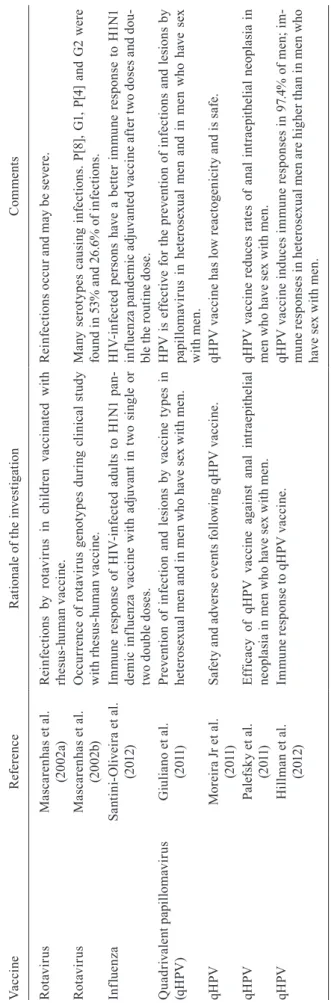
Tables I-IV show, for each study, its rationale and its
basic findings. Table V shows the number of clinical
studies by kind of vaccine (viral, bacterial or parasitic)
and its utilisation [commercial or by the National
Immu-nisations Program (NIP)].
DISCUSSION
The clinical studies with vaccines under the scope of
IOC and Fiocruz, besides their relevance to the public
health of Brazil and many other developing countries,
have contributed to the institutional TD.
These technical advances built institutional
knowl-edge and skills in vaccine thermostability, new
freeze-drying formulation, use of certified inputs,
improve-ment of quality control methodologies and the skills to
incorporate new products through technology transfers,
which resulted in scientific breakthroughs and have been
landmarks of Fiocruz history.
Examples of tech transfer include the yellow fever
(YF) vaccine (Rockefeller Institute), the polysaccharidic
AC meningococcal vaccine (Institut Mérieux), the
po-liomyelitis and measles vaccines (BIKEN Institute), the
Haemophilus influenzae Type b (Hib) vaccine, measles/
mumps/rubella (MMR) and rotavirus vaccines
[GlaxoS-mithKline (GSK)] and shortly the
measles/mumps/rubel-la/varicella (MMRV) vaccine (also with GSK). Besides
leading to the introduction of new vaccines into the NIP,
in a relatively short time, technology transfers of these
vaccines have made possible the creation, expansion and
improvement of new platforms, production and
laborato-ries and the creation of a qualified workforce that is now a
most valuable asset of Fiocruz. The positive consequences
of these innovative processes have been outstanding and
should not be minimised. Moreover, transfer of
technolo-gies has been feasible because of the intrinsic capacity of
the institution for absorbing, in a relatively short span of
time, the newly involved technologies.
The clinical studies of measles vaccines were
con-ducted to evaluate the successful technology transfer
and implement the regular use of a vaccine to counteract
one of the main causes of child mortality in Brazil
(Puff-er & S(Puff-errano 1973). The technology of production of this
vaccine was obtained thanks to the Brazil-Japan
Coop-eration Agreement, which involved the participation of
BIKEN Laboratory from Osaka University, with Japan
International Cooperation Agency and Funding
Authori-ty for Studies and Projects as intermediaries. This
agree-ment made possible the developagree-ment of new projects,
which included: (i) an improvement and adaptation of
laboratories for the production of viral antigens and
for-mulation, filling and lyophilisation in industrial scale,
(ii) the provision of industrial equipment, (iii) “on the
bench” training in Japan and the beginning of
produc-tion operaproduc-tions and (iv) the clinical studies in the states
of Pernambuco and Pará. This project gave
Bio-Man-guinhos the opportunity to build the infrastructure for
industrial production to meet today’s good
manufactur-R ef e re n ce R at io n al e o f t h e i n v e st ig at io n C o m me n ts N ev e s e t a l. (2 0 0 9) E x p re ss io n o f to ll -l ik e re ce p to r (T L R ) a n d a ct iv at io n o f N K ce ll s in ei g h t h e al th y a d u lt s v a c ci n at e d a g a in st Y F . N K c el ls a re a ct iv at ed s oo n a ft er v ac ci na tio n a ga in st Y F. I FN -γ i s i nc re as ed o n d ay 1 5 a ft e r v a c ci n at io n . M el o e t a l. (2 011 ) D u ra ti o n o f i m m u n it y a ft e r Y F v a c ci n e. 17 D D v a c ci n e p rot e ct s fo r at le a st 10 y e a rs , b u t w it h d e c re a si n g ti tr e s. S m al l sa m p le. S il v a e t a l. (2 011 ) In v e st ig at e th e in te rf e re n ce b et w e e n Y F v a c ci n e a n d m e a sl e s-m u m p s-ru b el la (M M R ) v a c ci n e wh e n a p p li e d s im u lt a n e o u sl y. N eg at iv e a n d r e cip ro ca l i n te rf e re n ce o f Y F , r u b el la a n d m u m p s a n ti g e n s. L u iz a-S il v a e t a l. (2 01 1a) C y to k in e s i n c h il d re n f ro m n in e -4 3 m o n th s o f a g e v a c ci n at e d a g a in st Y F . C y to k in e si g n at u re s sh o w p ro in fl a m m at o ry cy to k in e s o n su b je ct s w h o se ro -c o n v e rt (S C ) to Y F v a c ci n e a n d re g u la to ry o n n o n S C s. R ev a c ci n at e d o n e y e a r la te r, t h e re w a s SC o f p re v io u sl y n o n S C s w it
h a p
ro in fl a m m at o ry p at te rn . L u iz a-S il v a e t a l. (2 01 1b) C el lu la r s o u rc e s o f c y to k in e s i n 1 0 h e al th y a d u lt v a c ci n at e d a g a in st Y F . Pa tte rn of ac tiv at io n an d m od ul at io n. Pr od uc tio n of IF N -γ on da y 7 by N K ce lls a n d o n d ay s 1 5 a n d 3 0 b
y T C
Re
vie
w c
lin
ica
l s
tu
die
s at F
io
cru
z - T
D • R
ein
ald
o d
e M
en
ez
es M
ar
tin
s e
t a
l.
11
7
TABLE II
Synopsis of studies with other viral vaccines in chronological order of publication
Vaccine Reference Rationale of the investigation Comments
Measles Schatzmayr et al. (1982)
Seroconversion (SC) to measles vaccine by age in popula-tion of low social and economic status.
Supported the beginning of measles vaccination at nine months of age.
Measles Oliva et al.
(1986)
Immune response to measles CAM-70 vaccine in 341 children from six-12 months of age.
Measles CAM-70 vaccine seroconverted by neutralisation 100% of children ≥ 9 months of age without maternal antibodies. Measles Camacho et al.
(2000)
Dose-response to measles CAM-70 vaccine in children, three vaccine groups, with 5,000, 1,000 and 200 50% tis-sue culture infective dose (TCID50).
The group of higher dose, 5,000 TCID50 had better immunologi-cal response: 82% SC.
Measles Lindgren-Alves et al. (2001)
Immune response to vaccine CAM-70 in 50 children, 21 perinatally infected with human immunodeficiency virus (HIV).
The immune response to measles vaccine is lower in HIV perina-tally infected children, even after two doses.
Measles-mumps-rubella (MMR)
Boaventura et al. (2006)
To compare the immune response to three different MMR vaccines in schoolchildren in the state of Rio Grande do Sul, Brazil.
Satisfactory immune response to the three vaccines, but the Leningrad-Zagreb mumps component seems to be a stronger immunogen.
Oral poliomyelitis (OPV)
Schatzmayr and Homma (1969)
Immune response to three doses of OPV in 114 children from three months-three years of age in a semi-rural area of the state of Rio de Janeiro, Brazil.
SC to OPV types 1 and 3 was not satisfactory; type 1 dose should be increased. Vaccine in study had 500,000 TCID50 (type 1), 200,000 (type 2) and 300,000 (type 3) per dose.
OPV Schatzmayr et al.
(1986)
To compare the immune response between OPV and in-activated poliomyelitis vaccine (IPV) in 155 children at two-six months of age.
IPV induces more serum antibodies, especially to type 3.
OPV Patriarca et al.
(1988)
Immune response to trivalent OPV (TVOP) with increased type 3 dose compared with previous formulation.
TVOP induces higher SC to type 3 with formulation containing double the dose of type 3 (600,000 viral particles).
Hepatitis B (HB)
Motta et al. (2002)
To compare the immunogenicity of HB vaccine between preterm and term newborns.
Preterm newborns need an additional dose of HB vaccine.
HB Martins et al.
(2004)
Safety and immune response to recombinant HB vaccine from Butantan Institute, state of São Paulo, Brazil.
The HB vaccine from Butantan Institute is equivalent to Engerix B from GlaxoSmithKline (GSK) in children and inferior, but ac-ceptable for use in newborns, adolescents and young adults.
HB Luna et al.
(2009)
Safety and immune response of newborns to the HB vac-cine from Butantan Institute.
The HB vaccine from Butantan Institute is equivalent to Engerix B from GSK in newborns.
HB Moraes et al.
(2010)
Safety and immune response of adults to HB vaccine from Butantan Institute.
The HB vaccine from Butantan Institute is equivalent to Engerix B from GSK in adults from 31-40 years.
HB Potsch et al.
(2010)
To investigate the immune response to HB vaccine in HIV-infected adults, with double the routine dose and in four doses.
The immune response to HB vaccine is satisfactory with the new schedule.
HB Motta-Castro et al. (2009)
Adherence to vaccination and immune response to HB vaccine in quilombo communities in central Brazil.
Low adherence to vaccination schedule and lower immune re-sponse in males and people ≥ 40 years of age.
HB Potsch et al.
(2012)
Immune response to HB vaccine in HIV-infected adults with double the routine dose and in four doses.
ing practices requirements. This required new
organisa-tional structures including independent departments for
production, quality control and management which, in
a step by step process, resulted in the provision of good
quality vaccines for the NIP. Because of this successful
activity, Bio-Manguinhos is now prepared to provide the
MMR and MMRV vaccines to the NIP.
The clinical studies with poliomyelitis vaccines and
many additional seroepidemiological studies resulted in
changes and improvements in vaccine composition and
eventually resulted in the elimination of this disease in
Brazil and many other Latin American countries.
As with the measles vaccine, the oral polio vaccine
(OPV) technology was obtained under the umbrella of
the Brazil-Japan Cooperation Agreement. The
technol-ogy transfer for this vaccine came through the Japanese
Poliomyelitis Research Institute. These actions included
redesigns and upgrades of facilities, provision of
equip-ment, “on the bench” training within production
laborato-ries, quality control and neurovirulence testing in
nonhu-man primates. The creation of this highly qualified group
in 1982 allowed Bio-Manguinhos to take the
responsibil-ity for the qualresponsibil-ity control testing of the OPV vaccine used
in the national routine immunisation program or in mass
campaigns. Later, this responsibility was transferred to
the National Institute for Quality Control. Another great
contribution from Bio-Manguinhos was the formulation
improvements of OPV vaccine, including a doubling of
the dose of type 3 OPV, required to control poliomyelitis
outbreaks in Northeast Brazil. This formulation change
was accomplished in just two weeks after the decision
was made. The highly satisfactory results led the PAHO
to extend this recommendation to all Latin American
countries and, afterwards, WHO recommended the use
of the same formulation for all countries.
The clinical studies with diphtheria, tetanus and
per-tussis/Hib vaccine drove the technology transfer for the
Hib portion of the vaccine. This resulted in the
introduc-tion of this vaccine into the routine vaccinaintroduc-tion
sched-ule, which, in a very short time, drastically reduced the
incidence of Hib meningitis.
Table V shows that the clinical studies with viral and
bacterial vaccines led to the licensing of these essential
vaccines. Almost half these studies were conducted with
YF vaccine - a demonstration of the importance of this
vaccine for Brazil and the world and the need to improve
it, in order to reduce its serious adverse events.
In contrast to the other clinical studies, the ones for
parasitic diseases have not led to the licensure of any
vaccine. Due to genetic variation of parasites, the epitope
multiplicity and the complexity of anti-infectious
mech-anisms that are very different from virus and bacteria, it
has been a big challenge to develop vaccines for parasitic
diseases. Here, there is a need for new and innovative
ap-proaches. For malaria, there have been attempts to block
transmission from the mosquito using vaccines targeting
the sexual stages of Plasmodium falciparum (Biswas et
al. 2013). In the case of leishmaniasis, there may be a
combination of strategies, for example, antigens in
nano-particles (Santos et al. 2013) or a combination of
treat-ment and immunotherapy (Machado-Pinto et al. 2002,
Re
vie
w c
lin
ica
l s
tu
die
s at F
io
cru
z - T
D • R
ein
ald
o d
e M
en
ez
es M
ar
tin
s e
t a
l.
11
9
TABLE III
Synopsis of studies with bacterial vaccines in chronological order of publication
Vaccine Reference Rationale of the investigation Comments
Bacillus
Calmette-Guérin (BCG)
Camacho and Klein (1990)
To use BCG and purified protein derivative as a tool to evaluate prevalence of tuberculosis (TB) infections.
The prevalence of TB infections in areas of the state of Rio de Janeiro, Brazil, was 4.13%.
BCG Barbosa et al.
(2003)
Cytokines immune response to BCG revaccination in schoolchildren. Production of interferon (IFN)-γ increases after BCG revac -cination and may be a marker of protection against TB.
BCG Oliveira et al. (2013)
Production of IFN-γ after BCG revaccination. In the group with IFN-γ production increases of 3.3 or more after BCG revaccination the immune responses to mycobacte-rial antigens remained higher one year after vaccination than on the group with lower IFN-γ increases.
Diphtheria, tetanus and pertussis/Haemophilus influenzae Type b (DTP/Hib)
Clemens et al. (2003)
To investigate the possibility of mixing the conjugate, lyophilised, Hib vaccine from GlaxoSmithKline (GSK) with the DTP/whole cell pertus-sis (DTPw) vaccine from Butantan Institute, state of São Paulo, Brazil.
The Hib conjugate, lyophilised, vaccine from GSK, may be mixed with the DTPw vaccine from Butantan Institute.
DTP/Hib Martins et al. (2008b)
Consistency of production and non-inferiority of DTPw/Hib vaccine from Bio-Manguinhos/Oswaldo Cruz Foundation-Butantan Institute in comparison with DTPw/Hib vaccine with the DTP component from Butantan Institute and the Hib component from GSK.
Production of vaccine was consistent and the DTPw/Hib vac-cine from Bio-Manguinhos/Butantan Institute is non-inferior to DTPw/Hib vaccine with the DTP component from Butantan Institute and the Hib component from GSK.
DTP/Hib Matos et al. (2009)
Functional evaluation of immune response to poli-ribosil-ribitol-phosphate (PRP) from DTPw/Hib vaccine locally produced.
The immune response is mainly IgG1 and PRP avidity increases during vaccination, reaching maximum levels after the third dose.
Nascimento et al. 2010). Perhaps the traditional approach
for highly effective preventive vaccines will have to be
modified to include more modest but even so important
objectives, such as disease attenuation or disease
block-ing transmission strategies.
The difficulties for the development of vaccines for
some genetically unstable viruses, such as human
im-munodeficiency virus and hepatitis C, underscore the
need to explore new technologies. These would include
the presentation of antigens in virosomes and
nanoparti-cles, chimeric vaccines, new adjuvants and new ways for
delivering vaccines, such as in patches or microneedles.
Other vaccines need improvement, such as for
tubercu-losis (TB), which needs better protection, and for
pertus-sis and YF, which need improved safety.
Although some of the achievements have been
remark-able, we should recognise that innovations at IOC and
Fiocruz have been incremental and did not change
para-digms (Kuhn 1970). The innovation which results in
tech-nological leaps is a process that begins many years before.
It involves many groups working in cooperation on many
different fields - microbiology, immunology,
biochemis-try, genetics. It requires the engagement of a critical mass
of technological and human resources, a long term
finan-cial support and strong coordination and management.
The results presented here indicate that, over the last
several years, there have been considerable quantitative
and qualitative advances in the development of clinical
studies under the scope of IOC and Fiocruz. These
dem-onstrate that clinical studies no longer constitute a
bottle-neck for innovation, in terms of local capacity. However,
regulatory and financial constraints still remain. There
are also regulatory and operational issues that need to
be addressed, in order to streamline processes without
loss of safety and quality. Slow decision-making and
ex-cessive centralisation of regulatory and ethical processes
may, in fact, decrease the quality of studies and may
re-sult in loss of opportunities in a competitive world.
It should be noted that, although not reviewed here,
several clinical studies with meningococcal vaccines
have been conducted at Bio-Manguinhos/Fiocruz, of
which three have been Phase I studies and published in
congress annals (Martins et al. 2009a, b, 2010).
Although several new innovative vaccines are in
de-velopment, their complexity is increasing and will
cer-tainly require creativity and scientific and technological
capacity to achieve a final product.
It should also be stressed that if we have been weak
in technological innovation so far in Brazil, we have
been innovators on the ethical concept that vaccines are
a right of citizenship and that all people should have free
access to them, as to basic sanitary services and
edu-cation. The vaccine schedule of the Ministry of Health
has significantly expanded and now includes all
vac-cines used by developed countries (Martins et al. 2013a).
Moreover, there is a clear perception that vaccines have
an excellent cost/benefit relationship and that they
con-tribute to economic development (Bloom et al. 2005).
The contribution of vaccines for the improvement of
health conditions of the Brazilian population is evident
and outstanding. The infectious diseases targeted by
Review clinical studies at Fiocruz - TD • Reinaldo de Menezes Martins et al. 121
vaccination (except TB) are under control. The
Brazil-ian producers of vaccines made these conquests possible
and the clinical studies with vaccines have been an
es-sential part of this process.
The review of clinical studies under the scope of IOC
and Fiocruz within the period of this study indicates the
strength and potential of IOC and Fiocruz to conduct all
phases of clinical studies with vaccines. However, the
in-novation component is still weak and should be
strength-ened. To achieve this objective as well as to accelerate
the TD of new and innovative vaccines, we suggest: (i)
the urgent development of a new legal and institutional
framework for Bio-Manguinhos/Fiocruz, allowing
flex-ibility and capacity to produce and to operate in the
mar-ket. It is necessary to conciliate social commitment with
speeding up of processes and entrepreneurial capacity,
which are essential to industrial activity and
technologi-cal competitiveness; (ii) to stimulate intra and inter
insti-tutional partnerships and the exchange of personnel,
na-tionally and internana-tionally; (iii) to stimulate group and
personal cooperation through meetings and common
projects; (iv) to promote public-private partnerships,
TABLE V
Number of clinical studies by type of vaccine
Viral vaccines
Studies (n)
Licensed for use
Yellow fever 26 All
Hepatitis B 7
Quadrivalent papillomavirus 4
Oral poliomyelitis 3
Measles 4
Measles/mumps/rubella 1
Rotavirus 2
Influenza 1
Total 48
Bacterial vaccines
Bacillus Calmette-Guérin 3 All
Diphtheria, tetanus
and pertussis/Haemophilus
influenzae Type b (tetravalent) 3
Total 6
Parasitic vaccines
Leishmania 4 None
Malaria 2
Necator americanus 1
Total 7
All clinical studies 61 54/61
(88.5%)
Source: Martins (2014).
leading to technology transfers, to search for common
development of new products and processes; (v) to
stim-ulate innovation and creativity; (vi) to attract new
tal-ent, creating an inspiring and receptive atmosphere and
environment to innovation and creativity; (vii) to search
for expertise, wherever it may reside, to solve the
techno-logical and organisational problems of Bio-Manguinhos/
Fiocruz; (viii) to increase the governmental financing for
clinical studies and to stimulate the non-governmental
financing; (ix) to stimulate excellence, at all levels.
ACKNOWLEDGEMENTS
To José Rodrigues Coura, Martha Cecilia Suarez-Mutiz, Luiz Antonio Bastos Camacho, Jaime Larry Benchimol, Gabriel Oselka and Marilda Siqueira, for their valuable sug-gestions, and to the Bio-Manguinhos Clinical Advisory Unit and Oswaldo Cruz Home/Fiocruz.
REFERENCES
Artenstein AW 2010. Vaccines, a biography, Springer, New York, 401 pp.
Barbosa T, Arruda S, Fernandes BD, Carvalho LP, Cardoso S, Cun-ha S, Barreto ML, Pereira SM, Rodrigues LC, Barral-Netto M 2003. BCG (Bacille of Calmette-Guérin) revaccination leads to
improved in vitro IFN-γ response to mycobacterial antigen inde -pendent of tuberculin sensitization in Brazilian school-age chil-dren. Vaccine 21: 2152-2160.
Benchimol JL 2001. Febre amarela - a doença e a vacina, uma
história inacabada, Editora Fiocruz, Rio de Janeiro, 470 pp.
Biswas S, Li Y, Miura K, Zakutansky SE, Long CA, Sinden RE, Drap-er SJ, Hill F 2013. Enhancing antibody immunogenicity of trans-mission-blocking malaria vaccines. Am J Trop Med Hyg 89: 351.
Bloom DE, Canning D, Weston M 2005. The value of vaccination.
World Economics 6: 15-39.
Boaventura AS, Stralioto SM, Siqueira MM, Ranieri TS, Bercini M, Schermann MT, Wagner MB, Silveira TR 2006. Prevalence of antibodies against measles, mumps and rubella before and af-ter vaccination of school-age children with three different triple combined viral vaccines, Rio Grande do Sul, Brazil. Rev Panam
Salud Publica 20: 299-306.
Camacho LAB, Aguiar SG, Nascimento JP, Freire MS, Leal MLF, Iguchi T, Lozana JA, Farias RHG, Grupo Colaborativo para o Estudo das Vacinas de Febre Amarela 2005. Reactogenicity of yellow fever vaccines in a randomized, placebo-controlled trial.
Rev Saude Publica 39: 413-420.
Camacho LAB, Freire MS, Leal MLF, Aguiar SG, Nascimento JP, Iguchi T, Lozana JA, Farias RHG, Grupo Colaborativo para o Estudo das Vacinas de Febre Amarela 2004. Immunogenicity of WHO-17D and Brazilian 17DD yellow fever vaccines: a rand-omized trial. Rev Saude Publica 38: 671-678.
Camacho LAB, Freire MS, Yamamura AMY, Leal ML, Mann G 2000. Estudo de soroconversão com formulações da vacina BIK-EN CAM-70 contra sarampo. Rev Saude Publica 34: 358-366.
Camacho LAB, Klein CH 1990. Risco de infecção tuberculosa entre escolares com alta cobertura pelo BCG. Bol Oficina Sanit Panam 108: 100-112.
17D-213/77 yellow fever substrains trigger a balanced cytokine profile in primary vaccinated children. PLoS ONE 7: 1-11.
Clemens SA, Azevedo T, Homma A 2003. Feasibility study of the im-munogenicity and safety of a novel DTPw/Hib (PRP-T) Brazilian combination compared to a licensed vaccine in healthy children at 2, 4 and 6 months of age. Rev Soc Bras Med Trop 36: 321-330.
De Luca PM, Mayrink W, Alves CR, Coutinho SG, Oliveira MP, Bertho AL, Toledo VP, Costa CA, Genaro O, Mendonça CF 1999. Evaluation of the stability and immunogenicity of autoclaved and nonautoclaved preparations of a vaccine against American tegu-mentary leishmaniasis. Vaccine 17: 1179-1185.
De Luca PM, Mayrink W, Pinto JA, Coutinho SG, Santiago MA, To-ledo VP, Costa CA, Genaro O, Reis AB, Mendonça SCF 2001. A randomized double-blind placebo-controlled trial to evaluate the immunogenicity of a candidate vaccine against American tegu-mentary leishmaniasis. Acta Trop 80: 251-260.
Diemert DJ, Pinto AG, Freire J, Jariwala A, Santiago H, Hamilton RG, Periago MV, Loukas A, Tribolet L, Mulvenna J, Correa-Oliveira R, Hotez P, Bethony JM 2012. Generalized urticaria induced by the Na-ASP-2 hookworm vaccine: implications for the development of vaccines against helminths. J Allergy Clin Immunol 150: 169-176.
dos Santos AP, Bertho AL, Dias DC, Santos JR, Marcovistz R 2005. Lymphocyte subset analyses in healthy adults vaccinated with yellow fever 17DD virus. Mem Inst Oswaldo Cruz 100: 331-337.
dos Santos AP, Bertho AL, Martins RM, Marcovistz R 2007. The sample processing time interval as an influential fator in flow cytometry analysis of lymphocyte subsets. Mem Inst Oswaldo
Cruz 102: 117-120.
Fox JP, Cabral AS 1943. The duration of immunity following vac-cination with the 17D strain of yellow fever virus. Am J Hyg 37: 93-120.
Fox JP, Cunha JF, Kossobudzki SL 1948. Additional observations on the duration of immunity following vaccination with the 17D strain of yellow fever virus. Am J Hyg 47: 64-70.
Fox JP, Kossobudzki SL, Cunha JF 1943. Field studies on the immune response to 17D yellow fever virus. Am J Hyg 38: 113-138.
Fox JP, Lennette EH, Manso C, Aguiar JRS 1942a. Encephalitis in man following vaccination with 17D yellow fever virus. Am J
Hyg 36: 117-142.
Fox JP, Manso C, Penna HA, Pará M 1942b. Observations on the oc-currence of icterus in Brazil following vaccination against yellow fever. Am J Hyg 36: 68-116.
Freire MS, Carvalho R, Yamamura AMY, Almeida LFC, Santos HHL, Borges MBJ, Mann GF 2002. Seroconversion following vaccination with the 17DD substrain of yellow fever virus. Virus
Rev Res 7: 51-56.
Giuliano AR, Palefsky JM, Goldstone S, Moreira Jr ED, Penny ME, Aranda C, Vardas E, Moi H, Jessen H, Hillman R, Chang Y, Fer-ris D, Rouleau D, Bryan J, Marshall JB, Vuocolo S, Barra E, Ra-dley D, Haupt RM, Guris D 2011. Efficacy of quadrivalent HPV vaccine against HPV infection and disease in males. N Engl J
Med 354: 401-411.
Groot H, Ribeiro RB 1962. Neutralizing and haemagglutination-in-hibiting antibodies to yellow fever 17 years after vaccination with 17D vaccine. Bull World Health Organ 27: 699-707.
Hillman RJ, Giuliano AR, Palefsky JM, Goldstone S, Moreira Jr ED, Vardas E, Aranda C, Jessen H, Ferris DG, Coutlee F, Marshall JB, Vuocolo S, Haupt RM, Guris D, Garner EIO 2012. Immunogenicity of the quadrivalent human papillomavirus (type 6/11/16/18) vaccine in males 16 to 26 years old. Clin Vaccine Immunol 19: 261-267.
Kuhn TS 1970. The structure of scientific revolutions, 2nd ed., Uni-versity of Chicago Press, Chicago, 210 pp.
Lindgren-Alves CR, Freire LMS, Oliveira RC, Guerra HL, Da-Silva EE, Siqueira MM, Horta IM, Queiroz CC 2001. Pesquisa de an-ticorpos contra o sarampo em crianças infectadas pelo HIV após imunização básica. J Pediatr (Rio J) 77: 496-502.
Lopes OS, Guimarães SSDA, Carvalho R 1988. Studies on yellow fever vaccine. III - Dose response in volunteers. J Biol Stand 16: 77-82.
Luiza-Silva M, Campi-Azevedo AC, Batista MA, Martins MA, Avelar RS, Lemos DS, Camacho LAB, Martins RM, Maia MLS, Farias RHG, Freire MS, Galler R, Homma A, Ribeiro JGL, Lemos JAC, Martins MA, Eloi-Santos SM, Teixeira-Carvalho A, Martins-Fil-ho OA 2011a. Cytokine signatures of innate and adaptive immu-nity in 17DD yellow fever vaccinated children and its association with the level of neutralizing antibody. J Infect Dis 204: 873-883.
Luiza-Silva M, Martins MA, Espírito-Santo LR, Campi-Azevedo AC, Silveira-Lemos D, Ribeiro JGL, Homma A, Kroon EG, Teixeira-Carvalho A, Eloi-Santos SM, Martins-Filho OA 2011b. Characterization of main cytokine sources from the innate and adaptive imune responses following primary 17DD yellow fever vaccination in adults. Vaccine 29: 583-592.
Luna EJ, Moraes JC, Silveira L, Salina HSN 2009. Efficacy and safe-ty of the Brazilian vaccine against hepatitis B in newborns. Rev
Saude Publica 43: 1-6.
Machado-Pinto J, Pinto J, da Costa CA, Genaro O, Marques MJ, Mo-dabber F, Mayrink W 2002. Immunochemotherapy for cutaneous leishmaniasis: a controlled trial using killed Leishmania amazo-
nensis vaccine plus antimonial. Int J Dermatol 41: 73-78.
Martins MA, Silva ML, Elói-Santos SM, Ribeiro JGL, Peruhype-Magalhães V, Marciano APV, Homma A, Kroon EG, Teixeira-Carvalho A, Martins-Filho OA 2008a. Innate immunity pheno-typic features point toward simultaneous raise of activation and modulation events following 17DD live attenuated yellow fever first-time vaccination. Vaccine 26: 1173-1184.
Martins MA, Silva ML, Marciano APV, Peruhype-Magalhães V, Eloi-Santos SM, Ribeiro JGL, Correa-Oliveira R, Homma A, Kroon EG, Teixeira-Carvalho A, Martins-Filho OA 2007. Acti-vation/modulation of adaptive immunity emerges simultaneously after 17DD yellow fever first-time vaccination: is this the key to prevent severe adverse reactions following immunization? Clin
Exp Immunol 148: 90-100.
Martins RM 2014. Análises de estudos clínicos com vacinas realiza-dos no âmbito do Instituto Oswaldo Cruz e Fiocruz - memória,
avaliação e lições, PhD Thesis, Instituto Oswaldo Cruz, Rio de
Janeiro, 310 pp.
Martins RM, Barbosa GG, Maia MLS, Engstrom E, Camacho LAB, Périssé AR, Silveira IAFB, Leal ML, Marcovistz R, Homma A, Jessouroun E 2010. Phase I study of a meningococcal C strain 2135 conjugate vaccine. Proceedings of the 17th International Pathogenic Neisseria Conference, 11-16 September 2010, Banff, Canada, IPNC, Banff,p. 169.
Martins RM, Bensabath G, Arraes LC, Oliveira MLA, Miguel JC, Barbosa GG, Camacho LAB 2004. Multicenter study on the im-munogenicity and safety of two recombinant vaccines against hepatitis B. Mem Inst Oswaldo Cruz 99: 865-871.
Martins RM, Camacho LAB, Marcovistz R, de Noronha TG, Maia MLS, dos Santos EM, Barbosa GG, da Silva AMV, de Souza PCNF, Lemos MCF, Homma A 2008b. Immunogenicity, reacto-genicity and consistency of production of a Brazilian combined vaccine against diphtheria, tetanus, pertussis and Haemophilus
Review clinical studies at Fiocruz - TD • Reinaldo de Menezes Martins et al. 123
Martins RM, Camacho LAB, Périssé AR, Santos TM, Silveira IAFB, Maia MLS, Marcovistz R, Maia MLS, Homma A, Jessouroun E 2009a. Phase I safety and immunogenicity study of a serogroup C conjugate vaccine - Lessons learned. In Neisseria vaccines2009, Finlay Ediciones, Havana, p. 41.
Martins RM, Homma A, Migowski E 2013a. Imunizações. In JR Coura, Dinâmica das doenças infecciosas e parasitárias, Guana-bara Koogan, Rio de Janeiro, p. 431-443.
Martins RM, Maia MLS, Farias RHG, Camacho LAB, Freire MS, Galler R, Yamamura AMY, Almeida LFC, Lima SMB, Noguei-ra RMR, Sá GRS, Hokama DA, Carvalho R, Freire RAV, PereiNoguei-ra Filho E, Leal MLF, Homma A 2013b. 17DD yellow fever vaccine. A Double blind, randomized clinical trial of immunogenicity and safety on a dose-response study. Hum Vaccin Immunother 9: 1-10.
Martins RM, Périssé AR, Camacho LAB, Santos TM, Silveira IAFB, Leal ML, Maia MLS, Homma A, Jessouroun E 2009b. Phase I safety and immunogenicity study of a Brazilian bivalent sero-group B vaccine. In Neisseria vaccines 2009, Finlay Ediciones, Havana, p. 40.
Marzochi KBF, Marzochi MCA, Silva AF, Grativol N, Duarte R, Confort EM, Modabber F 1998. Phase 1 study of an inactivated vaccine against American tegumentary leishmaniasis in normal volunteers in Brazil. Mem Inst Oswaldo Cruz 93: 205-212.
Mascarenhas JDP, Leite JPG, Gabbay YB, Freitas RB, Oliveira CS, Monteiro TAF, Linhares AC 2002a. Rotavirus G serotypes and P[], G genotypes identified in cases of reinfection among children participating in a trial with rhesus-human reassortant tetravalent vaccine (RRV-TV) in Belém, Brazil. J Trop Pediatr 48: 93-97.
Mascarenhas JDP, Linhares AC, Gabbay YB, Leite JPG 2002b. De-tection and characterization of rotavirus G and P types from chil-dren participating in a rotavirus vaccine trial in Belém, Brazil.
Mem Inst Oswaldo Cruz 97: 113-117.
Matos DCS, Silva AMV, Neves PCC, Martins RM, Homma A, Mar-covistz R 2009. Pattern of functional antibody activity against
Haemophilus influenzae Type b (Hib) in infants immunized with
diphtheria-tetanus-pertussis/Hib Brazilian combination vaccine.
Braz J Med Biol Res 42: 1242-1247.
Melo AB, Nascimento EJM, Braga-Neto U, Dhalia R, Silva AM, Oe-lke M, Schneck JP, Sidney J, Sette A, Montenegro SML, Marques ET 2013. T-cell memory responses elicited by yellow fever vac-cine are targeted to overlapping epitopes containing multiple HLA-I and II binding motifs. PLoS Negl Trop Dis 7: 1-11.
Melo AB, Silva MPC, Magalhães MCF, Gil LHV, Carvalho EMF, Braga-Neto UM, Bertani GR, Marques Jr ETA, Cordeiro MT 2011. Description of a prospective 17DD yellow fever vaccine co-hort in Recife, Brazil. Am J Trop Med Hyg 85: 739-747.
Mendonça SCF, De Luca PM, Mayrink W, Restom TG, Conceiçao-Silva F, Da-Cruz AM, Bertho AL, Costa CA, Genaro O, To-ledo VPCP, Coutinho SG 1995. Characterization of human T lymphocyte-mediated immune responses induced by a vaccine against American tegumentary leishmaniasis. Am J Trop Med
Hyg 53: 195-201.
Moraes JC, Luna EJA, Grimaldi RA 2010. Immunogenicity of the Bra-zilian hepatitis B vaccine in adults. Rev Saude Publica 44: 1-5.
Moreira Jr ED, Palefsky JM, Giuliano AR, Goldstone S, Aranda C, Jessen H, Hillman RJ, Ferris D, Coutlee F, Vardas E, Marshall JB, Vuocolo S, Haupt RM, Guris D, Garner EIO 2011. Safety and reactogenicity of a quadrivalent human papillomavirus (types 6, 11, 16, 18) L1 viral-like-particle vaccine in older adolescentes and young adults. Hum Vaccin 7: 768-775.
Motta MSF, Mussi-Pinhata MM, Jorge SM, Yoshida CFT, Souza CBS 2002. Immunogenicity of hepatitis B vaccine in preterm and full term infants vaccinated within the first week of life. Vaccine 20: 1557-1562.
Motta-Castro ARC, Gomes SA, Yoshida CFT, Miguel JC, Teles SA, Martins RMB 2009. Compliance with and response to hepatitis B vaccination in remaining quilombo communities in central Bra-zil. Cad Saude Publica 25: 738-742.
Nascimento E, Fernandes DF, Vieira EP, Campos-Neto A, Ashman JA, Alves FP, Coler RN, Bogatzki LY, Kahn SJ, Beckmann AM, Pine SO, Cowgill KD, Reed SG, Piazza FM 2010. A clinical trial to evaluate the safety and immunogenicity of the LEISH-F1+MPL-SE vaccine when used in combination with meglumine antimoniate for the treatment of cutaneous leishmaniasis.
Vac-cine 28: 6581-6587.
Neves PCC, Matos DCS, Marcovistz R, Galler R 2009. TLR expres-sion and NK activation after human yellow fever vaccination.
Vaccine 27: 5543-5549.
Oliva OP, Chaves JRS, Loureiro MLP, Pereira LA, Homma A 1986. Vacina CAM-70 contra o sarampo produzida no Brasil. Avaliações de campo em crianças com 6-12 meses de idade. Boletim
Epide-miológico 18: 121-126.
Oliveira ES, Marinho JM, Barbosa T 2013. Interferon-gamma produc-tion by mononuclear cells in Bacille Calmette-Guérin-revaccinat-ed healthy volunteers prCalmette-Guérin-revaccinat-edictCalmette-Guérin-revaccinat-ed long-term antimycobacterial re-sponses in a randomized controlled trial. Vaccine 31: 3778-3782.
Palefsky JM, Giuliano AR, Goldstone S, Moreira Jr ED, Aranda C, Jessen H, Hillman R, Ferris D, Coutlee F, Stoler MH, Marshall JB, Radley D, Vuocolo S, Haupt RM, Guris D, Garner EIO 2011. HPV vaccine against anal HPV infection and anal intraepithelial neoplasia. N Engl J Med 365: 1576-1585.
Patriarca PA, Palmeira G, Lima Filho J, Cordeiro MT, Laender F, Oliveira MJC, Dantes MCS, Risi Jr JB 1988. Randomised trial of alternative formulations of oral poliovaccine in Brazil. Lancet 27: 429-432.
Plotkin AS 2011. History of vaccine development, Springer, New York, 349 pp.
Potsch DV, Camacho LAB, Tuboi S, Villar LM, Miguel JC, Ginuino C, Silva EF, Mendonça RMM, Moreira RB, Barroso PF 2012. Vaccination against hepatitis B with 4-double doses increases re-sponse rates and antibodies titers in HIV-infected adults. Vaccine 30: 5973-5977.
Potsch DV, Oliveira MLA, Ginuino C, Miguel JC, Oliveira SAN, Silva EF, Moreira RB, Cruz GVM, Oliveira ALVSM, Camacho LAB, Barroso PF 2010. High rates of serological response to a modified hepatitis B vaccination schedule in HIV-infected sub-jects. Vaccine 28: 1447-1450.
Puffer RR, Serrano CV 1973. Características de la mortalidad en la
niñez: informe de la Investigación Interamericana de la Niñez,
Or-ganización Panamericana de la Salud, Washington DC, 490 pp.
Santini-Oliveira M, Camacho LAB, Souza TML, Luz PM, Vascon-cellos MTL, Giacoia-Gripp CBW, Morgado MG, Nunes EP, Le-mos AS, Ferreira ACG, Moreira RI, Veloso VG, Siqueira MM, Grinsztejn B 2012. H1N1 pdm09 adjuvanted vaccination in HIV-infected adults: a randomized trial of two single versus two double doses. PLoS ONE 7: 1-11.
Santos DM, Carneiro MW, de Moura TR, Soto M, Luz NF, Prates DB, Irache JM, Brodskyn C, Barral A, Barral-Netto M, Espuelas S, Borges VM, de Oliveira CI 2013. PLGA nanoparticles loaded with KMP-11 stimulate innate immunity and induce the killing of Leishmania. Nanomedicine 9: 985-995.
Schatzmayr HG, Homma A 1969. Avaliação sorológica da vacina oral, tipo Sabin, contra a poliomielite, em região semi-rural. I. Formação de anticorpos em vacinados. Rev Soc Bras Med Trop 3: 317-322.
Schatzmayr HG, Maurice Y, Fujita M, Fillipis AMB 1986. Serological evaluation of poliomyelitis oral and inactivated vaccines in an urban low-income population at Rio de Janeiro, Brazil. Vaccine 4: 111-113.
Schatzmayr HG, Nogueira RMR, Bermudez JAZ, Pinhão AT, Queiroz B, Venâncio LR, Assis CER, Shiraiwa T 1982. Serologi-cal response to measles vaccine (Schwarz strain) in a low-income population at Rio de Janeiro. Rev Microbiol13: 242-249.
Silva JRN, Camacho LAB, Siqueira MM, Freire M, Castro YP, Maia MLS, Yamamura AMY, Martins RM, Leal MLF, Grupo Colabo-rativo para o Estudo das Vacinas de Febre Amarela 2011. Mutual interference on the immune response to yellow fever vaccine and
a combined vaccine against measles, mumps and rubella. Vaccine 29: 6327-6334.
Smith HH, Penna HA, Paoliello A 1938. Yellow fever vaccination with cultured virus (17D) without immune serum. Am J Trop Med
Hyg 18: 437-468.
Soper FL, Smith HH 1938. Yellow fever vaccination with cultivated virus and immune and hyperimmune serum. Am J Trop Med Hyg 18: 111-134.
Stefano I, Sato HK, Pannuti CS, Omoto TM, Mann G, Freire MS, Yamamura AMY, Vasconcelos PFC, Oselka GW, Weckx LW, Salgado MF, Noale LFO, Souza VAUF 1999. Recent immuniza-tion against measles does not interfere with the sero-response to yellow fever vaccine. Vaccine 17: 1042-1046.
Urdaneta M, Prata A, Struchiner CJ, Tosta CE, Tauil P, Boulos M 1996. Safety evaluation of SPf66 malaria vaccine in Brazil. Rev
Soc Bras Med Trop 29: 497-501.
Urdaneta M, Prata A, Struchiner CJ, Tosta CE, Tauil P, Boulos M 1998. Evaluation of SPf66 malaria vaccine efficacy in Brazil. Am