0103 - 5053 $6.00+0.00
Article
* e-mail: [email protected]
An Investigation of the Dispersion Forces in Weakly Bound Complexes Using Quantum
Chemical and Multipole Expansion Methods
Wagner B. De Almeida*
Departamento de Química, ICEx, Universidade Federal de Minas Gerais, Campus Universitário, Pampulha, 31270-901 Belo Horizonte - MG, Brazil
Neste artigo a importância das forças de dispersão para a estabilização de dímeros moleculares
fracamente ligados é investigada utilizando-se métodos quânticos ab initio de cálculo, além do
tratamento pela Expansão de Multipolos para as forças de longo alcance. O efeito da correlação eletrônica na estrutura molecular e energias de ligação foram avaliados. Atenção é dada para a
determinação das energias eletrostáticas e de dispersão através do cálculo ab initio de momentos de
dipolo e quadrupolo elétricos e polarizabilidades. O cálculo dos coeficientes de dispersão C6, C8 e
C10 para a interação entre monômeros com simetria axial é discutido.
In this article the role of dispersion forces for the stabilization of weakly bound molecular dimers
is investigated using quantum mechanical ab initio methods and the Long-Range Multipole Expansion
approach. The effect of the electron correlation on the molecular structure and binding energy is assessed. Attention is paid to the determination of the electrostatic and dispersion energies through theab initio calculated electric dipole and quadrupole moments and dipole polarizabilities. The
calculation of the dispersion coefficients C6, C8 and C10 for the interaction of axial symmetric
monomers is discussed.
Keywords: dispersion forces, multipole expansion, dimers, ab initio, electron correlation
Introduction
The theoretical calculation and experimental determination of intermolecular forces has been a fundamental subject discussed intensively on many review articles and books for many years.1-7 We can go back in time
as far as 1965 to the meeting of the of the Faraday Society held at the University of Bristol on the 14th, 15th and 16th
September, published on the 40th volume of the Discussion
of the Faraday Society,1 and quote the lecture presented by
Professor H.C. Longuet-Higgins and the summarizing remarks presented by Professor C.A. Coulson as outstanding reflections of the importance to intermolecular forces in chemistry. An issue of the Faraday Discussion of the
Chemical Society published on 1982, dedicated to the
subject of van der Waals molecules, deserves also to be mentioned.2 These two issues of the Discussions of the
Faraday Society contains very interesting discussions on intermolecular forces and weakly bound molecular complexes, with the participation of leading theoretical and experimental scientists on this field.
Over the past 20 years there have been major advances in experimental methods, mainly spectroscopic ones, for observing gas phase weakly bound complexes along with outstanding progress in the theoretical methodologies available for describing intermolecular interactions in the gas phase. Nowadays, highly correlated ab initio methods can be used for the study of dimers constituted of small molecules. Within the Born-Oppenheimer approximation the potential energy surface (PES) can be investigated at
theab initio level and therefore equilibrium and transition
state structures can be located on the PES, and important phenomena such as tunneling motions can be investigated.8-10 Nevertheless, more insight into the nature
of the intermolecular interactions are attractively gained through the partition of the interaction energy into electrostatic, induction and dispersion contributions.3 Then
the role played by the electronic correlation effects can be assessed based on the electrical properties of the free monomers, through the use of the short-range and long-range partition of the intermolecular potential, with the aid of the multipole expansion treatment.11
describing the intermolecular interactions that take place in the gas phase, where the validity of the theoretical models developed to describe the gas phase experimental observations in the limit of the low temperature and pressure conditions can be confirmed. It is with these ideas in mind that this article was planned. Four dimeric species were selected and thought as representative of three main types of molecular complexes, true van der Waals dimer, (H2)2, weakly bound complexes, (HCCH)2, and hydrogen bonded dimers, (H2O)2 and (HCN2), spanning T-shaped, Slipped-parallel, C2v-Trans-linear and Linear configurations. It is therefore believed that the results obtained here can be considered to encompass the most relevant class of molecular complexes. The aim of this work is to investigate the ability of the theoretical methods commonly used in the field of quantum chemistry to account for the dispersion forces present when molecules do interact to form a stable molecular complex.
Methodology
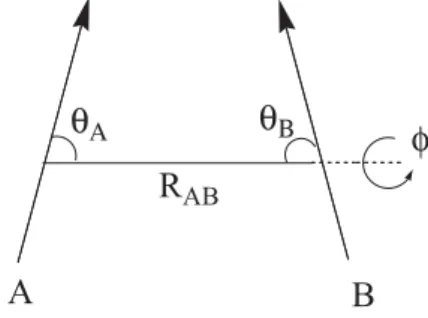
Figure 1 shows the intermolecular geometrical parameters with the definition of the intermolecular distance (RAB), angles (TA and TB) and dihedral angle (I),
with respect to the dipole moment vectors. The quantum chemical calculations were carried out with the intra and intermolecular geometrical parameters being fully optimized without symmetry or other geometrical constraint. For reason of simplicity only the intermolecular distances and angles will be presented here. Harmonic frequency calculations were also performed to characterize the located stationary point on the PES as minima (all frequencies are real) or first-order transition state (TS) structure (occurrence of one imaginary frequency). The Hartree-Fock (HF),12,14 Density Functional Theory (DFT)15
with the BLYP17-19 and PW9120-24 exchange correlation
functionals, and Moller-Plesset second order perturbation theory (MP2)25,26 methods were used for geometry
optimization and harmonic frequency calculations using the standard Pople’s split valence basis set of triple zeta quality adding polarization and diffuse functions on all atoms (6-311++G(2d,2p)).27-34 Single point energy
calculations were performed for the MP2 fully optimized geometry using the improved 6-311++G(3df,3pd) basis set employing the MP4(SDTQ) treatment of the electronic correlation with single, double, triple and quadruple excitations.26 For the (H
2)2 van der Waals dimer the
correlated consistent polarized valence triple-zeta and
quadruple-zeta, augmented with diffuse functions on all
atoms, (aug-cc-pVTZ and aug-cc-pVQZ) basis sets recent developed by Dunning and co-workers35-39 (see also
Davidson40) were used for MP2 geometry optimization and
frequency calculations, with single-point MP4(SDTQ) energy calculation being also performed. In addition, MP4(SDTQ) single-point energy calculation with the
correlated consistent polarized valence quintuple-zeta
basis set (aug-cc-pV5Z), for the MP2/aug-cc-pVQZ fully optimized geometry, was carried out, in order to assess the basis set limit behavior. The basis set superposition error (BSSE) was accounted for using the counterpoise method.41,42 For a more detailed discussion on the BSSE
correction see van Duijneveldt et al.43 For a discussion on
the effect of this correction for TS structures see Resende
et al.44
The spatial arrangements for the four dimers investigated in this work are depicted in Figure 2, along with the definition of the intermolecular geometrical parameters and dipole moment orientations. For the (H2)2 and (HCCH)2 dimers two structures, a true minimum (T-Shaped) and a first-order TS structure (Slipped-Parallel) were considered.
The multipole expansion for the molecular interaction energy, U(r), is given by the equation below.5-7
(1)
The coefficients for the interaction energy between two neutral molecules are given by equations (9-18). In these equationsPA,PB,4A,4B,DA , DB, EA, EB are respectively the permanent electric dipole moments, electric quadrupole moments, electric dipole polarizabilities and ionization energies of the monomers A and B, with H0 being the vacuum permittivity. The temperature-dependent Boltzmann weighted average induction energy contribution,7 corresponding to dipole-dipole interactions
for freely rotating molecules, is neglected.
The dipole moment vector, P and quadrupole tensor, Q, are given by45
P = 5rU(r)dW (2)
Q = 5rrU(r)dW (3)
whereU(r) is a continuous distribution of charge. It is of common practice to define a different quadrupole moment tensor which is traceless, with only five independent elements,
4 = ½6iqi(3riri - r21) (4)
where 1 is the unit tensor and the ½ factor is conventional. For axial symmetric and linear molecules the quadrupole tensor is diagonal in the molecular axes, with non-zero components 4xx = 4yy= - ½4zz. Then the quadrupole strength defined as 4 = 4zz - 4xx45 completely
determines the traceless quadrupole moment tensor. The multipole expansion permit the electrostatic potential (V(r)) due to a charge distribution to be written in terms of the electric moments associated with the charge distribution. In the presence of an external electrostatic field, E, the energy of the charge distribution, W, can be written as46
W = qV - P.E - 1/34:E’ (5)
where E’ is the field gradient tensor containing terms like wEx/wy.
The charge distribution can redistribute itself until its energy in the external field is minimized (polarization phenomenon), so the electric moments will change in the external field what can be studied by expanding the moments as a Taylor series. For the case of the electric dipole
P(E) = P(E=0) + D.E + ½!E’:EE + … (6)
where the first term on the right side is the permanent electric dipole, the second term the induced dipole by the external field (given by the polarizability D) and E’ the first hyperpolarizability (similar expansions can also be written for higher electric multipoles, and so a quadrupole polarizability can be defined).
The dipole polarizability tensor (D) in principal axis is diagonal. For a molecule with symmetry the principal axes coincide with symmetry axes.
(7)
(13)
London Approximation:47
(14)
In the quantum mechanical calculation of the energy of interaction between two molecules, the London
dispersion forces appear in the second-order perturbation
terms. They are called dispersion forces because the perturbation terms are expressed in terms of the same oscillator strengths, flk, as appear in the equations for the dispersion of light.5
The C8and C10 dispersion coefficients were evaluated with the equations below.5,48,49
(15)
(16)
(17)
(18)
The dispersion forces between asymmetric molecules at large separations can be calculated with equations (19) and (20), which takes into account the effect of the spatial orientation of the dipoles not present in the simple London approximation which is valid for spherically symmetrical systems. A deviation from isotropicity of the polarizability is considered and the magnitude of the dispersion energy
will depend on the mutual orientation of the two interacting molecules.5
(19)
All quantum chemical calculations were done using the GAUSSIAN 94/98 ab initio package50as implemented
on Digital/alpha-500au, SilicomGraphics R14000 workstations and Microcomputer Pentium-4, LYNUX Operating System, at the Laboratório de Química Computacional e Modelagem Molecular (LQC-MM), Departamento de Química, UFMG. The multipole expansion calculations for the molecular interaction energies were carried out using a Fortran code developed in the LQC-MM.
Results and Discussion
The results reported in the next Tables include DFT calculations using only two functionals BLYP and PW91. The aim here is not a detailed investigation of the performance of exchange-correlation functionals for describing molecular complexes. This subject has already been addressed in the literature and the difficulty of the DFT method for treating weakly bound dimers is well known. The interest here is mainly to assess how much electronic correlation these functionals contain, the BSSE effects, and also to confirm their ability to reproduce the interaction energy of H-bonded dimers, due to the plausibility of using DFT methods in larger molecular complexes where hydrogen bonding plays an important role. The reason for choosing the BLYP and PW91 functionals is our previous experience with the (PCCP)2 weakly bound complex study51 where various distinct
functionals were employed, using basis sets of different sizes. The results obtained could be grouped into two (11)
(12)
classes, and these two functionals were representatives of the results obtained among various exchange-correlation functionals used. The PW91 is the only functional that predicted a bound (PCCP)2 dimer, in agreement with Post-HF calculations. The other functionals employed, including BLYP, yielded an unbound dimer. So, a comparison between BLYP and PW91, for the description of the weakly bound, van der Waals and H-bonded dimers studied here may be interesting. In addition, we have recently used the BLYP/6-31G(d,p) level of calculation for the investigation of the hydration of D-cyclodextrin (D-CD)52 and the agreement with experiment for enthalpy
and Gibbs free energy of hydration was very good. Therefore, it is opportune to assess the behavior of the BLYP functional for the evaluation of interaction energies compared with Post-HF calculations, since DFT single point energy calculations can be performed at an affordable computational cost for large molecular complexes, such asD-CD dimer.53
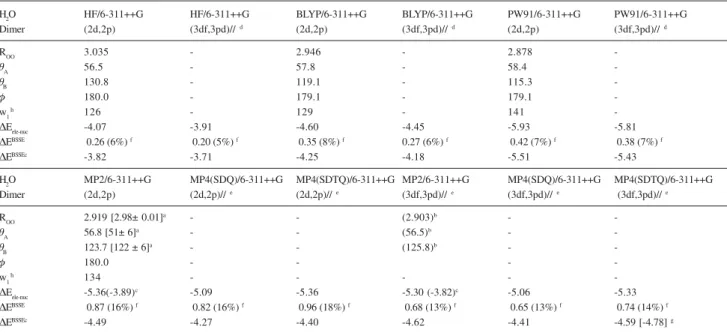
The calculated structural and energetic data for the water dimer is given in Table 1, where the experimental parameters are also quoted. As it has already been reported in the literature the agreement with experiment is fairly good. The HF energies are underestimated relative to the Post-HF ones due to the lack of electronic correlation. The BLYP energies are underestimated while the PW91 ones are overestimated compared to the MP4(SDTQ) values,
within the same basis set. The BSSE values are much smaller at the HF and DFT levels, showing that improved basis sets are required in Post-HF calculations. With the standard Pople’s 6-311++G(3df,3pd) basis set the BSSE correction is 14% of the total MP4(SDTQ) interaction energy, still a sizeable value. An improved value for the water dimer can be obtained using the correlated consistent polarized
valence quadruple-zeta, augmented with diffuse functions
on all atoms basis set (aug-cc-pVQZ) both at the MP4(SDTQ) and coupled cluster with single, double and non-iterative triple excitations (CCSD-T)56 levels of
calculation, which yield a value for the BSSE of 0.14 kcal mol-1, less than 3% of the ab initio stabilization energy.57
In addition the MP4(SDTQ)/aug-cc-pVQZ value of -4.94 kcal mol-1 value from De Almeida57 is closer to the
experimental value of -4.78 kcal mol-1 than the one
reported here with the 6-311++G(3df,3pd) basis set (the error is 3%), confirming the importance of the use of a good quality basis set in Post-HF stabilization energy calculations. In can be seen from the results of De Almeida57
that a practically BSSE free value would be attained using
the quintuple-zeta basis set ((aug-cc-pV5Z). It will be
shown later in this article that this is indeed the case for the (H2)2 van der Waals dimer. It can be seen from Table 1 that, after the BSSE correction is accounted for, the BLYP energies agree better with the MP4(SDTQ) values than the PW91 ones, providing an indication that the PW91 energy
Table 1. Geometrical parameters and interaction energy values for the (H2O)2 dimer. Distances in angstrom, angles in degrees and energies in units of kcal mol-1
H2O HF/6-311++G HF/6-311++G BLYP/6-311++G BLYP/6-311++G PW91/6-311++G PW91/6-311++G
Dimer (2d,2p) (3df,3pd)//d (2d,2p) (3df,3pd)//d (2d,2p) (3df,3pd)//d
ROO 3.035 - 2.946 - 2.878
-TA 56.5 - 57.8 - 58.4
-TB 130.8 - 119.1 - 115.3
-I 180.0 - 179.1 - 179.1
-w1h 126 - 129 - 141
-'Eele-nuc -4.07 -3.91 -4.60 -4.45 -5.93 -5.81
'EBSSE 0.26 (6%) f 0.20 (5%) f 0.35 (8%) f 0.27 (6%) f 0.42 (7%) f 0.38 (7%) f
'EBSSEc -3.82 -3.71 -4.25 -4.18 -5.51 -5.43
H2O MP2/6-311++G MP4(SDQ)/6-311++G MP4(SDTQ)/6-311++G MP2/6-311++G MP4(SDQ)/6-311++G MP4(SDTQ)/6-311++G Dimer (2d,2p) (2d,2p)//e (2d,2p)//e (3df,3pd)//e (3df,3pd)//e (3df,3pd)// e
ROO 2.919 [2.98± 0.01]a - - (2.903)b -
-TA 56.8 [51± 6]
a - - (56.5)b -
-TB 123.7 [122 ± 6]
a - - (125.8)b -
-I 180.0 - - -
-w1h 134 - - - -
-'Eele-nuc -5.36(-3.89)c -5.09 -5.36 -5.30 (-3.82)c -5.06 -5.33
'EBSSE 0.87 (16%) f 0.82 (16%) f 0.96 (18%) f 0.68 (13%) f 0.65 (13%) f 0.74 (14%) f
'EBSSEc -4.49 -4.27 -4.40 -4.62 -4.41 -4.59 [-4.78] g
aExperimental value from refs. 54,55; b MP2/6-311++G(3df,3pd) fully optimized value; c Hartree-Fock contribution to the MP2 energy; d The
double slash indicates that a single point calculation at the geometry optimized with the 6-311++G(2d,2p) basis set was performed;e The double
slash indicates that a single point energy calculation at the fully optimized MP2/6-311++G(2d,2p) geometry was performed; f Percentage value
relative to the 'Eele-nuc. (= ('EBSSE/'E
ele-nuc)x100);
gExperimental value from refs.58,54,55;hw
1 is the lowest harmonic frequency (in units of cm -1)
values may be somewhat exaggerated for the (H2O)2 dimer and, possibly, water clusters.
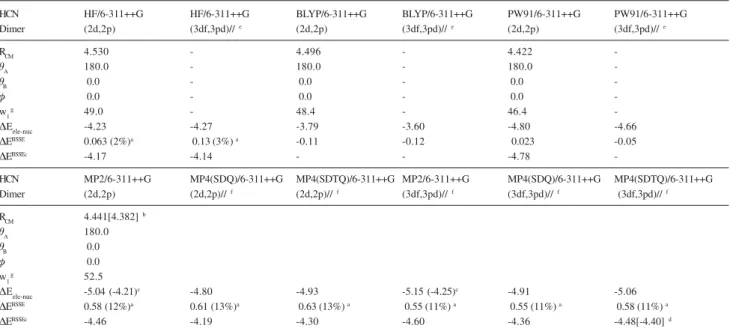
Table 2 show the results obtained for the linear (HCN)2 dimer. The strength of this hydrogen bonded dimer is very similar to the water dimer, with the ab initio BSSE being virtually the same. The experimentally observed intermolecular distance is in fair agreement with the MP2 value. It can be noted that the BSSE correction for the DFT calculations tend to be negative or very small, different from the water dimer case where they are small but larger than the ab initio HF values. This BSSE behavior for the DFT calculations have been observed for the (H2)2 and (HCCH)2 dimers and it appears that the counterpoise method may not be appropriate in DFT calculations of molecular complexes, where the stabilization energy trend with the basis set size does not follow the same pattern as
ab initio HF and Post-HF energy calculations. So, it seems
that there is no meaning in correcting DFT stabilization energies for BSSE. However, the results reported here may not be conclusive and a more detailed study is necessary. Therefore, BSSE uncorrected DFT stabilization energies is more advisable to be used. Another comparison with the water dimer reveals that the PW91 energies for the HCN dimer are larger than the BLYP ones but underestimated compared to the MP4(SDTQ) BSSE uncorrected values. So from the results of Tables 1 and 2, it can not be
concluded that the PW91 functional systematically predicts overestimated stabilization energies compared to
ab initio Post-HF results for H-bonded dimers, where
electrostatic interactions tend to play a major role. However, the BLYP energies follow a regular pattern for both hydrogen bonded dimers being systematically smaller than the corresponding Post-HF values but satisfactorily close, particularly for the water dimer where the deviation is ca. 3% (calculated in relation to the ab initio BSSE corrected value).
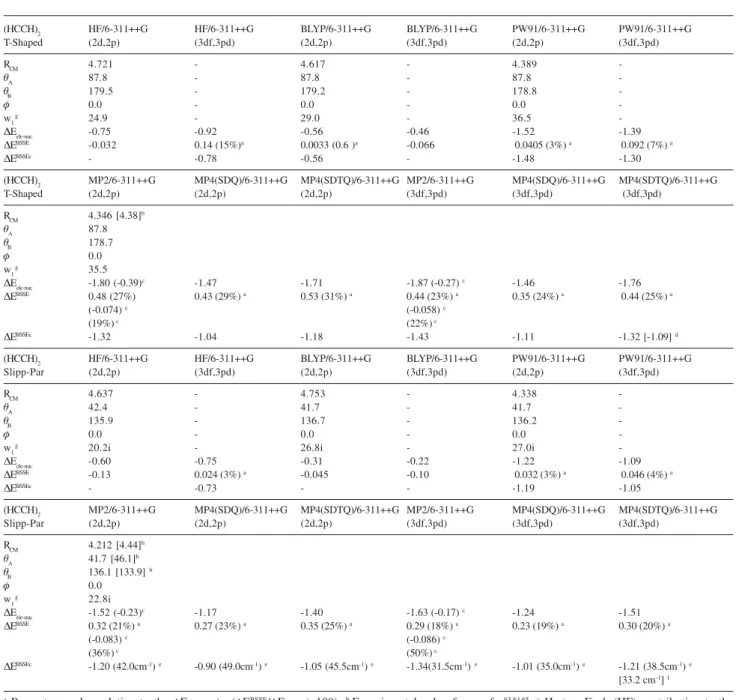
The results for the acetylene dimer are given in Table 3. For this weakly bound complex the electron correlation effects becomes very important, with a competition between electrostatic and dispersion effects promptly seen. The T-Shaped dimer is the global minimum on the PES, however there is a small barrier for interconversion between two equivalent T-Shaped forms through a Slipped-parallel TS structure, with the consequent splitting in the rotational spectrum being experimentally observed.61 The
experimental geometry is very satisfactorily reproduced a the MP2 level of theory. It can be seen that the BLYP functional is inappropriate to describe this weakly bound dimer, with the stabilization energy being far less than the HF value. In this case the correlation contribution to the stabilization energy is really substantial with the T-shaped being stabilized by ca. 60% in relation to the HF prediction
Table 2. Geometrical parameters and interaction energy values for the (HCN)2 linear dimer. Distances in angstrom, angles in degrees and energies in units of kcal mol-1
HCN HF/6-311++G HF/6-311++G BLYP/6-311++G BLYP/6-311++G PW91/6-311++G PW91/6-311++G
Dimer (2d,2p) (3df,3pd)//e (2d,2p) (3df,3pd)//e (2d,2p) (3df,3pd)//e
RCM 4.530 - 4.496 - 4.422
-TA 180.0 - 180.0 - 180.0
-TB 0.0 - 0.0 - 0.0
-I 0.0 - 0.0 - 0.0
-w1g 49.0 - 48.4 - 46.4
-'Eele-nuc -4.23 -4.27 -3.79 -3.60 -4.80 -4.66
'EBSSE 0.063 (2%)a 0.13 (3%) a -0.11 -0.12 0.023 -0.05
'EBSSEc -4.17 -4.14 - - -4.78
-HCN MP2/6-311++G MP4(SDQ)/6-311++G MP4(SDTQ)/6-311++G MP2/6-311++G MP4(SDQ)/6-311++G MP4(SDTQ)/6-311++G Dimer (2d,2p) (2d,2p)//f (2d,2p)//f (3df,3pd)//f (3df,3pd)//f (3df,3pd)// f
RCM 4.441[4.382]b
TA 180.0
TB 0.0
I 0.0
w1
g 52.5
'Eele-nuc -5.04 (-4.21)c -4.80 -4.93 -5.15 (-4.25)c -4.91 -5.06
'EBSSE 0.58 (12%)a 0.61 (13%)a 0.63 (13%) a 0.55 (11%) a 0.55 (11%) a 0.58 (11%) a
'EBSSEc -4.46 -4.19 -4.30 -4.60 -4.36 -4.48[-4.40]d
a Percentage value relative to the 'E
ele-nuc. (= ('E BSSE/'E
ele-nuc)x100);
bExperimental value from ref.59; c Hartree-Fock contribution to the MP2
energy;dExperimental value from ref.60; e The double slash indicates that a single point calculation at the geometry optimized with the
6-311++G(2d,2p) basis set was performed; f The double slash indicates that a single point energy calculation at the fully optimized
MP2/6-311++G(2d,2p) geometry was performed; gw
1 is the lowest harmonic frequency (in units of cm
-1) which characterize the located stationary point
Table 3. Geometrical parameters and interaction energy values for the (HCCH)2 T-Shaped and Slipped-Parallel dimers. Distances in angstrom, angles in degrees and energies in units of kcal mol-1
(HCCH)2 HF/6-311++G HF/6-311++G BLYP/6-311++G BLYP/6-311++G PW91/6-311++G PW91/6-311++G
T-Shaped (2d,2p) (3df,3pd) (2d,2p) (3df,3pd) (2d,2p) (3df,3pd)
RCM 4.721 - 4.617 - 4.389
-TA 87.8 - 87.8 - 87.8
-TB 179.5 - 179.2 - 178.8
-I 0.0 - 0.0 - 0.0
-w1g 24.9 - 29.0 - 36.5
-'Eele-nuc -0.75 -0.92 -0.56 -0.46 -1.52 -1.39
'EBSSE -0.032 0.14 (15%)a 0.0033 (0.6 )a -0.066 0.0405 (3%) a 0.092 (7%) a
'EBSSEc - -0.78 -0.56 - -1.48 -1.30
(HCCH)2 MP2/6-311++G MP4(SDQ)/6-311++G MP4(SDTQ)/6-311++G MP2/6-311++G MP4(SDQ)/6-311++G MP4(SDTQ)/6-311++G
T-Shaped (2d,2p) (2d,2p) (2d,2p) (3df,3pd) (3df,3pd) (3df,3pd)
RCM 4.346 [4.38]b
TA 87.8
TB 178.7
I 0.0
w1g 35.5
'Eele-nuc -1.80 (-0.39)c -1.47 -1.71 -1.87 (-0.27) c -1.46 -1.76
'EBSSE 0.48 (27%) 0.43 (29%) a 0.53 (31%) a 0.44 (23%) a 0.35 (24%) a 0.44 (25%) a
(-0.074)c (-0.058)c
(19%)c (22%)c
'EBSSEc -1.32 -1.04 -1.18 -1.43 -1.11 -1.32 [-1.09] d
(HCCH)2 HF/6-311++G HF/6-311++G BLYP/6-311++G BLYP/6-311++G PW91/6-311++G PW91/6-311++G
Slipp-Par (2d,2p) (3df,3pd) (2d,2p) (3df,3pd) (2d,2p) (3df,3pd)
RCM 4.637 - 4.753 - 4.338
-TA 42.4 - 41.7 - 41.7
-TB 135.9 - 136.7 - 136.2
-I 0.0 - 0.0 - 0.0
-w1g 20.2i - 26.8i - 27.0i
-'Eele-nuc -0.60 -0.75 -0.31 -0.22 -1.22 -1.09
'EBSSE -0.13 0.024 (3%) a -0.045 -0.10 0.032 (3%) a 0.046 (4%) a
'EBSSEc - -0.73 - - -1.19 -1.05
(HCCH)2 MP2/6-311++G MP4(SDQ)/6-311++G MP4(SDTQ)/6-311++G MP2/6-311++G MP4(SDQ)/6-311++G MP4(SDTQ)/6-311++G
Slipp-Par (2d,2p) (2d,2p) (2d,2p) (3df,3pd) (3df,3pd) (3df,3pd)
RCM 4.212 [4.44]b
TA 41.7 [46.1]
b
TB 136.1 [133.9] b
I 0.0
w1g 22.8i
'Eele-nuc -1.52 (-0.23)
c -1.17 -1.40 -1.63 (-0.17) c -1.24 -1.51
'EBSSE 0.32 (21%) a 0.27 (23%) a 0.35 (25%) a 0.29 (18%) a 0.23 (19%) a 0.30 (20%) a
(-0.083)c (-0.086)c
(36%)c (50%)c
'EBSSEc -1.20 (42.0cm-1)e -0.90 (49.0cm-1)e -1.05 (45.5cm-1)e -1.34(31.5cm-1)e -1.01 (35.0cm-1)e -1.21 (38.5cm-1)e
[33.2 cm-1]f
a Percentage value relative to the 'E
ele-nuc. (= ('E BSSE/'E
ele-nuc)x100);
bExperimental value from refs. 63,64,65;c Hartree-Fock (HF) contribution to the
MP2 interaction energy ('EMP2 = 'EHF + 'E(2));dExperimental value evaluated using the Pseudo-diatomic (PD) model (See for example62 and
structural/spectroscopic data from63);eBarrier for tunneling motion in units of cm-1 (1 kcal mol-1 = 349.8327759 cm-1);f Experimental barrier for
tunneling motion value from ref..61 V
4 barrier estimated from the splitting frequency of 2207 MHz (0.0736 cm
-1): V(D) = V
4/2[1 + cos(4 D)]; gw
1
is the lowest harmonic frequency (in units of cm-1) which characterize the located stationary point as true minima or first-order TS structure.
when electron correlation is included at the MP4(SDTQ)/ 6-311++G(3df,3pd) level of calculation. For the (HCCH)2 dimer the PW91/6-311++G(3df,3pd) energy values agree well with the corresponding MP4(SDTQ) BSSE corrected results, indicating that the PW91 functional seems to encompass the correlation energy in this case.
The weakest van der Waals dimer investigated, the (H2)2 complex, provided a good test for the ability of the DFT to
Table 4. Geometrical parameters and interaction energy values for the (H2)2 T-Shaped and Slipped-Parallel van der Waals dimers obtained with the standard Pople’s split-valence basis sets. Distances in angstrom, angles in degrees and energies in units of kcal mol-1
(H2)2 HF/6-311++G HF/6-311++G BLYP/6-311++G BLYP/6-311++G PW91/6-311++G PW91/6-311++G
T-Shaped (2d,2p) (3df,3pd) (2d,2p) (3df,3pd) (2d,2p) (3df,3pd)
RCM 4.230 4.188 - 7.385 - 3.274
TA 93.6 93.6 - 96.8 - 92.9
TB 175.7 175.7 - 170.2 - 177.6
I 180.0 180.0 - 180.0 - 180.0
w1e 16.6 19.5 - 5.0i - 3.5
'Eele-nuc -0.0112 -0.0114 - -0.00075 - -0.30
'EBSSE -0.0149 -0.0170 - -0.00228 - -0.019
'EBSSEc - - - - -
-(H2)2 MP2/6-311++G MP4(SDQ)/6-311++G MP4(SDTQ)/6-311++G MP2/6-311++G MP4(SDQ)/6-311++G MP4(SDTQ)/6-311++G
T-Shaped (2d,2p) (2d,2p) (2d,2p) (3df,3pd) (3df,3pd) (3df,3pd)
RCM 3.574 3.469
TA 93.1 93.0
TB 176.9 177.1
I 180.0 180.0
w1e 31.4 33.2
'Eele-nuc -0.05503 -0.06055 -0.06445 -0.07944 -0.09086 -0.09808
{0.01424}b {0.03169}b {-0.08352}c {-0.09475}d
'EBSSE 0.009977 0.01186 0.01186 0.01337 0.01544 0.01544
(18%)a (20%)a (18%)a (17%)a (17%)a (16%)a
{0.004330}b {0.003138}b {0.01581}c {0.01581}d
{30%}b {10%}b {19%}c {17%}d
'EBSSEc -0.04505 -0.04869 -0.05259 -0.06607 -0.07542 -0.08264
{0.01857}b {0.03483}b {-0.06771}c {-0.07894}d
(H2)2 HF/6-311++G HF/6-311++G BLYP/6-311++G BLYP/6-311++G PW91/6-311++G PW91/6-311++G
Slipp-Par (2d,2p) (3df,3pd) (2d,2p) (3df,3pd) (2d,2p) (3df,3pd)
RCM 4.270 4.252 - 6.682 - 3.247
TA 50.1 50.1 - 51.7 - 48.9
TB 130.9 130.8 - 133.6 - 130.5
I 0.0 0.0 - 0.0 - 0.0
w1e 16.8i 18.0i - 8.2i - 26.8
'Eele-nuc -0.00935 -0.00922 - -0.00050 - -0.29
'EBSSE -0.0147 -0.0173 - -0.0226 - -0.018
'EBSSEc - - - - -
-(H2)2 MP2/6-311++G MP4(SDQ)/6-311++G MP4(SDTQ)/6-311++G MP2/6-311++G MP4(SDQ)/6-311++G MP4(SDTQ)/6-311++G
Slipp-Par (2d,2p) (2d,2p) (2d,2p) (3df,3pd) (3df,3pd) (3df,3pd)
RCM 3.684 3.491
TA 44.3 49.5
TB 135.0 130.1
I 0.0 0.0
w1e 29.5i 24.7i
'Eele-nuc -0.04882 -0.05359 -0.05679 -0.07103 -0.08233 -0.08879
{0.007844}b {0.03043}b {-0.07549}c {-0.08559}d
'EBSSE 0.008660 0.01042 0.01042 0.01261 0.01475 0.01475
(18%)a (19%)a (18%)a (18%)a (18%)a (17%)a
{0.004518}b {0.003200}b {0.01481}c {0.01481}d
{58%}b {11%}b {20%}c {17%}d
'EBSSEc -0.04016 -0.04317 -0.04637 -0.05842 -0.06758 -0.07404
{0.01236}b {0.03363}b {-0.06068}c {-0.07078}d
a Percentage value relative to the 'E
ele-nuc. (= ('E BSSE/'E
ele-nuc)x100);
b Hartree-Fock (HF) contribution to the MP2 interaction energy ('EMP2 = 'EHF
+'E(2));cCCSD value; dCCSD-T value; ew
1 is the lowest harmonic frequency (in units of cm
-1) which characterize the located stationary point
as true minima or first-order TS structure.
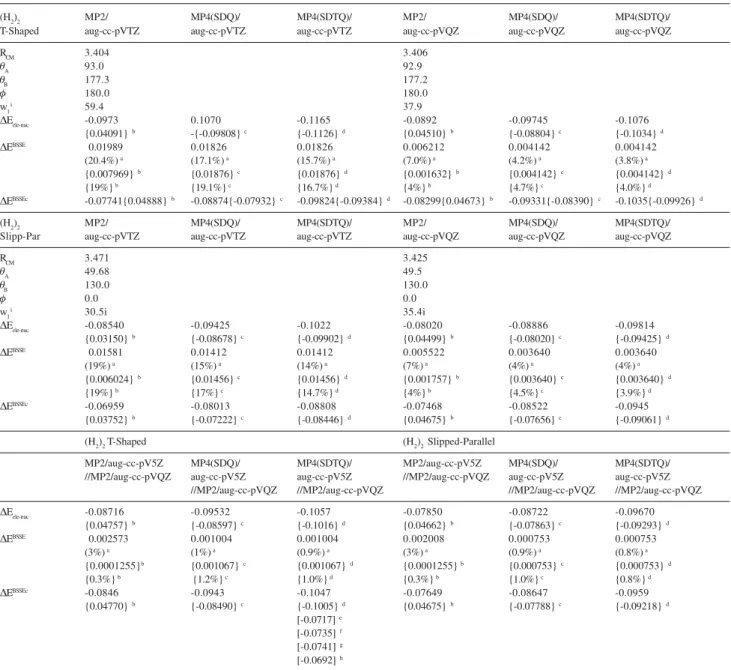
(similar to the behavior of the HF method). It can be seen from Table 4 that the BSSE is still sizeable for the 6-311++G(3df,3pd) basis set, with the aug-cc-pVTZ basis set doing a similar job (see Table 5). However, raising the basis set quality to the quintuple-zeta, i.e., aug-cc-pV5Z, the BSSE correction is below 1% at the MP4(SDTQ) level,
It should be noted that our best ab initio BSSE corrected stabilization energy value of -0.105 kcal mol-1
(MP4(SDTQ)/aug-cc-pV5Z//MP2/aug-cc-pVQZ) still deviates considerably from the available experimental data of -0.072 kcal mol-1. However, the experimental uncertainty
and limitation must be considered, once we are surely on the basis set limit and the electron correlation is adequately included. Also the stabilization energy value is quite small (< 1 kcal mol-1) which certainly offer a great
challenge for its accurate experimental determination,
being also very sensitive to the experimental method utilized for its determination as can be seen from the range of values quoted in Table 5.
In order the compare the performance of Post-HF methods to describe electron correlation effects CCSD-T single point energy calculations were performed for the MP2 optimized geometries using the Pople’s split-valence
and Dunning’s correlated consistent polarized valence
basis sets for the (H2)2 dimer, which is the smallest dimer investigated here, so our computational resources enable
Table 5. Geometrical parameters and interaction energy values for the (H2)2 T-Shaped and Slipped-Parallel van der Waals dimers obtained with the Dunning’s correlated consistent polarized valence basis sets. Distances in angstrom, angles in degrees and energies in units of kcal mol-1
(H2)2 MP2/ MP4(SDQ)/ MP4(SDTQ)/ MP2/ MP4(SDQ)/ MP4(SDTQ)/
T-Shaped aug-cc-pVTZ aug-cc-pVTZ aug-cc-pVTZ aug-cc-pVQZ aug-cc-pVQZ aug-cc-pVQZ
RCM 3.404 3.406
TA 93.0 92.9
TB 177.3 177.2
I 180.0 180.0
w1i 59.4 37.9
'Eele-nuc -0.0973 0.1070 -0.1165 -0.0892 -0.09745 -0.1076 {0.04091}b -{-0.09808}c {-0.1126}d {0.04510}b {-0.08804}c {-0.1034}d
'EBSSE 0.01989 0.01826 0.01826 0.006212 0.004142 0.004142
(20.4%)a (17.1%)a (15.7%)a (7.0%)a (4.2%)a (3.8%)a
{0.007969}b {0.01876}c {0.01876}d {0.001632}b {0.004142}c {0.004142}d
{19%}b {19.1%}c {16.7%}d {4%}b {4.7%}c {4.0%}d
'EBSSEc -0.07741{0.04888}b -0.08874{-0.07932}c -0.09824{-0.09384}d -0.08299{0.04673}b -0.09331{-0.08390}c -0.1035{-0.09926}d
(H2)2 MP2/ MP4(SDQ)/ MP4(SDTQ)/ MP2/ MP4(SDQ)/ MP4(SDTQ)/
Slipp-Par aug-cc-pVTZ aug-cc-pVTZ aug-cc-pVTZ aug-cc-pVQZ aug-cc-pVQZ aug-cc-pVQZ
RCM 3.471 3.425
TA 49.68 49.5
TB 130.0 130.0
I 0.0 0.0
w1i 30.5i 35.4i
'Eele-nuc -0.08540 -0.09425 -0.1022 -0.08020 -0.08886 -0.09814 {0.03150}b {-0.08678}c {-0.09902}d {0.04499}b {-0.08020}c {-0.09425}d
'EBSSE 0.01581 0.01412 0.01412 0.005522 0.003640 0.003640
(19%)a (15%)a (14%)a (7%)a (4%)a (4%)a
{0.006024}b {0.01456}c {0.01456}d {0.001757}b {0.003640}c {0.003640}d
{19%}b {17%}c {14.7%}d {4%}b {4.5%}c {3.9%}d
'EBSSEc -0.06959 -0.08013 -0.08808 -0.07468 -0.08522 -0.0945
{0.03752}b {-0.07222}c {-0.08446}d {0.04675}b {-0.07656}c {-0.09061}d
(H2)2 T-Shaped (H2)2 Slipped-Parallel
MP2/aug-cc-pV5Z MP4(SDQ)/ MP4(SDTQ)/ MP2/aug-cc-pV5Z MP4(SDQ)/ MP4(SDTQ)/ //MP2/aug-cc-pVQZ aug-cc-pV5Z aug-cc-pV5Z //MP2/aug-cc-pVQZ aug-cc-pV5Z aug-cc-pV5Z
//MP2/aug-cc-pVQZ //MP2/aug-cc-pVQZ //MP2/aug-cc-pVQZ //MP2/aug-cc-pVQZ 'Eele-nuc -0.08716 -0.09532 -0.1057 -0.07850 -0.08722 -0.09670
{0.04757}b {-0.08597}c {-0.1016}d {0.04662}b {-0.07863}c {-0.09293}d
'EBSSE 0.002573 0.001004 0.001004 0.002008 0.000753 0.000753
(3%)a (1%)a (0.9%)a (3%)a (0.9%)a (0.8%)a
{0.0001255}b {0.001067}c {0.001067}d {0.0001255} b {0.000753}c {0.000753}d
{0.3%}b {1.2%} c {1.0%}d {0.3%}b {1.0%}c {0.8%}d
'EBSSEc -0.0846 -0.0943 -0.1047 -0.07649 -0.08647 -0.0959
{0.04770}b {-0.08490}c {-0.1005}d {0.04675}b {-0.07788}c {-0.09218}d
[-0.0717]e
[-0.0735]f
[-0.0741]g
[-0.0692]h
a Percentage value relative to the 'E
ele-nuc. (= ('E BSSE/'E
ele-nuc)x100);
b Hartree-Fock (HF) contribution to the MP2 interaction energy ('EMP2 = 'EHF
+'E(2)); cCCSD value; dCCSD-T value; eExperimental value from refs. 66,67;f,gExperimental value obtained from the transport properties;68,69 hExperimental value obtained from molecular beams experiment.70;iw
1 is the lowest harmonic frequency (in units of cm
-1) which characterize
such huge ab initio calculation to be carried out. The conclusions can be extended to other weakly bound dimers. With all basis sets utilized the CCSD-T stabilization energies are systematically smaller than the MP4(SDTQ) ones by ca. 3-4% (0.004 kcal mol-1). The
comparison between the CCSD and MP4(SDQ) energies shows a larger variation of ca. 9-11%, with the CCSD being also smaller. In addition, the BSSE correction is virtually the same, so what would differs the two correlated calculations is indeed the way the electron correlation is handled, since both treatment of the correlation effects exhibit the same dependence with the basis set. It can be seen that no matter how big is the basis set this regular patter is observed for both energies and BSSE correction. So, it the light of these results it can be said that the CCSD-T and MP4(SDCCSD-TQ) stabilization energies agree within 3-4%, which is probably closer to the lowest experimental uncertainty for interaction energy determination for weakly bound dimers. In order to establish definitively whether or not the MP4(SDTQ) interaction energies are overestimated a systematic study for a series of weakly bound dimers, where experimental energies with uncertainties included are available, would be required. As the MP4(SDTQ) approach is computationally much cheaper than the CCSD-T one, the results reported in this article stimulates the use of the MP4 treatment for electron correlation in theoretical studies of weak molecular interactions in the gas phase.
In order to have a further assessment of the dispersion contribution to the interaction energies the multipole expansion described previously was used for the description of the long-range forces which play an important role for weakly bound species. One dimensional potential curves were also constructed by calculating the
ab initio energies as a function of the center of mass
intermolecular distance, varying the distance from 2 to 9 angstrom, hence including part of the short-range region. In these calculations the MP2/6-311++G(2d,2p) level was used, with all geometrical parameters being fully optimized without any constraint, and the center of mass distance kept frozen in the range of 2-9 angstrom, with a stepsize of 0.5 angstrom. The results are shown in Figures 3-5, respectively for the (H2)2-T-Shaped, HCN-linear, (HCCH)2 -T-Shaped and (H2O)2 dimers. In these plots the Hartree-Fock contribution to the MP2 energy curve is also shown, along with the Lennard-Jones (12-6) representation of the potential,71 using the MP2 parameters. The functional form
of the LJ-(12-6) potential is given below, wher -H is the minimum energy value at the equilibrium distance req and V (=2-1/6r
eq) is the intermolecular separation for which the
interaction energy is zero.
(21)
The HF contribution to the Post-HF stabilization energies are also given in Tables 1-5, along with the corresponding HF energies for the fully optimized HF equilibrium structures. The size of the HF and MPn contributions can be evaluated at the minimum energy point and the way these contributions vary on going from the short- to the long-range region can be seen from the potential curves depicted in Figures 2-5. As could be anticipated the weaker is the molecular complex the more important is the electron correlation effects. For the (H2)2 dimer the very small size of the stabilization energy preclude the visualization of the electron correlation effects from Figure 3a (the scale has to be enlarged).
Figure 3. MP2/6-311++G(2d,2p) Potential Energy Curve. RCM is the center of mass distance between the two monomer. All geometri-cal parameters, except for the RCM distance, were fully optimized for each point on the energy curve. The Lennard-Jones (LJ) 12-6 Po-tential was plotted using the MP2/6-311++G(2d,2p) parameters. There were no significant angular distortions from the symmetric T-Shaped structure of the (H2)2 dimer and Linear structure of the
It can be seen from Figure 4 that the electron correlation effects play an important role at the equilibrium and short-range region, while at longer intermolecular distances the HF and MP2 are practically coincident. It is also shown that below 4 angstrom the T-Shaped structure of the (HCCH)2 dimer is converted into the Slipped-Parallel one and then turning into the symmetrical Parallel structure. Therefore, any potential function to be used to model the behavior in the short-range region should be able to describe the angular dependence apart from the radial part as given by the Lennard-Jones potential. The same situation holds for the water dimer potential curve shown in Figure 5. Significant deviation from the C2v-Trans-linear structure occurs below 3 angstrom. Analyzing these potential energy curves it can be said that the LJ-(12-6) radial potential describes very well the intermolecular potential at the equilibrium and long-range region. However, a large deviation occur in the short-range region particularly for the (H2)2 and (HCCH)2 weakly bound dimers.
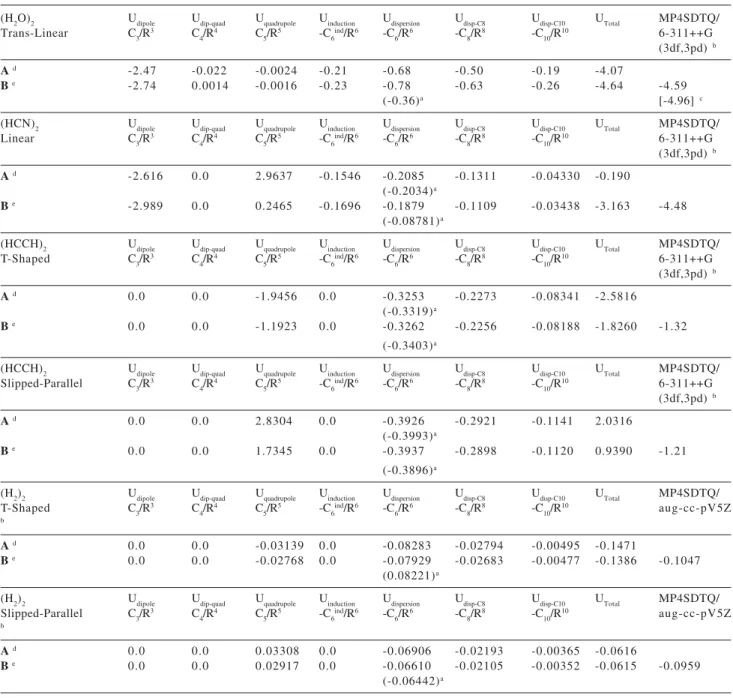
The electrostatic, induction and dispersion multipole expansion energy contributions to the long-range interaction energy are reported in Table 6. The electrical properties for the isolated monomers subunits and the dispersion coefficients are given respectively in Tables 7 and 8. From the values for -C6asym/R6 reported in Table 6 (in
parenthesis), which takes into account a deviation from the isotropicity of the polarizability tensor (equations (19) and (20)), it can be concluded that for T-Shaped and Slipped-Parallel spatial arrangements the simple London approximation47 works fine. However for the water dimer
and linear (HCN)2 structures the asymmetry characteristic given by C6asym becomes relevant. This can be better
observed by looking at the dispersion coefficients given in Table 8, where it can be seen that C6asym does not change
appreciably for T-Shaped and Slipped-Parallel spatial arrangements, but for water dimer it is almost half of the C6 value. Nevertheless, the neat effect on the total interaction energy (UTotal) is not so pronounced. The higher dispersion
Figure 4: MP2/6-311++G(2d,2p) Potential Energy Curve for (HCCH)2 T-Shaped dimer (as described in Figure 3). The preferred
spatial orientation in the short distance region is shown.
Table 6. Coulombic, Induction and Dispersion Long-Range Contributions to the Interaction Energy. All energy values in units of kcal mol-1. All
ab initio geometries were calculated at the MP2/6-311++G(2d,2p) level of theory
(H2O)2 Udipole Udip-quad Uquadrupole Uinduction Udispersion Udisp-C8 Udisp-C10 UTotal MP4SDTQ/
Trans-Linear C3/R3 C
4/R
4 C
5/R
5 -C
6
ind/R6 -C 6/R 6 -C 8/R 8 -C 10/R 10 6-311++G (3df,3pd) b
Ad -2.47 -0.022 -0.0024 -0.21 -0.68 -0.50 -0.19 -4.07
Be -2.74 0.0014 -0.0016 -0.23 -0.78 -0.63 -0.26 -4.64 -4.59
(-0.36)a [-4.96] c
(HCN)2 Udipole Udip-quad Uquadrupole Uinduction Udispersion Udisp-C8 Udisp-C10 UTotal MP4SDTQ/
Linear C3/R3 C
4/R
4 C
5/R
5 -C
6
ind/R6 -C 6/R 6 -C 8/R 8 -C 10/R 10 6-311++G (3df,3pd) b
Ad -2.616 0.0 2.9637 -0.1546 -0.2085 -0.1311 -0.04330 -0.190
(-0.2034)a
Be -2.989 0.0 0.2465 -0.1696 -0.1879 -0.1109 -0.03438 -3.163 -4.48
(-0.08781)a
(HCCH)2 Udipole Udip-quad Uquadrupole Uinduction Udispersion Udisp-C8 Udisp-C10 UTotal MP4SDTQ/
T-Shaped C3/R3 C
4/R
4 C
5/R
5 -C
6
ind/R6 -C 6/R 6 -C 8/R 8 -C 10/R 10 6-311++G (3df,3pd) b
Ad 0.0 0.0 -1.9456 0.0 -0.3253 -0.2273 -0.08341 -2.5816
(-0.3319)a
Be 0.0 0.0 -1.1923 0.0 -0.3262 -0.2256 -0.08188 -1.8260 -1.32
(-0.3403)a
(HCCH)2 Udipole Udip-quad Uquadrupole Uinduction Udispersion Udisp-C8 Udisp-C10 UTotal MP4SDTQ/ Slipped-Parallel C3/R3 C
4/R
4 C
5/R
5 -C
6
ind/R6 -C 6/R 6 -C 8/R 8 -C 10/R 10 6-311++G (3df,3pd) b
Ad 0.0 0.0 2.8304 0.0 -0.3926 -0.2921 -0.1141 2.0316
(-0.3993)a
Be 0.0 0.0 1.7345 0.0 -0.3937 -0.2898 -0.1120 0.9390 -1.21
(-0.3896)a
(H2)2 Udipole Udip-quad Uquadrupole Uinduction Udispersion Udisp-C8 Udisp-C10 UTotal MP4SDTQ/
T-Shaped C3/R3 C
4/R
4 C
5/R
5 -C
6
ind/R6 -C 6/R 6 -C 8/R 8 -C 10/R 10 aug-cc-pV5Z b
Ad 0.0 0.0 -0.03139 0.0 -0.08283 -0.02794 -0.00495 -0.1471
Be 0.0 0.0 -0.02768 0.0 -0.07929 -0.02683 -0.00477 -0.1386 -0.1047
(0.08221)a
(H2)2 Udipole Udip-quad Uquadrupole Uinduction Udispersion Udisp-C8 Udisp-C10 UTotal MP4SDTQ/
Slipped-Parallel C3/R3 C 4/R
4 C
5/R
5 -C
6
ind/R6 -C 6/R 6 -C 8/R 8 -C 10/R 10 aug-cc-pV5Z b
Ad 0.0 0.0 0.03308 0.0 -0.06906 -0.02193 -0.00365 -0.0616
Be 0.0 0.0 0.02917 0.0 -0.06610 -0.02105 -0.00352 -0.0615 -0.0959
(-0.06442)a
aThe dispersion energy evaluated taking into account a deviation from isotropicity of the polarizability (See equations (19) and (20)); bMP4(SDTQ) BSSE corrected values;c CCSD-T/aug-cc-pVQZ//MP2/aug-cc-pVTZ BSSE corrected value57;d In “A” available experimental
electrical properties, given in Table 7, were utilized. For the water dimer the experimental geometry (See Table 1) was also used;e In “B” only
ab initio calculated values for the electrical properties, given in Table 7, were used.
coefficients, C8 and C10, are also given in Table 6. Their absolute values are smaller than C6, and their behavior reflects that of a nicely converging power series, with the contribution of the next term, -C12/R12, expected to be
practically negligible. However, the C8 and C10 coefficients make a visible contribution to the dispersion energy for all four dimers studied here, and can not be ignored.
It can be seen that for the (H2O)2 and (HCN)2 dimers, the dipole and quadrupole electrostatic contributions
dimer (see Table 1) the corresponding difference is 19%, also in accordance with the results reported in Table 6. For the acetylene T-shaped dimer the dispersion contributions account for 35% of the interaction energy. However for the slipped-parallel structure the strongly repulsive quadrupole-quadrupole interaction contributions dominate the interaction energy, producing an unbound dimeric structure. Comparison with the ab initio values reported in Table 3 for the (HCCH)2 dimer reveal that the difference between the MP4 and HF values is 41% of the total interaction energy, in the line with the results reported in Table 6. Based on the analysis of Table 6 the (H2)2 dimer is predominantly bound through dispersion forces. The quadrupole contribution for the T-shaped dimer correspond to only 20% of the interaction energy and for the slipped-parallel this contribution is repulsive, similar to the acetylene dimer case, but in this case a bound structure is predicted due to the predominance of the dispersion effects. By comparison with the ab initio results from Table 4, it can be seen that energy difference between the MP4(SDTQ) and HF calculations in this case is 86% of the MP4 interaction energy in nice agreement with the 80% contribution of the dispersion effected predicted by the multipole expansion approach. So, the importance of the
induction-dispersion contributions to the total interaction energy can be placed in the following order, according to the long-range contributions to the interaction energy: (HCN)2 < (H2O)2 < (HCCH)2 < (H2)2. Comparing the total interaction energies reported in Table 6, with the MP4(SDTQ)/6-311++G(3df,3pd) BSSE corrected ab initio
values quoted in the last column a very satisfactory agreement is found, showing that the multipole expansion approach can predict the energetic trend for these dimeric species, and therefore, can also be used to aid the understanding of the nature of the intermolecular forces in weakly bound complexes. The best agreement between the multipole expansion and Post-HF results is found when the calculated ab initio electrical properties are used instead of the experimental tabulated values. It can be seen from Table 7 that in general the ab initio results are in good accordance with experiment, except for the electric quadrupole moments for the HCN and HCCH molecules. However, the overall agreement of the MP2/6-311++G(3d,3p) electric dipole and quadrupole moments and MP2/aug-cc-pVTZ electric dipole polarizabilities with experiment for a number of molecules is very satisfactory so, the use of these theoretical calculated electrical properties is recommended.
Table 7. Electrical Properties for the isolated monomers: Dipole Moments (P) in units of 10-30Cm, Electric Quadrupole Moments (4) in units of
10-40Cm2, Electric Dipole Mean Static Polarizabilities (–D0) in units of 10-40C2m2J-1, Ionization Energies (E
A) in eV. DA and D||are the two
independent components
4zz
a 4
yy 4xx
–
D0 D
A D|| EA P
H2O: Theoretical b -0.34 8.82 -8.48 1.58 1.55 1.65 13.856 6.36
H2O: Experimental c -0.43 ± 0.10 8.77 ± 0.07 -8.34 ± 0.07 1.65 d 12.607e 6.17 d
H2: Theoretical b 2.07 0.854 0.756 1.050 16.218 0.0
H2: Experimental f 2.2 0.895 c0.879 g 0.790 g 1.035 g 15.427h 0.0
HCCH: Theoretical b 21.92 3.76 3.12 5.05 11.130 0.0
HCCH:Experimentalc 2 8 3.71 g 2.70 g 5.70 g 11.4h 0.0
HCN: Theoretical b 7.41 2.76 2.32 3.66 13.410 10.06
HCN: Experimental c 25.68I 2.88g 2.14g 4.36g 13.8h 9.41 j
a The z axis is the principal axis. For H
2O the z axis is the C2v symmetry axis. For linear molecules: 4xx = 4yy = -½4zz;
b4,P and E
A calculated
at the MP2/6-311++G(3d,3p) level of theory and –D0with the aug-cc-pVTZ basis set (MP2 calculation); cSee ref.46;dSee ref.72;eSee ref.73;fSee
ref.45;gSee ref.5;hSee ref.74;iSee ref.75;jExperimental value from ref.76
Table 8. Calculated Dispersion Coefficients: C6/10
-79 Jm6(or 10-60ergcm6), C 8/10
-99Jm8 (or 10-76ergcm8) and C 10/10
-119Jm10 (or 10-92ergcm10)
C6
Expt. a C
6
Ab-initio b C
6
asym. c C
8
Expt. a C
8
Ab-initio b C
10
Expt. a C
10 Ab-initio b
(H2O)2Trans-Linear 33.32 33.57 15.38 216.29 229.38 737.20 822.76
(HCN)2Linear 111.10 100.10 46.79 1378.00 1165.60 8973.05 7125.63
(HCCH)2T-Shaped 152.30 152.72 159.31 2010.23 1994.48 13929.74 13674.49
(HCCH)2Slipped-Parallel 152.30 152.72 151.15 2010.23 1994.48 13929.74 13674.49
(H2)2T-Shaped 11.99 11.48 11.90 51.68 49.62 116.91 112.60
[11.56±0.32]d
(H2)2Slipped-Parallel 11.99 11.48 11.19 51.68 49.62 116.91 112.60
a Evaluated using the experimental electrical properties given in Table 7; b4,P and E
A calculated at the MP2/6-311++G(3d,3p) level of theory
and –D0 with the aug-cc-pVTZ basis set (MP2 calculation); c C 6
We finally return to the discussion of the electron correlation effects in Table 9. There are basically two groups of methods for the calculation of the interaction energy ('E). Within the supermolecule approach ('Ecomplex =
Ecomplex - 6(Emonomers)), the interaction energy can be written
as a sum of two contributions: the Hartree-Fock energy ('EHF) and the correlation energy ('Ecorr), where it is also
assumed that both the isolated systems and the supersystem are described with sufficient accuracy. With the perturbation treatment, where the perturbation and the corresponding interactions energy must be sufficiently small, being therefore appropriate for studying weak interactions, the interaction energy is obtained directly as the sum of various energy contributions (Coulombic, induction, charge-transfer, exchange-repulsion, dispersion), so it is free of BSSE. A detailed discussion on this subject can be found for example in Chalasinski and Szczesniak77 and Jeziorski et al.78 It can be shown that the
supermolecule HF interaction energy includes all the above contributions, except for the dispersion energy. It can also be shown that the dispersion energy can be considered to be identical with the intersystem correlation energy for large distances. 6,79
'E = 'EHF + 'Ecorr (22)
In the supermolecule calculations using MPn Post-HF methods the correlation energy can be identified as the difference between the total MPn interaction energy and the HF contribution evaluated with the MPn fully optimized geometry, denominated here as 'Ecorr.
'Ecorr = 'E ele-nuc
MPn - 'E ele-nuc
HF-contribution (23)
Following the discussion from Hobza and Zahradník6
we can also write the correlation energy as the difference of the MPn stabilization energy and the HF energy, calculated with the fully optimized HF geometry ('Ecorr-HF).
'Ecorr-HF = 'E
ele-nuc - 'Eele-nuc
HF (24)
The values represented by equations (23) and (24) are given in Table 9, along with the percentage contribution in relation to the total MPn interaction energy. This gives us a more realistic idea about the contribution of the HF energy. For reason of comparison the difference between
Table 9. Electronic correlation contributions to the dimer interaction energy. The percentage contribution of the correlation energy is given in parenthesis
(H2O)2 HF/6?311++G BLYP/6?311++G PW91/6?311++G MP2/6-311++G MP4(SDQ)/ MP4(SDTQ)/
Trans-Linear (3df,3pd) (3df,3pd)// (3df,3pd)// (3df,3pd)// 6-311++G 6-311++G
(3df,3pd)// (3df,3pd)//
'Ecorr-HF a 0.0 -0.54 (12%) -1.90 (33%) -1.39 (26%) -1.15 (23%) -1.42 (27%)
'Ecorr b,c - - - -1.48 (28%) -1.24 (25%) -1.51 (28%)
Udispersionf -1.67
(HCN)2Linear
'Ecorr-HF a 0.0 0.67 (19%) d -0.39 (8%) -0.88 (17%) -0.64 (13%) -0.79 (16%)
'Ecorr b,c - - - -0.90 (17%) -0.66 (13%) -0.81 (16%)
Udispersionf -0.33
(HCCH)2T-Shaped
'Ecorr-HF a 0.0 0.46 (100%) d -0.47 (34%) -0.95 (51%) -0.54 (37%) -0.84 (48%)
'Ecorr b,c - - - -1.60 (86%) -1.19 (82%) -1.49 (85%)
Udispersionf -0.63
(HCCH)2Slipped-Parallel
'Ecorr-HF a 0.0 0.53 (>100%) d -0.34 (31%) -0.88 (54%) -0.49 (40%) -0.76 (50%)
'Ecorr b,c - - - -1.46 (90%) -1.07 (86%) -1.34 (89%)
Udispersionf -0.80
(H2)2T-Shaped
'Ecorr-HF a 0.0 0.01065 (>100%) d -0.2886 (96%) -0.06804 (86%) -0.07946 (87%) -0.08668 (88%)
'Ecorr b,c - - - -0.1111 (>100%) e -0.1226 (>100%) e -0.1298 (>100%) e
Udispersionf -0.1109
(H2)2Slipped-Parallel
'Ecorr-HF a 0.0 0.00872 (>100%) d -0.2808 (97%) -0.06181 (87%) -0.07311 (89%) -0.07957 (90%)
'Ecorr b,c - - - -0.1015 (>100%) e -0.1128 (>100%) e -0.1192 (>100%) e
Udispersionf -0.09067
a'Ecorr-HF = 'E
ele-nuc - 'Eele-nuc
HF/6-311++G(3df,3pd) ; b'Ecorr = 'E ele-nuc
MPn - 'E ele-nuc
HF-contribution;cEvaluated using the Hartree-Fock (HF) contribution to the MP2
interaction energy ('EMP2 = 'EHF + 'E(2));d The correlation contribution is repulsive, in a sense that is increases the stabilization energy in relation
to the Hartree-Fock fully optimized geometry value; eAs the HF contribution to the MP2 energy is positive (repulsive) the correlation
contribution is larger than the stabilization energy itself; fU
the HF and DFT interaction energy (using the respective optimized geometries) is also given, and it may provide an assessment of the correlation energy contribution built in the exchange correlation functionals, where no partition of the correlation part is made as in the case of the ab initio
Post-HF methods. It can be seen from Table 9 that for the water dimer the correlation contribution of the BLYP functional is 12%, approximately half of the MP4(SDTQ) value (27%), with the corresponding contribution for the PW91 functional being higher (33%). For the (HCN)2 dimer the BLYP correlation part is repulsive and the PW91 value is only 8%, being this time half of the MP4(SDTQ) value (16%). For the (HCCH)2 and (H2)2 dimers the BLYP dispersion contribution is systematically repulsive with the PW91 value being attractive, accounting for three-quarters (34%) of the MP4(SDTQ) value (48%) for the acetylene dimer and 96% for the (H2)2 dimer (larger than the MP4 value of 88%). So, while a trend can be established for the BLYP functional, which appears to be unable to account for dispersion effects in weakly bound species, the behavior of the PW91 functional oscillates either underestimating or overestimating the correlation contribution, but, nevertheless, always yielding negative (attractive) values for the dispersion contribution. At this point, besides not having sufficient evidences, it is quite attempting to say that the PW91 functional has a tendency to produce somehow exaggerated attractive interactions, which may compensate the lack of dispersion effects present in the built in DFT exchange correlation functionals.
By looking back at Tables 1 to 4, it can be seen that the HF equilibrium intermolecular distance for the water and HCN dimers follow closely the MP2 optimized values, so 'Ecorr and 'Ecorr-HF are practically the same and equations
(22) and (23) can be used indiscriminately. In the case of the (HCCH)2 and (H2)2 weakly bound dimers the HF optimized intermolecular equilibrium distances are larger than the MP2 ones, producing considerably smaller interaction energies, and so, an enormous difference between'Ecorr and 'Ecorr-HF is observed. For the (H
2)2 dimer
the HF contribution to the MP2 interaction energy is even repulsive, therefore, the use of equation (23) for the definition of the correlation energy may not be wise. Nevertheless, the trend in the relative importance of the dispersion contribution can be clearly obtained using 'Ecorr-HF, equation (24), with respect to the
MP4(SDTQ)/6-311++G(3df,3pd) energy values: (HCN)2 16%, (H2O)2 27%, (HCCH)2 48%, (H2)2 88%. This result is in accordance with the multipole expansion analysis reported in Table 6, where according to the values obtained with the ab initio
calculated electrical properties for the isolated monomers
(line B of Table 6), the following order for the dispersion contribution is found: (HCN)2 11%, (H2O)2 36%, (HCCH)2 35%, (H2)2 80%. It can be seen that there is a good overall agreement between the dispersion long-range contributions to the interaction energy and the ab initio
MP4(SDTQ) correlation energy, 'Ecorr-HF given by
equation (24). The long-range dispersion energy (Udispersion) is also quoted in Table 9 for reason of comparison. It can be seen that it approaches the correlation energy ('Ecorr-HF), as it has been discussed in details in ref.6 The
results reported here definitively gives support for the utility of the multipole expansion long-range approach to help in the understanding of the nature of weak intermolecular interactions.
Conclusion
In this article four distinct dimers encompassing Linear, C2v-Trans-linear, T-Shaped and Slipped-Parallel equilibrium spatial arrangements were investigated using
ab initio HF and Post-HF (MP4(SDTQ), CCSD-T), DFT
(BLYP and PW91 functionals) and Multipole Expansion methods, aiming to understand the role played by dispersion forces for the dimer stabilization. The electrostatic, induction and dispersion energy contributions to the long-range interaction energy were calculated, using the ab initio MP2/6-311++G(2d,2p) level of calculation for dimeric structural and monomer electrical properties calculations (6-311++G(3d,3p) and aug-cc-pVTZ basis sets). The C6, C8, C10 and asymmetric C6 (C6asym),
which takes into account the deviation from the spherical symmetry, dispersion coefficients were calculated. The agreement with the ab initio MP4(SDTQ)/6-311++G(3df,3pd) correlation energy is fine, providing support for the use of the multipole expansion in the study of weakly bound complexes. The BSSE was accounted for using the counterpoise method. It was shown that the size of the BSSE correction may give an indication of how close to completeness a given basis set is. In this way, for the (H2)2 dimer, the correlated consistent Dunning’s aug-cc-pV5Z basis set yielded a BSSE correction value of less than 1% of the total interaction energy of -0.106 kcal mol-1