Healthcare resource utilization and costs of outpatient
follow-up after liver transplantation in a university hospital
in São Paulo, Brazil: cost description study
Utilização de recursos em saúde e custos do acompanhamento
ambulatorial pós-transplante de fígado em um hospital universitário
em São Paulo, Brasil: estudo de descrição de custos
Patricia Coelho de Soárez
I, Amanda Nazareth Lara
II, Ana Marli Christovam Sartori
III, Edson Abdala
IV,
Luciana Bertocco de Paiva Haddad
V, Luiz Augusto Carneiro D’Albuquerque
VI, Hillegonda Maria Dutilh Novaes
VIIDepartment of Preventive Medicine, Faculdade de Medicina da Universidade de São Paulo (FMUSP), São Paulo, Brazil
ABSTRACT
CONTEXT AND OBJECTIVE: Data on the costs of outpatient follow-up after liver transplantation are scarce in Brazil. The purpose of the present study was to estimate the direct medical costs of the out-patient follow-up after liver transplantation, from the irst outout-patient visit after transplantation to ive years after transplantation.
DESIGN AND SETTING: Cost description study conducted in a university hospital in São Paulo, Brazil.
METHODS: Cost data were available for 20 adults who underwent liver transplantation due to acute liver failure (ALF) from 2005 to 2009. The data were retrospectively retrieved from medical records and the hospital accounting information system from December 2010 to January 2011.
RESULTS: Mean cost per patient/year was R$ 13,569 (US$ 5,824). The irst year of follow-up was the most expensive (R$ 32,546 or US$ 13,968), and medication was the main driver of total costs, accounting for 85% of the total costs over the ive-year period and 71.9% of the irst-year total costs. In the second year after transplantation, the mean total costs were about half of the amount of the irst-year costs (R$ 15,165 or US$ 6,509). Medication was the largest contributor to the costs followed by hospitalization, over the ive-year period. In the fourth ive-year, the costs of diagnostic tests exceeded the hospitalization costs.
CONCLUSION: This analysis provides signiicant insight into the costs of outpatient follow-up after liver transplantation due to ALF and the participation of each cost component in the Brazilian setting.
RESUMO
CONTEXTO E OBJETIVO: Dados sobre os custos do seguimento ambulatorial pós-transplante de fígado são escassos no Brasil. O objetivo do presente estudo foi estimar os custos diretos médicos do seguimento ambulatorial pós-transplante de fígado a partir da primeira visita ambulatorial pós-transplante até cinco anos após o transplante.
TIPO DE ESTUDO E LOCAL: Estudo de descrição de custos realizado em um hospital universitário em São Paulo, Brasil.
MÉTODOS: Dados de custos estavam disponíveis para 20 adultos que foram submetidos a transplante de fígado devido a insuiciência hepática aguda (IHA) de 2005 a 2009. Os dados foram retrospectivamente obtidos em prontuários médicos e no sistema de informação contábil hospitalar de dezembro de 2010 a janeiro de 2011.
RESULTADOS: A média de custo por paciente/ano foi de R$ 13.569 (US$ 5.824). O primeiro ano de acom-panhamento foi o mais caro, R$ 32.546 (US$ 13,968), e medicação foi o principal impulsionador dos custos totais, respondendo por 85% dos custos totais no período de cinco anos e 71,9% dos custos totais do primeiro ano. No segundo ano pós-transplante, os custos médios totais foram cerca da metade do mon-tante de custos do primeiro ano (R$ 15.165 ou US$ 6,509). Medicação foi o maior contribuinte para os custos seguido da internação, no período de cinco anos. No quarto ano, os custos dos testes diagnósticos superam os custos de internação.
CONCLUSÃO: Esta análise proporciona uma compreensão signiicativa dos custos do seguimento ambula-torial pós-transplante de fígado por IHA e a participação de cada componente de custo no cenário brasileiro.
IDDS, MPH, PhD. Adjunct Professor, Department of Preventive Medicine, Faculdade de Medicina da Universidade de São Paulo (FMUSP), São Paulo, Brazil.
IIMD. Attending Physician, Infectious and Parasitic Diseases Clinic, Hospital das Clínicas (HC), Faculdade de Medicina da Universidade de São Paulo (FMUSP), São Paulo, Brazil.
IIIMD, MSc, PhD. Attending Physician, Infectious and Parasitic Diseases Clinic, Hospital das Clínicas (HC) Faculdade de Medicina da Universidade de São Paulo (FMUSP), São Paulo, Brazil.
IVMD, MSc, PhD. Attending Physician, Digestive Organ Transplantation Service, Department of Gastroenterology, Faculdade de Medicina da Universidade de São Paulo (FMUSP), São Paulo, Brazil.
VMD, MSc. Attending Physician, Digestive Organ Transplantation Service, Department of Gastroenterology, Faculdade de Medicina da Universidade de São Paulo (FMUSP), São Paulo, Brazil.
VIMD, MSc, PhD. Titular Professor, Digestive Organ Transplantation Service, Department of Gastroenterology, Faculdade de Medicina da Universidade de São Paulo (FMUSP), São Paulo, Brazil.
VIIMD, MSc, PhD. Associate Professor, Department of Preventive Medicine, Faculdade de Medicina da Universidade de São Paulo (FMUSP), São Paulo, Brazil.
KEY WORDS:
Health care costs. Costs and cost analysis. Liver transplantation. Liver failure, acute. Ambulatory care.
PALAVRAS-CHAVE:
INTRODUCTION
Brazil has a large public program of organ and tissue transplan-tations. According to the Brazilian transplant registry, 6,839 solid organ transplantations, among which 1,492 liver transplan-tations, were performed within the Brazilian National Health
System (Sistema Único de Saúde, SUS) in 2011.1
he inancial viability of high-cost procedures with small population coverage, such as organ transplantations, is an issue in low and middle-income countries that have limited resources and many competing priorities. Resource scarcity is a reality in all healthcare systems. Because of this scarcity, ei-cient allocation of resources is essential. he awareness of the importance of evaluating value for money in healthcare has increased over recent years.
Costs data on liver transplantations is scarce in Brazil, but the hospital costs of the transplantation procedure seem to be lower than in developed countries. In a study conducted in Fortaleza, state of Ceará, in northeastern Brazil, the hospital costs of the liver transplantation procedure ranged from US$ 11,384.30
to US$ 54,698.34, with a mean of US$ 20,605.01 in July 2008.2
However, the hospital costs of the procedure may have been underestimated in the study, which involved a retrospective analysis on medical records. In a prospective study, involv-ing 24 patients who received transplants in the state of Paraná, southeastern Brazil, the hospital costs of the liver transplanta-tion procedure ranged from US$ 21,582.90 (deceased donor) to
US$ 22,986.60 (living donor), in January 2004.3 he study may
also have underestimated the total hospital costs of the proce-dure since the costs of the healthcare workers and use of equip-ment were not included. he reimburseequip-ment paid by SUS for a liver transplantation, in December 2008, was R$ 57,089.41 (US$ 24,428.50), which included the hospitalization for the
pro-cedure, the surgery and the healthcare professionals involved.4
Besides hospitalization and procedure costs, outpatient care costs following transplantation should also be taken into consid-eration. Ater hospital discharge, the patient who received the transplant is followed up through outpatient care, with varying regularity according to clinical conditions and the institution’s protocol. Most patients receive immunosuppression through-out their lives. However, continued use of immunosuppression carries inevitable consequences: an increased risk of infections;
metabolic complications such as hypertension, diabetes
mel-litus (DM), hyperlipidemia, obesity and gout; and cancers.
Complications vary according to the time that has elapsed since transplantation: infections, perioperative causes and grat rejec-tion account for most complicarejec-tions in the irst year, whereas cardiovascular and metabolic diseases and malignancies are the
leading cause of morbidity late ater transplantation.5 he
bur-den of healthcare utilization ater liver transplantation may be substantial. Medical visits and routine laboratory tests are usually
performed every month in the irst semester, and every two or three months thereater.
We conducted a cost descriptive study in order to estimate the direct medical costs of the outpatient follow-up ater liver transplantation due to acute liver failure (ALF), from the irst outpatient visit ater transplantation to ive years ater trans-plantation, in a university hospital. he study was based on detailed retrospectively collected data on the outpatient visits, diagnostic tests, medications used and hospital admissions of 20 patients who underwent liver transplantation due to acute liver failure at the Digestive System Organ Transplantation Service of Hospital das Clínicas (HC), which is a tertiary hospi-tal attached to the School of Medicine of the University of São Paulo (Faculdade de Medicina da Universidade de São Paulo, FMUSP), in São Paulo, Brazil.
OBJECTIVE
Cost data relating to outpatient follow-up care ater liver trans-plantation is scarce in Brazil, as well as in the international litera-ture. To address this question, the objective of this study was to estimate the direct medical costs of the outpatient follow-up ater liver transplantation, from the irst outpatient visit ater trans-plantation to ive years ater transtrans-plantation.
METHODS
Study population
he study population included adults who underwent liver trans-plantation due to acute liver failure (ALF), at the Digestive System Organ Transplantation Service of HC, between January 1, 2005, and December 31, 2009, who returned for at least one outpatient visit ater hospital discharge. hirty-eight patients were identiied in a list provided by the service. Eighteen patients were excluded (15 died during the hospital stay for the liver transplantation pro-cedure and three did not return to the outpatient clinic ater dis-charge). he hospital data on all the 20 patients who returned to the outpatient clinic were reviewed.
Outpatient follow-up protocol
until the end of the irst year and then every three or four months if there were no complications.
Data collection
Data were retrospectively retrieved from the patients’ medical records and the hospital accounting information system.
A structured form was used to collect the following demo-graphic and clinical data from the medical records: age, sex, cause of ALF, comorbidities, date of liver transplantation, the irst and last clinical outpatient visit, post-transplantation hospi-talizations and length of stay, complications, immunosuppressive drugs and other medications used during outpatient care, diag-nostic tests and medical visits (in the transplantation unit and other specialties), from the irst outpatient medical visit to the last outpatient visit.
Data collection was conducted between December 2010 and January 2011.
Economic evaluation
his economic analysis took the perspective of the healthcare provider and only included direct medical costs relevant to the healthcare service. Direct medical costs were calculated for each of the ive years of follow-up.
Direct medical costs were estimated using “top-down” and “bottom-up” cost calculation methodology approaches. he top-down approach was used for the calculation of hospi-talization costs; the bottom-down, for the other direct medical costs. Hospitalization costs include all costs relating to proce-dures, diagnostic test and medication that were incurred during hospitalization. In the top-down or gross-costing approach, all relevant cost components are identiied at a highly aggregated level and valued per average per patient. he estimation of the resource utilization and costs is done based on information avail-able on national administrative databases, such as the Diagnostic Related Groups (DRGs) in the United States or the Autorizações de Internações Hospitalares (AIH) paid by the Ministry of Health to hospitals in Brazil. In this study, the speciic costs of each hos-pitalization were retrieved from the hospital accounting informa-tion system and corresponded to the reimbursement made by the Ministry of Health, through SUS (Sistema Único de Saúde), to the hospital. In the bottom-up or micro-costing approach, each component of resource use (for example, medications, diagnostic tests, medical visits) is identiied and measured, and a unit cost is applied for each individual patient.
With regard to medications, immunosuppressive drugs, antibiotics and antiviral agents used for treatment or prophy-laxis of frequent infections, and other drugs more frequently used were all included. Antihypertensive drugs were included in the analyses if the patient had not been hypertensive before the transplantation. Hypoglycemic drugs were not included if
the patient had been using these drugs before the treatment. Less frequently used drugs, such as those used to treat spe-cific infections, painkillers and antiemetics, were included in “other drugs”. Medication costs were estimated taking into account the dosages extracted from the medical records. The unit prices were calculated based on a drug-price guide from the hospital pharmacy.
he unit costs of visits to physicians and diagnostic tests were obtained from the public healthcare information sys-tem (SUS Management Syssys-tem for the Table of Procedures, Medications, Orthoses, Prostheses and Special Materials; Sistema de Gerenciamento da Tabela de Procedimentos, Medicamentos,
Órteses e Próteses e Materiais Especiais do SUS, SIGTAP).4
Healthcare utilization was identified and costs were pre-sented as the average cost per patient at the end of each year of the first five years post-transplantation. Patients’ infor-mation for each period was included provided that they had been followed up for at least 11 months of the respective year. In cases of death, the costs of treatment were incorporated independent of the length of follow-up in the respective year. Resources used and related costs were calculated per patient by multiplying the number of units used by the defined unit cost for each year of follow-up.
he costs presented are the sum of all the mean costs, per patient and year of follow-up. All costs are presented in 2008 reais (the Brazilian currency, US$ 1 = R$ 2.33, in December 2008) and were discounted at 5% per year.
RESULTS
Patient characteristics
he demographic characteristics, causes of ALF and preexisting conditions among the 20 adults with liver transplants who were
included in this study are presented in Table 1. he main cause
of ALF was drug-induced liver injury, which was observed in 9 cases (45%). he drugs relating to ALF in these patients were: methyldopa (4 cases), propylthiouracil (PTU) (2), isoniazid (2) and anesthetics (1). All the 20 patients included in the study underwent deceased-donor liver transplantation.
he length of outpatient follow-up ater transplantation var-ied according to the date of the liver transplantation. Two patients were lost (ater one and four years of outpatient follow-up)
and one patient died (in the 8th month ater transplantation).
he other 17 patients were still being followed up as outpatients at the time of data collection. hus, for the irst year ater trans-plantation, healthcare resource utilization and cost estimates were based on data from all 20 patients. For the subsequent years, the estimates were based on information from 14 patients
(sec-ond year), 12 patients (thirdyear), 7 patients (fourthyear) and
Complications during follow-up after transplantation
Eight episodes of infection were diagnosed during follow-up: cyto-megalovirus disease (2 episodes), pulmonary aspergillosis (1), central nervous system tuberculosis (1), orolabial herpes (1), parvovirus B19 infection (1), pneumonia (1) and acute appendicitis (1).
hree patients presented an episode of transplant rejection during the irst year ater transplantation.
Other complications included anemia (5 episodes), inci-sional hernia (4), biliary stenosis (3) and chronic renal failure (2).
Healthcare resource utilization
Medications
he immunosuppressive drugs used by all the patients during
the entire period were the main cost driver (Table 2), followed
by the drugs used for treatment or prophylaxis of infections: antiviral agents (ganciclovir and valganciclovir) for treatment or prophylaxis of cytomegalovirus; hepatitis B prophylaxis; and sulfamethoxazole-trimethoprim, mainly used in the irst two years of follow-up. here was also a decrease in the frequency and costs of drugs over time. he decrease in costs of immuno-suppressive drugs was associated with discontinuation of cor-ticosteroids and reduced doses of tacrolimus and cyclosporine.
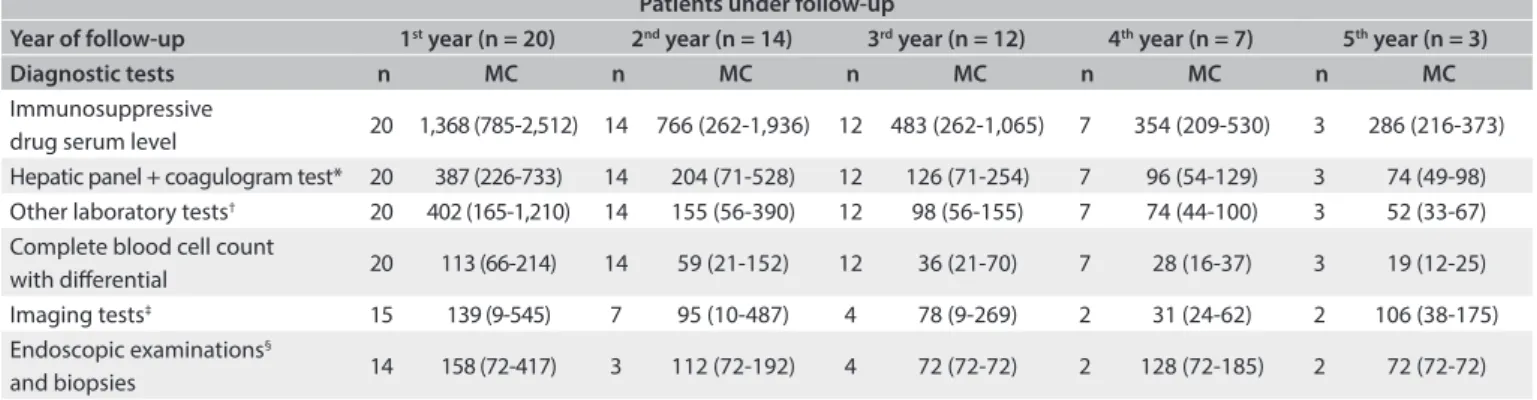
Diagnostic tests
The following laboratory tests were performed for all patients every year: hepatic panel (alanine aminotransferase, ALT; aspartate aminotransferase, AST; gamma glutamyl
transpep-tidase, γGT; alkaline phosphatase, ALP; bilirubins and
coag-ulogram), other biochemical tests (serum urea, creatinine, sodium, calcium, potassium and glucose), blood cell count and serum assays on immunosuppressive drugs (cyclosporine and tacrolimus). The number of times that these tests were done also decreased during the follow-up and ranged from 16to 53 (mean: 27.6) in the first year after transplantation; 5 to 37 (mean: 14.4) in the second year; 5 to 18 (mean, 8.9) in the third year; 4 to 9 (mean: 6.9) in the fourth year; and 3 to 6 (mean: 4.6) in the fifth year.
he frequencies of other diagnostic tests, such as radiographs, abdominal ultrasound, echocardiography, computed tomography (CT), cholangiopancreatography resonance, bone densitometry, scintigraphy, endoscopy and biopsy, which were not routinely
per-formed for all patients, also decreased over time (Table 3).
Table 1. Characteristics of adults in outpatient care after liver transplantation due to acute liver failure at Hospital das Clínicas (HC), Faculdade de Medicina da Universidade de São Paulo (FMUSP), Brazil 2005-2009
Characteristics Patients (n = 20)
Age at liver transplantation (years)
Mean ± SD 38 ± 14 Median (min-max) 37 (18-64) Sex (male/female) 4/16 Causes of acute liver failure, n (%)
Drug-induced liver injury 9 (45)
Hepatitis B 4 (20)
Autoimmune hepatitis (suspected) 2 (10)
Hepatitis A 1 (5)
Wilson’s disease 1 (5)
Indeterminate 3 (15)
Preexisting conditions, n (%)
Hypertension 4 (20)
Diabetes mellitus 2 (10)
Obesity 1 (5)
Tuberculosis 2 (10)
Hyperthyroidism 2 (10)
SD = standard deviation.
Patients under follow-up
1st year (n = 20) 2nd year (n = 14) 3rd year (n = 12) 4th year (n = 7) 5th year (n = 3)
Medication n MC n MC n MC n MC n MC
Immunosuppressive drugs 20 13,438 (855-23,673) 14 11,133 (1,260-18,755) 11 7,450 (1,212-10,923) 7 5,846 (460-11,408) 3 4,965 (1,060-10,194) Ganciclovir/valganciclovir 8 5,953 (2,098-15,581) 1 1,199 (1,199-1,199) 0 0 0 0 0 0 Hepatitis B immunoglobulin
and lamivudine 4 3,321 (1,566-3,914) 0 0 0 0 0 0 0 0
Sulfamethoxazole-trimethoprim 19 3,009 (442-6,163) 1 4,224 (4,224-4,224) 0 0 0 0 0 0 Ursodeoxycholic acid 10 1,547 (10-3,448) 5 1,873 (622-3,723) 2 3,070 (2,417-3,723) 2 3,509(3,509-3,509) 0 0 Omeprazole 18 70 (13-106) 8 91 (5-110) 4 110 (110-110) 4 110 (110-110) 3 105 (95-110) Antihypertensive drugs 7 14 (2-44) 4 21 (7-55) 3 28 (7-66) 1 66 (66-66) 1 91 (91-91) Other drugs 13 49 (0.2-313) 4 34 (1.75-122) 2 18 (1-34) 1 40 (40-40) 0
Table 2. Number of patients under treatment and mean costs of medications according to the year of follow-up (in Brazilian reais)
Serum assaying of immunosuppressive drugs was the main driver of diagnostic test costs. Although hepatic panels and other biochemical tests were not individually expensive, these also led to substantial costs due to the high frequency with which they were repeated.
Medical visits
he number of medical visits decreased over time, ranging from 13 to 43 (mean: 23) in the irst year of follow-up ater transplan-tation; from 4 to 35 (mean: 13.2) in the second year; from 3 to 16 (mean: 8) in the third year; from 5 to 10 (mean: 7.8) in the fourth year; and from 3 to 10 (mean: 6.3) in the ith year.
Hospitalizations
In the irst year of outpatient follow-up, 14 post-transplant patients (70%) were hospitalized, thus totaling 30 hospital admis-sions (1-6/patient). he length of hospitalizations ranged from 1 to 29 (mean: 13.4) days. here were decreases in the num-bers of hospital admissions in the subsequent years. In the sec-ond year of follow-up, six patients had 10 hospital admissions (1-4/patient) and the duration of hospitalizations ranged from 1 to 16 days (mean: 6). In the third year ater transplantation, three patients had ive hospital admissions (1-3/patient); the
length of hospitalizations ranged from 1 to 4 days (mean: 2). In the fourth year, there was one hospitalization (2 days in length). No hospitalizations occurred in the ith year of follow-up ater transplantation. he main cause of hospital admissions was “abnor-mal liver enzymes”, which was responsible for 11 events during the 5-year follow-up; followed by fever (5 hospital admissions), biliary drainage (4) and abdominal pain (4). he other causes of hospital admissions were diarrhea and vomiting (3), diabetes
mellitus (3) and incisional hernia repair (3).
Direct medical costs
he mean total costs and minimum and maximum values for the
ive-year period ater transplantation are presented in Table 4.
he total cost of all 20 patients over the ive-year period fol-low-up ater liver transplantation at our hospital was R$ 952,161 (US$ 408,653). he mean cost per patient/year was R$ 13,569 (US$ 5,824). In the irst year ater transplantation, the mean total cost of follow-up was R$ 32,546 (US$ 13,968) and presented a large variation, ranging from R$ 6,486 (US$ 2,784) to R$ 72,247 (US$ 31,007) per patient. here was a let-skewed gamma
dis-tribution in the mean direct costs (Figure 1). In the second year
ater transplantation, the mean total costs were about half of the amount of the irst-year costs (R$ 15,165 or US$ 6,509) and
Patients under follow-up
Year of follow-up 1st year (n = 20) 2nd year (n = 14) 3rd year (n = 12) 4th year (n = 7) 5th year (n = 3)
Diagnostic tests n MC n MC n MC n MC n MC
Immunosuppressive
drug serum level 20 1,368 (785-2,512) 14 766 (262-1,936) 12 483 (262-1,065) 7 354 (209-530) 3 286 (216-373) Hepatic panel + coagulogram test* 20 387 (226-733) 14 204 (71-528) 12 126 (71-254) 7 96 (54-129) 3 74 (49-98) Other laboratory tests† 20 402 (165-1,210) 14 155 (56-390) 12 98 (56-155) 7 74 (44-100) 3 52 (33-67)
Complete blood cell count
with diferential 20 113 (66-214) 14 59 (21-152) 12 36 (21-70) 7 28 (16-37) 3 19 (12-25) Imaging tests‡ 15 139 (9-545) 7 95 (10-487) 4 78 (9-269) 2 31 (24-62) 2 106 (38-175)
Endoscopic examinations§
and biopsies 14 158 (72-417) 3 112 (72-192) 4 72 (72-72) 2 128 (72-185) 2 72 (72-72)
Table 3. Numbers of patients undergoing diagnostic tests and test costs according to the year of follow-up (in Brazilian reais)
n = Number of patients in treatment; MC = Mean costs (min-max). *Hepatic panel: alanine aminotransferase (ALT), aspartate aminotransferase (AST), gamma glutamyl transpeptidase (γGT), alkaline phosphatase (ALP), bilirubins (total, direct and indirect). Coagulogram test = (prothrombin time + INR); †Other laboratory tests: serum
urea, creatinine, sodium calcium, potassium, glucose and hepatitis B; ‡Imaging: radiographs, abdominal ultrasound, echocardiography, computed tomography (CT),
cholangiopancreatography resonance, bone densitometry, scintigraphy; §Endoscopic examinations: endoscopy, colonoscopy, enteroscopy, bronchoscopy.
Table 4. Mean and total direct medical costs incurred per patient according to year of follow-up*, 2005-2009
Resource items 1
st year 2nd year 3rd year 4th year 5th year 1st - 5th year
Mean costs (min-max) Mean costs (min-max) Mean costs (min-max) Mean costs (min-max) Mean costs (min-max) Total
Medication 21,718 (4,720-40,132) 11,677 (1,581-24,036) 7,119 (1,099-11,998) 5,550 (397-9,949) 4,196 (1,026-8,477) 734,723 Hospitalizations 7,853 (345-26,467) 2,117 (1,321-2,645) 1,019 (636-1,401) 258 (258-258) 0 122,827 Diagnostic tests 2,744 (1,291-5,218) 1,246 (390-3,328) 760 (371-1,585) 548 (280-858) 492 (286-665) 86,748 Medical visits 230 (130-430) 126 (38-333) 72 (27-145) 68 (52-95) 31,01 (25-82) 7,864
Mean cost/patient 32,546 15,166 8,970 6,424 4,740 13,569
Total costs 603,796 193,269 97,461 43,416 14,220 952,161
ranged from R$ 3,330 (US$ 1,429) to R$ 30,342 (US$ 13,022) per patient. he higher costs in the irst year of follow-up can be attributed to higher spending on hospitalization and medication. Hospitalization contributed 18% of all the direct medical costs. In the second year ater transplantation, the contribution of hos-pitalization fell to approximately 6%. Medication accounted for approximately 85% of the total costs throughout the follow-up
period. Figure 2 shows the major cost drivers during the
post-transplantation follow-up. Medication was the largest contribu-tor to the costs, followed by hospitalization. In the fourth year, diagnostic tests costs surpassed the hospitalization costs.
DISCUSSION
The total direct cost over the five-year follow-up period after liver transplantation for these 20 patients in a tertiary-level university hospital in São Paulo was R$ 952,161 (US$ 408,653). The first year of follow-up was the most expensive and medi-cation was the main driver of the total costs, accounting for
85% of the total costs over the five-year follow-up period, and 71.9% of the first-year total costs. As expected, the costs decreased over the years due to reductions in the numbers of immunosuppressive drugs and dosages used, as well as declin-ing hospitalization. In the third and fourth years, ursodeoxy-cholic acid, with low unit cost but continuous use, became the second largest cost among the medications.
In Brazil, only data on the hospital costs of the
transplan-tation procedure have been published.2,3 he costs involved in
hospitalization are relatively simple to estimate, but the subse-quent phases can be extremely variable in terms of healthcare utilization, and hence costs, because of diferences in patient severity and surgical outcomes. To our knowledge, our study was the irst to evaluate the costs of outpatient follow-up ater liver transplantation in Brazil.
Direct comparison of costs between diferent studies is dii-cult due to diferences in the healthcare systems of diferent
coun-tries and the time periods analyzed.6 Nonetheless, our indings are
similar to what has been reported in some international studies. In a study in Taiwan that evaluated the total costs of outpatient care over the irst year ater kidney, heart and lung transplantation, using a countrywide health claims database, drugs were the main component of outpatient costs and were responsible for around 80-90% of the total healthcare costs. In relation to liver transplan-tation, medication was responsible for 85.75% of the total costs over the irst year of follow-up, whereas the estimate in our study
was 71.9%.7 In another study that prospectively evaluated the costs
starting from inclusion in the liver transplant waiting list to the end of the irst year ater transplantation, in a French university
hos-pital, drug expenses accounted for 70% of outpatient care costs.8
he majority of the studies that have evaluated outpatient costs took into consideration the costs of the irst year ater the surgical procedure. In our study, we evaluated the costs over a fol-low-up period of ive years ater liver transplantation. he costs were calculated using the bottom-up approach (except for hos-pitalizations, for which the hospital charges were used), which allowed us to identify all the cost elements individually.
Our study only included patients with ALF. Liver trans-plant due to ALF has high early mortality and grat loss,
par-ticularly within the irst year ater transplantation.9 Ater this
critical period, these patients’ long-term prognosis is quite good. In a study comparing the costs of transplantation proce-dures and the irst-year follow-up, patients with ALF had 42% higher costs than patients with chronic disease. his diference resulted mainly from hospitalization, intensive care and sup-port system costs (molecular adsorbent recirculating system). However, over the subsequent two to ive years, the costs were lower among ALF patients. Immunosuppressive drug costs
were signiicantly higher among chronic patients.10
Figure 2. Summary breakdown of mean direct medical costs incurred per person per resource use per year of outpatient follow-up after liver transplantation.
0 5000 10000 15000 20000 25000 30000 35000
1st year 2nd year 3rd year 4th year 5th year
Medication Hospitalization Diagnostic tests Medical visits 80000
70000
60000
50000
40000
30000
20000
10000
0
1 2 3 4 5 6 7 8 9 10 11 12 13 14 15 16 17 18 19 20
he estimates constructed in our study are essential for con-ducting a Brazilian model-based cost-efectiveness analysis. Data from cost estimates are considered to have low transferability. he economic evaluation guidelines are very strict and do not allow these data to be transferred under any circumstances. Cost unit estimates must be speciic to the context under evaluation, due to diferences in absolute and relative prices between
coun-tries.11 A Brazilian model will require the pattern of care
prac-ticed in local health services in order to determine the resources (medical consultations, hospitalizations, diagnostic tests, medi-cations, etc.), and the amounts used in outpatient, inpatient and
transplant cases and in post-transplantation follow-up.12
Our study has several limitations. Although we analyzed all the patients who received transplants due to ALF and who were being followed up at our center during the period studied, the sample size was small. his is a limitation because of the diversity of causes of liver transplantation and the possible clinical evolution, complica-tions and sequelae ater transplantation. here were smaller num-bers of patients in the last two years of follow-up: seven patients in the fourth year and three patients in the ith year.
Hospitalizations were important cost drivers in economic eval-uations, but because of the lack of detailed (patient level) data, the top-down approach was the only feasible option. he top-down approach has been used in several countries, including Australia, Belgium, Sweden, United Kingdom and the United States, to cal-culate hospital treatment costs. Moreover, the top-down approach
is cheaper and faster than the bottom-up approach.13 he
bot-tom-up methodology enables detection of costs diferences between patients of each single component of resource use. his methodology is time consuming, mainly when hospital infor-mation systems are absent or inadequate, and it has not been widely used because of its low feasibility. he bottom-up method can be highly accurate but expensive to use. On the other hand, the top-down method is more feasible, but its disadvantage is that it fails to trace costs of speciic patients. herefore, cost dif-ferences between patients cannot be revealed. he bottom-up and top-down methods are not mutually exclusive. In fact, it is oten appropriate to use both methodologies in the same study.
he SUS reimbursement fees used in this study might be a use-ful approximation, which may be more relevant from a national perspective than costs calculated within that particular hospital.
Another limitation of the study is that it evaluated just one center, a teaching hospital in São Paulo, which is the big-gest city in Brazil. Teaching hospitals that focus on research and education are considered costly in relation to other hospitals. his center in São Paulo is not representative of all Brazilian transplantation centers. It is diicult to generalize the costs of follow-up ater transplantation from this center to other states in Brazil, which is a heterogeneous country with difering realities
and social conditions. In other centers, the healthcare resource utilization may be less intensive, with fewer diagnostic tests and less expensive drugs in routine practice care.
CONCLUSIONS
We studied only the direct medical costs of the follow-up. Direct non-medical and indirect costs, which are an impor-tant part of the costs ater transplantation, were not addressed in the present study, because of the complexity of the meth-odology involved. Despite these caveats, this analysis provides signiicant insight into the costs of outpatient follow-up ater liver transplantation and the participation of each cost compo-nent in the Brazilian setting. Further studies need to be con-ducted in multiple transplant centers, with bigger samples, including patients who received transplants due to chronic liver disease, and direct non-medical and indirect costs. Economic evaluation methods in healthcare can be an important tool for assessing the costs of health technologies and helping policy makers inform eicient funding allocations. Knowing these costs is the irst step towards establishing a speciied threshold, identifying cost outliers and reducing costs, in a country where choices and priorities need to be set.
REFERENCES
1. Associação Brasileira de Transplante de Órgãos. Dados pediátricos. Dados numéricos da doação de órgãos e transplantes realizados por estado e instituição no período: Janeiro/Dezembro - 2011. Registro Brasileiro de Transplantes (RBT). 2011;XVII(4). Available from: http://www.abto.org.br/abtov03/Upload/ile/RBT/Pediatrico/ Pediatrico_2011.pdf. Accessed in 2013 (Nov 1).
2. Portela MP, Neri ED, Fonteles MM, et al. O custo do transplante hepático em um hospital universitário do Brasil [The cost of liver transplantation at a university hospital of Brazil]. Rev Assoc Med Bras. 2010;56(3):322-6. 3. Coelho JC, Wiederkehr JC, Lacerda MA, et al. Custo do transplante
hepático no Hospital de Clínicas da Universidade Federal do Paraná [Cost of liver transplantation at the Clinical Hospital of the University of Parana, Brazil]. Rev Assoc Med Bras. 1997;43(1):53-7.
4. Brasil. Ministério da Saúde. Datasus. SIGTAP. Sistema de Gerenciamento da Tabela de Procedimentos, Medicamentos e OPM do SUS. 2008. Available from: http://sigtap.datasus.gov.br/tabela-uniicada/app/ sec/inicio.jsp. Accessed in 2013 (Nov 1).
5. Lucey MR, Terrault N, Ojo L, et al. Long-term management of the successful adult liver transplant: 2012 practice guideline by the American Association for the Study of Liver Diseases and the American Society of Transplantation. Liver Transpl. 2013;19(1):3-26. 6. van der Hilst CS, Ijtsma AJ, Sloof MJ, Tenvergert EM. Cost of liver
7. Lee EK, Cham TM, Tseng PL. Using the pharmacoepidemiology approach to evaluate the irst-year posttransplantation ambulatory health care cost from the Longitudinal Health Insurance Database (2001 to 2006) in Taiwan. Transplant Proc. 2010;42(3):957-60. 8. Rufat P, Fourquet F, Conti F, et al. Costs and outcomes of liver
transplantation in adults: a prospective, 1-year, follow-up study. GRETHECO study group. Transplantation. 1999;68(1):76-83.
9. Germani G, Theocharidou E, Adam R, et al. Liver transplantation for acute liver failure in Europe: outcomes over 20 years from the ELTR database. J Hepatol. 2012;57(2):288-96.
10. Åberg F, Mäklin S, Räsänen P, et al. Cost of a quality-adjusted life year in liver transplantation: the inluence of the indication and the model for end-stage liver disease score. Liver Transpl. 2011;17(11):1333-43. 11. Barbieri M, Drummond M, Rutten F, et al. What do international
pharmacoeconomic guidelines say about economic data transferability? Value Health. 2010;13(8):1028-37.
12. De Soárez PC, Sartori AM, Santos A, et al. Contributions from the systematic review of economic evaluations: the case of childhood hepatitis A vaccination in Brazil. Cad Saude Publica. 2012;28(2):211-28.
13. Mogyorosy Z, Smith P. The main methodological issues in costing health care services. A literature review. CHE Research Paper 7. York: University of York. Available from: http://www.york.ac.uk/che/pdf/ rp7.pdf. Accessed in 2013 (Nov 1).
Sources of funding: None
Conlict of interest: None
Date of irst submission: April 9, 2013
Last received: February 11, 2014
Accepted: March 7, 2014
Address for correspondence:
Patricia Coelho de Soárez
Faculdade de Medicina da Universidade de São Paulo Av. Dr. Arnaldo, 455 – sala 2.221
Cerqueira César — São Paulo (SP) — Brasil CEP 01246-903