Efect of preoperative gabapentin on pain intensity
and development of chronic pain after carpal tunnel
syndrome surgical treatment in women: randomized,
double-blind, placebo-controlled study
Efeito da gabapentina pré-operatória na intensidade da dor e desenvolvimento
de dor crônica após o tratamento cirúrgico da síndrome do túnel do carpo em
mulheres: estudo randomizado duplo-cego controlado com placebo
Eduardo Jun Sadatsune
I, Plínio da Cunha Leal
II, Rachel Jorge Dino Cossetti
III, Rioko Kimiko Sakata
IVUniversidade Federal de São Paulo (Unifesp), São Paulo (SP), Brazil
ABSTRACT
CONTEXT AND OBJECTIVES: Efective postoperative analgesia is important for reducing the incidence of chronic pain. This study evaluated the efect of preoperative gabapentin on postoperative analgesia and the incidence of chronic pain among patients undergoing carpal tunnel syndrome surgical treatment. DESIGN AND SETTINGS: Randomized, double-blind controlled trial, Federal University of São Paulo Pain Clinic.
METHODS: Forty patients aged 18 years or over were randomized into two groups: Gabapentin Group received 600 mg of gabapentin preoperatively, one hour prior to surgery, and Control Group received placebo. All the patients received intravenous regional anesthesia comprising 1% lidocaine. Midazolam was used for sedation if needed. Paracetamol was administered for postoperative analgesia as needed. Codeine was used additionally if the paracetamol was insuicient. The following were evaluated: postop-erative pain intensity (over a month period), incidence of postoppostop-erative neuropathic pain (over a six-month period), need for intraoperative sedation, and use of postoperative paracetamol and codeine. The presence of neuropathic pain was established using the DN4 (Douleur Neuropathique 4) questionnaire. Complex regional pain syndrome was diagnosed using the Budapest questionnaire.
RESULTS: No diferences in the need for sedation, control over postoperative pain or incidence of chron-ic pain syndromes (neuropathic or complex regional pain syndrome) were observed. No diferences in postoperative paracetamol and codeine consumption were observed.
CONCLUSIONS: Preoperative gabapentin (600 mg) did not improve postoperative pain control, and did not reduce the incidence of chronic pain among patients undergoing carpal tunnel syndrome surgery.
RESUMO
CONTEXTO E OBJETIVOS: Analgesia pós-operatória eicaz é importante para reduzir a incidência de dor crônica. Este estudo avaliou o efeito da gabapentina pré-operatória na analgesia pós-operatória e na inci-dência de dor crônica em pacientes submetidos à cirurgia para tratamento da síndrome do túnel do carpo. DESENHO E LOCAL: Randomizado, duplo cego, Universidade Federal de São Paulo.
MÉTODOS: Os 40 pacientes com 18 anos ou mais de idade foram distribuídos aleatoriamente em dois grupos: o Grupo Gabapentina recebeu 600 mg de gabapentina no pré-operatório uma hora antes da ci-rurgia, e o Grupo Controle recebeu placebo. Todos os pacientes receberam anestesia regional intravenosa com lidocaína a 1%. Midazolam foi utilizado para sedação, se necessário. Paracetamol foi administrado para analgesia pós-operatória, conforme necessário, e codeína, se o paracetamol fosse insuiciente. Foram ava-liados: a intensidade da dor pós-operatória (durante seis meses), a incidência de dor neuropática pós-ope-ratória (durante seis meses), a necessidade de sedação intra-opepós-ope-ratória e o uso de paracetamol e codeína no pós-operatório. A presença de dor neuropática foi estabelecida utilizando-se o questionário DN4 (dor neuropática 4). Síndrome de dor regional complexa foi diagnosticada através do questionário Budapeste. RESULTADOS: Não foram observadas diferenças na necessidade de sedação, no controle da dor pós-ope-ratória e na incidência de síndromes dolorosas crônicas (neuropáticas ou síndrome de dor regional com-plexa). Não foram observadas diferenças no consumo de paracetamol e codeína.
CONCLUSÕES: Gabapentina pré-operatória (600 mg) não melhorou o controle da dor pós-operatória e não reduziu a incidência de dor crônica em pacientes submetidos à cirurgia para tratamento da síndrome do túnel do carpo.
IMD, MSc. Anesthesist, Department of Surgery,
Universidade Federal de São Paulo (Unifesp), São Paulo, SP, Brazil.
IIMD, PhD. Professor, Department of Medicine I,
Universidade Federal do Maranhão (UFMA), São Luís, MA, Brazil.
IIIMD. Professor, Department of Medicine I,
Universidade Federal do Maranhão (UFMA), São Luís, MA, Brazil.
IVMD, PhD. Professor, Department of Surgery,
Universidade Federal de São Paulo (Unifesp), São Paulo, SP, Brazil.
KEY WORDS:
Pain, postoperative. Chronic pain. Carpal tunnel syndrome. Neuralgia.
Anesthesia, conduction.
PALAVRAS-CHAVE:
Dor pós-operatória. Dor crônica.
Síndrome do túnel carpal. Neuralgia.
INTRODUCTION
Carpal tunnel syndrome surgery is usually a short outpatient procedure performed under intravenous regional anesthesia (IVRA). However, this type of anesthesia is unable to maintain postoperative analgesia.1,2
Many patients will develop chronic pain ater hand sur-gery, especially complex regional pain syndrome, which is asso-ciated with neuropathic, inlammatory and sympathetic dysfunc-tion mechanisms.3,4 Postoperative chronic pain (POCP) has been observed in more than 20% of patients ater carpal tunnel release.1,5
he occurrence of postoperative acute pain is an important predictor for the development of chronic pain. Adequate analge-sia in the acute postoperative phase reduces the risk of chronic pain. Efective postoperative analgesia is of major importance for preventing POCP.6,7
Gabapentin is known to reduce dorsal horn neuron excit-ability and central sensitization through various mechanisms.8-10 A review of the literature suggested that the incidence of postop-erative chronic pain was reduced through using gabapentin peri-operatively.11 However, a study on a single preoperative 300 or 600 mg dose of gabapentin prior to caesarean section did not show any improvement in pain control.12 herefore, the role of preoperative gabapentin for postoperative pain control remains a matter of controversy.
his study evaluated the efect of preoperative gabapentin on postoperative pain control and chronic pain incidence among patients undergoing carpal tunnel syndrome surgery under IVRA. he primary objective was to evaluate the efect of preop-erative gabapentin on postoppreop-erative pain control. he secondary objectives were to investigate the incidence of chronic pain, and the adverse event proile of gabapentin and lidocaine.
METHODS
Ethics approval for this study was provided by the Ethics Committee of the Federal University of São Paulo under the number 0223/09. he trial was registered at ClinicalTrials.gov (NCT01632215).
Study design
his was a prospective, randomized, double-blind study.
Place and setting
All patients underwent surgery performed using the same tech-nique (open carpal tunnel release surgery), by the same medi-cal team at the hospital of the Federal University of São Paulo between 2009 and 2011.
Participants
he inclusion criteria were that the patients needed to be 18 years of age or older, of either gender, and presenting American Society
of Anesthesia (ASA) physical status I or II, before open carpal tun-nel release surgery. Carpal tuntun-nel syndrome needed to have been diagnosed by means of clinical examinations (Phalen and Tinel tests) and electromyography (grade ≥ 2). he electromyography scale was graded as follows: normal (grade 0); very mild (grade 1), carpal tunnel syndrome demonstrable only with the most sensi-tive tests; mild (grade 2), sensory nerve conduction velocity slow on inger/wrist measurement, and normal terminal motor latency; moderate (grade 3), sensory potential preserved with motor slow-ing, and distal motor latency to abductor pollicis brevis (APB) < 6.5 ms; severe (grade 4), sensory potential absent but motor response preserved, and distal motor latency to APB < 6.5 ms; very severe (grade 5), terminal latency to APB > 6.5 ms; and extremely severe (grade 6), sensory and motor potentials efectively unrecord-able (surface motor potential from APB < 0.2 mV in amplitude).13 Patients presenting arrhythmia, myocardial ischemia, cogni-tive impairment, psychiatric disorders, drug abuse, pregnancy, sensitiveness to anesthetics or opioid, anticonvulsant or antide-pressant use were excluded.
he sample size was calculated using SPSS 17 for Windows. A reduction of approximately two points or 30% in the numeri-cal rating snumeri-cale14 for pain intensity represented a clinically impor-tant diference in chronic pain.15 To optimize the relevance of the study indings, a three-point diference in a numerical pain intensity score was chosen to be a clinically meaningful endpoint. For a power of 95% (beta), an alpha level of 5% and an estimated standard deviation of the population of 2.44, based on a prelimi-nary evaluation,16 the calculated sample size was 18 patients per group to demonstrate a three-point diference in the scores.
Randomization, allocation concealment and blinding he patients were randomly assigned to one of two paral-lel groups in a 1:1 ratio, through using the computer program Randomizer. Opaque envelopes were prepared in accordance with the computer randomization and were numbered and sealed by a researcher who was not involved in patient assessment. Each envelope contained either a gabapentin or a placebo tablet and was stored at the research hospital, to be given to the research physician prior to each surgery. he gabapentin and placebo tab-lets were identical in order to maintain patients and researchers blinded to the randomization group. None of the participating physicians or the researchers involved in data collection were aware of the patient study-group randomization. Patients ran-domized to the Gabapentin Group received 600 mg of gabapen-tin 1 hour prior to surgery. Patients randomized to the Control Group received placebo.
Preoperative and operative procedures
Anesthesia, surgical procedure and patient follow-up were per-formed by the same research physicians for all patients. Routine monitoring by means of electrocardiogram (ECG), pulse oxim-etry and noninvasive blood pressure (NIBP) was conducted throughout the duration of patient anesthesia. IVRA was per-formed with 20 ml of 1% lidocaine, using two tourniquets, in accordance with the technique described by Bier.2 In cases of persistent pain ater IVRA, local iniltration of 1% lidocaine was performed and the total dose used was recorded. Midazolam was administered for sedation if needed, e.g. if the patient became agitated, and the total dose was recorded.
Paracetamol (maximum of 4 g/24 h) was given if postsurgi-cal analgesia was required, for up to 6 months post-surgery, e.g. if patients reported moderate or severe pain, deined as a numerical scale score ≥ 4 (on a scale ranging from 1 to 10). Codeine (30 mg) was given if paracetamol was insuicient for pain control. he use of other drugs was not allowed for pain control during the follow-up period. he use of speciic orthosis was not allowed prior to or ater the procedure.
Outcomes (primary and secondary)
he primary outcome was pain intensity according to a numeri-cal snumeri-cale (0 = no pain, 10 = worst pain possible) prior to procedure (T-preoperative), at time 0 min (T0 = time of tourniquet release), 30 min, 1 h, 2 h, 2 weeks, 1 month, 3 months and 6 months ater the procedure. Secondary outcomes included: total dose of lido-caine supplementation; need for and dose of midazolam; post-operative need for and total dose of paracetamol and/or codeine; development of neuropathic pain and/or complex regional pain syndrome. he DN4 (Douleur Neuropathique 4) questionnaire,6 which evaluates seven sensory symptoms and three signs on physical exam, indicated neuropathic pain for patients with a score ≥ 4, measured at diferent assessment points (before anes-thesia and at 2 weeks, 1 month, 3 months and 6 months ater surgery). Complex regional pain syndrome was diagnosed using the Budapest questionnaire15 on scheduled assessment dates (2 weeks, 1 month, 3 months and 6 months ater surgery). Possible side efects were recorded.
Statistical analysis
SPSS 17 for Windows was used for the statistical analysis. Parametric variables were expressed as means ± standard devi-ation (SD). Nonparametric variables were described as median, 25th and 75th percentile values. he Mann-Whitney test was used to analyze age, weight, height and body mass index (BMI). he Chi-square test was applied to gender and pain scores. For pain intensity analysis, patients were grouped according to pain inten-sity score at the diferent assessment points: mild (score < 4) or
moderate/severe pain intensity (score ≥ 4). Proportion tests were used to assess pain intensity score groups between the assess-ment times (T-preoperative compared with other study points). he McNemar test was used for comparisons within the same study groups. he Mantel-Haenszel test was used for compari-sons between study groups. Student’s t test was used to analyze total paracetamol and midazolam doses, anesthesia and surgery duration, and occurrences of complex regional pain syndrome. Fisher’s test was used to evaluate occurrences of neuropathic pain and adverse efects, and the patients’ baseline character-istics (diabetes and prior treatment for carpal tunnel disease). he likelihood test was used to evaluate the electromyography grade of the carpal tunnel syndrome. Missing data were excluded from the analysis.
RESULTS
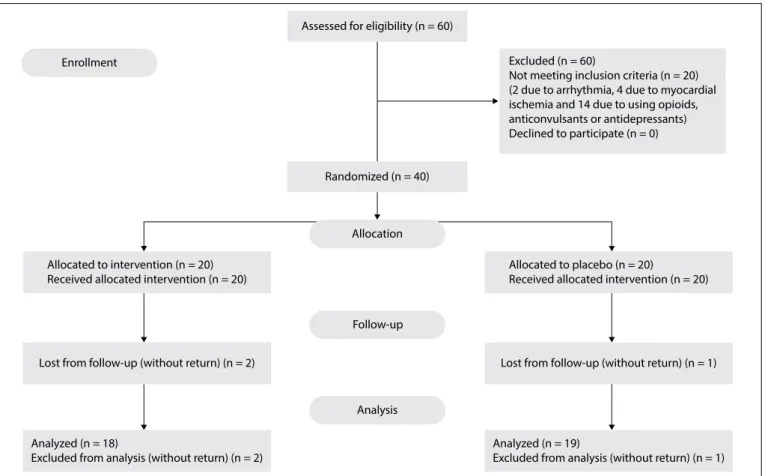
he patients’ recruitment and allocation lowchart, according to the CONSORT guideline, is shown in Figure 1. Twenty patients were excluded from the study: two due to arrhythmia, four due to myocardial ischemia and 14 due to opioid, anticonvulsant or antidepressant use. A total of 40 patients were included in the study, i.e. 20 in each group.
here were no diferences in patient demographics, duration of surgery and anesthesia, need for midazolam use, carpal tun-nel syndrome grade or previous diabetic status between the study groups (Table 1). Lidocaine supplementation was not required for any patient. All the patients were ASA I or II, with no difer-ence between the groups (P = 0.642). All the patients were female.
Table 1. Demographic data of patients with carpal tunnel syndrome
Gabapentin (n = 20) Control (n = 20) P
Age (years) 51.5 (48.5-54) 52.1 (46-56.7) 0.583*
Weight (kg) 65.7 (59.2-73) 68.7 (60-75) 0.383*
Height (cm) 158 (155-161.5) 157 (154-162) 0.939*
BMI (kg/m2) 26.2 (23.6-28.7) 27.5 (23.9-31.4) 0.659*
Duration of
surgery 33.06 ± 10.86 min 33.06 ± 16.90 min 0.894
†
Duration of
anesthesia 55.00 ± 11.50 min 54.21 ± 11.33 min 0.835
†
Need for
midazolam 7/18 5/19 0.823
†
Grade of carpal syndrome
Grade 2 1 2
0.93‡
Grade 3 7 8
Grade 4 10 10
Grade 5 1 1
Diabetes 2/18 1/19 1.00§
Treatment
naive 18/18 19/19 1.00
§
he postoperative assessments showed lower pain intensity scores in comparison with the preoperative baseline pain inten-sity within the same study groups, except for the T30 min assess-ment (McNemar’s test, Table 2). However, there was no statisti-cally signiicant diference in pain intensity scores over time in comparisons across study groups (Mantel-Haenszel test, Table 2). here was no statistically signiicant diference in the incidence of chronic neuropathic pain (Table 3) or complex regional pain syndrome between the study groups (Table 4).
here was no diference in the use of paracetamol (Gabapentin Group: 24.6 ± 30.1 doses; 95% CI: 13.1 ± 48.1; and Control Group: 30.9 ± 36.9 doses; 95% CI: 9.6 - 39.5; P = 0.572; Student’s t test) or codeine supplementation (Gabapentin Group: 0; Control Group: 1) over the six-month observation period between the study groups.
he adverse efects were similar at the preoperative assessment (beginning of surgery): metallic taste: 4 versus 2 (P = 0.660); oral paresthesia: 2 versus 1 (P = 1.0); dizziness: 4 versus 4 (P = 1.0); som-nolence: 4 versus 3 (P = 1.0); and tinnitus 2 versus 4 (P = 0.660); for the Gabapentin and Control groups, respectively. No diferences in adverse efects at the end of surgery were noted: metallic taste: 0 versus 1 (P = 1.0); oral paresthesia: 0 versus 0; dizziness: 3 versus 1 (P = 0.605); drowsiness: 2 versus 0 (P = 0.487); and tinnitus: 2 versus 0 (P = 0.486); for the Gabapentin and Control groups, respectively.
DISCUSSION
he current study did not demonstrate any diference in pain intensity scores, incidence of postoperative chronic pain (POCP)
or complex regional pain syndrome (CRPS), need for addi-tional postoperative analgesia or incidence of adverse efects, through using preoperative gabapentin for open carpal tunnel release surgery.
he demographic data were similar between the study groups. Interestingly, only female patients were included, despite no exclusion of male patients. his could be explained by the known higher prevalence of carpal tunnel syndrome in women.5
Previous studies have shown that there is a reduced risk of POCP ater other types of surgery with the use of gabapentin pre-operatively.17-19 In the current report, the observed incidence of POCP and CRPS was lower for the gabapentin group, but it did not reach statistical signiicance, despite a numerical diference.
Gabapentin was administered one hour prior to surgery to allow for drug absorption.20 he use of a single 600 mg dose of gabapentin could explain the lack of eicacy observed. Pre and postoperative gabapentin administration could have prevented central sensitiza-tion from previous pain stimulus, surgical trauma and postopera-tive inlammation, and may have inluenced the outcomes.
However, the use of 600 mg of gabapentin preoperatively fol-lowed by two-day maintenance had no beneicial efect ater total knee arthroplasty.21 Also, two study reviews were unable to dem-onstrate that preoperative gabapentin was efective for prevention of postoperative chronic pain,22 even at a higher dose (1200 mg).23 However, it should be noted that there was a diference in surgical trauma between those studies and the current report.
A study by Pandey et al.24 demonstrated that there was lower opioid consumption and reduced pain scores through using a single
Table 2. Intensity of pain (pain ≥ 4/pain < 4) among patients operated for carpal tunnel syndrome
Time points Gabapentin (n = 18) McNemar’s test
(Gabapentin Group)* Control (n = 19)
McNemar’s test
(Control Group)* Chi-square Mantel-Haenszel test*
Preoperative 17/1 18/1 0.969
T0 1/17 0.000 1/18 0.000 0.969 0.221
30 minutes 15/3 0.625 18/1 1.00 0.264 0.518
1 hour 4/14 0.01 8/11 0.02 0.197 0.824
2 hours 0/18 n/a 0/19 n/a n/a n/a
2 weeks 9/9 0.012 12/7 0.05 0.634 0.596
1 month 8/10 0.012 11/8 0.039 0.413 0.496
3 months 4/14 0.001 4/15 0.001 0.931 0.067
6 months 3/15 0.000 2/17 0.000 0.948 0.637
T0 = time of tourniquet release; n/a = not applicable; * = P-values.
Table 3. Neuropathic pain (DN4 questionnaire) in patients operated for carpal tunnel syndrome: n (%)
Time points Gabapentin (n = 18) Control (n = 19) P*
Preoperative 18 (100) 19 (100) 1.000
2 weeks 6 (33.3) 8 (42.1) 0.737
1 month 5 (27.8) 8 (42.1) 0.495
3 months 5 (27.8) 7 (36.8) 0.728
6 months 4 (22.2) 5 (26.3) 1.000
DN4 (Douleur Neuropathique 4) questionnaire; *Fisher’s test.
Table 4. Complex regional pain syndrome according to the Budapest questionnaire among patients operated for carpal tunnel syndrome: n (%)
Time points Gabapentin (n = 18) Control (n = 19) P*
2 weeks 5 (27.7) 9 (47.3) 0.231
1 month 6 (33.3) 10 (52.6) 0.131
3 months 4 (22.2) 6 (31.6) 0.535
6 months 3 (16.7) 3 (15.8) 0.944
pre or postoperative gabapentin dose ater open-door nephrectomy, compared with placebo, but no diference between pre or postoper-ative gabapentin. Further studies are still required, in order to better evaluate the efect of gabapentin on POCP prevention.25,26
he duration of the surgical procedure is known to have an impact on the development of POCP. Procedures that last longer than three hours have been correlated with an increased risk of POCP.27 However, the total duration of the surgical procedure in the current study was shorter than three hours, which may have contributed towards reduced incidence of POCP.
Brogly et al.17 demonstrated that there was lower incidence of POCP through using preoperative gabapentin prior to thyroidec-tomy.17 he current report only assessed patients until six months of follow-up. However, evaluation ater six months would most likely not ind any diferences in POCP, given that the pain inten-sity was already mild in both groups at six months.
Surgical procedures that may cause nerve injury have also been correlated with POCP.1 Previous studies have reported a wide range of POCP (5 to 80%), which may be related to diferent deinitions in the various studies.28,29 Study design, POCP assess-ment and interpretation of results may also contribute towards this variability.28
he incidence of POCP found in this report was higher than what was previously described.1 he observed incidence of POCP was 27.8% and 36.8% at three months, and 22.2% and 26.3% at six months, for G1 and G2, respectively, compared with 21% and 12% at three and six months reported by Yung et al.1 One possible explanation might be the diference in surgical techniques: a lim-ited open carpal tunnel release procedure was used in the above mentioned study. his could result in diferent eicacy, scar tissue compression of the median nerve and surgery-associated nerve injury, thus leading to POCP.1
IVRA is a simple anesthetic technique commonly used for carpal tunnel syndrome release. his type of surgery can usually be performed without intraoperative anesthetic supplementation because IVRA is suicient for local anesthesia. As expected, there was no need for additional anesthesia in this study. Also, no seda-tion was required since it is a fast procedure associated with low levels of patient distress.
However, its analgesic efect is limited to the duration of tour-niquet use. Additional medication is usually necessary in order to maintain postoperative analgesia,2 and this was implemented through using paracetamol and codeine. he use of preoperative gabapentin did not afect postoperative analgesic consumption. Figure 1. Patients’ recruitment and allocation lowchart.
Assessed for eligibility (n = 60)
Enrollment
Randomized (n = 40)
Allocation
Excluded (n = 60)
Not meeting inclusion criteria (n = 20) (2 due to arrhythmia, 4 due to myocardial ischemia and 14 due to using opioids, anticonvulsants or antidepressants) Declined to participate (n = 0)
Allocated to intervention (n = 20) Received allocated intervention (n = 20)
Allocated to placebo (n = 20)
Received allocated intervention (n = 20)
Follow-up
Lost from follow-up (without return) (n = 2) Lost from follow-up (without return) (n = 1)
Analysis
Analyzed (n = 18)
Excluded from analysis (without return) (n = 2)
Analyzed (n = 19)
Also, there was no diference in the reported side efects between the groups, as demonstrated by others.9,30 Common lidocaine-related side efects (e.g. metallic taste, oral paresthesia and tinnitus) were also not increased through using gabapentin.
LIMITATIONS OF THE STUDY
Gabapentin was given as a single preoperative dose, which may have been insuicient to reduce central sensitization and devel-opment of POCP. Use of gabapentin and other neuromodulatory drugs was not allowed for treating POCP, which may have con-tributed towards higher incidence of chronic pain. Additionally, this was a single-center study, which may limit the applicability of our results.
CONCLUSION
In conclusion, there was no diference in postoperative pain intensity through using a single 600 mg gabapentin dose ater open carpal tunnel release surgery.
Further studies are needed in order to determine the best perioperative gabapentin regimen for postoperative pain control and prevention of postoperative chronic pain syndrome ater car-pal tunnel surgery.
REFERENCES
1. Yung PS, Hung LK, Tong CW, Ho PC. Carpal tunnel release with a
limited palmar incision: clinical results and pillar pain at 18 months
follow-up. Hand Surg. 2005;10(1):29-35.
2. Colbern E. The Bier block for intravenous regional anesthesia:
technique and literature review. Anesth Analg. 1970;49(6):935-40.
3. Li Z, Smith BP, Tuohy C, Smith TL, Andrew Koman L. Complex regional
pain syndrome after hand surgery. Hand Clin. 2010;26(2):281-9.
4. Watts D, Kremer MJ. Complex regional pain syndrome: a review
of diagnostics, pathophysiologic mechanisms, and treatment
implications for certiied registered nurse anesthetists. AANA J.
2011;79(6):505-10.
5. Belze O, Remerand F, Laulan J, et al. Chronic pain after carpal tunnel
surgery: epidemiology and associated factors. Ann Fr Anesth Reanim.
2012;31(12):e269-74.
6. Poleshuck EL, Katz J, Andrus CH, et al. Risk factors for chronic
pain following breast cancer surgery: a prospective study. J Pain.
2006;7(9):626-34.
7. Sng BL, Sia AT, Quek K, Woo D, Lim Y. Incidence and risk factors for
chronic pain after caesarean section under spinal anaesthesia.
Anaesth Intensive Care. 2009;37(5):748-52.
8. Maneuf YP, Gonzalez MI, Sutton KS, et al. Cellular and molecular
action of the putative GABA-mimetic, gabapentin. Cell Mol Life Sci.
2003;60(4):742-50.
9. Dahl JB, Mathiesen O, Møiniche S. ‘Protective premedication’: an
option with gabapentin and related drugs? A review of gabapentin
and pregabalin in the treatment of post-operative pain. Acta
Anaesthesiol Scand. 2004;48(9):1130-6.
10. Gidal BE. New and emerging treatment options for neuropathic pain.
Am J Manag Care. 2006;12(9 Suppl):S269-78.
11. Clarke H, Bonin RP, Orser BA, et al. The prevention of chronic postsurgical
pain using gabapentin and pregabalin: a combined systematic review
and meta-analysis. Anesth Analg. 2012;115(2):428-42.
12. Short J, Downey K, Bernstein P, Shah V, Carvalho JC. A single
preoperative dose of gabapentin does not improve postcesarean
delivery pain management: a randomized, double-blind,
placebo-controlled dose-inding trial. Anesth Analg. 2012;115(6):1336-42.
13. Bland JD. A neurophysiological grading scale for carpal tunnel
syndrome. Muscle Nerve. 2000;23(8):1280-3.
14. Hjermstad MJ, Fayers PM, Haugen DF, et al. Studies comparing
Numerical Rating Scales, Verbal Rating Scales, and Visual Analogue
Scales for assessment of pain intensity in adults: a systematic
literature review. J Pain Symptom Manage. 2011;41(6):1073-93.
15. Farrar JT, Young JP Jr, LaMoreaux L, Werth JL, Poole RM. Clinical
importance of changes in chronic pain intensity measured on an
11-point numerical pain rating scale. Pain. 2001;94(2):149-58.
16. Harden RN, Bruehl S, Perez RS, et al. Validation of proposed diagnostic
criteria (the “Budapest Criteria”) for Complex Regional Pain Syndrome.
Pain. 2010;150(2):268-74.
17. Brogly N, Wattier JM, Andrieu G, et al. Gabapentin attenuates late
but not early postoperative pain after thyroidectomy with supericial
cervical plexus block. Anesth Analg. 2008;107(5):1720-5.
18. Sen H, Sizlan A, Yanarateş O, et al. The efects of gabapentin on acute
and chronic pain after inguinal herniorrhaphy. Eur J Anaesthesiol.
2009;26(9):772-6.
19. Sen H, Sizlan A, Yanarates O, et al. A comparison of gabapentin and
ketamine in acute and chronic pain after hysterectomy. Anesth
Analg. 2009;109(5):1645-50.
20. Dirks J, Fredensborg BB, Christensen D, et al. A randomized study
of the efects of single-dose gabapentin versus placebo on
postoperative pain and morphine consumption after mastectomy.
Anesthesiology. 2002;97(3):560-4.
21. Paul JE, Nantha-Aree M, Buckley N, et al. Gabapentin does not
improve multimodal analgesia outcomes for total knee arthroplasty:
a randomized controlled trial. Can J Anaesth. 2013;60(5):423-31.
22. Dauri M, Faria S, Gatti A, et al. Gabapentin and pregabalin for the
acute post-operative pain management. A systematic-narrative
review of the recent clinical evidences. Curr Drug Targets.
2009;10(8):716-33.
23. Zakkar M, Frazer S, Hunt I. Is there a role for gabapentin in preventing
or treating pain following thoracic surgery? Interact Cardiovasc
Thorac Surg. 2013;17(4):716-9.
24. Pandey CK, Singhal V, Kumar M, et al. Gabapentin provides efective
postoperative analgesia whether administered pre-emptively or
25. Kehlet H. Perioperative analgesia to prevent chronic postmastectomy
pain. Anesth Analg. 2006;103(2):494; author reply 494-5.
26. Chaparro LE, Smith SA, Moore RA, Wifen PJ, Gilron I. Pharmacotherapy
for the prevention of chronic pain after surgery in adults. Cochrane
Database Syst Rev. 2013;24;7:CD008307.
27. Peters ML, Sommer M, de Rijke JM, et al. Somatic and psychologic
predictors of long-term unfavorable outcome after surgical
intervention. Ann Surg. 2007;245(3):487-94.
28. Macrae WA. Chronic post-surgical pain: 10 years on. Br J Anaesth.
2008;101(1):77-86.
29. Gerbershagen HJ, Ozgür E, Dagtekin O, et al. Preoperative pain as a
risk factor for chronic post-surgical pain - six month follow-up after
radical prostatectomy. Eur J Pain. 2009;13(10):1054-61.
30. Markman JD, Dworkin RH. Ion channel targets and treatment eicacy
in neuropathic pain. J Pain. 2006;7(1):S38-47.
Acknowledgment: CAPES (Coordenação de Aperfeiçoamento de
Pessoal de Nível Superior) for inancial support
Funding sources: Departmental, hospital-based, institutional
Conlict of interest: None
Date of irst submission: March 17, 2015
Last received: September 28, 2015
Accepted: October 7, 2015
Address for correspondence:
Rioko Kimiko Sakata
Rua Três de Maio, 61 — apto 51
Vila Clementino — São Paulo (SP) — Brasil
CEP 04044-020
Tel./Fax (+55 11) 5571-4341