INTRODUCTION
Article/Artigo
1. Programa de Pós-Graduação em Doenças Infecciosas e Parasitárias, Universidade Federal do Mato Grosso do Sul, Campo Grande, MS. 2. Laboratório de Parasitologia Humana, Centro de Ciências Biológicas e da Saúde, Universidade Federal do Mato Grosso do Sul, Campo Grande, MS. 3. Curso de Ciências Biológicas, Universidade Estadual de Mato Grosso, Cáceres, MT. 4. Departamento de Bioquímica e Biologia Molecular, Instituto Oswaldo Cruz, Fundação Oswaldo Cruz, Rio de Janeiro, RJ. 5. Coleção de Flebotomíneos, Centro de Referência Nacional e Internacional para Flebotomíneos, Centro de Pesquisas René Rachou, Fundação Oswaldo Cruz, Belo Horizonte, MG.
Address to: Dra. Alessandra Gutierrez de Oliveira. Lab. Parasitologia Humana/CCBS/UFMS. Cidade Universitária s/n, 79070-900 Campo Grande, MS, Brasil.
Phone: 55 67 3345-7390
e-mail: [email protected]
Received in 29/07/2011
Accepted in 03/11/2011
Phlebotomine sandlies
fauna (Diptera: Psychodidae) at rural setlements
in the municipality of Cáceres, State of Mato Grosso, Brazil
Fauna lebotomínica (Diptera: Psychodidae) em assentamentos rurais no Município de
Cáceres, Estado de Mato Grosso, Brasil
Graziella Borges Alves
1, Elisa Teruya Oshiro
2, Marcio da Cruz Leite
3, Aline Vidor Melão
3, Letícia Moraes Ribeiro
2,
Nathália Lopes Fontoura Mateus
2, Reginaldo Peçanha Brazil
4, José Dilermando Andrade Filho
5and
Alessandra Gutierrez de Oliveira
1,2ABSTACT
Introduction: Leishmaniasis is expanding across Brazil, including the State of Mato Grosso (MT). he aim of this study was to characterize the phlebotomine sandly fauna at three rural setlements located in the municipality of Cáceres, MT, from August 2010 to July 2011. Methods: Sandly captures were conducted at the forest border and in intra and peridomicile areas with automatic light traps, biweekly, from 5pm to 6am. Results: Of the 630 sandlies collected, 348 were female, and 282 were male. Captured specimens were distributed across 11 genera - Brumptomyia, Evandromyia, Expapillata, Lutzomyia, Martinsmyia, Micropygomyia,
Nyssomyia, Pintomyia, Psathyromyia, Psychodopygus, and Sciopemyia - and 28 species. Among these, six species had not been marked yet in MT (Brumptomyia avellari, Br. mangabeirai,
Evandromyia aldafalcaoae, Micropygomyiaechinatopharynx, Micropygomyia peresi, and
Pa. campograndensis). Nyssomyia whitmani was the most abundant species across ecotopes at all setlements. Interestingly, Lutzomyia longipalpis and Lutzomyia cruzi were found in sympatry. Conclusions: he disorganized occupation of the environment that is happening at the rural setlements of Mata Comprida, Laranjeira I and II could provide opportunities for the domiciliation of wild populations of phlebotomine, including vectors of leishmaniasis. herefore, more studies are needed to understand the epidemiology of the disease in these areas and its impact on the human population.
Keywords: Mato Grosso. Phlebotomine fauna. Nyssomyia whitmani. Rural setlement.
RESUMO
Introdução: As leishmanioses encontram-se em expansão no Brasil, inclusive no Estado de Mato Grosso (MT). A presente pesquisa teve como objetivo estudar a fauna lebotomínica em três assentamentos rurais localizados no município de Cáceres, MT, entre agosto de 2010 e julho de 2011. Métodos: As coletas foram realizadas na margem da mata, no intra e peridomicílio com armadilhas automáticas luminosas, quinzenalmente, das 17h às 6h. Resultados: Foram coletados 630 exemplares, sendo 348 fêmeas e 282 machos. Os espécimes foram distribuídos em 11 gêneros: Brumptomyia, Evandromyia, Expapillata, Lutzomyia, Martinsmyia, Micropygomyia, Nyssomyia, Pintomyia, Psathyromyia, Psychodopygus e Sciopemyia e 28 espécies, sendo que dentre estas, seis não haviam sido assinaladas em MT (Brumptomyia avellari,
Br. mangabeirai, Evandromyia aldafalcaoae, Micropygomyiaechinatopharynx, Micropygomyia peresi e Pa. campograndensis). Ressalta-se o encontro de Nyssomyia whitmani, espécie mais abundante nos diferentes ecótopos em todos os assentamentos. Destaca-se também a presença das espécies Lutzomyia longipalpis e Lutzomyia cruzi em simpatria. Conclusões: A ocupação desordenada do ambiente, como vem ocorrendo nos assentamentos Mata Comprida, Laranjeira I e II, pode proporcionar a domiciliação de populações selváticas de lebotomíneos, dentre estes os vetores das leishmanioses, tornando-se necessários maiores estudos para entender a dinâmica de transmissão dessas morbidades nestes locais.
Palavras-chaves: Mato Grosso. Fauna lebotomínea. Nyssomyia whitmani. Assentamento rural.
Leishmaniases are zoonoses transmitted by phlebotomine sandlies (Diptera: Psychodidae)1,2
and caused by parasites of the genus Leishmania, which can parasitize diferent orders of mammals. Human infection occurs as a consequence of the ecological relationship between parasites and vectors. herefore, any change in the environment can result in modiications of the parasite distribution3.
In the State of Mato Grosso (MT), the presence of the following species has been reported: Lutzomyia cruzi, Lutzomyia longipalpis, and Lutzomyia whitmani. hey were found in three biomes (Amazon rainforest, savannah, and Pantanal)4. All the 141
cities from the State have recorded autochthonous cases of the integumental form of the disease in these three ecosystems5, and the human visceral form is
distributed in 34 municipalities of the State of Mato Grosso, with higher prevalence in the south-central and southeast regions of the State6.
Given the growing incidence and geographic spread of leishmaniasis, as well as the importance of the phlebotomine sandlies in the transmission of Leishmania species, this research aimed to analyze the phlebotomine sandly fauna (Diptera: Psychodidae) in three rural settlements at the municipality of Cáceres, State of Mato Grosso, with a view to developing beter control measures.
METHODS
Cáceres is 209.7km from the State capital, Cuiabá, and has the coordinates, S 16º 13’ 42” W 57º 40’ 51”. he city has an altitude of 118m above sea level7. It is located in the south of the State and east of
the Paraguai River and has an area of 24,351,446km2,
an estimated urban population of 87,942 inhabitants, and three biomes: savannah, Amazon, and Pantanal8.
temperature of 26.4°C. he city presents annual pluvial precipitation of 1,370mm, with the rainy season occurring between October and March, and in the other months, the climate becomes very dry. Humidity can reach up to 10% in August8.
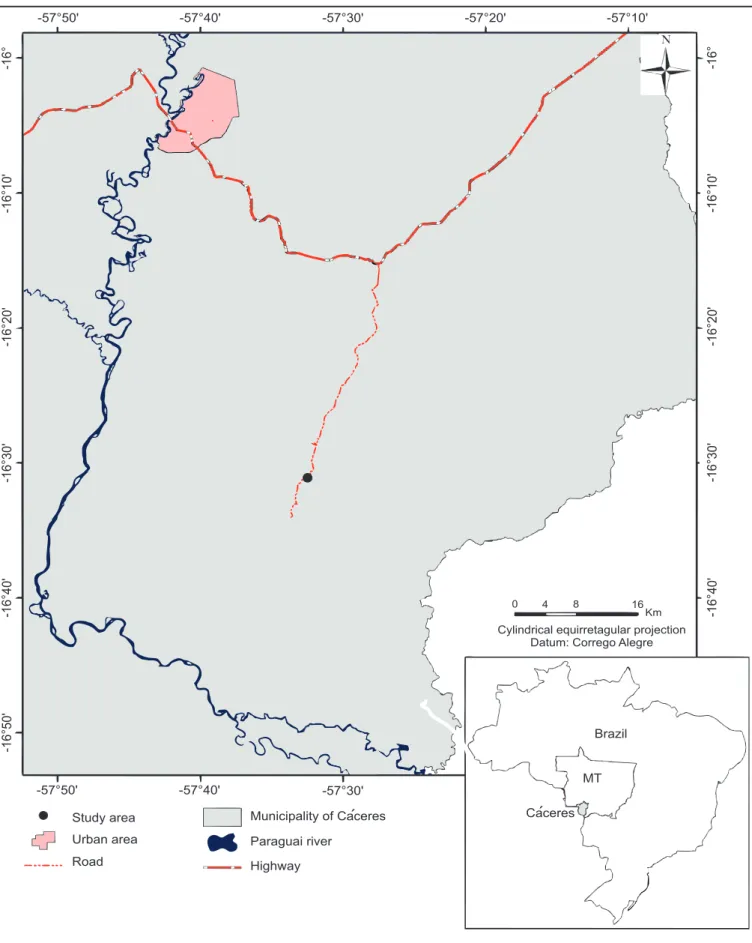
his study was conducted from August 2010 to July 2011 at three rural setlements, Laranjeiras I and II, and Mata Comprida in the municipality of Cáceres (Figure 1). The settlements are located in the northwest of the State of Mato Grosso, near the BR 070 Cuiabá-Porto Velho
´
´
RESULTS
TABLE 1 - Distribution of the phlebotomine species collected with Centers for Disease Control (CDC) traps, by sex, at the setlements Laranjeira I, Laranjeira II, and Mata Comprida, municipality of Cáceres, State of Mato Grosso, Brazil, from August 2010 to July 2011 (n=630).
Laranjeira I Laranjeira II Mata Comprida
Intradomicile Peridomicile Forest Intradomicile Peridomicile Forest Intradomicile Peridomicile Forest Total
Species M F M F M F M F M F M F M F M F M F M F %
Br. avellari - - - - 5 1 1 - - 1 4 2 1 1 2 - 9 - 22 5 4.3
Br. mangabeirai - - 1 - - - 1 - 2 - 0.3
Brumptomyia sp. - - - 1 - - - 2 - 3 0.5
Ev. aldafalcaoae - - - 1 - - - 1 - 0.2
Ev. corumbaensis - - - 1 - 3 - - - 4 0.6
Ev. evandroi - - - - 3 2 4 2 1 4 3 11 4 11 4 4 30 18 49 52 16.0
Ev. lenti - - 2 - 3 5 - 2 - - 6 5 2 1 1 - 14 1 28 14 6.7
Ev. teratodes - - - 1 - - - 3 - 1 - - - 2 - 7 1.1
Ev. termitophila - - - 2 1 3 3 7 - 6 3 19 1 6 - 5 5 19 13 67 12.7
Ev. (Ald) sp. 1 - - - 1 - 1 - 0.2
Ev. (Eva)sp. 2 - - - - 1 - - - 1 - - - 1 - 1 - 4 - 0.6
Ex. cerradincola - - - - 1 1 - - - 1 - - 1 - - 3 - 2 2 7 1.4
Lu. cruzi - - - - 3 - 2 - 1 - - - 1 - - - 7 - 1.1
Lu. longipalpis - - 1 - 1 - 1 - - - 1 - 3 - 7 - 1.1
Lu. Longipalpis/cruzi - - 1 - 1 - - 1 - - - 1 - 4 0.6
Mt. oliveirai - - - - 1 - - - 2 - - - 1 1 3 0.6
Mi. echinatopharynx - - - 1 - - - 1 0.1
Mi. micropyga - - - - 1 - - - 1 - - - 2 - 0.3
Mi. peresi - - - 2 2 10 - 1 1 2 - 7 - 2 1 2 1 21 5 47 8.3
Mi. quinquefer - - - - 5 4 - - - - 7 4 - - - - 6 6 18 14 5.1
Ny. whitmani - - 6 7 26 24 1 5 8 6 21 23 - 5 4 1 14 16 80 87 26.5
Pi. nevesi - - - 0 - - - 1 - - - 1 0.2
Pa. aragaoi - - - - 1 - - - 2 - - - 2 3 4 4 1.3
Pa. brasiliensis - - - - 2 - - - 1 - - - - 3 - 0.5
Pa. campograndensis - - - 1 - - - 1 - - 1 - - - 2 1 0.5
Pa. hermanlenti - - - - 1 - - - 1 - 1 2 3 2 0.8
Pa. shannoni - - 5 2 5 - - - 4 1 - - - - 9 1 23 4 4.3
Ps. hirsutus - - 1 - 0 - - - 1 0.2
Sc. servulolimai - - - 3 - - - 2 - - - - 1 - 1 5 1.0
Sc. sordellii - - - 2 - - - 4 1 3 1 - - 1 2 5 4 15 3.1
Total 0 0 15 17 57 60 11 18 11 23 49 81 10 27 15 17 92 100 260 343 100.0
Br: Brumptomyia; Ev: Evamdromyia;Ex: Expapillata; Lu: Lutzomyia;Mt: Martinsmyia;Mi: Micropygomyia;Ny: Nyssomyia;Pi. Pintomyia;Pa: Psathyromyia; Ps: Psychodopygus;Sc: Sciopemyia. Subgenus:Ald: Aldamyia; Eva: Evandromyia; M: male; F: female.
highway, at the west side of Mangaval mountain range, 70km away from the urban area of the municipality. he occupied area of Laranjeira I, which was founded in 1988, is 108,523,712km², and Pantanal biome is the prevalent vegetation. Laranjeira II holds an area of 11,928,120km2
and was founded in 19879. Mata Comprida has 34,448,425km² and was
founded in 1988 (PA Cunha: personal communication, 2011). he later two places are characterized as savannah10.
In each setlement, three houses were chosen at random. Each had animals (dogs, chickens, pigs, horses, and others) and is near a forest. he captures were conducted at the forest border, and intra and peridomicile areas were with automatic light traps (Falcão model)11,
biweekly, from 5pm to 6am.
Captured sandlies were sent to the laboratories of the Regional Health Office of Cáceres (ERSC) and Human Parasitology Laboratory of the Federal University of Mato Grosso do Sul (UFMS), separated, clariied, mounted, and identiied according to the nomenclature of Galati2. he abbreviations of the genus follow
the proposal of Marcondes12.
For the evaluation of the most abundant species as well as its spatial distribution, the index of species abundance was converted into a zero-to-one scale through the Standardized Index of Species Abundance (SISA). In this index, value 1 corresponds to the most abundant species13. he comparison of the frequencies among the
phlebotomine populations, for the diferent regions and ecotopes, was conducted using chi-squared tests (χ2 for the contingency and
absolute frequency tables).
Six hundred and forty-eight biweekly captures were conducted in the setlements of Laranjeira I, Laranjeira II, and Mata Comprida. Of the 630 specimens collected, 348 were females and 282 were males.
Table 1 shows the distribution of the phlebotomine fauna present at these three setlements.
whitmani, 0.94:1 for Evandromyia evandroi, and 0.19:1 for
Evandromyia termitophila.
Of the 29 species analyzed, 27 were present at Mata Comprida
setlement, 26 at Laranjeira I, and 20 at Laranjeira II. Regarding the totality of all sandlies collected, 274, 201, and 155 were from Mata Comprida, Laranjeira II and I, respectively. Ny. whitmani was the most frequent (26.5%) followed by Ev. evandroi (16%), and Ev. termitophila
(12.7%). Lutzomyia longipalpis and Lutzomyia cruzi, despite the low frequency (2.8%), were captured sympatrically. Two species of the genus Evandromyia were not identiied at a speciic level, which could be new species. Taxonomic studies will be performed aiming to verify this question, as well as the female of Brumptomyia mangabeirai (Table 1).
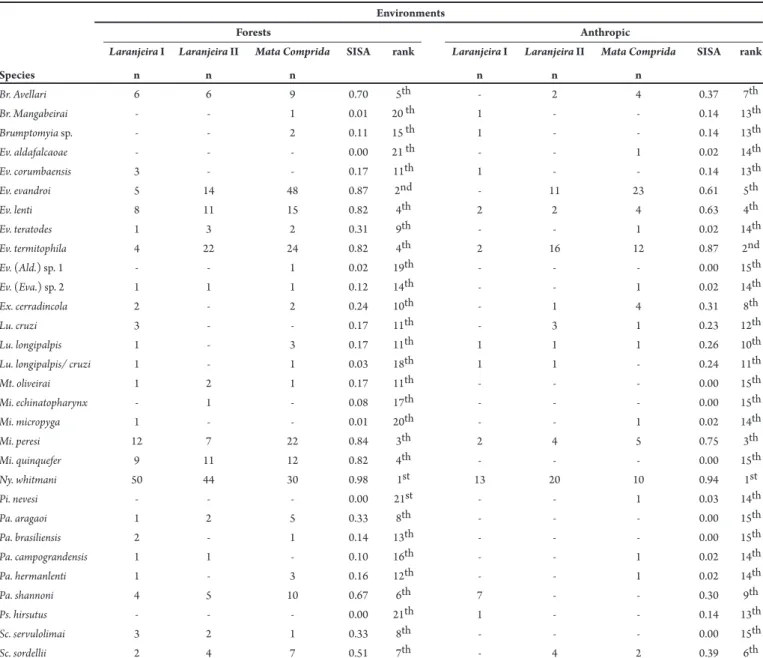
Nyssomyia whitmani predominated both in forest (SISA=0.98) and anthropic environments (SISA=0.94) and was in both ecotopes.
TABLE 2 - Standardized index of species abundance (SISA) for phlebotomines captured in forest and residential areas. Cáceres, State of Mato Grosso, Brazil, from August 2010 to July 2011 (n=630).
Environments
Forests Anthropic
Laranjeira I Laranjeira II Mata Comprida SISA rank Laranjeira I Laranjeira II Mata Comprida SISA rank
Species n n n n n n
Br. Avellari 6 6 9 0.70 5th - 2 4 0.37 7th
Br. Mangabeirai - - 1 0.01 20 th 1 - - 0.14 13th
Brumptomyia sp. - - 2 0.11 15 th 1 - - 0.14 13th
Ev. aldafalcaoae - - - 0.00 21 th - - 1 0.02 14th
Ev. corumbaensis 3 - - 0.17 11th 1 - - 0.14 13th
Ev. evandroi 5 14 48 0.87 2nd - 11 23 0.61 5th
Ev. lenti 8 11 15 0.82 4th 2 2 4 0.63 4th
Ev. teratodes 1 3 2 0.31 9th - - 1 0.02 14th
Ev. termitophila 4 22 24 0.82 4th 2 16 12 0.87 2nd
Ev. (Ald.) sp. 1 - - 1 0.02 19th - - - 0.00 15th
Ev. (Eva.)sp. 2 1 1 1 0.12 14th - - 1 0.02 14th
Ex. cerradincola 2 - 2 0.24 10th - 1 4 0.31 8th
Lu. cruzi 3 - - 0.17 11th - 3 1 0.23 12th
Lu. longipalpis 1 - 3 0.17 11th 1 1 1 0.26 10th
Lu. longipalpis/ cruzi 1 - 1 0.03 18th 1 1 - 0.24 11th
Mt. oliveirai 1 2 1 0.17 11th - - - 0.00 15th
Mi. echinatopharynx - 1 - 0.08 17th - - - 0.00 15th
Mi. micropyga 1 - - 0.01 20th - - 1 0.02 14th
Mi. peresi 12 7 22 0.84 3th 2 4 5 0.75 3th
Mi. quinquefer 9 11 12 0.82 4th - - - 0.00 15th
Ny. whitmani 50 44 30 0.98 1st 13 20 10 0.94 1st
Pi. nevesi - - - 0.00 21st - - 1 0.03 14th
Pa. aragaoi 1 2 5 0.33 8th - - - 0.00 15th
Pa. brasiliensis 2 - 1 0.14 13th - - - 0.00 15th
Pa. campograndensis 1 1 - 0.10 16th - - 1 0.02 14th
Pa. hermanlenti 1 - 3 0.16 12th - - 1 0.02 14th
Pa. shannoni 4 5 10 0.67 6th 7 - - 0.30 9th
Ps. hirsutus - - - 0.00 21th 1 - - 0.14 13th
Sc. servulolimai 3 2 1 0.33 8th - - - 0.00 15th
Sc. sordellii 2 4 7 0.51 7th - 4 2 0.39 6th Br: Brumptomyia;Ev: Evandromyia;Ex: Expapillata;Lu: Lutzomyia;Mt: Martinsmyia;Mi: Micropygomyia;Ny: Nyssomyia;Pi: Pintomyia;Pa: Psathyromyia;Ps: Psychodopygus;Sc: Sciopemyia. Subgenus: Ald: Aldamyia; Eva: Evandromyia; SISA: standardized index of species abundance; n: number.
Ev. evandroi and Ev. termitophila,the second and the third most frequent species overall, were both in second position at forest environment (SISA=0.87) and anthropic environment (SISA=0.87), respectively. Only Evandromyia aldafalcaoae, Pintomyia nevesi, and
Psychodopygus hirsutus were not captured in the forest environment (Table 2).
Table 3 shows that in every setlement, the amount of insects captured in forest environments were higher (p<0.01) than anthropic environments.
DISCUSSION
TABLE 4 - Numbers of sandlies in intradomicile and peridomicile areas in the setlements Laranjeira I, Laranjeira II, and Mata Comprida, municipality of Cáceres, State of Mato Grosso, Brazil, from August 2010 to July 2011 (n=630).
Environments
intradomicile peridomicile
Setlements n % n % Total
LaranjeiraI - 0.0* 32 18.9* 32
LaranjeiraII 30 17.6 35 20.6 65
Mata Comprida 39 23.0 34 20.0 93
* p<0.01.
TABLE 3 - Numbers of sandlies in anthropic and forest areas in the setlements Laranjeira I, Laranjeira II, and Mata Comprida, municipality of Cáceres, State of Mato Grosso, Brazil, from August 2010 to July 2011 (n=630).
Environments Anthropic Forest
Setlements n % n % Total
Laranjeira I 32 5.8a 123 19.5b 155
Laranjeira II 65 10.3a 136 21.6b 201
Mata Comprida 73 11.6a 201 32.0b 274
a,b: Diferent leters indicate signiicant diferences between the columns; p<0.01.
Light trap captures allowed the identiication of 630 sandlies belonging to 28 species, from 11 genera, conirming the large diversity of the phlebotomine sandly fauna at these three setlements in the municipality of Cáceres, as already reported from other places in the State of Mato Grosso14-16.
According to Missawa and Maciel17 and Amaral et al.18, the
variety of phlebotomine sandlies found in the State of Mato Grosso is as expected (107 species) considering the diversity of biomes characteristic of the region, such as savannah, Pantanal, transition forest, and the Amazon rainforest.
he data obtained in this research increased our knowledge of these insects fauna in the State, with six species not previously recorded: Brumptomyia avellari, Br. mangabeirai, Evandromyia aldafalcaoae, Micropygomyiaechinatopharynx, Micropygomyia peresi, and Psathyromyia campograndensis, raising the current record of species in the State to 112.
Among the identiied species, nine (43%) presented a wide geographic distribution in Brazil, with Evandromyia evandroi,
Lutzomyia longipalpis, Nyssomyia whitmani,and Psathyromyia aragaoi documented in the ive Brazilian regions, and the species
Brumptomyia avellari, Evandromyia termitophila, Micropygomyia peresi, Psathyromyia brasiliensis,and Psathyromyia hermanlenti are present in the north, northeast, southeast, and midwest regions of the country14. he wide area of occurrence of these species can be
explained by their adaptation to diverse habitats.
When comparing the number of specimens of each environment (intra, peridomicile, and forest) at the three setlements, we can notice that at anthropized environments (170/27%), a lower percentage of insects was observed when compared with the forest environment (460/73%); the higher quantity found in the forest can be explained by the plentiful organic mater of the soil and as this is the natural habitat of these insects19. Still, we should consider that
it is usual at transmission areas of cutaneous leishmaniasis (CL) to have a destruction of primary forests with subsequent invasion of vectors into the peridomicile environment20.
When the ratio of males to females is analyzed, we can notice the predominance of females with 0.81:1, contrasting with the result of the several works performed in the midwest region, which reported the reverse, such as Missawa and Dias21, that found a male
predominance of 1.9:1 at Várzea Grande, MT; Galati et al.22 with 1.2:1
at Corumbá, State of Mato Grosso do Sul (MS); Almeida et al.23 with
4.8:1 at Ponta Porã, MS; and Nunes et al.24 with 5.7:1 at Bonito, MS.
Comparing the density of phlebotomine sandlies at the three ecotopes, it is possible to notice a superior frequency and variety of species at Mata Comprida setlement. It is suggested that the largest inding of species (27) and specimens (274) captured at this setlement was due to biotic factors relating to savannah. Also worth pointing out is that this location has banana plantations and various fruit trees, and breeding sites of birds, pigs, horses, and catle.
Galati et al.25 and Oliveira et al.26 emphasized the relevance of a
sty and chicken coop as places of creation and maintenance of the high density of phlebotomine sandlies in the environment as a risk factor, which should be considered by epidemiological surveillance when planning actions to control the disease.
he setlement Laranjeira II, where savannah is predominant, was the ecotope that presented the second highest index of population density (201) of insects. In this ecosystem, Ny. whitmani was found in greater numbers compared with the other two setlements, which could be a relection of greater adaptation to the environment, as this area is the older ecotope (24 years). Few species identiied at this place, such as Lutzomyia longipalpis, Evandromyia lenti, Nyssomyia whitmani, Psathyromyia shannoni, Micropygomyia quinquefer,
Sciopemyia sordellii, and Ev. termitophila, were also described by Martin and Rebêlo27 from a savannah area at Maranhão.
The settlement Laranjeira I was the place with the lowest quantity of phlebotomine sandlies obtained (155) and with 79.3% of the species captured in the forest area. Of this number, only 32 specimens were atracted by traps set in the peridomicile area. It is a recent setlement located closer to the Boi Morto mountain range, and it is situated at a transition area with Pantanal. Possibly, the specimens still found food and shelter in areas of native forest. Furthermore, it is possible that the sandflies are undergoing adaptation and colonization. Another hypothesis is that the presence of a convex formation and luvial plain promote high soil moisture due to looding of the Paraguay River. It is known that this factor is prejudicial to the development of phlebotomine larvae28.
Among the species found in this study, we should emphasize
Ny. whitmani, Lu. longipalpis,and Lutzomyia cruzi.he irst two are eicient vectors of cutaneous and visceral leishmaniasis, respectively, and the last one is implicated as a visceral leishmaniasis (VL) vector. hese species are anthropophilic and possess greater ability to adapt to environments modiied by man1,29. his epidemiological aspect
is important as it could explain some cases of a visceral form that occurred among the residents who live at the setlements.
his study indicated the predominance of Ny. whitmani, which is of public health concern, as this vector is incriminated as a major vector of Leishmania (Viannia) braziliensis in the south, southeast, northeast, and midwest regions of Brazil, and Leishmania (V.) shawi
in the north30,31 and Leishmania (V.) guyanensis in the Amazon32.It
and anthropized environments, with chicken coops and pig sties33,34.
hese characteristics were also observed in the present study area. he species Ny. whitmani,besides being the most abundant overall (167/630), was most frequently found in the savannah (75.4%) as discovered in the State of Mato Grosso by Missawa e cols5. It is known that cutaneous leishmaniasis is a zoonosis of rural
environments35,36 similar to the setlements studied here.
Despite the predominance of a forest area (74.2%) in the three setlements, Ny. whitmani was present in lower percentages at peridomicile environments (25.8%); however, it is worth noticing that this vector is opportunistic and has an eclectic habit for food, adjusting its eating habits to the availability of hosts at anthropic environments37. According to Souza et al.38, transmission
of leishmaniasis can occur in intradomicile and peridomicile environments.
We should note the indings of Lu. longipalpis and Lu. cruzi in sympatry at the setlements Mata Comprida, Laranjeira I and II, similar to the one previously observed by Oliveira et al.34 at Campo
Grande, MS. Missawa and Lima39 conducted studies at 68 of 139
municipalities in MT, and Lu. longipalpis was reported at 23 of these. his species was found at higher frequency in the savannah, Amazon rainforest, transition, and Pantanal environments, corroborating with the present study.
he inding of Lu. longipalpis at the setlement Mata Comprida
at the forest and intradomicile environments, even in low quantity, represents a signiicant result as this species presents a high vectorial capacity, anthropophily, and an eclectic choice of hosts, besides being the major vector of Leishmania (Leishmania)infantum chagasi in the Americas, including Brazil29. he domiciliation of this vector at
undeveloped rural areas has become greater due to the modiication of the forests and anthropic action, mostly when associated with poor environmental sanitation and low socioeconomic status, as found at the setlements in question40-42.
The species Lu. cruzi has a wide geographic distribution at Mato Grosso, which is found in 24 municipalities but had not previously been reported from Cáceres39. Meanwhile, its inding
at anthropized environments in Laranjeira II and Mata Comprida
has epidemiological importance as it has previously been reported from Jaciara, MT43; Corumbá, MS; and Ladário, MS44. At these
municipalities, cases of human and canine visceral leishmaniasis were reported in the absence of Lutzomyia longipalpis, and with a detection of natural infection of Lu. cruzi by Leishmania chagasi
indicating, therefore, the participation of these phlebotomines in the transmission of the disease.
Evandromyia evandroi, Ev. termitophila, Ev. peresi, Br. avellari, and Ev. lenti were all frequently reported in areas close to the animal hosts. However, none of these species is associated with Leishmania
spp.14 transmission, except Ev. lenti, which has been found naturally
infected with Leishmania braziliensis, despite being refractory to experimental infection45,46.
he unorganized inhabitation of the environment that is occurring at the setlements Mata Comprida, Laranjeira I and II could lead to domiciliation of the wild population of phlebotomines, including the vectors of leishmaniasis. his highlights the need to carry out further studies to fully understand the dynamic transmission of these diseases in such places.
he authors thank the residents of the setlements for their permission to carry out this research, the geographer Jaqueline Cochev for the creation of the map, and Josdemar Muniz de Moraes, Sebastião Rodrigues, and Clóvis de Campos Leite from the laboratory of the Regional Health Oice of Cáceres (ERSC) for the logistic support. he authors would also like to extend their gratitude to Dr. Daniel Bray for the revision of the manuscript.
ACKNOWLEDGMENTS
he authors declare that there is no conlict of interest.
CONFLICT OF INTEREST
FINANCIAL SUPPORT
REFERENCES
his study was funded by Coordenação de Aperfeiçoamento de Pessoal de Ensino Superior (CAPES).
1. Grimaldi JRG, Tesh RB, McMahon-Pratt D. A review of the geographic distribution and epidemiology of leishmaniasis in the new world. Am J Trop Med Hyg 1989; 41:687-725.
2. Galati EAB. Classiicação de Phlebotominae. In: Rangel EF, Lainson R, Orgs. Flebotomíneos do Brasil. Rio de Janeiro: FIOCRUZ; 2003. p. 23-51. 3. Ashford RW. The leishmaniases as emerging and reemerging zoonoses.
Int J Parasitol 2000; 30:1269-1281.
4. Ribeiro ALM, Missawa NA, Zeilhofer P. Distribution of phlebotomine sandlies (Díptera: Psychodidae) of medical importance in Mato Grosso state, Brazil. Rev Inst Med Trop Sao Paulo 2007; 4:317-321.
5. Missawa NA, Maciel GBML, Rodrigues H. Distribuição geográica de Lutzomyia
(Nyssomyia) whitmani (Antunes e Coutinho, 1939) no Estado de Mato Grosso. Rev Soc Bras Med Trop 2008; 41:369-373.
6. Mestre GLC, Fontes CJF. A expansão da epidemia da leishmaniose visceral no Estado de Mato Grosso, 1998-2005. Rev Soc Bras Med Trop 2007; 40:42-48. 7. Ferreira JCV. Enciclopédia Ilustrada de Mato Grosso. Cuiabá: Buriti; 2004. 8. Instituto Brasileiro de Geograia e Estatística (IBGE) [Internet]. Rio de Janeiro:
IBGE; 2011; [Cited 2011 May 8]. Available from: htp://www.ibge.gov.br/ cidadesat/topwindow.htm?1/.
9. Alves J, Figueiredo AMR, Bonjour SCM. Os assentamentos rurais em Mato Grosso: Uma análise dos dados do Censo da Reforma Agrária. Panorama Socioeconómico 2009; 27:152-167.
10. Instituto Nacional de Colonização e Reforma Agrária. i3Geo [Internet]. Mato Grosso; 2011; [Cited 2011 April 2] Available from: htp://acervofundiario.incra. gov.br/i3geoDes/aplicmap/geral.htm?f7681ee332b516d1b3d2c4cb94eac85. 11. Falcão AR. Um novo modelo de armadilha luminosa de sucção para pequenos
insetos. Mem Inst Oswaldo Cruz 1981; 76:303-305.
12. Marcondes CB. A proposal of generic and subgeneric abbreviations of phlebotomines sandlies (Diptera: Psychodidae: Phlebotominae) of the world. Entomol News 2007; 118:351-356.
13. Roberts DR, Hsi BP. An index of species abundance for use with mosquito surveillance data. Environ Entomol 1979; 8:1007-1013.
14. Aguiar GM, Medeiros WM. Distribuição e habitats. In: Rangel EF, Lainson R, Orgs. Flebotomíneos do Brasil. Rio de Janeiro: FIOCRUZ; 2003. p. 207-255. 15. De Luca AS, Vasconcelos HL, Barret TV. Distribution of sandlies (diptera:
phlebotominae) in forest remnants and adjacent matrix habitats in brazilian Amazonia. Braz J Biol: 2003; 63:401-410.
17. Missawa NA, Maciel GBML. List of species in the genus Lutzomyia, França, 1924 (Psychodidae, Phlebotominae) from the State of Mato Grosso. Rev Soc Bras Med Trop 2007; 40:11-14.
18. Amaral AFS, Varjão JR, Silva GB, Arrais-Silva WW. Phlebotomine fauna (Diptera: Psychodidae: Phlebotominae) in a residential area and in a fragment of savanna vegetation in the municipality of Pontal do Araguaia, Mato Grosso, Brazil. Rev Bras Parasitol Vet 2011; 20:165-167.
19. Souza CF, Borges MAZ, Andrade AJ. Contribution to the knowledge of the phlebotomine sand lies fauna (Diptera: Psychodidae) of Timóteo municipality, Minas Gerais, Brasil. Neotrop Entomol 2009; 38:267-271.
20. Lonardoni MVC, Silveira TGV, Alves WA, Maia-Elkhoury ANS, Membrive UA, Membrive NA, et al. Leishmaniose tegumentar americana humana e canina no Município de Mariluz, Estado do Paraná, Brasil. Cad Saude Publica 2006; 22:2713-2716.
21. Missawa NA, Dias ES. Phlebotomine sand lies (Diptera: Psychodidae) in the municipality of Várzea Grande: an area of transmission of visceral leishmaniasis in the state of Mato Grosso, Brazil. Mem Inst Oswaldo Cruz 2007; 102:913-918. 22. Galati EAB, Nunes VL, Rego Junior FA, Oshiro ET, Rodrigues M. Estudo de lebotomíneos (Diptera, Psychodidae) em foco de leishmaniose visceral no Estado de Mato Grosso do Sul, Brasil. Rev Saude Publica 1997; 31:378-390. 23. Almeida PS, Minzão ER, Minzão LD, Silva SR, Ferreira AD, Faccenda O, et al.
Aspectos ecológicos de lebotomíneos (Diptera: Psychodidae) em área urbana do município de Ponta Porã, Estado de Mato Grosso do Sul. Rev Soc Bras Med Trop 2010; 43:723-727.
24. Nunes VLB, Galati EAB, Cardozo C, Rocca MEG, Andrade ARO, Santos MFC, et al. Estudo de lebotomíneos (Diptera, Psychodidae) em área urbana do município de Bonito, Mato Grosso do Sul, Brasil. Rev Bras Entomol 2008; 52:446-451. 25. Galati EAB, Nunes VLB, Cristaldo G, Rocha HC. Aspectos do comportamento
da fauna lebotomínea (Diptera: Psychodidae) em foco de leishmaniose visceral e tegumentar na Serra da Bodoquena e área adjacente, Estado de Mato Grosso do Sul, Brasil. Rev Pat Trop 2003; 32:235-261.
26. Oliveira AG, Galati EAB, Oliveira O, Oliveira GR, Espindola IAC, Dorval MEC, et al. Abundance of Lutzomyia longipalpis (Diptera: Psychodidae: Phlebotominae) and urban transmission of visceral leishmaniasis in Campo Grande, state of Mato Grosso do Sul, Brazil. Mem Inst Oswaldo Cruz 2006; 101:869-874.
27. Martin AMCB, Rebêlo JMM. Dinâmica espaço-temporal de lebotomíneos (Diptera, Psychodidae) do município de Santa Quitéria, área de cerrado do Estado do Maranhão, Brasil. Iheringia Ser Zool 2006; 96:283-288.
28. Morrison AC, Ferro C, Morales A, Tesh RB, Wilson ML. Dispersal of the sand ly Lutzomyia longipalpis (Diptera: Psychodidae) at an endemic focus of visceral leishmaniasis in Colombia. J Med Entomol 1993; 30:427-435.
29. Lainson R, Rangel EF. Lutzomyia longipalpis and the eco-epidemiology of American visceral leishmaniasis, with particular reference to Brazil - A Review. Mem Inst Oswaldo Cruz 2005; 100:811-827.
30. Costa SM, Cechinel M, Bandeira V, Zannuncio JC, Lainson R, Rangel E.
Lutzomyia (Nyssomyia) whitmanis.l. (Antunes e Coutinho, 1939) (Diptera: Psychodidae: Phlebotominae): geographical distribution and the epidemiology of American cutaneous leishmaniasis in Brazil: mini-review. Mem Inst Oswaldo Cruz 2007; 102:149-153.
31. Shaw J. he leishmaniases - survival and expansion in a changing world. A mini-review. Mem Inst Oswaldo Cruz 2007; 102:541-547.
32. Rangel EF, Lainson R. Ecologia das leishmanioses. In: Rangel EF, Lainson R, Orgs. Flebotomíneos do Brasil. Rio de Janeiro: FIOCRUZ; 2003. p. 311-327. 33. Galati EAB, Nunes VLB, Dorval MEC, Oshiro ET, Cristaldo G, Espíndola MA,
et al. Estudo dos lebotomíneos (Diptera, Pychodidae), em área de leishmaniose tegumentar, no Estado de Mato Grosso do Sul, Brasil. Rev Saude Publica 1996; 30:115-128.
34. Oliveira AG, Andrade Filho JD, Falcão AL, Brazil RP. Estudo de lebotomíneos (Diptera, Psychodidae, Phlebotominae) na zona urbana da cidade de Campo Grande, Mato Grosso do Sul, Brasil, 1999-2000. Cad Saude Publica 2003; 19:933-944.
35. Dias ES, França-Silva JC, Silva JC, Monteiro EM, Paula KM, Gonçalves CM, et al. Flebotomíneos (Diptera: Psychodidae) de um foco de leishmaniose tegumentar no Estado de Minas Gerais. Rev Soc Bras Med Trop 2007; 40:49-52. 36. Camargo LB, Langoni H. Impact of leishmaniasis on public health. J Venom
Anim Toxins Incl Trop Dis 2006; 12:527-548.
37. Muniz LHG, Rossi RM, Neitzke HC, Monteiro WM, Teodoro U. Estudo dos hábitos alimentares de lebotomíneos em área rural no sul do Brasil. Rev Saude Publica 2006; 40:1087-1093.
38. Souza CM, Pessanha JE, Barata A, Monteiro EM, Costa DC, Dias ES. Study on Phlebotomine Sand Fly (Diptera: Psychodidae) Fauna in Belo Horizonte, State of Minas Gerais, Brazil. Mem Inst Oswaldo Cruz 2004; 99:795-803.
39. Missawa NA, Lima GB. M. Distribuição espacial de Lutzomyia longipalpis (Lutz e Neiva, 1912) e Lutzomyia cruzi (Mangabeira, 1938) no Estado de Mato Grosso. Rev Soc Bras Med Trop 2006; 39:337-340.
40. Martins LM, Rebêlo JMM, Santos MCFV, Costa JML, Silva AR, Ferreira LA. Ecoepidemiologia da leishmaniose tegumentar no Município de Buriticupu, Amazônia do Maranhão, Brasil, 1996 a 1998. Cad Saude Publica 2004; 20:735-743.
41. Missawa NA, Lorosa ES, Dias ES. Preferência alimentar de Lutzomyia longipalpis
(Lutz e Neiva, 1912) em área de transmissão de leishmaniose visceral em Mato Grosso. Rev Soc Bras Med Trop 2008; 41:365-368.
42. Montoya-Lerma J, Cadena H, Oviedo M, Ready PD, Barazarte R, Travi BL, et al. Comparative vectorial eiciency of Lutzomyia evansi and Lu. longipalpis for transmiting Leishmania chagasi. Acta Trop 2003; 85:9-29.
43. Missawa NA, Veloso MAE, Maciel GBML, Michalsky EM, Dias ES. Evidência de transmissão de leishmaniose visceral por Lutzomyia cruzi no município de Jaciara, Estado de Mato, Grosso, Brasil. Rev Soc Bras Med Trop 2011; 44:76-78. 44. Santos SO, Arias J, Ribeiro AA, Hofmann MP, Freitas A, Malacco MAF. Incrimination of Lutzomyia cruzi as a vector of American visceral leishmaniasis. Med Vet Entomol 1998; 12:315-317.
45. Margonari C, Soares RP, Andrade-Filho JD, Xavier DC, Saraiva L, Fonseca AL, et al. Phlebotomine sand lies (Diptera: Psychodidae) and Leishmania infection in Gafanhoto Park, Divinópolis, Brazil. Entomol Soc America 2010; 47:1212-1219. 46. Brazil RP, Carneiro VL, Andrade Filho JD, Alves JCM, Falcão AL. Biology of