Vol. 10, No. 2, May/Aug., 2013 pp.323-338 ISSN online: 1807-1775
DOI: 10.4301/S1807-17752013000200008
_____________________________________________________________________________________ Manuscript first received/Recebido em 16/07/2012 Manuscript accepted/Aprovado em: 10/04/2013 Address for correspondence / Endereço para correspondência
Ernesto Galvis-Lista, Assistant Professor, Faculty of Engineering, Universidad del Magdalena, Calle 32 22-08, Santa Marta, Colombia Teléfono (57) 3174979167 E-mail: [email protected]
Jenny Marcela Sánchez-Torres, Associate Professor, Faculty of Engineering Universidad Nacional de Colombia Carrera 45 26-85, Bogotá, Colombia. Teléfono: (57) 3118531450 E-mail: [email protected]
A CRITICAL REVIEW OF KNOWLEDGE MANAGEMENT IN
SOFTWARE PROCESS REFERENCE MODELS
Ernesto Galvis-Lista
Universidad del Magdalena, Santa Marta, Colombia
Jenny Marcela Sánchez-Torres
Universidad Nacional de Colombia, Bogotá, Colombia
__________________________________________________________________________
ABSTRACT
Knowledge Management (KM) is a critical subject for software development organizations. For this reason, the purpose of this article is to provide a critical review on the way that KM is included in several models of reference of software process (SPRM). For this, five SPRM used in the Latin American countries were selected. Then, an analysis of each process of the SPRM was performed in order to identify features related to the KM. Finally, the KM aspects were mapped in relation to the KM schools (Earl) and the KM capacities (Gold et al). The main contribution of the paper is to show some breaches in SPRM content in relation to KM schools and capabilities.
Keywords: Knowledge Management Process, Knowledge Management in Software Engineering, Software Process Reference Models, Software Process Improvement
1. INTRODUCTION
On the other hand, in the last decade, Knowledge Management (KM) has become one of the management processes within SE. An increasing number of publications have treated this subject from diverse perspectives. A synthesis of the scientific work on KM in SE can be found in the systematic review performed (Bjørnson & Dingsøyr, 2008). In this work, it is found a predominant interest in subjects like codification, storage and recovery of knowledge using information technologies (IT). Subjects like the creation, transfer and application of knowledge, however, have not been treated extensively by the academic community. Furthermore, the authors conclude that the majority of the empirical research works are focused on the KM application in the software process improvement (SPI).
In this line of argument, KM in SPI is, in terms of (Aurum, Daneshgar, & Ward, 2008), an important research subject since the SPI initiatives have KM as their main component. Also, these authors argue that KM is useful in the definition of the software process in the application of a processes approach for SE and in the adaptation of software processes for future uses. However, a detailed review of papers published in the last five years, whose main subject is KM in SPI, led to the conclusion that the predominant approach is the knowledge codification, as it is found in (Alagarsamy, Justus, & Iyakutti, 2007, 2008a, 2008b; Capote, Llantén, Pardo, Gonzalez, & Collazos, 2008; Cruz Mendoza et al., 2009; Ivarsson & Gorschek, 2011; Montoni, Cerdeiral, Zanetti, & Cavalcanti da Rocha, 2008). Besides, there are works that treat the organizational knowledge mapping from the building of knowledge directories, as can be found in (Alagarsamy et al., 2008b; Li, Huang, & Gong, 2008), and in the creation and empowerment of organizational structures to promote the exchange and transfer of
knowledge, as it is found in (Basri & O’Connor, 2011; Capote, Llantén, Pardo, &
Collazos, 2009; Li et al., 2008; Nielsen & Tjørnehøj, 2010).
In synthesis, research works on KM in SPI have been focused on the application of KM as a technological and management tool in SPI initiatives and projects. Nevertheless, there are no approaches related to KM like a process included in SPI initiatives. For this reason, the purpose of this paper is to present a critical review about how KM has been included as a defined process within several SPRM used in the software industry in Latin America. It is important to say that the SPRM provide the basis for SPI initiatives as they contain the definition of all SE processes that SDO would have to implement and improve in order to achieve better levels of capability in their processes to obtain organizational maturity.
To present the results of the review, this paper was structured in the following way: The second section shows the KM theoretical foundations needed to compare, in accordance with a frame of common ideas, the diverse approaches on KM within the analyzed SPRM. In the third section the methodology used for the review is described. In the fourth section the review results are shown in accordance with selected theoretical foundations. Finally, the conclusions and references used in the preparation of the paper are discussed.
2. THEORETICAL FOUNDATIONS
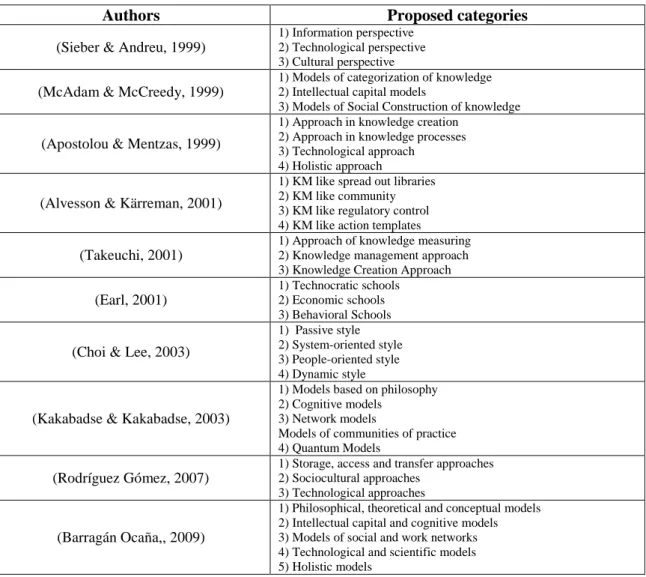
Authors Proposed categories
(Sieber & Andreu, 1999)
1) Information perspective 2) Technological perspective 3) Cultural perspective (McAdam & McCreedy, 1999)
1) Models of categorization of knowledge 2) Intellectual capital models
3) Models of Social Construction of knowledge
(Apostolou & Mentzas, 1999)
1) Approach in knowledge creation 2) Approach in knowledge processes 3) Technological approach
4) Holistic approach
(Alvesson & Kärreman, 2001)
1) KM like spread out libraries 2) KM like community 3) KM like regulatory control 4) KM like action templates (Takeuchi, 2001)
1) Approach of knowledge measuring 2) Knowledge management approach 3) Knowledge Creation Approach (Earl, 2001)
1) Technocratic schools 2) Economic schools 3) Behavioral Schools
(Choi & Lee, 2003)
1) Passive style 2) System-oriented style 3) People-oriented style 4) Dynamic style
(Kakabadse & Kakabadse, 2003)
1) Models based on philosophy 2) Cognitive models
3) Network models
Models of communities of practice 4) Quantum Models
(Rodríguez Gómez, 2007)
1) Storage, access and transfer approaches 2) Sociocultural approaches
3) Technological approaches
(Barragán Ocaña,, 2009)
1) Philosophical, theoretical and conceptual models 2) Intellectual capital and cognitive models 3) Models of social and work networks 4) Technological and scientific models 5) Holistic models
Table 1 Proposals of classification of the KM approaches
In this sense, the first theoretical referent considered was the taxonomy of KM strategies proposed by (Earl, 2001). The selection of this taxonomy is based on the fact that it was built on a research that included: (1) six case studies in organizations, (2) direct research with twenty chief knowledge officers, (3) a workshop about KM programs in organizations with the network of knowledge managers from the United Kingdom, and (4) the analysis of KM programs published in academic and professional journals.
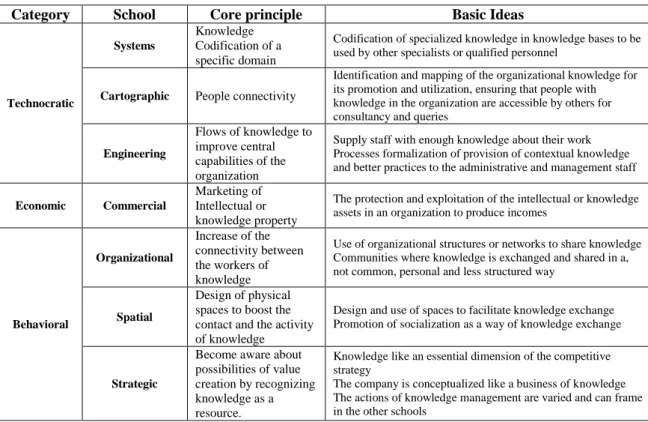
Furthermore, in relation to the content, it is believed that this taxonomy is the most detailed and, unlike others, the conceptual component is complemented by empirical studies. In addition, it is important to point out that although each school represents a particular purpose or approach, they are not competitive between themselves. On the contrary, in practice, KM programs are composed of strategies and tools from several schools. The identified KM schools are categorized as "technocratic", "economic", and "behavioral."
The economic schools are focused on the exploitation of organizational knowledge like intellectual capital that allows the creation of flows of income for the organization. In this category, Earl identified only the commercial school.
The behavioral schools are focused on the promotion of knowledge creation and exchange, as well as all organizational and personal aspects involved in the use of knowledge as an organizational resource. In this third category, there are three schools: organizational, spatial and strategic schools. The organizational school is focused on the creation of formal and informal networks to exchange knowledge. The spatial school is focused on the design of physical workspaces to promote and improve the exchange of knowledge. The strategic school is focused on the design and implementation of all the organizational strategy taking knowledge as its essence. A summary of Earl's taxonomy is shown in Table 2.
Category School Core principle Basic Ideas
Technocratic
Systems
Knowledge Codification of a specific domain
Codification of specialized knowledge in knowledge bases to be used by other specialists or qualified personnel
Cartographic People connectivity
Identification and mapping of the organizational knowledge for its promotion and utilization, ensuring that people with knowledge in the organization are accessible by others for consultancy and queries
Engineering
Flows of knowledge to improve central capabilities of the organization
Supply staff with enough knowledge about their work Processes formalization of provision of contextual knowledge and better practices to the administrative and management staff
Economic Commercial
Marketing of Intellectual or knowledge property
The protection and exploitation of the intellectual or knowledge assets in an organization to produce incomes
Behavioral
Organizational
Increase of the connectivity between the workers of knowledge
Use of organizational structures or networks to share knowledge Communities where knowledge is exchanged and shared in a, not common, personal and less structured way
Spatial
Design of physical spaces to boost the contact and the activity of knowledge
Design and use of spaces to facilitate knowledge exchange Promotion of socialization as a way of knowledge exchange
Strategic
Become aware about possibilities of value creation by recognizing knowledge as a resource.
Knowledge like an essential dimension of the competitive strategy
The company is conceptualized like a business of knowledge The actions of knowledge management are varied and can frame in the other schools
Table 2 Classification of GC schools. (Earl, 2001)
As a complementary perspective to the Earl’s approach, the work done by (Gold,
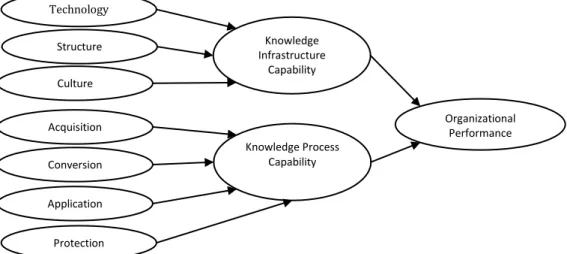
Malhotra, & Segars, 2001) was taken. In this proposal, the authors argue that organizations should take advantage of the knowledge they possess and create new knowledge to compete in their markets. To achieve this, organizations must develop two types of KM capabilities: knowledge infrastructure capabilities and knowledge processes capabilities.
Figure 1 Knowledge Management Capabilities and Organizational Effectiveness. (Gold et al., 2001)
The three infrastructure capabilities are the technology capability, the structure capability and the culture capability. The technology capability addresses tools and means that enable flows of knowledge efficiently. The structure capability focuses on the existence of rules, trust mechanisms and formal organizational structures that encourage the creation and exchange of knowledge between people in the organization. The cultural dimension refers to the presence of shared contexts within the organization.
The four knowledge processes capabilities are knowledge acquisition, knowledge conversion, knowledge application and knowledge protection. The knowledge acquisition process is aimed at the gain of knowledge from various sources both within and outside the organization. The knowledge conversion process focuses on making existing knowledge useful from its encoding, combination, coordination and distribution. The knowledge application process is addressed to the real use of the knowledge in the daily practices of the organization. And the knowledge protection process is designed to define and implement the strategies to protect the organizational knowledge of theft or improper or illegal uses. Table 3 summarizes the KM capabilities proposed by (Gold et al., 2001).
Categories Capabilities Main principle
Infrastructure
Technology The IT systems determine the way in which knowledge is transferred and accessed.
Structure The organizational structures, formal and informal, can inhibit or facilitate interaction between people, essential in the KM.
Culture The organizational culture must support and enhance the activities of knowledge.
Processes
Acquisition
The location and Acquisition of knowledge or creation of knowledge through the collaboration between individuals and business partners.
Conversion Knowledge must be organized and structured in a way that facilitates their distribution and use within the organization.
Application Knowledge must be used to adjust the direction, strategy, solve new problems and improve efficiency.
Protection Knowledge must be protected from inappropriate use, or unauthorized exploitation.
Table 3 Knowledge Management Capabilities: Infrastructure and Processes
Technology
Structure
Culture
Acquisition
Conversion
Application
Protection
Knowledge Process Capability Knowledge Infrastructure
Capability
3. METHODOLOGY
The review methodology designed to perform this work consists of three stages. In the first, SPRM (Software Process Reference Models) were selected for analysis in the practice of revision. For this, a set of publications by authors from Latin America over the past decade have been analyzed, whose main subject was the improvement of software processes. The analysis consisted in the identification and quantification of the worked or used SPRM as a foundation in the publications, with the purpose to select the five more worked SPRM.
In the second stage, the processes related to KM were identified in each of the SPRM included in the review. Here, the specification of each process was studied, in other words, the statement of the purpose and expected outcomes of the process. With this analysis, a subset of processes were selected which have related aspects with KM.
In the third stage, the processes identified in the second stage were analyzed in relation to the KM schools (Earl, 2001) and the KM capabilities (Gold et al., 2001). In this sense, each of the identified aspects was located in schools and corresponding capabilities. Table 4 describes each one of the steps of the methodology used in this study.
Stage Name Objective Activities
1 Selection of SPRM
Select a set of SPRM used in Colombian and Latin American contexts.
The search of papers on the improvement of software processes, published in the last decade, with origins in any of the countries of Latin America using SCOPUS and ISI Web of Knowledge.
Identification of the SPRM in the article, based on the reading of the metadata of the publication.
Data analysis to identify and select the most mentioned SPRM in academic publications. The search of primary documents, with the
description of the processes involved in each selected SPRM.
2 Identification of processes
Identify the processes, defined within the selected SPRM, that contained aspects related with the KM.
Extraction of the description of the purpose and the results of each process in a database. The search and record of key statements
related to KM in the description of the purpose of the process.
The search and record of key statements related to KM in the description of the expected results of the process. Selection of processes identified with
relative aspects of KM.
3 Mapping of processes
Relate the relative aspects of the KM, from the processes identified in step two, with the schools of KM and the organizational capabilities of KM.
Location of each key statement identified in step two in the corresponding KM school. Development of mapping of the processes
against KM schools.
Location of each key statement identified in step two in the corresponding KM
capabilities.
Development of mapping of the processes against the capabilities of KM.
Summary and discussion of the obtained results.
4. RESULTS
By following the steps of the methodology, the main results were: 1) the selection of five SPRM, 2) the identification of 19 processes related to the KM in the SPRM, and 3) the mapping of the 19 processes in relation to KM schools and the KM capabilities. In the following three subsections the results of each stage are described in detail.
1. Selection of SPRM
The selection of SPRM began with the definition of the search equations used in the ISI Web of Knowledge and SCOPUS databases. These equations are composed of phrases in English about improvement, capability and maturity of processes of software engineering. Table 5 shows the search equations and the results obtained from 2001 to 2012.
Source Search Equations Results
ISI Web of Knowledge
(TS=((("software process" OR "software engineering") AND ("improvement" OR "capability" OR "maturity" OR "reference model")) OR "ISO/IEC 15504")) AND (CU=("Argentina" OR "Bolivia" OR "Brazil" OR "Chile" OR "Colombia" OR "Costa Rica" OR "Ecuador" OR "El Salvador" OR "Guatemala" OR "Honduras" OR "Mexico" OR "Nicaragua" OR "Panama" OR "Paraguay" OR "Peru" OR "Portugal" OR "Spain" OR "Trinidad and Tobago" OR "Uruguay" OR "Venezuela"))
65
SCOPUS
TITLE-ABS-KEY((("software process" OR "software engineering") AND ("improvement" OR "capability" OR "maturity" OR "reference model")) OR "ISO/IEC 15504") AND (AFFILCOUNTRY("Argentina" OR "Bolivia" OR "Brazil" OR "Chile" OR "Colombia" OR "Costa Rica" OR "Ecuador" OR "El Salvador" OR "Guatemala" OR "Honduras" OR "Mexico" OR "Nicaragua" OR "Panama" OR "Paraguay" OR "Peru" OR "Portugal" OR "Spain" OR "Trinidad and Tobago" OR "Uruguay" OR "Venezuela"))
450
Table 5 Search Equations
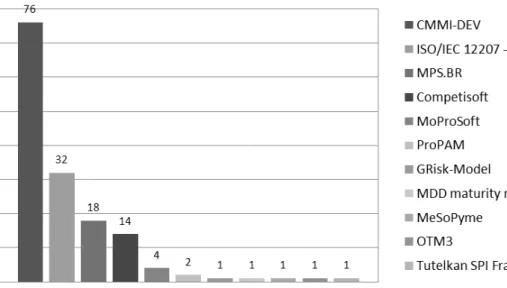
By eliminating duplicates, 424 items were obtained. Subsequently, on a first reading to exclude unrelated thematic articles a set of 124 articles to execute the data extraction were obtained as a result. The data extraction focused on classifying the articles according to the referenced SPRM in the content as part of the theoretical foundation or as methodological sustenance. The result of the classification is shown in Figure 2.
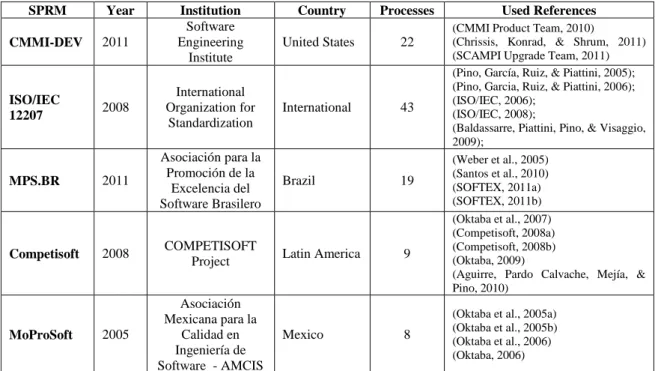
After the analysis, the first result was the selection of five SPRM: 1) the international standard, ISO / IEC 12207, 2) the Brazilian SPRM called MPS.BR by the acronym from the Portuguese expression " Melhoria de Processo do Software Brasileiro " or Improvement of Processes of the Brazilian Software, 4) The Process Model of the Mexican Software Industry (MoProSoft) and 5) the process model defined as part of the Process Improvement Program to Enhance the Competitiveness of Small and Medium Software Industry in Latin America - COMPETISOFT. Table 6 describes the selected SPRM.
SPRM Year Institution Country Processes Used References
CMMI-DEV 2011
Software Engineering
Institute
United States 22
(CMMI Product Team, 2010)
(Chrissis, Konrad, & Shrum, 2011) (SCAMPI Upgrade Team, 2011)
ISO/IEC
12207 2008
International Organization for
Standardization
International 43
(Pino, García, Ruiz, & Piattini, 2005); (Pino, Garcia, Ruiz, & Piattini, 2006); (ISO/IEC, 2006);
(ISO/IEC, 2008);
(Baldassarre, Piattini, Pino, & Visaggio, 2009);
MPS.BR 2011
Asociación para la Promoción de la
Excelencia del Software Brasilero
Brazil 19
(Weber et al., 2005) (Santos et al., 2010) (SOFTEX, 2011a) (SOFTEX, 2011b)
Competisoft 2008 COMPETISOFT
Project Latin America 9
(Oktaba et al., 2007) (Competisoft, 2008a) (Competisoft, 2008b) (Oktaba, 2009)
(Aguirre, Pardo Calvache, Mejía, & Pino, 2010)
MoProSoft 2005
Asociación Mexicana para la
Calidad en Ingeniería de Software - AMCIS
Mexico 8
(Oktaba et al., 2005a) (Oktaba et al., 2005b) (Oktaba et al., 2006) (Oktaba, 2006)
Table 6 Description of the selected SPRM
2. Identification of related processes with KM in the SPRM
The process analysis to identify those that contain aspects related to KM resulted in a set of 19 processes out of 101 processes from the five selected SPRM. Table 7 shows the identified processes in each SPRM.
Model Related processes to the KM
ISO 12207
Management of the Software Configuration. Process of Resolution of Software problems. Management of the Cycle of Life model. Management of Human Resources. Management of Reuse of Assets. Domain Engineering.
CMMI-DEV
Management of the Configuration. Definition of the Organizational Process. Organizational training.
MPS.BR
Management of the Configuration. Definition of the Organizational Process. Management of Human Resources. Development for the Reutilization.
MoProSoft
Management of the Process.
Management of Human Resources and of the Work Environment. Organizational Knowledge.
Competisoft
Management of the Process.
Management of Human Resources and of the Work Environment. Organizational Knowledge.
3. Mapping of processes in relation to km schools and capabilities
In relation to the analysis of the SPRM regarding the KM schools it was discovered that most of the identified aspects are related to the school system. In other words, the dominant approach is the encoding of knowledge. In fact, although in several SPRM there is an explicit reference to the KM (MoProSoft, Competisof), the scope of this process is limited to manage a repository of organizational knowledge. The contents of this repository of knowledge are, primarily, best practices, records of learned lessons, knowledge artifacts resulting from activities of software construction, and knowledge regarding the definition of the processes of the organization. Added to this, the ISO / IEC 12207, CMMI-DEV and MPS.BR models include the concept of repository of the organizational knowledge within the management processes of configuration and definition of the organizational process.
Also, all SPRM include aspects related to the engineering school. In particular, this school is materialized in the form of training activities and the provision of qualified personnel to carry out the activities of knowledge. These proposals become part of the processes of human resource management. Table 8 shows the relationships between the processes of the selected SPRM and KM schools.
Model Related Processes to KM
KM Schools S y ste m s Ca rto g ra p h ic En g in ee rin g Co m m erc ial Org an iza ti o n al S p ati al S trate g ic ISO 12207
Management of the Configuration. X - - - - Resolution of Software problems X - - - - Management of the Cycle of Life model - - X - - - - Management of Human Resources X - X - - - - Management of Reuse of Assets X - - - -
Domain Engineering X - - - -
CMMI-DEV
Management of the Configuration X - - - - Definition of the Organizational Process. X - - - -
Organizational training. - - X - - - -
MPS.BR
Management of the Configuration. X - - - - Definition of the Organizational Process. X - - - - Management of Human Resources. - - X - - - - Development for the Reutilization. X - - - -
MoProSoft
Management of the Process. X - - - -
Management of Human Resources and of the Work
Environment. - - X - - - -
Organizational Knowledge. X - - - -
Competisoft
Management of the Process. X - - - -
Management of Human Resources and of the Work
Environment. - - X - - - -
Organizational Knowledge X - - - -
Table 8 Relationship between the SPRM processes and KM schools
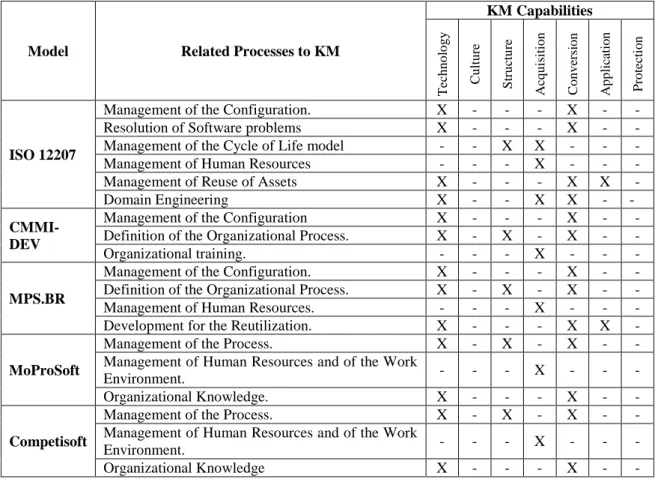
Model Related Processes to KM KM Capabilities Tec h n o lo g y Cu lt u re S tru ctu re Ac q u isit io n Co n v ersi o n Ap p li ca ti o n P ro tec ti o n ISO 12207
Management of the Configuration. X - - - X - -
Resolution of Software problems X - - - X - -
Management of the Cycle of Life model - - X X - - -
Management of Human Resources - - - X - - -
Management of Reuse of Assets X - - - X X -
Domain Engineering X - - X X - -
CMMI-DEV
Management of the Configuration X - - - X - -
Definition of the Organizational Process. X - X - X - -
Organizational training. - - - X - - -
MPS.BR
Management of the Configuration. X - - - X - -
Definition of the Organizational Process. X - X - X - -
Management of Human Resources. - - - X - - -
Development for the Reutilization. X - - - X X -
MoProSoft
Management of the Process. X - X - X - -
Management of Human Resources and of the Work
Environment. - - - X - - -
Organizational Knowledge. X - - - X - -
Competisoft
Management of the Process. X - X - X - -
Management of Human Resources and of the Work
Environment. - - - X - - -
Organizational Knowledge X - - - X - -
Table 9 Relationship between the SPRM processes and capabilities of KM
5. CONCLUSIONS
From the perspective of the KM schools, the subjects included in the SPRM are limited to systems and engineering schools. Therefore, any SDO that works on a SPI initiative based on the analyzed SPRM could not include strategies from other KM schools within the certification of their processes. For example, the design of the physical spaces to promote the creation and exchange of knowledge, from the spatial school, is not included in the studied SPRM, although a growing number of companies have been applying it in practice.
In addition, several authors argue that the software industry is a knowledge-intensive industry. Therefore, it is surprising and regrettable that the commercial
school’s approaches are not explicitly included in the studied SPRM. It s also noteworthy that the approaches of the organizational and strategic schools are not included in the studied SPRM, since these schools have a very close relationship with the principles and practices of the agile methods for software development which have an important influence on the software industry.
In this order of ideas, the present paper shows that the studied SPRM include within their scope some aspects of KM. This fact reaffirms the importance of KM for SDO, and in particular, the importance of KM in SPI. Mainly, the subjects of interest about KM in the SPRM are: 1) the encoding of knowledge, 2) the use of knowledge repositories, and 3) the organizational training. These topics of interest are located, in terms of (Buono & Poulfelt, 2005), in a first-generation KM. In this type of KM, knowledge is considered as a possession or something that can be captured and stored in repositories of knowledge-based technology. On the contrary, in the second-generation KM, knowledge is considered a complex phenomenon related to socio-cultural, political and technological aspects. For such a reason, a gap is evident in the content of the analyzed SPRM as these do not take into account elements of the second-generation KM.
The previous arguments encourage the formulation of three questions that serve as a source of motivation for future investigations: 1) what KM purposes and results should be incorporated into existing SPRM to have a more complete reference in the design, implementation, evaluation and improvement of processes within SDO? 2) Is it possible to incorporate these KM purposes and results as a new process within the existing SPRM? Or perhaps a reference model of KM processes for SDO is needed? 3) If the resulting reference model of KM processes could be used in an initiative for determining the levels of capability of SDO processes, what should the corresponding evaluation model of KM processes be like? The answers to these questions are highly valued in KM research and may be a significant contribution to the field since they are aligned with KM research trends identified by (Dwivedi, Venkitachalam, Sharif, Al-Karaghouli, & Weerakkody, 2011). They argue that the future research in the KM field requires studies related to the unification of the various KM models that exist today in the literature, and the understanding of the determinants of the evolution of KM in organizations. Also, studies are deemed relevant to the effectiveness of the KM and the necessary organizational and technological support to achieve it.
In summary, this study constitutes an important reference for research and practice as it represents a synthesis of the KM subjects included in the SPRM, and helps SDO to identify the fundamentals and the existing options for implementing KM initiatives. Moreover, this study helps researchers to identify trends and subjects to develop new research projects about the inclusion of the different "varieties" of KM in the SPRM, or to develop a reference model of KM processes for SDO.
ACKNOWLEDGEMENTS
The authors express their gratitude to COLCIENCIAS by its support through
“Generación del Bicentenario” program and to the Universidad del Magdalena by its
REFERENCES
Abran, A., Bourque, P., Dupuis, R., & Moore, J. W. (Eds.). (2001). Guide to the
Software Engineering Body of Knowledge - SWEBOK. IEEE Press.
Aguirre, A. F., Pardo Calvache, C. J., Mejía, M. F., & Pino, F. J. (2010). Reporte de experiencias de la aplicación de Competisoft en cinco mipymes colombianas. Revista EIA, (13), 107–122.
Alagarsamy, K., Justus, S., & Iyakutti, K. (2007). The knowledge based software process improvement program: A rational analysis. In 2nd International Conference on
Software Engineering Advances - ICSEA 2007.
Alagarsamy, K., Justus, S., & Iyakutti, K. (2008a). On the implementation of a knowledge management tool for SPI. In Proceedings - International Conference on
Computational Intelligence and Multimedia Applications, ICCIMA 2007 (Vol. 2, pp.
48–55).
Alagarsamy, K., Justus, S., & Iyakutti, K. (2008b). Implementation specification for software process improvement supportive knowledge management tool. IET Software, 2(2), 123–133.
Alvesson, M., & Kärreman, D. (2001). Odd Couple: Making Sense of the Curious Concept of Knowledge Management. Journal of Management Studies, 38(7), 995–1018. doi:10.1111/1467-6486.00269
Apostolou, D., & Mentzas, G. (1999). Managing corporate knowledge: a comparative analysis of experiences in consulting firms. Part 1. Knowledge and Process
Management, 6(3), 129–138.
doi:10.1002/(SICI)1099-1441(199909)6:3<129::AID-KPM64>3.0.CO;2-3
Aurum, A., Daneshgar, F., & Ward, J. (2008). Investigating Knowledge Management practices in software development organisations - An Australian experience.
Information and Software Technology, 50(6), 511–533.
doi:10.1016/j.infsof.2007.05.005
Baldassarre, M. T., Piattini, M., Pino, F. J., & Visaggio, G. (2009). Comparing ISO/IEC 12207 and CMMI-DEV: Towards a mapping of ISO/IEC 15504-7. In Proceedings of the ICSE Workshop on Software Quality, 2009. WOSQ ’09 (pp. 59–64). Presented at
the ICSE Workshop on Software Quality, 2009. WOSQ ’09, IEEE.
doi:10.1109/WOSQ.2009.5071558
Barragán Ocaña,, A. (2009). Aproximación a una taxonomía de modelos de gestión del conocimiento. Intangible Capital, 5(1), 65–101.
Basri, S. B., & O’Connor, R. V. (2011). Knowledge Management in Software Process
Improvement: A Case Study of Very Small Entities. In Knowledge Engineering for
Software Development Life Cycles: Support Technologies and Applications (p. 273).
IGI Global.
Bjørnson, F. O., & Dingsøyr, T. (2008). Knowledge management in software engineering: A systematic review of studied concepts, findings and research methods used. Information and Software Technology, 50(11), 1055–1068. doi:10.1016/j.infsof.2008.03.006
Capote, J., Llantén, C. J., Pardo, C., & Collazos, C. (2009). Knowledge management in a software process improvement program in micro, small and medium-sized enterprises: KMSPI Model. Revista Facultad de Ingenieria, (50), 205–216.
Capote, J., Llantén, C. J., Pardo, C., Gonzalez, A., & Collazos, C. (2008). Gestión del conocimiento como apoyo para la mejora de procesos software en las micro, pequeñas y medianas empresas. Ingenieria e investigacion, 28.
Choi, B., & Lee, H. (2003). An empirical investigation of KM styles and their effect on corporate performance. INFORMATION & MANAGEMENT, 40(5), 403–417.
Chrissis, M. B., Konrad, M., & Shrum, S. (2011). CMMI for Development®: Guidelines
for Process Integration and Product Improvement (3rd Edition) (3rd ed.).
Addison-Wesley Professional.
CMMI Product Team. (2010). CMMI® for Development, Version 1.3 (CMU/SEI-2010th-TR-033 ed.). Pittsburgh, PA, USA: Carnegie Mellon University.
Competisoft. (2008a). COMPETISOFT. Mejora de Procesos para Fomentar la
Competitividad de la Pequeña y Mediana Industria del Software de Iberoamérica.
Competisoft. (2008b). COMPETISOFT. Mejora de Procesos de Software para PEqueñas Empresas. Retrieved August 20, 2011, from http://alarcos.inf-cr.uclm.es/Competisoft/framework/
Cruz Mendoza, R., Morales Trujillo, M., Morgado C, M., Oktaba, H., Ibarguengoitia, G. E., Pino, F. J., & Piattini, M. (2009). Supporting the Software Process Improvement in Very Small Entities through E-learning: The HEPALE! Project. In 2009 Mexican
International Conference on Computer Science (ENC) (pp. 221–231). Presented at the
2009 Mexican International Conference on Computer Science (ENC), IEEE. doi:10.1109/ENC.2009.33
Dwivedi, Y. K., Venkitachalam, K., Sharif, A. M., Al-Karaghouli, W., & Weerakkody, V. (2011). Research trends in knowledge management: Analyzing the past and predicting the future. Information Systems Management, 28(1), 43–56.
Earl, M. (2001). Knowledge Management Strategies: Toward a Taxonomy. J. Manage.
Inf. Syst., 18(1), 215–233.
Gold, A. H., Malhotra, A., & Segars, A. H. (2001). Knowledge management: An organizational capabilities perspective. Journal of Management Information Systems, 18(1), 185–214.
ISO/IEC. (2004). ISO/IEC 15504-1:2004, Information technology - Process assessment
- Part 1: Concepts and vocabulary. Ginebra, Suiza: International Organization for
Standardization.
ISO/IEC. (2006). ISO/IEC 15504-5:2006, Information technology - Process Assessment
- Part 5: An exemplar Process Assessment Model. Ginebra, Suiza: International
Organization for Standardization.
ISO/IEC. (2008). ISO/IEC 12207:2008, Standard for Systems and Software Engineering
- Software Life Cycle Processes.
Kakabadse, N. K., & Kakabadse, A. (2003). Reviewing the knowledge management literature: towards a taxonomy. Journal of Knowledge Management, 7(4), 75–91. doi:10.1108/13673270310492967
Li, Z., Huang, S., & Gong, B. (2008). The knowledge management strategy for SPI practices. Chinese Journal of Electronics, 17(1), 66–70.
McAdam, R., & McCreedy, S. (1999). A critical review of knowledge management models. The Learning Organization, 6(3), 91–101. doi:10.1108/09696479910270416
Montoni, M. A., Cerdeiral, C., Zanetti, D., & Cavalcanti da Rocha, A. R. (2008). A Knowledge Management Approach to Support Software Process Improvement
Implementation Initiatives. In R. V. O’Connor, N. Baddoo, K. Smolander, & R.
Messnarz (Eds.), Software Process Improvement (Vol. 16, pp. 164–175). Berlin, Heidelberg: Springer Berlin Heidelberg.
Nielsen, P. A., & Tjørnehøj, G. (2010). Social networks in software process improvement. Journal of Software Maintenance and Evolution: Research and Practice, 22(1), 33–51. doi:10.1002/smr.452
Oktaba, H. (2006). MoProSoft®: A Software Process Model for Small Enterprises. In Proceedings of the 1st International Research Workshop for Process Improvement in
Small Settings (pp. 93–110). Presented at the International Research Workshop for
Process Improvement in Small Settings, Software Engineering Institute.
Oktaba, H. (2009). Co petisoft e ora e pro esos software para pe ue as y
medianas empresas y proyectos (1a ed.). Mé ico D.F. Alfaomega.
Oktaba, H., Esquivel, C., Su Ramos, A., Martínez, A., Quintanilla, G., Ruvalcaba, M.,
… Fernández, Y. (2005a). Modelo de Procesos para la Industria de Software
MoProSoft Version 1.3. México: Secretaría de Economía.
Oktaba, H., Esquivel, C., Su Ramos, A., Martínez, A., Quintanilla, G., Ruvalcaba, M.,
… Fernández, Y. (2005b). Modelo de Procesos para la Industria de Software
MoProSoft Version 1.3 Por Niveles de Capacidad de Procesos. México: Secretaría de
Economía.
Oktaba, H., Esquivel, C., Su Ramos, A., Martínez, A., Quintanilla, G., Ruvalcaba, M.,
… Fernández, Y. (2006). Software Industry Process Model MoProSoft Version 1.3. 2. México: Ministry of Economy.
Oktaba, H., García, F., Piattini, M., Ruiz, F., Pino, F. J., & Alquicira, C. (2007). Software Process Improvement: The Competisoft Project. Computer, 40, 21–28. doi:10.1109/MC.2007.361
Pino, F. J., Garcia, F., Ruiz, F., & Piattini, M. (2006). Adaptation of the standards ISO/IEC 12207:2002 and ISO/IEC 15504:2003 for the assessment of the software processes in developing countries. IEEE Latin America Transactions, 4, 85–92. doi:10.1109/TLA.2006.1642455
Pino, F. J., García, F., Ruiz, F., & Piattini, M. (2005). Adaptación de las normas ISO/IEC 12207: 2002 e ISO/IEC 15504: 2003 para la evaluación de la madurez de procesos software en países en desarrollo. In Pro ee ings of JISBD’05 (pp. 187–194).
Presented at the JISBD’05, IEEE.
Santos, G., Kalinowski, M., Rocha, A. R., Travassos, G. H., Weber, K. C., & Antonioni, J. A. (2010). MPS.BR: A Tale of Software Process Improvement and Performance Results in the Brazilian Software Industry (pp. 412–417). IEEE. doi:10.1109/QUATIC.2010.75
SCAMPI Upgrade Team. (2011). Standard CMMI® Appraisal Method for Process
Improvement (SCAMPI SM) A, Version 1.3: Method Definition Document
(CMU/SEI-2011th-HB-001 ed.). Pittsburgh, PA, USA: Carnegie Mellon University.
Sieber, S., & Andreu, R. (1999). La gestion integral del conocimiento y del aprendizaje. (With English summary.). Economia Industrial, (2), 63–72.
SOFTEX. (2011a). MPS.BR - Mejora de Proceso del Software Brasileño - Guía de
Evaluación. Brasil: SOFTEX.
SOFTEX. (2011b). MPS.BR - Mejora de Proceso del Software Brasileño - Guía
General. Brasil: SOFTEX.
Takeuchi, H. (2001). Towards a Universal Management Concept of Knowledge. In
Managing industrial knowledge (p. 315). Sage.
Weber, K. C., Araújo, E. E. R., Rocha, A. R. C., Machado, C. A. F., Scalet, D., & Salviano, C. F. (2005). Brazilian Software Process Reference Model and Assessment Method. In pInar Yolum, T. Güngör, F. Gürgen, & C. Özturan (Eds.), Computer and
Information Sciences - ISCIS 2005 (Vol. 3733, pp. 402–411). Berlin, Heidelberg: