Prevalence and severity of dental
fluorosis among students from João
Pessoa, PB, Brazil
Prevalência e severidade de fluorose dentária
em escolares da cidade de João Pessoa, PB,
Brasil
Abstract: The aim of this study was to determine the prevalence and severity of dental luorosis among 12-15-year-old students from João Pessoa, PB, Brazil before starting a program of artiicial luoridation of drinking water. The use of luoridated dentifrice was also surveyed. A sample of 1,402 students was randomly selected. However, 31 students refused to participate and 257 were not permanent residents in João Pessoa, thus leav-ing a inal sample of 1,114 students. Clinical exams were carried out by two calibrated dentists (Kappa = 0.78) under natural indirect light. Upper and lower front teeth were cleaned with gauze and dried, and then examined using the TF index for luorosis. A questionnaire on dentifrice ingestion and oral hygiene habits was applied to the students. The results revealed that luorosis prevalence in this age group was higher than expected (29.2%). Most luorosis cases were TF = 1 (66.8%), and the most severe cases were TF = 4 (2.2%). The majority of the students reported that they had been using luoridated den-tifrices since childhood; 95% of the participants preferred brands with a 1,500 ppm F concentration, and 40% remembered that they usually ingested or still ingest dentifrice during brushing. It was concluded that dental luorosis prevalence among students in João Pessoa is higher than expected for an area with non-luoridated water. However, although most students use luoridated dentifrices, and almost half ingest slurry while brushing, the majority of cases had little aesthetic relevance from the professionals’ point of view, thus suggesting that luorosis is not a public health problem in the locality.
Descriptors: Dental luorosis; Fluorides; Dentifrices.
Resumo: O objetivo deste estudo foi determinar a prevalência e severidade de luorose dentária em escolares de 12 a 15 anos de idade de João Pessoa, PB, Brasil antes da implan-tação de um programa de luoreimplan-tação de águas. O uso de dentifrício luoretado também foi investigado. De 1.402 escolares aleatoriamente selecionados, 31 recusaram-se a parti-cipar, 257 não eram residentes permanentes na cidade, resultando em uma amostra inal de 1.114 escolares. Dois cirurgiões-dentistas calibrados (Kappa = 0,78) realizaram exa-mes clínicos sob luz natural indireta nos dentes anteriores superiores e inferiores limpos com gaze e secos, aplicando-se o índice TF para luorose. Um questionário sobre ingestão de dentifrício e hábitos de higiene oral foi aplicado. Os resultados demonstram uma pre-valência de luorose acima do esperado (29,2%). A maioria dos casos foi TF = 1 (66,8%), e os mais severos foram TF = 4 (2,2%). A maioria dos estudantes informou que faz uso de dentifrícios desde a infância; 95% dos participantes preferiam marcas com 1.500 ppm F e 40% conirmaram que usualmente ingeriam ou ainda ingerem dentifrício durante a es-covação. Conclui-se que a prevalência de luorose entre estudantes de João Pessoa é acima do esperado para uma cidade sem luoretação de águas. No entanto, apesar de a maioria dos estudantes usar dentifrícios luoretados, e quase a metade deles ingerir dentifrício quando escova, a maioria dos casos foi de pouco comprometimento estético sob o ponto de vista dos proissionais, o que sugere que a luorose não se constitui em um problema de saúde pública nesta localidade.
Descritores: Fluorose dentária; Fluoretos; Dentifrícios. Thiago Saads Carvalho(a)
Helen Moura Kehrle(a) Fábio Correia Sampaio(b)
(a)DDSs; (b)Professor of Clinical Cariology –
School of Dentistry, Federal University of Paraíba.
Corresponding author:
Thiago Saads Carvalho Av. Nego, 935, apto. 202 (Ed. Camboriú), Tambaú João Pessoa - PB - Brazil CEP: 58039-101
E-mail: [email protected]
Introduction
The use of luoride in dental products, especial-ly in dentifrices, has been considered as one of the main reasons for caries decline in several countries and industrialized areas of Brazil.3,7,13,30
Fluoride can, however, induce toxic effects. Chronic intoxication with luoride affects the tooth mineralization process, resulting in hypomineral-ized enamel which is characterhypomineral-ized by greater po-rosity than that of normal enamel. This condition is called dental luorosis.28 The severity of the luorotic
enamel depends on the dose and on the duration of luoride exposure.29
Reports on the prevalence of dental luorosis in Brazil show a wide variation.10 In addition to the
different risk factors, it is also necessary to under-stand that several epidemiological indices have been used to measure luorosis.23 So far, dental luorosis
is a public health problem in few Brazilian locali-ties due to high ingestion of luoride from naturally luoridated water or due to the association between luoridated water intake and an uncontrolled in-gestion of luoridated products, particularly denti-frices.8,9,20,21,24,25,26 In Alagoas, a state of the
North-eastern region of Brazil, the ingestion of luoridated dentifrice (1,500 ppm) by young children accounted for 80% of the F-intake.14 However, the majority of
the Brazilian data on F-exposure are from cities in the Southern and Southeastern regions of the coun-try, where individuals are exposed to luoridated wa-ter as well as other sources of luoride.8,12,20
There-fore, a thorough observation of the isolated effect of luoridated dentifrices ingestion during childhood is much more dificult.
The SB-Brasil study, conducted with a small sample, indicated a low dental luorosis prevalence in João Pessoa (< 10%).5,19 Furthermore, empirical
data show few clinical cases of microabrasion treat-ment, thus indicating low luorosis severity.21,26 A bill
presented in 2004 and later approved in May 2005 by the local health council has allowed water luori-dation since 2006.15,17 To date (June 2007), however,
João Pessoa still does not have a luoridated public water system. Thus, an epidemiologic study on den-tal luorosis in João Pessoa before luoridating the public water system is important, primarily because
the data on dental luorosis prevalence will be useful in future epidemiologic studies, and also because it will be possible to separately measure, in the same urban area, the contribution of luoride intake from luoridated dentifrices and from luoridated water. The aim of this study was, therefore, to determine the prevalence of dental luorosis among 12- to 15-year-old students from João Pessoa (PB), a non-luo-ridated city that will start a program of artiicial lu-oridation of drinking water. The use of luoridated dentifrice was also surveyed.
Material and Methods
Area studied
João Pessoa has approximately 600 thousand in-habitants.18 The city had luoridated water for a two
year period in the middle of the 1980s, but since then the project has been disabled.16 Nowadays,
lu-oride concentration in the water is very low as stat-ed by Alves2 (2001) which monitored luoride levels
during 1 year and found it to be less than 0.1 ppm.
Individuals
Twelve to ifteen year old children, who were regularly attending public schools in the urban area of the city, were randomly chosen by cluster ran-dom sampling with a design effect of 2.0. A pilot study was conducted to estimate the prevalence of dental luorosis in 4 schools (n = 120), one in each zone of the city. The estimated prevalence observed was 21%. Thus, the sample size was calculated as-suming an expected prevalence of 0.21, a z value of 1.96 and an absolute precision of 0.04. A minimum sample size of 797 students was determined.22
How-ever, in order to avoid non-permanent residents in the sample and to compensate the refusals, a 30% increase in the calculated sample was carried out.6
Thus, a goal was set of at least 1,036 students to be selected. The clusters were drawn according to the population density of the target age group in the schools distributed in the 4 major city areas.18
areas of João Pessoa, 21 of them mainly have school children younger than 12 years old and therefore al-most all schools were included in the study.18
In order to assure that individuals were exposed only to the water from João Pessoa during their life, the permanent residency of the subjects was checked in the schools and then recorded to the iles. All stu-dents selected were examined; however, only per-manent residents were considered for data analysis. Additionally, in order to be included in the research, after having been selected, the students had to meet the following criteria: complete teeth eruption, ab-sence of lesion on the teeth, no orthodontic brackets. A total of 1,402 students were examined. However, 31 students refused to take part in the research and 257 were not permanent residents in João Pessoa, and thereby a inal sample of 1,114 students was ob-tained.
Questionnaire
The students answered a 4-question form on the use of luoridated dentifrice (if the student used it since childhood, and his/her preferred brand) and on oral hygiene habits (brushing frequency, and if he/she remembered ingesting dentifrice since child-hood).
Clinical examination
The dental exam for luorosis was carried out by two previously calibrated dentistry students. The calibration was carried out in two phases. Initially, the examiners were given a series of sixty random photographs of luorosis cases (TF.0 – TF.7). Then, each student separately analyzed and gave TF scores. In a second stage, the calibration was conducted in schools with 40 students with varying luorosis se-verities (TF.0 – TF.4). Comparing the scores from the examiners to the golden standard, the inter-examin-er kappa index was calculated (Kappa index = 0.78). Before the exam, the teeth were cleaned with gauze and dried for 30 seconds using an electric air com-pressor. The exams were carried out under natural indirect light during school hours and using wooden spatulas. Fluorosis severity was assessed using the TF index28 for the buccal surface of each tooth.
Up-per and lower incisors, canines and premolars were
examined. The overall luorosis severity degree for each individual was based on the highest TF value found in the individual’s oral cavity.
Statistical study
The data were put into tables in the SPSS pro-gram (v. 10.0). The chi-squared test was used when appropriate. Previously, a signiicance level of 5% was established. Approximately 8% of the sample was re-examined to obtain an intra-examiner Kap-pa index. The intra-examiner KapKap-pa index values were 0.88 and 0.80 for the irst and second exam-iner, respectively.
Ethical consideration
Before beginning the research, the project was evaluated and approved by the Ethics in Research Committee, Health Sciences Center, Federal Univer-sity of Paraíba (CEP/CCS-UFPB, protocol number 113/03). Consent forms were obtained from each student and from each school principle, thus com-plying with the legislation regarding research with human beings.
Results
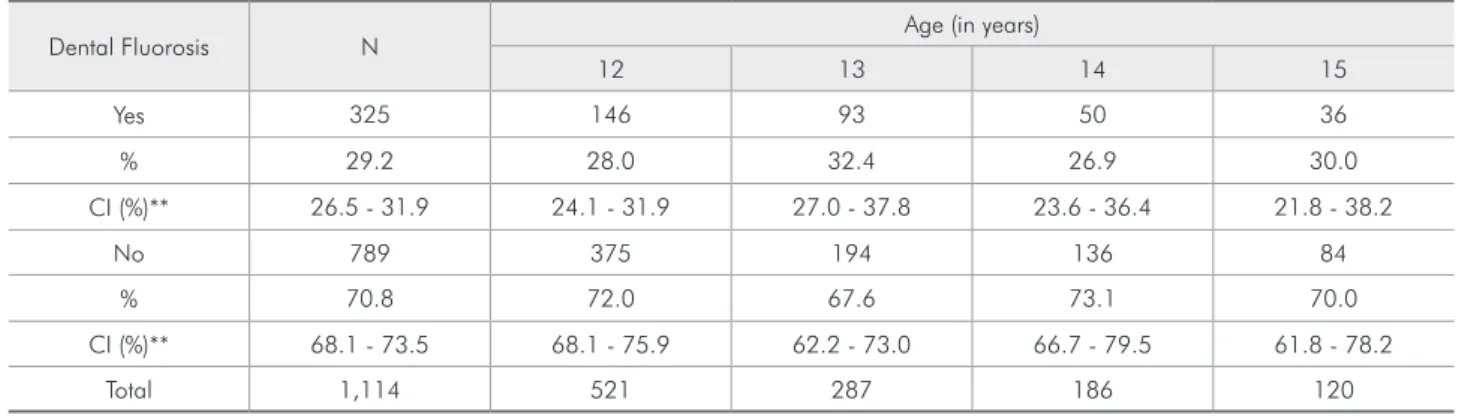
Fluorosis prevalence in permanent-resident stu-dents in João Pessoa was 29.2% (n = 325). The prevalence values were similar amongst the student age groups, with no statistical difference (Table 1).
A total of 537 males and 577 females were exam-ined, and no relation between luorosis prevalence and gender was found (p > 0.05, df = 1, χ2 = 2.3).
There was a slight decrease in the number of stu-dents as age increased. A total of 21,483 teeth were examined. Absent teeth added up to 797, which is 3.7% of the total. The mainly absent teeth were ca-nines (n = 207). Upper premolars (n = 4,212) were most affected by luorosis (21.1%; n = 889), fol-lowed by lower premolars (n = 4,224), from which 8.5% (n = 359) were affected. From the canines ex-amined (n = 4,190), 4.0% (n = 169) were affected, and from the incisors examined (n = 8,857), 2.3% (n = 201) were affected.
Among the 257 non-residents, the prevalence of dental luorosis was 46%. Most of them (43%) had TF values of 1 to 3.
In the majority of the city areas visited, a preva-lence of less than 25% was observed. However, 4 city neighborhoods (“Tambaú”, “Castelo Branco”, “Cruz das Armas” and “Varadouro”) presented a dental luorosis prevalence above 36%.
The majority of the students informed that they used luoridated dentifrice since childhood, includ-ing brands that were not available on the market-place at the time of the study; 95% of the preferred brands had a 1,500 ppm F concentration. Sixty ive percent of the students reported that they brushed their teeth 3 times a day. A total of 366 students were unable to remember if they had ingested denti-frice during childhood, but 456 of them did remem-ber they had ingested or still ingest dentifrice when brushing their teeth.
Discussion
The procedure of evaluating dental luorosis only among lifelong residents has been
recom-mended previously.27 Because of migration, many
students were not accounted for in data analysis. The higher luorosis prevalence of non-residents (46%) could certainly have overestimated the real prevalence of dental luorosis if this procedure had not been taken into consideration. This is partic-ularly important since there are 3 large endemic luorosis areas in Paraíba due to the presence of natural luoride in ground waters. The prevalence of dental luorosis in these areas can reach more than 70% among children and severe luorosis can be found.24,26 Due to migration, the present study
would certainly be biased if the lifelong residency criterion was disregarded.
Fluorosis prevalence in students from João Pes-soa was higher than expected (Table 1). A lower prevalence value was predicted, as the city does not have luoridated water. It is quite inadequate to compare this result with that of other studies due to the socio-cultural differences, as well as to the dif-ferent indexes used to record luorosis severity. The SB-Brasil study observed an 8.9% luorosis rate in João Pessoa.19 Underestimation should be
consid-ered since the sample number was low and the Dean index, which does not ask for a clean and dry tooth surface before examination, was used. Unlike the TF index,23,28 the Dean index is not related to
enam-el histological features. The TF index would there-fore be the most appropriate for a mild luorosis sce-nario, especially in areas lacking water luoridation. Underestimation cannot thus be disregarded in the study performed in Salvador, a city with luoridated Table 1 - Fluorosis prevalence according to students’ age. João Pessoa, 2004-2005*.
Dental Fluorosis N Age (in years)
12 13 14 15
Yes 325 146 93 50 36
% 29.2 28.0 32.4 26.9 30.0
CI (%)** 26.5 - 31.9 24.1 - 31.9 27.0 - 37.8 23.6 - 36.4 21.8 - 38.2
No 789 375 194 136 84
% 70.8 72.0 67.6 73.1 70.0
CI (%)** 68.1 - 73.5 68.1 - 75.9 62.2 - 73.0 66.7 - 79.5 61.8 - 78.2
Total 1,114 521 287 186 120
*(χ2 = 2.2, df = 3, p > 0.05); **Confidence Interval.
Table 2 - Distribution of the different fluorosis scores among 325 students. João Pessoa, 2004-2005.
Total TF
1 2 3 4
N 325 217 34 67 07
water that presented a 29% luorosis rate using the Dean Index.9
Fluorosis prevalence above 36% was found in 4 areas of João Pessoa. These neighborhoods are considered central areas of the city, where living conditions are better than in the outskirts. It is therefore expected that even impoverished people that live in these areas are able to acquire oral hy-giene goods more easily than those living in poorer neighborhoods.
Information about luoride ingestion in João Pessoa is not available. However, there are many reasons to consider the luoridated dentifrice as the main source of luoride. First, water luorida-tion stopped 20 years ago and, since that time, the luoride levels have been very low.2 Secondly, other
sources of luoride, such as mineral water, are un-likely to have contributed because the local mineral water commercialized in the city has low luoride levels.2,24,25 Thirdly, luoride-rich dietary products
could not be detected so far, and Albuquerque et al.1 (2003) reported that the use of luoridated
den-tifrice in young ages is common in João Pessoa. Ad-ditionally, our data support that this habit may go on until adolescence for some subjects. Finally, a survey of luoride intake showed that 80% of the luoride ingested by children in other cities of Paraí-ba came from dentifrices.25 In spite of the existence
of only two reports, the ingestion of dentifrice among the children in the Northeast region of Bra-zil is higher than that reported in other BraBra-zilian studies.8,12,14 A study about cultural habits is
war-ranted for this issue. A recent document reported that, in Paraíba, some persons are adding amounts of dentifrice to water and other drinking products to produce a “cool water” sensation.4 If this habit is
common among children, the risk of dental luoro-sis can be high.
The difference between luorosis prevalence in luoridated and non-luoridated regions is decreas-ing.25 Some studies have currently reported higher
luorosis prevalence in areas without water luorida-tion in comparison to areas with water luoridaluorida-tion,
whereas better oral health conditions are frequent in areas of luoridated water.11 Therefore, a water
luoridation program in João Pessoa is necessary since caries experience is still high among adoles-cents (DMFT = 3.5 among 12-year-old children) and in young children.12,16 The majority of the
luo-rosis cases observed was TF = 1. As the TF index ranges from 0 to 9, such a score represents thin opaque white lines on the enamel, which can only be clearly observed when the tooth surface is clean and dry.28 Under regular oral conditions, with the
enamel covered by dental plaque and saliva, that level of dental luorosis is not considered an aes-thetic problem, thus suggesting that the majority of the cases observed in this study cannot be regarded as a public health problem (Table 2). A luoridation program can, therefore, be safely recommended. An increase in dental luorosis prevalence due to the association of dentifrice ingestion and water luo-ridation can be expected. On the other hand, it is important to mention that an increase in the rosis prevalence does not mean an increase in luo-rosis severity. Having this study’s results in hand, it is dificult to identify the luoride sources involved, but it is possible to support that water luoridation had no effect on the actual luorosis prevalence ob-served in the studied group.
Conclusions
Dental luorosis prevalence among students from João Pessoa was higher than expected for an area with a non-luoridated water supply.
Most students used highly luoridated dentifrices, and almost half ingested slurry while brushing. The great majority of luorosis cases had little aesthetic relevance, thus suggesting that dental luorosis should not be considered as a public health problem.
Acknowledgments
This study was supported by the National Coun-cil for Scientiic and Technological Development (CNPq).
1.
2.
References
1. Albuquerque SSL, Lima MGGC, Sampaio FC. Utilização de dentifrício fluoretado por crianças de 2 a 5 anos na cidade de João Pessoa, Paraíba. Odontol Clin Cient. 2003;2(3):211-6. 2. Alves NSS. Situação da fluoretação de águas de abastecimento
público no estado da Paraíba [Monografia de Especialização]. João Pessoa: Universidade Federal da Paraíba; 2001.
3. Birkeland JM, Haugejorden O, von der Fehr FR. Some factors associated with the caries decline among Norwegian children and adolescents: age-specific and cohort analyses. Caries Res. 2000;34(2):109-16.
4. Brasil. Ministério da Saúde. Fundação Nacional de Saúde. De-partamento de Saúde Indígena. Uso indevido de creme dental. [s.l.]. Fundação Nacional de Saúde; 2005. Memorando circular n. 100 COOPE/DESAI.
5. Brasil. Ministério da Saúde. Secretaria de Atenção à Saúde. Departamento de Atenção Básica. Coordenação Nacional de Saúde Bucal. Projeto SB Brasil 2003: condições de saúde bucal da população brasileira no ano 2002-2003. Resultados Princi-pais. Brasília: Ministério da Saúde; 2004.
6. Brasil. Ministério da Saúde. Secretaria de Políticas Públicas. Departamento de Atenção Básica. Área Técnica de Saúde Bucal. Projeto SB2000: condições de saúde bucal da população brasi-leira no ano 2000: manual do coordenador. Brasília: Ministério da Saúde; 2001.
7. Bratthall D. Dental caries: intervened – interrupted – inter-preted. Concluding remarks and cariography. Eur J Oral Sci. 1996;104(4 pt 2):486-91.
8. Buzalaf MFR. Fatores de risco para fluorose dentária e biomar-cadores de exposição ao flúor [Tese de Livre Docência]. Bauru: Faculdade de Odontologia de Bauru da USP; 2002.
9. Cangussu MCT, Castellanos Fernandez RA, Rivas CC, Ferreira Jr C, Santos LC. Prevalência da fluorose dentária em escolares de 12 e 15 anos de idade em Salvador, Bahia, Brasil, 2001. Cad Saúde Pública. 2004;20(1):129-35.
10. Cangussu MCT, Narvai PC, Castellanos Fernandez R, Djehizian V. A fluorose dentária no Brasil: uma revisão crítica. Cad Saúde Pública. 2002;18(1):7-15.
11. Cypriano S, Pecharki GD, Sousa MLR de, Wada RS. A saúde bucal de escolares residentes em locais com e sem fluoretação nas águas de abastecimento público na região de Sorocaba, São Paulo, Brasil. Cad Saúde Pública. 2003;19(4):1063-71. 12. Lima YBO, Cury JA. Seasonal Variation of Fluoride Intake
by Children in a Subtropical Region. Caries Res. 2003;37(5): 335-8.
13. Narvai PC, Castellanos RA, Frazão P. Prevalência de cárie em dentes permanentes de escolares do Município de São Paulo, SP, 1970-1996. Rev Saúde Pública. 2000;34(2):196-200. 14. Omena LMF, Silva MF de A, Pinheiro CC, Cavalcante JC,
Sampaio FC. Fluoride intake from drinking water and den-tifrice by children living in a tropical area of Brazil. J Appl Oral Sci. 2006;14(5):382-7.
15. Paraíba. Assembléia Legislativa do Estado da Paraíba. Projeto de lei nº 554/2004. Dispõe sobre a fluoretação da água desti-nada para o consumo humano na Paraíba. Ata de sessão, jun 2004:3.
16. Paraíba. Companhia de Água e Esgotos da Paraíba. Lista de cidades com fluoretação de águas. Relatório Técnico; 1996, Ago:3.
17. Paraíba. Conselho Municipal de Saúde de João Pessoa. Reso-lução n. 09 de 05 de maio de 2005. Ata de sessão; 2005:25. 18. Paraíba. Secretaria de educação e cultura do estado da Paraíba.
Relatório de geoprocessamento; 2004.
19. Paraíba. Secretaria de Saúde. Dados parciais do SB Brasil 2003. João Pessoa; 2004.
20. Pereira AC, Da Cunha FL, Meneghim M de C, Werner CW. Dental caries and fluorosis prevalence study in a nonfluori-dated Brazilian community: trend analysis and toothpaste association. ASDC J Dent Child. 2000;67(2):132-5. 21. Pereira TB, Sampaio FC. Hábitos de escovação dental de
crian-ças em áreas de fluorose endêmica do estado da Paraíba [CD-ROM]. In: Anais do 21º Congresso Internacional de Odontolo-gia de São Paulo; 2003 jan 27-30; São Paulo. São Paulo: APCD; 2003.
22. Rodrigues PC. Bioestatística. Niterói: EDUFF; 1986. 23. Rozier RG. Epidemiologic indices for measuring the clinical
manifestations of dental fluorosis: overview and critique. Adv Dent Res. 1994;8(1):39-55.
24. Sampaio FC. Fluoride exposures and biomarkers in humans [PhD Dissertation]. Oslo: School of Dentistry, University of Oslo; 2000.
25. Sampaio FC, Kehrle HM, Carvalho TS. Monitoreo de la inges-tión de fluoruros en niños del interior de Paraiba [abstract].
In: Resúmenes de la XI Reunión Anual de la Asociación de Investigación Odontológica del Peru: 2004; Lima. Asociación de Investigación Odontológica del Peru: 2004. p. 35. 26. Sampaio FC, Mendes ACR, Pires GR. Remoção de manchas
de fluorose pela técnica de CROLL - Descrição de caso clínico. Revista da ABO. 1997;5(3):153-6.
27. Selwitz RH, Nowjack-Raymer RE, Kingman A, Driscoll WS. Dental caries and dental fluorosis among schoolchildren who were lifelong residents of communities having either low or optimal levels of fluoride in drinking water. J Public Health Dent. 1998;58(1):28-35.
28. Thylstrup A, Fejerskov O. Clinical appearance of dental fluo-rosis in permanent teeth in relation to histological changes. Community Dent Oral Epidemiol. 1978;6(6):315-28. 29. Villena RS, Cury JA. Flúor: aplicação sistêmica. In: Correia
MSNP. Odontologia para a primeira infância. São Paulo: San-tos; 1998. p. 291-314.