The In
fl
uence of Education and Depression on
Autonomy of Women with Chronic Pelvic Pain:
A Cross-sectional Study
A in
fl
uência da educação e depressão sobre a autonomia de
mulheres com dor pélvica crônica: um estudo transversal
Hermes de Freitas Barbosa
1Antonio Alberto Nogueira
2Júlio César Rosa e Silva
2Omero Benedicto Poli Neto
2Francisco José Candido dos Reis
21Department of Pathology and Legal Medicine, Ribeirao Preto School
of Medicine, University of Sao Paulo, Ribeirao Preto, Brazil
2Department of Gynecology and Obstetrics, Ribeirao Preto School of
Medicine, University of Sao Paulo, Ribeirao Preto, Brazil
Rev Bras Ginec Obst 2016;38:47–52.
Address for correspondence Francisco José Candido dos Reis, PhD, Departamento de Ginecologia e Obstetrícia, Ribeirao Preto School of Medicine, University of Sao Paulo, Av. Bandeirantes 3900, 8o andar, 14049-900 - Ribeirão Preto, Brazil (e-mail: [email protected]).
Keywords
►
autonomy
►
diagnostic
laparoscopy
►
chronic pelvic pain
►
education
►
depression
Abstract
Objective
Patient autonomy has great importance for a valid informed consent in clinical
practice. Our objectives were to quantify the domains of patient autonomy and to evaluate
the variables that can affect patient autonomy in women with chronic pelvic pain.
Methods
This study is a cross sectional survey performed in a tertiary care University
Hospital. Fifty-two consecutive women scheduled for laparoscopic management of
chronic pelvic were included. Three major components of autonomy (competence,
information or freedom) were evaluated using a Likert scale with 24 validated af
fi
rmatives.
Results
Competence scores (0.85 vs 0.92;
p
¼
0.006) and information scores (0.90 vs
0.93;
p
¼
0.02) were low for women with less than eight years of school attendance.
Information scores were low in the presence of anxiety (0.91 vs 0.93;
p
¼
0.05) or
depression (0.90 vs 0.93;
p
¼
0.01).
Conclusions
Our data show that systematic evaluation of patient autonomy can
provide clinical relevant information in gynecology. Low educational level, anxiety and
depression might reduce the patient autonomy in women with chronic pelvic pain.
Resumo
Objetivo
A autonomia da paciente é de grande importância para que o
consenti-mento informado seja válido na prática clínica. Nossos objetivos foram quanti
fi
car os
domínios da autonomia e avaliar variáveis que modi
fi
cam a autonomia em mulheres
com dor pélvica crônica.
Métodos
Este é um estudo transversal realizado em um Hospital Universitário
terciário. Foram incluídas consecutivamente 52 mulheres com dor pélvica crônica
agendadas para videolaparoscopia. Foi utilizada uma escala Likert com 24 a
fi
rmativas
validadas para quanti
fi
car os três principais componentes da autonomia (competência,
informação e liberdade).
Palavras-chaves
►
autonomia
►
laparoscopia
diagnóstica
►
dor pélvica
crônica
►
educação
received October 21, 2015 accepted November 9, 2015
DOIhttp://dx.doi.org/ 10.1055/s-0035-1570107. ISSN 0100-7203.
Copyright © 2016 by Thieme Publicações Ltda, Rio de Janeiro, Brazil
Introduction
Informed consent is an integral part of medical
decision-making for a patient accepting a specific treatment.1For an
informed consent to be valid, the patient has to be informed about potential effects and side effects of the treatment. The
final decision whether to recommend or not the treatment
should take in account the patient autonomy. Autonomy implies competence to consent, understanding of risks and
benefits, and freedom to decide.2 Competence to consent
refers to the ability to understand the information. The risks,
benefits and alternatives available have to be informed in an
accessible language. Finally, the patient has to feel free to decide in being submitted or not to the proposed procedure. According to the autonomy principle, all patients are entitled
to decide on the issues related to their own life.3
With medical care moving toward patient centered ap-proach, to understand the various aspects involved in auton-omy has great importance for achieving optimal care in reproductive medicine. However, in clinical practice, a
sys-tematic evaluation of patient’s autonomy is not done
rou-tinely. For women with chronic pelvic pain (CPP), the laparoscopic investigation can led to additional diagnostic procedures or treatment in 28.8% and discard unnecessary diagnostic procedures in 13% of cases. The rates of minor
complications are around 2% and major complications 0.1%.4
Despite the benefits of laparoscopy in the management of
selected patients with CPP, the informed consent is manda-tory before the surgical intervention. In this proof of princi-ple study, we systematically evaluated the autonomy in a consecutive series of women with CPP scheduled for diag-nostic laparoscopy.
Methods
Study Design and Participants
Fifty-two consecutive patients with chronic pelvic pain sched-uled to diagnostic laparoscopy were included in this cross-sectional survey study. The Institutional Ethics Committee for Research provided ethical approval for this study registration
number: 3973/2008) and all participants gave specific written
consent before being interviewed for this study.
The inclusion criterion was: pain in pelvic region persis-tent for at least six months requiring laparoscopy for diag-nosis and/or treatment. Women who had history of
abdominal cancer or pelvic cancer were not included. The informed consents for laparoscopic procedures were ob-tained by the consultant gynecologist, and the application of the questionnaires for this study was conducted by one of the authors of this study. All patients had given consent to be submitted to laparoscopy by the time the questionnaires were applied. This manuscript was written based on STROBE Statement.
Measures
The questionnaire for autonomy characterization was
based on five-level Likert scale and included 24 affi
rma-tions (►Table 1). The questionnaire was applied in
Portu-guese and the contents had been previously validated by six experts who evaluated whether test items assess the
proposed autonomy domains.5 The affirmations were
divided in three categories: information (11 affirmations),
competence (6 affirmations) and freedom (7 affirmations).
Each statement was followed by a visual analogue scale with the following alternatives and their corresponding values: strongly disagree (1), disagree (2), neither agree nor disagree (3), agree (4) and strongly agree (5). The statements were presented randomly, with positive and negative propositions. For negative propositions, the values were adjusted for the analysis. The scores for competence, information, and freedom were calculated by dividing the score obtained by the maximum possible value in the category.
Data on age, educational attainment, marital status and family monthly income, were obtained at the time of questionnaire application. Pain duration was recorded in months as informed by the patient. The current pain intensity was based on a 100 mm visual analogue scale:
moderate pain (45–74 mm) and severe pain (75–100
mm).6Anxiety and depression symptoms were evaluated
using the Hospital Anxiety and Depression Scale (HADS). The HADS is a fourteen item scale that generates ordinal data. Seven of the items relate to anxiety and seven relate
to depression. Each item is scored from zero to three.7In
this study we used the cut-off value of 8/21 for anxiety or
depression.8
Statistical Analysis
Statistical analysis was conducted using Stata 13 software (StataCorp LP, 2013, Texas, USA). A correlation matrix for
Resultados
Os escores de competência (0,85 vs 0,92;
p
¼
0,006) e informação
(0,90 vs 0,93;
p
¼
0,02) foram menores para mulheres com ensino fundamental
incompleto. Os escores de informação foram menores em mulheres com sintomas de
ansiedade (0,91 vs 0,93;
p
¼
0,05) ou depressão (0,90 vs 0,93;
p
¼
0,01).
autonomy components was calculated using the Pearson
product-moment correlation coefficient. Univariate analyses
were conducted using Studentt-test.
Results
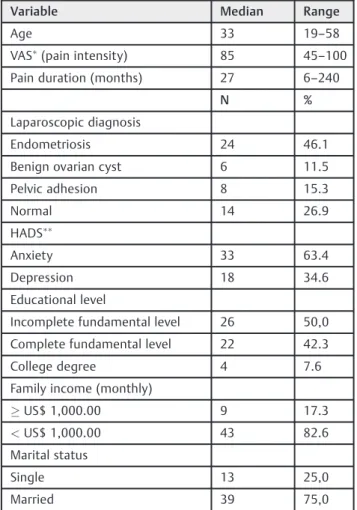
The baseline data are presented in ►Table 2. Patients’age
varied from 19 to 58 years with median of 33 years. Nineteen (37%) reported moderate pain and 33 (63%) severe pain
according to VAS classification. Twenty-six patients (50%)
had pain duration between 6 months and 2 years and 26 (50%) patients had pain duration longer than 2 years. Thirty-three (63%) patients presented anxiety symptoms and 18 (35%) presented depression symptoms. Twenty-six (50%) women did not complete the fundamental compulsory edu-cation time (8 years). Forty-three (83%) had family income lower than US$ 1,000.00 a month. Thirteen (25%) women were single.
Autonomy scores varied from 0.60 to 1.00 (mean¼0.92)
for competence, from 0.6 to 1.0 (mean¼0.92) for information
and from 0.80 to 1.00 (mean¼0.92) for freedom.
Compe-tence and information scores were significantly correlated
(r¼0.34,p¼0.01). However, the freedom scores were not
correlated with competence or information scores (►Table 3).
Associations between autonomy scores and patients
characteristics are presented in the►Table 4. Two
param-eters were significantly associated with reduction of
au-tonomy to consent in undergoing to laparoscopic diagnosis procedure: educational attainment and symptoms of de-pression. Women who did not complete the fundamental level of compulsory education had low competence score
(0.85 vs 0.92;p¼0.006) and low information score (0.90
vs 0.93; p¼0.02). The information score was low for
women with symptoms of anxiety (0.91 vs 0.93;
p¼0.05) or depression had low information score (0.90
vs 0.93;p¼0.02).
Table 1 Questionnaire for autonomy quantification
Category Statement Proposition
Information I have been informed about the proposed surgery. Positive
I have been explained about the available non-surgical management for my pain. Positive
I have been informed the advantages of the proposed surgery. Positive
I have been informed the disadvantages of the proposed surgery. Positive
I have been explained the reason for the surgery. Positive
The explanations provided by the health team gave me confidence to make a decision. Positive I would like having received further information about the proposed surgery. Negative
All my questions have been answered. Positive
I have been informed about the risks of the proposed surgery. Positive
I got the information to make the decision about undergoing surgery from internet, magazines, newspapers, TV shows or other sources.
Negative
I got the information to make the decision about undergoing surgery from people who underwent to the same surgery.
Negative
Competence I was able to understand the available alternatives to the proposed surgery. Positive
I found difficult to understand the provided information about the surgery. Negative I found difficult to understand the medical terms used by the doctor. Negative I was able to understand the procedure to be performed. Positive
I was able to understand the answers to my questions. Positive
The risks of the surgery are not clear to me. Negative
Freedom I feel free to talk to the health team about my doubts. Positive
The health team listened to my concerns. Positive
I felt difficulty to ask questions to the attending doctor. Negative
I feel free to decide about my treatment. Positive
I have not been asked about my preference for the type of treatment. Negative
I did not like the way I was treated when asked about the treatment. Negative
Discussion
Shared decision making is becoming dominant in
gynecolo-gy. This approach has ethical and clinical benefits,9however
its implementation is challenging. One important factor in this process is patient autonomy. In this study we evaluated a questionnaire, previously used for quantifying patient
au-tonomy in deciding about aesthetic procedures,5to quantify
patient autonomy in women with CPP scheduled for
diag-nostic laparoscopy. Our results showed that the quantifi
ca-tion of patient autonomy can provide details about the domains of autonomy: competence, information and free-dom. We were also able to identify variables that can affect these domains.
Educational level can affect many aspects of the decision process in health care. In the current study, patients were predominantly from low income population (83%). However, there were social inequalities even among them. Fifty per-cent of the patients did not complete the compulsory funda-mental educational level. In clinical trials the comprehension
of informed consent is impaired by low educational level.10
At the time of deciding to undergo hysterectomy for treating
benign gynecologic disease, the unjustified fear of cancer is
more common among less educated women.11 Men from
underserved communities are at higher risk of misunder-standing medical terms associated with diagnosis and
treat-ment of prostate cancer.12Our quantitative analysis showed
that the scores for competence and information were lower among less educated women. Although limited by the study design, a cross-sectional survey, our data provided evidence that usual care might not warrant autonomy for women with low educational level. Strategies based on decision aids are needed to improve the shared decision making for those
patients.13
The presence of symptoms of depression among women with CPP is high. While the prevalence of depression is
around 21% among women in general population14, among
patients with gynecological pain it is up to 35%.15In our
study, 34.6% of patients presented symptoms of
depres-sion. In this group the score for information were signifi
-cantly lower. Some studies in clinical ethics have demonstrated that depression can impair the ability to
appreciate significance of information about the illness
and the consequences of treatment options.16 Our data
reinforce the need of screening psychiatric disorders in women with CPP. In the presence of signs of depression, the patient should be properly evaluated before the decision about invasive diagnostic procedures.
In conclusion, we were to show that systematic evalua-tion of patient autonomy can provide clinical relevant
information in gynecology. The quantification of the
do-mains of patient autonomy might also be important for research on factors affecting the validity of informed consent in patients with low educational level or symp-toms of anxiety and depression.
Acknowledgments
Fundação de Apoio ao Ensino, Pesquisa e Assistência do Hospital das Clínicas da Faculdade de Medicina de Ri-beirão Preto da Universidade de São Paulo (FAEPA).
FAEPA had no involvement in study design; in the collection, analysis and interpretation of data; in the writing of the report; and in the decision to submit the article for publication.
Table 3 Matrix correlation among components of autonomy in women with chronic pelvic pain
Competence Information Freedom
Competence 1.0
Information r¼0.34 (p¼0.01)
1.0
Freedom r¼0.08 (p¼0.56)
r¼0.01 (p¼0.93)
1.0
r: Pearson correlation coefficient. Table 2 Baseline data
Variable Median Range
Age 33 19–58
VAS
(pain intensity) 85 45–100
Pain duration (months) 27 6–240
N %
Laparoscopic diagnosis
Endometriosis 24 46.1
Benign ovarian cyst 6 11.5
Pelvic adhesion 8 15.3
Normal 14 26.9
HADS
Anxiety 33 63.4
Depression 18 34.6
Educational level
Incomplete fundamental level 26 50,0
Complete fundamental level 22 42.3
College degree 4 7.6
Family income (monthly)
US$ 1,000.00 9 17.3
<US$ 1,000.00 43 82.6
Marital status
Single 13 25,0
Married 39 75,0
References
1 Tanderup M, Reddy S, Patel T, Nielsen BB. Informed consent in medical decision-making in commercial gestational surrogacy: a mixed methods study in New Delhi, India. Acta Obstet Gynecol Scand 2015;94(5):465–472
2 Nijhawan LP, Janodia MD, Muddukrishna BS, et al. Informed consent: Issues and challenges. J Adv Pharm Technol Res 2013; 4(3):134–140
3 Beauchamp TL, Childress JF. Principles of biomedical ethics. 7th ed. New York: Oxford University Press; 2013
4 Kang SB, Chung HH, Lee HP, Lee JY, Chang YS. Impact of diagnostic laparoscopy on the management of chronic pelvic pain. Surg Endosc 2007;21(6):916–919
5 Auricchio AM, Massarollo MC. [Aesthetic procedures: client’s perception regarding the information given for the decision making process]. Rev Esc Enferm USP 2007;41(1):13–20 Portuguese.
6 Jensen MP, Chen C, Brugger AM. Interpretation of visual analog scale ratings and change scores: a reanalysis of two clinical trials of postoperative pain. J Pain 2003;4(7):407–414
7 Zigmond AS, Snaith RP. The hospital anxiety and depression scale. Acta Psychiatr Scand 1983;67(6):361–370
8 Bjelland I, Dahl AA, Haug TT, Neckelmann D. The validity of the Hospital Anxiety and Depression Scale. An updated literature review. J Psychosom Res 2002;52(2):69–77
9 O’Connor AM, Bennett CL, Stacey D, et al. Decision aids for people facing health treatment or screening decisions. Cochrane Data-base Syst Rev 2009;(3):CD001431
10 Moodley K, Pather M, Myer L. Informed consent and participant perceptions of influenza vaccine trials in South Africa. J Med Ethics 2005;31(12):727–732
11 Gallicchio L, Harvey LA, Kjerulff KH. Fear of cancer among women undergoing hysterectomy for benign conditions. Psychosom Med 2005;67(3):420–424
12 Kilbridge KL, Fraser G, Krahn M, et al. Lack of comprehension of common prostate cancer terms in an underserved population. J Clin Oncol 2009;27(12):2015–2021
13 Stacey D, Légaré F, Col NF, et al. Decision aids for people facing health treatment or screening decisions. Cochrane Database Syst Rev 2014;1:CD001431
14 Kessler RC, McGonagle KA, Zhao S, et al. Lifetime and 12-month prevalence of DSM-III-R psychiatric disorders in the United States. Results from the National Comorbidity Survey. Arch Gen Psychi-atry 1994;51(1):8–19
15 Poleshuck EL, Bair MJ, Kroenke K, Watts A, Tu X, Giles DE. Pain and depression in gynecology patients. Psychosomatics 2009;50(3): 270–276
16 Hindmarch T, Hotopf M, Owen GS. Depression and decision-making capacity for treatment or research: a systematic review. BMC Med Ethics 2013;14:54
Table 4 Scores for autonomy components in women with chronic pelvic pain
Variable Competence P Information P Freedom P
Age 0.32 0.15 0.76
<33 years 0.90 (0.11) 0.92 (0.03) 0.88 (0.09)
33 years 0.87 (0.11) 0.91 (0.05) 0.87 (0.08)
Educational attainment 0.006 0.02 0.10
Incomplete elementary school 0.85 (0.13) 0.90 (0.05) 0.86 (0.08)
Elementary school or more 0.92 (0.07) 0.93 (0.04) 0.89 (0.09)
Marital status 0.43 0.95 0.84
Single 0.90 (0.03) 0.92 (0.05) 0.87 (0.1)
Married 0.88 (0.02) 0.92 (0.04) 0.88 (0.08)
Familial monthly income 0.36 0.16 0.96
<US$1,000.00 0.88 (0.11) 0.91 (0.04) 0.87 (0.09)
US$1,000.00 0.91 (0.08) 0.93 (0.05) 0.88 (0.10)
Pain intensity 0.81 0.81 0.12
Moderate 0.88 (0.10) 0.91 (0.05) 0.85 (0.09)
Severe 0.89 (0.12) 0.92 (0.04) 0.89 (0.08)
Pain duration 0.59 0.65 0.65
<2 years 0.89 (0.12) 0.91 (0.05) 0.87 (0.08)
2 years 0.88 (0.10) 0.92 (0.04) 0.88 (0.09)
Anxiety 0.66 0.05 0.29
Yes 0.88 (0.12) 0.91 (0.04) 0.86 (0.08)
No 0.89 (0.12) 0.93 (0.05) 0.89 (0.09)
Depression 0.34 0.01 0.63
Yes 0.86 (0.12) 0.90 (0.04) 0.87 (0.08)
No 0.89 (0.11) 0.93 (0.04) 0.88 (0.09)