ABSTRACT
http://dx.doi.org/10.1590/1679-775720130134
Factors affecting the bond strength of denture
base and reline acrylic resins to base metal
materials
Naomi TANOUE1, Yasuhiro MATSUDA2, Hiroaki YANAGIDA3, Hideo MATSUMURA4, Takashi SAWASE5
1- DDS, PhD, Assistant Professor, Division of Fixed Prosthodontics, Nagasaki University Hospital, Nagasaki, Japan. 2- DT, PhD, Central Laboratory Center, Nagasaki University Hospital, Nagasaki, Japan.
3- DDS, PhD, Assistant Professor, Department of Fixed Prosthodontics, Kagoshima University Graduate School of Medical and Dental Sciences School of Dentistry, Kagoshima, Japan.
4- DDS, PhD, Professor and Chair, Department of Fixed Prosthodontics, Nihon University School of Dentistry, Tokyo, Japan.
5- DDS, PhD, Professor and Chair, Department of Applied Prosthodontics, Nagasaki University Graduate School of Biomedical Sciences, Nagasaki, Japan.
Corresponding address: Naomi Tanoue - Division of Fixed Prosthodontics - Nagasaki University Hospital, 1-7-1 - Sakamoto Nagasaki - 852-8501 - Japan - Phone: +81-95-819-7688 - Fax: +95-819-7689 - e-mail: [email protected]
6XEPLWWHG-DQXDU\0RGL¿FDWLRQ$SULO$FFHSWHG0D\
O
bjective: The shear bond strengths of two hard chairside reline resin materials and an auto-polymerizing denture base resin material to cast Ti and a Co-Cr alloy treated using four conditioning methods were investigated. Material and Methods: Disk specimens (diameter 10 mm and thickness 2.5 mm) were cast from pure Ti and Co-Cr treated with the following bonding systems: 1) air-abraded with 50-70-μm grain alumina (CON); 2) 1) + conditioned with a primer, including an acidic phosphonoacetate monomer (MHPA); 3) 1) + conditioned with a primer including a diphosphate monomer (MDP); 4) treated with a tribochemical system. Three resin materials were applied to each metal specimen. Shear bond strengths were determined before and after 10,000 thermocycles. Results: The strengths decreased after thermocycling for all combinations. Among the !" shear bond strengths than the two reline materials, except for the CON condition. After 10,000 thermocycles, the bond strengths of two reline materials decreased to less than 10 MPa for both metals. The bond strengths of the denture base material with MDP were #$%!&'$*$///#6 surface treatment, and resin composition. For the relining of metal denture frameworks, a denture base material should be used.Key words: Chromium-cobalt alloys. Denture base. Denture rebasing. Shear strength.
Titanium.
INTRODUCTION
In the manufacture of removable partial and complete dentures, adhesive bonding between the metal framework and the denture base is an important factor in the durability of the denture structure. Most of the adhesive bonding of the metal framework to the denture base material 8 enough for short-term use.
Gaps may occur between the framework and
the residual mucous membrane when a denture has been used for a long time. In the case of metal base dentures, repairing the gap is clinically 9
long time. It is preferable if the metal base denture can be simply repaired using a resin material. However, for adhesive bonding of metal to a resin material in such a case, additional treatment for chemical adhesion is required.
commercially pure titanium (cp-Ti) is preferred because of its suitable mechanical properties; cobalt-chromium (Co-Cr) alloys are also frequently used for denture frameworks because of their favorable mechanical properties. In the case of repairing metal base dentures fabricated with these metals as the framework, the surfaces should be effectively conditioned since reliable mechanical and chemical bondings are required for the denture to function properly6.
Many methods have been used to increase the bond strength of cp-Ti and Co-Cr frameworks. Air-abrasion has been shown to effectively increase the strength between cp-Ti and composite veneering materials4,21. Watanabe, et al.22 (1999) demonstrated the effectiveness of air-abrasion in increasing the bond strength of cp-Ti to acrylic luting agents. Silanization is another method that improves the bonding properties of cp-Ti8,9. According to Yoshida, et al.25 (2005), treatment with hydrogen peroxide and halogen-light irradiation provided favorable surface conditions with an appropriate oxide film thickness for enhancing the bond strength of cp-Ti to acrylic luting agents. Treating the cp-Ti surface with 1 N HCl was reported to be effective for bonding to composite luting materials20. A spark-erosion bonding system was introduced as an easy and effective method for surface treatment of Co-Cr alloys or cp-Ti to improve the bonding to composite veneering materials5. In addition to the above treatments, chemical treatments using functional monomers after air-abrasion is also useful for enhancing the adhesive performance of cp-Ti10,11,19,23 and Co-Cr alloys11,12. For enhancing the bond strengths of Ti and Co-Cr alloys to heat- and auto-polymerizing denture base resins, the use of metal conditioners is also effective13,17.
According to Matsuda, et al.11 (2010), air-abrasion and treatment with a diphosphate monomer was most effective for both the Cp-Ti and Co-Cr.
Various types of resin materials can be used for repairs, e.g., heat-polymerizing denture base resins, auto-polymerizing resins, hard reline acrylic resins, and soft reline materials. Reline materials are newer than the other materials, but the reliabilities of their properties have already been reported1,14,16,24. However, only limited information is available regarding the factors affecting the bond strength between base metals for denture frameworks and these materials for repairs.
The aim of the present study is to evaluate the adhesion of a pour-type auto-polymerizing denture base material and two reline resin materials to cp-Ti and a Co-Cr alloy conditioned using four metal surface treatments. The hypothesis of the present study was that the type of denture framework material, resin material, and treatment would ? resins and the base metal framework.
MATERIAL AND METHODS
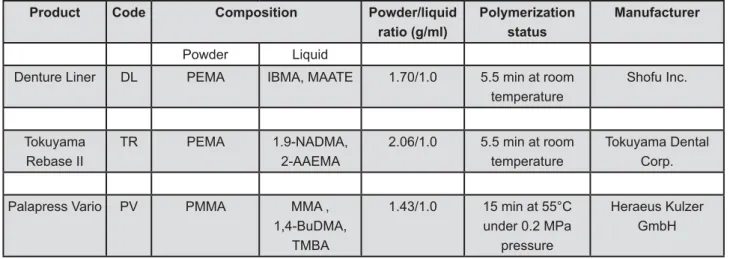
Two hard chairside reline resin materials and an auto-polymerizing denture base resin material were assessed in this study. Information on the resin materials used is presented in Figure 1.
A Co-Cr alloy (JD Alloy, Co 63.0, Cr 28.5, Mo 6.0, others 2.5 mass%, Heraeus Kulzer GmbH; Hanau, Germany) and a cp-Ti (T-Alloy H, GC Corp.; Tokyo, Japan) designed for denture frameworks and cast restorations were used as adherent materials. Two hundred and sixteen disk-shaped specimens (10 mm in diameter and 2.5 mm in thickness) were cast from the Co-Cr alloy and cp-Ti, respectively, according to the manufacturers’
Product Code Composition Powder/liquid ratio (g/ml)
Polymerization status
Manufacturer
Powder Liquid
Denture Liner DL PEMA IBMA, MAATE 1.70/1.0 5.5 min at room
temperature
Shofu Inc.
Tokuyama Rebase II
TR PEMA 1.9-NADMA,
2-AAEMA
2.06/1.0 5.5 min at room
temperature
Tokuyama Dental Corp.
Palapress Vario PV PMMA MMA ,
1,4-BuDMA, TMBA
1.43/1.0 15 min at 55°C
under 0.2 MPa pressure
Heraeus Kulzer GmbH
Figure 1- Resin materials used in this study
BEL Q 600 silicon-carbide abrasive paper and divided into four sets of 54 disks.
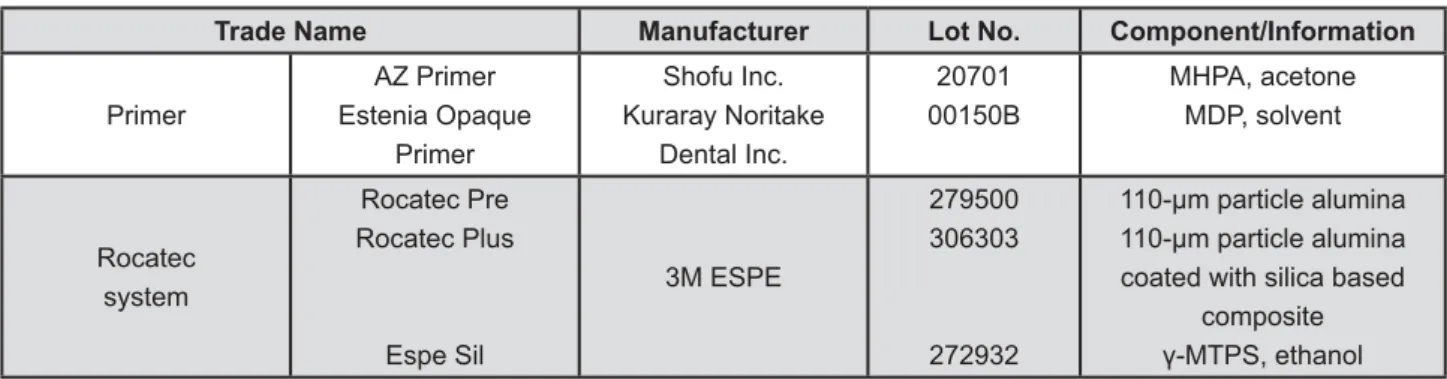
Of the four sets, three sets (162 disks) were air-abraded with 50-70-μm alumina (Hi-Aluminas, Shofu Inc.; Kyoto, Japan) for 10 s (Jet Blast II, J. Morita Corp.; Suita, Japan). The air pressure was 0.5 MPa and the distance of the nozzle from the metal surface was approximately 5 mm. One of the three sets (54 disks) was left unprimed as a control (CON). In two of the three air-abraded sets, one of two primers (AZ Primer, Shofu Inc. or Estenia Opaque Primer, Kuraray Noritake Dental Inc.; Tokyo, Japan) was applied to the metal surface using a sponge pellet. Both primers include acid functional monomers, but of different types. Information on the primers used is presented in Figure 2. The two treatments are denoted by MHPA and MDP since the AZ primer contains an acidic phosphonoacetate monomer (MHPA), and the Estenia Opaque Primer includes a diphosphate monomer (MDP) as the functional monomers. The remaining set was air-abraded with 110-μm alumina, air-abraded with 110-μm alumina coated with a silica-based composite, and primed with a silane coupling agent (Rocatec system, 3M ESPE; St. Paul, MN, USA; TC). Information on the primers used is also presented in Figure 2. A total of 54 specimens were prepared for each combination of metal and surface treatment.
A piece of tape with a hole of 5 mm diameter and 50 μm thickness was placed on the surface \ brass ring (6 mm inside diameter, 2 mm length, and 1 mm wall thickness) was placed around the resin materials were polymerized according to the manufacturer’s instructions (Figure 1). After polymerization, the specimens were immersed in water at 37°C for 24 h, and this state was E*L divided into two groups of nine specimens each. Half (12 sets of nine) of the disks were tested for 24-h, shear bond strength at thermocycle 0, and the remaining specimens were placed in a
thermocycling apparatus (Thermocycling Machine, RKC Instrument Inc.; Tokyo, Japan) and cycled between water at 4°C and 60°C, with a 1-min dwell-time per bath, for 10,000 cycles.
The specimens were embedded in acrylic resin molds, and seated in an ISO/TR 11405 shear testing jig. Shear bond strengths were determined using a mechanical testing device (AGS-10kNG, Shimadzu; Kyoto, Japan) at a cross-head speed of 0.5 mm/min. For each set of specimens, the mean shear bond strength, standard deviation (SD), and the rate of decrease in bond strength with thermocycling were calculated. To determine the ? 8 compared using the Steel-Dwass tests for each 8 set at α=0.05.
For the MDP and TC treatments after thermocycling, the values were compared using two-way analysis of variance (ANOVA) with the
8α=0.05. All
analyses were carried out using the SPSS 15.0 for Windows (SPSS Japan Inc; Tokyo, Japan).
RESULTS
The shear bond strength and Steel–Dwass test results at 0 and 10,000 thermocycles are given in Table 1. The strengths decreased after thermocycling for all combinations. Among the resin materials assessed, the PV denture base !" shear bond strengths than the two reline metals (DL and TR), except for the CON condition. In the case of the 10,000 thermocycling status in particular, the bond strengths of the DL and TR 10 MPa for both metals. In contrast, the bond '` &{'8 after thermocycling: 34.56 MPa for cp-Ti and 38.30 for the Co-Cr alloy. The rates of decrease with thermocycling are shown in Table 2, and the decrease rate for the PV with MDP is the lowest: 19.93% for cp-Ti and 25.60 for Co-Cr. Regarding bonding of the two reline materials, TC showed the
Trade Name Manufacturer Lot No. Component/Information
Primer
AZ Primer Estenia Opaque
Primer
Shofu Inc. Kuraray Noritake
Dental Inc.
20701 00150B
MHPA, acetone MDP, solvent
Rocatec system
Rocatec Pre Rocatec Plus
Espe Sil
3M ESPE
279500 306303
272932
110-μm particle alumina 110-μm particle alumina coated with silica based
composite
lowest decrease rate for both metals.
The MDP and TC treatments showed characteristic ? after thermocycling were examined using two-way (metal and resin types) factorial ANOVAs (Table 3). Regarding the MDP, the metal type factor was !" 9
the case of the TC, the metal and resin factors !"
DISCUSSION
Although the denture base resin and metal framework are substantially joined using a
Status DL TR PV
0 cycle CON cp-Ti
Co-Cr
8.27 (1.41)a
7.68 (1.25)a
10.95 (1.60)b
12.51 (4.10)b
9.97 (3.09)ab
12.13 (1.66)b
MHPA cp-Ti
Co-Cr
30.49 (4.22)a
32.32 (4.09)a
24.52 (1.36)b
26.30 (2.53)b
46.91 (3.72)c
48.20 (6.70)c
MDP cp-Ti
Co-Cr
28.67 (4.25)a
31.00 (3.27)a
23.17 (3.25)b
28.2 (2.86)a
43.16 (2.75)c
51.48 (6.14)b
TC cp-Ti
Co-Cr
23.12 (3.57)a
15.01 (3.22)a
23.18 (2.91)a
38.49 (5.49)b
38.49 (5.49)b
30.20 (3.25)c
10,000 cycles CON cp-Ti
Co-Cr
0.50 (0.31)a
0.32 (0.16)a
0.12 (0.05)b
0.25 (0.04)b
1.44 (0.76)c
0.83 (0.53)c
MHPA cp-Ti
Co-Cr
0.38 (0.19)a
0.50 (0.24)a
0.40 (0.18)a
0.30 (0.23)a
21.46 (1.72)b
21.16 (5.84)b
MDP cp-Ti
Co-Cr
0.50 (0.09)a
0.29 (0.13)a
1.89 (0.77)b
0.69 (0.62)a
34.56 (3.01)c
38.30 (3.66)b
TC cp-Ti
Co-Cr
4.19 (1.88)a
1.21 (1.00)a
4.57 (1.41)a
1.27 (0.93)a
12.22 (1.97)b
9.43 (0.90)b
Table 1- Bond strength results (MPa)
!! " #$$%
CON MHPA MDP TC
DL cp-Ti Co-Cr 93.96 95.83 98.75 98.75 98.26 99.06 81.88 91.94 TR cp-Ti Co-Cr 98.9 98,00 98.37 98.86 91.84 97.55 80.28 94.17 PV cp-Ti Co-Cr 85.56 93.16 54.25 56.1 19.93 25.6 68.25 68.77 Table 2- Decrease rates of bond strength with thermocycling
Unit: %
Source of variation df Sum of squares F-value P value
MDP treatment Metal (cp-Ti / Co-Cr)
Resin (DL / TR / PV) Metal / Resin
1 2 2 8.08 15205.32 61.29 2.07 1947.67 7.85 0.1566 #$$$'* 0.0011*
TC treatment Metal (cp-Ti / Co-Cr)
Resin (DL / TR / PV) Metal / Resin
1 2 2 123.65 771.48 0.58 61.54 191.98 0.14 #$$$'* #$$$'* 0.8668 Table 3- Results of two-way factorial ANOVA
mechanical retentive device, additional chemical bonding to the framework is necessary in the case of repairs. When using a metal base as the framework, air-abrasion followed by treatment with an acidic functional monomer is a well-known and useful method for mechanical and chemical adhesions between the metal and the resin6. However, the tribochemical system, i.e., TC, used in this study might also be effective, since TC mechanochemical bonding occurs for both noble and base metals. Air-abrasion, air-abrasion and treatment with two acidic primers, and the TC system were therefore selected for evaluation.
Thermocycling was used as an accelerated aging test to evaluate the consistency and durability of each surface treatment, and the results after considering the situation of a removable denture in the oral cavity. The results showed that for a thermocycling 10,000 status, only air-abrasion and treatments with the two acidic primers were effective denture base material treatments, irrespective of the metal materials. Palapress Vario denture-base material, which is the classic cold-curing denture acrylic material, is often used indirectly out of the oral cavity for repair work, because its polymerization takes time.
The bond strengths of the two reline materials {|}"? type of metal material and treatment, and the decrease rates for the acidic monomer conditions (MHPA and MDP) with thermocycling were more than 90%. The rate for the TC condition was not as high as those for the acidic monomer conditions, but was still more than 80%. This shows that an acrylic reline material is quite unsuitable for the repair of a metal framework. As seen from the compositions in Figure 1, the TR material, which characteristically includes 1.9-NADMA for cross-linking, was able to form stronger polymer networks than the DL was. Yatabe, et al.24 (1999) reported that highly polymerized and cross-linked reline materials are harder than conventional reline materials. Takahashi, et al.18 (2000) evaluated the strength of relined denture base materials subjected to long-term water immersion, and ?~ base material was dependent on the strength of the type of denture base polymer and that of the reline polymer. The results for the two types of in this study. Cucci, et al.2 (1999) evaluated the tensile bond strengths of reline materials ? bonding between the denture base resin and reline materials failed in only 50 h. They reported that these failures were caused by the effects of water, differences between the mechanical properties
of the resin materials, and so on. Obviously, the of thermal expansion of the metal material and the resin are different.
However, this study has some limitations. First, the methods used for polymerization of the three materials used in this study are different, since they were polymerized in accordance with the manufacturers’ instructions. The polymerization ? the test results. Second, there was no mechanical retention on the metal surfaces. This means that the experimental method used in this study did not reproduce the clinical situation. These factors might affect the results (values).
assumed to be more highly polymerized than the other two materials.
In the current study, the TC system, which uses impact energy to apply a silicate coating to the metal surface, was comparatively effective in enhancing the bond strength between the reline materials and frameworks. As has been noted, the reline materials are unsuitable for metal framework repairs. However, the decrease rate of TC was slightly lower, i.e., the performance of the TC was slightly better, than those of the other treatments. The TC values after thermocycling were not high, the metal and the resin. This tendency was different from the results for the MDP condition (Table 3). The particle size of alumina for air-abrasion was 50-70 μm for the CON, MDP, and MHPA, but that for the TC was 110 μm. The greater unevenness produced by the larger alumina particles might create stronger mechanical interlocks between the resin and metal material. Considering the results for the two acidic primers (MDP and MHPA), it is supposed that the chemical effect in the TC was ? / that the values for TC were generally lower and that the slight difference between the mechanical properties15 of the two metals was related to the mechanical retention. However, the highest values obtained with the TC-PV combination after 10,000 thermocycles were around 10 MPa; these are lower than those obtained for acidic monomers and in other similar studies6,7.
Within the limitations of this study, it is suggested that a denture base resin rather than a reline material should be selected for repair of a removable denture with a base metal framework. Also, as preprocessing for bonding with the denture base resin, the MDP treatment (air-abrasion and priming with MDP functional monomer) is recommended, regardless of the metal type.
CONCLUSION
Based on the results and limitations of this study, the following conclusions were drawn. When using a denture-base resin, treatment with air-abrasion and conditioning with a diphosphate functional monomer were effective for enhancing bonding durability to both cast Ti and a Co-Cr alloy.
ACKOWLEDGEMENTS
This study was supported in part by a Grant-in-\} /"B$!B*!*BEE 2013), 23592862 (2011-2013), and 21592474 (2009-2011) from the Japan Society for the Promotion of Science (JSPS).
REFERENCES
1- Chaves CA, Machado AL, Vergani CE, Souza RF, Giampaolo ET. Cytotoxicity of denture base and hard chairside reline materials: a systematic review. J Prosthet Dent. 2012;107:114-27. 2- Cucci AL, Rached RN, Giampaolo ET, Vergani CE. Tensile bond ? storage. J Oral Rehabil. 1999;26:631-4.
3- Finoti LS, Machado AL, Chaves CD, Pavarina AC, Vergani CE. Effect of long-term water immersion on the fracture toughness of denture base and reline resins. Gerodontology. 2012;29:e858-64.
4- Fujishima A, Fujishima Y, Ferracane JL. Shear bond strength of four commercial bonding systems to cp Ti. Dent Mater. 1995;11:82-6.
5- Janda R, Roulet JF, Latta M, Damerau G. Spark erosion as a metal-resin bonding system. Dent Mater. 2007;23:193-7. 6- Kawaguchi T, Shimizu H, Lassila LV, Vallittu PK, Takahashi Y. Effect of surface preparation on the bond strength of heat-polymerized denture base resin to commercially pure titanium and cobalt-chromium alloy. Dent Mater J. 2011;30:143-50. 7- Lim HP, Kim SS, Yang HS, Vang MS. Shear bond strength and failure types of polymethyl methacrylate denture base resin and titanium treated with surface conditioner. Int J Prosthodont. 2010;23:246-8.
8- Matinlinna JP, Lassila LV, Kangasniemi I, Yli-Upro A, Vallittu PK. Shear bond strength of Bis-GMA resin and methacrylated dendrimer resins on silanized titanium substrate. Dent Mater. 2005;21:287-96.
8- Matinlinna JP, Lassila LV, Vallittu PK. The effect of a novel silane blend system on resin bond strength to silica-coated Ti substrate. J Dent. 2006;34:436-43.
9- Matinlinna JP, Ozcan M, Lassila LV, Vallittu PK. The effect of a 3-methacryloxypropyltrimethoxysilane and vinyltriisopropoxysilane blend and tris(3-trimethoxysilylpropyl) isocyanurate on the shear bond strength of composite resin to titanium metal. Dent Mater. 2004;20:804-13.
10- Matsuda Y, Yanagida H, Ide T, Matsumura H, Tanoue N. Bond strength of poly(methyl methacrylate) denture base material to cast titanium and cobalt-chromium alloy. J Adhes Dent. 2010;12:223-9.
11- Matsumura H, Tanaka T, Taira Y, Atsuta M. Bonding of a cobalt-chromium alloy with acidic primers and tri-n-butylborane-initiated luting agents. J Prosthet Dent. 1996;76:194-9.
12- Ohkubo C, Watanabe I, Hosoi T, Okabe T. Shear bond strengths of polymethyl methacrylate to cast titanium and L8' { 2000;83:50-7.
13- Pinto LR, Acosta EJ, Távora FF, Silva PM, Porto VC. Effect of repeated cycles of chemical disinfection on the roughness and hardness of hard reline acrylic resins. Gerodontology. 2010;27:147-53.
14- Rodrigues RC, Almeida EP, Faria AC, Macedo AP, Mattos MG, Ribeiro RF. Effect of different investments and mold temperatures on titanium mechanical properties. J Prosthodont Res. 2012;56:58-64.
E!}&`/9? of thermal and mechanical stresses on the strength of intact and relined denture bases. J Prosthet Dent. 2006;96:59-67. 16- Shimizu H, Kurtz KS, Tachii Y, Takahashi Y. Use of metal conditioner to improve bond strengths of autopolymerizing denture base resin to cast Ti-6Al-7Nb and Co-Cr. J Dent. 2006;34:117-22.
17- Takahashi Y, Chai J, Kawaguchi M. Strength of relined denture base polymers subjected to long-term water immersion. Int J Prosthodont. 2000;13:205-8.
19- Tsuchimoto Y, Yoshida Y, Takeuchi M, Mine A, Yatani H, Tagawa Y, et al. Effect of surface pre-treatment on durability of resin-based cements bonded to titanium. Dent Mater. 2006;22:545-52. 20- Watanabe I, Kurtz KS, Kabcenell JL, Okabe T. Effect of sandblasting and silicoating on bond strength of polymer-glass composite to cast titanium. J Prosthet Dent. 1999;82:462-7. 21- Watanabe I, Watanabe E, Yoshida K, Okabe T. Effect of surface contamination on adhesive bonding of cast pure titanium and Ti-6Al-4V alloy. J Prosthet Dent. 1999;81:270-6.
22- Yanagida H, Matsumura H, Taira Y, Atsuta M, Shimoe S. Adhesive bonding of composite material to cast titanium with varying surface preparations. J Oral Rehabil. 2002;29:121-6.
23- Yatabe M, Yasuda N, Ai M, Okabe Y. Unpolymerized layer on autopolymerizing, hard reline materials. Int J Prosthodont. 1999;12:129-34.
24- Yoshida T, Terashima N, Niiro T, Nagasawa S, Ito M, Yagasaki H, et al. Bond strength of resin cements to H2O2-treated titanium
plates. Dent Mater. 2005;21:1087-97.