ABSTRACT
pH and calcium ion release evaluation of pure
and calcium hydroxide-containing Epiphany for
Mário TANOMARU-FILHO1, Juliana Nogueira SAÇAKI2, Frederico Bordini Chaves FALEIROS3,
Juliane Maria GUERREIRO-TANOMARU4
1- DDS, MSc, PhD, Associate Professor, Department of Restorative Dentistry, Araraquara Dental School, São Paulo State University, Araraquara, SP, Brazil. 2- DDS, Araraquara Dental School, São Paulo State University, Araraquara, SP, Brazil.
3- DDS, MSc, Department of Restorative Dentistry, Araraquara Dental School, São Paulo State University, Araraquara, SP, Brazil.
4- DDS, MSc, PhD, Assistant Professor, Department of Restorative Dentistry, Araraquara Dental School, São Paulo State University, Araraquara, SP, Brazil.
Corresponding address: Mário Tanomaru Filho - Rua Humaitá, 1680, Caixa Postal 331, Centro - 14801-903 Araraquara, SP, Brasil - Phone +55-16-3301-6390, Fax: +55-16-3301-6392 - e-mail: [email protected]
O
bjective: Hydroxyl (OH-) and calcium (Ca++) ion release was evaluated in six materials:G1) Sealer 26, G2) White mineral trioxide aggregate (MTA), G3) Epiphany, G4) Epiphany + 10% calcium hydroxide (CH), G5) Epiphany + 20% CH, and G6) zinc oxide and eugenol. Material and Methods: Specimens were placed in polyethylene tubes and immersed in distilled water. After 3, 6, 12, 24, and 48 h, 7, 14, and 28 days, the water was assessed for pH with a pH meter and for Ca++ release by atomic absorption spectrophotometry.
Results: G1, G2, G4, and G5 had the highest pH until 14 days (p<0.05). G1 presented the highest Ca++ release until 6 h, and G4 and G5, from 12 h through 14 days. Ca++ release
was greater for G1 and G2 at 28 days. G6 released the least Ca++. Conclusions: MTA,
Sealer 26, Epiphany, and Epiphany + CH release OH- and Ca++ ions. Epiphany + CH may
Key words: Retrograde obturation. Hydrogen-ion concentration. Calcium hydroxide.
INTRODUCTION
material14. In the search for a biocompatible
material capable of inducing mineralized apical tissue formation, calcium hydroxide (CH) has been
5,11,19.
In order to stimulate mineralized tissue formation, pH and release of calcium ions (Ca++)9,12,13.
Sealer 26 is an epoxy resin-based cement containing CH that can be used for retrograde filling if prepared with a higher powder/resin ratio than when used as a root canal sealer21,23,24.
Tanomaru-Filho, et al.22 (2006) studied Sealer 26
(Dentsply, Ind. e Com. Ltda., Petrópolis, RJ, Brasil) similar periapical repair with Sealer 26, ProRoot MTA (Tulsa Dental, Johnson, TN, USA), and Sealapex (Kerr Corp., Orange, CA, USA) with zinc oxide. Some
studies have shown lower rates of pH increase and Ca++ release for Sealer 26 compared to other
CH-containing cements4,19. However, in these studies,
Sealer 26 was prepared using the powder/resin ratio recommended for its use as a root canal sealer.
tricalcium silicate, tricalcium aluminate, and other mineral trioxides, shows adequate sealing ability in
27,29 and in the treatment of root
perforations15,17. This material is also biocompatible 23,28 and root canal
perforations30. MTA promotes alkaline pH6,18 and has
a mechanism of action similar to CH12.
Epiphany is a resin cement component of the Epiphany/Resilon system. Its presence allows materials and the root canal walls7,26. This cement
Maltezos, et al.16 (2006) evaluated the seal
materials, and observed less bacterial leakage for Resilon and MTA compared with Super-EBA. Those authors concluded that Resilon is a viable option
Duarte, et al.5 (2004) proposed the addition
of CH to AH Plus cement in order to reduce its & ' *; Epiphany to attain thicker consistency, facilitating of CH can alter the release of OH- and Ca++ ions.
Therefore, the present study aimed to evaluate the pH increase and calcium ion release of Epiphany cement and the Epiphany-CH association, compared
MATERIAL AND METHODS
The following materials, containing either CH or calcium oxide, were evaluated (Figure 1).
Preparation of specimens
For pH and calcium ion release evaluation, 10 specimens were prepared from each material studied. Sixty polyethylene tubes measuring 1 cm => the cements to be evaluated.
Sealer 26 (G1) was prepared in a 5:1 powder/ resin ratio, according to Tanomaru-Filho, et al.22
(2006). White MTA (G2) was prepared in a powder/ liquid ratio of 0.33 g/1g10. Pure Epiphany (G3) was
prepared using equal measurements of both pastes. After weighing the two paste components, 10% or 20% CH (CH) was added to the Epiphany sealer, resulting in the materials derived from Epiphany evaluated in G4 and G5, respectively. Zinc oxide and eugenol cement was prepared in a powder/ liquid ratio according to Bernabé, et al.2 (2005).
Immediately after preparing the materials &? @QV !X QY V V $[\ containing 10 mL distilled water with neutral pH and kept in an oven at 37°C. After 2, 6, 12, 24, and 48 h, 7, 14, and 28 days, the water was assessed for pH and calcium ion release. The tubes containing &? =]^ of distilled water for further analyses in the different time periods.
Analyses of pH and Calcium Release
pH readings
pH readings were performed with an UltraBasic pH Meter (Denver Instrument Company, Arvada, CO, USA), previously calibrated using substances with pHs 4, 7, and 10.
Ca++ Ion Release Readings
Ca++ release was monitored with an H1170
Hilger & Watts Atomspeck atomic absorption spectrophotometry (Rank Precision Industries Ltd. Analytical Division, London, UK) equipped " (wavelength =422.7 nm and current =20 mA), 0.7 nm slit and 5.0 cm burner length.
Ca++ ion release readings were compared to a
standard curve obtained by diluting calcium at 1.0, 2.0, 3.0, 4.0, 5.0, 6.0, 7.0, 8.0, 9.0, 10.0, 15.0, 20.0, and 25.0 ppm (Calcium Standard Solution, Merck, Darmstadt, Germany) in ultra-pure water.
Statistical Analysis
Data were subjected to statistical analysis by ANOVA and individual comparisons were performed ?"| of 5% was set for all analyses.
Material Composition Manufacturer
Sealer 26
Calcium hydroxide, bismuth oxide, tetramine hexamethylene, titanium dioxide, bisphenol
epoxy resin.
Dentsply, Rio de Janeiro, RJ, Brazil
White MTA
Silicon dioxide , potassium oxide, aluminum oxide, sodium oxide, iron oxide, sulfur trioxide, calcium oxide, bismuth oxide, magnesium oxide,
insoluble residues of calcium oxide, potassium and sodium per sulphates and crystalline silica.
Angelus, Soluções em Odontologia, Londrina, PR, Brazil
Epiphany
Bisphenol-A-glycidyl dimethacrylate, polyethylene glycol dimethacrylate, ethoxylated bisphenol-A
dimethacrylate, urethane dimethacrylate, barium sulphate, silica, calcium oxide, bismuth,
pigments.
Pentron Clinical Technologies, LLC., Wallingford, CT, EUA
Zinc oxide and eugenol
Powder: zinc oxide
Liquid: eugenol Dentsply, Rio de Janeiro, RJ, Brazil
RESULTS
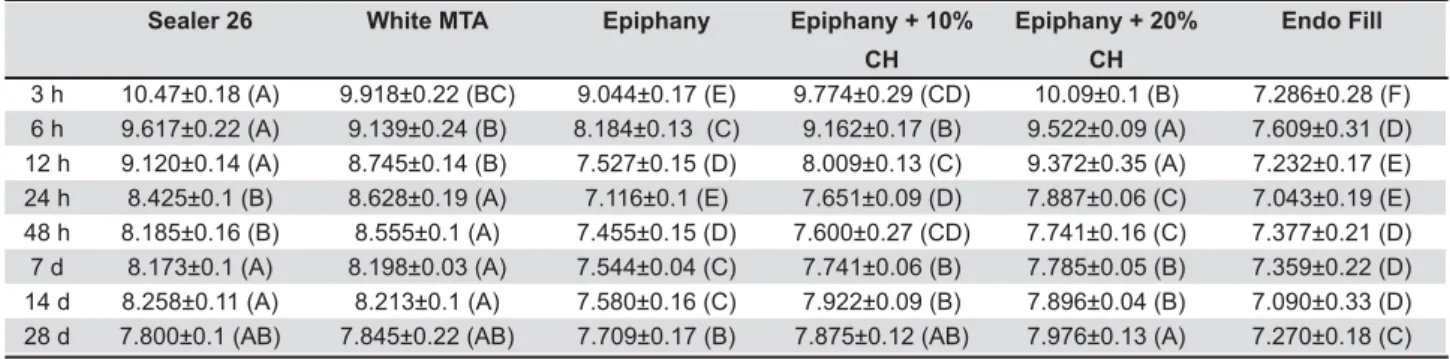
The mean pH values of the cements evaluated in the various experimental periods are shown in Table 1. Sealer 26 presented the highest pH value in the initial periods (3 and 6 h). After 12 h, Sealer 26 and Epiphany + 20% CH had equivalent results. From 7 through 14 days, White MTA and Sealer 26 had the highest pH values, followed by Epiphany with 10% and 20% CH. At 28 days, all materials had similar results, except for zinc oxide and eugenol (ZOE). In all the experimental periods ZOE had the lowest pH values (p<0.05).
The mean Ca++ ion release values for all cements
evaluated are shown in Table 2. Ca++ release at
3 and 6 h was greater for Sealer 26. From 12 h through 14 days, Epiphany with 10% and 20% CH had the highest Ca++ release. After 28 days,
Sealer 26 and White MTA presented the highest Ca++ release. In all experimental periods, ZOE had
the lowest Ca++ release values.
DISCUSSION
standardized tubes with the materials to be tested and immersing in distilled water. The pH is then determined in the resulting solution1. Numerous
authors have utilized similar methodology, immersing the plastic tubes containing cements in distilled, deionized, or Milli-q water. Duarte, et al.6 (2003) used tubes measuring 10 mm in length
and 1.5 mm in internal diameter. Santos, et al.18
(2005) evaluated pH and calcium release using MTA and an experimental dental cement placed in tubes measuring 10 mm in length and 1 mm in diameter. Distilled water was used due to its purity and neutral pH8.
Although several CH-based sealers are available in the market, the presence of CH in the composition of an endodontic sealer does not assure release of calcium and OH- ions in the final product.
After setting of the cement, the ions may not be released19, or the CH may be inactivated by other
components in the sealer.
The endodontic materials Sealer 26 and Epiphany contain CH or calcium oxide in their formulation. MTA includes calcium oxide in its composition. During its setting, hydration reactions take place, resulting in production of CH. When the set material is placed in a solution, it dissociates into OH- and
Ca++ ions, increasing both the pH and the calcium
concentrations in the medium20.
Regarding the pH of the cements evaluated, =}!}~# 20% CH showed the highest values among all
Sealer 26 White MTA Epiphany Epiphany + 10%
CH
Epiphany + 20%
CH
Endo Fill
3 h 10.47±0.18 (A) 9.918±0.22 (BC) 9.044±0.17 (E) 9.774±0.29 (CD) 10.09±0.1 (B) 7.286±0.28 (F)
6 h 9.617±0.22 (A) 9.139±0.24 (B) 8.184±0.13 (C) 9.162±0.17 (B) 9.522±0.09 (A) 7.609±0.31 (D)
12 h 9.120±0.14 (A) 8.745±0.14 (B) 7.527±0.15 (D) 8.009±0.13 (C) 9.372±0.35 (A) 7.232±0.17 (E)
24 h 8.425±0.1 (B) 8.628±0.19 (A) 7.116±0.1 (E) 7.651±0.09 (D) 7.887±0.06 (C) 7.043±0.19 (E)
48 h 8.185±0.16 (B) 8.555±0.1 (A) 7.455±0.15 (D) 7.600±0.27 (CD) 7.741±0.16 (C) 7.377±0.21 (D)
7 d 8.173±0.1 (A) 8.198±0.03 (A) 7.544±0.04 (C) 7.741±0.06 (B) 7.785±0.05 (B) 7.359±0.22 (D)
14 d 8.258±0.11 (A) 8.213±0.1 (A) 7.580±0.16 (C) 7.922±0.09 (B) 7.896±0.04 (B) 7.090±0.33 (D)
28 d 7.800±0.1 (AB) 7.845±0.22 (AB) 7.709±0.17 (B) 7.875±0.12 (AB) 7.976±0.13 (A) 7.270±0.18 (C)
Table 1- Mean ± standard deviation of hydroxide ions (pH) released from the materials studied after different periods of time
(A,B,C,D) In each period, means values followed by different labels are statistically different (p<0.05).
Table 2- Mean ± standard deviation of calcium (mg%) released from the materials studied after different periods of time
(A,B,C,D) In each period, means values followed by different labels are statistically different (p<0.05). Sealer 26 White MTA Epiphany Epiphany + 10%
CH
Epiphany + 20%
CH
Endo Fill
3 h 0.118±0.13 (A) 0 (B) 0 (B) 0 (B) 0 (B) 0 (B)
6 h 1.513±1.13 (A) 0.782±0.56 (B) 0.487±0.02 (BC) 0.855±0.18 (AB) 1.041±0.04 (AB) 0.219±0.03 (C)
12 h 0.249±0.08 (BC) 0.102±0.06 (C) 0.021±0.02 (C) 0.381±0.33 (B) 0.573±0.05 (A) 0 (C)
24 h 0.730±0.07 (C) 0.777±0.13 (C) 0.852±0.5 (C) 1.21±0.36 (B) 1.706±0.09 (A) 0.145±0.04 (D)
48 h 0.389±0.19 (C) 0.494±0.09 (C) 1.293±0.34 (B) 1.426±0.10 (B) 2.081±0.68 (A) 0.052±0.11 (CD)
7 d 0.170±0.09 (D) 0.519±0.06 (C) 1.615±0.16 (B) 1.774±0.15 (B) 2.581±0.33 (A) 0.007±0.02 (D)
14 d 0.229±0.05 (B) 0.303±0.07 (B) 0.06±0.04 (C) 0.43±0.14 (A) 0.520±0.08 (A) 0 (C)
materials studied. This may be due to the presence of 37% CH in the composition of Sealer 26, and due to its longer setting time. Epiphany cement, which contains calcium oxide, had 20% CH incorporated into its formulation. Similar results were reported by Duarte, et al.4 (2000), who observed higher
pH values for Sealer 26 in the initial experimental periods, when using the material in the powder/ resin ratio recommended for it use as a root canal sealer. MTA had initial pH of 9.01; 3 h after mixing its pH was 8.28 and remained constant thereafter. These results are in accordance with those obtained by Duarte, et al.6 (2003).
Tay, et al.25 (2007) described the calcium
phosphate phases produced after immersion of set Portland cement in phosphate buffered saline solution. The authors observed that the pH changes occurred in two stages, with release of OH- ions
during the precipitation of calcium phosphate. Moreover, these authors concluded that the biological action of MTA may be partially attributed to the ability to induce mineralized tissue formation by the components of Portland cement.
From 12 h through 14 days after mixing, Epiphany cement with 20% and 10% CH and pure Epiphany showed the greatest levels of calcium ion release, which may be related to the material’s properties of water sorption and solubility. Donnelly, et al.3 (2007) reported a higher degree of water
sorption and solubility for Epiphany compared to Ketac-Endo, InnoEndo, EndoREZ, Kerr EWT, AH Plus, and GuttaFlow cements. These properties may have contributed to the high values observed for Ca++ release in the longer experimental periods.
Duarte, et al.5 (2004), suggested the addition
of CH to AH Plus cement in order to decrease its & *; Epiphany promoted better consistency for its use in of OH- and Ca++ ions. Further studies are necessary
for a more detailed evaluation of the properties of this material, including its biological effects.
CONCLUSIONS
Based on the methodology used in this study, it may be concluded that Sealer 26, White MTA, Epiphany, and Epiphany with CH presented Ca++ and
OH- ion release. Addition of CH to Epiphany may be
REFERENCES
1- Anthony DR, Gordon TM, Del Rio CE. The effect of three vehicles on the pH of calcium hydroxide. Oral Surg Oral Med Oral Pathol Oral Radiol Endod. 1982;54:560-5.
2- Bernabé PF, Holland R, Morandi R, Souza V, Nery MJ, Otoboni JA, * $[ Q}]]>=~= ">>
3- Donnelly A, Sword J, Nishitani Y, Yoshiyama M, Agee K, Tay FR, et al. Water sorption and solubility of methacrylate resin-based root canal sealers. J Endod. 2007;33:990-4.
4- Duarte MA, Demarchi ACO, Giaxa MH, Kuga MC, Fraga SC, Souza LC. Evaluation of pH and calcium ion release of three root canal sealers. J Endod. 2000;26:389-90.
5- Duarte MA, Demarchi ACO, Moraes IG. Determination of pH and calcium ion release provided by pure and calcium hydroxide-containing AH Plus. Int Endod J. 2004;37:42-5.
6- Duarte MA, Demarchi ACO, Yamashita JC, Kuga MC, Fraga SC. ;} " Surg Oral Med Oral Pathol Oral Radiol Endod. 2003;95:345-7. 7- Dultra F, Barroso JM, Carrasco LD, Capelli A, Guerisoli DM, Pécora JD. Evaluation of apical microleakage of teeth sealed with four different root canal sealers. J Appl Oral Sci. 2006;14:341-5. 8- Eldeniz AU, Erdemir A, Kurtoglu F, Esener T. Evaluation of pH and calcium ion release of Acroseal sealer in comparison with Apexit and Sealapex sealers. Oral Surg Oral Med Oral Pathol Oral Radiol Endod. 2007;103:86-91.
9- Estrela C, Sydney GB, Bammann LL, Felippe O Jr. Mechanism of action of calcium and hydroxyl ions of calcium hydroxide on tissue and bacteria. Braz Dent J. 1995;6:85-90.
10- Fridland M, Rosado R. Mineral Trioxide Aggregate (MTA) solubility and porosity with different water-to-powder ratios. J Endod. 2003;29:814-7.
11- Holland R, Souza V. Ability of a new calcium hydroxide root Q # 1985;11:535-43.
12- Holland R, Souza V, Nery MJ, Bernabé FE, Filho JA, Dezan E Jr, et al. Calcium salts deposition in rat connective tissue after the implantation of calcium hydroxide-containing sealers. J Endod. 2002;28:173-6.
13- Holland R, Souza V, Nery MJ, Otoboni Filho JA, Bernabé PFE, Dezan E Jr. Reaction of rat connective tissue to implanted dentin J Endod. 1999;25:161-6.
14- Kim S, Kratchman S. Modern endodontic surgery concepts and practice: a review. J Endod. 2006;32:601-23.
15- Lee SJ, Monsef M, Torabinejad M. Sealing ability of a mineral trioxide aggregate for repair of lateral root perforations. J Endod. 1993;19:541-4.
16- Maltezos C, Glickman GN, Ezzo P, He J. Comparison of Resilon, V !"#$ " bacterial leakage study. J Endod. 2006;32:324-7.
17- Orosco FA, Bramante CM, Garcia RB, Bernadineli N, Moraes IG. Sealing ability of gray MTA AngelusTM, CPM TM and MBPc used as apical plugs. J Appl Oral Sci. 2008;16:50-4.
18- Santos AD, Moraes JCS, Araújo EB, Yukimitu K, Valério WV Filho. Physico-chemical properties of MTA and a novel experimental cement. Int Endod J. 2005;38:443-7.
19- Silva LAB, Leonardo MR, Silva RS, Assed S, Guimarães LFL. Calcium hydroxide root canal sealers: evaluation of pH, calcium ion concentration and conductivity. Int Endod J. 1997;30:205-9. }]"#| ions from set endodontic sealers containing calcium hydroxide. J Endod. 1988;14:588-91.
21- Tanomaru-Filho M, Chaves Faleiros FB, Saçaki JN, Hungaro Duarte MA, Guerreiro-Tanomaru JM. Evaluation of pH and calcium " " hydroxide or mineral trioxide aggregate. J Endod. 2009;35:1418-21.
22- Tanomaru-Filho M, Luis MR, Leonardo MR, Tanomaru JMG, Silva LAB. Evaluation of periapical repair following retrograde " periapical lesions. Oral Surg Oral Med Oral Pathol Oral Radiol Endod. 2006;102:127-32.
24- Tanomaru-Filho M, Tanomaru JMG, Barros DB, Watanabe E, Ito IY. In vitro antimicrobial activity of endodontic sealers, MTA-based cements and Portland cement. J Oral Sci. 2007;49:41-5. 25- Tay FR, Pashley DH, Rueggeberg FA, Loushine RJ, Weller RN. Calcium phosphate phase transformation produced by the interaction of the Portland cement component of white mineral " & Q # 2007;33:1347-51.
26- Teixeira FB, Teixeira EC, Thompson JY, Trope M. Fracture material. J Am Dent Assoc. 2004;135:646-52.
27- Torabinejad M, Higa RK, McKendry DJ, Pitt Ford TR. Dye leakage of four root end filling materials: effects of blood contamination. J Endod. 1994;20:159-63.
28- Torabinejad M, Pitt Ford TR, McKendry DJ, Abedi HR, Miller DA, Kariyawasam SP. Histologic assessment of mineral trioxide "?Q#= }}}>" 8.
29- Torabinejad M, Watson TF, Pitt Ford TR. Sealing ability of a J Endod. 1993;19:591-5.