CORRECTION
Correction: Dual Energy CT Angiography of
Peripheral Arterial Disease: Feasibility of
Using Lower Contrast Medium Volume
Abdulrahman Almutairi, Zhonghua Sun, Abduljaleel Poovathumkadavi, Tarek Assar
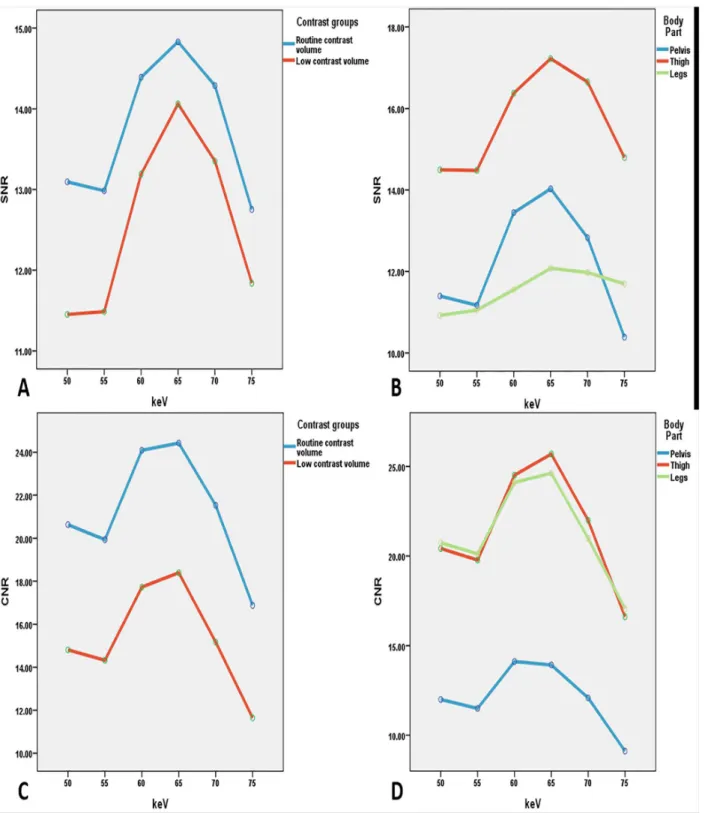
The image for
Fig 2
is incorrect. Please see the corrected
Fig 2
here.
PLOS ONE | DOI:10.1371/journal.pone.0145976 December 23, 2015 1 / 3
a11111
OPEN ACCESS
Citation:Almutairi A, Sun Z, Poovathumkadavi A, Assar T (2015) Correction: Dual Energy CT Angiography of Peripheral Arterial Disease: Feasibility of Using Lower Contrast Medium Volume. PLoS ONE 10(12): e0145976. doi:10.1371/journal. pone.0145976
Published:December 23, 2015
Fig 2. Comparison of SNR and CNR measured at two contrast groups at different body parts with variable keV sets.Comparison of calculated and measured SNR in monochromatic images with A showing the differences between the two contrast groups at different keV sets, B representing the SNR values of keV sets with three body parts, C showing the comparison of calculated and measured CNR in monochromatic images for the two contrast groups, and D demonstrating the CNR values of three body parts at different keV sets. In the range of 55–65 keV, both of the two curves increase sharply with the
gradual rise in keV. Between 65 and 75 keV, both curves of the contrast values decrease sharply with 65 keV resulting in the highest value. SNR: signal-to-noise ratio, CNR: contrast-to-signal-to-noise ratio.
doi:10.1371/journal.pone.0145976.g001
Reference
1. Almutairi A, Sun Z, Poovathumkadavi A, Assar T (2015) Dual Energy CT Angiography of Peripheral Arterial Disease: Feasibility of Using Lower Contrast Medium Volume. PLoS ONE 10(9): e0139275. doi:10.1371/journal.pone.0139275PMID:26418007