regional committee
PAN AMERICAN
HEALTH
ORGANIZATION
WORLD
HEALTH
ORGANIZATION
XXIX Meeting
Washington, D.C. September-October 1983
XXXV Meeting
o o I V8
f
Provisional Agenda Item 15 CD29/34 (Eng.)
12 August 1983 ORIGINAL: ENGLISH
PROPOSED PROGRAM BUDGET FOR 1984-85
This working document explains the revisions and refinements made to the Proposed Program Budget for 1984-85 contained in Offi-cial Document 187 as a result of the June 1983 meeting of the Exec-utive Committee. In addition, it contains several explanatory budget tables which summarize the revised program budget proposal. (Revised pages of Official Document 187 have been distributed separately.)
In accordance with Resolution VIII (see Annex) approved by the recent 90th Meeting of the Executive Committee, the recommendations and suggestions concerning priority programs have been taken into
consideration. The increases in these priority programs are
explained in this working document.
The Director has increased the Miscellaneous Income component of the proposal by an additional $2 million, which brings the funding from that source to $4.8 million. By taking this action, the increase requested from Member Countries is 12.7% over 1982-83. This increase is well below the mandatory cost rise of 14.4% and the program growth of 1.1% contained within the proposed overall 15.5% budget increase.
Draft appropriation and assessment resolutions which the
Directing Council may wish to consider are on pages 13-15 of Offi-cial Document 187. The draft appropriation resolution has been revised in accordance with the program modifications and the addi-tion to Miscellaneous Income. The draft assessment resolution has likewise been revised to reflect the increase in Miscellaneous Income, the reduction in positions, and the adjustment of the assessment scale in accordance with the OAS assessment scale.
CD29/34 (Eng.) Page 2
INTRODUCTION
The 90th Meeting of the Executive Committee considered the pro-posed program budget for the biennium 1984-85 in light of recent resolu-tions of the Governing Bodies and of current condiresolu-tions within the Region. The Director's presentation emphasized the view that the budget should represent the combined opinions of the Member Countries as reflected in the deliberations and decisions of the Governing Bodies of the Organi-zation. Therefore, the proposed program budget was presented by the Director to the Executive Committee in a form designed to enhance the ability of that Body to recommend specific modifications in the document.
The discussion of the proposed budget covered three major areas: 1) overall regional policies and priorities and the Organization's man-agement strategy; 2) the program budget ceiling and the appropriation resolution; and 3) the individual programs, their components and objec-tives. Following the Executive Committee's consideration of Official Document 187, the Director is proposing revisions in response to the Committee's suggestions and recommendations. (Revised pages of Offi-cial Document 187 have been distributed separately.)
I. EXECUTIVE COMMITTEE DISCUSSIONS AND EXPLANATIONS OF PROPOSED PROGRAM CHANGES
Regional Policies
The Director's presentation and the introduction to the budget disclosed new challenges and obstacles confronting the Organization and Member Countries in achieving progress toward the goal of health for all. However, it was noted that moments of crisis also constitute moments of opportunity, forcing institutions to find innovative and creative approaches to mobilize and utilize available resources more efficiently.
Two basic principles on which the new strategies of the Organiza-tion rest were defined by the Director. The first was the concentration of analysis, resources and actions at the country level, recognizing that the countries themselves constitute the basic unit of production of the Organization, and that the Country Offices constitute the basic unit of production of the Secretariat. For that reason, two-thirds of the budget increase of the Organization was being directed to country programs. Also partly resulting from this principle was the decision to eliminate the Area Offices as a bureaucratic layer between the Headquarters and the Country Offices.
CD29/34 (Eng.) Page 3
policy direction, the Member Countries should be continuing and active players in the full range of planning and programming of the cooperation activities of the Organization. One consequence of this principle is the need to promote and support the mobilization of national will and resources, not only for strengthening national capabilities and self-reliance but for stimulating cooperation among the countries of the Region.
There was concurrence that while radical changes were not feasi-ble, the program budget contained an essential reordering of priorities. Among the priority problem areas were those related to food and nutri-tion, and those affecting infants and mothers, such as diarrheal control, immunizations and respiratory illnesses. A second priority area included certain endemic diseases, such as malaria. A third area of concern was the increasing importance of chronic degenerative diseases. A final problem area encompassed problems affecting the health of workers. In all of these areas, there would be a fourfold focus on improving the health system infrastructure, expanding information services,
intensi-fying human development activities, and coordinating and promoting
research activities to help resolve these problem areas.
In implementing the budget priorities, three strategies of action were described. The first strategy would be to obtain a greater degree of technical excellence in the technical cooperation offered by the Organization to Member Countries. Within this context, four components were spotlighted: knowledge and the technical capacity of the profes-sionals of the Organization in their respective specialties; management of specialized knowledge, in terms of understanding its origins, of being able to analyze its uses and of being able to transform it into concrete and practical forms; recognition that technical solutions have to be eval-uated within the socioeconomic environment in which they are attempted; and, finally, development of attitudes and behavior that permit the most effective integration of the Organization's work into the national health effort.
A second strategic condition for transforming declarative prin-ciples into concrete actions and results is the capacity to assist in mobilizing national resources to meet national problems. Only after
mobilizing national technical, scientific, institutional, financial,
moral and political resources is it likely that the Organization's tech-nical cooperation activities can be targeted so as to be adequate to meet remaining national needs and to stimulate national participation in tech-nical cooperation activities with other countries.
The third strategy discussed was the articulation and coordination with other agencies of international cooperation providing technical
CD29/34 (Eng.) Page 4
Program Budget Ceiling
The Executive Committee recommended the overall ceiling of
$104,320,000, proposed by the Director for the program budget for 1984-85. That amount contains a $14 million increase over the level of the effective working budget for 1982-83, an increase of 15.5%. Of that total increase, 14.4% represents mandatory cost increases and 1.1% represents program growth.
However, Official Document 187, revised in accordance with the recommendations of the Executive Committee, now proposes an increase of only 12.7% in the direct contributions from Member Countries to finance the Effective Working Budget. The additional revenues will be provided
from $4.8 million in Miscellaneous Income, $2 million more than
originally allocated.
The proposed program budget raises country programs from 32 to 36% of the Organization's PAHO/WHO Regular Program Budget. Of the overall increase in the proposed program budget of $14 million, $13 million represents the additional amount allocated to country programs. There is a 30% increase in the country program budget over 1982-83, virtually the only component of the budget which shows any real growth beyond mandatory cost increases. The remaining program areas absorb significant portions of the mandatory cost increases faced by the Organization. Thus, the regional programs have a minimal increase of 5.9%, well below the 14.4% mandatory cost increase. Taking all program areas other than the country programs, there is an increase of 8.7%, still nearly six percentage points less than the rise in costs.
The discussion revealed that the budget increase proposed in Offi-cial Document 187 recommended by the Executive Committee is the lowest level of increase for a PAHO biennium program budget in more than a decade, and the increase proposed for Member Country contributions also would be the lowest in recent memory.
The Executive Committee acknowledged the actions proposed by the Director to make more efficient and effective use of PAHO resources through the elimination of the Area Offices with consequent cost savings, as well as the reorganization of the Headquarters structure.
Program Changes
The changes incorporated in the revised Official Document 187 since the meeting of the Executive Committee reflect comments and suggestions by Member Country representatives. Proposed modifications include shifts in allocations between program areas as well as redistribution of funding among the elements of the individual programs.
CD29/34 (Eng.) Page 5
totaling $1,212,700. Corresponding reductions were made in centers and lesser priority regional programs. The justifications for allocations are as follows:
Information Coordination
The Executive Committee discussed the roles of the coordinating units, particularly the role of the information coordination unit. Addi-tional resources have been assigned to the unit for the dual purposes of enhancing the monitoring and evaluation process for management control purposes and ensuring reliable and timely information for decision making within the Organization.
Women, Health and Development
The Executive Committee discussed the Regional Program for Women, Health and Development and the resolution of the Subcommittee on Women, Health and Development urging greater attention to efforts to assure the realization of the goals of the Five-Year Plan of Action for Women, Health and Development. As a result, additional resources have been pro-vided to undertake research at the country level into existing obstacles
to the achievement of those goals. Health Systems Infrastructure
The Executive Committee examination of the program budget for the Area of Health Systems Infrastructure produced a series of recommenda-tions which the Director has incorporated into proposed revisions of Official Document 187. One of the major recommendations was to bolster the Program of Increasing the Operating Capacity of Health Systems. In
that effort, it was felt that additional resources should be devoted to producing reference documents on methods and techniques, bibliographic reviews and analyses of successful past experiences. In the same pro-gram, additional funds also would be available for activities aimed at
preparing and retraining health personnel in systems development.
Finally, added resources were made available for operational research on the structures and functioning of health systems within the Region, an area where little has been done and where the new resources can provide a
start in gradually remedying the current gap in knowledge.
CD29/34 (Eng.) Page 6
Following the expression of concern at the level of funding for the Oral Health Program during the Executive Committee Meeting and the growing interest among Member Countries in the development of integrated dental health activities, additional resources have been devoted to this program. The emphasis in the use of these program resources will be on prevention and education concerning dental diseases with particular attention to the dissemination of technical information in this field.
In a joint meeting focusing on the work of BIREME,, it was con-cluded that a small funding increase to cover the services of a systems analyst was needed to assure the interaction of the BIREME minicomputer with the computer of the Research Institute in Nuclear Energy for the operation of the MEDLARS System in Brazil. The objectives would be to improve data processing and to coordinate and promote training of personnel within BIREME.
During the Executive Committee Meeting renewed attention was given to the severity of the problems faced by countries related to the availa-bility, quality and prices of essential drugs. The Committee expressed interest as to the progress of the regional program of the Organization and suggested augmenting efforts in this area. Similarly, it was noted that the Technical Discussions this year focusing on "Production and Commercialization of Essential Drugs" undoubtedly will prompt increased requests for technical cooperation. Finally, the existing initiatives presented to the Convenio Hip6lito Unanue and to CARICOM countries will require follow-up and stimulus from the Organization. The additional funds represent nearly an 85% increase in the resources originally available to the Regional Program of Essential Drugs.
The Executive Committee recommended strengthening the program on biologicals to support further the Blood Transfusion Program. Develop-ment of human resources and reliability of blood grouping reagents have been identified as key issues for the program. During the next biennium, it is proposed to hold two courses--one to qualify blood bank instructors in training middle level technicians, and the other in production and quality assurance of blood grouping reagents. In order to intensify and facilitate technical cooperation among blood banks, PAHO also will promote the development of a network of national and regional reference blood banks. During the biennium, at least six national blood banks will qualify as reference blood banks, of which two will be designated as Regional Centers.
Health Program Development
CD29/34 (Eng.) Page 7
The PAHO funds available for sexually transmitted diseases are being used through the Epidemiology Program to collaborate with countries in designing research and control programs.
The continuing prevalence of tropical diseases drew the Commit-tee's attention, particularly the deterioration or static situation with respect to those diseases in some geographical areas, despite considera-ble attention to this proconsidera-blem. It also was noted that an effective vaccine for widespread use would not be available in the near future, requiring other strategies for control of the vector-borne diseases such as malaria and dengue. The control of vectors continued to be viewed as the central strategy. PAHO therefore was attaching increased emphasis to vector biology and control. Stemming from that discussion, the revisions include a nearly 50% increase in the funding for Technical Advisory Services for Vector Biology and Control.
The Committee also examined the allocations of resources to activ-ities encompassed by the Program of Maternal and Child Health. After reviewing the report on action taken by Member Countries regarding infant and young child nutrition, the Committee adopted a resolution supporting activities in this area. The resolution requested the Director "to sup-port national studies regarding infant and young child feeding practices, particularly with regard to the prevalence and duration of breast-feed-ing." Additional funding is, therefore, being provided to the Program of Nutrition to be used in part to support national groups in conducting research for the Regional Research-Action Program in Nutrition. Special attention will be directed to studies on infant feeding practices, devel-opment of appropriate technology and promotion of more active participa-tion by primary health care workers and the community in nutriparticipa-tion activities.
The Expanded Program on Immunization also was discussed with the debate focused on the steps needed to improve immunization coverage. It was emphasized that such coverage will be one of the indicators used to monitor success of the PAHO/WHO strategy to achieve health for all by the year 2000. Difficulties were cited of achieving a level of coverage useful in epidemiological terms. It was concluded that operational research on vaccine development and studies on ways to improve community participation are of paramount importance if coverage is to be extended.
Funds for these purposes were included in the budget revisions.
CD29/34 (Eng.) Page 8
Within the area of Health Programs Development, the major reallo-cations have occurred in the program of Health of Adults. The Executive Committee reiterated the point made in the Introduction to Official Docu-ment 187 that demographic changes and life style alterations increasingly constitute a major challenge for the health sectors of Member Countries. Those factors have produced an increase in the health problems of adults and the aged, particularly in the rise of chronic degenerative diseases, cardiovascular diseases and cancer as leading causes of morbidity and mortality.
The Committee agreed that the Program of Health of Adults will have to strengthen its collaboration with Member Countries in their pro-grams of promotion of health and well-being of those population groups at risk from chronic diseases. Convincing evidence exists that reduction in risks of health damage from some of the chronic diseases may be altered by changes in behavior. There will have to be programs of prevention which focus on environmental, psychosocial and behavioral changes as well as programs which deal with service delivery and rehabilitation. Beha-vioral aspects of disease prevention are covered under the heading of mental health. Therefore, increases are proposed in the specific re-gional programs of Development of Health Services for the Elderly, Mental Health, Prevention and Control of Chronic Diseases, and the Latin Ameri-can Cancer Research Project.
In accepting the Director's proposition that one of the major thrusts of the Organization should be towards "managing knowledge," in the sense of generating knowledge through research and disseminating the results of that research, the Committee emphasized the need to focus on areas of highest priority to the countries. The reallocation of bud-getary resources to some extent reflects the attempt to give increased emphasis to those problem areas identified by the Committee as being of highest importance.
This concern with priority research is reflected directly in the reallocation of funds within the area of Health Programs Development to targeted research grants. This decision should enhance the capacity of the technical programs to be increasingly active in promoting research --the generation of knowledge--at the level of the countries. PAHO would not function as a passive recipient of research proposals, but would actively seek groups and individuals to undertake the research determined
jointly by the National Governments and PAHO to be of highest
importance. It is anticipated that much of this research will be
CD29/34 Page 9
(Eng.)
II. ANALYSIS OF THE PROPOSED $14 MILLION INCREASE IN PAHO REGULAR FUNDS (1982-83 TO 1984-85)
1. Total Appropriation
2. Less Miscellaneous Income
3. Gross Assessment on Member Countries
4. Less Credit from Tax Equalization Fund
1982-83
102,797,300
(2,000,000)
100,797,300
(12,477,300)
Increase (Decrease)
13,118,400 12.8
(2,800,000) (140.0)
10,318,400 10.2
881,600 7.1 (11,595,700)
5. Direct Contributions from Member Countries to the Effective Working Budget
6. Add Miscellaneous Income
7. Effective Working Budget
88,320,000 11,200,000 12.7 99,520,000
2,000,000 2,800,000 140.0 4,800,000
90,320,000 14,000,000 15.5 104,320,000
Between 1982-83 and 1984-85, the PAHO Effective Working Budget is proposed to increase $14 million or 15.5%. Within this proposed in-crease, the mandatory cost increases amount to $13,006,400, using a fac-tor of 14.4%. The program increase proposed is $993,600 or 1.1%.
The Direct Contributions from Member Countries to the Effective Working Budget, as shown in point (5.) above, amount to an increase of $11.2 million or 12.7%.
The Miscellaneous Income increase of $2.8 million is, therefore, funding $1,806,400 of the mandatory cost increase, and the total amount of the program increase of $993,600.
1984-85
$
115,915,700
(4,800,000)
CD29/34 (Eng.) Page 10
III. CHANGES TO THE PAHO CLASSIFIED LIST OF PROGRAMS WITH DESCRIPTIONS
PAHO CLASSIFIED LIST OF PROGRAMS WITH DESCRIPTIONS
_ _ _ _ _ _ _ _ _ _ _ _ _ _ _ _ _ _ _ _ _ _ _ _ _ _ _ _ _ _ _ _ _ _ _ _ _ _ _ _ _ _ _ _ _ _ _ _ _ _ _ _ _ _ _ _- _ _ _ _ _ _ _ _ _ _ _ _ _ _ _ _ _ _ _ _ _ _ _ _ _ _ _ _ _ _ _ _ _ _ _ _ _ _ _ _ _ _ _ _ _ _ _ _ _ _- - - - _ _ _ _ _ _
Official Document 187, pare 41:
DCM 1. DIRECTION, COORDINATION AND MANAGEMENT ... ...
Expenses directly attributable to the meetings of the Governing Bodies of PAHO (Pan American Sanitary Conference, Directing Council, and Executive Committee) and of such subcommittees as may be set up by the Governing Bodies; external audit.
PDM 2. General Program Development and Management
2. 1 Executive Management
2. 3 General Program Development
Offices of the Director and of the Chief of Administration; legal services, internal and-exeerna1 audit.
perartbons-'mangerzs-of~fee. Managerial process for program devel-opment (long-term planning, medium-term programming, evaluation; coordination of programs on women in health and development and the status of women at PAHO; information systems support (includ-ing electronic data-process(includ-ing); train(includ-ing in acquir(includ-ing all neces-sary information and information-processing facilities; and the "information science" component of national health information systems. Staff development and training.
Official Document 187, page 42:
HSI 2. HEALTH SYSTEM INFRASTRUCTURE B , ".. . .. . .. . .. .
HSD 3. Health System Development
3. 2 Managerial Process for National Health Promotion, initiation and the establishment of permanent func-tional mechanisms for the application of the process of broad national health program development and training of national personnel. Includes offices of Aree-amn Country Representatives and CPC.
EXM
GPD
MPN
CD e C]t P U. H 4'
t-L
0Q
v
I I
PAHO CLASSIFIED LIST OF PROGRAMS WITH DESCRIPTIONS (continued)
______---…_-…_---_ -_ --- -_---_-- ---- _- ________________
Official Document 187, page 45:
STP 3. HEALTH SCIENCE AND TECHNOLOGY - HEALTH PROMOTION AND CARE
DTR 12. Diagnostic, Therapeutic and Rehabilitative Technology
12. 1 Clinical, Laboratory and Radiological
Technology for Health Systems Based on Primary Health Care
Program planning and general activities (DTR). Activities con-cerned with the determination of standards for clinical, diagnos-tic and treatment methods (including surgical and manipulative) appropriate for delivery through primary health care, blood trans-fusion services~ and the immediate supporting levels. Promotional activities in the field of health technology including radiolog-ical and health laboratory techniques and dissemination of rele-vant information.
Official Document 187, page 47:
PRS 5. PROGRAM SUPPORT
... ,...
SPS 15. Support Services
PGS 15. 2 General Administration
and Services
Chief of A66 Leneral services, conference, office and building services.
CLR
00 n
.-CD29/34 (Eng.) Page 13
IV. ANALYSIS OF PROGRAM GROWTH AND MANDATORY COST INCREASES BY BUDGET CHAPTER
Program growth (or decrease) is defined as the increase (or decrease) in the 1984-85 program proposal as compared to the 1982-83 program, using the same levels of cost for both bienniums. Mandatory cost increases are defined as the sum of the various unavoidable rises in costs, from 1982-83 to 1984-85, due to inflation and statutory cost increases. Statutory cost increases include, among other things, the post adjustment index, salary scales, number of dependents, cost of insurance, language allowance, cost of home leave, and cost of education grants and travel. Forecasting is defined as the process of deriving the future average costs for certain budget elements, by location, on the basis of present costs as affected by, among other things, the antic-ipated rate of inflation and changes in the amount, the method of cal-culation, or both, of staff benefits. Recosting is defined as the application of the average cost figures which had been forecast and used for the previous biennium to the program proposals for the current biennium.
After forecasting the 1984-85 program costs and recosting the amounts of the 1984-85 program proposals to the 1982-83 levels, program growth is calculated by subtracting the 1984-85 program proposal amounts recosted to 1982-83 levels from the amounts of the 1982-83 program in Official Document 169. Since the mandatory cost increases have, in effect, been neutralized for the purposes of this calculation, this difference represents only the amount by which the 1984-85 proposed program has increased or decreased as compared to the 1982-83 program.
Mandatory cost increases from the 1982-83 biennium to the 1984-85 biennium are calculated by subtracting the 1984-85 program proposal amounts recosted to 1982-83 levels from the amounts of the 1984-85 program proposals. This difference represents only how much more the 1984-85 program proposal is going to cost because it will be carried out in 1984-85 as opposed to how much that very same 1984-85 program proposal would have cost in 1982-83.
Tables 1 and 2 show the two major steps involved in calculating program growth and mandatory cost increases. The procedure followed in these calculations is precisely that used in the WHO Program Budget Document.
Step 1: 1984-85 Cost Estimates and Derivation of Costs at 1982-83 Levels for Posts, Short-term Consultants, Fellowships, and Other Budget Elements The forecasting was carried out in four main budget element areas:
CD29/34 (Eng.) Page 14
This base was derived directly from the payroll, using actual expen-ditures each month and projecting these expenexpen-ditures to provide an annual cost to the Organization. To the base was added an estimate of the average non-payroll costs related to a professional post (such as education grants and related travel and home leave) and this com-bined annual average was projected into future years based on antici-pated increases in post adjustment index or salary scales.
2. Short-Term Consultant costs were forecast using the 1982-83 average of $280 per day (the 1984-85 average is now projected at $237 per day).
These averages were projected using the latest available informa-tion on actual average costs for short-term consultants per day regionwide.
3. Fellowship costs were forecast using the 1982-83 average of $1,400 per month (the 1984-85 average is now projected at $1,600 per month).
These averages were projected using the latest available information on actual average costs for fellowships per month regionwide.
4. All other budget element costs were forecast assuming an inflationary increase of 10% per year or 21% for the biennium. This factor was considered to be a conservative estimate of the level of inflation for the entire region.
These four budget element calculations were carried out for each detailed budget location, i.e.:
a) for each country;
b) for intercountry projects at Headquarters and in the field at each level of program coordination (each Headquarters office);
c) for CPC;
d) for each center;
e) for Headquarters at the levels of Director, Assistant Director, Administration and Governing Bodies.
Step 2: Calculation of Program Growth and Mandatory Cost Increases
Three sets of figures were used for these calculations:
CD29/34 (Eng.) Page 15
2. "1984-85" - Program proposed for 1984-85 in Official Document 187, using averages based on the best information available in early
1983: see Table 2, column (2).
3. "Recosted" - Program proposed for 1984-85 recosted to the 1982-83 averages used in Official Document 169: see Table 2, column (4). Details of this recosting are provided in Table 1.
The difference between "Recosted" and "1982-83" (column (4) minus column (1)) is the Program growth (or decrease) in the 1984-85 proposal: see Table 2, column (5).
The difference between "1984-85" and "Recosted" (column (2) minus column (4)) is the Cost increase (or decrease) in the 1984-85 proposal:
TABLE 1
Step:l: 1984-85 Cost Estimates and Derivation of Costs at 1982-83 Levels
for Posts, Short-term Consultants, Fellowships, and Other Budget Elements
Posts Short-term Consultants
At At
1984-85 1982-83 1984-85 1982-83 Proposals Costing Proposals Costing
Country Programs 27,152,100 23,791,700 5,472,300 6,466,600
Regional Programs:
Headquarters (ICP) 24,407,600 20,880,300 3,133,200 3,701,600
Regional Programs:
Field (ICF) 7,741,700 6,845,600 190,800 225,400
Regional Programs:
CPC and Areas 2,041,100 1,567,800 68,700 81,200
Regional Programs:
Centers 13,899,400 12,515,600 424,300 501,200
Technical and
Adminis-trative Direction 18,171,800 15,273,000 297,100 351,000
Governing Bodies 644,600 545,300 -
-TOTAL 94,058,300 81,419,300 9,586,400 11,327,000
*Includes such budget elements as duty travel, seminars and courses, supplies (including printing), and conference services.
Fellowships At 1984-85 1982-Proposals Costi
11,086,400 9,70(
104,800
367,200
11,558,400 10,105
and equipment, gra
84
320
Other Budget Elements* Total
At At
-83 1984-85 1982-83 1984-85 1982-83
ing Proposals Costing Proposals Costing
),600 12,180,400 10,066,200 55,891,200 50,025,100
- 10,627,700 8,?83,200 38,168,500 33,365,100
- 2,009,000 1,660,400 9,941,500 8,731,400
4,200 779,300 644,000 2,993,900 2,377,200
),600 5,058,200 4,180,300 19,749,100 17,517,700
- 8,197,100 6,774,400 26,666,000 22,398,400
- 1,099,200 908,400 1,743,800 1,453,700
5,400 39,950,900 33,016,900 155,154,000 135,868,600
Ints, general operating expenses, contractual services
I00 QQV)
Zs
TABLE 2
Step 2: Calculation of Mandatory Cost Increases and Program Growth
(1) (2) (3) (4) (5) (6)
(2) - (1) (4) - (1) (2) - (4)
(Recosted 1984-85
Proposals Program Cost
1982-83 1984-85 IncrseDecrease) using Increase (Decrease) Increase (Decrease)
Location from OD-169 Proposals $ X 82-83 Costs) S X
Country Programs 42,997,500 55,891,200 12,893,700 30.0 50,025,100 7,027,600 16.3 5,866,100 13.6
Regional Programs:
Headquarters (ICP) 37,354,200 38,168,500 814,300 2.2 33,365,100 (3,989,100) (10.7) 4,803,400 12.9
Regional Programs:
Field (ICF) - 9,941,500 9,941,500 ~ 8,731,400 8,731,400 1,210,'00
-Regional Programs:
CPC and Areas 11,289,100 2,993,900 (8,295,200) (73.5) 2,377,200 (8,911,900) (78.9) 616,700 5.5
Regional Programs:
Centers 18,239,000 19,749,100 1,510,100 8.3 17,517,700 (721,300) (4.0) 2,231,400 12.2
Technical and
Adminis-trative Direction 22,709,100 26,666,000 3,956,900 17.4 22,398,400 (310,700) (1.4) 4,267,600 18.8
Governing Bodies 1,743,100 1,743,800 700 * 1,453,700 (289,400) (16.6) 290,100 16.6
TOTAL 134,332,000 155,154,000 20,822,000 15.5 135,868,600 1,536,600 1.1 19,285,200 14.4
*Less than .05 percent
CD
0D to
--OQ
.
CD29/34 (Eng.) Page 18
V. CHANGES IN THE PROPOSED LEVELS OF APPROPRIATION AND ASSESSMENTS PURSUANT TO THE EXECUTIVE COMMITTEE DISCUSSIONS
Appropriation
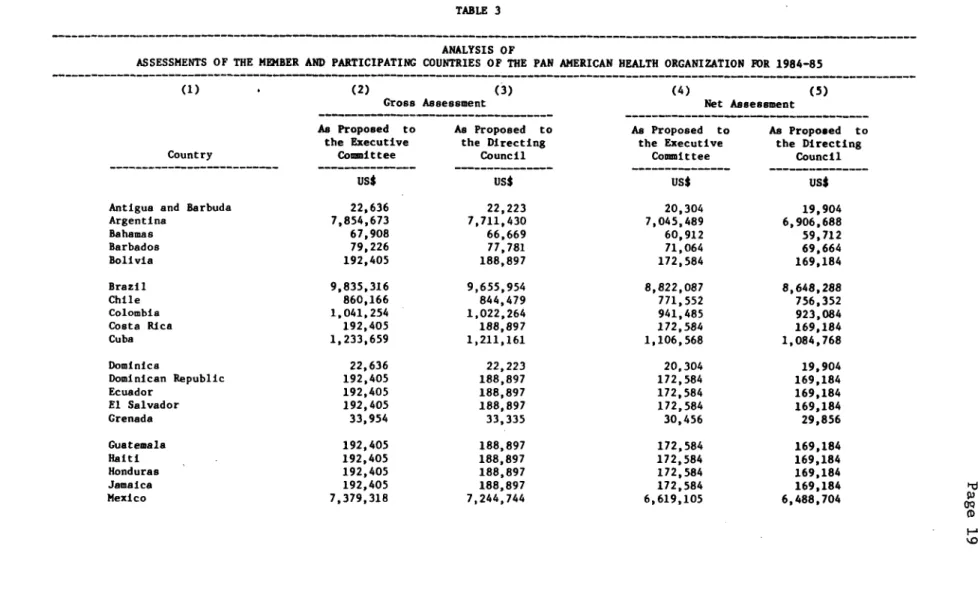
The draft appropriation resolution for the Pan American Health Organization for 1984-85, on page 13 of Official Document 187, has been changed in accordance with the program modifications and the addition in Miscellaneous Income.
Assessments
TABLE 3
ANALYSIS OF
ASSESSMENTS OF THE MEMBER AND PARTICIPATING COUNTRIES OF THE PAN AMERICAN HEALTH ORGANIZATION FOR 1984-85 ____________--- - _ ________--- _________---_---_---________________________________
---Gross Assessment (3) (4) Net Assessment
________________-____________ As Proposed to
the Executive Committee
US$
As Proposed to the Directing
Council
Uss
As Proposed to the Executive
Committee
uss
As Proposed to the Directing
Council
uss
Antigua and Barbuda Argentina Bahamas Barbados Bolivia Brazil Chile Colombia Costa Rica Cuba
Dominica
Dominican Republic
Ecuador El Salvador Grenada Guatemala Haiti Honduras Jamaica Mexico (1) (2) Country _______________________ (5) 22,636 7,854,673 67,908 79,226 192,405 9,835,316 860,166 1,041,254 192,405 1,233,659 22,636 192,405 192,405 192,405 33,954 192,405 192,405 192,405 192,405 7,379,318 22,223 7,711,430 66,669 77,781 188,897 9,655,954 844,479 1,022,264 188,897 1,211,161 22,223 188,897 188,897 188,897 33,335 188,897 188,897 188,897 188,897 7,244,744 20,304 7,045,489 60,912 71,064 172,584 8,822,087 771,552 941,485 172,584 1,106,568 20,304 172,584 172,584 172,584 30,456 172,584 172,584 172,584 172,584 6,619,105 19,904 6,906,688 59,712 69,664 169,184 8,648,288 756,352 923,084 169,184 1,084,768 19,904 169,184 169,184 169,184 29,856 169,184 169,184 169,184 169,184 6,488,704 F-d CZ ww 'IO
-Mx
TABLE 3 (continued)
Gross Assessment
--- __
(3) (4)
Net Assessment
Country _________________________ Nicaragua Panama Paraguay Peru Saint Lucia
St. Vincent and the Grenadines Suriname
Trinidad and Tobago United States of America Uruguay
Venezuela
Subtotal
Other Member Countries
Belize Canada Guyana
Participating Countries
France
Kingdom of the Netherlands United Kingdom
Subtotal
TOTAL
As Proposed to the Executive Committee USs 192,405 192,405 192,405 565,899 33,954 22,636 147,134 192,405 69,447,064 384,811 3,780,202 105,313,711 45,272 7,311,409 192,405 192,405 67,908 56,590 7,865,989 113,179,700
As Proposed to the Directing Council uss 188,897 188,897 188,897 555,578 33,335 22,223 144,450 188,897 68,102,812 377,793 3,711,264 103,315,379 ... 44,446 7,255,855 188,897 188,897 66,669 55,557 7,800,321 111,115,700
As Proposed to
the Executive
Committee Uss 172,584 172,584 172,584 507,600 30,456 20,304 131,976 172,584 67,992,671 345,168 3,416,767 100,197,860 ... 40,608 6,560,492 172,584 172,584 60,912 50,760 7,057,940 ... 107,...255,800.... 107,255,800
As Proposed to the Directing
Council us$ 169,184 169,184 169,184 497,600 29,856 19,904 129,376 169,184 66,695,808 338,368 3,349,968 98,267,196 ... 39,808 6,500,956 169,184 169,184 59,712 49,760 6,988,604 ... 105,255,800 ….m m m m
(1) (2) (5)
oQ
- --- - --- - --- - --- - --- - ---
90th Meeting 90th Meeting CD29/34 (Eng.)
ANNEX
RESOLUTION
VIII
PROPOSED PROGRAM BUDGET OF THE PAN AMERICAN HEALTH ORGANIZATION FOR THE BIENNIUM 1984-1985
THE 90th MEETING OF THE EXECUTIVE COMMITTEE,
Bearing in mind Resolution IV of the 86th Meeting of the Executive Committee, Resolution XVI of the XXVIII Meeting of the Directing Council, Resolution XVII of the 88th Meeting of the Executive Committee, and Resolution XIV of the XXI Pan American Sanitary Conference;
Considering that the provisional draft of the program budget has been the subject of further study by the Governments and of consultations with them to determine their latest desires and requirements;
Having carefully examined the proposed program budget of the Pan American Health Organization for the biennium 1984-1985 (Official Document
187);
Considering the recommendations and suggestions, contained in the records of this meeting, made by this Executive Committee concerning the format of Official Document 187 and the programs contained therein;
Recognizing that the 1984-1985 contribution by the Government of Argentina for support of the Pan American Zoonoses Center continues under negotiation;
Taking into consideration the estimate made by the Director that $2 million may be available in Miscellaneous Income in addition to the $2,800,000 contained in the original proposal; and
Bearing in mind Article 14.C of the Constitution of the Pan American Health Organization and Article III, paragraphs 3.5 and 3.6, of the PAHO Financial Regulations,
RESOLVES:
CD29/34 (Eng.) ANNEX
Page 2
2. To recommend to the XXIX Meeting of the Directing Council that it approve the proposed program budget of the Pan American Health Organization for the biennium 1984-1985, with an effective working budget
of $104,320,000, by adopting the corresponding appropriation and
assessment resolutions.
3. To recommend that the appropriation be financed by assessments
to Member and Participating Countries as well as $4,800,000 in
Miscellaneous Income.
4. To urge the Director to continue to refine the budget proposals, taking into account the recommendations and suggestions made by the Execu-tive Committee in the revision of Official Document 187, for presentation to the XXIX Meeting of the Directing Council.