Dr. Jorge Rosselot*
Health problems of mothers and children in Latin America are conditioned by the generally low level of development of the countries, which is reflected in relatively poor maternal and child welfare services. The present article establishes bases for the promotion of maternal and child protection programs and compre- hensive family education in accordance with the recom- mendations of the Governments of the Region.
Maternal and child health in Latin America is bound up with general development in the various countries and with the dynamic changes in population structure recorded over the last few years (1-3, 20, 33).
Thus, understandably, the health care of mothers and children can only be viewed in the context of the general programs of economic and social development and family well-being. These are among the targets laid down in the Charter of Punta de1 Este, one of which is the reduction of mortality rates in children under 5 years of age during the decade 196 l-l 97 1 (16).
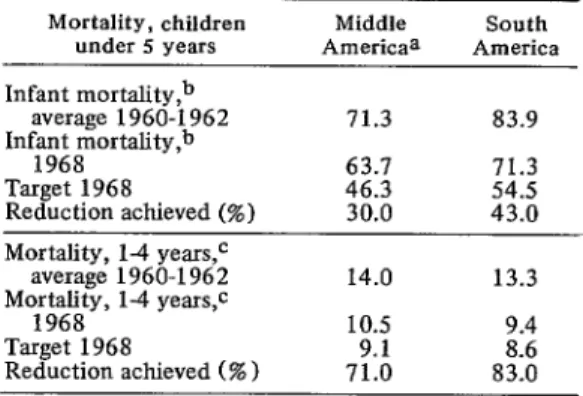
Some progress has been achieved in Latin America recently in regard to child health, and death hazards among children have been brought down closer to the level of the target figures (22), as is shown in Table 1. However, the facts are in all probability worse than they seem, partly because of the frequency of underregistration of vital statistics and partly because they reflect one facet of the problem only and do not take account of the health hazards to which those who survive are exposed.
Experience has shown fhe timeliness of the resolutions adopted at the Meeting of the American Chiefs of States (Punta de1 Este, 1967) (30), designed to intensify maternal and child protection and comprehensive family education programs.
‘Published in Soanish in Boletin de la Oficina Sanitaria Panamericana, Vol. LXX, No. 5 (May fYll), pp. 407421.
2Regional Adviser in Maternal and Child Health, PAHO.
TABLE l-Success achieved in reducing death rates for children under 5 years of age in relation to the goals of the Charter of Punta de1 Este, 1968.
Mortality, children Middle South under 5 years Americaa America
Infant mortality,b
average 1960-1962 71.3 83.9
Infant mortahty,b
1968 63.1 71.3
Target 1968 46.3 54.5
Reduction achieved (%) 30.0 43.0
Mortality, 1-4 years,c
average 1960-1962 14.0 13.3
Mortality, 14 years,c
1968 10.5 9.4
Target 1968 9.1 8.6
Reduction achieved (%) 71.0 83.0
aMexico, Caribbean Islands, and Central America. bPer 1,000 live births.
CPer 1,000.
Source: Health Conditions in the Americas (1965- 1968), Scientific Publication PAHO 207 (1970), p. 27.
At the Special Meeting of Ministers of Health of the Americas (Buenos Aires, 1968) (21) the recommendations made with a view to implementing the agreements reached by the Chiefs of State included in particular the need to expand the coverage of services in the sectors most at risk.
The Situation in regard to Maternal and Child Health
In Latin America the status of maternal and child health reflects the health situation as a whole in most of the countries, with their prevailing high levels of health hazards that could be avoided. The factors conditioning this
situation include the special susceptibility of certain age groups to the effects of a generally adverse environment, and the influence of current health policies.
Population at Risk
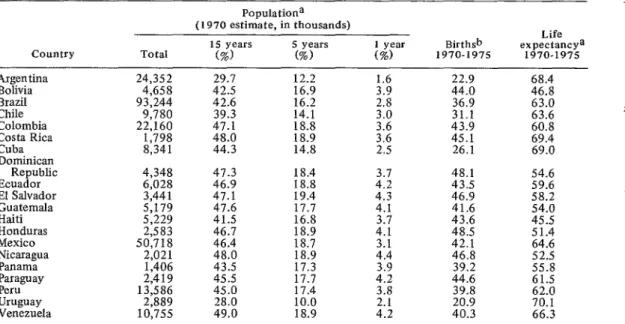
The population of the Americas in 1970 (22) is estimated at 5 IO million inhabitants, 55 per cent of them (283 million) living in Latin America; their distribution by countries and basic population variables are shown in Table 2 (I, 4.
Even though underregistration of vital statis- tics impairs the reliability of the available data, there is without doubt in the majority of the countries a rapid demographic growth attri- butable to large-scale maintenance of high birth rates and falling off in the death rates over the last decade. Thus in Latin America the propor- tion of groups exposed to maternal and child health risks is high in the case of women of child-bearing age (approximately 21.3 per cent) and of children under 15 years of age (42 per cent).
Level and Structure of Maternal Risk
Maternal mortality, according to the infor- mation available (23), which is subject to a high degree of underevaluation, is approximately five times higher in Latin America (with rates of 13.1 and 14.4 per 10,000 live births, respectively, in Middle America and South America) than in Northern America (2.7 per 10,000).
The causes of death among mothers are for the most part of a kind that could be pre- vented: toxemia during pregnancy, hemorrhagic accidents, sepsis, and in particular induced abortion; the extent of the increase in the last-named hazard calls for proper quantifica- tion, since death from abortion could be reduced. Mention should be made of the findings of the Inter-American Investigation of Mortality (27) carried out between 1962 and 1964 by the Pan American Health Organization and the Governments of nine countries of the Americas, which indicated that in some coun- tries induced abortion accounts for up to 33 per cent of all maternal deaths.
TABLE Z-Basic data concerning certain features of the population structure of selected Latin American countries.
Country Total
Populationa (1970 estimate, in thousands)
15 years S years
(%) (%) (%) 1 year 1970-197s Birth&
Life expectancya
1970-1975
Argentina 24,352 29.7 12.2 1.6 22.9 68.4
Bolivia 4,458 42.5 16.9 3.9 44.0 46.8
Brazil 93,244 42.6 16.2 32:: 36.9 63.0
Chile 9,780 39.3 14.1 31.1 63.6
Colombia 22,160 47.1 18.8 Z:Z 43.9 60.8
Costa Rica 1,798 48.0 18.9 45.1 69.4
Cuba 8,341 44.3 14.8 2.5 26.1 69.0
Dominican
Republic 4,348
Ecuador 6,028 1;:: 18.4 18.8 4.2 3.7 48.1 43.5 54.6 59.6
El Salvador 3,441 47.1 19.4 4.3 46.9 58.2
Guatemala 5,179 47.6 17.7 4.1 41.6 54.0
Haiti 5,229 41.5 16.8 3.7 43.6 45.5
Honduras 2,583 46.7 18.9 4.1 48.5 51.4
Mexico 50,718 46.4 18.7 3.1 42.1 64.6
Nicaragua 2,021 48.0 18.9 4.4 46.8 52.5
Panama 1,406 43.5 17.3 3.9 39.2 55.8
p;;ww 13,586 2,419 45.5 17.7 17.4 4.2 3.8 44.6 39.8 61.5 62.0
Uruguay 2,889 4258:: 10.0 2.1 20.9 70.1
Venezuela 10,755 49.0 18.9 4.2 40.3 66.3
Abortion in the Region is a frequent cause The Inter-American Investigation of Mor- of morbidity, but the actual extent can be tality in Childhood now under way in 13 areas determined only by means of retrospective or of Latin America is revealing that malnutrition prospective studies. With regard to its repercus- is a direct or associated cause of a large sions on medical care, sufficient data are percentage of deaths of children under 5 years. available to demonstrate that its prevalence in The Investigation also brings out the impor- many Latin American countries is such as to tance of communicable diseases, including account for up to 20 per cent of all obstetrical measles, as a contributing factor in child mor-
cases. tality (26).
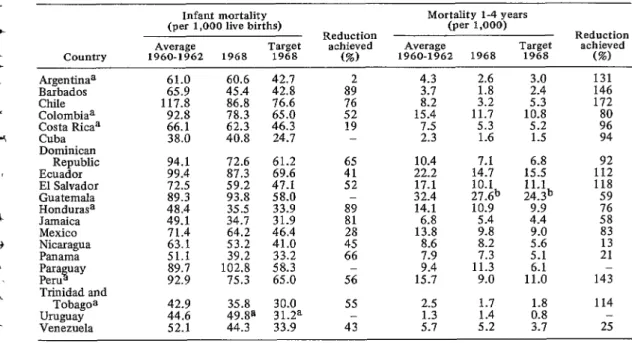
The death rates for infants and children between 1 and 4 years of age (Table 3) fluctuate considerably in the Latin American countries (22). Rath’s researches reveal that at times, especially in Central America (28), the official figures differ very appreciably from what is though to be the real situation.
The three most prevalent morbidity factors that bring about the deaths of children under 5 years of age represent hazards which in a large measure could be reduced: gastroenteritis, com- municable diseases, and respiratory diseases. But because of the poor certification of infant deaths, the prevalence of the true underlying cause-malnutrition-does not emerge clearly.
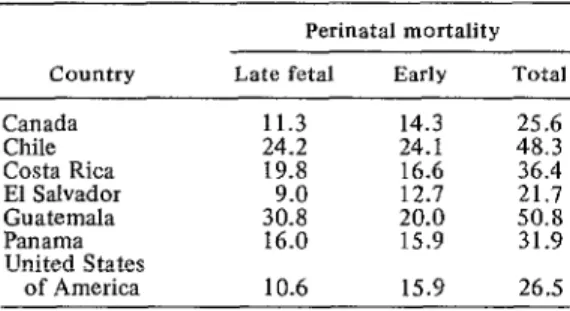
It should be pointed out that it is not easy to identify the causal role played by “diseases of early infancy,” most of which are to be found in group B of the current International Statistical Classification of Diseases, Injuries, and Causes of Death, and as a result the corresponding perinatal hazard is not given due weight (see Table 4) (32).
The Environment as a Health Hazard
In Latin America environmental factors have an important bearing on maternal and child health hazards. The most important of such TABLE 3-Success achieved in reducing death rates for children under 5 years of age in relation to the goals of the Charter of Punta de1 Este in selected Latin American countries, 1968.
country
Infant mortality (per 1,000 live births)
Average Target
1960-1962 1968 1968
Mortality l-4 years (per 1,000)
Reduction Reduction
achieved Average Target achieved
(%) 1960-1962 1968 1968 (%:)
Argentinaa Barbados Chile Colombiaa Costa Ricaa Cuba Dominican
Republic Ecuador El Salvador Guatemala Hondurasa Jamaica Mexico Nicaragua Panama Parastray Peru Trinidad and
Tobagoa Uruguay
2:;
45.4 60.6 %6611
78.3 86.8
62.3 38.0 40.8
42.7 42.8 76.6 65.0 46.3 24.7
94.1 72.6 61.2 99.4 87.3 69.6 72.5 59.2 47.1 89.3 93.8 58.0 48.4 35.5 49.1 34.7 71.4 64.2
33.9 31.9 46.4 63.1 53.2 41.0 51.1 39.2 33.2 89.7 102.8 58.3 92.9 75.3 65.0
42.9 35.8 44.6 49.8@
Venezuela 52.1 44.3
30.0 31.2a 33.9
892
z”2
19 -
:: 52
4.3 2.6
i.72
15:4 11.7
::;
7.5 5.3
2.3 1.6
10.4
22.2 1::: 17.1 10.1 32.4 27.6b 14.1 10.9
1% 5.4 9.8
8.6 8.2
E
15:7 1X 9:o
2.5 1.7
1.3
5.7
::“2
3.0 131
2.4 146
1% 172
:5 9”: 94
156:: 1:; 11.1
24.3b 118 59 9.9
4.4 ::
59:: 83 13
5.1 21
1;:; 143
A::
1143.7 25
a 1967. b1966.
TABLE 4-Perinatal mortality in selected countries of the Americas, 1965-1966.
Perinatal mortality
Country Late fetal Early Total
Canada Chile Costa Rica El Salvador Guatemala Panama United States
of America
Source: World Health Statistics Report, Vol. 22, No. 1, 1969.
factors are low income levels, ranging from US$86 in Haiti to US$977 in Venezuela; the proportion of the population living in rural areas, which fluctuates between 21.4 per cent in Uruguay and 82 per cent in Haiti; the availability of piped water supplies, ranging anywhere from 6.5 per cent in areas of Haiti to 92.3 per cent in Venezuela; illiteracy, which is fairly low in Argentina (8.6 per cent) and very high in Haiti (80.0 per cent); and calorie intake, ranging from 1,840 in El Salvador to 3,170 in Uruguay (3,22).
Interaction of Health Policies
The health policy adopted in the various countries is one of the factors determining the level and structure of the maternal and child health situation.
Over-all monetary resource figures indicate that frequently a sum of less than US$lO per capita is spent on health, and the average estimated implies a considerable imbalance, both geographically and institutionally.
Since as a general rule the resources assigned to maternal and child health services are not so specified, it is extremely difficult to identify the expenditure incurred in this area and the cost-benefit results of the pertinent activities, and information is also lacking on the specific resources available in terms of installed capacity
(chiefly hospital beds) and professional person- nel and auxiliary staff attached to the maternal and child health care services.
As regards the hospital bed situation as a whole, two-thirds of the Latin American coun- tries have fewer than five beds per 1,000 inhabitants, and in many instances the figures for pediatric and obstetrical beds are less than 10 per cent of the total number of beds (21). Even though we know that there is a certain additional unspecified number of beds serving the requirements of maternal and child care, it is an undoubted fact that the resources in this field are few.
The total available medical and nursing personnel in Latin America is limited, being approximately one-third and one-seventh, respectively, of those in Northern America (22); the numbers specializing in maternal and child protection programs are largely unknown. In seven countries, we know that the number of pediatricians and obstetricians is more than 5 per cent of the total number of doctors, but data are lacking on their distribution by geo- graphic area and type of care given, and on the proportion of general medical practitioners and nursing personnel with maternal and child health responsibilities. This explains why the operational level in Latin America is distinctly low.
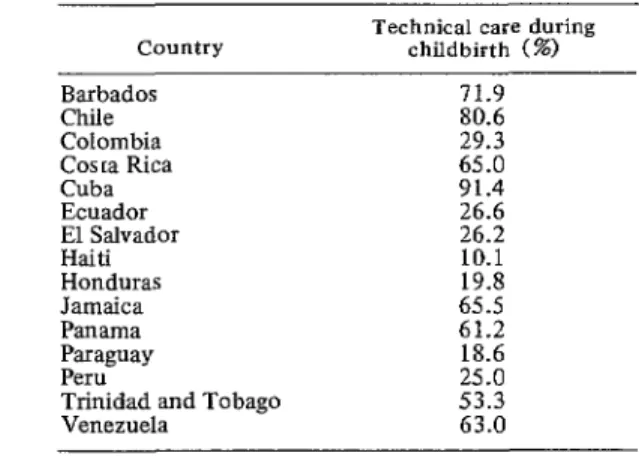
Institutionalized care during childbirth ranges from extremely low figures (Haiti 10.1 per cent, Paraguay 18.0 per cent) to a progres- sively adequate coverage (Cuba 91.4 per cent, Chile 80.6 per cent, Barbados 71.9 per cent). In approximately half the countries less than 50 per cent of women are given professional care during childbirth and in seven countries the figure is under 30 per cent-a particularly serious situation, since confinements not handled in hospital centers are left to the care of empirical midwives.
Integrated Maternal and Child Protection
The planning and development of an inte- grated maternal and child protection program is only conceivable as formulated in the context of a country’s national health plan. In most of the Latin American countries the situation is not explicit; there is no definition of the resources actually available for the execution of the program and for establishing feasible targets.
Purposes
The following should be stipulated as the basic purposes of an integrated maternal and child protection program:
a) To help to reduce morbidity andmortal- ity among mothers, particularly as caused by unduly frequent childbearing, induced abor- tion, cervical cancer, and other gynecological troubles.
b) To help to reduce morbidity and mor- tality among children, especially at the stage most vital for their development, by means of increased measures to reduce possible injury and promote adequate and timely medical care.
c) To help to improve the conditions of family well-being through better education and the provision of services aimed at the conscious exercise of the rights and duties of responsible parenthood, with due respect for free decision on the part of the spouses.
Objectives
The objectives include care, teaching, train- ing, and research.
Objectives Involving Medical Care
These are tentative targets for coverage and concentration of activities; they should be progressive in character, with program priorities obviously geared to the proper social and economic development level, as illustrated schematically in Table 5.
Over-All Family Protection
The family, as the natural and most im- mediate environmental medium in which normally speaking the vital cycles of maternity and childhood occur; a satisfactory legal basis and economic and employment stability for the family; procreation within the family, delib- erate and responsible; psychosocial harmony among its members and their incorporation in the activities of the local community-these are basic objectives to be sought in promoting maternal and child health. And in due course this means the multidisciplinary implementa- tion of programs and proper coordination of them by various agencies.
An optimum state of health in parents; suitable education in matters connected with conjugal and family responsibility; premarital health supervision, including the increasingly important activities of genetic counselling and guidance with a view to rationally accepted maternity-these are basic factors in the promo- tion of health in the intervals between child- bearing.
Prenatal Care
Early prenatal care, maintained with strict regularity, should be based on medical, obstet- rical, and dental supervision; the inculcation of hygienic habits, and especially nutrition educa- tion or supplementary feeding or both; and psychosocial guidance and economic and employment safeguards where these are called for, always with due regard to physiological needs during the gestation period. The scheme thus outlined implies not only that adequate resources-mainly personnel-must be forth- coming, but also that there must be informed motivation on the part of the mothers>them- selves.
TABLE S-Priorities in maternal and child protection programs according to level of socioeconomic development.
Pertinent health situation
Prevalent risks Maternal health
Zhild health
Pviority groups Maternal programs
Child programs
Preferential activities Education for
family life Primary prevention Medical care Mental health Social welfare Professional staff
available Specialists
Basic
Nonprofessional staff available
Socioeconomic level
High Medium Low
Minimun maternal High maternal
mortality mortality Very high over-all maternal mortality Perinatal mortality Neonatal and post- Mortality in young
natal mortality children
First confinements, First confinements
adolescents, and and repeated All pregnant women unmarried mothers abortion cases
Underweight Newborns All young children
newborns Unweaned babies
Limited Considerable Considerable
Moderate Considerable Considerable
Moderate Considerable Considerable
Considerable Moderate Limited
Limited Moderate Considerable
Obstetrician-pediatrician Obstetrician-pediatrician Obstetrician-pediatrician Nurse and/or Nurse and/or Nurse and/or
midwife midwife midwife
c***j (**I Co/*)
General physician General physician
and nurse and nurse General physician and nurse
(***I (**I (*I
Te(c$nical auxiliary Technical auxiliary Technical auxiliary
(**) (***)
Volunteers Community promoters Community promoters
(“1 and empirical personnel
(**I
and empirical personnel c***j
Note: The asterisks denote the relative level of resources available.
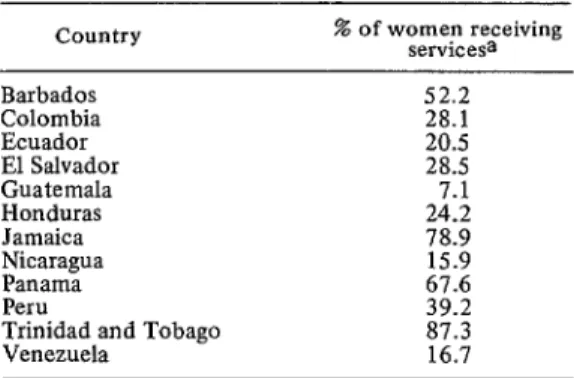
TABLE 6-Coverage of prenatal control in selected Latin American countries.
Country % of women receiving servicesa
Barbados 52.2
Colombia 28.1
Ecuador 20.5
El Salvador 28.5
Guatemala 7.1
Honduras 24.2
Jamaica 78.9
FiFanitr 67.6 15.9
Peru 39.2
Trinidad and Tobago 87.3
Venezuela 16.7
aPer 100 live births.
Source: Health Conditions in the Americas (1965 i!J18), Scientific Publication PAHO 207 (1970), p.
ment of an average coverage of not less than 60 per cent of the estimated number of pregnant women, if possible enrolled before the third month of pregnancy.
As regards the frequency of visits, it is felt that there ought to be at least five consultations per registered patient, including extra care in the event of gynecological or obstetrical complications.
Technical Care during Childbirth
Adequate technical care during the confine- ment is the next essential stage after prenatal care. Today there are vast differences from one Latin American country to another; but it is fair to say that a large proportion of confine- ments are not in professional hands, and where they are, it is as a rule because the patients are treated in hospitals, mostly in the capital or the larger provincial towns (Table 7).
The major challenge in this respect occurs in countries or parts of countries combining a high birth rate with extensive rural populations and hence inaccessibility to medical care. In such circumstances it is inevitable that, for a long time to come, realistic solutions must be found that include both the use of auxiliaries (12), with ad hoc training and surveillance, and arrangements by which emergency beds are installed in health units for this purpose.
In the light of the foregoing, the target for increase in technical care during confinement in the period 1972-1975 should be an average coverage of approximately 60 per cent. Obviously, this means, among other measures, the standardization of resources in terms of installed capacity based on a level of utilization
TABLE 7-Technical care during childbirth in selected Latin American countries, 1968.
country Technical care during childbirth (%)
Barbados Chile Colombia Cosra Rica Cuba Ecuador El Salvador Haiti Honduras Jamaica Panama Paraguay Peru
Trinidad and Tobago Venezuela
71.9 80.6 29.3 65.0 91.4 26.6 26.2 10.1 19.8 65.5 61.2 18.6 25.0 53.3 63.0
Source: PAHO document “Quadrennial Projec- tions of the Latin American Countries, 1971-1975,” and Health Conditions in the Americas (I 965-l 968), Scientific Publication PAHO 207 (1970), p. 142.
of 70 per cent and an average stay in hospital of four days.
Care during the Puerperium
Supervision during the puerperium is im- portant in maternal care; it provides an indis- pensable gynecological check, promotes educa- tion in regard to family life, and makes for an earlier start in supervising the child during the neonatal period. This type of activity has as a rule extremely low coverage in Latin America; in most of the countries it does not reach even 5 per cent of nursing mothers.
It seems highly likely that with the efficient coordination of maternal and child health protection activities, this problem will be over- come by making full use of the opportunities for mothers and children to make contact with the appropriate health services. Thus a target of progressive coverage might be set aiming at 50 per cent of mothers during the puerperium, wherever possible under the supervision of nurse-midwives with adequate training and supervision.
Regulation of Fertility
World Health Organization (7-11, 23-15) and the Pan American Health Organization (19, 21), the United Nations (30), the United States Agency for International Development, the Population Council, the International Family Planning Federation, the Ford Foundation, and the Pathfinder Foundation.
During the last five-year period, the Govern- ments of the Region have been gradually assuming the leadership of activities designed to regulate fertility, and have strengthened the maternal and child health divisions within the ministries to include family counselling. This complies with the pertinent recommendations of the Meeting of Ministers of Health of the Americas (Buenos Aires, 1968).
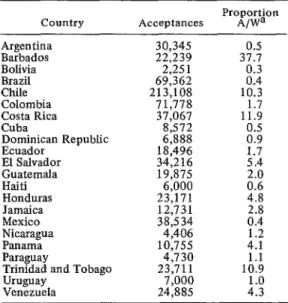
As is indicated in Table 8 (4), the coverage achieved in activities for the regulation of fertility in Latin America is low: in 12 coun- tries it reaches less than 2 per cent of women of childbearing age, and only four countries record figures of over 10 per cent.
One thing is certain: if the program in question is to be expanded, there must be a different approach from that used hitherto,
TABLE B-Coverage of activities for regulation of fertility in Latin America, 1968.
Country
j%3w;~;sa
Bolivia Brazil Chile Colombia Costa Rica Cuba
Dominican Republic Ecuador
El Salvador Guatemala Haiti Honduras Jamaica Mexico Nicaragua Panama Paraguay Trinidad and Tobago Uruguay
Venezuela
Proportion Acceptances A/Wa
30,345
22,239 3:::
2,251 0.3
69,362 0.4
213,108 10.3
71,778 1.7
37,067 11.9 8,572
6,888 E
18,496
34,216 :.‘4
19,875 2:o
6,000 0.6
23,171 4.8
12,731
38,534 t.4”
4,406 1:2
10,755 4.1
4,730 1.1
23,711 10.9
7,000 1.0
24,885 4.3
aA/W: Acceptances/Women of childbearing age. Source: Maria Luisa Garcia. CELADE Publication Series A-97, 1970.
especially as regards the incorporation of auxiliary health workers in the program and increased delegation of responsibility to them. Provided they are really well trained and supervised, auxiliaries can form a link with the community in promoting effective motivation and/or expansion of fertility regulation. Simi- larly, such action must be better coordinated than at present with the other activities of the maternal and child health program, and advantage must be taken of all contacts made in connection with the program, whether at the time of attendance at the hospital or health center, or in the course of home health visiting. In this connection, stress must be placed on the importance of postnatal consultation, which has a threefold function to fulfill: supervision during the puerperium, care of the newborn child, and family counselling, which obviously implies the promotion of harmonious collaboration among the relevant professionals in the health team. With these activities goes the rational and selective cytological examina- tion, making for early detection of cervico- uterine cancer and appropriate arrangements for treating it in time.
In the light of the above premises, a tenta- tive target for the period 1972-1975 might be an average coverage of 15 per cent of women of childbearing age (1544 years), with up to four consultations a year for each of the methods adopted, to be given in accordance with a systematic schedule by doctors, nurses, mid- wives, and health auxiliaries.
freedom of the individual and the dignity of the family, the process being complemented by additional measures: education, and economic, social and employment safeguards, designed to promote the well-being of the family.
Supervision of the Health of the Young Child Comprehensive supervision of the health of the young child and subsequent care are the master key to child protection, combining prevention and cure (29). The process must start early and at the appropriate operational level. Here it must be stressed that coverage in most of the Latin American countries is defec- tive, to judge by the scanty information avail- able (22).
Child supervision is a continuing operation, and the factors determining where the emphasis should be placed are prevention of the maximum risks to which early childhood is exposed, biological peculiarities in the child (congenital abnormalities, premature birth, mal- nutrition, etc.) and the socioeconomic and cultural situation of the family (work stoppage, alchoholism, legal or psychosocial complica- tions between the spouses, and illiteracy).
Integrated supervision includes, basically, evaluation of anthropometric growth and physical, psychic and emotional development, care in sickness, education in family hygiene, encouragement of maternal feeding, supple- mentary feeding where necessary; prevention of communicable diseases and accidents; and sound psychosocial adaptation of the child as a member of the household and of the com- munity.
Special mention must be made of actual sick care of the child. In an integrated health service this should be carried on jointly with the supervision of development as described above, and advantage should be taken of the existing medical care coordination and/or regionaliza- tion system while hospital centers should provide specialized consultant services and/or inpatient treatment where necessary.
In the light of the above, a target coverage for the four-year period 1972-1975 of up to 80
and 60 per cent might be set for the child population under 2 years and from 2 to 5 years of age, respectively. A program calculated to achieve such a coverage should provide for health consultations at the rate of 12, 8, and 1 in the first, second, and each succeeding year of childhood. Obviously, these consultations could coincide with casual illness, but this would not prevent regarding the contact with the health services on such occasions as an opportunity for keeping an eye on the basic aspects of child development (18).
It seems likely that increased morbidity will call for substantial help from auxiliary and outside personnel if the objectives in question are to be fullfdled.
With regard to hospital pediatric care, a utilization rate of approximately 80 per cent and an average of 10 days hospital stay will have to be obtained before medical care is sufficient to ensure the general expansion of the program.
Health Safeguards for the Schoolchild and the Adolescent
The biological protection of the schoolchild and the adolescent is the prolongation of the work carried out during early infancy and childhood, rounding off the health promotion operation covering the whole of the develop- ment cycle.
training for the various types of personnel within the health team to carry out the relevant activities in close cooperation with teachers, vocational guidance centers, and youth organi- zations.
Teaching, Training, and Research Objectives In establishing training targets, account must be taken both of the type of personnel under- going traininggmultidisciplinary in the case of maternal and child protection programs-and of the responsibilities assigned to such personnel. The basic curriculum and the schedule of research work should preferably include, among other subjects, the biological and health aspects of human reproduction and child development, and the organization of health services, particu- larly those concerned with maternal and child protection, with due regard to the demographic problem involved.
Mention should be made of the opportu- nities for advanced training available to the Latin American countries through various inter- national organizations, including the Pan American Health Organization: regular courses in clinical and social pediatrics (Santiago, Chile, and Medellin, Colombia); health and popula- tion dynamics (Santiago, Chile, and 550 Paulo, Brazil); administration of maternal and child health (Santiago, Chile, and Buenos Aires, Argentina); and intensive care of the mother, the fetus, and the newborn child (at the recently established Latin American Center for Perinatology and Human Development, Monte- video, Uruguay) (25).
Again with regard to maternal and child health teaching, stress must be placed on the coordinated activities carried out by PAHO in conjunction with the International Children’s Center in Paris and the Inter-American Children’s Institute, a specialized agency of the Organization of American States, by means of seminars designed to analyze the most im- portant problems connected with the health of the child and the family (25).
Finally, a word should be said about the serious attention given in Latin America to the
training of auxiliary medical personnel specifi- cally for carrying out maternal and child care activities.
In the field of research, maternal and child health programs in Latin America should as far as possible help to stimulate and/or strengthen basic or operations research studies designed inter alia, in conjunction with other agencies, to enhance our knowledge of the vital factors governing these health problems. Here, un- doubtedly, a considerable contribution has been made through the PAHO sponsorship both of the Inter-American Investigation of Mortal- ity among adults (1962-I 964) which brought to light significant epidemiological data con- nected with the study of maternal mortality (27) and of the current research in 13 selected areas of Latin America on mortality hazards during childhood. The preliminary findings of this current investigation make for greater precision in assessing the extent and knowledge of the problem and in determining the causes of mortality -soften avoidable mortality occurring early in life (26).
At the present time, apart from the research being carried out in specialized centers, mostly on the problems of human fertility, nutrition, and child growth and development, great interest has developed in Latin America in operations research designed to establish the most appropriate techniques and procedures for achieving the best results and efficiency in maternal and child care.
As a corollary to this, it should be pointed out that the attainment of the medical care, training, and research objectives referred to above is bound up with the possibility of a joint policy on the part of ministries of health and universities in regard to these activities.
Summary
situation is complicated by the underregistra- tion and unreliability of vital and other sta- tistics.
What can be said with reasonable certainty is that the maternal mortality rate in Latin America is some five times higher than in Northern America, and that the main causes of maternal death-toxemia, hemorrhage, sepsis, induced abortion, etc.-are largely preventable. The corresponding figures for young children suggest that the main hazards are gastro- enteritis, communicable diseases, and respira- tory disorders, but the statistics tend to under- estimate the major cause: malnutrition.
Some of the chief factors contributing to maternal and child health deficiencies are low income levels, primitive rural conditions, poor water supply, illiteracy, and lack of calories in the diet. At the same time the facilities for dealing with these problems-an adequate pro- portion of the scarce funds allocated to health services, a sufficient number of hospital beds, and a plentiful supply of doctors and nursing personnel-are not forthcoming.
The article advocates an integrated maternal
and child protection program, with the follow- ing basic aims: to reduce maternal mortality resulting from unduly frequent childbearing, induced abortion, cervical cancer, etc.; to lower the death rate for young children by better and more prompt action against reducible health hazards; and to improve family well-being by education in the rights and duties of responsible parenthood. The means of achieving these aims include the establishment of priorities in the light of social and economic factors; compre- hensive family protection (legal, psychosocial, hygienic, educational, etc.), with the coopera- tion of all the health agencies; prenatal care (medical, dental, economic, etc.); professional care during confinement; care during the puer- perium; regulation of fertility (family plan- ning); health supervision in infancy, including nutrition; protection of health of school- children and adolescents; teaching, training, and research. Under each of these headings, the author gives current statistics where available and suggests coverage targets attainable in the light of the varying stage of development of the countries. 0
REFERENCES
(I) Latin American Center for Demography (CELADE). Boletin Demogniifco. Year II, No. 3, Santiago, Chile, 1969.
(2) CELADE. Boletz’n Demogr@co. Year II, No. 4, Santiago, Chile, 1969.
(3) Inter-American Development Bank. Socio- Economic Progress in Latin America. Social Progress Fund. Ninth Annual Report. Wash- ington, D.C., 1969.
(4) Garcia, M. L. Programas de planificacidn familiar en Amkica Latina, 1969. CELADE Publica- tion Series A-97, Santiago, Chile, 1970. (5) Mir6, C. Un programa de encuestas cooperativas
de fecundidad en Amkrica Latina. Refutacibn de algunos conceptos errbneos. CELADE Publication Series A-49, Santiago, Chile, 1965.
(6) Mirb, C. and F. Rath. Resultados preliminares de las encuestas comparativas de fecundidad en tres paises latinoakericanos. C&LADE Publi- cation Series A-47. Santiapo, Chile. 1965. (7) World Health Organization- Eighteenth World
Health Assembly, Document A-78/P and B/4, Geneva, 1965.
(8) World Health Organization. Nineteenth World Health Assembly, Document A-18/P and B/19, Geneva, 1966.
(9) World Health Organization. Twentieth World Health Assembly, Document A-19/VR/14, Geneva, 1967.
(10) World Health Organization. Twenty-First World Health Assembly, Document A-21/P and B/9, Geneva, 1968.
(II) World Health Organization. Twenty-Second World Health Assembly, Document WHA/ 22.32, Geneva, 1969.
(12) World Health Organization. The Midwife in Maternity Care-Report of a WHO Expert Committee. Technical Report Series No. 331, Geneva, 1966.
(13) World Health Organization. Developments in Fertility Control-Report of a WHO Scien- tific Group. Technical Report Series No. 424, Geneva, 1969.
(14) World Health Organization. The Organization and Administration of Maternal and Child Health Services-Fifth Report of the WHO Expert Committee on Maternal and Child HeaZth. Technical Report Series No. 428, Geneva, 1969.
(1.5) World Health Organization. Biological Compo- nents of Human Reproduction: Studies of their Variations in Population Groups- Report of a WHO Scientific Group. Technical Report Series No. 435, Geneva, 1969. (16) Pan American Health Organization. Salud-Creci-
miento econ6mico y progreso social en la Am&ica latina. Miscellaneous Publication
(17) Pan American Health Organization. Task Force on Health at the Ministerial Level, Final Report. Official Document PAHO 51, Wash- ington, D.C., 1964.
(18) Pan American Health Organization. A Health Care Program for Mothers and Children. Scientific Publication PAHO 130, Washing- ton, D.C., 1966.
(19) Pan American Health Organization.“Partici- pation of the Health Sector in Population Policv.” In: Enafish Edition of the Boletin de la Oficina SaniLaria Panamericana-Selections from 1969, Washington, D.C., 1970, pp.
1-18.
(20) Pan American Health Organization. Facts OK Health Progress. Scientific Publication PAHO
166, Washington, D.C., 1968.
(21) Pan American Health Organization. Special Meet- ing of Ministers of Health of the Americas (Buenos Aires. October 1968)-Final Report. Official Document PAHO 89, Washington, D.C., 1968.
(22) Pan American Health Organization. Health Con- ditions in the Americas, 19651968. Scien- tific Publication PAHO 207, Washington, D.C., 1970.
(23) Pan American Health Organization. Maternal Nutrition and Family Planning in the Americas. Scientific Publication PAHO 204, Washington, D.C., 1970.
(24) Pan American Health Organization. “Quadren- nial Projections of the Latin American Coun- tries, 1971-1975.” Mimeographed document, Washington, DC., 1970.
(25) Pan American Health Organization. Quadrennial Report of the Director. 19661969. Official Document PAHO 101, Washmgton, D.C., 1970.
(26) Pan American Health Organization. “Progress Report of the Inter-American Investigation of Mortality in Childhood.” Mimeographed
document of the Ninth Meeting of the PAHO + Advisory Committee on Medtcal Research,
Washington, D.C., 1970.
(27) Puffer. R. R. and G. W. Griffith. Patterns of Urban Mortality. Scientific Publication PAHO 151, Washington, D.C., 1967. (28) Rath, F. “America Central. Tendencias tasadas y
perspectivas de su poblacibn.” Mimeographed document, University of Costa Rica, 1968. (29) Rosselot, J. “La salud de1 niiio, valores, ricsgos y -
metas, con especial referencia a Latinoame- rica.” Mimeographed document, PAHO/WHO Seminar on Family Planning, Panama, 1969. (30) Pan American Umon. “Declaration of the Presi- dents of America.” In: Meeting of American Chiefs of State (Punta de1 Este, Uruguay, April 1967). Publication 34.1.1-E-7480, Washington, D.C., 1967.
-1
’ 4’ (31) United Nations Economic and Social Council, - Committee on Coordination. “Special Report b on Coordination in Certain Fields Designated
by the Council in Resolution 1277 B (XLIII).” Mimeographed document, New ’ York, 1968.