A
R
T
I
G
O
A
R
T
I
C
L
E
1 Centro Latino-Americano de Estudos de Violência e Saúde Jorge Careli, Escola Nacional de Saúde Pública, Fundação Oswaldo Cruz. Avenida Brasil 4.036/700, Manguinhos. 21040-361 Rio de Janeiro RJ. [email protected]
Suicide mortality in people aged 60 and over
in Brazilian municipalities between 1996 and 2007
Mortalidade por suicídio em pessoas com 60 anos ou mais
nos municípios brasileiros no período de 1996 a 2007
ResumoEste trabalho teve como objetivo
conhe-cer a magnitude do suicídio em idosos em nível nacional. Foi feita uma descrição da mortalidade por suicídio nos municípios brasileiros, visando estabelecer aqueles de maior frequência do even-to. Empregou-se dados do Sistema de Informação sobre Mortalidade (SIM/MS) para o período de 1996 a 2007 (triênios), sendo utilizados os even-tos com códigos X60 a X84 e Y87.0 da 10ª revisão da Classificação Internacional de Doenças (CID-10). As taxas foram padronizadas segundo crité-rios da OMS. Verificou-se que 3.039 municípios brasileiros têm registros de casos de suicídio de pessoas com 60 anos ou mais em pelo menos um dos triênios analisados (54,6% do total de muni-cípios). Um total de 29,3% de municípios se loca-liza na região Sul, 29,6%, na região Sudeste e 27,5% na região Nordeste. O Rio Grande do Sul concentra o maior percentual de municípios com casos nos quatro triênios (27,3%), sendo seguido pelos estados de São Paulo (17,4%) e Santa Cata-rina (9,1%). Quanto à evolução temporal, obser-vou-se redução das taxas do triênio inicial para o triênio final em 32 dos 51 municípios com taxas mais elevadas em todo o período de análise. A ra-zão média de óbitos homem/mulher foi de 2,8 mortes masculinas para cada morte feminina. O principal meio empregado é o enforcamento, es-trangulamento e sufocação tanto entre homens (58,2%) quanto entre mulheres (49,8%). Palavras-chave Suicídio, Idosos, Mortalidade
Abstract The scope of this article was to assess
the nationwide scale of suicides among the elder-ly. An overview of suicides in Brazilian munici-palities was conducted to identify municimunici-palities with the highest incidence of suicide. Data from the Mortality Information System (SIM/MS) were used for the period from 1996 to 2007, using the events with codes X60 through X84 and Y87.0 of the 10th
review of the International Classifica-tion of Diseases (CID-10). The rates were stan-dardized according to the criteria of the WHO. It was discovered that 3,039 Brazilian municipali-ties have records of suicide cases of people aged 60 and more in at least one of the triennia analyzed (54.6% of all the municipalities). A total of 29.3% of those municipalities were in the Southern Re-gion, 29.6% in the Southeast and 27.5% in the Northeast. The State of Rio Grande do Sul has the highest percentage of municipalities with sui-cide cases in the four triennia (27.3%), followed by the States of São Paulo (17.4%) and Santa Catarina (9.1%). Between the first and the final triennium, it was observed that there was a re-duction in 32 of the 51 municipalities with high-er rates. The mean ratio of male/female deaths was 2.8 male deaths for every female death. The main method used is hanging, strangulation and suffocation among both men (58.2%) and wom-en (49.8%).
Key words Suicide, The elderly, Mortality
Liana Wernersbach Pinto 1
Simone Gonçalves de Assis 1
P
in
Introduction
According to the World Health Organization (WHO), approximately one million people die every year as a result of suicide, which is equiva-lent to one person dying every forty seconds, or 16 deaths per 100,000 inhabitants1. The phenom-enon’s origins involve psychological, social, bio-logical, cultural and environmental aspects1.
The following groups of individuals are con-sidered at-risk populations for suicide: young men (aged 15-49); the elderly, especially men; people suffering from mental diseases; people with a his-tory of abuse of alcohol and drugs; and prisoners2. Suicide is a complex phenomenon, with mul-tiple causes, and whose occurrence cannot be at-tributed to one single characteristic or stressor event3. Several studies attempted to identify risk factors and methods of protection against sui-cide4,5. The analysis of these studies show that causes vary depending on the sex and age group analyzed. For the elderly population, risk factors include the decrease of social support and isola-tion, mourning, alcohol abuse, loss of indepen-dence, depression, and the existence of diseases3. According to Conwell et al.5, risk factors associ-ated to the elderly also depend on age group. Therefore, factors associated to individuals aged around 60 are not the same as those associated with individuals aged circa 855.
Another important aspect about suicide among the elderly refers to the ratio between at-tempts and the actual death. Whereas in other age groups this number varies between 100 and 200 attempts for each death, among elderly indi-viduals it is of 2 to 3 attempts for every accom-plished act. Thus, the existence of previous at-tempts is an important predictive factor of sui-cide among the elderly4.
The requirements for a death to be consid-ered suicide vary from country to country. There are nations that require external evidence of the intention to commit the act - such as a note, for instance - and there are places where a trial is carried out to determine the intentions. Suicide is considered illegal in India. However, in most coun-tries the police and medical doctors are responsi-ble for privately declaring whether a certain death was the result of suicide. Differences between countries in terms of whether a death is consid-ered suicide (and also in terms of the way the fact is recorded) create a substantial underestimation in the statistics of death by suicide3.
A recent study by the WHO rated 106 coun-tries based on the completeness, coverage and
quality of information about vital statistics. Bra-zil was classified in the medium-quality category, along with countries such as Belgium, Austria, Uruguay, Italy and the Netherlands, among oth-ers. Regional differences between the countries are seldom discussed in scientific literature6.
In Brazil, several studies indicate the presence of problems related to both the quantity and the quality of death records obtained from the na-tional databases of health information7,8. One could suspect that suicide, due to all the factors related to it (such as religious and financial as-pects - life insurance is not redeemable in case of suicide), has even higher rates of subnotification than deaths associated to other external causes. According to Mello-Jorge et al.8, 67.2% of deaths due to unclear causes occur among individuals aged 60 years or above.
Suicide methods most commonly used in sev-eral countries are hanging, strangulation and suffocation. In some countries, there is a pre-dominance of firearms (United States) and in-toxication by pesticides (China). Men tend to use more aggressive methods1. Studies show that the elderly tend to use more violent and lethal meth-ods, such as hanging and firearms (the latter be-ing especially common among men) in different cultural contexts4,9,10.
Expanding the research about suicide among the elderly in Brazil is key to show which Brazil-ian municipalities have greater occurrence of the phenomenon and which groups are more vul-nerable, so that concrete actions can be planned and implemented aiming at these individuals. The fact that the population above age 60 is growing in the world and in Brazil, and raising even more the already high statistics, is yet another aspect that reinforces the importance of investigating suicide among these individuals4,5,11.
The objective of this paper is to nationally as-sess the magnitude of the problem of suicide among the elderly. With this purpose, it describes suicide mortality in Brazilian municipalities in an attempt to identify where it occurs more frequently.
Materials and Methods
lit-ú
d
e C
o
le
tiv
a, 17(
8)
:1963-1972,
2012
erature. The research was approved by the Com-mittee of Ethics in Research of the National School of Public Health / Oswaldo Cruz Foundation.
This is a descriptive study of suicide mortal-ity among individuals aged sixty or more in Bra-zilian municipalities between 1996 and 2007. It relies on data from the Mortality Data System (SIM), Ministry of Health / Department for the Analysis and Tabulation of Data of the Unified Health System (DATASUS) between years 1996 and 2007. This study uses the 10th revision of the International Classification of Diseases, and em-ploys events with codes X60 to X84 and Y87.0, which are: “ intentional self-harm” and “sequelae of intentional self-harm”. The data were aggre-gated and analyzed in four trienniums (1996-98, 1999-2001, 2002-04 and 2005-07).
The numerator considered in the mortality rates was the number of deaths by suicide in the triennium, and the denominator was the popula-tion estimate supplied by the Fundação Instituto Brasileiro de Geografia e Estatística (Brazilian In-stitute of Geography and Statistics - IBGE) for the triennium’s middle years (1997, 2000, 2003 and 2006). Rates of mortality by suicide were calculat-ed according to sex. The rates were standardizcalculat-ed according to the WHO standard, and a software written in FORTRAN was used12. The propor-tional mortality rate according to the method employed (category ICD -10) was also calculated. In addition to standardized rates, the tables also show: a) the percentual difference between the years of beginning and end of the analysis (D%); b) the quality of vital statistics, measured by calculation of the ratio of deaths due to events with unknown intent. This ratio used as numer-ator the number of deaths by suicide classified by the ICD-10 under codes Y10 to Y34 (insuffi-cient information available to distinguish between accident, self-harm or aggression) that occurred in each of the periods; the denominator used was the number of deaths due to external causes in the same period.
Since it was impossible for this paper to in-clude the rates of every Brazilian municipality, we selected those with rates above 10/100,000 inhab-itants during the entire period analyzed for the characterization of geographic distribution. The analysis of these data occurred by means of abso-lute and relative frequencies. The difference be-tween the rates of the first and last triennium for the municipalities selected was also calculated (D%).
The applications used in the construction of the database and execution of the analyses were
EXCEL and SPSS 19.0. TabWin 3.6b was used in the construction of the choropleth map.
Results
Between 1996 and 2007, 91,009 deaths by suicide occurred among people aged 10 or above in the country: on average, 7,584 individuals took their lives annually. Out of this total, 14.2% (12,913 deaths) occurred among people aged 60 or above (with an annual average of 1,076 elderly individu-als). In general, suicide mortality is higher among men than women, both when considering the population aged 10 and above (79.2% vs. 20.8%) and those aged 60 or above (82.2% vs. 17.8%).
It was found that 3,039 Brazilian municipali-ties have records of cases of suicide of individuals aged 60 or over in at least one of the trienniums analyzed (54.6% of the total number of munici-palities). Among the ones with a registry of deaths of elderly people, 48.1% have cases recorded in only one triennium, 14.0% in three trienniums and 11.9% (362 municipalities) in all four trien-niums under study.It was observed that 29.3% of the municipalities with cases between 1996 and 2007 are located in the South, 29.6%, in the South-east and 27.5% in the NorthSouth-east.
Concerning municipalities with a registry of deaths by suicide among people aged 60 or above in the four trienniums of the analysis, (N = 362), 44.5% are located in the South, 30.7% in the South-east, 13.3% in the Northeast and 9.1% in the Midwest.Only 2.5% of municipalities with cases in the four trienniums are from the North. In terms of federation units, Rio Grande do Sul had the highest percentage of municipalities with cas-es in the four trienniums (27.3%), followed by the States of São Paulo (17.4%) and Santa Cata-rina (9.1%).
Considering only the last triennium of the study (2005-07), 29.8% (1659) Brazilian munici-palities had cases of suicide among people aged 60 or over, of which 30.1%, 28.9% and 28.5% were respectively located in the South, Southeast and North of the country.
The distribution of suicide rates among peo-ple aged 60 or over through the regions and units of the Federation in the triennium 2005-2007 is shown in Figure 1. The figure indicates a scarcity of municipalities with deaths by suicide in the group under study in the North of the country.
trien-P
in
nium, as shown in Figure 1. We can also observe the clearly higher number of municipalities in the state of Rio Grande do Sul with rates classified in the last interval of the distribution.
2,527 municipalities had no cases between 1996 and 2007. The North, Northeast and Southwest had no cases in respectively 67.7%, 53.5% and 46.0% of their municipalities in the period. 42.5% municipalities of the Midwest had no deaths in the period. The lowest number of municipalities with no cases was found in the South, 25.1%. The distribution per federation unit is itemized in Ta-ble 1. It reveals that Amapá, Amazonas, Acre, Maranhão, Tocantins, Roraima, Paraíba and Pará are the states with the highest number of munic-ipalities without cases. Rio Grande do Sul, Rio de Janeiro, Mato Grosso do Sul, Pernambuco and Santa Catarina, on the other hand, were the states with the lowest numbers of municipalities with-out cases between 1996 and 2007.
Of 362 municipalities with a record of suicide cases in the four trienniums, 299 (82.6%) had rates above 10/100,000 inhabitants during the entire period of the analysis (1996-2007). Table 2 shows rates for 51 municipalities selected among those with rates above 10 deaths per 100,000 in-habitants. It includes municipalities with 24 or more cases in the period of the analysis (in an attempt to overcome the problem created by the effects of the small population on the rates).
Table 2 shows that 24 (47.1%) municipalities with high suicide rates between 1996-2007 are located in the state of Rio Grande do Sul. São Paulo appears on the list with 10 municipalities with rates above 10/100,000 in the four trienni-ums and number of deaths greater than or equal to 24. Three municipalities of Rio de Janeiro and Santa Catarina are on the list. The table also shows that at the end of the period, 19 munici-palities experienced an increase in the rate when compared to the 1996-98 triennium and 32 showed a decrease in the rate when compared to the first triennium of the analysis. When it comes to the average percentage of deaths with unknown intent, a variation between 1.1 and 19.7% was found, with an average of 7.6% and standard deviation of 4.0%. A percentage below 10% was found in 39 of the 51 municipalities listed.
In the 1996-98 triennium, in 15 of the 51 mu-nicipalities listed in Table 2 the percentage of deaths classified as unknown lesions was above
Region
North
Northeast
Southeast
South
Midwest
FU
Rondônia Acre Amazonas Roraima Pará Amapá Tocantins Maranhão Piauí Ceará
Rio Grande do Norte Paraíba
Pernambuco Alagoas Sergipe Bahia Minas Gerais Espírito Santo Rio de Janeiro São Paulo Paraná Santa Catarina Rio Grande do Sul Mato Grosso do Sul Mato Grosso Goiás Brasília
%
44,2 77,3 80,6 66,7 65,7 81,3 69,8 74,7 62,5 29,9 46,7 66,4 27,6 57,8 53,3 54,2 57,1 28,2 18,5 37,5 31,8 27,6 18,1 25,6 50,4 43,5 0,0
Table 1. Percentage of municipalities without cases between 1996 and 2007 by Brazil’s federation units (FU) and regions.
ú d e C o le tiv a, 17( 8) :1963-1972, 2012 FU SP SP RJ RJ A M PE SP SP MG SP RS SP SP SP PR SC RS RS DF RS M S CE RS RS PI GO SC RJ SP SC SP RS RS RS RS M S RS RS RS RS RN RS RS RS RS RS RS RS RS RS RS
Table 2. Suicide mortality among individuals aged 60 or above in municipalities with the highest rates (2005-2007 triennium) and with at least 24 deaths in the period. Brazil, 1996-2007.
NE 9,7 8,6 8,5 6,2 2,0 6,8 9,5 12,6 10,0 9,6 11,0 10,1 12,0 8,0 5,7 1,6 6,4 7,7 1,2 9,6 4,8 5,3 4,8 19,7 2,7 7,6 5,8 4,9 12,7 1,2 8,8 7,2 10,8 5,7 6,9 2,2 3,4 16,9 1,1 7,9 8,5 6,2 6,3 6,1 8,1 6,1 14,6 5,0 16,1 4,4 10,1 Municipality Ribeirão Preto São José do Rio Preto Duque de Caxias Petrópolis Manaus Recife Osasco Campinas Belo Horizonte Santo André Rio Grande São Paulo
São Bernardo do Campo Mogi das Cruzes Curitiba Joinville São Leopoldo Canoas Brasília Viamão Campo Grande Fortaleza Porto Alegre Santa Maria Teresina Goiânia Florianópolis
Campos dos Goytacazes Santos Blumenau Marília Novo Hamburgo São Gabriel Gravataí Passo Fundo Dourados Pelotas
Sant’Ana do Livramento Caxias do Sul
Bagé Mossoró Taquara Cachoeira do Sul Canguçu
Santa Cruz do Sul Caçapava do Sul Santiago
São Lourenço do Sul Candelária
Lajeado Venâncio Aires
Rate 1996-98
15,7 25,8 16,1 45,6 26,0 22,4 20,7 11,7 17,3 19,7 50,4 24,4 10,9 30,6 30,8 46,8 61,0 65,9 21,9 53,7 40,9 22,1 40,3 42,8 44,7 17,5 36,5 53,9 29,3 27,7 23,9 97,2 105,2 66,6 45,2 83,6 56,0 91,3 33,4 59,9 26,7 108,0 37,6 174,2 41,3 196,7 106,3 17,8 88,1 191,1 100,7 Rate 2005-07 12,4 13,3 13,7 14,4 15,4 15,5 15,5 15,8 16,0 17,8 18,0 20,1 20,6 21,9 23,4 24,0 24,1 24,2 24,5 25,5 25,6 27,2 27,2 27,3 28,2 28,7 29,3 30,7 33,9 35,8 38,2 39,1 40,0 43,8 52,1 53,9 56,5 60,2 60,8 60,9 65,3 79,8 82,5 85,7 105,4 106,7 111,4 138,4 147,2 185,6 242,9 ∆% -21,0 -48,5 -14,9 -68,4 -40,8 -30,8 -25,1 35,0 -7,5 -9,6 -64,3 -17,6 89,0 -28,4 -24,0 -48,7 -60,5 -63,3 11,9 -52,5 -37,4 23,1 -32,5 -36,2 -36,9 64,0 -19,7 -43,0 15,7 29,2 59,8 -59,8 -62,0 -34,2 15,3 -35,5 0,9 -34,1 82,0 1,7 144,6 -26,1 119,4 -50,8 155,2 -45,8 4,8 677,5 67,1 -2,9 141,2
General population aged 60 or above
P
in
10%. In 2005-07, although in 15 municipalities the percentage was above 10%, none of the val-ues was above 20% (a fact that had occurred in the first triennium analyzed). During the last tri-ennium, the percentage of unknown lesions was above 15% in only three municipalities, vis-à-vis nine in the first triennium.
Concerning the deaths classified as unknown lesions, in the 1996-98 triennium 22.6% of Bra-zilian municipalities had percentages considered adequate (below 10%). In 31.6% of municipali-ties, the numbers in the triennium exceeded 10% (inadequate) and information was not available for 45.9% of municipalities. For the 2005-2007 triennium, the percentage of municipalities clas-sified as adequate (unknown lesions below 10%) increased to 31%. The percentage of inadequate dropped to 26.6% and in 42.5% of the munici-palities data were not available.
Table 3 presents the rates of two trienniums for elderly men in forty municipalities selected (highest rates in the 2005-07 period, and twelve or more deaths in the period). Considering the male population, most of the municipalities list-ed belong to the state of Rio Grande do Sul (75%). It must be mentioned that, due to space constraints, the table does not include all the municipalities that met the mentioned selection criteria for male individuals. In fact, 123 munici-palities had rates above 10/100,000 in the four trienniums, and 12 or more cases in the period. Considering the total amount of municipalities that meet the mentioned criteria, the geographic distribution does not suffer any modifications and the state of Río Grande do Sul continues to lead the ranking with 35.8% of the municipalities of the list, followed by São Paulo (21.1%), Santa Catarina (9.8%) and Paraná (8.9%). As for the quality of information about the deaths of elder-ly men (Y10-Y34), in 29 municipalities the per-centages were below 10%.
Table 3 also shows the rate of suicide for wom-en aged 60 or above in the selected municipalities (those with rates above 10/100,000 in the four trienniums during the period of the analysis). It was also unnecessary to select according to num-ber of deaths, since only thirteen municipalities met the first criteria established. Nine municipal-ities (69.2%) are in Río Grande do Sul. Only three municipalities (Pelotas – 21 deaths, Teresina – 15 deaths and Venâncio Aires – 10 deaths) had ten or more deaths during the 1996-2007 period. In only one municipality, the percentage of deaths due to events with unknown intent (Y10-Y34) was above 10%.
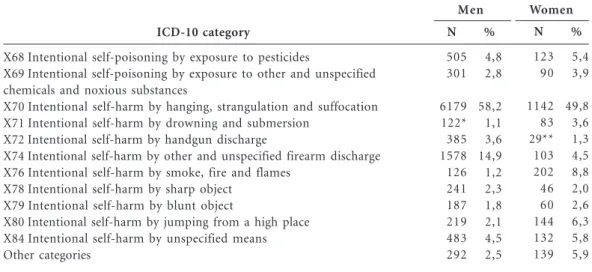
As for the methods employed, (Table 4), 56.7% of deaths by suicide that occurred between 1996 and 2007 were classified under category X70 (Intentional self-harm by hanging, choking and suffocation), 13.0% under category X74 (Inten-tional self-harm by other and unspecified fire-arm discharge) and 4.8% under X84 (Intentional self-harm by unspecified methods). These were the categories with highest occurrence.
An analysis of the method used according to sex reveals that hanging continues to be the main method employed both by men (58.2%) and women (49.8%), followed, in the case of men, by intentional self-harm by other firearm discharge (14.9%; X74) and, in the case of women, by in-tentional self-harm by smoke and fire (8.8%; X76). The third most used method by men was intoxication by ingestion of pesticides (4.8%; X68). In the case of women, the third most fre-quently used method of suicide was jumping from a high place (Table 4).
The male-to-female death ratio was 2.8 men for every woman. However, in 25% of the mu-nicipalities these numbers increase to 4 men for every woman. In a small number of locations, this ratio exceeds 6:1.
Discussion
This paper intended to provide data on cases of death by suicide among individuals aged 60 or more in the municipalities of Brazil between 1996 and 2007. In more than half of Brazilian munic-ipalities there were cases of death of elderly indi-viduals by suicide in at least one of the trienni-ums analyzed, with a special mention to the South as a whole, and to the state of Rio Grande do Sul more specifically. These data allow us to perceive the relevance of the problem for the coun-try, and the unequal epidemiological distribution in place.
Brazil is ranked 73rd in the world for the oc-currence of suicide, with rates that are consid-ered low, albeit borderline medium1,13. This fact can be related to the still precarious study about the subject14, to the subnotification that evident-ly exists, and to historical, cultural and economic aspects that lie at the base of the epidemiological profile of the country.
ú d e C o le tiv a, 17( 8) :1963-1972, 2012 FU CE SC RS RS RS RS PR RS SC RS RS RS RS RS RS RS RS RS RS RS RS RS RS CE RS PR RS RS RS SC RJ RS RS RS RS SP RS PR RS GO RS RS RS CE RS RS M S RS PI RS SP RS RS
Table 3. Suicide mortality among elderly individuals of both sexes aged sixty or above and municipalities with highest rates (05-07 triennium). Brazil, 1996-2007.
NE 9,1 -8,9 4,3 2,3 -13,6 1,8 20,0 2,9 2,3 6,1 7,2 14,1 2,1 7,4 4,7 15,3 6,3 3,6 6,3 4,5 4,1 2,4 6,6 3,1 3,4 7,9 -10,7 1,2 7,1 12,5 1,3 4,3 2,9 0,7 14,8 2,0 2,1 8,6 4,3 7,5 5,7 14,1 2,0 2,3 2,2 7,1 6,3 1,2 4,7 Municipality Tenente Portela Palmitos
Santa Vitória do Palmar Venâncio Aires Arroio do Meio Lajeado
Marechal Cândido Rondon Três Passos
São Miguel do Oeste São Sepé
São Lourenço do Sul Santa Cruz do Sul Gramado Sapiranga Santiago Camaquã Vacaria Caçapava do Sul Candelária Encruzilhada do Sul Uruguaiana São Borja Taquara Tauá Teutônia Campo Largo Canguçu Sapucaia do Sul Cachoeira do Sul Pomerode Teresópolis Bagé Pelotas Rosário do Sul Caxias do Sul Mogi Guaçu Passo Fundo Francisco Beltrão Sant’Ana do Livramento Aparecida de Goiânia
Três de Maio Agudo Venâncio Aires Aquiraz Montenegro Santiago Dourados Santa Cruz do Sul Teresina
Pelotas
Bragança Paulista Bagé
São Leopoldo
Rate 1996-98
967,4 849,6 67,3 207,4 181,5 417,2 241,0 349,9 316,1 136,3 37,5 86,6 592,9 120,5 196,4 117,1 282,3 430,8 216,7 484,9 50,8 113,0 246,1 134,8 318,0 131,9 318,2 129,9 74,2 716,5 46,7 100,9 102,3 55,5 49,8 66,3 91,4 40,1 214,0 57,2 69,0 90,2 28,0 51,5 39,1 32,2 18,9 16,5 13,9 28,6 17,4 27,3 57,9 Rate 2005-07 593,4 524,7 512,0 476,2 475,2 376,9 305,9 304,8 284,8 278,5 251,5 241,7 235,9 234,8 226,2 196,6 191,4 186,5 185,8 182,9 182,5 179,7 174,5 173,3 172,3 170,3 160,0 159,8 157,3 150,7 142,3 132,2 127,7 126,0 121,6 115,8 114,7 111,3 110,9 102,8 233,5 156,0 68,7 33,7 28,7 28,7 28,3 25,9 17,5 17,1 12,3 11,4 10,4 ∆% -0,4 -0,4 6,6 1,3 1,6 -0,1 0,3 -0,1 -0,1 1,0 5,7 1,8 -0,6 1,0 0,2 0,7 -0,3 -0,6 -0,1 -0,6 2,6 0,6 -0,3 0,3 -0,5 0,3 -0,5 0,2 1,1 -0,8 2,1 0,3 0,3 1,3 1,4 0,8 0,3 1,8 -0,5 0,8 2,4 0,7 1,5 -0,4 -0,3 -0,1 0,5 0,6 0,3 -0,4 -0,3 -0,6 -0,8
General population aged sixty or above
∆% - difference between trienniums ((tx05-07 – tx96-98)/tx96-98)*100. NE - average percentage of deaths from events with unknown intent (Y10-Y34) in the period 1996-2007. * Municipalities with 12 or more deaths in the period.
P
in
a high number of European descendants, espe-cially those located in the South and Southeast 16-18 and indigenous populations19. There are
tradi-tional epidemiological studies carried out in dif-ferent cities of Brazil that include distribution by sex, age, suicide method and other variables20-22. This material, however, deals with a broad age range, which again reiterates the scarcity of stud-ies about suicide among elderly individuals in Brazil. After the 2000’s, in general, there have been a growing number of articles about the subject, even though their focus continues to be the de-scription of suicide according to traditional epi-demiological variables.
Therefore, knowing the geographic and tem-poral distribution of deaths by suicide in Brazil-ian municipalities and attempting to correlate these data with the context where they are found is fundamental. Such knowledge would allow for a more appropriate definition of preventative actions, since tracking the entire elderly popula-tion is impracticable and not recommended due to the low number of cases. Tracking could be indicated to specific groups, based on knowledge of predisposing factors4.
The results of the men/women ratio showed a predominance of deaths among men, reaching 4:1 in 25% of municipalities, a finding that veri-fies literature data4. Szanto et al23. inform that suicide among men is two to four times more frequent than among women in adult life, reach-ing a ratio of 8-12:1 at around age 75.
Hanging, strangulation and suffocation were the predominant methods used to commit
sui-cide. The use of firearms was also frequent. The unavailability of means is considered an impor-tant factor in reducing the number of deaths, which is the case with the civil disarmament pol-icies. In that regard, preventing access to means that facilitate hanging (and similar acts) repre-sents a challenge to public health, given their im-mediate availability3.
The broad variation in suicide rates among the elderly in the two temporal extremities 1996/ 1998 and 2005/2007 – now increasing, then de-creasing - became evident through the data pre-sented to Brazilian municipalities with high rates for the phenomenon. Such richness in the sce-nario points toward the need to better know the different social determinants that exist in munic-ipalities and regions that may influence the oc-currence of suicide among the elderly in the coun-try. It must be mentioned that the temporal vari-ation studied in this article would require more in-depth temporal analysis studies, with the pur-pose of better understanding the reality of mu-nicipalities where suicide among elderly individ-uals is more frequent.
The presence of a significant number of events with unknown intent is a cause for concern, as it indicates a subnotification of deaths by suicide among the elderly. According to Laurenti et al.24, in spite of the decline in the percentage of deaths due to undefined causes in the country, (from 20% to 13%)25, Brazil is still not among coun-tries with high information quality, as data cov-erage is still incomplete and the proportion of “undefined causes” is still high. A study carried
ICD-10 category
X68 Intentional self-poisoning by exposure to pesticides
X69 Intentional self-poisoning by exposure to other and unspecified chemicals and noxious substances
X70 Intentional self-harm by hanging, strangulation and suffocation X71 Intentional self-harm by drowning and submersion
X72 Intentional self-harm by handgun discharge
X74 Intentional self-harm by other and unspecified firearm discharge X76 Intentional self-harm by smoke, fire and flames
X78 Intentional self-harm by sharp object X79 Intentional self-harm by blunt object
X80 Intentional self-harm by jumping from a high place X84 Intentional self-harm by unspecified means Other categories
N
505 301
6179 122* 385 1578 126 241 187 219 483 292
%
4,8 2,8
58,2 1,1 3,6 14,9 1,2 2,3 1,8 2,1 4,5 2,5
Table 4. Suicide mortality among individuals aged 60 or above according to ICD-10 category and sex. Brazil, 1996 to 2007.
N
123 90
1142 83 29** 103 202 46 60 144 132 139
%
5,4 3,9
49,8 3,6 1,3 4,5 8,8 2,0 2,6 6,3 5,8 5,9
Men Women
ú
d
e C
o
le
tiv
a, 17(
8)
:1963-1972,
2012
out in the European community demonstrates the barriers found by several countries of this economic block in suicide research: in spite of decreasing rates found in several countries, data validity is uncertain, recording procedures too varied, and prevention mechanisms too frail26.
Suicide is a preventable event, and several of its risk factors can be altered, such as the pres-ence of physical and mental diseases. Treating depression is a key aspect in suicide prevention. Physical exercise and changes in lifestyle also seem to be important. Improving social contact, sup-port and community integration also appear to be effective4. As it becomes recognized as a prob-lem that affects especially the eldest among the elderly, specific care can and must be taken by means of tailoring the guidelines provided by the World Health Organization27 and the Brazilian Ministry of Health28 to this group.
Collaborators
LW Pinto participated in all stages of develop-ment of this article. MCS Minayo and SG Assis participated in the stages of ideation, discussion of results and final writing. TO Pires participated in data analysis.
Acknowledgements
P
in
Schmitt R, Lang MG, Quervedo J, Colombo T. Per-fil epidemiológico do suicídio no extremo oeste do estado de Santa Catarina, Brasil. Rev Psiquiatr RS
2008; 30(2):115-123.
Macente LB, Santos EG, Zandonade E. Tentativas de suicídio e suicídio em município de cultura po-merana no interior do Estado do Espírito Santo. J
Bras Psiquiatr 2009; 58(4):238-244.
Oliveira CS, Lotufo FN. Suicídio entre povos indí-genas: um panorama estatístico brasileiro. Rev
Psi-quiatr Clin 2003; 30(1):4-10.
Lovisi GM, Santos AS, Legay L, Abelha L, Valencia E. Análise epidemiológica do suicídio no Brasil en-tre 1980 e 2006. Rev Bras Psiquiatr 2009; 31(Supl. II): 86-93.
Parente ACM, Soares RM, Araújo ARF, Cavalcante IS, Monteiro CFS. Caracterização dos casos de sui-cídio em uma capital do Nordeste Brasileiro. Rev
Bras Enferm 2007; 60(4):377-381.
Batista MN, Borges A. Suicídio: aspectos epidemio-lógicos em Limeira e adjacências no período de 1998 a 2002. Estudos de Psicologia 2005; 22(4):425-431. Szanto K, Prigerson HG, Reynolds CF. Suicide in the elderly. Clinical Neurosci Res 2001; 1(5):366-376. Laurenti R, Mello Jorge MHP, Lebrão ML, Gotlieb SLD, Almeida MF. Estatísticas Vitais: contando os nascimentos e as mortes. Rev Bras Epidemiol 2005; 8(2):108-110.
Rede Intergeracional de Informações para a Saúde (RIPSA). Indicadores e Dados Básicos IDB-2004. Bra-sília: RIPSA; 2005.
Christi P, Stone TH, Corcoran P; Williason E, Pe-dtridou E. Suicide Mortality in European Union.
Eur J Public Health 2003; 13(2):108-114.
World Health Organization (WHO). Multisite
inter-vention study on suicidal behaviours – SUPRE-MISS:
Protocol of SUPRE-MISS. Genève: WHO; 2002. Brasil. Ministério da Saúde (MS). Prevenção do Suicí-dio: manual dirigido a profissionais das equipes de saú-de mental. Brasília: MS, OPAS, Unicamp; 2006.
Artigo apresentado em 10/02/2012 Versão final apresentada em 06/03/2012 17.
18.
19.
20.
21.
22.
23.
24.
25.
26.
27.
28. References
World Health Oragnization (WHO). World Report
on Violence and Health. Genève: WHO; 2002.
World Health Organization (WHO), International Association for Suicide Prevention. Preventing
sui-cide in jails and prisons. Geneve: WHO; 2007.
Hawton K, Van Heeringer K. Suicide. The Lancet
2009; 373(9672):1372-1381.
O’Connell H, Chin AV, Cunningham C, Lawlor BA. Recent developments: Suicide in older people. BMJ
2004; 329(7471):895-899.
Conwell Y, Dubertein PR, Caine ED. Risk Factors for Suicide in Later Life. Biological Psychiatry 2002; 52(3):193-204.
Mathers CD, Fat DM, Inoue M, Rao C, Lopez AD. Counting the dead and what they died from: an assessment of the global status of cause of death data. Bulletin of WHO 2005; 83(3):371-377. Campos-Silva T, Oliveira RC, Abreu DMX. Análise da qualidade das informações sobre a mortalidade por causas externas em Minas Gerais, 1997 a 2005.
Cad Saude Colet 2010; 18(3):371-379.
Mello-Jorge MHP, Laurenti R, Lima-Costa MF, Go-tlieb SLD, Chiavenatto Filho ADP. A mortalidade de idosos no Brasil: a questão das causas mal definidas.
Epidemiol. Serv. Saúde 2008, 17(4):271-281.
Frierson RL. Suicide attempts by the old and the very old. Arch Intern Med 1991; 151(1):141-144. Johnston M, Walker M. Suicide in the Elderly Rec-ognizing the Signs. Gen Hosp Psychiatry 1996, 18(4):257-260.
Minayo MCS, Cavalcante FG. Suicide in elderly people: a literature review. Rev Saude Publica 2010; 44(4):750-757.
Chapman SJ. Fortran 90/95 for Scientists and Engi-neers. New York: McGraw-Hill Science/Engineer-ing/Math; 2003.
Minayo MCS, Pinto LW, Assis SG, Cacalcante FG; Mangas RMN. Tendência da mortalidade por sui-cídio em idosos, 1980-2006. Rev Saude Publica. No prelo 2012.
Rocha FF, Sousa KCA, Paulino N, Castro JO, Correa H. Carta aos editores: Suicídio em Belo Horizonte entre 2004 e 2006. Rev Bras Psiquiatr 2007; 29(2): 188-199.
Pires DX, Caldas ED, Recena MCP. Uso de agrotó-xicos e suicídios no Estado do Mato Grosso do Sul, Brasil. Cad Saude Publica 2005; 21(2):598-605. Vaina GN, Zenkner FM, Sakae TM, Escober BT. Prevalência de suicídio no Sul do Brasil, 2001-2005.
J Bras Psiquiatr 2008; 57(1):38-43.
1.
2.
3.
4.
5.
6.
7.
8.
9.
10.
11.
12.
13.
14.
15.