AR
TICLE
1 Departamento de Enfermagem, Universidade de Évora; Centro de Investigação em Desporto, Saúde e Desenvolvimento Humano (CIDESD-UEvora). Largo Senhor da Pobreza. 7000-811 Évora Portugal. [email protected] 2 Departamento de Enfermagem, Universidade de Évora. Évora Portugal.
Continuity of care from the perspective of users
Abstract Continuity of care, in addition to en-suring improvement of the quality of care, con-tributes to the reduction of health costs. The objec-tive of this study was to analyse the continuity of care in health units in the municipality of Évora (south of Portugal), from the perspective of users. This is across-sectional, exploratory and descrip-tive study with a quantitadescrip-tive approach, with a sample consisting of 342 users of health units. The instrument was a questionnaire adapted from En-glish and Spanish studies. The results show that elements of continuity were identified in the dif-ferent dimensions of the continuity of care - rela-tional, management, information and some items of flexible continuity. Longitudinal continuity has the lowest values in nursing care. In conclusion, what stands out positively, and in its different di-mensions, is relational continuity, in which most users recommend their family doctor and nurse to family and friends, and flexible continuity, which translates into reduced waiting times to be attend-ed by a doctor or nurse and access to care. What stands out negatively is the weak involvement of the user in care by health professionals, in the di-mensions of relational continuity.
Key words Patient care continuity, Primary Health Care, Community health services, Health
Felismina Rosa P. Mendes 1
M
end
es FRP
Introduction
In a context of uncertainty and rapid changes and, in the specific case of health, given the cur-rent pressure on costs, coordination between different healthcare providing organisations has increasing importance.
In the Portuguese health system, continuity
of care is conceived as “sequentiality, in time and
in healthcare and social security systems, of inte-grated health and social support interventions1.
Continuity of care ensures improvement in the quality of the care provided, contributes to a reduction in costs and is presented as a suit-able strategy and a policy to be followed by health services. Users are vulnerable to experiencing loss of continuity when there are changes in health or when they move between healthcare organi-sations.
The objective of this study was to analyse the continuity of care in community health units of five municipalities in the district of Évora (south of Portugal), from the perspective of users.
The National Health Service (SNS) integrates the group of official services and institutions, which depend on the Ministry of Health (MS), with the objective of ensuring access to health-care to all citizens, within the limits of financial, human and technical resources. The health sys-tem is made up by the SNS and all public organi-sations that organise activities of promotion, pre-vention and treatment in the health area and by all private organisations and all free professionals that agree with the former on the provision of all
or some of those activities2,3.
The health system is based on Primary Health Care (CSP), with this requiring to be situated within communities. It is the first level of contact with the SNS for individuals, family and commu-nity. In Portugal, the definition of the CSP issued by the Declaration of Alma-Ata (1978) is
adopt-ed, which considers it as “essential health care
based on practical, scientifically sound and socially acceptable methods and technology made univer-sally accessible to individuals and families in the community through their full participation and at a cost that the community and country can afford to maintain at every stage of their development in the spirit of self-reliance and self-determination.4
In 2008, in Portugal, CSP was recognised as the central pillar of the health system, consider-ing health centres (CS) as the first point of access of citizens to healthcare, having strengthened their role in the promotion of health and preven-tion of illness, providing care during illness and
connection to other services in the continuity of care, by reforming CSP. Other central objectives of this reform were to guarantee the access of the entire population to healthcare and the assign-ment of a family doctor to all citizens.
To formalise this in geodemographic terms, Health Centre Groups (ACES) were created, de-fining objectives and competencies for each of the units that came to form part of the health
centres5.
In each ACES, there is also a Public Health Unit (USP), which functions as a health observa-tory of the geodemographic area of the different CS’s and of a Shared Healthcare Resource Unit (URAP), which provides technical assistance ser-vices to citizens using USFs, UCSPs and UCCs, as can be seen in Figure 1.
In view of the ageing population and the sub-sequent typical profile of the elderly, a large part of which use CSP, the importance of integration and continuity of care stands out, its objective
being to ensure that users, depending on their
spe-cific situation, can access the type and intensity of care that they in fact need, at the right time and place6.
Continuity of Care
Continuity of care is a right of citizens, which takes on even greater importance when they re-quire multi-professional care/interventions
di-Figure 1. Organisation chart of community
healthcare.
Health Center Grouping
URAP
UCC UCC
Health Center
A
Health Center
B
Health Center
C
USP
USF and/ or UCSP
USF and/ or UCSP
e C
ole
tiv
a,
22(3):843-855,
2017
rected at chronic or complex situations of which they are carriers.
Continuity of care is believed to exist when it is provided in a complementary manner within a suitable period. Continuity refers to the imple-mentation of care by different providers, in a
co-herent, logical and timely manner7.
The complexity of current health problems and efficient resource use require a multidisci-plinary and inter-institutional approach, due to which the coordination between hospital health-care and CSP is crucial, thus enabling global in-tervention at the three levels of prevention. This coordination requires multi and interdisciplinary teamwork. In order for coordination to exist be-tween the different levels of care, sufficient
com-munication between professionals is essential8.
Continuity of care begins at the service where the person is attended, which results in the need to establish contacts and put into operation the early preparation of the discharge. In this con-text, the family is a fundamental link, which is why it is necessary to reflect on the information provided and way of doing it, given the state of
vulnerability of the family9.
There are several benefits associated with continuity of care, namely a greater possibility of integration of the physical, psychological, social and economic dimensions; improvement of the relationship between users and care providers; reduction in the improper use of health services and an eventual reduction in costs. On the other hand, user satisfaction increases with the service, as well as that of the healthcare professional with
his or her work10. The fragmentation of care, in
turn, can result in treatment guidelines that are confusing for the user, with a strong probability of errors and duplications, inadequate follow-up, as well as a lack of preparation/information of the user and informal care providers. It is es-sential to reduce the asymmetry of information between users and healthcare providers, with the provision of more information to users of health
services11.
The sharing of clinical information can be an important means of supporting the provision and continuity of care, due to the possibility of exchanging information between professions from different levels of care, namely CSP and hospital care. Another determining factor will be the user’s participation. Better informed us-ers will also be usus-ers with a greater capacity for
participation12.
Information sharing between health services in Portugal is either non-existent or scarce. The
development of a model for information shar-ing and coordination of nursshar-ing information systems between hospital and CSP will allow for significant improvement, through continuity of care, of access to and the quality of nursing care
provided13.
A study14 performed with the objective of
analysing the criteria used for admission, rout-ing and continuity of care to users at centres for psycho-social attention led to the conclusion that continuity of care was mentioned as a problem, possibly due to the difficulty of monitoring users in the community. Continuity of care at home
is an innovative way of providing care. A study9
was performed for the purpose of understanding how to ensure continuity of care at home and the role of the nurse in building this continuity.
Another study8 sought to learn about
strat-egies of partnership/collaboration between an in-patient service and CSP, with a view to im-proving the quality of care provided at a low-er cost, concluding that continuity of care to children with oncological illness is practically non-existent. According to the author, coordina-tion between services is very weak, lacks coher-ence and is highly unsystematic.
In order to develop strategies for continuity of care, health organisations must establish dif-ferent organisational mechanisms, including: training, planning and decision making at the inter-institutional level through information sys-tems, interdisciplinary clinical evaluation,
proto-cols, follow-up and professional feedback15.
A study conducted between 2001 and 200413,
for the purpose of studying relevant information
for purposes of continuity of nursing care between different care contexts (Hospital and Health
Cen-tre), concluded that this information system was
crucial in coordination between the different lev-els of care, contributing to communication and continuity of care. Relevant domains were
iden-tified for a specific informational architecture for
management of SIEs; namely:
1. The structure of the model for sharing nursing information;
2. Information sharing strategies;
3. Protection and security in data processing; 4. Access to nursing information;
5. Data/information components to be inte-grated in the information sharing model.
Another study16 mentions that users refer
M
end
es FRP
diabetes, they might need an urgent consulta-tion, or might want to speak with their family doctor or nurse to obtain advice); flexible con-tinuity (which characterises the degree in which clinics manage to respond in the face of changes to the needs of users over time) and manage-ment continuity between levels (concerns with cross-boundary continuity, where the degree of coherence and coordination of care between different contexts of care and between different clinics is evaluated).
Yet another study17 identifies relational
con-tinuity, longitudinal, personal and continuous continuity as domains of continuity of care, which involve familiarity of one person with an-other in the context of a therapeutic relationship, with commitment and trust under which doctor and patient contribute to its creation and main-tenance; and the management continuity, involv-ing coordination and teamwork between carers and across organisational borders.
Access and relationship are important for continuity of care to users and their carers in CSP. Users recognise the value of continuity of care, which is more important for them in com-parison with other aspects, such as quick access or a wide range of services. Continuity of care
was considered in three main aspects18:
Information Continuity - where information, based on previous events and personal circum-stances, is used to ensure continuity of care;
Management Continuity - where there is a consistent approach for managing the health-care of a user, responding to his or her changing needs;
Relationship (also referred to as interperson-al) Continuity - where there is a continuous ther-apeutic relationship between a user and one or more care providers.
On analysing the valuation of continuity of care of users and identifying elements of (dis) continuity based on their experiences in health-care services in Catalonia, three types of assis-tance-related continuity were identified, which are related to each other: of Relationship, under-stood as the user’s perception of the relationship established over time with one or more caregiv-ers; of Information, perceived as the user’s per-ception of the availability, use, interpretation of information on preceding events to provide care suited to current circumstances; of Management, as the user’s perception about the manner in which he or she receives care from different ser-vices, in a coordinated and complementary
man-ner, without duplication19.
Each dimension of continuity in providing care refers to an important body of knowledge about the organisation and provision of health care, as a result of which it becomes interesting to learn the perceptions of users about the continui-ty of care. The different dimensions of continuicontinui-ty of care that were analysed in Chart 1.
In this study, it was decided to study conti-nuity of care from the perspective of users, firstly because it has not been well studied, specifical-ly among users under different types of
condi-tions20-22 and secondly, because there are
differ-ences between the perspective of users and
profes-sionals and policies in its perception23. For users,
continuity is usually related to the doctor-patient relationship, with satisfaction, with the quality
of care and access to it24. Several dimensions of
continuity, such as interpersonal communication and specifically, trust and choice, are strongly val-ued by users. The importance of analysing and explaining the differences encountered between different users with different problems (for ex-ample those with and without chronic illness), and understanding whether they view continuity in the same way, through the use of studies, has
been noted by several authors25.
For health professionals and policies, conti-nuity is essentially valued based on its impacts on the greater or lesser use of health services (in-pa-tient or out-pa(in-pa-tient), in the limitation of access/ use of specialised care and in the reorganisation of health services. Also in this context, the au-thors suggest the need to perform more studies that support the relationship and the dynamics that are established between continuity of care
and the levels of use of health services23.
Methodology
A cross-sectional, exploratory and descriptive study with a quantitative approach. The research instrument was based on a conceptual as well as objective framework, as well as two question-naire models on continuity of care, which were consulted and for which authorisation for
ad-aptation was obtained16,19. The questionnaire is
divided into six different parts, the first of which collects sociodemographic data, while the other five correspond to types of continuity (Relation-al, Information, Management, Longitudinal and Flexible Continuity).
e C
ole
tiv
a,
22(3):843-855,
2017
performed the necessary adjustments.
The sample was made up by all users ap-proaching the Community Health Units of 5 municipalities of the district of Évora (Alentejo Region - south of Portugal), in the month of May 2014, aged 18 years or older, whose cognitive ca-pacities were maintained and who agreed to par-ticipate in the study (inclusion criteria), with a total of 342 users. This sample is not representa-tive of the population.
The data was then processed statistically,
us-ing the Statistical Package for the Social Sciences
(SPSS®) 18.0. Using the Kolmogorov-Smirnov
test, it was observed that the data did not follow
normal distribution, as it presented p values ≤
0.05, though there is homogeneity in the sample. In order to test the significance of independent variables that can influence dependent variables, the One-way ANOVA statistics test was used. On
calculating the Cronbach’s Alpha of the
dimen-sions analysed, it was seen to vary between 0.768 and 0.979.
All ethical procedures were complied with (informed consent, confidentiality and anonym-ity), based on the Declaration of Helsinki on Ethical Principles in Research Involving Humans, and the Opinion of the Health Ethics Committee of ARSA no. 4/2012/CES was obtained.
Results
342 users of health units of the district of Évora, with ages from 19 to 101 years, responded to the questionnaire. Median age was 48.25 years, with a standard deviation of 17.348. 20.5% of the pop-ulation is aged 65 years or more. With regard to gender, 29.8% are men and 69.6% women. The majority of users surveyed have more than 9
years of schooling (59%), and only 3.2% do not have any schooling. The family units are mainly made up of 2 people (31%). Single-person and larger (5 or more people) families represent the lowest percentages, 11.4% and 4.9% respectively.
Relating to health data, the analysis shows that almost all users have a family doctor (97.1%).
The data indicate that 34.5% of the users suf-fer from chronic illnesses. Among these, diabetes (35.6%) and high blood pressure (33.9%) stand out, while other illnesses show percentages that are much lower. Interestingly, 8.8% of these users mentioned suffering from more than one chron-ic pathology simultaneously.
The analysis performed reveals that there are statistically significant differences between bio-logical and social variables, which characterise the users surveyed and some dimensions of the different types of continuity analysed, as will be seen below in the presentation of the results.
The results obtained relating to the different types of continuity allow us to observe that in
terms of relational continuity, and with regard to
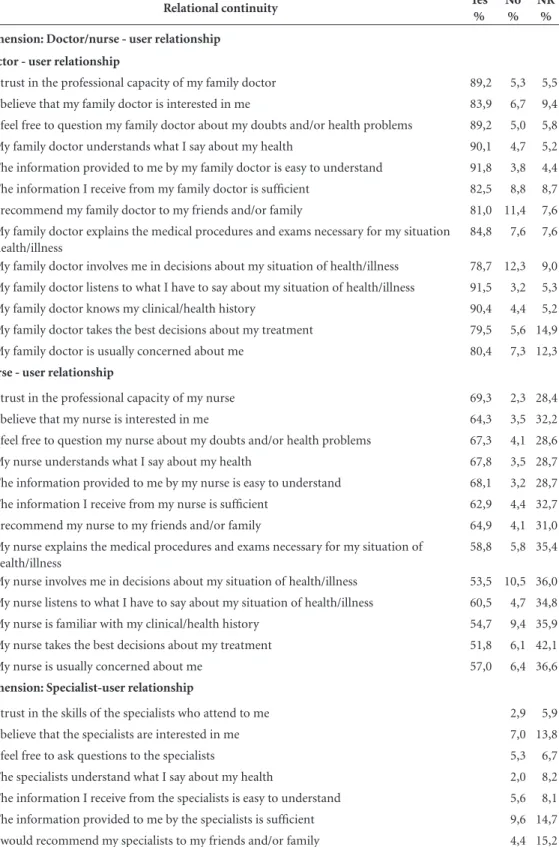
the family doctor - user relationship, users have a positive view of the variables that make up this dimension, with percentages above 80%, except for the involvement of the user in decisions on the situation of health/illness and the fact that the family doctor takes the most important deci-sions on the user’s treatment (Table 1).
Concerning the nurse-user relationship, the values of all the variables of this dimension are clearly lower than those observed relating to the doctor-user relationship, although they are above 50%, as can be seen in Table 1. In this dimension, as with the doctor-user relationship, with regard to nurses as well, the lowest values are reported in the involvement of users in decisions on their sit-uation of health/illness (53.5%) and in decision making on the best treatment (51.8%).
In relation to the specialist doctor - user re-lationship, the analysis of the data indicates that the values obtained are close to the ones found in the doctor-user relationship, with a highly posi-tive perception of this relationship. The variable showing the lowest values, but still above 75%, concerns information received from specialists.
Based on analysis of the data, what stands out is the fact that the highest values of the dif-ferent variables of the nurse-user relationship do not even approach the lowest values obtained for the specialist doctor - user relationships.
The use of the One-Way ANOVA test allowed
us to observe, in relational continuity, that there
are statistically significant differences between
Relationship Continuity
Dimension: Doctor/nurse - user relationship Dimension: Specialist-user relationship
Information Continuity
Dimension: Transfer of clinical information
Management Continuity
Dimension: Coherence/Consistency of care Dimension: Accessibility between different levels
Longitudinal Continuity Flexible Continuity
Chart 1. Synthesis of the Dimensions of Continuity of
M
end
es FRP
Table 1. Perception of users with regard to relational continuity.
Relational continuity Yes
% No
% NR
%
Dimension: Doctor/nurse - user relationship
Doctor - user relationship
I trust in the professional capacity of my family doctor 89,2 5,3 5,5
I believe that my family doctor is interested in me 83,9 6,7 9,4
I feel free to question my family doctor about my doubts and/or health problems 89,2 5,0 5,8
My family doctor understands what I say about my health 90,1 4,7 5,2
The information provided to me by my family doctor is easy to understand 91,8 3,8 4,4
The information I receive from my family doctor is sufficient 82,5 8,8 8,7
I recommend my family doctor to my friends and/or family 81,0 11,4 7,6
My family doctor explains the medical procedures and exams necessary for my situation of health/illness
84,8 7,6 7,6
My family doctor involves me in decisions about my situation of health/illness 78,7 12,3 9,0
My family doctor listens to what I have to say about my situation of health/illness 91,5 3,2 5,3
My family doctor knows my clinical/health history 90,4 4,4 5,2
My family doctor takes the best decisions about my treatment 79,5 5,6 14,9
My family doctor is usually concerned about me 80,4 7,3 12,3
Nurse - user relationship
I trust in the professional capacity of my nurse 69,3 2,3 28,4
I believe that my nurse is interested in me 64,3 3,5 32,2
I feel free to question my nurse about my doubts and/or health problems 67,3 4,1 28,6
My nurse understands what I say about my health 67,8 3,5 28,7
The information provided to me by my nurse is easy to understand 68,1 3,2 28,7
The information I receive from my nurse is sufficient 62,9 4,4 32,7
I recommend my nurse to my friends and/or family 64,9 4,1 31,0
My nurse explains the medical procedures and exams necessary for my situation of health/illness
58,8 5,8 35,4
My nurse involves me in decisions about my situation of health/illness 53,5 10,5 36,0
My nurse listens to what I have to say about my situation of health/illness 60,5 4,7 34,8
My nurse is familiar with my clinical/health history 54,7 9,4 35,9
My nurse takes the best decisions about my treatment 51,8 6,1 42,1
My nurse is usually concerned about me 57,0 6,4 36,6
Dimension: Specialist-user relationship
I trust in the skills of the specialists who attend to me 2,9 5,9
I believe that the specialists are interested in me 7,0 13,8
I feel free to ask questions to the specialists 5,3 6,7
The specialists understand what I say about my health 2,0 8,2
The information I receive from the specialists is easy to understand 5,6 8,1
The information provided to me by the specialists is sufficient 9,6 14,7
I would recommend my specialists to my friends and/or family 4,4 15,2
e C
ole
tiv
a,
22(3):843-855,
2017
the family doctor - user relationship (p = 0.023) and the nurse-user relationship (p = 0.002) and the presence or absence of chronic illnesses, and users without chronic illness viewed relational continuity most positively. Also observed were statistically significant differences between the nurse-user relationship and age (p = 0.015) and academic qualifications (p = 0.001), wherein younger users and holders of greater academic qualifications where those who contributed the most to relational continuity.
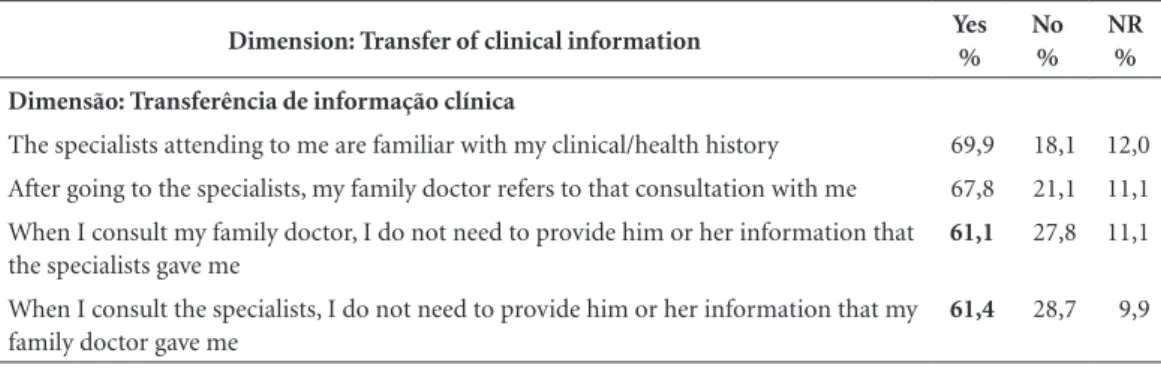
The analysis of data relating to continuity of
information reveals, with regard to the transfer of clinical information, that the majority of users believe that the specialists have prior knowledge of their clinical history and do not require them to provide the information that the family doctor provided them, as can be seen in Table 2.
In the contrary sense, it is also observed that the majority of the survey respondents mention that when they consult their family doctor, they do not need to provide him or her with informa-tion that the specialists provided them and that after being attended to by the specialists, their family doctor refers to that consultation with them.
Using the One-Way ANOVA test, it was
ob-served that there are statistically significant
dif-ferences between information continuityand
ac-ademic qualifications (p = 0.040), as the survey respondents with the highest academic qualifica-tions were those who viewed information conti-nuity most positively.
In terms ofmanagement continuity, some
val-ues below 50% were seen in the two dimensions analysed. In the first dimension - coherence/con-sistency of care - the variables with the lowest val-ues point towards communication between the family doctor and the specialists (negative sense)
and towards non-repetition of exams (positive sense in terms of management of resources). Re-lating to the values presented by the remaining variables of this dimension, the perception of users is on the whole positive on the coherence and consistency of care received, as can be seen in Table 3.
Accessibility between different levels presents the lowest values of the different dimensions an-alysed. Half of the users indicate that when spe-cialists direct them to family doctors, it is they themselves (users) who have to deal with all the paperwork for obtaining a consultation at the CS. The values obtained in the different variables of this dimension (below 50%) reveal that ac-cessibility between the different levels of care is viewed negatively by the users.
Using the One-Way ANOVA test, it was
ob-served that, concerningmanagement continuity,
in the coherence/consistency dimension of care, there were statistically significant differences with regard to age (p = 0.005) and whether or not the user was suffering from a chronic illness (p = 0.044). The oldest survey respondents and those without chronic illness had a positive opin-ion about the coherence/consistency of care.
In the dimension of accessibility between dif-ferent levels, it is observed that there are statisti-cally significant differences with age (p = 0.005), academic qualifications (p = 0.007) and whether or not the user was suffering from chronic illness (p = 0.014). Similarly, the oldest survey respon-dents, with the most academic qualifications and without chronic illness had the most impact in the favourable assessment of accessibility be-tween the different levels.
The analysis of data on longitudinal
continu-ity revealed the user’s follow-up over time with
the observation that, in the previous 12 months,
Table 2. Perception of users with regard to continuity of information.
Dimension: Transfer of clinical information Yes
% No
% NR
%
Dimensão: Transferência de informação clínica
The specialists attending to me are familiar with my clinical/health history 69,9 18,1 12,0
After going to the specialists, my family doctor refers to that consultation with me 67,8 21,1 11,1 When I consult my family doctor, I do not need to provide him or her information that
the specialists gave me
61,1 27,8 11,1
When I consult the specialists, I do not need to provide him or her information that my family doctor gave me
61,4 28,7 9,9
M
end
es FRP
the majority spoke up to 3 times with the fam-ily doctor about their clinical/health situation and performed supplementary diagnostic exams up to 2 times. The majority of users approached their family doctor up to 3 times for a consulta-tion, in the same time period.
In relation to follow-up by the nurse, in the previous 12 months, a high percentage of no responses was noted, varying between 41% and 47%. Only 18.1% mentioned that they had al-ready spoken 4 or more times with the nurse about their clinical/health situation. On the other hand, 21.9% approached the nurse only once in order to consult him or her.
The data relating to flexible continuity express
the capacity for response in the face of users’ needs over time, by different professionals. In terms of the doctor’s capacity for response, the majority of users mention that when they need to be urgently attended, they take a maximum of 3 days to be able to speak with the family doctor. It is noted, howev-er, that 44.2% manage this in less than 1 day. The majority of users feel that it is easy to manage to speak with the family doctor about their situation of health/illness when they need to.
While analysing the nurse’s capacity for re-sponse, the results obtained reveal that 44.7%
of users wait for less than 1 day to speak to this professional, in an emergency situation. Howev-er, 8.8% may wait 1 to 7 days to manage to speak with a nurse, in an emergency situation. Although the majority of users (59.4%) mention that it is easy to manage to speak to the nurse about their clinical/health situation, this percentage is clearly lower than the one given for the same situation with the doctor.
Discussion
In order to better frame the results obtained, it becomes necessary to refer to the reform of CSP in Portugal, which took place in 2005, due to the relationship this could have with the degree of satisfaction and with accessibility, variables that are inseparable from the evaluation of conti-nuity of care from the perspective of users. The top-priority objectives of this reform were: to create conditions for the provision of more and better healthcare and the increase in
accessibili-ty and proximiaccessibili-ty to citizens26. The results of the
analysis performed, by the Consulting Group for the Reform of CSP (GCRCSP), present the results of the reform as positive, mentioning an
Tabela 3. Percepção dos utentes relativamente à continuidade da gestão.
Management continuity Yes
% No
% NR
% Dimension: Coherence/consistency of care
My family doctor is generally in agreement with the specialists 68,4 8,8 22,8
My family doctor and my specialists communicate with each other about my clinical/health situation
33,3 39,2 27,5
The specialists are generally in agreement with the instructions of my family doctor
54,4 15,5 30,1
The specialists do not repeat exams that I have already performed with my family doctor
43,0 38,9 18,1
The specialists send me to my family doctor for follow-up consultations 63,7 21,6 14,7
The specialists provide me with the first prescription of the treatment prescribed for me
71,6 12,0 16,4
I feel that the attention I receive from my family doctor and the specialists is coordinated
61,4 18,1 20,5
Dimension: Accessibility between different levels
Visits to the specialists are scheduled from the Health Centre 45,0 45,0 10,0
As long as my family doctor refers me to the specialists, I wait less for speciality consultations
38,6 36,5 24,9
When the specialists refer me to my family doctor, I have to deal with all the paperwork for obtaining a consultation at the Health Centre.
50,0 31,3 18,7
As long as the specialists refer me to my family doctor, I wait less for the consultation 35,4 40,4 24,2
e C
ole
tiv
a,
22(3):843-855,
2017
increase in access and satisfaction, of
profession-als as well as users27,28. The USFs were mentioned
as their most visible face, due to the possibility of extension of public coverage.
Continuity of care is related to the increase in user satisfaction, and there is evidence of its association with the aspects of use of healthcare. Several studies have shown that accessibility to healthcare in Portugal has improved significantly in recent years, together with user satisfaction in
relation to care received29,30.
With regard to the relations with the quali-ty of technical assistance and with health results,
the studies on continuity are not consensual31.
In terms of relational continuity, users
posi-tively value the relationship with the profession-als attending to them - medical, nursing and spe-cialist. It is felt that health professionals are inter-ested in and concerned about them, and they feel free to clear their doubts and feel that they have been heard.
Statistically significant differences are ob-served between the doctor-user and nurse-us-er relationship, and the presence or absence of chronic illness. Users that do not have chronic ill-nesses are the ones who maintained a greater re-lationship with these professionals, which is not
in agreement with other studies32 which mention
that for users with chronic illness, relational con-tinuity is most important.
The survey respondents show clear trust in the health professionals who attend to them. The lowest values, which are still rather high, concern the involvement of users in decisions on their sit-uation of health/illness and relating to decision making on the best treatment. The principle of autonomy is also seen to be respected, this being, in the doctor-user relationship, extremely rele-vant, to the extent that medical procedures are discussed and only carried out if the user is in fact capable and aware to accept such procedures and attitudes.
In the area of relational continuity, what also stands out is the low values obtained in the nurse-user relationship. If the organisation of the CS’s by a family doctor ensures continuity in the doctor/user relationship, which reflects the immediate recognition by the user, this does not take place with the nurse. The fact of the absence of a model nursing professional who ensures care to individuals and families through a relationship maintained over time, seems to make it harder to win over trust and simultaneously justifies the values obtained. Even so, users recognise that nurses are concerned with them and that they are
familiar with their clinical and health history, es-tablishing a relationship of trust to question and clarify doubts about their problems.
This fact leads to reflection on the impor-tance of implementation of the figure of the Family Nurse in the current context of CSP. As with the family doctor, what is desired is that this
person be the model qualified support
profession-al who, in functionprofession-al complementarity and from a perspective of intervention in a network, responds to family needs in exercising family functions33. In
fact, the nurse, particularly in CSP, plays a leading
role, to the extent that the thrust and provision of
services are moving increasingly from the hospital to the home, from curative to preventive, from in-stitutions to communities, and nurses are increas-ingly in the centre of the vortex of healthcare – the glue that brings continuity to care34.
Continuity of care inevitably entails work-ing in partnership, with each person takwork-ing on responsibility for his or her health and everyone taking on responsibility for the health each one,
wherein communication of information between
all involved is the common thread in this rela-tionship.
In this study, this relationship is clearly visi-ble. The channels of communication between the different professionals are seen as open, as the us-ers mention that the specialists have prior knowl-edge of their clinical history, while the result of consultations with the specialists also becomes known to the family doctor, without the user needing to be the transmitter of this information.
This fact is borne out in other studies35, which
mention that continuity of care must have open and effective communication between the two areas of activity as an essential condition. The value of continuity for users appears to be asso-ciated with a sense of being cared for, of being understood and the trust placed in
profession-als24. This aspect becomes more relevant when
it relates to the transition of the user from the hospital environment to the home. The way in which the entire process develops influences the continuity or lack of it in the care provided. The planning of the discharge is a determining fac-tor in the patient’s transition, from the hospital
to the home, and guarantees continuity of care36.
It has become increasingly clear that, although continuity is a (high) priority for many users, its importance varies for different groups of users,
with different types of health problems24.
M
end
es FRP
system37, which is once again seen in the results of
our study on establishing open communication between specialists and the family doctor in care of the user and the perception of users about the coordination between them, on considering that the attention received from the family doctor and the specialist is coordinated.
The statistically significant differences
be-tween information continuityand academic
qual-ifications of the survey respondents, reveal that those possessing higher academic qualifications have greater perception in terms of communi-cation of information. Higher literacy levels are
associated with greater literacy levels in health38.
In relation to management continuity
be-tween the family doctor and the specialist, it is observed that the majority of users mentioned having to repeat the exams that had already been performed with their family doctor. This aspect may reveal a possible element of discontinuity, potentially problematic for users with complex pathologies and with co-morbidities in which
a multidisciplinary intervention is required39
leading to an unnecessary duplication of exams, medical errors and inconsistent treatments.
Still in management continuity, in the di-mension of accessibility between different levels of care, it is observed that there are statistically significant differences with age and academic qualifications. The elderly and those with higher academic qualifications are those that perceive this dimension of continuity most positively.
In the context of the therapeutic relationship
over time, the follow up performed on the user by the doctor, or by the nurse, imply that it does not take place only at times of scheduled consul-tation, but that there is a capacity for response of professionals to sporadic requests. This accessi-bility to services, as an integrating part of flexible continuity, is also a dimension of the quality of care, visible in the results presented which entail a reduced wait time, for medical consultations or nursing.
Conclusion
Continuity of care covers a set of dimensions conducive to the improvement of healthcare pro-vided to the public and their subsequent satisfac-tion with the care received.
In this study, we identified elements of con-tinuity at the level of different dimensions of the continuity of care – relational, information, man-agement, longitudinal and flexible continuity.
Based on the perception of users, it is con-cluded that there are lacunas at the level of rela-tional continuity, namely in terms of the involve-ment of users in decisions that relate to their health, a requirement given in the Declaration of Alma-Ata (1978) which called for care to be placed within the reach of all individuals and families of the community, by means of their full participation.
Also in terms of relational continuity, the fact that the users express satisfaction with the care received is noteworthy, as revealed when they rec-ommend their family doctor and nurse to family members and friends.
The continuity of management, in spite of elements of discontinuity that were found, with respect to the coherence/consistency of care, the results reveal that family doctors are more often in agreement with the specialists than the other way round. Also to be highlighted are the lacunas indicated at the level of transmission of informa-tion between the family doctor and the specialists about the user’s clinical/health situation and the repetition of exams pointed out when they con-sult with the specialist. Also, accessibility between the different levels is not facilitated, namely with respect to the waiting time for speciality consul-tations, or those with the family doctor.
The improvement of accessibility, efficiency, quality and continuity of care and, subsequently, the satisfaction of professionals as well as users, was one of the aims of the reform of Primary Health Care. The health centres represent the first access of users to healthcare, assuming the responsibility for health promoting and disease prevention activities, provision of care during ill-ness and promotion of continuity of care.
e C
ole
tiv
a,
22(3):843-855,
2017
In spite of wariness that exists about percep-tions of users in evaluating continuity of care, it is felt that listening to the perceptions of users is giving a voice to (encouraging) citizens in health and social issues.
Collaborations
M
end
es FRP
16. Guilliford M, Naithani S, Morgan M. Continuity of care in type 2 diabetes: patients’, professionals’ and carers’ experiences and health outcomes. Report for the National Co-ordinating Centre for NHS Service Delivery and Organisation R&D (NCCSDO) [serial on the In-ternet] 2006 April [cited 2013 jan 27]; 1(1):[about 183 p.]. Available from: http://www.nets.nihr.ac.uk/__data/ assets/pdf_file/0003/81264/ES-08-1209-014.pdf 17. Hill AP, Freeman GK. Promoting continuity of care in
general practice. RCGP Policy Paper [serial on the In-ternet] 2011 marc [cited 2013 Jan 17]; 1(1):[about 42 p.]. Available from: http://www.drsharmaspractice.nhs. uk/files/2012/03/RCGP-Full-Report-Report- Continu-ity-of-Care.pdf
18. Baker R, Freeman G, Low J, Boulton M, Windridge K, Tarrant C, Turner D, Hutton E, Bryan S. The access/ relationship trade off: how important is continuity of primary care to patients and their carers? Continuity of care - Briefin Paper [serial on the internet] 2006 sept [cited 2013 Jan 07]; 1(1):[about 6 p.]. Available from: http://www.hpm.org/Downloads/Bellagio/Articles/ Continuity/13b-13-briefing-paper.pdf
19. Hernández MBA, Lorenzo IV, Pérez IS, Martínez DH, Lassaleta JC, López JRL, Mercadé MF, Figuera LC, Na-varrete MLV. La continuidad asistencial entre niveles percibida por usuarios del sistema de salud en Cata-luña. Rev Esp Salud Pública 2010; 84(4):371-387. 20. Gulliford M, Naithani S, Morgan M. What is
‘conti-nuity of care’? Jounal of Health Services Reearch Policy 2006; 11(4):248-250.
21. Gulliford MC, Naithani S, Morgan M. Measuring con-tinuity of care in diabetes mellitus: an experience-based measure. Annals of Family Medicine [serial on the In-ternet] 2006 Nov [cited 2013 jan 07]; 4(6):548-555. Available from: http://www.ncbi.nlm.nih.gov/pmc/ articles/PMC1687166/
22. King M, Jones L, Richardson A, Murad S, Irving A, Aslett H, Ramsay A, Coelho H, Andreou P, Tookman A, Mason C, Nazareth I. The relationship between patients’ experiences of continuity of cancer care and health outcomes: a mixed methods study. Br J Cancer [serial on the Internet] 2008 Feb [cited 2013 Jan 07]; 98(3):529-536. Available from: http://www.ncbi.nlm. nih.gov/pmc/articles/PMC2243159/
23. Hansen AH, Halvorsen PA, Aaraas IJ, Førde OH. Conti-nuity of GP care is related to reduced specialist health-care use a cross-sectional survey.Br J Gen Pract 2013; 63(612):482-489.
24. Salisbury C, Sampson F, Ridd M, Montgomery AA. How should continuity of care in primary health care be assessed? Br J Gen Pract [serial on the Internet] 2009 Apr [cited 2014 jan 14]; e134- e141. Available from: http://www.ncbi.nlm.nih.gov/pmc/articles/PMC 2662124/
25. Adler R, Vasiliadis A, Bickell N. The relationship be-tween continuity and patient satisfaction: a systematic review. Fam Pract 2010; 27(2):171-178.
26. Pisco L. A Reforma dos Cuidados de Saúde Primários. Cadernos de economia [periódico na Internet]. 2007 [acessado 2013 Jul 10]; 80:60-66. http://www.portalda- saude.pt/NR/rdonlyres/9A05F533-B7AE-4256-9F80-7FDD3E7C4FC7/0/CE80Luis_Pisco.pdf
References
1. Portugal. Decreto-Lei n.º 101 de 6 de junho de 2006. Cria a Rede Nacional de Cuidados Continuados Inte-grados, no âmbito dos Ministérios da Saúde e do Tra-balho e da Solidariedade Social. Diário da República 2006; 6 jun.
2. Portugal. Lei nº 48 de 24 de agosto de 1990. Lei da Bases da Saúde. Diário da República 1990; 24 ago.
3. Portugal. Lei n.º 27 de 8 de novembro de 2002. Aprova o novo regime jurídico da gestão hospitalar e procede à primeira alteração à Lei n.º 48/90, de 24 de Agosto. Diário da República 2002; 8 nov.
4. Declaração de Alma-Ata. In: Conferência Internacional sobre Cuidados Primários de Saúde; 1978; Alma Ata, Cazaquistão [acessado 2015 nov 29]. Disponível em: http://cmdss2011.org/site/wp-content/uploads /2011 /07/Declara%C3%A7%C3%A3o-Alma-Ata.pdf 5. Portugal. Decreto-Lei nº 28 de 22 de fevereiro de 2008.
Cria os agrupamentos de centros de saúde do Serviço Nacional de Saúde (ACES). Diário da República 2008; 22 fev.
6. Neves ICD. Integração e continuidade de cuidados [dis-sertação]. Aveiro: Universidade de Aveiro; 2011. 7. Duarte S. O papel do enfermeiro em contexto dos
cui-dados domiciliários: revisão sistemática da literatura, Revista Investigação em Enfermagem 2007; 16:11-23. 8. Ferreira O. Continuidade de cuidados: uma prática em
parceria, estratégias de parceria entre o centro de referên-cia em oncologia pediátrica do Norte - IPO Porto – e os cuidados de saúde primários – ARS Norte [dissertação]. Porto: ICBAS; 2007.
9. Duarte SFC. Continuidade em cuidados domiciliários: o papel do enfermeiro [tese]. Lisboa: ESEL; 2010. 10. Cunha EM, Giovanella L.
Longitudinalidade/continui-dade do cuidado: identificando dimensões e variáveis para a avaliação da atenção primária no contexto do sistema público de saúde brasileiro. Cien. Saude Colet 2011; 16(Supl. 1):1029-1042.
11. Dias A, Queirós A. Integração e Continuidade de Cuida-dos. Plano Nacional de Saúde 2011-2016. Lisboa: Missão para os Cuidados de Saúde Primários; 2010.
12. World Health Organization Europe (WHO). European Ministerial Conference on Health Systems: Health Sys-tems, health and wealth. Tallin: WHO; 2008.
13. Sousa PAF, Frade MHLBC, Mendonça DMMV. Um modelo de organização e partilha de informação de enfermagem entre hospital e centro de saúde: estudo delphi. Acta Paul Enferm 2005; 18(4):368-381. 14. Cavalcanti MT, Dahl CM, Carvalho MCA, Valencia E.
Critérios de admissão e continuidade de cuidados em centros de atenção psicossocial, Rio de Janeiro, RJ. Rev Saúde Pública 2009; 43(Supl. 1):23-28.
e C
ole
tiv
a,
22(3):843-855,
2017
27. Grupo Consultivo para a Reforma dos Cuidados de Saúde Primários (GCRCSP). Reforma dos cuidados de Saúde Primários – Um acontecimento extraordinário. 2009. Disponível em: http://www.portaldasaude.pt/ NR/rdonlyres/070DDE85-32AD-4317-B174-6D2ED-2C173F9/0/2REL_Fev09_formatado_Final.pdf 28. Miguel L, Sá A. Cuidados de Saúde Primários em
2011-2016: reforçar, expandir. Contribuição para o Plano Nacional de Saúde 2011-2016. 2010: [cerca de 30 p.]. Disponível em: http://www.opss.pt/sites/opss.pt/files/ CSP1.pdf
29. Mendes FM, Mantovani MF, Gemito ML, Lopes MJ. A satisfação dos utentes com os cuidados de saúde primá-rios. Revista Enfermagem Referência [periódico na In-ternet] 2013 mar [acessado 2014 Jul 21]; III(9):17 - 25. Disponível em: http://www.scielo. mec.pt/scielo.php?s-cript=sci_arttext&pid=S0874-02832013000100002 &lng = pt
30. Simões J, coordenador. Trinta anos do Serviço Nacional de Saúde. Um percurso comentado. Lisboa: Edição Gul-benkian/APES; 2010.
31. Saultz JW, Lochner J. Interpersonal continuity of care and care outcomes: a critical review.Ann Fam Med [se-rial on the Internet] 2005 Mar-Apr [cited 2014 Jan 14]; 3(2):159-166. Available from: http://www.ncbi.nlm. nih.gov/pmc/articles/PMC1466859/
32. Lin IP, Wu SC, Huang ST. Continuity of Care and Avoidable Hospitalizations for Chronic Obstructive Pulmonary Disease (COPD); J Am Board Fam Med 2015; 28(2):222-230.
33. Ministério da Saúde. Grupo Técnico para o Desenvol-vimento dos Cuidados de Saúde Primários - Papel do enfermeiro de saúde familiar nos CSP pressupostos para a sua implementação. (Documento de trabalho - versão de 2012.09.30). [Internet] 2012 [cited 2015 Feb 22]; 1(1):[about 5 p.] Available from: http://www. acss.min-saude.pt/Portals/0/22-papeldoenfermeirode-saudefamiliarnoscsp.pdf
34. Conselho Internacional dos Enfermeiros (ICN). Servir a comunidade e garantir qualidade: os enfermeiros na vanguarda dos cuidados de saúde primários. Dia Inter-nacional do Enfermeiro. Genebra: ICN; 2008. 35. Faustino AM, Moreira AM, Martinho C.
Hospitaliza-ção do idoso: uma abordagem focalizada nos aspectos preventivos. Servir 2002; 50(5):236-240.
36. Almeida AC. Transição do doente dependente para a família. Revista Sinais Vitais 2005; 62:26-31.
37. Bilro MES. Articulação de cuidados. In Bilro MES, Cruz AG, organizadores. Enfermagem Oncológica. Co-imbra: Formassau; 2004. p. 195-200.
38. Sorensen K et al. Health literacy and public health: A systematic review and integration of definitions and models. BMC Public Health [serial on the Internet] 2012 March [cited 2014 Jun 02]. Available from: http:// www.biomedcentral.com/1471-2458/12/80
39. Agarwal G, Crooks VA. The nature of informational continuity of care in general practice. Br J Gen. Pract. 2008; 58(556):e17-e24.
Article submitted 03/09/2015 Approved 26/04/2016