Mandibular growth and dentoalveolar development in
the treatment of Class II, division 1, malocclusion using
Balters Bionator according to the skeletal maturation
Paulo Roberto dos Santos-Pinto1, Lídia Parsekian Martins2, Ary dos Santos-Pinto3, Luiz Gonzaga Gandini Júnior3 Dirceu Barnabé Raveli3, Cristiane Celli Matheus dos Santos-Pinto4
How to cite this article: Santos-Pinto PR, Martins LP, Santos-Pinto A,
Gan-dini Júnior LG, Raveli DB, Santos-Pinto CCM. Mandibular growth and dento-alveolar development in the treatment of Class II, division 1, malocclusion using Balters Bionator according to the skeletal maturation. Dental Press J Orthod. 2013 July-Aug;18(4):43-52.
Submitted: August 04, 2009 - Revised and accepted: December 29, 2010
Contact address: Prof. Paulo Roberto dos Santos-Pinto Orthodontic Center – Rua Américo Brasiliense, 1702 – Sala 5, CEP: 14015-050 – Ribeirão Preto/SP – Brazil
E-mail: [email protected]
1 Professor, Barretos University - UNIFEB
2 PhD in Orthodontics. Assistant Professor, Children’s Clinic Department,
School of Dentistry of Araraquara - UNESP.
3 Full Professor, Children’s Clinic Department, School of Dentistry of
Araraquara - UNESP.
4 MSc in Orthodontics, FOB-USP. Professor, Ribeirão Preto University -
UNAERP.
» The authors report no commercial, proprietary or inancial interest in the prod-ucts or companies described in this article.
Objective: The purpose of the study was to evaluate the inluence of the skeletal maturation in the mandibular and dentoalveolar growth and development during the Class II, division 1, malocclusion correction with Balters bionator. Methods: Three groups of children with Class II, division 1, malocclusion were evaluated. Two of them were treated for one year with the bionator of Balters appliance in diferent skeletal ages (Group 1: 6 children, 7 to 8 years old and Group 2: 10 children, 9 to 10 years old) and the other one was followed without treatment (Control Group: 7 children, 8 to 9 years old). Lateral 45 degree cephalometric radiographs were used for the evaluation of the mandibular growth and dentoalveolar development. Tantalum metallic implants were used as ixed and stable references for radiograph su-perimposition and data acquisition. Student’s t test was used in the statistical analysis of the displacement of the points in the condyle, ramus, mandibular base and dental points. Analysis of variance one-ixed criteria was used to evaluate
group diferences (95% of level of signiicance). Results: The intragroup evaluation showed that all groups present
signiicant skeletal growth for all points analyzed (1.2 to 3.7 mm), but in an intergroup comparison, the increment of the mandibular growth in the condyle, ramus and mandibular base were not statically diferent. For the dentoalveolar modiications, the less mature children showed greater labial inclination of the lower incisors (1.86 mm) and the most mature children showed greater irst permanent molar extrusion (4.8 mm).
Keywords:Angle Class II malocclusion. Orthopedics. Growth and development.
Objetivo: avaliar a inluência da maturação óssea no processo de crescimento e de desenvolvimento mandibular e
den-toalveolar durante a correção da Classe II, divisão 1, com o Bionator de Balters. Métodos: foram avaliados três grupos
de crianças com Classe II, divisão 1. Dois grupos foram tratados por um ano com o aparelho Bionator de Balters, em diferentes idades esqueléticas (Grupo 1: 6 crianças, com 7 a 8 anos de idade; e Grupo 2: 10 crianças, com 9 a 10 anos); e um grupo sem tratamento (Grupo controle: 7 crianças, com 8 a 9 anos). Telerradiograias laterais em norma de 45° foram utilizadas para a avaliação do crescimento mandibular e para o desenvolvimento dentoalveolar. Implantes metálicos de tântalo foram usados como referência ixa e estável para sobreposições radiográicas e aquisição de dados. Na análise estatística do deslocamento de pontos localizados na região de côndilo, corpo e base mandibular e de pontos dentários, foi empregado o teste t de Student; para avaliar as diferenças entre os grupos, usou-se a análise de variância a um critério
de classiicação (nível de signiicância de 95%). Resultados: os grupos, quando avaliados individualmente, apresentaram
crescimento de todos os pontos esqueléticos de forma signiicativa (1,2 a 3,7mm); porém, quando comparados entre si, a quantidade de crescimento na região do côndilo, ramo e base da mandíbula não foi estatisticamente diferente. Quanto às alterações dentárias, ocorreu maior inclinação dos incisivos inferiores para vestibular (1,86mm) nos pacientes menos maduros, e maior extrusão dos primeiros molares permanentes (4,8mm) nos pacientes mais maduros.
INTRODUCTION
The treatment of Class II malocclusion with func-tional appliances, studied for decades in experimen-tal studies in animals and humans, prove that this therapy is able to rearrange the growth and normal
development of the face,26,28 with skeletal and
dento-alveolar effects, important for the correction of
mal-occlusion.12,21,23 Regarding mandible, studies with
different methodologies have proven that functional therapy in patients with Class II malocclusion, can alter condylar growth and promote mandibular bone
remodeling.26,28 However, the condylar growth is up
to nowadays, a controversial and poorly defined fact.22
The importance of this study of Class II treatment with Balters bionator appliance lies in the use of 45° lateral teleradiographs, to allow an evaluation without
overlapping anatomical structures,16 by referential of
metallic implants24 and the distribution of these patients
by bone age, which makes the results more reliable. There are studies already that used similar
meth-odologies23 however, the clinician still has difficulty in
defining the ideal stage to start intervention, because literature is often contradictory, with authors arguing that in young patients the mandibular length increase
may occur with the use of these appliances,5,24
chal-lenged by authors who claim that this form of treat-ment does not grow the mandible, because puberty is
where the child has more growth earnings.22
The objective of this study is to evaluate the influ-ence of bone maturation, in mandibular and dentoal-veolar growth and development, natural and induced by treatment of Class II malocclusion, division 1, with Balters bionator.
MATERIAL AND METHODS
This study used radiographs of a sample composed by 23 Caucasian patients being 09 males and 14 fe-males, with bone ages between 7-10 years, Angle’s Class II malocclusion, division 1, and mandibular deficiency. Oblique lateral radiographs, 45° (oblique teleradiography), of right and left hemimandibles, and hand and wrist radiographs were taken by the same technician on the same day, using X-ray ma-chine (Funk Orbital X15), Lanex screens and TMG film with the factors: 82 kVp, 80 mA and 0.5 seconds exposure. These radiographs were collected prospec-tively in two stages with an interval of 1 year and archived in the Post-Graduation Course in Ortho-dontics, School of Dentistry - UNESP, in the city of Araraquara (SP).
Patients in the study were divided into 3 groups according to bone age obtained by the method of Eklöf and Ringertz using the program Radiocef Stu-dio, Radiocef Studio version, based on measurements of 10 dimensions of the bones of the hand and wrist in radiographs images scanned. Control group (C),
Values
Mean ± S.D.
n Minimum Maximum
Control group
Chronological age - start 7 6.9 10.2 8.7 ± 1.05
Chronological age - end 7 7.9 11.2 9.7 ± 1.07
Treatment time 7 0.9 1 1 ± 0.06
Skeletal maturity - start 7 8.5 9.4 9 ± 0.34
Skeletal maturity - end 7 9.3 10.3 9.8 ± 0.41
Group 1
Chronological age - start 6 7.1 9.8 8.4 ± 1.11
Chronological age - end 6 7.9 10.7 9.4 ± 1.16
Treatment time 6 0.8 1.1 1 ± 0.09
Skeletal maturity - start 6 7 8.5 8 ± 0.54
Skeletal maturity - end 6 8.6 9.7 9.1 ± 0.36
Group 2
Chronological age - start 10 8.7 11.2 9.8 ± 0.78
Chronological age - end 10 9.8 12.2 10.8 ± 0.78
Treatment time 10 1 1.2 1.1 ± 0.07
Skeletal maturity - start 10 9.3 10.7 10 ± 0.42
Skeletal maturity - end* 9 9.9 11.5 10.6 ± 0.57
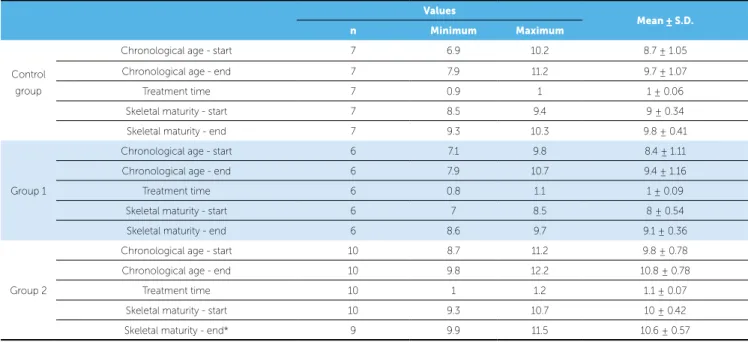
Table 1 - Descriptive statistics of samples per treatment group.
with patients without treatment with 8.5 to 9.4 years of bone age and, treated Groups 1 and 2, with patients with initial bone age 7 to 8.5 years and 9.3 to 10.7 years, respectively (Table 1).
The appliance used in patients of treated groups
was the bionator described by Balters,4 with acrylic
deep extension of the lower arch seeking greater mu-cosal support in the lingual region and always made
by the same professional.23
All patients received three tantalum metal im-plants, measuring 0.5 mm in diameter and 1.5 mm length, positioned on the mandible cortical surface
as the method developed by Björk.8 The first
posi-tioned at the center of the symphysis, between the roots of the incisors and the other two positioned in the posterior region, between the roots of the lower first permanent molars, right and left.
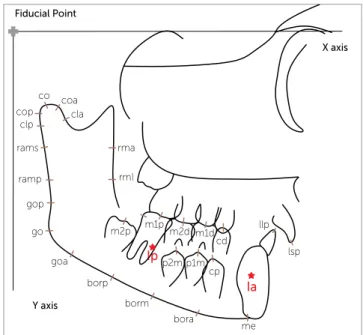
Aiming to evaluate mandibular growth and tooth development, natural and induced by orthopedic treatment with Balters bionator, it was established 16 cephalometric points marked in visualized right and let oblique radiographs of the mandible: Condy-lar points (co, coa, cop, cla, and clp) points in the ra-mus region (ramp, rams, rma and rmi) and lower bor-der (gop, go, goa, me, bora, borm and borp) (Table 1).
The points marked on the permanent teeth were icp, iip, cp, m1p, m2p, p1m and p2m and on decidu-ous teeth: cd, m1d and m2d, totaling 10 dental points, and 2 reference points of implant (Fig 1, Table 2).
For analysis of the displacements of cephalometric landmarks it was used a Cartesian coordinate system.
The X axis is represented by the horizontal line formed by the orbital plane determined in the initial
radiographic (T1) and transferred to subsequent
ra-diographs through the superimposition of the images of metallic implants located at the anterior and pos-terior mandible (Ip and Ia). The Y axis is represented by the vertical line perpendicular to the orbital plane passing through a fiducial point located at the rear end of the orbit plane in a rearmost position to skel-etal and dental structures of cephalometric tracing. The anteroposterior position of each cephalometric point was obtained by linear distance from point re-ferred to the Y axis, parallel to the axis X. Similarly, the vertical position of each cephalometric point was obtained by linear distance from the point to the X axis parallel to the Y axis (Fig 1).
The horizontal displacement for each point was calculated as the diference between the linear hori-zontal distance of the points at two diferent instants
(I2-I1) where I1 represents the beginning of orthopedic
treatment (treated group) or beginning of the
observa-tion period (control) and I2, the displacement ater 1
year of orthopedic therapy (treated group) or end of the observation period (Control group). The total dis-placement of each point was obtained using the rule of the right triangle (total displacement equal to the square root of the sum of squared horizontal displace-ment and vertical displacedisplace-ment squared).
This study was approved on May 4, 2009 by the research ethics committee of the Faculty of Dentist-ry of Araraquara under protocol 39/06, which is in accordance with resolution 196/96 of the National Health Council/MS.
STATISTICAL ANALYSES
The predetermined points in the radiographs were digitized twice by the same calibrated operator every 15 days, using the IBM compatible personal com-puter with the program Dentofacial Planner Plus ver-sion 2.02, on Numonics Accugrid digitizing tablet. Data were taken to the Excel Program in IBM
micro-Figure 1 - X axis represented by the horizontal line formed by the orbital plane determined on the initial radiograph (T1), transferred to the subsequent
radio-graphs through the superposition of metallic implants. Y axis determined by a vertical line passing through the iducial point located at the posterior end of the orbital plane with points on the mandibular body: Condylar (co, coa, cop, cla, and clp); mandibular ramus points (ramp, rams, rma and rmi); lower border (gop, go, goa, me, bora, borm, and borp); and dental points (isp, iip, cp, m1p, m2p, p1m, p2m, m1d, m2d and cd).
co coa
cla
rma
X axis
Y axis Fiducial Point
rmI
m2p m1p m2d
p2m p1m cp m1d
cd llp
lsp
bora
me borm
borp goa go gop ramp rams clp cop
Ip
computer and statistically analyzed using SPSS. This procedure was performed to evaluate the error of the method in the scanning process. It was applied In-traclass Correlation Coefficient (ICC) which showed variations from 0.893 to 0.996, with the smallest cor-responding to the point m1d(v) and the highest to points oj, cop(v) coa(v) and rmd, demonstrating that the error method was not significant.
For comparison between groups, the data were annualized in order to balance the small difference in time for observation or treatment from 0.8 to 1.2 years (Table 1).
From each patient, at each study point, it was ob-tained two oblique teleradiographs one on the right side and another on the left side. The study of cor-relation of the displacements of the predetermined points on both sides employing the Pearson cor-relation coefficient showed that for 77 % of them
the correlation is zero or very weak and 16 % of the correlation is moderate showing that a promoted correction by the device or natural growth is not necessarily symmetric. Based on these results it was chosen to work with the measurements of both sides as independent measures.
For statistical analysis of the displacement of each point, it was employed Student’s t test for the mean of a population. To assess whether the means of each measure in the three groups were equal, it was used analysis of variance with a criterion of classiication (ANOVA) when the homogeneity test of variances was not signiicant, otherwise the statistical analysis was performed by the Brown-Forsythe test. It was conducted tests of multiple comparison of means for variables that showed statistically signiicant results in testing the hypothesis of equality of means. The
signif-icance level for all statistical tests was 95 % (p< 0.05).
Point Name Definition
Condylion co Most superior point of the mandibular condyle
Anterior condylion coa Most anterior point of the mandibular condyle
Posterior condylion cop Most posterior point of the mandibular condyle
Anterior condylar neck cla Most anterior point of the mandibular condyle neck
Posterior condylar neck clp Most posterior point of the condylar neck
Posterior superior ramus rams Most posterior and superior point of the ramus of the mandible
Posterior median ramus ramp Most posterior and median point of the ramus of the mandible
Anterior superior ramus rma Located at the anterior and superior surface of the ramus of the mandible
Anterior median ramus rmi Located at the anterior and median surface of the ramus of the mandible
Superior gonion gop Most upper (superior) and posterior point of the gonial angle
Gonion go Most lower (inferior) and posterior point of the gonial angle
Antegonial notch goa Located at the antegonial notch region
Menton me Located at the base of the mandible. In the intersection with mandibular symphysis
The landmarks of the posterior, median and anterior base of the mandible
borp, borm and bora
Landmarks determined, respectively, from goa, by dividing the segment goa me in three equidistant points
Posterior implant Ip Mandibular landmark which the implant is Located at the posterior surface of the mandibular body
Anterior implant Ia Mandibular landmark which the implant is Located at the anterior of the mandibular body
Upper permanent incisor isp Located at the incisal edge of the upper incisor
Lower permanent incisor iip Located at the incisal edge of the lower incisor
Lower permanent canine cp Located at the incisal edge of the lower canine
Lower deciduous canine cd Located at the incisal edge of the lower deciduous canine
Mandibular irst premolar p1m Located at the incisal edge of the mandibular irst premolar
Mandibular second premolar p2m Located at the incisal edge of the mandibular second premolar
Deciduous mandibular irst molar m1d Located at the incisal edge of the deciduous mandibular irst molar
Deciduous mandibular second molar m2d Located at the incisal edge of the deciduous mandibular second molar
Permanent mandibular irst molar m1p Located at the middle portion of the occlusal surface of the permanent mandibular irst molar
Permanent mandibular second molar m2p Located at the middle portion of the occlusal surface of the permanent mandibular second molar
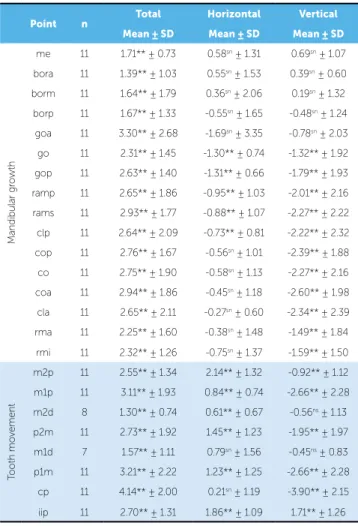
The data from Group 1 (Table 4), of patients with lower bone age or less mature, showed significant to-tal displacement of all studied points, both for mea-sures of skeletal origin as tooth meamea-sures.
The total tooth movements were all significant, with mesial movement of all teeth, except the first deciduous molars and canines, and significant extru-sion of permanent teeth (m1p, m2p, p1m, p2m, cp).
Significant changes occurred in both horizontal and vertical at goa, go, gop, ramp, rams, clp, cop, co, coa, cla, rmi points, only horizontally at borp point, and vertically at me and rma points.
The dental changes in both horizontal and verti-cal occurred with significant mesial movement and extrusion of points m2p, p2m, and cp, only extrusion at m1p, p1m points.
RESULTS
According to the analyzed sample and the mea-surements it is possible to say that, accompanied by one year without treatment, natural growth occurred promoting back horizontal changes at goa and go points and back and down at points gop, ramp, rams, clp, cop, co, coa, cla and rma and, only down at point me, with statistical significance (Table 3).
The results of the displacement of dental points of this Control group were significant for the overall tooth displacement. Horizontally it occurred labial migration of incisors, the m2p points, p2m, p1m and cp points moved to mesial and occlusal and m1p shifted toward occlusal significantly. The remain-ing evaluated teeth showed no significant changes in this group.
Point n Total Horizontal Vertical
Mean ± SD Mean ± SD Mean ± SD
Mandibular gr
owth
me 14 1.20** ± 0.97 -0.35ns ± 1.12 0.74** ± 0.72
bora 14 1.37** ± 1.12 -0.69ns ± 1.52 0.20ns ± 0.63
borm 14 1.73** ± 1.42 -0.55ns ± 1.97 0.11ns ± 1.01
borp 14 2.14** ± 1.40 -0.87ns ± 2.13 0.02ns ± 1.24
goa 14 2.07** ± 1.01 -0.71ns ± 1.79 -0.20ns ± 1.37
go 14 1.90** ± 1.29 -1.03** ± 1.00 -0.86ns ± 1.61
gop 14 2.07** ± 1.25 -0.89** ± 0.80 -1.21* ± 1.77
ramp 14 2.28** ± 1.11 -0.69* ± 0.90 -1.40* ± 1.84
rams 14 2.10** ± 0.95 -0.78** ± 0.85 -1.42** ± 1.44
clp 14 2.27** ± 1.41 -0.52* ± 0.83 -1.76** ± 1.79
cop 14 2.18** ± 1.57 -0.68* ± 0.97 -1.51* ± 1.92
co 14 2.29** ± 1.65 -0.69* ± 0.93 -1.68** ± 1.99
coa 14 2.35** ± 1.71 -0.40ns ± 1.02 -1.83** ± 2.01
cla 14 2.40** ± 1.52 -0.45* ± 0.76 -2.02** ± 1.82
rma 14 1.83** ± 1.10 -0.55* ± 0.82 -1.11* ± 1.58
rmi 14 2.94** ± 2.23 -0.30ns ± 3.20 -0.80ns ± 1.82
Tooth movement
m2p 14 2.18** ± 1.18 1.48** ± 1.31 -1.16** ± 1.00
m1p 14 2.19** ± 1.14 0.49ns ± 1.07 -1.85** ± 1.16
m2d 12 1.54** ± 0.58 0.48ns ± 1.03 -0.59ns ± 1.11
p2m 14 2.79** ± 2.01 1.31** ± 1.24 -2.36** ± 1.75
m1d 9 1.13** ± 0.88 0.08ns ± 1.23 -0.46ns ± 0.68
p1m 14 2.67** ± 2.15 1.38* ± 2.28 -1.84** ± 1.16
cp 13 4.96** ± 2.12 1.00* ± 1.36 -4.72** ± 2.01
iip 14 1.52** ± 0.80 0.72** ± 0.84 0.58ns ± 1.22
Point n Total Horizontal Vertical
Mean ± SD Mean ± SD Mean ± SD
Mandibular gr
owth
me 11 1.71** ± 0.73 0.58sn ± 1.31 0.69sn ± 1.07
bora 11 1.39** ± 1.03 0.55sn ± 1.53 0.39sn ± 0.60
borm 11 1.64** ± 1.79 0.36sn ± 2.06 0.19sn ± 1.32
borp 11 1.67** ± 1.33 -0.55sn ± 1.65 -0.48sn ± 1.24
goa 11 3.30** ± 2.68 -1.69sn ± 3.35 -0.78sn ± 2.03
go 11 2.31** ± 1.45 -1.30** ± 0.74 -1.32** ± 1.92
gop 11 2.63** ± 1.40 -1.31** ± 0.66 -1.79** ± 1.93
ramp 11 2.65** ± 1.86 -0.95** ± 1.03 -2.01** ± 2.16
rams 11 2.93** ± 1.77 -0.88** ± 1.07 -2.27** ± 2.22
clp 11 2.64** ± 2.09 -0.73** ± 0.81 -2.22** ± 2.32
cop 11 2.76** ± 1.67 -0.56sn ± 1.01 -2.39** ± 1.88
co 11 2.75** ± 1.90 -0.58sn ± 1.13 -2.27** ± 2.16
coa 11 2.94** ± 1.86 -0.45sn ± 1.18 -2.60** ± 1.98
cla 11 2.65** ± 2.11 -0.27sn ± 0.60 -2.34** ± 2.39
rma 11 2.25** ± 1.60 -0.38sn ± 1.48 -1.49** ± 1.84
rmi 11 2.32** ± 1.26 -0.75sn ± 1.37 -1.59** ± 1.50
Tooth movement
m2p 11 2.55** ± 1.34 2.14** ± 1.32 -0.92** ± 1.12
m1p 11 3.11** ± 1.93 0.84** ± 0.74 -2.66** ± 2.28
m2d 8 1.30** ± 0.74 0.61** ± 0.67 -0.56ns ± 1.13
p2m 11 2.73** ± 1.92 1.45** ± 1.23 -1.95** ± 1.97
m1d 7 1.57** ± 1.11 0.79sn ± 1.56 -0.45ns ± 0.83
p1m 11 3.21** ± 2.22 1.23** ± 1.25 -2.66** ± 2.28
cp 11 4.14** ± 2.00 0.21sn ± 1.19 -3.90** ± 2.15
iip 11 2.70** ± 1.31 1.86** ± 1.09 1.71** ± 1.26
Table 3 - Mean and standard deviation of mandibular growth, tooth eruption (total, horizontal and vertical) and signiicance of the Student’s t test of the hypothesis that the mean is equal to zero - Control Group.
Table 4 - Mean and standard deviation of mandibular growth, tooth eruption (total, horizontal and vertical) and signiicance of the Student’s t test of the hypothesis that the mean is equal to zero – Group 1.
* - the hypothesis that the mean is zero is rejected at a signiicance level of 0.05. ** - the hypothesis that the mean is zero is rejected at a signiicance level of 0.01.
ns - the hypothesis that the mean is zero is not rejected.
* - the hypothesis that the mean is zero is rejected at a signiicance level of 0.05. ** - the hypothesis that the mean is zero is rejected at a signiicance level of 0.01.
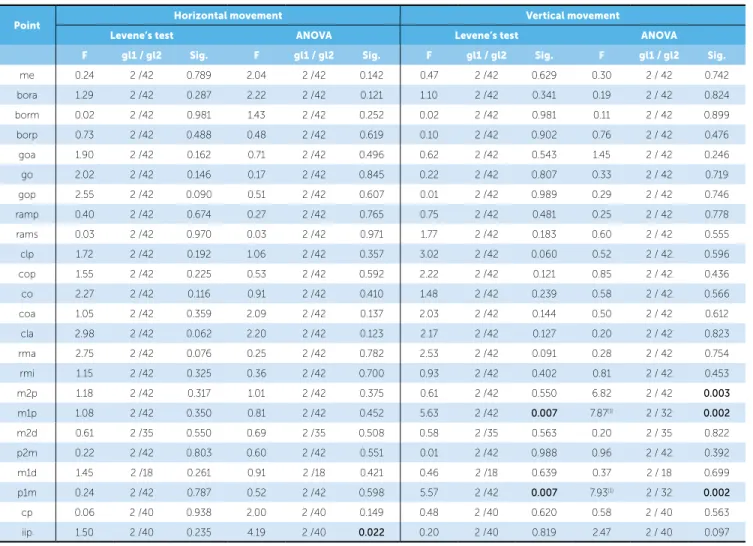
iip mean from Group 1 differs from means of Control group and Group 2. For measures of vertical growth, the results indicate that there is significant difference between the group’s means only for some measures of tooth movement, m2p, m1p and p1m. Regarding to p1m it was also observed no significant difference between the variances of the three groups. The re-sults of multiple comparisons of means show that, for the three measures cited above, the vertical growth in Group 2 was higher and significantly different from the other two groups.
DISCUSSION
This work was carried out at 45° oblique teleradi-ographs of patients who had metal implants inserted in the mandible, used as stable references, what al-lowed a more reliable evaluation of the results. This feature eliminates variables like the magnification of
radiographic images3 and incorrect positioning of
the patients head in cephalostat. The images of
im-plants as suggested by Bjork8 were marked on the
ini-tial teleradiograph and transferred to the subsequent, providing an assessment of the real displacement of the points in evaluated time (for all groups), which
otherwise would not be possible.23
Identifying whether the orthopedic device only changes the direction of condylar growth or the rate and amount of this growth has been the purpose of
many authors. Bjork and Skieller9 cite the
impor-tance, in longitudinal studies, the condylar growth in mandible length increase, being the growth di-rection of the condyle extremely variable and dif-ficult to predict. The real role of the condyle in the mandibular growth is controversial in cranio-facial growth studies. The cartilage of the condyle has a capacity of compensatory growth, generating enough growth to allow adaptation of the mandible to the skull base by articular fossa (mandibular fossa) and to maxillary complex.
In the Control group of our study, the growth of the condyle was significant in all its references, ante-rior and posteante-rior condylar neck (cla and clp), poste-rior and supeposte-rior portion (cop and co), up and back. The anterior condylar region (coa) was an exception and showed no backward growth.
With the use of the appliance in younger chil-dren (Group 1) the condyle showed no signiicant
Point n Total Horizontal Vertical
Mean ± SD Mean ± SD Mean ± SD
Mandibular gr
owth
me 20 1.45** ± 0.75 -0.17ns ± 1.19 0.50* ± 1.04
bora 20 1.95** ± 1.16 -0.73ns ± 1.95 0.29ns ± 0.94
borm 20 1.77** ± 1.47 -0.89ns ± 1.93 0.01ns ± 0.94
borp 20 2.18** ± 2.07 -1.31* ± 2.35 -0.48ns ± 1.30
goa 20 2.68** ± 1.87 -1.61** ± 2.23 -1.13** ± 1.41
go 20 2.42** ± 1.48 -1.26** ± 1.68 -1.27** ± 1.47
gop 20 2.58** ± 1.69 -1.24** ± 1.52 -1.48** ± 1.91
ramp 20 2.77** ± 1.64 -0.94** ± 1.18 -1.53* ± 2.45
rams 20 3.05** ± 2.26 -0.83** ± 1.07 -2.22** ± 2.80
clp 20 3.62** ± 3.12 -1.11** ± 1.51 -2.75** ± 3.47
cop 20 3.53** ± 3.09 -1.04* ± 1.70 -2.70** ± 3.31
co 20 3.57** ± 3.13 -1.23** ± 1.89 -2.68** ± 3.24
coa 20 3.70** ± 3.27 -1.28** ± 1.70 -2.77** ± 3.52
cla 20 3.54** ± 3.02 -1.08** ± 1.54 -2.62** ± 3.39
rma 20 3.01** ± 1.79 -0.74ns ± 1.61 -1.67** ± 2.58
rmi 20 3.05** ± 1.64 -1.01* ± 2.15 -1.55** ± 2.07
Tooth movement
m2p 20 3.14** ± 1.17 1.72** ± 0.95 -2.37** ± 1.35
m1p 20 4.83** ± 2.52 0.40ns ± 0.94 -4.64** ± 2.68
m2d 18 1.33** ± 0.73 0.14ns ± 1.18 -0.37ns ± 0.93
p2m 20 2.21** ± 1.81 0.94** ± 1.42 -1.50** ± 1.76
m1d 5 1.21* ± 0.87 0.95ns ± 1.10 -0.15ns ± 0.48
p1m 20 5.35** ± 2.40 0.68ns ± 2.34 -4.64** ± 2.68
cp 19 4.29** ± 2.22 1.08** ± 1.09 -3.97** ± 2.31
iip 20 1.90** ± 1.12 0.40ns ± 1.55 0.59ns ± 1.46
* - the hypothesis that the mean is zero is rejected at a signiicance level of 0.05. ** - the hypothesis that the mean is zero is rejected at a signiicance level of 0.01.
ns - the hypothesis that the mean is zero is not rejected.
Table 5 - Means and standard deviation of the mandibular growth and total dental eruption, horizontal and vertical, and t test signiicance of the hypoth-esis that the mean is equal to zero – Group 3.
To evaluate whether the average of each measure in the three groups were equal it was used analysis of variance with one classification criterion (ANOVA) when the test for homogeneity of variance was not significant, otherwise the comparison of means was performed by Brown-Forsythe test. The results are shown in Tables 6 and 7, and in Table 8 the results of the multiple comparisons of means of variables that showed statistically significant results in test for dif-ference of means.
Point Horizontal movement Vertical movement
Levene’s test ANOVA Levene’s test ANOVA
F gl1 / gl2 Sig. F gl1 / gl2 Sig. F gl1 / gl2 Sig. F gl1 / gl2 Sig.
me 0.24 2 /42 0.789 2.04 2 /42 0.142 0.47 2 /42 0.629 0.30 2 / 42 0.742
bora 1.29 2 /42 0.287 2.22 2 /42 0.121 1.10 2 /42 0.341 0.19 2 / 42 0.824
borm 0.02 2 /42 0.981 1.43 2 /42 0.252 0.02 2 /42 0.981 0.11 2 / 42 0.899
borp 0.73 2 /42 0.488 0.48 2 /42 0.619 0.10 2 /42 0.902 0.76 2 / 42 0.476
goa 1.90 2 /42 0.162 0.71 2 /42 0.496 0.62 2 /42 0.543 1.45 2 / 42 0.246
go 2.02 2 /42 0.146 0.17 2 /42 0.845 0.22 2 /42 0.807 0.33 2 / 42 0.719
gop 2.55 2 /42 0.090 0.51 2 /42 0.607 0.01 2 /42 0.989 0.29 2 / 42 0.746
ramp 0.40 2 /42 0.674 0.27 2 /42 0.765 0.75 2 /42 0.481 0.25 2 / 42 0.778
rams 0.03 2 /42 0.970 0.03 2 /42 0.971 1.77 2 /42 0.183 0.60 2 / 42 0.555
clp 1.72 2 /42 0.192 1.06 2 /42 0.357 3.02 2 /42 0.060 0.52 2 / 42 0.596
cop 1.55 2 /42 0.225 0.53 2 /42 0.592 2.22 2 /42 0.121 0.85 2 / 42 0.436
co 2.27 2 /42 0.116 0.91 2 /42 0.410 1.48 2 /42 0.239 0.58 2 / 42 0.566
coa 1.05 2 /42 0.359 2.09 2 /42 0.137 2.03 2 /42 0.144 0.50 2 / 42 0.612
cla 2.98 2 /42 0.062 2.20 2 /42 0.123 2.17 2 /42 0.127 0.20 2 / 42 0.823
rma 2.75 2 /42 0.076 0.25 2 /42 0.782 2.53 2 /42 0.091 0.28 2 / 42 0.754
rmi 1.15 2 /42 0.325 0.36 2 /42 0.700 0.93 2 /42 0.402 0.81 2 / 42 0.453
m2p 1.18 2 /42 0.317 1.01 2 /42 0.375 0.61 2 /42 0.550 6.82 2 / 42 0.003
m1p 1.08 2 /42 0.350 0.81 2 /42 0.452 5.63 2 /42 0.007 7.87(1) 2 / 32 0.002
m2d 0.61 2 /35 0.550 0.69 2 /35 0.508 0.58 2 /35 0.563 0.20 2 / 35 0.822
p2m 0.22 2 /42 0.803 0.60 2 /42 0.551 0.01 2 /42 0.988 0.96 2 / 42 0.392
m1d 1.45 2 /18 0.261 0.91 2 /18 0.421 0.46 2 /18 0.639 0.37 2 / 18 0.699
p1m 0.24 2 /42 0.787 0.52 2 /42 0.598 5.57 2 /42 0.007 7.93(1) 2 / 32 0.002
cp 0.06 2 /40 0.938 2.00 2 /40 0.149 0.48 2 /40 0.620 0.58 2 / 40 0.563
iip 1.50 2 /40 0.235 4.19 2 /40 0.022 0.20 2 /40 0.819 2.47 2 / 40 0.097
Table 6 - Results of tests for homogeneity of variance (Levene’s test) and to test the hypothesis that the mean of the 3 groups are equal (ANOVA or Brown For-sythe test) - points with vertical and horizontal movements.
(1) The analysis of variance (ANOVA) was replaced by Brown and Forsythe statistical due to the heterogeneity of variances.
back growth and vertical growth similar to the Con-trol group. In Group 2, with mature children, the condyle showed signiicant backwards and upwards growth, showing a modiication of condylar growth
more to posterior and superior as found by Araújo.3
This pattern of condylar growth did not difer from that presented by the children in the Control group, but there was greater vertical growth in both treated groups (1 and 2) and horizontal in Group 2 being
dis-cordant from results of Bjork8 who suggests that
back-ward growth from treatment might have been statisti-cally signiicant compared to the Control group and
Huttgren et al,15 who reported that activators caused a
redirection of the condyle in posterior position. These
results are consistent with Monini,25 who found
stabil-ity in the direction of condylar growth.
Our study showed that there were significant indi-vidual changes, but the comparison between groups,
changes in relation to the condyle were not signifi-cant, allowing us to reaffirm the hypothesis of
sev-eral authors3,20 who accepted the redirection of
man-dibular growth, however, nothing beyond the natural growth potential.
Regarding the mandibular ramus, it was found in the Control group a slip of the ramus to posterior rep-resented by resorption of the anterior ramus (back-ward and up(back-ward) and apposition on the back(back-ward posterior. These data were observed both in the up-per (rams and rma) and middle ramus (ramp and rmi). The treated Groups 1 and 2 exhibited a displace-ment onto the upper anterior ramus and upward and backward in the lower ramus, similar to the Control group. These results are consistent with the process of ramus displacement relative to the mandibular body which occurs naturally during facial skeleton growth
0.86 mm (c), 1.32 mm (g1) and 1.27 mm (g2), result-ing in a small increase in the co-go distance, respec-tively of 0.82 mm for the Control group, 0.95 mm for Group 1 and 1.41 mm for Group 2. The results found
by Reis et al,27 were similar to ours, where Balters
bi-onator stimulated the growth of the mandibular body and ramus similarly in both age groups without modi-fying the tendency of individual growth. Moreover,
Malta et al19 showed that the diference in amount of
mandibular growth occurs and is signiicant (3.3 mm) when comparing cases of Class II patients treated with Balters bionator appliance and untreated, demonstrat-ing that this appliance is eicient.
The data show that the gonion region exhibited significant changes in all studied groups. The points goa, go and gop showed significant upward and back-ward displacement except for goa in Group 1. The displacement of these points in Group 2 was higher than in other groups, but without statistical signifi-cance. These results point to a pattern of remodeling gonion region, especially in mature children, compat-ible with the natural growth demonstrated by several
authors,8,9,10,14 who observed resorption in the
man-dible posterior border. So, part of the vertical growth seen in the condylar region is partially offset by reab-sorption which occurs in the gonion region, resulting in small changes in mandibular ramus height.
Bigli-azzi, Kessner and Faltin Jr.,7 found that in Class II,
division 1, patients with mandibular retrognathia, the gonion angle remained unchanged during the treat-ment period with bionator.
Point Total movement
Levene’s test ANOVA
F gl1 / gl2 Sig. F gl1 / gl2 Sig.
me 0.05 2 /42 0.951 1.21 2 /42 0.309
bora 0.01 2 /42 0.991 1.45 2 /42 0.247
borm 0.08 2 /42 0.921 0.02 2 /42 0.977
borp 1.22 2 /42 0.307 0.34 2 /42 0.714
goa 2.18 2 /42 0.126 1.29 2 /42 0.286
go 0.20 2 /42 0.823 0.59 2 /42 0.562
gop 0.66 2 /42 0.524 0.59 2 /42 0.558
ramp 0.54 2 /42 0.586 0.42 2 /42 0.660
rams 1.83 2 /42 0.173 1.21 2 /42 0.307
clp 3.72 2 /42 0.033 1.64(1) 2 /36.6 0.207
cop 3.69 2 /42 0.033 1.68(1) 2 /38.7 0.199
co 3.06 2 /42 0.058 1.16 2 /42 0.323
coa 2.49 2 /42 0.095 1.16 2 /42 0.323
cla 1.55 2 /42 0.224 1.04 2 /42 0.364
rma 1.83 2 /42 0.173 2.51 2 /42 0.094
rmi 0.41 2 /42 0.663 0.64 2 /42 0.532
m2p 0.24 2 /42 0.789 2.66 2 /42 0.082
m1p 4.88 2 /42 0.012 8.44(1) 2 /34.7 0.001
m2d 0.09 2 /35 0.915 0.41 2 /35 0.669
p2m 0.23 2 /42 0.794 0.47 2 /42 0.627
m1d 0.50 2 /18 0.614 0.43 2 /18 0.655
p1m 0.45 2 /42 0.639 6.52 2 /42 0.003
cp 0.30 2 /40 0.745 0.54 2 /40 0.588
iip 1.02 2 /40 0.370 3.35 2 /40 0.045
(1) The analysis of variance (ANOVA) was replaced by Brown and Forsythe statistical due to the heterogeneity of variances.
Table 7 - Results of tests for homogeneity of variance (Levene’s test) and to test the hypothesis that the mean of the 3 groups are equal (ANOVA or Brown Forsythe test) – landmarks with total movements.
Point Control Group Group 1 Group 2
Mean ± SD Mean ± SD Mean ± SD
Total displacement
m1p 2.19a ±1.14 3.11a ±1.93 4.83b ±2.52
p1m 2.67a ±2.15 3.21a ±2.22 5.35b ±2.40
iip 1.52a ±0.80 2.70b ±1.31 1.90ab ±1.12
Horizontal displacement
iip 0.72a ±0.84 1.86b ±1.09 0.40a ±1.55
Vertical displacement
m2p -1.16a ±1.00 -0.92a ±1.12 -2.37b ±1.35
m1p -1.85a ±1.16 -2.66a ±2.28 -4.64b ±2.68
p1m -1.84a ±1.16 -2.66a ±2.28 -4.64b ±2.68
Note: Diferent letters correspond to statistically diferent averages by Student–
Newman–Keuls (SNK) test
Table 8 - Means and standard deviations of tooth eruption and results of multiple comparison tests of mean measures that showed a signiicant result in the ANOVA.
The comparative results between the 3 groups analyzed show that the mandibular body showed growth in the vertical direction, without statisti-cal significance, suggesting that Balters bionator did not influenced this growth. These results
cor-roborate with Kessner and Faltin18 because there is a
joint remodeling that promotes mandibular adapta-tion more to anterior without changing mandibular
length significantly. Schulhof and Engel,29 disagree
with these findings and emphasize that treatment with the bionator appliance promotes an increase in ascending ramus and mandibular body in relation to normal growth.
Clinical observations have shown that the use of orthopedic devices can alter the growth of the mandi-ble, however the exact nature of this change remains
a topic of great controversy.13 Our results showed that
in the Control group there was a significantly down-ward movement of menton and that the mandibular border exhibited backward movement without sta-tistical significance. These data are consistent with
other studies,14,30 which found bone apposition in the
anterior portion of the mandibular border.
In Group 1 occurred forward and downward dis-placement of the mentum and anterior border, while the posterior border had a backward and upward movement, all insignificant. In Group 2, the mentum presented downward movement and the posterior border a significant backward movement and nothing significant of the anterior and middle border. These data indicate a relative stability of the mandibular lower border, mainly in young children.
The results observed for mature children were similar to the Control group, results that are in
ac-cordance with other studies.20,21 On the other hand,
Almeida,1 who treated children aged 10.8 months
ob-served an increase in mandibular protrusion and the effective length of the mandibular body, which
ac-cording to Almeida-Pedrin,2 promoted a significant
improvement in the maxillomandibular relationship compared to the Control group, which agrees with
the study of Basciftci et al,5 in the same year, that the
greatest amount of growth occurs during adolescence.
Opheij et al26 did not ind statistical signiicant
skeletal changes in Class II malocclusion patients with mandibular retrognathia, treated with bionator, notic-ing the most signiicant efects on the dentoalveolar
structures. For Janson17 children treated in the
pre-pu-bertal period exhibited dentoalveolar changes, nota-bly a protrusion of the lower incisors and correction of molar relationship in distal-occlusion. It was
ob-served17 an overjet reduction of approximately 2 mm,
similar to what was observed in our study (signiicant overjet decrease in 1.86 mm in Group 1, compared
with 0.72 mm in the Control group and 0.4 mm in
Group 2). For Bastos and Mucha,6 one of the bionator
indications is when there is a possibility of backward
projection of the lower incisors. For Martins21 skeletal
changes promoted by bionator occur in 32 % through increased lower facial height and 68 % dentoalveolar movement, higher of lower molars and upper incisors.
In the vertical direction occurred greater amount of eruption of posterior teeth, significant for Group 2 that showed nearly twice eruption of molars (2.37 mm of the first molars, 4.64 mm of second molars and 2.66 mm of the first premolars) when compared to the Control group and Group 1. These facts demon-strate that the bionator appliance with occlusal sup-port allows the active eruption of permanent molars. With respect to premolars, these erupt in more ma-ture individuals (Group 2), mainly due to more ad-vanced stage of root formation that they are. For the
authors1,11 there was a significant increase in posterior
facial height especially in the treated group with bi-onator by extrusion of posterior teeth, confirmed by our study when considering the results of the more mature group (Group 2) and the youngest (Group 1), which demonstrated the predominance of dentoal-veolar adaptation in the horizontal direction.
CONCLUSION
Due to the methodology adopted in this study and the results, based on statistical analysis, we conclude that:
1 – When it was evaluated the skeletal and dental changes in groups individually, there was growth at all points analyzed.
2 – When the groups were compared with each oth-er, skeletal mandibular changes were similar indicating that the mandibular growth pattern has not changed signiicantly with the established treatment and.
1. Almeida MR. Avaliação cefalométrica comparativa da interceptação da má-oclusão de Classe II, divisão 1, utilizando o aparelho de Frankel e o bionator de Balters [tese]. Bauru (SP): Universidade de São Paulo; 2000. 2. Almeida-Pedrin RR. Efeitos cefalométricos do aparelho extrabucal
conjugado (Splint Maxilar) e do bionator, no tratamento de má oclusão de Classe II, divisão 1 [tese]. Bauru (SP): Universidade de São Paulo; 2003. 3. Araujo AM. Estudo cefalométrico com implantes metálicos dos efeitos
do aparelho Bionator de Balters no desenvolvimento esquelético maxilomandibular durante o tratamento da má oclusão Classe II, divisão 1 [tese]. Araraquara (SP): Universidade Estadual Paulista; 2003. 4. Balters W. Guía de la técnica del Bionator. Buenos Aires: Editorial Mundi;
1969. 68p.
5. Basciftci FA, Uysal T, Büyükerkmen A, Sari Z. The efects of activator treatment on the craniofacial structures of Class II, division 1 patients. Eur J Orthod. 2003;25(1):83-7.
6. Bastos GK, Mucha JN. Aparelhos funcionais: uma revisão. Rev Bras Odontol. 2002;59(3):184-8.
7. Bigliazzi R, Kessner CA, Faltin Jr K. Estudo das alterações anatômicas e morfológicas em pacientes em Classe II, divisão 1, com retrognatismo mandibular, tratados com bionator de Balters, empregando-se a análise das contra-partes de Enlow. Rev Dental Press Ortod Ortop Facial. 2000;5(2):9-19.
8. Björk A. Facial growth in man, studied with aid of metallic implants. Acta Odontol Scand. 1955;13(1):9-34.
9. Björk A, Skieller V. Normal and abnormal growth of the mandible. A synthesis of longitudinal cephalometric implant studies over a period of 25 years. Eur J Orthod. 1983;5(1):1-46.
10. Buschang PH, Gandini Jr L. G. Mandibular skeletal growth and modelling between 10-15 years. Eur J Orthod. 2001;23:1-11.
11. Cavalcante CT. Alterações verticais decorrentes da interceptação da Classe II com o aparelho Bionator [tese]. Bauru (SP): Universidade de São Paulo; 2003.
12. Almeida MR, Henriques JF, Ursi W. Comparative study of the Frankel (FR- 2) and bionator appliances in the treatment of Class II malocclusion. Am J Orthod Dentofacial Orthop. 2002;121(5):458-66.
13. Graber TM, Neumann B. The Bionator removable orthodontic appliances. Philadelphia: Saunders Company; 1977.
14. Gu Y, McNamara JA Jr. Mandibular growth changes and cervical vertebral maturation. Angle Orthod. 2007;77(6):947-53.
15. Hultgren BW, Isaacson RJ, Erdman AG, Worms FW. Mechanics, growth, and class II corrections. Am J Orthod. 1978;74(4):338-95.
16. Iseri H, Solow B. Change in the width of the mandibular body from 6 to 23 years of age: an implant study. Eur J Orthod. 2000;22(3):229-38. 17. Janson I. A cephalometric study of the eiciency of the Bionator. Trans
Eur Orthod. Soc. 1977;53:283-93.
REFERENCES
18. Kessner CA, Faltin Jr K. Estudo cefalométrico radiográico sobre a inluência do Bionator de Balters no crescimento mandibular e o incremento vertical do ramo ascendente da mandíbula, nos tratamentos das más oclusões de Classe II, divisão I com retrognatismo mandibular. Rev Inst Ciênc Saúde. 1997;15(esp. issue):51-8.
19. Malta LA, Baccetti T, Franchi L, Faltin K, McNamara JA. Long-term dentoskeletal efects and facial proile changes induced by bionator therapy. Angle Orthod. 2010;80(1):10-7.
20. Maltagliati LA, Henriques JFC, Janson G, Almeida RR, Freitas MR. A inluência do tratamento ortopédico nas estruturas faciais de indivíduos com má oclusão de Classe II, 1ª divisão. Um estudo comparativo. J Appl Oral Sci. 2004;12(2):164-70.
21. Martins RP, Rosa Martins JC, Martins LP, Buschang PH. Skeletal and dental components of Class II correction with the bionator and removable headgear splint appliances. Am J Orthod Dentofacial Orthop. 2008;134(6):732-41.
22. McNamara JA Jr, Carlson DS. Quantitative analysis of temporomandibular joint adaptations to protrusive function. Am J Orthod. 1979;76(6):593-61. 23. Melo ACM, Gandini Jr LG, Santos-Pinto A, Araújo AM, Gonçalves JR.
Avaliação cefalométrica do efeito do tratamento da má oclusão Classe II, divisão 1, com o bionator de Balters: estudo com implantes metálicos Rev Dental Press Ortod Ortop Facial. 2006;11(3):18-31.
24. Melo ACM, Santos-Pinto A, Martins JCR, Martins LP, Sakima MT. Orthopedic and orthodontic component of Class II division 1 malocclusion correction with Balters bionator: a cephalometric study with metallic implants. World J Orthod. 2003;4:237-42.
25. Monini AC. Estudo cefalométrico com implantes metálicos das alterações esqueléticas, a longo prazo, após o uso do Bionator de Balters [tese]. Araraquara (SP): Universidade Estadual Paulista; 2008.
26. Opheij DG, Callaert H, Opdebeeck HM. The efect of the amount of protrusion built into the bionator on condylar growth and displacement: a clinical study. Am J Orthod Dentofacial Orthop. 1989;95(5):401-9. 27. Reis SAB, Moresca R, Goldenberg FC, Vigorito JW. Utilização da análise
de Jarabak para a avaliação do tratamento da Classe II, divisão 1, com o Bionator de Balters. Ortodontia. 2000;33(2):42-52.
28. Ruf S, Pancherz H. Temporomandibular joint growth adaptation in Herbst treatment a prospective magnetic resonance imaging and cephalometric roentgenographic study. Eur J Orthod. 1998;20(4):375-88.
29. Schulhof RJ, Engel GA. Results of Class II to functional appliance treatment. J Clin Orthod. 1982;16(9):587-99.