Evaluation of the quality of life and risk of suicide
Veroˆnica de Medeiros Alves,I,*Leilane Camila Ferreira de Lima Francisco,I Flaviane Maria Pereira Belo,I Valfrido Lea˜o de-Melo-Neto,IIVinicius Gomes Barros,IAntonio E. NardiIII
IUniversidade Federal de Alagoas, Departamento de Enfermagem, Arapiraca/AL, Brasil.IIUniversidade Federal de Alagoas, Faculdade de Medicina,
Maceio´/AL, Brasil.IIIUniversidade Federal do Rio de Janeiro, Instituto de Psiquiatria, Rio de Janeiro/RJ, Brasil.
OBJECTIVE:To identify the socio-demographic profiles, suicidal ideation, the presence of mental disorders and the quality of life of patients using mental health services in Arapiraca, Alagoas, Brazil.
METHOD:Interviews were conducted in family health units and the Psychosocial Attention Center. The sample included 202 mental disorder patients with a risk of suicide attempts, 207 mental disorder patients without a risk of suicide attempts and 196 controls. This study used an identification questionnaire, the abbreviated World Health Organization Quality of Life questionnaire, Beck‘s Suicidal Ideation Scale and the Mini International Neuropsychiatric Interview.
RESULTS: Patients who had a mental disorder and a risk of suicide attempts tended to be single, had less education and lower family income, were not working and showed lower scores in quality of life domains; 73 of these patients had suicidal ideation in the previous week. Depressive disorders, manic episodes, hypomanic episodes, social phobias, obsessive compulsive disorder, post-traumatic stress disorder, psychotic syndromes and generalized anxiety disorder were more frequent and statistically significant for patients at risk for suicide attempts.
CONCLUSION:The management of patients with a risk of suicide attempts must focus on individual patients because this risk is directly linked to changes in quality of life and the improvement of these patients’ prognosis.
KEYWORDS: Mental Disorders; Suicide Attempts; Suicidal Ideation; Quality of Life.
Alves VM, Francisco LC, Belo FM, de-Melo-Neto VL, Barros VG, Nardi AE. Evaluation of the quality of life and risk of suicide. Clinics. 2016;71 (3):135-139
Received for publication onSeptember 25, 2015;First review completed onDecember 1, 2015;Accepted for publication onDecember 18, 2015
E-mail: [email protected]
*Corresponding author
’ INTRODUCTION
In 2014, the World Health Organization (WHO) (1) reported that almost 804,000 people commit suicide every year. According to the United Nations, 75% of these cases involve people from low- and middle-income countries. Brazil ranks eighth in the world for the number of suicides. In 2012, 11,821 deaths due to suicide were recorded in Brazil, including 9,198 men and 2,623 women. Between 2000 and 2012, the number of suicides increased by 10.4% (1).
Suicidal behavior encompasses a number of phenomena linked to suicide, of which the most relevant are the suicide itself (death) and suicide attempts (2). Suicide attempts have the same phenomenological characteristics of suicides and differ only in terms of the outcome, which is not fatal in the case of suicide attempts (2).
It is believed that suicide attempts occur at least ten times more often than suicides, but official records regarding suicide attempts are scarcer and less reliable than those regarding suicide (3). There are no worldwide records on suicide attempts. It may be impossible to accurately obtain these data because most of these attempts are never recorded in medical or legal contexts. It is estimated that the rates of suicide attempts may be 10 to 40 times higher than the rates of suicide (4). In addition, there may be at least ten times as many suicide attempts for each suicide and there may be four unrecorded suicide attempts for each attempt recorded (5).
Patients with mental disorders often complain of suicide attempts and/or suicidal ideation. Risk factors for suicide are social isolation, depression, schizophrenia, bipolar disorder, alco-holism, unemployment, extreme economic situations, difficult family relationships, a parental loss in childhood, a recent loss of a close friend or family member, organic diseases causing dis-ability, chronic pain, malignant neoplasms and AIDS (3). In addition, a family history of suicide is considered an aggravating factor (6).
Due to the consequences that suicide attempts generally introduce in the lives of patients and their families, this study aims to identify the socio-demographic profiles, suicidal ideation, the presence of mental disorders and the quality of DOI:10.6061/clinics/2016(03)03
Copyright&2016CLINICS–This is an Open Access article distributed under the terms of the Creative Commons License (http://creativecommons.org/licenses/by/ 4.0/) which permits unrestricted use, distribution, and reproduction in any medium or format, provided the original work is properly cited.
life of patients who are receiving mental health services and who are at risk of suicide in Arapiraca, Alagoas, Brazil.
’ MATERIALS AND METHODS
This quantitative research was conducted at the Psycho-social Attention Center (PAC) Nise da Silveira and in family health units (FHU) located in Arapiraca, Alagoas, Brazil.
The sample consisted of 605 people: 202 mental disorder patients with a risk of suicide attempts (the MDRS group); 207 mental disorder patients without a risk of suicide attempts (the MDWS group); and 196 patients without mental disorders and without a risk of suicide attempts, who were the study’s control group (the CO group).
The exclusion criteria were patients with mental retarda-tion and people who were younger than 18 years of age. The Research Ethics Committee of the Federal University of Alagoas approved this study, and the subjects expressed their acquiescence through informed consent.
The following scales and questionnaires were used: an identification questionnaire, the abbreviated WHO Quality of Life questionnaire (WHOQOL), Beck’s Suicidal Ideation Scale and the Mini International Neuropsychiatric Interview (MINI 5.0) (7).
The identification questionnaire provided an economic profile and the social and health conditions of the patients studied. The WHOQOL allowed for an evaluation of the patient’s quality of life in four domains: the physical, the psychological, social rela-tions and the environment (8). The Suicidal Ideation Scale was used to identify people who had had suicidal ideation in the previous week (9). The MINI 5.0 was used as a diagnostic inter-view. The control group consisted of patients who showed no mental disorder or suicide risk during the MINI.
The analysis was conducted using the statistical program SPSS 20. Pearson’s correlation, x2tests, and Student’s t tests were used, with a significance value ofpp0.05.
’ RESULTS
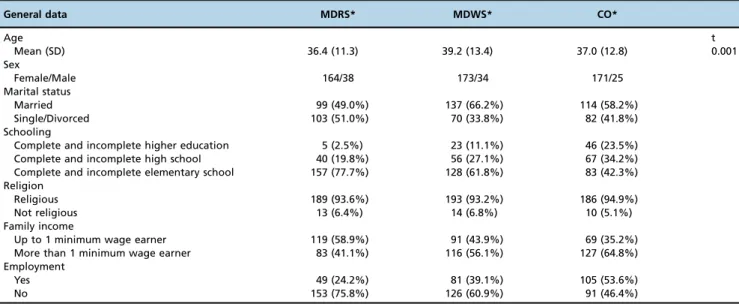
The MDWS group’s average age was greater than the ages of the other groups (po0.05). Most of the patients inter-viewed were female (Table 1).
Most patients in the MDRS group were single or divorced, whereas most of the patients in the MDWS group (po0.05) and the CO group were married (p40.05) (Table 1).
The level of education of the MDRS patients was lower than that of the MDWS group (po0.05) and that of the CO group (po0.05). A high level of education was found in the CO group (po0.05), followed by the MDWS group (po0.05) (Table 1).
All patients claimed to be religious. Most of the patients in the MDRS group had a family income of less than or equal to the minimum wage (po0.05), whereas most of the patients in the other groups had a family income exceeding the minimum wage (Table 1). Most of the patients in the MDRS group and the MDWS group did not work (po0.05), whereas most of those in the control group worked (po0.05) (Table 1). When health conditions were evaluated, it was clear that most of the sample did not report their number of hos-pitalizations (Table 2). When compared with the other groups (Table 2), the MDRS group had the highest number of patients who reported that they had relatives with mental disorders (po0.05).
The MDWS group reported being more physically active than the other groups (p40.05) (Table 2). The MDRS group
reported more diseases (diabetes, hypertension and heart problems) (p40.05) (Table 2).
Among the 202 patients in the MDRS group, 168 had already attempted suicide, but only 73 reported suicidal ideation in the last week. In this group, the risk of suicide attempts was mild, followed by severe and moderate risks. Among the 207 patients in the MDWS group, 42 had already attempted suicide, but only four reported suicidal ideation in the last week. None of the patients from the CO group presented suicide risks in the MINI 5.0 (Table 2).
In the general sample, it is clear that the ’environment’ domain received the lowest score. In the MDRS group, the lowest-scoring domains were the ’environment’, ’physical’ and ’psychological’. In the MDWS and CO groups, the lowest-scoring domain was the ’environment’. Statistical correlation has been found between these two groups (po0.05). Notably, the patients in the MDRS group presented the lowest quality of life compared with the other groups (Table 3).
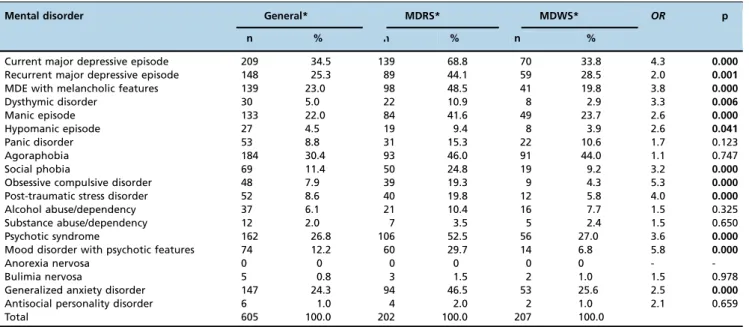
The MINI 5.0 revealed that depressive disorders, psychotic syndromes, manic and hypomanic episodes, generalized anxiety disorder, social phobias, post-traumatic stress dis-order and obsessive compulsive disdis-order are more common and statistically significant in the MDRS group (po0.05) (Table 4).
’ DISCUSSION
The average age in the three groups was 36.4 (MDRS), 39.2 (MDWS) and 37.0 years (CO). Some studies show that these averages are within the age range of patients who reported more suicide attempts in the southern region of Brazil (30 to 39 years of age) (10) and in Ceará (30 to 59 years of age) (11). A study conducted in Alagoas found that the average age of patients who reported suicide attempts was younger (20.1 years) (12), which conflicts with our study’s findings.
Most of the interviewed patients were female, perhaps because the greatest demand for health services in Arapiraca comes from women. This gender ratio may present a bias in this study; however, because suicide attempts are more frequent among women (10-13), this ratio does not negate the findings of the study. Women attempt suicide more often than men, but men choose more lethal means to achieve that purpose (10).
One study found that a higher risk of suicide exists among single and divorced/widowed people compared with married people (14). Our data corroborate this finding. However, a study conducted in southern Brazil showed that married women attempted suicide more often than other women did (10).
We found that the patients in the MDRS group had a lower level of education than patients in the other groups did. A low educational level is common among individuals who attempt suicide (10,11,13). Researchers should consider whether a low level of education may be related to a previous mental disorder that reduces the individual’s likelihood of achieving a higher level of education (15).
which could provide them with possible solutions and relief from their suffering (16). A study conducted in Ceará showed that most patients who attempted suicide were religious (96.5%) (11).
Most of the patients in the MDRS group had lower family incomes than patients in the other groups. According to the WHO (17), risk factors for suicide are social extremes, including low and high incomes. Some studies show that individuals who have attempted suicide often belong to a low economic class (5,11), particularly identifying the classes C, D and E (13).
Most of the patients in the MDRS and MDWS groups did not work, whereas most of those in the CO group worked. Mental disorders might hinder patients in the MDRS and MDWS groups from entering the labor market. Some studies show that unemployment is a risk factor for suicide attempts (5,11). However, studies have found suicide attempts among some workers (10).
A study conducted in Ceará showed that 68% of patients who attempted suicide had a history of psychiatric hospita-lization (11). In this study, it was not possible to identify how many times the patients were hospitalized to evaluate how
Table 1-General characteristics of the sample (n=605).
General data MDRS* MDWS* CO*
Age t
Mean (SD) 36.4 (11.3) 39.2 (13.4) 37.0 (12.8) 0.001
Sex
Female/Male 164/38 173/34 171/25
Marital status
Married 99 (49.0%) 137 (66.2%) 114 (58.2%)
Single/Divorced 103 (51.0%) 70 (33.8%) 82 (41.8%)
Schooling
Complete and incomplete higher education 5 (2.5%) 23 (11.1%) 46 (23.5%)
Complete and incomplete high school 40 (19.8%) 56 (27.1%) 67 (34.2%)
Complete and incomplete elementary school 157 (77.7%) 128 (61.8%) 83 (42.3%)
Religion
Religious 189 (93.6%) 193 (93.2%) 186 (94.9%)
Not religious 13 (6.4%) 14 (6.8%) 10 (5.1%)
Family income
Up to 1 minimum wage earner 119 (58.9%) 91 (43.9%) 69 (35.2%)
More than 1 minimum wage earner 83 (41.1%) 116 (56.1%) 127 (64.8%)
Employment
Yes 49 (24.2%) 81 (39.1%) 105 (53.6%)
No 153 (75.8%) 126 (60.9%) 91 (46.4%)
* MDRS: mental disorder patients and risk of suicide attempts; MDWS: mental disorder patients without risk of suicide attempts; CO: control.
Table 2-Characteristics of the health conditions of the sample (n=605).
Health conditions MDRS* MDWS* CO*
Number of hospitalizations
Up to 2 21 (10.4%) 7 (3.4%) 3 (1.5%)
More than 2 29 (14.4%) 12 (5.8%) 2 (1.0%)
None 152 (75.2%) 188 (90.8%) 191 (97.5%)
Relatives with mental disorders
Yes 120 (59.4%) 89 (43.0%) 66 (33.7%)
No 72 (35.6%) 107 (51.7%) 107 (54.6%)
Do not know 10 (5.0%) 11 (5.3%) 23 (11.7%)
Physical activity
Yes 41 (20.3%) 60 (29.0%) 52 (26.5%)
Comorbidity
Diabetes 20 (9.9%) 15 (7.2%) 9 (4.6%)
Hypertension 37 (18.3%) 32 (15.5%) 25 (12.8%)
Heart problems 10 (5.0%) 6 (2.9%) 6 (3.1%)
Other 22 (10.9%) 30 (14.5%) 20 (10.2%)
Number of suicide attempts 168 (83.2%) 42 (20.3%) 0
1 time 67 (39.9%) 26 (61.9%) 0
2 to 3 times 28 (16.7%) 7 (16.7%) 0
More than 4 times 62 (36.9%) 5 (11.9%) 0
Not reported 11 (6.5%) 4 (9.5%) 0
Current suicidal ideation
Yes 73 (36.1%) 4 (1.9%) 0
Risk of suicide (MINI)
Mild 101 (50.0%) 0 0
Moderate 12 (5.9%) 0 0
Severe 89 (44.1%) 0 0
the number of hospitalizations related to the risk of suicide attempts.
A family history of mental disorders increases the risk of suicidal behavior (2). In this study, we found that most patients in the MDRS group had relatives with mental disorders and that this was more common in the MDRS group than in other groups.
Some studies have shown that degenerative diseases contri-bute to suicidal behavior (18). A study in the Republic of Korea found that heart problems and diabetes mellitus were risk factors for suicide (19). However, a study in Australia did not identify diabetes mellitus as a risk factor for suicide (20). Our study found that patients in the MDRS group showed the highest frequency of chronic degenerative diseases, including diabetes, hypertension and heart problems.
In all three groups, we found that the ’environment’ domain performed worse than the other domains. The patients in the MDRS group showed lower quality of life when compared to the other groups. In individual terms, emotional resiliency, the ability to solve problems and certain social skills can reduce the impact of adverse environmental factors or intrapsychic factors and can counterbalance the weight of some risk factors (2). Suicide is a complex pheno-menon with various causes, and it is an important indicator of a population’s quality of life (21).
The presence of a mental disorder is one of the most important risk factors for suicide. In general, it is believed that 90% to 98% of those who commit suicide have a mental disorder (2,22,23). Our study showed that depressive dis-orders, manic episodes, hypomanic episodes, social phobias, obsessive compulsive disorder, post-traumatic stress disor-der, psychotic syndromes and generalized anxiety disorder are more common in patients in the MDRS group.
Mood disorders, particularly depressive disorders, repre-sent the most frequent diagnoses among patients with mental disorders who committed suicide (2,24,25). In addition, studies show that the presence of depression (13,26) and anxiety disorders (13,27) increases the risk of suicide.
Depression was the most common mental disorder in the MDRS group. Despite the severity of depression and the availability of effective treatments, only 30% of cases world-wide receive the necessary care (28). Estimates show that by 2020, depression will be the second most common disease and will be more prevalent in all age groups of both sexes worldwide (28).
This study suggests that urgent mental health care measures should be implemented for patients with mental disorders who present a higher risk of suicide attempts. Otherwise, there will be a considerable increase in the number of suicide attempts and, in turn, in the number of suicides.
Table 3-Average and standard deviation of domains in relation to the presence of mental disorders and the risk of suicide attempts.
Mean (SD) Physical Psychological Social relations Environment General quality of life p
General 62.3 (17.8) 63.7 (17.4) 66.0 (17.6) 53.5 (14.4) 64.1 (20.7) 0.000
MDRS* 50.5 (17.4) 51.2 (18.3) 57.4 (18.3) 46.9 (14.7) 52.9 (22.4) 0.000
MDWS* 64.0 (15.4) 65.6 (13.3) 66.6 (15.9) 53.6 (12.4) 66.3 (17.8) 0.000
CO* 72.6 (12.6) 74.4 (11.2) 74.2 (12.4) 60.0 (12.9) 72.9 (16.2) 0.000
* MDRS: mental disorder patients with risk of suicide attempts; MDWS: mental disorder patients without risk of suicide attempts; CO: control. Significant difference between the MDRS, MDWS and CO groups (p=0.000) (two-way ANOVA).
Presented correlation between the MDWS and CO groups (p=0.001) (Pearson correlation coefficient).
Table 4-Frequency of mental disorders in patients with and without risk of suicide attempts.
Mental disorder General* MDRS* MDWS* OR p
n % n % n %
Current major depressive episode 209 34.5 139 68.8 70 33.8 4.3 0.000
Recurrent major depressive episode 148 25.3 89 44.1 59 28.5 2.0 0.001
MDE with melancholic features 139 23.0 98 48.5 41 19.8 3.8 0.000
Dysthymic disorder 30 5.0 22 10.9 8 2.9 3.3 0.006
Manic episode 133 22.0 84 41.6 49 23.7 2.6 0.000
Hypomanic episode 27 4.5 19 9.4 8 3.9 2.6 0.041
Panic disorder 53 8.8 31 15.3 22 10.6 1.7 0.123
Agoraphobia 184 30.4 93 46.0 91 44.0 1.1 0.747
Social phobia 69 11.4 50 24.8 19 9.2 3.2 0.000
Obsessive compulsive disorder 48 7.9 39 19.3 9 4.3 5.3 0.000
Post-traumatic stress disorder 52 8.6 40 19.8 12 5.8 4.0 0.000
Alcohol abuse/dependency 37 6.1 21 10.4 16 7.7 1.5 0.325
Substance abuse/dependency 12 2.0 7 3.5 5 2.4 1.5 0.650
Psychotic syndrome 162 26.8 106 52.5 56 27.0 3.6 0.000
Mood disorder with psychotic features 74 12.2 60 29.7 14 6.8 5.8 0.000
Anorexia nervosa 0 0 0 0 0 0 -
-Bulimia nervosa 5 0.8 3 1.5 2 1.0 1.5 0.978
Generalized anxiety disorder 147 24.3 94 46.5 53 25.6 2.5 0.000
Antisocial personality disorder 6 1.0 4 2.0 2 1.0 2.1 0.659
Total 605 100.0 202 100.0 207 100.0
This study found that patients with mental disorders who had a risk of suicide attempts were mostly single, had a lower level of education, had a lower family income and did not work. They also experienced suicidal ideation in the previous week, had a lower quality of life and suffered from depressive disorders, manic episodes, hypomanic episodes, social phobias, obsessive compulsive disorder, post-traumatic stress disorder, psychotic syndromes and/or generalized anxiety disorder.
The management of patients with a risk of suicide must be revised to enable changes in the patients’quality of life and the care devoted to the mental disorders identified. A patient who does not receive the necessary care may be more likely to attempt suicide. Therefore, offering a mental health service network that facilitates patients’access to care may reduce or prevent suicide attempts and contribute to the improvement of these patients’quality of life.
The limitation of this study is related to the difficulty of interviewing men in health services in Arapiraca. A more homogeneous sample with regard to sex would make it possible to identify the profile of mental disorders, suicide attempts and quality of life in both sexes, although men do not usually attend this type of service.
’ ACKNOWLEDGMENTS
The authors are grateful for the support of the National Council for Scientific and Technological Development.
’ AUTHOR CONTRIBUTIONS
Alves VM designed the study, wrote the protocol, managed the literature searches, analyzed the data, wrote the manuscript and performed the statistical analyses. Lima Francisco LC, Pereira Belo FM, de-Melo-Neto VL and Barros VG analyzed the data and wrote the manuscript. Nardi AE contributed to a critical review of the paper. This research is part of a doctoral thesis in Psychiatry and Mental Health by Veronica de Medeiros Alves, Institute of Psychiatry, Federal University of Rio de Janeiro. All authors contributed to and approved thefinal manuscript.
’ REFERENCES
1. WHO - World Health Organization. Preventing suicide: a global imperative. 2014.
2. Bertolote JM, Mello-Santos C, Botega NJ. Detecc¸ão do risco de suicídio
nos servic¸os de emergência psiquiátrica. Rev Bras Psiquiatr. 2010;32(SII):
87-95, http://dx.doi.org/10.1590/S1516-44462010000600005.
3. Organizac¸ão Pan-Americana da Saúde. Ministério da Saúde.
Uni-versidade Estadual de Campinas. Prevenc¸ão do suicídio. Manual dirigido
a profissionais das equipes de saúde mental. Brasília: Organizac¸ão
Pan-Americana da Saúde. Ministério da Saúde. Universidade Estadual de Campinas. 2006.
4. Bertolote JM, Fleischmann A. A global perspective on the magnitude of suicide mortality. In: Wasserman D, Wasserman C, editors. Oxford text-book of suicide and suicide prevention. Oxford: Oxford University Press. 2009;7(2):91-98.
5. Gonc¸alves LRC, Gonc¸alves E, Oliveira Júnior LB. Determinantes espaciais
e socioeconômicos do suicídio no Brasil: uma abordagem regional. Nova Economia. 2011;21(2):281-316, http://dx.doi.org/10.1590/S0103-63512011000200005.
6. Abreu KP, Lima MADS, Kohlrausch E, Soares JSF. Comportamento suicida: fatores de risco e intervenc¸ões preventivas. Rev Eletrôn Enf. 2010;12:195-200.
7. Lecrubier Y, Weiller E, Hergueta T, Amorim P, Bonora LI, Sheehan JPD, et al. M.I.N.I. Mini International Neuropsychiatric Interview. M.I.N.I. 5.0.0 Brazilian version/DSM IV/1999.
8. Fleck MPA, Louzada S, Xavier M, Chachamovich E, Vieira G, Santos L, et al. Aplicac¸ão da versão em português do instrumento abreviado de
avaliac¸ão da qualidade de vida‘‘WHOQOL-bref’’. Rev Saúde Púb. 2000;
34(2):178-183.
9. Beck AT, Steer RA. Manual for Beck Scale for Suicide Ideation. San Antonio: Psychological Corporation. 1991.
10. Ferreira VRT, Trichê VJS. Epidemiological Profile of Suicide Attempts and Deaths in a Southern Brazilian City. Psico. 2014; 45(2):219-27.
11. Oliveira MIV, Bezerra Filho JG, Lima MVN, Ferreira CF, Garcia LU, Goes LSP. Características psicossociais de usuários de um Centro de Atenc¸ão
Psicossocial com história de tentativa de suicídio. Revista Electrónica en Salud Mental, Alcohol y Drogas. 2013;9(3):136-43, http://dx.doi.org/ 10.11606/issn.1806-6976.v9i3p136-143.
12. Magalhães APN, Alves VM, Comassetto I, Lima PC, Faro ACM, Nardi AE. Atendimento a tentativas de suicídio por servic¸o de atenc¸ão
pré-hospitalar. J Bras Psiquiatr. 2014;63(1):16-22, http://dx.doi.org/10.1590/ 0047-2085000000003.
13. Molina MRAL, Wiener CD, Branco JC, Jansen K, Souza LDM, Tomasi E. Prevalência de depressão em usuários de unidades de atenc¸ão primária
Prevalence of depression in users of primary care settings. Rev Psiquiatr Clín. 2012;39(1):194-7.
14. Bando DH, Brunoni AR, Fernandes TG, Benseñor IM, Lotufo PA. Suicide rates and trends in São Paulo, Brazil, according to gender, age and demographic aspects: a joinpoint regression analysis. Rev Bras Psiquiatr. 2012;34(3):286-93, http://dx.doi.org/10.1016/j.rbp.2012.02.001. 15. Bezerra Filho JG, Werneck GL, Almeida RLF, Oliveira MIV, Magalhães FB.
Estudo ecológico sobre os possíveis determinantes socioeconômicos, demográficos e fisiográficos do suicídio no Estado do Rio de Janeiro, Brasil, 1998-2002. Cad Saúde Púb. 2012; 28(5):833-44.
16. Câmara MC, Pereira MAO. Percepc¸ões de transtorno mental de usuários
da Estra- tégia Saúde da Família. Rev Gaúcha Enf. 2010; 31(4):730-7. 17. Organizac¸ão Mundial da Saúde. Prevenc¸ão do suicídio: um manual para
médicos clínicos gerais. Genebra: Organizac¸ão Mundial da Saúde. 2000.
18. Minayo MCS, Cavalcante FG. Estudo compreensivo sobre suicídio de mulheres idosas de sete cidades brasileiras. Cad Saúde Púb. 2013; 29(12): 2405-15.
19. Cho J, Jung SH, Kim C, Suh M, Choi YJ, Sohn J, Cho S-K, et al. Suicide loss, changes in medical care utilization, and hospitalization for cardiovascular disease and diabetes mellitus. Eur Heart J. 2015 Sep 14. pii: ehv448. [Epub ahead of print], http://dx.doi.org/10.1093/eurheartj/ehv448.
20. Davis WA, Starkstein SE, Bruce DG, Davis TME. Risk of suicide in Aus-tralian adults with diabetes: the Fremantle Diabetes Study. Intern Med J. 2015;45(9):976-80, http://dx.doi.org/10.1111/imj.12853.
21. Heck RM, Kantorski LP, Borges AM, Lopes CV, Santos MC, Pinho LB. Ac¸ão
dos profissionais de um centro de atenc¸ão psicossocial diante de usuários
com tentativa e risco de suicídio. Tex Contexto Enf. 2012;21(1):26-33. 22. Mejías Y, García Caro MP, Schmidt J, Quero A, Gorlat B. Estudio
pre-liminar de las características del intento de suicidio en la provincia de granada. Anales del Sistema Sanitario de Navarra. 2011; 34(3):431-41, http://dx.doi.org/10.4321/S1137-66272011000300009.
23. OPAS. Prevenc¸ão ao suicídio: Manual dirigido a profissionais da saúde da
Atenc¸ão Básica. Ministério da Saúde–Brasil, Organizac¸ão Pan-Americana
da Saúde e UNICAMP. 2009.
24. Fernández AS, Cortés MJ, Guede EA, Astiz EM. Protocolo de manejo del paciente con riesgo de suicídio. Medicine. 2011; 10(85):5782-5, http://dx. doi.org/10.1590/S1516-44462010000200021.
25. Rocca CCA, Gerchmann L, Abreu LN, Lafer B. Lifetime history of suicide attempts is associated with poorer social skills in patients with bipolar disorder type I. Rev Bras Psiquiatr. 2010;32(2):200-201.
26. Negrín-Calvo Y, Toledo-Prado J, Cabrales-Escobar J, Carpio-Muñoz E, Muro-García A, Oria-Barreto E. Factores de riesgo asociados al suicidio en el municipio Sancti Spíritus en el quinquenio 2005-2009. Revista Finlay. 2013;3(1):60-7.
27. García-Rábago H, Sahagún-Flores JE, Ruiz-Gómez A, Sánchez-Ureña GM, Tirado-Vargas JC, González-Gámez JG. Factores de riesgo, asociados a intento de suicidio, comparando factores de alta y baja letalidade. Rev salud púb. 2010;12(5):713-21.