1 Universidade de São Paulo, Instituto de Biociências, Departamento de Botânica, São Paulo, SP, Brazil 2 Universidade Federal de Rio de Janeiro, Museu Nacional, Departamento de Botânica, Rio de Janeiro, RJ, Brazil
Pollen morphology of the genus
Eremanthus
Less.
(Vernonieae, Asteraceae)
RESUMO
(Morfologia polínica de espécies do gênero Eremanthus Less. (Vernonieae, Asteraceae)).Com a fi nalidade de avaliar a importância da morfologia polínica para a taxonomia de Eremanthus (Vernonieae, Asteraceae) em nível genérico e infragenérico e fornecer dados adicionais para a sua reconstrução fi logenética, os grãos de pólen de 20 das 23 es-pécies do gênero foram examinados usando a microscopia de luz e eletrônica de varredura. Os grãos de pólen foram acetolisados, medidos, descritos e ilustrados sob microscópio de luz. Para a análise em microscópio eletrônico de varredura foram utilizados grãos de pólen com e/ou sem tratamento químico. As espécies apresentaram grãos de pólen isopolares, oblato-esferoidais, na maioria dos táxons, mais raramente prolato-esferoidais ou suboblatos, âmbito subtriangular, tricolporados e subechinolofados. A variação entre os caracteres quantitativos não se correlacionam com a subdivisão macromorfológica do gênero nem com os limites genéricos ou específi cos.
Palavras-chave: Lychnophorinae, Compositae, taxonomia, palinologia
Benoît Loeuille1, Raquel Maria Batista Souza-Souza2, Vanessa Holanda Righetti Abreu2, Cláudia Barbieri Ferreira Mendonça2 and Vania Gonçalves-Esteves2,3
ABSTRACT
(Pollen morphology of the genus Eremanthus Less. (Vernonieae, Asteraceae)). In order to evaluate the signifi cance of the pollen morphology for generic and infrageneric taxonomy of the genus Eremanthus (Vernonieae, Asteraceae), and to provide additional data for its phylogenetic reconstruction, the pollen of 20 of the 23 species of the genus was examined using light and scanning electron microscopy. Acetolysed pollen grains were measured, described, and illus-trated using light microscopy, while non-acetolysed pollen grains were analyzed using scanning electron microscopy. Pollen grains of these species are isopolar, oblate-spheroidal in most of the species, more rarely prolate spheroidal or suboblate, subtriangular amb, tricolporate and subechinolophate. Th e variation among quantitative characters does not correlate with the macromorphological subdivision of the genus or with the generic or specifi c limits.
Key words: Lychnophorinae, Compositae, taxonomy, palynology Recebido em 2/10/2011. Aceito em 7/11/2011
Introduction
Th e tribe Vernonieae Cass. (Asteraceae) contains c. 1500 species distributed mostly in the tropical parts of the world with two major centers of diversifi cation: southeastern Brazil and the central region of Africa (Robinson 1999, 2006/2007; Keeley & Robinson 2009). Th e 129 genera are placed into 21 subtribes mainly defi ned by their infl orescence pattern, pollen morphology, chemical composition and chromo-some number (Keeley & Robinson 2009). Lychnophorinae is one of the biggest subtribes of Vernonieae, and includes ca. 100 species (11 genera) from the cerrado and campos rupestres of Brazil. Th is subtribe is defi ned by the lack of enlarged nodes or sclerifi ed cells at the base of the styles, usually the extensive presence of a pubescence of T-shaped
hairs, presence of sclerifi ed cells and lack of glands on the anther appendages (Robinson 1992, 1999, 2007; Keeley & Robinson 2009).
Eremanthus, a genus of c. 23 species, endemic to Brazil, is a typical element of the cerrado and campo rupestre fl oras (Keeley & Robinson 2009). Robinson (1980) excluded her-baceous elements from Eremanthus and MacLeish (1984, 1987) recircumscribed the genus synonymising Vanillos-mopsis (with deciduous inner pappus setae) under Ereman-thus (with persistent inner pappus setae) and transferring nine species from Eremanthus to Vernonia. Robinson (1999) restricted the concept of Vernonia to North American taxa, and therefore had to reintegrate fi ve of the latter excluded species into Eremanthus—E. crotonoides (DC.) MacLeish,
Barroso and E. veadeiroensis H. Rob.—without specifi c
morphological investigations. Th e narrower concept of
Eremanthus, i.e., including Vanillosmopsis but not Paralych-nophora (MacLeish 1987, Hind 2000), is here followed (for a diff erent point of view, see Robinson 1997, 1999, 2006/2007). Pollen characters of Asteraceae have been shown to be particularly variable and form useful patterns in the context of phylogenies. Such patterns could be used to support hypotheses of relationships, or provide diagnostic characters for groups at diff erent levels (Wortley et al. 2007,
Wortley et al. 2008, Blackmore et al. 2009). Blackmore et al. (2009) noticed that Vernonieae provides an example where a large number of pollen characters are congruent with the relationships presented in the Asteraceae supertree (Funk et al. 2005). Blackmore et al. (2009) provide
puta-tive synapomorphies for groups, most of them concern-ing African clades. Vernonieae pollen grains are usually lophate or sublophate, tricolporate or triporate, with either a continuous or discontinuous punctate or micropunctate tectum, and are with or without spines (Keeley & Robinson 2009; for a detailed description see Blackmore et al. 2009). Th e large pollen diversity of the tribe has been used exten-sively in taxonomic delimitations at generic and subtribal levels (Jones 1979, 1981, Bolick & Keeley 1994; Keeley & Robinson 2009). Kingham (1976) created six pollen Types (I–VI) for the tribe, based on the study of 85 species (mostly African). Keeley and Jones (1977, 1979) also identifi ed six basic Types (A–F) to which additional variations have been added (Robinson 1999). Currently, ten pollen Types are recognised for the tribes (Dematteis & Pire 2008). Using mainly the classifi cation of Keeley and Jones, several authors have analysed and described pollen grains of Vernonieae, mostly of Vernonia s.l. (Keeley & Jones 1977, 1979; Jones 1979, 1981; Robinson 1987a,b,c, 1988a,b,c, 1990; Skvarla et al. 2005; Mendonça & Gonçalves-Esteves 2000; Mendonça
et al. 2007a,b,c, 2009, 2010; Dematteis & Pire 2008; Angulo & Dematteis 2010).
Th e pollen grains of Lychnophorinae are tricolporate, echinate, sublophate with a perforated tectum continuous between colpi (Type “A”) (Robinson 1992, 1999; Keeley & Robinson 2009). Th e endoaperture is usually lalongate (Peçanha et al. 2008). Th e Type “A” pollen is considered a reversion from more strongly lophate ancestors in the Vernonieae, but it is nevertheless one of the most common forms in the tribe and is consistent in many groups such as the Piptocarphinae, Vernonia s.s. and Vernonanthura
(Robinson 1990, 1992, 1999). Robinson (1999) suggested that due to common reversion of lophate pollen to Type “A”, co-occurrence in diff erent groups of the Vernonieae may have little phylogenetic signifi cance.
Th e pollen Type of Eremanthus was initially described by Stix (1960) (based on E. glomerulatus Less. and E. poly-cephalus (DC.) MacLeish) as Lychnophora-type, and latter called Type “A” by Keeley and Jones (1979). Kingham (1976) assigned the pollen of E. crotonoides (as Vernonia
crotonoi-des DC.) to his category VI: grains spherical, tricolporate,
micropunctate, subechinolophate tending to echinate. Peçanha et al. (2008) described pollen grains of Paralych-nophora bicolor (DC.) MacLeish (as E. bicolor (DC.) Baker) and E. erythropappus (DC.) MacLeish (as Vanillosmopsis erythropappa (DC.) Baker). Th is study revealed some in-teresting variation of the exine pattern at the generic level:
Paralychnophora having a sublophate exine and Eremanthus
a subechinolophate one. Peçanha et al. (2008) concluded that their data do not support the inclusion of Vanillosmopsis
in Eremanthus (inclusion made by MacLeish in 1987). Such conclusion however cannot be considered valid, since they actually compared pollen grains of Paralychnophora with
Eremanthus subg. Vanillosmopsis MacLeish, and not the latter with E. subg. Eremanthus Sch. Bip. as intended.
Th e present study aimed to conduct a comprehensive examination of the pollen morphology in the genus Er-emanthus, using LM and SEM, with almost complete
spe-cies coverage, in order to evaluate the signifi cance of this structure for generic and infrageneric taxonomy and to provide additional data for the phylogenetic reconstruction.
Materials and methods
Pollen grains of 20 species of Eremanthus were examined (see Appendix). Th e samples were obtained from anthers of fl ower buds from specimen kept at the herbaria ESA, HRB, HUEFS, IBGE, MBM, SP, SPF, UB and UEC; acronyms ac-cording to Holmgren et al. (1990).
Th e terminology used for descriptions follows Punt et al. (2007), taking into consideration size, form, number of apertures and the ornamentation of the sexine. For the light microscopy (LM) study, the pollen grains were pho-tomicrographed with a Sony Cyber-shot DSC-W7 digital camera coupled with a Zeiss Axiostar Plus microscope. For scanning electron microscopy (SEM), acetolysed and non-acetolysed pollen samples were placed on aluminium stubs covered with carbon tape and sputter-coated with a thin layer of gold palladium (c. 150 Å). Th e samples were analysed using a ZEISS DS M960 microscope at Laboratório de Ultraestrutura Celular Hertha Meyer, Inst. de Biofísica (UFRJ) and a JEOL JSM-5800 microscope at Departamento de Invertebrados do Museu Nacional (UFRJ).
Pollen grains were prepared for light microscopy by the acetolysis method of Erdtman (1952), modifi ed by Melhem
et al. (2003). Measurements in equatorial view (PD= polar diameter and ED=equatorial diameter) were randomly taken on 25 pollen grains per sample. Measurements of equatorial diameter from polar view (EDPV) and apocolpus were randomly taken on 10 pollen grains distributed on, at least, three diff erent slides.
range. For the measurements of the other characteristics, such as endoapertures size, layers of exine and pollen grain diameters of comparison material, the arithmetic mean of 10 measurements were calculated randomly chosen from, at least, three diff erent slides (Salgado-Labouriau et al. 1965; Salgado-Labouriau 1973).
Results
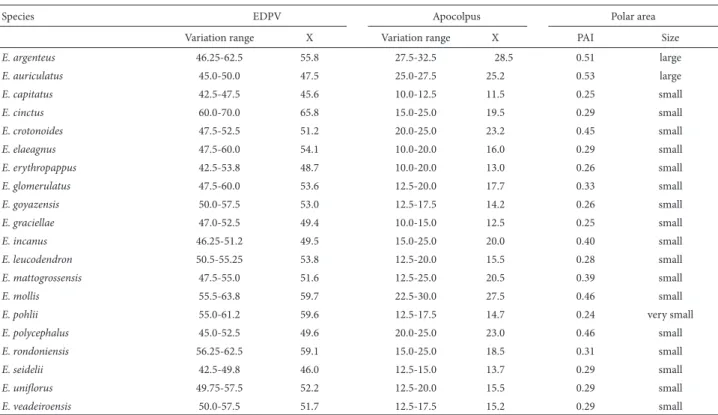
The palynological description has been organised according to the following characteristics: size, polarity, shape, apertures and exine surface. Th e results of the mea-surements are summarized in Tab. 1-3, Fig. 1-5.
Polarity, size and shape
Pollen grains are isopolar, large, medium sized only in
E. auriculatus (Fig. 1D), E. capitatus, E. erythropappus, E. polycephalus, E. seidelii and E. veadeiroensis, oblate spheroidal in most species, prolate spheroidal in E. argenteus and E. veadeiroensis, suboblate in E. unifl orus, subtriangular amb, small polar area in most species, very small in E. pohlii and large in E. argenteus and E. auriculatus (Tab. 1, 2).
Apertures
Pollen grains are 3-colporate; colpus long (values range from 23.9 μm in E. auriculatus and E. capitatus to 33 μm in
E. elaeagnus); colpus wide, width varying from 4.6 μm (E. mattogrossensis) to 9.1 μm and 9.6 μm (E. elaeagnus and
E. glomerulatus). Th e endoapertures are lalongate (smallest diameter: 1.6 μm in E. mollis; largest one: 6.8 μm in E. mattogrossensis) (Tab. 3). Some species have endoapertures with a median constriction, as in E. capitatus (Fig. 1I), E. crotonoides (Fig. 2C), E. erythropappus (Fig. 2I), E. graciellae
(Fig. 3E), E. leucodendron (Fig. 3K), E. polycephallus (Fig. 4H), E. rondoniensis (Fig. 4K), E. unifl orus (Fig. 5F). Exine
Th e exine is thick: values range from 5.1 (E. rondoniensis) to 13.5 mm (E. argenteus). Th e sexine is subechinolophate, muri tall, sinuous, densely microperfurate at the base of muri and one microperfuration at the base of spine. Th e spines show variation in size: the longest spines were found in E. pohlii (12.2 μm) (Fig. 4F) and the shortest ones in E. veadeiroensis (4 μm) (Fig. 5H), the width of the spines ranges from 2 (E. veadeiroensis) to 7.4 μm (E. incanus). Th e dis-tance between the spines varies widely, ranging from 3.4 (E. veadeiroensis) to 11.4, 11.7 and 11.8 mm (E. glomerulatus,
E. pohlii and E. unifl orus, respectively). Th e sexine is always thicker than the nexine (Tab. 3).
Discussion
In the present study 20 species of Eremanthus were analysed (87% of the species), including all taxa placed by
Robinson (1999) in the genus (except Paralychnophora
spe-cies). Th e pollen of Eremanthus is isopolar, oblate spheroidal in most of the species, more rarely prolate spheroidal or suboblate, subtriangular amb, tricolporate and subechinolophate, i.e., corresponding to Type «A». Many of the quantitative characters have some variability, however the results show considerable overlap between species. Th erefore, it was not possible to construct a palynological key to identify the species or to defi ne some pollen subtypes.
Th e pollen shape is the only qualitative character that varies in the genus. Eremanthus argenteus MacLeish & H. Schumach. and E. veadeiroensis H. Rob. have prolate spheroidal pollen grains, the former belongs to the subg.
Eremanthus and the latter was not included in Eremanthus
by MacLeish (1984, 1987) because of its densely pubescent stems, loose infl orescence and a large number of fl orets per capitulum (8–11); these three characters are uncommon within the genus. Phylogenetic analyses based on molecu-lar and morphological data (Loeuille 2011) have indicated that E. veadeiroensis is closely related to E. elaeagnus (Mart. ex DC.) Sch. Bip. of subg. Pseuderemanthus. Th e two spe-cies of subg. Pseuderemanthus (E. elaeagnus and E. seidelii
MacLeish & H. Schumach.) have, nonetheless, an oblate spheroidal pollen as the majority of the species. Eremanthus argenteus belongs to E. subg. Eremanthus sect. Synglomeru-lus MacLeish & H. Schumach. characterised by its simple cyme synfl orescence. Th e two others species of this section (E. auriculatus MacLeish & H. Schumach. and E. cinctus
Baker) have an oblate spheroidal pollen shape, not prolate spheroidal like E. argenteus.
Th e subg. Vanillosmopsis is composed of eight species, six of them are included in this study: Eremanthus capitatus
(Spreng.) MacLeish, E. erythropappus (DC.) MacLeish,
E. graciellae MacLeish & H. Schumach., E. pohlii (Baker) MacLeish, E. polycephalus (DC.) MacLeish and E. unifl orus
MacLeish & H. Schumach. No palynological characters have been found to characterise this subgenus. Based on a macromorphological analysis, Loeuille et al. (in prep.) sug-gested that E. capitatus, E. graciellae and E. pohlii are conspe-cifi c. Th e quantitative characters vary conspicuously between the three species, a variation that encompasses the subgeneric categories, E. pohlii having more similar pollen grains of the species of subg. Eremanthus than of subg. Vanillosmopsis.
Th e results of phylogenetic analyses (Loeuille 2011) have indicated that E. crotonoides, E. leucodendron and E. pabstii
are not closely related to the genus Eremanthus. Again, our
palynological data did not show any diff erence between these species and the rest of the genus.
The presence of meaningless differences in pollen between closely related species of the tribe Vernonieae has already been documented. For instance, in the small genus
Table 1. Pollen characters (m) in equatorial view of Eremanthus species (n = 25).
Species PD ED PD/ED
Variation range X±SDX IC (95%) Variation range X±SDX IC (95%)
E. argenteus 47.5-57.5 52.4+0.5 51.4-53.4 40.0-62.5 51.6+0.9 49.8-53.4 1.01
E. auriculatus 40.0-57.5 45.0+0.7 43.6-46.4 42.5-52.5 48.0±0.5 47.0-49.0 0.93
E. capitatus 37.5-47.5 41.6+0.5 40.6-42.6 35.0-50.0 45.8+0.6 44.6-47.0 0.90
E. cinctus 55.0-67.5 61.2+0.5 60.2-62.2 61.8-72.5 67.7+0.5 66.7-68.7 0.90
E. crotonoides 42.5-52.5 46.1+0.3 45.5-46.7 45.0-60.0 51.1+0.5 50.1-52.1 0.90
E. elaeagnus 47.5-55.5 52.5+0.3 51.9-53.1 20.0-62.5 55.9+0.5 54.9-56.9 0.93
E. erythropappus 37.5-55.0 44.8+0.7 43.4-46.2 42.5-57.5 49.7+0.8 48.1-51.3 0.90
E. glomerulatus 48.0-61.2 53.7+0.6 52.5-54.9 52.5-61.2 56.3+0.5 55.3-57.3 0.95
E. goyazensis 47.5-55.0 51.5+0.3 50.9-52.1 50.0-57.5 52.9+0.3 52.3-53.5 0.97
E. graciellae 45.0-50.0 47.1+0.3 46.4-47.8 47.5-55.0 50.6+0.4 49.8-51.4 0.93
E. incanus 42.5-55.0 47.4+0.6 46.2-48.6 47.5-57.5 51.3+0.5 50.3-52.3 0.92
E. leucodendron 47.5-55.0 51.0+0.4 50.2-51.8 52.5-62.5 56.2+0.4 55.4-57.0 0.90
E. mattogrossensis 48.8-55.0 52.2+0.4 51.4-53.0 50.0-57.5 53.5+0.4 52.7-54.3 0.97
E. mollis 50.0-60.0 56.2+0.4 55.4-57.0 55.0-65.0 61.6+0.5 60.6-62.6 0.91
E. pohlii 52.5-62.5 57.7+0.4 56.9-58.5 57.5-65.2 61.6+0.4 60.8-62.4 0.93
E. polycephalus 40.0-52.5 46.0+0.5 45.0-47.0 46.2-53.8 49.2+0.4 48.4-50.0 0.93
E. rondoniensis 52.5-62.5 57.7+0.6 56.5-58.9 57.5-67.5 61.7+0.5 60.7-62.7 0.93
E. seidelii 40.0-46.2 43.2+0.3 42.6-43.8 45.0-50.0 47.3+0.2 46.9-47.7 0.91
E. unifl orus 42.5-50.0 47.0+0.3 46.4-47.6 50.0-54.0 53.9+0.5 52.9-54.9 0.87
E. veadeiroensis 37.5-45.0 41.2+0.4 40.4-42.0 35.0-40.0 38.0+0.3 37.4-38.6 1.08
PD - polar diameter; ED – equatorial diameter; X – means; SDX - standard deviations of the mean; IC – confi dence interval
Table 2. Pollen characters (m) in polar view of Eremanthus species (n = 10).
Species EDPV Apocolpus Polar area
Variation range X Variation range X PAI Size
E. argenteus 46.25-62.5 55.8 27.5-32.5 28.5 0.51 large
E. auriculatus 45.0-50.0 47.5 25.0-27.5 25.2 0.53 large
E. capitatus 42.5-47.5 45.6 10.0-12.5 11.5 0.25 small
E. cinctus 60.0-70.0 65.8 15.0-25.0 19.5 0.29 small
E. crotonoides 47.5-52.5 51.2 20.0-25.0 23.2 0.45 small
E. elaeagnus 47.5-60.0 54.1 10.0-20.0 16.0 0.29 small
E. erythropappus 42.5-53.8 48.7 10.0-20.0 13.0 0.26 small
E. glomerulatus 47.5-60.0 53.6 12.5-20.0 17.7 0.33 small
E. goyazensis 50.0-57.5 53.0 12.5-17.5 14.2 0.26 small
E. graciellae 47.0-52.5 49.4 10.0-15.0 12.5 0.25 small
E. incanus 46.25-51.2 49.5 15.0-25.0 20.0 0.40 small
E. leucodendron 50.5-55.25 53.8 12.5-20.0 15.5 0.28 small
E. mattogrossensis 47.5-55.0 51.6 12.5-25.0 20.5 0.39 small
E. mollis 55.5-63.8 59.7 22.5-30.0 27.5 0.46 small
E. pohlii 55.0-61.2 59.6 12.5-17.5 14.7 0.24 very small
E. polycephalus 45.0-52.5 49.6 20.0-25.0 23.0 0.46 small
E. rondoniensis 56.25-62.5 59.1 15.0-25.0 18.5 0.31 small
E. seidelii 42.5-49.8 46.0 12.5-15.0 13.7 0.29 small
E. unifl orus 49.75-57.5 52.2 12.5-20.0 15.5 0.29 small
E. veadeiroensis 50.0-57.5 51.7 12.5-17.5 15.2 0.29 small
Figure 5. LM and SEM photomicrographs of the pollen grains of Eremanthus. A–C. E. seidelii – polar view: A. Cross section; B. Detail of surface (SEM); C. Equatorial view, aperture. D–F. E. unifl orus – polar view: D. Cross section; E. Surface of apocolpium; F. Equatorial view, aperture. G–I. E. veadeiroensis – polar view: G. Cross section; equatorial view: H. Cross section; I. Aperture. Barras = 10 mm.
Cass. (Robinson & Kahn 1986). Th e case of Eremanthus is slightly diff erent because the only variation is found in the quantitative characters, which are usually more diffi cult to interpret. Th e pollen grains of the species here analysed are typically subechinolophate and not sublophate, i.e., not Type «A» sensu Keeley & Jones (1979) (echinate to sublophate, continuous and microperforate tectum, spines on the ridges of sublophate grains). Th erefore one might consider that the Eremanthus species are a modifi ed Type «A» (subechinolophate).
groups (especially the Lepidaploa complex) could not be used as a general rule in the tribe.
The absence of variable qualitative characters and the fact that quantitative characters show a high level of homoplasy limit greatly the use of palynological data to reconstruct the phylogeny of the subtribe Lychnophorinae. Keeley & Robinson (2009) arrived at a similar conclusion for Vernonieae. Nonetheless, because Peçanha et al. (2008) found sublophate pollen in Paralychnophora bicolor, it would be valuable to analyse the pollen grains of more species of that genus and of other genera of the subtribe Lychnophori-nae to evaluate how frequent the sublophate pattern occurs and if it could be used in a systematic context.
Conclusions
Pollen Type “A” is present in all the species of the genus
Eremanthus. No qualitative variation has been found in dif-ferent species and the variation of quantitative characters does not correlate with the macromorphological subdivision of the genus at the generic or specifi c limits. Th ese results in-dicate that palynological data might not be variable enough to be relevant in the delimitation at the specifi c level and probably at the generic level in the subtribe Lychnophorinae.
Acknowledgements
Th e authors acknowledge Noêmia Rodrigues Gonçalves (Lab. de Ultraestrutura Celular do Inst. de Biofísica da Univ. Federal do Rio de Janeiro) for the technical support, and FAPERJ (Proc. E-26/110.953/09, supplies for the lab and grant for and fellowship support to the second author), CNPq (fellowship supports for the fi rst, third and last au-thors), and CAPES (fellowship support to the last author) for the fi nancial support.
Specimens investigated
Eremanthus argenteus MacLeish & H. Schumach. BRAZIL, Goiás, Teresina de Goiás, Chapada dos Veadeiros, Souza 24698 (ESA). E. auriculatus MacLeish & H. Schumach. BRAZIL, Goiás, Alto Paraíso,
Chapada dos Veadeiros. Loeuille 279 (SPF).
E. capitatus (Spreng) MacLeish. BRAZIL: Bahia, Salvador, Metropolitan Park Pituaçu, Teles 35 (SPF).
E. cinctus Baker. BRAZIL: Goiás, Chapadão do Céu, National Park of Emas, Batalha 3038 (SPF).
E. crotonoides Sch. Bip. BRAZIL: Minas Gerais, Santa Bárbara, Serra do Caraça, Pirani 338 (SPF).
E. elaeagnus (Mart. ex DC.) Sch. Bip. BRAZIL: Minas Gerais, Diamantina, road to Conselheiro Mata, Arbo 4385 (SPF).
E. erythropappus (DC.) MacLeish. BRAZIL: Minas Gerais, Datas, Morro do Coco, Mello-Silva CFCR 7997 (SPF).
E. glomerulatus Less. BRAZIL: Bahia, Abaíra, Catolés, Mata do Bem Querer, Ganev 271 (SPF).
Table 3. Pollen measurements (m) of endoapertures and exine layers of Eremanthus species (n = 10).
Species Colpus Endoaperture Exine layers Spine
length width length width Exine Nexine Sexine* Sexine** length width distance***
E. argenteus 25.6 5.5 2.8 11.3 13.5 1.0 12.5 1.1 11.4 6.4 10.7
E. auriculatus 23.9 5.2 4.4 5.4 9.6 1.0 8.6 1.0 7.6 5.2 7.9
E. capitatus 23.9 5.0 4.2 5.0 10.8 1.0 9.8 1.0 8.8 4.4 8.6
E. cinctus 29.4 7.7 4.6 10.9 7.2 0.9 6.3 0.9 5.4 3.7 6.1
E. crotonoides 24.3 6.1 5.7 26.1 11.9 0.9 11.0 0.9 10.1 4.9 9.9
E. elaeagnus 33.0 9.1 4.0 14.9 12.1 1.0 11.1 1.6 9.5 6.9 10.5
E. erythropappus 28.9 7.1 5.8 7.1 12.3 1.8 10.5 2.1 8.4 5.0 8.3
E. glomerulatus 31.3 9.6 4.9 9.6 13.2 1.8 11.4 1.4 10.0 6.0 11.8
E. goyazensis 29.4 7.2 5.7 11.2 12.3 1.0 11.3 1.2 10.1 5.6 10.7
E. graciellae 28.8 6.1 4.2 9.9 11.8 1.1 10.7 1.3 9.4 5.5 10.2
E. incanus 25.5 5.2 4.1 8.7 12.5 1.2 11.3 1.2 10.3 7.4 10.7
E. leucodendron 32.1 7.3 5.9 12.4 12.6 1.1 11.5 1.2 10.3 5.9 10.7
E. mattogrossensis 28.3 4.6 6.8 7.5 10.4 1.1 9.3 1.0 8.3 4.5 7.7
E. mollis 23.2 5.3 1.6 12.5 11.0 1.0 10.0 1.0 9.0 5.4 5.9
E. pohlii 31.0 6.4 5.2 10.7 14.3 1.0 13.3 1.1 12.2 6.3 11.7
E. polycephalus 24.6 5.8 4.2 11.0 11.5 1.0 10.5 1.0 9.5 5.9 8.9
E. rondoniensis 31.2 6.7 6.1 11.7 5.1 0.9 4.2 0.9 4.3 2.8 4.0
E. seidelii 27.3 5.3 4.1 8.1 10.2 1.0 9.2 1.0 8.2 4.9 9.0
E. unifl orus 28.3 5.9 4.0 9.7 12.6 1.3 11.3 1.0 10.3 5.6 11.4
E. veadeiroensis 25.5 5.2 4.1 13.8 6.0 1.0 5.0 1.0 4.0 2.0 3.4
E. goyazensis (Gardner) Sch. Bip. BRAZIL: Goiás, Alto Paraíso, Chapada dos Veadeiros, Moraes 644 (UEC).
E. graciellae MacLeish & H. Schumach. BRAZIL: Bahia, Correntina, Biological Reserve Fazenda Jatobá, Aparecida da Silva 1527 (UB). E. incanus (Less.) Less. BRAZIL: Minas Gerais, Diamantina, Cachoeira
da Sentinela, Stehmann 2683 (ESA).
E. leucodendron Mattf. BRAZIL: Bahia, Rio de Contas, Pico de Itabira, Harley PCD 4277 (SPF).
E. mattogrossensis Kuntze. BRAZIL: São Paulo, Pedregulho, Estreito, Sasaki 527 (SPF).
E. mollis Sch. Bip. BRAZIL:Minas Gerais, Capitólio, Represa de Furnas, Vichnewski s.n. (UEC n° 19067).
E. pohlii (Baker) MacLeish. BRAZIL: Minas Gerais, São Gonçalo do Abaeté, Hatschbach, G. 67936 (MBM).
E. polycephalus (DC.) MacLeish. BRAZIL: Minas Gerais, Grão Mogol, estrada para Virgem da Lapa, Souza 25838 (SPF).
E. rondoniensis MacLeish & H. Schumach. BRAZIL: Mato Grosso, Arenápolis, Chapada dos Parecis, Hatschbach 62692 (MBM). E. seidelii MacLeish & H. Schumach. BRAZIL: Minas Gerais, Formiga,
Schumacher 3027 (UEC).
E. unifl orus MacLeish & H. Schumach. BRAZIL: Goiás, Alto Paraíso, National Park Chapada dos Veadeiros, Mendonça 2246 (IBGE). E. veadeiroensis H. Rob. BRAZIL: Goiás, Alto Paraíso, Chapada dos
Veadeiros, King 8831 (UB).
References
Angulo, M.B. & Dematteis, M. 2010. Pollen morphology of the South American genus Lessingianthus (Vernonieae, Asteraceae) and its taxonomic implications. Grana49: 12-25.
Blackmore, S. 2000. The palynological compass: the contribution of palynology to systematics. Pp. 161-177. In Nordenstam, B. El-Ghazaly, G. & Kassas, M. (Eds.). Plant Systematics for the 21st Century London, Portland Press.
Blackmore, S.; Wortley, A.H.; Skvarla, J.J. & Robinson, H. 2009. Evolution of pollen in the Compositae. Pp. 101-130. In Funk, V.A.; Susanna, A.; Stuessy, T.F. & Bayer, R.J. (Eds), Systematics, evolution and biogeography of Compositae. Wien, IAPT.
Bolick, M.R. & Keeley, S.C. 1994. Pollen morphology and classifi cation of the Vernonieae. Acta Botanica Gallica141: 279-284.
Dematteis, M. & Pire, S.M. 2008. Pollen morphology of some species of Vernonia s. l. (Vernonieae, Asteraceae) from Argentina and Paraguay. Grana47: 117-129.
Erdtman, G. 1952. Pollen morphology and plant taxonomy – Angiosperms. Stockholm, Almqvisit & Wiksel.
Funk, V.A.; Bayer, R.J.; Keeley, S.C.; Chan, R.; Watson, L.; Gemeinholzer, B.; Schilling, E.; Panero, J.L.; Baldwin, B.G.; Garcia-Jacas, N.; Susanna, A. & Jansen, R.K. 2005. Everywhere but Antarctica: using a supertree to understand the diversity and distribution of the Compositae. Biologiske Skrift er55: 343-374.
Hind, D.J.N. 2000. Two new species of Paralychnophora (Compositae: Vernonieae) from Bahia, Brazil. Kew Bulletin 55: 367-379. Holmgren, P.K.; Holmgren, N.H. & Bainett, L.G. 1990. Index Herbariorum.
New York, New York Botanical Garden.
Jones, S.B. 1979. Synopsis and pollen morphology of Vernonia (Compositae: Vernonieae) in the New World. Rhodora 81: 425-447.
Jones, S.B. 1981. Synoptic classifi cation and pollen morphology of Vernonia (Compositae: Vernonieae) in the Old World. Rhodora 83: 59-75. Keeley, S.C. & Jones, S.B. 1977. Taxonomic implications of external pollen
morphology to Vernonia (Compositae) in the West Indies. American Journal of Botany 64: 576-584.
Keeley, S.C. & Jones, S.B. 1979. Distribution of the pollen types in Vernonia (Vernonieae: Asteraceae). Systematic Botany 4: 195-202.
Keeley, S.C. & Robinson, H. 2009. Vernonieae. In: Funk, V.A.; Susanna, A.; Stuessy, T.F.& Bayer, R.J. (Eds). Systematics, evolution and biogeography of Compositae. Pp. 439-469. Wien: IAPT.
Kingham, D.L. 1976. A study of the pollen morphology of tropical african and certain other Vernonieae (Compositae), Kew Bulletin 31: 9-26.
Loeuille, B. 2011. Towards a phylogenetic classifi cation of Lychnophorinae (Asteraceae). PhD Th esis. São Paulo, Universidade de São Paulo. MacLeish, N.F.F. 1984. Eight new combinations in Vernonia (Compositae:
Vernonieae). Systematic Botany 9: 133-136.
MacLeish, N.F.F. 1987. Revision of Eremanthus (Compositae: Vernonieae). Annals of the Missouri Botanical Garden 74: 265-290.
Melhem, T.S.; Cruz-Barros, M.A.V.; Corrêa, A.M.S.; Makino-Watanabe, H.; Silvestre-Capelato, M.S.F. & Gonçalves-Esteves, V. 2003. Variabilidade polínica em plantas de Campos de Jordão (São Paulo, Brasil). Boletim do Instituto de Botânica, São Paulo 16: 9-104.
Mendonça, C.B.F. & Gonçalves-Esteves, V. 2000. Morfologia polínica de algumas espécies da tribo Vernonieae (Compositae Giseke) ocorrentes na restinga da Carapebus, Rio de Janeiro. Hoehnea 27: 131-142. Mendonça, C.B.F.; Esteves, R.L. & Gonçalves-Esteves, V. 2007a.
Palinotaxonomia de espécies de Lepidaploa (Cass.) Cass. (Vernoniinae-Compositae) ocorrentes no Sudeste do Brasil. Revista Brasileira de Botânica 30: 71-88.
Mendonça, C.B.F.; Gonçalves-Esteves, V.; Souza, M.A. & Esteves, R.L. 2007b. Estudio polínico de Albertinia brasiliensis Spreng., de las especies de Cololobus H. Rob., Cyrtocymura H. Rob. y Dasyanthina serrata (Less.) H. Rob. (Vernoniinae-Compositae) que ocurren en el Sudeste de Brasil. Polibotánica 23: 77-92.
Mendonça, C.B.F., Souza, M.A., Gonçalves-Esteves, V. & Esteves, R.L. 2007c. Palinotaxonomia de espécies de Chrysolaena H. Rob., Echinocoryne H. Rob. e Stenocephalum Sch. Bip. (Vernonieae-Compositae). Acta Botanica Brasilica 21: 627-639.
Mendonça, C.B.F.; Gonçalves-Esteves, V.; Esteves, R.L.& Nunes, A.D. 2009. Palynotaxonomy of Vernonanthura H. Rob. (Vernonieae, Asteraceae) species from Southeast Brazil. Revista Brasileira de Botânica 32: 647-662. Mendonça, C.B.F.; Carrijo, T.T.; Esteves, R.L. & Gonçalves-Esteves, V. 2010. Lessingianthus (Vernonieae-Asteraceae): generic and infrageneric relationships based on pollen morphology. Nordic Journal of Botany 28: 1-10.
Peçanha, A.F.; Esteves, R.L. & Gonçalves-Esteves, V. 2008. Palinotaxonomia de Albertinia brasiliensis Spreng., Eremanthus bicolor (DC.) Baker e Vanillosmopsis erythropappa (DC.) Sch. Bip. (Compositae-Vernonieae). Acta Botanica Brasilica 22: 313-321.
Punt, W.; Hoen, P.P.; Blackmore, S.; Nilsson, S. & Le Th omas, A. 2007. Glossary of pollen and spore terminology. Review of Palaeobotany and Palynology 143:1-81
Robinson, H. 1980. Notes on the Lychnophorine genera Chresta and Eremanthus (Vernonieae: Asteraceae). Phytologia 45: 89-100. Robinson, H. 1987a. Studies in the Lepidaploa complex (Vernonieae:
Asteraceae). I. Th e genus Stenocephalum Sch. Bip.Proceedings of the Biological Society of Washington 100: 578-583.
Robinson, H. 1987b. Studies in the Lepidaploa complex (Vernonieae: Asteraceae). II. A new genus Echinocoryne.Proceedings of the Biological Society of Washington 100: 584-589.
Robinson, H. 1987b. Studies in the Lepidaploa complex (Vernonieae: Asteraceae). III. Two new genera Cyrtocymura and Eirmocephala. Proceedings of the Biological Society of Washington 100: 844-855. Robinson, H. 1988a. Studies in the Lepidaploa complex (Vernonieae:
Asteraceae). IV. Th e new genus Lessingianthus.Proceedings of the Biological Society of Washington 101: 929-951.
Robinson, H. 1988b. Studies in the Lepidaploa complex (Vernonieae: Asteraceae). V. Th e new genus Chrysolaena.Proceedings of the Biological Society of Washington 101: 925-958.
Robinson, H. 1988c. Studies in the Lepidaploa complex (Vernonieae: Asteraceae). VI. A new genus Aynia.Proceedings of the Biological Society of Washington 101: 959-965.
Robinson, H. 1990. Studies in the Lepidaploa complex (Vernonieae: Asteraceae). VII. Th e new genus Lepidaploa.Proceedings of the Biological Society of Washington 103: 464-498.
Robinson, H. 1992. Notes on Lychnophorinae from Minas Gerais, Brazil, a synopsis of Lychnophoriopsis Schultz-Bip., and the new genera Anteremanthus and Minasia (Vernonieae: Asteraceae). Proceedings of the Biological Society of Washington 105: 640-652.
Robinson, H. 1999. Generic and subtribal classifi cation of American Vernonieae. Smithsonian Contributions to Botany 89: 1-116. Robinson, H. 2006/2007. Tribe Vernonieae. In J. Kadereit & C. Jeff rey
(Eds.), Th e families and genera of vascular plants. vol. 8. Asterales (pp. 165–192). Berlin, Springer.
Robinson, H. & Kahn, B. 1986. Trinervate leaves, yellow fl owers, tailed anthers, and pollen variation in Distephanus Cassini. Proceedings of the Biological Society of Washington 99: 493-501.
Salgado-Labouriau, M.L.; Vanzolini, P.E. & Melhem, T.S. 1965. Variation of polar axes and equatorial diameters in pollen grains of two species of Cassia. Grana Palynologica6: 166-176.
Salgado-Labouriau, M.L. 1973. Contribuição à palinologia dos cerrados. Rio de Janeiro, Academia Brasileira de Ciências.
Skvarla, J.J.; DeVore, M.L. & Chissoe, W.F. 2005. Lophate sculpturing of Vernonieae (Compositae) pollen. Review of Palaeobotany and Palynology133: 51-68. Stix, E. 1960. Pollenmorpholosgische untersuchungen na Compositen.
Grana Palynologica 2: 41-114.
Wortley, A.H.; Funk, V.A.; Robinson, H.; Skvarla, J.J. & Blackmore, S. 2007. A search for pollen morphological synapomorphies to classify rogue genera in Compositae (Asteraceae). Review of Palaeobotany and Palynology 146: 169-181.
Wortley, A.H.; Funk, V.A. & Skvarla, J.J. 2008. Pollen and evolution of Arctotideae (Compositae). Botanical Review 74: 438-466.