Using a dumb number to do smart things:
learning to dance with ISSN
Peter Burnhill
Director of the Edina, University of Edinburgh, United Kingdom. E-mail: [email protected]
Abstract
This written celebration of 40 years of the ISSN Network is written in two parts. The first takes its starting point in about 1995, about halfway in the life of the ISSN Network, when the Internet was well established and the Web was beginning to have significance for scholarly communication. As this was also when contact was made with the ISSN International Centre and EDINA was being established, this chronicles some of their joint activity over the past twenty years. This makes reference to the role the ISSN has had in identifying serial content during the shift from the print to the digital. The second part reflects upon the relationship between the Web, the Scholarly Record and the ISSN as part of a forward look to the next twenty to forty years. An underlying theme is focus on how to ensure continuity of access to the digital back copy of issued content from old and new forms of seriality.
Keywords: ISSN. Library. Distributed systems. Digital preservation. Open Access.
Usando um número silencioso para fazer coisas inteligentes: aprendendo a dançar com o ISSN
Resumo
Estacelebração aos 40 anos da rede ISSN é escrita em duas partes. A primeira inicia por volta de 1995, próximo da meia-vida da rede ISSN, quando a Internet estava bem estabelecida e a Web começava a ter significância para a comunicação acadêmica. Como também foi o período em que se fez contato com o Centro Internacional do ISSN e EDINA estava se estabelecendo, narram-se algumas de suas atividades conjuntas nos últimos vinte anos.Faz referência ao papel do ISSN na identificação de conteúdo seriado durante a mudança do impresso para o digital. A segunda parte reflete sobre o relacionamento entre Web, o Registro Acadêmico e o ISSN como parte de uma visão de futuro para os próximos vinte a quarenta anos. Um tema subjacente é o foco, sobre como assegurar a continuidade de acesso à cópia digital de conteúdo publicado pelas formas novas e antigas de publicações seriadas.
Usando un número silencioso para hacer cosas inteligentes: aprendiendo a bailar con el ISSN
Resumen
Esta celebración de los 40 años de la red ISSN se escribe en dos partes. La primera empieza aproximadamente en 1995, cerca de la mitad de la vida de la red ISSN, cuando la Internet estaba bien establecido y la Web empezaba a tener importancia para la comunicación académica. Como tambiénfue el período en que se contactó elCentro Internacional del ISSN y EDINA se establecía, se narran algunas de sus actividades conjuntas de los últimos veinte años. Se hace referencia al papel del ISSN en la identificación de contenido seriado durante el cambio del mundo impreso al digital. La segunda parte refleja la relación entre la Web, el Registro Académico y el ISSN como parte de una visión de futuro para los próximos veinte a cuarenta años. Un tema subyacente es cómo asegurar la continuidad del acceso a la copia digital de contenido publicado por las formas nuevas y antíguas de publicaciones seriadas.
Palavras-chave: ISSN. Biblioteca. Sistemas de distribución. Preservación digital. Acesso abierto.
INTRODUCTION
The International Standard Serial Number (ISSN) is an eight-digit number (usually represented as two blocks of four of four separated by a hyphen) and permanently linked with its key title (PORTAL ISSN, 2015). The eighth digit is smart: it is a checksum. The other digits have no meaning, other that they are pointers to an entry in a list. Technically this means that the ISSN is a dumb number.
The smart thing about a numeric key is that it makes matching across systems so very much easier, rather than having to attempt the ambiguity inherent in text matching.Including a unique key title as part
of the formal definition of the ISSN was always a
smart move as this provides something with which humans can read and therefore can check the errors of others, including computer systems.
It was twenty years ago today that the Web began to play an increasing part in access to serial content.
The first part of this celebration of the ISSN takes
its starting point halfway within the 40 years of the
ISSN Network and also marks the first contact this author had with the ISSN International Centre. This contribution chronicles some of the activity that has brought the JISC centre for digital expertise and online service delivery(PORTAL EDINA, 2015), calledEDINA, together with the ISSN International Centre (ISSN IC) over the past twenty years. It makes reference to the role the ISSN has had in identifying serial content during the shift from the print to the digital, assisting both the increased ease of access to serial content, that is now digital, and then the need to ensure continuity of access to that digital content.
Perhaps what is really smart about the ISSN is the attempt to identify the point of issuance for a stream of objects, whether issued in parts or changing over time, rather than objects per se.This will feature more in the second half of this contribution,
reflecting upon the evolving role of the ISSN now that we are beginning to recognise some of the long run implications of having move to web-resident
fusion in use of the ISSN as identifier of product and that of content, the conflation of medium with
message. Themes include how to use the concept of seriality and how to manage change over time.
Taking 1995 as a start point also enables introduction of EDINA which marks the 20th anniversary of its launch as a UK national datacentre on 25th January 2016.It had been designated as such by JISC (PORTAL JISC, 2015)4, to serve all the universities in the UK, in mid-1995. This was based upon the activity of Edinburgh University Data Library which had been set up in 1983/84 to be a library of datasets
for universities in the central belt of Scotland and involved UK-wide competition. With a background in social science and geo-spatial map data and in cataloguing standards for machine-readable data
files, EDINA started to develop and deliver systems,
as local load for UK universities, for a wide variety of bibliographic databases, including Art Abstracts, BIOSIS Previews, Compendex, EconLit, INSPEC, MLA, and PAIS. These abstract and indexing databases became referred to as discovery services, to distinguish them from the location services represented by OPACs and union catalogues.
EDINA became actively engaged with collaborative activity across the UK universities to develop standards-based interoperability across different services as part of a "move to a distributed electronic library” through a series of MODELS workshops (PORTAL UKOLN, 2015) funded by JISC. This triggered exchange of ideas between library groups in the UK and the USA. The
EU-funded programmes of activity were intended to do similarly across Europe.
The first part begins with the formation of a project consortium called CASA led by the University of Bologna which was subsequently funded under the Telematics for Libraries Programmeofthe European Union’s 4th Framework (CASA FIRST BULLETIN, 2015).There was then significant activity in the development and later delivery of SUNCAT, the
UK’s first national union catalogue of serials. More
recently, and of global significance, EDINA and
the ISSN IC and ISSN Network have been working together to create the Keepers Registry in which the ISSN Register plays a central role. The ISSN Network has taken some serious decisions during that period. These have included the priority given to
assigning ISSN for e-journals. Others of significance
for activity reported here have been to devise the ISSN-L (PORTAL ISSN, 2015).
A number of way-markers in EDINA’s relation with the ISSN Network signal how online digital content has emerged to be mainstream:
− The Internet and the emergence of the Web, c. 1994
- Digital access to metadata about serial content - Serial content mostly print
− A national union catalogue for print and digital content, c. 2003
- SUNCAT and the OpenURL Router
- To access both print and digital serial content
− Time to monitor preservation of the digital and the digitised, c. 2008
- Keepers Registry and the ISSN-L 1 JISC was an arm of the UK higher education funding bodies. Renamed ‘Jisc’,
- Focus on the born-digital and the digitised print journal
− Rethinking the ISSN
- Identifying issued streams of digital content
MOSTLY PRINT BUT ENGAGING THE DIGITAL: THE WEB EMERGES, c. 1994
THE EMERGENCE OF DISTRIBUTED SYSTEMS
In the initial phase of the Web there was online access to digital information about a physical object and physical delivery of service to something that located somewhere else. For a while the term database
within libraries was interpreted and limited to the abstract and indexing (A&I) databases used for the discovery of bibliographic references. The actual contents of journals and other serials – the full text – remained mostly print and on-shelf.
SALSER, perhaps the first web-based national
union catalogue (for Scotland’s university and research libraries) was launched in 1994. In practice the data from OPACs for several of the contributing libraries were periodically aggregated together centrally, rather than linked to in situ. However, this was the beginning of understanding on how to combine federated searching, using ISSN across Z39.50, and the easier and more predictable rendering of user interfaces (HTML) for presentation of digital content across a standard means of access (HTTP).
The early stages of the Web built upon but also radically transformed what was understood by the scholarly community of the Internet that had already enabled and demonstrated the telematic advantages
of email, remote log-on and file transfer. The Web
has had global significance beyond the walls of
universities, libraries and scholarly communication. Only with the Web did interaction between libraries and publishers really start to change. As what was digital and online was becoming recognised as indicative as the future present, there was shift in focus to links from metadata for discovery to the online full text.
THE CASA PROJECT
EDINA became as a partner alongside the ISSN IC in the CASA project, led by the University of Bologna. Entitled Co-operative Archive on Serials & Articles, CASA was funded under the EU 4th Framework: Telematics for Libraries Programme. The aim was to assist users and providers of services on serials and articles via telematic use of ISSN-based
identifiers. The objectives were threefold:(1) to
understand the underlying structure of transactions in the emerging information economy as this affects serials and articles;(2) to investigate the information infrastructure needed to exploit the telematic opportunity;(3) to do something practical.
Many positive professional and personal relationships were forged in that project which ran from 1997 through to December 2000. We shared three lines of thought:
a) Serials as complex or structured information objects
− Nesting: serial, volume (issue), article, information fragments
b) Articles as real information objects of desire
− What should be the main focus of interest: Journals or Articles?
− What role for serials authority file (ISSN Database) in an article economy?
c) Seriality as important concept for the Virtual/ Digital Library
− addressing problems of granularity & excessive information objects/fragments.
The journal article was recognised as the object of desire as far as the researcher is concerned, but it was the serial that was the device for issuing and distributing access to those articles. In the 1990s, those serials were mostly print and put on shelves but there were the beginnings of full-text online.The ISSN was seen as the linchpin for interoperability across systems, as illustrated in Figure 1.
In the second phase of the project, from 1998, the focus switched from the initial notion of a centralised Archive to distributed Activity, hence a title change: CASA Co-operative Activity on Serials & Articles. The overall aim was to assist users and providers of services on serials and articles
through identifiers and supporting authority files,
including those extant for serials (ISSN) and what were then seen as emerging for articles (SICI & DOI) (POWELL, 1987).Among the project work packages was early prototyping to combine the new technologies that supported XML and RDF with the older technologies based on Z39.50. The schematic for a Serial Services Directory (BOLLINI; BURNHILL, 1999)is shown as Figure 2.
The variety of services that are listed are reminder of the times: of inter-library loan; of ways to assist visits to the libraries that held volumes of serials on their shelves; of the emergence of online access to the full text.
EARLY ATTEMPT AT JOIN-UP IN THE UK
In late 1990s, EDINA gained further knowledge of distributed architecture in the JOIN-UP Programme which brought together four projects that were looking at federated searching by Z39.50 which was being promoted as the preferred protocol by JISC. These four covered discovery by cross searching A&I databases, use of electronic tables of contents, a general locate facility and supply of online full
d
Figure 1 - The ISSN as linchpin in the information chain
text from the British Library and/or from library consortia. These never became parts of any integrated whole.The British Library proceeded to make its Table of Contents available as the zetoc service from Mimas. EDINA developed and still operates the OpenURL Router (PORTAL OPENURL, 2015) which re-directs requests from discovery systems to the OpenURL resolver to which the library of a searcher subscribes.
SUNCAT AND THE CHALLENGE OF HYBRID CONTENT: PRINT & DIGITAL, c. 2003
Following a feasibility study for a generic national union catalogue in 2001 and a scoping study for a
more specific serials union catalogue in 2002, the
decision was made to commission the design and build of the latter. So began a multi-phase activity
to build SUNCAT (BURNHILL; HALLIDAY;
ROZENFELD, 2009) that was to have three principal functions:
i. the key online tool for locating journals in UK research libraries, both individual titles and titles on a given subject
ii. a cost-effective means for the upgrade of local library catalogues, via the accumulation of high quality bibliographic records
iii. to inter-operate with the developing UK information environment.
Phase 1 started in 2003, led by EDINA in partnership with Ex Libris and going from investigation and prototype. The project began with catalogue data from six of the largest research libraries in the
UK (including Oxford and Cambridge, and then later the British Library), with regular updates from the CONSER database and from the ISSN Register.There were twenty-two contributing libraries by the end of Phase 1. As with any union catalogue, matching of records was both critical and challenging.The ISSN was important although only a minority of serials in any one of these six libraries had an ISSN in the record, largely because these were older serials for which no assignment had ever taken place.(This remains the case.) With assistance from Slawek Rozenfeld, formerly Head of Computing at the ISSN IC, a scheme of SUNCAT
identifiers was devised for title matches.
Today SUNCAT holds the serial records of all the major research libraries in the UK with a database in excess of 5million records. It covers 100 institutions including all members of RLUK (Research Libraries UK) and most of the members of the 1994 Group, as well as the three national libraries and a growing number of specialist libraries for major research institutes and cultural organisations. There is also update from the Directory of Open Access Journals (DOAJ).
The primary purpose of SUNCAT is as a finding
of the ISSN helps to move along that chain of discovery, location (of service), request (by privilege of membership) and then online access.
SUNCAT continues a source of shared cataloguing so that all institutional libraries can upgrade their local OPACs.
There is also provision of services to the libraries in UK Research Reserve2 (PORTAL UKRR, 2015). The aim of UKRR is to assist libraries remove little-used printed volumes from their shelves in order to use space for other purposed.SUNCAT supports selection of candidate titles without the need to check manually the holdings of other libraries. Here there is a mix of titles with and without ISSN – those without take much longer to process.
This is not the only time to assert that if it is worth archiving it should have an identifier.Print archiving exercises represent an excellent opportunity for retrospective assignment of ISSN to older print serials.
KEEPERS REGISTRY AND PRESERVATION OF DIGITAL AND THE DIGITISED, c. 2008
THE CHALLENGE IN THE DIGITAL
The shift from print has had some of less desirable consequences. These were being recognised some twenty years ago, as noted in this extract from the Report of the Task Force on Archiving of Digital Information in May 1996:
Today, information technologies that are increasingly powerful and easy to use, especially like those that support
the World Wide Web, have unleashed the production and distribution of digital information. Such information is penetrating and transforming nearly every aspect of our culture. If we are effectively to preserve for future generations the portion of this rapidly expanding corpus of information in digital form that represents our cultural record, we need to understand the costs of doing so and we need to commit ourselves technically, legally, economically and organizationally to the full dimensions of the task. Failure to look for trusted means and methods of digital preservation will certainly exact a stiff, long-term cultural penalty (Page 4).
Once upon a time university libraries could reply upon an informal agreement whereby research libraries held much of what we call the scholarly record. To provide access also meant to keep content, for use today and tomorrow. The role of ‘holding library’ exercised by research libraries also provided support to many more ‘access libraries’, through various forms of document supply.
Today, libraries no longer take physical custody of the key content required by researchers and students. It is the publishers not libraries who deliver an ease of access that would once have seemed unimaginable. University libraries are now customers, no longer custodians of content; their e-collections are really only e-connections. Much of the same could be said of the digital equivalent of the government documents and newspapers that once sat on library shelves now that so much is issued online.
There is a challenge to the traditional role of research libraries as stewards of the scholarly and cultural record over the long-term. One consequence of the Web, observed about ten years ago is that libraries no longer take custody of content in order to provide access.
That role is being exercised by a growing number of established archiving organisations.These include two that operate internationally, CLOCKSS (PORTAL CLOCKSS, 2015) and Portico (PORTAL PORTICO, 2015).The CLOCKSS Archive entrusts digital content into a dark archive network distributed across the globe in twelve libraries of long-standing. The Portico archive is a centralized repository of tens of thousands of e-journals, e-books, and other electronic content, replicated to ensure security. A number of national libraries libraries have also stepped forward to archive digital content. There are also a growing number of subject-based and area based consortia of research, often deploying what is termed a Private LOCKSS Network (PLN) as has been summarised recently but a long-term activist in this area (REICH, 2012).
Having multip The third kind of challenge is substantive le archiving organisations is a good thing. What would also be good would be to know what serials were being kept safe and which were not, and therefore at risk of loss. What was needed was means to monitor who has what title, and what title is not being ingested with archival intent.
MONITORING WHO HAS STEWARDSHIP OF WHAT
SERIAL CONTENT
In 2008, EDINA and the ISSN IC became partners in a JISC-funded project to Pilot an E-journal Preservation Registry Service (PEPRS). The ISSN Register was at the heart of the design of this registry in order to match, record and then display the archiving activity of various organizations that are undertaking long time care of electronic serials. This is illustrated in Figure 3, taken from the reference paper for this project published in Serials (BURNHILLET AL, 2009).
In order to make the project manageable, the scope of electronic serials was limited only to those for which an ISSN had been assigned. Fortunately the ISSN Network had been giving priority to the assignment of ISSN for electronic continuing resources. At the outset of the project there were a little over 35,000 ISSN assigned. During the course of the project the number of ISSN assigned by the ISSN Network rose dramatically, reaching about 100,000 in 2012, covering the vast majority of commonly used e-journals. At the time of writing, that number had risen to over 160,000.
The prototype for the e-journal registry was
opportunity to use the ISSN-L linking field. The use
of the ISSN-L as a kernel within the registry also enables a forgiving and user-friendly response to users who opted to enter the ISSN for a print version into the search box.Use of the ISSN-L is also valuable at ingest of metadata from the archiving organisations, for those instances when the publisher (incorrectly) supplies ISSN relating to the printed version as metadata for digital content.
Re-named the Keepers Registry (PORTAL THE KEEPERS, 2015), the results of the project have become established as the global monitor on archival activity for e-serial content. The best way to appreciate what Keepers Registry can do is to try it, including the upload of lists of ISSN to assist a library discover whether its subscribed online
journals are being archived sufficiently.
There were initially five archiving organisations
in the PEPRS project, providing test data. These included CLOCKSS, Portico, e-Depot (PORTAL THE KEEPERS, 2015), the British Library
(PORTAL BRITISH LIBRARY, 2015) and the
Global LOCKSS Network (PORTAL LOCKSS, 2015).During the second phase of the project, other archiving organizations joined in: the Archaeology
Data Service(ADS)(PORTAL ARCHAELOGY
DATA SERVICe, 2015), the National Library of Science of the Chinese Academy of Sciences
(PORTAL NATIONAL SCIENCE LIBRARY,
2015) and HathiTrust (PORTAL HAITI TRUST, 2015).At the time of writing there are ten archiving organisations reporting into the Registry, including
the Library of Congress(PORTAL LIBRARY
OF CONGRESS, 2015) and Scholars Portal (SCHOLARS PORTAL, 2015).
THE DIGITISED JOURNAL
The inclusion of HathiTrust, which is an archive for content that has been digitised from print sources, put focus upon the assignment of ISSN for digitised content. Aggregating their metadata records for the buckets of digitised content from the volumes on shelves suggests as many as 300,000 serial titles (not all journals) are represented in the HathiTrust archive; very few of the printed serials have had an ISSN assigned. The richness within
HathiTrust, which is based in the USA, is impressive: it includes many older titles that were published in other continents of the world. The Keepers Registry only records archival activity for a small subset of serials. Knowledge of what was excluded, through lack of ISSN assignment, provided a stimulus to the consideration that the ISSN Network was already beginning to give to the rules for assigning ISSN to digital reproductions. A debate ensued: was this to be regarded as equivalent to an electronic serial and have the same ISSN, was the ISSN for the printed serial appropriate, or was a separate and new ISSN for the digitized serial required?
The outcome was the rule in section 2.2.3, Continuing resources published in different media of the ISSN Manual that “a single ISSN is assigned to identify all online versions made available under the same title including: versions digitized from print [and] born digital versions” (ISSN INTERNATIONAL CENTRE, 2012). This was subsequently amended and currently reads: “a single ISSN is assigned to identify all online versions made available under the same title including: versions digitized from print, born digital versions, versions available simultaneously in different encoding formats such as PDF or HTML, and versions for mobile phones, e-readers, etc” (ISSN INTERNATIONAL CENTRE, 2015). This means that the same ISSN applies to all digital versions of an online resource.
REFLECTION ON WHAT HAS BEEN DONE AND WHAT REMAINS TO BE DONE
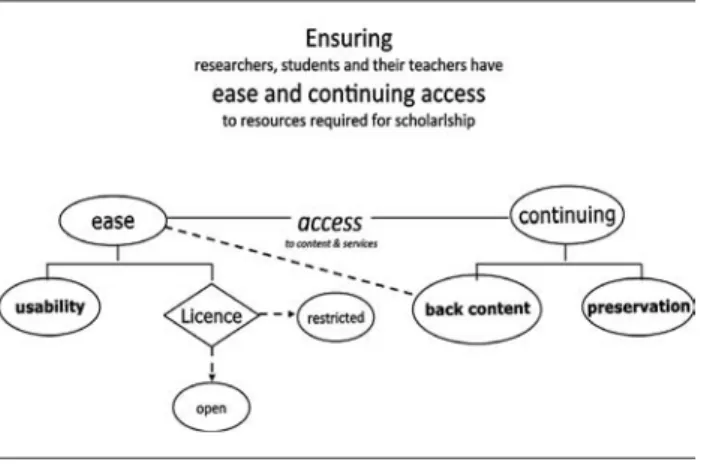
Priority needs to be given to securing assurance about the ease of access and of the continuity of access to digital back copy. What was once to hand as printed volumes on the shelf is now digital: seemingly more convenient, but held remotely by a publisher or a third party who cannot be assumed to have archival intent.
The role of libraries can be re-stated graphically, as in Figure 4.
As noted, ease of access has greatly increased via publishers and their publishing platforms (not by libraries). This is largely in terms of usability and convenience. It is also due to licence conditions for subscribed content and the associated management of authorisation.
What is moot is the responsibility for ensuring continuity of access, both long-term preservation and continuing access to back copy, regardless of current subscription status.The concern is not only for long-term preservation – assurance that the
digital content exists and is being kept safe with good prospect of re-use in the future. The concern is also for the ease and assurance of access to that back content in the event of cancellation of current subscription, a prospect now pressing because of cuts to library budgets.
Several challenges have emerged during the making of the Keepers Registry which relate to this concern about continued access to serial content, now no longer on the shelves of libraries. These are of
three kinds. The first kind concerns bibliographic
summary and so is commented upon here. The second is methodological in another way, concerning what should be said and known in terms of summary description of archival activity by each of the keepers of digital content, on which comment here may be out of place.
The third kind of challenge is substantive, with focus on summary statistics on what is and what is not being archived. Again, this might not be the place for extended comment, save to say that there is good news and bad news. The good news is that the number of online continuing resources assigned ISSN that are reported to being ingested by an archival organisation has been steadily rising. In 2011, the Keepers Registry recorded 16,558 titles as ingested with archival intent by at least one keeper. By the close of 2013, this had risen to 21,557 titles, and in March 2014, there23,268 titles recorded as ingested with archival intent by at least one keeper. At the time of writing, April 2015, that number was 27,323, and 9,770 titles were reported as having volumes ingested and archived by three or more keepers.
This increase is partly due to increased archiving activity. It is partly due to an increase in the number
of keepers of digital content reporting into the Keepers Registry, and so the world knows more about what is being archived. The bad news is that number of e-serials being ingested as a ratio of the total ISSN assigned is low, less than 10%.This Ingest Ratio, as it is reported on the Keepers Registry Blog, is subject
to fluctuation and the number of ISSN assigned to
all types of online continuing resource increases. It also varies when applied to the limited subset of what might be regarded as scholarly journals, a
definition which is discussed later.Another measure
is the KeepSafe Ratio, the number of titles in the safe keeping of three or more keepers of digital content. The ISSN provides the basis for the arithmetic.
Progress on ensuring continuity of access to the scholarly and cultural record represented by the online resources that are assigned ISSN depends on the priorities and effort accorded by libraries, publishers and archives globally. There is need for cooperation, with some actions appropriate at regional and national level and others requiring international or trans-national division of labour. This must include intelligence gathering to establish what digital content is being archived for future use and what is not, and resolving priority of attention on ensuring that what is valued is not lost. In this the ISSN plays a key role
as an identifier of sources of issued content.
Those interested can find onward links from the
Keepers Registry website, from the Keepers blog and from such summary accounts now included in the literature.
The summary account of how the Keepers Registry came about (BURNHILL, 2013) contains discussion of a range of the serial issues that were raised during the project. Some have been discussed above.
One which is of major concern for serials extends beyond the usual scope of the ISSN Network and the ISSN Register. That is on how to record the actual volumes of content that were being archived, and how to assess might be missing.This includes the matter of granularity below that of volumes, on whether that is the issue level or the level of the article. Related to this is how to enable analysis across archival holdings, both for computation of
missing and for display for easy human consumption. Beyond that is the practical matter of establishing sources of information on what was ever issued in order to establish what is at risk of loss.
Information in the Keepers Registry about current publisher comes from the archiving organisations. This is available only for those serials which are being archived, and not for the serials that would appear to be at risk of loss, as one of the limitations of the ISSN Register is that information about the publisher of a serial is generally only that which was recorded at the time that ISSN was assigned, and this becomes out of date as serials are transferred from one publisher to another and as publishers themselves change through merger and acquisition, and sometimes just name changes. More on current publisher information is discussed in section 6.3, below.
RETHINKING THE ISSN
ISSN, THE WEB AND THE SCHOLARLY RECORD
of voluntary behaviours. Very many parties enjoy
the benefit, and we pay directly for neither: they
are both part of our information infrastructure, delivered as global acts towards the common good.
The syntax and practices of ISSN describe a flow
that connects past and future issued content. The syntax and present practices of the Web do precisely the opposite, what is on the Web today does not represent what was there yesterday and there is no guarantee that it will be there tomorrow. This poses a challenge for the scholarly record; similarly for the cultural record.
Within formal scholarly communication the article
has been a significant object of desire for the reader,
the researcher and student, allowing that the long-form
book has importance in the humanities, likewise a record of performance in the creative arts. The serial has been the device for issuing and distributing access to those articles.
The change in the acceptable-use policies for the Internet by the National Science Foundation in the early 1990s meant that the emergence of the World Wide Web had gradual public and commercial adoption. This revolutionised the ease of access to the scholarly record as it has to all sorts of information resource, including those needed for present and future scholarship.
The disruption brought about by the Web for global scholarly and cultural communication is not yet over. The context for any discussion of scholarly and cultural communication, and thereby the role of the ISSN, is the extent to which so much formal communication is carried out across the Web with interesting aspects of seriality. Indeed this might be said of communication that once would have been
regarded as informal but is now out there as a matter of public record on one form of social media or another.
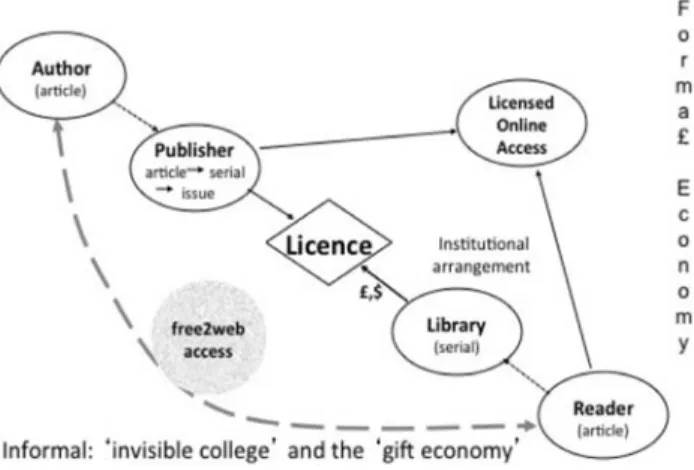
The communication between author and reader has had its focus on the article, mediated by third parties
that have had their relationship defined by the serial,
as illustrated in Figure 5.This is one of the things that is being changed by the Internet and the Web.
In this the Author and the Reader have two modes of communication. One mode supports a formal economy via the traditional middleware/infrastructure
of the Publisher and the Library. Those two parties do business on behalf of their respective clients via a licence. This often involves the payment of money, with £ and $ signifying wide range of currency, reminder of international purchases and
impact of currency fluctuation.Notwithstanding, it
is publishers that provide Readers with an ease of (online) access, with international and multinational points of delivery. Typically this provision enables direct access to the article although rendered to the user within the context of a serial volume, even if
availability does not depend upon the release of articles in batches at regular intervals.
The Informal mode has always existed as Author and Reader communicate via seminar (and other peer-to-peer meetings) or engage in private correspondence as members of the invisible college
of their discipline (in scholarly society, so to speak). Without need of Publisher and Library, and often in advance of determination of what would be written into the (scholarly) record, the parties operated a gift economy in which reward was recognition for the size and quality of the gift.
What has been disruptive with the emergence of the Web is also twofold. One is that the informal transactions of that invisible college are now much more public not limited to what was formally recorded. Much of what takes place in those peer-to-peer meetings is simultaneously broadcast across the Internet and held as a recording on the
Web. A significant amount of what was bilateral
correspondence between peers is not conducted in private and now leaves a trace to be read (and commented upon) by third parties, typically other authors and readers but also (secondary) publishers. The second is that licence for use of what is made available via the Web often does not require any payment of money. It is open, gratis and libre.
OPEN ACCESS
Open Access to the product of scholarship deserves mention. It is an area into which enriched records from the ISSN Register have been made available, via an online facility ROAD (PORTAL ROAD, 2015) which has itself been assigned ISSN 2310-9173.
Modification to the diagram in Figure 4 is required to take account of the changes in the relationships between Author, Publisher, Library and Reader because of changes to the underlying business model, with the emergence of so-called Gold and Green Open Access. In Gold Open Access, authors pay publishers to assign an Open Access licence to an article included in an issue of a serial. In the latter, Green Open Access, the author grants or secures Open Access licence to make some version of the article available, often via a repository (rather than as an issue of a serial). The relationship between the respective parties is changed. In particular, the role of the Library is even less clear.
Perhaps it is too soon to have re-drawn the diagram shown as Figure 6, especially as now it is the
University, to which the Author is affiliated, that
might need representation (through other than the Library).The Reader of this article is invited to re-draw the picture, on a white board together with peers, and perhaps then later to share that across the Web as annotation to this article.This suggestion is itself illustrative of the manner in which the Web might enable such interactions between reader and author, shared with global reach.
ACCOUNTING FOR PARTS IN THE SCHOLARLY RECORD, INCLUDING WEB REFERENCES
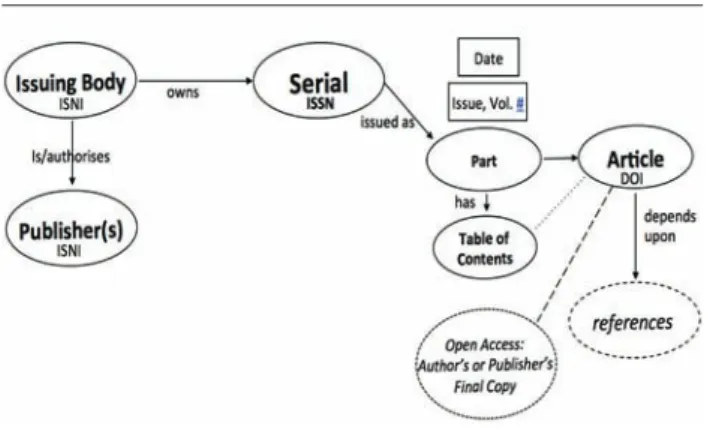
The focus had been on demonstrable value of the ISSN in the supply chain. The Article is nested within the Serial but these are not the only entities from a bibliographic perspective.Some of the
additional entities, with appropriate identifiers, are
shown in Figure 7.
It is common to state relationship between the Serial and the Publisher. With the emergence of the ISNI (PORTAL ISNI, 2015), this means a table that relates ISSN to ISNI. There is a missing entity, that of the Issuing Body, such as a learned society, that may have opted to authorise a Publisher to undertake publishing and distribution.Each would be assigned ISNI which in instances where the Publisher was the Issuing Body would be the same.
The ISSN for the Serial plays a key role when there is transfer from one publisher to another, which happens to large extent over the history of serials. In this the concept of Issuing Body is important as often the relationship between the Serial and the Issuing Body would remain the same. This is one example of the dynamic character that must be recognised in the management of serials.
It was earlier remarked, in section 4.3 (above), that there is interesting byproduct for the ISSN Register from the operation of the Keepers Registry in that information on the current publisher is supplied by archiving organisations, as most obtain serial content direct from the publisher.Clearly there are a variety of third party sources that engage with current publishers of the very many subsets of serials that have been assigned ISSN. However, there is no one single source, although for changes in publisher there is useful online facility resulting from the UKSG TRANSFER initiative (PORTAL UKSG, 2015) which provides practical support to publishers, librarians and other stakeholders in the publishing process with respect to transfer of responsibility from one publisher to another. This includes an Enhanced Transfer Alerting Service
and an archive of transfer information supplied by publishers using the service supporting searches by ISSN as well as by title or keyword.A record extracted that facility is displayed as Figure 8.
This states that the serial entitled Publications of the Astronomical Society of the Pacific will (have) been transferred on 1 January 2016 from one Publisher to
Figure 7 - Abstract Data Model for Serial Content
another Publisher. Note also that the Issuing Body remains the same, and that CLOCKSS is mentioned as the archiving agencies (which should also have an ISNI) and that reference is made to the Keepers Registry.
On the matter of identifiers, the ISSN for the online
and the print version are both recorded. There is also provision for a journal level DOI.It would be good to have the ISNI for each publisher and the issuing body.
The decision would be whether to provide this up-to-date publisher information as an intrinsic part of the ISSN Register or as an adjunct, potentially in association with another agency. The facility supported by the UKSG TRANSFER initiative is one such agency. Of course ISSN is used beyond
academic and scientific publishing so this is also
a partial, although very important source of information that would add value to the ISSN Register. In any event, it would require cooperative action according to some long-term plan. Starting with a selection of those 160,000 ISSN assigned to online continuing resources would be a good start.
In another part of the Abstract Model (Figure 7), the relationship between the Article (the object of desire) and the Serial could be reduced to mapping of DOI (of the article) to ISSN (of the serial), noting that the ISSN can be included within the syntax of the DOI. Again there is an intervening
entity, the Part - the issuance of which defines a
Serial.Typically that Part has notation indicating Volume and Issue, but that can vary. Agreement on the identifying metadata for this middle child
of serials metadata is lacking, although there is a variety of approach (PORTAL ASSOCIATION
FOR LIBRARY COLLECTIONS & TECHNICAL
SERVICES, 2015) (PORTAL EDITEUR, 2015). It is also the case that the systematic record of the extent of issued parts for any given serial is also not generally available.
Note that for an ongoing integrating resource there is no Part as such. The date takes on an importance for locating the content that was issues as some DateTime, as outlined with respect to a Memento (VAN DE SOMPEL ET AL, 2009) denoting an archival record of a resource issued on the Web.
The Web has enabled the emergence of a new practice, namely the availability of what was once called a preprint version of a journal article, issued through a subject repository (such as ArXiv) or an institutional repository. This version of the article was the Authors Final Copy (recognising with placement of the apostrophe that the norm has become articles with multiple authors), to distinguish it from the Publisher’s Final Copy (that which was issued by the publisher, including any formatting and addition of metadata). Note that the work issued via a subject repository can be heavily cited even though it is not a precursor to the publication of article in a journal. (The copy that is made available for Open Access can now be either of those versions, as shown in Figure 7.)
Increasingly there is citation beyond that to resources on the web-at-large.This dependence has been the subject of the international Hiberlink project (PORTAL HIBERLINk, 2015) (SANDERSONET AL, 2013) funded by the Andrew Mellon Foundation. This is still ongoing at the time of writing. The
project has been successful in defining the problem
of reference rot (the combination of link rot and content drift), it has measured and reported on the extent of the threat (KLEIN ET AL, 2014), and it is reporting on approaches that can remedy the problem (BURNHILL ; WINCEWICZ, 2015). The threat is now being recognised more widely, although with acknowledgement that archiving content that has copyright restrictions is a challenge (PERKEL, 2015).
ISSN AND THE SCHOLARLY (AND CULTURAL)
RECORD
The ISSN is assigned to all sorts of journals, periodicals, magazines, and newspapers that could be said to comprise a large part of the world’s cultural record.A simple representation of the relationship between what is assigned ISSN and that subset of the cultural record that is regarded as the scholarly record is represented in Figure 9.
There is reminder in Figure 7 that ISSN are assigned to two classes of continuing resources: the first are serials
which are issued in parts; the second are ongoing integrating resources which have content that changes over time.
This schematic is not in any sense drawn to scale; it is intended to illustrate the present and prospective relevance of ISSN in scholarly discourse.The scholarly record has a fuzzy edge and includes more
than serials (the book length work, for example). Journals are regarded as scholarly because they may employ peer review for submitted articles or otherwise enjoy editorial prestige.
The output of scholarship may also be found in the journals and magazines of practitioners, as has long been noted in analysis of the published work of social science, as summarised by Hicks (2004) in which she cites earlier work including that of the present author:
Scrutiny of the actual titles of articles and serials indicated that the articles performed different functions. On the one hand, publication performed an `enlightenment’ function for projects in education, reaching practitioners through such periodicals as the Times Education Supplement, with researchers in sociology, social administration and socio-legal studies publishing in such periodicals as New Society and Nursing Times. On the other hand, a scholarly communication function was being performed in the Linguistics Papers series published by the Universities of Belfast and York
(BURNHILL; TUBBY-HILLE, 1994)
This fuzzy edge of the definition of what is scholarly
is explored in Hicks and Wang (2013) who have
noted that the New York Times receives more citations from academic journals than the American Sociological Review, Research Policy, or the Harvard Law Review.
This places such prestigious newspapers, as part of mass media, on that edge between part of the scholarly record and that which is regarded as resource for scholarship. Indeed the online digital equivalent of the newspapers and government documents that once sat on the shelves of research libraries are notable examples of resources for scholarship. (Not all Gov Docs are serials but very many are.) The same could be said of trade magazines that are used in both contemporary and historical study.
Resource for scholarship is of course unbounded but it would certainly include much of that which is assigned ISSN.Updating databases, digital repositories, blogs and myriad websites are also assigned ISSN as ongoing integrating resources, provided they meet all the inclusion and exclusion criteria outlined in Section 0.3.2 of the ISSN Manual.
It is however worth noting what of the scholarly record is not, as yet, assigned ISSN. For example, doctoral theses and dissertations are consulted as though they were part of the scholarly record, and they are made available as e-theses in repositories, as a single point of issuance. Could each e-thesis be regarded as forming a part of a continuing resource? The awarding universities certainly have commitment to continue and to make such work available.
THE SCHOLARLY RECORD ON THE WEB
A sideways take on the ISSN is to regard it as a
dumb number that identifies the point of issuance
for a stream of digital content. This use of the
phrase a stream of digital content is an attempt to be
smart. It is deliberate allusion to the lack of fixity
that characterises the manner in which resources are made available in digital form. In the past there
was unconscious presumption of fixity in the marks on paper, whereby articles and commentary were collated, printed and distributed as (supposedly) immutable packages.
The idea of a stream of issued content is most evident where content is issued over time on the Web. Indeed what is on the Web now may not have been there yesterday and we cannot, indeed should not, presume that the same content will be there tomorrow.As noted, the consequences of that in terms of reference rot has been the focus of the Hiberlink project (PORTAL HIBERLINK, 2015).
As the Web enables new forms of scholarly statement and new venues for the issue of content, so we might wish to assess what would be the extension of the ISSN in order to cover these new forms of seriality as updating integrating resources. How that might happen is beyond the scope of this contribution. However, it might be worth noting the early attempt to map the ISSN into the URN namespace (ROZENFELD, 2001) and the subsequent update to account, among other matters,
for the ISSN-L (GODEFROY, 2015).
At present the ISSN-L is a field in an ISSN record,
and is not itself an identifier within the ISSN Register for any entity representing the title. ISSN-L
might yet come to be an identifier that has currency
Within the digital domain the focus for the researcher and student continues to be on the article; the syntax of the Web and the practice of search engines encourages that. There is also a shift from using the Web to provide means for access and delivery towards using the Web to host what could be termed web resident scholarly objects. These bring together assemblages of summary statement, of
method and software, of workflow, of data and,
subsequently, of annotation by third parties.
ACKNOWLEDGEMENTS
This article is based upon a presentation and paper delivered to the 2012 ACNP-NILDE Conference, see http://www.aib.it/aib/sezioni/emr/bibtime/ num-xv-3/burnhill.htm, held in Bari (Italy), in May 2012 and a presentation delivered at the National Science Library in New Delhi (India) in March 2015. It is also based upon a series of conversations with colleagues past and present in the ISSN Network, most notably Regina Romano Reynolds, Slawek Rozenfeld and Pierre Godefroy: the published work of the former is implicit in several serial matters written about here. I am grateful to Dorota Laska for editorial help and comment. The errors remain my own.
REFERENCES
BOLLINI, A. And P. BURNHILL. Distributed SSD Prototype Feasibility Study. CASA Public Technical Deliverable, CIB, University of Bolo-gna,1999. TD18.0/0038.
BURNHILL, P. Tales from the Keepers Registry: Serial issues about archiving & the Web. Serials Review [online]. 2013, vol.39, no.1 [viewed 22 May 2015]. Available from:. dx.doi.org/10.1016/j. serrev.2013.02.003 Author’s Copy available from: https://www.era. lib.ed.ac.uk/handle/1842/6682
BURNHILL, P. M. and M. E. TUBBY-HILLE. On Measuring the Relation between Social Science Research Activity and Research Publication. Research Evaluation, 1994 4(3) 130-152. doi: 10.1093/ rev/4.3.130
BURNHILL, P. and others. Piloting an e-journals preservation registry service.Serials [online]. 2009, vol. 22 no.1 [viewed 22 May 2015]. Available from:http://uksg.metapress.com/link.asp?i-d=350487p5670h0v61
BURNHILL, P. and others. SUNCAT: a modern serials union catalogue for the UK. Serials [online]. 2009. 17, 1, p. 61-67 [viewed 22 May 2015]. Available from:http://uksg.metapress.com/content/ c6y0ltjtxlhrgfr9/.
BURNHILL, P. and R. WINCEWICZ. Reference Rot: Threat and Remedy [slides online] [viewed 22 May 2015]. Available from: http://www. slideshare.net/edinadocumentationofficer/reference-rot-and-linked-data-threat-and-remedy
CASA FIRST BULLETIN [viewed 22 May 2015]. Available from:ht-tp://casa.unibo.it/meetings/bull1eng.html
GODEFROY, P. Using International Standard Serial Numbers as Uniform Resource Names draft-ietf-urnbis-rfc3044bis-issn-urn-01. Informational [online].2012[viewed 22 May 2015]. Available from: https://tools.ietf.org/html/draft-ietf-urnbis-rfc3044bis-issn-urn-01 HICKS, D. The Four Literatures of Social Science. Handbook of Quantitative Science and Technology Research [online]. Ed. Henk Moed. Kluwer Academic, 2004. Available from: http://works.bepress.com/ diana_hicks/16
HICKS, D. and J. WANG. The New York Times as a resource for Mode 2. Science Technology and Human Values [online]. 2013, vol. 38, no.6 [viewed 22 May 2015]. Available from: http://works.bepress. com/diana_hicks/34
ISSN INTERNATIONAL CENTRE. ISSN Manual [online]. Paris: ISSN. 2015. [downloaded 25 April 2015] [viewed 22 May 2015]. Available from:http://www.issn.org/understanding-the-issn/assign-ment-rules/issn-manual/
ISSN INTERNATIONAL CENTRE. ISSN Manual [online]. Paris: ISSN, 2012[downloaded 21 August 2012] [viewed 22 May 2015]. Available from: http://www.ndl.go.jp/jp/aboutus/issn/ issnmanual2012-en.pdf
KLEIN M. and others. Scholarly Context Not Found: One in Five Articles Suffers from Reference Rot. PLoS ONE[online]. 2014, vol.9, no.12 [viewed 22 May 2015]. Available from: http://doi:10.1371/ journal.pone.0115253
PORTAL ARCHAEOLOGY DATA SERVICE [viewed 22 May 2015]. Available from:http://archaeologydataservice.ac.uk/ PORTAL ASSOCIATION FOR LIBRARY COLLECTONS &TECHNICAL SERVICES [viewed 22 May 2015]. Avai-lable from:http://www.ala.org/alcts/resources/collect/serials/ holdinfo#webdata
PORTAL BRITISH LIBRARY [viewed 22 May 2015]. Available from:http://www.bl.uk/aboutus/stratpolprog/legaldep/#elec PORTAL CROSSREF [viewed 22 May 2015]. Available from:http:// www.crossref.org/
PORTAL CLOCKSS [viewed 22 May 2015]. Available from: http:// www.clockss.org/
PORTAL ISSN [viewed 22 May 2015]. Available from:http://www. issn.org
PORTAL EDINA [viewed 22 May 2015]. Available from: http:// edina.ac.uk
PORTAL EDITEUR [viewed 22 May 2015]. Available from:http:// www.editeur.org/120/SOH/
PORTAL FYIFRANCE [viewed 22 May 2015]. Available
from:http://www.fyifrance.com/
PORTAL HAITI TRUST [viewed 22 May 2015]. Available from:ht-tp://www.hathitrust.org/about
PORTAL HIBERLINK [viewed 22 May 2015]. Available from:http://hiberlink.org/about.html
PORTAL HIBERLINK [viewed 22 May 2015]. Available from: http://hiberlink.org/about.html
PORTAL ISNI [viewed 22 May 2015]. Available from:http://www. isni.org/how-isni-works
PORTAL ISSN [viewed 22 May 2015]. Available from:http://www. issn.org/2-22637-What-is-an-ISSN-L.php
PORTAL JISC [viewed 22 May 2015].Available from: http://www. jisc.ac.uk.
PORTAL KB [viewed 22 May 2015]. Available from:http://www. kb.nl/hrd/dd/index-en.html
PORTAL LIBRARY OF CONGRESS [viewed 22 May 2015].
Avai-lable from:http://www.loc.gov/
PORTAL LOCKSS [viewed 22 May 2015]. Available from:http:// www.lockss.org/
PORTAL NATIONAL SCIENCE LIBRARY. Chinese Academy of Sciences [viewed 22 May 2015]. Available from:http://english. las.cas.cn/
PORTAL OPENURL [viewed 22 May 2015]. Available fromhttp:// openurl.ac.uk/doc/
PORTAL PORTICO[viewed 22 May 2015]. Available from: http:// www.portico.org/
PORTAL ROAD [viewed 22 May 2015]. Available from:http:// road.issn.org/en
PORTAL THE KEEPERS. [viewed 22 May 2015]. Available from:ht-tp://thekeepers.org
PORTAL UKOLN [viewed 22 May 2015]. Available from:http:// www.ukoln.ac.uk/dlis/models/
PORTAL UKRR [viewed 22 May 2015]. Available from: http://www. ukrr.ac.uk/how/default.aspx
PORTAL UKSG [viewed 22 May 2015]. Available from: http:// www.uksg.org/transfer
PORTAL UKSG. Transfer [viewed 22 May 2015]. Available from:ht-tp://uksg-transfer.blogspot.co.uk/2015_03_01_archive.html PORTAL WELL [viewed 22 May 2015]. Available from: http:// www.well.com
POWELL, A. Unique Identifiers in a Digital World [online] [viewed 10 April 2015]. Available from: www.ariadne.ac.uk/issue8/unique-iden-tifiers
REICH, V. LOCKSS: ensuring access through time. Ciência da Infor-mação [online]. Brasília: 2012, 41,1 [viewed 22 May 2015]. Available from: http://revista.ibict.br/cienciadainformacao/index.php/ciinf/ article/view/2125
ROZENFELD, S. Using the ISSN (International Serial Standard Number) as URN (Uniform Resource Names) Withing an ISSN-URN Namespace.Informational [online]. 2001 [viewed 22 May 2015]. Available from: https://tools.ietf.org/html/rfc3044
SANDERSON, R., H. and others. Hiberlink: Towards time travel for the scholarly web. In: Proceedings of the 1st Internatio-nal Workshop on Digital Preservation of Research Methods and Ar-tefacts (DPRMA ‘13) [online]. New York: ACM, 2013. pp.21. DOI=10.1145/2499583.2500370 [viewed 22 May 2015]. Available from: http://doi.acm.org/10.1145/2499583.2500370
SCHOLARS PORTAL [viewed 22 May 2015]. Available from:http:// www.scholarsportal.info/