ABSTRACT
Objective: To determine whether COPD severity correlates with sputum cell counts, atopy, and asthma. Methods: This was a cross-sectional study involving 37 patients with COPD and 22 healthy subjects with normal lung function (controls). Sputum cell counts were determined by microscopy after centrifugation of samples. Skin prick tests were performed, and serum cytokines were determined by ELISA. Results: Patients were stratiied by bronchodilator response: a non-reversible airlow limitation (nonRAL) group comprised 24 patients showing no signiicant post-bronchodilator change in FEV1; and a partially reversible airlow limitation (partialRAL) group comprised 13 patients showing FEV1 reversibility (post-bronchodilator FEV1 increase ≥ 12%). The proportion of eosinophils in sputum was higher in the partialRAL group than in the nonRAL group (p < 0.01), and there was an inverse correlation between the proportion of eosinophils and FEV1 (p < 0.05). However, none of the patients had a history of asthma and skin prick test results did not differ between the two groups. In the patient sputum samples, neutrophils predominated. Serum levels of TNF, IL-6, IL-8, and RANTES (CCL5) were higher in patients than in controls (p < 0.001) but did not differ between the two patient groups. Conclusions: COPD patients with partial FEV1 reversibility appear to have higher sputum eosinophil counts and greater airway hyperresponsiveness than do those with no FEV1 reversibility. However, we found that COPD severity did not correlate with atopy or with the cytokine proile.
Keywords: Pulmonary disease, chronic obstructive; Cytokines; Chemokines; Eosinophils; Sputum/cytology; Forced expiratory volume.
Inlammatory and immunological proiles in
patients with COPD: relationship with FEV
1
reversibility
Cleriston Farias Queiroz1, Antonio Carlos Moreira Lemos1,
Maria de Lourdes Santana Bastos1, Margarida Célia Lima Costa Neves1,
Aquiles Assunção Camelier2, Natália Barbosa Carvalho3 ,
Edgar Marcelino de Carvalho3
Correspondence to:
Cleriston Farias Queiroz. Serviço de Pneumologia, Ambulatório Magalhães Neto, Complexo Hospitalar Universitário Professor Edgard Santos, Rua Padre Feijó, 240, Canela, CEP 40110-170, Salvador, BA, Brasil.
Tel.: 55 71 3283-8378. Fax: 55 71 3237-5353. E-mail: [email protected] Financial support: None.
INTRODUCTION
COPD is an inlammatory disorder that affects the airways, pulmonary parenchyma, and pulmonary vessels, progressing slowly to irreversible airway obstruction. Although studies have shown that neutrophil and eosinophil counts are both elevated during COPD exacerbations, neutrophilic inlammation is the norm in COPD.(1) However,
even in the stable phase of the disease, eosinophils are found in up to 40% of patients.(2) It is thought that this
feature is related to a COPD subtype—COPD with asthma, also known as the asthma-COPD overlap syndrome.(2)
Patients with that syndrome show FEV1 reversibility after bronchodilator use.
The inflammatory response of the airways has received special attention in recent years.(3,4) Levels of inlammatory mediators such as C-reactive protein, IL-8, IL-6, TNF, and RANTES (CCL5) have been found to be elevated in COPD.(5-7) In addition, neutrophil counts are higher in smokers with COPD, as are levels of IL-8 and eosinophil cationic protein.(4) According to Lapperre et al.,(8) it is possible that inlammation associated with
smoking occurs in two stages: an initial phase, during which neutrophils and macrophages are present in the epithelium and submucosa, and a late stage, with the additional participation of lymphocytes and eosinophils. Nevertheless, the association between COPD and asthma has been controversial, and the inluence that eosinophils have on airway inlammation and on the severity of COPD is not completely understood.
The severity of airlow obstruction can be determined by quantifying the magnitude of the decrease in FEV1, and
the stages of COPD are based on the post-bronchodilator FEV1.
(9) Once the diagnosis of COPD has been made,
pulmonary function tests are useful for quantitative monitoring of the course of the disease. To determine the severity of COPD, FEV1 and its reversibility are reconciled
with the Global Initiative for Chronic Obstructive Lung Disease (GOLD) classiication.(10) The aim of the present study was to determine whether COPD severity correlates with FEV1 reversibility, asthma, and atopy. In addition,
we evaluated the relationship between serum cytokine levels and COPD subtypes based on FEV1 reversibility.
1. Serviço de Pneumologia, Ambulatório Magalhães Neto, Complexo Hospitalar Universitário Professor Edgard Santos, Universidade Federal da Bahia, Salvador (BA) Brasil.
2. Universidade do Estado da Bahia, Salvador (BA) Brasil.
3. Serviço de Imunologia, Complexo Hospitalar Universitário Professor Edgard Santos, Universidade Federal da Bahia, Salvador (BA) Brasil.
Submitted: 25 May 2015.
Accepted: 9 May 2016.
METHODS
This was a cross-sectional study involving 37 patients diagnosed with COPD on the basis of the GOLD criteria.(11) All patients were under treatment
in the Pulmonology Department of Professor Edgard Santos University Hospital, in the city of Salvador, Brazil. The study was approved by the Research Ethics Committee of the Hospital (Protocol no. 113/2012), and all participating patients gave written informed consent. All of the patients completed questionnaires designed to evaluate the history of asthma in childhood, smoking, passive smoking, and allergic rhinitis. All patients also underwent physical examinations and pulmonary function tests with an emphasis on the functional parameters FEV1, FVC, and FEV1/FVC ratio.
According to the GOLD criteria,(11) an FEV
1/FVC ratio
≤ 70% of the predicted value is diagnostic of COPD. Spontaneous or induced sputum samples were obtained, skin prick tests were performed in order to assess sensitivity to allergens, and 10-mL blood samples were collected for determination of serum cytokine levels. A group of 22 healthy subjects without COPD (with normal lung function) were used as controls.
On the basis of the pulmonary function test param-eters established in the 2010 GOLD guidelines and the response to bronchodilator, the COPD patients were divided into two groups: non-reversible airlow limitation (nonRAL), comprising the patients who showed no signiicant post-bronchodilator change in FEV1 (n = 24); and partially reversible airlow
limitation (partialRAL), comprising the patients who showed FEV1 reversibility (n = 13). Post-bronchodilator
FEV1 reversibility was deined as a ≥ 12% increase
in FEV1, as proposed in the joint American Thoracic
Society (ATS)/European Respiratory Society (ERS)/ GOLD guidelines.(12) The control group was composed
of (N = 22) healthy subjects without COPD and with normal lung function.
All patients underwent spirometry in accordance with the ATS/ERS/GOLD joint guidelines.(12) Bronchodilator
testing was performed with 100 µg/mL of albuterol sulfate (Aerolin® [Ventolin®]; GlaxoSmithKline Brasil
Ltda., Rio de Janeiro, Brazil). In brief, four puffs (400 µg/mL) were administered with the aid of a spacer (Fumax®; GlaxoSmithKline Brasil Ltda.). At 15 min after
administration of the bronchodilator, the pulmonary function tests were repeated.
Patients were submitted to the immediate hypersen-sitivity skin prick tests, as described by Pepys et al.(13)
and modiied by Osterbalee and Weeke.(14) The allergens tested included dog dander, cat dander, airborne fungi (Aspergillus fumigatus), cockroach allergens (from Blattella germanica and Periplaneta americana), and dust mite allergens (from Dermatophagoides pteronyssinus and Blomia tropicalis). Reagents were obtained from Immunotech ([a division of] FDA Allergenic Ltda., Rio de Janeiro, Brazil).
Sputum induction was performed in accordance with the modiied protocol described by Pavord et al.,(15) with
inhalation of hypertonic saline solution (3%, 4%, and 5%) in an ultrasonic nebulizer (Fisoneb®; Canadian
Medical Products, Ltd, Markham, Ontario, Canada) at a low low rate (0.87 L/min). Peripheral blood samples (10 mL each) were centrifuged at 2,000 rpm for 10 min. Serum was collected and stored at −20°C for subsequent cytokine measurements. Cytokines and chemokines were quantiied by sandwich ELISA according to the manufacturer’s protocol (R&D Systems, Minneapolis, MN, USA). To quantify TNF and IL-6, we used high sensitivity kits (Quantikine HS ELISA; R&D Systems). To quantify RANTES (CCL5) and IL-8, we used DuoSet ELISA kits (R&D Systems).
In the statistical analysis, we used measures of central tendency, including means and medians, for demographic and clinical variables. Data were analyzed using the Statistical Package for the Social Sciences, version 17.0 for Windows (SPSS Inc., Chicago, IL, USA). The values obtained for the variables body mass index, SpO2, and lung function, which typically have a normal
distribution, were analyzed with Student’s t-tests. For the comparison between sputum cell counts and the stages of COPD severity, we used the Mann-Whitney test. The correlation between eosinophils in sputum and FEV1 (before and after bronchodilator use) was
analyzed by Spearman’s correlation coeficient. The comparisons among the nonRAL, partialRAL, and control groups, in terms of cytokine production, sputum cell counts, and COPD severity, were made with the Kruskal-Wallis test, followed by Dunn’s post-test for multiple comparisons.
RESULTS
Characteristics of the sample
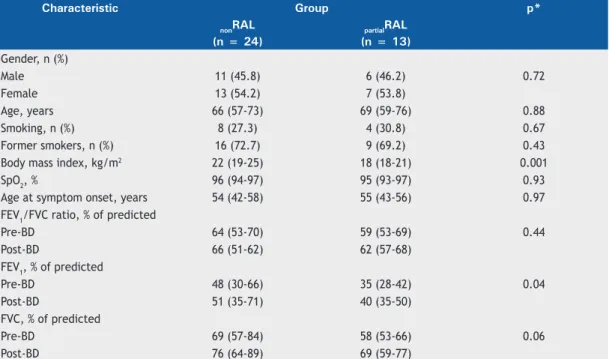
The demographic features, smoking status, and pulmonary function test results of the COPD patients, by group (with or without post-bronchodilator FEV1 reversibility), are shown in Table 1. There were no differences between the two patient groups regarding age, gender, or smoking status. There were also no differences between the two groups in terms of the body mass index, SpO2, or age at the onset of symptoms.
All patients in the sample had an FEV1/FVC ratio ≤
70% of the predicted value. The median values for pre- and post-bronchodilator FEV1 were 48.2% (range,
30-66%) and 51% (range, 35-71%), respectively, in the nonRAL group, compared with 35% (range, 28-44%) and 47% (range, 36-52%), respectively, in the partialRAL group (p < 0.04), whereas they were 79% (range, 65-82%) and 84% (range, 69-89%), respectively, in the control group. None of the control subjects were smokers or former smokers.
COPD severity, sputum cell counts, and atopy
the partialRAL group were categorized as having stage III COPD. Although neutrophil counts increased in proportion with the severity of COPD, eosinophils were not detected in patients with stage IV COPD (data not shown).
In both patient groups, we performed differential counts of neutrophils and eosinophils in the sputum samples (Table 2). The neutrophil counts did not differ between the two groups (p > 0.05). However, the median eosinophil count was signiicantly higher in the partialRAL group than in the nonRAL group (p < 0.01). In our evaluation of atopy, with the skin prick test, we found no difference between the two patient groups in terms of positivity for any of the antigens tested (Table 2). Of the 24 patients in the nonRAL group, 5
(21%) had at last one positive test, compared with 4 (31%) of the 13 patients in the partialRAL group (p > 0.05). Moreover none of the patients in either patient group had a history of asthma. In 2 of the patients in the nonRAL group, the response to histamine was negative.
Relationship between the proportion of eosinophils and FEV1
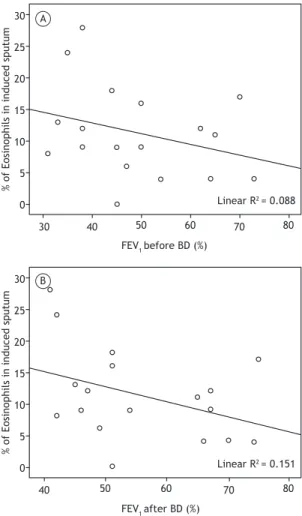
The relationship between the proportion of eosinophils in the sputum and FEV1 (before and after bronchodilator use) is shown in Figure 1. There was an inverse relationship between the proportion of eosinophils in the sputum and FEV1 before and after bronchodilator
use (p < 0.01).
Table 1. Demographic, clinical, and pulmonary function characteristics of patients with COPD.a
Characteristic Group p*
nonRAL partialRAL
(n = 24) (n = 13)
Gender, n (%)
Male 11 (45.8) 6 (46.2) 0.72
Female 13 (54.2) 7 (53.8)
Age, years 66 (57-73) 69 (59-76) 0.88
Smoking, n (%) 8 (27.3) 4 (30.8) 0.67
Former smokers, n (%) 16 (72.7) 9 (69.2) 0.43
Body mass index, kg/m2 22 (19-25) 18 (18-21) 0.001
SpO2, % 96 (94-97) 95 (93-97) 0.93
Age at symptom onset, years 54 (42-58) 55 (43-56) 0.97
FEV1/FVC ratio, % of predicted
Pre-BD 64 (53-70) 59 (53-69) 0.44
Post-BD 66 (51-62) 62 (57-68)
FEV1, % of predicted
Pre-BD 48 (30-66) 35 (28-42) 0.04
Post-BD 51 (35-71) 40 (35-50)
FVC, % of predicted
Pre-BD 69 (57-84) 58 (53-66) 0.06
Post-BD 76 (64-89) 69 (59-77)
nonRAL: non-reversible airlow limitation; partialRAL: partially reversible airlow limitation; and BD: bronchodilator.
aValues expressed as median (interquartile range), except where otherwise indicated. *Student’s t-test
(two-tailed); level of statistical signiicance set at p < 0.05.
Table 2. Cell counts in induced sputum samples, by COPD stage, and results of allergy testing in patients with COPD,
by group.a
Variable Group p
nonRAL partialRAL
(n = 24) (n = 13)
GOLD stage
II 6 (27.3) 0 (0.0) 0.03
III 12 (45.5) 12 (92.3) 0.77
IV 6 (27.3) 1 (7.7) 0.43
Skin prick test
Positive 5 (20.8) 4 (30.8) 0.58
Negative 17 (70.8) 9 (69.2) 0.09
Proportion of neutrophilsb 38 (24-52) 37 (26-47) 0.67
Proportion of eosinophilsb 0 (0-7) 9 (2-15) 0.01
Immunological proile
The cytokine and chemokine levels in the nonRAL group, partialRAL group, and control group are shown in Figure 2. The median TNF levels were 2.9 pg/mL (range, 0.95-6.03 pg/mL) in the nonRAL group and 3.2 pg/mL (range, 2.65-5.50 pg/mL) in the partialRAL group, both of which were signiicantly higher than the 0.35 pg/mL (range, 0-1.9 pg/mL) observed for the controls (p < 0.01). The median IL-6 levels were also signiicantly higher in the nonRAL group, and partialRAL group than in the control group—1.4 pg/mL (range, 0.42-2.10 pg/mL) and 0.92 pg/mL (range, 0.37-1.89 pg/mL), respectively, versus 0 pg/mL (p < 0.01). In addition, IL-8 levels were signiicantly higher in the nonRAL group than in the control group (p < 0.05) and RANTES (CCL5) levels did not differ signiicantly between the two patient groups or between either patient group and the control group (p > 0.05 for all). As depicted in Figure 2, the median IL-8 values for the nonRAL, partialRAL, and control groups were 0 (range, 0-57.50), 0 (range, 0-51.75), and 0 (range, 0-0), respectively, the difference between the nonRAL group and the control group being statistically signiicant (p < 0.05). There were no statistical differences among the three groups in terms of the serum levels of RANTES (CCL5; Figure 2). The severity of COPD did not correlate signiicantly with the serum levels of TNF, IL-6, IL-8, or RANTES (CCL5; data not shown).
DISCUSSION
COPD is a severe progressive inlammatory disease and is the fourth leading cause of death in the United States.(16) The prevalence of and mortality associated with COPD continue to rise. In addition, COPD has become a major cause of death and disability worldwide.(17) Two COPD subtypes, based on FEV
1
reversibility, have recently been identiied. Here, we attempted to determine whether those subtypes are associated with sputum cell counts, cytokine levels, and symptom severity. We found that COPD patients with reversibility of FEV1 had higher sputum eosinophil
counts and greater airway hyperresponsiveness than did those without such reversibility, and that there was an inverse correlation between the proportion of eosinophils in the sputum and the FEV1 before and after bronchodilator use. Furthermore, we showed that COPD with FEV1 reversibility was not associated
with atopy or asthma. In fact, our indings corroborate those of previous studies showing that, although IL-6, IL-8 and TNF levels are higher in COPD patients than in healthy subjects, the production of those cytokines is comparable between the two types of COPD.
Historically, the incidence of COPD has been highest among males and among smokers. However, the proportional representation of women has been increasing.(18) In addition, a marked female predom-inance has been reported among patients with an early onset of severe COPD.(19) In the present study,
the proportional distribution of males and females was
similar between the two patient groups, as was the proportion of smokers.
The analysis of sputum is an useful tool in the evalua-tion of inlammaevalua-tion of the airways.(15) Induced sputum was initially used for the diagnosis of lung cancer and later for infectious diseases. In the early 1990s, this method was employed in the investigation of bronchial inlammation associated with asthma.(20) More recently, because of its safety, reproducibility and low cost, it has been used for investigation of the pathogenesis of asthma and COPD. Local neutrophil recruitment in inlammation is a hallmark of COPD, as is an increase in the levels of inlammatory mediators in the airways and in circulating blood.(21) The release of neutrophil
elastase, acid phosphatase, and myeloperoxidase that occurs during neutrophilic inlammation is characteristic of COPD.(22-24) Neutrophils are the predominant cells in the sputum of COPD patients, and high proportions of neutrophils were found in the sputum of the patients in both of the COPD groups evaluated in the present study.(3) However, it is also possible that the hypertonic
30 30
25
20
15
10
5
0
40 50 60 70 80
Linear R2 = 0.088
FEV1 before BD (%)
30
25
20
15
10
5
0
40 50 60 70 80
% of Eosinophils in induced sputum
% of Eosinophils in induced sputum
Linear R2 = 0.151
FEV1 after BD (%) A
B
Figure 1. Scatter plots showing the proportion of eosinophils
in induced sputum and the FEV1 of COPD patients with
saline solution used for the induced sputum techniques contributes to increasing the number of neutrophils.(25)
The role that eosinophils in the sputum play in COPD is not clear. It was once thought that the presence of eosinophils was related to a subgroup of COPD patients with features of asthma(2,5) and that it was associated with a better response to corticosteroid therapy.(26) In fact, an association between asthma and COPD would further the development of strategies for the therapeutic management of COPD.(27,28) However, our data argue against the occurrence of asthma in patients who show post-bronchodilator FEV1 reversibility. None of our patients had a personal or family history of asthma, and the prevalence of atopy, as determined with the skin prick test, was comparable between the two patient groups. In addition, the immunological proile (cytokine and chemokine production) was similar in the two groups, and there was no increase in RANTES (CCL5), which is a typical Th2 cytokine in COPD patients with post-bronchodilator FEV1 reversibility. In a previous
study, we found an association between nasal eosin-ophils and atopy in patients with COPD.(29) However,
in the present study, the presence of eosinophils in the sputum was not found to be associated with atopy
or asthma. Although the role that eosinophils play in COPD is not completely understood, we observed that eosinophil counts were increased in COPD patients with post-bronchodilator FEV1 reversibility. We also
identiied an inverse correlation between the proportion of eosinophils in the sputum and the decrease in FEV1.
Although our indings might suggest that eosinophils are related to the severity of COPD, no eosinophils were found in the sputum of the patients with stage IV COPD. It is possible that, as in the later stages of the disease, the numbers of inlammatory cells are decreased in that phase of the disease.
Increased levels of IL-6, IL-1β, TNF, and IL-8 have been observed in the induced sputum of patients with stable COPD.(5) There is also evidence of a relationship between elevated cytokine levels in COPD and cigarette smoking.(6,30) However, the relationship that chemokines have with eosinophils in the sputum or with FEV1
reversibility has not been evaluated. Serum IL-6 is considered the best biomarker of COPD severity when associated with the degree of airway obstruction and has been associated with mortality.(7) We found that the severity of COPD did not correlate with the serum levels of IL-6, IL-8, TNF, or RANTES (CCL5). In the
HC
(n = 22) non RAL
(n = 24) partial RAL (n = 13)
HC
(n = 22) non RAL
(n = 24) partial RAL (n = 13) HC
(n = 22) non RAL
(n = 24) partial RAL (n = 13)
HC
(n = 20) non RAL
(n = 24) partial RAL (n = 13) 0
10 20 30
40 †
†
TNF- (pg/mL)
0 2 4 6 10 20 30 40
†
IL-6 (pg/mL)
0 200 400
600 *
IL-8 (pg/mL)
0 500 1000 1500 2000 2500
CCL5 (pg/mL)
A
B
C
D ‡
Figure 2. Dot plots of serum levels of the cytokines TNF (A), IL-6 (B), and IL-8 (C), as well as those of RANTES (CCL5;
D), in healthy controls (HC), COPD patients with non-reversible airlow limitation (nonRAL), and COPD patients with partially reversible airlow limitation (partialRAL). *p < 0.05, †p < 0.01, and ‡p < 0.001; Kruskal-Wallis test followed by
present study, it was possible to evaluate the levels of cytokines (IL-6 and TNF) and chemokines—IL-8 and RANTES (CCL5)—in COPD patients with and without FEV1 reversibility after bronchodilator use. However, the cytokine and chemokine levels were similar between the two patient groups.
Eosinophilic airway inlammation has been associated with COPD exacerbations.(31) A reduction in sputum
eosinophil counts has been associated with a reduc-tion in COPD exacerbareduc-tions.(31) Because this was a
cross-sectional study, we did not assess the relationship between the inlammatory response and exacerbation. However, we found an association between eosinophil inlammation and airway obstruction. That supports the relationship between eosinophilic airway inlammation and COPD exacerbation,(31) as well as the association
between the peripheral blood eosinophil count and death from exacerbations of COPD.(32)
One limitation of the present study is the small number of participants. However, it is clear that patients in the partialRAL group had greater airway hyperres-ponsiveness. In addition, the observation that COPD with FEV1 reversibility was not related to asthma but was associated with increased numbers of eosinophils in the sputum, together with the inverse correlation observed between the proportion of eosinophils in the sputum and FEV1, suggests that eosinophils play an
important role in the inlammatory response in COPD patients with post-bronchodilator FEV1 reversibility.
Our data do not support the occurrence of asth-ma-COPD overlap syndrome in patients who show airway responsiveness to bronchodilator use. Although we cannot rule out the possibility that eosinophilic inlammation is a subtype of COPD, our data indicate that it is a phase of the disease that is associated with greater airway obstruction.
REFERENCES
1. Saetta M, Di Stefano A, Maestrelli P, Turato G, Ruggieri MP,
Roggeri A, et al. Airway eosinophilia in chronic bronchitis during exacerbations. Am J Respir Crit Care Med. 1995;152(6 Pt 1):1926-31.
2. Brightling CE, Monteiro W, Ward R, Parker D, Morgan MD,
Wardlaw AJ, et al. Sputum eosinophilia and short-term response to prednisolone in chronic obstructive pulmonary disease: a randomized controlled trial. Lancet. 2000;356(9240):1480-5. http://dx.doi. org/10.1016/S0140-6736(00)02872-5
3. Ruino R, Costa CH, Souza HS, Madi K, Silva JR. Induced sputum and peripheral blood cell proile in chronic obstructive pulmonary disease. J Bras Pneumol. 2007;33(5): 510-8.
4. Willemse BW, ten Hacken NH, Rutgers B, Lesman-Leegte IG,
Postma DS, Timens W. Effect of 1-year smoking cessation on airway inlammation in COPD and asymptomatic smokers. Eur Respir J. 2005;26(5):835-45. http://dx.doi.org/10.1183/09031936.05.0010890 4
5. Keatings VM, Collins PD, Scott DM, Barnes PJ. Differences in interleukin-8 and tumor necrosis factor-alpha in induced sputum from patients with chronic obstructive pulmonary disease or asthma. Am J Respir Crit Care Med. 1996;153(2):530-4. http://dx.doi.org/10.1164/ ajrccm.153.2.8564092
6. Lim S, Roche N, Oliver BG, Mattos W, Barnes PJ, Chung KF. Balance of matrix metalloprotease-9 and tissue inhibitor of metalloprotease-1 from alveolar macrophages in cigarette smokers. Regulation by interleukin-10. Am J Respir Crit Care Med. 2000;162(4 Pt 1):1355-60. http://dx.doi.org/10.1164/ajrccm.162.4.9910097
7. Celli BR, Locantore N, Yates J, Tal-Singer R, Miller BE, Bakke P, et
al. Inlammatory biomarkers improve clinical prediction of mortality in chronic obstructive pulmonary disease. Am J Respir Crit Care Med. 2012;185(10):1065-72. http://dx.doi.org/10.1164/rccm.201110-1792OC
8. Lapperre TS, Postma DS, Gosman MM, Snoeck-Stroband JB,
ten Hacken NH, Hiemstra PS, et al. Relation between duration of smoking cessation and bronchial inlammation in COPD. Thorax. 2006;61(2):115-21. http://dx.doi.org/10.1136/thx.2005.040519
9. Hurd S. The impact of COPD on lung health worldwide: epidemiology and incidence. Chest. 2000;117(2 Suppl):1S-4S. http://dx.doi. org/10.1378/chest.117.2_suppl.1S
10. Senior RM, Silverman EK. Chronic obstructive pulmonary disease. ACP Medicine [monograph in the Internet]. Hamilton, Canada: Decker 2011:[about 18 p.] Available from: http://www.medicinanet. com.br/m/conteudos/acp-medicine/6413/doenca_pulmonar_ obstrutiva_cronica.htm
11. Global initiative for chronic obstructive lung disease [homepage on
Internet]. Bethesda: GOLD [updated 2011 Dec 1, cited 2012 Jul 9]. Global Strategy for the Diagnosis, Management and Prevention of Chronic Obstructive Pulmonary Disease. Available from: http://www. goldcopd.org/guidelines-global-strategy-for-diagnosis-management. html
12. Standards for the diagnosis and care of patients with chronic
obstructive pulmonary disease. American Thoracic Society. Am J Respir Crit Care Med. 1995;152(5 Pt 2):S77-121.
13. Pepys J, Roth A, Carrol KB. RAST, skin and nasal tests and the history in grass pollen allergy. Clin Allergy. 1975;5(4):431-42. http:// dx.doi.org/10.1111/j.1365-2222.1975.tb01882.x
14. Osterbalee O, Weeke B. A new lancet for skin prick testing. Allergy.
1979;34(4):209-12. http://dx.doi.org/10.1111/j.1398-9995.1979. tb01700.x
15. Pavord ID, Pizzichini MM, Pizzichini E, Hargreave FE. The use
of induced sputum to investigate airway inlammation. Thorax. 1997;52(6):498-501. http://dx.doi.org/10.1136/thx.52.6.498
16. Hoyert DL, Kung HC, Smith BL. Deaths: preliminary data for 2003. Natl Vital Stat Rep. 2005;53(15):1-48.
17. Mannino DM: COPD: epidemiology, prevalence, morbidity and mortality, and disease heterogeneity. Chest. 2002. 121(5 Suppl):121S-126S. http://dx.doi.org/10.1378/chest.121.5_suppl.121S
18. Mannino DM, Homa DM, Akinbami LJ, Ford ES, Redd SC. Chronic
obstructive pulmonary disease surveillance--United States, 1971-2000. MMWR Surveill Summ. 2002;51(6):1-16.
19. Silverman EK, Weiss ST, Drazen JM, Chapman HA, Carey V,
Campbell EJ, et al. Gender-related differences in severe, early-onset chronic obstructive pulmonary disease. Am J Respir Crit Care Med. 2000;162(6):2152-8. http://dx.doi.org/10.1164/ajrccm.162.6.2003112
20. Pin I, Gibson PG, Kolendowicz R, Girgis-Gabardo A, Denburg JA, Hargreave FE, et al. Use of induced sputum cell counts to investigate airway inlammation in asthma. Thorax. 1992;47(1): 25-9. http:// dx.doi.org/10.1136/thx.47.1.25
21. Moermans C, Heinen V, Nguyen M, Henket M, Sele J, Manise M,
et al. Local and systemic cellular inlammation and cytokine release in chronic obstructive pulmonary disease. Cytokine. 2011;56(2): 298-304. http://dx.doi.org/10.1016/j.cyto.2011.07.010
22. Saetta M. Airway inlammation in chronic obstructive pulmonary disease. Am J Respir Crit Care Med. 1999;160(5 Pt 2):S17-20. http:// dx.doi.org/10.1164/ajrccm.160.supplement_1.6
23. Cosio MG, Majo J, Cosio MG. Inlammation of the airways and lung parenchyma in COPD: role of T cells. Chest. 2002;121(5 Suppl):160S-165S. http://dx.doi.org/10.1378/chest.121.5_suppl.160S
24. Barnes PJ, Chowdhury B, Kharitonov SA, Magnussen H, Page CP, Postma D, et al. Pulmonary biomarkers in chronic obstructive pulmonary disease. Am J Respir Crit Care Med. 2006;174(1):6-14. http://dx.doi.org/10.1164/rccm.200510-1659PP
25. Kips JC, Fahy JV, Hargreave FE, Ind PW, in’t Veen JC. Methods for sputum induction and analysis of induced sputum: a method for assessing airway inlammation in asthma. Eur Respir J Suppl. 1998;26:9S-12S.
27. Kanazawa M. Diseases to differentiate from COPD, with emphasis on bronchial asthma [Article in Japanese]. Nihon Rinsho. 2007;65(4):675-81.
28. Miravitlles M, Morera J. It’s time for an aetiology-based deinition of chronic obstructive pulmonary disease. Respirology. 2007;12(3):317-9. http://dx.doi.org/10.1111/j.1440-1843.2007.01082.x
29. Neves MC, Neves YC, Mendes CM, Bastos MN, Camelier AA,
Queiroz CF, et al. Evaluation of atopy in patients with COPD. J Bras Pneumol. 2013;39(3):296-305. http://dx.doi.org/10.1590/S1806-37132013000300006
30. Kuschner WG, D’Alessandro A, Wong H, Blanc PD. Dose-dependent
cigarette smoking-related inlammatory responses in healthy adults. Eur Respir J. 1996;9(10):1989-94. http://dx.doi.org/10.1183/0903193 6.96.09101989
31. Siva R, Green RH, Brightling CE, Shelley M, Hargadon B, McKenna S,
et al. Eosinophilic airway inlammation and exacerbations of COPD: a randomized controlled trial. Eur Respir J. 2007;29(5):906-13. http:// dx.doi.org/10.1183/09031936.00146306
32. Hospers JJ, Schouten JP, Weiss ST, Rijcken B, Postma DS. Asthma