REVIEW
ART ICLE
logical mechanisms modulating
HRduring or after an
ex-ercise program are not totally clear, and further studies are
needed.
Key words: Training. Heart rate. Autonomic nervous system.
Exer-cise.
INTRODUCTION
The regular practice of physical exercises is an
impor-tant factor to reduce morbidity and mortality rates of
car-diovascular and all other conditions
1,2; there also seems to
have further and independent benefits from the practice of
physical exercises and improvement of the aerobic
condi-tion
3-6, which speaks for their being practiced more and
more frequently. The American Heart Association
recom-mends individuals to practice physical exercises in most
days of the week, every day if possible, with intensity
rang-ing from moderate to strenuous, accordrang-ing to their
physi-cal capability, for a period of 30 minutes or more
7.
Even though moderate exercises enhance health
condi-tions, there are recent and consistent evidences that high
intensity or strenuous exercises have even more significant
positive effects on lipid profile
8, reducing up to two times
mortality rates over a decade
9-12.
Acute and chronic effects of physical exercises on the
human body have been targeted by many researches over
the last few decades
13-18, and are identified as responses to
exercise, such as higher
HRat the initial transient of the
exercise, and adjustments to training, with a lower
HRfor
the same intensity of submaximal exercise, respectively.
Because it is easy to measure, heart rate (
HR) behavior
has been extensively studied under different
exercise-re-lated types and conditions.
HRis primarily controlled by
direct activity of the autonomic nervous system (
ANS),
through actions on its sympathetic and parasympathetic
branches on the sinus node autorhytmicity, especially
rest-ing vagal activity (parasympathetic), which is
progressive-ly inhibited since the exercise was started
19, and
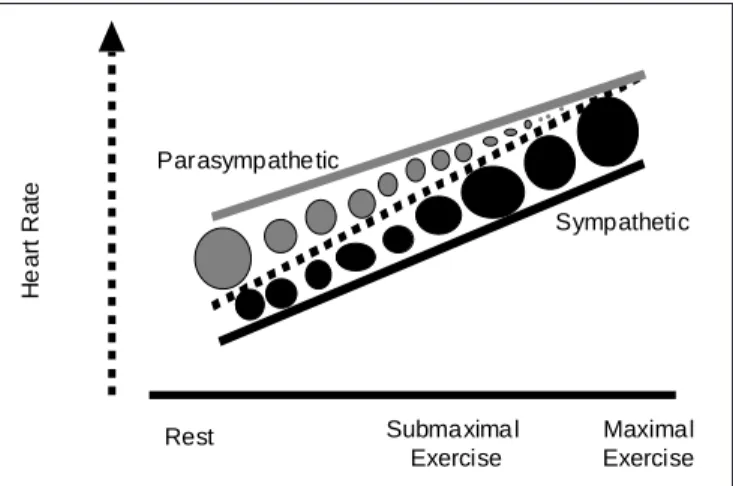
sympa-thetic when exercise intensity is further incremented (figure
1). Different mechanisms act to adjust
HRat different
mo-ments of a physical exercise. For instance, the mechanism
through which
HRraises on the first four seconds of a
phys-ical exercise has been extensively studied, including under
Effects of aerobic training on heart rate
Marcos B. Almeida
1and Claudio Gil S. Araújo
1,21. Programa de Pós-Graduação em Educação Física da Universidade Gama Filho – Rio de Janeiro, RJ.
2. Clinimex – Clínica de Medicina do Exercício – Rio de Janeiro, RJ. Received in 27/11/02
Approved in 14/3/03
Correspondence to:
Dr. Claudio Gil S. Araújo
Clínica de Medicina do Exercício – Clinimex (www.clinimex.com.br) Rua Siqueira Campos, 93/101
22031-070 – Rio de Janeiro, RJ E-mail: [email protected]
ABSTRACT
Regular physical exercise is an important factor to
re-duce the indexes of cardiovascular and all causes
morbi-mortality. However, there is, apparently, additional and
in-dependent benefits of the regular practice of physical
exercise and the improvement of the level of aerobic
con-dition. Heart rate (
HR) is mediated primarily by the direct
activity of the autonomic nervous system (
ANS),
specifi-cally through the sympathetic and parasympathetic
branch-es activitibranch-es over the sinus node autorhythmicity, with
pre-dominance of the vagal activity (parasympathetic) at rest,
that is progressively inhibited since the onset of the
exer-cise. The
HRbehavior has been widely studied during
dif-ferent conditions and protocols associated to the exercise.
A reduction of the cardiac vagal tone (parasympathetic
function) and consequently a diminished
HRvariability in
rest, independently of the protocol of measurement used,
is related to an autonomic dysfunction,
chronic-degenera-tive diseases and increased mortality risk. Individuals with
high levels of aerobic condition have a lower resting
HR,
along with a larger parasympathetic activity or smaller
sym-pathetic activity, but it is not necessarily a direct
conse-quence of the exercise training, as long as other inherent
adaptations to the aerobic conditioning can influence the
resting
HR. The
HRresponse in the onset of the exercise
represents the integrity of the vagus nerve, and the
HRre-covery on the post-exercise transient also denotes
impor-tant prognostic information; by the way, individuals that
have a slow
HRrecovery in the first minute post-exercise
have increased mortality risk. In conclusion, the
the effect of pharmacological block
20-22, and is almost
ex-clusively mediated by vagal inhibition, with no significant
sympathetic role
20, partly from different times of latency
from the two branches to this physiological stress.
HR
variability was originally studied by Hon and Lee
23in newborns, and has been the target of many researches
over the past few years. At a search with the key word “heart
rate variability” on MedLine, there were over 6,000
refer-ences, 32% between the years 1999 and 2002, showing a
raising interest on the theme within the
academic/scientif-ic fields.
HRvariations or variability can be measured within
the time and frequency domains, with specific protocols
for each domain
24-30, even with specificity enough for an
isolated assessment of cardiac vagal tone
(parasympathet-ic branch) in the transition from rest to dynam(parasympathet-ic exercise
20.
A reduction of the cardiac vagal tone, thus of
HRvari-ability, regardless of the measuring protocol, is related to
autonomic dysfunction, chronic-degenerative diseases, and
increased mortality risk
31-37, thus representing an
impor-tant indicator of health status
38,39. An isolated decrease of
HR
variability reflects a two- to five-fold increase in the
relative mortality risk due to a cardiac event
33,40; when
as-sociated to a significant decrease of baroreflex sensitivity
(< 3 ms/mmHg), this relative risk may reach a 7-fold
in-crease
33. On the other hand, in individuals with congestive
heart failure, even small increases in
HRvariability
indi-ces, such as standard-deviation of normal RR intervals (time
domain), may decrease mortality risk in up to 20%
32. For
this reason, and for its predominance on resting, cardiac
vagal activity has been addressed in a number of trials,
especially when it relates to physical activity.
Today, at the light of science, one cannot deny that
aero-bic training leads to improvement in the maximum oxygen
uptake
15,41,42, due to, at least in part, an increase of cardiac
output from an increase in the systolic volume. Maximal
HR
does not tend to change, whereas somewhat smaller
values may be seen in rest and, especially, during
submax-imal exercise
43, and are probably related to mechanisms
such as increase of venous return and myocardial
contrac-tility
44. Furthermore, maximum O
2
uptake, both absolute,
and gender and age-related, is an important longevity
fac-tor, i.e., the higher the aerobic conditions of an individual,
the smaller his/her mortality risk
3,45,46(table 1). These
ad-justments of
HRbehavior from aerobic training may also
be due to changes in the sympathetic-vagal balance or
in-trinsic adaptations, such as improvement in the
atrioven-tricular conduction system
47. Some studies suggest that the
mere practice of physical exercises is not enough to
effec-tively decrease mortality risk, being necessary that the
train-ing program be capable of promottrain-ing adjustments in both,
the individual’s aerobic condition
3,45,46and the autonomic
function
48.
It remains unclear if the improvement of the aerobic
con-dition from training enhances cardiac vagal tone, thus
rest-ing-
HRvariability. Therefore, the purpose of this review is
to discuss the effects of aerobic training on the autonomic
nervous system to control resting
HR, and in the initial and
Fig. 1 – Heart rate autonomic control at rest and at exercise.
Parasym-pathetic role decreases when intensity of exercise is increased, and the opposite happens with the sympathetic role.
TABLE 1
M ortality relative risk according to aerobic condition
Aerobic RR condition* (CI 95%)
Laukkanen et al., 2001 > 10.6 1.0 (ref) (asym ptom atic individuals) 9.3-10.6 0.71-3.01
7.9-9.2 1.44-5.39 < 7.9 2.02-7.32
Kavanagh et al., 2002 < 4.2 1.0 (ref) (individual w ith 4.2-6.3 0.54-0.71 cardiovascular disease) > 6.3 0.33-0.47
M yers et al., 2002 1.0-5.9 3.0-6.8 (asym ptom atic individuals) 6.0-7.9 1.5-3.8 8.0-9.9 1.1-2.8 10.0-12.9 0.7-2.2 > 13.0 1.0 (ref)
M yers et al., 2002 1.0-4.9 3.3-5.2 (individuals w ith 5.0-6.4 2.4-3.7 cardiovascular conditions) 6.5-8.2 1.7-2.8 8.3-10.6 1.4-2.2 > 10.7 1.0 (ref)
* Aerobic condition m easured in M ETs. RR: Relative risk for cardiovascular m ortality. ref.: Value of reference.
H
e
a
rt R
a
te
Rest Maximal
Exercise Parasympathetic
Sympathetic
Submaximal Exercise
final exercise transients, i.e., the potential of aerobic
train-ing in inductrain-ing physiological changes of the cardiac vagal
tone.
This review was based primarily on original studies in
humans of different medical and physical conditions
(lev-els of physical activity) ranging from individuals with
se-vere heart conditions, even heart-transplanted subjects, to
healthy, but sedentary individuals to high-performance
ath-letes.
EFFECTS ON RESTING-HR
A low resting
HRreflects a good health condition,
where-as higher values are apparently related to a higher
mortal-ity risk
49. A mistake often made in sports area is to use
resting-
HRas an indicator of the degree of aerobic
condi-tioning, since the association between low resting-
HRand
maximal aerobic power is quite modest, and may be due to
higher resting vagal activity
50, reducing diastolic
depolar-ization rate and prolonging duration of the cardiac cycle,
primarily on account of a proportionally longer diastole
13.
However, can training induce higher resting vagal activity,
and therefore be accountable for lower resting-
HR?
Studies suggest that well-trained or physically well-fit
(aerobically) individuals present a lower resting-
HR,
sug-gestive of higher parasympathetic activity
51-55or lower
sym-pathetic activity
56. However, except for the later, a
cross-sectional analysis does not allow us to conclude that training
was responsible for such adjustment on the
ANS. These
stud-ies did not take into consideration the level of aerobic
con-ditioning and the autonomic function of athletes prior to
training; by knowing that there is an important genetic
in-fluence in determining
HRvariability
57, one could
specu-late that those individuals could have better cardiovascular
adjustment upon training for having a better prior cardiac
vagal tone
58. Uusitalo et al.
59and Bonaduce et al.
60, after
longitudinal studies, noted a reduction of resting-
HR, even
though significant changes in autonomic indicators were
not seen. Exercise-induced bradycardia can also be due to
intrinsic adaptation of the sinus node
61.
A lower resting-
HRcan also be consequence of other
factors derived from a training program
60, such as the
in-crease of venous return and systolic volume. With the
im-provement of the venous return, there is an increase in the
systolic volume, and according to Frank-Starling law, when
there is an increase in the volume of blood in its cavities,
there is an increase in heart contractility
62. To keep
resting-heart output constant, there is a decrease of
HRin response
to a higher systolic volume, and these adaptations are
ex-pected in individuals with better aerobic conditioning
62,
re-gardless of their autonomic function. However, will
train-ing effects on cardiorespiratory variables also modify
ANS?
EFFECTS ON EXERCISE-HR
As previously discussed,
HRbehavior during the
exer-cise is mediated by
ANS.
HRvariability is the oscillation in
time between consecutive myocardial contractions
(systo-les)
23.
Studies with selective pharmacological block
22showed
the exclusive role of the vagus nerve in
HRresponse at the
initial transient of the exercise
20,21, with predominance of
the vagal activity at rest that is gradually inhibited at
sub-maximal exercise
63both active and passive
64-66, up to the
maximum level of exercise, when parasympathetic
activi-ty is apparently totally inhibited
67, causing smaller or
ab-sence of
HRvariability.
In the initial seconds of the exercise,
HRincreases due to
inhibition of vagal activity, which not only increases atria
contractility, but also conduction velocity of the ventricle
depolarization wave from
AVnode
62, regardless of the
lev-el of intensity of the exercise
68,69and aerobic conditioning
of healthy individuals
70,71. On other hand, an individual who
does not elevate significantly his/her
HRin the beginning
of the exercise, may be signalizing an impaired vagal
ac-tivity
72. After this initial stage, as one goes on exercising,
HR
increases again, due to adrenergic overstimulation on
sinus node, or due to increase of serum norepinephrine, or
atrial mechanics distention and therefore, sinus node
dis-tention due to a higher venous return, and the increase in
body’s temperature and blood’s acidity
73.
While Tulppo et al.
74and Goldsmith et al.
75relate
de-crease of
HRvariability to age, in face of decreased
physi-cal fitness from aging, and that this could be reverted by
maintaining or improving aerobic physical condition,
re-sults from Migliaro et al.
76and Byrne et al.
77suggest that
age alone could be the main factor to decrease autonomic
modulation, regardless of aerobic fitness.
Al-Ani et al.
89, and Gallo Jr et al.
90reached significant
out-comes with training on autonomic markers of healthy
in-dividuals, and Levy et al.
91further suggest that these gains
would not be age-dependent. In spite of the different
meth-odologies used, and the fact that time of effective training
had ranged from six weeks to 12 months, the results were
consonant, showing an increase in vagal activity due to an
exercise program, or even a decrease in resting
sympathet-ic activity, whsympathet-ich aid to hemodynamsympathet-ic improvements
56,92.
Duru et al.
93were not successful in investigating
posi-tive effects of the regular physical exercises in the
auto-nomic function of post-
MIindividuals when compared to
sedentary matches, as, although resting-
HRbeing lower after
training, variability indices (in frequency domain) are not
significantly altered. On the other hand, in the control group,
there was a significant decrease of these indices, showing
an advanced stage of autonomic imbalance in favor of a
sympathetic preponderance in individuals with post-
MIleft
ventricular dysfunction. These results can be interpreted
in another way: the regular practice of physical exercises
can, at least, maintain sympatho-vagal balance under
para-sympathetic predominance in post-
MIindividuals,
where-as sedentarism tends to increwhere-ase sympathetic influence, even
at rest. Other studies also failed in finding differentiated
adaptations of
ANSto a program of exercises. Loimaala et
al.
94did not find differences on variability indices of
ap-parently healthy sedentary individuals with age ranging
from 35 to 55 years, after 5 months of training, even at
night, when sympathetic activity is quite decreased and
there is less interference of other variables, with
improve-ment on resting-
HRonly, probably due to intrinsic
adapta-tions.
On the other hand, another interesting aspect is that
Boutcher and Stein
58have observed that individuals with
better cardiac vagal tone respond better to an aerobic
train-ing, with higher gains in maximum oxygen uptake, and
further decreasing resting-
HR. Confirming the last studies,
Uusitalo et al.
59e Bonaduce et al.
60, after investigating
ef-fects of high aerobic performance training on autonomic
modulations of young athletes, did not find differences,
neither for males nor females. It is possible that some
chang-es in
ANSactivity, due to training, are observed only as a
response to a stimulus, such as changes in posture or
dur-ing exercise, but not in rest
85,90, as in most protocols. One
cannot state that failure in finding differences in
autonom-ic functions due to training is due to measuring in rest,
without taking into account the possibility of a
ceiling-ef-fect of
ANSactivities, which could justify the mere
main-taining of the magnitude of sympathetic and
parasympa-thetic influences on
HRvariability after training period in
athletes or physically very well-fit individuals.
EFFECTS ON HR POST-EXERCISE RECOVERY
Another very important aspect addressed by the
litera-ture over the last few years is post-exercise, maximal
95-97and submaximal
98-100HRrecovery.
HRbehavior at the final
transient of the exercise is another indicator of vagus nerve
integrity.
HRfall at the end of the exercise does not replace
other measurements of cardiac autonomic activity, but it is
a remarkable complement to a medical and/or physical
as-sessment of an individual
101.
At the end of the exercise, special attention should be
paid to
HRbehavior, as its lowering less than 12 beats per
minute (bpm) if return to rest is active
97or 18 bpm if
pas-sive, in the supine position
102, at the first recovery minute
after a maximum-exercise test, represents an unfavorable
prognosis for relative-risk of cardiovascular mortality in
asymptomatic individuals and cardiopaths
95,97,102, i.e., for
both initial and final transient, the smaller the
HRvaria-tion, the higher the relative risk.
This stage of the exercise has been intensively
investi-gated over the last few years, but results still differ as to
the necessary time for total restore to post-exercise
ANSresting levels. The time for
HRto fall to resting levels
de-pends on the interaction among autonomic functions, the
level of physical fitness
103,104, and also on the intensity of
the exercise
68,105. Recovery can take one hour after light or
moderate exercise
105, four hours after long-duration
aero-bic exercise
106, and even up to 24 hours after intense or
maximal exercise
107. The mechanisms responsible for such
discrepancies as to the time needed for total
HRpost-exer-cise recovery are not fully clear, and the following
expla-nations are currently considered as the most plausible:
de-creased vagal activity
105,108-110, sympathetic overactivity
107,111or even increase in the activity of both
ANSbranches,
re-covering balance with slight vagal predominance
25. Five
minutes after a moderate to intense exercise session,
se-rum norepinephrine is still higher than when in rest
110,
sug-gesting higher sympathetic activity at this stage. However,
one must take into account a latency time of about 2.5
min-utes for serum norepinephrine to reach its peak
112, leading
us to wonder that the five-minute recovery time of this study
could be too short. It seems that with aging, the time to
norepinephrine be removed from the blood is slower, and
cardiac rhythm remains faster for a longer time after the
exercise. The decrease of post-exercise norepinephrine
con-centration comes along
HRdecrease, but there is
indica-tion that at the beginning of recovery, vagal modulaindica-tion is
primarily responsible for
HRfall
69,110.
Heart-transplanted individuals have a significantly slower
idea from Perini et al.
110. Physical training can increase the
delta between
HRat the end of the exercise and at the
be-ginning of recovery, and eight weeks of training would be
enough to augment this difference within the first 30
sec-onds post-exercise
114, with no differences in outcome for
gender or age group
115; however, such adaptation may be
lost in few weeks without training
79,114. In children,
recov-ery may be faster than in young adults due to their higher
central cholinergic modulation
116; there are differences for
elders as well, in whom decrease of post-exercise serum
norepinephrine takes longer
117. Apparently, the time for total
restoration of
ANSactivities is inversely related to the
max-imum level of O
2uptake
55,106, in spite of Arai et al.
63not
having found evidences in their results that indicated
dif-ferences in variables such as: gender
63,118, position of
sub-ject on recovery (seated or supine), and level of physical
activity among healthy individuals
63. When healthy
indi-viduals were compared to heart-failure or heart-transplanted
individuals, the former required shorter time for
post-max-imal exercise
HRrecovery; notwithstanding,
HRvariability
measured under frequency domain at the peak of the
exer-cise did not show differences among the groups, probably
a sign of complete inhibition of vagal activity at this stage
67.
The groups of heart-failure and heart-transplanted
individ-uals had reduced their
HRless than 10 bpm at the
begin-ning of the recovery stage, which is compatible to a
prob-able autonomic dysfunction and related to a high mortality
risk
95-97.
CONCLUSIONS
As discussed in this review,
HRvariability has been
stud-ied at a number of trials over the last few years, especially
its relation to a higher risk of cardiovascular mortality, a
common finding in many of these trials. Vagal nerve
activ-ity (parasympathetic branch) is considered to be a
cardio-vascular protection factor; therefore,
ANSdysfunction,
par-ticularly reduction of the cardiac vagal tone, translates in a
significant increase of cardiovascular mortality risk. It is
not clear if the regular practice of physical exercise can
significantly increase
ANSfunction, as shown by some
ev-idences. Perhaps some of the changes that take place in
HR
control at rest and at exercise submaximal levels are
consequence of intrinsic adaptations of the sinus node, or
derived from other physiological changes, such as the
in-crease of venous return and systolic volume, and improved
myocardial contractility; or peripheral, such as improved
oxygen extraction (oxygen arteriovenous difference) or
en-hanced O
2use to generate more work (mechanical
efficien-cy), causing
HRto reduce to those (submaximal) required
levels.
Apparently, aerobically well-fit individuals present a
more effective autonomic activity than sedentary ones, and
there is indication that individuals with better cardiac
va-gal tone have a better response to aerobic training, which
lead us to question whether aerobically well-fit athletes have
a higher cardiac vagal tone due to training or those
indi-viduals with genetically higher cardiac vagal tone have a
higher potential to become elite athletes if properly trained.
Certainly, the large variety of
HRmeasuring methods,
and the features and peculiarities of the samples and the
outlines used in each trial, have added to differences among
the results and their interpretations as to the effects of
ex-ercise and training on parasympathetic
ANSand
HRcon-trol.
In spite of the need of other studies on immediate and
late acute effects, and chronic effects of physical exercise
on the autonomic nervous system, especially of the
para-sympathetic component, identifying possible changes on
the cardiac vagal tone, some conclusions could be reached.
REFERENCES
1. Blair SN, Kohl 3rd HW, Barlow CE, Paffenbarger RS, Gibbons LW,
Mac-era CA. Changes in physical fitness and all-cause mortality. A prospec-tive study of healthy and unhealthy men. JAMA 1995;273:1093-8.
2. Centers for Disease Control. Coronary heart disease attributable to sed-entary life-style – selected states, 1988. JAMA 1990;264:1390-2.
3. Myers J, Prakash M, Froelicher V, Do D, Partington S, Atwood JE. Ex-ercise capacity and mortality among men referred for exEx-ercise testing. N Engl J Med 2002;346:793-801.
4. Willians PT. Physical fitness and activity as separate heart disease risk factors: a meta-analysis. Med Sci Sports Exerc 2001;5:754-61.
5. Erikssen G, Liestol K, Bjornholt J, Thaulow E, Sandvik L, Erikssen J. Changes in physical fitness and changes in mortality. Lancet 1998;352: 759-62.
6. McGinnis JM, Foege WH. Actual causes of death in the United States. JAMA 1993;270:2207-12.
7. Pearson TA, Blair SN, Daniels SR, Eckel RH, Fair JM, Fortmann SP, et al. AHA guidelines for primary prevention of cardiovascular disease and stroke: 2002 update. Consensus panel guide to comprehensive risk re-duction for adult patients without coronary or other atherosclerotic vas-cular diseases. Circulation 2002;106:388-91.
8. Kraus WE, Houmard JA, Duscha BD, Knetzger KJ, Wharton MB, Mc-Cartney JS, et al. Effects of the amount and intensity of exercise on plasma lipoproteins. N Engl J Med 2002;347:1483-92.
9. Paffenbarger RS, Lee IM. Physical activity and fitness for health and longevity. Res Q Exerc Sport 1996;67:11-28.
10. Manson JE, Hu FB, Rich-Edwards JW, Colditz GA, Stampfer MJ, Wil-lett WC, et al. A prospective study of walking as compared with vigor-ous exercise in the prevention of coronary heart disease in women. N Engl J Med 1999;341:650-8.
12. Tanasescu M, Leitzmann MF, Rimm EB, Willet WC, Stampfer MJ, Hu FB. Exercise type and intensity in relation to coronary disease in men. JAMA 2002;288:1994-2000.
13. Nottin S, Vinet A, Stecken F, N’Guyen LD, Ounissi F, Lecoq AM, Obert P. Central and peripheral cardiovascular adaptations to exercise in en-durance-trained children. Acta Physiol Scand 2002;175:85-92. 14. McGuirre DK, Levine BD, Williamson JW, Snell PG, Blomqvist CG,
Saltin B, et al. A 30-year follow-up of the Dallas Bed Rest and Training Study. The effect of age on the cardiovascular response to exercise. Cir-culation 2001;104:1350-7.
15. McGuirre DK, Levine BD, Williamson JW, Snell PG, Blomqvist CG, Saltin B, et al. A 30-year follow-up of the Dallas Bed Rest and Training Study. The effect of age on the cardiovascular adaptation to exercise. Circulation 2001;104:1358-66.
16. Stratton JR, Levy WC, Cerqueira MD, Schwartz RS, Abrass IB. Cardio-vascular responses to exercise. Effects of aging and exercise training in healthy men. Circulation 1994;89:1648-55.
17. Nóbrega ACL, Williamson JW, Araújo CGS, Friedman DB. Heart rate and blood pressure responses at the onset of dynamic exercise: effect of Valsalva manoeuvre. Eur J Appl Physiol 1994;68:336-40.
18. Ekblom B, Astrand PO, Saltin B, Stenberg J, Wallstrom B. Effect of training on circulatory response to exercise. J Appl Physiol 1968;24: 518-28.
19. Ekblom B, Hermansen L. Cardiac output in athletes. J Appl Physiol 1968; 25:619-25.
20. Araújo CGS, Nóbrega ACL, Castro CLB. Heart rate responses to deep breathing and 4-seconds of exercise before and after pharmacological blockade with atropine and propranolol. Clin Auton Res 1992;2:35-40. 21. Maciel BC, Gallo L Jr, Marin Neto JA, Lima Filho EC, Martins LE. Autonomic nervous control of the heart rate during dynamic exercise in normal man. Clin Sci (Colch) 1986;71:457-60.
22. Jose AD. Effect of combined sympathetic and parasympathetic block-ade on heart rate and function in man. Am J Cardiol 1966;18:476-8. 23. Hon EH, Lee ST. Electronic evaluations of the fetal heart rate patterns
preceding fetal death: further observations. Am J Obstet Gynecol 1965; 87:814-826.
24. Moraes RS, Ferlin EL, Polanczyk CA, Rohde LE, Zaslavski L, Gross JL, Ribeiro JP. Three-dimensional return map: a new tool for quantifica-tion of heart rate variability. Auton Neurosci 2000;83:90-9.
25. Oida E, Moritani T, Yamori Y. Tone-entropy analysis on cardiac recov-ery after dynamic exercise. J Appl Physiol 1997;82:1794-801. 26. European Society of Cardiology. Heart rate variability: Standards of
measurement, physiological interpretation, and clinical use. Task Force of the European Society of Cardiology and the North American Society of Pacing Electrophysiology. Circulation 1996;93:1043-65.
27. Marfella R, Guigliano D, di Maro G, Acampora R, Giunta R, D’Onofrio F. The squatting test. A useful tool to assess both parasympathetic and sympathetic involvement of the cardiovascular autonomic neuropathy in diabetes. Diabetes 1994;43:607-12.
28. Castro CLB, Nóbrega ACL, Araújo CGS. Testes autonômicos cardio-vasculares. Uma revisão crítica. Parte I. Arq Bras Cardiol 1992;59:75-85.
29. Castro CLB, Nóbrega ACL, Araújo CGS. Testes autonômicos cardio-vasculares. Uma revisão crítica. Parte II. Arq Bras Cardiol 1992;59:151-8.
30. Wieling W, Borst C, Karemaker JM, Dunning AJ. Testing for autonomic neuropathy: initial heart rate response to active and passive changes of posture. Clin Physiol 1985;5: S5-23-7.
31. Tapanainen J, Thomsen P, Kober L, Torp-Pedersen C, Makikallio T, Still A, et al. Fractal analysis of heart rate variability and mortality after an acute myocardial infarction. Am J Cardiol 2002;90:347.
32. Bilchick KC, Fetics B, Djoukeng R, Fisher SG, Fletcher RD, Singh SN, et al. Prognostic value of heart rate variability in chronic congestive heart failure (Veterans Affairs’ Survival Trial of Antiarrhythmic Therapy in Congestive Heart Failure). Am J Cardiol 2002;90:24-8.
33. La Rovere MT, Pinna GD, Hohnloser SH, Marcus FI, Mortara A, Noha-ra R, et al. Baroreflex sensitivity and heart Noha-rate variability in the identi-fication of patients at risk for life-threatening arrhythmias. Implications for clinical trials. Circulation 2001;103:2072-7.
34. Colhoun HM, Francis DP, Rubens MB, Underwood SR, Fuller JH. The association of heart rate variability with cardiovascular risk factors and coronary artery calcification. A study in type 1 diabetic patients and the general population. Diabetes Care 2001;24:1108-14.
35. Ribeiro AL, Moraes RS, Ribeiro JP, Ferlin EL, Torres RM, Oliveira E, Rocha MO. Parasympathetic dysautonomia precedes left ventricular sys-tolic dysfunction in Chagas disease. Am Heart J 2001;141:260-5.
36. Nolan J, Batin PD, Andrews R, Lindsay SJ, Brooksby P, Mullen M, et al. Prospective study of heart rate variability and mortality in chronic heart failure. Results of the United Kingdom Heart Failure Evaluation Assessment of Risk Trial (UK-Heart). Circulation 1998;98:1510-6. 37. Singh JP, Larson MG, Tsuji H, Evans JC, O’Donnell CJ, Levy D.
Re-duced heart rate variability and new-onset hypertension. Insights into pathogenesis of hypertension: The Framingham Heart Study. Hyperten-sion 1998;32:293-7.
38. Kikuya M, Hozawa A, Ohokubo T, Tsuji I, Michimata M, Matsubara M, et al. Prognostic significance of blood pressure and heart rate variabili-ties. The Ohasama Study. Hypertension 2000;36:901-6.
39. Moser M, Lehofer M, Sedminek A, Lux M, Zapotoczky HG, Kenner T, et al. Heart rate variability as a prognostic tool in cardiology. A contri-bution to the problem from a theoretical point of view. Circulation 1994; 90:1078-82.
40. La Rovere MT, Bigger Jr JT, Marcus FI, Mortara A, Schwartz PJ, for the ATRAMI (Autonomic Tone and Reflexes After Myocardial Infarction) investigators. Baroreflex sensitivity and heart rate variability in predic-tion of total cardiac mortality after myocardial infarcpredic-tion. Lancet 1998; 351:478-84.
41. Seal DR, Chase PB. Influence of physical training on heart rate variabil-ity and baroreflex circulatory control. J Appl Physiol 1989;66:1886-95. 42. Blomqvist CG, Saltin B. Cardiovascular adaptations to physical
train-ing. Ann Rev Physiol 1983;45:169-89.
43. Fox EL, Bartels RL, Billings CE, O’Brien R, Bason R, Mathews DK. Frequency and duration of interval programs and changes in aerobic power. J Appl Physiol 1975;38:481-4.
44. Yoshiga CC, Higuchi M. Heart rate is lower during ergometer rowing than during treadmill running. Eur J Appl Physiol 2002;87:97-100.
45. Kavanagh T, Mertens DJ, Hamm LF, Beyene J, Kennedy J, Corey P, et al. Prediction of long-term prognosis in 12169 men referred for cardiac rehabilitation. Circulation 2002;106:666-71.
46. Laukkanen JA, Lakka TA, Rauramaa R, Kuhanen R, Venäläinen JM, Salonen R, et al. Cardiovascular fitness as a predictor of mortality in men. Arch Intern Med 2001;161:825-31.
47. Stein R, Moraes RS, Cavalcanti AV, Ferlin EL, Zimerman LI, Ribeiro JP. Atrial automaticity and atrioventricular conduction in athletes: con-tribution of autonomic regulation. Eur J Appl Physiol 2000;82:155-7. 48. La Rovere MT, Bersano C, Gnemmi M, Specchia G, Schwartz PJ.
Exer-cise-induced increase in baroreflex sensitivity predicts improved prog-nosis after myocardial infarction. Circulation 2002;106:945-9.
50. Jensen-Urstad K, Saltin B, Ericson M, Storck N, Jensen-Urstad M. Pro-nounced resting bradycardia in male elite runners is associated with high heart variability. Scand J Med Sci Sports 1997;7:274-8.
51. Aubert AE, Beckers F, Ramaekers D. Short-term heart rate variability in young athletes. J Cardiol 2001;37: S85-8.
52. Spalding TW, Jeffers LS, Porges SW, Hatfield BD. Vagal and cardiac reactivity to psychological stressors in trained and untrained men. Med Sci Sports Exerc 2000;32:581-91.
53. Shin K, Minamitani H, Onishi S, Yamazaki H, Lee M. Autonomic dif-ferences between athletes and nonathletes: spectral analysis approach. Med Sci Sports Exerc 1997;29:1482-90.
54. Shin K, Minamitani H, Onishi S, Yamazaki H, Lee M. The power spec-tral analysis of heart rate variability in athletes during dynamic exercise – part I. Clin Cardiol 1995;18:583-6.
55. Dixon E, Kamath MV, McCartney N, Fallen E. Neural regulation of the heart rate in endurance athletes and sedentary controls. Cardiovasc Res 1992;26:713-9.
56. Chacon-Mikahil MPT, Forti VAM, Catai AM, Szrajer JS, Golfetti R, Martins LEB, et al. Cardiorespiratory adaptations induced by aerobic training in middle-age men: the importance of a decrease in sympathetic stimulation for the contribution of dynamic exercise tachycardia. Bra-zilian J Med Biol Res 1998;31:705-12.
57. Singh JP, Larson MG, O’Donnell CJ, Tsuji H, Evans JC, Levy D. Heri-tability of the heart rate variability. The Framingham Heart Study. Cir-culation 1999;99:2251-4.
58. Boutcher SH, Stein P. Association between heart rate variability and train-ing response in sedentary middle-aged men. Eur J Appl Physiol 1995; 70:75-80.
59. Uusitalo ALT, Uusitalo AJ, Ruscko HK. Exhaustive endurance training for 6-9 weeks did not change in intrinsic heart rate and cardiac autonom-ic modulation in female athletes. Int J Sports Med 1998;19:532-40. 60. Bonaduce D, Petretta M, Cavallaro V, Apicella C, Ianniciello A,
Ro-mano M, et al. Intensive training and cardiac autonomic control in high level athletes. Med Sci Sports Exerc 1998;30:691-6.
61. Catai AM, Chacon-Mikahil MP, Martinelli FS, Forti VAM, Silva E, Golfetti R, et al. Effects of aerobic exercise training on heart rate vari-ability during wakefulness and sleep and cardiorespiratory responses of young and middle-age healthy men. Brazilian J Med Biol Res 2002;35: 741-52.
62. Clausen JP. Effect of physical training on cardiovascular adjustments to exercise in man. Physiol Rev 1977;57:779-815.
63. Arai Y, Saul JP, Albrecht P, Hartley LH, Lilly LS, Cohen RJ, Colucci WS. Modulation of cardiac autonomic activity during and immediately after exercise. Am J Physiol 1989;256:H132-41.
64. Nurhayati Y, Boutcher SH. Cardiovascular response to passive cycle exercise. Med Sci Sports Exerc 1998;30:234-8.
65. Nóbrega ACL, Williamson JW, Friedman DB, Araújo CGS, Mitchell JH. Cardiovascular responses to active and passive cycling movements. Med Sci Sports Exerc 1994;26:709-14.
66. Nóbrega ACL, Araújo CGS. Heart rate transient at the onset of active and passive dynamic exercise. Med Sci Sports Exerc 1993;25:37-41. 67. Alonso DO, Forjaz CLM, Rezende LO, Braga AMFW, Barretto ACP,
Negrão CE, et al. Comportamento da freqüência cardíaca e da sua varia-bilidade durante as diferentes fases do exercício físico progressivo. Arq Bras Cardiol 1998;71:787-92.
68. Baum K, Ebfeld D, Leyk D, Stegemann J. Blood pressure and heart rate during rest-exercise and exercise-rest transitions. Eur J Appl Physiol 1992; 64:134-8.
69. Araújo CGS. Fast “on” and “off” heart rate transients at different bicy-cle exercise levels. Int J Sports Med 1985;6:68-73.
70. Araújo CGS, Nóbrega ACL, Castro CLB. Vagal activity: effect of age, sex and physical pattern. Brazilian J Med Biol Res 1989;22:909-11. 71. Borst C, Wieling W, van Brederode JFM, Hond A, de Rijk LG, Dunning
AJ. Mechanisms of initial heart rate response to postural change. Am J Physiol 1982;243:H676-81.
72. Nóbrega ACL, Castro CLB, Araújo CGS. Relative roles of the sympa-thetic and parasympasympa-thetic systems in the 4-s exercise test. Brazilian J Med Biol Res 1990;23:1259-62.
73. Araújo CGS. Fisiologia do exercício. In: Araújo WB, editor. Ergometria e cardiologia desportiva. Rio de Janeiro: Medsi, 1986;1-57.
74. Tulppo MP, Mäkikallio TH, Seppänen T, Laukkanen RT, Huikuri HV. Vagal modulation of heart rate during exercise: effects of age and phys-ical fitness. Am J Physiol 1998;274:H424-9.
75. Goldsmith RL, Bigger JT, Bloofield DM, Steinman RC. Physical fitness as a determinant of vagal modulation. Med Sci Sports Exerc 1997;29: 812-7.
76. Migliaro ER, Contreras P, Bech S, Etxagibel A, Castro M, Ricca R, et al. Relative influence of age, resting heart rate and sedentary life style in short-term analysis of heart rate variability. Brazilian J Med Biol Res 2001;34:493-500.
77. Byrne EA, Fleg JL, Vaitkevicius PV, Wright J, Porges SW. Role of aer-obic capacity and body mass index in the age-associated decline in heart rate variability. J Appl Physiol 1996;81:743-50.
78. Hunt BE, Farquhar WB, Taylor JA. Does reduced vascular stiffening fully explain preserved cardiovagal baroreflex function in older, physi-cally active men? Circulation 2001;103:2424-7.
79. Frederiks J, Swenne CA, Bruschke AVG, van der Velde ET, Maan AC, Tenvoorde BJ, et al. Correlated neurocardiologic and fitness changes in athletes interrupting training. Med Sci Sports Exerc 2000;32:571-5. 80. Uusitalo ALT, Laitinen T, Väisänen SB, Länsimies E, Rauramaa R.
Ef-fects of endurance training on heart rate and blood pressure variability. Cli Physiol & Func Im 2002;22:173-9.
81. Malfatto G, Branzi G, Riva B, Sala L, Leonetti G, Facchini M. Recov-ery of cardiac autonomic responsiveness with low-intensity physical train-ing in patients with chronic heart failure. Eur J Heart Fail 2002;4:159-66.
82. Radaelli A, Coats AJ, Leuzzi S, Piepoli M, Meyer TE, Calciati A, et al. Physical training enhances sympathetic and parasympathetic control of heart rate and peripheral vessels in chronic heart failure. Clin Sci (Colch) 1996;91: S92-4.
83. Iellamo F, Legramante JM, Massaro M, Raimondi G, Galante A. Effects of a residential exercise training on baroreflex sensitivity and heart rate variability in patients with coronary artery disease. A randomized, con-trolled study. Circulation 2000;102:2588-92.
84. Oya M, Itoh H, Kato K, Tanabe K, Murayama M. Effects of exercise training on the recovery of the autonomic nervous system and exercise capacity after acute myocardial infarction. Jpn Circ J 1999;63:843-8. 85. La Rovere MT, Mortara A, Sandrone G, Lombardi F. Autonomic
ner-vous system adaptations to short-term exercise training. Chest 1992;101: 299S-303.
86. Seals DR, Hurley BF, Hagberg JM, Schultz J, Linder BJ, Natter L, et al. Effects of training on systolic time intervals at rest and during isometric exercise in men and women 61 to 64 years old. Am J Cardiol 1985;55: 797-800.
87. Melanson EL, Freedson OS. The effect of endurance training on resting heart rate variability in sedentary adult males. Eur J Appl Physiol 2001; 85:442-9.
89. Al-Ani M, Munir SM, White M, Towend J, Coote JH. Changes in R-R variability before and after endurance training measured by power spec-tral analysis and by the effect of isometric muscle contraction. Eur J Appl Physiol 1996;74:397-403.
90. Gallo Jr L, Maciel BC, Marin-Neto JA, Martins LEB. Sympathetic and parasympathetic changes in heart rate control during dynamic exercise induced by endurance training in man. Brazilian J Med Biol Res 1989; 22:631-43.
91. Levy WC, Cerquera MD, Harp GD, Johannessen KA, Abrass IB, Schwartz RS, et al. Effect of endurance exercise training on heart rate variability at rest in healthy young and older men. Am J Cardiol 1998; 82:1236-41.
92. O’Sullivan SE, Bell C. Training reduces autonomic cardiovascular re-sponses to both exercise-dependent and -independent stimuli in humans. Auton Neurosci 2001;91:76-84.
93. Duru F, Candinas R, Dziekan G, Goebbels U, Myers J, Dubach P. Ef-fect of exercise training on heart rate variability in patients with new-onset left ventricular dysfunction after myocardial infarction. Am Heart J 2000; 140:157-61.
94. Loimaala A, Huikuri H, Oja P, Pasanen M, Vuori I. Controled 5-mo aerobic training improves heart rate but not heart rate variability or baroreflex sensitivity. J Appl Physiol 2000;89:1825-9.
95. Nishime OE, Cole CR, Blackstone EH, Pashkow FJ, Lauer MS. Heart rate recovery and treadmill exercise score as predictors of mortality in patients referred for exercise ECG. JAMA 2000;284:1392-8. 96. Pierpont GL, Stolpman DR, Gornick CC. Heart rate recovery as an
index of parasympathetic activity. J Auton Nerv Syst 2000;80:169-74. 97. Cole CR, Blackstone EH, Pashkow FJ, Snader CE, Lauer MS. Heart rate recovery immediately after exercise as a predictor of mortality. N Engl J Med 1999;341:1351-7.
98. Morshedi-Meibodi A, Larson MG, Levy D, O’Donnel CJ, Vasan R. Heart rate recovery after treadmill exercise testing and risk of cardio-vascular disease events (The Framingham Heart Study). Am J Cardiol 2002;90: 848-52.
99. Cole CR, Foody JM, Blackstone EH, Lauer MS. Heart rate recovery after submaximal exercise testing as a predictor of mortality in a car-diovascularly healthy cohort. Ann Intern Med 2000;132:552-5. 100. Lauer MS, Francis GS, Okin PM, Pashkow FJ, Snader CE, Marwick
TH. Impaired chronotropic response to exercise stress testing as a pre-dictor of mortality. JAMA 1999;281:524-9.
101. Shetler K, Marcus R, Froelicher VF, Vora S, Kalisetti D, Prakash M, et al. Heart rate recovery: validation and methodologic issues. J Am Coll Cardiol 2001;38:1980-7.
102. Watanabe J, Thamilarasan M, Blackstone EH, Thomas JD, Lauer MS. Heart rate recovery immediately after treadmill exercise and left ven-tricular systolic dysfunction as predictors of mortality. The case of stress echocardiography. Circulation 2001;104:1991-6.
103. Hatfield BD, Spalding TW, Santa Maria DL, Porges SW, Potts JT, Byr-ne EA, et al. Respiratory sinus arrhythmia during exercise in aerobical-ly trained and untrained men. Med Sci Sports Exerc 1998;30:206-14.
104. Darr KC, Bassett DR, Morgan BJ, Thomas DP. Effects of age and train-ing status on heart rate recovery after peak exercise. Am J Physiol 1988; 254:H340-3.
105. Terziotti P, Schena F, Gulli G, Cevese A. Post-exercise recovery of autonomic cardiovascular control: a study by spectrum and cross-spec-trum analysis in humans. Eur J Appl Physiol 2001;84:187-94.
106. Hautala A, Tulppo MP, Mäkikallio TH, Laukkanen R, Nissilä S, Huikuri HV. Changes in cardiac autonomic regulation after prolonged maximal exercise. Clin Physiol 2001;21:238-45.
107. Furlan R, Piazza S, Dell’Orto S, Gentile E, Cerutti S, Pagani M, Mal-liani A. Early and late effects of exercise and athletic training on neural mechanisms controlling heart rate. Cardiovasc Res 1993;27:482-8.
108. Melanson EL. Resting heart rate variability in men varying in habitual physical activity. Med Sci Sports Exerc 2000;32:1894-901.
109. Imai K, Sato H, Hori M, Kusuoka H, Ozaki H, Yokoyama H, et al. Vagally mediated heart rate recovery after exercise is accelerated in athletes but blunted in patients with chronic heart failure. J Am Coll Cardiol 1994;24:1529-35.
110. Perini R, Orizio C, Comandè A, Castellano M, Beschi M, Veicsteinas A. Plasma norepinephrine and heart rate dynamics during recovery from submaximal exercise in men. Eur J Appl Physiol 1989;58:879-83.
111. Dilaveris PE, Zervopoulos GA, Michaelides AP, Sideris SK, Psomada-ki ZD, Gialafos EJ, et al. Ischemia-induced reflex sympathoexcitation during the recovery period after maximal treadmill exercise testing. Clin Cardiol 1998;21:585-90.
112. Watson RDS, Hamilton CA, Jones DH, Reid JL, Stallard TJ, Littler WA. Sequential changes in plasma noradrenaline during bicycle exer-cise. Clin Sci 1980;58:37-43.
113. Desai MY, Peña-Almaguer E, Mannting F. Abnormal heart rate recov-ery after exercise as a reflection of abnormal chronotropic response. Am J Cardiol 2001;87:1164-9.
114. Sugawara J, Murakami H, Maeda S, Kuno S, Matsuda M. Change in post-exercise vagal reactivation with exercise training and detraining in young men. Eur J Appl Physiol 2001;85:259-63.
115. Hao SC, Chai A, Kligfield P. Heart rate recovery response to symptom-limited treadmill exercise after cardiac rehabilitation in patients with coronary artery disease with and without recent events. Am J Cardiol 2002;90:763-5.
116. Ohuchi H, Suzuki, Yasuda K, Arakaki Y, Echigo S, Kamiya T. Heart rate recovery after exercise and cardiac autonomic nervous activity in children. Pediatr Res 2000;47:329-35.
117. Tasaki H, Serita T, Irita A, Hano O, Iliev I, Ueyama C, et al. A 15-year longitudinal follow-up study of heart rate and heart rate variability in healthy elderly persons. J Gerontol 2000;55A:M744-9.