ORIGINAL ARTICLE
Development, validity, and reliability of the General
Activities of Daily Living Scale: a multidimensional
measure of activities of daily living for older people
Jonas J. de Paula,
1,2,3Laiss Bertola,
1,2Rafaela T. de A
´ vila,
1,2Luciana de O. Assis,
3,4Maicon Albuquerque,
1,2,5Maria A. Bicalho,
6Edgar N. de Moraes,
6Rodrigo Nicolato,
2,7Leandro F. Malloy-Diniz
1,2,71Laboratory of Research in Clinical Neuroscience (LINC), Universidade Federal de Minas Gerais (UFMG), Belo Horizonte, MG, Brazil. 2National Science and Technology Institute for Molecular Medicine, School of Medicine, UFMG, Belo Horizonte, MG, Brazil.3Faculdade de Cieˆncias Me´dicas de Minas Gerais, Belo Horizonte, MG, Brazil.4Graduate Program in Neurosciences, Institute of Biological Sciences, UFMG, Belo Horizonte, MG, Brazil.5Universidade Federal de Vic¸osa, Vic¸osa, MG, Brazil.6Department of Medical Practice, School of Medicine, UFMG, Belo Horizonte, MG, Brazil.7Department of Mental Health, School of Medicine, UFMG, Belo Horizonte, MG, Brazil.
Objective:To propose and evaluate the psychometric properties of a multidimensional measure of activities of daily living (ADLs) based on the Katz and Lawton indices for Alzheimer’s disease (AD) and mild cognitive impairment (MCI).
Methods:In this study, 85 patients with MCI and 93 with AD, stratified by age (f74 years,.74 years), completed the Mini Mental State Examination (MMSE) and the Geriatric Depression Scale, and their caregivers completed scales for ADLs. Construct validity (factor analysis), reliability (internal consistency), and criterion-related validity (receiver operating characteristic analysis and logistic regression) were assessed.
Results:Three factors of ADL (self-care, domestic activities, and complex activities) were identified and used for item reorganization and for the creation of a new inventory, called the General Activities of Daily Living Scale (GADL). The components showed good internal consistency (. 0.800) and moderate (younger participants) or high (older participants) accuracy for the distinction between MCI and AD. An additive effect was found between the GADL complex ADLs and global ADLs with the MMSE for the correct classification of younger patients.
Conclusion:The GADL showed evidence of validity and reliability for the Brazilian elderly population. It may also play an important role in the differential diagnosis of MCI and AD.
Keywords: Activities of daily living; older people; Alzheimer’s disease; mild cognitive impairment; functional assessment; psychometric properties
Introduction
The population explosion that has occurred in the last decades and the improvement in overall quality of life and health conditions has led to an increase in the proportion of older people in relation to the general population in recent years.1With the continuous enhancement of life expectancy, diseases associated with advancing age, such as most dementias and other neuropsychiatric conditions, have become more prevalent.2 Dementia due to Alzheimer’s disease (AD) and mild cognitive impairment (MCI) are two diagnoses associated with advanced aging. Both are characterized by cognitive and functional impairment and are generally progressive, resulting in poorer quality of life, as well as social and economic burden. In AD, functional impairment is
required for diagnosis, whereas in MCI, functional deficits are usually mild, compromise complex activities, and do not result in expressive limitations in daily life.3
The use of inventories of activities of daily living (ADLs) is a common method for the assessment of functional status in older patients. These inventories are usually lists of common behaviors that are expected to be performed without difficulty by older patients. ADLs are commonly divided into ‘‘basic ADLs’’ (BADLs, related to self-care, such as using the bathroom, bathing, and changing clothes) and ‘‘instrumental ADLs’’ (IADLs, which are related to more complex activities, such as housekeeping, financial management, and correct use of medications). There is a hierarchy of complexity and cognitive demands between BADLs and IADLs. The latter are usually more dependent on cognitive aspects, but some overlap occurs, as indicated by an important study using a general cognitive measure.4 For IADLs, informant reports have commonly been used in the literature as a proxy for real-world functioning. This method has distinct advantages and disadvantages. Informant-report questionnaires are
Correspondence: Jonas Jardim de Paula, Av. Alfredo Balena, 190, CEP 30130-100, Belo Horizonte, MG, Brazil.
E-mail: [email protected]
Submitted Sep 16 2012, accepted May 23 2013.
easy to administer and may provide a reasonably accurate representation of the real world. They are, however, vulnerable to subjective bias.5
According to the results of a Brazilian review of cognitive and functional assessment tools,6only a few measures of functional status have undergone formal adaptation and validation procedures for the older population. The Pfeffer Functional Activities Questionnaire seems to be one of the most commonly used tools for functional assessment aiming at the investigation of IADL performance.7-10One study using the Pfeffer scale7 found an additive effect between functional scores and the Mini Mental State Examination (MMSE) for the diagnosis of AD. The Disability Assessment for Dementia was also adapted for Brazil11and seems to be useful for the characterization of functionality in frontotemporal dementia and AD, asses-sing both BADLs and IADLs as well as leisure activities, although these two groups do not show differences in functional performance.12
The BADL index was developed by Sidney Katz in 196313 to study the results of treatment and prognosis among older and chronically ill people. The grades of the index summarize overall performance in bathing, dressing, going to the bathroom, transferring, continence, and feeding. During the development of the index, 1,001 patients were assessed, and the use of the index was validated as a survey instrument and as an aid in rehabilitation teaching.13 The Katz Index was culturally adapted and translated to Brazilian Portuguese.14,15The reliability and internal consistency of the adapted version were assessed by independent examiners by retesting patients on the same day (kappa = 0.91; alpha = 0.92/0.91) or 7 days after the first interview (kappa = 0.67; alpha = 0.80/0.83). The final version was considered easy to understand and to use with solid evidence of reliability.15
In 1969, Lawton & Brody developed16a scale to measure a somewhat more complex set of behaviors: telephoning, shopping, food preparation, housekeeping, laundering, use of transportation, medicine management, and financial behavior. They tested the inventory on 265 patients and found significant correlations with other functional, beha-vioral, and cognitive measures. This IADL scale provides a brief and objective assessment and was found to have practical utility in widely diverse settings, with a range of population groups and ages, and for a variety of goals.16In Brazil, a study reported adequate reliability for this index (0.90 by the same examiner and 0.80 between observers) and a significant correlation with the strength of upper limbs (r = 0.530), but not lower limbs (r = 0.270).17
Adapted versions of the Katz and Lawton indices are commonly used in Brazilian gerontology centers for the functional assessment of older patients.18These scales are based on components of the classical Katz and Lawton-Brody Inventories and are designed for the assessment of ADL in older adults. However, consensual objective scoring criteria are not available for these adapted scales, requiring a subjective interpretation of symptoms by the health practitioner. In Brazilian studies, the interpretation of these indices is heterogeneous, with adoption of a Likert-like scoring method19 or frequency
analysis20 of independent, partially dependent, and dependent activities. This may reduce the uniformity of clinical assessment, producing bias for the clinician and limiting the possibility of between-study comparisons in research settings. Therefore, unified scoring criteria for BADL and IADL scales may improve their uses in both contexts. Additionally, these indices refer to a continuum of functional abilities, and an integrated interpretation of the BADL and IADL scales is necessary for an accurate assessment of patients. Therefore, the present study proposes to evaluate the reliability (internal consistency) and validity (construct and criterion) of an objective and unified scoring system for ADLs. Based on the analysis, an empirically based inventory of ADLs will be proposed for the functional assessment of older Brazilian people. We hypothesize a multifactorial structure for ADLs based on the complexity of specific activities.
Methods
Sample and procedure
The present study included 178 participants: 85 diag-nosed with amnestic MCI according to Petersen’s criteria3 and 93 patients diagnosed with mild probable AD by the NINCDS-ADRDA21 criteria. The assessment included an interview with the patient and a close caregiver to investigate the symptoms, progression, functional loss, family history, and possible confounders. Clinical examination and neuroimaging tests were per-formed when necessary. The study included cognitive screening methods (MMSE,22Verbal Fluency,23and the Clock Drawing Test23), psychiatric symptom interviews (including the Geriatric Depression Scale 15-item version – GDS-1524), an unstructured functional status interview assessing functional complaints based on a caregiver report focusing on lost abilities, a neuropsychological assessment including a brief protocol proposed for assessment of working memory, language comprehen-sion, constructional praxis, and executive functions in older people,23 the Brazilian Portuguese version of the Rey Auditory-Verbal Learning Test25to assess episodic memory, and the Frontal Assessment Battery26to assess frontal-executive functions. The Clinical Dementia Rating27was used for staging of AD patients (only mildly demented patients were invited). The diagnoses were performed by consensus, including at least one geria-trician and one neuropsychologist, no more than 1 month prior to the assessment of the present study. Patients with severe sensory or motor impairment, those with positive psychotic symptoms, and those without care-givers were not included in this study. Only patients who met the aforementioned inclusion criteria were invited to participate. The patients were assessed at the Instituto Jenny de Andrade Faria de Atenc¸a˜o a` Sau´de do Idoso, a secondary/tertiary public health center for older people. The project was approved by the Research Ethics Committee of the Federal University of Minas Gerais (COEP-334/06). All patients and their families gave written consent for participation.
JJ de Paula et al. 144
Inventories of activities of daily living
The BADL and IADL inventories based on the Katz and Lawton indices and adopted by the Instituto Jenny de Andrade Faria de Atenc¸a˜o a` Sau´de do Idoso were selected as candidate measures of ADLs.18After minor adjustments of the items aiming at better comprehension by the caregiver, an adapted version was used in the present study (Appendices 1 and 2). Responses were provided by a relative (usually the spouse, son, or sibling) living with the patient and accompanying the patient’s performance in daily life. By combining the two indices, 14 ADLs were evaluated and divided into six basic and eight instrumental activities. Objective scoring criteria were adopted for the evaluation of each activity according to the following procedure: 1) independent: performs the activity in question spontaneously, independently, safely, and without the need for supervision by others or additional technological resources (score = 2); 2) partially dependent: requires some degree of supervision or assistance, human or technological, for the safe perfor-mance of the proposed activities (score = 1); 3) dependent: requires constant human assistance to per-form the tasks (score = 0). Based on this scoring system, BADL scores range from a minimum of 0 (worst) to a maximum of 12 (best). The IADL score, following the same method, ranges from 0 to 16. Together, the items range from 0 to 28 points.
Statistical procedures
Because age is an important factor for the performance of ADLs,28MCI and AD patients were divided by the sample median (74 years), creating the subgroups young (f74) and old (. 74). According to a chi-square statistic, no differences were found between the proportion of AD and MCI patients between the two age groups (chi-square = 2.05, p = 0.203). In addition to the results of the MMSE, the GDS-15, BADL, and IADL, the demographic char-acteristics of the participants were assessed by descrip-tive statistics. The general analysis of data distribution, performed by the Kolmogorov-Smirnov test (n . 50), showed predominantly non-parametric distributions. Differences between the four groups (MCI young, AD young, MCI old, and AD old) were analyzed by non-parametric tests: the Kruskal-Wallis test for general group comparisons and Bonferroni-corrected (p = 0.008) Mann-Whitney tests for specific group comparisons. Differences in the distribution of men and women among the groups were assessed by chi-square tests.
The analysis of construct validity was performed first by an exploratory factor analysis of all ADLs. Principal axis factoring was chosen for the factor extraction, and an orthogonal rotation design (varimax) was adopted for better interpretation of the components. The criteria for factor extraction were eigenvalues larger than 1 and a convergent scree plot analysis by two experienced researchers. To determine significant factor loadings on each item, parameters based on sample size were adopted.29Based on our sample size, factor loadings of 0.45 or higher can be considered significant. The factor
structure was used for the development of a new inventory, grouping the ADL of each factor on new functional performance indices. For the assessment of the reliability of the new variables, Cronbach’s alpha was used to investigate the internal consistency of each component. Correlational analysis was performed (using Spearman’s rank-order correlation) between the encoun-tered factors, the MMSE, GDS-15, age, and education.
For the assessment of criterion-related validity, con-sidering the encountered factor division, a ROC curve analysis was performed for the differential diagnosis of MCI and AD patients stratified by age group with each of the functional measures. A sensitivity and specificity ratio close to 1 was adopted for the selection of cutoff scores, offering a conservative diagnostic approach. Because functional and cognitive assessments are relevant for the diagnosis of AD and MCI, binomial logistic regression models were created for the assessment of a possible additive effect between the functional components created after the factor analysis and the MMSE on the differential diagnosis of AD and MCI. The regression models were built by first including the MMSE (used as a base for the others), then combining it with each of the factors encountered and, finally, the total score of the new inventory. These regression analyses were performed independently for young and old participants. A model was developed for each combination (five models per age group), thus reducing multicollinearity. All statistical procedures were performed in SPSS version 17.0.30
Results
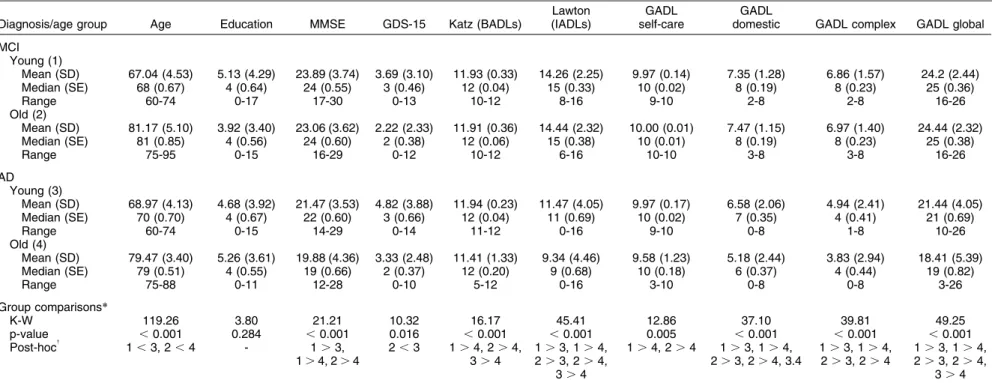
Considering the AD and MCI patients without stratifying for age, this factor did not differ between the two groups (U = 4448.50, Z = 1.44, p = 0.148). When the participants were stratified by age, there were no differences concerning education (chi-square = 3.80, p = 0.284) or the proportion of men and women (chi-square = 3.27, p = 0.352). The groups differed in terms of total MMSE score (chi-square = 23.55, p,0.001) and GDS-15 (chi-square = 9.17, p = 0.027). These comparisons and the post-hoc analysis are reported in Table 1.
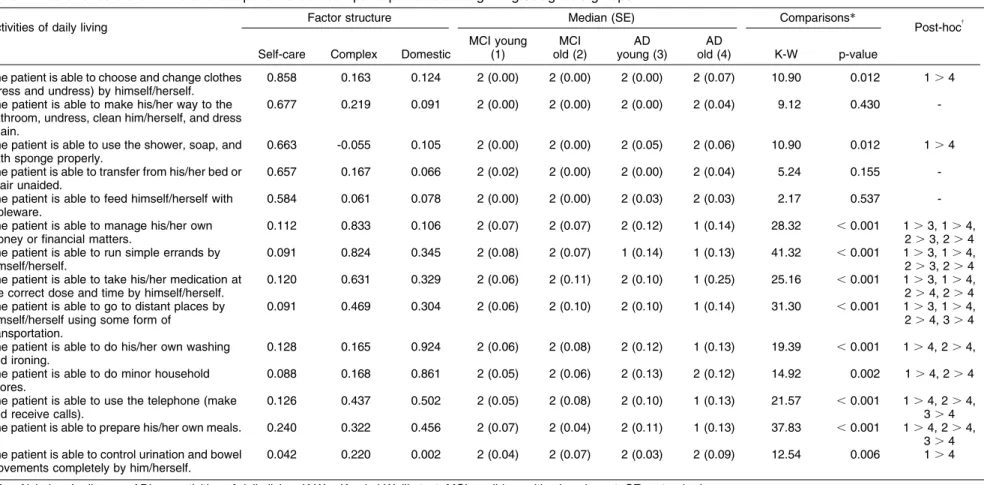
The factor analysis procedure for the ADL indices was adequate, considering the sample size and character-istics (Kaiser-Meyer-Olkin sample adequacy = 0.871; Bartlett’s test of sphericity, p,0.001). The scree plot of factor extraction is available from the authors on request. After factor extraction and orthogonal rotation, a three-factor structure (Table 2) was considered the most suitable for the participants’ data. Together, these factors accounted for 53% of the explained variance. The first factor, self-care ADLs (eigenvalue: 4.97), accounts for 33% of the total variance and involves basic ADLs. The second factor, complex ADLs (eigenvalue: 2.30), accounts for 13% of the total variance and contains items related to more complex ADLs, such as financial and medication management. The last factor, domestic ADLs (eigenvalue: 1.32), accounts for 7% of the total variance and contains items more closely related to domestic ADLs, such as housekeeping and cooking. In
The GADL index for older people 145
Table 1 Sample profile stratified by diagnosis and age group, with comparisons of sociodemographic, clinical, and functional variables
Diagnosis/age group Age Education MMSE GDS-15 Katz (BADLs)
Lawton (IADLs)
GADL self-care
GADL
domestic GADL complex GADL global
MCI Young (1)
Mean (SD) 67.04 (4.53) 5.13 (4.29) 23.89 (3.74) 3.69 (3.10) 11.93 (0.33) 14.26 (2.25) 9.97 (0.14) 7.35 (1.28) 6.86 (1.57) 24.2 (2.44) Median (SE) 68 (0.67) 4 (0.64) 24 (0.55) 3 (0.46) 12 (0.04) 15 (0.33) 10 (0.02) 8 (0.19) 8 (0.23) 25 (0.36) Range 60-74 0-17 17-30 0-13 10-12 8-16 9-10 2-8 2-8 16-26 Old (2)
Mean (SD) 81.17 (5.10) 3.92 (3.40) 23.06 (3.62) 2.22 (2.33) 11.91 (0.36) 14.44 (2.32) 10.00 (0.01) 7.47 (1.15) 6.97 (1.40) 24.44 (2.32) Median (SE) 81 (0.85) 4 (0.56) 24 (0.60) 2 (0.38) 12 (0.06) 15 (0.38) 10 (0.01) 8 (0.19) 8 (0.23) 25 (0.38) Range 75-95 0-15 16-29 0-12 10-12 6-16 10-10 3-8 3-8 16-26
AD Young (3)
Mean (SD) 68.97 (4.13) 4.68 (3.92) 21.47 (3.53) 4.82 (3.88) 11.94 (0.23) 11.47 (4.05) 9.97 (0.17) 6.58 (2.06) 4.94 (2.41) 21.44 (4.05) Median (SE) 70 (0.70) 4 (0.67) 22 (0.60) 3 (0.66) 12 (0.04) 11 (0.69) 10 (0.02) 7 (0.35) 4 (0.41) 21 (0.69) Range 60-74 0-15 14-29 0-14 11-12 0-16 9-10 0-8 1-8 10-26 Old (4)
Mean (SD) 79.47 (3.40) 5.26 (3.61) 19.88 (4.36) 3.33 (2.48) 11.41 (1.33) 9.34 (4.46) 9.58 (1.23) 5.18 (2.44) 3.83 (2.94) 18.41 (5.39) Median (SE) 79 (0.51) 4 (0.55) 19 (0.66) 2 (0.37) 12 (0.20) 9 (0.68) 10 (0.18) 6 (0.37) 4 (0.44) 19 (0.82) Range 75-88 0-11 12-28 0-10 5-12 0-16 3-10 0-8 0-8 3-26
Group comparisons*
K-W 119.26 3.80 21.21 10.32 16.17 45.41 12.86 37.10 39.81 49.25 p-value ,0.001 0.284 ,0.001 0.016 ,0.001 ,0.001 0.005 ,0.001 ,0.001 ,0.001 Post-hoc{ 1,3, 2,4 - 1.3,
1.4, 2.4
2,3 1.4, 2.4, 3.4
1.3, 1.4, 2.3, 2.4,
3.4
1.4, 2.4 1.3, 1.4, 2.3, 2.4, 3.4
1.3, 1.4, 2.3, 2.4
1.3, 1.4, 2.3, 2.4,
3.4
AD = Alzheimer’s disease; BADLs = basic activities of daily living; GDS-15 = Geriatric Depression Scale; IADLs = instrumental activities of daily living; GADL = General Activities of Daily Living Scale; K-W = Kruskal-Wallis test; MCI = mild cognitive impairment; MMSE = Mini Mental State Examination; SD = standard deviation; SE = standard error.
*Specific group comparisons (Mann-WhitneyUtests and effect sizes) are available from the authors on request.
{Bonferroni-corrected p-values for specific comparisons (p = 0.008).
JJ
de
Paula
et
al.
146
Rev
B
ras
P
siquiatr.
2014
Table 2 Factor structure of ADLs and comparisons between participants according to age/diagnosis groups
Activities of daily living Factor structure Median (SE) Comparisons* Post-hoc{
Self-care Complex Domestic
MCI young (1)
MCI old (2)
AD young (3)
AD
old (4) K-W p-value
The patient is able to choose and change clothes (dress and undress) by himself/herself.
0.858 0.163 0.124 2 (0.00) 2 (0.00) 2 (0.00) 2 (0.07) 10.90 0.012 1.4
The patient is able to make his/her way to the bathroom, undress, clean him/herself, and dress again.
0.677 0.219 0.091 2 (0.00) 2 (0.00) 2 (0.00) 2 (0.04) 9.12 0.430
-The patient is able to use the shower, soap, and bath sponge properly.
0.663 -0.055 0.105 2 (0.00) 2 (0.00) 2 (0.05) 2 (0.06) 10.90 0.012 1.4
The patient is able to transfer from his/her bed or chair unaided.
0.657 0.167 0.066 2 (0.02) 2 (0.00) 2 (0.00) 2 (0.04) 5.24 0.155
-The patient is able to feed himself/herself with tableware.
0.584 0.061 0.078 2 (0.00) 2 (0.00) 2 (0.03) 2 (0.03) 2.17 0.537
-The patient is able to manage his/her own money or financial matters.
0.112 0.833 0.106 2 (0.07) 2 (0.07) 2 (0.12) 1 (0.14) 28.32 ,0.001 1.3, 1.4, 2.3, 2.4 The patient is able to run simple errands by
himself/herself.
0.091 0.824 0.345 2 (0.08) 2 (0.07) 1 (0.14) 1 (0.13) 41.32 ,0.001 1.3, 1.4, 2.3, 2.4 The patient is able to take his/her medication at
the correct dose and time by himself/herself.
0.120 0.631 0.329 2 (0.06) 2 (0.11) 2 (0.10) 1 (0.25) 25.16 ,0.001 1.3, 1.4, 2.4, 2.4 The patient is able to go to distant places by
himself/herself using some form of transportation.
0.091 0.469 0.304 2 (0.06) 2 (0.10) 2 (0.10) 1 (0.14) 31.30 ,0.001 1.3, 1.4, 2.4, 3.4
The patient is able to do his/her own washing and ironing.
0.128 0.165 0.924 2 (0.06) 2 (0.08) 2 (0.12) 1 (0.13) 19.39 ,0.001 1.4, 2.4,
The patient is able to do minor household chores.
0.088 0.168 0.861 2 (0.05) 2 (0.06) 2 (0.13) 2 (0.12) 14.92 0.002 1.4, 2.4
The patient is able to use the telephone (make and receive calls).
0.126 0.437 0.502 2 (0.05) 2 (0.08) 2 (0.10) 1 (0.13) 21.57 ,0.001 1.4, 2.4, 3.4 The patient is able to prepare his/her own meals. 0.240 0.322 0.456 2 (0.07) 2 (0.04) 2 (0.11) 1 (0.13) 37.83 ,0.001 1.4, 2.4,
3.4 The patient is able to control urination and bowel
movements completely by him/herself.
0.042 0.220 0.002 2 (0.04) 2 (0.07) 2 (0.03) 2 (0.09) 12.54 0.006 1.4
AD = Alzheimer’s disease; ADLs = activities of daily living; K-W = Kruskal-Wallis test; MCI = mild cognitive impairment; SE = standard error.
*Data from Mann-WhitneyUtests are available from the authors on request.
{Bonferroni-corrected p-values for specific comparisons (p = 0.008).
The
GADL
index
for
older
people
147
Rev
B
ras
Psiquiatr.
this analysis, sphincter control did not show relevant factor loadings for any component and was excluded from the subsequent analysis.
New variables were created that summed the ADL items related to each factor. The descriptive data and group comparisons for these new measures are shown in Table 1. Cronbach’s alpha was used to estimate the reliability of the three factors reported in the previous results. The results show good internal consistency for self-care ADLs (0.806), domestic ADLs (0.810), complex ADLs (0.822), and the sum of all items (0.849), indicating that the encountered factors and the global score of ADL are highly reliable. The correlational analysis showed significant associations between domestic and global measures of ADL with age, but not education. The domestic, complex, and global measures were significantly related to MMSE scores. Only domestic and complex ADL were weakly correlated with depressive symptoms. Considering the three inventory components, all were related to the global score. Weak associations were found between the self-care component and the other two measures. However, when these latter two measures were correlated, a moderate association was observed between them. These data are shown in Table 3.
Based on this new distribution, we called the new inventory Escala Geral de Atividades de Vida Dia´ria / General Activities of Daily Living Scale. Appendices 1 and
2 contain the English and Portuguese versions of the inventory, respectively.
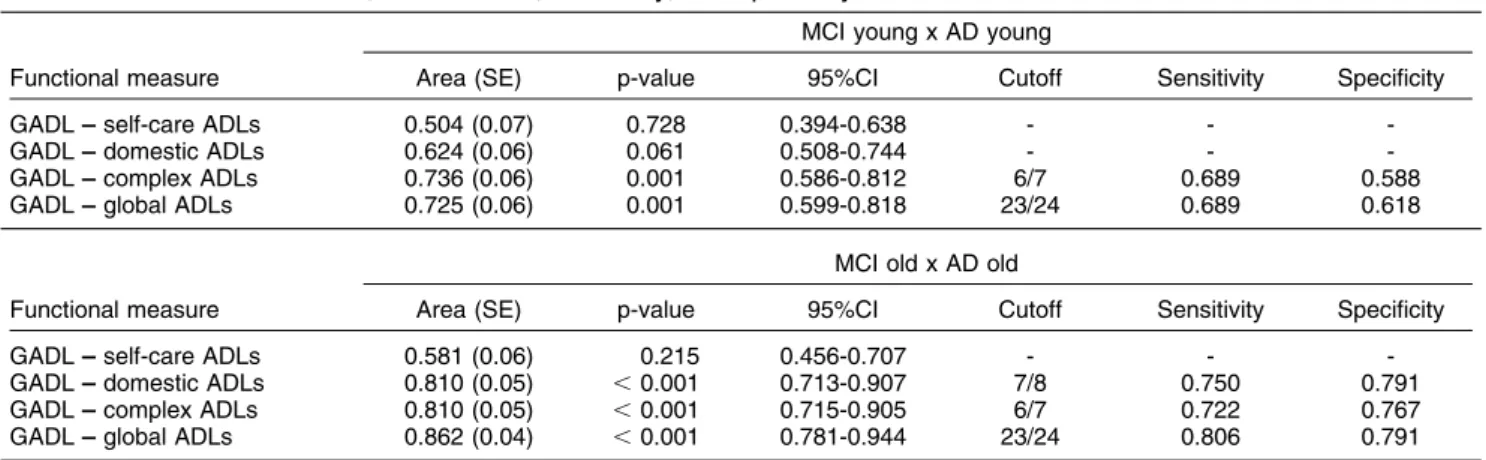
ROC curve analysis was performed independently on young and older participants. Results are presented in Table 4. Considering the younger patients, only the curves for GADL complex ADLs and GADL global ADLs were significant (both p , 0.001). Considering the guidelines most commonly adopted in neuropsychology, the accuracy of the functional measure for these participants (0.736 and 0.725, respectively) can be considered only moderate. The suggested cutoffs were 6/7 and 23/24 (case/non-case). The accuracy of the GADL in the older group showed a different pattern, in which the GADL domestic ADL, complex ADL, and global ADL scores showed significant areas under the curve (p
,0.001). Accuracy in this older group was higher (0.810, 0.810, and 0.862) compared with the analysis of younger patients. The recommended cutoff scores were 7/8 for GADL domestic ADL, 6/7 for the GADL complex ADL, and 23/24 for the inventory total score.
We tested five independent regression models for young and old participants, beginning with the MMSE (model 1), adding one of the GADL components (models 2, 3, and 4), and finally using the GADL global score. The model results are shown in Table 5. For younger participants, an additive effect of functional measures on cognitive screening for diagnosis was observed only
Table 4 Area under the curve, cutoff values, sensitivity, and specificity of the functional measures
MCI young x AD young
Functional measure Area (SE) p-value 95%CI Cutoff Sensitivity Specificity
GADL –– self-care ADLs 0.504 (0.07) 0.728 0.394-0.638 - - -GADL –– domestic ADLs 0.624 (0.06) 0.061 0.508-0.744 - - -GADL –– complex ADLs 0.736 (0.06) 0.001 0.586-0.812 6/7 0.689 0.588 GADL –– global ADLs 0.725 (0.06) 0.001 0.599-0.818 23/24 0.689 0.618
MCI old x AD old
Functional measure Area (SE) p-value 95%CI Cutoff Sensitivity Specificity
GADL –– self-care ADLs 0.581 (0.06) 0.215 0.456-0.707 - - -GADL –– domestic ADLs 0.810 (0.05) ,0.001 0.713-0.907 7/8 0.750 0.791 GADL –– complex ADLs 0.810 (0.05) ,0.001 0.715-0.905 6/7 0.722 0.767 GADL –– global ADLs 0.862 (0.04) ,0.001 0.781-0.944 23/24 0.806 0.791
95%CI = confidence interval; AD = Alzheimer’s disease; ADLs = activities of daily living; GADL = General Activities of Daily Living Scale; MCI = mild cognitive impairment; SE = standard error.
Table 3 Spearman rank-order correlations between GADL factor scores, sociodemographic variables, MMSE, and GDS-15
(1) (2) (3) (4) (5) (6) (7) (8)
(1) Age 1
(2) Education -0.008 1
(3) MMSE -0.215{ 0.396{ 1
(4) GDS-15 -0.298{ 0.075 0.134 1
(5) GADL –– self-care ADLs -0,089 -0.170 0.146 -0.098 1 (6) GADL –– domestic ADLs -0.206{
0.037 0.320{
-0.169* 0.201* 1
(7) GADL –– complex ADLs -0.126 -0.021 0.322{ -0.158* 0.230{ 0.610{ 1
(8) GADL –– global ADLs -0.174* -0.004 0.360{ -0.149 0.290{ 0.820{ 0.932{ 1
ADLs = activities of daily living; GDS-15 = Geriatric Depression Scale; GADL = General Activities of Daily Living Scale; MMSE = Mini Mental State Examination.
*Correlation significant at 0.05.
{Correlation significant at 0.001.
JJ de Paula et al. 148
when GADL complex ADLs or GADL global ADLs were added to the MMSE (models 4 and 5), increasing the classification rate of MCI and AD patients from 62 to 76 and 77%, respectively. A different pattern was observed in older patients. In these participants, when the GADL domestic ADLs, GADL complex ADLs, or GADL global ADLs were added to the initial model, the MMSE total score lost significance, but the models were able to correctly classify 81, 76, and 84% of subjects, respec-tively, increasing from 67% (MMSE alone).
Discussion
This study analyzed the psychometric characteristics of two indices commonly adopted in clinical gerontology practice in Brazil to evaluate ADLs in older people. Based on this analysis, a new inventory was proposed that considered BADLs and IADLs as a continuum of complexity for the assessment and diagnosis of MCI and AD patients stratified by age group. Internal consistency and construct- and criterion-related validity were analyzed. The GADL, our proposed new inventory, showed significant evidence of these properties.
The division of the spectrum of ADLs into three specific components was found to be useful for classifying the functional impairment of AD and MCI patients. Our data sustain a three-component division of ADLs based on two different methods, one related to construct validity (three components found in factor analysis) and the other to criterion-related validity (because in younger patients, complex but not domestic ADLs were helpful for the correct classification of MCI/AD). A recent study31found satisfactory validity for functional measures (related to advanced ADLs with greater involvement of executive
functioning) for the characterization and staging of cognitive impairment in patients with MCI and AD. Especially in younger participants, ADLs related to complex activities were a useful component for the distinction of these two conditions. In MCI, impairment is generally restricted to more complex ADLs, which involve social interpretation, prospective memory, and executive functioning.3,32 This may explain the lack of significance of more basic ADLs for the differential diagnosis. Our data and other studies are in agreement with the proposal of Thomas et al.,33according to which ADLs should not be addressed as a unitary construct.34 This may be particularly relevant when MCI and AD are considered as a continuum. The division of ADLs into levels of complexity may help clinicians track the progression of dementia when combined with cognitive measures. However, as stated previously, although the division of ADLs may be interesting for this purpose, some overlap may occur concerning the complexity of specific ADLs.4
The present study attempts to contribute to previous reports of functional measures for the assessment of older Brazilian people by developing a quick, objective, and clinically guided index that can be available to any health professional and is based on questions commonly used in the evaluation of ADL. The GADL provides empirical evidence for this purpose. Possible advantages of the GADL are that it works with commonly assessed ADLs, improving its clinical applicability for clinicians of different professional backgrounds, and it includes a broad range of ADLs of different complexities. In the context of Brazilian studies, to our knowledge, this is the first work to investigate the role of functional measures on the differential diagnosis of AD and MCI. In addition, we Table 5 Logistic regression models assessing the differential diagnosis of MCI and AD for young and old participants
MCI x AD (young participants)
Model Chi-square p-value R2 MCI % AD % Overall % Variables b Wald p-value
Model 1 8.13 0.004 0.13 67 44 62 MMSE -0.181 7.22 0.007
Model 2 8.14 0.017 0.13 77 44 62 MMSE -0.181 7.19 0.008
GADL self-care 0.119 0.01 0.936
Model 3 11.26 0.004 0.18 77 53 66 MMSE -0.173 6.46 0.011
GADL domestic -0.272 2.73 0.099
Model 4 21.95 ,0.001 0.33 84 65 76 MMSE -0.172 5.45 0.020
GADL complex -0.380 11.46 0.001
Model 5 19.34 ,0.001 0.29 84 68 77 MMSE -0.169 5.55 0.018
GADL global -0.270 0.78 0.003
MCI x AD (old participants)
Model Chi-square p-value R2 MCI % AD % Overall % Variables b Wald p-value
Model 1 11.36 ,0.001 0.18 61 72 67 MMSE -0.194 9.62 0.002
Model 2 19.08 ,0.001 0.29 69 67 68 MMSE -0.195 8.56 0.003
GADL self-care -18.980 0.00 0.998
Model 3 28.45 ,0.001 0.49 89 74 81 MMSE -0.109 2.49 0.114
GADL domestic -0.654 9.96 0.002
Model 4 31.77 ,0.001 0.44 81 72 76 MMSE -0.112 2.45 0.118
GADL complex -0.518 13.13 ,0.001
Model 5 37.97 ,0.001 0.51 86 81 84 MMSE -0.070 0.95 0.330
GADL global -0.409 14.93 ,0.001
AD = Alzheimer’s disease; GADL = General Activities of Daily Living Scale; MCI = mild cognitive impairment; MMSE = Mini Mental State Examination.
The GADL index for older people 149
developed preliminary cutoff scores for this purpose, which should allow clinicians to perform a brief functional assessment and allow health professionals to make better use of consultation time (which is generally scarce in public health care in Brazil).
However, there are important limitations when adopting reporting scales for the functional assessment of patients. First, low ecological validity is common for self-reported questionnaires, perhaps due to the anosognosia pre-sented by these patients or to loss of insight when faced with social demands.35 In such cases, scales are more effective if they are based on the report of a caregiver close to the patient who shares his or her daily life and is aware of his or her main difficulties, as is common in inventories of behavioral assessment.36 Although this method is often more precise than self-evaluation (and is the method adopted in our research), it has limitations because the caregiver’s perceptions and reports of the patient’s behavior may be biased by the caregiver’s relationship to the patient. Caregivers who are over-burdened and experience socioeconomic problems and psychological disorders tend to provide biased responses, diminishing the accuracy of these instruments for assessment of ecological functioning.23,37
The gold standard for functional evaluation is the ecological examination, which uses contextual tasks that explore components of the verisimilitude of ecological validity.38In Brazil, only a few structured instruments are available for such examinations, such as the Rivermead Behavioral Memory Test39 (a measure of episodic memory that demands complex ADL functioning). However, this instrument demands expertise and experi-ence in the application, scoring, and interpretation of its results and requires time and material resources that are usually unavailable to the average health professional. It is more appropriate in the context of a more thorough assessment (usually performed by a neuropsychologist, occupational therapist, or physical therapist). Further studies that aim to identify a correlation between GADL components and such measures are needed to establish the ecological validity of the reports obtained by the inventory.
In conclusion, the present study provides a synthetic tool for the evaluation of ADLs in older people and makes it available to Brazilian health professionals. Further studies should consider other psychometric properties of the GADL, such as its predictive validity, its correlation with specific cognitive measures (for instance, episodic memory, executive functions, visuospatial abilities, lan-guage, and processing speed), and its applicability and diagnostic power for other types of dementia. Additionally, to improve the external validity of our results, other studies in different contexts should attempt to replicate our findings in larger and more heterogeneous samples involving patients with different ranges of cognitive impairment and diagnoses.
Disclosure
The authors report no conflicts of interest.
References
1 Lin RT, Chen YM, Chien LC, Chan CC. Political and social determinants of life expectancy in less developed countries: a longitudinal study. BMC Public Health. 2012;12:85.
2 Lopes MA, Bottino CM. Prevaleˆncia de demeˆncia em diversas regio˜es do mundo: ana´lise dos estudos epidemiolo´gicos de 1994 a 2000. Arq Neuropsiquiatr. 2002;60:61-9.
3 Petersen RC, Doody R, Kurz A, Mohs RC, Morris JC, Rabins PV, et al. Current concepts in mild cognitive impairment. Arch Neurol. 2001;58:1985-92.
4 Njegovan V, Hing MM, Mitchell SL, Molnar FJ. The hierarchy of functional loss associated with cognitive decline in older persons. J Gerontol A BiolSci Med Sci. 2001;56:M638-43.
5 Schmitter-Edgecombe M, Parsey C, Cook DJ. Cognitive correlates of functional performance in older adults: comparison of self-report, direct observation, and performance-based measures. J Int Neuropsychol Soc. 2011;17:853-64.
6 Vasconcelos LG, Brucki SMD, Bueno OFA. Cognitive and functional dementia assessment tools: Review of Brazilian literature. Dement Neuropsychol. 2007;1:18-23.
7 Aprahamian I, Martinelli JE, Cecato J, Yassuda MS. Screening for Alzheimer’s disease among illiterate elderly: accuracy analysis for multiple instruments. J Alzheimers Dis. 2011;26:221-9.
8 Laks J, Batista EM, Guilherme ER, Contino AL, Faria ME, Rodrigues CS, et al. Prevalence of cognitive and functional impairment in community-dwelling elderly: importance of evaluating activities of daily living. Arq Neuropsiquiatr. 2005;63:207-12.
9 Laks J, Coutinho ES, Junger W, Silveira H, Mouta R, Baptista EM, et al. Education does not equally influence all the Mini Mental State Examination subscales and items: inferences from a Brazilian community sample. Rev Bras Psiquiatr. 2010;32:223-30.
10 Sanchez MA, Correa PC, Lourenc¸o RA. Cross-cultural adaptation of the ‘‘Functional Activities Questionnaire –– FAQ’’ for use in Brazil. Dement Neuropsychol. 2011;5:322-7.
11 Carthery-Goulart MT, Areza-Fegyveres R, Schultz RR, Okamoto I, Caramelli P, Bertolucci PH, et al. [Cross-cultural adaptation of the Disability Assessment for Dementia (DAD)]. Arq Neuropsiquiatr. 2007;65:916-9.
12 Bahia VS, Silva MM, Viana R, Smid J, Damin AE, Radanovic M, et al. Behavioral and activities of daily living inventories in the diagnosis of frontotemporal lobar degeneration and Alzheimer’s disease. Dement Neuropsychol. 2008;2:108-13.
13 Katz S, Ford AB, Moskowitz RW, Jackson BA, Jaffe MW. Studies of illness in the aged; The Index of ADL: A standardized measure of biological and psychosocial function. JAMA. 1963;185:914-9. 14 Lino VTS, Pereira SRM, Camacho LAB, Filho STR, Buksman S.
Adaptac¸a˜o transcultural da Escala de Independeˆncia em Atividades da Vida Dia´ria (Escala de Katz). Cad Sau´de Pu´blica. 2008;24:103-12.
15 Duarte YAO, Andrade CL, Lebra˜o ML. O I´ndex de Katz na avaliac¸a˜o da funcionalidade dos idosos. Rev Esc Enferm USP. 2007;41:317-25.
16 Lawton MP, Brody EM. Assessment of older people: self-monitoring and instrumental activities of daily living. Gerontologist.1969;9:179-86.
17 Santos RL, Virtuoso Ju´nior JS. Confiabilidade da versa˜o brasileira da escala de atividades instrumentais da vida dia´ria. Rev Bras Prom Saude. 2008;21:290-6.
18 Secretaria de Estado de Sau´de de Minas Gerais (SESMG) [Internet]. 2012. http://www.hc.ufmg.br/geriatria/img/galeria_fotos/Protocolo. pdf
19 Oliveira DLC, Goretti LC, Pereira LSM. O desempenho de idosos institucionalizados com alterac¸o˜es cognitivas em atividades de vida dia´ria e mobilidade: estudo piloto. Rev Bras Fisioter. 2006;10:91-6. 20 Lebra˜o ML, Laurenti R. Sau´de, bem-estar e envelhecimento: o estudo SABE no Municı´pio de Sa˜o Paulo. Rev Bras Epidemiol. 2005;8:127-41.
21 McKhann G, Drachman D, Folstein M, Katzman R, Price D, Stadlan EM. Clinical diagnosis of Alzheimer’s disease: report of the NINCDS-ADRDA Work Group under the auspices of Department of Health and Human Services Task Force on Alzheimer’s. Neurology. 1984;34:939-44.
JJ de Paula et al. 150
22 Brucki SM, Nitrini R, Caramelli P, Bertolucci PH, Okamoto IH. [Suggestions for utilization of the Mini-Mental State Examination in Brazil]. Arq Neuropsiquiatr. 2003;61:777-81.
23 de Paula JJ, Schlottfeldt CG, Moreira L, Cotta M, Bicalho MA, Romano-Silva MA, et al. Psychometric properties of a brief neuropsychological protocol for use in geriatric populations. Rev Psiquiatr Clin. 2010;37:246-50.
24 Almeida OP, Almeida SA. Short versions of the geriatric depression scale: a study of their validity for the diagnosis of a major depressive episode according to ICD-10 and DSM-IV. Int J Geriatr Psychiatry. 1999;14:858-65.
25 Malloy-Diniz LF, Lasmar VA, Gazinelli L de S, Fuentes D, Salgado JV. The Rey Auditory-Verbal Learning Test: applicability for the Brazilian elderly population. Rev Bras Psiquiatr. 2007;29:324-9. 26 Dubois B, Slachevsky A, Litvan I, Pillon B. The FAB: a Frontal
Assessment Battery at bedside. Neurology. 2000;55:1621-6. 27 Morris JC. The Clinical Dementia Rating (CDR): current version and
scoring rules. Neurology. 1993;43:2412-4.
28 Hogan DB, Ebly EM, Fung TS. Disease, disability, and age in cognitively intact seniors: results from the Canadian Study of Health and Aging. J Gerontol A Biol Sci Med Sci. 1999;54:M77-82. 29 Hair Jr J, Anderson RE, Tatham RL, Black WC. Ana´lise multivariada
de dados. Porto Alegre: Bookman; 2005.
30 SPSS Inc. Statistical Package for the Social Sciences (SPSS Base) 17.0 for Windows User’s Guide. Chicago: SPSS; 2008.
31 Bombin I, Santiago-Ramajo S, Garolera M, Vega-Gonza´lez EM, Cerulla N, Caracuel A, et al. Functional impairment as a defining feature of: amnestic MCI: cognitive, emotional, and demographic correlates. Int Psychogeriatr. 2012;24:1494-504.
32 Brown PJ, Devanand DP, Liu X, Caccappolo E, Alzheimer’s Disease Neuroimaging Initiative. Functional impairment in elderly patients with mild cognitive impairment and mild Alzheimer disease. Arch Gen Psychiatry. 2011;68:617-26.
33 Thomas VS, Rockwood K, McDowell I. Multidimensionality in instrumental and basic activities of daily living. J Clin Epidemiol. 1998;51:315-21.
34 Royall DR, Lauterbach EC, Kaufer D, Malloy P, Coburn KL, Black KJ, et al. The cognitive correlates of functional status: a review from the Committee on Research of the American Neuro-psychiatric Association. J Neuropsychiatry Clin Neurosci. 2007;19: 249-65.
35 Starkstein SE, Jorge R, Mizrahi R, Robinson RG. A diagnostic formulation for anosognosia in Alzheimer’s disease. J Neurol Neurosurg Psychiatry. 2006;77:719-25.
36 Cummings JL. The Neuropsychiatric Inventory: assessing psycho-pathology in dementia patients. Neurology. 1997;48:10-6. 37 Schulz R, Cook TB, Beach SR, Lingler JH, Martire LM, Monin JK,
et al. Magnitude and Causes of Bias Among Family Caregivers Rating Alzheimer Disease Patients. Am J Geriatr Psychiatry. 2012 Jan 10. [Epub ahead of print]
38 Chaytor N, Schimitter-Edgecombe M. The ecological validity of neuropsychological tests: a review of the literature on everyday cognitive skills. Neuropsychol Rev. 2003;13:181-97.
39 Yassuda MS, Flaks MK, Viola LF, Pereira FS, Memo´ria CM, Nunes PV, et al. Psychometric characteristics of the Rivermead Behavioural Memory Test (RBMT) as an early detection instrument for dementia and mild cognitive impairment in Brazil. Int Psychogeriatr. 2010;22:1003-11.
The GADL index for older people 151
JJ de Paula et al. 152