Mailing address: Henrique Miller Balieiro •
Rua Alfredo Whately, 365 / 403 Bl. A – Campos Elíseos – 27542-170 – Resende, RJ, Brazil
E-mail: [email protected]
Manuscript received October 30, 2008; revised manuscript received December 5, 2008; accepted on May 6, 2009.
Abstract
Background: data on heart failure (HF) in Brazil are ensued from tertiary centers. This information can not be extended to the rural population, for it reflects distinct social, economic and cultural characteristics.
Objective: To establish the clinical and demographic profile and quality indicators for HF in rural areas.
Methods: Transversal cohort study that included 166 patients from the rural area of Valença, Rio de Janeiro, Brazil. After the evaluation of clinical, laboratorial and echocardiograph data, chi-square and Fisher’s exact tests were used for analysis of proportion, as well as the Student’s t-test for numeric variables, in order to establish the population’s characteristics.
Results: Mean age was 61±14 years old, as 85 of them (51%) were men, 88 (53%) were afro-Brazilian and 85 (51%) had heart failure with reduced ejection fraction (HFREF). Systemic arterial hypertension (151 patients, 91%) and metabolic syndrome (103 patients, 62%) were prevalent comorbidities. The most common etiologies were: hypertensive (77 patients, 46%) and ischemic (62 patients, 37%). Quality indicators in HF were: 43 patients (26%) with previous echocardiogram, 102 patients (62%) were in use of beta-blockers, 147 patients (88%) received angiotensin converter enzyme inhibitor (ACEI) or angiotensin receptor blockers (ARB), and 22% of the patients with atrial fibrillation (AF) were under treatment with oral anticoagulation. For heart failure with normal ejection fraction (HFNEF), females (p=0.001; OD: 0.32; CI=0.17-0.60), metabolic syndrome (p=0.004; OD: 0.28; CI=1.31-4.78) and hypertensive etiology (p<0.0001; OD: 6.83; CI=3.45-13.5) were predominant. For HFREF, males (p=0.001; OD: 0.32; CI=0.170-0.605) and ischemic etiology (p<0.0001; OD: 0.16; CI=0.079-0.330) were predominant.
Conclusion: In rural areas, HF shows similarity with regard to sex, ethnicity and classification. Hypertensive etiology was the most commonly present. HFNEF was prevalent among women and in the presence of metabolic syndrome, while HFREF was associated with males and ischemic etiology. (Arq Bras Cardiol 2009; 93(6):637-642)
Key Words: Heart failure; health profile; quality indictors, health care; rural population.
Clinical and Demographic Profile and Quality Indicators for Heart
Failure in a Rural Area
Henrique Miller Balieiro
1,2, Raphael Kasuo Osugue
1, Samuel Pereira Rangel
1, Raphael Brandão
1, Tatiana Leal Balieiro
1,
Sabrina Bernardez
2, Evandro Tinoco Mesquita
2Faculdade de Medicina de Valença1, Valença, RJ; Universidade Federal Fluminense2, Niterói, RJ, Brazil
Introduction
The first publication on cardiac insufficiency in Brazilian rural areas dates from 1909, when Dr. Carlos Ribeiro Justiniano das Chagas (also known as Carlos Chagas) published his discovery1, later on called Chagas’ Disease. Before the
centenary of this valuable publication, many articles on heart failure (HF) in rural areas continue to be published only about Chagas’ cardiopathy2-4.
Studies on heart failure (HF) have been directed by intra-hospital assessments in cases of decompensate heart failure (HF), through Datasus database, and in specialty
ambulatories of institutions of great Brazilian metropoles5,6.
These data can not be extended to the rural areas, for populations have very distinct demographic characteristics, food and cultural habits, type of occupations and access to medical assistance.
International studies carried out at hospitals of rural areas demonstrated a poor access of the population to medical assistance, bad hospital and therapeutics quality, as well as a poor access to basic exams for HF, such as echocardiogram7-9.
In addition, these studies have shown that, according to hospitalization index, patients presented not only bad life quality, but also low life expectancy in comparison to those of the urban area. It may be partially explained by the isolation, the lack of means of transportation, the distance and even by other comorbidities9.
socioeconomic conditions, a common characteristic in rural areas, were the major mortality predictor.
Valença borough is located in the South region of Rio de Janeiro State, a non-endemic zone for Chagas’ disease. The biggest part of its territory is rural and presents an estimated population (2006 data) in 70,375 inhabitants. It comprises a great territorial area (1,305 km2), considered as the second
biggest city in expansion of the State, with low demographic density (53.9 inhab/km2).
In 2006, cattle raising represented approximately 4.2% of the borough’s internal raw material, while in the capital of the State, this activity did not reach 1%. In 2001, the average monthly income of Valença’s population was estimated in R$ 500.25, while in Rio de Janeiro city this value reached R$ 1,083.8811.
By assessing data of Health Ministry12 concerning the
period that comprises 2000 to 2006, Balieiro et al. shown that hospitalization and mortality due to HF rates in Valença was proportionally higher than the rate found in national territory13.
This paper aims at describing clinical and demographic characteristics as well as studying the quality indicators of patients with HF from the rural area of Valença.
Methods
A transversal study was carried out on 166 patients that were prospectively and consecutively included, after being referred to the ambulatory of HF in the period from October 2006 to May 2008. Inclusion criteria were: age >18 years old, Boston criteria with values >7 for HF diagnosis, and residence in the rural area.
According to the Brazilian Institute for Geography and Statistics (IBGE, acronym in Portuguese), rural area is defined as the area that is external to the urban perimeter (as urban area, on the other hand, is characterized by buildings, streets and intense human habitation). Patients who lived in rural agglomerates of urban extension, that is, localized at least 1 km distant from and in contiguity with the area of a city or village which is officially urbanized, were also considered as inhabitants of rural areas. Such areas consist of simple extension of the effectively urbanized area with inhabited lots, agglomerates of habitations considered subnormal or groups developed around industrial, commercial or service establishments11.
The group was assessed in the moment of admittance to the HF ambulatory. All patients went through medical consultation, fulfilled a clinical questionnaire of assessment and were submitted to blood exams (complete hemogram, glucose, urea, creatinine, uric acid, sodium, potassium, and lipid profile), urine, electrocardiogram, thoracic radiograph and bidimensional transthoracic echocardiography with color Doppler. Patients who presented dilated ventricle in the echocardiography, showed no evidence for ischemia and were from endemic areas for Chagas disease, or had been to endemic locations, were submitted to serology for Chagas’ disease diagnosis.
The following variables were considered: sex, self-declared ethnicity, etiology of heart failure, history of coronary artery disease (CAD), atrial fibrillation (AF), systemic arterial hypertension (SAH), diabetes mellitus (DM), smoking, functional class of New York Heart Association (NYHA), chronic renal insufficiency (CRI), heart failure with normal ejection fraction (HFNEF) and heart failure with reduced ejection fraction (HFREF).
Patients who presented previous invasive coronary intervention, history of infarction with electrocardiograph a l t e r a t i o n s , a n y p o s i t i v e t e s t f o r i s c h e m i a o r cineangiocoronariography with lesion superior to 50% of obstruction in any artery were considered patients with CAD. Systolic blood pressure ≥140 mmHg, diastolic blood pressure ≥110 mmHg, or patients normal systolic and diastolic blood pressure under treatment with antihypertensive medicines were considered patients with SAH. DM was defined as the fast glucose result higher than 126 mg/dl. Patients under substitutive dialysis and those who presented serum creatinine ≥1.5 mg/dl were considered patients with CRI.
To determine CINEF and CIREF, the minimum percentage for the ejection fraction of the left ventricle was 50%14.
The study protocol was approved by the Ethics Committee of the institution and all patients signed the informed consent.
In the statistical analysis, chi-square and Fisher’s exact tests were used for analysis of proportion, and Student’s t-test for numeric variables. Values of p<0.05 were considered significant. The statistical software SPSS 11.0 was employed.
Results
From October 2006 to May 2008, 166 patients were included in the study after being referred to HF ambulatory. General characteristics of population are described in Table 1. Mean age was 61±14 years old and there were 85 (51%) male patients. There were 78 (47%) non-afro-Brazilian self-declared patients, and HFREF was found in 81 (49%) patients.
Among risk factors, SAH was predominant in 151 (91%) patients, and metabolic syndrome in 103 (62%) patients.
Hypertensive etiology was detected in 77 (46%) patients, a superior rate in relation to ischemic etiology, detected in 62 (37%) patients, followed by rheumatic valvulopathy in 14 (8%) patients, idiopathic dilated cardiomyopathy in 10 (6%) patients, alcoholic in 2 (1%) and hypertrophic in 1 patient (1%).
Overweight and obesity were present in 103 (62%) patients, but there was a low rate for malnutrition, present in only 3 (2%) patients.
HFNEF - heart failure with normal ejection fraction; HFREF - heart failure with reduced ejection fraction; CAD - coronary artery disease; SAH - systemic arterial hypertension; IRC - chronic renal insuficiency; BMI - body mass index; PND - paroxysmal nocturnal dyspnea; MMII edema - inferior members edema; NYHA - New York Heart Association.
Demographic data
Age (years) 61±14
Sex – n (%)
Male 85 (51%)
Female 81 (49%)
Color – n (%)
Other ethnicities 78 (47%) Afro-Brazilians 88 (53%) Heart failure classiication – n (%)
HFNEF 81 (49%)
HFREF 85 (51%)
Risk factors – n (%)
Smoking 70 (42%)
Diabetes mellitus 51 (31%) Previous CAD 68 (41%)
SAH 150 (91%)
Metabolic syndrome 103 (62%) Atrial ibrillation 37 (22%)
CRI 22 (13%)
NYHA – n (%)
I 58 (35%)
II 56 (34%)
III 48 (29%)
IV 4 (2%)
Etiology – n (%)
Hypertensive 77 (46%)
Ischemic 62 (37%)
Rheumatic valvulopathy 14 (8%)
Idiopathic 10 (6%)
Others 3 (2%)
Clinical characteristics
B3 31 (19%)
B4 39 (23%)
MMII edema 50 (30%) Jugular turgency 25 (15%)
PND 48 (29%)
BMI kg/m2 – n (%)
<18 3 (2%)
18 – 25 60 (36%)
25 – 30 58 (35%)
>30 45 (27%)
Table 1 – General characteristics of the studied population (n=166) fibrillation were under treatment with anticoagulation at the time of admittance.
Forty seven patients (28%) were under treatment with diagoxine, 83 (50%) with furosemide, 42 (25%) with tiazidic. On the other hand, 105 (63%) patients were under treatment with acetylsalicylic acid, 82 (49%) were using statins, 43 (26%) were using calcium channel blockers, and 3 patients were in use of nitrate associated with hydralazin.
When assessing complementary exams, the following characteristics were found: in the echocardiogram, mean and standard deviation of the left atrium diameter was 44.5±8 mm. Diastolic diameter of the left ventricle was 58±10 mm, while its systolic diameter was 43±12 mm. Ejection fraction of left ventricle resulted 49±17%, and the interventricular septus was 10,9±2 mm. In the conventional electrocardiogram, 37 patients (22%) presented atrial fibrillation, 28 (17%) had left bundle branch block with QRS higher than 120 ms, while there were 12 (7%) patients with right bundle branch block with QRS higher than 120 ms. Among studied patients, 113 (68%) presented some pattern of left ventricular hypertrophy. After studying the differences between CINEF and CIREF in this sample, we observed that the following variables did not present significant differences between groups: age, self-declared ethnicity, SAH, AF, CRI, DM, NYHA classification, MMII edema, paroxysmal nocturnal dyspnea (PND) and jugular turgency.
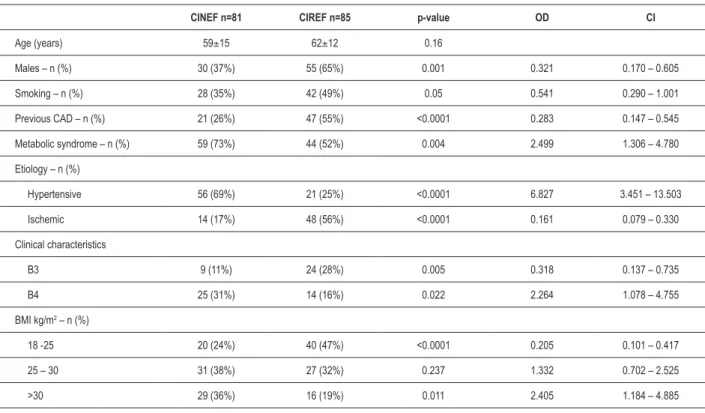
In HFNEF cases, the predominant characteristics were: females (p= 0.001; OD: 0.32; CI= 0.17-0.60); metabolic syndrome (p= 0.004; OD: 0.28; CI= 1.31-4.78), hypertensive etiology (p<0.0001; OD: 6.83; CI= 3.45-13.5) and obesity (p= 0.011; OD: 2.4; CI= 1.19-4.89) (Table 3).
In HFREF cases, the predominant characteristics were: males (p= 0.001; OD: 0.32; CI=0.170-0.605); CAD (p< 0.0001; OD: 0.28; CI= 0.147-0.545); ischemic etiology (p< 0.0001; OD: 0.16; CI= 0.079-0.330), and normal body mass index (BMI) (p< 0.0001; OD: 0.20, CI= 0.101-0.417) (Table 3).
When differences between males and females were analyzed, variables such as age, self-declared color, SAH, AF, CRI, DM, previous CAD, NYHA classification, MMII or B4 no significant differences were found.
Among males, smoking (p< 0.0001; OD: 3.45; CI= 1,815-6,670), ischemic etiology (p= 0.015; OD: 2.13; CI=
First consultation n (%)
LV function assessment rate 43 (26%)
ACEI usage rate 128 (77%)
ARB usage rate 19 (11%)
Beta blocker usage rate 102 (62%)
Oral anticoagulation usage in AF rate 22% Table 2 – Indicadores de qualidade assistencial na cardiac insuficiency
1,122-4,073), B3 (p= 0.032; OD: 2.33; CI= 1,021-4,073), jugular turgency (p= 0.05; OD: 2.28; CI= 0,925-5,627), paroxysmal nocturnal dyspnea (PND) (p= 0.021; OD: 2.16; CI=1,080-4,324) and obesity (p= 0.011; OD: 0.41; CI= 0,205-0,845) were common occurrences.
Among females, there was a higher prevalence of metabolic syndrome (p= 0.004; OD: 0.40; CI= 0,209-0,765); hypertensive etiology (p= 0.007; OD: 0,437; CI= 0,234-0,815) and relevant obesity according to BMI (p= 0.011; OD: 0.416; CI= 0,205-0,845).
Discussion
This pioneer study on clinical and demographic profile of patients with heart failure from rural areas identified similar prevalence for CINEF e CIREF, as well as an elevated occurrence of metabolic syndrome and SAH.
Mean age of the studied population was 61 years old, which is below that observed inFramingham Heart Study15
(65 years old) or by Jaarsma et al16 (71 years old). Roger et
al17, studying patients from USA communities, found a mean
age of 74 years old, a value that is similar to those found in some national studies, such as EPICA (Niterói, RJ, Brazil), in which mean age was 60 years old6.
The similar distribution among men and women with HF in the present study was also observed in EPICA study6 – Niteroi (Rio de Janeiro); however, the majority
of national and international studies show prevalence for males5,15,18.
Males were predominantly carriers of HFREF, while HFNEF was prevalent in females. Ischemic etiology in a bigger proportion was also observed in HFREF cases, a result that corresponds to those found by Villacorta et al19.
When assessing patients’ admittance data, a good usage of angiotensin converter enzyme inhibitor (ACEI) (77%) and angiotensin receptor blocker (ARB) (11%) was observed, as well as beta-blockers (62%) and oral anticoagulation (22%) usage rate under recommendations for patients with atrial fibrillation. Inferior medical therapeutics – with under-usage of angiotensin converter enzyme inhibitor and beta-blockers – were found by Ansari et al20, who compared such medication
in rural and urban areas.
As observed in international studies8,9 on HF in rural
areas, a under-usage of echocardiogram in the admittance to the ambulatory was also found.
A great difference was found with regard to cardiac insufficiency etiology. National studies, such as those performed by Barreto et al5 and Bocchi et al21 showed
a higher prevalence of ischemic etiology (33 and 34%, respectively), while hypertensive etiology was present in 7 and 13% of the patients, respectively. This study showed predominance for hypertensive etiology (46%) versus
ischemic etiology (37%).
CAD - coronary artery disease; BMI - body mass index; CINEF - cardiac insuficiency with normal ejection fraction; CIREF - cardiac insuficiency with reduced ejection fraction; OD - odds ratio, CI - conidence interval
CINEF n=81 CIREF n=85 p-value OD CI
Age (years) 59±15 62±12 0.16
Males – n (%) 30 (37%) 55 (65%) 0.001 0.321 0.170 – 0.605
Smoking – n (%) 28 (35%) 42 (49%) 0.05 0.541 0.290 – 1.001
Previous CAD – n (%) 21 (26%) 47 (55%) <0.0001 0.283 0.147 – 0.545
Metabolic syndrome – n (%) 59 (73%) 44 (52%) 0.004 2.499 1.306 – 4.780
Etiology – n (%)
Hypertensive 56 (69%) 21 (25%) <0.0001 6.827 3.451 – 13.503
Ischemic 14 (17%) 48 (56%) <0.0001 0.161 0.079 – 0.330
Clinical characteristics
B3 9 (11%) 24 (28%) 0.005 0.318 0.137 – 0.735
B4 25 (31%) 14 (16%) 0.022 2.264 1.078 – 4.755
BMI kg/m2 – n (%)
18 -25 20 (24%) 40 (47%) <0.0001 0.205 0.101 – 0.417
25 – 30 31 (38%) 27 (32%) 0.237 1.332 0.702 – 2.525
>30 29 (36%) 16 (19%) 0.011 2.405 1.184 – 4.885
References
The relation between metabolic syndrome and HF, found mainly among females in this study, is similar to the studies of Balieiro et al22, who analyzed cardiac insufficiency
and metabolic syndrome in rural area, and to that found by Coelho et al23, who studied cardiac insufficiency and
metabolic syndrome in patients referred from primary medical care.
Discrepant data, such as the high prevalence of hypertensive etiology, low usage of beta-blockers and basic exams, such as echocardiogram, showed a necessity of further researches on this subject, in order to study HF in distinct areas. This is a duty of great importance for the creation of regional attention protocols and for the reduction of morbi-mortality and socioeconomic impacts caused by this disease.
Conclusion
In patients from rural areas, data homogeneity with regard to sex, ethnicity and HF syndrome for cardiac function was observed.
The most widely present etiology was the hypertensive, followed by ischemic and valvulopathy.
Among risk factors, hypertension and metabolic syndrome were predominant.
HFNEF was prevalent in females and in patients with metabolic syndrome. HFREF, on the other hand, was associated with smoking, CAD and males.
Among females there was a higher prevalence of metabolic syndrome and hypertensive etiology and, among males, the main etiology found was ischemic. Males also presented a higher rate for smoking.
In patients from rural areas, we observed a usage below that recommended for beta-blockers, as well as for anticoagulation substances in atrial fibrillation cases, and reference to echocardiogram.
Potential Conflict of Interest
No potential conflict of interest relevant to this article was reported.
Sources of Funding
There were no external funding sources for this study.
Study Association
This article is part of the thesis of master submitted by Henrique Miller Balieiro, from Universidade Federal Fluminense e Faculdade de Medicina de Valença.
1. Chagas C. Nova tripanozomíase humana: estudos sobre a morfologia e o ciclo evolutivo do Schizotrypanum cruzi n.gen. n.sp. agente etiológico de nova entidade mórbida do homem. Memórias do Instituto Oswaldo Cruz. 1909; 1: 159-218.
2. Aras R, Veiga M, Gomes I, Mota G, Rodrigues B, Rabelo R. Prevalence of Chagas’ disease in Mulungu do Morro northeastern Brazil. Arq Bras Cardiol. 2002; 78 (5): 441-3.
3. Silva EF, Oliveira AL, Siefer MW, Gazetta ML, Bertani IF. Demographic profile and work situation of patients with Chagas disease. Arq Bras Cardiol. 1995; 65 (1): 43-6.
4. Silva RA, Sampaio SM, Koyanagui PH, Poloni M, Carvalho ME, Rodrigues VL. Infestation by triatomines in rural settlement and resettlement areas the Region of Pontal do Paranapanema, State of São Paulo. Rev Soc Bras Med Trop. 2007; 40 (5): 527-32.
5. Barretto AC, Nobre MR, Wajngarten M, Canesin MF, Ballas D, Serro-Azul JB. Heart failure at a tertiary hospital of São Paulo. Arq Bras Cardiol. 1998; 71: 15-20.
6. Tavares LR, Victer H, Linhares JM, Barros CM, Oliveira MV, Pacheco LC, et al. Epidemiologia da insuficiência cardíaca descompensada em Niterói – Projeto EPICA – Niterói. Arq Bras Cardiol. 2004; 82: 121-4.
7. Martins SJ, Cardenuto SL, Golin V. Mortality risk factors in patients over 65 years of age hospitalized in a São Paulo, Brazil university hospital. Rev Panam Salud Pública. 1999; 5: 386-91.
8. Samborn MD, Manuel DG, Lee DS. Potential gaps in congestive heart failure management in a rural hospital. Can J Rural Med. 2005; 10 (3): 155-61. 9. Moscovice I, Wloley DR, Klinener J, Knott A. Measuring rural hospital quality.
J Rural Health. 2004; 20 (4): 383-93.
10. Campos Lopes CB, Yamada AT, Araújo F, Pereira Barreto AC, Mansur AJ. Socioeconomic factors in the prognosis of heart failure in a Brazilian cohort. Int J Cardiol. 2006; 113 (2): 181-7.
11. Instituto Brasileiro de Geografia e Estatística (IBGE). [homepage na internet]. Indicadores de saúde e econômicos. [acesso 2008 jun 10]. Disponível em: <http://www.ibge.gov.br>
12. Ministério da Saúde [homepage na internet]. Secretaria Executiva. Datasus. Sistema de Informações Hospitalares do SUS (SIH/SUS). Morbidade hospitalar do SUS. [acesso 2007 jan 12]. Disponível em: <http:/www.datasus.gov.br> 13. Balieiro HM, Mesquita ET, Balieiro TL, Osugue RK, Brito SRS, Miranda LH, et
al. Estudo epidemiológico da insuficiência cardíaca no município de Valença (RJ). Rev SOCERJ. 2007; 20 (5): 347-52.
14. Paulus WJ, Tschope C, Sanderson JE, Rusconi C, Flachskampf FA, Rademakers FE, et al. How to diagnose diastolic heart failure: a consensus statement on the diagnosis of heart failure with normal left ejection fraction by the heart failure and echocardiography associations of the European Society of Cardiology. Eur Heart J. 2007; 28 (20): 2539-50.
16. Jaarsma T, van der Wal MH, Lesman-Leegte I, Luttik ML, Hogenhuis J, Veeger NJ, et al. Effect of moderate or intensive disease management program on outcome in patients with heart failure: Coordinating Study Evaluating Outcomes of Advising and Counseling in Heart Failure (COACH). Arch Intern Med. 2008; 168 (3): 316-24.
17. Roger VL, Weston SA, Redfield MM, Hellermann-Homan JP, Killian J, Yawn BP, et al. Trends in heart failure incidence and survival in a community-based population. JAMA. 2004; 292: 344-50.
18. Austin BA, Wang Y, Smith GL, Vaccarine V, Krumholz HM, McNamara RL. Systolic function as a predictor of mortality and quality of life in long-term survivors with heart failure. Clin Cardiol. 2008; 31 (3): 119-24.
19. Villacorta H, Rocha N, Cardoso R. Evolução intra-hospitalar e seguimento pós alta de pacientes com insuficiência cardíaca congestiva na unidade de emergência. Arq Bras Cardiol. 1998; 70: 167-71.
20. Ansari MZ, Henderson T, Ackland M, Cicuttini F, Sundararajan V. Congestive cardiac failure: urban and rural perspective in Victoria. Aust J Rural Health. 2003; 11 (6): 266-70.
21. Bocchi EA, Vilas-Boas F, Moreira MC, Barretto AC, Lage S, Albuquerque D, et al. Levosimendan in decompensated heart failure patients: efficacy in a Brazilian cohort. Results of the BELIEF study. Arq Bras Cardiol. 2008; 90 (3): 182-90.
22. Balieiro HM, Balieiro TL, Osugue RK, Brito SRS, Moreira RB, Silva IV, et al. Síndrome metabólica em portadores de insuficiência cardíaca em área rural. Rev SOCERJ. 2007; 20 (6): 423-9.