DOI: 10.9789/2175-5361.2019.v11i5.1122-1128 | Mira BC, Ferreira AMR, Ozela CS, et al. | Socioeconomic and Behavioral Determinants...
The Active Aging of Elderly People From a Community Living
Center
Determinantes Socioeconômicos e Comportamentais Que Permeiam o
Envelhecimento Ativo dos Idosos de Um Centro Comunitário de Convivência
Determinantes Socioeconómicos y de Comportamiento que Permiten el
Envejecimiento Activo de Los Mayores de Un Centro de Vida Comunitario
Bruna Corrêa de Mira1*; Angela Maria Rodrigues Ferreira2; Claudia dos Santos Ozela3; Maria Izabel Penha de
Oliveira Santos4; Iaci Proença Palmeira5; Silvio Éder Dias da Silva2
Como citar este artigo:
Mira BC, Ferreira AMR, Ozela CS, et al. Socioeconomic and Behavioral Determinants That Permeate The Active Aging of Elderly People From a Community Living Center. Rev Fund Care Online.2019. Oct./Dec.; 11(5):1122-1128. DOI: http://dx.doi.org/10.9789/2175-5361.2019.v11i5.1122-1128
ABSTRACT
Objective: The study’s purpose has been to describe the socioeconomic and behavioral determinants that permeate the active aging of a socialization group from a Universidade da Terceira Idade [University of the Old Age]. Methods: It is a descriptive research with a quantitative approach, which was carried out from a questionnaire, with 183 participants from a socialization group at a public university in Belém City, Pará State. Results: From a total of 183 participants, 91% were female, 71% were between 60 and 70 years old; 51% had schooling over 8 years; 68% lived with their families and 55% were economically active. It was observed that 99% reported change after starting their participation in the group, 80% presented at least one comorbidity, 91% practiced physical activities and 73% used drugs rationally. Conclusion: The socioeconomic and behavioral determinants of the study participants indicate satisfaction in socialization group, knowledge, quality of life and the promotion of active aging.
Descriptors: Aging, Health Behaviors, Senior Community Centers.
1 Nursing Graduate by the UEPA, Postgraduate student in Urgency and Emergency at the Escola Superior da Amazônia. Universidade do
Estado do Pará (UEPA), Brazil.
2 Nursing Graduate by the Universidade Federal do Pará (UFPA), MSc in Nursing by the Escola de Enfermagem Anna Nery (EEAN)
[Nursing School Anna Nery] form Universidade Federal do Rio de Janeiro (UFRJ), PhD in Infectious and Parasitic Agents Biology from the UFPA, Assistant Professor of the Community Nursing Department form the UEPA.
3 Nursing Graduate by the UEPA, Specialist’s Degree in Intensive Care by the Escola Superior da Amazônia, MSc by the UEPA.
4 Nursing Graduate by the UFPA, Specialist’s Degree in Aging and Elderly Health by the Faculdade de Ciências Médicas, Specialist’s
Degree in Human Aging by the Universidade de Passo Fundo (UPF), MSc in Education, Professor at the UEPA and Instituto de Pesquisa
Latino Americano e Caribenho, PhD in Nursing by the Escola de Enfermagem Anna Nery (EEAN) [Nursing School Anna Nery] form Universidade Federal do Rio de Janeiro (UFRJ), Post-doctorate in Human Aging, Gerontologist by the Sociedade Brasileira de Geriatria e Gerontologia (SBGG) [Brazilian Society of Geriatrics and Gerontology].
5 Nursing Graduate by the UEPA, MSc in Education by the Instituto Latino-Americano e Caribeño (IPLAC-Cuba) [Latin American and
Caribbean Institute (IPLAC-Cuba)]/UEPA, PhD in Nursing by the Escola de Enfermagem Anna Nery (EEAN) [Nursing School Anna Nery] from the UFRJ, Adjunct Professor of the Community Nursing Department at UEPA.
6 Nursing Graduate by the UEPA, MSc in Nursing by the UFRJ, PhD in Nursing by the Universidade Federal de Santa Catarina (UFSC),
Professor of the Nursing Graduation Course at the Faculdade de Enfermagem [Faculty of Nursing] from the UFPA. Universidade Federal
RESUMO
Objetivo: Descrever os determinantes socioeconômicos e comportamentais que permeiam o envelhecimento ativo dos participantes do grupo de convivência de uma Universidade da Terceira Idade. Método: Pesquisa descritiva, quantitativa, realizada a partir de um questionário, com 183 participantes de grupos de convivência de uma universidade pública de Belém/PA. Resultado: Dos 183 participantes, foi predominante 91% do gênero feminino, 71% com idades entre 60 e 70 anos; 51% apresentaram escolaridade superior a 8 anos; 68% residiam com seus familiares e 55% eram ativos economicamente. Observou-se que 99% referiu mudança após início da participação no grupo, 80% apresentou pelo menos uma comorbidade, 91% praticava atividades físicas e 73% usava racionalmente os medicamentos. Conclusão: Os determinantes socioeconômicos e comportamentais dos participantes do estudo apontam satisfação no convívio grupal, conhecimento, qualidade de vida e a promoção do envelhecimento ativo.
Descritores: Envelhecimento, Comportamentos Saudáveis, Centros Comunitários para Idosos.
RESUMEN
Objetivo: Describir los determinantes socioeconómicos y comportamentales que permean el envejecimiento activo de los participantes del grupo de convivencia de una Universidad de la Tercera Edad. Metodo: Investigación descriptiva, cuantitativa, realizada a partir de un cuestionario, con 183 participantes de grupos de convivencia de una universidad pública de Belém/PA. Resultado: De los 183 participantes, fue predominante 91% del género femenino, 71% con edades entre 60 e 70 años; 51% presentaran escolaridad superior a 8 años; 68% residían con sus familiares y 55% eran activos económicamente. Se observó que 99% refirió el cambio después del inicio de la participación en el grupo, 80% tenía al menos una comorbilidad, 91% practicando actividades físicas y 73% utilizan racionalmente los medicamentos. Conclusión: Los determinantes socioeconómicos y comportamentales de los participantes del estudio apuntan satisfacción en la convivencia grupal, conocimiento, calidad de vida y la promoción del envejecimiento activo.
Descriptores: Envejecimiento, Conductas Saludables, Centros para Personas Mayores.
INTRODUCTION
Population aging is one of the major challenges to be faced today, since in most countries of the world there is a phenomenon of historical aging, in which the average life expectancy exceeds 80 years. In some countries, this group accounts for about 19% of the total, but demographic pro-jections already suggest that it may represent about 30% within a few decades.1
In Brazil, according to the 2010 Census, 9.7% of the Brazilian population is made up of the elderly, and ac-cording to demographic projections, by 2050, 22% of the population will be over 60 years old, thus showing that the percentage of older people will increase to 21%, while that of children will fall from 33% to 20%.2
Thus, it is appropriate, in Brazilian society, to perform an analysis on the character of population aging since we face a society that has been experiencing several difficulties and disabilities related to the promotion of a good quality of life to the elderly population.3
Because of these deficiencies and to meet the needs of the elderly people and enhance their capacities, the World Health Organization (WHO) has defined the concept of Active Aging as a life course perspective, depending on a variety of determinants personal, behavioral, economic, environmental, social and health issues.4
According to the current model of active aging, the full integration of the elderly people in society is considered the only way they can exercise their right to citizenship. This model, beyond the aspects of maintaining physical and psychological autonomy, implies participation and in-volvement in social, cultural, economic, civil and spiritual matters.3
Performing social activities enables people to become socially involved and participate in social and productive interactions, benefit from the sense of belonging provided by group life, derive important information from adapta-tion, and have increased chances of experiencing subjective well-being.5
Concerning active citizenship, in today’s society, there is a need for dynamics that promote changes in situations of information reduction, passivity, and dependence on decision making, knowledge production and sharing and promotion of autonomy and independence of the elderly, for as long as possible.3
In this context, it is noteworthy that innovative models of care, such as social centers, have proven to be cost-effec-tive alternacost-effec-tives with encouraging results. Another initia-tive that demonstrates good results, since its implementa-tion, are the Universidades da Terceira Idade [Universities of the Old Age], which offer a field of experimentation and assistance fully focused on the challenges of the elderly people.6
However, despite continuous efforts to make aging hap-pen with quality, the challenges are immense, as in Belém, the capital of the State of Pará, which has a population of 9.1% of elderly people from the total number of inhabi-tants, according to the 2010 Population Census, has just a Universities of the Old Age.
In the survey of scientific productions, conducted from November 2014 to February 2015, it was found 1,104 (one thousand one hundred and four) studies conducted in various countries of the world, 174 (one hundred and sev-enty-four) produced in Brazil, among which only 36 (thir-ty-six) were directly related to the theme of “active aging”.
From these results obtained in the literature survey about the object of study, there was a scarcity of research focused on the theme, especially in the North region, since no publications on the subject produced in that region were found. These results also warn of the need to investigate and better describe the aspects that involve the active aging process in community centers for the elderly.
Describing the economic, social and behavioral deter-minants that permeate the active aging of participants of the senior community center of the University of the Old
Age, analyzing the positive aspects acquired and the diffi-culties and/or weaknesses presented by the participants.
METHODS
This is a descriptive epidemiological study with a quan-titative approach. It was held at the Universidade Federal do Pará (UFPA), Belém campus, in 03 (three) projects of the Programa de Extensão Universidade da Terceira Idade (UNITERCI) [University Program of the Old Age], enti-tled: “The Old Age in the Amazon: art and culture”; “Cul-tural Update in the Elderly” and “Body, Movement and Quality of Life in the Elderly”.
The research participants were elderly members of the projects mentioned above and had as inclusion criteria: el-derly of both sexes who were enrolled and participating in the projects for the research. Those who presented some kind of comprehension difficulty or disability that compro-mised their participation were excluded.
The sample was conducted for convenience, in other words, the participants were approached by the research-er on the project meeting days. Thus, initially thresearch-ere wresearch-ere a total of 200 participants, since this was the total number of enrolled in all projects, but a final sample of 183 seniors, who were present at the time of data collection and par-ticipated in the research by signing the Free and Informed Consent Form (ICF).
The research was based on Resolution No. 466 of De-cember 12th, 2012, which considers respect for human
dig-nity and protection of participants in scientific research in-volving human beings. To comply with the principles of the Resolution, all participants signed the informed consent form, confirming their knowledge of the research and their acceptance to participate, ensuring the non-disclosure of the name, ensuring confidentiality, privacy, image protec-tion and non-use of informaprotec-tion that bring harm to them.
Data collection was carried out from May to August 2016 and, for the survey of information, a form was used as a collection instrument, adapted from the instrument validated by Vicente (2012), called “Instrument for Multi-dimensional Assessment of Aging Active”. The instrument consists of 22 (twenty-two) closed questions, divided into 04 (four) parts: Part I - Identification: Gender and Age, Part II - Social Determinants, Part III - Economic Determinants and Part IV - Behavioral Determinants.
The instrument was completed individually before starting routine activities in a private room at the group’s meeting place. At the time, the research objectives were ex-plained, invited to participate and, after accepting the par-ticipation, the Free and Informed Consent Form (ICF) was read and explained, removing any possible doubts and then the moment of the signatures and the data collection.
The data collected were recorded and organized in a specific spreadsheet in the Microsoft Excel program and
analyzed by the SPSS (Statistical Program for Social Sci-ence) version 24.0. Data analysis was performed using de-scriptive statistics, such as simple frequency and percent-age.
The research was conducted after approval by the Re-search Ethics Committee of the State University of Pará - Campus IV- Undergraduate Nursing Course, according to the protocol No. 1,576,529.
RESULTS AND DISCUSSION
The study was attended by 183 elderly people. Form the total sample, 166 elderly are female and 17 male, with a pre-dominance among females, with 91% of the sample stud-ied. Regarding age group, it is found that 131 participants were aged between 60 and 70; 47 elderly had between 71 and 80, and 05 participants were over 80 years old.
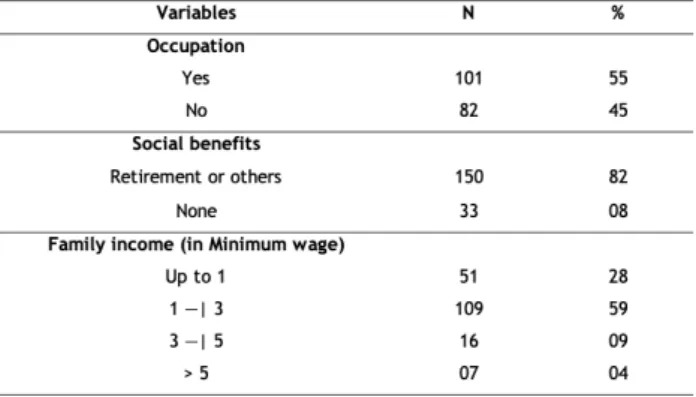
About the economic determinants, 55% of the elderly people reported having some type of paid activity, with 82% of participants receiving retirement or some kind of social benefit and 59% receiving between 1 and 3 minimum wages per month, as shown in Table 1.
Table 1 - Economic determinants of the elderly people of University of the Old Age Extension Program. Belém City, Pará State, 2016.
With respect to the level of education, observed in Ta-ble 2, a significant number of elderly people with more than eight years of schooling were obtained, in a frequency of 94 participants, representing 51% of them, followed by a percentage of 27% referring to those with education be-tween four and eight years of schooling.
Among the 183 elderly people interviewed, 125 report-ed living with a family member, corresponding to 68% of the total. As shown in Table 2, the elderly in the study 99% reported some type of change after participating in the co-habitation groups, the most cited being: “greater knowledge about issues involving aging”, representing 74% of the re-ports, and the “greater social interaction”, with a significant 63% of citations.
Table 2 - Social determinants of the elderly people of University of the Old Age Extension Program. Belém City, Pará State, 2016.
Regarding the personal determinants of the elderly people, it can be observed that of the total sample, 146, representing 80% of the population, reported some comor-bidity, especially diabetes (n = 19), hypertension (n = 74), cancer (n = 02), arthrosis (n = 51), rheumatism (n = 33), osteoporosis (n = 47), and depression (n = 27).
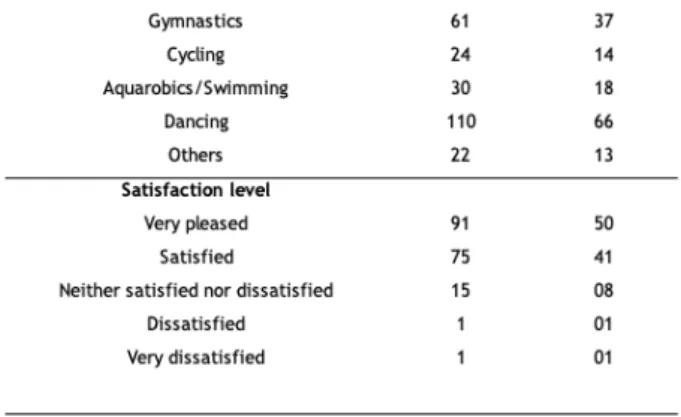
As for the behavioral determinants of the research par-ticipants, it is evident that most reported do not use ciga-rette and alcohol, 61% and 76%, respectively. When asked about the use of medications, it is observed that most use medications, 73% of the sample, and they use one to two medications per day. It was also investigated when per-forming physical activities, and most of them do physical activity, 91%, with dance being the most common, 66%, as can be identified in Table 3
Table 3 - Behavioral determinants of the elderly people of University of the Old Age Extension Program. Belém City, Pará State, 2016.
The study showed that the largest number of elderly participants in socialization groups is female. This data is consistent with the results of several studies conducted with elderly populations,2,8 which highlight the
predomi-nance of females in social groups and point to factors such as earlier medical follow-up, attention to disease preven-tion and healthier lifestyle habits as some of the various hypotheses that justify women’s longevity, and hence the process of feminization of old age.7
According to the Instituto Brasileiro de Geografia e Es-tatística (IBGE) [Brazilian Institute of Geography and Sta-tistics] conducted in 2010, in Brazil, the female population of elderly women increased from 2.2% in 1940 to 4.7% in 2000 and 6% in 2010.8
In addition to greater longevity than men, older wom-en have stood out socially as having a new, more dynamic and happier image of old age, participating in generation-al groups and learning to be more sociable, in addition to taking care of themselves, feeling become more free, which results in a more distant perspective of these women and, consequently, with a better quality of life. 2
Regarding the age range of the participants, this find-ing is consistent with the reports of studies conducted with the elderly public, which indicate a higher incidence of the age group between 65 and 69 years old,9 as well as with the
research conducted in the State of Rio Grande do Sul, Bra-zil, that the elderly people in the socialization groups are between 60 and 81 years old.10 The result is also
corrobo-rated by the Brazilian reality that says 7.28% of the general population and 71.7% of the elderly people are between 60 and 74 years old.11
The high level of education found in the elderly par-ticipants differs with the findings reported in the national literature, which shows the predominance of the low level of education of the elderly.6 However, we can associate this
fact with the evolution of the elderly population, thanks to investments in education, as a factor that justifies the search for the elderly population to increasingly increase their knowledge. Thus, the improvement in educational performance may be associated with the improvement of their living conditions, through socialization centers, adult literacy programs and others, recently implemented to
im-prove interaction and social inclusion, which is a way to rescue autonomy, to live with dignity, within the scope of being healthy.12,3
Most participants (68%) reported living with a family member. The family is considered as one of the primary re-lationships, characterized by being emotional, intimate and lasting relationships, since they are very important for the feelings of coping with everyday situations and the feeling of loneliness that can arise in old age.14 And it is noteworthy
that in Porto Alegre City, Rio Grande do Sul State, it was found by participants that maintaining a social network, participation in the elderly group, family and friendship network and emotional support are shown by the elderly people as healthy aging.15
Regarding the practice of paid activity performed by the elderly participants, the search for a paid occupation may be justified by the feeling of job loss caused by retirement in these people, since for them the fact can be considered one of the biggest losses in their lives, especially those who do not replace their routines with other roles in society.16
In a survey conducted in Rodeio City, Santa Catarina State, most of the elderly people, with 70% of the sample, were retired and did not perform paid activities, disagree-ing with the finddisagree-ings of this research, but it was also point-ed out that 90.9% of the population performpoint-ed activities in the unpaid community, showing that they had an active aging,17 corroborating what was found in this study,
be-cause the elderly participants may need to be included in the social context through the performance of collaborative activities.
Another justification refers to the meaning, for the re-tired elderly person, of greater physical and mental auton-omy and greater social integration, as well as a higher in-come, which corroborates the national context that reveals that most Brazilian elderly people are retired and receive up to a minimum income wage, revealing a reduced pur-chasing power that, added to the needs related to health maintenance and survival, influences the possibility of con-sumption and quality of life, reflecting the reality presented by the research participants.18
In front of the changes found by the participants after the beginning of their participation in the socialization group, we found an evolution and the development of dif-ferent characteristics of the new profile of the elderly peo-ple, which is becoming increasingly active, dynamic and interactive in front of the socialization groups.14 Social
in-teraction contributes to the exercise of citizenship, to the appreciation and insertion of the elderly in the social envi-ronment. Therefore, such interaction enables them to ex-perience a sense of belonging to a social group with which they can contribute to their knowledge in a more meaning-ful way, since aging can be a time for building knowledge and acquiring new life experiences.18
The abstinence of addictions such as alcoholism and smoking, in addition to the rational use of medicines,
re-ported in the research, can prevent diseases and functional decline, also increasing the longevity and quality of life of the individual.17 It is noteworthy that the theme smoking
and alcohol is widely discussed and included in group pro-gramming for the prevention and improvement of quality of life, a fact that may also have influenced the percentages that quit smoking.
With regard to comorbidities, during the aging process, the elderly people tend to have more episodes of generally chronic diseases, and the incidence of such brings the con-notation of disability, which is often the reason for isolation and/or withdrawal from social life by the elderly people.19
Changes in the cardiopulmonary and musculoskeletal sys-tems are among the main functional changes observed in old age, since they significantly affect physical skills and energy levels, compromising health status of the elderly population.20
Concerning the reported comorbidities, they are in agreement with the main diseases reported by the elderly participants, since hypertension is arguably the most com-mon comorbidity in this population group. Osteoarticular diseases are more frequent among female elderly, which justifies their expressive frequency in the findings of the study, since most participants are women.20
The practice of physical activities presented by the el-derly participants, such as walking and dancing, reflects the fact that one of the projects offered by the Universidade da Terceira Idade (UNITERCI) [University of the Old Age] program, “Body, Movement and Quality of Life in the El-derly”, has as its main activities ballroom dancing and se-nior dance and counts with a large part of the research par-ticipants. The practice of regular physical activity reduces such negative effects caused by the aging process, even de-laying some restrictions on the performance of activities of daily living, thus prolonging the active life of the elderly.21
In addition to contributing physiologically and func-tionally, physical activity also positively influences the self-esteem of the elderly people, being a determining fac-tor for them to have the motivation to maintain an active behavior in the society in which they live.17
One of the activity options offered and much sought by the elderly is dancing. The movements that involve musicality result in beneficial effects such as personal sat-isfaction, joy, autonomy, overcoming limits, development of potentialities and capacities, and through contact with dance, the elderly people begin to overcome their fears, un-certainties and doubts, making become more receptive to interpersonal relationships and social inclusion.22
Another relevant factor assessed for active aging was the participants’ level of satisfaction with life, which is the set of factors such as hope, future vision, purpose, meaning, per-sistence and self-efficacy, since when performing an anal-ysis of life, the individual considers their past experiences, their achievements, failures, and their future perspective.16
in improving the self-esteem of the elderly is observed since the ability to interact socially is fundamental, so that they can conquer and maintain social support networks and en-sure a higher quality of life, especially when the elderly peo-ple have to adapt to the physical and social losses of old age. As older people come to see and positively evaluate their quality of life, expectations are more favorable for their fu-ture to be healthier and more active.18
CONCLUSIONS
The promotion of aging with quality of life through the development of reflexive, autonomous and socially active elderly people is only effective once these elderly people have the empowerment of their old age, which consists in expanding the possibilities of controlling aspects related to their life.
The research carried out in the community living cen-ter of the UNITERCI allowed the evaluation and descrip-tion of the social, economic and behavioral determinants that permeate the active aging of the participants of these spaces. It was also possible to perform the analysis of the positive aspects acquired during their participation in the projects and relation to the difficulties and weaknesses pre-sented by the participants, it can be noted that, even with their existence, these are faced and overcome with the help of the activities promoted by the social centers themselves.
In addition to offering such activities, socializing groups are also excellent when it comes to social interaction, as the elderly participants come to live with people outside their family, such as the multidisciplinary team itself and grou-pmates, allowing them to live new experiences and know-ledge.
It is hoped that this work can contribute to greater knowledge about the aspects that involve aging related to social groups, especially UNITERCI, to promote citi-zenship, health and well-being of the elderly people throu-gh social inclusion and exercising their rithrou-ghts.
REFERENCES
1. Lopes MJ, Mendes FRP, Silva AO, organizadores. Envelhecimento: estudos e perspectivas. São Paulo: Martinari; 2014.
2. Pina, OCA. Envelhecimento Ativo em relação ao Género no Concelho de Viseu [Dissertação]. Viseu: Universidade Católica Portuguesa; 2013.
3. Mendes F et al. As Representações Sociais do Envelhecimento Ativo de Idosos e Profissionais. São Paulo: Martinari, 2014.
4. Santos J. Conceções de cidadania na idade dos cabelos grisalhos: envelhecimento ativo e participação social das pessoas idosas [Dissertação]. Coimbra: Universidade de
Coimbra; 2016.
5. Vieira LAM. Envolvimento e Suporte Social Percebidos na Velhice: dados do estudo FIBRA UNICAMP [Dissertação]. Campinas: Universidade Estadual de Campinas; 2013.
6. Moliterno ACM, Faller JW, Borghi AC, Marcon SS, Carreira L. Living with the family and the elderly’s quality of life at the senior citizens’ open university. Rev. enferm. UERJ [Internet]. 2012 [cited
2015 nov 05]; 20(2):179-84. Available from: http://www.facenf.uerj. br/v20n2/v20n2a07.pdf
7. Silva IMC, Andrade KL. Quality of life assessment in elderly assisted in a geriatrics ambulatory in the Northeast region of Brazil. Rev Bras Clin Med [Internet]. 2013 [cited 2016 jan 12];11(2):129-34. Available from: http://files.bvs.br/upload/S/1679-1010/2013/v11n2/ a3561.pdf
8. Almeida AV, Mafra SCT, Silvia EP, Kanso S. The Feminization of Old Age: a focus on the socioeconomic, personal and family characteristics of the elderly and the social risk. Textos & Contextos [Internet]. 2015 [cited 2016 jan 12]; 14(1):115-131. . Avaliable from: http://revistaseletronicas.pucrs.br/ojs/index.php/fass/article/ viewFile/19830/13313
9. Carvalho IS, Neto AVL, Silva BCO, Nunes VMA, Alchieri JC. Evaluation of basic and instrumental activities of daily life of elderly participants in groups living together Fundam. Care [Internet]. 2014 [cited 2016 jan 13]; 6(2):607-617. Available from: http://www.seer.unirio.br/index.php/cuidadofundamental/article/ view/3063/pdf_1251
10. Both JE, Leite MT, Hildebrandt LM, Pilati ACL, Stamm B, Jantsch LB. Grupos de convivência: uma estratégia de inserção do idoso na sociedade. Revista Contexto & Saúde [Internet]. 2011 [cited 2017 jun 12]; 10(20): 995-998. Available from: https://www.revistas. unijui.edu.br/index.php/contextoesaude/article/view/1718/1421 11. Instituto Brasileiro de Geografia e Estatística (IBGE). Projeção da
população do Brasil e das Unidades da Federação [Internet]. 2016 [cited 2016 oct 15]. Available from: http://www.ibge.gov.br/apps/ populacao/projecao/
12. Pontes ALF, Silva LM, Silva CSO, Ascuitti LSR, Silva AO, Gonçalves MCR. Perfil demográfico de idosos não institucionalizados e sua percepção sobre alimentos funcionais. Rev enferm UERJ [Internet]. 2015 [cited 2016 sep 12]; 23(3):310-7. Available from: http://www. facenf.uerj.br/v23n3/v23n3a04.pdf
13. Wichmann FMA, Couto NA, Areosa SVC, Montañés MCM. Grupos de convivência como suporte ao idoso na melhoria da saúde. Revista Brasileira de Geriatria e Gerontologia [internet]. 2013 [cited 2017 jun 12]; 16(4): 821-832. Available from: http://www. scielo.br/pdf/rbgg/v16n4/1809-9823-rbgg-16-04-00821.pdf 14. Areosa SVC, Benitez LB, Wichmann FMA. Relações familiares
e o convívio social entre idosos. Textos e contextos [Internet]. 2012 [cited 2016 sep 16]; 11(1):184–192. Available from: http:// revistaseletronicas.pucrs.br/ojs/index.php/fass/article/ view/10495/8059
15. Valer DB, Bierhals CCBK, Aires M, Paskulin LMG. The significance of healthy aging for older persons who participated in health education groups. Revista Brasileira de Geriatria e Gerontologia [internet]. 2015 [cited 2017 jun 12]; 18(4):809-819. Available from: http://www.scielo.br/pdf/rbgg/v18n4/pt_1809-9823-rbgg-18-04-00809.pdf
16. França LH, Stepansky DV. Educação permanente para
trabalhadores idosos: o retorno à rede social. Boletim Técnico do Senac [Internet]. 2016 [cited 2017 feb 04]; 31(2): 41-50. Avaliable from: http://www.bts.senac.br/index.php/bts/article/view/337/320 17. Vicente FR, Santos SMA. Avaliação multidimensional dos
determinantes do envelhecimento ativo em idosos de um município de Santa Catarina. Texto Contexto Enferm [Internet]. 2013 [cited 2016 feb 29]; 22(2): 370-8. Available from: http://www.scielo.br/pdf/ tce/v22n2/v22n2a13.pdf
18. Farias RG, Santos SM. Influência dos Determinantes do Envelhecimento Ativo Entre Idosos Mais Idosos. Texto Contexto Enferm [Internet]. 2012 [cited 2016 sep 11]; 21(1): 167-76. Available from: http://www.scielo.br/pdf/tce/v21n1/a19v21n1.pdf
19. Linden Júnior E, Trindade JLA. Avaliação da qualidade de vida de idosos em um município do Sul do Brasil. Rev. Bras. Geriatr. Gerontol [Internet]. 2013 [cited 2016 oct 05]; 16(3):473-47. Available from: http://www.scielo.br/pdf/rbgg/v16n3/v16n3a06.pdf
20. Silva PAB. Fatores associados à qualidade de vida de idosos adscritos no distrito sanitário nordeste de Belo Horizonte [Dissertação]. Belo Horizonte: Universidade Federal de Minas Gerais; 2012.
21. Cavalli AS, Pogorzelski LV, Domingues MR, Afonso MR, Ribeiro JAB, Cavalli MO. et al. Motivation of elderly people to engage in physical exercising: a comparative study between two university-based programs - Brazil and Portugal. Rev. Bras. Geriatr. Gerontol [Internet]. 2014 [cited 2016 oct 06]; 17(2):255-264. Available from: http://www.scielo.br/pdf/rbgg/v17n2/1809-9823-rbgg-17-02-00255. pdf
22. Gil PR, Streit IA, Contreira AR, Naman M, Mazo GZ. Previous habits physical activity and recreation dance practitioners in the
elderly. Revista Kairós Gerontologia [Internet]. 2015 [cited 2016 oct 06]; 18(2):227-245. Avaliable from: http://revistas.pucsp.br/index. php/kairos/article/view/26997/19140
Received on: 08/18/2017 Required Reviews: None Approved on: 11/14/2018 Published on: 10/05/2019
*Corresponding Author:
Bruna Corrêa de Mira Av. 9 de Janeiro, 15 Passagem Osório, Belém, PA, Brasil E-mail address: [email protected] Telephone number: +55 91 98202-4302 Zip Code: 66060-400 The authors claim to have no conflict of interest.