ANALYSIS OF MORPHOMETRIC ATTRIBUTES OF BENTHIC
NEMATODES AS DESCRIPTORS OF THE DIFFERENT
ECOLOGICAL CONDITIONS
Hércio Issac Patrício Chiziane
Dissertation in partial fulfilment of the requirements for the Degree of
Masters in
Management and Conservation of Natural Resources
Advisor: Ana Sofia Rosa Santos Alves;
Co-advisor: Maria Helena Soares Martins Adão
Jury:President: Maria Teresa Marques Ferreira (PhD), Full Professor at Instituto Superior de Agronomia, Universidade de Lisboa.
Members: Sofia Alexandra Pinto Ramalho (PhD), Researcher at IMAR/OKEANOS - Universidade dos Açores.
Ana Sofia Rosa Santos Alves (PhD), Postdoctoral Researcher at IMARE - Centro de Ciências do Mar e do Ambiente da Universidade de Évora.
II
ACKNOWLEDGEMENT
After an intensive period of 9 months, I finally reached this day. Writing this note of thanks is the finishing touch on my dissertation. I went through a period of intense learning, not only on the scientific arena, but also on a personal level. Therefore I would like to reflect on the people who have supported and helped me so much throughout this period. I would like first to thank my life coach, my late father Patrício Isaac Chiziane: because I owe it all to him. Many Thanks dad! Once you told me that the only way to learn more was the way of humility. Therefore I have humbled myself and acquired knowledge compared to what I had before. I am also grateful to my siblings and in special to my elder sister Hamate Chiziane, who have provided me with moral, emotional and financial support. She did not remove her eyes from me a single moment. My forever interested, encouraging and always enthusiastic elder sister Hamate Chiziane: She was always keen to know what I was doing and how I was proceeding, although it is likely that she never grasped what it was all about! I am also grateful to my other family members and friends who have supported me along the way, especially to my mother Odete Jeremias, and my two friends Ana Carolina Rodrigues and Joana Moreira.
I also want to extend this gratitude to my brothers in Christ. Special thanks to my Pastors; Carlos Abdnon and Aparecida Abdnon who provided me with spiritual and emotional guidance all along the way. Thanks very much, I appreciate!
I would also like to thank my thesis advisor Professor Ana Sofia and my co-advisor Professor Helena Adão. The door to prof. Ana Sofia's Office was always open whenever I ran into a trouble spot or had a question about my experiment, research or writing. She consistently allowed this paper to be my own work but steered me in the right direction whenever she thought I need it.
At last, but by no means least, I would like to extend my gratitude to everyone in the MARE Laboratory. It was great sharing the laboratory with all of you during the last months. Special thanks to João and Gilda for the many times they abandoned their own activities to give me technical support with the computer and the microscope.
Thanks for all your encouragement! Hércio Chiziane
III
Do not forsake wisdom, and she will protect you; love her, and she will
watch over you. The beginning of wisdom is this: Get Wisdom. Though it
may cost all you have got, get
UNDERSTANDING.
IV
Resumo
Os nemátodes de vida livre foram e são continuamente considerados ótimos bioindicadores por vários autores. A elevada diversidade estrutural e funcional dos nemátodes de vida livre torna-os o grupo mais diversificado e numericamente dominante em habitats aquáticos, com uma ampla distribuição que varia de habitats intocados a habitats altamente poluídos. Este fato chamou a atenção de muitos investigadores que, por sua vez, motivaram e promoveram o seu uso na avaliação da qualidade das massas de água. Além disso, estudos mostraram que a morfometria e biomassa são dois aspectos importantes a serem considerados em estudos ecológicos de nemátodes de vida livre. O corrente estudo foca-se na investigação dos atributos morfométricos dos nemátodes de vida livre do estuário do Tejo de modo a relacioná-los com as várias condições ambientais do sedimento ao longo do estuário. Para este efeito foi testada a seguinte hipótese nula: Não haverá diferenças nos parâmetros de nemátodes (comprimento, largura, relação C/L e biomassa) em diferentes secções do estuário. As conclusões levaram à rejeição da hipótese nula. Diferenças significativas foram observadas ao longo das seções do estuário para a maioria das medições dos atributos morfométricos dos seis géneros mais abundantes de nemátodes no estuário do Tejo (Terschellingia, Sabatieria, Daptonema, Ptycholaimellus, Viscosia e Anoplostoma). Embora a salinidade, profundidade, tamanho do sedimento e matéria orgânica tenham sido as variáveis ambientais mais correlacionadas com a variância dos atributos morfométricos dos nemátodes ao longo do estuário, o tamanho e a morfologia de nemátodes nas seções investigadas refletiram diferenças na qualidade e quantidade de matéria orgânica e tamanho do sedimento do estuário. A maior parte da variabilidade em termos de morfometria dos nemátodos ao longo do estuário do Tejo foi verificada para o género Terschellingia, levando à conclusão de que este género pode fornecer uma melhor informação sobre as diferentes condições ambientais do sedimento ao longo do estuário do Tejo.
Palavras-chave: Bioindicadores, Pressão Antropogénica, Estuário, Qualidade Ambiental,
V
Abstract
Free-living nematodes have been and are continually considered excellent bioindicators by several authors. Their high structural and functional diversity makes them more diversified and numerically dominant in aquatic habitats, with a wide distribution ranging from untouched habitats to highly polluted habitats. This fact as called the attention of many researchers who in turn motivated and promoted their use in the evaluation of the quality of water bodies. Farther, studies showed that morphometry and biomass are two important aspects to consider in ecological studies of free-living nematodes. The current study focuses on the investigation of the morphometric attributes of the free-living nematodes of the Tagus estuary (Portugal) in order to relate them to the various environmental conditions of the sediment along the estuary. Therefore, the following null hypothesis was tested: There will be no differences in the nematode morphometric parameters (length, width, L / W ratio and biomass) in the different sections of the estuary. Conclusions led to the rejection of the null hypothesis as significant differences were observed along the sections of the estuary for most of the morphometric attributes measurements taking in consideration the six most abundant genera of nematodes in the Tagus estuary (Terschellingia, Sabatieria, Daptonema, Ptycholaimellus, Viscosia and Anoplostoma). Though salinity, depth, grain size variables and organic matter were the environmental variables that were found to be more correlated with the nematode morphometric attributes variance along the estuary, nematode size and shape at investigated sections most likely reflected differences in quality and quantity of organic material and sediment size of the estuary. Most of the variability in terms of nematode morphometry along the Tagus estuary were verified for the genera Terschellingia leading to the conclusion that this genera can provide better information about the different environmental conditions of the sediment along the Tagus estuary.
Keywords: Bioindicators, Anthropogenic Pressures, Estuary, Environmental Quality,
VI
Resumo alargado
As mudanças ambientais têm sido documentadas como um factor crítico e que tem afetado significativamente a densidade, a diversidade e a estrutura das comunidades biológicas. Os sedimentos são em vários estudos considerados como locais mais impactado por efeitos antrópicos e portanto, representam a zona alvo para estudos e ações voltadas para a conservação da biodiversidade. No âmbito desta avaliação e monitorização das condições da qualidade de ecossistemas aquáticos, a Diretiva Quadro da Água Europeia (DQA, Diretiva 2000/60 / CE) destaca a importância do uso de descritores biológicos. O principal objectivo da DQA é que todas as águas europeias atinjam um “Bom” estado ecológico. Para alcançar um “Bom” estado ecológico, os “Estados-Membros” são recomendados a abordarem os factores que prejudicam os ecossistemas aquáticos. A poluição é um deles, mas as massas de água também podem ser afetadas pelas mudanças morfológicas, como a construção de barragens nos rios. Para tal conquista, é necessário uma avaliação e monitorização do atual estado dos ecossistemas aquáticos a fim de estabelecer o quão longe estes estão do “Bom” estado ecológico, indicando, portanto, a necessidade de intervenção. É no âmbito desta avaliação do estado de um ecossistema que se recorre aos bioindicadores pois este é um processo muito complexo. Por sua vez, os descritores biológicos ou indicadores biológicos são reconhecidos por various autores como ferramentas mais apropriadas para a avaliação da qualidade ecológica do que as variáveis físico-químicas ou abióticas isoladamente e vários estudos têm promovido o uso destes na avaliação do estado de ecossistemas. As vantagens associadas ao uso de bioindicadores incluem o fato de permitirem a determinação de impactos biológicos, serem uma alternativa economicamente viável quando comparadas a outros sistemas de medição especializados e serem mais eficazes para prever o grau de contaminação de um ecossistema.
Antes do desenvolvimento de estudos que sugerem o uso de nemátodes (meiofauna) como descritores biológicos, o estado ecológico de um ecossistema aquático era definido por uma ampla variedade de índices bióticos baseados em dados sobre a macrofauna. No entanto, a meiofauna, e em especial os nemátodes, têm-se destacado como melhores bioindicadores devido às suas respostas rápidas às mudanças ambientais, ciclos de vida curtos, alta abundância e diversidade e alta tolerância à variedade de stress ambiental, o que permite analisar essas comunidades em locais onde elas são muitas das vezes as únicas presentes. Em suma, as vantagens ecológicas e práticas associadas ao uso de nemátodes em estudos biológicos bentónicos são boas razões para utilizá-los como um grupo descritor na avaliação do estado de qualidade de sedimentos marinhos.
VII O presente estudo centrou-se na investigação dos atributos morfométricos dos nemátodes de vida livre do estuário do Tejo (Portugal) de modo a relacioná-los com as várias condições ambientais do sedimento ao longo do estuário. Os dados ambientais registados no estuário do Tejo mostraram que o gradiente de salinidade e o tamanho do sedimento não são os típicos da maioria dos pequenos estuários. Este não apresenta uma definição clara das regiões (gradiente) de salinidade. A secção “Upstream” foi considerada predominantemente polialina, enquanto que as restantes áreas foram consideradas euhalinas. Para investigar os atributos morfométricos foi testada a seguinte hipótese nula: Não haverá diferenças nos parâmetros de nemátodes (comprimento, largura, relação C/L e biomassa) em diferentes secções do estuário. As conclusões levaram à rejeição da hipótese nula. Em geral, os atributos morfométricos dos nemátodes no estuário do Tejo revelaram-se sensíveis na detecção de diferenças nas características do sedimento.
Diferenças significativas foram observadas ao longo das secções do estuário para a maioria das medições dos atributos morfométricos dos seis géneros mais abundantes de nemátodes do estuário do Tejo (Terschellingia, Sabatieria, Daptonema, Ptycholaimellus, Viscosia e Anoplostoma). Em contrapartida, a salinidade, profundidade, tamanho de grão do sedimento e matéria orgânica foram as variáveis ambientais que se mostraram mais correlacionadas com a variância dos atributos morfométricos dos seis géneros de nemátodes bentónicos mais abundantes ao longo do estuário do Tejo. O tamanho e a forma dos nemátodes ao longo do estuário provavelmente refletiram diferenças na qualidade e na quantidade de material orgânico nas seções investigadas do estuário (em particular a elevada largura corporal de alguns géneros). A maior parte da variabilidade em termos de morfometria dos nemátodes ao longo do estuário do Tejo foi verificada para o género Terschellingia e foi altamente associada ao tamanho do sedimento, levando à conclusão de que este género e suas espécies podem fornecer informações valiosas sobre as diferentes condições ambientais do sedimento ao longo do estuário.
Valores de comprimento baixo foram registrados para os géneros Ptycholaimellus, Sabatieria, Viscosia e Terschellingia na seção “Upstream” do estuário em comparação com a seção “Downstream”, na qual os valores médios de comprimento atingiram o seu pico. Este pormenor foi associado ao tipo de sedimentos em cada seção. Em termos de composição do sedimento, as estações de amostragem localizadas nas seções do “Upstream” e “Intermediate” eram compostas por areia fina e argilosa com altas percentagens de matéria orgânica. No entanto, nas seções “Bay” e “Downstream” os sedimentos eram principalmente areia fina, areia grossa e cascalho. Por sua vez, nemátodes de habitats arenosos tendem a ser mais compridos e longos, uma vez que precisam se mover pelas aberturas intersticiais,
VIII enquanto os nemátodes de habitats lamacentos são geralmente mais robustos, o que lhes permite cavar através do sedimento.
Também foi possível detetar uma melhoria nas condição do sedimento ao longo das seções do estuário do Tejo à medida que se analisavam dados das seções mais afastadas de “Upstream”. Esta melhoria nas condições do sedimento reflectiu-se no tamanho dos nemátodes através de parâmetros como o comprimento dos organismos. Maiores comprimentos foram atingidos na seção “Bay” e na “Downstream”, o que levou a conclusões semelhantes às encontradas por Losi et al. (2013) em que é referido que, em contraste com o tempo e o conhecimento especializado que são necessários em análises taxonómicas de nemátodes, as análises de biomassa e atributos alométricos podem fornecer uma ferramenta mais simples, mas comparável, no âmbito da avaliação da qualidade dos sedimentos e a heterogeneidade ambiental dos ecossistemas afetados.
Das variáveis físico-químicas, a salinidade, profundidade, tamanho de grão do sedimento e matéria orgânica foram as variáveis que se mostraram mais correlacionadas com a variância dos atributos morfométricos dos seis géneros de nemátodes bentónicos mais abundantes ao longo do estuário do Tejo. Em termos de morfotipos, a maioria dos géneros de nemátodes revelou estar na categoria “Fina” com relação C/L de 18 - 72 µm, seguida de nemátodes “robustos” com relação C/L <18 µm. Nemátodes longos, com relação C/L > 72 µm foram observados apenas na seção “Downstream” do estuário e pertenciam ao género Terschellingia.
A separação do tamanho e da forma dos nemátodes pertencentes aos géneros mais abundantes no estuário do Tejo com base nos valores de comprimento e largura entre as secções do estuário serviou como uma base para reafirmar o que já havia sido encontrado por outros autores nesta área, de que fatores locais também podem ser muito importantes para estruturar a morfometria das comunidades de nemátodes e que os atributos morfológicos das comunidades de nemátodes são úteis para demonstrar diferenças nas condições ambientais de ecossistemas aquáticos.
Table of contents
Resumo ... IV Abstract ... V Resumo alargado ... VI List of Tables ... VII List of Figures ... VII List of Abreviations ... IX
1. GENERAL INTRODUCTION ... - 1 -
1.1. Water Framework Directive ... - 2 -
1.2. Free-Living Benthic Nematodes as Biological Indicators ... - 3 -
1.3. Benthic nematodes biomass and morphometric attributes as indicators of environmental quality ... - 5 -
1.4. Anthropogenic factors affecting nematodes ... - 6 -
1.5. Estuaries and their challenges ... - 7 -
1.6. Tagus Estuary ... - 9 -
1.7. General Aim ... - 14 -
2.ANALYSIS OF MORPHOMETRIC ATTRIBUTES OF BENTHIC NEMATODES AS DESCRIPTORS OF THE DIFFERENT ECOLOGICAL CONDITIONS. ... - 15 -
2.1. Introduction ... - 16 - 2.2. Methodology ... - 19 - 2.3. Results ... - 26 - 2.4. Discussion ... - 42 - 2.5. Conclusion ... - 47 - 2.6. References ... - 48 - 2.7. APPENDIX ... - 57 -
VII
List of Tables
Page
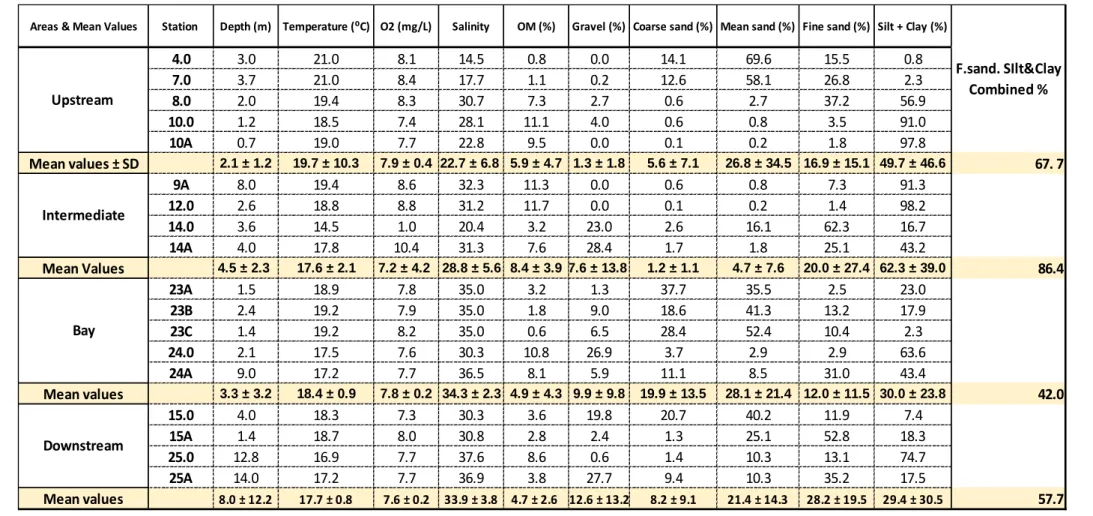
Table 1 – Environmental variables measured at each 18 selected sampling
stations in the Tagus Estuary and their mean values±SD.
23
Table 2 – Total density (number of individuals per 10cm-2), percentage and
mean±standard error in each Tagus estuary sampling section (n=40).
25
Table 3 – Morphometric attributes mean and standard deviation for all
nematode measurement parameters per sampling sections.
27
Table 4 – Details of one-factor PERMANOVA test (Factor “Section”, 4 levels)
carried out on Length, Width, L/W ratio, Wet biomass and Dry biomass of the analysed nematode genera (Daptonema, Ptycholaimellus, Sabatieria, Viscosia and Terschellingia).
29
Table 5 – BIOENV results carried out to nematode morphometric measures
and environmental parameters, for each of the most abundant nematode genera with exception of Anoplostoma genera.
VII
List of Figures Page
Figure 1 – General overview of Portugal
Figure 2 – General overview of the Tagus Estuary in Portugal. Figure 3 – General overview of the Metropolitan Area of Lisbon.
10 11 12
Figure 4 – Tagus estuary (Portugal). Indication of meiofauna sampling
sections and stations.
16
Figure 5 – Captured Microscopic Image showing nematode Length and
Width measurements. Width was measured at least in 3 different points to ensure that the maximum width of organism was identified. Length was measured from the initial buccal area to the tail; excluding the filiform tail.
18
Figure 6 – Nematodes Length measurement using internal and external
features as reference points.
19
Figure 7 – Principal Component Analysis ( PCA) ordination based on
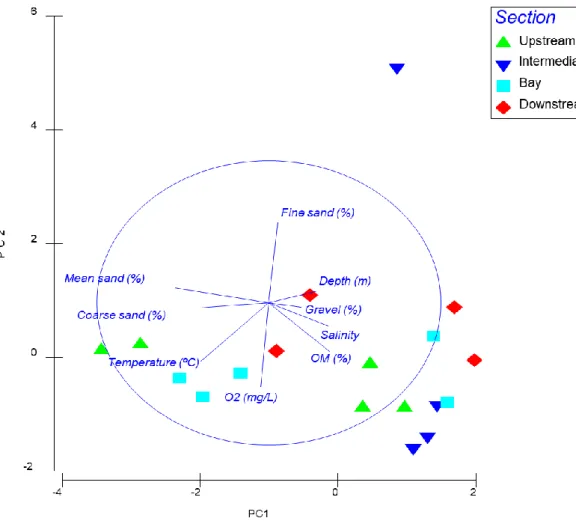
environmental data measured in each of the 18 sampling stations belonging to the 4 different sections of the Tagus Estuary (Upstream, Intermediate, Bay, Downstream section). PC1=32.9%; PC2=23.7%.
24
Figure 8 – Total number of nematodes measured per genera along the
sections of the Tagus estuary.
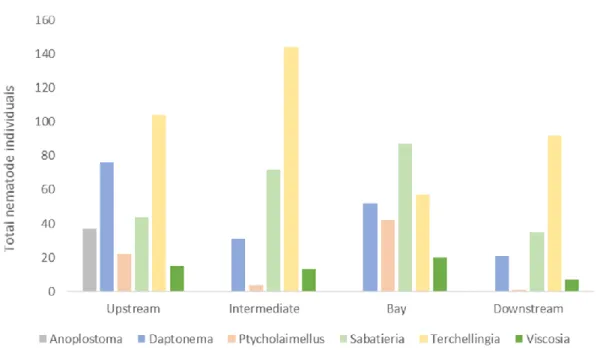
26
Figure 9 – Length (Mean±SE) per genera in each section of the Tagus
estuary.
34
Figure 10 – Width (Mean±SE) per genera in each section of the Tagus
estuary.
35
Figure 11 – Length/Width (Mean±SE) per genera in each section of the
Tagus estuary.
36
Figure 12 – Wet Biomass (Mean±SE) per genera in each section of the
Tagus estuary.
37
Figure 13 – Dry Biomass (Mean±SE) per genera in each section of the
Tagus estuary.
39
Figure 14 – Representation of the morphotypes classification of the Tagus
estuary nematodes based on L/W ratio. Stout nematodes (L/W ratio < 18 µm), slender (L/W ratio of 18 – 72 µm) and long (L/W ratio > 72µm).
39
Figure 15 – nMDS ordination based on morphometric attributes
measurement (Length, Width, L/W ratio and Wet biomass) in each of the sampling stations on each “Section” (Upstream, Intermediate, Bay and Downstream).
IX
List of Abreviations
EEA – European Environmental Agency WFD – Water framework Directive EU – European Union
EC – European Commission MSs – Member States ES – Ecological Status
USEPA – United States Environmental Protection Agency NOAA – National Oceanic and Atmospheric Administration USA – United States of America
CSOs – Combined Sewage Overflows NASA – American National Space Agency MSFD – Marine Strategy Framework Directive PCA – Principal Component Analyse
- 1 -
1. GENERAL INTRODUCTION
Anthropogenic activities cause ecosystem deterioration worldwide, resulting in loss of biodiversity and impoverished ecosystem services (Crain et al., 2008; Kay et al., 2016). Aquatic systems are among the most degraded habitats, yet must fulfil societal demands for food, drinking water, transport, power generation and leisure activities (Gleick, 1998). As well know, water is life. It is a precondition for human, animal and plant life as well as an indispensable resource for the economy (European Commission, 2016). Water also plays a fundamental role in the climate regulation cycle. However, water sources present significant challenges such as droughts, floods and chemical pollution as significant challenges and site chemical pollution as the biggest threat to water resources. Industrial, farming, mining, and forestry activities significantly affect the water quality of rivers, lakes, and groundwater. Farming in most cases increases the concentration of nutrients, pesticides, and suspended sediments. Industrial activities can increase concentrations of metals and toxic chemicals, add suspended sediment, increase temperature, and lower dissolved oxygen in the water. Each of these effects can have a negative impact on the aquatic ecosystem and/or make water unsuitable for established or potential uses. In Europe, the continuing presence of pollutants in waters threatens aquatic ecosystems and raises concerns for public health (EEA, 2015). Discharge from urban wastewater treatment, and industrial effluents and losses from farming, are the main sources for the European water pollution. These water–related problems are seen by the general European public as “serious” as stated by the EU 2012 Environmental Press: “Europeans call for stronger EU action on water”. Citizens are worried about both water quantity and quality. This concern has been increasing for a considerable time. Thus, citizens and environmental organizations have been increasingly demanding for cleaner rivers and lakes, groundwater and coastal beaches (European Commission, 2012). Therefore, the European Commission has made water protection one of the priorities of its work. Ensuring effective protection of water resources, of fresh and salt water ecosystems and of the drinking and bathing water (EEA, 2015). Such actions included the drafting and implementation of the European Water Framework Directive (WFD Directive 2000/60/EC) which, brought much improvement of the water quality in the last decade in most of the European regions.
The Water Framework Directive states that Water is not a commercial product like any other, but a heritage that must be protected, defended and treated as such. In 2015, the European Environmental Agency, concluded that although considerable success has been achieved in reducing the different pressures on ecosystems, the full implementation of the WFD throughout all sectors is still necessary in order to commit all users in a river basin to focus on the achievement of healthy water bodies with good status. They also found out that recently, challenges with discharges of pollutants into Europe's waters remain for urban and industrial
- 2 -
wastewater and for pollution from agricultural sources. Therefore, measures are needed to ensure the evaluation of their biological impact as well the removal of emerging pollutants.
1.1 Water Framework Directive
In the Earth Summits in 1992 (Rio de Janeiro), 1995 (New York) and 2002 (Johannesburg) and the 1992 Convention of Biological Diversity, countries worldwide agreed to achieve environmental sustainability (Hering et al., 2010). In Europe, this led to the proposal for an EU Directive on the Ecological Quality of Surface Waters, which led many countries to adopt monitoring schemes and environmental quality objectives and standards. But, since the 1970s, parts of Europe (e.g. UK and Sweden) had already shown a willingness to harmonize environmental measures to tackle trans-regional water quality issues (McLusky and Elliott, 2004). Nevertheless, the European Directive proposal for the Ecological Quality of Surface Waters was never adopted, possibly because of its high ecological bias and inadequate consideration of socio-economic impacts yet it led to the drafting of the European Water Framework Directive which was finally adopted in 2000 (Hering et al., 2010). The European Water Framework Directive (WFD) establishes a framework for the protection of groundwater, inland surface waters, estuarine waters, and coastal waters. The WFD constitutes a new view of the water resources management in Europe. Its key purposes are to prevent further deterioration of, and protecting and enhancing the status of, aquatic ecosystems in Europe (Josefsson and Baaner, 2011). According to Pollard and Huxham, (1998), the WFD establishes innovative principles for water management, including public participation in planning and economic approaches, and the recovery of the cost of water services in which, member states are required to achieve a “good surface water status” in inland surface waters, transitional waters and coastal waters. Groundwater must also be protected and restored to ensure the quality of dependent surface water and terrestrial ecosystems. Thus, the WFD requires Member States (MSs) to assess the Ecological Status (ES) of water bodies. The Directive also introduces and emphasizes on biological (and not just chemical) quality goals, and the introduction of a consideration of ecological functioning (as well as structure) (European Commission, 2016). Though, it also requires the assessment of hydromorphological and chemical, in addition to biological variables, being in most cases given priority to biological assessment (Pollard, and Huxham, 1998).
The WFD classification system for water quality includes five status categories: “High” for biological, chemical, and morphological conditions associated with no or very low human pressure; this is also the reference condition or benchmark as it is the best status achievable
- 3 -
(reference conditions are type specific which makes them different for different types of rivers, lakes, or coastal waters in order to represent the diversity of ecological regions in Europe); “Good” for that state of the system in the absence of any anthropogenic pressures, or a slight biological deviation from what would be expected under undisturbed/reference conditions (“no, or only very minor, anthropogenic alterations”), (European Commission, 2016); “Moderate” for moderate deviation from the reference condition and “Poor” for substantial deviation from the reference condition and “Bad” to severe deviation from the reference condition (Josefsson and Baaner, 2011). The main objective of the WFD is for all waters to reach good or high ecological status. To achieve good ecological status, Member States address the factors harming water eco-systems. Pollution is one, but water bodies could also be affected by the morphological changes such as dams built on rivers. For such achievement, monitoring is essential for assessing their current state, in order to establish how far they are from good or high ecological status, therefore indicating the need for management. Measuring accurately the state of a system is a very complex process that often resorts to the use of indicators in order to evaluate its performance (Voulvoulis et al., 2017).
1.2 Free-Living Benthic Nematodes as Biological Indicators
The Water Framework Directive (WFD, Directive 2000/60/EC) highlights the importance of biological descriptors in evaluating and monitoring environmental conditions. Moreno et al. (2011) emphasized that biological indicators are a more appropriate tool for the assessment of ecological quality than physico-chemical or abiotic variables alone. The term "Bioindicator" is used as an aggregate term in relation to all sources of biotic and abiotic reactions to ecological changes (Silveira, 2004). Dale and Beyeler (2001) state that one of the best characteristic of a good indicator should be being anticipatory thus, providing early warning of natural responses to environmental impacts (Marshall et al., 1993; Woodley, 1996). According to Kotwicki (2006), the advantages associated with the use of bioindicators include the fact that they allow the determination of biological impacts, they are also an economically viable alternative when compared to other specialized measuring systems, and they are more effective for predicting the degree of contamination of an ecosystem. Therefore, the use of only physical-chemical or abiotic variables to detect impacts on environmental conditions was rendered as insufficient (Goodsell et al., 2009), especially considering that in some cases, contaminants may be present in very small concentrations to be detected using chemical or physical measurements (Suter, 2001).
In the other hand, and for measuring environmental pollution and anthropogenic impacts, biological rather than physicochemical indicators alone, were promoted (Goodsell et al., 2009).
- 4 -
Thus, living organisms were considered as bioindicators since they integrate the biotic and abiotic components of an ecosystem through their adaptive responses (Casazza et al., 2002). Therefore, they are the most appropriate to be used in the evaluation of the quality of water bodies.
Free-living nematodes are part of the meiofaunal community also referred in many studies as meiobenthos (Benthic fauna). The terms benthic and benthos are derived from the Greek for "depths of the sea" (Giere, 2009). Nevertheless, the term is also used in freshwater biology to refer to the zone and organisms at the bottoms of freshwater bodies of water. That includes both standing and running waters; lakes, rivers, and streams. The benthic meiofauna are basically the minute intertidal animals living in aquatic sediments. They are described by their size and that often vary from researcher to researcher. The two most abundant types of meiofauna are copepods and nematodes. Kotwicki (2006) defines nematodes as those metazoan animals that pass unharmed through a 0.5 – 1 mm mesh but are retained on a 30 μm mesh. Nevertheless, some studies consider meiofauna to be made of those organisms that pass through a 1 mm mesh but are then retained by a 45 μm mesh. Giere (2009) mentions that recently, deep – see meiobenthologists proposed an upper size of 1mm (or 500 μm) and a lower size limit of 31 μm. For this work, meiofauna was considered to be that metazoan fauna associated with the Tagus estuary sediment, which passed from a sieve of 1mm but was retained in a smaller sieve with 38 μm.
The benthic fauna is very diverse. It occurs in fresh and marine habitats. Nevertheless, most of the ecological studies on meiofauna have been performed in marine environment. Within meiofauna, copepods have a high dispersal rate, which allows them to spread out throughout the sediment while, the rest of the meiofauna are motile organisms that can move within the sediment (Commito et al., 2002). Meiofauna community has proven to be extremely useful in assessing the effects of anthropic disturbance on marine sediments (Coull et al., 1981, Coull and Chandler 1992, Austen and Somerfield 1997); these and most recent authors agree that their peculiar characteristics (small size, high abundance, presence of typical tolerant genera) are the main reason for their importance in assessing the effects of anthropogenic pressures on marine sediment.
Cullen (1973) and Riemann and Schrage (1978) stated that the most ecological value of nematodes is related to their notable abundance (90 – 95%) and biomass (50 – 90%) in silty-sand sediments; their interactions with bacteria; and their role within the trophic chains of aquatic ecosystems. Kotwicki (2006) emphasized that meiofauna in special nematodes play an important role as a trophic link between bacteria and larger fauna as they enhance the rate of carbon mineralization by stimulating microbial activity through predation, and consumption
- 5 -
of detritus by larger deposit-feeding invertebrates. A number of other studies also emphasized on the role of nematodes as a food resource for larger benthic and pelagic invertebrates and vertebrates within the aquatic ecosystems (Beier et al., 2004; Muschiol et al., 2008; Weber and Traunspurger, 2014).
Nematodes were labelled good bioindicators by the fact that they can be distinguished on both morphological and functional basis (Semprucci and Balsamo, 2012). Their traits which includes (body and tail shape and life strategy) can be easily identified and recognized. Thus, the nematode community structure was found to be a promising indicator of pollution in river sediments (Heininger et al., 2007). Their short life cycle also enables a faster detection of pollutants effects on the development of the organisms (Coull, et al., 1992). In the other hand, nematodes are highly sensible to the effects of urbanization and therefore they are good indicators for the chemical pollution. Speccially because they show effects of pollution faster and at lower concentrations levels than most other organisms. According to Kennedy and Jacoby (1999), all these ecological and practical advantages associated with using nematodes in benthic studies are a good reason for utilizing them as an ideal indicator group for the assessment of sediment quality.
1.3 Benthic nematodes biomass and morphometric attributes as indicators of environmental quality
Peters (1983) and Calder (1984) documented that the body size of an animal is related to many aspects of animals, such as life history, physiology, energy requirement, and biotic and abiotic interactions. Body dimensions and structures are thought to describe important functional attributes of species and genera of free-living nematodes, since various ecological characteristics (metabolic rates, chemical stress tolerance, mobility, vulnerability to predation) depend on the size of organisms (Schratzberger et al., 2007). Fleeger et al., (2011) emphasized that morphometry presents a large content of information comparable to the composition of the community and trophic groups in terms of detecting natural changes and anthropic effects on communities, providing ecological information related to size. According to Kennedy and Jacoby (1999), meiofauna morphological, physiological and life history characteristics evolved to explore the interstitial matrix of marine sediments. That included the reduction of body cells that lead to simplification of body organization or organ loss (Giere, 2009).
Nematodes show a wide range of different sizes and body proportions that result from environmental adaptations. These indicators reflect specific modes of life in terms of feeding
- 6 -
strategies, life history and diversity. Therefore, biomass and morphotypes may be used to study nematodes ecosystems (Warwick and Price 1979). The biomass of nematodes depends on the shape of the nematodes since it is calculated based on their length and width (Soetaert et al., 2002). Therefore, compared to taxonomic identification, biomass and allometric attributes provide an easier way to monitor sediment changes due to natural or anthropic stress. Thus, both biomass and morphotypes are the ideal tool when aiming at bringing a significant contribution to the ongoing ecosystem management studies which often require rapid time and economic response (Vanaverbeke et al., 2003).
Total biomass can be estimated through the Andrassy’s formula; W= (LxD2)/ (1.6x10⁶) where
W is the mass (μg wet weight), L is the length (μm) and D is the body diameter (μm) (Andrassy 1956). A ratio of 0.25 may then be assumed to convert wet weight into dry weight (Heip et al., 1985). The length/width (L/W) ratio is a measure of nematodes body shape. According to this ratio, nematodes have been classified into three main categories. Stout, nematodes with a low L/W ratio < 18; slender, nematodes with an L/W ratio of 18-72 and long/thin, nematodes with a high L/W ratio > 72 (Schratzberger et al., 2007). Vanaverbeke et al., (2004) suggested that slender nematodes are those found mostly in sandy habitats. The statement is justified by the fact that these animals would have to adjust their shape in order to move through the interstitial apertures. Other authors documented that there is a relationship between the body length of nematodes and their generation time. Larger animals tend to live longer (Ferris and Bongers, 2006) whereas, nematodes from muddy habitats are ofthen more robust as they have to burrow through the sediment (Tita et al., 1999).
1.4 Anthropogenic factors affecting nematodes
Meiofauna, and especially marine nematodes are common in sediments around the world. There are a number of studies that have shown the importance of environmental effects on meiofauna communities and in particular the nematodes (Heip et al., 1985; Giere, 1993). Enviromental factors mostly affect the distribution, the density and diversity of the nematodes. Most studies schollers have documented that the size of the sediment particle, salinity and temperature are the most important environmental factors affecting nematode communities (Coull, 1999). Other factors such as oxygen and food availability, turbidity, hydrodynamic regime, topography, seagrass distribution, as well as anthropogenic pressures, are also reported to have a significant effect on nematode communities and that in most cases, they explain nematodes spatial (vertical and horizontal) and temporal distribution (Heip et al., 1985; Fleeger and Decho, 1987). Different combinations of environmental variables can be
- 7 -
considered as responsible for the meiofauna and nematode communities’ structures (Coull, 1999).
Attrill and Power (2000) elaborated on anthropogenic pressures affecting nematode abundance and distribution. Several studies have also focused on the effects of global warming, organic enrichment, oil spills and other contaminants (such as copper, lead, zinc, iron and cadmium). For these authors, the most important impacts in the estuaries are associated with floods or droughts due to salinity, which, in particular, is one of the main structuring factors in estuarine regions. Freshwater nematodes are mostly restricted to salinities lower than 10, whereas several marine species can be found in almost freshwater conditions or at salinity gradient up to 50 or higher (Heip et al., 1985; Moen et al., 2013). Anthropogenic activities in estuaries often result in high discharges of nutrients and organic matter, creating an unbalanced ecosystem (Austen and Warwick, 1995). Nevertheless, studies have detected that nematodes tend to increase in abundance along a gradient of increasing organic enrichment, to a point where conditions deteriorate until nematodes are no longer present. Carman et al., (1997) argues that the response of nematode communities to anthropogenic pressures, by totally disappearing or decrease in number of species, can significantly influence the interactions between other benthic taxa. It can also create negative changes in the marine food chain that in turn can have serious implications for the functioning of the entire marine ecosystem (Attrill and Power, 2000). Animals that have nematodes as a mandatory food source may have food restriction and, on the other hand, food sources of nematodes, such as microalgae, may increase as a consequence of reduced feed.
1.5 Estuaries and their challenges
For the scientific community, understanding the natural dynamics of estuarine ecosystems and their response to changes in the human-related or climatic drivers is fundamental to guarantee their environmental quality especially considering that estuaries are among the most productive ecosystems on Earth and provide multiple ecosystem services (Barbier et al., 2011; Underwood and Kromkamp, 1999). They are naturally variable ecosystems considered as transition zones between freshwater and marine systems. They are highly variable zones compared to the coastal and marine areas due to the high degree of variability of physical-chemical characteristics such as salinity, dissolved oxygen and temperature (Elliott and Quintino, 2007). They are influenced mainly by the hydrological regime, having a biotic change along the estuary gradient which results in great spatial differences. However, these spatial patterns may change over time in some estuaries that are characterized by strong seasonal
- 8 -
changes brought about by freshwater discharges (Chainho et al., 2009). These are of paramount importance in that they provide the essential basis for reproduction, feeding and harboring of invertebrates, fish and birds (Heck et al., 2003), as well as essential goods and services for mankind which include water supply, regulation of climate, nutrient recycling, erosion control, and for recreational and cultural uses (Costanza et al., 1997). But one of the most typical features of estuaries is that they form a mosaic of interconnected habitats that should not be considered in isolation (Morrisey et al., 2003) because each is of particular value to the different species that use it.
In addition, human activities have contributed to major modifications of these ecosystems. Coastal communities often grow three times faster than elsewhere. Unfortunately, as more people flock to the shore, they upset the natural balance of estuaries and threatening their health. We endanger the estuaries by polluting the water and building on the lands surrounding them. These anthropogenic actions in estuaries are responsible for impacts such as loss or alteration of habitats, changes in the structure and functioning of biological communities and reduction in water quality (Worm et al., 2006). To be specific, they contribute to unsafe drinking water, beach and shellfish bed closings, harmful algae blooms, declines in fisheries, loss of habitat, fish kills, and a host of other human health and natural resource problems. Being areas naturally stressed and continually subjected to high levels of anthropogenic stress, the estuaries present biological communities that adapt to these pressures. Nevertheless, the susceptibility of estuarine systems to climate change and human-induced threats is a major concern. These threats may reduce their capacity to buffer the coastal receiving waters from increased nutrients and other contaminants inputs, leading to poor water quality, reducing ecosystems health and, ultimately, affecting all the related social and economic benefits (Rabalais et al., 2009; Statham et al., 2012).
- 9 -
1.6 Tagus Estuary
The Tagus estuary is located in the Portuguese west coast. It is one of the largest estuaries in Europe with an area of about 320 km2 (APA, 2016). It has a complex morphology (Fig.1) with
a deep, long and narrow inlet connecting the Atlantic Ocean to a broad and shallow inner basin that has extensive tidal flats and marshes. In the context of the Water Framework Directive (WFD), the Tagus estuary is classified as a transitional water of the typology A2 – mesotidal well-mixed estuary with irregular river discharge (Bettencourt et al., 2004). The estuary is part of the transnational Tagus river basin that covers an area of about 80800 km2, of which about
31% is located in Portugal (APA, 2016). The circulation in the Tagus estuary is primarily driven by tides but it is also influenced by the river flow, wind, and atmospheric pressure and surface waves. The North American National Oceanic and Atmospheric Administration (NOAA) also classifies it as a mesotidal estuary, with semi-diurnal tides ranging from 0.4 m at neap tide to 4.1 m at spring tide (Duarte et al., 2013).
The Tagus estuary water levels are mainly influenced by river discharges but only farther than 40 km upstream of the mouth (Vargas et al., 2008). The Tagus River is the main affluent of the Tagus estuary. The river has an annual mean flow of 400 m3/s-1 (Cabral et al., 2001; Chainho
et al., 2008). Seawater enters the estuary through a deep narrow inlet channel and tidal influence reaches 80 km inland from Lisbon (Duarte et al., 2013). According to Vaz et al., (2011), together, these interconnected forces induce the appearance of sharp gradients of salinity inside the estuary with the formation of three distinct regions: a marine region (lower estuary), a mixing region (middle estuary) and a region where freshwater inflow dominates (upper estuary). Two other rivers that contribute significantly to the water inflow in the Tagus estuary are the Sorraia River with about 5% of the Tagus River discharge (Rodrigues et al., 2009) and the Trancão River. Within the estuary, salinity varies from freshwater (0.0), 50 km upstream from the mouth, to marine (36.0) at the mouth of the estuary (Cabral et al., 2001). Unlike the general cases of smaller estuaries (e.g. Mondego and Mira), in regular years there are no significant differences between summer and winter salinity values registered along the Tagus estuary (Chainho et al., 2008). The minimum water temperature values range from 9-10° C and the maximum values range from approximately 24-27 ºC (Martins et al., 1982, 1983; Silva et al., 1986; Gameiro et al., 2007).
The Tagus estuary sediment dynamics is usually driven by tides and waves (Franz et al., 2014). Approximately 40% of the estuarine area is composed of intertidal mudflats. The Tagus River is the main source of sediments (Vale and Sundy, 1987). The Tagus sediments are generally muddy, except along some channels and margins (Silva et al., 2013). In the upper
- 10 -
and middle estuary the prevalent sediment is muddy sand and in lower estuary and adjoining coastal area the dominant sediment is sand (Cabral and Costa 1999).
The estuary is included in the Metropolitan Area of Lisbon and comprises along its margins 11 municipalities with about 1.7 million of total inhabitants. The western and northern margins of the estuary are densely urbanized. The easten area is basically an agricultural influenced side (Tavares et al., 2015). According to Rilo et al., (2012), the land use cartography of the Tagus estuary covering a total area of 130 km2 along its margins, shows that agriculture occupies
35% of the area, urban zones 34%, industrial, port and airport facilities 24%, green spaces like leisure facilities 6% and natural areas about 1%. The intertidal area occupation includes: salt marshes 13%, anthropogenic structures like aquaculture installations 15% and beaches 1%.These and other factors increased the pressure on the estuarine waterfront and prevented the natural evolution of the majority of the margins. Therefore, during the last 60 years, human activities in the intertidal zones and along the estuarine margins were identified as the main drivers for the loss of natural areas and estuarine shoreline changes (Rilo et al., 2012). The Tagus estuary also hosts a natural reserve, the “Tagus Estuary Natural Reserve”, covering about 14000 hectares, which is one of the most important sanctuaries for wintering or staging birds in Europe and also an important nursery area for fish and shellfish juveniles. Rodrigues et al. (2017) documents that the middle-upstream area of the estuary is classified under the Birds and Habitats Directives as a Special Protection Area (PTZPE0010, Estuário do Tejo, about 44800 ha) and as a Site of Community Importance (PTCON0009, Estuário do Tejo, about 44600 ha), and under the Ramsar Convention as a Wetland of International Importance.
- 11 -
- 12 -
- 13 -
Figure 3 – General overview of the Metropolitan Area of Lisbon comprising 11 municipalities with about 1.7 million inhabitants.
- 14 -
1.7 General Aim
It is important to highlight that nematodes are not included in the biological compartment that needs to be monitored within the scope of the European Water Framework Directive, despite the fact that they provide valuable information on ecosystem health. This study will contribute in a general way to the recent surveys in the field of meiofauna which seek awareness of the importance of such small organisms and their relevance in studies of environmental impacts. Its main aim was to investigate the morphometric attributes of the benthic nematodes from the Tagus estuary and relate them to the various sediment environmental conditions along the estuary. The study was triggered by the following scientific questions: i) “Does the morphology of benthic nematodes of the same genera change along the Tagus estuary?” ii) To what extent such changes are related to environmental characteristics of the estuary?”
To achieve the desired goal, biomass, length (L), width (W) and L/W ratio of the nematodes from the Tagus estuary were assessed taking into consideration the main sections of the Tagus estuary according to previous hydromorphological studies (Upstream, Intermediate, Bay and Downstream section; Marco Machado's thesis, 2015). Then, the following null hypothesis was tested: “There would be no differences on nematodes parameters length, width, L/W ratio, and biomass at different sections of the Tagus estuary.”
- 15 -
2
ANALYSIS OF MORPHOMETRIC ATTRIBUTES OF BENTHIC
NEMATODES AS DESCRIPTORS OF THE DIFFERENT
- 16 -
2.1. Introduction
There has been an increasing pressure on aquatic ecosystems worldwide. They have been reported worldwide as a result of multiple stressors of both natural and anthropogenic origin (Dauvin, 2007). Schratzberger (2012) documents that there has never been a greater and immediate need for scientific advice on aquatic systems management due to rapid social development, which in turn has increased pressures on the ecosystems, thus challenging the scientific community and society in order to create mechanisms to harmonize the progressive development and conservation of the environment. Therefore, several studies have highlighted the need for a better understanding of the functioning of aquatic systems, and that led to the need of assessing the state of an ecosystem in order to better inform decision makers and the general public (Schratzberger, 2012).
In this context, living organisms have been used and are currently being promoted by various organizations such as the World Conservation Union and the International Union for Conservation of Nature as the most appropriate means to evaluate ecosystems and human effects because they integrate the biotic and abiotic components of an ecosystem through their adaptive responses (Casazza et al., 2002). In Europe, the European Water Framework Directive (WFD) and the Marine Strategy Framework Directive (MSFD) also recommend the use of biological indicators (Bioindicators) in monitoring environmental conditions in relation to other measurement methods (use of physicochemical or abiotic variables) (Voulvoulis et al., 2016). Long-lived organisms such as sea grass have long periods of response to environmental changes. That fact makes the use of descriptors related to the seagrass plant or prairie unrealizable in some cases as they may not allow a proper identification of early effects of ecosystem disruption (Balata et al., 2008). Thus, the implementation of the European WFD calls for the development of new bio-indicators capable of assessing, in the short term, responses to anthropogenic impacts.
The current study focuses on the use of meiofauna community, specifically nematodes, as possible indicators of the state of an aquatic system. Meiofauna in turn is formally defined as a group of organisms by their size, larger than microfauna, but smaller than macrofauna (Giere, 2009). For this study, meiofauna was considered to be the metazoan fauna that passes through a 1000 μm sieve, but is retained on a 38 μm sieve. According to Warwick et al., 1988, meiofauna characteristics are a good indicator of environmental conditions. Changes in density, diversity, structure and functioning may indicate changes in the ecosystem. In the other hand, nematodes are considered as suitable groups for use in environmental assessment and monitoring due to i) their rapid responses to environmental changes; ii) short life cycles (which allow responses in a short time); (iii) high abundance and diversity in
small-- 17 small--
scale spaces and a high tolerance to the variety of environmental stress, which allows to analyze these communities in places where they are often the only ones present. Semprucci et al. (2015) documented that free-living nematodes exhibit high sensitivity to pressures of anthropogenic origin and are thus considered to be excellent pollution sentinels. In the sediment they are also of extreme importance as they facilitate the biomineralization of organic matter and increase the regeneration of nutrients and serve as food for a variety of higher trophic levels.
Nematode body dimensions and structures describe important functional attributes of species and genera of free-living nematodes as several ecological characteristics depend on the size of organisms (Schratzberger et al., 2007). Fleeger et al. (2011) emphasizes that morphometry presents a great content of information comparable to the composition of the community and trophic groups in terms of detecting natural changes and anthropic effects on communities, providing ecological information related to size. According to Kennedy and Jacoby (1999), nematodes morphological, physiological and life history characteristics evolved to explore the interstitial matrix of marine sediments. A prior requirement to successfully explore the interstitial space of marine sediments is to be small in at least one dimension (body width or length). Giere ( 2009) documents that nematodes can reduce the number of cells, keeping the average cell size reasonably constant, leading to a simplification of body organization or organ loss.
Nematode body dimension are affected by a number of factors. The length and consequently the relationships between length and width (L/W) are affected by factors such as solids dissolved in water and nitrate concentrations in sediments; sediment particle size, chlorophyll and the total concentration of pigments and oxygen concentrations (Atkinson, 1973). An elongated body results in increased mobility, allowing short excursions from the anoxic to the oxic layer (Fonseca et al., 2007; Gallucci et al., 2008, Vanreusel et al., 2010). Udalov et al. (2005) concluded that individual and total biomass of nematodes are negatively correlated with dissolved oxygen therefore, nematode individual biomass tends to decrease with depth, as revealed by meta-analyses based on large datasets (Udalov et al.,2005, Soetaert et al., 2009). Nematodes with higher dry weight require lower oxygen consumption, suggesting that nematodes are well adaptable to low oxygen conditions. Some studies showed higher individual biomass in clayey estuarine sediments than in sandy sediments (Tita et al., 1999). Nevertheless, many other sediment characteristics besides sediment size, such as organic matter content, water content, and redox potential among others, are documented to also affect the size of the body of nematodes (Fleeger et al., 2011). Therefore, compared to taxonomic identification, biomass and allometric attributes can provide a way to monitor sediment changes due to natural or anthropogenic stress, more easily, thus gaining time and
- 18 -
saving energy and money (Vanaverbeke et al., 2003), and at the same time contribute significantly to ecosystem management studies, which often require rapid and cost-effective response.
In Portugal, meiofauna is a recent research area. Nevertheless, several studies of meiofauna and nematodes distribution and their role as bioindicators at different levels of estuarine environment have already been done, as for example (Alves et al., 2009; Adão et al., 2009 Materatski et al., 2015). However, the amount of information available when it comes to the Tagus estuary is very low (Soetaert et al., 1995) though its importance for the country. Until now, there are no studies analyzing the morphology of the meiofauna or nematodes communities that comprise the Tagus estuary. However, the analysis of morphometric data has already shown to be advantageous in previous studies in Portugal. Materatski et al. (2015) investigated how the biomass and morphometric attributes of the Mira estuarine nematodes were related to community characteristics and environmental variables, and these morphometric characteristics were found to be valuable in determining differences in environmental changes caused by the collapse of Zostera noltii seagrass beds. In partial fulfilment of the requirements for the master's degree in Conservation Biology, Marco Machado, a formal student at the University of Évora also worked with the nematodes from the Tagus estuary while analyzing the effects of the non-indigenous bivalve Ruditapes Philippinarum on meiofaunal communities. Marco Machado made the description of the taxonomic composition of the Tagus estuary nematode communities. He also analyzed the genera distribution of nematodes from the estuary. His work forms the basis on which the current study was performed . In a way of continuation, this study will focus on the analysis of the morphological structure of nematodes from the Tagus estuary and relate them to the sediment environmental characteristics. It will take into consideration the main four sections of the Tagus estuary (Upstream, Intermediate, Bay and Downstream section) according to previous hydromorphology studies (Machado, 2015). The main objective of the study is to: i) investigate the morphometric characteristics (Length, Width, L/W ratio, and Biomass) of the most abundant genera of nematodes along the Tagus estuary and ii) Relate those characteristics with the variation in the environmental composition of the Tagus estuary. These objectives were investigated mainly to answer to the following scientific question: Are there differences in terms of parameters (length, width, L/W and biomass) for the same nematode genera in the different sections (areas) of the Tagus estuary?
- 19 -
2.2. Methodology Study Area
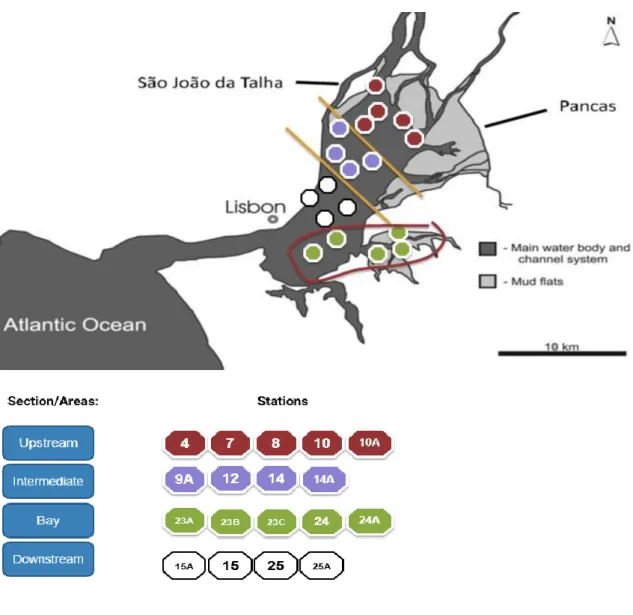
The study was carried out at the Tagus estuary (further description is found in chapter 1). The Tagus estuary is located in the Portuguese west coast. It is one of the largest estuaries in Europe with an area of about 320 km2 (APA, 2016). The estuary is included in the Metropolitan Area of Lisbon and comprises along its margins 11 municipalities with about 1.7 million of total inhabitants. Thus it suffers from a number of anthropogenic pressure that culminates in various forms of pollution. Most of the Tagus estuary pollution is directly linked to urbanization from the metropolitan area of Lisbon. Urbanization causes changes in sedimentation as well as the introduction of dangerous compounds like pesticides to the system. An increase in urbanization in most cases implies increased anthropogenic impacts on the environment. While urbanization has not occurred along all stretches of the Tagus estuary coast, many coastal areas have already been disrupted, and possibly changed, by the urbanization. For this study, the estuary was divided into 4 different sections/ areas according to previous hydromorphological studies of the estuary (Upstream, Intermediate, Bay and Downstream) section (Machado, 2015).
Field Activity
Meiofauna samples were collected at stations distributed along the Tagus estuary. Sampling surveys were conducted during May 2013 as part of the project “Identification of the effects of the Manila clam on the biological communities in the Tagus estuary; Impact of the Manila clam harvesting”. Within the scope of this program, a thesis was developed by Marcos Machado, a formal student from the University of Évora. He analyzed the density, diversity and trophic composition of the meiofauna community along the estuary and related those specific characteristics with the physicochemical parameters.
At this phase, samples stations were analyzed to investigate the morphological attributes of nematodes belonging to the same genera along the estuary and study how these morphometric attributes could be linked to the estuary’s dynamic environmental conditions. Therefore, the procedure for the current study required a random selection of a number of representative stations from a total of 40 sampling stations within the estuary. A total of 18 sampling stations were selected; five (5) in the “Upstream” and “Bay” section respectively and four (4) stations in the “Intermediate” as well as in the Downstream” section (Fig. 4)
- 20 -
Figure 4: Tagus estuary (Portugal). Indication of meiofauna sampling sections and stations.
Environmental Parameters - Sampling and Treatment
The environmental parameters were collected in order to understand how environmental parameters vary in the different sections of the estuary. Physicochemical parameters in the water included temperature (ºC), pH, salinity (Practical Salinity Scale) and dissolved oxygen (DO) (mg/L-1), which were measured at each sampling station. Approximately 100g of
sediment were collected at each sampling station to determine data of sediment associated environmental features such as total organic content and grain size. Sediment total organic content (OM) was determined as the difference between the weights of each sample after oven drying at 60 ºC for 72h followed by combustion at 450 ºC for 8h , and was expressed as the percentage of the total weight. Grain size was determined by dry mechanical separation through a column of sieves of different mesh sizes, corresponding to the five classes described
- 21 -
by Brown and McLachlan (1990): (a) gravel (>2 mm), (b) coarse sand (0.500 – 2.000 mm), (c) mean sand (0.250 – 500 mm), (d) fine sand (0.063 – 0.250 mm), and (e) silt and clay (<0.063 mm). The relative content of the different grain size fractions was expressed as a percentage of the total sample weight.
Meiofauna Community - Sampling and Laboratory Treatment
Meiofauna samples for nematode analysis were extracted from the sediment using a 3.5cm inner diameter transparent Plexiglas tube – 3 cm forced into the sediment. Samples were then preserved in a 4% buffered formalin solution. Later in the laboratory, the meiofauna fixed samples were rinsed under a gentle jet of fresh water over a 1000 µm sieve to exclude macrofauna, followed by a sieving using 38 µm mesh. The retained 38 – 1000 µm fraction was washed and centrifuged three times with Ludox HS40 (specific density 1.18 g cm-3). The
supernatant of each washing cycle was again collected on a 38 µm sieve. Samples were then preserved in a buffer 4% formalin solution and stained with Rose Bengal after extraction. All metazoan meiobenthic organisms were counted and identified under a stereomicroscope (40X magnification) and the density (individuals per 10 cm-2) of each taxon was quantified.
Nematode Laboratory Identification
100 – 120 nematodes (or the total number of individuals in samples with less than 100 nematodes), were randomly picked from each replicate, for making slides for posterior identification (Vincx, 1996). All nematodes were identified to genus level using a microscope fitted with a 100X oil immersion objective and based on the pictorial keys of Platt and Warwick (1983, 1988), Warwick et al. (1998), Nemys (Vanaverbeke et al., 2014) and Machado, (2015). For nematodes, the most widely used diversity descriptor is species or genus richness, as it gives a clear and simple indication of how many species or genera are present in a sample or area (Moens et al., 2013). Genus level identification has been shown by various outhors to be relevant in detecting and describing significant ecological patterns in nematode communities, just asthespecies level identification (Warwick et al., 1988; Vanaverbeke et al., 1997; Fonseca and Soltwedel, 2007; Schratzberger et al., 2007). Farther, the identification to genus level using general pictorial keys (Warwick et al. 1998) is an easy and simplified process, requiring only observation skills.
Laboratory Nematode´s Morphometric Attributes – Measurement
Eighteen (18) sampling stations were randomly selected from a number of 40. They covered for the entire estuary. Nematode parameters were measured and calculated taking into consideration only the six (6) most abundant nematode genera (Terschellingia, Sabatieria, Daptonema, Ptycholaimellus, Viscosia and Anoplostoma) which accounted for 71.7% of total
- 22 -
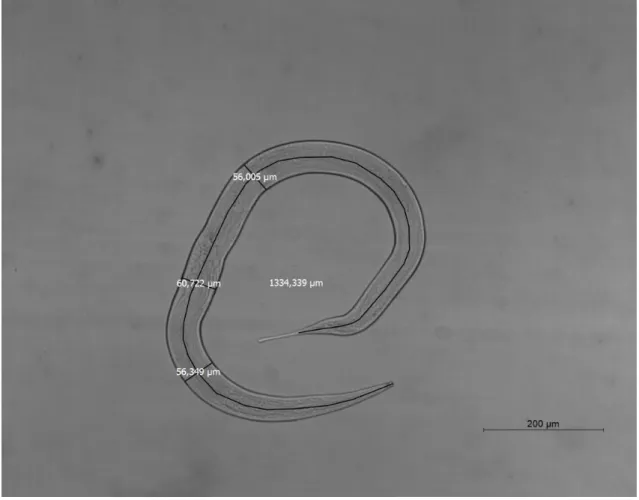
nematode density in the estuary. These nematode specimens were measured in terms of maximum length (excluding filiform tail) and width using Leica Application Suite software integrated with a Leica microscope fitted with a DM 2000 Camera, which sent live images on a computer. The Leica Software also allowed the nematode image capturing (Fig. 5).
Figure 5 – Captured Microscopic Image showing nematode Length and Width measurements. Width was measured at least in 3 different points to ensure that the maximum width of organism was identified. Length was measured from the initial buccal area to the tail; excluding the filiform tail.
Both length and width measurements were taken under a 10X magnification as it allowed a proper identification of the beginning and the ending of most animals. The Leica software zoom feature was used to measure the width of animals as prior tests did not show significant differences compared to the use of a higher resolution (20X and 40X).
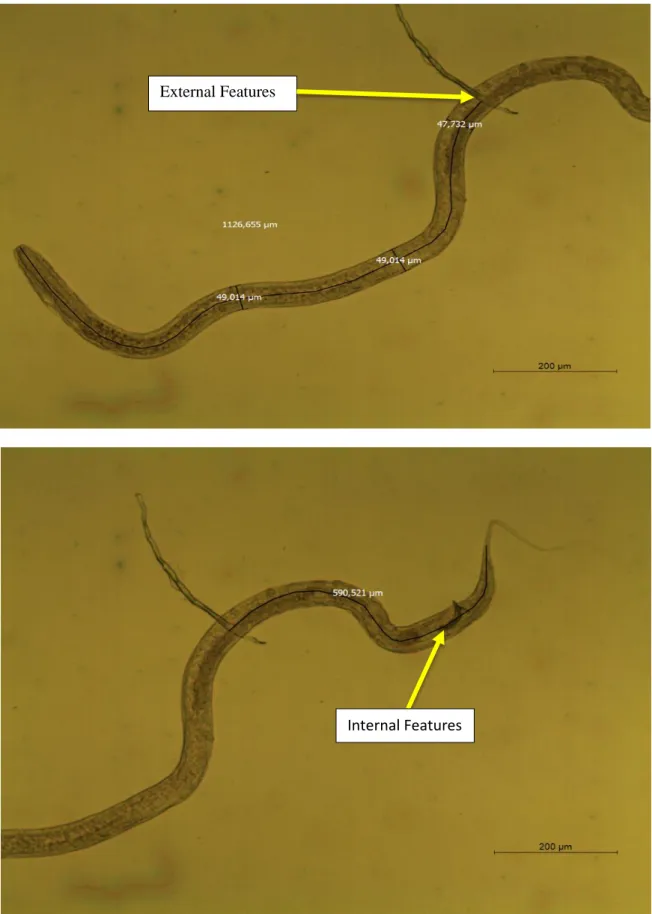
In the case of very long animals, the length measurement would be taken in two split parts. For such, internal and external features of the animals were used as references points (Fig.6).
- 23 -
Figure 6 – Nematodes Length measurement using internal and external features as reference points. External Features
- 24 - Biomass Calculation:
The nematode wet body biomass was estimated using the Andrassy (1956) formula. W = (LXD2)/ (1.6X10⁶)
Where W is the mass (as fresh weight μg) per individual, L is the nematode length (μm) and D is the greatest body diameter (μm). The dry biomass was estimated to be 25% of the wet biomass according to Wieser (1960) and expressed in μg. The use of manual measurements of the lengths and maximum widths of nematodes to estimate their biomass with the formula proposed by Andrassy (1956) is the most commonly used method in present-day studies of marine meiofauna that document biomass values (e.g. Vanaverbeke et al., 2003).
Morphotypes
For morphotypes the “De Man’s ratio” was applied (Platt and Warwick, 1983): maximum body length divided by the maximum body width. The length:width ratio (L/W) is a quantitative measure of the nematode shapes, with slender organisms having high L/W ratios and plump ones low L/W ratios. Stout (L/W ratio < 18 µm), slender (L/W ratio of 18 – 72 µm) and long (L/W ratio > 72µm).
Data Analysis
Machado (2015) determined the spatial distribution patterns, density and composition of the meiofauna and, particularly, the nematodes assemblages along the Tagus estuary. The current study analyzed the data from 18 sampling stations in order to determine (a) the differences in the morphometric attributes of the same genera of nematodes along the estuary and (b) relate the environmental patterns with the identified variability in the morphometric attributes.
To find out data patterns in a multi-dimensional scale, a Principal Components Analysis (PCA) of the environmental variables was performed. Environmental variables were first normalized and then subjected to Principal Components Analysis (PCA) for ordination. Prior to the calculation of the PCA, the redundant variables were removed from the analysis so that the first two axes accounted for the maximum variability in the dataset. The variables retained (Depth (m), Temperature (⁰C), O2 (mg/L), Salinity, OM (%), Gravel (%), Coarse sand (%), Mean sand (%), Fine sand (%)) acted as proxy for the ones that were eliminated (Silt+clay). Statistical analyses of nematode measurements and environmental data were performed using the PRIMER v6 software package (Clarke and Warwick, 2001) with the PERMANOVA add – on package (Anderson et al., 2008). In order to investigate the null hypothesis (“There would