HOW DOES TECHNOLOGY INFLUENCE KNOWLEDGE
SHARING AND APPLICATION AMONG TEAM MEMBERS?
Joana Simões Rita Grossinho Fontinha
Dissertation submitted as a partial requirement to obtain the title of master in Human Resource Management and Organizational Consultancy
Supervisor:
Professor Ana Margarida Passos, Associate Professor, ISCTE Business School, Department Human Resource Management
I
Abstract
Knowledge along with the human resource is the most valued asset of a company. Knowledge management has received much interested by researchers since it is a determinant key to perform efficiently. Due to society’s evolution, namely technological tools, on personal and professional routines, literature has improved in that sense and concluded that it can raise knowledge sharing facilitating the way employees work as well as the access to information, improving the performance. However, it is not known much about the interaction of this variables on team level.
In this study, we explored how technology influence team performance through knowledge sharing and application considering sense making leadership, meaning, how the relationship above works if there was a promotion of discussion among team members.
We tested our model in a sample of 54 teams (210 individuals). The results showed that there is a significant relationship between technology and knowledge sharing and hence team performance. Knowledge application does not have a direct implication, despite its indirectly impact on team’s performance. As a moderator, sense making leadership has a crucial role in the relationships described above in a way that can work as a substitute of technology, enhancing knowledge sharing and application when IT tools are not available.
Therefore, regarding practical implications of this study, since society is continuously improving being more technological over time, it is important to organizations to keep the investment on it, never forgetting the way it is managed into teams.
Keywords: team; knowledge; team performance; promotion sense making leadership. JEL Classification System:
M54 – Labour Management
II
Resumo
O conhecimento em paralelo com os recursos humanos são o maior ativo numa empresa. A gestão do conhecimento tem recebido a atenção dos investigadores, dado que poderá ser a chave para um desempenho eficiente. Tendo a tecnologia sofrido uma considerável evolução, a nível pessoal e profissional, a literatura tem acompanhado este progresso e concluiu que a partilha do conhecimento é proporcionada pela tecnologia disponibilizada, que facilitará o método de trabalho e o acesso à informação melhorando o desempenho. Contudo, ao nível da equipa, estas dinâmicas não têm sido aprofundadas.
Ao longo do trabalho, o modelo explorado permite averiguar de que forma a tecnologia influencia o desempenho da equipa através da partilha e aplicação do conhecimento, tendo em conta a promoção da discussão das variadas situações na equipa.
O modelo foi testado numa amostra de 54 equipas (210 trabalhadores). Os resultados revelaram uma relação significativa entre a tecnologia e a partilha do conhecimento e, consequentemente, no desempenho da equipa. A aplicação do conhecimento tem um impacto indireto no desempenho da mesma. A promoção de sense making pelo líder tem um papel fundamental nas relações acima descritas, na medida em que funcionará como substituto da tecnologia, promovendo a transferência e uso do conhecimento quando este tipo de recurso não está disponível.
Cada vez mais, a tecnologia faz parte das rotinas da sociedade, pelo que, é importante que as empresas continuem a investir nesta área, nunca esquecendo de que é importante o modo como é utilizada e gerida ao nível das equipas.
Palavras-Chave: equipa; conhecimento; desempenho da equipa; promoção de sense
making; liderança.
JEL Sistema de Classificação:
M54 – Gestão do trabalho
III
Acknowledgements
Reach this step and finish this dissertation is a mixed feeling of accomplish the challenged goal, of start the adult live and get into the job market, defining my professional personality and hence to propose myself to new challenges. It was a hard journey, with moments of joy, sadness, victories, but all worked out and I would not get here if I was alone. I came this far surrounded by a group of people that supported me unconditionally and never let me demotivate. Besides and namely for this dissertation that it is now presented, there are acknowledgements that I would like to do.
To my family, mother, father, sister and dogs. There is not enough appreciation for the effort and support given through all the years, especially for the development of this
study.
To my friends, I highlight not only the moments of hard work but also the moments of fun. From the academic beginning and for live.
To thesis group, to whom I appreciate the effort done and without who I cannot develop my study.
To all the participants that contribute with the questionnaire and took a few minutes to help me develop my work.
To the group of teachers that followed me from the beginning as well as the institution that hosted and helped me, sharing all the knowledge, experiences and advices that could. Specially my supervisor Ana Passos, for helping me develop a relevant work to
the study’s field.
Since every single person listed above contribute for my graduation, my knowledge, my professional personality, from the heart, I appreciate.
IV
Contents
Abstract ... I Resumo ... II Acknowledgements ... III 1. Introduction ... 8 2. Literature Review ... 10 2.1. Technology ... 10 2.2. Knowledge ... 14 2.3. Leadership ... 202.4. The mediations roles of knowledge sharing and application in the relationship between technology and team performance ... 24
2.5. The moderations roles of leadership in the relationship between technology and knowledge sharing and application ... 30
2.6. Conceptual Model and Hypotheses ... 32
3. Methodology ... 33
3.1. Sample ... 33
3.2. Procedure ... 34
3.3. Measures ... 34
4. Results ... 36
4.1. Descriptive Statistics and Correlations ... 36
4.2. Test of Hypotheses ... 37
5. Discussion ... 46
5.1. Theoretical Implications ... 46
5.2. Practical Implications ... 48
5.3. Limitations and Future Research ... 49
6. References ... 52
V 7.1. Annex A – Team member questionnaire ... 54
7.2. Annex B – Team leader questionnaire ... 60
7.3. Annex C – Items for measuring each variable for the present study ... 62
Index of figures
Figure 1 – Research model ... 32
Figure 2 – Representation of the mediation model of knowledge sharing into the relationship between technology and team performance ... 38
Figure 3 – Representation of the mediation model of knowledge application into the relationship between technology and team performance ... 39
Figure 4 – Representation of the moderation model of leadership into the relationship between technology and knowledge sharing ... 40
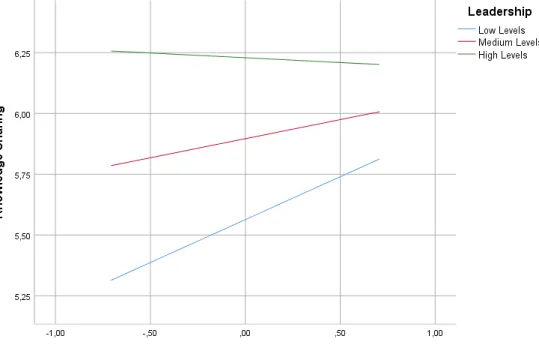
Figure 5 – Interactive effective of technology and leadership on knowledge sharing ... 41
Figure 6 – Representation of the moderation model of leadership into the relationship between technology and knowledge application ... 42
Figure 7 – Interaction effect of technology and leadership on knowledge application .. 43
Figure 8 – Representation of the moderated mediation model described previously as the research model ... 44
VI
Index of tables
Table 1 – Focuses of knowledge according each perspective adapted from (Alavi and Leidner, 2001) ... 14
Table 2 - Four approaches’ description of knowledge creation adapted from (Alavi and Leidner, 2001; Mohayidin et al., 2007) ... 16
Table 3 – Dimensions identified by functional leadership theory adapted from (Zaccaro et al., 2001) ... 22
Table 4 – Description of team cycle adapted from (Morgeson et al., 2009) ... 23
Table 6 – Sociodemographic characteristics of team members and leaders that participate into this study ... 33
Table 7 – Means, standard deviations, correlations and Cronbach’s Alpha of each variable of this study ... 36
Table 8 – Results of the mediation model of knowledge sharing into the relationship between technology and team performance ... 38
Table 9 – Results of the mediation model of knowledge application into the relationship between technology and team performance ... 39
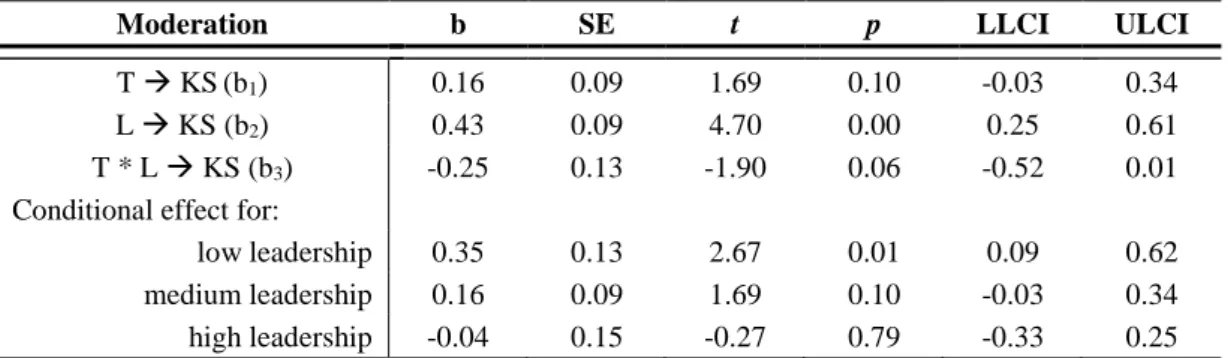
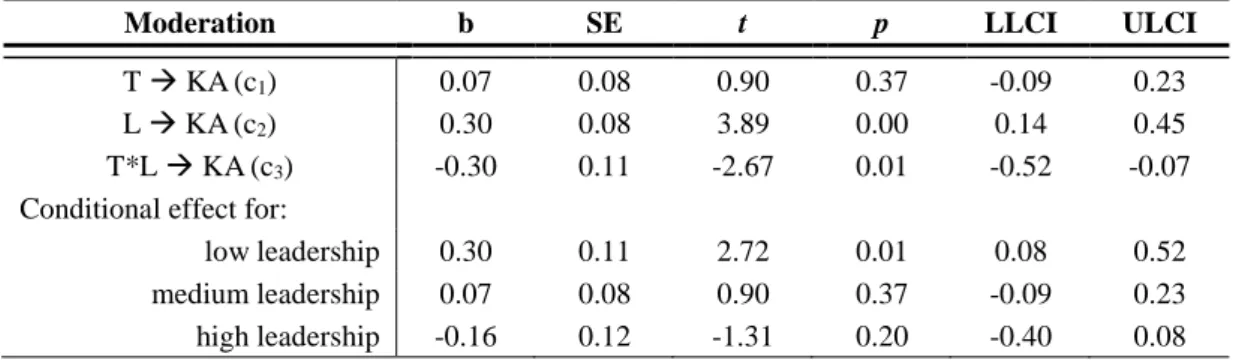
Table 10 – Results of the moderation model of leadership into the relationship between technology and knowledge sharing ... 40
Table 11 – Results of the moderation model of leadership into the relationship between technology and knowledge application ... 42
Table 12 – Results of the moderated mediation model described previously as the research model ... 44
VII
List of abbreviations
CMC – Computer mediated communication ICT – Information and communication technology IM – Instant messaging
IT – Information technology KA – Knowledge application KM – Knowledge management
KMP – Knowledge management practices or processes KMS – Knowledge management systems
KS – Knowledge sharing VT – Virtual teams
8
1. Introduction
Knowledge has been conquering proponents all over the fields and the interest around this topic has grown not only around researchers but also among organizational leaders. It has been defined as a precious resource and the key to develop sustainable competitive advantage in order to achieve success (Alavi and Leidner, 2001; Ou, Davison, and Leung, 2014; Sue Young Choi, Heeseok Lee, and Youngjin Yoo, 2010). A culture of innovation must be encouraged through the process of learning into an organization and that may happen through knowledge. This process and each step of knowledge, namely the act of sharing, are closely connected in a way that knowledge need to be distributed and spread over teaching and learning among every individuals that belong to a company (Mohayidin, Azirawani, Kamaruddin, Margono, and Idawati, 2007; Yang, 2007). Whether or not those individuals work together, there are interactions among them that will determine the failure or success of the project and hence of the company. Team processes have a highly importance and impact on team, leaders and organizational effectiveness (Zaccaro, Rittman, and Marks, 2001). It is known that leadership influences team effectiveness and so its performance as well as team. However, this interaction regarding teams is not really explored into organizational contexts. It is possible to affirm that it is a reciprocal influence, team and leader performances (Zaccaro et al., 2001).
According with researchers Mohayidin, Azirawani, Kamaruddin and Margono (2007) knowledge is developed and spread through all the organization as a basis of value development. Hence, over time, knowledge has become an asset with value into organization and, along with his grow, companies started to feel the need to manage it. Due to this attention and significance, the art of treating and exploring knowledge has been studied and updated regarding the advances of society, specially technology. The practice of knowledge management is identify as “one of the most promising ways of achieving success in the information age” (Mohayidin et al., 2007: 301).
The rise of new technological tools and systems came to help the organizational need of exploring this topic and it allowed not only to complement the traditional methods of process knowledge but also to improve effectiveness and performance of the overall knowledge mechanisms (Mohayidin et al., 2007). Despite the massive alternatives of new IT tools as collaboration tools, document sharing, document cocreation, meeting tools, project management tools and social networking, research still focus on traditional IT
9 tools, which means that new emerging technologies used on daily work in organizations have not receiving the importance that deserved (Gilson, Maynard, Jones Young, Vartiainen, and Hakonen, 2015). Society lives in a time range that daily life is based on technology and every activity no matter the source has this variable involved. Thus, human resource is one of the most precious assets from a company and it may be from where a competitive advantage born.
Thus, the focus of this study will rely on exploring the impact of technological daily used tools in knowledge sharing and knowledge application and how this will influence teams’ performance, having in mind the effect that each leader might have or not in each interaction. The innovation and strength of this study will fulfil the gap into the literature since it will be developed assuming technology tools that are used regularly and meaningful to the employees as well as how the presented variables succeed at a team level.
10
2. Literature Review
2.1. Technology
Since the huge change in nowadays routine, individuals that belong to teams need to act with more flexibility in the moment of coordinating the actions of team members (Zaccaro, Rittman, and Marks, 2001). Technology is considered as an input that enables communication and performance monitoring, although it is important to have in mind the fact that technology and it tools will differ between cultures (Gilson et al., 2015) as well as size and resources of companies (Edmondson, Bohmer, and Pisano, 2001).
In this sense, the improvement of technology have permitted companies to take advantage into a positive way regarding virtual teams (VT) (Mathieu, Maynard, Rapp, & Gilson, 2008). These teams can be described in three dimensions: (i) “the extent to which team members rely on virtual tools to coordinate and execute team processes”; (ii) “the amount of informational value provided by such tools”; and (iii) “the synchronicity of team member interaction” (Rico, Sánchez-Manzanares, Gil, and Gibson, 2008: 175).
Research regarding technology has been focused mainly on traditional options such as email, chat and discussion boards. Nevertheless, new computer mediated communication (CMC) tools such as meeting tools, has received more attention overt time (Gilson et al., 2015).
Many institutions have invested seriously in ICT or IT systems/tools, which includes “intranets, search engines, document repositories, and collaboration tools that allow virtual communities of practices to be organized” (Mohayidin et al., 2007; Sue Young Choi, Heeseok Lee, and Youngjin Yoo, 2010: 857).
CMC is a process in which human data interacts through several types of networking technology, including email and instant messaging (IM) (Gilson et al., 2015). IM is one of the most dominant having the capacity to overcome geographical distance as others CMC tools, however, with the additional benefits of facilitate the interaction among team members promoting as well multi-tasking and efficiency work, which was demonstrated into various studies (Ou et al., 2014).
11 Certain CMC’s research have concluded that these types of communication into organizations can rise overall satisfaction, decrease status differences among team members and balance challenges which can be leaded from task difficulty in order to motivate teams to use CMC options (Gilson et al., 2015).
According with Gilson et al., (2015) “personalized CMC exhibited a positive effect on extra group network size and structural holes, whereas communal CMC increased intragroup tie strength” (2015: 1318). Besides, different generations have distinct reactions to those tools, nevertheless, all of them affirmed that they decrease boundaries and increase collaboration.
Intranets may be an alternative technology for corporate communication and information management, even if the adoption rate is pretty much the same when comparing big or small size organizations. Nevertheless it will generate greater benefits from the technology as it was showed through corporate and employee performance after it implementation (Lai, 2001).
Given the huge technological tools that are available nowadays, it is important to highlight that the biggest advantage will be the fact that several enable team members to work from anywhere at any time (Gilson et al., 2015), a valuable characteristic in the labour market currently.
According with researchers, IT tools may have not only several advantages but also at different levels as the authors specified, they can facilitate dialogic practices by supporting ownership, it will be easy to travel since will enable users to move effortlessly among documents, it will create multiplicity in order that comparisons and perspectives are easily created, it will allow the construction of new categories and constructs creating the concept of emerging and, last but not least, it will destroy barriers not only inside each organization, for example, departments, but also at a national level (Hendriks, 1999; Ou et al., 2014; Sue Young Choi et al., 2010).
A strong advantage of intranets and other different tools, it is the fact of they have been used not only to unify geographically dispersed work forces but also empower employees around the world through communication’s instruments that supports collaboration, interaction and real-time sharing of information. Due to it, intranet have created a lot of interest among IT managers as its ability to resolved internal corporate communication bottlenecks. However, their contribution is not completely accepted because of variables
12 as productivity and collaboration gains (Lai, 2001). Continue the intensive work of Lai (2001), the author affirmed that intranets allow smaller companies to integrate and navigate around corporate data in a way to enhance organizational effectiveness with a minimal cost but with results that enable smaller companies to achieve a level in which larger organizations are present.
From the perspective of employees, IM, as the flexible and informal instrument, will allow workers to use it as a substitute for email on collaborative tasks as well as engage in intensive communication between colleagues, hence, new and innovative ideas will be generated. Yet, Ou et al. (2015) also pointed that IM can negatively affect efficiency, hence decrease productivity and employee’s concentration since the continuous interruptions, despite they may be associate with work or it clarifications, scheduling, questions, discussions, among other options.
Organizations have certain routines around technologies used on daily tasks giving the feeling of stability which can create some resistance when a new technology is implemented. Thus, the adoption must be a continuous learning process, making cognitive, interpersonal ongoing practice (Edmondson et al., 2001). Contrarily, they may be a trigger as well for changing organizational routines and so bring some improvement to it. In sum, technology implementation needs to go through a progression which evolves a development at the same time of individual and collective values, routines and not only new and also already earned skills (Edmondson et al., 2001).
The option to accept a new technology and bring it to the daily tasks does not give security that it will be an effective operation. In fact, recent literature founded new technology can have a role of inconsistency for a reagent for change (Edmondson et al., 2001). Despite the IT tools have gained some status along time, either they are really used or not, there are numerous ways for knowledge storage not only in human minds, documents, notes, manuals and reports, but also shared as the traditional channels of communication such as conferences or training programs that have been applied for many years. The appearance of technological tools has completed the common channels and methods and it has also raise the effectiveness of global methods of knowledge (Mohayidin et al., 2007).
13 Social media has gained a lot of visibility around society and nowadays can be viewed almost as an instrumental of work for knowledge sharing and to get specific knowledge (Gilson et al., 2015). Another emerging tool that has been talked is 3D virtual environments. This instrument refers to a system in which several individuals can share one 3D digital place in spite of being at different location and hence it will allow interacting among members with avatars (Gilson et al., 2015).
Through this study, technology will be defined as IT tools, which means that every tool that allowed employees to develop their daily tasks in order to achieve the goals that were proposed to. Examples from those tools are emails, chats, intranets, common platforms that allowed to share documents, among others.
14
2.2. Knowledge
Knowledge can be defined as the unique information possessed in the mind of individuals related to facts, procedures, concepts, interpretations, ideas, observations and judgements (Alavi and Leidner, 2001). It may be viewed from different perspectives such as a state of mind, an object, a process, a condition of access to information or a capability and these perspectives lead to unequal understandings and strategies to manage knowledge. Based on the work of Alavi and Leidner (2001), Table 1 presents the focuses that knowledge should be driven into regarding each perspective.
Table 1 – Focuses of knowledge according each perspective adapted from (Alavi and Leidner, 2001)
According with the authors Alavi and Leidner (2001), there are two dimensions of knowledge: tacit and explicit. The first embraced two elements named cognitive, regarding the individuals’ mental models and beliefs, and technical, about the specific know-how and skills applied to a concrete situation. The explicit dimension of knowledge refers to codified and communicated ways and/or natural language, such as an instruction’s manual (Alavi and Leidner, 2001). Hence, knowledge can be defined as a result from the dynamic between explicit and tacit knowledge (Mohayidin et al., 2007).
•Knowledge management should focus on the processes of creation, sharing and distribution
Knowledge seen as a process
•Knowledge management should focus on building and dealing with knowledge stocks
Knowledge seen as an objetc or as an access to information
•Knowledge management is a state of knowing and understanding, which involves increase individuals' learning and understanding through sources of inmation and not providing knowledge itself
Knowledge seen as a state of mind
•Knowledge management is about build core competencies, understand strategic advantages of know-how and create intellectual capital
15 The services that each company provides depend on how the resources are combined and applied which is translated into the know-how of the organization and its entities such as its culture, identity, policies, documents and also individual employees (Alavi and Leidner, 2001). Groups of employees with homogeneous knowledge tended to generate similar definitions of their mission and appropriate actions based on prior common assumptions about their tasks. Knowledge diversity refers to the distribution of knowledge relevant to the purpose or task of a team among its members (Rico et al., 2008). More important than the knowledge itself, it is the application and that’s the source of a competitive advantage, since it will be driven by the aptitude of an organization to generate, recognize, share and spread over knowledge (Alavi and Leidner, 2001; Sue Young Choi et al., 2010). In that sense, there is the concept of knowledge management (KM) which consists in identify and leverage the knowledge among employees in an organization. Thus, an organization’s ability to create, identify, share and apply knowledge directly affects and it is a key business process responsible for shaping each organizational competitive advantage (Alavi and Leidner, 2001; Ou et al., 2014; Sue Young Choi et al., 2010).
For companies and their managers, one of the most determinant challenges lies on manage effectively the knowledge resource (De Vries, Van Den Hooff, and De Ridder, 2006). KM has been defined as a dynamic and continuous set of processes and practices embedded in individuals as well as in groups and physical structures. The knowledge management processes or practices (KMP) have a reciprocity relationship and it can be described mainly in four: capture/creation, storage, transfer/share and application (Alavi and Leidner, 2001; Ou et al., 2014; Yang, 2007). In these four steps, knowledge transmission occurs whenever knowledge is diffused from one individual to other through socialization, education and learning. More specifically, both conceptual and empirical studies have suggested the stronger the ties and so trust, the easier will be to transfer knowledge (Ou et al., 2014).
Looking into the four interdependent and intertwined approaches of knowledge creation described by several authors, Table 2 analyse each one closely relying on the studies from Mohayidin et al. (2007) and Alavi et al. (2001).
16 Table 2 - Four approaches’ description of knowledge creation adapted from (Alavi and Leidner, 2001; Mohayidin et al., 2007)
Socialization Combination
Transformation regarding tacit knowledge to new tacit knowledge through social interactions and shared experiences.
Making new explicit knowledge by reorganizing and synthesizing in reports for example the existing explicit knowledge.
Externalization Internalization
Converting tacit to new explicit knowledge by incorporate company’s practices learned.
Constructing new tacit knowledge through explicit knowledge that already exists in the company such as the act of understanding.
In order to create new knowledge in the organization, there must have moments, tools, tasks in which it is possible to promote and develop knowledge and introduce it into the system of the organization in order to storage it (Mohayidin et al., 2007).
Organizations and their individuals create knowledge just as they forget and that’s why it is important to storage it and/or diffuse it. This is the reason organizational memory is so important. It refers to several components that preserve and allow the knowledge to remain in the system once acquired such as written documents, information storage in electronic databases, documented organizational processes and tacit knowledge that is gained by employees and networks of them (Alavi and Leidner, 2001; Mohayidin et al., 2007).
In order for the knowledge achieve every employee in the company, it is important to transfer and/or share it (Alavi and Leidner, 2001). Knowledge sharing (KS) has been identified as the main focus area of knowledge management mostly because it provides a connection between the level of individual knowledge workers, where knowledge resides, and on the organization’s level, where knowledge reaches its value (Hendriks, 1999).
Regarding the last process of KM, knowledge application is seen as a crucial part since more important than the knowledge, it is the application of it adapting to each reality.
17 Yang (2007) alleged knowledge depreciation may be seen as a way to lose the value and it can occurs in five different situations:
▪ Employees quit a job without the transfer of their knowledge;
▪ Existing organizational knowledge is outdated since the company temporarily loses its competitiveness;
▪ New creative products and services are rendered sub-standard by old know-how or unprofitable products;
▪ Knowledge is incompletely transferred (or shared with certain employees); ▪ Organizational knowledge is difficult to access.
Regarding the complementing and importance of both last processes, sharing and application and adding the fact the second infers a previous moment of knowledge sharing (Sue Young Choi et al., 2010), these will be the focuses in this study.
Knowledge sharing
Knowledge sharing (KS) is one of the four processes of knowledge management and it assumes a relation between two parties, one that possesses knowledge and the other that acquires it (Hendriks, 1999). It is where individuals exchange their knowledge and are able to create new knowledge (De Vries et al., 2006). It happens when a person is able to not only help and but also learn from others in order to develop individual abilities (Yang, 2007). Research regarding the degree and the way in which people share their knowledge, concluded that it is increasingly relevant to do it and it has identified variable factors that will determine it, such as technology tools, motivation, communication and organizational environment (De Vries et al., 2006).
According with Hendriks (1999), KS might happen in two phases: first, it presumes an act of externalization by those who have the knowledge, which can adopts several forms and it don’t need to be a conscious action. From the individual who shares the knowledge, there are two behaviours that Vries, Hoof and Ridder (2006) consider: willingness that
18 implies a positive attitude to others members of a group, in which the actors will “provide access to their personal knowledge”, since they expect the learners have the same interest and similar behaviour through the group they are; and eagerness, that also implies a optimistic attitude to share knowledge rather it is invited or uninvited (De Vries et al., 2006: 117). The second phase assumes an act of internalization by those who acquire knowledge (Hendriks, 1999). These two steps can be described in Davenport and Prusak’s (1998) formula in which sharing results from the interaction of transmission plus absorption (Hendriks, 1999).
Having in mind that at least two individuals are involved in this process, it will always exist a knowledge donation and a knowledge collecting. Both ways are distinguished, active, from a different nature and they can influence the participants differently. Nevertheless, reciprocity is important since both parties are expect the other to contribute (De Vries et al., 2006). Knowledge owners share it, because they are excepting or hoping for recognition and appreciation of their work, promotional opportunities, some kind of responsibility or maybe because they are expecting for reciprocity (Hendriks, 1999). Hence, as individuals are more satisfied with their work or the recognition received, their motivation to participate and influence into the development of others increases as well as the interest of the receptors to collect that information having the expectation to also receive the initial recognition, becoming almost a cycle (De Vries et al., 2006). Thus, workers are triggered by personal growth, operational autonomy and task achievement and not by financial rewards. Besides, people do not share knowledge with those they do not trust (Alavi and Leidner, 2001). A lot of companies invest in this system, however this process depends on different variables and so it is not truly trustable (Hendriks, 1999).
A crucial and not easy variable about knowledge sharing is the location of the data, since it must be where it is needed, where it can be used, attainable to everyone who needs. That’s why knowledge transfer was contextualized according with five variables: the value of the source, the willingness to share the information, the existence and richness of transmission channels, the willingness to acquire the information and the capacity of the receptor to absorb, assimilate and use it (Alavi and Leidner, 2001).
According with Yang (2007), the partial transmission of knowledge can occur when the channels through it is transmitted are redundant, because knowledge loses quality and hence value, being less concrete. The channels used might be categorized into informal or formal and personal or impersonal. On one hand, an informal channel, such as coffee
19 break conversations or unscheduled meetings, will promote socialization and it is more effective in small companies. Formal, such as training sessions might be greater for distribution, but it will not allow creativity. On the other hand, personal channels can be more effective since it will distribute more and better specific knowledge, rather impersonal channel, just as repositories, that may be more effective for knowledge that can be adapted and transversal to different situations (Alavi and Leidner, 2001).
KS allows “enhancement of employees’ capabilities but also contributes to overall organization effectiveness and bottom-line profit” (Yang, 2007: 83). If people truly learn from each other and share their knowledge, it can bring benefits and be increased. Knowledge sharing allows not only individuals but also organizations to recognize their behaviours, to get inputs from outside agents as well as the market they operate (Yang, 2007). It can also leads to a better decision making at an individual and team level and to increase their ability to get individual or collective goals (Matoskova, 2017). In order to take advantage of this benefits, individuals, teams, departments, all should be integrated into the process of knowledge sharing (De Vries et al., 2006).
However, share knowledge may also be detrimental to knowledge itself, since people between them can transfer inadequate representations of it (Hendriks, 1999; Yang, 2007).
Knowledge application
Knowledge application (KA) is the last set of knowledge processes. This involves a group of interconnected activities (Alavi and Leidner, 2001) that complement the previous processes of creation and share, since these two cannot lead to a good individual and organizational performance except when knowledge is applied (Sue Young Choi et al., 2010).
More important than have the knowledge itself, it is important to apply it and to do so there are three instruments that may help to develop an organizational capability, such as directives, organizational routines and self-contained task teams. The first consists in specific rules or standards. Organizational routines, which refers to the development of task performance or process specifications in which individuals will be able to use the knowledge in their routines either they are simple or complex. And integration
20 mechanism regards the development of self-contained task teams (Alavi and Leidner, 2001). Organizational routines can describe the daily activity of each one, emphasise status quo giving a significant relevance to “cycle of stability” (Edmondson et al., 2001: 685).
Researchers identify that organizations have gaps between what they know and what they do and there may have a lot of reasons for employees to consult the knowledge available but not to apply it, such as the fact that the source is not trustable, no time to apply it or the risk that is associate to the use of that knowledge. Hence, there are some significant perceptions regarding the cognitive processes, mainly, problem solving and decision making, in which, for example, knowledge structures has showed that cognitive processes of employees are not the focus and so the pre-existing knowledge it’s the one it is used due as well to routines (Alavi and Leidner, 2001). However, according with the literature, routines can change, even if it will be slowly, and knowledge may suffer it through temporal stages (Edmondson et al., 2001).
It is widely known, similarly and as a consequence at an organizational level, there are also gaps between what employees know and what they do (Alavi and Leidner, 2001) as well as the implications that team learning will have on knowledge application. However, along with the variables that are associated, there have been studies in which the conclusions reflected that knowledge application into a process of team learning it will have a strong impact on team performance, enhancing it (Sarin and McDermott, 2003).
2.3. Leadership
Organizational life has change through time and defining functions, projects, works and tasks has become essential to be successful (Morgeson, DeRue, and Karam, 2009). It is up to the higher hierarchies to structures that work and leaders have a determinant role in this process. Besides, there are seven factors that may influence the organizational leadership which are cognitive, social, personal, political, technological, financial and staffing (Zaccaro et al., 2001).
21 One of the areas that it started to be studied was the role of leadership in team settings, namely, “how leaders can help teams”, “the role of leaders in promoting team learning and adaptation”, “the role of team leaders in managing team boundaries”, and “how leadership roles are shared in teams” among others (Morgeson et al., 2009: 2). Therefore, according with the authors cited, there is a significant gap regarding teams and leadership processes, since the research presented focus on traditional leadership models which are characterized as not to distinguish dynamics between the leader and the subordinate and the team (Morgeson et al., 2009).
Functional leadership is described by Zaccaro et al. (2001) and his co-workers as “a social problem solving” where leaders have the duty for detecting any obstacles that might develop to achieve the stablished goals, as well as for create and organizing suitable solutions and for executing. This theory number three critical divisions about team leadership. Firstly, leadership as a boundary, meaning that, most of team problems have been created from their environment. Secondly, leadership is a choice regarding the solutions that would be suitable in certain problems, and the last idea is about the focuses of the theory that are not based on “what leaders should do” but on “what needs to be done” to have an effective performance (Zaccaro et al., 2001: 454).
Functional leadership theory refers also to four dimensions about leaders’ functions that are described on Table 3 above. It was made based on the work of Zaccaro and his co-workers (2001).
22 Table 3 – Dimensions identified by functional leadership theory adapted from (Zaccaro et al., 2001)
In sum, leader’s responsibilities go beyond the motivation and organization of collective achievement, meaning that they do not only have the duty to train but also to develop each resource under their command. Hence, functional leadership theory refers that there are specific situations that will lead to the success’ leader or not as well as the act of disable some situations (Zaccaro et al., 2001), influencing how a team reacts according with the obstacles (Gilson et al., 2015).
Those factors Zaccaro and his co-workers described can demand certain attitudes from the leader in order to the team achieve the goal positively and so, contrarily, it will define actions that the leader cannot perform so the group not to fall. Which means that the leader is effective if the team has success and the other way around is also valid (Zaccaro et al., 2001) having the variable communication in this equation, it will influence who emerged as a leader (Gilson et al., 2015). Besides communication and consequents behaviours, team processes will also have a critical role on team performance and might affect other exogenous variables such as environmental, organizational and team characteristics. Those team processes can affect it through four stages of team processes: cognitive, motivational, affective and coordination (Zaccaro et al., 2001). Regarding the motivational aspect, leaders can drive and increase team motivation either directly and indirectly. First through specific strategies and secondly by scheduling the activities, coordinate them, focusing on team development by feedback behaviours (Zaccaro et al., 2001).
•Leader's systematic research, acquisition, evaluation, organization of information regarding team goals and operations
1. Information search and structuring
•After the goal is stablish, the leader identifies task needs and requirements, develops, evaluate possible solutions as well as plans of implementation
2. Information use in problem solving
3. Managing personnel resources
•Leadership activities that include in the actual implementation of the settled plans
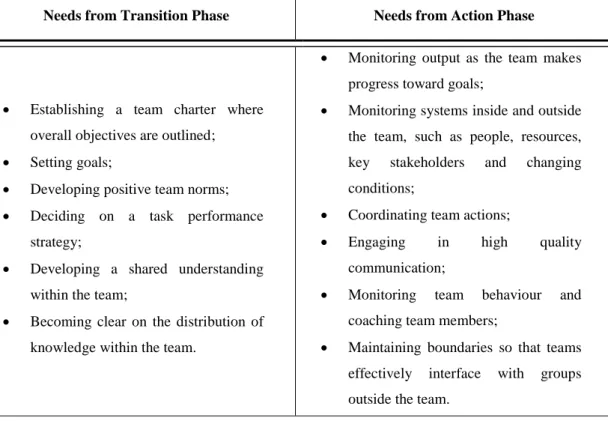
23 Team work may be defined in two big phases that together define a cycle: the transition, in which teams engage in, defined the goal, stablish a strategy, among other aspects; and the action phase in which team performs the strategy defined and develop activities that directly contribute to achieve the big goal, within both these performance stages team action will appears (Morgeson et al., 2009). In Table 4, build from the work of previous authors in 2009, it is possible to see more about those two moments of the team cycle.
Table 4 – Description of team cycle adapted from (Morgeson et al., 2009)
Needs from Transition Phase Needs from Action Phase
• Establishing a team charter where overall objectives are outlined; • Setting goals;
• Developing positive team norms; • Deciding on a task performance
strategy;
• Developing a shared understanding within the team;
• Becoming clear on the distribution of knowledge within the team.
• Monitoring output as the team makes progress toward goals;
• Monitoring systems inside and outside the team, such as people, resources, key stakeholders and changing conditions;
• Coordinating team actions;
• Engaging in high quality communication;
• Monitoring team behaviour and coaching team members;
• Maintaining boundaries so that teams effectively interface with groups outside the team.
No matter each stage the team is in, there are challenges that appears from different contexts as team, organization or external, and they can affect team viability making difficult to achieve the stablished goals (Morgeson et al., 2009). Local leaders have to have the concern to apply an active learning cycle in order for the development of the team (Edmondson et al., 2001).
On one hand, several leadership theories mention team procedures as moderators, that may indicate that leadership behaviours are suitable or effective in certain circumstances. On the other hand, not many team performance models specify leadership processes as drivers of team processes (Zaccaro et al., 2001). Despite the plenty of literature on
24 leadership and team dynamics, it is not known much about how leaders lead effectiveness to teams (Mathieu et al., 2008). According with this idea, leadership was studied toward three aspects of leadership: external, team coaching and shared leadership. External leadership represents the traditional pattern and focuses on the influence of a leader who is responsible for the teams’ performance. Cited by Mathieu in 2008 and mentioned by Hackman & Wageman in 2005, coaching “refers to direct interaction with a team intended to help members make coordinated and task-appropriate use of their collective resources in accomplishing the teams’ work.” (Mathieu et al., 2008: 450). And last, shared leadership is related with the idea of the fact that leadership can emerge within the team as well as from the traditional top-down process of external individual (Mathieu et al., 2008).
2.4. The mediations roles of knowledge sharing and application in
the relationship between technology and team performance
Studies of team effectiveness, more than 50 years ago, advanced an input-process-outcome (IPO) framework in which inputs describe previous factors that allow or not individuals’ interactions, no matter there are individual, team, organizational or context factors. Processes describe how team inputs are transformed into outcomes and, the last frame, outcomes, focuses on the team’s valued results by all parties (Mathieu et al., 2008). This model has been changing through time and the most significant difference regards the repercussion that the environmental and organizational context might have in the grounding of leader’s practices, task design and the interaction with the team. It also have been receiving a lot of critics because it fails into how it discriminate the several types of methods and results (Mathieu et al., 2008).
An effective team is also the one that can keep high levels of collective performance no matter the atmosphere among team members or the context that it is involved (Zaccaro et al., 2001). Individuals who have a good performance and a respectable know-how are more likely to offer valued resources to individuals of a team (De Vries et al., 2006). Besides, an optimistic attitude between individuals from the same team can generate more
25 cooperation, participation, less conflict and stronger social interactions among the team. Contrarily, a negative perspective will lead to internal conflicts and less eagerness to work with each other. (Zaccaro et al., 2001).
Technology have a determinant function on the improvement of knowledge resources into organizations (Sue Young Choi et al., 2010) and to manage it, it will be necessarily an equilibrate combination of technology and organizational, social and managerial actions (Mohayidin et al., 2007). Regardless the fact that new technologies might be crucial to sustained competitiveness for several organizations (Edmondson et al., 2001), they disable free interaction among individuals (Mohayidin et al., 2007). In fact, authors defend that technology may create gaps in the process of information exchange, confusion regarding the content of it, reduction of the data since there may be incoherent messages, among others aspects (Gilson et al., 2015), and according with some researchers defend that all of it will have consequences on job performance due perhaps to the fact that employees might not know how to use the technological tools (Zhang and Venkatesh, 2017). Having a negative impact on efficiency of each member, technology may decrease team’s performance a sense that it can affect individual’s concentration due to the continuous interruptions (Ou et al., 2014).
There are two dimensions of knowledge, tacit and explicit, and it is defended that the explicit knowledge has more value than tacit. If recognized, this might be a positive aspect through the use of technology in the area of knowledge management processes (Alavi and Leidner, 2001). According with Alavi and Leidner (2001), the biggest the shared knowledge, the less the context needed for individuals to share knowledge among individuals, the biggest the explicit knowledge and the biggest the value of using technology in KM. However, the authors also affirmed the smaller the existing shared knowledge space, the biggest the need for relative information, the less importance of explicit knowledge and hence, the less pertinent use of technology to KM. If it is well achieved and functional, it will allow people to share knowledge constantly and thus decrease operating costs, improve employees’ productivity, increase knowledge base and individual and share expertise (Alavi and Leidner, 2001).
On Table 5, based on the work of Alavi and Leidner (2001), it is possible to summarized what are the processes of KM as well as the significant influence of technology in each one of them.
26 Table 5 – Processes of KM and the influence of technology on them adapted from (Alavi & Leidner, 2001)
Knowledge Creation Knowledge Storage Knowledge Sharing Knowledge Application
IT enables the combination of learning tools and new
sources of knowledge in order to provide the experience of learning. IT provides individual’s support and organizational memory as well as knowledge access of any individuals into the
same group.
IT allows more communication channels, faster flow of
data just as more sources of information.
Knowledge can be applied in several locations and at the same time allowing more workflow
automation.
A limited value can be associated to KS in a way that IT ignores when and how the quality of KS will be enhanced (Hendriks, 1999). Therefore, it is important to highlight that for a lot of new technologies, new knowledge have to be transported in order to enable the use, technical knowledge as well as social, which refers to who knows what (Edmondson et al., 2001). Thereby, provide organizational maps to employees will let them to find easily and quicker either the knowledge or the source of it if would be possible without technological support (Alavi and Leidner, 2001).
It is known that the most used tool for KM is a document repository (Sue Young Choi et al., 2010) and in order to improve knowledge storage, technology can be a precious help due to the important role in enhance and expand organizational memory (Alavi and Leidner, 2001). Destroying barriers at three levels are one of the advantages that technology can improve regarding KS: temporal distance (suitable to keep knowledge along time), physical distance (suitable to KS among virtual teams), and social distance (suitable to easily social interaction). Besides, access to information bases for storing data as well as identify several elements that may be crucial to the process of KS, are also positive factors to use technology for KS (Hendriks, 1999).
Studies concerning relationships between group attributes, as it personality, and team performance are recent but they have shown that the first variable studied will affect positively the second and that the impact into groups are bigger than the impact at individual level (De Vries et al., 2006). Thus, a solid relationship facilitate and boosts
27 knowledge sharing whereas, weak ties will simplify the knowledge creation (Ou et al., 2014). The conclusion is knowledge transfer has an encouraging relation with the strength of a social network.
Collecting information is a complex procedure that involves five steps, from understanding team’s problem, using individual and shared knowledge, reaching a unanimous solution, planning and implementing actions to achieve the solution stablished and until the monitorisation (Zaccaro et al., 2001). According with these authors, when teams succeed at a task, individuals do not feel the need to go through the steps in order to reflect on shared information processing and interaction patterns (Zaccaro et al., 2001). Despite this attitude, team processes will improve in a sense that individuals share their knowledge (Rico et al., 2008). Moreover, there are factors that will shape the procedure of learning as well the performance of the team, for example the risk of project, regarding a good inexistence of routines, or the team size, contrarily since it will affect into not a good way the education stage (Sarin and McDermott, 2003).
Despite knowledge has been seen as a significant organizational resource, Cranfield University, found that companies recognized the knowledge needed is inside it but it is difficult to identify, find and leverage it (Alavi and Leidner, 2001). Researchers have created knowledge management systems (KMS) which are technology-based systems developed to support creation of knowledge directories, transfer the best practices and apply all of the above in order to increase knowledge (Alavi and Leidner, 2001) leveraging the group experience of workers (Mohayidin et al., 2007) as well as decreasing operating costs, improve employees’ productivity, increase knowledge base and individual and share expertise (Alavi and Leidner, 2001). Conclusions regarding the studies about KMS were not much consistent, as an example, "one study found that the use of an integrated multifunction KMS decreased employees' performance" or on the other way around "other studies showed that KMS use had a significant and positive effect on individual performance" (Zhang and Venkatesh, 2017: 1276). The discrepancy between both sides concerning the use of KMS might lie into the way employees make use of each systems and thus it is important to understand how individuals can make a better use of KMS in order to raise job performance (Zhang and Venkatesh, 2017).
Since knowledge-based resources are difficult to reproduce exactly as it is in another company, those may be the key to get a long-term sustainable competitive advantage no matter the industry of actin of the company or the levels of development inside each
28 company, rather administrative and industrial processes (Edmondson et al., 2001). Nevertheless, in order to create that advantage, it is determinant that through the existing knowledge, the company will create new. Technologies will have a big influence into process of creation since they can be used to systematize, enhance and accelerate large-scale intra and inter firm KM (Alavi and Leidner, 2001). 80% of cultural modifications shape the KM processes, such as, management program, behaviour of team members and leaders, share information as well as reward or penalty mechanisms. The lasting 20% refers to technology tools that will allow the application of knowledge into daily tasks all over the organization and so facilitate these methods and ensure the effectiveness of the process (Mohayidin et al., 2007).
Authors defended that CMC may rise the quality of knowledge creation and transfer in a way that it will allow a common interpretations based on beliefs and leading to new ideas and so go beyond the formal communication lines (Alavi and Leidner, 2001; Sue Young Choi et al., 2010). In addition, technological advancements have changed the way individuals interact, connect and work as a team (Gilson et al., 2015) since information and valued resources, ideas, feelings and moods are all exchange and shared, shaping boundaries and increase team interdependence (Edmondson et al., 2001). This exchange can occur directly through face-to-face interaction or indirectly by technology-mediated information exchange (Rico et al., 2008). In that sense, IT can boost each individual to share knowledge among the team (Sue Young Choi et al., 2010). Nevertheless, some IT applications reduce the need for communication and coordination, permitting more efficient use of organizational routines along time and facilitating the flow of documents, information, rules and activities (Alavi and Leidner, 2001). An optimistic affect or mutual liking of communication partners as well as the right motivation may remove temporal and spatial barriers as well as improve the access to information about knowledge and increase the act of share it (De Vries et al., 2006; Hendriks, 1999). That way, authors are in favour to connect working professionals in several social networks, as instant messaging, since it will contribute to knowledge creation in the workplace and hence rise team performance (Ou et al., 2014).
Studies showed that the bigger the internal social network of an employee, the bigger the organizational memory available and so, knowledge will predominate through time and space (Alavi and Leidner, 2001) starting to be part of the organizational routines. On these routines, the knowledge will be applied and the influence of technology on this process
29 may be determinant in a way that can be responsible for making the transition between individual routine to organizational routines, bonding culture due to the fact that will become role models of organizational norms (Alavi and Leidner, 2001) and so the teams can achieve the given challenge (Sue Young Choi et al., 2010). On the other hand, technological routines have demonstrated to be hard to transform (Edmondson et al., 2001).
Developing standards in order to promote individual and collective flexibility and adaptability to achieve dynamic environments promoting long term and continuous effectiveness will drive a successful and well performed team (Gilson et al., 2015; Zaccaro et al., 2001). Thus, the higher involvement the best performance teams will achieve, because each task and role will contribute to the communal success (Zaccaro et al., 2001).
Some motivation to work hard on behalf of the team will derive from the cohesion of the it and its sense of group efficacy. A higher cohesion is probably linked to individuals’ beliefs in an extent that together they can accomplish the tasks they need to perform to be effective. Those beliefs will be helpful on performance conditions and hence lead to changes in team communication processes (Zaccaro et al., 2001). If employees do not have that sense to share information, it is predictable that they are not motivated to use facilitating tools. Besides, they will empower the individual and the collective knowledge since it is associate if the evolution of them personal and group skills (Hendriks, 1999). Other kind of motivation as bonuses or money may conduct to more frequent use of KS tools, however, it is not much probably that it will rise motivation for KS itself (Hendriks, 1999).
The set of knowledge processes includes the creation, storage, sharing and application. The first three do not lead essentially to organizational performance, however, an effective knowledge application will do (Alavi and Leidner, 2001). Therefore and plus the fact that technology will enhance the processes of share and apply knowledge among individuals within an organization, it is expectable that knowledge sharing influences positively its application and hence increase team work performance, by receiving the most consideration in predicting team effectiveness (Gilson et al., 2015; Ou et al., 2014; Sue Young Choi et al., 2010; Yang, 2007).
30
2.5. The moderations roles of leadership in the relationship
between technology and knowledge sharing and application
Team processes and it positive or negative results will influence not only the performance of the team itself and individually, but also leader’s effectiveness (Zaccaro et al., 2001) which will define the way each leader stablish team directions and shape the team in order to have the best growth along such directions. It is important to empower and manage a team and it process so the organization can be able to response to external variables that may affect its abilities (Edmondson et al., 2001). This idea means that not every leadership actions will positively contribute to team effectiveness and each individual’s skills will explain most of the success of the team (Zaccaro et al., 2001). Besides, it is an unknown field the relationship between team leader, team learning and hence the process of knowledge application (Sarin and McDermott, 2003).
Leader’s behaviour and traits have gained a lot of distinction as well as transformational and transactional leaders. Regarding technology, transformational leadership gains strength given personality and communication aspects in a way that will affect positively performance, satisfaction and motivation (Edmondson et al., 2001; Gilson et al., 2015).
Leadership processes, as search and structure the team’s work or manage the resources to spare so the team can use, will influence the team processes such as the knowledge transfer. This topic is involved into the cognitive process in a way that its influence will be felt in the process of gathering data. This collective stage refers to the reflexion regarding how individuals construct problems, do it analysis, search for the solution and implemented it. Through all this process each leader may have a determinant role in order to promote the sense making among the team since leaders are responsible for enable the data collection in order the team to accomplish the proposed aim (Zaccaro et al., 2001).
Leader’s sense making is one critical process of leadership (Pye, 2005) which consists in making sense of something (Weick, 1995) and understand, interpret and explain it regarding its interaction, construction (Weick, 1995; Zaccaro et al., 2001) of meaning, through particular characteristics that are not easy to achieve such as do a retrospective sense, undoubtedly ongoing and social, focus on and extracted by cues (Pye, 2005). Into another words, the process of sense making promotion can be seen as a cycle over time
31 in which teams retain the main external cues, apply them to the team’s context and understand the meaning of those cues (Weick, 1995; Zaccaro et al., 2001). Besides, the more team leaders involve teams into each progressions decisions, mainly decision-making, the better will be the process of learning among them (Sarin and McDermott, 2003).
It was demonstrated that knowledge application can be encouraged among teams by effective leadership (Sarin and McDermott, 2003). Moreover, studies have showed that team information process is more focused on the corresponding leader when teams are under situations of stress, threat or even under lack of time (Zaccaro et al., 2001). Despite different studies, it was also proved that leaders who shared problem-solving tasks raised more KS among team members which can lead to an easy way to increase effectiveness (Zaccaro et al., 2001).
In sum, it is possible to conclude that the promotion of sense making will increase cognitive abilities of the team due to the fact that an effective team contain characteristics from the processes which leaders influence (Zaccaro et al., 2001).
The use of technological tools will enable a more effective KS and so application around teams, since they are able to solve complex situations as well as to be innovative regarding the solution (Sue Young Choi et al., 2010). Team leaders has a critical role regarding not only ensuring that individuals’ actions are aligned to accomplish the stablished goals but also about the action of communication and reinforcing a certain technological frame, since it will affect how the rest of the team and individuals that surround it will think about new technology and the nature of the challenge it presents in a same way that leaders will influence the attitudes of team members (Edmondson et al., 2001; Santos, Passos, Uitdewilligen, and Nübold, 2016; Zaccaro et al., 2001). Besides, they are able to coordinate several activities that will help into the implementation of the project. If technology will be seen as a moderator, so it appears to support the connection among inspirational leadership, commitment and trust but it will not contribute to the relationship between hierarchical leadership and performance (Gilson et al., 2015) Since teams started to become more aware and starting to promote innovation in organizations, the role of the leader started to be crucial and given the skills regarding team leadership as well as team learning processes (Edmondson et al., 2001).
32
2.6. Conceptual Model and Hypotheses
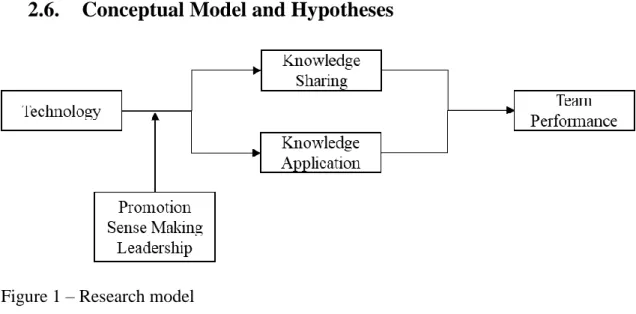
Figure 1 – Research model
H1a: The relationship between technology and team performance is mediated by
knowledge sharing.
H1b: The relationship between technology and team performance is mediated by
knowledge application.
H2a: The relationship between technology and knowledge sharing is moderated by sense
making leadership.
H2b: The relationship between technology and knowledge application is moderated by
sense making leadership.
H3a: The conditional indirect effects of technology in predicting team performance by
knowledge sharing will be stronger for those teams with more sense making leadership.
H3b: The conditional indirect effects of technology in predicting team performance by
knowledge application will be stronger for those teams with more sense making leadership.
33
3. Methodology
3.1. Sample
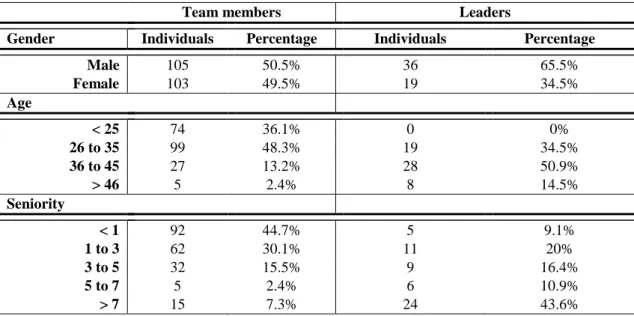
To ensure an enough variation in team, technology range, leadership and ability of knowledge sharing and knowledge application, the data for this study was collected among 54 teams that were composed with 210 individuals and which belong 54 leaders. The participants belonged to consulting companies and teams were ranged from 3 to 54 members with an average of 8 individuals each team. Most were composed with 4 or 6 elements (18% each range), the average of age was 29 years old among team members, 50% of them were male and 65% of leaders were also male. All this information is summarized into Table 6.
Table 6 – Sociodemographic characteristics of team members and leaders that participate into this study
Team members Leaders
Gender Individuals Percentage Individuals Percentage Male 105 50.5% 36 65.5% Female 103 49.5% 19 34.5% Age < 25 74 36.1% 0 0% 26 to 35 99 48.3% 19 34.5% 36 to 45 27 13.2% 28 50.9% > 46 5 2.4% 8 14.5% Seniority < 1 92 44.7% 5 9.1% 1 to 3 62 30.1% 11 20% 3 to 5 32 15.5% 9 16.4% 5 to 7 5 2.4% 6 10.9% > 7 15 7.3% 24 43.6%
34
3.2. Procedure
Data were collected through questionnaires in paper and in Portuguese as is shown into annexes A and B. Participants belong to several teams and needed to respond as well as the corresponding leader. Both answered it at the same time. Each team had the same questionnaire for team members however, it was different from the one that the leaders answered.
3.3. Measures
In order to analyse each variable, there were selected several items that are described in detail above according with each measure. All variables were measured using a 7-point scale from Likert (1 = strongly disagree, 7 = strongly agree). All items are grouped per variable and noted into annexes C.
Technology (T) is measured into six items, in which participants had to evaluate through
them if technology available is useful to perform, namely, if it allows team members to search and access necessary information, allow communication among them, allow systematic storing and, among other, if it is adequate to teams’ daily tasks. Thus, four of these six items were used and adapted for this research context from the study of Sue Young Choi et al. (2010) and the other two from the work of Vincent S. Lai (2001). The Cronbach’s alpha equals to .93.
Knowledge Sharing (KS) is measured into three items that evaluate each team into three
different situations, namely, if team members share experience or know-how among them, if they provide their methodologies and if they share their work reports and official documents. The Cronbach’s alpha equals to .82. Knowledge Application (KA) is measured as well with three items which analyse if individuals of each team apply the knowledge earned from previous experiences and if they use and apply that knowledge to solve new problems. The Cronbach’s alpha equals to .89. All of the six items were used and adapted for this research context from the study of Sue Young Choi et al. (2010).
35
Promotion Sense Making Leadership (L) was measured based on five items such as
“The leader helps the team interpret internal and external events.”, “The leader helps the team make sense of ambiguous situations.” or, for example, “The leader facilitates the team’s understanding of events or situations.”. To evaluate the promotion of sense making from the leader, the items were used and adapted for this research context from the study of Morgeson (2009). The Cronbach’s alpha equals to .93.
Team Performance (TP) was rated into two items extracted from the questionnaire of
the leader in which it is described how the team behave, due to the fact that each team leader will have an impartial and outsider vision of team and individual performance. Those items were “My team has a good performance.” and “My team is effective.” adapted from work of González-Romá, et al. (2009). The Cronbach’s alpha equals to .83.
36
4. Results
4.1. Descriptive Statistics and Correlations
Table 7 presents the descriptive statistics and correlations for the variables of the research model presented before. With the aim to examine the correlation, for this study was used Pearson’s correlation coefficient, due to the fact that it will measure the statistical association between variables of interest.
Due to observation, it is possible to affirm that the strongest correlation occurs between knowledge sharing and knowledge application (r = 0.77; p < 0.01), followed by the relationship between knowledge sharing and promotion of sense making leadership (r = 0.53; p > 0.01) and the relationship between knowledge sharing and team performance (r = 0.37; p < 0.01). It is also an evidence that the weakest correlation is among variables of technology and leadership (r = 0.19; p < 0.01).
Table 7 – Means, standard deviations, correlations and Cronbach’s Alpha of each variable of this study
Variables Mean Standard
Deviation Technology Knowledge Sharing Knowledge Application Promotion Sense Making Leadership Team Performance Technology 5.71 0.71 (.93) Knowledge Sharing 5.87 0.58 0.31* (.82) Knowledge Application 6.13 0.45 0.21 0.77** (.90) Promotion Sense Making Leadership 5.51 0.77 0.19 0.53** 0.40** (.93) Team Performance 5.80 0.74 0.22 0.37** 0.24 0.30* (.83) N = 54 teams ** p < 0.01 (2-tailed) * p < 0.05 (2-tailed)