http://dx.doi.org/10.4236/ojsst.2013.34010
Safety Climates in Construction Industry: Understanding
the Role of Construction Sites and Workgroups
Sílvia Silva1, Adriana Araújo2, Dário Costa3, J. L. Meliá4
1ISCTE-IUL Instituto Universitário de Lisboa, Lisbon, Portugal 2ISCTE-IUL, Lisboa, Portugal
3Organizational and Social Psychology, ISCTE-IUL, Lisboa, Portugal 4Department of Methodology, University of Valencia, Valencia, Spain
Email: [email protected], [email protected], [email protected], [email protected] Received August 1, 2013; revised September 1, 2013; accepted September 7, 2013
Copyright © 2013 Sílvia Silva et al. This is an open access article distributed under the Creative Commons Attribution License, which permits unrestricted use, distribution, and reproduction in any medium, provided the original work is properly cited.
ABSTRACT
Studies of safety climate in construction revealed a significant positive association between safety climate and various aspects of occupational health and safety. The mechanisms through which this impact operates are still unclear and safety climate is usually studied without considering the complexity of this industry (companies, worksites and groups). The aim of this research is to analyze to what extend there are differences between construction sites and to explore the relations between construction sites’ safety climate and workers’ safety response and to examine how this influence occur considering the workgroups. The safety climate was evaluated using a reduced version of the questionnaire that is a part of Battery HERC (Herramienta para evaluacion riesgos comportamentales). The data were collected in a Portu- guese construction company (5 construction sites; including sub-contractors) comprising 213 workers. Differences be- tween construction sites safety climate were found, suggesting the prevalence of safety sub-climates. The workgroup safety climate played a determinant role on workers’ safety response in subcontracted workgroups and it is an important mechanism through which the principal contractor can influence subcontractors’ safety response. Designers of preven- tion and training programs for accidents prevention should include specific contents in order to improve supervisory safety leadership and workgroup safety responses.
Keywords: Construction; Safety Climate; Workgroup Safety Climate; Workers’ Safety Response
1. Introduction
According to Eurostat, more than one-in-four (26.1%) fatal accidents at work in the EU-27 in 2009 took place within the construction sector [1]. Work accidents are still a worrying phenomenon, with serious economic and social consequences. In Portugal, construction is one of highest risk industries. Even with recent reductions in incident rates, around 47% of workplace accidents regis- tered in 2010 occurred in industries (26.6%) and con- struction (20.6%). Construction sector leads the total incidence rate, with 91,836 accidents per 100,000 work- ers, almost twice superior to the overall incidence rate. In 2012, in Portugal, 42 construction workers died [2].
Over the years, research community has tried to iden- tify the factors associated with the accidents occurrence. Studies about safety culture and safety climate in con- struction focus on organizational and social factors, but safety climate have always been investigated separately
at organization and subunit levels. Previous research also emphasizes that sub-climates for safety can exist within an organization. Some research on different groups with- in organizations has focused on comparing individuals who have not suffered an injury with those who have [3]. Glendon and Litherland [3] applied a modified version of the safety climate questionnaire [4] and found differences in the safety climate of job sub-groups on two of the fac- tors: “Relationships” and “Safety Rules”. Gillen and col- leagues [5] found statistically significant differences be- tween union and nonunion workers’ responses regarding perceived safety climate. Cooper and Phillips [6] found different safety climate perceptions on departments with- in a company. Despite potential benefits of comparing sub-groups within an organization, few studies have eva- luated different groups on a construction site basis. The aim of this research is to analyze to what extend there are differences on safety climate between construction sites
and to explore the relations between construction sites’ safety climate and workers’ safety response.
2. Safety Climate
2.1. Background
Organizational climate refers to shared perceptions among members of an organization with regard to as- pects of the organizational environment that inform role behavior, that is, the extent to which certain facets of role behavior are rewarded and supported in any organization [7]. For instance Reichers & Schneider (1990: p. 22) em- phasize the perceptions of organizational policies, prac- tices and procedures, Since organizations have multiple goals and means of attaining goals, senior managers must develop policies and procedures for key organizational facets like customer service, product quality, and em- ployees’ safety [8]. Safety climate is a particular area of organizational climate that was introduced in the litera- ture by Zohar [9] and is defined as individual perceptions of the policies, procedures and practices relating to safety in the workplace [10]. A range of factors has been identi- fied as being important components of safety climate: management values (e.g. management concern for em- ployee well-being), management and organizational practices (e.g. adequacy of training, provision of safety equipment, quality of safety management systems), com- munication and employee involvement in workplace health and safety [11]. The development of shared per- ceptions about the priority placed upon safety within the work environment is believed to inform workers’ role be- havior through expectations they form about how certain behaviors will be rewarded and supported in an organiza- tion [7,8]. During the past few decades, several research- ers confirmed the effects of safety climate on employees’ safety behaviors [6,11] and on accidents [12-17].
Recently, safety climate has been re-defined as a mul- tilevel construct [7,13,16,17] that emphasized supervi- sors’ safety practices behavior [13,18,19] and co-workers safety practices [16,17]. Meliá and colleagues [20], iden- tified four main safety agents, organization, supervisors, co-workers and worker and five safety climate factors: Organizational safety response, supervisors’ safety re- sponse, co-workers’ safety response, worker’s safety re- sponse and Perceived risk of accidents. This analysis is relevant because the organizational processes occur si- multaneously at different hierarchical levels of an organi- zation; policies and procedures are established at the or- ganization level and are executed at the subunit level (su- pervisory practices). Policies define strategic goals and the procedures for their attainment, practices are related to the execution of policies by supervisory leaders across the organizational hierarchy [8]. For example, a supervi- sor who directs workers to disregard certain safety pro-
cedures whenever production falls behind schedule cre- ates a distinction between company procedures and sub- unit practices, thus creating the potential for distinctive sub-climates within one organization.
In addition, the importance of co-workers as a safety climate agent has been reinforced and successfully tested. Recently, results from Brondino and colleagues [17] re- vealed that co-workers’ safety climate had a stronger in- fluence on safety behaviors, and in particular on safety participation, than supervisor’s safety climate, at indi- vidual level as well at group level.
2.2. Construction Safety Climate
The study of the safety climate in construction began with Dedobbeleer and Beland [12] who tested the Brown and Holmes’ three-factor safety climate model on con- struction workers, in nine non-residential construction sites. The results showed that safety was perceived as a joint responsibility of workers and management. Since then, many studies were conducted and revealed a sig- nificant positive association between safety climate and various aspects of occupational health and safety per- formance in the construction industry [5,21-23] and sub- sequent safety behaviors among Latino residential con- struction workers, with differences by trade being par- ticularly important [24]. Teo & Feng [25], in their study about safety culture in construction sites, found that sa- fety climate has an impact on the three dimensions of safety culture, psychological, situational/environmental and behavioral dimensions. According to Meliá and col- leagues [20,26], safety climate can be analyzed from the point of view of the agent that performs the safety re- sponse in question, by identifying four main safety agents (organization, supervisors, co-workers and wor- ker). In their study, results revealed that organizational safety response and supervisory safety response are strongly related, as are co-worker and worker safety re- sponse. In other studies, supervisors’ safety response as perceived by workers has been considered a relevant part of safety climate models and therefore it has been in- cluded regularly in measures of safety climate, some- times considering managers and supervisors together [6,27,28]. Lingard & Blismasa [29] tested a multi-level safety climate model in the Australian construction in- dustry. Subcontracted workers’ perceptions of the organ- izational safety response and supervisor safety response in their own organization and that of the principal con- tractor were measured using a safety climate survey and the results suggest that supervisors play an important role in shaping safety performance in subcontracted work- groups. The subcontracting is a main characteristic of construction industry and is determinant for the occupa- tional health and safety performance. Subcontractor in- volvement is a core aspect of construction safety culture
[30]. Construction subcontractors are often engaged in complex relationships both horizontally (i.e. when multi- ple subcontractors are engaged by a principal contractor) and vertically (i.e. in the case of pyramid of multilayered subcontracting). In this context, workers involved in sub- contracted companies are not connected with the prin- cipal contractor and relatively isolated from their own company, which could affect the development and im- pact of the safety climate [26]. Moreover, considering that workers usually work in groups and have one super- visor it is important to see how much difference the workgroup can make in this specific context. These im- plications—subcontracting, construction sites and work- groups—and their impact on development of safety cli- mate on the construction industry are still unclear.
The main goal of our research was to analyze the dif- ferences on safety climate among construction sites owned by the same principal company and to determine whether workgroup could play a mediation role between safety climate and worker safety response. We formu- lated the hypothesis as follows:
Hypothesis 1 [H1]: Differences on safety climate exi- sts between construction sites.
Hypothesis 2 [H2]: Construction site safety climate is positive and significantly related with workers’ safety re- sponse.
Hypothesis 2a [H2a]: The relationship between con- struction site safety climate and workers’ safety response is mediated by workgroup safety climate, centered in supervisors.
Hypothesis 2b [H2b]: The relationship between con- struction site safety climate and workers’ safety response is mediated by workgroup safety climate, centered in co- workers.
3. Methodology
3.1. Instrument
For the purpose of this study, the safety climate survey developed by Meliá was used. HERC is an instrument of safety climate that was developed and validated for the construction sector, on the Project “Elaboración y vali- dación de una herramienta diagnostica estandarizada para la evaluación de los riesgos comportamentales y psicoso- ciales ligados a siniestralidad en el sector de la contruc- ción”. The version used comprises 3 parts. The question- naire contains four scales to construction sites: construc- tion site safety response (e.g. “In the construction site are conducted safety inspections to assess risks”), group safety climate, covering subscales related to co-workers and supervisors’ safety responses (e.g. “My supervisor makes an effort to do his job safely”) and workers’ safety response (e.g. “When I do my work I follow safety in- structions”). The questionnaire has 33 itens and the ques-
tions are answered in a six-point Likert scale (0 = never, 5 = continuously).
The questionnaire in this study was applied in one company responsible for five construction sites.
Cronbach’s alpha was calculated for each scale to test internal consistency. The construction site safety climate scale revealed an adequate reliability (α = 0.75). The group safety response scales and workers’ safety re- sponse scales also presented good reliability, supervisory α = 0.93 and co-workers, α = 0.90 and workers’ safety response, α = 0.88.
3.2. Participants
Participants for this study were the construction workers on five construction sites performed by a Portuguese principal construction company. Overall, our sample covers 20 subcontracted companies, 57% of the total of subcontracted companies, and a total of 213 participants, approximately 65% of the total number of employees. The majority of the respondents were male (94.5%), 20.7% aged 26 - 30.
4. Results
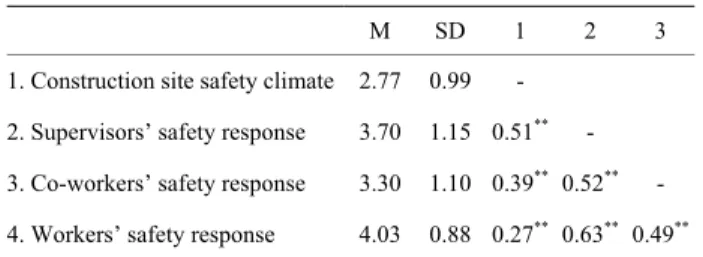
Table 1 shows means, standard deviations, and correla- tions among the variables used in the present study. The means show that respondents perceive high levels of workgroup safety climate, workers’ safety response and low levels of construction site safety climate.
All variables are positive and significantly correlated. Construction site safety response and supervisors’ safety response (r = 0.51, p < 0.01) are correlated and construc- tion site safety climate and co-workers’ safety response are correlated (r = 0.39, p < 0.01). Supervisors’ safety response (r = 0.63, p < 0.01) and co-workers’ safety re- sponse (r = 0.49, p < 0.01) have higher correlations with workers’ safety response than other variables.
4.1. Comparison between Construction Sites
The mean values of the four types of safety responses, obtained in the five construction sites, were compared using an One-Way Anova test. Significant differences between construction sites were found for all the varia- bles (F values range between 3.35 and 5.96; and p value
Table 1. Descriptive statistics and correlations.
M SD 1 2 3
1. Construction site safety climate 2.77 0.99 -
2. Supervisors’ safety response 3.70 1.15 0.51** - 3. Co-workers’ safety response 3.30 1.10 0.39** 0.52** - 4. Workers’ safety response 4.03 0.88 0.27** 0.63** 0.49** *p < 0.05; **p < 0.01.
between less than 0.001 to 0.01).
Table 2 presents the results of the Tukey test (post hoc), to test mean differences between construction sites. As can be seen, in what concerns to construction site safety climate, construction site 1 (CS1) has lower means than all the others constructions sites and construction site 4 (CS4) has higher means. However, we only obtain significant differences between two construction sites (CS2 and CS4).
In what concerns to supervisory safety response, sig- nificant differences exists between one and other three construction sites, co-workers safety response presents significant differences between two construction sites and safety response presents significant differences be- tween one and other two construction sites.
With regard to the shared perceptions within construc- tion sites, it was found that only one construction site presented a high degree of consensus, (Rwg range be-tween 0.03 and 0.74) which was expected considering the fact that there were employees from different compa-nies.
4.2. Relation between Safety Climate and Workers’ Safety Response and Mediating Role of Workgroup Safety Response
To test mediation a statistical procedure proposed by Baron and Kenny (1986) was applied and the Sobel test was calculated to check to what extent was or not the mediations significant. The assumptions were verified
Table 2. Variables mean values.
CS1 CS2 CS3 CS4 CS5
Construction site safety climate 1.98 2.47a 2.29 3.02b 2.83 Supervisory safety response 3.03 4.29a 3.38b 3.67b 3.68b Co-workers safety response 2.5a 3.83b 3.22 3.42 2.99a Safety response 3.6 4.45a 3.69 b 3.91b 4.13 Means with different letters signify that groups are significantly different (p < 0.05).
with correlations analysis.
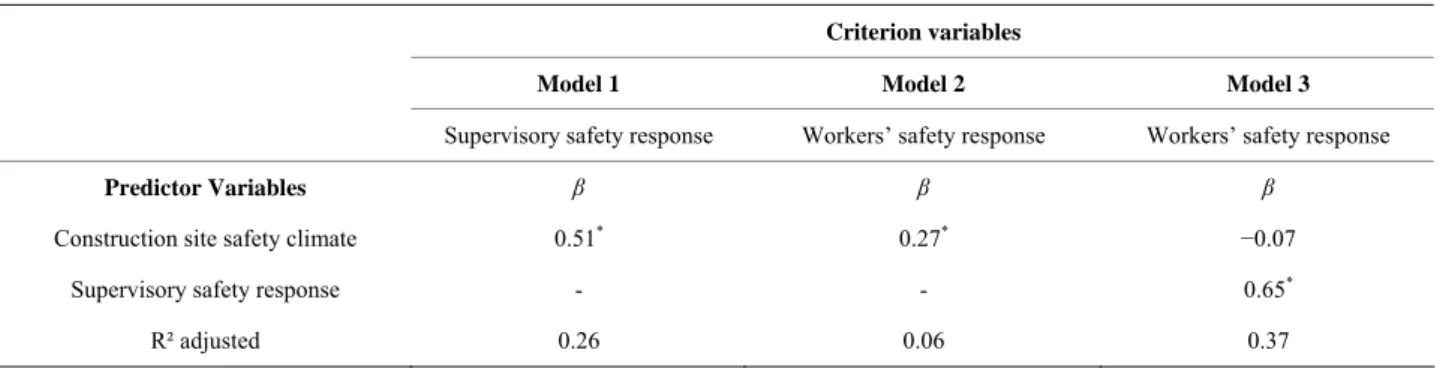
Regarding the role of workgroup safety climate in the relationship between construction site safety climate and workers’ safety response, (Table 3) results revealed that supervisors’ safety response, is a complete mediator, since the relation between the predictor variable (con- struction safety climate) and the outcome variable (workers’ safety response) is no longer significant with the introduction of the mediator variable (supervisors’ safety response) in the model. Sobel test supports the complete mediation (z = 6.78, p < 0.01). This model ex- plains 37% of total variance of workers’ safety response.
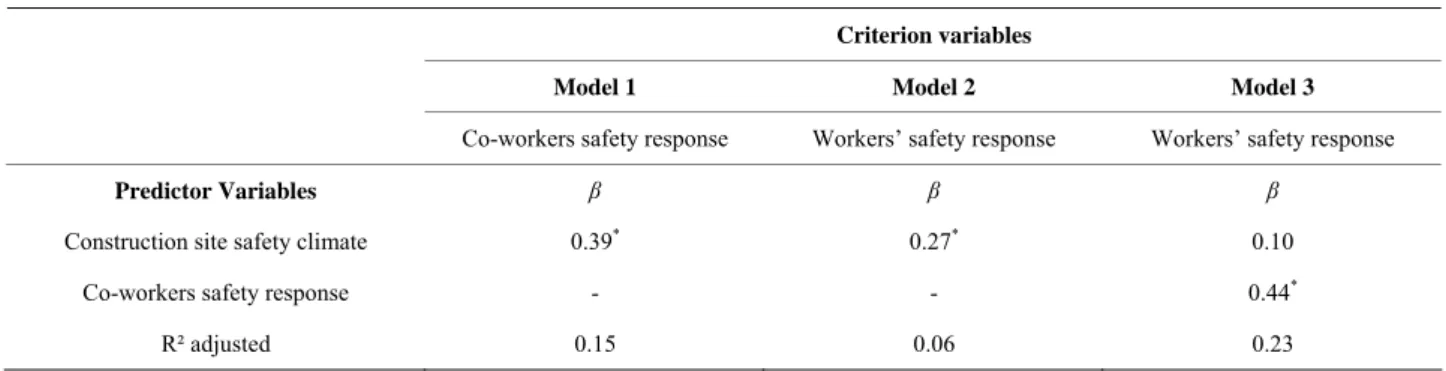
Co-workers’ safety response, is also a complete me- diator in the relationship between construction site safety climate and workers’ safety response (Table 4), since the relation between the predictor variable (construction site safety climate) and the outcome variable (workers’ safety response) is no longer significant with the introduction of the mediator variable in the model (co-workers safety response). Sobel test supports that is a complete media- tion (z = 4.76, p < 0.01). The model explains 23% of the total variance of workers’ safety response.
To check if the same results would be obtained in the context of specific construction sites, the mediation hy-pothesis was also tested in the construction sites that had the biggest sample size namely CS2, CS4 and CS5. Overall, a similar mediation results pattern was also found. Namely, it was found a total mediation, supported by Sobel test, from supervisors and co-workers safety response on the relationship between construction site safety climate and workers safety response.
5. Discussion
The aim of this research was to analyze to what extend there are differences between construction sites and to explore the relations between construction site safety climate and workers’ safety response and to examine how this influence may occur. The present results showed that differences between construction sites exist.
The principal contribution of this study is the inclusion Table 3. Supervisory safety climate mediation.
Criterion variables
Model 1 Model 2 Model 3
Supervisory safety response Workers’ safety response Workers’ safety response
Predictor Variables β β β
Construction site safety climate 0.51* 0.27* −0.07
Supervisory safety response - - 0.65*
R² adjusted 0.26 0.06 0.37
Table 4. Co-workers’ safety climate mediation.
Criterion variables
Model 1 Model 2 Model 3
Co-workers safety response Workers’ safety response Workers’ safety response
Predictor Variables β β β
Construction site safety climate 0.39* 0.27* 0.10
Co-workers safety response - - 0.44*
R² adjusted 0.15 0.06 0.23
*p < 0.001.
of a new agent in construction safety climate analy-sis—the construction site—which proved to be relevant for the analysis of safety climates. Indeed, construction site is an important, specific and complex part of the con- struction sector, which is so often referred to in an at- tempt to explain results in previous studies [20]. Con- struction subcontractors are often engaged in complex relationships and workers involved in subcontracted companies are not connected with the principal contrac- tor and remain relatively isolated from their own com- pany, which could conduct to sub-units (construction site) safety climate that should be predicted by construction companies.
Concerning to relations between construction site safety climate and workers safety performance, they are positively associated. The mediation role of workgroup, centered on supervisory safety climate and co-workers safety climate, was analyzed. Results shows, as previe- wed, that supervisory safety climate completely mediates the relationship between construction site safety climate and workers’ safety response and that co-workers safety climate also completely mediates the relationship be- tween construction site safety climate and workers’ safe- ty response. The results are in agreement with previous findings like the test of psychosocial model of work- related accidents [16], that shows how safety climate influences workers’ safety behavior through supervisors’ and coworkers’ safety responses and from Lingard, Cooke & Blismas [29], whose results suggest that super-visors play an important role in shaping safety perform-ance in subcontracted workgroups.
There are some limitations of this study that should be noted. Self-reported data were used, and considering the nature of this context some degree of under-reporting, social desirability, and/or response bias may have oc- curred. Data were collected using only quantitative tech- niques. Notwithstanding these limitations, the present research contributes to the organizational safety literature by providing empirical evidence of an agent by which safety climate can be modified and supporting supervisor role in safety promotion.
6. Conclusions
This study focuses on the construction sites’ specific safety climate that has been understudied. Moreover, pre- vious studies on construction industry’s mechanisms upon which safety climate has its impact were still un-clear. The present study findings suggest the relevance of construction site safety climates, the prevalence of safety sub-climates and the importance of the workgroup safety climate on workers’ safety response in subcontracted workgroups.
Future studies should continue to do deeper analysis that grasps better the nature of construction companies and construction sites. For instance, to analyze sub-con- tracted companies and it’s workgroups operating in one specific construction site. It is important to see if there are differences between contracted companies and in what way the construction safety climate is different from the company safety climate and what ends up to be more determinant of workers’ safety behaviors. It will be also important to develop and test adequate intervention programs that can be applied to positively change the safety climate at all the levels as well as the individual’s safety response.
Improving safety at work in the construction industry is still a challenge that requires multidisciplinary efforts for developing better prevention interventions.
REFERENCES
[1] Eurostat, 2012. http://epp.eurostat.ec.europa.eu/statistics_explained/index .php/Health_and_safety_at_work_statistics [2] ACT, 2013. http://www.act.gov.pt/(pt-PT)/CentroInformacao/Estatisti ca/Paginas/default.aspx[3] A. Glendon and D. Litherland, “Safety Climate Factors, Group Differences and Safety Behavior in Road Con-struction,” Safety Science, Vol. 39, No. 3, 2001, pp. 157- 188. http://dx.doi.org/10.1016/S0925-7535(01)00006-6 [4] A. I. Glendon, N. A. Stanton and D. Harrison, “Factor
naire,” In: S. A. Robertson, Ed., Contemporary Ergono-
mics, Ergonomics for All, Taylor and Francis, London,
1994, pp. 340-345.
[5] M. Gillen, D. Baltz, M. Gassel, L. Kirsch and D. Vaccaro, “Perceived Safety Climate, Job Demands, and Coworker Support among Union and Nonunion Injured Construc- tion Workers,” Journal of Safety Research, Vol. 33, No. 1, 2002, pp. 33-51.
http://dx.doi.org/10.1016/S0022-4375(02)00002-6 [6] M. D. Cooper and A. Phillips, “Exploratory Analysis of
the Safety Climate and Safety Behavior Relationship,”
Journal of Safety Research, Vol. 35, No. 5, 2004, pp.
497-512. http://dx.doi.org/10.1016/j.jsr.2004.08.004 [7] D. Zohar and G. Luria, “A Multilevel Model of Safety
Climate: Cross-Level Relationships between Organization and Group-Level Climates,” Journal of Applied Psychol-
ogy, Vol. 90, No. 4, 2005, pp. 616-628.
http://dx.doi.org/10.1037/0021-9010.90.4.616
[8] D. Zohar, “Safety Climate and beyond: A Multi-Level Multi-Climate Framework,” Safety Science, Vol. 46, No. 3, 2008, pp. 376-387.
http://dx.doi.org/10.1016/j.ssci.2007.03.006
[9] D. Zohar, “Safety Climate in Industrial Organizations: Theoretical and Applied Implications,” Journal of
Ap-plied Psychology, Vol. 65, No. 1, 1980, pp. 96-102.
http://dx.doi.org/10.1037/0021-9010.65.1.96
[10] A. Neal and M. A. Griffin, “A Study of Lagged Relation- ships among Safety Climate, Safety Motivation, Safety Behaviour, and Accidents at the Individual and Group Levels,” Journal of Applied Psychology, Vol. 91, No. 4, 2006, pp. 946-953.
http://dx.doi.org/10.1037/0021-9010.91.4.946
[11] A. Neal, M. A. Griffin and P. M. Hart, “The Impact of Organizational Climate on Safety Climate and Individual Behavior,” Safety Science, Vol. 39, 2000, pp. 157-188. [12] N. Dedobbeleer and F. Beland, “A Safety Climate Meas-
ure for Construction Sites,” Journal of Safety Research, Vol. 22, No. 2, 1991, pp. 97-103.
http://dx.doi.org/10.1016/0022-4375(91)90017-P
[13] D. Zohar, “A Group-Level Model of Safety Climate: Testing the Effect of Group Climate on Micro-Accidents in Manufacturing Jobs,” Journal of Applied Psychology, Vol. 85, No. 4, 2000, pp. 587-596.
http://dx.doi.org/10.1037/0021-9010.85.4.587
[14] D. Zohar and G. Luria, “Climate as a Social-Cognitive Construction of Supervisory Safety Practices: Scripts as Proxy of Behavior Patterns,” Journal of Applied Psy-
chology, Vol. 89, No. 2, 2004, pp. 322-333.
http://dx.doi.org/10.1037/0021-9010.89.2.322
[15] S. Silva, M. L. Lima and C. Baptista, “OSCI: An Organ- izational and Safety Climate Inventory,” Safety Science, Vol. 42, No. 3, 2004, pp. 205-220.
http://dx.doi.org/10.1016/S0925-7535(03)00043-2 [16] J. L. Meliá, “Un Modelo Causal Psicosocial de los Acci-
dentes Laborales (A Psychosocial Causal Model of Work Related Accidents),” Anuario de Psicología, Vol. 29, No. 3, 1998, pp. 25-43.
[17] M. Brondino, S. Silva and M. Pasini, “Multilevel Ap-
proach to Organizational and Group Safety Performance: Co-Workers as the Missing Link,” Safety Science, Vol. 50, No. 9, 2012, pp. 1847-1856.
http://dx.doi.org/10.1016/j.ssci.2012.04.010
[18] D. Zohar and G. Luria, “The Use of Supervisory Practices as Leverage to Improve Safety Behavior: A Cross-Level Intervention Model,” Journal of Safety Research, Vol. 34, No. 5, 2003, pp. 567-577.
http://dx.doi.org/10.1016/j.jsr.2003.05.006
[19] J. L. Melià and A. Sesé, “Supervisor’s Safety Response: A Multisample Confirmatory Factor Analysis,” Psicothe-
ma, Vol. 19, No. 2, 2007, pp. 231-238.
[20] J. L. Meliá, K. Mearns, S. Silva and M. L. Lima, “Safety Climate Responses and the Perceived Risk of Accidents in the Construction Industry,” Safety Science, Vol. 46, No. 6, 2008, pp. 949-958.
http://dx.doi.org/10.1016/j.ssci.2007.11.004
[21] U. Varonen and M. Mattila, “The Safety Climate and Its Relationship to Safety Practices, Safety of the Work En- vironment and Occupational Accidents in Eight Wood- Processing Companies,” Accident Analysis and Preven-
tion, Vol. 32, No. 6, 2000, pp. 761-769.
http://dx.doi.org/10.1016/S0001-4575(99)00129-3 [22] S. Larsson, “Constructing Safety: Influence of Safety
Climate and Psychological Climate on Safety Behaviour in Construction Industry,” Chalmers University of Tech- nology, Goteborg, 2005.
[23] O. Siu, D. Phillips and T. Leung, “Safety Climate and Safety Performance among Construction Workers in Hong Kong. The Role of Psychological Strains as Me-diators,” Accident Analysis and Prevention, Vol. 36, No. 3, 2004, pp. 359-366.
http://dx.doi.org/10.1016/S0001-4575(03)00016-2 [24] T. A. Arcury, T. Mills, A. J. Marín, P. Summers, S. A.
Quandt, J. Rushing, W. Lang and J. G. Grzywacz, “Work Safety Climate and Safety Practices among Immigrant Latino Residential Construction Workers,” American
Journal of Industrial Medicine, Vol. 55, No. 8, 2012, pp.
736-745. http://dx.doi.org/10.1002/ajim.22058
[25] E. A.-L. Teo and Y. B. Feng, “The Role of Safety Cli- mate in Predicting Safety Culture on Construction Sites,”
Architectural Science Review, Vol. 52, No. 1, 2009, pp.
5-16. http://dx.doi.org/10.3763/asre.2008.0037
[26] J. L. Meliá, “An Integrative Multilevel Psychosocial view and measurement of Safety Climate,” 11th European
Congress on Work and Organizational Psychology,
Lis-bon, 2003.
[27] S. J. Cox and A. J. T. Cheyne, “Assessing Safety Culture in Offshore Environments,” Safety Science, Vol. 34, No. 1-3, 2000, pp. 111-129.
http://dx.doi.org/10.1016/S0925-7535(00)00009-6 [28] J. L. Melià and M. Becerril, “Safety Climate Dimensions
from the ‘Agent’ Point of View,” In: P. Mondelo, M. Mattila, W. Karwowski and A. Hale, Eds., Proceedings of
the Fourth International Conference on Occupational Risk Prevention, Seville, 2006.
[29] Helen Clare Lingard, Tracy Cooke and Nick Blismas, “Safety Climate in Conditions of Construction Subcon- tracting: A Multilevel Analysis,” Construction Manage-
ment and Economics, Vol. 28, No. 8, 2010, pp. 813-825.
http://dx.doi.org/10.1080/01446190903480035
[30] S. Mohamed, “Safety Climate in Construction Site Envi- ronments,” Journal of Construction Engineering and Ma-
nagement, Vol. 128, No. 5, 2000, pp. 375-384.
http://dx.doi.org/10.1061/(ASCE)0733-9364(2002)128:5( 375)