T owards a scientific status for micromolecular Systematics
Abstract
While dlfferent biosynthetic groups of secondary metabolltes (mlcromolecules) rarely accumulate in the same plant species, one such group may replace another In morphologically related taxa . The use ot micromo-lecules as general systematic markers of the p1ant klngdom thus requires unifying postulates concernmg their evolutlon patterns. Two such postulates - con-traction of the shikimate pathway and block.ng of
oxidative enzymes - are lllustrated with the ald of systematic considerations on the genera Aniba (laura-ceae) and Derris-lonchocarpus (Leguminosae) whlch lnvolve besldes chemistry, morphology, ecology and geography. Extrapolatlon of the principies applied In these examples to the entire plant kingdom seems possible, an important fact, due to the ecological lmplications ot micromolecules. In this sense, the paper opens the way, rather than simply to a more "natural" classiflcation, to an information retrleval devrce of ecologlcally relevant facts about plants.
!NTRODUCTlON
The evolutionary classification of plants ls endowed with predictive value (Cronquist, 1968), i. e. a better than random chance ex i sts for information on certain characters of as yet unstudied taxa to fali into the pattern which has been established for these characters by the study of a relatively limited number of taxa. The closer the evolutionary relationship of the taxa, the higher the chance for reasona-ble predictions. So far, so good; unless you have recognized the x-part of the equation I just mounted, namely the pattern-concept. Jt is, of course, not possible to extrapolate experimentally determined chemical characters until the patterns of chemical evolution are ennounced, until the chemical phenomena which accompany development of lineages beco me known.
Otto R. Gottlieb ( .. )
We know by now about patterns of macromolecular evolution and appreciate that nucleic acid and protein (cytochrome c, ferredoxin, plastocyanin, hemoglobin) data (Smith, 1976) are the best, if not sole, unifying themes bridging the diversity of organisms. But can micromolecules be used in a similar way? The answer to this question is no if we think of each biogenetic group of metabolites in isolation . To quote only examples from our own work, benzylisoquinolines (Rezen-de et ai., 1975), índoles (Cagnin et a/., 1977). quinolizidines (Salatino & Gottlieb, 1980),
quinolones (Gottlieb et a/., 1980) and a few other classes of alkaloids (Gomes & Gottlieb, 1980), as well as coumarins (Gottlieb et ai., 1980), flavonoids (Cagnin & Gottlieb, 1978; Go-mes
et ai.,
1980), iridoids (Kaplanet a/.,
1980), xanthones (Rezende & Gottlieb, 1973; Kubitzki et ai., 1978) are usually employed as systematic markers for particular plant taxa. Jt has been established, however, that different groups rarely accumulate, í.e. are subject to structural variation, in the same species (Gottlieb, 1980) and that, indeed, one group may replace another in morphologically related taxa (Got-tlieb & Kubitzki, 1980a). Let us accept this as evidence that these groups perform anologous functions, say defence, attraction of pollinators, and set out to find a common character-istic capab le of measuring evolutionary ad-vancement of a metabolite irrespective of thebiogenetic group to which the metabolite be-longs. This means, of course, that we will have to shift emphasis from the structure of accumulated molecules to alterations of biosynthetic pathways. Although this re-quirement has been clearly stated years ago (Birch, 1963), its recognition was not
im-C • l - Ha!f-Hour Plenary Lecture given at the 12th IUPAC Symposium on the Chemlstry of Natural Products, Tenerife, Canary lslands, Sept. 21-27, 1980. A travei grant by Conselho Nacional de Desenvolvimento Cientifico e Tecnológico (CNPq), Brasil, is gratefully acknowle dged.
( .. ) - Instituto de Química, Universidade de São Paulo, São Paulo .
mediately helpful. No procedures existed to assess the significance of such alterations in connection with plant evolution (Birch, 1973).
The natural products chemist knows of only one way to deduce biosynthetic correlations: inspect the structure of micro-molecules and analyse their common features in relation to natural occurrence. In doing this we stumbled upon severa! conspicuous trends of micromolecular evolution. lnterpreted in terms of basic principies they may prove of value in elevating micromolecular systemat!cs from an old art into a scientific discipline.
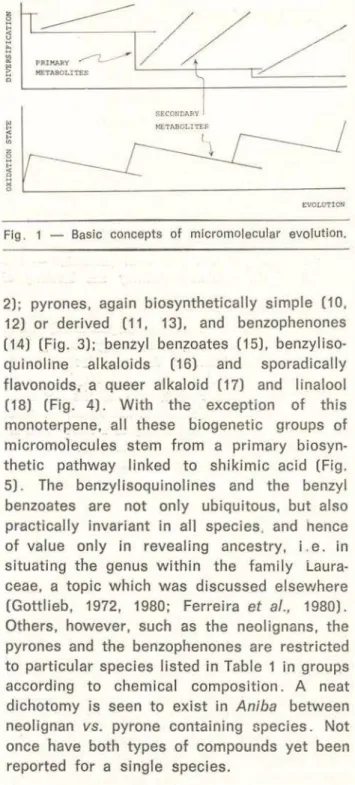
The first principie (Fig. 1, top) states that evolution of the primary precursors (from which biogenetic groups of secondary me-tabolites are derived) proceeds by blocking of reaction steps. Such blocking leads to new chemical fines . Within each fine evofution of the metabofites befonging to biogenetic groups proceeds by diversification (1). The second principie (Fig. 1, bottom) states that evofution of micromolecules proceeds by oxidation . The relativefy highly oxidized compounds charac-terize new chemical I ines . Within each fine evolution proceeds by deoxygenation.
In the following sections, the relevance of these principies is discussed with the aid of two examples, the systematics of Aniba
and of Derris-Lonchocarpus, genera of our
south America flora. We have commented on these topics in papers (resp. Gottlieb & Ku-bitski , 1980a, b; Gomes et a/., 1980) which should be consulted inclusively for references to the voluminous literature on the chemical composition of species .
M!CROMOLECULAR EVOLUTION IN ANlBA
The chemistry of 18 out of the 41 recog-nized Aniba species (family Lauraceae)
(Ku-bitzki, 1980) is fairly well known. In essence, their trunk wood contains propenylphenols (1) and allylphenols (2), precursors to neolignans belonging to severa! constitutional and con-figurational types which may be biosyntheti-cally simple {3 - 6) or derived (7 - 9) {Fig
&VOWTlOtl
Fig . 1 - Basic concepts of micromolecular evolution.
2); pyrones, again biosynthetically simple (10, 12) o r derived ( 11 , 13). and benzophenones (14) (Fig. 3); benzyl benzoates (15). benzyliso-quinoline alkaloids (16) and sporadically flavonoids, a queer alkaloid (17) and linalool (18) (Fig. 4). With the exception of this monoterpene, ali these biogenetic groups of micromolecules stem from a primary biosyn-thetic pathway linked to shikimic acid (Fig. 5) . The benzylisoquinolines and the benzyl benzoates are not only ubiquitous, but also practically invariant in ali species. and hence of value only in revealing ancestry, i.e. in situating the genus within the family Laura-ceae, a topic which was discussed elsewhere
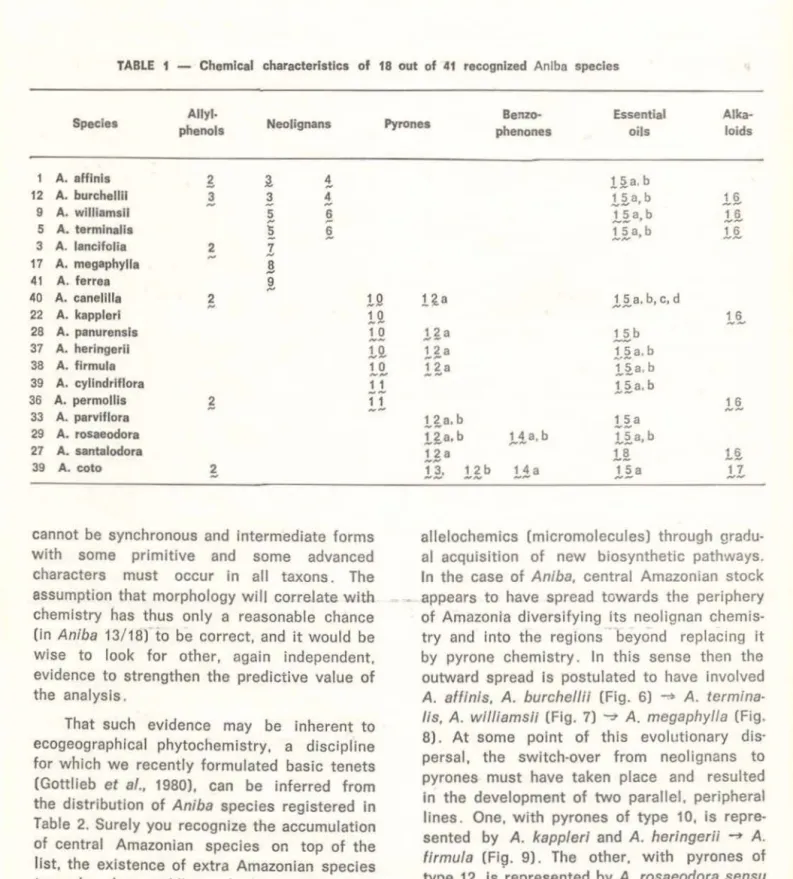
(Gottlieb, 1972, 1980; Ferreira et a/., 1980). Others. however, such as the neolignans, the pyrones and the benzophenones are restricted to particular species listed in Table 1 in groups according to chemical composition . A neat dichotomy is seen to exist in Aniba between
neolignan
vs.
pyrone containing species. Not once have both types of compounds yet been reported for a single species.In my experience such switch-overs are reasonably general phenomena and chemists who tried to classify taxons by presence/
/ absence of chemical characters have often seen their results under fire from morpholo-gists (cf. e.g. Mabry, 1974). This is where our principies of micromolecular systematics come in. According to the first principie, blocking of reaction steps in the shik:mate
( 1 l - This coroflary of the first principie was formerly designated second principie (Gottlleb, 1980).
PRECURSOR$ SIMPLE NEOLIGNANS DERIVEO NEOLIGNANS
)
~Me
Ar--~~0
1 3 5 7
Ar~
2
..
6 8---~~
...
I
Ar·'
'
ÓH 9Flg. 2 - Maln types of neolígnans of Aniba specles
pathway would imply the use of cinnamates rather than of propenylphenols as biosynthetic starting materiais. Application of the principie to the case of Aniba (Fig. 5) thus suggests the evolutic:m of the propenylphenol derived neolignans into the cinnamate derived pyrones, benzophenones and flavonoids, and assigns a more primitive position in the evolutionary history of the genus to the neolignan than to the pyrone containing species .
According to the corollary of the first principie, evolution of micromolecules in a biogenetic group involves substitutional, configurational and/or skeletal diversification Replacement of the neolignans of types 3 - 6 by 7 - 9, ai well as of the pyrones of types 1 O by 11 and of types 12a by 13 o r addition of anibine (12b) and benzophenones (14), requires skeletal diversification through expansion of
Towards .. .
reaction pathways. Application of the corvllary to the case of Aniba thus warrants the listing of the species within each of the three groups, the neolignan and the two pyrone ones. in arder of evolutionary advance as shown in Table 1.
How does this chemical classification correlate with morphology (Table 2)? Floral structure suggests a subdivision of the genus in two groups according to the opening modes of the valves of the anther cells of the stamens. The structure of the lower leaf epidermis and wood anatomy also seem to be characters of classificatory importance.
What we have learnt so far is that the evolutions of chemical, floral, vegetativa and histological characters proceed as general trends, in parallel. Since the differentiation of these characters is largely independent, it
TABLE 1 - Chemlcal characterlstlcs of 18 out of 41 recognlzed Anlbo specles
Specles phenols Allyf. Neolignans Pyrones phenones Benzo- Essential oils Alka-loids
1 A. aHlnls ~
'ª-
1.
12 A. burchellll....
3 ~1
9 A. willlamsll 5 ~~
5 A. termlnalls ~
3 A. lanclfolia 2
1
""17 A. megaphylla
.!!
41 A. ferrea 9 ,..,40 A. canelllla 2
lQ
""
22 A. kapplerl 1
--
o
28 A. panurensls 1
--
o
37 A. herlngerll !Q.
38 A. firmula 1
--
o
39 A. cyllndrlflora 1 1
36 A. permollls ~
--
1 1 33 A. parviflora29 A. rosaeodora
21 A. santalodora
39 A. coto 2
cannot be synchronous and intermediate forms with some primitiva and some advanced characters must occur in ali taxons. The assumption that morphology will correlate with chemistry has thus only a reasonable chance (in Anlba 13/18) to be correct, and it would be
wise to look for other, again independent. evidence to strengthen the predictive value of the analysis.
That such evidence may be inherent to ecogeographlcal phytochemistry, a discipline for which we recently formulated basic tenets (Gottlieb et a/., 1980), can be inferred from
the distributlon of Aniba species registered in Table 2. Surely you recognize the accumulation of central Amazonian species on top of the list, the existence of extra Amazonian species towards the middle and the incidence of relatively widespread species towards the botton as an lndication for the existence of general distrlbutionai trends. According to the firt tenet, plant populations possess a center of irradiatlon where they are endowed with a biosynthetlcally simple chemistry. Conquest of new regions Js conditloned by the consti-tutional or configurational diversification of
848-H.a b
1.2-a,b
--
1 6 1.2-a,b 1 6 --H,a,b !2.H.
a J.ia.b,c,d19..
l~a llb
!.~a 1 5a. b
12a lia.b
--
1,2.a.bH.
H.a.b l~a
l~a.b ,..-1 4 a, b 1~a,b
l~a
l!!.
1.2.
H:
_,... 12b 1.!a lia1.1.
allelochemics (micromolecules) through gradu-al acquisition of new biosynthetic pathways. In the case of Aniba, central Amazonian stock
appears to have spread towards the periphery of Amazonia diverslfying its neolignan chemis-try and into the regions beyond replacing it by pyrone chemistry. In this sense then the
outward spread is postulated to have involved
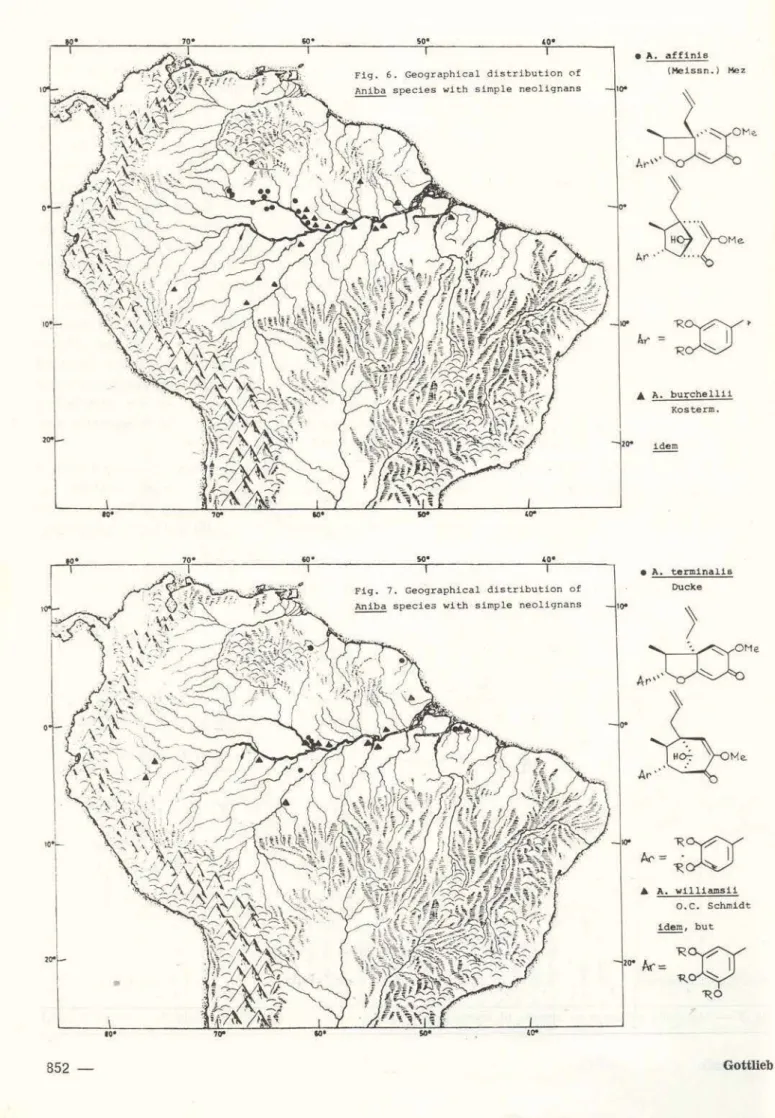
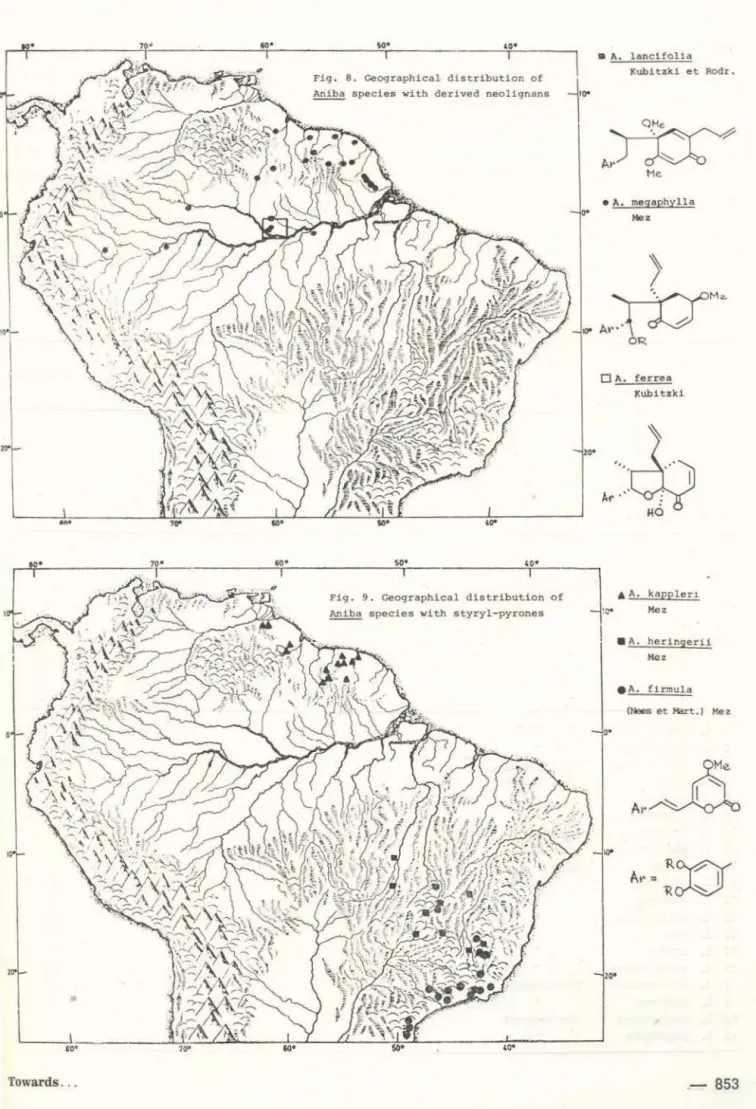
A. afflnls, A. burchellii (Fig. 6) ~ A. termina· tis, A. wllliamsli (Fig. 7) -:2 A. megaphylla (Fig.
8). At some point of this evolutionary dis· persal, the switch-over from neolignans to pyrones must have taken place and resulted in the development of two parallel, peripheral I ines. One, with pyrones of type 10, is repre-sented by A. kapp/erl and A. heringerii -; A.
firmula (Fig. 9). The other. with pyrones ot
type 12, is ·represented by A. rosaeodora sensu
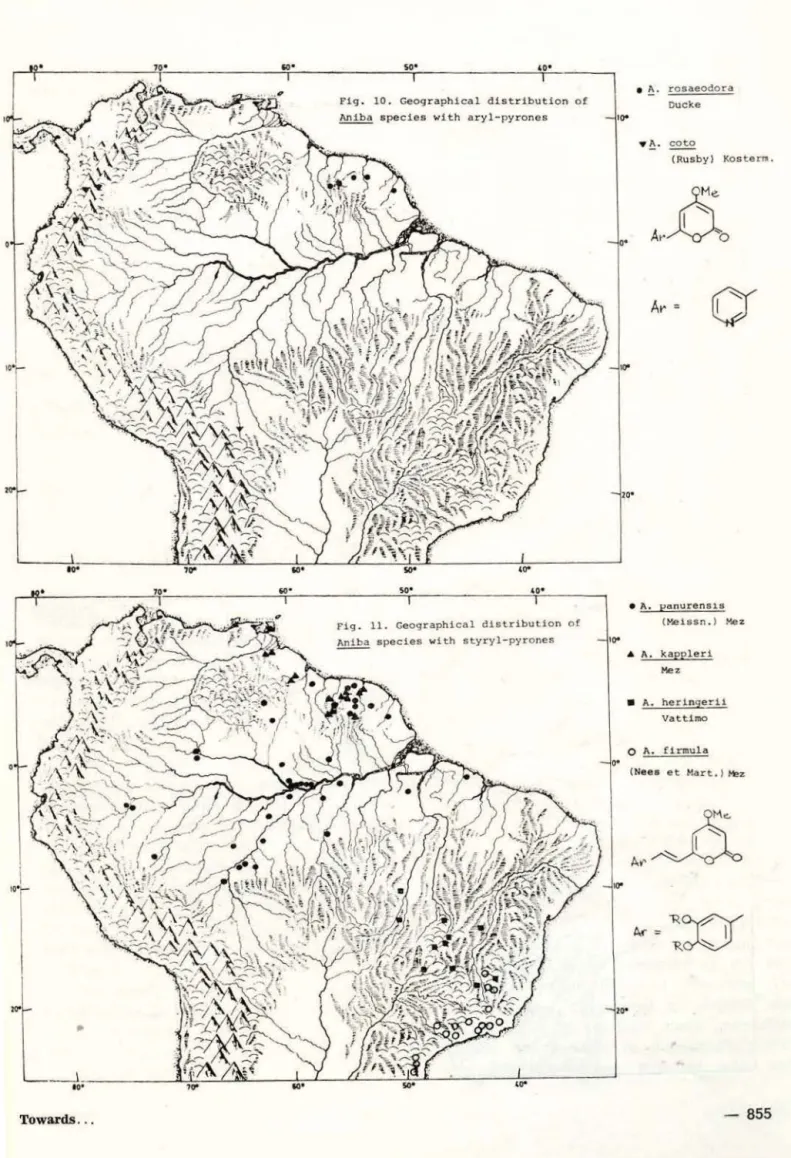
Oucke (i.e. from Guiana) andA. coto (Fig. 10)
According to the second tenet, the geogra· phlcal development of natural products chemis-try Js directional. At the fringes of a species habitat, slightly different metabolites may be produced, together with the old ones, adapting the specles to the new conditions. Dispersai from the fringe back Jnto the territory occupied
SIMPLE PYRONES DERIVED PYRONES BENZOPHENONES
~
Á~~o
Ao
Ar
1 0
12a Ar
=
12b Arary1
B- pyri dv 1
11 14a
14b
1 3
Me
Ar
=
arylAr
=
B-pyridy1Flg . 3 - Ma in types of cinnamate-acetate derived metabolites of Aniba specles
by the old and very similar species, however, is not favoured since for ecologica lly associ-ated sympatric species chemical diversity is advantageous if not mandatory, and direction-ality of migration results. In the case of Aniba,
chemically similar species are indeed allopatric (Figs. 6, 11). Once the chemical composition of the lineage, however. has been altered significantly (by acquisition of pyrones), possibly at or beyond the limits of the Amazon basin, reversal of the migréltory direction would have been an allowed process since it leads to the co-existence of species characterized by considerably diverse chemical compositions. The neolignan·free chemistry of peripheral
Aniba species thus made the ir re-entry into
Amazonia possible. This was achieved in the 10-pyrone lineage by A. panurensis (Fig. 11)
and A. canelilla (Fig. 12) and climaxed by the
again central Amazonian A. cylindriflora and
A. permollis (Fig. 13) with pyrones of type 11;
and in the 12-pyrone lineage by A. parviflora
and A. duckei Kosterm. (now included in A.
Towards . . .
rosaeodora) and climaxed in the again central Amazonian A. santalodora (Fig. 14).
Thus, although in 5 out o f the 18 experi-mental cases of Table 2 (12, 17, 41, 40, 22} the
&
ou
MXX)
R.~
I
RRl R2
~:cr
15a H H Me
I~
15b OH H
15c OMe H 16
15d O Me OMe
18
OH
Flg. 4 - Selected types of metabolites of Aniba species
(I)
01
o
12 9 5
3
17 41
40 22 28
37 38 35 36
33
29
27
39 A. A. A. A. A. A. A. A. A. A.
A. A. A. A. A. A. A. A.
•
TABLE 2 - Chemlcal, morphologlcal, histologlcal and geographlcat charactertstics of 18 out of 41 recognlzed Aniba specles.
Chemlcal Anther cells of Leaf under- Wood Geographical dlstributlon Speclet
characteristics oute r stamens surface anatomy Amazonia Periphery
affinls
2.
!
lntrorse-Jatrorse smooth Anlba-type Negroburchelll 3
i
papilloso Mad .• Ama.williamsll ~
!
smooth lower Negro Guianaterminalls 5
!..
Sol .• Mad., Ama.lancifolia 7 lower Negro
megaphylta
!
strlctly lntrorse Neg., Sol .• Ama. Guianaferre a
,..
9 Ucarfa.type lower Negrocanelilla
!!a
!~a Mod., Neg., Ama. Gul .. Orlnocokapplerl
11•
Anlba-type Gul .• Orlnocopanurensls
!!a .!_la papillose Mad.. Sol., Negr., Guiana
Tap .• Ama. herlngerll
!.!.•
H.
a Central Plat.firmula 11 a 1.~· Atlantlc Coast
cylindrlflora
11b
• Mod .. Sol., Negr.permollls
Ítb
• SollmOes Guianaparvlflora
H.
aH.
• Mod., Tap., Ama. Guianarosaeodora !f. a .!.~
H .
• • Sol., Neg., Ama., GuianaToe
santalodora !f. a • lowcr Negro
three morphological characters give conflicti11g evidence, a reasonable decision concerning the probable chemical composition can be reached even here in 4 cases by consideration of the geographical distribution (e. g. A. ferrea
is central Amazonian and thus should indeed contain neolignans; A. canelilla is inclusively
peripheral and thus should indeed contain pyrones). A wrong forecast would be given only for A. megaphyl/a (a significant result in
view of the high specialization of its neolignan chemistry). The reliability of the chemical inventory in the Aniba case thus would attain 17/ 18 or 94%.
MlCROMOLECULAR EVOLUTION rn DERRIS-LONCHOCARPUS
Ali flavonoids which have so far been reported for species of the tribe Tephrosieae (family Leguminosae), to which the genera
Derris and Lonchocarpus belong (Polhill , 1980).
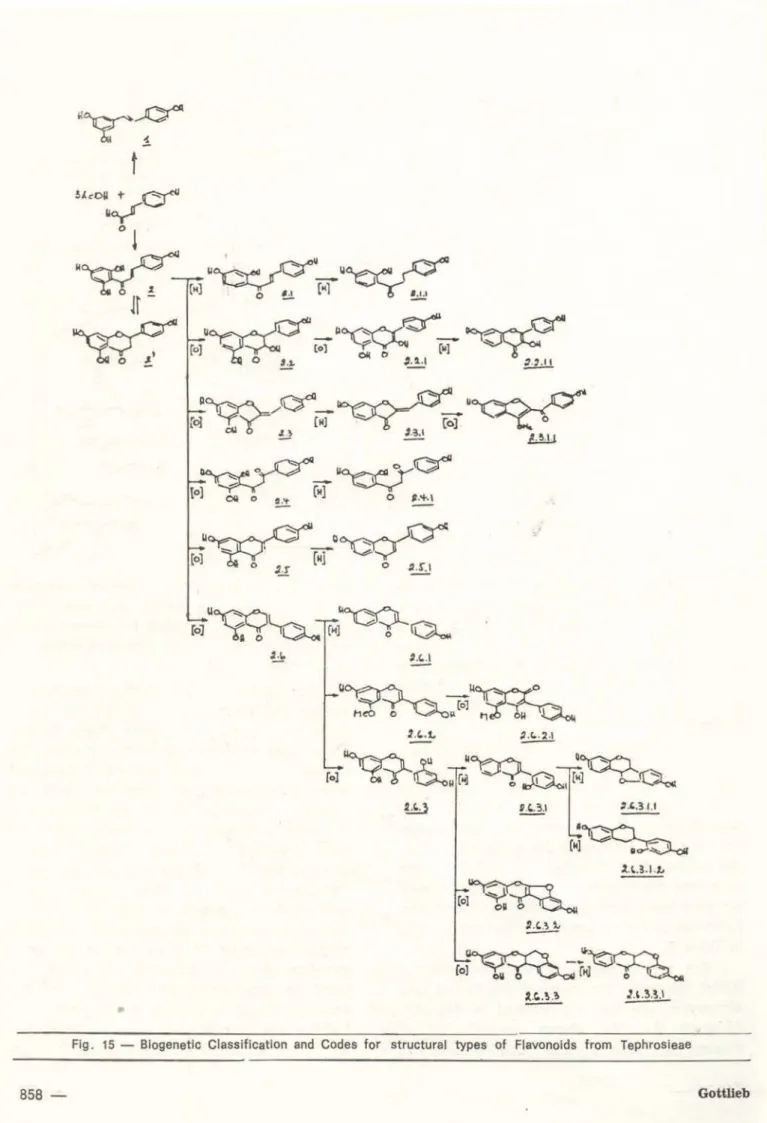
were classífíed into structLJral types, arranged and codified according to their biosynthetic relationship (Fíg. 15). Considering the
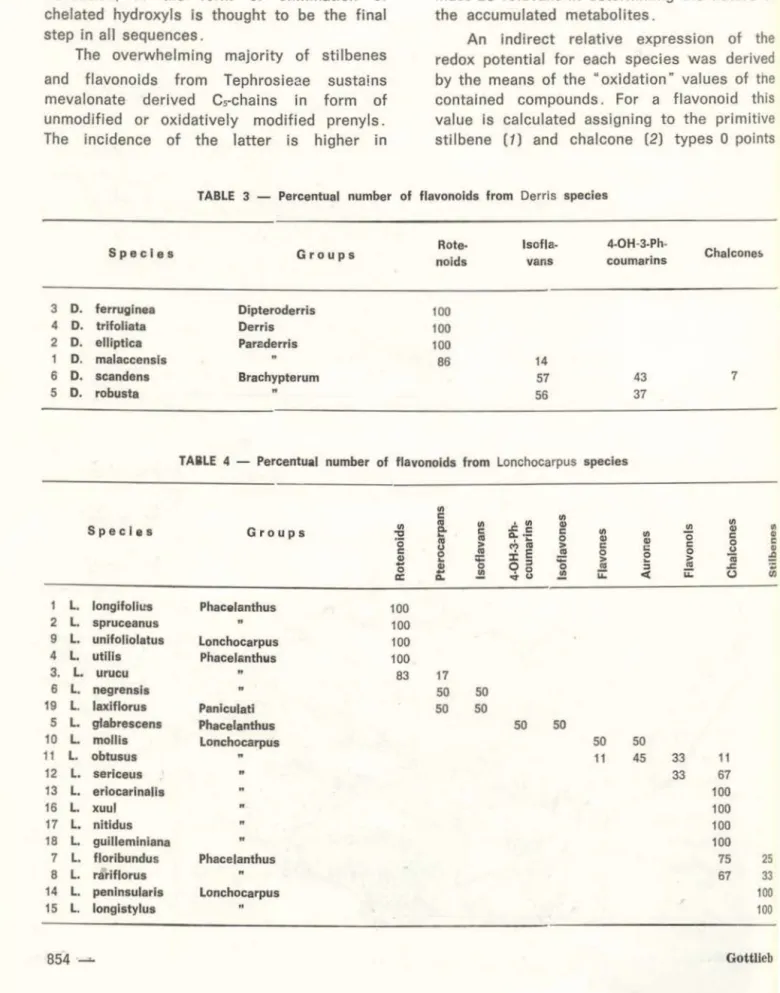
compo-sition of the species, characterized by the number of representatives of eac.h structural type expressed percentually in relation to the total number of flavonoids, severa! neatly circunscribed clusters of Derris (Table 3) and
Lonchocarpus (Table 4) species can be
dis-cerned. The direct application of micromole-cular data thus does not provide evidence for infra-generic unity (a concept which is wholly derived from morphological criteria). and must be even less reliable in the differentiation or amalgamation of the two genera (a controver-sial botanical problem, cf. e.g. Polhill, 1971,
vs.
Geesink, 1980). There is, furthermore, noclearcut correspondence between the traditio-nal morphological subgeneric groups (Phace-lanthus and Lonchocarpus) and these chemical
clusters. So either secondary metabolites are poor systematic markers or
we
overlooked information contained in the biogenetic map (Fig. 15).This indicates formation, from an identical cinnamatetriacetate precursor, initially of stilbenes (1) and chalcones (2) . From here on the reactions are mostly oxidative processes.
FLAVOtlOI OS P Y R O N ES BENZOI'IIENONES
~H
t.I SHli<I MIC ACl D
i'-ENZYLISQQUINOLI NES
-29 28 35
::o ..
l
::o ..
I
37 39
~
~
~
-29 38 29 33 39 39 37 40
::o ..
1
::o ..
1
~"
-
BENZOATES BEN ZY L-~"
-: :cr
·
: ~:~
j+
ALLnJ' >O'h'OL<j
+2
j
I'. cO H
+2
j
A c OH
+3
j
A cO H
22 37 2 7 33 39 1
28 38 28 38 5 9
35 40 29 39 12 1 7
P Y R O N E S BENZOPHENONES N E O L I G N 1' N S
Flg. 5 - Metabollc pathways to classes of compounds of Aniba specles indicateb by numbers (for key see Table 1)
to•
lO~
•
•o•
852-so•
Fig. 6. Geographical distribution ~f
~ species with simple neolignans
400
so•
Fig. 7. Geographical distribution of
~ species with simple neolignans
400
200
100
e 1.. aff1n1e
( Meissn. ) Mez
À A. bur;chellii
Kosterm.
• 1.. terminal!& Ducke
>
~OH e
Ar'''~
~
& A. williamsii
o.c. Schmidt
idem, but
2oo k=
RYI(
R~
~o
10"'-1
-..
Towards ...
co• s.o•
Fig. 8. Geographical di s tribution of
~ species witb derived neolignans
Sl)•
Fig. 9. Geographical distribution oC
~ species with styryl- pyrones
• A. lanc1fol1a Kub1tzk1 et Rodr.
• A. megaphylla Hez
)
~M ~
Ar··'~
OR O A . ferreaKubitzk1
'··~···
.
I
lw-• •• :'~o
A A• kapplen :co Mez
I
. A.
heringeriiJ
..
Mcz
e A. firmula
(Nees et Hart.) Mez
~e
A r~
The presence of a para-hydroxyl on ring B of the chalcone is essential for the rearrangement to isoflavones and the cycl ization to aurones. Reduction, in the form of elimination of chelated hydroxyls is thought to be the final step in ali sequences .
The overwhelming majority of stilbenes and flavonoids from Tephrosieae susta!ns mevalonate derived Cs-chains in form of unmodified o r oxidatively modified prenyls. The incidence of the latter is higher in
f lavonoids whose formation involves oxidative steps (Fig. 16) . Thus the redox potential of the general enzyme system in Tephrosieae must be relevant in determining the natt.re of the accumulated metabolites .
An indirect relative expression of the redox potential for each species was derived by the means of the " oxidation" values of tne conta ined compounds . For a flavonoid this value is calculated assigning to the primitive stilbene (1) and chalcone (2) types O points
TABLE 3 - Percentual number of flavonolds from Derris specles
Sp ec le s Group s nolds R o te· lsofla-vans coumarins 4-0H-3-Ph· Chalcone!>
3
o.
ferrugl nea Oipteroderris 1004
o.
t rlfollata Oerris 1002
o.
elliptlca Paraderrls 1001
o.
malaccensls 86 146
o.
scandens Brachypterum 57 43 75
o.
robusta " 56 37TAIILE 4 - Percentual number of flavonolds from Lonchocarpus specles
UI
I
UI UIUI UI ' UI Gl UI 111
Specl e s Groups "C c ..c c Gl
o. ·- c UI UI õ c Cll
'õ tV '
...
o Q)Gl o c
> Mftl > c t: c u Cll
c o tV 'E tV o o o
'ii
ª
Q)...
15
x::~ ;: >...
>-
o Q) O o o 111 :I 111 ..c!: ~ ~ ii: c( ii: (.) Ui
a: ~u
L. longlfolius Phacelanthus 100
2 L spruceanus 100
9 L. unlfollolatus Lonchocarpus 100
4 L. utllls Phacelanthus 100
3. L urucu 83 17
6 L. negrensls 50 50
19 L JaxHiorus Panicutati 50 50
5 L. glabrescens Phacelanthus 50 50
10 L mollls l onchocarpus 50 50
11 L. obtusus 11 45 33 11
12 L. serlceus " 33 67
13 L. erlocarlnalls 100
16 L. xuul " 100
17 L. nitldus 100
18 L guillemlnlana
"
1007 L. floribundus Phacetanthus 75 25
8 L. rarlflorus 67 33
14 L. peninsularis l onchocarpus 100
15 L. longlstylus 100
60'
IO'
j-60'
Towards ...
so• 10'
Fig . 10. Geographica1 distribution of
~ species with a r y1-pyrones
lO'
so•
Fig. 11. Geograph1 ca1 distribution of
~ species wi th styryl - pyrones
.
~· rosaeodoraDucke
lO'
· ~·
~(Rusbyl Koste rTIL
20'
e A. l?_anurensl.s
(l'.eissn . ) ~.ez
10'
• A. kaee1er1
Mez
•
A . herin2erU Vattimo0 A. fit111ula
o•
(Nees et Mart. ) ~
20'
so•
lO"
t o
856-so•
Fig. 12. Geographical distr1but1on of an Aniba species with styryl-pyrones
40°
Fiq. 13. Geoqraphical distribution of species with derived styryl-pyrones
lO"
lO"
• A. canel1lla
(H.B.K.) Mez
(traces)
• A. cyl1ndrlflora Kosterm.
~
Ar~Ao
& A. permollis (Nee s) Mez
lO·
and adding or subtracting single points re-spectively for each oxidation or reduction step, defined in Fig. 15, necessary to arrive at the given structural type. In the particular com· pound this type may have undergone secondary modifications which are evaluated by further additions or subtractions of points as listed in Table 5.
A further reaction, which determines the direction of a reaction sequence and thus influences the nature of the accumulated metabolites, concerns 0-methylation. The reta-tive efficiency of the pertinent enzyme system can again be expressed for each species by the means of the "methylation" values of the contained compounds. This value is calculated for each compound by adding the pertinent point values for methoxyls and hydroxyls listed In Table 6.
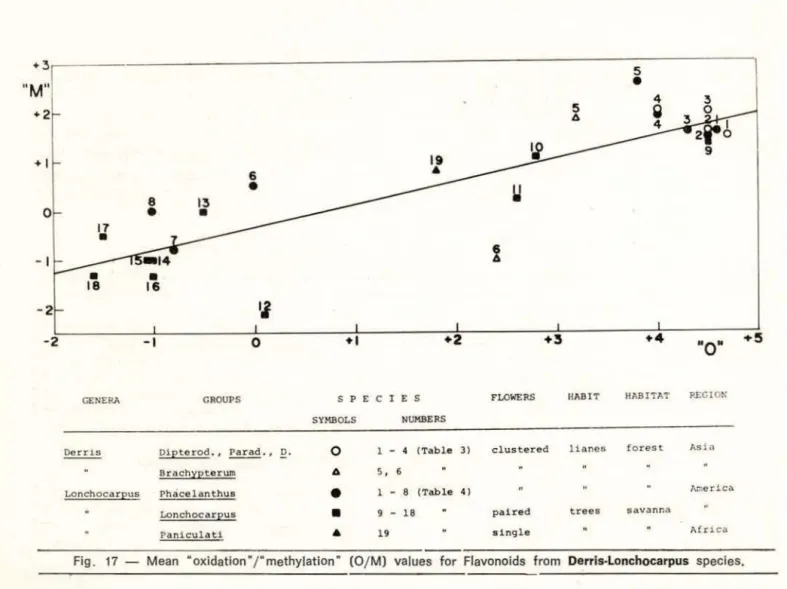
The mean "oxidation" vs. "methylation" (0/M ) values for flavonoids in Derris and Lon-chocarpus species are plotted in Fig. 17. Although the plot shows severa! disjunct clusters of points, their location along a
Towards ...
• A. roaaeodora Ducke
· ~ (Ruaby) ~osterm .
A A. parv1flora
(.Meiaen. l Mez
• A. santalodora Ducke
Ar ,. Pb, R • 0/'le
Ar • Py, R • O.Me Ar • Ph, R • H
Ar~
"R~Me
Ar • Pb
Ar•Py
~
O li+
+
+ +
~COa!~
-p;e.
+ +A .. ~
+
I
stralght line conveys a feeling of continuity. The correlation of oxidizing and methylating power is not too surprising for reasons of the well known instability of phenolic substrates
in oxldlzing media.
Superposition of the chemical gradient on the general characteristics of the Derris-Lon-chocarpus complex of species (Fig. 17) pro-vidas clues to their evolutionary history. This should have started in south-east Asia with specles (numbered 1·4) associated with the Derris group (marked o). At the time of their dispersai a humid tropical land-bridge must have extended to Amazonia where present day species (1·4) of the Phace/anthus group
( e ) are again rotenoid bearing forest lianes with clustered flowers. Comparison of these Asian and American groups reveals the loss of 5-hydroxylation of rotenoids as the sole variation of their flavonoid chemistry. The trend to less oxygenated metabolites also occurs, although in a much more pronounced fashion due possibly to dramatically altered ecological conditions, together with con·
858-u~o~
(o)
'ti'
.UM
o~
~~~
~
-(o1u~o
--,.,~I~~~ t-1~-r~~~
1.C..t.. ~
f·J
~~.r:~~·r:;-·~
(wl ~
---.;r-o.ou
.t~ .3.1.L
(ol~
~
Fig. 15- Biogenetic Classificatlon and Codes for structural types of Flavonoids from Tephrosieae
traction of the inflorescence and change to arboreous habit, upon radi ation into savanna regions . These phenomena accompany de-velopment of the south American species (10-18) of the Lonchocarpus group (•) w hich must have occurred at relatlvely recent times, after the separation of the continents and possibly even after the quaternary glaciations.
There is only one major fact which may be evoked against this theory: the distri-butional gap between the Paraderris and Pha-celanthus groups . We do not consider this too disturbing. Rotenoid containing Derris or Lonchocarpus species from Africa may either so far have escaped detection or have suc-cumbed in the Ice Ages. Their (pastor present)
TABLE 5 - lncrements for the calculation of the "oxldatlon" value of a flavonoid
6asic value for structural type (see Fig . 14 3nd texl . . . . . . • • . . . • . . . x
lncrements : additlonal oxy.group, each . . . • . . . • • • . . . • . . . • . . . • . . .
+
1lacking oxy.group, each . . . • . . . • . . . -1
02CH2-ring . . . • . . .
+
1Basic value for \"• y- or ex:, oc-dlmethylallyl . . . • . • . . . . • . . . • . O lncrements: addltlonal double bond or hydroxyl . . . . . . . . • • . • . . . • . + 1
cycl!zatlon to dimethylchromene o r lsopropen yldlhydrofurane . . . • . . . • . . . . • . • . • • . . . • .
+
1cyclizatlon to furane . . . • • • . . . • . . . • . . . • • . . .
+
2cyclizatlon to other types . . . • . . . • . . . • . • • . . . •
+
3TABLE 6 - lncrements for the calculation of the " methylatlon" value of a flavonoid Basic value (prenyl and derived ethers) . . . • • . . . • . . • • . . . • . . . O lncrements· OMe or 02CH2, each . • . . . • . . • . • • . . . . • . . . • . . . • • . . . • . . • . • • . . . . • . . . • • . . . • . . • + 1
OH, each • .. . . • . • • . . . • • • . . . • . . . • . . . .• .• . . . .• . -1
12 + 3
· - - - -0---..
+3, r--- --- -- --- --- ~5---- -- ----~
•
-2 -I
o
+I +2 +S +4"O"
+5CENERA CROUPS SPECIES FLOII'ERS HA81T HABITAT RE CIO~
SYMBOLS NUMBERS
Der ris Dil2terod ., ~ ·· o.
o
l - 4 !Table 3) clustered lianes forest As i"Brach:z:eterum 6 5 . 6
Lonchocareus Phacelan thus
•
1 - 8 ( Ta.b1e 4 ) llmer1caLonchocareus
•
9-
18 paired trees sav3nnaPaniculati
..
19 sinq l e Afr1 caFig . 17- Mean "oxidation"/" methylation" (0/ M) values for Flavonoids from Derris·Lonchocarpus species .
existence is documented i n the derived west African L. laxiflorus (19, A ) and possibly also in the ambi-Atlantic L. sericeus (12,
•J.
so far the sole African species of the genus for which flavonoid data were reported.Particular discrepancies apparent in Fig. 16 may prove instructive, unless, of course. the specimens used for the chemical analysis were w rongly classified . L. f/oribundus and L.
rariflorus (resp. species 7 and 8, • ) have low 0 / M leveis for members of the Phacelanthus
group, but both are clearly transitional, oc-curring already at forest margins and appearing not only in the form of lianes but also as shrubs. In opposition L. unifoliolatus (9, • ) has high 0 / M leveis for a member of the
Lon-chocarpus group, but the seed morphology is more akin to the forest than to the savanna elements .
As in the Aniba case, although thus ali facts may be understandable only if examined
860--•
in sufficient detail, even a superficial scrutiny of the situation (Table 7) will reveal the higher probability for the forest species of the Derris
Brachypterum and Phacelanthus groups to
contain flavonoids with high 0 / M-values and for the savanna species of the Paniculati and
Lonchocarpus groups to contain f lavonoids
with low 0 / M-values.
CONCLUSION
In hindsight, both evolutionary phenome-na - contraction of the shikimate pathway and blocking of oxidative enzymes - might have been foreseen . Form and allelochemics of a plant are alternative expressions of me-tabolism involving identical precursors (Go-mes & Gottlieb, 1978) . Thus. in angiosperms,
the long recognized evolutionary trend from arboreous forms (based on shikimate derived lignin) to herbaceous forms should indeed be accompanied by the gradual replacement of
shikimate by acetate or mevalonate derived allelochemics. Should, furthermore, an in-crease in oxygen uptake be required to power the energy producing process which introduces the modifications associated with the de-velopment of a new lineage? lf so, once the lineage is established, blocking of oxygP.n-·transferring enzymes is to be expected for reasons of economy and concomitant activation
of other, inherited enzyme sys!ems should take place.
Whatever the acceptability of such in-terpretations, the principies point the way to a unified evolutionary scheme of secondary metabolítes on which to base the appraisement of trends in plant evolution. I f these trends were to be considered with changes of
TABLE 7 - Number of species of known tlavonold com..,;:;sl tion belonglng to the Derris, Dipteroderris & Paraderrls (DER), Brachypterum (BRA), Phacelanthus (PHA) , Paniculatl (PHAN) and Lonchocarpus (LON) gro1..ps.
Flavonoid composition
Variation of
0 / M
DER
rotenoids 4-0H..J-phenyl coumarins pterocarpans
& lsoflavans
flavones & flavonols stllbenes &
chalcones
+4 . 4.±0.4/+ 1.8±0.3
+3.1±0. 7/+0.9±1.9
+0.9±0.9/+0.6±0.2
+2. 7±0.1/+0.8±0.3
+0.8±0.9/-1.0±1.1
other functional systems, such as morphologv ecology and geography, the chances of making a more meaningful and predictive classification of plants seem to be very promising.
Resumo
Enquanto diferentes grupos blogenéticos de meta-bolltos secundários raramente se acumulam na mesma espécie vegetal, um grupo pode substituir outro em taxons morfologicamente relacionados. Assim o uso de mlcromoléculas como marcadores sistemáticos gerais do reino vegetal requer postulados unificadores de seus padrões de evolução. Dois postulados desta natureza - a contração do caminho do chiqulmato e o bloqueio de enzimas oxidatlvas - são llustrados com ajuda de considerações sistemáticas acerca dos generos Aniba (lauraceae) e Derrls-Lonchocarpus (Leguminosas) que
Towards ...
4
Number of species
Derris Lonchocarpus
BRA PHA PAN LON
5
2
2
2 7
envolvem. além de qufmica, também morfologia, ecolo-gia e geografia. Parece possrvel extrapolar os princf-plos aplicados nestes exemprincf-plos a todo o reino vegetal, o que é Importante, devido às Implicações ecológicas das micromoléculas. Neste sentido, o trabalho abre ca-minho, não apenas a uma classificação mais "natural", mas ainda a um arquivo de Informações de relevância ecológica acerca das plantas.
LITERATURE BrRCH, A.J.
1963 - Blosynthetic pathways. pp. 141-166. In:
T. Swaln (ed .) C hem leal Plant Taxonomy. Academlc Press, London.
1973 - Blosynthetlc pathways in chemical
phy-logeny. pp. 261-270. In: G. Bendz & J . Santesson (eds.) Chemlstry in Botanlcal Classiflcatlon . Academlc Press, New York.
CAGNIN, M .A.H.; GOMES, C.M.R.; GoTILIEB, O. R. ; MARX, M .C.; RocHA, A.I. DA; SILvA, M .F . DAS G.F. DA & TEMPERINT, J . A .
1977 - Biochemical systematics: methods ()nd principies: Plant. Syst . Evol., (suppl. 1): 53-76 .
CAGNIN, M .A .H. & GorrLIEB, O.R.
1978 - lsoflavonoids as systematic markers. Biochem. Syst. Eco I., 6 : 225-238 .
C RONQUIST, A.
1968 - The Evolution and Classiflcation of Flower-ing Plants. p . 5, London, Nelson. F ERREIRA, Z .S.; GOTILIEB, O.R. & ROQUE, N .F .
1980 - Chemosystematic implícations of benzylte-trahydl·oisoquinolines in Aniba . Biochem. Syst. Ecol., 8: 51-54 .
GEESJNK, A .J .
1980 - In press. In: R.M. Polhill and P.H . Raven (eds.) Advances in Legume Systematics. Royal Botanic Gardens, Kew .
GoMES, C.M.R. & GorrLIEB, O . R.
1978 - The evolution of st ructural biopolymers and secondary metabolites is connected? Revta. brasil. Bot., 1 : 41-45.
GoMEs, C.M . R. & GoTILIE.B, O .R.
1980 - Alkaloid evolution and angiosperm system-atics . Biochem. Syst. Eco I., 8 : 81-87 . GoMES, C.M.R.; GorrLTEB, O.R.; GoTILIEB, R.C. & SALATINO, A.
1980 - Chemosystematics of the Papiliono1deae. In press. In: R. M . Polhill and P.H. Raven ( eds . ) Advances in Legume Systematics. Royal Botanic Gardens, Kew.
GuMES, C.M.R.; GorrLIEB, O. R .; MARJNr-BErroLO, G. B .; D ELLE MONACHE, F . & PoLIDLL, R . M.
1980 - Systematic significance of flavonolds in Derris and Lonchocarpus (Tephrosieae). Biochem. Sy st. Eco I., 8: in press.
GoTILIEB, O.R.
1972 - Chemosystematics of t he Lauraceae. Phy-tochemistry, 11 : 1537-1570.
1980 - Micromolecular systematlcs: principies ond practice. pp . 329-352. In: F.A. Bisby, J.G. Vaughan & C.A. Wright (eds . ) Chemosys-tematics: Principies and Practice. Lonoon, Academ!c Press .
Gorru:w, O.R . ; GoMEs, C.M.R.; SALATINo, A. ; SILVA, M .F. DAS G.F . DA & YOUNo, M.C .M.
1980 - Published in preliminary form In: Mamo-rias del VIII Seminario Latinoamericano de Química. Universidade de Buenos Aires.
•
862-GoTILIEB, O . R. & KUBITZKJ, K.
1980a - Chemosystematics of Aniba (Lauraceae). Biochem. Syst. Eco I., 8: in press . 1980b - Chemogeography o f Aniba (Lauraceae) .
Plant Syst. Evol., 133: (in press).
l<APLAN, M.A .C. ; FroUEJREDO, M.R. ; SCHATCHEVSKI, F. & GOTTLTEB, O .R .
1980 - lridoids as systematic markers. Ciência e
Cultura, São Paulo, 32(7) : 451 . KUB!TZKI, K.
1980 - Flora Neotropica, to be submitted. Ku:srrZKI, K.; M ESQUITA, A .A .L . & GoTILIEB, O . R .
1978 - Chemosystematic implications ot xanthO· nes in Bonnetia and Archytaea. Biochem. Syst. Ecol., 6 : 185-187 .
MABRY, T .J.
1974 - ls the order Cent rospermae monophyletic? pp . 275-285 . In: G . Bendz & J . Santes&on (eds . ) Chemist ry in Botanical Classifi-cat ion. New York, Academic Press . POLHTLL, R . M.
1971 - Some observation on generic llmits In Daibergieae-Lonchocarpineae Benth. (Legu-minosae). Kew Buli., 25 : 259-273 .
1980- In press. In: R. M . Polhill & P. H. Raven ( eds.) Advances in Legume Systematics. Royal Botanic Gardens, Kew .
R EZENDE, C. M . A. DA M . & GOTTLI.EB, 0. R .
1973 - Xanthones as systematic mai kers. Biochem. Syst. Ecol., 1 : 111-118.
REZENDE,
c.
1\1 . A. DA M. ; GOTTLIEB,o .
R . &MARx-M .C .
1975 - Benzyltetrahydroisoquinoline-derived alka-loids as systematic mal'kers. Biochem. Syst. Eco I., 3 : 63-70 .
SALATTNO, A . & Gomms, O.R.
1980 - Quinolizidine alkaloids as systematic
SMITfl, p . M.
markers of the Papi lionoideae . Biochem. Sy st. Ecol., 3: 133-147 .
1976 - The Chemot<t>Conomy of Plants. London, Edward Arnold, p. 313 .
(Aceito para pub.licação em 5/11/80. Prioridade autori-zada) •