New and little-known Psocoptera from the Reserva Oucke, Amazonas
Abstract
New Brazilian specíes of Musapsocus (1), Thyrsop· socus ( 1), Psococerastis ( 1), Metylophorus ( 1}, Psoci-dus (1), Myopsocus (1). Phlotodes (1), and Lophoptery· gella (2) are described and figured, and augmented des-criptions given of Cervopsocus medialis New and Pso-cidus quadrisignatus (Banks). Musapsocus and Lophop-terygella are here recorded from Brazil for the first ti· me .
JNTRODUCTION
This paper contains notes on, and de-scriptlons of. severa! noteworthy Psocoptera collected by Drs. J. Arias and N. D. Penny during their survey ot the Reserva Ducke (3008'S, 60 ~ 0 2'W, 26 km from Manaus along
Highway Am-01 O, Amazonas. Brazi l), an area of primary rain forest. lt dea ls with an Electrentomoid, Myopsocidae, and some parts of Psocidse. The single Electrentomoid col-lected represents a genus new to Brazil
(Musapsocu.<; Mockford) , and the Myopsocidae
comprise four new species, two of which represent a genus not previously recorded from mainlt;nd South America. The Psocidae are mainly representatives of groups which have recently been more comprehensively reappraised, but
two
anomalous taxa are also included. Other Psocidae will be treated. together with other taxa in the collection. elsewhere .For conc!seness, only the trapping method and date are given for the following species: ali are from the above locality, and were coilected by J. Arias or N. D. Penny. Types of new species will be deposited in the collections of INPA (Manaus), and abbrevi-ations are as in an earlier p:~per (New, in press. Ali measurements are given in mm.
T. R. New (")
MUSAPSOCIDAE
Musapsocus mockfordi sp. n. (Figs. 1-6)
FEMALE. Unknown .
MALE. Coloration. Pai e brown. Eyes black.
Ocelli small, with black crescents along inner borders. Postclypeus slightly greyed ; head otherwise unmarked. Dorsum of thorax slightly darkened. Wings unmarked, venation brown Legs and abdomen pai e.
Morphology. Forewing venation (Fig. 1):
areola postica long and shallow; vein A2 ending free in membrane. Hindwing venation as in Fig . 2. Lacini al apex (Fig. 3) slenderr , elongate ou ter tine with small inner tine we 11 behind apex; third tine tapered. Hypandrium simple, transverse. Phallosome (Fig. 4) slender; outer branches of parameres very slender and tapered; inner branches broader. sinuous. Last tergite (Fig. 5) with opposed 'C's of small denticles. Epiproct (Fig . 6) shallow, broad, with setae at and near apex . Paraproct elongate, with field of 14 trichobo-thria.
Dimensions. 8. 1 . 90, FW 1 . 76, HW 1 . 44,
f, 0.225, f2 0.225, f,jf2 1.00, F 0.435, TO. 780, t , 0.285, t2 0.135, t.lt2 2.111.
Holotype , 5 , Malaise trap, 6. ix.1978.
COMMENTS
The few known species of Musapsocus
Mockford (1967) are known from Mexico (2). Costa Rica (1), Venezuela (1), and Trinidad (1). The present species is most similar to the lwo Mexican taxa, huastecanus Mockford
and taba!:>censis Mockford. In mockfordi and
huastecanus the phallosome is narrow but the
6
0·12 _
-'-'·"'-o _ _--~
5
0·20·2
3
Figs. 1-6 . Musapsocus mockfordi sp. n.: Flg. 1 - Fo· rewing; Flg. 2 - Hindwing; Fig. 3 - Laclnlal apex; Flg. 4 - Phallosome; Fig. 5 - Male clunium; Fig. 6
-Male eplproct. (Scales In mm) .
two species differ markedly in epiproct and clunial features. The lacinia of mockfordi resemblles that of tabascensis in that the outer tine is very slender, and both species have the ou ter paramere branches ve1y long . The phsllosome of mockfordi is much narrower. and the clunial ornamentation also differs considerably.
PSOCIDAE
Thyrsopsocus (Thyrsopsocus) brasiliensis sp. n.
(Figs. 7·13)
FEMALE, MALE. Coloration . Pai e brown. Eyes
black. Ocellar tubercle slightly darkened. Central region of face with dark brown stripe; genae darkened; postclypeus with traces of striae . Maxillary palpi pale . Antennae pale basally, f1 darkened black after basal thircl. Thorax black dorsally, pale laterally. Legs pai e. Forewing (Figs. 7, 11) strongly marked with orange-brown; basal markings dark greyish brown. Hindwing darkened basally . Abdomen pai e.
Morphology. Female. Forewing as in Fig .
11 . Subgenital plate (Fig . 12) with rounded apical lobe; this sclerotised along central axis to link with anterior sclerotised crescent and transverse b'3r; lateral areas lightly sc leroti-sed. Gonapophyses (Fig. 13) : dorsal valve tapered and spiculate near apex; externai valve
very broad . Epiproct rounded. Paraproct with field of about 26 trichobothria.
Mal e. Forewing as in Fig . 7. Hypandrium (Fig. 8) symmetrical , with broad rugose dorsolateral lobes; a broad transverse posteri-or crest; strongly convex. Phallosome (Fig . 9) with long tapered posterior spike; frame broadened anteriorly. Clunium (Fig. 1 O) expanàed, broad, slightly emarginate medially. Epiproct (Fig. 10) tapered . Paraproct (Fig 10) with strong basal rod. slender curved apicô! spine and a field of about 24 trichobothrio.
Dimensions . Female. B 7.40, FW 6.27 HW
4. 02, f 1 2 . 68, hind leg missing .
M ale, B 5.20, FW 4.60-4 . 79, HW 2 .92-3.16, f1 2 . 060, f2 1 . 916, f1/2 1 . 075, F 1 . 305-1 . 320 , T 2 .205, t 1 0 . 735-0 . 780 , t2 0.210, t 1/t2 3.500· 3. 714, ct 33-34.3-4.
Holotype , ~ , Malaise trap, 18.x .1978. Paratypes, 3 ô ó , Malaise trap, 29.XI .1 977 24.i.1978, 6.ix.1978; 1 ~ . Malaise trap 6.ix.1978.
11
2·0Figs. 7-11. Thyrsopsocus (Thyrsopsocus) brasiliensis sp. n.: Fig. 7 - Male forewing ; Fig. 8 - Hypandrium ; Fig. 9 - Phallosome; Fig. 10 - Male clunium, epiproct and paraproct; Fig. 11 - Female forewing. (Scales
COMMENTS
This species if very similar to T. (T.) bel/us (Mclachlan) as diagnosed by New (1978a) , in which the forewing markings are sornewhat variable. lt is possible that the two sexes represent rlifferent species, but the close similarity in body coloration, together with the absence of other mate Thyrsopsocus, slrongly suggests thí:lt only one species is represented. Males differ from bellus considerably in the form of the hypandrium and phalloscme: in particular, bellus bears rows of larger spmes on the hypcmdrium and has the posterior phallosome blunt rather than forming a distinct spike . Females are less distinctive, but the externai gonapophysis valve of brasiliensis is broader than that of bellus.
Psococerast is amazonica sp. n. (Figs. 14·16)
FEMALE. Coloration. Pai e brown. Eyes dark
grey. Ocelli with black crescents along inner margins. Vertex with groups of srnall brown
1·5
~
..
:·
;\; ,; ',\':..::
;-,\...
..._. ·f~ ~} , -}~. \ ( ~ \ • '\t'i ;r , I {f i.! 4;, ·' . ;::·/ ... ::. -.' ,,,,., ,, '·W ,:..-;: ~ .~.I ,,_., · " ! • 'r 1
• ' " ·'1· ! '~
C. I I i.. • \-' ; .. \i.;" .J ~ - .-'},•, \ ~t v'
~ ~.···· ·
..
~~r· · ' -,...
15
.
~
-
.0·3
16
0·2Flgs. 12-16. Figs. 12-13 - Thyrsopsocus (T.) brasilien-sis sp. n.: Fig. 12 - Subgenital plate; Fig. 13 - Gona-pophyses . Figs. 14-16-Psococerastis amazonica sp. n.: Fig. 14 - Forewing; Fig. 15 - Subgenital plate; Fig.
16 - Gonapophyses. (Scales In mm).
spots across posterior, along midline and narrowly dorsal to eyes . Postclypeus wlth traces of 4-6 narrow striae each side of midline; anteclypeus pai e; labrum úarkened.
Maxillary palpi dsrk brown. Antennae blackened beyond basal half of f,. Thorax darkened dorsally, palc laterally . Legs mainly pale: FJ darkened near apex ; apices of ali tibiac dark whole of tarsi dark brown. Forewing marked wich dark greyish brown as in Fig. 14. Hindwing hyaline. Abdomen mainly pale, with traces of darker dorsal markings.
Morphology. Forewing venation as in Fig.
14 . Subgenital plate (Fig . 15) witi1 short expanded median lobe; a small median sclerotised patch anterio( to main sclerotised area. Gonapophyses (Fig. 16): ventral and dorsal valves spiculate near apex; ext~rnal
valve transverse, with small lobe. Epiproct tapered, rounded at apex. Paraproct with field of about 32 trichobothria.
Dimensions. B 4.70, FW 4 . 55 , HW 3 . 07.
f , 1.230, f2 1 500, f / f2 0.820, F 0.870 T 1.770, t , 0.450, t2 0.210, t,/t ~ 2.143 , ct 20.6.
Male. Unknown .
Holotype, 9 , Malaise trap, 5 . xii . 1977.
COMMENTS
This species is clearly related to those noted by New (1978b) as belonging to the
'Psococerastis taprobanes complex.' Most of
the described South American species in this group have the forewing less heavily marked, and only in sticticus (Banks, 1920) does the intensity of pigmentation approach the con-dition in amezonica. The two apparently differ in (1) stícticus has the basal bar linked to the
di~tal pigmentation by pigment along M before
As, whereas amazonica is linked through the centre of the discoidal cell, and (2) amazonica has most of cell R, darkened, whereas, in
stictiws the cell is not darkened beyond the
widest part of the pterostigma . Genital ia of
sticticus have not been described. P. amazonica
has female genitalia closely resembling those
of P. cal/anganus (Enderlein 1900) known from
forewing is much more lightly marked (see Figs. 31-33 o f New 1978b), but the anterior sclerotised patch on the subgenit al plate indicates that the two species may be closely related.
Cervopsocus medialis New
Cervopsocu s medialis New 1978c: 15, Figs. 9-14 ( ô , Brazil)
(Figs. 17-19)
F E MALE. Coloration. As in original description
except: lateral regions of postc lypeus un · marked, antennae with apex of scape and of pedicel black, anterior ha lf of abdomen irregu-larly darkened dorsaliy.
Morpho/ogy. Forewing as in original
de-scr iption. Subgenital plate (Fig. 17) with short bluntly-rounded median process; base of process with arcuate inner thickenings; an
" I f ' ' ) I • ·-' f ' •
, t ~. ! , ' • . t , ~ _.;
''
... :~·~~:tr=_ 1 ~:.. /
-~
0·2
18
0 · 220
2·022
0·521
Figs. 17-22 . Figs. 17-19 - Cervopsocus medialis New: Fig. 17 - Subgenital plate; Fig. 18 - Gonapophyses ; Fig. 19 - Female epiproct and paraproct. Figs 2022 -Metylophorus fasciatus sp. n.: Fig. 20 - Forewing; Fig. 21 - Subgenital plate; Fig. 22 - Gonapophyses fSca·
les In mm)
anterior sc lerotised bar. Gonapophyses (Fig 18): ventral va lve slender and spiculate near apex; dorsal va lve spicul ate , with siignt apical projection; axternal valve very broad, without ap!ca l lobe. Epiproct (Fig . 19) deep , tapered to narrow rounded apex. Paraproct (Fig. 19) with field of about 24 trichobothria.
Dimensions. B 4.60 , FW 4 .31 , HW 2 .97,
F 0.945, T 1.815, t 1 0.480, t2 0 . 165, t1/t 2 2.909, ct 25.3.
Material examined, 9 , light trap 17.i .1978.
COMMENTS
Cervopsocus was described from males
on!y (New 1978c) , and this specimen is the first known female . As in many othe;· Psocidae, the female is somewhat larger than the corre-sponding male, but is clearly referable to the
same species. The following are additional to the generic diagnosis: subgenital plate with short median lobe and anterior sclerot ised bar; gonapophyses with dorsal valve bearing short ap ical projection and externai valve lacking apical lobe. The latter feature confirms the generic placement in the Metylophor ini .
Metylophorus fasciatus sp. n. (Figs. 20-22)
FEMALE. Coforation. Buff. Eyes bl ack. Ocell i
on bllack tubercle Vertex with groups of small brown spots posteriorly and dorsal to eyes . Genae pa i e. Postclypeus with 5 or 6 narrow striae each side of midline; labrum darkened. Maxillary palpi dark brown. An-ter111al flagellum black. Thorax bl ackened dorsally; generally pale laterally, but darkened above coxae. Legs pale : apices of tibiae , whole of tarsi dark. For ewing strongly marked with dark brown as in Fig. 20. Hindwing si ightly darkened near base. Abdomen with irregu lar dark brown markings across al i terga ; genital ia dark brown.
Morphology . Forewing venation as in Fig .
(Fig. 22) clongate: ventral valve slender: dorsal valve spiculate near rounded apex; externa i valve without lobe. Epiproct deep. membr3nous near apex. Paraproct elongate, with field of about 35 small trichobothria.
Dimensions. B 4.45, FW 4.31, HW 3.02,
f, O. 960, f2 O 990, t,if2 O. 970, F O. 960, T 1 . 920 . t, 0.570, t2 0.210, t ,it2 2.714, ct 28.4.
Mal e. Unknown.
Holotype3, !? , Malaise trap, 6. ix.1978 Paratype . 9 , same data.
COMMENTS
Few species of Mety/ophorus are recorded from South America and most of these have forewings without s t r o n g
I
y contrasted markings The forewing of fasciatus is somcwh3t similar to that of 'Psocus' elegantu/a Banks ( 1920) , a species known only frorn Bank's figure and unaccompanied by othei· de-scription or note of country or origin. The wing of fasciatus is, however, considerably less heavily marked. The unusual wing pattern and greatly elong3ted genitalia appear to be distinctive features.Psocidus manausensis sp. n. (Figs. 23-28)
FEMALE. MALE. Coloration. Very dark brown.
Eyes black. Ocelli on black tubercle. Vertex with groups of small dark patches dorsal to eyes and along midline. Frons darkened medially. Postclypeus, anteclypeus and labrum very dark brown . Maxillary palpi and antennae brown. Thorax and legs very dark brown. Forewing marked with dark greyish brown as in Fig. 23 . Hindwing browned basally and, lightly, over apical third. Abdomen with irregular dar·k brown dorsal markings on ali terga.
Morphology. Female. Forewlng venation as
in Fig. 23 . Subgenital plate (Fig. 27) with short blunt apical lobe. Gonapophyses (Fig. 28): ventral valvc slender; dorsal va lve with long apical spine; externai valve transverse, with small apical lobe. Epiproct rounded, apical region membranous with few short setae. Paraproct with round fie!d of about 26 trichobothrin.
29
,__~ 1· 0._____,Figs. 23-31. Figs. 23-28-Psocidus manausensis sp n.· Ftg. 23 - Forewing; Fig. 24 - Hypandrium; Fig. 25 -Phal losome; Fig. 26 - Male epiproct and paraproct; Fig. 27 - Subgenital plate; Fig. 28 - Gonapophyses. Figs. 29-31 - Psocidus quadrisignatus (Banks): Fig. 29 - Forewing; Fig. 30 - Hypandrium; Fig. 31 -
Phallo-some. (Scales in mm) .
Mele. Forewing as female. Hypandrium (Fig.
24) symmetrical, simple , unornamented. Phallo-some frame (Fig. 25) closed: narrow anteriorly, with trilobed apex; slight lateral expansions at about half its length . Epiproct (Fig . 26) triangular, with few short setae and traces of whorled sclerotisation . Paraproct (Fig . 26) broad, with curved apical spine and field of about 18-20 small trichobothria .
Dimensions. Female, B 2.65, FW 2 .60,
HW 1.85, f , 0.495,
f2
0.460, f,/f2 1.077, F 0.490.T
0.940,t ,
0.310, t2 0.120, t ,/t2 2 . 583 , ct 20 . 2.Male, B 2 . 58, FW 2 . 50, HW 1.77, f t 0.480, F 0.465,
T
0.930, t t 0.300, t2 0.120, t,!t2 2.500 . ct 19.2 .Holotype , ~ , Mala i se trap, 2. v. 1978.
Paratypes: 1 ex, 4.vii.1978; & 9 , 8.vrii.1978;
COMMENTS
This spe>cies is described as exemplifying a number of unusual features: in particular the form of the phallosome is unlike that of any descriued Psocidae . The lateral expansions resemble those of some species of Ptycta Enderlein s .I . , but members of that genus typically have a hypandrium with a median tongue, and at least a trace of a spurvein from the pterostigma . Female genital ia are more similar to thúse of Ptycta but it appears unwise to allocate the species to any described genus at this stage. lt is therefore referred to a 'holding genus', Psocidus Pearman, and the wing markings apparently differ from ail other S . American taxa included in that genus, although a number of these have not been described in detail.
Psocidus quadrisignatus (Banks)
Psocus quadrisignatus Banks, 1920: 305
Psocidus quadrisignatus (Banks). Smithers, 1967: 110. (Figs. 29-31)
MALE. Coloration. Essentially as 1n original
description: postclypeus with traces of 5 ar 6 narrow striae each srde of midline: anteclypeus and labrum darkened; forewrng markings as in Fig. 24.
Morpho/ogy. Forewing venation as in Fig.
29. Hypandrium (Fig. 30) symmetrical, with 2 broad, heavily-sclerotised rugose postero-dorsal hooks: central border slightly rugose. Phallosome hame (Fig . 31) closed. elongate: a broad truncate apex with narrow spike inserted before apex; slight anterolateral lobes. Epiproct rounded, with bluntly-rounded dorsal flap extending about half its length . Paraproct with apical spine and a field of about 30 trichobothrla.
Dimensions. B 2.90, FW 2.73, HW 1.96.
F 0.585. T 1 140, t 1 0 . 390, tz 0.120, t 1/t2 3.250.
ct 21.3 .
Material examined, 6 .xii .1977.
COMMENTS
~ , light trap ,
P. quadrisignatus, the type of which has
not been reexamined, was described from 'Brazil", and Banks' figure of the forewing tallies closely with that of the present species;
the markings appear to be distinctive . Banks also notes the large tarsal ratio of the nindl eg bu r his specimen appears to be somewhat larger than the present one .
The unusual ornamentation of the hypan-drium, and t he preapical phallosomc spine do not correspond with features of any known genus, and the species is therefore retained in
Psocidus
s .
1 .MYOPSOCIDAE
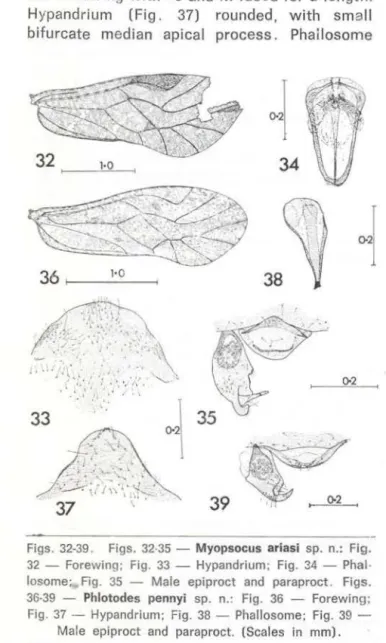
Myopsocus ariasi sp. n. (Figs. 32·35)
FEMALE . Unknown.
MALE . Pai e brown, Eyes black. Ocelli on bl;~ c k tubercle. Central region of frons and vertex dar kened ; anteclypeus and labrum dark brown. Apical segmcnt of maxillary palpi very dark . Thorax darkened dorsally, paler laterally Legs wirh apex of tibiae and much of tarsi dark brown . Forewing (Fig. 32) heavily marked wit h greyish brown. Hindwing hyaline. Ab-domen pai e irregularly darkened dorsaliy.
M arpho1 ogy. Forewing venation as in Fig
32 . Hindwing
R
5 andM
linked by crossvein . Hypandrium (Fig. 33) broad, rounded; unorna-mented, although parts of border thickened . Phallosome (Fig. 34) slightly broadened pcs-teriorly, trame only membranously closed pos· teriorly; a strong longitudinal median bar , broadened and incipientfy bifurcate posteriorly. Epiproct (Fig. 35) broad, with a broad shallow dcrsal flap Pear base. Paraproct (Fig. 35) with a straight unornamented inner process and a broader blunt outer process bearing short setae; a field of about 32 small trichobothria and 2 or 3 central setae without basal rcsettesDimensions . B 3.15, FW 2 . 97, HW 2 . 20 ,
F 0.540 T 1. 050 , t1 0.375 , t2 0.050 , t
3 0 . 090,
t tlt2 7.500,
t1/tz
0.556, ct 19.1.1. Holotype, ô , light trap 6 .xii .1977.COMMENTS
This species is rather similar to M.
pul-chellus New and Thornton (1975, Brazil) but
differs in details of body and leg coloration and in having more regular wing pattern which is overall darker than in pulchellus. Males of
Phlotodes pennyi sp. n. (Figs. 36·39)
FEMALE. Unknown.
MALE. Coloration. Dark brown. Eyes black .
Ocelli in small black annuli. Small discrete urcwn spots dorsal to eyes and across pos-terior of vertex; central region of frons darkened. Postclypeus with striae towards midline; anteclypeus pale; labrum dark brown Maxillary palpi dark brown. Thorax darkened dorsally on lobes. Legs dark brown except for base of t , and short preapical lengths of tibiae. Forewing m:=~rked with greyish brown as in Fig. 36. Hindwing hyaline . Abdomen greyish brown, with darker dorsal mottling.
Morphology . Forewing venation as in Fig.
36. Hindwing with Rs and M fused for a length. Hypandrium (Fig. 37) rounded, w ith small bifurcate median apical process. Phallosome
1·0
1·0
39
Figs. 32-39. Figs. 32-35 - Myopsocus ariasi sp. n.: Fig. 32 - Forewing; Fig. 33 - Hypandrium; Fig. 34 - Phal · losome; Fig. 35 - Male epiproct and paraproct. Figs. 36-39 - Phlotodes pennyi sp. n.: Fig. 36 - Forewing; Fig. 37 - Hypandrium; Fig. 38 - Phallosome; Fig. 39
-Mal e epiproct and paraproct. (Scales in mm).
(Fig 38), elongate, strong ly tapered and wíth broad median tongue. Epiproct (Fig. 39) shallow and very broad, with small setae near apex. Paraproct (Fig. 39) with tapered curved apical spine; a field of 17 trichobothria, and 2 central setae without basal rosettes .
Dimensions. B 3.00, FW 2.40, HW 1. 87,
F 0.450, T 0.880, t, 0.315, t2 0.045.
4
0.060. t ,/t2 7. 000, h/4 O. 750, ct 18. 1. 1.Holotype, ~ , ligth trap, 8. xi. 1977.
Paratypes, 2 t t , light trap 6 and 29.xii.1977.
COMMENTS
Of the South American Myopsocidae, only
P. minor New & Thornton (1975, Brazil) is of
similar size to the present species, and is the only Neotropical species confirmed as
be-longing to Phlotodes. P. pennyi diffe1 s con-siderably from mlnor in wing and genitalic features.
Lophopterygella albomaculata sp. n. (Figs. 40·42)
FEMALE. Coloration. Pai e brown Eyes black.
Ocelli on small black tubercle . Severa I small dark brown spots dorsal to each eye and on posterior half of vertex. Central region of frons and postclypeus darkened; anteclypeus and labrum dark brown . Maxillary palpi black. Antennae base dark brown . Thorax darkened dorsally. Legs with coxae very dark brown, femora with 2 pale bands near apex, apex of tibiae and whole of tarsi darkened. Forewing (Fig . 40) strongly marked wíth greyish brown; celts M, and M2 with conpicuous white marginal spots. Hindwing hyaline except for slignt darkening of apical border . Abdomen dark brown, irregularly shaded dorsally.
Morphology. Forewing (Fig. 40) w1th
region . Gonapophyses (Fig. 42) : ventral valve very short . Epiproct broad, rounded . Paraproct broad, with a field of about 24 trichobothria .
Dimensions . B 3.70 , FW 3.35 , HW 2 . 63 ,
F 0 . 705 , T 1.320, t 1 0.435, t2 0.060, t3 0 .090, t1/t2 7.250, t1/t3 0.667, ct 16.1.1.
Mal e. Unknown .
Holotypc, 2 • light trap, 6 . xii . 1977 .
Paratype . 2 , same data .
COMMENTS
Lophopterygel/a has not previously been
recorded from the mainland of South America.
although one species was described from
Haiti (Banks 1938) . The present species , and the next, both differ from Lophopterygell a sensu stricto in h~ving Rs and M in the hindwing fused for a length, rather than linked
45
0·30·3
44
0·3Figs. 40-45 . Figs. 40·42 - Lophopterygella albomacula-ta sp. n.: Flg. 40 - Forewing; Fig. 41 - Subgenital pia-te; Fig. 42 - Gonapophyses . Figs. 43-45 - L. cincta sp. n.: Fig. 43 - Forewing; Fig. 44 - Subgenital plate;
Flg. 45 - Gonapophyses. (Scales in mm) .
by a crossvein, and are thus perhaps aber ront species of Myopsocus Hggen. However, the pronounced incurring of the forewing margin between branches of M is regarded as the most distinctive feature of Lophopterygel/a and the species are thus referred to this genus.
The two species described here differ substantially from each other, and from
hai-tiensis Banks ( 1938) on features of forewing
pi~mentation . The two Braz i lian species are
further separable on features of the subgenital pi2te: genital ia of haitiensis are unknown.
Lophopterygella cincta
sp. n. (Figs. 43-45)FEMALE. Cobration. Pai e greyish brown. Eyes black. Ocelli on small black tubercle . Central region of vertex and frons darkened. Postcly-peus with traces of striae anteriorly; ante-clypeus and labrum dark brown . Apical segment of maxillary palp very dark brown. Thorax slightly darkened dorsally . Legs mainly very dark brown ; apex of femora, of tibiae, and whole of t 1 pai e, almost white. Forewing mottled with pale greyish brown as in Fig . 43 ; apex of pterostigma castaneous. H indwing hyaline, except for slight darkening or apical border. Abdomen with irregular greyish dorsal mottling .
Morphology . Forewing venation (Fig . 43) ;
a prominent flap on vein 1A. Subgenital plate (Fig . 44) with tapered narrow median lobe bearing 2 setae ; posterior sclerotised region linked laterally with anterior sclerotisation. Gonapophyses as in Fig . 45 . Epiproct broad , rounded. Paraproct with field of about 26 trichobothria.
Resumo
REFERENCES
BANKS, N.
1920- New Neuropteroid lnsects. Buli . Mus . comp Zool. , Harvard., 64: 299·362. 1928 - New West lndian Neuropte roid lnsects .
Revta . Ent ., Rio de J. , 9: 285-304.
ENDERLEIN, G.
1900 - Di e Psociden fauna Perus. Zool. Jb . Abt . Syst ., 14: 133-160.
MOCKFORD, E.L.
1967 - The Electrentomoíd Psocids (Psocoptera) . Psyche, Camb., Mass., 74: 118-165. NEw, T.R.
1978a- A n appraisal of t he Thyrsophorinae stat. nov . (Psocoptera, Psocidae) and o f its cons· tit uent genera from the Neotropics. Syste-matíc Entomology, 3: 35-49.
..
1978b- Notes on the complex of species all ied to Psococerastis taprobanes (Hagen) (Psocop· tera, Psocidae) . Ent Brasil 3: 235·248 . 1978c- Notes on some unusual Psocidae (Psocop·
tera) from Brazil. Revta. Bras . Ent . , 22: 11·18.
sd - Epipscocetae (Psocoptera) from the Reser· v a Ducke, Amazonas. Acta Amazoníca,
NEw, T.R. & n iORNl'ON, I.W . B.
1975 - Psocomorpha (Psocoptera) collected on re· cent expeditions to South America. J . Ent. , (B) 44: 27·80.
SMnHERs, C . N .
1967 - A Catalogue of the Psocoptera of the World. Aust . Zool. , XIV . 1-145.