Berry-cluster thinning to reduce compactness of ‘Black Star’ table grapes
Despenca como método de raleio para reduzir a compacidade de cachos da uva de mesa ‘Black Star’
Sergio Ruffo Roberto1* Cesar Hideki Mashima1 Ronan Carlos Colombo1 Adriane Marinho de Assis2 Renata Koyama1 Lilian Yukari Yamamoto3 Muhammad Shahab1 Reginaldo Teodoro de Souza4
ISSNe 1678-4596
INTRODUCTION
‘Black Star’ is a new cultivar of table grapes which is developed from the somatic mutation of ‘Brasil’ table grape (Vitis vinifera L.). The seeded berries are long ellipsoid shaped, having dark red skin color which tends to turn black at full maturity. Its cycle, productivity and susceptibility to fungal diseases are similar to ‘Italia’ table grape (ROBERTO et al., 2012).
However, ‘Black Star’ table grape has compact bunches, and therefore berry thinning should be performed to avoid compactness, as already practiced for ‘Brasil’ table grape. Through this technique, berries can reach maximum size, beside other important features like avoiding deformation of berries, lack of color and
sweetness on the inside of bunches (PRESZLER et al., 2010) due to the higher source/drain ratio, imprinting quality of the remaining fruits (PASTORE et al., 2011).
Thinning of grapes may consist the removal
of flower buds, individual berries, berry-clusters, or
even the removal of individual bunches. The last method has been used more widely in wine grapes (WINKLER et al., 1974; GIL et al., 2013; KAROGLAN et al.,
2014). In table grapes, flower buds thinning
(flower-cluster thinning or brushing) is performed with in a
short period of time at the pre-flowering stage using
a plastic brush, while the individual berries thinning is practiced in a longer period of time when the berries are still pea size, from each bunch 60 to 70% of berries are removed using scissors (ROBERTO et al., 2015). 1Departamento de Agronomia, Universidade Estadual de Londrina (UEL), Rodovia Celso Garcia Cid, PR 445, km 380, 10.011, 86057-970,
Londrina, PR, Brasil. E-mail: [email protected]. *Corresponding author.
2Departamento de Fitotecnia, Faculdade de Agronomia Eliseu Maciel (FAEM),Universidade Federal de Pelotas (UFPel), Capão do Leão, RS, Brasil. 3Departamento de Agronomia, Universidade Estadual de Maringá (UEM), Maringá, PR, Brasil.
4Embrapa Uva e Vinho, Sítio Embrapa, Córrego Barra Bonita, s/n., Jales, SP, Brasil.
ABSTRACT: The berry-cluster thinning technique was evaluated at different phenological times to prevent bunch compactness of ‘Black
Star’ table grape, a new somatic mutation of ‘Brasil’ grape. The trial was carried out during 2012 and 2013 seaons in a vineyard situated in Marialva, PR, Brazil. Vines were trained in an overhead trellis system and spaced at 3x4m. The randomized block design was used as a
statistical model with five replications and five treatments. The following treatments were evaluated: control; brushing prior to anthesis; and
berry-cluster thinning at different times, when berries were 3-6, 7-10, or 11-15mm in diameter. The prevalence of bunch compactness was
evaluated considering the levels: loose, medium loose, and dense bunches. The main physico-chemical characteristics of grapes and yield were
also appraised. The data obtained were submitted to ANOVA, and toTukey’s test at 5% was applied. So, thinning is a mandatory practice to avoid bunch compactness of ‘Black Star’ grapes. The technique has to be performed, preferably, by means of brushing prior to anthesis, and the failure to accomplish this practice at this time, berry-cluster thinning when berries are 11-15mm in diameter can be used.
Key words: Vitis vinifera L., grape thinning, cultural practices.
RESUMO: O método de raleio de bagas em diferentes fases fenológicas reduz a compactação de cachos da uva fina de mesa ‘Black Star’,
uma nova mutação da uva ‘Brasil’. As videiras foram conduzidas em latada em espaçamento 3x4m, e o experimento foi realizado nas safras
2012 e 2013. O delineamento experimental consistiu em blocos casualizados, com cinco repetições e cinco tratamentos: controle sem raleio; raleio com escova plástica realizado no pré-florescimento e; despenca quando as bagas apresentavam 3-6, 7-10 ou 11-15mm de diâmetro. A compacidade predominante dos cachos foi avaliada de acordo com a seguinte classificação: cachos soltos, medianamente soltos e compactos. As características físico-químicas dos cachos e a produtividade também foram avaliadas. Os dados foram submetidos à análise de variância e as médias comparadas pelo teste de Tukey a 5%. Verificou-se que o raleio de bagas é uma prática obrigatória na uva ‘Black Star’ para diminuir a compacidade dos cachos. A operação deve ser realizada, preferencialmente, com a escova plástica no pré-florescimento, e na impossibilidade de executar ou finalizar essa prática nesta fase, pode-se empregar a despenca quando as bagas apresentarem 11-15mm de diâmetro.
Palavras-chave: Vitis vinifera L., raleio de bagas, tratos culturais.
Ciência Rural, v.47, n.4, 2017. for seeded grapes.
Thus, berry-cluster thinning as a thinning option presents a promising alternative for seeded grapes, since unlike the individual berry thinning, requires less labor (ROBERTO et al., 2015). This method includes the removal of some berry-cluster
and the maintenance of others after flowering, for
better distribution of berries in rachis (RODRÍGUEZ et al., 2013). However, it is necessary to mention that the assessment of the appropriate phenological stage is important for performing this operation, since each cultivar may respond differently to this technique. Thus, the objective of this study was to evaluate the thinning of berries by menas of berry-cluster thinning in different phenological phases to avoid compactness of ‘Black Star’ table grape bunches.
MATERIALS AND METHODS
This trial was carried out in a 3-year-old commercial vineyard of ‘Black Star’ table grape (Vitis vinifera L.) grafted onto ‘IAC 766 Campinas’, located in Marialva, 23º30.930’S, 51º47.829’W, Paraná State, Brazil, 614m a.s.l, in two consecutive crop seasons, 2012 and 2013. The grape vines were trained on overhead trellises and spaced 3.0x4.0m with 833 vines ha-1. The local climate, according to
Koppen classification, is Cfa (subtropical) with an
average annual rainfall of 1,600mm.
Winter pruning was made to leave 7-8 buds per cane, and right after that, 6% of the plant growth regulator hydrogen cyanamide was applied to induce an uniform buds sprouting. In order to prevent ‘Black Star’ bunch compactness, the following treatments were analyzed: control; brushing prior to anthesis; and berry-cluster thinning at different times, when berries were 3-6, 7-10, or 11-15mm in diameter.
Brushing prior to anthesis, flower-cluster thinning,
was made by means of a plastic brush, “brushing” the rachis 6 to 8 times, what resulted in a removal of
around 65% of the flower buds (HANNI et al., 2013).
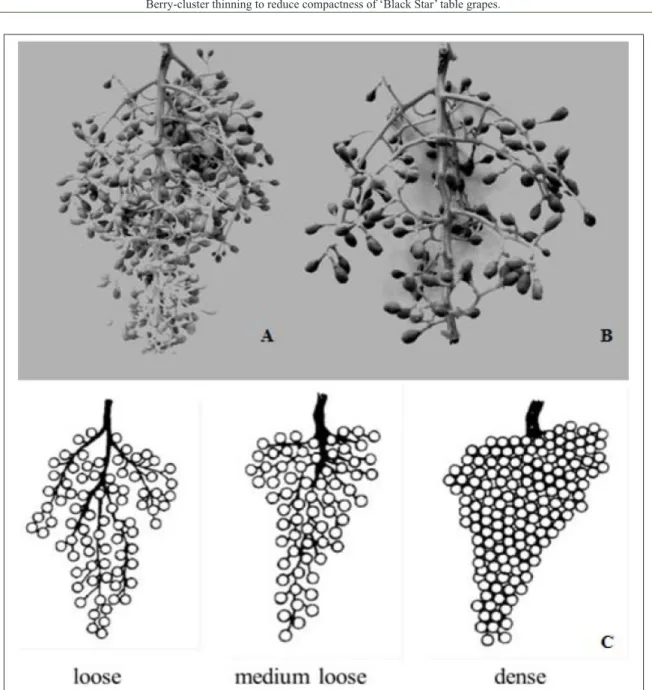
The berry-cluster thinning consisted in to keep four bunch shoulders, to remove the following three clusters, to keep the following three berry-clusters, to remove the three following berry-berry-clusters, and to keep the following three berry-clusters, followed by bunch tipping (Figures 1A and 1B).
To finalize the operation, small, hard, deformed or
The prevalence of bunch compactness in % was visually analyzed (30 bunches per plot) considering the descriptor code #204 for Vitis cultivars proposed by OIV (2001) and ALBUQUERQUE (1999): loose (raquis visible), medium loose (separated berries, well distributed and non-visible pedicels), and dense bunches (compact berries) (Figure 1C). Prevalence of bunch compactness of each plot was considered when the it was higher than 80%. Bunch compactness was also evaluated by means of berry density per linear cm, obtained by the ratio between the number of berries and bunch length (cm) (GONZAGA & RIBEIRO, 2009).
For physicochemical analysis of berries and bunches, such as total soluble solids (TSS), titratable acidity (TA) and maturation index (TSS/ TA), production per plant (kg) and yield (t ha-1), it
was used the methodology described by YOUSSEF & ROBERTO (2014) and ROBERTO et al. (2015). The berry sphericity, expressed in percentage, was calculated by means of the ratio of polar and equatorial diameters, multiplied by 100, in which 100% corresponds to a full spheric format (MASCARENHAS et al., 2013).
Berry color was analyzed using a colorimeter Minolta® CR-10 to obtain the following variables from
the equatorial portion of berries (n=2 per berry): L*
(lightness), C* (chroma) and h° (hue) (ROBERTO et
al., 2013). The color index for red grapes (CIRG) was calculated using the formula: CIRG = (180 - hº)/(L* + C*)
(CARREÑO & MARTINEZ, 1995).
The production per plant in kg and the yield in t ha-1 were calculated considering the number
of bunches per vine, bunch mass and planting density. The data obtained were submitted to ANOVA, and theTukey’s test at 5% was applied.
RESULTS AND DISCUSSION
In the season 2012 and 2013, the control treatment resulted in predominantly compact clusters (Table 1), which is typical of ‘Black Star’ table grape. However, in both harvests, bunches submitted to the
brushing or berry-cluster thinning were classified,
mostly, as medium loose, except those of berry-cluster thinning when berries were 3-6mm in diameter,
which were classified as loose. Thus, the berry-cluster thinning performed earlier did not prove to be sufficient
berry-cluster thinning resulted in high levels of medium loose bunches when the berries were about 7-18mm in diameter, over 70% (ROBERTO et al., 2015).
Density of berries per linear cm differed
significantly between treatments (Table 1), and in
both harvests, control resulted in higher average as compared to other treatments. Thinning operations, beside improving the appearance of bunches, also helps in effective pest control as due to less compactness of berries, the chemicals easily reaches to the interior
areas of the bunch and protect it against the attack of pathogenic fungi or saprophytes, ultimately resulting in a better quality product.
During both seasons, it was observed that the mass of ‘Black Star’ berries was smaller when bunches were not treated (Table 1). These results were
expected and are supported by the findings of other
authors for ‘Perlette’ (CHEEMA et al., 1997), ‘Merlot’ and ‘Cabernet Sauvignon’ grapes (KAROGLAN et al., 2014), whereas with the lowest number of berries
Figure 1 - Bunches of ‘Black Star’ table grape before (A) and after (B) berry-cluster thinning. (C) Classification of table grape
Ciência Rural, v.47, n.4, 2017. per bunch in result of thinning process, more energy
is carried from for the remaining berries.
The time required for performing thinning operation is an important factor for deducing the production costs of table grapes. Brushing thinning requires less time as compared to berry-cluster
thinning, so the labor can be utilized more efficiently
and effectively (ROBERTO et al., 2015). Similarly, for ‘Black Star’ grapes, brushing thinning at the
pre-flowering stage, as practiced for ‘Itália’ grapes,
appears to be the preferred method.
With regard to shape, color index (CIRG) and titratable acidity (TA) of berries, there were no
significant differences among the treatments in both
crops (Table 1), indicating that different types of thinning
had no influence on these characteristics of the grapes.
However, regarding total soluble solids of the berries (TSS), it was reported that in both crops, the average of all thinning treatments were superior to the control, the same being observed for the maturation index (TSS/AT) (Table 1). This may be due to the reduced number of berries in bunches which were subjected to
thinning, either by brushing in the pre-flowering stage or
berry-cluster thinning in different phenological stages. Higher levels of TSS were observed in ‘Thompson Seedless’ grapes when the thinning was carried out in the most advanced phenological stages (WEAVER & POOL, 1973). Similarly, ROBERTO et al. (2015) also reported higher level of TSS in ‘BRS Vitória’ seedless grape when berry thinning was done at the
pre-flowering stage, but in this case the number of berries were
reduced excessively, that resulted in very loose bunches. Thinning in ‘Crimson Seedless’ table grapes in more advanced stages of berry development accelerated the process of maturation and increased the TSS and anthocyanins (EL-RAZEK et al., 2010). Similar results were observed in ‘Sangiovese’ grapes where thinning increased the source/drain ratio from 0.6 to 1.2m2 of leaf area per kilogram of berries, increasing
the TSS and anthocyanins (PASTORE et al., 2011). Regarding the maturation index (TSS/ AT), the evaluated means of thinning treatments were above 20, which is desirable for the production of table grapes (ROBERTO et al., 2015).
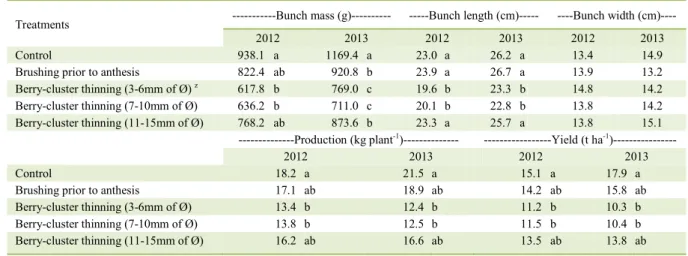
As for the bunch mass, it was observed that during both harvests, control treatment showed
2012 2013 2012 2013
Control D y D 4.2 a 5.5 a
Brushing prior to anthesis ML ML 3.5 b 3.2 b
Berry-cluster thinning (3-6mm of Ø) z L L 3.4 b 2.9 b
Berry-cluster thinning (7-10mm of Ø) ML ML 3.5 b 3.1 b
Berry-cluster thinning (11-15mm of Ø) ML ML 3.4 b 3.3 b
Berry mass (g) --Berry sphericity (%)-- ---Berry color index (CIRG)---
2012 2013 2012 2013 2012 2013
Control 7.9b 8.1b 67.7 63.7 4.5 4.5
Brushing prior to anthesis 8.7a 10.7a 69.1 67.7 4.7 4.2
Berry-cluster thinning (3-6mm of Ø) 9.4a 11.0a 64.6 62.5 4.8 4.2
Berry-cluster thinning (7-10mm of Ø) 9.0a 10.0a 67.1 63.2 4.8 4.2
Berry-cluster thinning (11-15mm of Ø) 8.9a 10.3a 65.6 65.8 4.9 4.6
---TSS (°Brix)--- ----TA (% tartaric acid)---- ---TSS/TA---
2012 2013 2012 2013 2012 2013
Control 14.1b 13.8 b 0.6 0.7 23.8 b 19.7 b
Brushing prior to anthesis 14.8 a 14.4 a 0.6 0.7 24.7 a 20.6 a
Berry-cluster thinning (3-6mm of Ø) 15.1 a 14.6 a 0.6 0.7 25.2 a 20.8 a
Berry-cluster thinning (7-10mm of Ø) 14.7 a 14.4 a 0.6 0.7 24.5 a 20.6 a
Berry-cluster thinning (11-15mm of Ø) 14.9 a 14.5 a 0.6 0.7 24.8 a 20.7 a
Ciência Rural, v.47, n.4, 2017. an average higher than others (Table 2), but it is
also important to mention that when thinning was
performed either by brushing at pre-flowering stage
or by berry-cluster thinning when the berries were 11-15mm in diameter, the average bunch mass remained in an intermediate position. Since the control treatment was not subjected to any thinning operation, these results were expected because of the higher number of berries in a bunch. In this case, the loss in number of berries due to berry-cluster thinning was not compensated by the increase in the berries mass. However, CHEEMA et al. (1997)
reported no significant effect of thinning treatments
and control on the mass of bunches, when brushing thinning was applied in ‘Perlette’ grapes. Similar results are reported by ROBERTO et al. (2015) for ‘BRS Vitória’ seedless grape. However, a study conducted by ÖZER et al. (2012) on ‘Recel Uzumu’ grapes in which thinning was perfomed removing the the tip of the raquis, reduced the length of bunches, and higher intensive of thinning resulted in decreased mass of bunches.
Bunches of control treatment and those
thinned brushing at the pre-flowering stage had
the highest average length, since bunches were not tipped like berry-cluster treatments (Table
2). However, there was no significant difference
observed on bunches width in both seasons,
showing that different treatments had no influence
on this characteristic of ‘Black Star’ grapes. ÖZER et al. (2012) studied ‘Recel Uzumu’ grapes and also reported that the thinning treatments did not
influence the width of clusters.
Regarding the estimated yield per plant
and productivity of ‘Black Star’ grapes, no significant
difference was observed between the treatments during both harvests (Table 2), however, higher average were recorded for control treatment whereas lower values were observed for the treatment of berry-cluster thinning when the berries were 3-6mm and 7-10mm in diameter. However, when thinning
was performed either brushing at pre-flowering stage
or by berry-cluster thinning when the berries were 11-15mm in diameter, the means reached an intermediate position, as observed previously for berry mass. That is the reason why berry-cluster thinning of ‘Black Star’ grapes at an early phenological stage should be avoided, as also reported by ROBERTO et al. (2015) for ‘BRS Vitória’ seedless grape.
These results are in conformity with the
findings of ÖZER et al. (2012) who also reported
that productivity of vines was reduced where grapes were subjected to thinning. Converesely, CHEEMA et al. (1997) observed that thinning of ‘Perlette’ grape by brushing resulted in lower number of berries, but the higher berry mass of treated bunches provided a compensation in the lower number of berries, and thus, yield was not much affected. ROBERTO et al. (2015) also reported no differences in the yield and grape productivity of ‘BRS Vitória’ seedless grape when compared the bunches with no thinning to those subjected to berry-cluster thinning when the berries were 11-15mm in diameter, but it is important to keep in mind that this is a seedless grape and the effect of thinning operation may differ for different cultivars.
Table 2 - Mass, length, width, production and yield of ‘Black Star’ table grape submitted to different thinning techniques.
Treatments ---Bunch mass (g)--- ---Bunch length (cm)--- ----Bunch width (cm)----
2012 2013 2012 2013 2012 2013
Control 938.1 a 1169.4 a 23.0 a 26.2 a 13.4 14.9
Brushing prior to anthesis 822.4 ab 920.8 b 23.9 a 26.7 a 13.9 13.2
Berry-cluster thinning (3-6mm of Ø) z 617.8 b 769.0 c 19.6 b 23.3 b 14.8 14.2
Berry-cluster thinning (7-10mm of Ø) 636.2 b 711.0 c 20.1 b 22.8 b 13.8 14.2
Berry-cluster thinning (11-15mm of Ø) 768.2 ab 873.6 b 23.3 a 25.7 a 13.8 15.1
---Production (kg plant-1)--- ---Yield (t ha-1)---
2012 2013 2012 2013
Control 18.2 a 21.5 a 15.1 a 17.9 a
Brushing prior to anthesis 17.1 ab 18.9 ab 14.2 ab 15.8 ab
Berry-cluster thinning (3-6mm of Ø) 13.4 b 12.4 b 11.2 b 10.3 b
Berry-cluster thinning (7-10mm of Ø) 13.8 b 12.5 b 11.5 b 10.4 b
Berry-cluster thinning (11-15mm of Ø) 16.2 ab 16.6 ab 13.5 ab 13.8 ab
Ciência Rural, v.47, n.4, 2017. and weight of berries because these factors determine
the market price.
To summarize, the thinning is a mandatory practice for ‘Black Star’ table grapes in order to prevent bunch compactness. Without this practice, bunches become more compact, which makes the task
of pest control more difficult. Productivity of plants
thinned by brushing is similar to those subjected to berry-cluster thinning, when the berries were
11-15mm in diameter. During pre-flowering stages, the brushing thinning should be the first option, while berry-cluster thinning allows more efficient use of
labor and should be performed in more advanced developmental stages of bunches.
CONCLUSION
Thinning is a mandatory practice to avoid bunch compactness of ‘Black Star’ table grapes. The technique has to be performed, preferably, by means of brushing prior to anthesis, and the failure to accomplish this practice at this time, berry-cluster thinning when berries are 11-15 mm in diameter can be used.
ACKNOWLEDGEMENTS
To the Coordenação de Aperfeiçoamento de Pessoal de Nível Superior (CAPES) (for granting the scholarship #40002012013P4) and to Conselho Nacional de Desenvolvimento
Científico e Tecnológico (CNPq) for the research grant
(#302326/2010-3).
REFERENCES
ALBUQUERQUE, T. C. S. Avaliação de genótipos de uva no semi-árido brasileiro. In: QUEIRÓZ, M.A. et al. Recursos genéticos e
melhoramento de plantas para o Nordeste brasileiro. Petrolina:
Embrapa Semi-Árido; Brasília, DF: Embrapa Recursos Genéticos e Biotecnologia, 1999. p.1-22. Available from: <http://www.cpatsa. embrapa.br/catalogo/livrorg/index.html>. Accessed: Apr. 20, 2016.
CARREÑO, J.; MARTINEZ, A. Proposal of an index for the objective evaluation of the colour of red table grapes. Food Research
International, v.28, n.4, p.373-377, 1995. Available from: <http://
www.sciencedirect.com/science/article/pii/096399699500008A>. Accessed: Mar. 13, 2016. doi: 10.1016/0963-9969(95)00008-A.
CHEEMA, S. S. et al. Effect of flower thinning, girdling and gibberellic
acid on fruit quality of Perlette grapes. Journal of Research Punjab
Agricultural University, v.34, n.2, p.163-167, 1997. Available
from: <http://ainfo.cnptia.embrapa.br/digital/bitstream/item/97820/1/ Artigo.pdf>. Accessed: Mar. 18, 2016.
GIL, M. et al. Effect of two different treatments for reducing grape yield in Vitis vinifera cv. Syrah on wine composition and quality: Berry thinning versus cluster thinning. Journal of Agricultural
and Food Chemistry, v.61, p.4968-4978, 2013. Available from:
<http://pubs.acs.org/doi/abs/10.1021/jf400722z>. Accessed: May 22, 2016. doi: 10.1021/jf400722z.
GONZAGA, H. M. V.; RIBEIRO, V. G. Giberelic acid in grape cluster thinning, cv. ‘Superior Seedless’, grafted on the rootstock ‘SO4’, cultivated at São Francisco Valley. Revista Brasileira de Fruticultura, v.31, n.4, p.931-937, 2009. Available from: <http://www.scielo.br/ scielo.php?script=sci_arttext&pid=S0100-29452009000400003>. Accessed: May 22, 2016. doi: 10.1590/S0100-29452009000400003.
HANNI, E. et al. Alternatives to the use of gibberellins for bunch thinning and bunch compactness reduction on grapevine. Acta
Horticulturae, v.978, p.335-345, 2013. Available from: <http://
www.actahort.org/books/978/978_39.htm>. Accessed: Apr. 02, 2016. doi: 10.17660/ActaHortic.2013.978.39.
KAROGLAN, M. et al. Effect of cluster and berry thinning on Merlot and Cabernet Sauvignon wines composition. Czech
Journal of Food Sciences, v.32, n.5, p.470-476, 2014. Available
from: <http://www.agriculturejournals.cz/publicFiles/133176.pdf>. Accessed: Feb. 17, 2016.
MASCARENHAS, R. J. et al. Qualidade sensorial e físico-química
de uvas finas de mesa cultivadas no Submédio São Francisco.
Revista Brasileira de Fruticultura, v.35, n.3, p.546-554, 2013.
Available from: <http://www.scielo.br/scielo.php?script=sci_artte xt&pid=S0100-29452013000200025>. Accessed: May 21, 2016. doi: 10.1590/S0100-29452013000200025.
OIV (ORGANISATION INTERNATIONALE DE LA VIGNE ET DU VIN). Liste des descripteurs OIV pour lês varietes et
especes de Vitis. 2001. Available from: <http://www.oiv.int/fr/
normes-et-documents-techniques/description-des-cepages/liste- des-descripteurs-oiv-pour-les-varietes-et-especes-de-vitis-2eme-edition>. Accessed: May 22, 2016.
ÖZER, C. et al. The effects of berry thinning and gibberellin on ‘Recel Uzumu’ table grapes. Pakistan Journal of Agricultural
Sciences, v.49, n.2, p.105-112, 2012. Available from: <https://
www.researchgate.net/publication/287904475_The_effects_of_ berry_thinning_and_gibberellin_on_recel_uzumu_table_grapes>. Accessed: May 13, 2016.
PASTORE, C. et al. Increasing the source/sink ratio in Vitis vinifera
(cv. ‘Sangiovese’) induces extensive transcriptome reprogramming
and modifies berry ripening. BMC Genomics, v.12, n.1, p.631,
2011. Available from: <http://bmcgenomics.biomedcentral.com/ articles/10.1186/1471-2164-12-631>. Accessed: May 13, 2016. doi: 10.1186/1471-2164-12-631.
PRESZLER, T. et al. A model to establish economically sustainable cluster thinning practices. American Journal of Enology and
Viticulture, v.61, n.1, p.140-146, 2010. Available from: <http://www.
ROBERTO, S. R. et al. ‘Black Star’: a new natural somatic mutation of ‘Brasil’ table grape. Revista Brasileira de
Fruticultura, v.34, n.3, p.947-950, 2012. Available from:
<http://www.scielo.br/scielo.php?script=sci_arttext&pid =S0100-29452012000300040>. Accessed: May 22, 2016. doi: 10.1590/S0100-29452012000300040.
ROBERTO, S. R. et al. Ethephon use and application timing of abscisic acid for improving color of ‘Rubi’ table grape.
Pesquisa Agropecuária Brasileira, v.48, n.7, p.797-800, 2013.
Available from: <http://www.scielo.br/scielo.php?script=sci_ arttext&pid=S0100-204X2013000700013>. Accessed: Apr. 22, 2016. doi: 10.1590/S0100-204X2013000700013.
ROBERTO, S. R. et al. Berry-cluster thinning to prevent bunch compactness of ‘BRS Vitoria’, a new black seedless grape. Scientia
Horticulturae, v.197, p.297-303, 2015. Available from: <http://
www.sciencedirect.com/science/article/pii/S0304423815302144>. Accessed: May 13, 2016. doi: 10.1016/j.scienta.2015.09.049.
RODRÍGUEZ, R. C. et al. Adaptación de la poda y ajuste de carga para maximizar los rendimientos de uva de mesa. Revista de la Facultad de
Ciencias Agrarias Uncuyo, v.45, p.129-139, 2013. Available from: <http://
www.redalyc.org/pdf/3828/382837655020.pdf>. Accessed: May 11, 2016.
WEAVER, R. J.; POOL, R. M. Effect of time of thinning on berry size of girdled, gibberellins treated ‘Thompson Seedless’ grapes.
Vitis, n.12, p.97-99, 1973. Available from: <http://www.vitis-vea.
de/admin/volltext/e012530.pdf>. Accessed: May 20, 2016.
WINKLER, A. J. et al. General viticulture. California: University of California, 1974. 710 p.