ALCIDES N. SIAL1∗, VALDEREZ P. FERREIRA1∗, AFONSO R. DEALMEIDA2, ANTONIO W. ROMANO3, CLOVIS V. PARENTE2,
MARCONDES L. DACOSTA4and VICTOR H. SANTOS1
1NEG-LABISE, Dept. de Geol., UFPE, C.P.7852, 50732-970 – Recife, PE, Brazil 2Dept. de Geologia, UFCE, 60455-760 – Fortaleza, CE, Brazil 3Instituto de Geociências, UFMG, 30430-120 – B. Horizonte, MG, Brazil 4Centro de Geociências, UFPA, C.P. 1611, Belém, Pará, 66.075-900, Brazil
Manuscript received on March 9, 2000; accepted for publication on July 4, 2000; contributed byAlcides N. Sial
ABSTRACT
Carbon isotope fluctuations in Precambrian sedimentary carbonates between 2.8 Ga and 0.60 Ga in Brazil are examined in this study. The carbonate facies of the BIF of the 2.8 Ga-old Carajás Formation, state of Pará in northern Brazil, has rather homogeneousδ13C (-5◦/◦◦PDB), compatible with carbonatization of a silicate protolith by a CO2-rich fluid from mantle degassing. The Paleoproterozoic Gandarela Formation, state of Minas Gerais, displays a narrowδ13C variation (-1.5 to +0.5◦/◦◦) compatible with carbon isotope signatures of carbonates deposited around 2.4 Ga worldwide. The Fecho do Funil Formation has probably recorded the Lomagundiδ13C positive anomaly (+6.4 to +7.1◦/◦◦PDB). The magnesite-bearing carbonates of the Orós mobile belt, state of Ceará, exhibit carbon isotope fluctuation within the range for carbonates deposited at 1.8 Ga.
The C-isotope record of the Frecheirinha Formation, northwestern state of Ceará, shows negativeδ13C values in its lower portion (-2◦/◦◦) and positive values up section (+1 to +3◦/◦◦), which suggests this sequence is a cap carbonate deposited after a glacial event around 0.95 Ga. The Jacoca and Acauã sedimentary carbonate Formations, state of Sergipe, NE Brazil, show carbon isotope fluctuations very similar to each other (average around -5◦/◦◦), compatible with a deposition around 0.76 Ga. The younger Olho D’Água carbonate Formation, however, also in the state of Sergipe, displays negativeδ13C values at the lower portion of the Formation, changing dramatically up section to positive values as high as +10◦/◦◦, a characteristic compatible with a Sturtian cap carbonate deposited around 0.69 Ga.
On the light of the C isotope data discussed in this study, it seems thatδ13C fluctuations in Paleoproterozoic carbonates in Brazil are within the range found globally for metasedimentary carbonates of this age. Car-bon isotope data proved to be very useful in establishing relative chronology of Neoproterozoic carCar-bonate formations for which precise radiometric ages are not available.
Key words:carbon isotopes, carbonates, chemostratigraphy, Archean, Paleoproterozoic, Neoproterozoic.
∗Member of the Academia Brasileira de Ciências Correspondence to: Alcides N. Sial
E-mail: [email protected]
INTRODUCTION
impor-540 ALCIDES N. SIAL et allii
tant information about the exogenic C cycle through-out Earth history (Veizer & Hoefs 1976, Knoll et al. 1986). Besides, the carbon isotope stratigraphy has been one of the most powerful tools in Precambrian chronostratigraphy, especially when sediments lack recognizable animal fossils (Kaufman 1998) or are radiometrically undatable. According to this au-thor, temporal variations ofδ13C are interpreted as the product of long-term changes in the proportion of organic matter to carbonate buried in sediments. Carbon isotope variations may reflect episodic in-troduction of12C into the ocean surface or almost complete cessation of biological productivity.
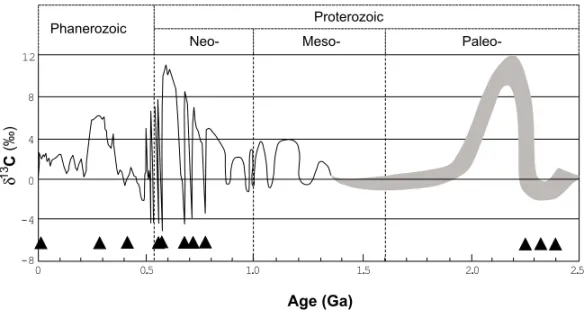
A δ13C (PDB) chemostratigraphic curve for marine carbonates has been compiled by Hoffman et al. (1998a) starting at 2.5 Ga. A widespread pos-itiveδ13C anomaly in the age interval of 2.33-2.06 Ga age has been recognized (Baker & Fallick 1989a, b, Melezhik & Fallick 1994, Melezhik et al. 1997, Hoffman et al. 1998a). The remainder of the Pale-oproterozoic (2.0 to 1.6 Ga) and most of the Meso-proterozoic showδ13C near 0◦/◦◦PDB, with slightly
positive values in the 1.1-1.0 Ga age interval (Hoff-man et al. 1998a). More recently, Kha et al. (1999) studied carbonates of the Bylot Supergroup, Baffin Islands, Canada (1.27 to 0.72 Ga) and compiled new and published data improving the Mesoproterozoic to earliest Neoproterozoic global carbon isotopic curve for this interval. In the Neoproterozoic, the δ13C secular variation curve shows strong positive-negative excursions, four of the major positive-negative ones being interpreted as the stratigraphic position of an-cient ice ages which led to a more elaborated theory of Snowball Earth (Hoffman et al. 1998b, Hoffman & Schrag 2000). Figure 1 represents a compilation of the two above-mentioned secularδ13C variation curves.
The two most striking phenomena recorded by C isotopes in the Proterozoic are the widespread positiveδ13C anomaly in the 2.33-2.06 Ga interval (Lomagundi or Jatulian event) and the striking cli-mate reversal with glacial deposits (four glaciations) blanketed by carbonate rocks between 0.75 Ga and 0.58 Ga ago (Sturtian-Vendian periods) with strong
C isotopic excursions. The isotopically heavy car-bonates in the Lomagundi event (δ13C up to 17%) are linked with the explosion of stromatolites, ex-pressed as a peak in the abundance and taxonomic diversity of stromatolites (Melezhik et al. 1997). In the Neoproterozoic, the fragmentation of the ancient Rodinia supercontinent was accompanied by inter-mittent, but widespread glaciation in the 0.75-0.55 Ga interval. The isotopic excursions are enormous in this time interval in comparison to excursions in the preceding 1.2 billion years or in the Phanero-zoic (Hoffman et al. 1998b). In this age interval, it is common to observe post-glacial carbonate rocks even in terrigenous-dominated sections.
The major scope of this work includes: (a) study of the fluctuation of carbon isotopes in some Precambrian metasedimentary carbonates in Brazil and how these fluctuations fit to variations of the global C isotopic curve; (b) regional correlation of some Neoproterozoic diamictites/carbonates in Brazil with other continents that once were part of the Gondwana supercontinent (e.g. West Africa) and (c) inferring the age of some Neoproterozoic metasedimentary carbonate sequences on the basis of their carbon isotope fluctuations versus theδ13C (PDB) chemostratigraphic curve for Neoproterozoic marine carbonates.
SAMPLING PROCEDURE, LOCALITIES AND ANALYTICAL METHODS
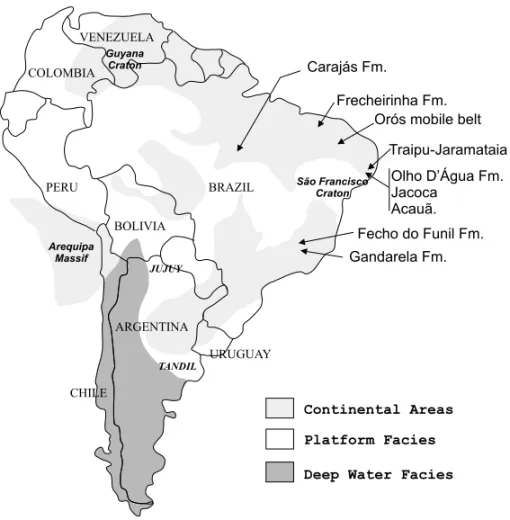
Theδ13C stratigraphy of carbonate sequences from several localities in Brazil examined in this study in-cludes the Carajás Formation, in the northern region of the country three Paleoproterozoic sequences (Gandarela and Fecho do Funil Formations, Minas Gerais, eastern Brazil, and magnesite-bearing car-bonates of the Orós mobile belt, Ceará, northeast-ern Brazil) and six Neoproterozoic Formations in northeastern Brazil (Frecheirinha and São José in Ceará, and Jacoca, Olho D’Água, and Acauã, state of Sergipe, and Traipu-Jaramataia, state ofAlagoas). The approximate location of the study areas is shown in Fig. 2.
Fig. 1 – Compilation of the secularδ13C variation curves based on Hoffman et al. (1998a) and Kha et al. (1999). The thin black line corresponds to the well-constrained Later Neoproterozoic carbon isotopic curve (Hoffman et al. 1998a), while the thicker gray line represents a preliminary compilation of carbon isotopic compositions (Hoffman et al. 1998a, Kha et al. 1999). Triangles indicate glacial events.
samples were collected along traverses, perpendic-ular to the strike of the bedding (or major folia-tion in some cases), at a metric to centimetric scale, from the Precambrian metasedimentary carbonate sequences in this study.
CO2gas was extracted from powdered carbon-ates in a high vacuum line after reaction with 100% phosphoric acid at 25◦C for one day (three days in the case of dolomite, calcite-dolomite mixtures or ankerite), and cryogenically cleaned, according to the method described by McCrea (1950). CO2gas released was analyzed for O and C isotopes in a double inlet, triple collector SIRA mass spectrome-ter, using the BSC reference gas (Borborema skarn calcite) that was calibrated against 18, NBS-19 and NBS-20 standards, and has aδ18O value of −11.28◦/◦◦PDB andδ13C =−8.58◦/◦◦PDB. The
pre-cision of the method has been assessed by repeated analyses of the BSC reference gas and the accuracy by comparison of NBS standards. The results are expressed in the notationδ◦/◦◦(per mil) in relation
to the international PeeDee belemnite (PDB) scale. Carbon isotope compositions of most of the bulk rock probably do not change much during
di-agenesis because the volume of carbon within the carbonate rock is vastly greater than that in the pore-water reservoir and because the fractionation be-tween calcium carbonate is relatively small at near-surface temperatures (Emrich et al. 1970, Scholle & Arthur 1980). Most metasedimentary carbonates in this study have been submitted to sub-greenschist to greenschist facies metamorphism with only one ex-ception (Traipu-Jaramatia Formation) that has been submitted to amphibolite facies metamorphism.
ARCHEAN SEDIMENTARY CARBONATE ROCKS
Sea water yields an integrated and weighted global signal of events shaping the development of the solid Earth, life, ocean and air (Veizer et al. 1989a). These signals are encoded in chemical sediments precipitated from ancient oceans and, in particular, isotopic signatures of oxygen, carbon, sulfur and strontium are important tools in deciphering these signals. The chemistry of the Archean oceans has been buffered by the so-called "mantle" flux, that is, by pervasive interaction with oceanic crust (δ13C of −4±2◦/◦◦PDB; Veizer et al. 1989b).
542 ALCIDES N. SIAL et allii
Fig. 2 – Geographic location of sampled stratigraphic units in the present study: Carajás Formation, state of Pará, Frecheirinha and São José Formations, state of Ceará, Acauã, Jacoca, Olho D’Agua, state of Sergipe, Traipu-Jaramataia, state of Alagoas, and Gandarela and Fecho do Funil Formations, state of Minas Gerais. In this Figure, it is also indicated the distribution of Neoproterozoic carbonate rocks in South America, and a possible paleographic scheme during the Vendian (adapted from Aceñolaza & Durand 1987).
component of Archean greenstone belts. Even so, these rocks are important because they recorded chemical and isotopic properties of the co-eval oceans. Most Archean carbonates described in the literature are regarded as of hydrothermal ori-gin (e.g. Superior and Slave provinces of Canada, Kapvaal Craton of South Africa and Pilbara block of Australia) from field criteria, that is, they resulted from carbonatization of silicate protoliths. Only few exceptions are known (e.g. Steep Rock Lake, Ontario, Canada) where a 3.0 Ga-carbonate plat-form succession, 500m thick, was deposited by a combination of chemical and biological processes (Veizer et al. 1989b, Kushy & Hudleston 1998).
The best estimate forδ13C for the Archean sedimen-tary carbonates (3.5 Ga and 2.8±0.2 Ga) is about +1.5±1.5◦/◦◦PDBwhileδ18O is of about−7◦/◦◦PDB
(Veizer et al. 1989b). In the present study, we have selected carbonate rocks associated with the banded iron formation of Carajás, state of Pará, northern Brazil, for carbon and oxygen isotope determina-tions.
1. The Carajás Formation (2.76Ga), state of Pará, Amazon region
Fig. 3 – Location map of the Carajás mineral Province Formation, state of Pará, northern Brazil (crossed hammers for the location of N4E iron deposit). Modified from Teixeira et al. (1997).
and as the site for one of the largest operating iron mines in the world. The Carajás BIF constitute the Carajás Formation of the Grão Pará Group, a 2.76 Ga volcano-sedimentary belt (Machado et al. 1991). This Group is the main stratigraphic unit of the Serra dos Carajás and carries iron and man-ganese protores and ores. The Grão Pará Group is constituted by the predominantly volcanic Pa-rauapebas (basalts and subordinate rhyolites), Cara-jás (BIF and basaltic sills), Igarapé Cigarra (basalts, BIF, tuffs, sandstones and cherts) and Igarapé Boa Sorte (siltites and shales) Formations. There is no evidence of regional metamorphism in these rocks, basalts displaying well-preserved igneous textures. The Carajás Formation is 220m thick in the N4E iron mine. Recent drillings in this mine re-vealed carbonate-rich jaspilites that, perhaps, corre-spond to the carbonate facies of these BIF. Unmeta-morphosed jaspilites exhibit milli- to centimetric bands of hematite/magnetite alternating with bands of jasper/chert/ chalcedony. The carbonatic jaspilite is brown to dark gray, with preserved millimetric
banding, locally folded, faulted and brecciated. The carbonate (dolomite, calcite) appears as light gray bands as well as in veinlets that cut the bedding. Hematite and pseudomorphs of magnetite are, mostly, corroded and partially replaced by carbon-ates. Dolomite and calcite are the main carbonate minerals.
Oxygen isotope data displayδ18O values from −24 to−10◦/◦◦PDB, predominating values between
−15 to −10◦/◦◦. The twenty five analyzed
sam-ples from drill-holes display δ13C predominantly around−5◦/◦◦PDB (total variation from−3 to−6; Fig. 4), distinctly lighter than the inferred value for normal Archean seawaterδ13C (near zero) (Veizer et al. 1990).
hy-544 ALCIDES N. SIAL et allii
Fig. 4 – (a) and (b) Carbon and oxygen isotope profiles of the carbonatic jaspilite of the Carajás Formation sampled in drill holes in the N4E iron deposit, state of Pará.
drothermal fluid input, with deeper basinal waters characterized by lighter carbon (δ13C≈ −5◦/◦◦PDB)
compared to surface waters (δ13C≈ 0◦/◦◦PDB). If
this was the case for the Carajás carbonates, it is
mantle signature (−5◦/◦◦PDB). This CO2-rich fluid
could be from mantle degassing or recycling of C in a subduction-related environment.
PROTEROZOIC SEDIMENTARY CARBONATES
In comparison to Archean oceans, Proterozoic and Phanerozoic oceans have been buffered mostly by river flux (Veizer et al. 1989a), which implies a much more pronounced C isotopic variation than that observed in Archean carbonates. In con-sequence, positive excursions to anomalously high δ13C have been identified in Paleoproterozoic and Neoproterozoic strata. The Paleoproterozoic posi-tiveδ13C anomaly (Lomagundi event) in sedimen-tary carbonate rocks or in their metamorphic equiva-lents has been kept as a single event which lasted for about 260 million years. Buick et al. (1998), how-ever, detected three positiveδ13C anomalies in Pale-oproterozoic sedimentary carbonates in the Kapvaal craton (2.43 to 1.93 Ga interval). Unfortunately, from his work, it was not clear whether these excur-sions reflect a global or a local process.
A) Paleoproterozoic SedimentaryCarbonate sequences
1. The Gandarela Formation (2.4Ga), Quadri-łátero Ferrífero, Minas Gerais
The Minas Supergroup is a large sedimentary se-quence with a basal unit of clastic rocks (conglom-erates, quartzites and phyllites of the Caraça Group), a middle unit composed of chemical rocks (iron for-mation and carbonates of the Itabira Group) and an upper unit of interlayered clastic and chemical rocks (Piracicaba Group). The Itabira Group has exten-sive banded iron formations and is divided into the Cauê and Gandarela Formations. The latter consists, dominantly, of carbonate rocks deposited in shallow water, and has a total thickness of∼500m. In the Gandarela Syncline, stromatolitic structures occur in the intermediate member of the Gandarela Fm. A Pb-Pb isochron age of 2.42±0.02 Ga was reported by Babinski et al. (1995).
About 60 carbonate samples were
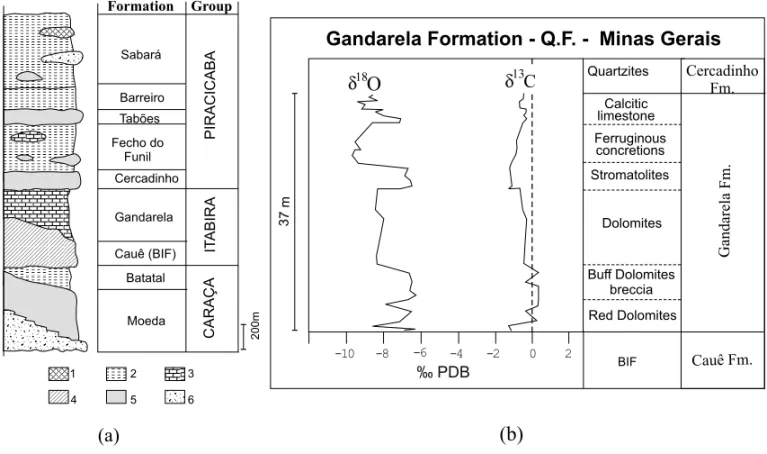
sam-pled from four sections around the Gandarela Farm (Fig. 5). These carbonate rocks are gray, buff to red dolomites (∼60m thick, next to the base of this car-bonate sequence, in contact with iron formations) to limestones which present light and dark-gray al-ternating bands on a cm scale and, locally, display stromatolitic structure. In this sequence,δ13C val-ues vary from−1.6 to+0.4◦/◦◦PDB. The reddish
dolomites, at the base of the Formation, display the most negative values (−1 to−1.3◦/◦◦PDB) followed
upsection by positive values (average+0.3◦/◦◦PDB),
limited to the buff dolomites, and succeeded, im-mediately above an intraformational breccia, by slightly negative values (−0.3◦/◦◦PDB) in buff,
slightly clay-rich dolomites (Fig. 6b). The C-isotope variation in this Formation lies within the range for carbonates of this age in the C-isotope sec-ular variation curve in Fig. 1. Oxygen isotope ratios vary from−6.6 to−10.4◦/◦◦PDB. Theδ18O values of the dolomitic portions of this sequence average −7◦/◦◦PDB, while the more calcitic portions average
−9◦/◦◦PDB. Regarding the very low grade of
meta-morphism these rocks underwent, these data, per-haps, reflect environmental variations during lime-stone deposition.
2. The Fecho do Funil Formation, Piracicaba Group, Minas Gerais (2.1Ga)
This Formation is represented by an association of terrigenous and chemical sedimentary platform fa-cies. Light-gray, greenish and pinkish dolomitic rocks form a 60m thick lens with poorly preserved columnar stromatolite structures, exposed at the top of the sequence. A Pb-Pb isochron minimum age of 2.11±0.1 Ga for this Formation has been reported (Babinski et al. 1995).
Three representative samples from Morro do Bule locality, near Ouro Preto town (Fig. 5), were analyzed for C and O isotopes in this study. δ13C values in these rocks vary from+6.4 to+7.1◦/◦◦PDB
whileδ18O varies from−9.4 to−9.1◦/◦◦PDB. The
546 ALCIDES N. SIAL et allii
Fig. 5 – Simplified map of the Quadrilátero Ferrifero (modified from Inda et al. 1984, Babinski et al. 1995), state of Minas Gerais. The two sampled localities (Gandarela Farm) and Morro do Bule are indicated by solid circles. GF = Gandarela Formation, FFF = Fecho do Funil Formation. 1 = Minas Supergroup; 2 = Rio das Velhas Supergroup; 3 = Minas Supergroup; 4 = Rio das Velhas Supergroup; 5 = granite-gneiss terranes.
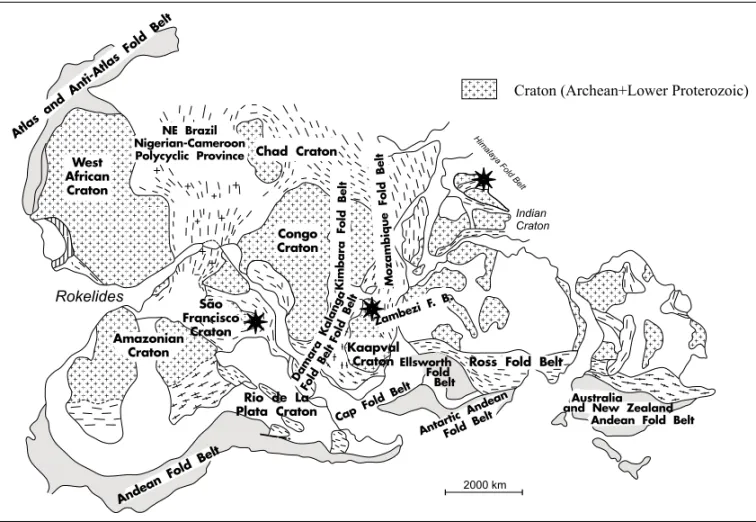
recorded in sedimentary carbonates of this age in South America. This suggests depositional condi-tions similar to that prevailing during the deposition of sedimentary carbonates of equivalent age in the Lomagundi Formation in Zimbabwe (Schidlowski et al. 1976), Kapvaal craton, and in dolostones of the Aravalli Supergroup in the Aravalli craton in In-dia (Fig. 7; Maheshwari et al. 1999).
3. The Magnesite-bearing metasedimentary carbonates of the Orós Mobile Belt, Ceará (1.8Ga)
Fig. 6 – (a) Lithostratigraphy of the Minas Supergroup, state of Minas Gerais (Babinski et al. 1995). 1 = graywackes, 2 = phyllites, 3 = carbonate rocks, 4 = banded iron formations, 5 = quartzites, 6 = conglomerates; (b) Composite carbon and oxygen isotope profiles for the Early Paleoproterozoic Gandarela Formation at the Gandarela Farm.
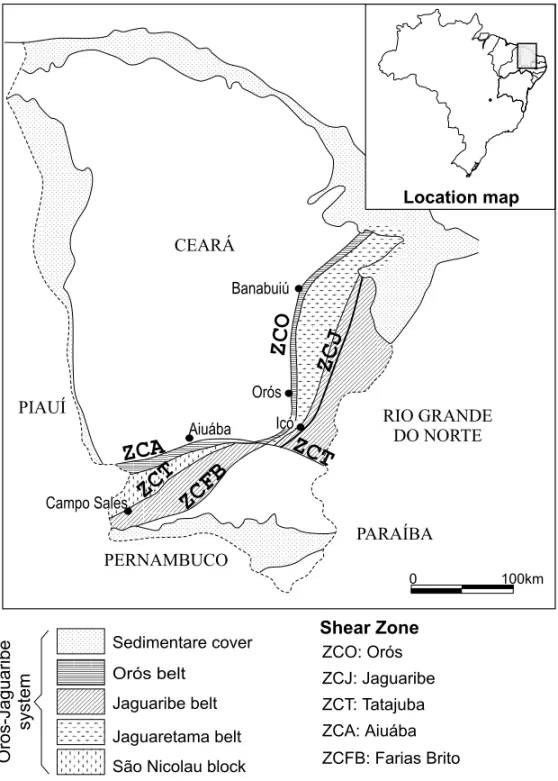
to amphibolite-facies metavolcano-sedimentary se-quences intruded by Meso- to Neoproterozoic gran-itoids. Calcitic, dolomitic and magnesitic marbles occur in discontinuous lenses for about 140 km in the domain of this belt between Alencar (Ceará) and Pio IX (Piaui) villages. These marbles represent evap-orites deposited in a shallow marine environment (Parente & Arthaud 1995). Zircons from metarhyo-lites of this belt yielded a U-Pb age of 1.79±0.1 Ga (Van Schmus et al. 1995), probably corresponding to the age of sedimentation.
The metacarbonate sequence is very abundant and more calcic in the southwestern extremity of the belt, but less voluminous and more magnesian towards the northeastern portion of the belt, the high-est Mg contents being observed in the Alencar-Orós region. Magnesite deposits pass gradually into metadolomites and then to almost pure calcitic mar-bles westward the belt.
Sixteen calcitic to dolomitic carbonate sam-ples from this discontinuous set of magnesian meta-carbonate rocks displayδ13C values from−3.2 to +2.1◦/◦◦PDB. The calcitic limestones, deposited on
open-marine environment, the older of these car-bonate sequences, display positive δ13C (+0.5 to +2.1◦/◦◦) while dolomitic marbles to dolostones,
deposited on less-open marine environment, display negative shift (−0.7 to−3.2◦/◦◦PDB). This totalδ13C variation is within the limits for 1.8 Ga-old carbon-ate rocks. The calcitic marbles display δ18O val-ues from−6.5 to−10◦/◦◦PDB, while the dolomitic
ones have values in the−10 to−15◦/◦◦PDB range.
Oxygen isotope ratios were probably modified at greenschist to amphibolite-facies metamorphic con-ditions and, therefore, are of little use in tracing the thermal history of the carbonate deposition.
548 ALCIDES N. SIAL et allii
Fig. 7 – Schematic structural map of Gondwana (modified from Trompette 1994) showing the geographic distribution of cratons and foldbelts. Stars: Paleoproterozoic Formations where the Lomagundi event has been recorded (Fecho do Funil Fm., Minas Gerais, Brazil; Lomagundi Fm., Zimbabwe, Africa, and the Aravalli Supergroup, Aravalli craton, India).
The C-isotope stratigraphy of some Neoproterozoic metasedimentary carbonate sequences in northeast-ern Brazil are discussed below, including the Fre-cheirinha and São José Formations, NW Ceará; Jacoca, Acauã, and Olho D’Água Formations, Ser-gipe, and Traipu-Jaramataia Formation, Alagoas. Together with other correlative deposits (e.g. Para-noá-Bambuí Groups in central Brazil, Santos et al. in press, the Una Group, Irecê Basin, Bahia, Misi & Veizer 1998) these carbonate metasedimentary rocks offer important information on events coeval with the initial and final break-up of the Rodinia super-continent (≈1.0−0.75 Ga; Unrug 1997) applicable to other cratons and belts of western Gondwana.
1. The Frecheirinha and São José Formations, Ceará
The Middle Coreaú Domain, northwestern region of the state of Ceará is characterized by a series of grabens and horsts whose boundary faults trend SW-NE. The sediments of the Ubajara Group were posited in the Bambuí-Jaibaras Graben, which is de-limited to the southeast by the Sobral-Pedro II shear zone (considered part of the shield-scale Trans-Brasiliano lineament, Caby et al. 1991). In the Mar-tinópole graben, separated from the previous one by the Tucunduba horst (Fig. 9), sediments of the Mar-tinópole Group, a possible correlative of the Ubajara Group, have been deposited.
Fig. 8 – Simplified geologic map of the Orós Mobile belt, state of Ceará, northeastern Brazil (modified from Parente & Arthaud 1995).
Ubajara Group have been considered for long time as sedimentary deposits correlative to carbonates of the Bambuí Group in central and eastern Brazil (Fig. 9). The Frecheirinha carbonates rest on red slates and quartzites of the Caiçaras Formation. Arkoses, graywackes and arkosic sandstones of the Coreaú Formation are found overlying the Frecheirinha car-bonate rocks. The only inferred age for the
550 ALCIDES N. SIAL et allii
Fig. 9 – Simplified map of northwestern state of Ceará, NE Brazil, showing the location of the Bambui-Jaibaras (Ubajara Group), and the Martinópole (São José Formation) grabens separated by the Tucunduba horst.
in the Middle Coreaú domain yielded concordant plots with an upper intersect of 1.78 Ga (Magini et al. 1999) interpreted as an indication of Stathe-rian crystallization. This would imply a probable Late Paleoprotereozoic age for the Ubajara Group metasedimentary rocks, much older than previously supposed, something which requires further confir-mation.
In the Martinópole graben, the low-grade meta-pelite-metapsamitic sequence of the Martinópole Group (schists, quartzites and slates) are overlain by magnesian limestones, graywackes, sandstones, fer-ruginous metacherts and metavolcanic rocks which
have been regarded as the São José Group (Prado et al. 1979). The lithologic units of this Group are well represented in the São José hill, near the Ubatuba village about 70 km west of Granja village, in the northwerstern Ceará.
Fig. 10 – Composite oxygen and carbon isotope profiles for sedimentary carbonates of the Frecheirinha Forma-tion, northwestern Ceará, NE Brazil.
The δ13C in four of the sampled sections is about+1◦/◦◦PDBwhile in the upper carbonate layers
values jump to+2.5 to+3.7◦/◦◦(Fig. 10). Similar
δ13C pattern is also observed on the Paranoá Group gray carbonates which are about 1◦/
◦◦PDB(Santos et
al. in press) and in the lower portion of the Bam-buí Group limestones, jumps up to+2.6◦/◦◦PDB
in-creasing to 12◦/
◦◦upwards this unit (values as high as
+16◦/◦◦PDBfor the upper Bambuí carbonates were
reported elsewhere (Iyer et al. 1995, Santos et al. in press). In the light of the present C-isotope data, most marly limestones/limestones of the Frecheir-inha Formation are isotopically equivalent to the Paranoá limestones, while the upper section of the Frecheirinha Formation is isotopically equivalent to the limestones of the lower Bambuí Group (noδ13C >4◦/
◦◦ has been found in Frecheirinha Formation
carbonates). δ13C for the marly carbonates at the lowermost portion of the Frecheirinha Formation is negative (−8 to−1.2◦/◦◦PDB) coinciding with the
highest δ18O values (−6.9 to−5.3◦/◦◦PDB) in the
sequence. These marly carbonates were probably deposited under lower temperature conditions, in a post-glacial transition to a warmer climate.
Fig. 11 – Oxygen and carbon isotope profiles for the São José Formation, northwestern Ceará, NE Brazil.
Ten samples of carbonates of the São José meta-sedimentary carbonates were collected at the São José hill. All these samples displayδ13C between −1.5 (bottom of the section) and−0.5◦/◦◦PDB
up-section, whileδ18O varies from−14 (bottom) to −10◦/◦◦PDBupsection (Fig. 11).
2. The Jacoca, Acauã and Olho D’Água For-mations, Sergipe
552 ALCIDES N. SIAL et allii
and its interface with the northern margin of the São Francisco Craton demonstrated that sedimentation recorded the evolution of a passive continental mar-gin and is divided into two cycles, each one compris-ing a continental to shallow marine, basal siliciclas-tic megasequence overlain by a carbonate sequence. The cratonic cover encompasses cycle I and part of the basal megasequence II. All of these rocks spread continuously across the craton margin into the Sergi-pano Foldbelt where they occur around the Itabaiana and Simão Dias basement domes and are overlain by a metadiamictite formation and a metacarbonate formation that complete cycle II. According to D’el Rey da Silva (1999), basement and cover underwent the same Neoproterozoic compressive deformation under sub-greenschist facies.
The lower siliciclastic megasequence is repre-sented by the Juetê (arkosic sandstone, conglomer-ate lenses, diamictites), Itabaiana (conglomerconglomer-ates, quartzites, metasiltites) and Ribeirópolis (silty phyl-lites, metagreywackes, pebbly phylphyl-lites, diamic-tites) Formations and the lower carbonate megase-quence is represented by the Acauã and Jacoca For-mations. These two megasequences in cycle I com-prise the Estância-Miaba Group.
The upper siliciclastic megasequence (Simão Dias Group) is represented by the Lagarto-Palmares (mudstones, siltstones, sandstones and lithic wa-ckes), the Jacaré (metasiltites to metasandstones) and the Frei Paulo (silty phyllites with intercalations of metasandstones, metacarbonates and wackes) Formations. This megasequence is overlain by metasediments of the Vaza Barris Group that is comprised of diamictites of the Palestina Forma-tion and the upper carbonate megasequence (Olho D’Água Formation).
The lower carbonate megasequence. The Acauã Formation conformably overlies the Juetê Forma-tion and unconformably the basement gneiss (D’el Rey da Silva 1999). It consists of basal limestone, dolomite, calci-argillite with limestone lenses and layers of limestone and dolomites with intercala-tions of cross-bedded red sandstone and green
argillite. In this study, twenty-one samples have been collected in a section of the Acauã carbonates with strata dipping about 300 northwestward, along the river at the Brejinho Farm, 10 km southeast of Lagarto town, state of Sergipe.
The Jacoca Formation overlies the pebbly phyl-lites/conglomerates of the Ribeirópolis Formation and comprises two lithofacies: metacarbonates and a mixed lithofacies of metasiliciclastics and meta-carbonates (D’el Rey da Silva 1995). The metased-imentary carbonates are< 300m thick around the Itabaiana dome (Fig. 13a) with the best exposures, in the Capitão farm, along the Salgado and Vaza Bar-ris rivers southwest of the Macambira village, state of Sergipe.
A typical section of the Jacoca Formation as described in the Capitão Farm by D’el Rey da Silva (1995), starts with a thick layer of laminated white to gray, 1-3cm thick beds of dolomites containing beds of pyrite and chalcopyrite. This is followed upsec-tion by a 15m-thick layer of laminated dolomites, and dark gray to black phyllites and about 10m thick of massive dolomites. This unit is overlain by a 40m thick sequence of gray limestones, calcarenites and dark gray to black phyllites. Finally, a sequence of gray metadolomites, 200m thick, is observed.
In this study, about thirty-one samples of Ja-coca carbonate from a section along the Vaza Barris River at the Capitão Farm, and twenty-one carbonate samples from the Acauã Formation at the Brejinho Farm, have been analyzed for carbon and oxygen isotopes and results are shown in Figure 13a, b.
In the Jacoca carbonates, δ13C varies from −6.4 to−2.8◦/◦◦PDB, with majority of the values
554 ALCIDES N. SIAL et allii
Fig. 13 – Carbon and oxygen isotope profiles: (a) Jacoca Formation; (b) Acauã Formation; (c) Olho D’Agua Formation (state of Sergipe) and (d) Traipu-Jaramataia Formation (state of Alagoas), NE Brazil.
correspond to cap carbonates sequences.
Five samples from a 10m-thick (meta) marl to marly carbonate lens intercalated in phyllites of the
Theδ13C varies from+3 to+8◦/◦◦PDBand from−9 to−6◦/◦◦PDB.
The upper carbonate megasequence. The thick Olho D’Água Formation is composed of a se-quence of marbles and interbedded green, calcare-ous chlorite-schists and silty phyllites of the Vaza Barris Group and overlies the thick diamictites, peb-bly metagreywackes of the Palestina Formation. Marble beds are interbedded with blue to black, fine-grained metalimestone and gray metadolomite. In-dividual marble beds vary from one to 40m thick in the lower part of the Formation with only local one meter-thick beds in the upper part. Thicker and more abundant carbonate beds are observed in the south limb of the Pinhão anticline. The thick carbon-ates around the Simão Dias dome pass upward into supertidal-intertidal facies with oolites, and wave-reworked structures indicating a near shore environ-ment (D’el Rey da Silva 1992). Oolites to stromato-lites are very rare, and reducing conditions predom-inated during the carbonate deposition. Stromato-lites have been observed at Saco da Camisa local-ity (Cassedane & Silva Filho 1982) and have been classified asstratifera undata, with a probable age
between 1.0 Ga and 0.55 Ga.
One hundred and twenty samples of Olho D’Água Formation were collected from∼500 me-ter of discontinuous outcrops across the southern limb of the Pinhão anticline, starting from the con-tact with the Palestina diamictite/pebbly metagrey-wackes. Marly carbonates at the basis of the se-quence, near the contact with Palestina diamictites, displayδ13C values as low as −4.7◦/◦◦PDB, which
increase upsection to values between zero and 1◦/
◦◦PDB, and at the top change dramatically to
val-ues as high as+10◦/◦◦PDB(Fig. 13c). This variation
suggests that environmental conditions during de-position at the base of this sequence were different from those for carbonates at the top, allowing for an enormous C-isotope oscillation. Thisδ13C trend on presumed cap carbonates, according to Kennedy (1996), would suggest that the Palestina diamictites would be correlatable to Sturtian glacial episode.
Oxygen isotopes show a more limited variation with δ18O values ranging from−7 to−10◦/◦◦PDB.
3. The Traipu-Jaramataia Formation, Alagoas
The Macururé tectonic domain (state of Alagoas, northern part of the Sergipano foldbelt; Fig. 12) is separated from the Miaba-Vaza Barris Domain, described above, by the São José do Aleixo shear zone. While the carbonate to clastic sediments of the Miaba-Vaza Barris Domain were mono-deformed and subject to greenschist-facies metamorphism, the Macururé Domain metasediments were poly-deformed and mostly metamorphosed at the amphi-bolite facies.
The Traipu-Jaramataia Formation of the Macu-ruré Group is characterized by a sequence of meta-greywackes, metasiltstones, metashales and minor metasedimentary carbonates (marbles), besides fel-sic, basaltic and ultrabasic igneous rocks metamor-phosed in the amphibolite facies. Narrow and elon-gate carbonate lenses are observed along the Belo Monte Fault zone and near the road between Batalha town and Capivara village.
About twenty-five carbonate samples have been collected at a metric scale across the strike of a representative 80 m-thick lens by the point where the road Batalha-Capivara branches off to the Jara-mataia village. These marbles are usually coarse-grained, banded, pink to white, with intercalated mica-rich layers (locally with epidote), intercalated in a garnet-rich biotite-schist. Theδ13C values in this Formation are always positive (Fig. 13d) and most of them are in the+3 to+4◦/◦◦PDBinterval, a
behavior which totally differ from that observed in the Jacoca and Acauã carbonates. This suggests that the Traipu-Jaramataia carbonate rocks have been de-posited at a different time in relation to the Acauã and Jacoca Formations in the state of Sergipe.
CONCLUSIONS
556 ALCIDES N. SIAL et allii
in Brazil and may become useful for future inter and intra-basinal correlations. Interpretations here are, however, mostly preliminary and require, in some cases, further detailed studies.
Carbon isotopes in the carbonate-rich jaspilites of the Archean Carajás (BIF) Formation demon-strate that, as in the majority of Archean carbon-ates, they have acquired a mantle signature through carbonatization of a silicate protolith by a CO2-rich fluid from mantle degassing; or equilibrium with a deep basinal water with a composition around −5◦/◦◦PDB.
Carbonates of the Paleoproterozoic Gandarela Formation display a C-isotope oscillation within the worldwide secular variation, and the Fecho do Funil Formation seems to record the positive δ13C Lo-magundi (Jatulian) anomaly, a contention which re-quires further investigation.
The C isotope fluctuations in the studied Neo-proterozic metasedimentary carbonate sequences in northeastern Brazil lead to the following inferences, when the secularδ13C variation in the Neoprotero-zoic (Fig. 1) is taken into account:
1. The C isotope pattern for the Frecheirinha For-mation withδ13C values around−1 to −2◦/◦◦PDB
and positive values around+2 to+3◦/◦◦PDBis
com-patible with a deposition around 0.98 Ga. A similar C isotopic behavior has been observed in Paranoá carbonates in central Brazil (Santos et al. in press) and it is possible that these two units have been syn-chronously deposited.
2. The Jacoca-Acauã Formations, according to their δ13C oscillations seem to have been deposited around 0.76 Ga, on top of diamictites (Ribeirópo-lis, Jacarecica Formations). Values ofδ13C around −4◦/◦◦PDB are observed in both Formations and no
positiveδ13C values have been recorded from either one.
3. Metacarbonate lenses of the Frei Paulo Forma-tion show positiveδ13C, averaging+5◦/◦◦PDB, and
a deposition age around 0.74 Ga can be inferred. 4. The Olho D’Água carbonate sequence shows δ13C around−4◦/◦◦PDBat the base of the Formation,
and values around+9◦/◦◦PDB, at the top, consistent
with a cap carbonate deposition around 0.69 Ga on the Capitão-Palestina diamictites.
All Neoproterozoic carbonate sequences in this study, some of which have been previously regarded as chronocorrelatable to the Bambuí Group carbon-ates, seem, based on their carbon isotope behavior, to be older than this Group. The Bambuí Group dis-playsδ13C values as high as+16◦/◦◦PDB(Iyer et al.
1995, Santos et al. in press) or even higher in the top carbonate Formations, which we interpret as in-dication of a Post-Sturtian deposition, around 0.60 Ga. A similar age (595±5 Ma) has been recently proposed by Kawashita (1999), based on the behav-ior of the87Sr/86Sr for the Bambuí carbonates and in a secular variation curve for the Neoproterozoic.
ACKNOWLEDGEMENTS
Field and laboratory works were supported in part by a PADCT/FINEP project (65.930.619-00). We thank three anonymous reviewers whose comments and suggestions helped to improve an earlier ver-sion of this manuscript. Thanks are also due to Gilsa M. Santana and Vilma Sobral Bezerra for the assis-tance with carbon and oxygen isotope analyses at the Stable Isotope Laboratory (LABISE) in the Fed-eral University of Pernambuco, Brazil. This is the contribution n.172 of the NEG-LABISE.
REFERENCES
Aceñolaza FG & Durand FR.1987. Paleontologia del limite Precámbrico-Cámbrico de Argentina. X Congreso Geológico Argentino, Actas,1:315-320.
Babinski M, Chemale JR F & Van Schmus WR.1995. The Pb/Pb age of the Minas Supergroup carbonate rocks, Quadrilátero Ferrífero, Brazil. Precamb Res
72:235-245.
Baker AJ & Fallick AE. 1989a. Evidence from Lewisian limestone for isotopically heavy carbon in two-thousand-million-year-old sea water. Nature
337:352-354.
Norway: implications for the Precambrian carbon cycle.Geochim Cosmochim Acta53:1111-1115
Beukes NJ, Klein C, Kaufman AJ & Hayes JM.1990. Carbonate petrography, kerogen distribution, and carbon and oxygen isotope variations in an Early Proterozoic transition from limestone to iron-forma-tion deposiiron-forma-tion, Transvaal Supergroup, South Africa.
Econ Geol85:663-690.
Bowins RJ & Crocket JH.1994. Sulfur and carbon isotopes in Archean banded iron formations: impli-cations for sulfur sources.Chem Geol111:307-323.
Buick IS, Uken R, Gibson RL & Wallmach T.1998. High 13C Paleoproterozoic carbonates from the Transvaal Supergroup, South Africa. Geol26: 875-878.
CabyR, Sial AN, Arthaud M & Vauchez A.1991. Crustal evolution and the Brasiliano Orogeny in Northeast Brazil. In:Dallmeyer, RD & Lécorché, J/P.(eds): The West African Orogens and Circum-Atlantic Correlatives, Springer-Verlag: 373-397.
Cassedane JP & Silva Filho MA.1982. Stromatolite do Saco de Camisa (Sergipe). An Acad Bras Ci54:
429-439.
D’el ReySilva LJH.1992. Tectonic Evolution of the Southern Part of the Sergipano Fold Belt, NE Brazil. Univ. of London, Ph.D. Dissertation, 258p.
D’el ReySilva LJH.1995. The evolution of basement gneiss domes of the Sergipano fold belt (NE Brazil) and its importance for the analysis of Proterozoic basins.Jour South Amer Earth ci8(3/4): 325-340.
D’el ReySilva LJH.1999. Basin in-filling in the south-ern-central part of the Sergipano Belt (NE Brazil) and implications for the evolution of Pan-African/Brasi-liano cratons and Neoproterozoic sedimentary cover.
Jour South Amer Earth ci4-5(2): 1-18.
Emrich K, Ehhalt DH & Vogel JC.1970. Carbon iso-tope fractionation during the precipitation of calcium carbonates. Earth Plan.Sci Letters8:363-371.
Hoffman PF & Schrag DP.2000. Snowball Earth. Sci American, January: 50-57.
Hoffman PF, Kaufman AJ & Halverson GP.1998a. Comings and goings of global glaciations on a
Neo-proterozoic tropical platform in Namibia.GSA Today
8(5): 1-10.
Hoffman PF, Kaufman AJ, Halverson GP & Schrag DP.1998b. A Neoproterozoic Snowball Earth. Sci-ence281:1342-1346.
Inda HV, Schorscher HD, Dardenne MA, Schobben-haus C, Haralyi NLE, Branco PCA & Ramalho R. 1984. O craton de São Francisco e a Faixa de Dobramentos Araçuai: In: C Schobbenhaus, DA Campos, GR Derze & HE Asmus(editors), Geolo-gia do Brasil, DNPM, Brasília, 193-248.
Iyer SS, Babinski M, Krouse HR & Chemale F.1995. 13C-enriched carbonate and organic matter in the
Neoproterozoic sediments of the Bambuí Group, Brazil.Precamb Res73(1,2,3,4): 271-282.
Kaufman AJ. 1998. Neoproterozoic chemostratigra-phy: key events in Earth history ordered by detailed intra- and inter-basinal correlation. XL Congresso Brasileiro de Geologia, Belo Horizonte, p.2.
Kawashita K.1999. Datação de rochas carbonáticas: Grupo Bambuí como exemplo. An Acad Bras Ci
71(4-II): 1037-1038.
KennedyMJ.1996. Stratigraphy, sedimentology, and isotopic geochemistry of Australian Neoproterozic Postglacial cap dolostones: deglaciation, δ13C ex-cursions, and crabonate precipiation. J Sedd Re-search6(66): 1050-1064.
Kha LC, Sherman AG, Narbonne GM, Knoll AH & Kaufman AJ.1999. δ13C stratigraphy of the Pro-terozoic Bylot Supergroup, Baffin Islands, Canada: implications for regional lithostratigraphy correla-tions.Can Jour Earth Sci36:313-332.
Knoll AH, Hayes JM, Kaufman AJ, Swett K & Lam-bert IB.1986. Secular variations in carbon isotope ratios from Upper Proterozoic successions of Sval-bard and East Greenland.Nature321:832-838.
KushyTM & Hudleston PJ.1998. Growth and demise of an Archean carbonate platform, Steep Rock Lake, Ontario, Canada.Can Jour Earth Sci36:565-584.
Cara-558 ALCIDES N. SIAL et allii
jás area, Amazon shield, Brazil. Precamb Res49:
329-354.
Magini C, Santos TC, Brito Neves BB, Hackspacher PC, Van Schmus WR, Dantas E & Fetter A.1999. Statherian Taphrogenesis in the Borborema Province, NE Brazil. Actas II South American Symposium on Isotope Geology, Cordoba, Argentina: 327-329.
Maheshwari A, Sial AN & Chittora VK.1999. High Paleoproterozoic carbonates from the Aravalli Super-group, Western India. Intern Geol Review41:
949-954.
McCrea JM.1950. On the isotope chemistry of carbon-ates and a paleotemperature scale. Jour Chem Phys
18:849-857.
Melezhik VA & Fallick AE.1994. A worldwide 2.2-2.0 Ga-old positiveδ13C anomaly as a phenomenon in relation to the Earth’s major paleoenvironmental changes.Miner Mag58a:593-594.
Melezhik VA, Fallick AE, Makharikhin V & Lyub-tsov VV.1997. Links between Paleoproterozoic pa-leogeography and rise and decline of stromatoilites: Fennoscandian Shield.Precamb Res82:311-348.
Misi A & Veizer J.1998. Neoproterozoic carbonate sequences of the Una Group, Irecê Basin, Brazil: chemostratigraphy, age and correlations. Precamb Res89:87-100
Novais FRG, Brito Neves BB & Kawashita K.1979. Reconhecimento cronoestratigráfico na região Noro-este do Ceará. Atas IX Simpósio Geol. Nord., Natal, pp. 93-110.
Parente CV & Arthaud MH.1995. O sistema Orós-Jaguaribe no Ceará-NE do Brasil. Revista Brasileira de Geociências25(4): 297-305.
Prado FS, Mendonça JCG, Moprais JBA, Medeiros MF, Assunção PRS, Andrade VA & Medeiros RP. 1979. Relatório Final do Projeto Martinópole. Com-panhia de Pesquisa de Recursos Minerais, SUREG-Recife: 63-75.
Santos RV, Alvarenga CJS, Dardenne MA, Sial AN & Ferreira VP. Carbon and oxygen isotope profiles across Neoproterozoic limestones from cen-tral Brazil: Bambuí and Paranoá groups. Precamb
Res (in press).
Schidlowski M, Eichmann R & Junge CE.1976. Car-bon isotope geochemistry of the Precambrian Loma-gundi carbonate province, Rhodesia.Geochim Cos-mochim Acta53:859-871.
Scholle PA & Arthur MA.1980. Carbon isotope fluc-tuations in Cretaceous pelagic limestones: potential stratigraphic and petroleum exploration tool.AAPG Bull64:67-87.
Teixeira JB, Ohmoto H & Eggler DH.1997. Elemen-tal and oxygen isotope variations in Archean mafic rocks associated with the Banded Iron-Formation at the N4 Iron Deposit, Carajás, Brazil. In: Costa, ML & Agelica, RS.Contribuições à Geologia da Amazônia, 161-203.
Trompette R.1994. Geology of Western Gondwana. Balkema, 350pp.
Unrug R.1997. Rhodinia to Gondwana: the Geody-namic Map of Gondwana Super-continent Assembly.
GSA Today7:1-5.
Van Schmus WR, Brito Neves BB, Hachspacher P & Babinski M.1995. U/Pb and Sm/Nd geochronologic studies of the Eastern Borborema Province, North-eastern Brazil: initial conclusions.Jour South Amer Earth ci8(3/4): 267-288
Veizer J & Hoefs J. 1976. The nature of O18/O16 and C13/C12secular trends in sedimentary carbonate rocks.Geochim Cosmochim Acta40:1387-1395.
Veizer J, Hoefs J, Ridler RH, Jensen LS & LOWE DR.1989a. Geochemistry of Precambrian carbon-ates: I. Archean hydrothermal systems. Geochim Cosmochim Acta53:845-857.
Veizer J, Hoefs J, Lowe DR & Thurston PC.1989b. Geochemistry of Precambrian carbonates: II Arch-ean greenstone belts andArchArch-ean sea water.Geochim Cosmochim Acta53:859-871.