Março, 2018
Patrícia Filipa Vieira Pereira da Rocha Perdigão
Licenciatura em Engenharia de Materiais
Development of Conductive Electrospun Fabric
Systems for Smart Textiles
Dissertação para obtenção do Grau de Mestre em
Engenharia de Materiais
Orientador: Doutora Ana Catarina Bernardino Baptista,
Investigadora de Pós-doutoramento, DCM,
FCT - UNL
Co-orientador: Doutor Bruno Miguel Morais Faustino,
Inves-tigador de Pós-doutoramento, DCM, FCT -
UNL
Júri:
Presidente: Doutor João Pedro Veiga, Professor Auxiliar, FCT-UNL
Arguente: Doutora Rita Maria Mourão Salazar Branquinho, Professora
Auxiliar Convidada, FCT-UNL
Vogal: Doutora Ana Catarina Bernardino Baptista, Investigadora em
iii
Development of Conductive Electrospun Fabric Systems for Smart Textiles
Copyright © Patrícia Filipa Vieira Pereira da Rocha Perdigão, Faculdade de
Ciên-cias e Tecnologia, Universidade Nova de Lisboa.
v
vii
However difficult life may seem, there is always something you can do and succeed at.
ix
Acknowledgments/Agradecimentos
Agradeço à minha orientadora, Doutora Ana Baptista, por toda a ajuda que me deu no decorrer desta dissertação. Por todo o apoio e motivação para que continuasse a fazer um bom trabalho, sobretudo nesta reta final em que duvidei que conseguisse. Ao meu co-orientador, Dou-tor Bruno Miguel Faustino, por toda a paciência que teve para corrigir o meu inglês, e pela ajuda dada no laboratório. A ambos agradeço as conversas de gabinete, não só para esclarecer dúvidas, mas também por todos os momentos de descontração criados. Um dia talvez ainda me ouçam cantar.
À Professora Isabel Ferreira um enorme obrigado por toda a ajuda dada durante esta dis-sertação. Sem dúvida que as reuniões quinzenais me ajudaram não só a manter o meu trabalho organizado, bem como a partilhar as minhas dúvidas e conquistas consigo e com o grupo. Agra-deço ainda a disponibilidade em puder usufruir dos materiais e equipamentos necessários ao de-senvolvimento desta dissertação.
Ao Professor João Paulo Borges um enorme obrigado pelo trabalho incansável que tem feito enquanto coordenador do MIEMat. Agradeço ainda a ajuda dada durante esta dissertação, sobretudo na disponibilidade em puder utilizar o Laboratório de Biomateriais, para a realização desta dissertação.
À Joana Tata um especial obrigado pela repetição do estudo de reticulação das membranas de PVP. Espero ter-te ajudado a descobrir “o maravilhoso mundo da investigação”, que tantas
vezes só nos traz resultados incoerentes e muitas dores de cabeça.
À Doutora Ana Luísa Mendonça, obrigado pelas explicações de Química que me deste. Sem ti não tinha conseguido fazer metade das soluções de electrospinning, lavado a loiça, ou entendido o mecanismo de polimerização da PANI.
À Ana Gaspar, obrigado por te teres tornado uma amiga logo desde o primeiro dia. Ainda temos de tratar de um certo fato de Carnaval de Hello Kitty!
Ao “amigo” António (ou então não), obrigado pela melhor prenda de amigo secreto de
sempre! Dei-lhe imenso uso para organizar escrita nesta fase final.
À Sofia, obrigado por teres servido de cupido (tu e o Miguel), parece que pegou (ahahah). Continua sempre assim, divertida e com saídas picantes.
x
Aos meus colegas de Mestrado, Eduardo, Davide e Filipa, obrigado por partilharem co-migo os desesperos de uma tese. Convosco as horas de seca no laboratório tornam-se mais
inte-ressantes. Quem é que se lembra de escrever os “10 Mandamentos do 209”?
À Gamba, obrigado por todo o apoio que me deste ao longo dos anos. Temos tido os nossos altos e baixos, mas estiveste sempre presente quando mais precisei. Tenho a certeza de que és das melhores pessoas que conheço. Obrigado por me dares na cabeça quando nem vejo
que estou a errar. E obrigado por todos os planos de “migas”! Que venham mais coffees (ou copos de sangria de frutos vermelhos) no “Manga Pimenta”! Estou sempre aqui para o que precisares.
Ao PJ, sempre foste o “irmão mais velho” que nunca tive. Obrigado por me teres aberto
os olhos quando mais precisei. Ah, e obrigado por estragares todas as canções infantis que co-nheço.
À Ala Geriátrica (Gamba, Jaime, PJ, Martinha e Pilão), obrigado por partilharem comigo
este sentimento de “já estou velha para isto”. Sem dúvida que não existia melhor nome para uma equipa de paintball… Espero que continuemos assim até à cova: que o Jaime e o Pilão abram a
sua cervejaria artesanal, eu e a Gamba a decoremos, o PJ estrague as nossas canções de infância
e a Martinha apareça (de preferência a horas) para podermos finalmente ir almoçar aos “3 Reis”.
À Carolina, obrigado pelos coffees matinais e pausas a meio do dia. Ainda me lembro de uma frase que me disseste no início desta tese - “a tua tese ainda não se decidiu se quer sair do
armário ou não” - na altura não sei se me apeteceu rir ou chorar. Obrigado por teres estado sempre presente ao longo destes anos.
Ao meu padrinho académico, Ornelas, obrigado por me teres ensinado o que é o espírito académico. O meu traçar da capa ficou-me marcado ao longo de todos estes anos. Obrigado pelo significado que atribuíste àquele momento. (Ainda hoje sou capaz de distinguir a minha capa pelo cheiro, é a única que tem um cheiro doce!)
Aos meus afilhados académicos, Jorge e Imán, obrigado por me terem escolhido como vossa madrinha. Espero ter-vos ajudado ao longo do curso. Sempre que precisarem (de aponta-mentos, conselhos, o que for) estarei sempre disponível.
Aos grandes amigos que fiz neste curso, Cláudia, Correia, Rafa e Estefânia, obrigado pela paciência que tiveram para me aturar.
Ao meu namorado e melhor amigo, Jaime, obrigado pela paciência incansável que tiveste comigo nestes meses. Quem diria que a minha vida iria dar uma volta tão grande? Desistir de uma
tese e começar tudo de novo… parecia que estava a perder muita coisa, mas afinal ganhei ainda
mais! De um grande amigo que tinha há já quase 4 anos nasceu algo que nenhum de nós estava à
espera. Obrigado! Obrigado por me dizeres “Chora! Deita esses nervos e stress todos cá para fora!”, por me ensinares a trabalhar com o Origin, por acreditares em mim quando me senti
xi
Aos meus avós, Zé e Toia, obrigado! Espero que tenham muito orgulho na vossa neta.
Aos meus avós, Tuti e Cuca, apesar que já cá não estarem, obrigado! Estejam onde estive-rem sei que se orgulham de mim.
Por último, agradeço aos meus pais e à minha irmã, por aturarem o meu mau feitio desde sempre. Aos meus pais obrigado por me terem dado a oportunidade de tirar um curso superior. Sei o quanto vos saiu do pêlo e espero um dia puder retribuir tudo o que fizeram por mim. Des-culpem todas as dores de cabeça que vos dei ao longo dos anos. Não há ninguém tão teimoso como eu, não é?! Sou teimosa ao ponto de querer ver para crer, nem que acabe a bater com a
cabeça… obrigado por me terem compreendido e ajudado quando precisei. E desculpem ser tão
orgulhosa ao ponto de querer fazer tudo sozinha… sempre vos quis mostrar que “sou perfeita”, o
que nem sempre acontece. No fundo sei que têm muito orgulho em mim.
A todos obrigado! Sem vocês seria impossível fechar este capítulo da minha vida acadé-mica.
xiii
Abstract
Electrospinning (ES) is a simple, cost-effective and versatile method for the production of nanofibrous materials. However, the production of intrinsically conductive polymers (ICPs) nan-ofibres by electrospinning still represents an important challenge – often due to poor solubility and high crystallinity of the rigid backbone.
This dissertation reports the development of conductive fibres produced by electrospinning of two ICPs: polyaniline (PANI) and poly(3,4-ethylenedioxythiophene)-poly(styrenesulfonate) (PEDOT:PSS). These were electrospun and studied in terms of their electrical conductivity. In both cases, polyvynilpyrrolidone (PVP) was used as a carrier polymer in the ES process.
PANI was synthesised from the aniline monomer and the influence of the oxidant-to-mon-omer ratio on its conductivity was studied. Pellets of pressed PANI powders resulted in an average conductivity of 20.64 S.cm-1. The chemical addition of a tert-butyloxycarbonyl (t-Boc) group to
the structure of PANI allowed the dissolution in dimethylformamide (DMF). The soluble PVP/t -Boc-PANI was electrospun into fibres with an average fibre diameter of 180 nm with a maximum conductivity of 5.1810-3 S.cm-1.
Electrospinning of PVP/PEDOT:PSS allowed the production of non-woven mats with an average fibre diameter of 1.5 µm with a conductivity of 4.010-8 S.cm-1. A thorough study of the
UV crosslinking of PVP is enclosed.
xv
Resumo
A electrofiação (ES) é um método simples, versátil e de baixo custo de produção de mate-riais nanofibrosos. Contudo, a produção de nanofibras de polímeros intrinsecamente condutores (ICPs, em inglês) por eletrofiação ainda representa um desafio importante – muitas vezes devido à fraca solubilidade e alta cristalinidade da sua estrutura polimérica.
Esta dissertação reporta o desenvolvimento de fibras condutoras produzidas pela eletrofia-ção de dois ICPs: polyanilina (PANI) e poly(3,4-ethylenedioxythiophene)-poly(styrenesulfonate) (PEDOT:PSS). Estas foram eletrofiadas e estudadas quanto à sua condutividade elétrica. Em am-bos os casos, foi utilizado polivinilpirrolidona como polímero transportador no processo de ES.
A PANI foi sintetizada a partir do monómero anilina e estudada a influência do ratio agente oxidante-monómero na sua condutividade. Pastilhas de pós de PANI prensados demonstraram possuir uma condutividade elétrica média de 20.64 S.cm-1. A adição química do grupo tert
-butyloxycarbonyl (t-Boc) à estrutura da PANI permitiu a sua dissolução em dimetilformamida (DMF). Uma solução de PVP/t-Boc-PANI permitiu a produção de fibras com um tamanho médio de fibra de 180 nm, com um máximo de condutividade de 5.1810-3 S.cm-1.
A eletrofiação de PVP/PEDOT:PSS permitiu a produção de membranas com um diâmetro médio de fibra de 1.5 µm, com uma condutividade de 4.010-8 S.cm.1. Um estudo da reticulação
UV do PVP é também apresentado.
xvii
Contents
ACKNOWLEDGMENTS/AGRADECIMENTOS ... IX ABSTRACT ... XIII RESUMO ... XV LIST OF TABLES ... XIX LIST OF FIGURES ... XXI ABBREVIATIONS ... XXIII
MOTIVATION AND OBJECTIVES ... 1
1 INTRODUCTION ... 3
1.1 ELECTROSPINNING PROCESS... 3
1.2 INTRINSICALLY CONDUCTING POLYMERS ... 4
1.2.1 Polyaniline ... 4
1.2.2 Poly(3,4-ethylenedioxythiophene):poly(styrenesulfonic acid) ... 6
1.3 SMART TEXTILES ... 7
2 MATERIALS AND METHODS ... 9
2.1 SYNTHESIS OF POLYANILINE (PANI) POWDERS ... 9
2.2 SYNTHESIS OF T-BOC PROTECTED PANI POWDERS ... 9
2.3 ELECTROSPINNING OF PVP/T-BOC PROTECTED PANI ... 9
2.4 ELECTROSPINNING OF PVP/PEDOT:PSS ... 10
2.5 ELECTROSPINNING OF PVP ... 10
2.6 CROSSLINKING OF PVP-BASED ELECTROSPUN MEMBRANES ... 10
2.7 CHARACTERISATION TECHNIQUES ... 11
3 RESULTS AND DISCUSSION ... 13
3.1 POLYANILINE MEMBRANES ... 13
3.1.1 Study of the influence of oxidant-to-monomer ratio (OM ratio) in the PANI powders conductivity ...14
3.1.2 Chemical modification of PANI powders synthesized with a tert-butoxycarbonil (t-Boc) group ...18
3.1.3 Study of UV crosslinking time on PVP membranes ...18
3.1.4 t-Boc protected PANI fibres ...21
3.2 PEDOT:PSS MEMBRANES ... 24
3.2.1 PEDOT:PSS fibres production ...24
4 CONCLUSIONS AND FUTURE PERSPECTIVES ... 29
5 REFERENCES ... 31
6 SUPPORTING INFORMATION ... 37
xix
List of Tables
TABLE 3.1-ESTIMATED YIELD OF CHEMICAL POLYMERIZATION FOR VARIOUS OM RATIOS. ... 15
TABLE 3.2-AVERAGE CONDUCTIVITY OF PANI PELLETS AFTER 2 MONTHS AND AS PREPARED. ... 15
TABLE 3.3-ELECTROSPINNING PROCESS CONDITIONS OF PEDOT:PSS MEMBRANES. ... 25
xxi
List of Figures
FIGURE 1.1–SCHEMATIC ILLUSTRATION OF AN ELECTROSPINNING SET-UP. ... 3
FIGURE 1.2–CHEMICAL REPRESENTATION OF GENERALIZED PANI STRUCTURE (A) AND ITS MOST COMMON FORMS:(B) COMPLETELY REDUCED FORM (Y =1,LEUCOEMERALDINE BASE),(C) HALF-OXIDIZED FORM (Y =0.5,EMERALDINE BASE) AND (D) COMPLETELY OXIDIZED FORM (Y =0,PERNIGRANILINE BASE). ... 5
FIGURE 3.1-CHEMICAL OXIDATIVE POLYMERIZATION OF ANILINE MONOMER BY AMMONIUM PERSULFATE.
... 13
FIGURE 3.2-SCHEMATIC DRAWINGS FOR CHEMICAL MODIFICATION OF PANI STRUCTURE WITH T-BOC PROTECTING GROUP. ... 14
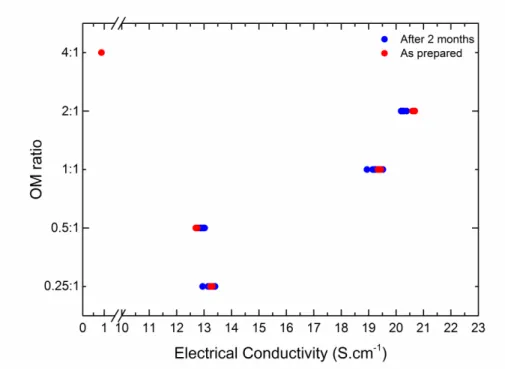
FIGURE 3.3-ELECTRICAL CONDUCTIVITY OF PANI PELLETS MEASURED AFTER 2 MONTHS (BLUE CIRCLES) AND AS PREPARED (RED CIRCLES) IN ORDER TO OM RATIO. ... 16
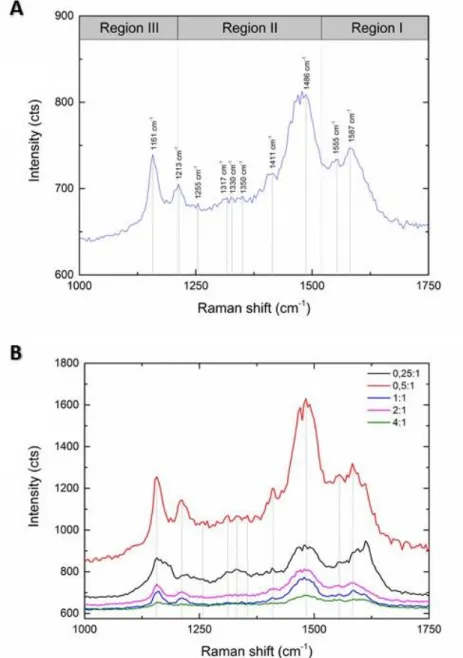
FIGURE 3.4-RAMAN SPECTRA OF PANI2:1OM RATIO WITH PEAK ANALYSIS (A) AND DIFFERENT PANI OM RATIOS SYNTHESIZED (B). ... 17
FIGURE 3.5-SEM MICROGRAPHS OF SYNTHESIZED POWDERS OF PANI2:1OM RATIO (A) AND PANI(T
-BOC) POWDERS (B). ... 18
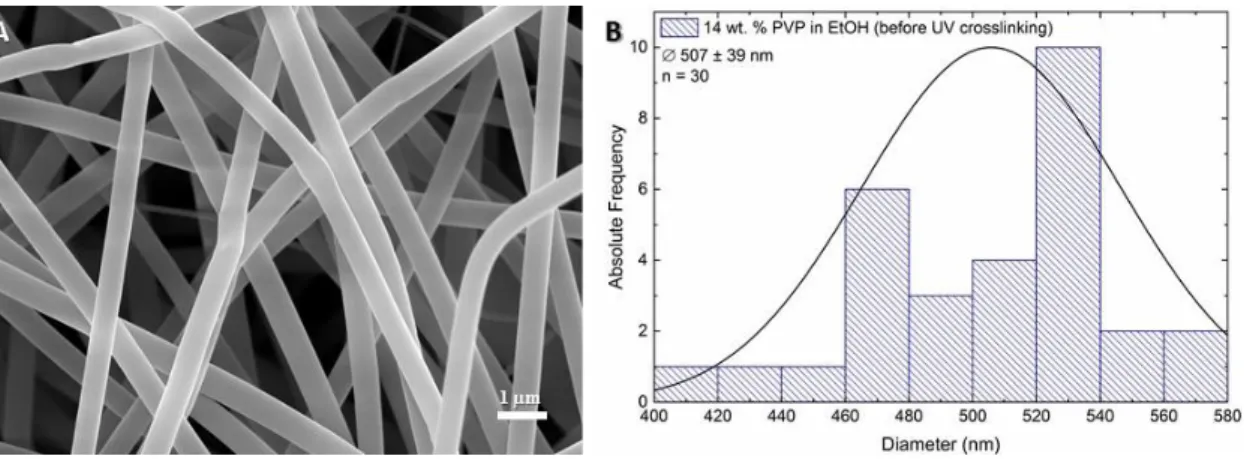
FIGURE 3.6-SEM MICROGRAPHS OF 14 WT.%PVP IN ETOH NON-WOVEN MATS BEFORE UV
CROSSLINKING (A) AND RESPECTIVE MEAN FIBRE DIAMETER (B).SEM MICROGRAPHS WERE
OBTAINED USING A 10K X MAGNIFICATION AND A 5 KV ELECTRON BEAM. ... 19
FIGURE 3.7-AVERAGE WEIGHT LOSS PERCENTAGE IN FUNCTION OF UV CROSSLINKING TIME OF
PVP/ETOH MEMBRANES FOR 5 MIN (BLACK) AND 5 H (RED) IMMERSION IN WATER. ... 20
FIGURE 3.8-SEM MICROGRAPHS OF 14 WT.%PVP/ETOH NON-WOVEN MATS AFTER 45 MIN UV
CROSSLINKING (A), AND RESPECTIVE MEAN FIBRE DIAMETER (B).SEM MICROGRAPH WAS OBTAINED
USING A 10K X MAGNIFICATION AND A 5 KV ELECTRON BEAM. ... 21
FIGURE 3.9-SEM MICROGRAPHS OF 12 WT.%PVP/PANI(T-BOC)/DMF NON-WOVEN MAT BEFORE UV
CROSSLINKING (A) AND RESPECTIVE MEAN FIBRE DIAMETER (B).SEM MICROGRAPH WAS OBTAINED
USING A 10K X MAGNIFICATION AND A 5 KV ELECTRON BEAM. ... 21
FIGURE 3.10-SEM MICROGRAPH OF A PANI(T-BOC) CROSSLINKED SAMPLE EXPOSED 90 MIN TO 1MHCL VAPOURS.SEM MICROGRAPH WAS OBTAINED USING A 10K X MAGNIFICATION AND A 5 KV ELECTRON BEAM. ... 22
FIGURE 3.11-POST-ELECTROSPINNING TREATMENTS ON PANI(T-BOC) NON-WOVEN MATS, TO REMOVE T
-BOC PROTECTING GROUP AND PROTONATE PANI MEMBRANES... 23
FIGURE 3.12-AFM MICROGRAPHS OF PANI(T-BOC) MEMBRANE BEFORE HCL VAPOURS TREATMENT (A);
AND PANI MEMBRANE EXPOSED 5 MIN TO CONCENTRATED HCL VAPOURS (B). ... 24
FIGURE 3.13-AFM MICROGRAPHS OF 10 WT.%PVP IN 2:1ETOH/PEDOT:PSS FIBRE (A) AND 10 WT.%
xxiii
Abbreviations
AFM Atomic force microscopy
Ani Aniline
APS Ammonium persulfate DMAP 4-(dimethylamino)pyridine DMF N, N-dimethylformamide DTBDC di-tert-butyl dicarbonate
ES Electrospinning
EtOH Ethanol
ICP Intrinsically conductive polymer NMP N-methyl-2-pyrrolidinone OM ratio Oxidante-to-monomer ratio PANI Polyaniline
PEDOT Poly(3,4-ethylenedioxythiophene) PSS Polystyrene sulfonate
PVP Polyvinylpirrolidone
SEM Scanning electron microscopy t-Boc tert-butyloxycarbonyl
1
Motivation and Objectives
In the past, smart textiles were presented as imaginary products and they were only used in very limited areas. The scientific efforts on development of new materials for smart textile appli-cations and innovative forms to the production of those materials has led to the production of consumer-accessible devices. A lot of scientists are developing new solutions, ideas and concrete products to answer the needs of everyday life. The smart textiles are now used by consumer, as a clothing device, as well as by military professionals, for protection and safety purpose. [1]
According to a study reported in January 2015 by Grand View Research, Inc., the global smart textiles / smart fabrics market is expected to reach USD 9.3 billion by 2024. The increasing adoption of smart textiles in areas such as sport & fitness and defence & military, is expected to be the main driving force for the industry in the future [2].
The growing interest of scientists and researchers on the development of innovative smart textiles has increased the number of scientific publications and citations. According to Web of Science platform, only in 2017 were published 249 articles, of the 1361 published since 1996, corresponding to 18 %.
3
1
Introduction
1.1
Electrospinning Process
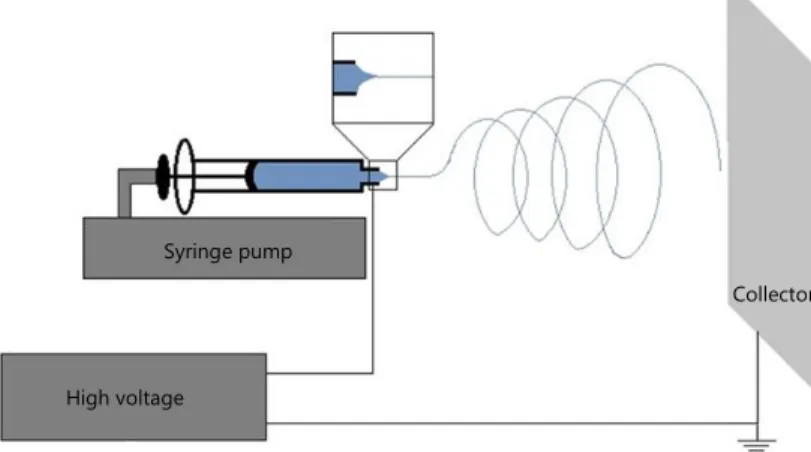
Electrospinning is a simple, cost-efficient and highly versatile fibre production technique that uses electrostatic forces to produce fibres with micrometre diameters or even a few nanome-tres. [3] [4] This process is capable of producing fibres, from solutions or melts, with thinner diameters and large surface area than those obtained via conventional spinning processes. [5] Any electrospinning setup comprises of a high-voltage direct current power supply, a syringe pump and a grounded collecting plate, and it can be operated at room temperature with controlled at-mosphere conditions. [5] [6]
Typically, during the electrospinning procedure, charge is induced by an electric field on the surface of a droplet of a fluid that is coming out from the tip of a needle. As the intensity of the electric field increases the droplet stretches forming the Taylor cone. When the repulsive elec-tric force generated overcomes the surface tension, a charged jet is ejected from the tip of the Taylor cone (Figure 1.1). The fibre formed is accelerated by the electric field and randomly de-posited on a metal collector. During the trajectory, between the metal needle and the grounded collector, solvent evaporates leading to the formation of a non-woven mat on the target. [6]–[8]
There are three types of parameters that affect the morphology of the fibres and electro-spinning process in general: solution properties ( e.g. concentration, viscosity, conductivity and surface tension), ambient parameters (e.g. temperature and humidity), and process parameters (e.g. flow rate, electric potential applied to the tip and the distance between the tip and the grounded collector). [7][9] These parameters can greatly affect fibre formation and structure [6].
Figure 1.1 – Schematic illustration of an electrospinning set-up.
High voltage
Syringe pump
4
1.2
Intrinsically conducting polymers
Intrinsically conductive polymers (ICPs) or synthetic metals are organic polymers with mechanical properties characteristic of a conventional polymer while exhibiting electrical, elec-tronic, optical and magnetic properties common to metallic materials. [10] The synthesis of ICPs implicates an oxidative polymerization of monomer units and can be achieved chemically - using an oxidant agent as reaction initiator -, or electrochemically – by the application of an oxidizing potential through an electrode. [11] ICPs are formed of linear backbones, with alternating double and single bonds along the backbone (conjugate bonding). [12] Its conjugated structure preserves the molecular stability and allows the electron mobility and transport of electric charge within and between the polymer chains. [13] By doping with chemicals known as dopants, the electrical conductivity of ICPs can be increased by several orders of magnitude, to conductivities close to metals and semiconductors. Dopants lead to the formation of counterions through an oxidation or a reduction process, which is reversible and it does not degrade the polymer backbone. [10][14] During the oxidation process, holes are generated along the polymer backbone due to the removal of the electrons. Neighbouring electrons are free to move into these holes allowing the progression of charge along the polymer backbone, which explains its resulting conductivity. [11]
Due to their conductivity, low density, and easy processability [15], ICPs can replace met-als and semiconductors in a lot of applications. Their properties, such as volume, change when submitted to redox reactions. Its ability to store charge and change colour is associated with their oxidation state. In sum, porosity changes, electronic and ionic conductivity [16] allows their ap-plication in organic chemical sensors and electrochromic devices [17], electrodes and actuators, transparent antistatic coatings and solar batteries [15], and in drug release and tissue engineering [18]. However, the production of ICP nanofibres by electrospinning still represents an important challenge. The poor solubility in common solvents and high crystallinity of ICPs due to the rigid backbone presented by this type of polymers, make their electrospinning difficult. [19]
1.2.1
Polyaniline
5
absorption, light-emitting diodes, chemical sensors, electrochromic displays, anodic passivation, corrosion prevention of metals, and electromechanical devices. [21]
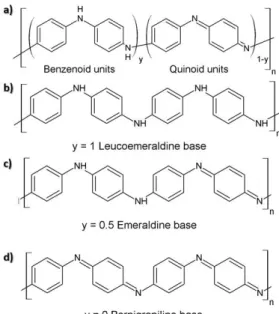
The easiest method to synthesize PANI is via the chemical oxidative polymerization of aniline, in which ammonium persulfate is the most commonly used oxidant agent. [15] Its elec-trical conductivity produced by this method depends on the nature of the reaction medium, tem-perature of the reaction medium, concentration of oxidizing agent, polymerization time [22][23], dopant acid concentration [16], oxidant-to-monomer ratio (OM ratio), rate of addition of the ox-idant to the monomer and purity of monomer [21]. PANI consists of monomer units built from reduced (y, benzenoid units) and oxidized (1-y, quinoid units) blocks (Figure 1.2 a). The average oxidation state can be varied continuously from y=1 to give the completely reduced polymer – leucoemeraldine (Figure 1.2 b) -, to y=0.5 to give the half-oxidized polymer – emeraldine (Figure 1.2 c) -, to y=0 to give the completely oxidized polymer – pernigraniline (Figure 1.2 d). [10] [24] The forms of PANI differ in their colour, stability and conductivity. Doping PANI to a highly conducting regime produces an environmentally stable polysemiquinone radical cation, termed the emeraldine base form of polyaniline. [10] The emeraldine form of PANI is the only form electrically conductive and shows a green colour. Emeraldine may occur as either salt or base forms. The emeraldine salt form of PANI is formed by doping, during protonation of emeraldine base in an acidic medium (1 < pH < 3) with the use of organic or inorganic acids. [15][13]
Figure 1.2 – Chemical representation of generalized PANI structure (a) and its most common forms: (b) completely reduced form (y = 1, Leucoemeraldine base), (c) half-oxidized form (y = 0.5,
6
As all ICPs, PANI is insoluble in most common solvents.
Its low sol
ubility, combined with small molecular weights characteristics of this polymer, makes its electrospinnability diffi-cult. To solve this problem, many researchers uses blends of PANI with commonly electrospun insulating polymers to produce nanofibres. However, the presence of an insulating polymer causes a decrease on conductivity of the elctrospun fibres. [13][25] In another approach, Lee et. al suggests the introduction of an acid-labile tert-butyloxycarbonyl (t-Boc) group to PANI to make the polymer soluble in common organic solvents [26], which allows electrospinning solu-tion formulasolu-tion. The subsequent treatment of the electrospun PANI t-Boc protected fibres with HCl should remove the protecting group and enhance their conductivity, which generate HCl-doped conducting PANI fibres. [27]1.2.2
Poly(3,4-ethylenedioxythiophene):poly(styrenesulfonic acid)
Poly(3,4-ethylenedioxythiophene):poly(styrenesulfonic acid) (PEDOT:PSS) is another ICP with outstanding properties such as excellent environmental stability in air, tuneable conduc-tivity, good thermal stability, the ability to form stable aqueous dispersions at low pH values and manageable properties [19], which allows its use in sensing applications [28], and flexible and portable electronics. [29][30]
Polyethylenedioxythiophene (PEDOT) is insoluble in water and organic solvents, which explains why it is commonly grafted with poly(4-styrenesolfunate) (PSS) (Figure 1.3), a strong polyelectrolyte, that allows its colloidal suspension in water. [31] PSS acts as a dopant too, im-proving electrical conductivity of the PEDOT:PSS copolymer. [32] To overcome the problem of processing ICPs by the electrospinning technique, PEDOT:PSS could be mixed with a carrier polymer, such as polyvinylpirrolidone (PVP), promoting the entanglement of the polymer chains, which allows the fibre formation. [19][32]
7
1.3
Smart textiles
The term “smart textiles”, also known as intelligent textiles, electro- or e-textiles [33], de-scribes textile products, such as fibres and filaments, yarns together with woven, knitted or non-woven structures, which can sense and respond to environmental stimuli [34]. In terms of its form of operation, they can be divided in three main groups:
• Passive smart textiles: able to change their properties according to an environmental stim-ulation (e.g. shape memory materials, hydrophobic or hydrophilic textiles, etc) [34][35];
• Active smart textiles: able to detect and react to different signals from the environment using various textile-based, flexible, or miniaturized actuators (e.g. textile displays, mi-crovibrating devices, light-emitting diode (LED), organic light-emitting diode (OLED), etc) [34][35];
• Very smart textiles: able to sense, react and adapt their behaviour to the given circum-stances (space suits, thermos-regulating clothing, health monitoring apparel) [34][36].
Electronic textiles have attracted massive attention in the past decade due to their potential applications in wearable electronics and portable devices [37], such as healthcare detectors [38][39], portable power [40], work and military uniforms[41][42]. The term “electrically
con-ductive textiles” is used for a vast range of textile fibre-based products with widely differing specific electrical conductivity. Electrically conductive textiles include conductive fibres, yarns, fabrics and final products made from them [36]. Conductive polymers, due to their conjugated backbone, play an important role on smart textiles development in that they offer properties sim-ilar to those of metals and semiconductors, with the advantage of maintaining intrinsic mechanical properties of a polymer material and the possibility to be assembled together with other polymers which allows its easy manufacturing. [43] Fibres / yarns completely made of conducting polymers are usually produced by melt spinning, wet spinning or electrospinning, which produce electro-spun fibre electronics of nano or microsized diameters. Conductive fibres / yarns, due to their tiny shape, are then integrated in textile structures by weaving, knitting or braiding technology [36]. Smart textile research is still in its infancy and there is little understanding of the mechanically demanding environment that electronic circuits face during integration into textiles and subse-quent wearing of the smart textile inside clothing [38].
9
2
Materials and Methods
2.1
Synthesis of Polyaniline (PANI) powders
An oxidant solution of ammonium persulfate (APS, (NH4)2S2O8, Sigma-Aldrich, 98%
purity) in 1M HCl (Honeywell, 37%) was added dropwise to an aqueous acid and organic solution of aniline (Ani, C6H5NH2, Sigma-Aldrich, 99.5% purity) in 1M HCl and chloroform (CHCl3,
Carlo Erba Reagents, for analysis-ISO-Stabilized with EtOH) - heterogeneous medium composed of aqueous acid and an organic phase (aq/org phase) 2:1 vol./vol., in order to prevent undesirable side reactions – protocol adapted from [44]. Five different ratios of monomer to oxidising agent have been studied (1:4, 1:2, 1:1, 1:0.5 and 1:0.25) to maximise the electrical conductivity of PANI powders. All reactions were carried out in an ice bath (at c.a. 0°C) under constant mechanical stirring. After 2 hours of reaction, solutions were filtered with vacuum, washed with 1M HCl solution and then dried in vacuum at 90°C. Pellets of PANI dried powders were produced by uniaxial pressing for electrical conductivity measurements. For this purpose, powders were placed into a 13 mm diameter evacuable pellet die (from Specac) and a load of 3 tons was applied for 60 seconds using a manual hydraulic press from Specac.
2.2
Synthesis of t-Boc protected PANI powders
In a three-necked round-bottom flask, 1.5g of synthesized PANI powders (1:2 mon:ox ra-tio) and 5.9864 g of 4-(dimethylamino)pyridine (DMAP, C7H10N2, FluoroChem) were dissolved
in 30.71 mL of 1-Methyl-2-pyrrolidinone (NMP, C5H9NO, Alfa Aesar, 99% purity). A solution
of 1.375 g of di-tert-butyl dicarbonate (DTBDC, [(CH3)3COCO]2O, Alfa Aesar, 97% purity) in
15.35 mL of NMP was added slowly to the first one. The mixture was stirred for 3h at 80 °C under a nitrogen atmosphere. n-Hexane (C6H14, Carlo Erba Reagents, RPE - For analysis - ACS
- Reag. Ph.Eur.) was added in large excess to precipitate the solid powder. The mixture was then washed with methanol (CH3OH, Honeywell, 99.8 % purity) and filtrated with vacuum. The
filtrated powder was dried in vacuum at 70°C. After grinding the t-Boc protected PANI powders, these were dissolved in N, N-dimethylformamide (DMF, HCON(CH3)2, Carlo Erba Reagents)
and the mixture was filtered to remove any insoluble starting materials.
2.3
Electrospinning of PVP/t-Boc protected PANI
A 15 mL solution of 12 wt.% of Polyvinylpyrrolidone (PVP, (C6H9NO)n, Sigma-Aldrich,
𝑀̅𝑤 = 1.300.000 Da) in DMF with 0.5067 g of t-Boc protected PANI dissolved, was prepared.
10
experiments.The electrospinning experiments were conducted using a high voltage power supply (Glassman high USA), a digitally programmed syringe pump (KdScientific) and a collector. The 12 wt.% PVP / t-Boc protected PANI in DMF solution was pumped through a 1 ml syringe with a metal needle (23-gauge) at a flow rate of 0.25 ml.h-1. A high-voltage of 15.5 kV was applied to
the metal needle to generate nanofibres, which were collected on a grounded aluminium foil at a distance of 15 cm under controlled environmental conditions (temperature of 20 – 25 °C and relative humidity of 30 - 40 %). The average thickness of the electrospun membranes produced have been measured with a digital micrometer and obtained a thickness of 243.3 ± 27.6 µm.
2.4
Electrospinning of PVP/PEDOT:PSS
Electrospinning solutions using PVP as a carrier polymer were prepared by dissolving 10 wt.% of PVP in a binary mixture of Ethanol (EtOH, Scharlau, analytical grade) and poly(3,4-ethylenedioxythiophene) polystyrene sulfonate (PEDOT:PSS, Sigma-Aldrich, 3.0-4.0% in H2O,
high-conductivity grade). Two different EtOH/PEDOT:PSS weight ratios have been studied (2:1 and 1:1) in order to evaluate the suitable solution to produce electrospun fibres with controlled morphology and electrical conductivity. Solutions were kept under magnetic stirring overnight at room temperature to ensure complete homogenization.
PVP-based solutions were loaded into a 1 mL syringe fitted with a 23-gauge blunt tip nee-dle. The solution of 10 wt.% PVP in 2:1 EtOH/PEDOT:PSS was electrospun using a flow rate of 0.15 mL.h-1, an applied voltage of 17 kV and tip-to-collector distance of 18 cm. For the 10 wt.%
PVP in 1:1 EtOH/PEDOT:PSS solution, the electrospinning parameter were: flow rate of 0.15 mL.h-1, an applied voltage of 17.5 kV and tip-to-collector distance of 15 cm. For both systems,
temperature and relative humidity were kept constant at 20 – 25 °C and 30 – 40 %. The membra-nes produced have an average thickmembra-ness of 104.3 ± 30.5 µm.
2.5
Electrospinning of PVP
PVP is a water-soluble polymer and thus required photo-crosslinking. A solution of 14 wt.% of PVP in ethanol was loaded into a 1 mL syringe fitted with a 23-gauge blunt tip needle. PVP membranes were electrospun using a flow rate of 0.3 mL.h-1, an applied voltage of 17 kV
and at a tip-to-collector distance of 15 cm. The membranes produced have an average thickness of 40.6 ± 3.3 µm.
2.6
Crosslinking of PVP-based electrospun membranes
In order to prevent the degradation (dissolution) of fibres upon exposure to humidity, mem-branes of PVP in ethanol prepared in section 2.5 were crosslinked using a BIO-LINK® irradiation
11
crosslinking time. After being UV crosslinked, PVP membranes were immersed in distilled water for two periods - 5 min and 5 h - and then dried in air for 1h at 50°C, to estimate the average mass loss. After the optimization study, all PVP-based electrospun membranes were crosslinked during 45 min.
2.7
Characterisation techniques
All electrical conductivity measurements of PANI pellets and PANI membranes, prior to t-Boc protecting group removal, have been performed using a Hall Effect Measurement System (Ecopia, HMS7000 + AMP55T 0.53T), applying a current of 0.5 mA for all samples. To ensure a good contact between samples and test-probes, a carbon conductive paint (Bare Conductive ©) was used as electrodes. Due to the thin thickness of PVP/PEDOT:PSS membranes, electrical con-ductivity measurements were performed using a home-made I/V curve plotter apparatus. Silver contacts were painted to guarantee a better contact sample-to-test-probe with a silver coating from Holland Shielding Systems B.V. All samples were measured in the interval -1 to 1 V.
Scanning electron microscopy (SEM) was used to evaluate the morphology of electrospun PVP and PVP/t-Boc protected PANI fibres, and PANI and t-Boc protected PANI powders. Small pieces/amounts of the samples were fixed on carbon tape, mounted on a support and sputtered with a thin layer of gold/palladium (Au/Pd), and then analyzed using a Joel JSM7001FSchottky Emission Scanning Electron Microscope (FEG-SEM). The diameter and distribution of the elec-trospun fibres were analyzed using ImageJ software.
13
3
Results and Discussion
In this chapter, experimental work and obtained results will be discussed. In section 3.1, the production of conductive PANI membranes will be presented, comprehending: the synthesis of PANI powders and chemical modification with t-Boc protecting group which allowed the pro-duction of a soluble PANI (t-Boc) in DMF, the electrospinning experiments and fibres morphol-ogy obtained, the removal of t-Boc protecting PANI group with HCl post-treatments and their improvement on membranes conductivity. It is also presented a photo-crosslinking study on PVP membranes. In section 3.2, the production of PEDOT:PSS membranes will be presented. Two solution systems will be discussed in terms of electrospinning experiments and the influence of conductive content on membranes electrical conductivity.
3.1
Polyaniline membranes
One of the focus of this dissertation is the production of conductive PANI membranes through electrospinning technique. To reach such a goal, PANI powders were synthetized by chemical oxidative polymerization of aniline monomer in an aqueous acid medium, using ammo-nium persulfate ((NH4)2S2O8) as oxidizing agent, as described in Figure 3.1. [15]
Figure 3.1 - Chemical oxidative polymerization of aniline monomer by ammonium persulfate.
14
DTBDC, Pyridine, NMP
Figure 3.2 - Schematic drawings for chemical modification of PANI structure with t-Boc protecting group.
3.1.1
Study of the influence of oxidant-to-monomer ratio (OM ratio) in the PANI
pow-ders conductivity
As previously outlined, electrical conductivity of PANI synthesized by this process is de-pendent on: i) nature of the reaction medium; ii) temperature of the reaction medium; iii) polymer-ization time; iv) dopant acid concentration; v) concentration of the oxidant; vi) rate of addition of the oxidizing agent; and vii) oxidant-to-monomer ratio (OM ratio).
The influence of the OM ratio on the PANI powders conductivity was studied. PANI pow-ders were synthesised with five different OM ratios: 4:1, 2:1, 1:1, 0.5:1, and 0.25:1, maintaining constant a 2 h of reaction in an ice bath (c.a. 0 °C), under mechanical stirring.
15
During the oxidative polymerization of aniline, the solutions becomes progressively trans-parent light pink – immediately after the first drops of oxidant solution touches the aq / org aniline solution-, blue, and green – a few minutes after starting the polymerization process. The colour of the solution is due to the presence of soluble oligomers formed by coupling of radical cation of aniline. [45]
After 2 h, the reactions were stopped, immediately filtrated, while washed with a solution of 1 M HCl, and dried in vacuum at 90 °C. Establishing a ratio mass of aniline in solution to the mass of PANI polymer produced, the yield of the chemical polymerization reaction for each OM ratio were estimated (Table 3.1). PANI powders with an OM ratio 2:1 present the highest yield, allowing the production of 0.3614 g of PANI in a 20 mL solution.
Table 3.1 - Estimated yield of chemical polymerization for various OM ratios.
OM ratio 0.25:1 0.5:1 1:1 2:1 4:1
Yield (%) 14 27 63 97 91
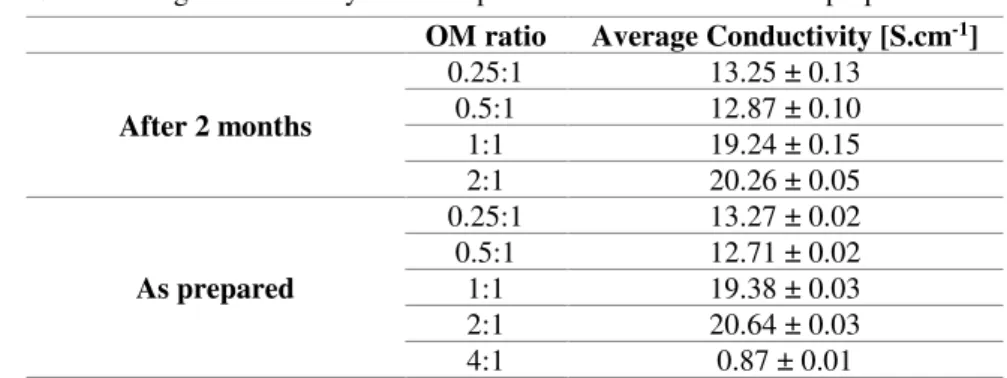
PANI dried powders of each OM ratio were uniaxially pressed to produce pellets which were electrically characterized in a hall effect equipment to measure electrical conductivity. To verify if there exists any degradation or conductivity loss along the time, PANI pellets as prepared and after 2 months were compared. As shown in Figure 3.3, there is no significant change on the conductivity of the pellets over time. In terms of the average electrical conductivity for different OM ratios: 0.25:1; 0.5:1; 1:1 and 2:1, the average value remains in the same order of magnitude, between 12.71 and 20.64 S.cm-1 (see Table 3.2). It is notorious that, as the concentration of
oxi-dizing agent increases, the conductivity of the PANI powders increases. However, when the con-centration of oxidizing agent becomes too high PANI particles precipitation or aggregation may occur and excessive oxidation of aniline monomer with the fracture of the PANI conjugated can explain the decrease of conductivity [46], as can be observed for the 4:1 OM ratio.
Table 3.2 - Average conductivity of PANI pellets after 2 months and as prepared.
OM ratio Average Conductivity [S.cm-1]
After 2 months
0.25:1 13.25 ± 0.13 0.5:1 12.87 ± 0.10 1:1 19.24 ± 0.15 2:1 20.26 ± 0.05
As prepared
16
Figure 3.3 - Electrical conductivity of PANI pellets measured after 2 months (blue circles) and as prepared (red circles) in order to OM ratio.
Considering the maximum yield of the chemical polymerization reaction of 96.63 % and an electrical conductivity of 20.64 S.cm-1, the 2:1 OM ratio PANI powders were selected for the
chemical modification of PANI powders with t-Boc protecting group.
Raman spectroscopy technique was used to evaluate the chemical oxidation of selected PANI powders (Figure 3.4 A). Raman spectra of these powders can be divided in three regions of Raman shift [47]:
In region I, corresponding to C – C ring stretching vibrations, between 1650 and 1520 cm -1, shows a peak at 1587 cm-1 and other at 1555 cm-1, which are associated to the stretching modes
of C = C and C – C vibrations in quinoid and semi-quinone (B) (Q) rings [48].
In region II, at which the different C – N stretching modes prevail, between 1520 and 1210 cm-1, four important aspects can be highlighted: a) A peak at 1486 cm-1, attributed to C = N
stretching in quinoid units (Q) and vibration of imine group [49]–[51]; b) A peak at 1411 cm-1,
associated to C – N bonds of tertiary amines on cyclic structures produced during the crosslinking of the polymer [49]–[51]; c) A set of peaks at 1350, 1330 and 1317 cm-1, corresponding to the
vibrational modes of C – N+• delocalized polaronic structures [52]; d) Two peaks at 1255 and
17
In region III, corresponding to the deformation of C – H bond, between 1210 and 1100 cm -1, the Raman spectra showed a pick at 1161 cm-1, attributed to emeraldine base form [52], which
was also found in all OM ratios of PANI studied (Figure 3.4 B). Furthermore, it is possible to affirm that all the PANIs synthesized are in the emeraldine base form as all samples present the same Raman peaks, as the ones identified for PANI 2:1 OM ratio (Figure 3.4 B).
18
3.1.2
Chemical modification of PANI powders synthesized with a tert-butoxycarbonil
(t-Boc) group
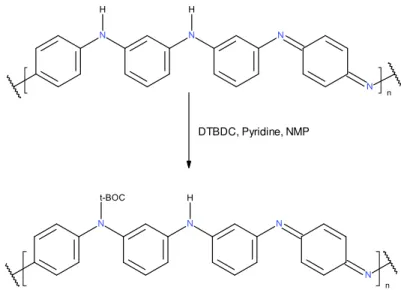
The soluble t-Boc protected PANI was obtained by reacting PANI powders (2:1 OM ratio selected) with DTBDC in NMP as solvent, following a procedure describe in the literature [26]. The emeraldine base form is composed of two amine nitrogen groups followed by two imine nitrogen groups along the chain. When reacted with DTBDC, in presence of DMAP, in NMP, one of the hydrogens of the amine group is substituted by the acid-labile tert-butyloxycarbonyl (t-Boc) group, as show in Figure 3.2. Such chemical substitution allows t-Boc-PANI soluble in common solvents. After precipitation in n-Hexane, the solid reaction product was washed and filtrated. The obtained powder was then dried in vacuum at 70 °C, and the obtained soluble PANI (t-Boc) dissolved in DMF.
SEM analysis of 2:1 OM ratio PANI powders (Figure 3.5 A) and PANI (t-Boc) powders (Figure 3.5 B) showed that chemical modification with the addiction of t-Boc protecting group does not greatly modifies powder morphology.
Figure 3.5 - SEM micrographs of synthesized powders of PANI 2:1 OM ratio (A) and PANI (t-Boc) powders (B).
3.1.3
Study of UV crosslinking time on PVP membranes
As described in section 2.3, t-Boc protected PANI membranes were obtained by electro-spinning of a solution of PVP in DMF with PANI (t-Boc) dissolved. As PVP is a water-soluble polymer, it was necessary to crosslink the electrospun membranes in order to prevent the disso-lution of fibres with time upon exposure to humidity. There are several options to crosslink PVP. Either using high-energy irradiation [53] or temperature treatments [54]; however, in this disser-tation, PVP was crosslinked by means of UV irradiation, a green and cost-effective technique.
19
PVP absorption spectrum (200 – 280 nm). During UV exposure, pyrrolidone substituents and cyclic amines on the PVP chains generate macroradicals, whose recombination leads to intermo-lecular crosslinked PVP. The crosslinking degree will depend on the irradiation dose and hence on the time that the non-woven mats are irradiated.
The study of the optimum UV crosslinking time of PVP was performed for PVP electro-spun membranes and then applied to the electroelectro-spun PVP t-Boc protected PANI fibres. A solution of 14 wt.% PVP in EtOH was prepared and electrospun. The electrospinning parameters used to obtain bead-free fibres were: a flow rate of 0.3 ml.h-1, an applied voltage of 17 kV, tip-to-collector
distance of 15 cm, and 2 h deposition under controlled environmental conditions (30 – 40 % relative humidity and 20 – 25 °C temperature).
Scanning electron microscopy (SEM) proved that electrospun fibres form non-woven mats, with a mean fibre diameter of 507 ± 39 nm (Figure 3.6).
Figure 3.6 - SEM micrographs of 14 wt. % PVP in EtOH non-woven mats before UV crosslinking (A) and respective mean fibre diameter (B). SEM micrographs were obtained using a 10k x magnification
and a 5 kV electron beam.
After electrospinning, membrane samples were peeled-off from the aluminium foil and exposed to UV irradiation for 15, 30, 45, 60, 90 and 120 min. Then, UV crosslinked samples were immersed in water for 5 min and 5 h, left dry in an oven at 50 °C, and their loss of weight calcu-lated (Figure 3.7).
20
Figure 3.7 - Average weight loss percentage in function of UV crosslinking time of PVP/EtOH membranes for 5 min (black) and 5 h (red) immersion in water.
In order to better understand the influence of the UV crosslinking time on the weight loss of PVP membranes, samples were immersed for 5 h in distilled water. An initial decrease on weight loss percentage with increasing UV irradiation time of up to 45 min can be observed. Exposures of 15 and 30 min of UV irradiation leads to weight losses of 52 and 41 %, respectively - indicating a lower irradiation time than the optimal. A UV exposure of 60, 90 and 120 min shows weight losses of 36, 35 and 30 %, respectively. This supports the idea that an excessive
irradiation time leads to degradation of fibres morphology, promoting the disruption of fibre’s
mat [55]. Therefore, 45 min of UV irradiation can be concluded to be the ideal crosslinking time
as it allows membrane’s structure stability. It is important to note that the final application of the fibre does not require their immersion in water; however, it is important that they are resistant to atmospheric air humidity conditions.
21
Figure 3.8 - SEM micrographs of 14 wt. % PVP/EtOH non-woven mats after 45 min UV cross-linking (A), and respective mean fibre diameter (B). SEM micrograph was obtained using a 10k x
magni-fication and a 5 kV electron beam.
3.1.4
t-Boc protected PANI fibres
The electrospinning solution was obtained by dissolving the modified t-Boc protected PANI powders in DMF. Insoluble solids were removed by filtrating the solution with a syringe filter. To guarantee the fibre formation, 12 wt.% of PVP (a carrier polymer) was dissolved in the filtered DMF / t-Boc protected PANI solution. The electrospinning experiments were conducted applying a voltage of 15.5 kV, a flow rate of 0.25 ml.h-1, and keeping the tip-to-collector distance
at 15 cm. Electrospinning process and solution (PVP concentration in DMF) parameters were chosen, despite some changes, accordingly to an optimization study described in the literature [56]. These conditions allowed the formation of a stable Taylor’s cone. After a few minutes of
deposition, a light blue colour, characteristic of the PANI (t-Boc), appeared on the electrospun membrane.
SEM micrographs of t-Boc protected membranes showed non-woven mats with a mean fibre diameter of 179 ± 50 nm (Figure 3.9).
Figure 3.9 - SEM micrographs of 12 wt. % PVP/PANI (t-Boc)/DMF non-woven mat before UV crosslinking (A) and respective mean fibre diameter (B). SEM micrograph was obtained using a 10k x
22
In this study, several treatment approaches with HCl were tested in 8 h electrospun samples to remove the t-Boc protecting group. Membranes were cut to a 20x10 mm size.
Crosslinked (C) and non-crosslinked (NC) samples were immersed in water and in solu-tions of 0.1 M and 1 M HCl. These were then left to dry in air. Membranes turned instantly from light blue to dark green when in contact with water and HCl aqueous solutions. After dried, mem-branes preserved their green colour but seemed to have a film-like structure (sticky). As this ap-proach was probably too destructive to the structure of the fibre, it was chosen to expose the membranes to HCl vapours, using for this purpose a closed vapours chamber. Initially, a cross-linked sample was exposed for 90 min to 1 M HCl vapours. After a few minutes the characteristic green colour of a doped-PANI membrane appeared. Although the membrane does not give the visually impression of a film-like morphology, as observed in the immersed samples, SEM mi-crographs showed a melted fibre structure (Figure 3.10).
Figure 3.10 - SEM micrograph of a PANI (t-Boc) crosslinked sample exposed 90 min to 1 M HCl vapours. SEM micrograph was obtained using a 10k x magnification and a 5 kV electron beam.
In order to attempt to solve this problem, the exposure time to HCl vapours was reduced to 5 min and the acid concentration in the aqueous solution varied – 0.1 M, 1 M and concentrated HCl (37 %). The electrical conductivity measurements revealed that the more concentrated the HCl vapours are, the more conductive the membranes become (Figure 3.11). In presence of HCl or water molecules, t-Boc protecting groups are substituted by them. The complete protonation of the imine nitrogen atoms by aqueous HCl results in the formation of a delocalised polysem-iquinone radical cation, and is accompanied by an increase in conductivity [10].
23
the conductivity of the membrane. As expected, the electrical conductivity of the PANI proto-nated membranes increased as the time of exposure increased. However, 20 min of HCl vapours exposure leads to a decrease in samples average conductivity but with a wider distribution of conductivity values between measurements – this may be explained by the degradation of fibre structure.
Figure 3.11 - Post-electrospinning treatments on PANI (t-Boc) non-woven mats, to remove t-Boc protecting group and protonate PANI membranes.
In order to confirm if exposing PANI (t-Boc) membranes to concentrated HCl vapours destroy the fibre structure, a 5 min exposure membrane was observed by atomic force microscopy (AFM). AFM micrographs showed that only 5 min in a vapour chamber with concentrated HCl causes the fusion of PANI (t-Boc) fibres, leading to partial destruction of fibre’s structure, as
24
Exposing a crosslinked non-woven mat of PANI (t-Boc) to 15 min of concentrated HCl (37 %) vapours leads to an electrical conductivity of 5.1810-3 S.cm-1. The results are not the best
accordingly to the literature, however all treated membranes agree with the electrical conductivity interval of electrospun PANI fibres (6.210-7 to 20 S.cm-1) (see Supporting Information). Its low
conductivity value is due to the addition of a matrix polymer, PVP, to promote the entanglement of the polymer chain. The random orientation of the fibres within the PVP polymer matrix results in less contact points between PANI chains and so reducing electron diffusion across the mem-brane.
Figure 3.12 - AFM micrographs of PANI (t-Boc) membrane before HCl vapours treatment (A); and PANI membrane exposed 5 min to concentrated HCl vapours (B).
3.2
PEDOT:PSS membranes
As the focus of this dissertation is the production of conductive non-woven mats, PE-DOT:PSS, another ICP, was used as comparative system to the PANI electrospun membranes. As previously mentioned in section 1.2.2, PEDOT is insoluble in water and organic solvents. However, PEDOT grafted with poly(4-styrenesolfunate) (PSS), a strong polyelectrolyte, allows PEDOT:PSS suspension in water and increases its electrical conductivity.
3.2.1
PEDOT:PSS fibres production
25
that the solution 2:1 EtOH/PEDOT:PSS after the addiction of the calculated amount of PVP be-came more viscous than the 1:1 EtOH / PEDOT:PSS solution, leading to different electrospinning conditions to guarantee Taylor’s cone formation. The applied conditions are shown in Table 3.3:
Table 3.3 - Electrospinning process conditions of PEDOT:PSS membranes.
Solution Flow rate (ml.h-1) Voltage (kV) Distance (cm)
2:1 EtOH / PEDOT:PSS 0.15 17 18
1:1 EtOH / PEDOT:PSS 0.15 17.5 15
All electrospinning experiments were carried out under controlled environmental condi-tions – 30 to 40 % relative humidity, and temperature of 20-25 °C. The mean fibre diameter was estimated by AFM. In AFM, a three-dimensional shape (topography) of the sample surface is obtained by scanning the interaction between the force that the probe exerts on the sample and the force that the sample imposes on the probe. This interaction estimates the position of the sample with respect to the probe and the height of the probe is recorded. Nevertheless, during the electrospinnig process, a glass slide was placed next to the collector for 10 s, in order to collect a set of fibres from each solution. The collected fibres were analysed by AFM (Figure 3.13), pre-senting differences between the heights and widths of the fibres, in both electrospun collected samples.
Figure 3.13 - AFM micrographs of 10 wt. % PVP in 2:1 EtOH/PEDOT:PSS fibre (A) and 10 wt. % PVP in 1:1 EtOH/PEDOT:PSS fibre (B).
26
mean fibre widths were estimated, obtaining a mean fibre width of 1.75 ± 0.34 µm to 2:1 EtOH/PEDOT:PSS solution, and 2.45 ± 0.26 µm to 1:1 EtOH/PEDOT:PSS solution. It can be observed a higher difference between maximum height (64.96 nm) and mean fibre width (2.45 ± 0.26 µm) for 10 wt. % PVP in 1:1 EtOH/PEDOT:PSS fibre (vs 241 nm height and 1.75 ± 0.34 µm, for 10 wt. % PVP in 2:1 EtOH/PEDOT:PSS fibre). A non-uniform fibre diameter is also notorious in the AFM micrographs of fibres obtained from 1:1 EtOH/PEDOT:PSS solution. This fact leads to the conclusion that the presence of a higher amount of EtOH on electrospinning solution results in better solvent evaporation before fibres reach the collector.
Electrical conductivities of 2 h electrospinning membranes were measured using a home-made I/V curve plotter apparatus. This equipment applies an electrical potential from -1 to 1 V between the two test-probes and records the current response. The resultant current-voltage char-acteristic IV curve give electrical information of the sample measured, such as its electrical con-ductivity. On forward bias region, the slope of the linear region of the curve gives information on the inverse of the resistance value (1/R). Knowing the dimension of the sample, it is possible to
estimate the electrical conductivity (σ) from the equation:
𝜎 =1𝑅𝐴𝑙 (1)
Where 1
𝑅 is the inverse of the resistance, 𝑙 is the distance between silver contacts, and 𝐴 the
cross-sectional area. Three measurements for each electrospun membrane were performed and by the extrapolation of resistance values from the IV curves calculated the average conductivity of each system. As shown in Table 3.4, the solution of 10 wt. % PVP in 1:1 EtOH / PEDOT:PSS reveals a higher electrical conductivity – 4.0210-8 ± 1.910-9 S.cm-1. This difference in
conduc-tivity is clearly explained by the higher content of conductor component – PEDOT:PSS – on the electrospinning solution. These results are a quite low for electrode applications. However, the mean fibre diameter and electrical conductivity of both membranes are better than a similar sys-tem PEDOT:PSS / PVP found in the literature [28].
Table 3.4 - Average electrical conductivity of PVP/PEDOT:PSS membranes.
Solution Fibres diameter [µm] Average membrane conductivity [S.cm-1]
10 wt. % in
2:1 EtOH / PEDOT:PSS 1.75 ± 0.34 (1.8 ± 0.2) 10
-8
10 wt.% in
1:1 EtOH / PEDOT:PSS 2.45 ± 0.26 (4.0 ± 0.2) 10
27
29
4
Conclusions and Future Perspectives
This dissertation reports on the development of conductive nanofibres capable to be used in smart textile applications. Two different intrinsically conductive polymers – polyaniline (PANI) and poly(3,4-ethylenedioxythiophene)-poly(styrenesulfonate) (PEDOT:PSS) - were elec-trospun through electrospinning technique which allowed the production of non-woven mats from both ICPs. The inherent difficulty in electrospinning of conductive polymers, due to their poor solubility, rigid backbone and low viscosity in aqueous solutions made it necessary to use a carrier polymer – polyvinylpirrolidone – in both systems to promote the entanglement of the polymer chains and consequent fibre formation.
For the production of conductive PANI electrospun membranes, PANI powders were firstly synthetized through chemical oxidative polymerization of aniline monomer in an aqueous acid medium using ammonium persulfate as oxidizing agent. The influence of oxidant -to-mon-omer ratio on the electrical conductivity of PANI powders was studied in detail. PANI obtained using an OM ratio of 2:1 not only led to a high chemical reaction yield of 97 %, but also showed the highest electrical conductivity, 20.6 S.cm-1. Additionally, the electrical conductivity of
pressed PANI powders have demonstrated a good stability over a period of 2 months.
Since PVP is a water-soluble polymer, an optimization study of the UV crosslinking was carried out by exposing PVP electrospun membranes to different UV exposure time. After being immersed in water for 5 min and 5 h, and dried, the samples irradiated for 45 min showed the lower weight loss percentage, 12.5 ± 2.7 %, for samples immersed 5 min in water and 29.4 ±
6.5% for 5 h immersed in water. As the fibre final application does not require their immersion in water, but only that they are resistant to normal air humidity conditions, 45 min exposure to UV irradiation was found to be the optimal condition to crosslink all electrospun membranes. Interestingly, after 45 min UV irradiation, PVP non-woven mats presented an increase in the mean fibres diameter - from 506 ± 39 nm to 677 ± 71 nm. This increase may be due to the recom-bination of macroradicals in intermolecular crosslinking of PVP.
After crosslinked for 45 min, the PANI (t-Boc) electrospun membrane presented a mean fibre diameter of 179±50 nm. Since PANI (t-Boc) membrane is non-conductive, several treat-ments with HCl were carried out to remove the t-Boc protecting group. It was found out that 15 min of exposure to concentrated HCl vapours leads to a maximum conductivity of 5.2×10⁻³ S.cm -1. However, all HCl treatments explored appeared to cause the fibre fusion, which was not desired
30
As expected, the membrane with a higher content of PEDOT:PSS (1:1 ratio) showed a conductivity slightly higher, (4.0 ± 0.2) 10-8 S.cm-1, than the membrane obtained with a ratio of
2:1, (1.8 ± 0.2) 10-8 S.cm-1.
According to the literature, PANI and PEDOT fibres are expected to present electrical con-ductivities in a large range of values, from 10-12 to 101 S.cm-1. In Supporting Information, a
sum-mary of some representative methods developed for the fabrication of conductive electrospun PANI and PEDOT fibres is outlined.