This paper is available online free of all access charges (see http://jxb.oxfordjournals.org/open_access.html for further details)
RESEARCH PAPER
The ER luminal binding protein (BiP) mediates an increase in
drought tolerance in soybean and delays drought-induced
leaf senescence in soybean and tobacco
Maria Anete S. Valente1, Jerusa A. Q. A. Faria1, Juliana R. L. Soares-Ramos1, Pedro A. B. Reis1,
Guilherme L. Pinheiro1, Newton D. Piovesan1, Ange´lica T. Morais2, Carlos C. Menezes3, Marco A. O. Cano4, Luciano G. Fietto1, Marcelo E. Loureiro4, Francisco J. L. Araga˜o2and Elizabeth P. B. Fontes1,*
1
Departamento de Bioquı´mica e Biologia Molecular, BIOAGRO, Universidade Federal de Vicxosa, Avenida PH Rolfs s/n, 36571.000 Vicxosa, MG, Brazil
2
Embrapa Recursos Gene´ticos e Biotecnologia, PqEB W5 Norte, 70770-900, Brası´lia, DF, Brazil 3
Universidade de Rio Verde, Fazenda Fontes do Saber, 75901-970, Rio Verde, GO, Brazil 4
Departamento de Biologia Vegetal, Universidade Federal de Vicxosa, 36571.000, Vicxosa, MG, Brazil
Received 17 September 2008; Revised 28 October 2008; Accepted 29 October 2008
Abstract
The ER-resident molecular chaperone BiP (binding protein) was overexpressed in soybean. When plants growing in soil were exposed to drought (by reducing or completely withholding watering) the wild-type lines showed a large decrease in leaf water potential and leaf wilting, but the leaves in the transgenic lines did not wilt and exhibited only a small decrease in water potential. During exposure to drought the stomata of the transgenic lines did not close as much as in the wild type, and the rates of photosynthesis and transpiration became less inhibited than in the wild type. These parameters of drought resistance in the BiP overexpressing lines were not associated with a higher level of the osmolytes proline, sucrose, and glucose. It was also not associated with the typical drought-induced increase in root dry weight. Rather, at the end of the drought period, the BiP overexpressing lines had a lower level of the osmolytes and root weight than the wild type. The mRNA abundance of several typical drought-induced genes [NAC2, a seed maturation protein (SMP), a glutathione-S-transferase (GST), antiquitin, and protein disulphide isomerase 3 (PDI-3)] increased in the drought-stressed wild-type plants. Compared with the wild type, the increase in mRNA abundance of these genes was less (in some genes much less) in the BiP overexpressing lines that were exposed to drought. The effect of drought on leaf senescence was investigated in soybean and tobacco. It had previously been reported that tobacco BiP overexpression or repression reduced or accentuated the effects of drought. BiP overexpressing tobacco and soybean showed delayed leaf senescence during drought. BiP antisense tobacco plants, conversely, showed advanced leaf senescence. It is concluded that BiP overexpression confers resistance to drought, through an as yet unknown mechanism that is related to ER functioning. The delay in leaf senescence by BiP overexpression might relate to the absence of the response to drought.
Key words: Binding protein, BiP, drought tolerance, environmental stresses, leaf senescence, soybean.
Introduction
Plants under natural conditions are continually subject to environmental stresses that adversely affect growth and productivity. As a consequence, they have evolved a variety of adaptive and molecular responses. Water deficit is among
the major environmental limitations to crop productivity. Engineered overexpression of a single downstream target, such as biosynthetic enzymes for osmoprotectants, enzymes of the antioxidant system, late embryogenesis abundant
* To whom correspondence should be addressed: E-mail: [email protected] ª2008 The Author(s).
(LEA) proteins, and molecular chaperones, has been shown to increase water deficit tolerance in plant model systems (Gupta et al., 1993; Wehmeyer and Vierling, 2000; Rodrigues et al., 2006; Ashraf and Foolad, 2007). The endoplasmic reticulum (ER)-resident molecular chaperone BiP (binding protein) has been shown to confer drought tolerance when constitutively overexpressed in N. tabacum
(Alvim et al., 2001). However, the underlying mechanism for BiP-mediated increases in water stress tolerance and the effectiveness of this strategy on other economically relevant crops are unknown. They constitute the major focus of the present investigation.
BiP has been demonstrated to act as a multifunctional protein in animal systems (for a review see Maa and Hendershot, 2004; Malhotra and Kaufman, 2007). BiP assists in the folding of proteins and also acts in the ER quality control mechanism that recognizes unfolded or abnormally folded proteins and sends them out of the organelle for degradation (Maa and Hendershot, 2004). Conditions that disrupt ER homeostasis and promote the accumulation of misfolded or unfolded proteins in the ER lumen cause ER stress. Cells respond to ER stress by activating a protective signalling cascade, designated un-folded protein response (UPR), that allows the ER process-ing and foldprocess-ing capacities to be balanced with the cell secretory activity (Malhotra and Kaufman, 2007). In animal systems, BiP plays a major role as a sensor of disturbances in protein folding. It regulates the activity of the UPR proximal transducers, PERK, URE1, and ATF6 (Malhotra and Kaufman, 2007). Overexpression of BiP in mammalian cultured cells (Morriset al., 1997) and tobacco protoplasts (Leborgne-Castelet al., 1999) increases cell tolerance to ER stress, whereby ER stress is defined as an imbalance between the cellular demand for ER function (proper protein folding) and the capacity of the ER to carry out this function. Furthermore, antisense down-regulation of BiP mRNA has been shown to increase the sensitivity of transfected cells to ionophores (Li and Lee, 1991; Liet al., 1992) and oxidative stress (Gomeret al., 1991).
The effect of BiP overexpression on a typical ER stress response was investigated previously using a germination/ survival assay in the presence of tunicamycin, a potent inducer of ER stress and an activator of UPR (Alvimet al., 2001). Transgenic seeds expressing a soybean BiP gene (soyBiPD, Figueiredoet al., 1997) were better able to cope with ER stress (Alvimet al., 2001). As in mammalian cells, in plants the BiP-mediated protection against ER stressors is related to the alleviation of the reduced protein synthesis (Morris et al., 1997; Laitusis et al., 1999; Leborgne-Castel
et al., 1999; Alvim et al., 2001). In addition to alleviating ER stress and being up-regulated by treatments that promote ER stress, the ER-resident molecular chaperone BiP from soybean exhibits an unusual response to drought. Four BiP genes have been identified in soybean (Kalinski
et al., 1995; Figueredo et al., 1997). Overexpression of one of these, soyBiPD, has been found to confer tolerance to drought in the plant model systemN.tabacum(Alvimet al., 2001). Although the mechanism of BiP-mediated water
stress tolerance has yet to be elucidated, BiP overexpression prevented the increase in anti-oxidative defences found in wild-type plants exposed to drought. Some physiological and molecular changes in the response to drought in-troduced by the overexpression of BiPD in soybean are investigated here, including the effect of this overexpression on soybean leaf senescence. In addition, the effect ofBiPD
silencing and BiPD overexpression on leaf senescence in drought-stressed tobacco is reported.
Materials and methods
Soybean transformation
A plant expression cassette containing the soyBiPD gene (GeneBank accession number AF031241) was constructed by insertion of the 2.0 kb XbaI cDNA insert of pUFV42 (Alvim et al., 2001) into the pBS35SdAMVNOS2 vector. The resulting clone pBS35SdAMVNOS2-BiP contains the BiP cDNA under control of a duplicated cauliflower mosaic virus 35S promoter with an enhancer region from the alfalfa mosaic virus and the polyadenylation signal of thenosgene. The Arabidopsis thaliana ahas gene (that confers tolerance to the herbicide imazapyr) was removed from the vector pAC321 (Araga˜o et al., 2000) with XbaI and inserted into the vector pFACM1 to generate pFACMahas. The BiPD
expression cassette was released with SalI and NotI from pBS35SdAMVNOS2-BiP and cloned into the vector pFACMahas to yield pahasBip. The vector pahasBip was used to transform soybean (cv. Conquista) as previously decribed by Araga˜o et al. (2000). Primary transformants were selected by PCR. Segregation analyses of indepen-dently transformed soybean lines (35S:BiP-1, 35S:BiP-2, 35S:BiP-3, 35S:BiP-4) were performed by PCR and accu-mulation of BiP was monitored in each subsequent generation by immunoblottings.
PCR analysis of transgenic plants
PCR was carried out on 20 ng of genomic DNA isolated from 4-week-old greenhouse-grown transgenic plants, using 200 nM each of BiPgene-specific primers and 5 U of Taq
polymerase (Invitrogen) in a final volume of 25 ml. The PCR reactions were conducted for 35 cycles (60 s at 95°C, 60 s at
50°C, and 60 s at 72°C) with a final extension at 72°C, for 5
min. The soyBiPD-specific primers, bipsoy235 (5# -GAGA-GACTAATTGGAGAGGCTG-3#) and bipsoy645c (5# -ATAGGCAATGGCAGCAGCAGTG-3#), amplify a 410 bp sequence from the BiPD gene coding region and cover an intron region from genomicBiPDsequence.
Immunoblot analysis
gels to nitrocellulose membranes by electroblotting. Immu-noblot analyses were performed using polyclonal BiP anti-bodies prepared against a purified protein fraction from soybean seeds (Figueiredoet al., 1997) or against anE.coli -produced BiP carboxy domain (anti-carboxy BiP; Buzeli
et al., 2002), at a 1:1000 dilution and a goat anti-rabbit IgG alkaline phosphatase conjugate (Sigma) at a 1:5000 dilution. Alkaline phosphatase activity was assayed using 5-bromo-4-chloro-3-indolyl phosphate (Sigma.) and p-nitro blue tetra-zolium (Sigma).
Isolation of microsomal fraction
The isolation of the microsomal fraction from soybean leaves was performed as described by Pirovaniet al.(2002). Briefly, soybean leaves were homogenized with 25 mM TRIS/HCl, pH 7.0, 250 mM sucrose, 2.5 mM dithiothreitol, 10 mM EDTA, and 0.5 mM phenylmethylsulphonyl fluoride in the ratio of 1 g tissue per 5 ml buffer. The homogenate was filtered and centrifuged for 15 min at 14 000 g and 4 °C.
Microsomal preparations were isolated by centrifugation at 80 000gfor 50 min at 15°C and the pellet was washed twice
with 10 mM MES-KOH pH 6.8, 2.5 mM DTT, resuspended in 100 mM K2HPO4/KH2PO4pH 7.5 and stored at –80°C.
Plant growth and water stress induction
Soybean seeds of wild type (Glycine maxcv. Conquista) and transgenic lines were germinated in organic soil (Bioplant), transferred to 3.0 l pots containing a mixture of soil, sand and dung (3:1:1 by vol.; Pedra et al., 2000) and grown in greenhouse conditions under natural conditions of light, relative humidity (65–85%) and temperature (15–35°C) and
approximately equal day and night length. A slow soil drying experiment was imposed in 50% of wild type and transgenic lines at the V6 stage of development. Control plants were watered daily, providing about 180 ml of water per plant. In the drought treatment the daily water supply was reduced to about 40% of that of the controls. The drought treatment lasted for 18 d. After this period, the plants again received the normal water supply for 2 weeks. The remaining 50% of plants received normal water supply continuously. All the experiments were conducted with five clones from at least four independently transformed lines. For the fast soil drying experiment, after 30 d of growth with normal water supply (V3 stage of development), severe drought stress was induced by withholding irrigation for one-week from one-half of 35S:BiP-2 (T4 generation), 35S:BiP-4 (T5generation) and wild-type plants.
Drought experiments were also conducted using the T4 generation of transgenic control (pBI121 vector alone), transgenic sense (35S-BiPS lines), and transgenic antisense (35S-BiPAS lines) tobacco plants (Alvimet al., 2001). In this case, 2-week-old seedlings were transplanted individually into pots and grown in a growth chamber with a 12 h photoperiod at a 23/18 °C day/night temperature cycle, 240 lmol m 2s 1irradiance, and a relative air humidity of 60%.
After 4 weeks of growth with normal water supply, one-half of the transgenic plants received 40% of the normal irrigation (restricted water regime) for 35 d and the remaining trans-genic plants received normal water supply continuously (control).
For the PEG-induced dehydration experiment, soybean seeds from 35S:BiP-2 and 35S:BiP-4 transgenic lines as well as untransformed soybean seeds were germinated in MS medium (Murashige and Skoog, 1962) without and with 1% (w/v) or 2% (w/v) PEG. After 30 d, the length (cm) and the dry weight (g) of roots were determined.
Real-time RT-PCR analysis
For quantitative RT-PCR, total RNA was extracted from frozen leaves with TRIzol (Invitrogen) according to the instructions from the manufacturer. The RNA was treated with 2 U of RNase-free DNase (Promega) and further purified through RNeasy Mini Kit (QIAGEN) columns. First-strand cDNA was synthesized from 4lg of total RNA using oligo(dT)-18 and Trancriptase Reversa M-MLV (Invitrogen), according to the manufacturer’s instructions.
Real-time RT-PCR reactions were performed on an ABI7500 instrument (Applied Biosystems), using SYBRÒ
Green PCR Master Mix (Applied Biosystems). The ampli-fication reactions were performed as follows: 2 min at 50°C, 10 min at 95°C, and 40 cycles of 94°C for 15 s and
60 °C for 1 min. To confirm quality and primer specificity,
the size of amplification products was verified after electro-phoresis through a 1.5% agarose gel, and the Tm (melting temperature) of the amplification products was analysed in a dissociation curve, performed by the ABI7500 instrument. The primers used are listed in Table 1. For quantitation of gene expression in soybean leaves, RNA helicase (Irsigler
et al., 2007) was used as the endogenous control gene for data normalization in real-time RT-PCR analysis. For the quantitation of gene expression in tobacco leaves, actin was used as a control gene (Costaet al., 2008).
Fold variation, which is based on the comparison of the target gene expression (normalized to the endogenous control) between experimental and control samples, was quantified using the comparative Ct method: 2– (DCtTreatment–DCtControl). Absolute gene expression was quantified using the 2–DCTmethod and values were normal-ized to the endogenous control.
Photosynthesis and chlorophyll fluorescence
Proline content determination
Proline content was determined spectrophotometrically after quantitative extraction with 80% (v/v) ethanol, re-action with ninhydrin, followed by quantitative extrre-action with toluene, as described by Bateset al. (1973) and using L-proline (Sigma) as standard.
Determination of chlorophyll content and lipid peroxidation
Total chlorophyll content was determined spectrophotomet-rically at 663 nm and 646 nm after quantitative extraction from individual leaves with 80% (v/v) acetone as described by Lichtenthaler (1987). The extent of lipid peroxidation in leaves was estimated by measuring the amount of MDA, a decomposition product of the oxidation of polyunsatu-rated fatty acids. The malondialdehyde (MDA) content was determined by the reaction of thiobarbituric acid (TBA) as described by Hodgeset al.(1993).
Statistical analysis
Statistical analysis of data was performed using a one-way analysis of variance and the least statistic difference (LSD) test for multiple pairwise comparisons at P<0.05 with the Software Scientific (SOC) package (EMBRAPA, Brazil). Means were also compared by the Tukey test at 5% probability.
Results
Generation of soybean transgenic lines
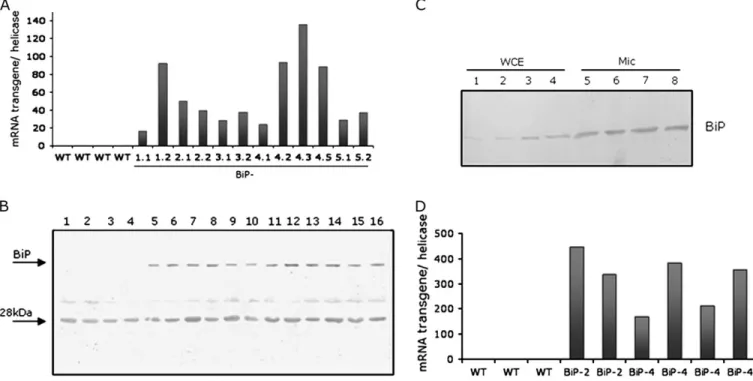
To examine the protective function of BiP against de-hydration in soybean, transgenic plants were generated that expressedsoyBiPDunder the control of the 35S cauliflower mosaic virus promoter. Several independent transgenic lines were established; the expression level of the transgene was analysed by RT-PCR and the accumulation of BiP was monitored in each subsequent generation by immunoblot-ting. The independently transformed overexpressing (OE) lines constitutively accumulated higher levels of BiPD
mRNA (Fig. 1A) and protein (Fig. 1B) than untrans-formed, wild-type controls. The antibody prepared against purified BiP from soybean seeds cross-reacted with a 28 kDa polypeptide that persisted as a contaminant in the purified BiP fraction used as antigen. To examine whether the ectopically expressed BiP protein was correctly localized in transgenic cells, microsomal fractions were prepared from soybean leaves at the V3 developmental stage and immunoblotted with an anti-BiP serum (Fig. 1C). As expected, BiP was detected in microsomal membrane-enriched fractions from wild-type leaves (lanes 5 and 6) and to a higher extent in microsomal fractions from 35S:BIP-2 and 35S:BiP-4 leaves (lanes 7 and 8). These results indicate that high levels of ectopically expressed BiP were correctly localized in the ER of soybean transgenic leaf cells. Trans-gene expression, analysed by RT-PCR, was also higher in roots of independently transgenic lines (Fig. 1D).
Stress tolerance in 35S:BiP transgenic lines
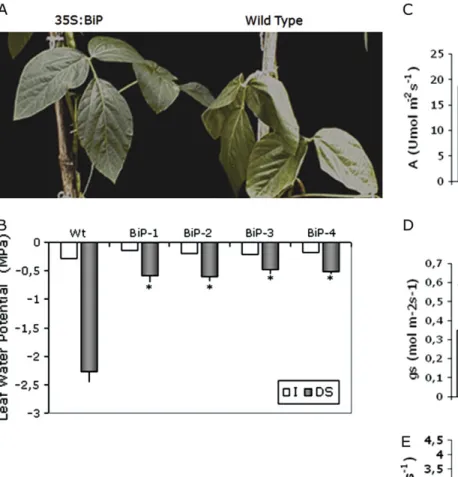
To investigate whether overexpression ofBiPwas correlated with water stress tolerance in soybean transgenic lines, either T3 transgenic plants at the V6 developmental stage or T4 transgenic plants at the V3 developmental stage were subjected to two distinct water deficit regimes, slow and fast soil drying treatments. In the first one, water deficit was induced by a reduction of irrigation to a 40% level for 18 d. This slow soil drying experiment was intended to mimic field conditions and to allow physiological and molecular responses to low water potential (ww) be examined for a longer period. The soil water content of all samples was recorded as a function of time to ensure that the extent of soil drying or the severity of plant water stress was similar for all samples analysed. After 18 d of 40% irrigation the leaves of wild-type plants had completely wilted. The transgenic plants, by contrast, had normal turgid leaves (Fig. 2A). The leafww of stressed wild-type plants declined to a maximum stress of –2.2 MPa, whereas the leafwwof transgenic plants did not decrease below –0.7 to –1.0 MPa (Fig. 2B). The leaf water status indicated that BiP overexpressing lines were protected against dehydration. However, this was not a direct result of stomatal closure because, in independent transgenic Table 1. Genes analysed and primers for qRT-PCR
Clone description Clone accession Forward primer Reverse primer
Calnexin AW508066 TGATGGGGAGGAGAAGAAAAAGGC CACTTGGGTTTGGGATCTTGGCTC
BiPD AF031241 ATCTGGAGGAGCCCCAGGCGGTGG CTTGAAGAAGCTTCGTCGTAAAACTAAG
SMP (LEA) AW397921 GCCGAACTGAGGAAAAGACGAACC CTTGGGCTGTTTGTTGGGTCTTC
BiP transgene BIPD-nos ATCTGGAGGAGCCCCAGGCGGTGG CATCGCAAGACCGGCAACAGGAT
RNA helicase AI736067 TAACCCTAGCCCCTTCGCCT GCCTTGTCGTCTTCCTCCTCG
GST AACI8566 CGGTTCTCATCCACAATGGCAAAC CAGCCCAGAATCTAGCCTGAGC
NAC2 AY974350 TGACCTCTATGTCCCTGCGTTA CCCCTGTGTGAAATCATTCTGA
Antiquitin AY250704 CGAAAAGGGAGAGGAGGACTTC TCTGGGTCACCGAAAGGCAA
PDI3 AW277660 CGAAAAGGGAGAGGAGGACTTC TCTGGGTCACCGAAAGGCAA
Actin AB158612 AGCAAGGAAATTACCGCATTAGC ACCTGCTGGAATGTGCTGAGA
NTCP-23 AB032168 GTGGACTGTGCTGGAGCTTTTAAT ATAAGCCATTCTTGCCAGTGTATG
lines under stress conditions, the stomatal conductance and transpiration rate were significantly higher than in wild-type lines (Fig. 2D, E). The stomatal conductance, transpiration and photosynthetic rate did not differ in well-watered wild-type and transgenic lines (Fig. 2C, D, E). The transgenic lines also displayed normal growth and were undistinguible from the wild type (results not shown). However, under 40% irrigation the stomata did not close as much as in the wild type, and both the rate of transpiration and the rate of photosynthesis were not reduced as much as in the wild type (Fig. 2C). In the 40% irrigation experiment, the photochem-ical efficiency (Fv/Fmratio) of transgenic and wild-type leaves remained unaltered and was similar to that of the well-watered counterparts (data not shown). After the 18 d period of drought, the plants were rewatered and their recovery was evaluated (Fig. 2). By contrast with the wild-type plants that required 14 d to recover (RW-14d), the transgenic lines recovered faster. Within a 5 d period of normal watering, their rate of photosynthesis and transpiration, and their stomatal conductance were similar to that of continuously normally irrigated controls. By then these parameters had significantly higher values than in the drought-stressed wild type.
For the fast soil drying treatment, wild type, 35S-BiP-2, and 35S-BiP-4 lines were allowed to reach the V3 stage of development when drought was rapidly induced by with-holding irrigation for 7–10 d. After the 7 d period, the leaves of wild-type lines had completely wilted, whereas the leaves of the transgenic plants were still turgid (Fig. 3A). This was associated with a significantly higher relative water content of the leaves in BiP overexpressing plants, com-pared with those in the wild type (Fig. 3B).
Drought-induced variations on photosynthetic rate, sto-matal conductance, and transpiration rate in transgenic (35S:BiP-4) and wild-type lines followed the same pattern as observed during mild water stress (see above), although, under severe drought, the differences between wild type and transgenic lines were lower but yet statistically significant (Fig. 3C, D, E; see Supplementary Fig. S1 atJXBonline).
Ectopic expression of BiP in soybean does not promote typical stress avoidance responses
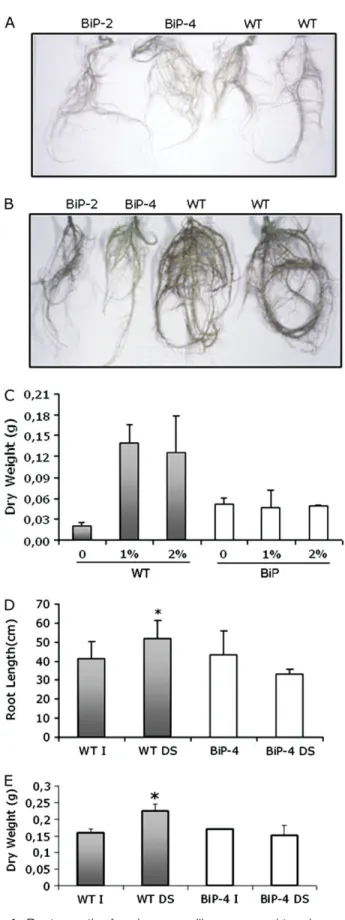
Fig. 3B), suggesting that a stress avoidance mechanism could account, at least in part, for the apparent increase in water stress tolerance mediated by BiP. The reported data indicate that stomatal closure did not account for the water-stress tolerance in the BiP overexpressing lines. It is hypothesized that an adaptation in root growth might explain the drought tolerance. PEG was used for inducing a low ww stress. In the absence of PEG, the seedlings of controls and BiP-overexpressing lines developed roots at similar growth rates (Fig. 4A). The inclusion of 1% or 2%
PEG in the rooting medium resulted in a typical increase in root growth in wild-type seedlings (Fig. 4B, C). By contrast, treatment of OE seedlings with PEG did not alter signif-icantly root morphology and root DW. Hence overexpres-sion ofBiPseemed to prevent the drought-induced increase in root growth.
To examine whether the observed root response of soybean plants to PEG-induced osmotic stress also exists for plants growing in soil under drought stress, wild type and OE lines were subjected to a 7–9 d period of severe Fig. 2. Elevated levels of BiP confer drought tolerance to soybean plants under a restricted water regime. (A) Overexpression ofBiP maintains leaf turgidity under drought. Drought stress was induced by reducing irrigation to 40% of the daily normal water supply. The leaves were photographed on day 18 of the experiment. (B) Leaf water potential of transgenic leaves under drought stress (reducing daily irrigation). Each value represents the mean6SD of five replicates from three independent experiments. The asterisks indicate significant differences atP<0.05 as compared to the wild type. I, normally irrigated; DS, drought stress. (C, D, E) Photosynthesis and water relations in soybean transgenic lines continuously irrigated or exposed to the drought regime. Photosynthetic rate (C), stomatal
drought treatment when the root growth was measured (Fig. 4D, E). Drought stress treatment stimulated root growth in wild-type plants, because stressed plants had a significantly higher root length and more dry weight than the well-watered wild-type plants. By contrast, root length and root dry weight of OE lines (35S:BiP-4) under drought stress were slightly lower than those of their irrigated counterparts. Therefore, overexpression of BiP prevented the root response to water deficit.
Proline is one of the major organic osmolytes that accumulates in a variety of plant species in response to drought, as a mechanism of dehydration avoidance (Porcel and Ruiz-Lozano, 2004; Ashraf and Foolad, 2007). Under drought conditions, both wild type and transgenic (35S:BiP-4) lines accumulated free proline in leaves to a higher level than their well-watered counterparts (Fig. 5A). Neverthe-less, the proline level in stressed wild-type leaves was significantly greater than in stressed transgenic leaves. The soluble sugar content in leaves was also measured from independently transgenic lines as osmoprotectants (Porcel and Ruiz-Lozano, 2004). Water stress induced the accumu-lation of sucrose in wild-type leaves to a higher extent than
in OE leaves and there were no clear differences between glucose levels of wild type and transgenic lines (Fig. 5B, C). These results indicated that changes in soluble sugars and proline levels were not associated with the high turgidity of transgenic leaves under drought.
Overexpression of BiP inhibits induction of stress-responsive gene expression
It was hypothesized that overexpression of BiP may in-directly affect stress tolerance by inducing a higher expres-sion of water-stress responsive genes, such as SMP (seed maturation protein P30; AW397921; Irsigler et al., 2007),
GST (glutathione-S-transferase; AAC18566; Irsigler et al., 2007),NAC2(AY974350; Irsigleret al., 2007),PDI3(protein disulphide isomerase, isoform 3; AW277660; Irsigler et al., 2007), and antiquitin (AY250704; Rodrigues et al., 2006).
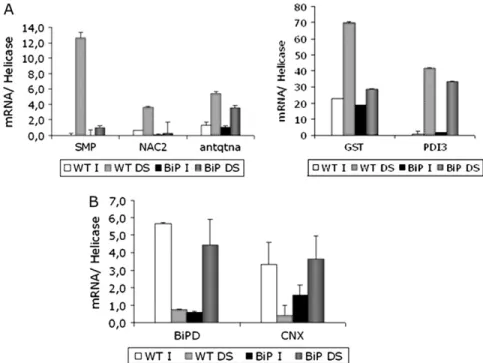
encodes a cytosolic aldehyde dehydrogenase. A large increase of the mRNA abundance of these genes was found in leaves of wild-type plants exposed to drought. Depending on the gene a smaller or a much smaller increase in mRNA abundance was observed in leaves of the BiP overexpressing plants (Fig. 6A). These results indicate that overexpression of
BiP inhibits the induction of different classes of stress-responsive genes.
Overexpression of BiP prevents down-regulation of BiP and calnexin gene expression by severe drought conditions
As outlined in the introduction, the accumulation of malfolded proteins activates the protective signalling cas-cade called UPR. The UPR results in co-ordinated tran-scriptional up-regulation of BiP and other genes encoding ER-resident proteins, such as calnexin (CNX). This and other proteins are involved in the proper folding and assembly of nascent proteins (reviewed by Urade, 2007). In experiments with soybean, PEG-induced dehydration has recently been shown to down-regulate genes that encode ER-resident molecular chaperones such as BiP and CNX
(Irsigler et al., 2007). A similar effect of drought on these UPR-specific targets in leaves of wild-type plants (Fig. 6B) is shown here. It was also observed that under normal conditions, overexpression of BiP transgene repressed expression of endogenous BiP and CNX genes, as the OE lines accumulated lower transcript levels than in the wild type (Fig. 6B). This result is consistent with previous work in soybean (Costa et al., 2008) and in tobacco cells (Leborgne-Castel et al., 1999). However, severe drought relieved the BiP-mediated repression of UPR targets and the stressed OE lines accumulated similar levels of BiP and CNX transcripts as unstressed wild-type plants. These results indicate that overexpression of BiP suppresses the water deficit induced-down-regulation of transcripts encod-ing ER-resident molecular chaperones.
Expression of leaf senescence-associated markers in wild type and OE lines during drought
Drought is known to accelerate senescence. It was examined whether the drought-tolerant phenotype mediated by over-expression of BiP might be associated with a delay in leaf senescence. In these experiments, our transgenic tobacco plants ectopically expressing BiP in the sense or antisense orientations (Alvimet al., 2001) were also analysed. Trans-genic soybeans were exposed to a fast soil-drying regime
Fig. 4. Root growth of soybean seedlings exposed to a low water potential. Wild type (WT) and BiP overexpressing (BiP-2 and BiP-4 lines) soybean seedlings were grown on MS solid medium in the absence (A) and presence of 1% PEG (B) for 4 weeks when the roots were photographed. In (C), the root dry weight of 4-week-old seedlings (WT and BiP-4) grown in MS medium supplemented with 1% (PEG1) or 2% PEG (PEG2) was measured. (D) Root length
(complete stop of watering) and the leaves were assayed for hallmarks of senescence. After 7 d of progressive drought, wild-type leaves displayed more chlorophyll loss than did OE lines (Fig. 7A). Likewise, in wild-type stressed leaves, total protein content was significantly lower than in stressed OE leaves (Fig. 7B). The drought-induced senescence phenotype was examined further by measuring the accumu-lation of thiobarbituric acid (TBA)-reactive compounds such as malondialdehyde (MDA). These compounds are products of senescence-associated lipid peroxidation, a pro-cess resulting in the generation of reactive oxygen species
(Dhindsa et al., 1981). A significantly higher concentration of TBA-reactive compounds was observed in wild-type leaves in comparison with OE lines (Fig. 7C). Expression of the senescence-associated genes, NAC1 and NAC3 (see Supplementary Fig. S2 at JXB online) was also assayed by quantitative RT-PCR (Fig. 7D). Drought induced the expression of both NAC1 and NAC3 to higher levels in wild-type leaves than in OE lines.
The relation between BiP mRNA abundance and leaf senescence was also studied in tobacco, using lines in which BiP was suppressed (antisense lines) and lines in which BiP was overexpressed (Alvimet al., 2001). Plants were exposed to a 40% irrigation, slow soil-drying regime for 35 d and assessed for chlorophyll loss and the expression of two genes (didi A9 and NTCP-23). didi A9 (AAZ23261) is a homologue to Arabidopsis SEN1 (Simo´n-Mateo et al., 2006). The Arabidopsis SEN1 (AT4G35770) is expressed during natural and dark-induced leaf senescence, as well as after pathogen infection (Schenk et al., 2005). NTCP-23 (AB032168; called CP1 in Costaet al., 2008) was shown to be up-regulated in association with tobacco leaf senescence (Uedaet al., 2000; Costa et al., 2008). The drought regime induced chlorophyll loss in OE lines although to a lesser extent than in the wild type (Fig. 8C, D). As expected, in wild-type plants, the drought treatment increased the mRNA abundance of both genes studied (Fig. 8A, B). By contrast, no such increase was found in the BiP OE lines. Conversely, in the BiP antisense lines, these senescence parameters (chlorophyll loss and expression of senescence-associated genes) were more pronounced than in wild-type plants, indicating that decreased expression of endogenous
BiPgene accelerated drought-induced leaf senescence.
Discussion
It has previously been demonstrated that overexpression of a BiP gene from soybean confers drought tolerance in tobacco. It is now shown that the same gene (soyBiPD) confers drought tolerance in soybean. The BiP-mediated drought-tolerant phenotype and the possible mode of action of BiP in conferring drought resistance is characterized further here. The role of this gene on drought-induced senescence in soybean and tobacco is also investigated. In soybean plants subjected to drought, the overexpression of BiP resulted in the maintenance of shoot turgidity. Un-expectedly, this improvement of leaf water relations was associated with less stomatal closure during drought, and less reduction of photosynthesis and transpiration. The increase in drought tolerance was also not related to some parameters of other short-term or long-term avoidance responses. For example, overexpression of BiP did not result in the accumulation of proline and sucrose, and did not result in the normal increase in root growth under drought condi-tions. Taken together these results show less drought stress in the drought-treated plants. This was also inferred from the lower (or very much lower) induction of typical drought-induced genes, in drought-stressed BiP overexpressing plants. Fig. 5. Drought-induced accumulation of some osmolytes in
Fig. 6. Induction of drought-responsive genes in transgenic lines. (A, B) Drought was induced in soybean plants at the V3 developmental stage by withholding irrigation for 7 d. Total RNA was isolated from leaves of wild type (WT) and 35S:BiP-4 lines and the transcript levels of selected genes (as indicated) were quantified by real-time PCR, using gene-specific primers. I, normally irrigated plants; DS, drought-stressed plants. Values represent the mean6SD of three replicates. SMP, seed maturation protein; NAC2, transcription factor from the soybean NAC family; antqtn, antiquitin; GST, glutathione-S-transferase; PDI3, protein disulphide isomerase, isoform 3; BiPD, binding protein, isoform D from soybean; CNX, calnexin.
It should be noted, however, that our measurement of proline and sugars did not exhaust the possibilities of osmotic adaptation. Further work on osmotic potential in the transgenic lines might still reveal an underlying osmotic effect. Interestingly, in the plants in which BiP was overex-pressed, drought did also not result in the typical down-regulation of genes encoding the ER molecular chaperones BiP and CNX. The attenuation of drought-induced responses and the basal levels of ER-molecular chaperone transcripts in OE lines may reflect a lower intensity of drought-induced endogenous stress. The reason why the plants become resistant to drought when overexpressing BiP, therefore, is at present unknown. The data might suggest that changes in the ER protein-folding process may serve as an early sensing mechanism of drought stress.
PEG-induced dehydration has been demonstrated to promote a co-ordinate down-regulation of ER molecular chaperones and folding catalysts in young soybean plants (Irsigler et al., 2007). Our results showed that severe
drought imposed by a drying soil also represses the expression of UPR–specific targets, such asBiP and CNX, in soybean plants. These results indicated that drought stress inversely regulates UPR-specific targets, impairing the ER folding capacity. However, overexpression of BiP
prevented the drought-mediated down-regulation of UPR genes. Also, the levels of BiP and CNX transcripts in droughted OE leaves were as high as those detected in wild-type leaves under normal growth conditions. Thus, BiP
overexpression may prevent the cell from sensing osmotic stress-induced variations in ER function by keeping ER basic activities to a normal level under severe drought conditions.
not induced in these plants. Interestingly, decreasing BiP expression in tobacco antisense lines hastened leaf senes-cence, thus showing a close connection between BiP mRNA and senescence. It is not yet known if the accelerated leaf senescence in the BiP antisense plants is associated with a lower leaf water potential than in wild-type plants.
In addition to its role as molecular chaperone, in mammalian cells BiP has been shown to function as a sensor of alterations in the ER environment that activate the cytoprotective unfolded protein response (Malhotra and Kaufman, 2007). Like BiP from animal systems, plant BiP has been shown to regulate UPR negatively (Leborgne-Castelet al., 1999; Costaet al., 2008). BiP regulates UPR by controlling the activation status of the three transducers, IRE1, PERK, and ATF6 which act in concert to reduce the unfolded protein load in the ER by attenuating protein synthesis and promoting protein folding and degradation of misfolded proteins (Malhotra and Kaufman, 2007). BiP has also been demonstrated to regulate pro-apoptotic pathways that emanate from the ER when ER homeostasis cannot be restored (Reddy et al., 2003; Malhotra and Kaufman, 2007). Prolonged ER stress (accumulation of unfolded or misfolded proteins) has been shown to induce cell death, apoptotic-like responses and leaf senescence in plants (Crosti et al., 2001; Malerba et al., 2004; Zuppini et al., 2004, Wanget al., 2007; Costaet al., 2008; Watanabe and Lam, 2008). The effect of UPR on leaf senescence has recently been associated with multimeric G-protein signal-ling (Wanget al., 2007). Disruption of the Gbgene impairs ER stress-induced leaf cell death and attenuates UPR in the same fashion asBiPoverexpression.
BiP-mediated increases in water stress tolerance may be connected to Ca2+ signalling responses. This idea is based on several observations. Firstly, BiP has been demonstrated to play a direct role in the storage of a rapidly exchanging Ca2+ pool within the ER lumen (Lievremont et al., 1997). Thus, overexpression of BiP in sense plants may increase the ER Ca2+ storage capacity, thereby modulating Ca2+ signalling in response to drought and hence altering stress perception and response. Secondly, the cytoplasmic Ca2+ signal transduction pathway is thought to regulate turgor pressure of plant cells and to co-ordinate stomatal responses to leaf dehydration (for a review see Shinozaki and Yamaguchi-Shinozaki, 1997). Thirdly, an increase in the level of cytosolic free calcium ions is involved in signal transduction leading to one type of programmed cell death in plants, the hypersensitive response (Xu and Heath, 1998). Fourthly, in mammalian cells, the control of Ca2+ release from the ER by BiP overexpression prevented oxidative stress and cell death (Liu et al., 1997, 1998). Finally, drought promotes a rapid and excessive accumulation of reactive oxygen species (ROS) in plant cells that, in turn, causes a lipid peroxidation chain reaction resulting in chemically reactive cleavage products, largely represented by TBA-reactive compounds such as malondialdehyde (Bartels, 2001). Under drought, the level of TBA-reactive compounds was much lower inBiP OE lines as compared to wild-type lines. Thus, BiP overexpression apparently
attenuated the degree of membrane degradation, which is often associated with the release of reactive oxygen species. Leaf senescence is also usually associated with an increase in membrane degradation and an increase in TBA-reactive compounds. Thus, by functional analogy with mammalian cells, the plant BiP effect on oxidative stress and leaf senescence may be associated with a capacity to control Ca2+ release from the ER. Therefore, the BiP control of ER Ca2+ homeostasis may provide a link for the appar-ently pleiotropic physiological effects of BiP protection under water stress. This hypothesis warrants further in-vestigation.
Supplementary data
Supplementary data are available atJXBonline.
Supplementary Fig. S1.Photosynthesis, stomatal conduc-tance, and transpiration in leaves of soybean transgenic lines continuously irrigated (I) or exposed to a 7 d period of suspended irrigation (drought stress, DS).
Supplementary Fig. S2. Enhanced accumulation of
GmNAC1 and GmNAC3 transcripts during leaf senescence in soybean.
Acknowledgements
We thank all the members of the Plant Molecular Biology Laboratory at BIOAGRO/UFV for technical assistance and for reading the manuscript. This research was supported by the Brazilian Government Agencies CNPq grants 50.6119/ 2004-1 and 470878/2006-1 (to EPBF), FAPEMIG grant EDT 523/07 and FINEP grant 01.07.610.00 (to EPBF) and Brazilian soybean genome consortium (CNPq/GENO-SOJA, grant 552735/2007-8). MASV, JAQAF, and GLP were supported by a graduate fellowship from CNPq and PABR by an undergraduate scholarship from CNPq.
References
Alvim FC, Carolino SMB, Cascardo JCM, Nunes CC,
Martinez CA, Otoni WC, Fontes EPB.2001. Enhanced accumula-tion of BiP in transgenic plants confers tolerance to water stress.Plant Physiology126,1042–1054.
Araga˜o FJL, Sarokin L, Vianna GR, Rech EL.2000. Selection of transgenic meristematic cells utilizing a herbicidal molecule results in the recovery of fertile transgenic soybean (Glycine max(L.) Merrill) plants at high frequency.Theoretical and Applied Genetics101,1–6.
Ashraf M, Foolad MR.2007. Roles of glycine betaine and proline in improving plant abiotic stress resistance.Environmental and Exper-imental Botany59,206–216.
Bates LS, Waldren RP, Teare ID.1973. Rapid determination of free proline for water stress studies.Plant and Soil39,205–207.
Buzeli RAA, Cascardo JCM, Rodrigues LAZ, Andrade MO, Loureiro ME, Otoni WC, Fontes EPB.2002. Tissue-specific regulation of Bip/Grp78 genes: acis-acting regulatory domain is required for BiP promoter activity in plant meristems.Plant Molecular Biology50,757–771.
Cascardo JCM, Almeida RS, Buzeli RAA, Carolino SMB, Otoni WC, Fontes EPB.2000. The phosphorylation state and expression of soybean BiP isoforms are differentially regulated following abiotic stresses.Journal of Biological Chemistry275,14494– 14500.
Catsky J.1974. Water saturation deficit (relative water content). In: Slavik N, ed.Methods of studying plant water relations. New York: Springer Verlag, 136–154.
Costa MDL, Reis PAB, Valente MAS, Irsigler AST, Carvalho CM, Loureiro ME, Araga˜o FJL, Boston RS, Fietto LG, Fontes EPB.
2008. A new branch of endoplasmic reticulum stress signalling and the osmotic signal converge on plant-specific asparagine-rich proteins to promote cell death.Journal of Biological Chemistry283,20209– 20219.
Crosti P, Malerba M, Bianchetti R.2001. Tunicamycin and Brefeldin A induce in plant cells a programmed cell death showing apoptotic features.Protoplasma216,31–38.
Dhindsa RS, Plumb-Dhindsa P, Thorpe TA.1981. Leaf senes-cence: correlated with increased levels of membrane permeability and lipid peroxidation and decreased levels of superoxide dismutase and catalase.Journal of Experimental Botany32,93–101.
Dixon DP, Cummins I, Cole DJ, Edwards R.1998. Glutathione-mediated detoxification systems in plants.Current Opinion in Plant Biology1,258–266.
Figueiredo JEF, Cascardo JCM, Carolino SMB, Alvim F, Fontes EPB.1997. Water-stress regulation and molecular analysis of the soybean BiP gene family.Brazilian Journal of Plant Physiology9,
103–110.
Gomer CJ, Ferrario A, Rucker N, Wong S, Lee AS.1991. Glucose regulated protein induction and cellular resistance to oxidative stress medi-ated by porphyrin photosensitization.Cancer Research15,6574–6579.
Gupta AS, Heinen JL, Holaday AS, Burke JJ, Allen RD.1993. Increased resistance to oxidative stress in transgenic plants that overexpress chloroplastic Cu/Zn superoxide-dismutase.Proceedings of the National Academy of Sciences, USA90,1629–1633.
Hodges DM, Delong JM, Forney CF, Prange RK.1993. Improving the thiobarbituric acid-reactive-substances assay for estimating lipid peroxidation in plant tissues containing anthocyanin and other in-terfering compounds.Planta207,604–611.
Irsigler AST, Costa MDL, Zhang P, Reis PAB, Dewey RE, Boston RS, Fontes EPB.2007. Expression profiling on soybean leaves reveals integration of ER- and osmotic-stress pathways.BMC Genomics8,431.
Kalinski A, Rowley DL, Loer DS, Foley C, Buta G, Herman EM.
1995. Binding-protein expression is subject to temporal, developmen-tal and stress-induced regulation in terminally differentiated soybean organs.Planta195,611–621.
Kamauchi S, Wadahama H, Iwasaki K, Nakamoto Y,
Nishizawa K, Ishimoto M, Kawada T, Urade R.2008. Molecular
cloning and characterization of two soybean protein disulfide iso-merases as molecular chaperones for seed storage proteins.FEBS Journal275,2644–2658.
Laitusis AL, Brostrom MA, Brostrom CO.1999. The dynamic role of GRP78/BiP in the coordination of mRNA translation with protein processing.Journal of Biological Chemistry274,486–493.
Leborgne-Castel N, Jelitto-Van Dooren EPWM, Crofts AJ, Denecke J.1999. Overexpression ofBiPin tobacco alleviates endoplasmic reticulum stress.The Plant Cell11,459–470.
Li LJ, Li X, Ferrario A, Rucker N, Liu ES, Wong S, Gomer CJ, Lee AS.1992. Establishment of a Chinese hamster ovary cell line that expresses grp78 antisense transcripts and suppresses A23187 in-duction of both GRP78 and GRP94.Journal of Cell Physiology153,
575–582.
Li XA, Lee AS.1991. Competitive inhibition of a set of endoplasmic reticulum protein genes (GRP78, GRP94, and Erp72) retards cell growth and lowers viability after ionophore treatment.Molecular and Cellular Biology11,3446–3453.
Lichtenthaler HK.1987. Chlorophylls and carotenoids: pigments of photosynthetic biomemembranes.Methods in Enzymology148,350– 382.
Lievremont J-P, Rizzuto R, Hendeershot L, Meldolesi J.1997. BiP, a major chaperone protein of the endoplasmic reticulum lumen, plays a direct and important role in the storage of the rapidly
exchanging pool of Ca2+.Journal of Biological Chemistry272,30873– 30879.
Liu H, Bowes III RC, van de Water B, Sillence C, Nagelkerke JF, Stevens JL.1997. Endoplasmic reticulum chaperones GRP78 and calreticulin prevent oxidative stress, Ca2+disturbances, and cell death in renal epithelial cells.Journal of Biological Chemistry272,21751– 21759.
Liu H, Miller E, van de Water B, Steven JL.1998. Endoplasmic reticulum stress proteins block oxidant-induced Ca2+increases and cell death.Journal of Biological Chemistry273,12858–12862.
Maa Y, Hendershot LM.2004. ER chaperone functions during normal and stress conditions.Journal of Chemical Neuroanatomy28,
51–65.
Malerba M, Cerana R, Crosti P.2004. Comparison between the effects of fusicoccin, tunicamycin, and brefeldin A on programmed cell death of cultured sycamore (Acer pseudoplatanusL.) cells. Proto-plasma224,61–70.
Malhotra JD, Kaufman RJ.2007. The endoplasmic reticulum and the unfolded protein response.Seminars in Cell and Developmental Biology18,716–731.
Morris JA, Dorner AJ, Edwards CA, Hendershot LM, Kaufman J.
1997. Immunoglobulin binding protein (BiP) function is required to protect cells from endoplasmic reticulum stress but is not required for the secretion of selective proteins.Journal of Biological Chemistry272,
4327–4334.
Murashige T, Skoog F.1962. A revised medium for rapid growth and bioassays with tobacco tissue cultures.Physiologia Plantarum15,
473–497.
a sucrose binding protein homologue gene from soybean in transgenic tobacco affects plant growth and carbohydrate partitioning in leaves.
Plant Science152,87–98.
Pirovani CP, Maceˆdo JNA, Contim LAS, Matrangolo FSV, Loureiro ME, Fontes EPB.2002. A sucrose binding protein homologue from soybean exhibits GTP-binding activity that functions independently of sucrose transport activity.European Journal of Biochemistry269,3998–4008.
Porcel R, Ruiz-Lozano JM.2004. Arbuscular mycorrhizal influence on leaf water potential, solute accumulation, and oxidative stress in soybean plants subjected to drought stress.Journal of Experimental Botany55,1743–1750.
Reddy RK, Mao C, Baumeister P, Austin RC, Kaufman RJ, Lee AS.2003. Endoplasmic reticulum chaperone protein GRP78 protects cells from apoptosis induced by topoisomerase inhibitors: role of ATP binding site in suppression of caspase-7 activation.Journal of Biological Chemistry278,20915–20924.
Rodrigues SM, Andrade MO, Gomes APS, DaMatta FM, Bara-cat-Pereira MC, Fontes EPB.2006. Arabidopsis and tobacco plants ectopically expressing the soybean antiquitin-likeALDH7gene display enhanced tolerance to drought, salinity, and oxidative stress.Journal of Biological Chemistry57,1909–1918.
Schenk PM, Kazan K, Rusu AG, Manners JM, Maclean DJ.2005. TheSEN1gene ofArabidopsisis regulated by signals that link plant defence responses and senescence.Plant Physiology and Biochem-istry43,997–1005.
Simo´n-Mateo C, Depuydt S, de Oliveira Manes CL, Cnudde F, Holsters M, Goethals K, Vereecke D.2006. The phytopathogen
Rhodococcus fasciansbreaks apical dominance and activates axillary meristems by inducing plant genes involved in hormone metabolism.
Molecular Plant Pathology7,103–112.
Shinozaki K, Yamaguchi-Shinozaki K.1997. Gene expression and signal transduction in water-stress response.Plant Physiology115,
327–334.
Ueda T, Seo S, Ohashi Y, Hashimoto J.2000. Circadian and senescence-enhanced expression of a tobacco cysteine protease gene.Plant Molecular Biology44,649–657.
Urade R.2007. Cellular response to unfolded proteins in the endoplasmic reticulum of plants.FEBS Journal274,1152–1171.
Xu HX, Heath MC.1998. Role of calcium in signal transduction during the hypersensitive response caused by basidiospore-derived infection of the cowpea rust fungus.The Plant Cell10,585–597.
Wang S, Narendra S, Fedoroff N.2007. Heterotrimeric G protein signaling in theArabidopsisunfolded protein response.Proceedings of the National Academy of Sciences, USA104,3817–3822.
Watanabe N, Lam E.2008. BAX Inhibitor-1 modulates endoplasmic reticulum stress-mediated programmed cell death inArabidopsis.
Journal of Biological Chemistry283,3200–3210.
Wehmeyer N, Vierling E.2000. The expression of small heat shock proteins in seeds responds to discrete developmental signals and suggests a general protective role in desiccation tolerance.Plant Physiology122,1099–1108.