Abstract. The pharmaceutical industry is knowledge and research-intensive. Due to technological, socio-political and organisational changes there has been a continuous evolution in the knowledge base utilized to achieve and maintain competitive advantages in this global industry. There is a gap in analysing the linkages and effects of those changes on knowledge creation processes associated with pharmaceutical R&D activities. Our paper looks to fill this gap. We built on an idiosyncratic research approach – the systematic literature review – and looked to unearth current trends affecting knowledge creation in international/global pharmaceutical R&D. We reviewed scientific papers published between 1980 and 2005. Key findings include promising trends in pharmaceutical innovation and human resource management, and their potential implications on current R&D practices within the pharmaceutical industry, from managerial and policy-making perspectives.
Key words: Knowledge creation, pharmaceutical industry, systematic review, global R&D.
1. Introduction
The pharmaceutical industry is research-intensive, and its competitiveness depends on continuous inventions and innovations. The ultimate embodiment of knowledge creation in the pharmaceutical industry is the successful commercialization of new drugs, and represents the key competitive factor
25 years of knowledge creation processes in pharmaceutical
contemporary trends
Alexander Kofinas
Manchester Metropolitan University, Business Information Technology Group, Graduate School of Business Irina Saur-Amaral
Universidade de Aveiro, Departamento de Economia, Gestão e Engenharia Industrial
Address: Manchester Metropolitan University Business School, Aytoun Campus Manchester, M1 3GH, United Kingdom. E-mail: [email protected]
Note: In this paper knowledge is used in its simplest Aristotelian definition as “justified true belief” (Nonaka & Takeuchi, 1995). Our focus on knowledge creation stems from the knowledge-based view of the firm, where knowledge becomes the primary resource/asset that confers a sustainable competitive advantage to the firm, promoting knowledge management to the most important organisational process within the firm (Blackler, 1995; Nonaka et al., 2001).
(e.g. Lipitor, the number one drug in 2005, sold 12,9 thousand million dollars, i.e. 2,3% of world-wide market sales) and the main means to recover high investments in R&D (in average more than 20% of total sales) and to cope with increasingly lower success rates (Atun, Gurol-Urganci, & Sheridan, 2007; Atun & Sheridan, 2007; Datamonitor, 2004; DiMasi, Grabowski & Vernon, 2004; IMS, 2006). It is a global industry, highly concentrated in terms of markets (about 90% of total sales in 2005 were in the Triad countries, i.e. US, Europe and Japan), and key players (top 10 firms had in 2005 more than 50% of worldwide sales), and is highly dependent on IP rights, specifically on patent protection (Arlington, Hughes, & Palo, 2002; Bierly & Chakrabarti, 1996; Class, 2002; Datamonitor, 2004; DiMasi et al., 2004; Gassmann & Reepmeyer, 2005; Hayes & Walsham, 2003; Howells, 2002; IMS, 2006; Rousch, 2001; Salazar, Hackney, & Howells, 2002; Studt, 2003).
Recently, various factors have affected the operation and efficiency of pharmaceutical R&D processes, e.g. global markets, technology advances, the advent of biotechnology players, focus shifts on chronic diseases, stronger regulatory concerns regarding safety, price squeezes due to lower health budgets (particularly in Europe) (Attridge, 2007; Atun & Sheridan, 2007; Class, 2002; Gassmann & Reepmeyer, 2005; Thomas, 2004). The pharmaceutical companies have struggled to reduce the uncertainty associated to those factors, however few effects are visible, pace is slow, and little is seen in terms of efficiency increase in drug development.
A direct result of these new developments has been the rise of a Research Industry – new contract research organizations (CROs), some rivalling in size and influence the major pharmaceutical players, including most biotechnology firms. Arguably these new networks and the consequent research outsourcing have started to relegate the traditional pharmaceutical innovators to the role of global knowledge brokers and have put pressure on traditional knowledge creation processes in pharmaceutical R&D (Galambos & Sturchio, 1998; Gassmann & Reepmeyer, 2005; Hargadon, 1998; Martin, 2003; Mittra, 2007; Salman & Saives, 2005). The academic community has focused insuffi-ciently on these matters, so the whole picture is rather “fuzzy”.
Our research has struggled to reduce the fuzziness and analysed by means of a systematic literature review (Tranfield, Denyer, & Smart, 2003) a large number of scientific papers published between 1980 and 2005, which focused on international/global knowledge creation processes in pharmaceutical industry. We further present the methodology and results of this research according to the following structure. First, we discuss the systematic review methodology and share the protocol used to perform the review. Then we present and analyze data collected and we share the main results. Finally, we discuss the findings and point out relevant trends that may affect the knowledge creation processes in pharma-ceutical context, including potential managerial and policy implications.
2. The Systematic Review Methodology: Brief Overview
The purpose of a systematic review is to provide a thorough appreciation of existing research in a specific field in order to promote evidence-based policy and practice. A systematic literature review starts with a research question/issue which guides the examination of the relevant literature (Macpherson & Holt, 2005a; Thorpe, Holt, Macpherson, & Pittaway, 2005; Tranfield et al., 2003).
The history of the evidence-based systematic review was outlined by Tranfield et al. (2003), and incorporates lessons and methodologies considered relevant from the medical profession (e.g. Higgins & Green, Eds., 2005) to inform a protocol for systematic reviews in the business and management fields. The systematic literature review concept introduces a vigorous methodology that can be replicable, scientifically-minded and transparent. It aims to minimize bias via exhaustive literature searches of published material, while it provides an audit trail for the reader regarding the reviewers’ decision processes, procedures and conclusions (Thorpe et al., 2005; Tranfield et al., 2003).
Our review drew from the general stages and protocols outlined by the study of Tranfield and colleagues (2003), complemented by insights provided by Creswell (2003). We considered three phases:
- Definition of the review scope and protocol; - Data collection and analysis;
- Discussion of findings and implications on field reviewed.
3. Review Scope and Protocol
Scope
In defining the broader scope we went through an iterative process that determined the key parameters as follows.
The primary objective of the systematic review is to perform an exploratory study that increases the understanding of trends affecting knowledge creation processes in global pharmaceutical R&D.
The issue addressed is the impact of the new socio-political paradigm on the pharmaceutical industry, with a primary focus on knowledge creation processes. Since our outcome is connected to the wider pharmaceutical context, it will lead to new understandings and useful prescriptive suggestions regarding knowledge creation, management and policy making in pharmaceutical context and thus will inform future research in the global pharmaceutical R&D context or in other industries with similar characteristics.
Protocol
The protocol we have developed consists of a number of concrete conceptual steps. The first is to identify the relevant data for our review. Thus relevant papers for this systematic review would: 1. develop theoretical models of global pharmaceutical R&D and/or empirical papers that used qualitative, quantitative and mixed-methods. Reasoning: our review should not be biased either by method or by type (empirical/theoretical). Such a decision assumes that theory-based modelling as well as field work present credible views and understandings of the processes of knowledge creation in the industry.
2. cross-refer to organizations and institutions at different stages of development. Reasoning: we wished to avoid limiting ourselves to certain types of pharmaceutical companies, or companies that are under specific pressures.
3. focus on how knowledge and innovation networks for R&D are formed between pharmaceutical companies or/and with biotech companies and other partners. Reasoning: we wanted in particular to examine the results of environmental pressures (e.g. globalisation; new technologies; new political pressures) to the structures and organisational arrangements within the pharma-ceutical industry. One of the major responses to these changes has been the formation of extensive collaboration networks and the formation of alliances with the biotech firms. This has led to knowledge creation, especially in the form of bio-science drugs.
4. be published in peer-reviewed journals. Reasoning: it is assumed here that peer-reviewed journals would ensure a higher quality and credibility of the source papers and thus would inform credibly the systematic literature review.
Thus in general our criteria for paper inclusion aim to separate material contextually (a focus on knowledge creation in the pharmaceutical industry) rather than methodologically or organisationally (by content).
Ineligible/irrelevant papers would:
1. analyse global R&D in other industries. Reasoning: our focus is the pharmaceutical industry 2. analyse aspects not related with global R&D. Reasoning: we aimed at companies that were
affected dramatically by the major changes. For example globalisation would not affect a company with local R&D operations and local market orientation while the IT revolution would affect to a much lesser extent a company with a one country R&D orientation. 3. have been published before 1980; Reasoning: most of the major changes happened after
the first biotechnology firms came to be. The IT revolution affected the industry even later, towards the end of the 1990s. Thus it made sense not to include publications before 1980. Furthermore a practical consideration has been that publications before 1980 are harder to locate online.
4. be written in other languages than English; Reasoning: we argue that the analysed knowledge domain is dominated by the English language. An additional practical consideration has been that both researchers shared advanced language fluency only in English.
5. include unpublished material, books, conference papers or other non-reviewed source of information. Reasoning: such data sources may not be as credible as peer-reviewed journals. Primary data is extracted from scientific databases available to both reviewers, using specific search terms based on the above-mentioned inclusion and exclusion criteria developed conjointly. In order to test the asserted criteria we have devised a pilot search. In the pilot search we have also included Google Scholar, a freely available commercial search engine that specializes on academic material. In preparation for the pilot study, we built a classification system that would facilitate our review (Macpherson & Holt, 2005b). The search string for the pilot is developed in Boolean language to ensure comparability of results across databases. The choice of the terms in the search string is derived from the wider knowledge management and pharmaceutical R&D literature. The aim is to
segregate results on knowledge, pharmaceutical R&D, and globalization. The search string is pre-sented here:
Once the pilot was completed, we revised the search string and the classification system. A detailed summary of the protocol thus developed is presented in Appendix 1.
4. Data Collection and Analysis
We started by performing the pilot study (see Appendix 2), as follows:
- Individual search in scientific databases, e.g. ProQuest (AB Inform), Elsevier (Science Direct), Sage, and Wiley Interscience aiming to determine how many relevant articles in total could be gathered. We examined top-10 results manually.
- Search on Google Scholar as to assess whether it would be comparable to the scientific databases. We analysed the top-20 results manually.
The pilot study revealed important issues.
First, that the same academic databases differed in each of authors’ respective institutions, e.g. ABI Proquest encompassed 2,951 publications in one institution and 4,728 in the other. Most databases proved to have a different portfolio of access in each institution. Differential access made the conducting of a systematic and consistent literature review a particularly challenging task. Only Science Direct did not differ in literature scope; thus the search results for both researchers were identical. Other databases yielded consistent results but proved inadequate for our enterprise. Wiley Interscience did not yield any results, while Science Direct yielded a very small number of relevant articles and both were dropped.
The second issue was that each academic database has had different search facilities leading to a data gathering process that utilised different search parameters for each database. For example in ABI one could search text and citations combined while in Science Direct one could not. Concerning Google Scholar, it gave different results every time we ran the search string, a phenomenon that did not occur searching in the academic databases. That is attributed to the way Google creates and presents the results, where even our own search was affecting the order and number of results we were receiving!
The pilot study revealed two things: Google Scholar provided the most articles and in our pilot study it had the greatest number of relevant articles. We considered that it had great potential if used properly, as it brought together papers from a wide range of academic databases and it provided cached abstract when papers were not available. We concluded that Google Scholar was comparable, if not superior to academic databases.
We added further qualifications and modifications to our search string:
The changes reflected partially the idiosyncratic nature of the Google Scholar search engine. The Google scholar tool automatically assumes an “AND” between words. The addition of the “ISSN” qualification assisted in focusing on published material. Furthermore, we restricted our search to “Business, Administration, Finance, and Economics” and “Social Sciences, Arts, and Humanities”.
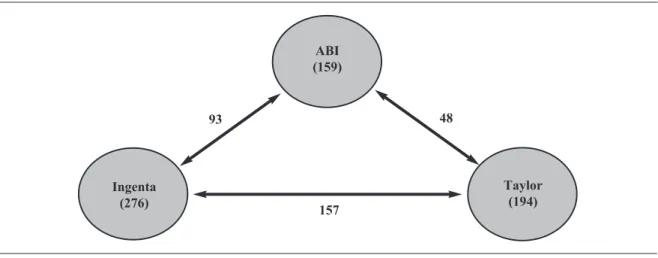
We used the refined search string in Google Scholar. Results were then input into Endnote. Our investigation looked at papers from the last 20 years and identified 672 papers potentially relevant to our search. These were then viewed manually. A total of 253 were removed (146 were institutional reports, working papers or other material that did not qualify as journal articles, 55 were books, and 52 were duplicate records). The remaining 419 articles were cross-examined for records in other databases. The results are portrayed in Figure 1.
It was quite clear that Google scholar integrated results from all three academic databases. Ingenta and Taylor and Francis are explicitly and fully incorporated in the Google Scholar with links after every record leading directly to the appropriate entry in the database. Google contained more records than those that could be found in each academic database in isolation. However since ABI is not included in the Google scholar we could not conclusively say that Google contains all the possible records from ABI. The records from our population were identified manually. Only 40
Pharmaceutical innovation (knowledge OR learning OR learn) (global OR international) (research OR R&D) ISSN
Figure 1. Relationship of inclusion among records identified in Google Scholar Search with ABI (Ingenta and Taylor & Francis)
ABI (159) Ingenta (276) Taylor (194) 48 93 157
records (about 10% of the total) were present in all three academic databases indicating that Google Scholar casts a much wider net of search than any of the other academic databases.
For an accurate classification of our data, we use two software tools: Endnote and NVivo. Endnote is more efficient in performing simple content analysis and assisted us originally with the categori-zation of the articles. The qualitative software NVivo is a useful tool for performing qualitative research (Hold, 2004; Richards, 2004) and is used here to analyse the abstracts of the most relevant articles, aiming to identify patterns. Thus we could identify potentially important trends and present their implications on current research and policy making, pointing out recommendations and insights on R&D practices and R&D management in pharmaceutical industry, a procedure consistent with similar systematic reviews in the management literature (Macpherson & Holt, 2005a; Thorpe et al., 2005).
Once the sample was put in Endnote, we refined the classification system by adding two classi-fication dimensions. The first separated articles into relevant, peripheral and irrelevant as determined by the presence or absence of our five core concepts. The second distinguished between theoretical and empirical material. This classification system further reduced the sample size of the articles and allowed for more detailed examination of our findings. However, a content search performed in Endnote revealed that it is rather difficult to identify articles that would be primary according to our original classification scheme, which was based only on abstract and title content analysis.
It became quickly apparent that the original Google search examined the whole article rather than just the title/abstract combination. This led to a relaxation of our original requirement for primary (presence of all five core concepts in the article). Four concepts would suffice to label an article as primary while 3 terms would label it peripheral. Based on this reviewed classification scheme, we categorized the 419 papers in Endnote, based on individual abstract analysis performed by the two reviewers conjointly (to ensure validity). We obtained 45 relevant records for our qualitative analysis. These articles (see Appendix 3) were isolated in another Endnote library and their titles and abstracts were exported to an NVivo project. A roadmap of the review scope and protocol can be seen in Figure 2.
The NVivo approach was two-pronged.
First a grounded-theory approach was used to identify the key concepts. One reviewer per-formed free coding on all 45 abstracts and built a hierarchical tree of respective codes. Similar codes were merged and a final model was built in order to most objectively describe the nature and quality of the information contained in the abstracts examined. Via an iterative process the final hierarchical model was synthesized. This model is presented in Appendix 4, whilst statistical data on which themes appeared more frequently in the analyzed records are illustrated in Appendix 5.
As it can be observed from the model, the considered abstracts indicate extensive links between the pharmaceutical industry and, mainly, biotechnology, with a few links to the paper, food and forestry (!) industry (can be considered an outlier). 58% of all records pointed to linkages to other industries (predominantly Biotechnology). This is an indication of the pharmaceutical industry’s efforts to complement existing knowledge by creating synergies with this emerging industry. This result is hardly surprising.
34% of all records considered the pharmaceutical industry’s context. Issues like the new scope of health, the role of customers are mentioned and the emphasis given to regulatory issues (85% of
all records relating to context) reflects an important concern of its relevance/impact to the business and its innovation patterns. We also note a specific interest given to patenting (free circulation of knowledge and uniform rules versus tighter enforcement of patents). This also came as no surprise, since we analyzed knowledge processes in a knowledge-intensive and global industry, where regu-lations and patenting play an important role in securing knowledge creation and determining knowledge distribution and exploitation.
Under the globalization heading, issues like distributed production, distributed innovation, new organizational forms and increasing competitiveness (e.g. networks, strategic alliances, mergers, clustering) as well as technological interdependence are at the core of analyzed material. However, more interest was shown to distributed innovation and the subsequent exploitation of innovation resources all over the world to enhance the efficiency of the drug development process. New organi-zational forms were also at the core of academic discourse, with particular emphasis given to the importance of localization (89% of all records in the Globalization category). This is also to be expected in a global context.
Figure 2. Roadmap of the Systematic Literature Review
Google Scholar ProQuest, Elsevier, Sage, Wiley Review scope Pilot study Data collection Data analysis Review protocol Updated review protocol Endnote NVivo Final conclusion Findings & implications
In addition, pharmaceutical industry appeared to look into rigorous HR management practices, giving emphasis to knowledge workers’ autonomy, to knowledge sharing between them and to the creation of a global mindset among these workers (e.g. mobility, knowledge combination). 24% of the records gave importance to HR management and the role of knowledge workers, covering issues linked to their desirable autonomy to exploit duly their competences.
Second, and in order to validate the original coding, the other reviewer utilised the developed framework and applied it to re-code the abstracts and titles of the 45 articles. The re-coding was done independently (the second coder had no knowledge of results of the first coding). The desired outcome was to test the robustness and external validity of the framework previously developed. It also gave space to revise the internal validity and reach an agreement over both construct and concept validity of the hierarchical tree.
Results proved quite positive. The hierarchical tree was revised yet not substantially. There was some reshuffling and some new codes developed (see Appendix 6). There was an estimated 15% difference between the node structure of the hierarchical tree of the first reviewer and the second. This indicated that the result was a robust construct with a relatively high degree of internal validity.
There were differences in the percentages coded under each node (see Appendices 5 and 7). Mostly the second coding pushed up the percentages of three of the four main nodes (context/industries/ globalisation) by 20-5%, which indicated that second coding considered broader understandings of the concepts than the first one. That may be a direct result of the fact that the second tree had fewer nodes due to additional reiterations by the authors. The only notable exception was in the fourth, the HRM parent node where the second author actually seemed to have taken a more limited understanding of the node than the first author.
Another interesting issue was that in this second phase, context became more important (63% of all records). Same happened to knowledge production, research intensive networks, importance of funding, localization in clusters, networks and internationalization of technology. However, the main conclusions Figure 3. Records’ Distribution on Publication Year (all 45 considered for qualitative analysis)
remained intact, which reinforces the validity of the model and its capacity to describe accurately the analyzed records.
Alongside the coding, statistical data was gathered as to the publication year of each paper and their empirical or theoretical base wherever it was possible to identify. Interestingly, papers’ distribution by publication year (as Figure 2 portrays) reflects how the field of knowledge creation in the pharma-ceutical R&D context has only recently been addressed by the academic community.
The filtered records of our analysis were published between 1999 and 2005. We recall that our search covered papers with publication date from 1980. This may signify one of two things: either issues related to globalization of innovation and knowledge production processes in the pharmaceutical industry fell into academic attention only after 1996-7, or that databases used by Google Scholar only made available papers published in the last 7-8 years. The first explanation is more plausible since Ingenta and other databases, which are already included in the Google Scholar, contain data much before 1996.
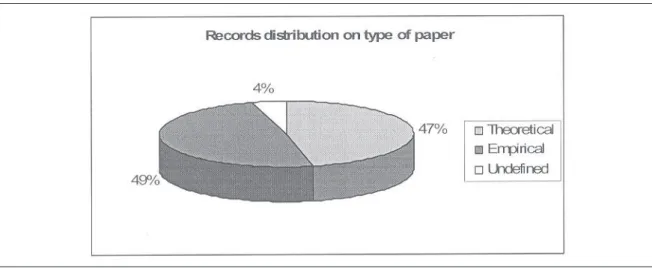
As of the empirical – theoretical distribution, the classification work was performed conjointly by the two researchers. 49% of the papers were theoretical and 47% were of empirical nature, which indicates an equilibrated distribution. If we go back to the roots of systematic reviews, we note that usually only empirical works were considered for this kind of studies. Yet, theoretical papers can provide particularly good insights and should be, in our opinion, considered for the purpose of a systematic review.
5. Findings
Summarizing, key identified trends that affected knowledge creation processes in pharmaceutical industry during the analyzed period were the following:
- Strong linkages with the biotechnology industry;
- High influence of and importance given to regulatory environment, with contradictory ten-dencies on knowledge freedom and protection;
- Strong emphasis on the globalization issue, with focus on distributed innovation (especially linked with knowledge production), new organizational forms to better deal with it (emphasis given to funding, clusters and networks) and technology (especially internationalization of technology);
- Emerging issues like the new scope of health and competences (knowledge workers’ autonomy and global mindset).
Looking at these trends, a first insight is that new knowledge creation in pharmaceuticals and its linkage to aspects of localization, regional funding, global regulations needs yet to be properly addressed; further study is required to identify appropriate (and more flexible) methods and instruments to perform the knowledge creation processes efficiently. A conspicuous absence in our findings is that of the information technology (IT) as a factor. Very few articles refer to its importance in knowledge management, even though it is frequently mentioned in generic knowledge management literature (e.g. Cabrera & Cabrera, 2002; Gray, 2001; Lerer & Piper, 2003; Nonaka, Reinmoller, & Toyama, 2001). This could indicate either that pharmaceutical industry has not made much progress on IT-based KM or that the search should have focused on IT usage in fields related to the pharmaceutical industry such as bioinformatics or that the advances in IT are secretive and there is little public information. In addition one should note that certain technologies such as genomics, proteomics and even the field of biotechnology are implicitly yet certainly based on IT (Galambos & Sturchio, 1998; Howells, 2002; McMeekin & Harvey, 2002).
Localization issues focus on clustering and networks. It is unclear from our data whether this is evidence of the emergence of a network society or the natural evolution of simpler approaches based on regional/local agglomeration of specialized knowledge i.e. universities or specific research organi-zations. Future research should consider whether clustering is an appropriate way to look at locali-zation issues, whereas other simpler explanations could be considered. The bewildering variety of cluster/network arrangements found in the review may indicate that scholars either are unclear of the investigated phenomena, or that their rhetoric in pharmaceutical R&D literature has advanced way beyond the actual developments in the industry. However, armed with the information obtained on publication dates one would probably side with the former version, i.e. lack of clarity. Pharmaceutical industry is a relatively slow industry and the ideas of clustering, networks and national innovation systems were developed in the early 1990’s. Thus the relative dearth of articles before 1996 may indicate that pharmaceutical firms or the academics have not caught up with changes brought about by
these new organisational arrangements (networking and clusters), new IT and technology developments (biotechnology, genomics, proteomics), and changes in regulation regime.
In what concerns the role of knowledge creation in global pharmaceutical R&D it is addressed only indirectly in the analyzed records, in terms of innovation and general regulations. Knowledge creation seems to underlie all strategic decisions of global pharmaceutical R&D but as a process is never put explicitly in focus. However the role of knowledge processes is discussed, especially when it comes to distributed innovation and HR management. Thus more studies that focus explicitly on the role of knowledge creation in pharmaceuticals or on the systematic management of knowledge processes may help revealing efficient management practices both for research and general strategy in the pharmaceutical industry.
6. Policy implications
The identified trends may serve as inspiration to policy-makers, as follows.
Institutional mechanisms and incentives may be further developed at international levels in order to enhance cooperation with the biotechnology partners and to complement the current tendency of limited collaboration initiatives with commercial ends. This is important so as to stimulate coope-ration between pharmaceutical firms and biotechnology ones, especially in the discovery phase, and thus to facilitate a common language between these partners. It may increase competitiveness on both sides and benefit patients, while increasing the available knowledge base for timely embodiment in new products and services.
Policy makers should include a global mindset, a global reasoning in their approaches. If pharma-ceutical industry and the knowledge creation processes for new drug development are global, albeit concentrated in Triad countries (only lately more open to other developing countries, too), what reason is it to make nationally bounded policies for such an industry? We believe policy makers could be true knowledge workers with global perspectives and collaborate with the pharmaceutical industry, biotech partners, regulatory authorities, decision makers (physicians, pharmaceutical profession, patients) so as to benefit all actors of an increasingly global society.
Regulatory entities should continue working at an international level to achieve consensus and harmonize regulations, in order to relieve pharmaceutical firms from increasing and unnecessary paper work and time losses. ICH (International Conference for Harmonization) in its effort to define good practices for R&D and production is one step in the right direction; it needs though to be further developed. EMEA’s work on European pharmaceutical market is another good step, by approving medicines for usage in any European market; however pricing is still established nationally and process is difficult and longer than it should be. A desirable development would be setting up market entry process valid for several key countries, with pricing and remaining details processed batch-like with common requirements. By reducing time-to-market and harmonizing regulations there is more time and money for knowledge creation and commercialization.
And maybe if all the funds spent on bureaucracy would be spent on ethical, less profitable research on cures for orphan diseases (e.g. malaria, or other developing countries’ devastating plagues) there may be a way to address the paradox between freedom of knowledge and the corresponding need for protecting it.
7. Conclusions
Pharmaceutical innovation is paramount now more than ever as the environment constraints increase and the market becomes more competitive. New knowledge creation is the key way to expand the markets ahead of the increasing global constraints and various market pressures. So while the pharmaceutical industry expands its networks and enhances its HR practices, it has to pay attention to how the new arrangements enhance its knowledge creation processes or dilute the existing capacities to create new knowledge. The global element becomes more and more prominent and the companies have to consider it in their calculations for further expansion and growth.
Knowledge work implies a certain degree of freedom. Human resources from this industry are increasingly considered knowledge workers, and are given considerable autonomy to create and utilize knowledge in order to respond to existing challenges and prepare for new ones. Pharmaceutical R&D managers are viewed as knowledge managers and their behaviour and management practices have to adjust accordingly so as to inspire their subordinates and colleagues to think globally and creatively. This empowerment and flexibility is reflected in the rise of the new organisational forms and networks prominent in the results of this study. Thus, as the R&D function mutates and changes to meet this new and daring knowledge world, possible structural arrangements diversify accordingly to meet the challenge. Yet the pharmaceutical industry has witnessed increasing regulation and the organi-sational knowledge processes seem intimately related to knowledge protection patterns and institutional regulations. The heavy regulatory environment would be expected as health is a sensitive issue. There are concerns about biotechnology, about the harmonisation of regulations for the benefit of the public, there is talk about the new scope of health and pressure to reduce prices and increase safety. However it highlights a potential friction between the freedom implied in new knowledge production and the pressure for regulation, a dialectic that is transparent and prominent in our research. This may have detrimental effect to the capacity of the industry to innovate in the long term, and a new balance between regulation and creativity should be seriously considered by policy makers, especially in the Triad countries.
With a two century experience in research and a historical resilience to various socio-economic and technological upheavals, the pharmaceutical industry has repeatedly proven its flexibility and adaptability to new challenges. Probably the key conclusion of this research, tentative though it may be, is that we lay in the middle of dramatic changes regarding the way knowledge creation is pursued by contemporary pharmaceutical R&D processes, yet their effects in the pharmaceutical knowledge base are still fuzzy. It may take several years before we have a clearer picture of what structures of global pharmaceutical R&D will prevail in the industry’s constant efforts for knowledge
creation and innovation. Thus a need to ascertain the new paradigm will require another thorough systematic review that may clarify the fuzzy elements that we identified.
We end with a short note on the methods used in this article. The rigorous classification and analysis of the results from the Google scholar database search has provided us with an initial sample of almost 700 papers pertaining to pharmaceutical innovation and knowledge creation in a global setting. We then considered a bit more than 400 papers for our initial classification and around 10% of that were retained for qualitative analysis. Even by using strict criteria to perform searches, technical limitations of the database search platform may require a human double-check of results. In the case of Google Scholar, as it only performs search on full text and does not allow search refinements to abstract and title, the number of final relevant records was quickly diminished. This then casts some doubt to the original assessment that the Google Scholar may be superior to the academic databases. Even though it evidently provides far more hits per category and is much broader in scope than academic databases, its limited search engine does not allow sophisticated searching and thus renders the breadth advantage meaningless.
References
Arlington, S. S. B., Hughes, S., & Palo, J. (2002). Pharma 2010: The threshold of innovation. New York: IBM Business Consulting Services.
Attridge, J. (2007). Innovation models in the biopharmaceutical sector. International Journal of Innovation
Management, 11 (2), 215-243.
Atun, R. A., Gurol-Urganci, I., & Sheridan, D. (2007). Uptake and diffusion of pharmaceutical innovations in health systems. International Journal of Innovation Management, 11 (2), 299-322.
Atun, R. A., & Sheridan, D. (2007). Innovation in health care: The Engine of technological advances. International
Journal of Innovation Management, 11 (2), v-x.
Bierly, P., & Chakrabarti, A. (1996). Generic knowledge strategies in the U.S. pharmaceutical industry. Strategic
Management Journal, 17 (winter special issue), 123-135.
Blackler, F. (1995). Knowledge, knowledge work and organizations: An overview and interpretation.
Organi-zation Studies, 16 (6), 1021-1046.
Cabrera, A., & Cabrera, E. F. (2002). Knowledge-sharing dilemmas. Organization Studies, 23 (5), 687-710. Class, S. (2002). Pharma overview. Chemical & Engineering News, 80 (48), 39-49.
Creswell, J. W. (2003). Research design: Qualitative, quantitative and mixed methods prproaches (2nd ed.). Thousand Oaks: SAGE Publications.
Datamonitor (2004). Addressing pharma’s R&D productivity crisis. London: Datamonitor.
DiMasi, J., Grabowski, H., & Vernon, J. (2004). R&D costs and returns by therapeutic category. Drug Information
Journal, 38, 211-223.
Galambos, L., & Sturchio, J. L. (1998). Pharmaceutical firms and the transition to biotechnology: A study in strategic innovation. Business History Review, 72 (2), 250-278.
Gassmann, O., & Reepmeyer, G. (2005). Organizing pharmaceutical innovation: From science-based knowledge creators to drug-oriented knowledge brokers. Creativity and Innovation Management, 14 (3), 233-245. Gray, P. H. (2001). The impact of knowledge repositories on power and control in the workplace. Information,
Technology & People, 14 (4), 368-384.
Hargadon, A. B. (1998). Firms as knowledge brokers: Lessons in pursuing continuous innovation. California
Management Review, 40 (3), 209-227.
Hayes, N., & Walsham, G. (2003). Knowledge sharing and ICT’s: A relational perspective. In M. Easterby-Smith, & M. Lyles (Eds.), The Blackwell Handbook of Organizational Learning and Knowledge
Mana-gement (pp. 54-77). Malden, MA: Blackwell.
Higgins, J., & Green, S. (Eds.) (2005). Cochrane handbook for systematic reviews of interventions. 4.2.5. Retrieved 24th of April 2006, from http://www.cochrane.org/resources/handbook/handbook.pdf
Hold, R. (2004). Evaluating a computer-based marketing course by means of focus groups and interviews. In J. Gadner & R. Buber (Eds.), Organising knowledge: Methods and case studies (pp. 120-140). New York: Palgrave Macmillan.
Howells, J. (2002). Mind the gap: Information and communication technologies, knowledge activities and innovation in the pharmaceutical industry. Technology Analysis & Strategic Management, 14 (3), 355-370. IMS (2006). Intelligence. 360: Global pharmaceutical perspectives in 2005. Fairfield, US: IMS.
Lerer, L., & Piper, M. (2003). Digital strategies in the pharmaceutical industry. New York: Palgrave Macmillan. Macpherson, A., & Holt, R. (2005a). Knowledge, learning and SME growth: A systematic review of the evidence.
Manchester: Manchester Metropolitan University Business School.
Macpherson, A., & Holt, R. (2005b). Knowledge, learning and SME growth: A systematic review of the evidence. Manchester: Manchester Metropolitan University Business School.
Martin, S. (2003). The evaluation of strategic research partnerships. Technology Analysis & Strategic Management,
15 (2), 159-176.
McMeekin, A., & Harvey, M. (2002). The formation of bioinformatic knowledge markets: An ‘economies of
knowledge’ approach. Manchester: CRIC, The University of Manchester & UMIST.
Mittra, J. (2007). Life science innovation and the restructuring of the pharmaceutical industry: Merger, acquisition and strategic alliance behaviour of large firms. Technology Analysis & Strategic Management, 19 (3), 279-301. Nonaka, I., Reinmoller, P., & Toyama, R. (2001). Integrated information technology systems for knowledge
creation. In M. Dierkes, A. Berthoin, J. Child, & I. Nonaka (Eds.), The Blackwell Handbook of
Organi-zational Learning and Knowledge Management (pp. 826-848). Oxford: Oxford University Press.
Nonaka, I., & Takeuchi, H. (1995). The knowledge-creating company: How Japanese companies create the dynamics
of innovation. New York: Oxford University Press.
Richards, L. (2004). Managing complexity: Knowledge organisation and qualitative software. In J. Gadner & R. Buber (Eds.), Organising knowledge: Methods and case studies. New York: Palgrave Macmillan. Rousch, W. (2001). Lean mean R&D machines. Technology Review, 104 (10), 71-78.
Salazar, A., Hackney, R., & Howells, J. (2002). The strategic impact of internet technology in biotechnology and pharmaceutical firms: insights from a knowledge management perspective. Information Technology
and Management, 4, 289-301.
Salman, N., & Saives, A.-L. (2005). Indirect networks: an intangible resource for biotechnology innovation.
R & D Management, 35 (2), 203-215.
Thomas, L. G., III (2004). Are we all global now? Local vs. foreign sources of corporate competence: the case of the Japanese pharmaceutical industry. Strategic Management Journal, 25 (8/9), 865-886.
Thorpe, R., Holt, R., Macpherson, A., & Pittaway, L. (2005). Using knowledge within small and medium-sized firms: A systematic review of the evidence. International Journal of Management Review, 7 (4), 257-281. Tranfield, D., Denyer, D., & Smart, P. (2003). Towards a methodology for developing evidence-informed
mana-gement knowledge by means of systematic review. British Journal of Manamana-gement, 14, 207-222.
Resumo. A indústria farmacêutica baseia-se na utilização intensiva de conhecimento e na investigação e desenvolvimento de novos medicamentos. Devido às mudanças tecnológicas, sociopolíticas e organi-zacionais, a base de conhecimento utilizada para conquistar e manter as vantagens competitivas tem estado a evoluir constantemente. Existe uma lacuna na análise das relações e dos efeitos daquelas mudanças nos processos de criação de conhecimento associados às actividades farmacêuticas de I&D. O nosso artigo procura colmatar esta mesma lacuna. Recorremos a uma abordagem original de investigação – a revisão sistemática da literatura – e procurámos identificar as tendências que afectam actualmente a criação de conhecimento nas actividades de I&D internacional/global. Considerámos na revisão artigos científicos publicados entre 1980 e 2005. Os principais resultados incluem as tendências promissoras na inovação farmacêutica e na gestão de recursos humanos, e as suas potenciais implicações nas práticas actuais de I&D na indústria farmacêutica, considerando as perspectivas da gestão e da governação.
Palavras-chave: Criação de conhecimento, indústria farmacêutica, revisão sistemática da literatura,
APPENDIX 1
— Summary of the protocol —Steps Criteria Checks
Study identification (inclusion or Global R&D in pharmaceutical and Cross-read the paper/abstract to ensure exclusion) knowledge processes, focus on that the search equation is respected.
knowledge creation. This is important as database search may fail.
Assessment of quality Scientific publications, and reviewers’ ISSN, citation statistics (if available), conjoint evaluation (in case of doubt, number of links in Google (if available). with justification and record of the
rationale).
Data collection and extraction Trends affecting knowledge creation in Ensure the comprehension of the global pharmaceutical industry. Usage knowledge creation concept is the same of Endnote software for storage and as reviewers’ understanding.
subsequent analysis.
Data analysis NVivo software/grounded theory Double coding to ensure validity. approach to codification.
APPENDIX 2
— Results of the pilot study —GENERIC RESULTS
Number of results
Search string Scope Date of search Date range Sage Wiley ABI Science Direct Google
Pharmaceutical* Title and 10 Jan 2005 1980-2005 312 0 128 53 208 AND (learn* OR abstract
know*) AND innov*
AND (global* OR Title and 10 Jan 2005 1980-2005 273 0 39 52 183 international) abstract
AND (research OR Title and 10 Jan 2005 1980-2005 270 0 25 50 182 R&D)
SAGE (EXAUSTIVE SEARCH)
Selected results Primary Secondary Peripheral Conceptual Irrelevant Comments
10 0 1 2 0 6 1 record difficult to evaluate.
ABI (EXHAUSTIVE SEARCH)
Selected results Primary Secondary Peripheral Conceptual Irrelevant Comments
10 6 3 1 0 0 Good results, apparently relevant. However, small initial sample (25 results only).
SCIENCE DIRECT (EXAUSTIVE SEARCH)
Selected results Primary Secondary Peripheral Conceptual Irrelevant Comments
10 2 0 0 0 8 Mainly irrelevant results.
GOOGLE (EXHAUSTIVE SEARCH)
Selected results Primary Secondary Peripheral Conceptual Irrelevant Comments
21 1 0 6 0 10 A single relevant record. Six peripherals. High initial sample (182).
APPENDIX 3
— Records considered relevant for qualitative analysis —
Abraham, J., & Reed, T. (2001). Trading risks for markets: The international harmonisation of pharmaceuticals regulation. Health, Risk & Society, 3 (1), 113-128.
Bagchi-Sen, S., & Scully, J. L. (2004). The Canadian environment for innovation and business development in the biotechnology industry: A firm-level analysis. European Planning Studies, 12 (7), 961-983. Béret, P., Mendez, A., Paraponaris, C., & Richez-Battesti, N. (2003). R&D personnel and human resource
mana-gement in multinational companies: between homogenization and differentiation. International Journal
of Human Resource Management, 14 (3), 449-468.
Benner, M. (2004). Catching up in pharmaceuticals : government policies and the rise of genomics. Aust. Health
Rev, 28 (2), 161-170.
Cantwell, J., & Janne, O. (2000). The role of multinational corporations and national states in the globalization of innovatory capacity: the european perspective. Technology Analysis and Strategic Management, 12 (2), 243- 262.
Cooke, P. (2003). The evolution of biotechnology in three continents: schumpeterian or penrosian? European
Planning Studies, 11 (7), 757-763.
Cooke, P. (2004). Regional knowledge capabilities, embeddedness of firms and industry organization: bioscience megacentres and economic geography. European Planning Studies, 12 (5), 625-641.
Currie, G., & Kerrin, M. (2003). Human resource management and knowledge management: enhancing knowledge sharing in a pharmaceutical company. International Journal of Human Resource Management, 14 (6), 1027-1045.
DaSilva, E. (2004). Art, biotechnology and the culture of peace. Electronic Journal of Biotechnology, 7 (2), 130-166.
Drejer, I. (2000). Comparing patterns of industrial interdependence in national systems of innovation – a study of Germany, the United Kingdom, Japan and the United States. Economic Systems Research, 12 (3), 377-399. Feldman, M. P., & Ronzio, C. R. (2001). Closing the innovative loop: moving from the laboratory to the shop
Fontes, M. (2005). Distant networking: the knowledge acquisition strategies of ‘out-cluster’ biotechnology firms. European Planning Studies, 13 (6), 899-920.
Fontes, M., & Padua, M. (2002). The impact of biotechnology pervasiveness and user heterogeneity on the orga-nizational of public sector research. Technology Analysis and Strategic Management, 14 (4), 419-441. Foray, D., & Steinmueller, E. (2002). On the economics of R&D and technological collaborations: Insights and
results from the Project Colline. Economics of Innovation and New Technology, 12, 77-91.
Frank, R., & Ecks, S. (2004). Towards an ethnography of Indian homeopathy. Anthropology & Medicine, 11, 307-326.
Frow, J. (2000). Public domain and the New World Order in knowledge. Social Semiotics, 10 (2), 173-185. Glasner, P., & Rothman, H. (2001). New genetics, new ethics? Globalisation and its discontents. Health, Risk &
Society, 3, 245-259.
Gray, K., Piva, T., & Nicolettou, A. (2004). Quality, viability and relevance: A strategic framework for evaluating the effectiveness of mixed-mode teaching and learning in an undergraduate biotechnology and biomedical science degree. Educational Media International, 41, 219-231.
Hansen, A. (2001). Biotechnology regulation: Limiting or contributing to biotech development? New Genetics
and Society, 20, 255-271.
Heywood, M. (2002). Drug access, patents and global health: ‘chaffed and waxed sufficient’. Third World
Quarterly, 23 (2), 217-231.
Howells, J. (2002). Mind the gap: Information and communication technologies, knowledge activities and innovation in the pharmaceutical industry. Technology Analysis & Strategic Management, 14 (3), 355-370. Kaiser, R. (2003). Multi-level science policy and regional innovation: The case of the Munich cluster for
pharma-ceutical biotechnology. European Planning Studies, 11 (7), 841-857.
Laestadius, S. (2000). Biotechnology and the potential for a radical shift of technology in forest industry. Technology
Analysis and Strategic Management, 12, 193-212.
Lawton Smith, H. (2005). Regulating science and technology: The case of the UK biotechnology industry. Law
& Policy, 27, 189-212.
Lee, J. (2003). Innovation and strategic divergence: An empirical study of the U.S. pharmaceutical industry from 1920 to 1960. Management Science, 49 (2), 143-159.
Lee, S. S.-J. (2005). Personalized medicine and pharmacogenomics: Ethical and social challenges.
Persona-lized Medicine, 2, 29-35.
Lin, B., & Darling, J. (1999). An analysis of the formulation of strategic alliances: A focus on the pharmaceutical industry. Industrial Management & Data Systems, 99 (3), 121-127.
Lloyd, C., & Newell, H. (2001). Capture and transfer: improving the performance of the pharmeceutical sales rep.
International Journal of Human Resource Management, 12 (3), 464-483.
Loeppky, R. (2005). History, technology, and the capitalist state: the comparative political economy of biotechno-logy and genomics. Review of International Political Economy: RIPE, 12 (2), 264-286.
Lofgren, H. (2004). Pharmaceuticals and the consumer movement: the ambivalences of ‘patient power’. Australian
Health Review, 28 (2), 228-237.
Malhotra, P., & Lofgren, H. (2004). India’s pharmaceutical industry: hype or high tech take-off? Aust Health
McKinlay, A. (2002). The limits of knowledge management. New Technology, Work and Employment, 17 (2), 76-88.
McMeekin, A., & Green, K. (2002). The social and economic dimensions of biotechnology: an introduction.
New Genetics and Society, 21 (2), 101-108.
Moldrup, C., & Morgall, J. M. (2001). Risk Society – reconsidered in a drug context. Health, Risk & Society,
3, 59-74.
Owen-Smith, J., Riccaboni, M., Pammolli, F., & Powell, W. (2002). A comparison of U.S. and European University-Industry relations in the life sciences. Management Science, 48 (1), 24-43.
Pownall, I. (2000). An international political economic view of the biotechnology industry. Electronic Journal of
Biotechnology, 3 (2), 120-139.
Ray, A., & Bhaduri, S. (2001). R&D and technological learning in Indian industry: econometric estimation of the research production function. Oxford Development Studies, 29 (2), 155-171.
Smith, H. L., Mihell, D., & Kingham, D. (2000). Knowledge-complexes and the locus of technological change: the biotechnological sector in Oxfordshire. Area, 32 (2), 179-188.
Solleiro, J. L., & Castanón, R. (1999). Technological strategies of sucessful Latin American biotechnological firms. Electronic Journal of Biotechnology, 2 (1), 26-35.
Stredwick, J. (2000). Aligning rewards to organisational goals – a multinational’s experience. European Business
Review, 12 (1), 9-18.
Tansey, G. (2002). Patenting our food future: Intellectual property rights and the global food system. Social Policy
and Administration, 36 (6), 575-592.
Walsh, V. (2002). Biotechnology and the UK 2000-05: globalization and innovation. New Genetics & Society,
21, 149-176.
Walsh, V., & Lodorfos, G. (2002). Technological and organizational innovation in chemicals and related products.
Technology Analysis and Strategic Management, 14 (3), 273-298.
Wilkinson, J. (2002). The final foods industry and the changing face of the global agro-food system. Sociologia
Ruralis, 42 (4), 329-346.
Zerbe, N. (2001). Seeds of hope, seeds of despair: towards a political economy of the seed industry in southern Africa. This World Quarterly – Journal of Emerging Areas, 22, 657-673.
APPENDIX 4
APPENDIX 5
— Statistical data on NVivo model (grounded theory approach) —
Theme Number of records % of parent % of all
Pharmaceutical industry 38 100% 100%
Other industries 32 58% 58%
Biotechnology 29 86% 50%
Paper industry 1 5% 3%
Context 13 34% 34%
New scope of health 1 8% 3%
Customers 1 8% 3%
Regulations 11 85% 29%
Patenting 5 45% 13%
Uniform rules 3 60% 8%
Enforcement of patents 1 20% 3% Free circulation of knowledge 1 20% 3%
Guidance 2 18% 5%
Use of technology 2 100% 5%
For knowledge creation 1 9% 3% Institutional models 1 100% 3% Various industrial specializations 1 100% 3% For technology acceptance 1 9% 3% For networks and consortia 2 18% 5%
Globalization 19 50% 50%
Distributed production 2 11% 5% Distributed innovation 11 58% 29%
High value-added areas 5 45% 13%
Drug development process 4 80% 11%
Knowledge production 3 27% 8%
Knowledge usage 2 18% 5%
Wide applicability of production 1 9% 3% New organizational forms 9 47% 24%
ICT 3 33% 8%
Outside clusters collaborations 1 33% 3% Research intensive networks 1 11% 3% Established knowledge clusters 1 11% 3% Importance of localization 8 89% 21% In clusters 6 75% 16% Outside clusters 2 25% 5% Networks 2 22% 5% Research collaborations 1 11% 3% Collaborative alliances 1 11% 3% Technology 3 16% 8% Importance of learning 1 33% 3% Internationalization of technology 1 33% 3% HR management 9 24% 24% Knowledge workers 4 44% 11% Knowledge sharing 1 11% 3%
Recruitment and mobility 2 22% 5% Global pharmaceutical industry 1 11% 3%
APPENDIX 6
APPENDIX 7
— Statistical data on NVivo model (after second review) —
Theme Number of records % of parent % of all
Pharmaceutical industry 38 100% 100%
Other industries 26 68% 68%
Biotechnology 24 92% 63%
Others 5 19% 13%
Context 24 63% 63%
New scope of health 3 13% 8%
Customers 1 4% 3%
Regulations – Institutions 23 96% 61%
Uniform rules and regulations 3 13% 8% Patents and circulation of knowledge 3 13% 8% Ethical guidance on technological use 9 38% 24%
Knowledge creation – Institutional models 2 8% 5% Knowledge creation – Various industrial specializations 4 17% 11%
For technology acceptance 2 8% 5% For networks and consortia 7 30% 18%
Markets 4 17% 11%
Globalization 29 76% 76%
Distributed production 3 10% 8% Distributed innovation 16 55% 42%
Drug development process 4 25% 11%
Knowledge production 10 63% 26%
Knowledge usage 2 13% 5%
Wide applicability of production 1 6% 3% New organizational forms 18 62% 47%
ICT 1 6% 3%
Research intensive networks 4 22% 11%
Importance of funding 5 28% 13%
Localization in clusters 7 39% 18%
Localization outside clusters 2 11% 5%
Networks 6 33% 16% Clusters 6 33% 16% Research collaborations 1 6% 3% Collaborative alliances 2 11% 5% Technology 9 31% 24% Importance of learning 2 22% 5% Internationalization of technology 1 11% 3% Internationalization of technology 5 56% 13% HR management 7 18% 18% Knowledge workers 4 57% 11% Knowledge sharing 2 29% 5%
Recruitment and mobility 2 29% 5% Global pharmaceutical industry 3 43% 8%