Adolescent Psychiatry, 2018, 8, 00-00 1
RESEARCH ARTICLE
2210-6766/18 $58.00+.00 © 2018 Bentham Science Publishers
Assessing Personality Disorders in Adolescence: A Validation
Study of the IPOP-A
Isabel Leal1,*, Sara Bailote Silva2, Maria Meireles Ramos1, Marta Pedreira2, Vera Santos Ramos3 and Pedro Pires3
1William James Center for Research, ISPA – Instituto Universitário, Lisboa, Portugal; 2ISPA –
Instituto Universitário, Lisboa, Portugal; 3Hospital Garcia de Orta, Almada, Portugal
A R T I C L E H I S T O R Y Received: September 24, 2018 Revised: November 01, 2018 Accepted: November 11, 2018 DOI: 10.2174/2210676609666181204144136
Abstract: Background: The need to develop clinical and empirically-based tools for
assessing personality development in adolescence led to the proposal of the IPOP-A (Ammaniti, Fontana, Kernberg, Clarkin, & Clarkin, 2011), a semi-structured interview for adolescents that aims to differentiate personality organization processes from characteristics that may reflect a personality disorder.
Objective and Method: This research aimed to evaluate the adaptation of the IPOP-A to the
Portuguese population, attending to its diagnostic properties and its discriminant validity by comparing a clinical group with a nonclinical one. A total sample of 44 adolescents from 13 to 18 years old has taken part in this study, 22 of whom had a previous personality disorder diagnosis. The content of the interviews was transcribed and codified according to the coding manual.
Results: Acceptable internal consistency values across the dimensions of the IPOP-A are
found and statistically significant differences are revealed between the clinical group and nonclinical group, with the clinical group revealing values that suggest higher impairment in the dimensions of the personality functioning in comparison with the nonclinical one.
Conclusion: Our study supports that the Portuguese version of the IPOP-A can be
considered a valid instrument to identify adolescents with a personality disorder.
Keywords: Adolescence, assessment, IPOP-A, personality development, personality disorder,
semi-structured interview.
1. INTRODUCTION
Personality disorder, which typically onsets in adolescence or adulthood, is included in Axis II of the Diagnostic and Statistical Manual of Mental Disorders (DSM-V; American Psychiatric Asso-ciation [APA], 2013) and is characterized by a pat-tern of inner experience and behavior that becomes stable, pervasive and inflexible over time, differ-ing in a marked way from the expectations of the culture in which the individual takes part. This
*Address correspondence to this author at William James Center for Research, ISPA – Instituto Universitário, Rua Jardim do Ta-baco, 34, 1149-041 Lisboa, Portugal; Tel: +351 21 8811700; Fax: +351 21 8860954; E-mail: [email protected]
pattern manifests itself through abnormal cogni-tive, affeccogni-tive, interpersonal, and impulse control functioning, causing distress and impairment in several aspects of life (APA, 2013); even in cases of remission, self-perception and social function may remain compromised (Gunderson et al., 2011; Sharp & Wall, 2018). Since personality disorder etiology appears to be linked to temperamental and developmental experiences (Morey & Hopwood, 2013) and that the literature suggests that personal-ity disorder can result in impairment both to adult’s and youngsters’ lives (P. Kernberg, Weiner, & Bardenstein, 2000), early diagnosis and intervention seem to have numerous benefits. Ado-lescence is usually pointed out as a central period
for personality development (Ammaniti, Fontana, & Nicolais, 2015) due to flexibility in the person-ality traits (Chanen & McCutcheon, 2013), which might result in identity consolidation or in the de-velopment of psychopathological characteristics (Ramos, Canta, de Castro, & Leal, 2014; Sharp & Wall, 2018). Therefore, adolescence presents itself as a key developmental stage for intervention to take place regarding personality disorders.
Indeed, the DSM-V (APA, 2013) recognizes personality disorder diagnosis in adolescence as possible, and there is growing evidence supporting that possibility (Chanen & McCutcheon, 2008; Laurenssen, Hutsebaut, Feenstra, Van Busschbach, & Luyten, 2013; Westen, Shedler, Durret, Glass, & Martes, 2003)—especially in case of borderline personality disorder (Ammaniti et al., 2015; Laurenssen et al., 2013; Paris, 2013; Ramos et al., 2014; Sharp & Wall, 2018). However, clinicians seem reluctant to diagnose it (Chanen & McCutcheon, 2008; P. Kernberg et al., 2000; Laurenssen et al., 2013; Paris, 2013). This might be due to fear of a stigmatizing diagnosis (De Fruyt & De Clercq, 2014; Laurenssen et al., 2013; Paris, 2008; Ramos et al., 2014; Shiner & Allen, 2013) that also might be prejudicial for the adoles-cent’s future (P. Kernberg et al., 2000). However, when adequately explained, personality disorder diagnosis can be well accepted, whereas not mak-ing an accurate assessment may lead to inappro-priate treatments or difficult access to more suit-able ones (P. Kernberg et al., 2000; Paris, 2008; Shiner & Allen, 2013). It might be the case that clinicians do not find support in insurance compa-nies if a personality disorder diagnosis is made, since this diagnosis in minors might not be ac-knowledged as possible by third-party payers, making it ineligible for a managed care approach (P. Kernberg et al., 2000). Consequently, another diagnosis might be made. In fact, clinically sig-nificant symptoms may only be assessed as part of an Axis I disorder (Laurenssen et al., 2013); yet, there is an underlying comorbidity risk between Axis I and II disorders in youth, with personality disorder producing a dramatic impact on the course and treatment of Axis I disorders (Cohen, Crawford, Johnson, & Kasen, 2005; Kasen et al., 2007). For example, a worse response to psycho-pharmacologic treatments might occur when a per-sonality disorder is not recognized, which might lead to a worse prognosis (P. Kernberg et al., 2000). In addition, the assumption that
psychopa-thology in adolescence is fluid and will remit over time (Kasen et al., 2007; Laurenssen et al., 2013; Paris, 2013), as well as a possible misconception between normative developmental characteristics and features of a personality disorder (Westen, et al., 2003), may perpetuate controversy regarding the diagnosis. Given that one of the main tasks of adolescence is organizing personality traits in a coherent whole (Sharp &Wall, 2018), the idea of personality instability remains (Kasen et al., 2007; P. Kernberg et al., 2000).
Having these aspects in mind, the predomi-nance of studies on personality disorders in adult-hood is clear, leaving a gap in research related to adolescence, specifically concerning assessment instruments. The tendency is to adapt instruments from the adult population (Haslam, 2003; Heim & Westen, 2009; Livesley, 2007), which are struc-tured on a categorical perspective (Haslam, 2003; Livesley, 2007) that considers mental disorders not only as qualitatively distinct from one another (APA, 2013), but also as medical conditions with delimited boundaries between normality and pa-thology (Huprich & Bornstein, 2007), which are assessed in a dichotomous way regarding pres-ence-absence of specific criteria (Westen, Shedler, & Bradley, 2006). Examples include self-report instruments such as the Millon Adolescent Clinical Inventory (MACI; Millon & Davis, 1993) and the Adolescent Psychopathology Scale (APS; Rey-nolds, 1998). However, a dimensional perspective of personality seems to be of greater relevance in adolescence than a categorical one. A dimensional perspective assumes personality traits and psycho-pathology in a continuum, with personality disor-der being a non-adaptive variation of personality traits that merge with each other and with normal-ity (APA, 2013). Consequently, this allows for greater focus on developmental processes that pre-cede psychopathological manifestations of person-ality (De Fruyt & De Clercq, 2014), and therefore might also be particularly useful to implement treatments promoting an adaptative development and to help preventing eventual forthcoming im-pairments of a personality disorder (Somma et al., 2016). While a categorical perspective might be, for instance, criticized by excessive comorbid di-agnosis, heterogeneity among people with a spe-cific diagnosis or inadequate coverage of the diag-nostic categories, a dimensional approach allows unique description of subject’s whole set of per-sonality traits (Widiger & Trull, 2007). For our
knowledge, there is a lack instruments that help to provide a valid and reliable clinical assessment on personality disorders through a dimensional per-spective, being an example of this the Personality Inventory for DSM-5 (PID-5; Krueger, Derringer, Markon, Watson, & Skodol, 2012), that have only been recently studied regarding clinical referred youth (De Caluwé, Verbeke, Van Aken, Van der Heijden, & De Clerq, 2018; Somma et al., 2016). In this sense, the Interview of Personality Organi-zation Processes in Adolescence (IPOP-A; Am-maniti, Fontana, Kernberg, Clarkin, & Clarkin, 2011) might also present itself a relevant instru-ment for an integrated comprehension of personal-ity organization specifically addressing personalpersonal-ity assessment of adolescents.
The IPOP-A is a semi-structured clinical inter-view based on the psychoanalytic theory of Otto and Paulina Kernberg that intends to assess the personality organization processes and to differen-tiate those from personality disorder (Ammaniti et al., 2012; O. Kernberg, 1995; P. Kernberg et al., 2000). According to the authors, internalized ob-ject relations, i.e., affective states towards interac-tions between oneself and another person, are in-tegrated and organized following affective memo-ries of experienced interactions with others (with affective states being dependent not only on early interactions with significant figures but also on affect predispositions). This internalized object relations will then influence how identity is formed: identity results of the process of integra-tion of representaintegra-tions of the self and others, and these representations will be stable and realistic in case of a normal and consolidated identity while a pathological identity will be composed of unstable and unrealistic representations. This integrated view of the self and the others will reflect itself on features such as the ability to pursue commit-ments, evaluate others, maintain autonomy while emotionally investing in relationships with others, and in the internalization of a mature system of values. Additionally, a normal and consolidated identity will be associated with a higher diversity and complexity of effects with a predominance of positive affective states, compared to an identity with pathological features, specially associated with negative affective states and a poor ability to modulate effects (O. Kernberg & Caligor, 2005; P. Kernberg et al., 2000). As such, the IPOP-A com-prises three important dimensions: identity, object relations and effect regulation.
Regarding identity, it is important to highlight that healthy adolescents experience a transitory period of confusion and discrepancy between ex-periences and self-related perspectives (Ammaniti et al., 2012; Erikson, 1956; O. Kernberg, 2006), which are nonetheless based on a complex and profound representation of themselves and signifi-cant others, with a progressive attempt to integrate the various characteristics of those representations (Ammaniti et al., 2012; O. Kernberg, 2006; Nurmi, 2004; Sharp & Wall, 2018). Hence, it is imperative to differentiate normative identity crisis from identity pathology, which can manifest itself in several ways: a subjective sense of incoherence; difficulty in self-investment towards occupational roles and choices; and trouble distinguishing their own attributes, feelings, and desires from those of others, fearing the loss of personal identity with the end of a relationship (Wilkinson-Ryan & Westen, 2000).
The theory of object relations is stated as an in-tegrative structure of personality since it focuses on the internalization of interpersonal relationships that contribute to a normal or pathological ego and superego functioning (O. Kernberg, 1995). Thus, concerning object relations, the second individua-tion process from caregivers and the investment in peer and romantic relationships must be consid-ered regarding the quality of interpersonal func-tioning during adolescence (Ammaniti et al., 2012; Ammaniti et al., 2015).
Finally, affect regulation, based on interactions between temperament, interpersonal relationships and life experiences (Ammaniti et al., 2012; Am-maniti et al., 2015), reflect how youth internally experience their lives and how they relate to their interpersonal experience with significant others, being an important feature in personality assess-ment during adolescence (Weinberg & Klonsky, 2009). It is expected that healthy adolescents, es-pecially in late adolescence, will be able to experi-ence a wide variety of effects, as well as to modu-late and share affective experiences (Ammaniti et al., 2012; Ammaniti et al., 2015).
The assessment of personality development during adolescence is a particularly complex chal-lenge, making the existence of reliable and valid clinical tools that might access personality organi-zation processes particularly relevant. Therefore, the purpose of this research is to analyze the
adap-tation of the IPOP-A (Ammaniti et al., 2011) to the Portuguese adolescent population, by estab-lishing validity criteria and analyzing whether it allows differentiation between youth with a per-sonality disorder and a normative perper-sonality.
2. METHOD 2.1. Participants
The present study has a convenience sample of 44 adolescents of both sexes between 13 and 18 years old. Twenty-two of those adolescents belong to a clinical group previously diagnosed with personality disorder by child and adolescent psy-chiatrists using DSM-IV (APA, 1994) criteria and in psychiatric and/or psychological treatment in the hospital’s child and adolescent mental health clinic where the recruitment had taken place. The remaining participants belonged to a nonclinical group, composed of adolescents in no psychiatric and/or psychological treatment and identified as
potential participants for the study by family members reached through a snowball method. Mean age was 15 (SD = 1.61) for the clinical group and 16 (SD = 1.71) for the nonclinical group.
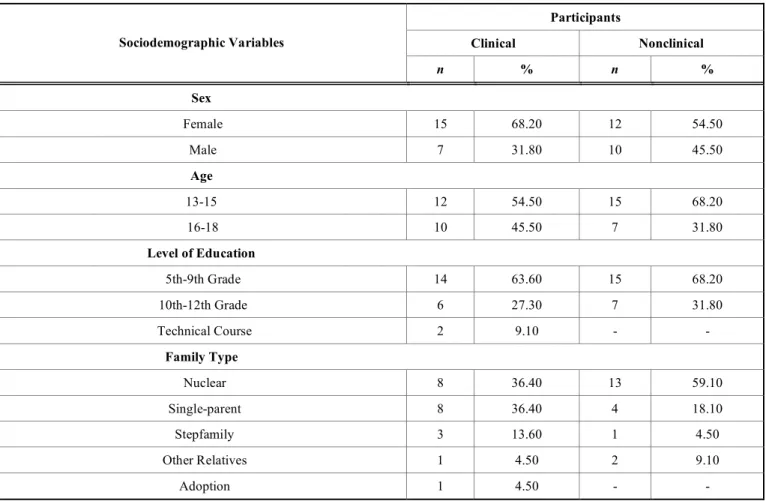
The clinical group reported more stressful life events, with parents’ divorce or separation being the most frequently mentioned, followed by their own or a relative’s illness and difficulties in the family relationships. In the nonclinical group, the most often stated stressful life event was the ill-ness of a relative, followed by parents’ divorce or separation, difficulties in family dynamics and one’s own illness. Table 1 summarizes the charac-teristics of the sample. Exclusion criteria were the presence of moderate or severe mental deficiency, psychosis, severe behavioral changes associated with an antisocial functioning, substance abuse as the first diagnosis, acute decompensation and neu-ropsychiatric symptoms with physical cause.
Table 1. Characterization of adolescent participants (N = 44) in relation to sociodemographic variables. Participants Clinical Nonclinical Sociodemographic Variables n % n % Sex Female 15 68.20 12 54.50 Male 7 31.80 10 45.50 Age 13-15 12 54.50 15 68.20 16-18 10 45.50 7 31.80 Level of Education 5th-9th Grade 14 63.60 15 68.20 10th-12th Grade 6 27.30 7 31.80 Technical Course 2 9.10 - - Family Type Nuclear 8 36.40 13 59.10 Single-parent 8 36.40 4 18.10 Stepfamily 3 13.60 1 4.50 Other Relatives 1 4.50 2 9.10 Adoption 1 4.50 - - (Table 1) Contd…
Participants Clinical Nonclinical Sociodemographic Variables n % n % Institution 1 4.50 - - Emancipation - - 2 9.10 Romantic Relationship Yes 2 9.10 6 27.30 No 20 90.90 16 72.70
Stressful Life Events
Own Illness 6 27.30 3 13.60
Illness of a Relative 5 22.70 7 31.80
Parent’s Divorce/ Separation 11 50.00 6 27.30
Difficulties in Family Dynamics 5 22.70 3 13.60
Institutionalization 3 13.60 1 4.50
Death of Parent/ Caregiver 2 9.10 - -
Adoption 1 4.50 - -
Maltreatment 4 18.20 - -
Abandonment by One/ Both Parent(s) 2 9.10 - -
Sexual Abuse 1 4.50 - -
Motive for Seeking Treatment
Depressive Complains 12 54.50 - -
Behavioral Changes 9 40.90 - -
Suicide Ideation/ Attempt 6 27.30 - -
Socialization Difficulties 10 45.50 - -
Obsessive Rituals 4 18.20 - -
Physical Complains 3 13.60 - -
Changes in Eating Behavior 1 4.50 - -
Clinical Referral
Own Initiative 4 18.20 - -
Family/ Friend Advice 8 36.40 - -
Medical Referral 10 45.50 - -
Type of Treatment
Psychology 5 22.70 - -
Psychiatry 8 36.40 - -
Both 9 40.90 - -
Note. The dash indicates the absence of participants in relation to the respective sociodemographic characteristic. 2.2. Procedure
After the IPOP-A authors’ approval to use the instrument and the respective coding manual, the
IPOP-A was first translated to Portuguese and then back-translated to English by different clinical psychologists and psychology researchers in an independent way to verify intersubjective
agree-ment on the meaning equivalence of the translated items regarding its original English version. This agreement was achieved by consensus through a discussion group between translators. Then, it was performed a cognitive debriefing with the target population to determine the comprehension level of the instrument’s questions.
After ethical approval and informed consent were obtained, the participants filled in the so-ciodemographic questionnaire prepared by the authors for this study. Items included sex, age, level of education, family type (assessed by asking with whom they lived), current romantic relation-ship status, stressful life events experienced, type of treatment taken, motive for seeking treatment and who did the clinical referral. Secondly, the IPOP-A was administered by a psychologist pre-viously trained on the IPOP-A protocol, with this assessment lasting approximately 50 to 90 min-utes. Data collection was performed in a quiet and private environment, adjusted whenever possible to the physical and time availability of the partici-pants. Each protocol was assigned with a numeri-cal code and the audiotaped interviews were fully transcribed by three evaluators. The evaluation of the participants’ answers was performed inde-pendently with the level of intersubjective agree-ment achieved by consensus after discussion among the three evaluators.
2.3. Ethical Approval and Informed Consent
Written approval by the Ethics Committee of the hospital and by the adolescents’ caregivers was secured before data collection, and an informed consent, both in an oral and in a written form, was presented to the participants clarifying the re-search’ collaboration format and reinforcing its confidentiality, anonymity and voluntary nature along with the possibility for withdrawal at any moment without prejudice.
2.4. Materials
The IPOP-A (Ammaniti et al., 2011) is a semi-structured interview for adolescents between 13 and 21 years old with 42 questions distributed along three dimensions: identity, object relations, and affect regulation. The identity dimension ferentiates normal identity crisis from identity dif-fusion, assessing aspects such as representations of the self and significant others, self-esteem, integra-tion of corporal and sexual changes, investment in
school and leisure activities, goals and ambitions. The object relations dimension evaluates the qual-ity of interpersonal functioning with peers, care-givers, and romantic partners. Finally, the affect regulation dimension appraises the ability to iden-tify experience and modulate affective experi-ences, with the participants being questioned about how they would feel and react to quotidian events (Ammaniti et al., 2012, Ammaniti et al., 2015).
The IPOP-A (Ammaniti et al., 2011) is a modi-fied version of the Structured Interview of Person-ality Organization-Adolescent Version (STIPO-A; Fontana & Ammaniti, 2010), which derives from the Structured Interview of Personality Organiza-tion (STIPO; Clarkin, Caligor, Stern, & Kernberg, 2003) for adults. This modification reduced the duration of the interview administration so that adolescents would not get bored. Despite the STIPO-A having shown good results, namely in internal consistency values with Cronbach’s alphas ranging between .96 and .81, Ammaniti et al. (2011) reduced the number of items and added an affect regulation dimension, which was not origi-nally a part of the STIPO-A. Additioorigi-nally, unlike the STIPO, the IPOP-A (Ammaniti et al., 2011) allows a focus on personality development proc-esses.
2.5. Data Analysis
Data analysis was performed through a content analysis according to the IPOP-A coding manual (Ammaniti et al., 2011). This manual considers the participant’s gender and divides adolescence into three groups: early adolescence (12-15 years old), middle adolescence (16-18 years old) and late ado-lescence (19-21 years old). The coding system var-ies between the values 0 and 2, where “0” corre-sponds to healthy aspects, “1” means moderate difficulties and “2” indicates high risk difficulties.
It was not possible to perform an exploratory factor analysis to evaluate the validity of the construct given the reduced number of subjects (Tabachnick & Fidell, 2007). As such, the IPOP-A dimensions were considered according to the dis-tribution of items suggested by Ammaniti et al. (2011). Internal consistency was evaluated by the Cronbach’s alpha coefficient and normality by the Kolmogorov-Smirnov (K-S) test along with skew-ness (Sk) and kurtosis (Ku) values.
The homogeneity of variance assumption was verified through the Levene test. Then, t-tests for independent samples were performed to analyze variance in the IPOP-A dimensions between clini-cal and noncliniclini-cal groups. More t-tests for inde-pendent samples were applied to assess variance in these same dimensions according to sex, age, and level of education of each group. To analyze this variance according to the family type, one-way analysis of variance (ANOVA) was used.
It should be noted that, in order to perform these analyses, some of the categories regarding the level of education—10th to 12th grade and technical course—and some others regarding the family type—stepfamily, other relatives, adoption, institution and emancipation—were grouped to achieve a more balanced distribution of the sam-ple. However, unequal sampling distribution re-garding the categories of romantic relationships and the stressful life events did not allow these to take part in the analysis. All data were analyzed with the program IBM SPSS Statistics, version 18.
3. RESULTS
3.1. Psychometric Analysis
The three dimensions of the IPOP-A showed satisfactory internal consistency levels after re-moving item 10 “Do you like doing risky things or challenging rules?” originally integrated into the Identity dimension, and item 21, “How does he/she put together these different aspects of him-self/herself?” of the object relation dimension. These items were removed, since alpha if item de-leted index suggested an improvement in Cron-bach’s alpha levels if these individual items were deleted, and since these removals still allowed us to preserve the theoretical meaning of these di-mensions. Consequently, we obtained Cronbach’s
alphas of .69 for the identity dimension, .79 for the object relations dimension, and .61 for the affect regulation dimension, with the identity and affect regulation reliability levels indicating moderate reliability since the values obtained are between .50 and .70 (Hinton, Brownlow, McMurray, & Cozens, 2004).
Through the Kolmogorov-Smirnov test, we also found that the identity dimension, D(44) = 0.19, p < .001, and the object relations dimension, D(44) = 0.17, p = .002, unlike the affect regulation di-mension, D(44) = 0.13, p = .052, did not display a normal distribution. However, since the sample exceeds 30 subjects, it is possible to evoke the central limit theorem and assume an approxi-mately normal distribution (Marôco, 2014). Addi-tionally, the skewness and kurtosis values did not compromise this distribution since skewness val-ues were below 3 and kurtosis valval-ues were below 8, which allows the preservation of robustness of the parametric tests (Kline, 2011).
3.2. Descriptive and Differential Analysis
The Levene test revealed homogeneity of vari-ance assumption for the dimensions Identity, F(1, 42) = 1.61, p = .212, object relations, F(1, 42) = 11.46, p = .062, and affect regulation, F(1, 42) = 0.03, p = .868; therefore, comparisons between means were performed. Considering the total sam-ple, analysis of mean values revealed the Identity dimension (M = 0.49, SD = 0.06) to be the most compromised dimension, since it presents values higher than both Object Relations dimension (M = 0.39, SD = 0.04) and the affect regulation dimen-sion (M = 0.37, SD = 0.04). The t-tests for inde-pendent samples revealed statistically significant differences for all dimensions of the IPOP-A in both groups, with the clinical group showing higher mean values than the nonclinical group (Table 2).
Table 2. Discriminant validity of the IPOP-A.
Clinical Group Nonclinical Group
Domain M (SD) M (SD) t p
Identity 0.70 (0.42) 0.28 (0.18) 4.32 .000***
Object Relations 0.50 (0.29) 0.27 (0.22) 2.94 .005*
Affect Regulation 0.45 (0.23) 0.29 (0.21) 2.29 .027*
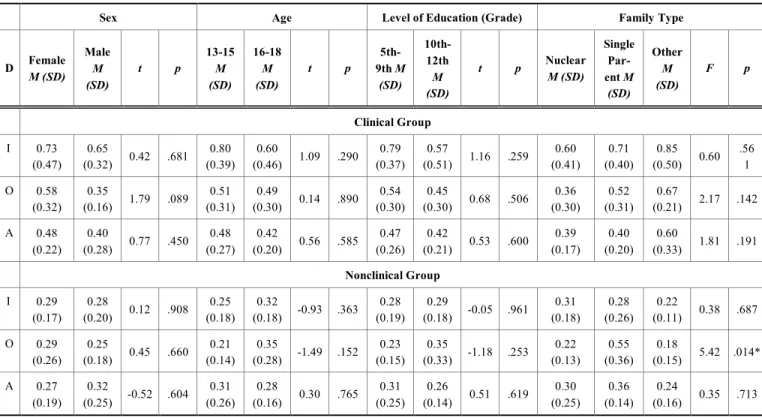
Table 3. Comparison of the IPOP-A domains in relation to sociodemographic variables across groups.
Sex Age Level of Education (Grade) Family Type
D Female M (SD) Male M (SD) t p 13-15 M (SD) 16-18 M (SD) t p 5th-9th M (SD) 10th-12th M (SD) t p Nuclear M (SD) Single Par-ent M (SD) Other M (SD) F p Clinical Group I 0.73 (0.47) 0.65 (0.32) 0.42 .681 0.80 (0.39) 0.60 (0.46) 1.09 .290 0.79 (0.37) 0.57 (0.51) 1.16 .259 0.60 (0.41) 0.71 (0.40) 0.85 (0.50) 0.60 .56 1 O 0.58 (0.32) 0.35 (0.16) 1.79 .089 0.51 (0.31) 0.49 (0.30) 0.14 .890 0.54 (0.30) 0.45 (0.30) 0.68 .506 0.36 (0.30) 0.52 (0.31) 0.67 (0.21) 2.17 .142 A 0.48 (0.22) 0.40 (0.28) 0.77 .450 0.48 (0.27) 0.42 (0.20) 0.56 .585 0.47 (0.26) 0.42 (0.21) 0.53 .600 0.39 (0.17) 0.40 (0.20) 0.60 (0.33) 1.81 .191 Nonclinical Group I 0.29 (0.17) 0.28 (0.20) 0.12 .908 0.25 (0.18) 0.32 (0.18) -0.93 .363 0.28 (0.19) 0.29 (0.18) -0.05 .961 0.31 (0.18) 0.28 (0.26) 0.22 (0.11) 0.38 .687 O 0.29 (0.26) 0.25 (0.18) 0.45 .660 0.21 (0.14) 0.35 (0.28) -1.49 .152 0.23 (0.15) 0.35 (0.33) -1.18 .253 0.22 (0.13) 0.55 (0.36) 0.18 (0.15) 5.42 .014* A 0.27 (0.19) 0.32 (0.25) -0.52 .604 0.31 (0.26) 0.28 (0.16) 0.30 .765 0.31 (0.25) 0.26 (0.14) 0.51 .619 0.30 (0.25) 0.36 (0.14) 0.24 (0.16) 0.35 .713 Note. D = Domain; I = Identity; O = Object Relations; A = Affect Regulation.
*p < .05.
As shown in Table 3, no significant differences were found between dimensions of the IPOP-A according to sex, age and level of education in ei-ther group. Regarding the clinical group, ei-there were also no significant differences according to the type of family; however, there were significant differences in the object relations dimension ac-cording to the type of family in the nonclinical group. A post-hoc analysis revealed significant differences between nuclear and single-parent families (p = .023) and between single-parent and other types of families that were neither nuclear nor single-parent (p = .028), with single-parent families revealing higher mean values (Mnuclear =
0.22, SDnuclear = 0.13; Msingle-parent = 0.55, SD single-parent = 0.36; Mother = 0.18, SDother = 0.15).
4. DISCUSSION
The results show that the Portuguese version of the IPOP-A presents satisfactory internal consis-tency values throughout its dimensions. These di-mensions also follow an approximately normal distribution, which altogether supports the IPOP-A as a valid instrument to collect information on the personality organization processes of adolescents and to identify adolescents with a personality
dis-order. Of further note, the three dimensions of the IPOP-A—identity, object relations and affect regulation—are aligned with the DSM-V alterna-tive model criteria for personality disorder diagno-sis (APA, 2013). This model is based on a dimen-sional perspective regarding personality (Am-maniti et al., 2012; Am(Am-maniti et al., 2015), which is relevant due to the importance of this perspec-tive when evaluating youth.
The higher mean values of our total sample on the identity dimension of the IPOP-A suggest that this is the most impaired feature of adolescent’s psychological functioning in comparison to the other analyzed dimensions. This is consistent with the developmental process of personality being particularly central during adolescence, when flexibility in traits is a reality (Chanen & McCutcheon, 2013) and there is a progressive at-tempt to organize various perspectives of the self and significant others into a coherent whole (Am-maniti et al., 2012; O. Kernberg, 2006; Nurmi, 2004; Sharp & Wall, 2018). This in turn may re-sult either in personality consolidation or devel-opment of psychopathological characteristics (Ramos et al., 2014; Sharp & Wall, 2018). Indeed, by assessing the discriminant validity of the
IPOP-A, there were statistically significant differences in all dimensions of the instrument, with mean values for the adolescents in the clinical group being higher than those of the nonclinical group. This might reflect greater functionality impairment in adolescents whose characteristics are associated with personality disturbance, not only at an iden-tity consolidation level but also regarding the quality of the interpersonal relationships estab-lished and the subjects’ affect regulation ability.
The present study also showed no significant difference between the IPOP-A dimensions in any of the sample groups when considering sex, age or level of education. However, it might indicate a tendency to higher impairment among girls in the generality of dimensions regarding our results, which seem to show slightly higher mean levels for girls. This may be explained by an increased risk in women to experience greater distress to-wards negative life events (Hilt & Nolen-Hoeksema, 2009; Rose & Rudolph, 2006). Since personality pathology can emerge from an adapta-tion attempt towards stressful experiences (Shiner & Allen, 2013), these experiences should then be considered when assessing adolescent’s identity consolidation, interpersonal functioning, and affect regulation ability.
Given the prominence of social, academic and occupational contextual factors in adolescence, it is possible that these factors impact personality functioning and, as such, contribute to the emer-gence and maintenance of problematic patterns related to personality pathology. This is especially likely with regard to family stress, which strongly relates to the emergence of personality disorder symptoms (Shiner & Allen, 2013). Thus, although in our study no significant differences were found in any of the IPOP-A dimensions by family type in the clinical group, the higher mean values of sub-jects whose families are neither nuclear nor single-parent suggests a tendency for these family types to be associated with higher impairment in IPOP-A dimensions, which is in line with the finding by Lahti et al. (2012) that separation from caregivers increases the risk for development of personality disorders. Other risk factors identified by Cohen et al. (2005) include the presence of only one parent, parental conflict, and parental illness or death. This accords with our finding that adolescents in the nonclinical group of single-parent families showed more impairment in the object relations
dimension compared to subjects of nuclear or other types of families. In fact, by analyzing abso-lute frequencies of stressful life events experi-enced in our overall sample, we verified that par-ents’ divorce or separation was the most com-monly reported stressful life event among the ado-lescents of both groups. These events ranked sec-ond in the nonclinical group, being only preceded by the illness of a relative. Therefore, one might hypothesize that despite the presence of personal-ity disorder indicators or a normative personalpersonal-ity functioning, these events can have some impact on the youth’s psychological adjustment.
While variations occur in normal adolescence regarding affect, self-control, relationships quality and perspectives of the self, others and life experi-ences, personality disorder is characterized by an unusual pattern in cognitive, affective, and inter-personal functioning as well as impulse control (APA, 2013), making it essential to comprehen-sively assess youth’s personality (Shiner & Allen, 2013). There are few instruments adapted for ado-lescents to evaluate personality disorder, and only a small number of instruments available to assess personality based on a dimensional perspective. The satisfactory psychometric characteristics of the IPOP-A support the validity of the instrument in differentiating adolescents with personality dis-order from those with a healthy personality func-tioning, and the descriptive characteristics and variations found in the clinical and nonclinical groups may provide clues for possible future stud-ies that account for both populations. Hence, this study is an important contributor to better under-stand the psychopathological manifestations of personality compared with developmental mani-festations of it, although the need prevails for deeper understanding concerning this issue.
Some limitations must be considered regarding this research. Despite Ammaniti and colleagues’ (2011) intention to decrease the IPOP-A’s admini-stration time compared to the STIPO-A, partici-pants in our study sometimes complained about its length. Thus, intrapersonal variables, such as fa-tigue, might have compromised generalization of the results. Future research should take this into account and consider the need for an even shorter interview. The generalization of results may also be limited given the inequalities in the original samples with respect to the level of education and family type, which forced us to regroup the
par-ticipants to equally distribute those categories in order for the analysis to be performed. It was also not possible to compare groups through differen-tial analysis regarding the categories of romantic relationships and stressful life events due to une-qual sampling distribution along those, which might be pertinent to assess in future studies. In fact, one may presume that the absence of signifi-cant differences among the IPOP-A dimensions according to the analyzed sociodemographic vari-ables will possibly not be verified in other studies with higher sampling sizes in both clinical and nonclinical groups. Future research should include larger samples to clarify these results. Neverthe-less, it is noteworthy that this research allowed gathering data from a clinical group of adolescents with a previous personality disorder diagnosis, which is rarely achieved in scientific studies.
Despite these limitations, the IPOP-A valida-tion in the Portuguese populavalida-tion seems to amplify the possibility of collecting useful clinical infor-mation on personality disorders and personality organization processes. We suggest that its use along with other assessment instruments and tech-niques may promote not only a more comprehen-sive and adequate diagnosis but also more effec-tive clinical interventions regarding the needs and the mental health condition of adolescents.
ABOUT THE AUTHORS
Isabel Leal, PhD, is a Full Professor in Clinical
and Health Psychology Department, Researcher of the William James Center for Research, ISPA – Instituto Universitário, and Psychologist and Psy-chotherapist in private practice in Lisbon.
Marta Pedreira, MSc, is a Clinical and Health
Psychologist in Lisbon. At the time of this study, she was also Researcher in ISPA – Instituto Uni-versitário.
Pedro Pires, MD, is Psychiatrist and Chief of
the Child and Adolescent’s Psychiatry Department of Hospital Garcia de Orta.
Sara Bailote Silva, MSc in Health Psychology,
was concluding her masters in ISPA – Instituto Universitário at the time of this study.
Maria Meireles Ramos, MSc in Clinical and
Health Psychology, is Research Assistant in
Wil-liam James Center for Research, ISPA – Instituto Universitário.
Vera Santos Ramos, MSc, is Clinical and
Health Psychologist in the Psychology Unit of Hospital Garcia de Orta.
ETHICS APPROVAL AND CONSENT TO PARTICIPATE
Not applicable.
HUMAN AND ANIMAL RIGHTS
This study involved human participants. Proce-dures regarding ethical approval and human sub-jects protections are detailed in the manuscript.
CONSENT FOR PUBLICATION
Not applicable.
CONFLICT OF INTEREST
The author declares no conflict of interest, fi-nancial or otherwise.
ACKNOWLEDGEMENTS
William James Center for Research is funded by the Fundação para a Ciência e Tecnologia – FCT (grant UID/PSI/04810/2013).
REFERENCES
American Psychiatric Association (1994). Diagnostic and
statistical manual of mental disorders (4th ed.).
Washington, DC: Author.
American Psychiatric Association (2013). Diagnostic and
statistical manual of mental disorders (5th ed.).
Washington, DC: Author.
Ammaniti, M., Fontana, A., Clarkin, A., Clarkin, J. F., Nico-lais, G., & Kernberg, O. F. (2012). Assessment of adolescent personality disorders through the Interview of Personality Organization Processes in Adolescence (IPOP-A): Clinical and theoretical implica-tions. Adolescent Psychiatry, 2, 36-45. doi:10.2174/2210677411202010036
Ammaniti, M., Fontana, A., Kernberg, O., Clarkin, J. & Clarkin, A. (2011). Interview of Personality
Organi-zation Processes in Adolescence (IPOP-A). Rome:
Department of Dynamic and Clinical Psychology & New York: Personality Disorder Institute, Weill Medical College. Unpublished Manuscript.
Ammaniti, M., Fontana, A., & Nicolais, G. (2015). Border-line personality disorder in adolescence through the lens of the Interview of Personality Organization
Processes in Adolescence (IPOP-A): Clinical use and implications. Journal of Infant, Child, and Adolescent
Psychotherapy, 14(1), 82-97.
doi:10.1080/15289168.2015.1003722
Chanen, A. M., & McCutcheon, L. K. (2008). Personality disorder in adolescence: The diagnosis that dare not speak its name. Personality and Mental Health, 2(1), 35-41. doi:10.1002/pmh.28
Chanen, A. M., & McCutcheon, L. (2013). Prevention and early intervention for borderline personality disorder: Current status and recent evidence. The British
Jour-nal of Psychiatry, 202(54), 24-29.
doi:10.1192/bjp.bp.112.119180
Clarkin, J. F., Caligor, E., Stern, B., & Kernberg, O. F. (2003). Structured Interview of Personality
Organiza-tion (STIPO). New York: Weill Cornell Medical
Col-lege. Unpublished Manuscript.
Cohen, P., Crawford, T. N., Johnson, J. G., & Kasen, S. (2005). The children in the community study of de-velopmental course of personality disorder. Journal
of Personality Disorders, 19(5), 466-486. doi:10.1521/pedi.2005.19.5.466
De Fruyt, F., & De Clercq, B. (2014). Antecedents of per-sonality disorder in childhood and adolescence: To-ward an integrative developmental model. Annual
Re-view of Clinical Psychology, 10, 449-476. doi:10.1146/annurev-clinpsy-032813-153634
Erikson, E. H. (1956). The problem of ego identity. Journal
of the American, 4(56), 56-121.
doi:10.1177/000306515600400104
Fontana, A., & Ammaniti, M. (2010). Adolescent STIPO:
psychometric properties, convergent validity and comparison with normal adolescents. Paulina Kern-berg Memorial Conference. White Plains, US: Weill
Medical College of Cornell and Columbia University. Gunderson, J. G., Stout, R. L., McGlashan, T. H.,
Shea, M. T., Morey, L. C., Grilo, C. M., … Skodol, A. E. (2011). Ten-year course of borderline personality disorder: Psychopathology and function from the collaborative longitudinal personality disor-ders study. Archives of General Psychiatry, 68(8), 827-837. doi:10.1001/archgenpsychiatry.2011.37 Haslam, N. (2003). Categorical versus dimensional models
of mental disorder: The taxometric evi-dence. Australian and New Zealand Journal of
Psy-chiatry, 37(6), 696-704. doi:10.1080/j.1440-1614.2003.01258.x
Heim, A., & Westen, D. (2009). Theories of personality and personality disorders. In J. M. Oldham, A. E. Skodol, & D. S. Bender (Eds.), Essentials of personality
dis-orders (pp. 13-34). Washington, DC: American
Psy-chiatric Publishing, Inc.
Hilt, L. M., & Nolen-Hoeksema, S. (2009). The emergence of gender differences in depression in adolescence. In S. Nolen-Hoeksema & L. M. Hilt (Eds.), Handbook
of depression in adolescents (pp. 111-135). New
York, NY: Routledge.
Hinton, P., Brownlow, C., McMurray, I., & Cozens, B. (2004). Using SPSS to analyse questionnaires: Reli-ability. In P. R. Hinton, C. Brownlow, I. McMurray, & B. Cozens (Eds.), SPSS Explained (pp. 355-365). New York, NY: Routledge.
Huprich, S. K., & Bornstein, R. F. (2007). An overview of issues related to categorical and dimensional models of personality disorder assessment. Journal of
Per-sonality Assessment, 89(1), 3-15. doi:
10.1080/00223890701356904
Kasen, S., Cohen, P., Skodol, A. E., First, M. B., John-son, J. G., Brook, J. S., & Oldham, J. M. (2007). Co-morbid personality disorder and treatment use in a community sample of youths: A 20-year follow-up. Acta Psychiatrica Scandinavica, 115, 56-65. doi:10.1111/j.1600-0447.2006.00842.x
Kernberg, O. F. (1995) Transtornos graves de
personalida-de: Estratégias psicoterapêuticas [Severe personality
disorders: Psychotherapeutic strategies] (R. C. Lopes, Tans.). Porto Alegre: Artes Médicas.
Kernberg, O. F. (2006). Identity: Recent findings and clinical implications. Psychoanalytic Quarterly, 75(4), 969-1004. doi:10.1002/j.2167-4086.2006.tb00065.x Kernberg, O. F., & Caligor, E. (2005). A psychoanalytic
theory of personality disorders. In M. F. Lenzenweger & J. F. Clarkin (Eds.), Major theories of personality
disorder (2nd ed., pp. 114-156). New York, NY: The
Guilford Press.
Kernberg, P. F., Weiner, A. S., & Bardenstein, K. K. (2000).
Personality disorders in children and adolescents.
New York, NY: Basic Books.
Kline, R. B. (2011). Data preparation. In Principles and
practice of structural equation modeling (3rd ed., pp.
46-74). New York, NY: The Guilford Press.
Krueger, R. F., Derringer, J., Markon, K. E., Watson, D., & Skodol, A. E. (2012). Initial construction of a mal-adaptative personality trait model and inventory for DSM-5. Psychological Medicine, 42(9), 1879-1890. doi:10.1017/S0033291711002674
Lahti, M., Pesonen, A., Räikkönen, K., Heinonen, K., Wahl-beck, K., Kajantie, E., … Eriksson, J. G. (2012). Temporary separation from parents in early childhood and serious personality disorders in adult life. Journal
of Personality Disorders, 26(5), 751-762. doi:10.1521/pedi.2012.26.5.751
Laurenssen, E. M., Hutsebaut, J., Feenstra, D. J., Van Busschbach, J. J., & Luyten, P. (2013). Diagnosis of personality disorders in adolescents: a study among psychologists. Child and Adolescent Psychiatry and
Mental Health, 7(3), 1-4. doi:10.1186/1753-2000-7-3
Livesley, W. J. (2007). A framework for integrating dimen-sional and categorical classifications of personality disorder. Journal of Personality Disorders, 21(2), 199-224. doi: 10.1521/pedi.2007.21.2.199
Marôco, J. (2014). Análise estatística com o SPSS Statistics [Statistical analysis with SPSS Statistics] (6th ed.). Lisboa: ReportNumber.
Millon, T., & Davis, R. D. (1993). The Millon Adolescent Personality Inventory and the Millon Adolescent Clinical Inventory. Journal of Counseling and
Devel-opment, 71(5), 570-574. doi: 10.1002/j.1556-6676.1993.tb02244.x
Morey, L. C., & Hopwood, C. J. (2013). Stability and change in personality disorders. Annual Review of Clinical
Psychology, 9, 499-528. doi:10.1146/annurev-clinpsy-050212-185637
Nurmi, J. (2004). Socialization and self-development: Chan-neling, selection, adjustment, and reflection. In R.M. Lerner & L. Steinberg (Eds.), Handbook of
Adoles-cent Psychology (2nd ed., pp. 85-124). New Jersey:
John Wiley & Sons, Inc.
Paris, J. (2008). [Peer commentary on the paper “Personality disorder in adolescence: The diagnosis that dare not speak its name” by A. M. Chanen & L. K. McCutch-eon]. Personality and Mental Health, 2(1), 42-43. doi: 10.1002/pmh.29
Paris, J. (2013). Personality disorders begin in adoles-cence. Journal of the Canadian Academy of Child
and Adolescent Psychiatry, 22(3), 195-196. Retrieved
from
https://www.ncbi.nlm.nih.gov/pmc/articles/PMC3749 891/
Ramos, V., Canta, G., De Castro, F., & Leal, I. (2014). Dis-crete subgroups of adolescents diagnosed with bor-derline personality disorder: A latent class analysis of personality features. Journal of Personality
Disor-ders, 28(4), 463-482. doi:10.1521/pedi_2013_27_126
Reynolds, W. M. (1998). Adolescent Psychopathology Scale:
Psychometric and technical manual. Lutz, FL:
Psy-chological Assessment Resources.
Rose, A. J., & Rudolph, K. D. (2006). A review of sex dif-ferences in peer relationship processes: Potential trade-offs for emotional and behavioral development of girls and boys. Psychological Bulletin, 132(1), 98-131. doi:10.1037/0033-2909.132.1.98
Sharp, C., & Wall, K. (2018). Personality pathology grows up: Adolescence as a sensitive period. Current
Opin-ion in Psychology, 21, 111-116.
doi:10.1016/j.copsyc.2017.11.010
Shiner, R. L., & Allen, T. A. (2013). Assessing personality disorders in adolescents: Seven guiding princi-ples. Clinical Psychology: Science and
Prac-tice, 20(4), 361-377. doi:10.1111/cpsp.12047
Somma, A., Fossati, A., Terrinoni, A., Williams, R., Ardiz-zone, I., Fantini, F., … Ferrara, M. (2016). Reliability and clinical usefulness of the personality inventory for DSM-5 in clinically referred adolescents: A pre-liminary report in a sample of Italian inpa-tients. Comprehensive Psychiatry, 70, 141-151. doi:10.1016/j.comppsych.2016.07.006
Tabachnick, B. G., & Fidell, L. S. (2007). Using multivariate
statistics (5th ed.). Boston, MA: Allyn &
Ba-con/Pearson Education.
Weinberg, A., & Klonsky, E. (2009). Measurement of emo-tion dysregulaemo-tion in adolescents. Psychological
As-sessment, 21(4), 616-621. doi: 10.1037/a0016669
Westen, D., Shedler, J., Durret, C., Glass, S., & Martens, A. (2003). Personality diagnoses in adolescence: DSM-IV axis II diagnoses and an empirically derived alter-native. American Journal of Psychiatry, 160(5), 952-966. doi:10.1176/appi.ajp.160.5.952
Westen, D., Shedler, J., & Bradley, R. (2006). A prototype approach to personality disorder diagnosis. American
Journal of Psychiatry, 163(5), 846-856. doi:10.1176/ajp.2006.163.5.846
Widiger, T. A., & Trull, T. J. (2007). Plate tectonics in the classification of personality disorder: Shifting to a dimensional model. American Psychologist, 62(2), 71-83. doi:10.1037/0003-066X.62.2.71
Wilkinson-Ryan, T., & Westen, D. (2000). Identity distur-bance in borderline personality disorder: An empirical investigation. The American Journal of Psychiatry,
157(4), 528-541. doi: 10.1176/appi.ajp.157.4.528
DISCLAIMER: The above article has been published in Epub (ahead of print) on the basis of the materi-als provided by the author. The Editorial Department reserves the right to make minor modifications for further improvement of the manuscript.