Immunosuppressive Therapy in Lupus Nephritis
The Euro-Lupus Nephritis Trial, a Randomized Trial of
Low-Dose Versus High-Dose Intravenous Cyclophosphamide
Fre´de´ric A. Houssiau,
1Carlos Vasconcelos,
2David D’Cruz,
3Gian Domenico Sebastiani,
4Enrique de Ramon Garrido,
5Maria Giovanna Danieli,
6Daniel Abramovicz,
7Daniel Blockmans,
8Alessandro Mathieu,
9Haner Direskeneli,
10Mauro Galeazzi,
11Ahmet Gu¨l,
12Yair Levy,
13Peter Petera,
14Rajko Popovic,
15Radmila Petrovic,
16Renato Alberto Sinico,
17Roberto Cattaneo,
18Josep Font,
19Genevie`ve Depresseux,
1Jean-Pierre Cosyns,
1and Ricard Cervera
19Objective. Glomerulonephritis is a severe
mani-festation of systemic lupus erythematosus (SLE) that is usually treated with an extended course of intravenous
(IV) cyclophosphamide (CYC). Given the side effects of this regimen, we evaluated the efficacy and the toxicity of a course of low-dose IV CYC prescribed as a remission-inducing treatment, followed by azathioprine (AZA) as a remission-maintaining treatment.
Methods. In this multicenter, prospective clinical
trial (the Euro-Lupus Nephritis Trial [ELNT]), we randomly assigned 90 SLE patients with proliferative glomerulonephritis to a high-dose IV CYC regimen (6 monthly pulses and 2 quarterly pulses; doses increased according to the white blood cell count nadir) or a low-dose IV CYC regimen (6 fortnightly pulses at a fixed dose of 500 mg), each of which was followed by AZA. Intent-to-treat analyses were performed.
Results. Followup continued for a median of 41.3
months in the low-dose group and 41 months in the high-dose group. Sixteen percent of those in the low-dose group and 20% of those in the high-low-dose group experienced treatment failure (not statistically signifi-cant by Kaplan-Meier analysis). Levels of serum creat-inine, albumin, C3, 24-hour urinary protein, and the disease activity scores significantly improved in both groups during the first year of followup. Renal remis-sion was achieved in 71% of the low-dose group and 54% of the high-dose group (not statistically significant). Renal flares were noted in 27% of the low-dose group and 29% of the high-dose group. Although episodes of severe infection were more than twice as frequent in the
Supported by the European League Against Rheumatism.
1Fre´de´ric A. Houssiau, MD, PhD, Genevie`ve Depresseux,
MD, Jean-Pierre Cosyns, MD, PhD: Cliniques Universitaires St. Luc, Universite´ Catholique de Louvain, Brussels, Belgium;2Carlos
Vascon-celos, MD: Hospital Santo Antonio, Porto, Portugal;3David D’Cruz,
MD: Royal London Hospital, London, UK;4Gian Domenico
Sebas-tiani, MD: Ospedale San Camillo, Rome, Italy;5Enrique de Ramon
Garrido, MD: Hospital Regional del SAS de Malaga, Malaga, Spain;
6Maria Giovanna Danieli, MD: Istituto di Clinica Medica, Universita`
degli Study di Ancona, Ancona, Italy; 7Daniel Abramovicz, MD:
Hoˆpital Erasme, Universite´ Libre de Bruxelles, Brussels, Belgium;
8Daniel Blockmans, MD: Gasthuisberg Academisch Ziekenhuis,
Katholieke Universiteit Leuven, Leuven, Belgium; 9Alessandro
Mathieu, MD: Universita` di Cagliari, Cagliari, Italy; 10Haner
Direskeneli, MD: University of Marmara Hospital, Istanbul, Turkey;
11Mauro Galeazzi, MD: Universita` degli Studi di Siena, Siena, Italy; 12Ahmet Gu¨l, MD: University of Istanbul, Istanbul, Turkey;13Yair
Levy, MD: Chaim Sheba Medical Center, Tel Aviv University, Tel Hashomer, Israel;14Peter Petera, MD: Lainz Hospital, Vienna,
Aus-tria; 15Rajko Popovic, MD: Military Medical Academy, Belgrade,
Yugoslavia; 16Radmila Petrovic, MD: University of Belgrade,
Bel-grade, Yugoslavia; 17Renato Alberto Sinico, MD: Ospedale
Poli-clinico, Ospedale San Carlo Borromeo, Milan, Italy;18Roberto
Catta-neo, MD: Ospedale Civile, Universita` degli Studi di Brescia, Brescia, Italy;19Josep Font, MD, Ricard Cervera, MD: Hospital Clinic, Institut
d’Investigacions Biomediques August Pi i Sunyer, Universitat de Barcelona, Barcelona, Spain.
Address correspondence and reprint requests to Fre´de´ric A. Houssiau, MD, PhD, Rheumatology Department, Cliniques Universi-taires St. Luc, Universite´ Catholique de Louvain, Avenue Hippocrate 10, Brussels B-1200, Belgium. E-mail: [email protected].
Submitted for publication October 26, 2001; accepted in revised form April 30, 2002.
high-dose group, the difference was not statistically significant.
Conclusion. The data from the ELNT indicate
that in European SLE patients with proliferative lupus nephritis, a remission-inducing regimen of low-dose IV CYC (cumulative dose 3 gm) followed by AZA achieves clinical results comparable to those obtained with a high-dose regimen.
An extended course of high-dose intravenous (IV) cyclophosphamide (CYC), in combination with glucocorticoids, has become the standard treatment of proliferative lupus glomerulonephritis since the pioneer-ing prospective trials performed by the National Insti-tutes of Health (NIH) group that demonstrated the superiority of this regimen over oral (1) or IV (2–4) glucocorticoid therapy alone. Several investigators have, however, raised some concerns about the indiscriminate use of the so-called “NIH regimen” to treat all lupus nephritis patients (5,6). First, the results of the NIH studies, as well as a recent meta-analysis of all random-ized trials in lupus nephritis (7), failed to demonstrate that an extended course of IV CYC was superior in terms of renal outcome and survival to other regimens of oral or IV cytotoxic drug(s). Second, high-dose IV CYC treatment is highly toxic; up to 25% of patients develop herpes zoster infection, up to 26% experience a severe infection, and up to 52% of women at risk have ovarian failure (1–4,8). Third, clinically milder cases of biopsy-proven proliferative nephritis—for which less-aggressive treatment might be justified—are now frequently diag-nosed because of prompt assessment of early renal involvement.
As an alternative to prolonged intense immuno-suppression, we have, over the last 10 years, successfully treated lupus nephritis patients with a sequential regi-men consisting of low-dose IV CYC (cumulative dose 3 gm) as a remission-inducing agent, followed by azathio-prine (AZA) as a long-term remission-maintaining agent. This approach, supported by retrospective analy-ses (9–11), has never been validated by a controlled study, however.
Herein we describe the results of the Euro-Lupus Nephritis Trial (ELNT), a European-based multicenter, prospective, randomized study designed to compare high-dose IV CYC (not a strict NIH protocol) and low-dose IV CYC as remission-inducing therapy for proliferative lupus nephritis. AZA was used in both study arms as a long-term immunosuppressive agent to maintain remission.
PATIENTS AND METHODS
Patient selection.Between September 1996 and Sep-tember 2000, a total of 90 SLE patients were enrolled in the trial at 19 European centers. All patients met the following study criteria: a diagnosis of SLE according to the American College of Rheumatology criteria (12), ageⱖ14 years, biopsy-proven proliferative lupus glomerulonephritis (World Health Organization [WHO] class III, IV, Vc, or Vd), and proteinuria ⱖ500 mg in 24 hours. Patients who had taken CYC or AZA during the previous year or had takenⱖ15 mg/day of pred-nisolone (or equivalent) during the previous month were excluded (except for a course of glucocorticoids for a maxi-mum of 10 days before referral). Other exclusion criteria were renal thrombotic microangiopathy, preexisting chronic renal failure, pregnancy, previous malignancy (except skin and cer-vical intraepithelial neoplasias), diabetes mellitus, previously documented severe toxicity to immunosuppressive drugs, and anticipated poor compliance with the protocol. To avoid selection bias, all nephritis patients who met the inclusion/ exclusion criteria were randomized into the trial, except for a few patients who declined to participate.
The study was approved by the ethics committees of all participating hospitals. Written informed consent was obtained from all study patients.
Assessment of renal biopsy samples. Kidney biopsy specimens were assessed (light and immunofluorescence stud-ies) by the renal pathologist at each center. Treatment was decided according to the biopsy classification. Slides of paraffin-embedded sections from all but 1 patient were re-viewed by one of us (J-PC), who was blinded to the random-ization data. The reviewer evaluated the specimens for activity and chronicity indices, according to the method of Morel-Maroger et al (13).
Briefly, the activity index (maximum score 42) repre-sents the sum of the scores of glomerular hyperactive and active lesions. Hyperactive lesions (hematoxylin bodies, necro-sis, circumferential crescents, and necrotizing angiitis) were scored on a scale of 0–6, where 0 ⫽ absent, 2 ⫽ mild, 4 ⫽ moderate, and 6⫽ severe. Active lesions (endocapillary pro-liferation, partial crescents, wire-loops, hyalin thrombi, nuclear debris, and acute tubulointerstitial lesions) were scored on a scale of 0–3, where 0⫽ absent, 1 ⫽ mild, 2 ⫽ moderate, and 3 ⫽ severe. The chronicity index (maximum score 6) was derived by summing the glomerular obsolescence score and the extent of stripes of tubulointerstitial fibrosis. Glomerular ob-solescence was scored on a scale of 0–3, where 0⫽ absent, 1 ⫽ 1–29% of the glomeruli, 2⫽ 30–59% of the glomeruli, and 3 ⫽ ⬎60% of the glomeruli. The extent of stripes of tubulointer-stitial fibrosis was scored on a scale of 0–3, where 0⫽ absent, 1⫽ small, 2 ⫽ large, and 3 ⫽ diffuse.
Treatment. Immediately after informed consent was obtained and randomization had been performed, all patients received 3 daily pulses of 750 mg of IV methylprednisolone, followed by oral glucocorticoid therapy at an initial dosage of 0.5 mg/kg/day of prednisolone (or equivalent) for 4 weeks. A dosage of 1 mg/kg/day was allowed in critically ill patients (those with renal impairment or severe extrarenal disease). After 4 weeks, glucocorticoid dosages were tapered by 2.5 mg of prednisolone (or equivalent) every 2 weeks. Low-dose
glucocorticoid therapy (5–7.5 mg of prednisolone per day) was maintained at least until month 30 after inclusion.
All patients received IV CYC therapy beginning on day 1 of study inclusion. They were randomized by minimiza-tion into 2 treatment groups: high-dose or low-dose IV CYC. With minimization, the group allocation does not rely on chance, but is designed to reduce as much as possible any difference in the distribution of determinants of outcomes (14). The following determinants were taken into account by the minimization: study center, age, sex, history of renal disease, history of glucocorticoid treatment, history of treat-ment with other immunosuppressive drugs, serum creatinine level, serum albumin level, 24-hour urinary protein level, diastolic blood pressure, European Consensus Lupus Activity Measure (ECLAM) score (15), WHO class, and the presence of crescents, glomerular necrosis, or fibrosis on kidney biopsy specimens.
Patients assigned to the high-dose group received 8 IV CYC pulses within a year (6 monthly pulses followed by 2 quarterly pulses). The initial CYC dose was 0.5 gm/m2of body
surface area; subsequent doses were increased by 250 mg according to the white blood cell count nadir measured on day 14 (16), with a maximum of 1,500 mg per pulse. Patients assigned to the low-dose group received 6 fortnightly IV CYC pulses at a fixed dose of 500 mg. The use of mesna was left to the decision of the physician. In both treatment arms, AZA (2 mg/kg/day) was started 2 weeks after the last CYC injection and continued at least until month 30 after study inclusion. For cases of AZA-related toxicity, the dosage was reduced to 1 mg/kg/day. Patients who did not tolerate this AZA dosage were dropped from the trial.
Benign renal flares (i.e., those not meeting the defini-tion of severe flares [see below]) were treated with low-dose glucocorticoids (ⱕ15 mg of prednisolone per day) for a 2-week period, hydroxychloroquine (6 mg/kg/day), and/or nonsteroidal antiinflammatory drugs (NSAIDs). A severe renal flare was defined as 1 of the following 3 features: renal impairment, increase in proteinuria, or severe systemic disease. Renal impairment was defined as an SLE-related increase of⬎33% in the serum creatinine level within a 1-month period. An increase in proteinuria was defined as the recurrence or appearance of nephrotic syndrome (albuminemia⬍3.5 gm/dl and proteinuriaⱖ3 gm in a 24-hour sample). In patients with low-grade proteinuria at baseline (ⱖ0.5 gm but ⬍1 gm in 24 hours), a 3-fold increase in 24-hour urinary protein levels within a 3-month period was also considered a severe flare, provided that it was accompanied by microscopic hematuria and a ⬎33% reduction of serum C3 levels within a 3-month period. Severe systemic disease was defined as any of the following events: central nervous system disease, thrombocy-topenia (⬍100,000 platelets/l), hemolytic anemia, lupus pneumonitis, lupus myocarditis, extensive skin vasculitis, or serositis not responding to low-dose glucocorticoid and/or NSAID treatment. A severe flare was always treated by an increase in the glucocorticoid dosage (0.5–1.0 mg/kg/day of prednisolone) for 1 month, and then promptly tapered to the patient’s preflare dosage. Up to 2 IV pulses of methylpred-nisolone (750 mg) were allowed within a 1-week period.
Hypertension (diastolic blood pressure ⱖ90 mm Hg) was treated initially with angiotensin-converting enzyme inhib-itors, unless contraindicated.
Contraception was prescribed for all sexually active women of childbearing potential. These patients were also warned against the potential deleterious effects of pregnancy on their disease, at least during the first 30 months after study inclusion.
End points.Patients were evaluated monthly within the first year after study inclusion and quarterly thereafter. Median followup was 41 months (range 8–62 months). In addition to the primary end point, 3 secondary end points were examined.
The primary end point was treatment failure, which was defined as 1 of the following 3 features: absence of a primary response after 6 months of therapy, occurrence of a glucocorticoid-resistant flare, or a doubling of the serum creatinine level. These features are defined in Table 1. Impor-tantly, for patients who presented with impaired renal func-tion, stabilization at that level was considered treatment fail-ure. Patients censored because of treatment failure were treated according to the decisions of their physicians but were included in the intent-to-treat analyses because followup data were available.
The 3 secondary end points were as follows: 1) the kinetics of the response to therapy in the first year, based on serial measurements of serum creatinine, serum albumin, 24-hour urinary protein, and serum C3 levels, as well as the ECLAM score; 2) the rate of renal remission, defined as⬍10 red blood cells/high-power field and a 24-hour urinary protein level⬍1 gm, in the absence of a doubling of the serum creatinine level; and 3) the number of severe flares, as defined above.
Statistical analysis. Our estimate of the clinically meaningful difference in the primary outcome was a doubling of the number of patients achieving treatment failure (e.g., a change from 15% to 30%). Given the limited number of patients included in the trial (due to the rarity of the disease and the strict inclusion criteria), the power of our study was low (i.e., 0.22) at the 0.05 significance level.
Table 1. Definitions of treatment failure
Treatment failure was defined as either of the following 3 features: 1. Absence of a primary response (applicable only to patients
presenting with severe renal disease, which was defined as renal impairment and/or nephrotic syndrome)
A. For patients with a baseline serum creatinine level ⱖ1.3 mg/dl but ⱕ2.6 mg/dl, absence of a primary response was defined as failure of the serum creatinine level to decrease to⬍1.3 mg/dl at 6 months
B. For patients with a baseline serum creatinine level ⬎2.6 mg/dl, absence of a primary response was defined as failure of the serum creatinine level to improve by 50% at 6 months
C. For patients with nephrotic syndrome at baseline (serum albumin level⬍3.5 gm/dl and 24-hour urinary protein level ⱖ3 gm/day), but without renal impairment (serum creatinine level⬍1.3 mg/dl), absence of a primary response was defined as the persistence of nephrotic syndrome at 6 months
2. A glucocorticoid-resistant flare (defined as a severe flare that did not respond to a 1-month increase in the glucocorticoid dosage)
3. A doubling of the serum creatinine level over the lowest value reached at any time during the followup and confirmed on 2 consecutive visits 1 month apart
Survival curves were derived using the Kaplan-Meier method and were statistically tested with the log rank test. We calculated the hazard ratios (HRs) and their 95% confidence intervals (95% CIs) using the univariate Cox proportional hazards model. Patients dropped from the trial were included in all Kaplan-Meier analyses (intent-to-treat analyses). Serial data were compared within and between groups by repeated-measures analysis of variance, with a “between groups” and a “repeated measures” comparison. Unpaired t-tests or Mann-Whitney U tests were used for between-group comparisons, as appropriate.
RESULTS
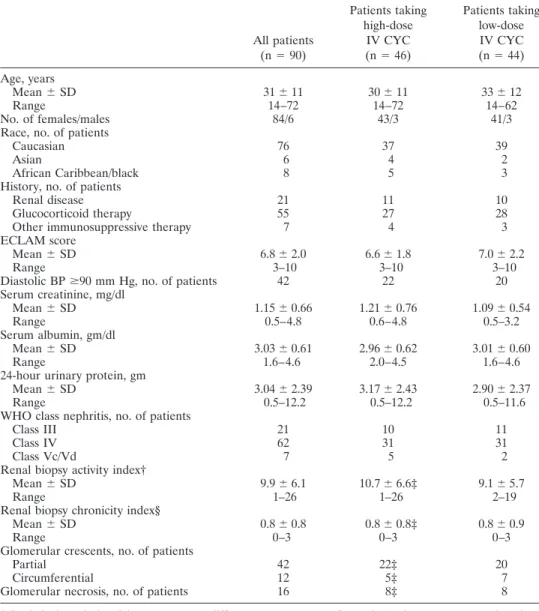
Baseline data and treatment. Forty-six patients were assigned to the high-dose IV CYC group and 44 to the low-dose IV CYC group. Their baseline clinical, biochemical, and kidney pathology data are detailed in Table 2. Of the 90 patients, 20 (22%) presented with renal impairment (serum creatinine level ⱖ1.3 mg/dl)
Table 2. Characteristics of the study subjects at baseline*
All patients (n⫽ 90) Patients taking high-dose IV CYC (n⫽ 46) Patients taking low-dose IV CYC (n⫽ 44) Age, years Mean⫾ SD 31⫾ 11 30⫾ 11 33⫾ 12 Range 14–72 14–72 14–62 No. of females/males 84/6 43/3 41/3 Race, no. of patients
Caucasian 76 37 39
Asian 6 4 2
African Caribbean/black 8 5 3
History, no. of patients
Renal disease 21 11 10
Glucocorticoid therapy 55 27 28
Other immunosuppressive therapy 7 4 3 ECLAM score
Mean⫾ SD 6.8⫾ 2.0 6.6⫾ 1.8 7.0⫾ 2.2
Range 3–10 3–10 3–10
Diastolic BPⱖ90 mm Hg, no. of patients 42 22 20 Serum creatinine, mg/dl Mean⫾ SD 1.15⫾ 0.66 1.21⫾ 0.76 1.09⫾ 0.54 Range 0.5–4.8 0.6–4.8 0.5–3.2 Serum albumin, gm/dl Mean⫾ SD 3.03⫾ 0.61 2.96⫾ 0.62 3.01⫾ 0.60 Range 1.6–4.6 2.0–4.5 1.6–4.6
24-hour urinary protein, gm
Mean⫾ SD 3.04⫾ 2.39 3.17⫾ 2.43 2.90⫾ 2.37
Range 0.5–12.2 0.5–12.2 0.5–11.6
WHO class nephritis, no. of patients
Class III 21 10 11
Class IV 62 31 31
Class Vc/Vd 7 5 2
Renal biopsy activity index†
Mean⫾ SD 9.9⫾ 6.1 10.7⫾ 6.6‡ 9.1⫾ 5.7
Range 1–26 1–26 2–19
Renal biopsy chronicity index§
Mean⫾ SD 0.8⫾ 0.8 0.8⫾ 0.8‡ 0.8⫾ 0.9
Range 0–3 0–3 0–3
Glomerular crescents, no. of patients
Partial 42 22‡ 20
Circumferential 12 5‡ 7
Glomerular necrosis, no. of patients 16 8‡ 8 * Statistical analysis of between-group differences was not performed on the parameters taken into account by the minimization procedure (see Patients and Methods). For the other parameters, all P values were greater than 0.05. IV⫽ intravenous; CYC ⫽ cyclophosphamide; ECLAM ⫽ European Consensus Lupus Activity Measure; BP⫽ blood pressure; WHO ⫽ World Health Organization.
† Maximum possible score 42, according to the criteria of Morel-Maroger et al (13). ‡ Data were available for only 42 patients.
and 25 (28%) presented with nephrosis (24-hour urinary proteinⱖ3.5 gm). Of note, this was the first episode of nephritis in 67 patients (74%). Only 8% of the patients had previously been treated with immunosuppressive drugs other than glucocorticoids.
Mean (⫾SD) daily starting doses of prednisolone were similar in the 2 groups (33 ⫾ 11 mg/day in the high-dose group versus 36⫾ 13 mg/day in the low-dose group; P⫽ 0.23). The mean (⫾SD) cumulative dose of IV CYC prescribed for patients in the high-dose group (before dropout or treatment failure) was 8.5⫾ 1.9 gm. All patients who were randomized into the low-dose group received a cumulative IV CYC dose of 3 gm (before dropout or treatment failure), except for 1 patient who died on day 28 (see below). Cumulatively, angiotensin-converting enzyme inhibitors were used by 52% and 59% of patients in the high-dose and low-dose groups, respectively.
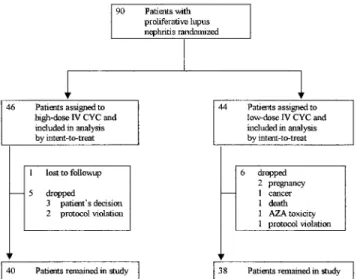
As indicated in Figure 1, 1 patient (assigned to the high-dose treatment) was lost to followup at week 44, and 11 patients (12%) were dropped from the trial for the following reasons: patient’s decision (n ⫽ 3), protocol violation (n ⫽ 3), death (n ⫽ 1), pregnancy (n⫽ 2), cancer (n ⫽ 1), and AZA toxicity (n ⫽ 1). After being dropped from the study, patients were treated according to the decisions of their physicians. Followup was available for all of them, thereby allowing analyses
by intent-to-treat. Primary end point. After a median followup of
41.3 months for patients in the low-dose group and 41 months for those in the high-dose group, 7 of the 44 low-dose patients (16%) and 9 of the 45 high-dose patients (20%) experienced treatment failure, which was the primary end point of the study. The Kaplan-Meier curves shown in Figure 2 indicate that there was no significantly greater cumulative probability of treatment failure in patients given a low-dose IV CYC regimen than in those given a high-dose IV CYC regimen (HR 0.79, 95% CI 0.30–2.14; P⫽ 0.64). The reason for failure was as follows: absence of a primary response in 2 of the low-dose and 4 of the high-dose patients, a glucocor-ticoid-resistant flare in 2 low-dose and 2 high-dose patients, and doubling of the serum creatinine level in 3 low-dose and 3 high-dose patients.
The baseline clinical, biochemical, and pathologic data for the 16 patients who experienced treatment failure did not differ from the data in the patients who did not experience treatment failure (data not shown). Treatment failure was not significantly more frequent in patients with WHO class IV nephritis compared with patients with WHO class III nephritis, nor in nonwhite patients compared with white patients (data not shown).
Figure 1. Trial profile, showing the number of patients enrolled, the number of patients assigned to high-dose and low-dose intravenous (IV) cyclophosphamide (CYC), the number of dropouts from each group, and the number of patients who remained in the study. AZA⫽ azathioprine.
Figure 2. Kaplan-Meier analysis of the probability of an absence of treatment failure. Patients were randomized to a low-dose (LD;■) or a high-dose (HD; F) regimen of intravenous cyclophosphamide, followed by azathioprine treatment. Treatment failure was defined as 1 of the following 3 features: absence of a primary response after 6 months of therapy, occurrence of a glucocorticoid-resistant flare, or a doubling of the serum creatinine level (features are defined in Table 1). The hazard ratio for treatment failure in the low-dose group compared with the high-dose group was 0.79 (95% confidence interval 0.30–2.14; P ⫽ 0.64). Numbers shown along the abscissa are the number of patients at risk in each group. Analysis was by intent-to-treat.
Secondary end points.Figure 3 shows the kinet-ics of the initial response to therapy. Serum creatinine, serum albumin, 24-hour urinary protein, serum C3 ti-ters, and the ECLAM score significantly improved in
both groups during the first year of followup (P ⱕ 0.005). No significant difference was noted between patients in the low-dose and high-dose IV CYC groups for any of the parameters examined (P⬎ 0.05).
Impor-Figure 3. Kinetics of the initial response to therapy. Patients were randomized to a low-dose (LD) or a high-dose (HD) regimen of intravenous cyclophosphamide, followed by azathioprine treatment. Values are the mean⫾ SEM. Repeated-measures analysis of variance yielded P⬍ 0.005 for all “repeated measures” analyses and P ⬎ 0.05 for all “between groups” comparisons. Numbers in parentheses are the number of patients considered in this analysis (with data available at every time point). Analysis was by intent-to-treat. ECLAM⫽ Euro-pean Consensus Lupus Activity Measure.
Figure 4. Kaplan-Meier analysis of the probability of renal remission. Patients were randomized to a low-dose (LD;■) or a high-dose (HD; F) regimen of intravenous cyclophosphamide, followed by azathio-prine treatment. Renal remission was defined as ⬍10 red blood cells/high-power field and a 24-hour urinary protein level⬍1 gm, in the absence of a doubling of the serum creatinine level. The hazard ratio for renal remission in the low-dose group compared with the high-dose group was 1.26 (95% confidence interval 0.72–2.21; P⫽ 0.36). Numbers shown along the abscissa are the number of patients at risk in each group. Analysis was by intent-to-treat.
Figure 5. Kaplan-Meier analysis of the probability of renal flare. Patients were randomized to a low-dose (LD;■) or a high-dose (HD; F) regimen of intravenous cyclophosphamide, followed by azathio-prine treatment. The hazard ratio for renal flare in the low-dose group compared with the high-dose group was 0.90 (95% confidence interval 0.40–2.04; P ⫽ 0.80). Numbers shown along the abscissa are the number of patients at risk in each group. Analysis was by intent-to-treat.
tantly, the glucocorticoid-tapering regimens did not dif-fer between groups as shown in Figure 3 (P⬎ 0.05). A subset analysis performed on patients presenting with renal impairment (serum creatinine ⱖ1.3 mg/dl) re-vealed a similar response to the 2 treatments (data not shown).
Achievement of renal remission at any time dur-ing followup could be evaluated in 83 patients for whom regular quarterly followup data were available. Thirty of the 42 evaluable patients in the low-dose group (71%) and 22 of the 41 evaluable patients in the high-dose group (54%) achieved renal remission. The Kaplan-Meier curves shown in Figure 4 indicate that the cumu-lative probability of achieving renal remission did not
differ between patients given a low-dose regimen versus those given a high-dose regimen (HR 1.26, 95% CI 0.72–2.21; P⫽ 0.36).
Twelve of the 44 patients in the low-dose group (27%) and 13 of the 45 patients in the high-dose group (29%) experienced renal flare. Again, Kaplan-Meier analysis failed to detect a significant difference in the cumulative probability of renal flare between patients given a low-dose regimen versus those given a high-dose regimen (HR 0.90, 95% CI 0.40–2.04; P⫽ 0.80) (Figure 5). Six of the 25 patients with renal flare had a doubling of the serum creatinine level at the last followup visit; 2 of these 6 patients had end-stage renal disease (ESRD). Four additional patients (1 low-dose and 3 high-dose)
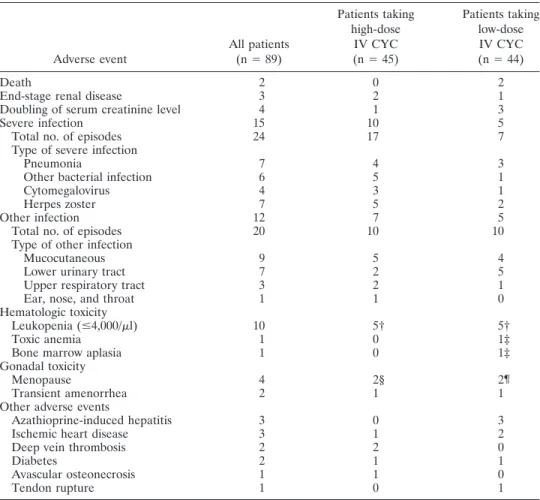
Table 3. Adverse events*
Adverse event All patients(n⫽ 89)
Patients taking high-dose IV CYC (n⫽ 45) Patients taking low-dose IV CYC (n⫽ 44) Death 2 0 2
End-stage renal disease 3 2 1
Doubling of serum creatinine level 4 1 3
Severe infection 15 10 5
Total no. of episodes 24 17 7
Type of severe infection
Pneumonia 7 4 3
Other bacterial infection 6 5 1
Cytomegalovirus 4 3 1
Herpes zoster 7 5 2
Other infection 12 7 5
Total no. of episodes 20 10 10
Type of other infection
Mucocutaneous 9 5 4
Lower urinary tract 7 2 5
Upper respiratory tract 3 2 1
Ear, nose, and throat 1 1 0
Hematologic toxicity
Leukopenia (ⱕ4,000/l) 10 5† 5†
Toxic anemia 1 0 1‡
Bone marrow aplasia 1 0 1‡
Gonadal toxicity
Menopause 4 2§ 2¶
Transient amenorrhea 2 1 1
Other adverse events
Azathioprine-induced hepatitis 3 0 3
Ischemic heart disease 3 1 2
Deep vein thrombosis 2 2 0
Diabetes 2 1 1
Avascular osteonecrosis 1 1 0
Tendon rupture 1 0 1
* Because of the small numbers of events, Kaplan-Meier analyses were not performed on these data, except for the cumulative probability of severe infection (see Figure 6). Values are the number of patients, except for the values for the number of episodes and types of both severe infection (those requiring in-patient antimicrobial therapy) and other infection. IV⫽ intravenous; CYC ⫽ cyclophosphamide. † During pulse CYC therapy in 2 patients.
‡ While taking azathioprine.
§ At age 20 years and age 55 years, respectively. ¶ Both at age 44 years.
experienced a severe extrarenal flare. Of note, of the 16 patients in the high-dose group who experienced a renal flare, 7 experienced the flare while being treated with CYC pulses, whereas the remaining 9 patients experi-enced the flare while taking AZA. As anticipated, based on the duration of CYC pulse therapy in the low-dose group, all but 1 of the 13 patients in this group who experienced a flare did so while taking AZA.
Adverse events.All adverse events occurring be-tween study inclusion and the last followup visit were recorded (Table 3). Two patients, both in the low-dose group, died. One of the patients (age 14 years) presented with renal impairment, nephrotic syndrome, and conges-tive heart failure. Despite treatment with IV methyl-prednisolone and CYC (500 mg on day 1 and day 14), she developed multiorgan failure on day 20, and on day 28, she died. The other patient (age 51 years), was dropped from the trial during week 121 because of breast cancer. This patient died suddenly of unknown causes during week 194.
Three patients, 2 in the high-dose group and 1 in the low-dose group, progressed to ESRD (at week 104, 193, and 208, respectively) and are currently undergoing dialysis. Two of them had been censored because of the absence of a primary response; the third patient had been censored because of doubling of the serum creat-inine level. In addition to these 3 patients who reached ESRD, 4 others (1 in the high-dose and 3 in the low-dose group) experienced a doubling of their serum creatinine level by the time of the last visit. Three of them had been censored because of doubling of the serum creatinine level, and the fourth had been dropped because of pregnancy.
Severe infections (those requiring inpatient anti-microbial therapy) were noted in 10 patients from the high-dose group (17 episodes) and in 5 patients from the low-dose group (7 episodes). As indicated in Figure 6, the cumulative probability of severe infection was simi-lar in both groups (HR 0.50, 95% CI 0.17–1.47; P ⫽ 0.20), as was the number of severe infections/patient-year (mean ⫾ SD 0.14 ⫾ 0.36 in the high-dose group versus 0.06⫾ 0.22 in the low-dose group; P ⫽ 0.35).
As indicated in Table 3, similar numbers of patients in both groups experienced hematologic and gonadal toxicity (defined clinically in premenopausal women as a prolonged absence of menstrual periods). Only 1 patient (age 20 years) developed premature ovarian failure. This patient was in the high-dose group and received oral CYC after treatment failure at week 49. The other 3 patients were all over the age of 40 years when they became menopausal.
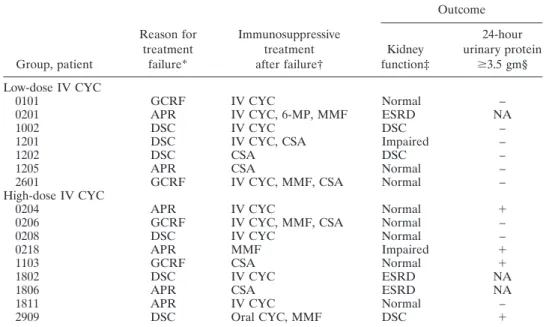
Outcome after treatment failure.Table 4 summa-rizes the immunosuppressive treatment(s) prescribed to patients after failure of the study treatment. Eight (5 in the high-dose and 3 in the low-dose group) of the 16 patients censored because of treatment failure had normal renal function by the time of the last followup visit. Most of the other 8 patients who did not recover normal kidney function had been censored, as expected, because of doubling of the serum creatinine level.
DISCUSSION
The ELNT is a multicenter, prospective, random-ized study designed to test whether a low-dose IV CYC regimen (6 fortnightly pulses of 500 mg; cumulative dose 3 gm), followed by AZA, is an effective therapy for proliferative lupus glomerulonephritis, as suggested by retrospective analyses (9–11). The low-dose IV CYC regimen was compared with a high-dose IV CYC treat-ment (6 monthly pulses and 2 quarterly pulses, with doses increased according to the white blood cell count nadir). In both treatment arms, AZA was used as long-term immunosuppressive therapy. The results of the trial indicate that 1) there was no significantly greater cumulative probability of treatment failure in patients taking a low-dose IV CYC regimen than in those taking a high-dose regimen, 2) the kinetics of the
Figure 6. Kaplan-Meier analysis of the probability of absence of severe infection. Patients were randomized to a low-dose (LD;■) or a high-dose (HD; F) regimen of intravenous cyclophosphamide, fol-lowed by azathioprine treatment. The hazard ratio for severe infection in the low-dose group compared with the high-dose group was 0.50 (95% confidence interval 0.17–1.47; P⫽ 0.20). Numbers shown along the abscissa are the number of patients at risk in each group. Analysis was by intent-to-treat.
initial response did not differ between the two groups, 3) the cumulative probability of achieving renal remission was similar in both groups, and 4) the number of renal flares did not differ between the two groups. Severe infectious side effects were less common in the low-dose group, although the difference was not statistically sig-nificant.
These data suggest that good clinical results may be achieved even with a low cumulative dose of 3 gm of IV CYC. Our findings therefore call into question the current practice, based on the NIH trials, of treating all lupus nephritis patients with an extended course of IV CYC.
There are, however, differences between the ELNT and the NIH studies. First, most patients in-cluded in the ELNT did not have clinically severe kidney disease. Although all patients had proliferative glomer-ulonephritis, only 22% presented with renal impairment and 28% presented with nephrosis, compared with 64% and 62% respectively, in the study by Boumpas et al (2). It should be stressed, however, that the patients random-ized into the ELNT are, by definition, representative of those currently treated in our lupus clinics. Milder cases of proliferative lupus nephritis, for which less-aggressive
treatment is certainly justified, are now frequently diag-nosed due to the prompt assessment of kidney involve-ment, particularly in lupus patients presenting without renal signs at diagnosis and in whom proteinuria is detected and investigated as early as possible through regular followup visits.
Second, few black or African Caribbean patients were included in the ELNT (9% of the cohort); this is in contrast to the high percentage of black patients ran-domized into the NIH studies reported by Boumpas et al (43%) (2) and Gourley et al (34%) (3). Since the outcome of lupus nephritis is poorer in black patients compared with the outcome in white patients (17), the underrepresentation of this ethnic group in our Euro-pean populations might explain, at least in part, why a low-dose IV CYC regimen was effective in most of our patients.
Third, the duration of the high-dose IV CYC regimen prescribed in the ELNT is shorter than that of the studies conducted in North America, and as a consequence, the cumulative dose of IV CYC is lower. Given the high incidence of gonadal failure (38–52% of women at risk) associated with the standard NIH
regi-Table 4. Outcome after treatment failure
Group, patient Reason for treatment failure* Immunosuppressive treatment after failure† Outcome Kidney function‡ 24-hour urinary protein ⱖ3.5 gm§ Low-dose IV CYC 0101 GCRF IV CYC Normal –
0201 APR IV CYC, 6-MP, MMF ESRD NA
1002 DSC IV CYC DSC –
1201 DSC IV CYC, CSA Impaired –
1202 DSC CSA DSC –
1205 APR CSA Normal –
2601 GCRF IV CYC, MMF, CSA Normal – High-dose IV CYC
0204 APR IV CYC Normal ⫹
0206 GCRF IV CYC, MMF, CSA Normal –
0208 DSC IV CYC Normal –
0218 APR MMF Impaired ⫹
1103 GCRF CSA Normal ⫹
1802 DSC IV CYC ESRD NA
1806 APR CSA ESRD NA
1811 APR IV CYC Normal –
2909 DSC Oral CYC, MMF DSC ⫹
* GCRF⫽ glucocorticoid-resistant flare; APR ⫽ absence of primary response; DSC ⫽ doubling of the serum creatinine level.
† IV⫽ intravenous; CYC ⫽ cyclophosphamide; 6-MP ⫽ 6-mercaptopurine; MMF ⫽ mycophenolate mofetil; CSA⫽ cyclosporin A.
‡ Impaired kidney function was defined as a serum creatinine levelⱖ1.3 mg/dl, without doubling of the serum creatinine level. ESRD⫽ end-stage renal disease; DSC ⫽ doubling of the serum creatinine level. § NA⫽ not applicable.
men, we decided to reduce the number of pulses in the high-dose regimen, using 8 instead of 14. As a conse-quence, comparison with trials in which a more intense and prolonged high-dose regimen was prescribed might be difficult.
Finally, the use of AZA for long-term immuno-suppression after completion of the CYC pulses is yet another difference between the ELNT and the previ-ously published trials using IV CYC. In the ELNT regimen, a potentially toxic drug is prescribed for a short period of time as remission-inducing therapy and a possibly less-toxic drug is prescribed for a longer period of time as remission-maintaining treatment. By securing long-term immunosuppression, this sequential treat-ment might have contributed to the good results achieved in patients given a low-dose regimen of IV CYC. It should be stressed, however, that a significant number of patients in each group (9 in the high-dose and 12 in the low-dose group) experienced at least 1 flare, mostly renal, while they were being treated with AZA. Other remission-maintaining drugs should therefore be tested in lupus nephritis. The newly developed immuno-suppressive drug mycophenolate mofetil, an uncompeti-tive, reversible inhibitor of inosine monophosphate de-hydrogenase (18), is promising in this respect given its superiority over AZA in reducing the incidence of episodes of acute rejection after renal and cardiac transplantation (19,20) and its successful short-term use, together with high-dose glucocorticoid, in Chinese pa-tients with SLE and proliferative glomerulonephritis (21).
Despite the aforementioned differences between the designs of the ELNT and the NIH trials, the results presented here will be compared with those of a strict NIH protocol in terms of renal remission, renal relapse, and poor renal outcome. The rate of renal remission (71% in the low-dose group) is similar to that observed with the classic NIH regimen (62%) in a group of patients with comparable baseline disease severity (3). The rate of renal relapse in our patients is higher than that reported in patients given a classic NIH protocol (7% reported by Gourley et al [3]). It should be stressed, however, that we took into account all renal flares, whereas only those occurring after completion of the monthly phase of treatment (2) or only those occurring after achieving remission and maintaining it for 1 year (3) were counted in the two recent NIH trials. More importantly, a possible difference in renal relapse rates should be weighted against the very high risk (up to 52%) of premature ovarian failure associated with the
classic NIH regimen (1–4,8), a side effect explaining why a significant proportion of patients now decline high-dose IV CYC therapy. Finally, the rates of poor renal outcome are comparable. Thus, the percentage of pa-tients whose serum creatinine level eventually doubled was 7% in our high-dose group and 9% in our low-dose group, while this value varied between 4% and 24% in the recent NIH trials (2–4).
The incidence of major side effects did not differ significantly between the high-dose and the low-dose groups, probably because of the relatively low numbers of patients included in the study. The number of patients with severe infections and the number of episodes of severe infection were, however, at least twice as high in patients taking the high-dose treatment. As indicated by the Kaplan-Meier analysis shown in Figure 6, the cumu-lative probability of severe infection increased maxi-mally in both groups within the first months of treat-ment, stabilizing after 6 months in the low-dose group. In contrast, in the high-dose group, additional patients experienced their first severe infectious event after 6 months of treatment. The possibility that the cumulative probability of severe infection would have been greater had a standard NIH regimen been applied would be consistent with published data (1–4).
Only a very few patients experienced permanent ovarian failure, a not-unexpected finding given the cu-mulative dose of IV CYC prescribed, even to high-dose patients (8). Whether or not women given high-dose IV CYC therapy will reach menopause earlier than those given low-dose therapy, will be addressed in an analysis after longer followup.
The issue of whether a 500-mg pulse of CYC could be given orally rather than intravenously was not addressed in this trial. Although the bioavailability of oral CYC is excellent (22), gastrointestinal side effects, such as nausea and vomiting, might compromise opti-mum compliance and introduce confusion about the amount of CYC that is actually being absorbed (23).
Although caution should be exercised in extrap-olating the results of the ELNT to other lupus nephritis populations with different ethnic backgrounds or disease severity, the many advantages of the ELNT regimen should be emphasized. A 500-mg pulse of CYC can be administered, with excellent immediate tolerance, on an outpatient basis as a 30-minute infusion, without the need for IV antiemetics and forced hydration. The costs of therapy and, possibly, the cumulative dose-dependent long-term toxicity would thereby be reduced.
ACKNOWLEDGMENTS
The authors are most grateful to Dr. J. Jamart (De-partment of Biostatistics, Cliniques Universitaires de Mont-Godinne, Universite´ Catholique de Louvain, Yvoir, Belgium) for performing the Kaplan-Meier analyses, Dr. M. Jadoul (Nephrology Department, Cliniques Universitaires St. Luc, Universite´ Catholique de Louvain, Brussels, Belgium) for expert advice on the protocol, most stimulating discussions, and critical reading of the manuscript, M. El Hachmi for help in data collection, and Dr. G. R. V. Hughes (St. Thomas’ Hospital, London, UK) for introducing the low-dose IV CYC regimen as remission-inducing therapy for lupus nephritis and for inspiring the investigators of the European Working Party on SLE to embark on a controlled trial.
REFERENCES
1. Austin HA III, Klippel JH, Balow JE, le Riche NG, Steinberg AD, Plotz PH, et al. Therapy of lupus nephritis: controlled trial of prednisone and cytotoxic drugs. N Engl J Med 1986;314:614–9. 2. Boumpas DT, Austin HA III, Vaughan EM, Klippel JH, Steinberg
AD, Yarboro CH, et al. Controlled trial of pulse methylpred-nisolone versus two regimens of pulse cyclophosphamide in severe lupus nephritis. Lancet 1992;340:741–5.
3. Gourley MF, Austin HA III, Scott D, Yarboro CH, Vaughan EM, Muir J, et al. Methylprednisolone and cyclophosphamide, alone or in combination, in patients with lupus nephritis. Ann Intern Med 1996;125:549–57.
4. Illei GG, Austin HA III, Crane M, Collins L, Gourley MF, Yarboro CH, et al. Combination therapy with pulse cyclo-phosphamide plus pulse methylprednisolone improves long-term renal outcome without adding toxicity in patients with lupus nephritis. Ann Intern Med 2001;135:248–57.
5. Urowitz MB. Is “aggressive” therapy necessary for systemic lupus erythematosus? Rheum Dis Clin North Am 1993;19:263–70. 6. Ponticelli C. Treatment of lupus nephritis: the advantages of a
flexible approach. Nephrol Dial Transplant 1997;12:2057–9. 7. Bansal VK, Beto JA. Treatment of lupus nephritis: a meta-analysis
of clinical trials. Am J Kidney Dis 1997;29:193–9.
8. Boumpas DT, Austin HA III, Vaughan EM, Yarboro CH, Klippel JH, Balow JE. Risk for sustained amenorrhea in patients with systemic lupus erythematosus receiving intermittent pulse cyclo-phosphamide therapy. Ann Intern Med 1993;119:366–9. 9. Houssiau FA, D’Cruz DP, Haga H-J, Hughes GRV. Short course
of weekly low-dose intravenous pulse cyclophosphamide in the
treatment of lupus nephritis: a preliminary study. Lupus 1991;1: 31–5.
10. D’Cruz D, Cuadrado MJ, Mujic F, Tungekar MF, Taub N, Lloyd M, et al. Immunosuppressive therapy in lupus nephritis. Clin Exp Rheumatol 1997;15:275–82.
11. Haga H-J, D’Cruz D, Asherson R, Hughes GRV. Short term effects of intravenous pulses of cyclophosphamide in the treatment of connective tissue disease crisis. Ann Rheum Dis 1992;51:885–8. 12. Tan EM, Cohen AS, Fries JF, Masi AT, McShane DJ, Rothfield NF, et al. The 1982 revised criteria for the classification of systemic lupus erythematosus. Arthritis Rheum 1982;25:1271–7.
13. Morel-Maroger LM, Mery JP, Droz D, Godin M, Verroust P, Kourilsky O, et al. The course of lupus nephritis: contribution of serial renal biopsies. Adv Nephrol Necker Hosp 1976;6:79–118. 14. Treasure T. Minimisation: the platinum standard for trials? Br
Med J 1998;317:363–4.
15. Vitali C, Bencivelli W, Isenberg DA, Smolen JS, Snaith ML, Sciuto M, et al, and The European Consensus Study Group for Disease Activity in SLE. Disease activity in systemic lupus erythematosus: report of the Consensus Study Group of the European Workshop for Rheumatology Research. II. Identification of the variables indicative of disease activity and their use in the development of an activity score. Clin Exp Rheumatol 1992;10:541–7.
16. Balow JE, Boumpas DT, Fessler BJ, Austin HA III. Management of lupus nephritis. Kidney Int 1996;49 Suppl 53:S88–92. 17. Dooley MA, Hogan S, Jennette C, Falk R, for the Glomerular
Disease Collaborative Network. Cyclophosphamide therapy for lupus nephritis: poor renal survival in black Americans. Kidney Int 1997;51:1188–95.
18. Bardsley-Elliot A, Noble S, Foster RH. Mycophenolate mofetil: a review of its use in the management of solid organ transplantation. Biodrugs 1999;12:363–410.
19. European Mycophenolate Mofetil Cooperative Study Group. Pla-cebo-controlled study of mycophenolate mofetil combined with cyclosporin and corticosteroids for prevention of acute rejection. Lancet 1995;345:1321–5.
20. Kobashigawa J, Miller L, Renlund D, Mentzer R, Alderman E, Bourge R, et al, for the Mycophenolate Mofetil Investigators. A randomized active-controlled trial of mycophenolate mofetil in heart transplant recipients. Transplantation 1998;66:507–15. 21. Chan TM, Li FK, Tang CSO, Wong RWS, Fang GX, Ji YL, et al,
for the Hong Kong–Guangzhou Nephrology Study Group. Effi-cacy of mycophenolate mofetil in patients with diffuse proliferative lupus nephritis. N Engl J Med 2000;343:1156–62.
22. Dawisha SM, Yarboro CH, Vaughan EM, Austin HA III, Balow JE, Klippel JH. Outpatient monthly oral bolus cyclophosphamide therapy in systemic lupus erythematosus. J Rheumatol 1996;23: 273–8.
23. McCune WJ. Oral bolus cyclophosphamide: liberating libation or nauseating nostrum? J Rheumatol 1996;23:212–3.