http://dx.doi.org/10.21707/gs.v10.n04a32
M
icrobiologyforenvironMentalconservation:
asysteMaticreviewofbioreMediationofheavyMetalsbychromobacteriumviolaceum
abstract – The release of metals in ecosystems results in not only environmental damage, but also harm to the health and quality of human life. This study aims to compare and discuss the research evolution performed worldwide, which made use of the potential of Chromobacterium violaceum for bioremediation of heavy metals. The study consists of a systematic review, limited to research published between 2001 and 2015, using LILACS, PubMed, and SciELO databases. The bioleaching technique was further discussed; gold was the bioremediated substrate most mentioned, and cyanidation was the prevalent phenotypic mechanism. Genetic mechanisms were mentioned in 29.4% of the publications, and among proteins transcribed by C. violaceum 18.3% were hypothetical. The adaptive versatility of C. violaceum reveals its great biotechnological potential on environmental pollution by heavy metals, favoring environmental conservation. However, the high number of hypothetical ORFs (Open Reading Frame) highlights the need for further research.
Key words: Bioremediation; ChromoBaCteriumviolaCeum; heavymetals.
ResuMo – O lançamento de metais nos ecossistemas resulta não somente em danos ambientais, mas também à saúde e qualidade de vida humana. Este trabalho objetiva comparar e discutir a evolução das pesquisas realizadas em âmbito mundial, as quais fizeram uso do potencial biorremediador da Chromobacterium violaceum a metais pesados. O estudo consiste em uma revisão sistemática, limitada a trabalhos publicados entre 2001 e 2015, utilizando-se dos bancos de dados LILACS, PubMed e SciELO. A biolixiviação foi a técnica mais discutida; o ouro o substrato biorremediado mais citado e a cianetação o mecanismo fenotípico prevalente. Mecanismos genéticos foram citados em 29,4% das publicações e entre as proteínas transcritas por C.
violaceum 18,3% eram ditas hipotéticas. A versatilidade adaptativa da C. violaceum revela seu grande potencial biotecnológico
diante da poluição ambiente por metais pesados, favorecendo a conservação ambiental. Entretanto, o número elevado de ORFs (Open Reading Frame) hipotéticas evidencia a necessidade da realização de novas pesquisas.
Palavras chave: Biorremediação, ChromoBaCteriumviolaCeum; metaispesados.
ResuMen – La liberación de los metales en los ecosistemas no sólo resulta en daños al medio ambiente, sino también la salud y la calidad de la vida humana. Este estudio tiene como objetivo comparar y analizar la evolución de la investigación llevada a cabo en todo el mundo, lo que hizo uso del potencial de biorremediación de Chromobacterium violaceum a metales pesados. El estudio consiste en una revisión sistemática, limitado a las obras publicadas entre 2001 y 2015, utilizando las bases de datos LILACS, PubMed y SciELO. La técnica de biolixiviación se volvió a examinar; el sustrato de oro bioremediated los personajes más citados y la cianuración del mecanismo fenotípica frecuente. Mecanismos genéticos fueron citados por el 29,4% de las publicaciones y entre proteínas transcritas por C. violaceum 18,3% se dijo hipotética. Versatilidad de adaptación de C. violaceum revela su gran potencial de la biotecnología en el entorno de la contaminación por metales pesados y por lo tanto favorece la conservación del medio ambiente. Sin embargo, el elevado número de ORFs (Open Reading Frame) hipotéticas revela la necesidad de nuevas investigaciones.
Palabrasclave: BiorremediaCión, ChromoBaCteriumviolaCeum; metalespesados.
a MicrobiologiaParaaconservaçãoaMbiental: uMarevisãosisteMáticadabiorreMediaçãodeMetaisPesadosPor
chromobacteriumviolaceum
MicrobiologíaParaconservacióndelMedioaMbiente: unarevisiónsisteMáticadelabiorreMediacióndeMetales PesadosPorchromobacteriumviolaceum
feliPhe souzade alencar lacerda1; erMeton do nasciMento duarte1
& Magnólia florênciode araújo fernande1*.
1 Departamento de Microbiologia e Parasitologia Microbiologia ambiental. Centro de Biociêncoas. Universidade Federal do Rio Grande do Norte.
* E-mail para correspondência: [email protected]
i
ntroductionUncontrolled anthropogenic action from contaminant agents and pollutants wasted in diverse ecosystems has promoted countless environmental impacts on a global scale. Among these contaminants and pollutants, heavy metals have generated great concern, as they consist of persistent elements that are non-degradable, teratogenic, mutagenic, and carcinogenic. Thus, decontamination seems to be a solution of great environmental importance although its use provides enormous quantitative deficits (Weber 2004; Lima, 2008; Sight et al., 2010). This less expressive use of environmental decontamination techniques generates not only impacts on the environment, but also serious consequences to health and people’s quality of life, becoming necessary the development, application, and full disclosure of techniques, aimed at reducing the pathogenic potential of ecosystem contamination (Moura, 2001).
The bioremediation term appears in this context as a practical and effective tool, defined as a process in which plants or microorganisms are utilized to remedy or reduce environmental pollutants or degrade toxically harmful substances to the environment. Among the potentially important microorganisms, for the development of this activity, the Chromobacterium violaceum is highlighted (Gaylard et al., 2005), which was isolated initially in 1867 (Antônio and Passa, 2004). But only in April of 1880, its discovery was accepted by science, when, accidentally, the Italian researcher Curzio Bergonzini observed the appearance of a violet pigment bacteria and while testing the mechanisms related to putrefaction delay, he suspected Cromococcus violaceus. However, after finding the insolubility of this pigment in water, and performing biochemical tests, Bergonzini realized that it was a new organism, called Cromobacterium violaceum, and received the addition of the letter ‘h’ by Zimmerman in 1881, becoming Chromobacterium violaceum (Duran and Meck, 2001). These observations were published in 1882 by Boisbaudran in Comptes Rendus Hebdomadaires des Seances de L’Academie dês Sciences, with the following title: “Matiére colorante se formant dans la colle de farine” (Colored material is formed on flour glue) (Antônio and Passa, 2004).
C. violaceum is classified as a Gram-negative, saprophyte, facultative aerobic, rod-shaped
Beta-proteobacterium, provided with mobility by a single polar flagellum and lateral or sub-polar flagellums, and present, in solid means, colonies of creamy appearance, and usually with violet color, associated with the pigment violacein synthesis (Dias et al., 2005). Furthermore, it is characterized by a versatile energetic metabolism, where oxidase and reductase enzymes are able to use diverse energy sources, growing in aerobic and anaerobic environments. In aerobic conditions, this bacterium is able to grow in a minimal environment supplemented by simple sugars such as glucose, fructose, galactose, and ribose, using Embden-Meyerhoff and tricarboxylic acid pathway, as well as the glyoxylate cycle. In anaerobic conditions, C. violaceum metabolizes glucose with acetic and formic acid production, besides using amino acids and lipids as energy source, thereby giving it a cosmopolitan feature (Antônio and Passa, 2004; Lima-Bittencourt et al., 2007).
This bacterium shows circumtropical distribution, and is generally isolated from terrestrial and aquatic environments, living in tropical and subtropical regions between 35 °S and 35 °N latitudes. The ideal temperature for growth is between 20 oC and 37 oC, but some isolated from
ability of this organism to survive under different environmental stress is related to the production of a variety of secondary metabolites and enzymes, able to detoxify reactive oxygen species, proteins related to tolerance against antimicrobial substances, high temperature, and presence of acids as well as heavy metals (Momen and Hoshino, 2000; Hungria et al., 2005).
Associated with the high spatial distribution and adaptive potential of C. violaceum, its high incidence of pathogenicity still stands out. The pathogenic potential of this bacterium was first described by Wooley in 1905, when it was identified as responsible for the death of buffalo by septicemia in the Philippines (Wooley, 1905). Years later, new cases of infections have also been reported in pigs, monkeys, ewes, and dogs (Chattopadhyay et al., 2002). In humans, the first infection case occurred in Malaysia, described by Lesslar in 1927 (Perez et al., 2007). However,
C. violaceum is normally considered non-pathogenic for humans and may possibly act as an
opportunistic pathogen (Durán and Menck, 2001; Crosse et al., 2006).
The infection in humans typically begins with a damaged skin exposure to contaminated soil or water, and has an incubation period from three to fourteen days, affecting mainly young immunocompromised individuals. The clinical features begin with cellulitis, lymphadenitis, skin wounds and visceral abscesses, most often hepatic, kidney, and pulmonary; and urinary tract infection, gastroenteritis, osteomyelitis, sinusitis, and meningitis may still occur (Sirinavin et al., 2005; Teoh et al., 2006; Martinez and Mattar, 2007; Manjunath, 2007) . The symptomatology usually progresses to severe sepsis and death in 24 to 72 h. The quick evolution and ineffective treatment with antibiotics result in a fatality rate of over 60% (De Siqueira et al., 2005). The infection diagnosis is made by culturing blood or abscess fluid, and biochemical identification (Chang et al., 2007), although there are studies for the development of diagnostic techniques per PCR (Polymerase Chain Reaction) (Scholz et al., 2006).
Despite pathogenic implications attributed to this bacterium, several studies highlight C.
violaceum as a microorganism with diverse industrial, pharmaceutical, and ecological applications.
Many researchers have reported the presence of genes involved in resistance to arsenic, cyanide, and iron, as well as capable of reducing halogen compounds to less toxic forms (Carepo et al., 2004; Azevedo et al., 2008; Lima et al., 2014). Thus, facing several biotechnological applications assigned to this microorganism, in 2001, the nucleotide sequencing national grid, inserted in the Brazilian genome project, began sequencing the ATCC 12472 lineage of C. violaceum, isolated from aquatic environments located in Mentekeb and Malaysia. This sequencing was finalized in 2003, thereby enabling the development and application of efficient techniques to combat and mitigate pollution of ecosystems (Vasconcelos et al., 2003).
Therefore, a better understanding of the dynamics of C. violaceum bioremediation of heavy metals is required around the world and in diverse environments, aiming, with this knowledge, to allow improvement and application directed toward prevention and environmental pollution control. Thus, this study was structured from a systematic review of specialized references on the use of C. violaceum in bioremediation techniques for heavy metals, utilized worldwide in diverse environments, aiming to analyze, compare, and describe the temporal evolution of developed research on this theme, from the sequencing of C. violaceum that began in 2001 to the present day.
M
aterialsandMethodsThis study consists of a systematic review, limited to research published between 2001 to 2015, whose theme approached the use of Chromobacterium violaceum in bioremediation of heavy metals in diverse environments and published anywhere in the world. The article search was performed in LILACS, PubMed, and SciELO databases. A systematized theoretical review was conducted, where keywords in Portuguese, English, and Spanish, proposed by DECs (Descritores de Assunto em Ciências da Saúde - Subject Keywords in Health Sciences), belonging to the BVS database (Biblioteca Virtual em Saúde - Virtual Health Library), were divided into three key terms: 1) Chromobacterium violaceum; 2) bioremediation and its synonyms; and 3) metals and related terms, as shown in Table 1.
Table 1 - Keywords utilized in the theoretical survey. Essential Keywords
Portuguese English Spanish
TERM 1
Chromobacterium violaceum
TERM 2
Bioremediação Bioremediation Bioremediación
Sinônimos: Remediação; Metabolização; Mineralização; Transformação; Redução; Remoção; Eliminação; Degradação microbiana; Degradação biológica; Biorreparação e biolixiviação Synonims: Remediation; Metabolism; Mineralization Transformation; Reduction; Removal; Elimination; Microbial Degradation; Biological Degradation; Biorestauration and bioleaching
Sinónimos: Remediación; Metabolismo; Mineralización Transformación; Reducción; Remoción; Eliminación; Deterioro Microbiano; Degradación Biológica; Biorreparación y biolixiviación TERM 3
Metal pesado Heavy Metal Metale Pesado
Sinônimos: Metal; Resíduo metálico Synonims: Metals; Metallic Waste Sinónimos: Metales; Residuo Metálico
Excluded from this review were studies not complying with the inclusion criteria, those that had only cited the above-mentioned keywords but whose focus of research was not bioremediation related to C. violaceum and heavy metals, those whose bioremediator organism was not C. violaceum, and/or those in which the degraded substrate differed from heavy metals.
Finally, we tried to compare and discuss the temporal evolution research performed worldwide, which made use of the potential of C. violaceum for bioremediation of heavy metals in the last 14 years. Highlighted in our review were the countries with the highest prevalence, the main isolation environments of this microorganism, the main bioremediation techniques addressed, the most tested heavy metals, the main phenotypic and genotypic resistance mechanisms of C.
violaceum on these metals, as well as the main genes associated with them.
Results and discussion
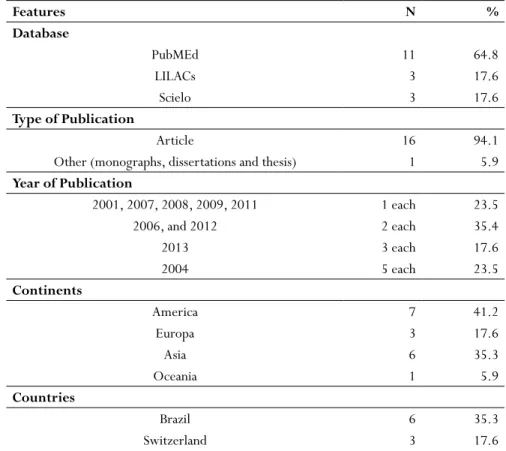
From the theoretical review performed in all databases, 1053 studies were obtained. After application of the exclusion criteria, we found 17 publications, consisting of 16 articles (94.1%) and 1 master’s thesis (11.8%). As for the publications list with database evaluated, 11 (64.8%) were from the PubMed and 3 (17.6%) from LILACS and SciELO, each. The studies were published between 2001 and 2013 in the North America and South America Americas(41.2%), Europe (17.6%), Asia (35.3%), and Oceania (5.9%). Brazil had the largest number of studies associated with the theme (35.3%) (Table 2).
Table 2 - Searchable databases, type and year of publication, prevalence
of continents and countries inserted in the studied subject.
Features N % Database PubMEd 11 64.8 LILACs 3 17.6 Scielo 3 17.6 Type of Publication Article 16 94.1
Other (monographs, dissertations and thesis) 1 5.9
Year of Publication 2001, 2007, 2008, 2009, 2011 1 each 23.5 2006, and 2012 2 each 35.4 2013 3 each 17.6 2004 5 each 23.5 Continents America 7 41.2 Europa 3 17.6 Asia 6 35.3 Oceania 1 5.9 Countries Brazil 6 35.3 Switzerland 3 17.6
North Korea 3 17.6 United States 1 5.9 Japan 1 5.9 Singapore 1 5.9 India 1 5.9 Australia 1 5.9 Total 17 100
Assessing the methodology addressed in each selected study, we observed that 76.4% utilized the standard strains C. violaceum associated with the adaptation and bioremediation mechanisms of heavy metals. The studies which utilized standard strains frequently mentioned ATCC 12472 (46.1%), followed by DSMZ 30191 (30.8%), and NBRC 12614, MTCC 2656 and KTCT strains, mentioned in 7.7% of the research. Only 23.6% of the studies did not specify the type of strain, and one publication made use of isolated wild strains from an aquatic environment, in well water.
C. violaceum adaptation to heavy metals was discussed in all selected studies, and among
the bioremedied substrates, gold was the most researched (35.6%), followed by copper (13%); iron (9.8%); zinc, silver, arsenic, and nickel, 6.4% each; while platinum, aluminum, manganese, cadmium and mercury were less prevalent, each mentioned in 3.2% of publications.
Phenotypic adaptation was the most commonly addressed mechanism (70.6%), and only cyanide production was highlighted in all the studies by bioleaching technique. Only five studies (29.4%) mentioned and/or described genetic mechanisms associated with the adaptation of
C. Violaceum to iron, arsenic, magnesium, zinc, cadmium and mercury heavy metals, as well as
the correlation between bioleaching processes associated with hydrogen cyanide synthesis by this microorganism. As for the genetic mechanisms, 93 ORFs were mentioned associated with adaptive capacity and C. violaceum bioremediation of heavy metals. Among these, 88.8% made reference to adaptation and metabolization of iron, 4.3% to arsenic and zinc each, and 1.1% to cadmium, mercury and manganese metals, each, according to Tables 3, 4 and 5.
Table 3 - Proteins associated with metal metabolism in C. violaceum.
Gene ORF Definition Metal
arsR 2438 Transcription regulator protein, arsenical resistance operon repressor Arsenic
arsC 2439 arsenate reductase Arsenic
arsB 2440 arsenic resistance membrane protein ArsB/ACR3 Arsenic
hcnC 1682 hydrogen cyanide synthase HcnC *
hcnB 1683 hydrogen cyanide synthase HcnB *
hcnA 1684 hydrogen cyanide synthase HcnA *
fur 1797 ferric uptake regulation protein Iron
fepC 2234 enterochelin ABC transporter ATP-binding protein Iron
fepD 2236 iron-enterobactin transporter membrane protein Iron
fepG 2235 iron-enterobactin transporter permease Iron
fhuA 2251 ferrichrome-iron outermembrane receptor protein Iron
fhuC 1487 1560
1793 iron ABC transporter ATP-binding protein Iron
znuA 3064 high-affinity zinc transport system substrate-binding protein Zinc
znuB 3065 high-affinity zinc transport system permease Zinc
znuC 3066 zinc transport system ATP-binding protein Zinc
zntA 1154 3478 lead,cadmium,zinc and mercury transporting ATPase Cadmium, Zinc and Mercury
mntH 0576 manganese transport protein MntH Manganese
* gene associated with regulation and hydrogen cyanide synthesis by C. violaceum, playing an important role in bioleaching processes of heavy metals.
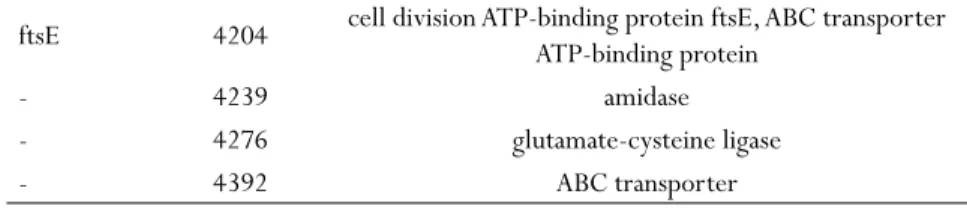
From the protein function point of view, it was observed that most of the described proteins (66.7%) had adaptive potential of resistance to heavy metals, performing functions of regulation and/or metabolization of these elements, while 18.3% of proteins were considered hypothetical and whose sequencing has not been performed or completed, and 11.8% had the carrier function of heavy metals. In addition, it was observed in the literature that C. violaceum, when exposed to iron concentrations, tends to express several proteins with transport functions, regulation, and metabolization of these elements, which are subdivided into non-hypothetical (Table 4 ) and hypothetical (Table 5).
Table 4 - Non-hypothetical protein expressed in C. violaceum cultivated in iron presence.
Gene ORF Definition
- 0148 transcriptional regulator
- 0124 inhibitor of septum formation
glpK 0251 glycerol kinase
aldB 0393 aldehyde dehydrogenase
Soj 0475 chromosome partitioning protein ParA
Atpf 0668 ATP synthase F0 subunit B
Glms 0677 glucosamine--fructose-6-phosphate aminotransferase
- 0889 methyl-accepting chemotaxis protein
pstS 0938 phosphate ABC transporter substrate-binding protein
nuoD 0944 NADH dehydrogenase subunit D
- 1029 GntR family transcriptional regulator
- 1080 methyl-accepting chemotaxis protein
gst1 1164 glutathione S-transferase family protein
- 1222 aldehyde dehydrogenase
ctaQ 1292 carboxypeptidase Taq
phoA2 1513 alkaline phosphatase
- 1541 3-oxoacyl-ACP synthase
- 1646 porin
cysS 1746 cysteinyl-tRNA synthetase
metY 1934 O-acetylhomoserine (thiol)-lyase
caiA 2084 acyl-CoA dehydrogenase
- 2097 nitrilase
trpE 2179 anthranilate synthase component I
- 2181 short chain dehydrogenase
Rpe 2182 ribulose-phosphate 3-epimerase
- 2481 amino acid ABC transporter
- 2802 peptide synthetase
pepA 2914 leucyl aminopeptidase
- 2932 signal peptide protein
flaD 3011 flagellin D
- 3012 serine carboxypeptidase
Ugd 3041 UDP-glucose dehydrogenase
nagD 3244 N-acetylglucosamine metabolism protein
vioA 3274 vioA - tryptophan 2-monooxygenase
acsA 3282 acetyl-CoA synthetase
aceB 3304 malate synthase
Pgm 3352 phosphoglyceromutase
Prc 3354 carboxy-terminal processing protease
cysI 3573 sulfite reductase hemoprotein subunit beta
- 3605 hydrolase
purM 3615 phosphoribosylaminoimidazole synthetase
rpsF 3640 30S ribosomal protein S6
rpoS 3682 RNA polymerase sigma factor RpoS
trpS2 3715 tryptophanyl-tRNA synthetase
greA 3801 transcription elongation factor
- 3814 type II secretion system protein
goaG 3926 4-aminobutyrate aminotransferase
- 3943 ABC transporter ATP-binding protein
ftsE 4204 cell division ATP-binding protein ftsE, ABC transporter ATP-binding protein
- 4239 amidase
- 4276 glutamate-cysteine ligase
- 4392 ABC transporter
Table 5 - Hypothetical protein expressed in C. violaceum cultivated in iron presence. Hypothetical protein expressed in C. violaceum cultivated in iron presence.
Gene ORF Definition
- 0008 hypothetical protein - 0090 hypothetical protein CV_0856 0856 hypothetical protein CV_0884 0884 hypothetical protein CV_1082 1082 hypothetical protein CV_1175 1175 hypothetical protein CV_1543 1543 hypothetical protein CV_1628 1628 hypothetical protein CV_1790 1790 hypothetical protein CV_2374 2374 hypothetical protein CV_2376 2376 hypothetical protein CV_3001 3001 hypothetical protein CV_3099 3099 hypothetical protein CV_3694 3694 hypothetical protein CV_3824 3824 hypothetical protein CV_3850 3850 hypothetical protein CV_4107 4107 hypothetical protein
Among the main bioremediation techniques discussed, bioleaching was the most frequently addressed, mentioned in 70.6% of the studies published, while other studies did not specify the technique. The applicability of bioremediator techniques was directed to several environments and materials. Among these, the compounds from electronic residues were most frequently related to remediation of heavy metals by C. violaceum (35.3%) evaluated separately and/or together with other compounds. Similarly, compounds originating from automotive catalytic converters were described in 11.8% of the research, while those from printed circuit boards were mentioned in only 5.9%.
Among the selected publications, 17.6% mentioned the industrial sector, especially the mining industry, as the probable environment for applicability of bioremediator techniques, while other studies only described the techniques without highlighting the environment for
application. In the obtained review, 23.5% of the studies were published in 2004, one year after the sequencing of C. violaceum, finalized in 2003. In addition, the Brazil pioneerism in research with this microorganism, associated with favorable weather conditions for adaptation and isolation, may explain the higher prevalence of studies associated with the theme (35.3%).
The isolation of this microorganism has been reported worldwide. Countries such as Hong Kong, India, Australia, Colombia, the United States, Nigeria and South Africa, located in tropical and subtropical regions show favorable conditions to the growth of this organism (Currie and Carapetis, 2000; Martinez et al., 2000; Chattopadhyay et al., 2002; Ray et al., 2004; Dias et al., 2005; Teoh et al., 2006; Pérez et al., 2007; Bosch et al., 2008). This also explains the performance of studies associated with this issue in countries such as North Korea (17.6%), as well as Japan, India, Singapore, Australia, and the United States (5.9% each).
In Brazil, C. violaceum is present in three main ecosystems: the Amazon Forest, Cerrado, and Atlantic Forest (Byamukama et al., 2005; Lima-bittencourt et al., 2007; Dall’agnol et al., 2008). There are also reports of C. violaceum isolation in other locations in Brazil, such as Rio Negro (Black River) and sand banks located in Amazon region, as well as in rivers and soils of Serra do Cipó National Park (MG), thus showing the high adaptability of this bacterium (Dias et al., 2002).
Furthermore, studies have highlighted the high adaptability of C. violaceum strains isolated from aquatic environments to aluminium, copper, manganese and zinc heavy metals (Sumita et al., 2007). Another study, in turn, identified 35 genes associated with transport and storage of iron in this organism, as well as several other genes related to the complexion and decontamination of heavy metals (Vasconcelos et al., 2003). This highlights the importance of the development and application of combat and mitigation biotechnology techniques for environmental problems, resulting from the release of metallic waste, such as, bioremediation.
Diverse studies show the use of C. violaceum for bioremediation of heavy metals, emphasizing its bio-decontamination potential, and/or as bio-indicator. A total of 496 Open Reading Frames (ORFs) were identified in C. violaceum, for instance, membrane proteins related to transport, among which are highlighted several transport proteins of heavy metals, thus indicating the versatility of this organism in controlling the concentration of diverse substances by intracellular means (Durán and Menck, 2001; Vasconcelos et al., 2003; Grangeiro et al., 2004).
The genetic sequencing of C. violaceum disclosed the presence of a genome consisting of a circular chromosome with 4,751,080 base pairs, with 89% of the coding regions. Of these ORFs, approximately 61% encode known proteins. The other 39% are hypothetical proteins, which are divided into conserved proteins and exclusive of this bacterium. The genome shows 98 tRNA genes, which are capable of transcribing carriers for 20 amino acids of the cell. rRNA genes are grouped into eight operons, and they all contain identical sequences of the coding region, according to the Brazilian National Genome Project BNGP 2003 (Vasconcelos et al., 2003).
In addition, 539 ORFs were identified in the C. violaceum genome, which encode proteins involved in metabolite transport. Of these, 489 ORFs encode protein sequences showing significant similarity to sequences of membrane proteins, which are related to transport in other organisms. The other 50 ORFs were characterized as hypothetical and/or conserved hypothetical. This significant number of potential carriers may be related to the fact that C. violaceum is found in different environments of tropical and subtropical regions, requiring adaptation to different
external conditions. What still stands out is its metabolic capacity to express proteins when facing stress situations, related to the presence of heavy metals (Grangeiro et al., 2004).
Table 6 - C. violaceum genome characteristics.
C. violaceum Genome
Length (pb) 4,751,080
Content (Guanine + Cytosine) 64.83%
ORFs 4,431
Coding regions (%) 89%
Average length per ORF (pb) 954
Known proteins 2,717
Conserved hypothetical proteins 958
Exclusive hypothetical proteins 756
Operons of rRNAs 8 x (16S-23S-5S)
Genes of tRNAs 98
Metabolic interactions among heavy metals and microorganisms affect the chemical composition of those elements, changing characteristics such as solubility, mobility, bioavailability and toxicity; therefore, the use of C. violaceum may contribute decisively for the implementation of recovery, mobilization, immobilization, or metallic pollutant detoxification techniques. In this context, the use of C. violaceum appears to be an important tool for treating contaminated areas with heavy metals, since such bacteria are involved in several biogeochemical cycles and many of them show adaptive, plasmidial, and chromosomal mechanisms in elevated concentrations of metals, as well as conversion of toxic forms of these elements into less toxic forms (Mukhopadhyay
et al., 2002).
Regarding such high adaptive capacity of C. violaceum to heavy metals, diverse bioremediator techniques have been described in the literature, among which bioleaching is the most commonly mentioned. The bacterial leaching or bioleaching may be defined as a biotechnological process based on the use of microorganisms able to solubilize metal through oxidation of metallic sulfides (Pradhan et al., 2008; Pradhan and Kumar, 2012; Shin et al., 2013).In this process, the bacterial adaptation mechanisms become indispensable to the complexion and bioremediation of the heavy metals treated (Bevilaqua et al., 2002; Haghshenas et al., 2009).
Studies suggest the possible existence of two adaptive mechanisms of bacterial response during bioleaching technique application. The first mechanism is called “direct mechanism,” and is based on microbial adhesion to the metal surface, followed by mineral dissolution through enzymatic reactions. The second mechanism is based on electrostatic interaction of extracellular polysaccharide (EPS), synthesized by the bacteria to the treated mineral, through oxidative reactions (Sand et al., 2001). C. violaceum shows great applicability in bioleaching techniques, and has an Operon hcnABC associated with the production of Hydrogen Cyanide (HCN), which interacts with diverse metals, complexing them to stable and water-soluble forms. It is, therefore, of great value in gold solubilization processes, e.g., avoiding environmental pollution
by the traditional process, which uses mercury to recover this precious metal, thus constituting an important bioremediation strategy in areas contaminated by gold-digging (Campbell et al., 2001; Durán and Menck, 2001; Carepo et al., 2004; Duarte et al., 2004; Faramarzi et al., 2004; Brandl and Faramarzi, 2006; Kita et al., 2006; Brandl et al., 2008; Fairbrother et al., 2009).
Studies have shown that C. violaceum was able to solubilize, for seven days, 15% of gold and copper of printed circuit board pieces (Faramarzi et al., 2004). The printed circuit boards may be found in most all-electronic equipment, being composed generally of ceramic or metallic polymers. Moreover, the growing waste disposal of electronic equipment has provided a bioaccumulation of these elements, causing large environmental problems, mainly due to the release of metallic waste from the industry (Veit et al., 2006; Guo and Xu, 2009; Chi et al., 2011).
The development of the industrial sector is a major contributor to the pollution problem of the ecosystems, whether by negligence in waste treating or by frequent accidents and carelessness. Besides, environmental pollution due to the presence of metals has become recurrent in modern society, and heavy metals such as iron, copper, cadmium, zinc, lead, nickel and chromium are often found in the environment, presenting critical toxicity, especially to aquatic and terrestrial life, including humans. The review performed in this study demonstrated that these elements have been reported, with prevalence of 13% for copper and 9.8% for iron. Gold was mentioned in 35.6% of the studies. Although it is not commonly released into the environment, gold has a high economic value, justifying the large number of publications directed to this element (Tay et al., 2013).
Heavy metals are among the main agents responsible for environmental pollution, being involved in cytotoxicity, genotoxicity, and carcinogenesis. The environmental pollution by these elements makes possible the acidification in aquatic environments, accelerating the heavy metal solubilization process and making these environments selective to diverse microorganisms (Desoize, 2003; Waisberg et al., 2003).
In this way, the development and application of bioremediator techniques are required, as well as the use of microorganisms that present high adaptive capacity to heavy metals. Highlighted among these is C. violaceum, which can possibly mitigate and/or combat the negative environmental impacts caused by such elements.
c
onclusionThe literature review showed phenotypic and genotypic features of C. violaceum associated with the resistance and bioremediator capacity to heavy metals, and emphasizes the great importance of its biotechnological potential, attributed to the use of this bacterium in the control and mitigation processes of the problematic environmental pollution caused by heavy metals. In addition, the adaptive versatility of this microorganism allows a circumtropical distribution, evidenced by several studies performed in the American, European, Asian and Oceania continents, and, consequently, makes possible the application of bioremediator techniques through the use of C. violaceum in diverse environments. However, despite the biotechnological importance of C.
violaceum, the systematic review found an even higher number of hypothetical ORFs related to the
adaptation of this organism to heavy metals, and highlights the need for further research aimed at a better understanding of the C. violaceum dynamics on these elements.
r
eferencesAntônio RV, Pasa TBC. 2004. Genetic analysis of violacein biosynthesis by Chromobacterium
viola-ceum. Genetics and Molecular Research, 3(1):85-91.
Azevedo JSN et al. 2008. Gene expression of the arsenic resistance operon in Chromobacterium
violaceum ATCC12471. Can. J. Microbiol, 54:137-142.
Bevilaqua D et al. 2002. Oxidation of chalcopyrite by Acidithiobacillus ferrooxidans and
Acidithioba-cillus thiooxidans in shake flasks. Process Biochemistry, 38:87-592.
Bosch FJ et al. 2008. Successful treatment of Chromobacterium violaceum sepsis in South Africa.
Journal of Medical Microbiology, 57:1293-1295.
Brandl H et al. 2008. Biomobilization of silver, gold, and platinum from solid waste materials by HCN-forming microorganisms. Hydrometallurgy, 94(1-4):14-17.
Brandl H, Faramarzi MA. 2006. Microbe-metal-interactions for the biotechnological treatment of metal-containing solid waste. China Particuology, 4(2):93–97.
Byamukama D et al. 2005. Contrasting occurrence of Chromobacterium violaceum in tropical drink-ing water sprdrink-ings of Uganda. Journal of Water and Health, 3:229-238.
Campbell SC et al. 2001. Biogenic production of cyanide and its application to gold recovery.
Journal of Industrial Microbiology and Biotechnology, 26 (3):134–139.
Carepo MSP et al. 2004. Identification of Chromobacterium violaceum genes with potential biote-chnological application in environmental detoxification. Genetics and Molecular Research, 3(1):181–194.
Chang CY et al. 2007. Chromobacterium violaceum infection in Taiwan: a case report and literature review. Journal Microbiology Immunology Infection, 40 (3):272-275.
Chattopadhyay A, Kumar V, Bhat N, Karnataka R. 2002. Chromobacterium violaceum Infection: A Rare But Frequently Fatal Disease. Journal of Pediatric Surgery, 37:108-110.
Chi TD et al. 2011. Bioleaching of gold and copper from waste mobile phone PCBs by using a cyanogenic bacterium. Minerals Engineering, 24(11):1219–1222.
Crosse PA et al. 2006. Chromobacterium violaceum infection in two dogs. J. Am. Anim. Hosp.
Assoc, 42(2):154-159.
Currie BJ, Carapetis JR. 2000. Skin infections and infestations in Aboriginal communities in northern Australia. Australasian Journal of Dermatology, 41:139-145.
Dall’agnol LT et al. 2008. Diversity of Chromobacterium violaceum isolates from aquatic environments of state of Pará, Brazilian Amazon. Memórias do Instituto Oswaldo Cruz, 103(7):678-682. De Siqueira IC et al. 2005. Chromobacterium violaceum in siblings. Brazilian Emerging
Desoize B. 2003. Metals and metal compounds in carcinogenesis. In Vivo, 17(6):529-539. Dias JP et al. 2005. Chromobacteriosis in Ilhéus, Bahia: epidemiologic, clinical and laboratorial investigation. Revista da Sociedade Brasileira de Medicina Tropical, 38(6):503-506. Dias JRLC et al. 2002. Semiempirical INDOS/S study on the absorption spectrum of violacein. Jornal of Molecular Structure: THEOCHEM, 580:85-90.
Duarte FT et al. 2004. DNA repair in Chromobacterium violaceum. Genetics and Molecular
Research, 3(1):167-180.
Durán, N, Menck CF. 2001. Chromobacterium violaceum: a review of pharmacological and industiral perspectives. Crit. Rev. Microbiol, 27 (3):201-222.
Fairbrother L et al. 2009. Effect of the cyanide-producing bacterium Chromobacterium violaceum on ultraflat Au surfaces. Chemical Geology, 265(3-4):313–320.
Faramarzi MA et al. 2004. Metal solubilization from metal-containing solid materials by cyanoge-nic Chromobacterium violaceum. Journal of biotechnology, 113(1-3): 6-321.
Gaylarde CC, Belinaso ML, Manfio GP (2005) Aspectos biologicos e técnicos da biorremediaçao de xenobióticos. Biotecnologia ciência e desenvolvimento, 34: 36-43.
Grangeiro TB et al. 2004. Transport genes of Chromobacterium violaceum. Genetics and
Molec-ular Research, 3(1):117-133, 2004.
Guo J, Xu Z. 2009. Recycling of non-metallic fractions from waste printed boards: a review.
Journal of Hazardous Materials, 168(2-3):567-590.
Haghshenas DF et al. 2009. Adaptation of Acidithiobacillus ferrooxidans to high grade sphalerite con-centrate. Minerals Engineering, 22:1299-1306.
Hungria M et al. 2005. Genetic characterization of Chromobacterium isolates from black water environments in the Brazilian Amazon. Letters in Applied Microbiology, 41:17-23.
Kita Y, Nishikawa H, Takemoto T (2006) Effects of cyanide and dissolved oxygen concentration on biological Au recovery. Journal of biotechnology 124(3):545–51.
Lima CVS. 2008. Potencial de fitoextração do nabo forrageiro e da aveia preta em
argissolo contaminado por cádmio. 52 p. Dissertação (Mestrado em ciências do solo) -
Universidade Federal do Rio Grande do Sul, UFRS, Faculdade de Agronomia, Programa de Pós--Graduação em Ciência do Solo.
Lima DC et al. 2014. The influence of iron on the proteomic profile of Chromobacterium violaceum.
BMC Microbiology, 14:267.
Lima-bittencourt CI et al. (2007) Analysis of Chromobacterium sp. natural isolates from different Brazilian ecosystems. BMC microbiology 7:58.
Manjunath M. 2007. Fatal septicaemia due to Chromobacterium violaceum. West Indian Med J, 56(4):1-380
Martinez P, Mattar S. 2007. Fatal septicemia caused by Chromobacterium violaceum in a child from Colombia. Revista Instituto Medicina Tropical, 49(6):391-393
Martinez R et al. 2000. Chromobacterium violaceum infection in Brazil. A case report. Revista
Instituto Medicina Tropical, 42(2):111-113.
Momen AZ, Hoshino T. 2000. Biosynthesis of violacein: intact incorporation of the tryptophan molecule on the oxindole side, with intramolecular rearrangement of the indole ring on the 5-hy-droxyindole side. Bioscience Biotechnology Biochemistry, 64(3):539-49.
Moura MCPA. 2001. Utilização de Microemulsões como Agentes Modificadores de
Superfícies para Remoção de Íons Metálicos. 203 p. Tese (Doutorado em engenharia
química) - Universidade Federal do Rio Grande do Norte, UFRN, Programa de pós-graduação em engenharia química.
Mukhopadhyay RR et al. 2002. Microbial arsenic: from geocycles to genes and enzymes. FEMS
Microbiol Rev, 26(3):311-325.
Perez F et al. 2007. The continuing challenge of ESBLs. Current Opinion in Pharmacology, 7:459–469.
Pérez JAD, García J, Villamizar LAR. 2007. Sepsis by Chromobacterium violaceum: First Case Report from Colombia. The Brazilian Journal of Infectious Diseases, 11(4):441-442.
Pradhan JK., Kumar S. 2012. Metals bioleaching from electronic waste by Chromobacterium
viola-ceum and Pseudomonads sp. Waste management & research : the journal of the
Interna-tional Solid Wastes and Public Cleansing Association, ISWA, 30(11):1151–9.
Pradhan N et al. 2008. Heap bioleaching of chalcopyrite: A review. Minerals Engineering 21:355-365. Ray P et al. (2004) Chromobacterium violaceum septicaemia from north India. Indian Journal
Medical, 120:523-526.
Sand W et al. 2001. (Bio)chemistry of bacterial leaching-direct vs. indirect bioleaching.
Hydro-metallurgy, 59:159-175.
Scholz HC et al. (2006) Genotyping of Ochrobactrum anthropi by recA-based comparative se-quence, PCR-RFLP, and 16S rRNA gene analysis. FEMS Microbiol Lett 257:7-16.
Shin D et al. 2013. Evaluation of bioleaching factors on gold recovery from ore by cyanide-produ-cing bacteria. Minerals Engineering, 48:20–24.
Singh A et al. 2010 Health risk assessment of heavy metals via dietary intake of foodstuffs from the wastewater irrigated site of a dry tropical area of India. Food and Chemical Toxicology, 48:611–619.
Sirinavin S et al. 2005. Invasive Chromobacterium violaceum infection in children: case report and review. Pediatr Infect Dis J, 24(6):559-561.
Sumita TC et al. 2007. Avaliação da interação de Zinco , Alumínio , Cobre e Manganês em
Chromo-bacterium violaceum. Ambiente & Água - An Interdisciplinary Journal of Applied
Tay SB et al. 2013. Enhancing gold recovery from electronic waste via lixiviant metabolic enginee-ring in Chromobacterium violaceum. Scientific reports, 3:2236.
Teoh AYB et al. 2006. Fatal septicaemia from Chromobacterium violaceum: case reports and review of the literature. Hong Kong Medical Journal, 12.
Vasconcelos ATR et al. 2003. The complete genome sequence of Chromobacterium violaceum reveals remarkable and exploitable bacterial adaptability. Proceedings of the National Academy of
Sciences of the United States of America – PNAS, 100(20):11660–11665.
Veit HM et al. 2006. Recovery of Copper from Printed Circuit Boards Scraps by Mechanical Pro-cessing and Electrometallurgy. Journal of Hazardous Materials, 137:1704-1709.
Waisberg M, Joseph B, Beyersmann D. 2003. Molecular and cellular machanisms of cadmiun carcinogenesis. Toxicology, 192(2-3):95-117.
Weber J. 2004. Biogeochemical processes and role of heavy metals in the soil environment.
Geo-derma, 122:105-107.
Wooley PG. 1905. Bacillus violaceus manilae (a pathogenic organism). Bull John Hopkins