538
PLASTIC WASTE FOR
ELECTRICAL POWER
GENERATION: A CASE STUDY IN NIGERIA
Olaide Monsor Aderoju
1; Aliyu B. Oke
2; Ganiy Ishola Agbaje
3; António Guerner Dias
4 Olaide Monsor Aderoju (PhD in View in Environmental Science & Technology at Faculdade de Ciências da Universidade do Porto, Porto – Portugal, E-mail: [email protected]
Aliyu Bamidele Oke (Master’s in Chemical Engineering at National Space Research & Development Agency – NASRDA. Abuja, FCT – Nigeria, E-mail: zayidali@ yahoo.com
Ganiy Ishola Agbaje (PhD in Geography-Geomatics at African Regional Centre for Space Science and Technology Education in English (ARCSSTE-E), Ile-Ife, Osun State – Nigeria, E-mail: [email protected]
António Guerner Dias (PhD in Geoscience at Universidade do Porto, Assistant Professor at Faculdade de Ciências da Universidade do Porto, Porto – Portugal, E-mail: [email protected]
ABSTRACT: Nigerian is currently threatened by the quantity of waste
plastics in its major cities. However, waste plastics has been a menace to the Nigerian environs (land and water) majorly and contributed to flood disasters and other environmental degradation events which has led to severe health risk. In view of this, the study aims to assess the waste plastics in Nigeria for electric power generation. The study devised two strategies (incentive-based approach, and the Extended Producer’s Responsibility (EPR)) for the collection of waste plastics from the environment. This study is focused on the incineration of waste plastics with energy recovery; hence the proximate and ultimate analyses were carried out to determine the Higher Heat Value (HHV) and the Lower Heat Value (LHV) as well as to estimate the Power Generation Potential (PGP). The empirical results show that the HHV was evaluated as 568.96 kcal/kg and, the LHV was evaluated as 561.55 kcal/kg. Again, the power generation potential (PGP) was enumerated using 100 tons of waste plastics and 4.83 million tons (81% of inadequately managed plastics) to arrive at about 0.6MW and 29,000MW respectively. This study contributes to the literature on the problems of waste plastics in Nigeria. Furthermore, it is likely to be a sustainable solution to the backlog of waste plastics in the environment and a supplementary solution to the erratic electric power supply. The results show that the quantity of waste plastics in Nigeria is likely to generate enough electricity to complement the existing source of power supply.
KEYWORDS: incineration; municipal solid waste; waste to energy; waste
plastics; power generation potential.
RESUMO: Um dos grandes problemas da Nigéria, na atualidade, é a
grande quantidade de resíduos plásticos que são produzidos nas suas principais cidades. Os resíduos plásticos têm sido uma ameaça para os arredores daquelas cidades (em particular sobre o solo e sobre a água) e contribuem para desastres de inundação e outros eventos de degradação ambiental que conduzem a sérios riscos para a saúde humana. Assim, este estudo tem como objetivo avaliar o potencial dos resíduos plásticos produzidos na Nigéria para a geração de energia elétrica. O estudo desenvolvido baseia-se em duas estratégias (uma abordagem baseada em incentivos e no princípio da Responsabilidade Estendida do Produtor (REP)) para a coleta de resíduos plásticos no meio ambiente. O foco deste trabalho está na incineração de resíduos plásticos com recuperação da energia produzida. Assim, foram realizadas análises imediata e elementar para determinar o Poder Calorífico Superior (PCS) e o Poder Calorífico Inferior (PCI), bem como estimar o Potencial de Geração de Energia (PGE). Os resultados empíricos mostram que o PCS foi avaliado em 568.96 kcal/ kg e o PCI foi avaliado em 561.55 kcal/kg. Adicionalmente, foi determinado o Potencial de Geração de Energia (PGE) usando 100 toneladas de resíduos plásticos e 4.83 milhões de toneladas (81% de plásticos manuseados inadequadamente) obtendo-se, respetivamente, 0.6 MW e 29.0 MW.
Este estudo contribui para a literatura como uma visão geral de gestão de resíduos na Nigéria, focando-se nos problemas relacionados com os resíduos plásticos. Além disso, o conceito proporciona uma solução sustentável para esta tipologia de resíduos que afeta particularmente a envolvente das grandes cidades. Além disso, é provável que seja uma solução sustentável para a acumulação de resíduos plásticos no meio ambiente e uma solução suplementar para a produção de energia elétrica. Os resultados mostram que a quantidade de resíduos plásticos produzidos na Nigéria, provavelmente, gerará eletricidade suficiente para complementar as fontes tradicionais de produção de eletricidade.
PALAVRAS-CHAVE: incineração; resíduos sólidos urbanos; resíduos para
a produção de energia; resíduos plásticos; potencial de geração elétrica.
RESUMEN: Uno de los principales problemas de Nigeria hoy en día es la
gran cantidad de residuos plásticos que se producen en sus principales ciudades. Los residuos plásticos han sido una amenaza para las afueras de esas ciudades (particularmente en el suelo y el agua) y contribuyen a los desastres de inundaciones y otros eventos de degradación ambiental que conducen a serios riesgos para la salud humana. Por lo tanto, este estudio tiene como objetivo evaluar el potencial de los residuos plásticos producidos en Nigeria para la generación de electricidad. El estudio desarrollado se basa en dos estrategias (un enfoque basado en incentivos y el principio de Responsabilidad Extendida del Productor (REP)) para la recolección de desechos plásticos en el medio ambiente. El objetivo de este trabajo es la incineración de residuos plásticos con la recuperación de la energía producida. Por lo tanto, se realizaron análisis inmediato y elemental para determinar el poder calorífico superior (PCS) y el poder calorífico inferior (PCI), así como para estimar el potencial de generación de energía (PGE). Los resultados empíricos muestran que el PCS se calificó a 568.96 kcal/kg y el PCI se calificó a 561.55 kcal/kg. Además, el potencial de generación de energía (PGE) se determinó utilizando 100 toneladas de residuos plásticos y 4,83 millones de toneladas (81% de plásticos manejados incorrectamente), produciendo respectivamente 0.6 MW y 29.0 MW. Este estudio contribuye a la literatura como una visión general de la gestión de residuos en Nigeria, centrándose en cuestiones relacionadas con los residuos plásticos. Además, el concepto proporciona una solución sostenible para esta tipología de residuos que afecta particularmente a los alrededores de las grandes ciudades. Los resultados muestran que la cantidad de residuos plásticos producidos en Nigeria probablemente generará electricidad suficiente para complementar las fuentes tradicionales de producción de electricidad.
PALABRAS-CLAVE: incineración; residuos sólidos urbanos; residuos
para la producción de energía; residuos plásticos; potencial de generación de energía.
539
v. 8, n. 3 (2019): set./dez
.
INTRODUCTIONRapid population growth, booming economy, lifestyle, standard of living, rapid urbanization has accelerated Municipal Solid Waste (MSW) generation rate in developing countries (Minghua et al., ). According to UNU-WIDER (), solid waste management in developin g countries has received less attention from policymakers and academics compared to other environmental prob-lems. Globally, solid waste generation has soared in the past few decades and, it has resulted in the inability of waste management authorities to cope with the volume of solid waste generated and over-stretching of waste management facilities (Nnaji, ). Th e current threat to global community is the quantity of waste plastics in the environ-ment. In the world produced only million tons per year. Since then, annual production has increased nearly -fold, reaching million tons in (Geyer, Jambeck, & Law, ). Also, it was reported that the world’s total consumption of plastics will reach . million tons by with an average growth rate of – (Huang, ; Somsak, ).
Nigeria became an increasingly urbanized and urban-oriented society because of the oil boom in the s (Aderoju, Guerner Dias & Guimaraes, ). During the s, Nigeria had possibly the fastest urbanization growth rate in the world (Ochuo ). Th e World Bank () reported that Nigeria as a developing nation with a total urban population exceeding million has its per capita generation of MSW as .kg/capita/day and estimated projection is expected to be at . kg/ capita/day by . Indeed, the impact of urban growth in Nigeria has led to an increasing volume and variety of MSW, resulting from increased fl ow of goods and services, and changed lifestyle and consumption pattern.
Waste management is an important objective of planning to ensure that the future generations inherit an environment that is as pollution free as possible given the present scientifi c, economic, social and political constraints (USEPA, ). Waste management in developing and developed nations diff er in the waste composition, density, political and economic framework, and in waste amount, access to waste for collection, awareness, and attitudes (Ogwueleka, ). According to
(Nabegu, ), most cities across Nigeria, solid waste is disposed by transporting and discharging in open dumps location almost close to residential areas, which are environmentally unsafe. Current practice in Nigeria has shown that collection of MSW from homes, dump sites, and roadsides are the mandate of state and local government agen-cies. Waste density in Nigeria ranges from - kg/m with waste generation rate of million tons annually and at a daily rate of .-. kg/ individual daily (Ogwueleka, ). Nevertheless, Nigeria, like any other developing country has the informal sector (scavengers) who are highly committed to the collection and recovery of useful materials from waste streams in homes, market, dumps and landfi lls respectively.
Th ere have been several studies on waste management, however, these studies were mostly focused on suitable location for waste disposal sites; outreach and education on waste management practices; eff ect of poor waste management prac-tices; MSW characterization; energy recovery from waste among others. For instance; Nwambuonwo & Mughele () analyzed the existing landfi ll sites in Lagos, established the need for new dumpsites and proposed candidate landfi ll sites, using GIS with the World Bank criteria for siting a landfi ll. Also, Aderoju, Guerner Dias & Anwasia (), utilized the (Aderoju conceptual model) ACM as a tool for awareness creation and education to the inhabitants of Kogi state, Nigeria to mitigate the events of fl ood disasters as a result of indiscrim-inate disposal of MSW into drainage ways and open fi elds. Babayemi & Dauda (), focused on: the quantity and rate of solid waste genera-tion in several cities in Nigeria; factors infl uencing the MSW generation; and, MSW characteriza-tion, collection and disposal pattern in Abeokuta, Nigeria with the aid of administered questionnaires. (Oumarou, Dauda, Abdulrahim & Abubakar, ) revealed that a comprehensive characteriza-tion of MSW is crucial to the long-term effi cient and economical planning for solid waste manage-ment. MSW characterization plays an important role in the determination of the possible environ-mental impacts on nature as well as on society (Alamgir, Donald, Roehi, & Ahsan, ). In a study by Rousta & Dahlén, (), it was reported that inhabitants’ participation in waste separa-tion schemes seems crucial for the improvements
540
needed to achieve a better ambitious material recycling goal, but there is no defi nite approach on how to design waste sorting and collection systems that engage inhabitants to increase their waste sorting. According to (Xu, Zhou, Lan, Jin & Cao, ), it was stated that an incentive-based source separation concept has infl uenced an increase in resource recovery whereby households receive an economic incentive for separating biodegradable and recyclable material from other waste streams, creating environmental and economic gains for the waste management sector. Jambeck et al. in () combine available data on solid waste with a model that uses population density and economic status to estimate the amount of land-based plastic waste entering the ocean.
Studies have shown that plastics are the most diffi cult constituents of MSW in the environment because of its inability to decompose naturally. In a way to reduce the backlogs of waste plastics in Nigeria, this study aims to utilize the waste plastic for electric power generation. Furthermore, the study devised strategies to segregate and collect waste plastics from the environment to be utilize as fuel for electric power generation in a waste to energy process. Th is study is likely to reduce the quantity of waste plastics in the environment eff ectively, and it will also provide an alternative electric power source to Nigeria as a nation owing to the nation’s low power supply to its inhabitants.
. THEORETICALREFERENCE
. NIGERIAN APPROACH TO SOLID WASTE MANAGEMENT
Th e approach used in the management of MSW in Nigeria is no diff erence to many developing nations. Currently, the common practice of waste collection, transportation, and disposal to a waste disposal site is often carried out by the authorities. However, inade-quate service coverage for proper waste collection as only limited areas of the cities is covered (Nabegu, ). Limited budgets have compelled local agen-cies not to have adequate capacity to handle the increasing solid waste. Th erefore, the common practice of MSW dumped in open spaces, drainage ways, water bodies, and on access roads has led to blockages in the waterways, streets littering, water body contamination, creating a breeding ground for vector causing diseases and rodents. According to
(Ogbonna, Ekweozor & Ig, ), it was reported that little attention is given to some traditional suburban settlements for provision of waste collec-tion and disposal services.
Currently, there are no formal recycling or resource recovery programmes in Nigeria (Ogwueleka, ) and no policy on composting. Th e recovery/recycling operations are carried out mostly by the informal sector which includes the scavengers and other used item vendors as a source of livelihood. Scavengers are driven by poverty and desire to earn a living. Th e practice is common in major cities and its suburbs whereby scavengers go to residential areas to purchase recyclables and condemned electronics from resi-dence owners. Adebola () reported that the vacuum that was created by selective services and irregular management of solid waste was fi lled by both the formal and informal private sector in solid waste management, while the formal private sector is made up of registered companies / enter-prises who have the fi nancial strength, some level of technical know-how/experience and are gener-ally mechanized (see fi g.a and b).
In the same study, Adebola also described the informal private sector as individuals, families, group or small enterprises that carry out unregis-tered, unregulated activities by going from House-to-House waste collection transportation and recovery of useful materials from the waste stream (see fi g. a and b). Th is sector provides employment opportunities for a large group of people.
Scavenging and recycling should be encouraged because it involves stakeholders such as; consumers/ scavengers, middlemen, and manufacturers. Th e scavengers (those involved in the on-site waste recovery or scavenging), the resource merchants (those involved in the purchase of all recovered clables and re-usable waste materials) and the recy-clers (the micro and small scale recyrecy-clers that converts recovered materials like paper, animal by-products, plastic, metal among others to valuable materials and raw materials for the consumption of the indus-trial sector. Recycling is mostly carried out by segre-gation from mixed waste such that the sorting of waste stream to diff erent classes (organic and inor-ganic) and furthermore by the collection crew from waste vehicles; and by scavengers, both from street bins and at the dumpsite. Scavengers normally have no formal education, inadequate capacity (technical know-how and equipment), and do not normally have alternative employment opportunities in the
541
v. 8, n. 3 (2019): set./dez
formal sector. Th e scavengers (see fi g. a and b) and other informal sector recyclers generally sell their recovered materials to middlemen, who in turn sell to small- and large-scale processing and manufac-turing industries. For example, collected glass is processed and recycled locally as cullet for use in the glass industry; whole bottles are cleaned and reused as syrup, drinks and juice containers; the bases of broken bottles are sold to small scale industries that cut and polish the glass to manufacture items such as ash trays and candle holders (Imam, Mohammed, Wilson & Cheeseman, ).
Th e government of Lagos state, Nigeria through Lagos State Waste Management Agency (LAWMA) has embark on a private sector part-nership (PSP) scheme to solve the MSW manage-ment issue in the state. Th e cooperation between the LAWMA and private operators is reported to have led to more effi cient collection of waste from places of residency; the outsourcing of waste collection to the private sector under the PSP scheme may thus be considered as a signifi cant improvement that has been made (Idowu, Omirin, & Osagie, ). According to the Nations newspaper of the st of
June reported that the Lagos state government signed an executive order to facilitate the building of a resource center at Olusosun dumpsite for training and retraining of youths, scavengers on waste sorting, recovery and conversion to wealth. Also, the Also, the Daily Trust (), Abuja Environmental Protection Board (AEPB) reported that would witness a departure from the traditional system of waste storage to an integrated solid waste manage-ment system in the Federal Capital Territory (FCT), Nigeria. AEPB director, reported that with the new system, waste will be separated at source with the provision of two coloured waste bins, green and blue. He further stated that the green bin will be used to store garbage such as food remnants while the blue bin will be used for the collection and storage of recyclable materials such as glass, plastics, pet bottles, cardboard etc.” Th e AEPB and Japan International Cooperation Agency (JICA) are in collaboration on a pilot project on a semi-aerobic Landfi ll as a pilot on disposal. Also, the introduc-tion of material recovery facility at transfer staintroduc-tions for recycling at the on-going construction of transfer station at (Apo, Mpape and Kubwa) Abuja, Nigeria.
Figure 1. Formal Waste Management sector in Nigeria; (a) & (b)
Source: (a) www.theglitters.com.ng Source: (b) www.saharareporters.com
Figure 2. Scavengers in Nigeria (a) & (b)
542
. WASTE-TO-ENERGY (WTE)
Fossil fuel has been the main source of energy in most countries over the years. Th e continued concerns over energy prices, increasing popula-tion and climate change issues has led the drive towards a need for alternative and new energy sources (Amoo & Fagbenle, ). Waste-to-Energy (WTE) technologies can be described as any waste treatment process that creates energy in the form of electricity, heat or transport fuels (e.g. diesel) from a waste source. Th e WTE industry has proven itself to be an environmentally friendly solution to the disposal of MSW and the produc-tion of energy (Kumar, Subbaiah & Prasada Rao, ). WTE technologies can convert the energy content of diff erent types of waste into various forms of valuable energy hence electric power is produced and distributed through local and national grid systems (WEC, ). Th e design and optimization of solid waste management technol-ogies and practices aims at maximizing the yield of valuable products from waste, as well as mini-mizing the environmental eff ects (Johannessen & Boyer, ). Waste-to-Energy technologies has the capability of converting the energy content of diff erent types of waste into various forms of valu-able energy, hence electric power is produced and distributed through local and national grid systems (WEC, ). According to Suberu, Mokhtar & Bashir, (), thermo-chemical conversion is preferably used due to its ability to ensure that the contribution of both biodegradable and non-bio-degradable components of the waste are used for the energy output. Waste combustion according to Voelker () provides integrated solution to the problems of modern era “by recovering otherwise lost energy, thereby reducing our use of precious natural resources, cutting down our emissions of greenhouse gases, saving valuable land that would otherwise be destined to become landfi ll and recovering land once scarifi ed to product of consumerism. WTE technology, according to Lauber (), is a robust for minimal environ-mental risk which has been proven in practice over several decades. In a way to reduce emissions of GHG from WTE facilities, several technolo-gies have been developed to enhance the process of energy generation from MSW cleaner, more economical and sustainable. WTE facilities currently produce clean, renewable and reliable energy through combustion of waste in specially
designed power plants equipped with the most pollution control equipment to clean emissions. Th e USEPA in its report affi rms that MSW has a potential of generating clean energy from a sustainable perspective: waste reduction, recy-cles the recyclables, and GHG emission reduc-tion in the environment (Amoo & Fagbenle, ). Research has shown and demonstrated that WTE plant does supply power hours daily throughout the year. However, there is a constant need for trash disposal.
. INCINERATIONWITHENERGYRECOVERY
Th is process can simply be described as the combus-tion of MSW with energy recovery. It is basically the combustion of unprepared (raw or residual) MSW. However, the combustion process for the purpose of energy recovery require that the mois-ture content in the MSW is less than otherwise the MSW is likely to require a pre-drying process (He, Giannis & Wang, ). In this process (see fi g. ), MSW is delivered through waste collection vehicles and feed into a bunker where it is thor-oughly mixed. Th e mixing is required to blend the waste to ensure that the energy output to the combustion chamber is consistent. Th e combustion in this process requires enough oxygen to oxidize fuel (MSW). Energy recovery from incineration of MSW utilizes the combustion heat through a boiler generation steam. Th e combustion tempera-tures are in excess of about C such that the MSW is converted into CO and water. About of the available energy in the waste stream can be retrieved in the boiler to produce steam and the steam is used for power generation through a steam turbine (DEFRA, ). Th e non-com-bustible materials in this process are referred to as bottom ash. Combustion of MSW results in the emission of CO and other greenhouse gases. Nonetheless, studies have shown that the more effi cient the energy generation process, the lower the carbon emission per unit energy produced. Consequently, there are policies and guidelines recommended for the use of local energy sources like incineration of MSW with energy recovery and CO mitigation (Korobitsyn, Jellema & Hirs, ). Some European countries like Denmark, Portugal, Germany among others use incineration to shrink and recover energy from large quantity of their disposed MSW. Th e Industrial Emission Directive (IED) in , stated its goal as to
543
v. 8, n. 3 (2019): set./dez
“reduce emissions into air, soil, water and land, and to prevent the generation of waste in order achieve a high level of protection of the environment taken as a whole”. Hence, the combustion conditions from any incineration plant is required to ensure complete burnout of the feed in waste and emis-sion limits into the atmosphere are set to mini-mize any environmental and health impact. Th e incineration with energy recovery is advantageous according to Tchobanoglous & Kreith (). Th ey revealed in their research that the advantages of incineration includes: the immediate reduc-tion of volume and weight of waste without long time of residence in the environment; incineration exercise can be carried out on site (landfi ll/dump-site); emissions can be controlled to the minimum; and the ash content are sterile. Plastics have the highest LHV content over all other constituents of the MSW (Nordi, Palacios-Bereche R, Gallego & Nebra ). Hence, it is the most desirable constituent of the MSW in terms of incineration with energy recovery.
. GLOBAL OVERVIEW OF WASTE PLASTICS, AND WASTEPLASTICSINNIGERIAN
Plastics are found in all major MSW categories, containers and packaging plastics (bags, sacks, and wraps, other packaging, other containers, and soft drink, milk, and water containers) represent
the highest tonnage (USEPA, ). In , Jambeck et al. revealed that China produced the largest quantity of plastic annually, at nearly million tons, followed by the United States at million, Germany at . million, Nigeria at . million tons, and India at . million tons (see fi g. ). According to (Jambeck et al., ), devel-oped countries, including most of Europe, North America, Japan among others have very eff ective waste management infrastructure and systems which ensures that discarded plastic wastes are well managed and stored in secure, closed landfi lls. However, they further stated that, inadequately disposed waste can be high; across many devel-oping countries in South Asia and Sub-Saharan Africa, between - percent of plastic waste (see fi g. ) is inadequately disposed of, and therefore at risk of polluting rivers and oceans.
According to UNEP () heavier depen-dence on the use of plastic based packaging mate-rial in developing countries may result in increased incidences of littering the outcome of which could lead to the pollution of the environment (including water bodies) and blockage of drainages. In recent times, there have been great concern on the impact of plastics on the environment as it aids urban fl ood because of its disposal into the drainage systems. For instance, (Aderoju, Guerner Dias & Anwasia, ) revealed that indiscriminate dumping of waste in Lokoja, Nigeria has contributed to the
Figure 3. Incineration of MSW for Power Generation
544
constant fl ash fl ood events during the rainy season. Again, microplastics have been reported ingested by sea animals which is likely to be consumed by humans eventually. (Revel, Châtel & Mouneyrac, ) stated the several ways by which plastic particles can be ingested: orally through water, consumption of marine products which contain microplastics, and inhalation of particles in the air.
In Nigeria, the situation of waste plastics in the environment has been an adversity to the authori-ties and the populace. Uncontrolled consumerism, unregulated production and circulation of the products, and improper disposal and management of the fi nal waste output have been identifi ed as major contributing factors to excessive plastics (post-consumer PET bottles) in the major cities
Figure 4. Global plastic waste generation per annum
Source: Ritchie & Roser (2018) Figure 5. Inadequately managed plastics.
545
v. 8, n. 3 (2019): set./dez
in Nigeria (Abdulkarim & Abiodun, ). Floods wreak havoc seasonally on Nigeria, especially in populated metropolitan cities where plastic bottles, plastic bags (popularly known as polythene bags) and other waste materials crammed drainage channels, thereby hindering free fl ow of water whenever it rains (Punch Newspaper, ). Also, (Aderoju, Guerner Dias, Ekweozoh & Offi ong, ) revealed that poor waste management prac-tices and unethical behavior of the people upon the MSW disposal in Nigeria have led to littered street, and inland waterways pollution with excess plastic waste (see fi g. a and b).
Nonetheless, few small medium entrepreneurs (SMEs) have set up plastic recycling projects and only specifi ed plastics such as polyethylene terephthalate (PET) among others that are not contaminated are usually accepted otherwise it is rejected. Th erefore, this is an implication that just a small percentage of plastics are recycled in Nigeria, even so, a greater quantity of these plastics ends up as garbage in the streets, drains, and watercourse / shores across the country. Th e importance of managing plastic waste in Nigeria should be emphasized especially with the rapid population growth and the unregulated produc-tion and use of plastic products for packaging.
. METHODOLOGY
Th e approach employed in this study was estab-lishing a sustainable strategy that is likely to reduce waste plastics from the Nigeria communities. Th e study tends to exploit the concept of MSW segre-gation from source with the focus on waste plas-tics to be collected at garbage collection points for the purpose of electric power generation. Th e characterization of MSW in Abuja, Nigeria was
adapted from Aderoju & Guerner Dias (). Th e choice of Abuja was a preferable option as it is the nation’s capital and its inhabitants fairly represent all the ethnic groups and their culture in Nigeria. Th e study tends to employ the inciner-ation of waste plastics for electrical power produc-tion in Nigeria since the Nigeria power sector is defi cient in providing electricity for the populace. Furthermore, this empirical study performed proximate and ultimate analyses on the waste plastics in the MSW stream to estimate the higher heat value (HHV) and lower heat value (LHV), and it went on to determine the power generation potential (PGP) of the waste plastics in Nigeria.
. STUDYAREA
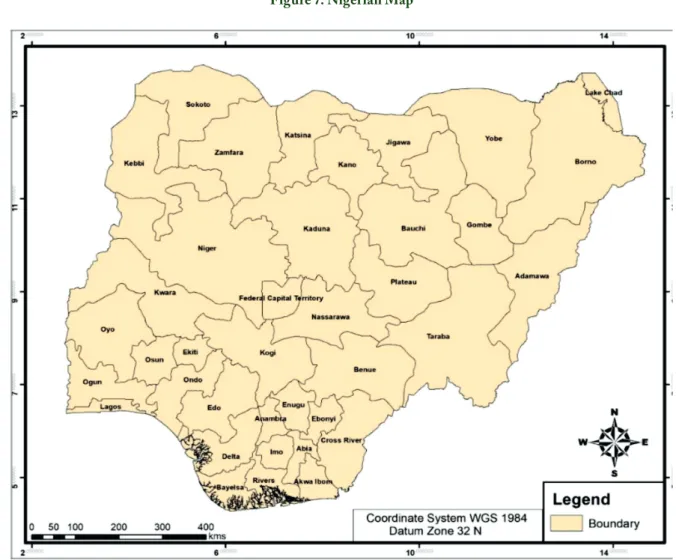
Nigeria is a country located in the western part of the African continent which lies between the latitudes oN and oN and longitudes oE and oE (see fi g.) and a landmass of approximately ,km. Nigeria is a federal republic in West Africa, bordering Niger in the north, Chad in the northeast, Cameroon in the east, and Benin in the west. Its coast in the south is located on the Gulf of Guinea in the Atlantic Ocean. Th e feder-ation comprises states and the Federal Capital Territory, with its capital city, Abuja. Nigeria is blessed with many natural resources like crude oil, natural gas, limestone, gold, among others. Also, Nigeria has an immense potential of hydropower generation because of two great rivers (Rivers Niger and Benue) entering from the Northeast and Northwest, and with an access to km coastline in the Southern part of the country (Adebayo, ). Th e southern part of Nigeria lies on the coastline hence its tidal power potential can be utilized for power generation. However,
Figure 6. (a) Littered street with plastics; (b) River pollution with plastics
546
the northern part of Nigeria is close to the Sahara region, hence it tends to experience a lot of sunlight and medium winds for a considerable electrical power generation.
. WASTEPLASTICSCOLLECTIONSTRATEGY
Th e creation of plastic collection points (PCP) in specifi ed but suitable places whereby only waste plastics are collected in closed or monitored bins/ facility to prevent littering. Active participation plays a very important role in the collection of waste plastics from the environment. Th e two methods for the collection of waste plastics in the environment
are the incentive-based approach and the Extended Producer Responsibility (EPR) approach (see fi g. ). Th ese two methods will enhance the responsibility of the waste plastics collection by the combined eff ort of principal actors in the waste management sector. Th e principal actors, in this case, are the manufac-turer of plastic packaging products, the consumers, and the collection fi rms/individuals (scavengers).
. WASTECHARACTERIZATION
Th is study adapts the characterization of the MSW in Aderoju & Guerner Dias (). Th e American Standard Test Method (ASTM D -) was
Figure 7. Nigerian Map
547
v. 8, n. 3 (2019): set./dez
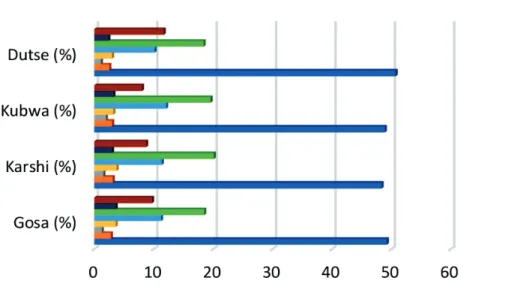
used for the characterization of the MSW at the major landfi lls (Gosa; Karshi; Kubwa; and Dutse) in Abuja during the wet season and dry season. Th e characterization of these waste streams was carried out in each of the landfi lls times a week for weeks during the wet and dry seasons of the year. A manual collection of kg of freshly mixed MSW in all the landfi lls times a week for weeks during the wet and dry seasons of the year. kg of freshly mixed MSW were collected as samples and were thoroughly mixed and weighed with a hand-held weighing device after every collection at each of the landfi lls. Samples were manually sorted into categories, then each category of MSW type is reweighed to determine the composition of MSW in a mix. Th e physical analysis was done based on weight ratio of diff erent components in the MSW stream. Th e percentage of samples composition were categorized into diff erent components which are: food waste/organic; textile; paper; plastics; glass/ ceramics; metal; rubber: and other waste materials. Th e category of other waste includes tiny stones and grit, used batteries, and composite materials. Th e mean weight ratio for each of the landfi lls for both dry and wet seasons was estimated as shown in fi g. . Furthermore, the mean waste plastics present in the results of the characterization exercise at each landfi ll was extracted and it was labeled SDUT, SKUB, SKAR, SGOS respectively see table .
. PROXIMATEANALYSIS
Proximate analysis was used to evaluate the mois-ture, volatile matter, fi xed carbon and ash content of the waste plastic samples. A subsample of g was drawn from each of mixed samples of waste plastics
from each of the landfi lls (SDUT, SKUB, SKAR, SGOS) in Abuja. Each of the subsamples of waste plastics (WPDUT, WPKUB, WPKAR, WPGOS) were mixed and shredded and formed into pellets and fl akes. Another g was drawn again from each of the subsamples and it was mixed together in a single bowl and it amounted to g which is a fair represen-tation of the waste plastics from the landfi lls. Th is new mixed sample containing waste plastics from the landfi ll is referred to as sample Z. Th e sample Z was placed into petri dishes and was heated in oven for hr at oC to determine the moisture content and dry mass of sample Z. For an additional loss of weight, of the dry mass of the sample Z was placed in the crucible after the initial weight of the crucible had been obtained, and later reweighed before it was placed into the SXL-oC benchtop Muffl e furnace on ignition at oC for min to determine the volatile matter (dry basis) and ash content. Th e Eq. (), () and () was used for the calculations in proximate analysis was adapted from Kuleape et al. ().
M = {{w - d}100} / w (1)
Where: M = wet-mass moisture content, %; w (kg) = initial mass of WP subsample; d (kg) = mass of subsample after drying. Vm = {{d1 – w1}100} / d1 (2)
Ash = {w1 * 100} / d1 (3)
Where; Vm= % volatile (dry basis); Ash= % ash (dry basis);
d1= weight of dry sample Z; w1 = weight of residue after ignition.
Figure 9. Abuja landfi ll Composition
548
. ULTIMATEANALYSIS
Th e ultimate analysis was used to estimate the elemental content which includes; carbon, hydrogen, oxygen, nitrogen, sulphur and ash (C, H, O, N, S) present in the sample under inves-tigation. However, plastics only contain carbon, hydrogen and oxygen. Provided the dry mass of the sample is determined, the elemental contents like carbon, hydrogen, oxygen and the ash content for waste sample can be determined using the standard table of ultimate analysis of combustible waste in (Tchobanoglaus, Th eisen & Vigil, ). Th e elemental content can be estimated by the expression (see Eq. );
Ec (kg) = {d * Ev} / 100 (4) Where; Ec = Elemental Content (kg); d = Dry mass;
Ev= Element value (use standard elemental table)
Th e element content values in these waste plastics sample Z was obtained using the standard table and dry mass of the sample. Moreover, the elemental contents for the sample Z was computed and it was substituted into the modifi ed Dulong equation (Tchobanoglous, Th eisen & Vigil, ) to determine the energy content (HHV) of the waste plastics and it is expressed in Eq. () as;
HHV (MJ/kg) = 337C + 1419{H2O – 0.125O2} + 93S + 23N (5)
Where: C= Carbon (%); H= Hydrogen (%); O= Oxygen (%); S= Sulphur (%);
N= Nitrogen (%).
. ENERGY OUTPUT ESTIMATION FROM WASTE PLASTICS
Th e calorifi c value is classifi ed into the Higher Heat Value (HHV) and Lower Heat Value (LHV). In a study by (Franjo, Ledo, Rodriguez & Nunez, ), the HHV was defi ned as the quan-tity of heat generated by a complete combustion of a unit mass of sample in air or oxygen, such that the product of combustion cooled down to the room temperature and remains in liquid form. Again, they also described the LHV as the net heat produced when a unit mass of the sample is completely burnt in air or oxygen, such that the product of combustion can escape as steam. Th e LHV of the waste plastics subsample was calcu-lated using eqn () as it was done in (Prasada Rao, Venkata & Sudhir, ) as;
LHV (kcal/kg) = HHV – 9H * LHS (6)
Where: LHV = Lower Heat Value; HHV= Higher Calorifi c Value;
LHS = Latent Heat of Steam which is 587 (kcal/kg); H = Hydrogen (%).
. POWERGENERATIONPOTENTIAL FROMWASTE PLASTICS
Reported that the amount of energy recov-ered from MSW based on diff erent conversion methods is a function of its calorifi c value and organic content(Tsunatu, Tickson, San & Namo, ). In this context, waste plastics is considered as the fuel to be utilized for combustion in waste-to-energy plants, and with the heat from the fi re to make steam (LHV) for electric power gener-ation. Th erefore, the Energy Recovery Potential (Erp) as expressed in Eq. () is simply the amount of energy that can produce electric power supply or heat system for an hour. However, the power generation potential is the amount of energy that can produce electric power supply or heat system for hours, and it is expressed Eq. () as:
Erp (kWh) = LHV * W * {1000/860} * β (7)
Where; Erp (kWh) = energy recovery potential of waste plastics;
LHV = Lower Heat Value; W = Weight of plastics (tons);
β = Conversion Effi ciency is between 22% – 28% (IEA, 2007).
Th e power generation potential (PGP) as it is in Eq. 8; it was further expanded in Eq. 9:
PGP (kW) = Erp / 24 (8) PGP = LHV * Wt * 0.04845 * β (9)
. RESULTSANDDISCUSSION
In this section, results of the MSW characteri-zation during the wet and dry season in Abuja, Nigeria (see table ). Also, the results of proximate and ultimate analyses are shown in table and table respectively. Others includes the mathe-matical estimation of the calorifi c values (HHV and LHV), and the power generation potential of the waste plastics in Abuja and Nigeria at large was equally carried out. Th e discussion of the results was explicitly explained.
549
v. 8, n. 3 (2019): set./dez
. RESULTSOFANALYSIS
.. CALCULATINGFORHHVANDLHV
For HHV and LHV, the estimated (C, H, O) data in table shows the total elemental content in a waste plastics sample for Abuja. Given; C = . kg; H = . kg; O = . kg; By substituting the (C, H, O, N, S) values in the modifi ed Dulong equation (See Eq. ).
HHV (MJ/kg) = 337 (0.01169) + 1419((0.001403 x 2) 0.00444) – 0.125(0.00444 x 2)}
HHV = 2.383 MJ/kg
Converting to (kcal/kg) from (MJ/kg) 1 (MJ/kg) = 238.8459 (kcal/kg) HHV = 568.96 kcal/kg
Recall that in Eq. 6; LHV = HHV – 9H * LHS Recall that the LHS = Latent heat of steam = 587 kcal/kg
LHV = 568.96 – 9 (0.001403) * 587 LHV = (568.96 – 7.41) kcal/kg LHV = 561.55 kcal/kg
.. ESTIMATION OF THE POWER GENERATION POTENTIAL (PGP)
Recall that from Eq. (7,8 & 9);
Erp (kWh) = LHV * W * {1000/860} * β PGP (kW) = Erp / 24
PGP = LHV * Wt * 0.04845 * β
Using tons of waste plastics, = . * * . * . = .kW
= .MW
Recall that from fi g. , that the annual plastic production in Nigeria is about . million tons. In addition, according to Jambeck et al. () see fi g. , of produce plastics in Nigeria are inadequately managed and it is assumed that these mismanaged plastics fi nds its way into the envi-ronment. Th erefore, of . million tons was estimated to be . million tons of waste plastics.
()
SDUT . . .
SKUB . . .
SKAR . . .
SGOS . . .
Table 1. the mean % waste plastics characterization in Abuja, Nigeria
() () () ()
Plastics . . . .
Table 2. Waste plastics proximate analysis result
() () ()
()
() () ()Plastics . . . . . . .
Table 4. Ultimate Analysis result of waste plastics sample for Abuja, Nigeria
() () () () ()
Plastics . . NIL NIL
550
Using . million tons of waste plastics; = . * . x * . * . = .kW.
= ,MW.
. DISCUSSION
In many Nigeria cities, the situation of poorly managed MSW has led to serious environmental consequences such as fl ood disasters, health risk and fi nancial liabilities. Th e components of MSW in Nigeria basically includes food waste/organics, plastics, paper, metals, rubber, textile, and other wastes (grits, used batteries, and other composite materials). However, plastic which is otherwise referred to as waste plastics in this study has been a threat to mankind and the world at large. Th e situation of excessive waste plastics in the Nigeria environment was confi rmed by Jambeck et al. () that over of produce plastics in Nigeria are inadequately mismanaged. Hence, this study intends to reduce the incoming and backlogs of waste plastics in Nigeria by utilizing it as fuel in a WTE plant for electric power generation. Th e study identifi es the need for the collection of waste plastics from the environment and therefore devised two methods for its collection.
Th e two methods devised for the collection includes; the incentive-based approach and the Extended Producer Responsibility (EPR). Th e incentive-based approached require the use incen-tive (money or gift) to encourage the segrega-tion of MSW from the source. Th is act is likely to promote sorting out waste plastics which will eventually become a daily practice to the people if well conceded. On the other hand, a big busi-ness to scavengers whose livelihood depends on selling recovered materials from MSW. Th e EPR approach is a little diff erent because it requires the legislative arm of the government to enact a law that mandates packaging companies especially those that utilize plastics in their production and packaging to take responsibility for the removal of the waste products that emanate from their prod-ucts at production and distribution levels. Th is law will prompt packaging companies to employ small enterprise to help them recover the waste from their products in the environment. Th is can be done by positioning coloured bins with waste type specifi cation in recreational places, business and residential districts, religious homes, schools (elementary, secondary and tertiary), marketplaces
among others for the recovery of waste plastics and other MSW category. Th e collected waste plastics are transported to central collection sites where it can be accessed by energy recovery and recycling companies.
From the proximate analysis experiment, tables show the result obtained using the waste plastics sample Z which represents Abuja, Nigeria. However, it was deduced that the moisture content played a little role in the estimation of the amount of Carbon; Hydrogen, Oxygen of waste plastics to determine the energy output. It was clear that the moisture content in waste plastics in Nigeria is . despite being kept in open bins or dumped in open fi elds. Th e derived elemental composition (see table ) using experimental carbon content and ratios of elements given by Tchobanoglous et al, () was used to obtain the higher calorifi c value (HHV) for waste plastics in Abuja. Th e elemental composition was computed with the dry mass of the waste plastics to obtain the actual mass of the elemental composition in the waste plastic (see table ). Th e results of these elemental composition in mass was inputted in the modi-fi ed Dulong formula to estimate the HHV. Using Eq. , the values of HHV calculated was . kcal/kg. In addition, it is vital that for a feasible energy output for power generation, the product of combustion is in form of steam which represents the LHV. Th erefore, the LHV for the waste plas-tics calculated using Eq. was . kcal/kg.
In order to obtain the PGP of waste plastics, the Eq. was used and it is important to have vari-ables such as LHV, to be calculated; conversion effi ciency (), which is a constant variable which varies from - (IEA, ); and Wt, which was the weight of the waste plastics utilized. Th e study considered the lowest conversion effi ciency rate of due to the effi ciency of the waste plas-tics used as fuel, and the type of WTE plant employed. For this study, tons of waste plastics was initially used for the estimation and the result of the PGP was .MW. Recall that in fi g. , Jambeck et al. () reported that of produce plastics in Nigeria are inadequately managed and it is assumed that these mismanaged plastics are disposed into the environment. Also, from fi g. where it was reported that the annual produc-tion of plastics in Nigeria was . million tons. Th erefore, of . million tons was estimated to be . million tons of waste plastics. And it was
551
v. 8, n. 3 (2019): set./dez
inputted into the Eq. and the result of the PGP was at ,MW.
. CONCLUSION
Various methods have been used by diff erent researchers on how to eff ectively sort and collect waste plastics from environment. Th is study iden-tifi es the use of incentive-based approach for scav-engers who sort and gather waste plastics to be sold for their livelihood. Also, the adoption of the EPR policy ensures that manufacturers are responsible for the evacuation of the waste plastics from the environment. Th e manufacturers in turn employs fi rms that focused on the use of mobile garbage banks for waste plastics collection from schools and religious homes. Furthermore, the placement of coloured bins at recreational places and other public places to segregate diff erent MSW constit-uents is another way of eff ectively collecting waste plastics from the environment. A typical example is the Eco Point concept.
Th is study revealed that the incineration with energy recovery concept is likely to reduce the backlogs and newly generated waste plastics in the Nigerian environment provided that modern technologies and sound emission control system are put in place. Moreover, the study employed the proximate and ultimate analyses using waste plastics samples obtained from the Abuja landfi lls. Th e result of this analysis was used to evaluate the HHV at . kcal/kg, and LHV at . kcal/ kg. In addition, the power generation potential (PGP) using tons of waste plastics in Abuja, Nigeria was estimated to be .MW. Hence, based on the Jambeck et al. (), of produce plastics in Nigeria are inadequately managed. Th is study estimated that the PGP of mismanaged plastics in Nigeria to about ,MW. Th is will go a long way to complement the poor electricity supply in the country.
Based on the fi ndings of the study, it is imper-ative to ensure the segregation of plastic materials from MSW mix and its proper disposal is carried out with the intention for electric power supply. Although the practice of separating waste plastics might be complex initially, nevertheless its success depends on the synergy among the stakeholders. It is recommended that the government should invest in capital projects such as WTE through public private partnership (PPP), and attract
foreign investors in this sector in order to attain a sustainable economy likewise reduce the burden of waste plastics in the society.
REFERENCES
Abdulkarim I.A & Abiodun A.O (2012). A study of problems associated generation and disposal in Kano Metropolis. Academic Research International, Vol. 3, No. 2, pp 56-65. Adebayo C (2014). “How is 100% Renewable Energy Possible for Nigeria?” Global Energy Network Institute (GENI). Retrieved from geni.org/global energy; Accessed on the 25/04/19.
Adebola O.O (2006). Th e Role of Informal Private Sector in Integrated Solid Waste Management (ISWM) in Lagos, Nigeria - A Developing Country. Proceeding of the 21st International Conference on Solid Waste Technology & Management. Philadelphia P.A, March 26th – 29th.
Aderoju O.M, Guerner Dias A. & Anwasia B (2016). Ancestral Heritage of Flood plain Residence and Solid Waste Disposal Pattern in Flood Events in Kogi State, Nigeria, Conference Proceedings of the 3rd International Conference on Environmental and Economic Impact on Sustainable Development; in Valencia, Spain; June 8th – 10th. Ecology and Th e Environment, Vol 203, p 37-48, WIT Press, ISSN 1743-3541 (on-line).
__________ & Guerner Dias A. (2018). Waste to energy as a complementary energy source in Abuja, Nigeria. WASTES: Solutions, Treatments and Opportunities, Published by Taylors and Francis Group, London, pp 63-68, ISBN 978-1-138-19669-8.
__________, Guerner Dias A., Ekweozoh P.C & Offi ong I (2019). A Sustainable approach for Post-consumer PET bottles Recovery and Reduction in Nigeria. Proceedings of the 34th International Conference on Solid Waste Technology and Management, Annapolis, MD, USA; March 31st – April 3rd. Widerner University Press, USA.
__________, Guerner Dias A. & Guimaraes R (2015). Building Capacity an Integrated Perception and Attitude towards Municipal Solid Waste Management in Nigeria. WASTES: Solutions, Treatments and Opportunities, Published by Taylors and Francis Group, London, pp 7-12, ISBN 978-1-138-02882-1.
Alamgir M, Donald C. Mc, Roehi K. E and Ahsan A. (2005). Integrated management and safe disposal of MSW in least developed Asian countries-A feasibility study, Waste Safe. Khulna University of Engineering and Technology, Asia Pro Eco-Programme of the European Commission.
Amoo, O.M & Fagbenle, R.L (2013). Renewable Municipal Solid Waste pathways for Energy Generation and Sustainable Development in the Nigerian context. International Journal of Energy and Environmental Engineering, 4/42.
ASTM D 5231-92 (Reapproved 2016). Standard Test Methods for Determination of the Composition of Unprocessed Municipal Waste; ASTM International, 6p, 2016. Available online at: http://www.astm.org/standards/D5231.
Babayemi J.O & Dauda K.T (2009). Evaluation of Solid Waste Generation, Categories and Disposal options in Developing
552
Countries: A case study of Nigeria. J. Appl. Sci. Environ. Management 13(3): 83–88.
Daily Trust (2016). Abuja Environmental Planning Board (AEPB) Plans Integrated Solid Waste Management (ISWM). Retrieved online; https://www.pressreader.com. Accessed on 20/ 03/2019.
DEFRA (2013). Incineration of Municipal Solid Waste; Department for Environment, Food and Rural Aff airs. February 2013.www.defra.gov.uk
Franjo C.F, Ledo J.P, Rodriguez A. J.S and Nunez L (1992). Calorifi c Value of Municipal Solid Waste. Environmental Technology, 13: 11, 1085-1089. DOI: 10, 1080/09593339209385246.
Friends of the Environment (2018). Plastic Wastes von Water. https://fote.org.ng/2018/03/well-phase-plastic-bottles-2023-lagos-government/plastic-wastes-on-water/. Accessed on 26/04/2019.
Geyer R, Jambeck J. R & Law, K. L (2017). Production, use, and fate of all plastics ever made. Science Advances, 3(7), e1700782. Available at: http://advances.sciencemag.org/ content/3/7/e1700782.
He C, Giannis A & Wang J (2013). Conversion of Sewage sludge to Clean Solid fuel using hydrothermal Carbonzation; Hydrochar fuel Characteristics and Combustion Behavior; Application Energy 2013; 111:257 0 266.
How to Start Waste Management Business in Nigeria (2018). Retrieved online from; https://infoguidenigeria.com/waste-management-business-nigeria/. Accessed on 15/05/2019. Huang N. (2012). Industry Insight: Global Plastics Industry. Retrieved online: http://www.businessvibes.com/blog/ industry-insight-global-plastics-industry.
Idowu O, Omirin M, & Osagie J. (2011). Outsourcing for Sustainable Waste Disposal in Lagos Metropolis: Case study of Agege Local Government, Lagos. Journal of Sustainable Development, 4(6), 116-131.
IEA (2007). Biomass for Power Generation and CHP. IEA Energy Technology Essential, 2007, ETE03, pp 1–4.
Imam A, Mohammed B, Wilson D.C & Cheeseman R. (2008). Solid waste management in Abuja, Nigeria. Waste Management, 28: 468-472.
Jambeck J. R, Geyer R, Wilcox C, Siegler T. R, Perryman M, Andrady A, Narayan R, & Law K. L. (2015). Plastic waste inputs from land into the ocean. Science, 347(6223), 768-771. Available at: http://science.sciencemag.org/ content/347/6223/768. Accessed on 20/04/2019.
Johannessen LM & Boyer G (1999). Observations of Solid Waste Landfi lls in Developing Countries: Africa. Urban Development Division, Waste Anchor Team, the World Bank. pp 10-12.
Kokalj F & Samec N (2013). Municipal Solid Waste for Power Production. Advances in Internal Combustion Engines and Fuel Technologies. DOI: 10.5772/55497.
Korobitsyn M.A, Jellema P & Hirs G.G (1999). Possibilities for Gas Turbine and Waste Incineration Integration, Energy 24(9): 783-793. DOI: 10.1016/SO360-5442(99)00034-1. Kuleape R, Cobbinah S.J, Dampare S.B, Duwiejuah A.B, Amoako E.E, & Asare W (2014). Assessment of Energy recovery potential of solid waste generated in Akosombo,
Ghana, African. Environmental. Science & Technology, 8 (5), 297–308. DOI: 10.5897/AJEST2014.1663.
Kumar J.S, Subbaiah K.V & Prasada Rao P.V.V (2010). Waste to Energy – A Case Study of Eluru City, Andhra Pradesh, India; International Journal of Environmental Science; Vol 1, No 2, pp 151 – 162.
Lauber J.D (2005). The Burning Issues of Municipal Solid Waste Disposal; What Works and What Doesn’t; Invited Presentation at The Toronto City Council Municipal Solid Waste Conference: Advances in process and programs; 12th may.
Minghua Z, Xiumin F, Rovetta A, Qichang H, Vicentini F, Bingkai L, Giusti A & Yi L (2009). Municipal solid waste management in Pudong New Area, China. Waste Manage 29:1227–1233.Modern Engineering Research, Vol. 2 No. 5, pp. 3669-3672.
Nabegu, A.B (2009). Municipal Solid Waste Management in Kano and Katsina cities: A comparative Analysis. Journal of Geography and Development 2(2): 97–209.
__________. (2011). Solid Waste and Its Implications for Climate Change in Nigeria. Journal for human Ecology 34(2): 67–73.
Nnaji C.C (2015). “Status of municipal solid waste generation and disposal in Nigeria”, Management of Environmental Quality: An International Journal, Vol. 26 Issue 1 pp. 53 – 71. Nordi G.H, Palacios-Bereche R, Gallego A.G & Nebra S.A (2017). Electricity production from Municipal Solid Waste in Brazil. Waste Management & Research, pp 1-12. DOI: 10.1177/07342X17705721.
Nwambuonwo O. J. & M Mughele E. S. (2012). Using geographic information system to select suitable landfi ll sites for megacities (Case Study of Lagos, Nigeria). Computing, Information Systems & Development Informatics, 3(4), 48–56. Ogbonna D, Ekweozor K & Ig E (2002). Waste management: a tool for environmental protection in Nigeria. Journal of Environmental Science 3(1): 55–57.
Ogwueleka T.C (2003). Planning Model for Refuse Management. Journal of Science and Technology 3(2): 71–76. __________. (2009). Municipal Solid Waste Characteristics and Management in Nigeria. Iranian Journal of Environmental Health Science & Engineering 6(3): 173–180.
Oucho J (1986). Population Studies and Research Institute, Our Common Future. Report of the World Commission on Environment, Public Hearing, Nairobi, 23 Sept. 1986 A/42/427.
Oumarou M, Dauda M, Abdulrahim A & Abubakar A (2012). Characterization and generation of municipal solid waste in north central Nigeria, International Journal of Modern Engineering Research Vol.2, Issue.5, Sep-Oct. 2012 pp-3669-3672. ISSN: 2249-6645.
Prasada Rao P.V, Venkata K.S &Sudhir J.K (2010). Waste to energy: A case study of Eluru, A.P, India. International Journal of Environmental Science and Development, 1(2): 151–162. Punch Newspaper (2018): Plastic Pollution; Nigeria’s Untapped Waste Wealth Fuel Environmental Disaster. Retrieved online; http://www.punchng.com. Accessed on 7/9/ 2018.
Revel M, Châtel A, & Mouneyrac C. (2018). Micro (nano) plastics: A threat to human health? Current Opinion in Environmental Science & Health, 1, 17-23. Retrieved
553
v. 8, n. 3 (2019): set./dez
online: https://www.sciencedirect.com/science/article/pii/ S2468584417300235. Accessed on 19/05/ 2019.
Ritchie H & Roser M (2018). Plastic Pollution. Retrieved online; https://ourworldindata.org/plastic-pollution. Accessed on 9/05/2019.
Rousta K & Dahlén L (2015). Source separation of household waste; technology and social aspects. In: Taherzadeh M.J and Richards T (eds) Resource Recovery to Approach Zero Municipal Waste. Boca Raton: CRC Press, pp.61–77.
Sahara Reporters (2018), Visionscape, Ambode’s New Waste management Company Struggles to keep Lagos Clean. Retrieved online; https://www.saharareporters.com. Accessed on 12/04/2019.
Scavengers seek Conducive Environment to do Business (2018). Retrieved online; https:// www.environewsnigeria. com/scavengers-seek-conducive-environment-to-do-business/. Accessed on 21/04/2019.
Somsak S (2014). Separation of PVC from PET/PVC mixtures using fl oatation by calcium Lignosulfonate Depressant. Engineering Journal, Vol. 18, issue 1, pp 45-53. ISSN 0125-8281, Doi: 8.4186/ej.2014.18.1.45
Suberu M.Y, Mokhtar A.S, & Bashir N (2012). Renewable Power Generation Opportunity from Municipal Solid Waste: A Case Study of Lagos Metropolis (Nigeria). Journal of Energy Technologies and Policy: Vol. 2, No.2, 2012.
Tchobanoglous G, & Kreith F (2002). Handbook of Solid Waste Management, 2nd ed. New York: McGraw-Hill. __________, Th eisen H, & Vigil S.A (1993). Integrated solid waste management: engineering principles and management issues. McGraw-Hill Inc., New York.
Th e Guardian (2018). Th e ban on Scavengers in FCT, Nigeria. Retrieved online; https:// guardian.ng/opinion/the-ban-on-scavengers-in-the-fct/. Accessed on 11/05/2019.
Th e Nation (2019). “Youths will be trained to convert waste to wealth”. Retrieved online; https:// thenationonlineng.net/ waste to wealth/. Accessed on 1/06/2019.
Tsunatu D.Y, Tickson T.S, San K.D, & Namo J.M (2015). Municipal Solid Waste as Alternative Source of Energy Generation: A Case Study of Jalingo Metropolis, Taraba State, Nigeria. International Journal of Engineering and Technology, Vol.5, No. 3, pp. 185-193. ISSN: 2049-3444.
UNEP (2005). Solid Waste Management (Vol. I). United Nations Environment Programme- International Environmental Technology Centre. CalRecovery, Inc.
UNU-WIDER (2010), “Solid wastes, poverty and the environment in developing country cities: challenges and opportunities”, Working Paper No. 2010/23, United Nations University, World Institute for Development Economics Research, Helsinki.
USEPA (2005). Report of the municipal solid waste in the United States:2005 Facts and Figures. 5–15.
__________ (2005). Report of the Municipal Solid Waste in the United States: 2005 Facts and Figures. pp 5-15.
Voelker B M. (2000). Waste–to- Energy, Solution for solid Waste Problem of 21st Century. http//www/p2pays.org/ ref/09/08624.pdf.14/03/08.
WEC (2013). “World Energy Resources; Waste to Energy,” Vol. 7b, pp 2 -11.
World Bank (2012). “Urban Development Series: What is Waste; a global review of Solid Waste Management,” No 15. Xu W, Zhou C, Lan Y, Jin J & Cao A (2015). An incentive-based source separation model for sustainable municipal solid waste management in China. Waste Management Resources; 33(5):469-76. DOI: 10.1177/0734242X15574979.